Podcast
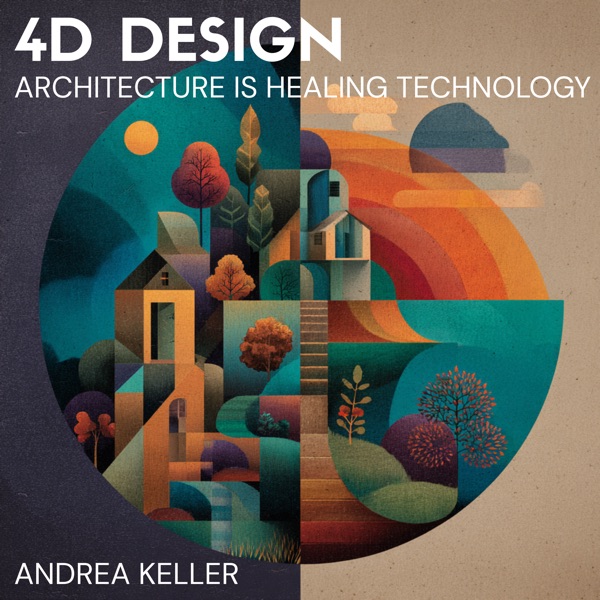
4D Design
4D Design Podcast explores how Architecture + Design can control our perceptions, our behaviors, and our health. Are you interested in how Design works but don't know how where to start? We will explain all of the tricks we learn in architecture school, and how to read and use the visual language of Design.
Andrea Keller (AK) has been a licensed architect for more than 20 years and has taught architectural history, theory and design at USC School of Architecture and Otis. She is an expert in Sacred Geometry and is creating new architecture based on the geometry of music. She believes that everyone should be able to use design in order to be healthier, stronger and more successful.
Episodes include Architectural Explainers, Case Studies, History, Theory, and Q&As with AK.
- Episodes
- 30
- Releases
- Every two weeks
- Typical length
- 26 min
- On air since
- 2023
- Latest episode
- 1 month ago
Episodes
30 episodes, newest first
-
24 min
S2 EP 6: Buildings Have Skin, Too! - Thresholds and Skin
Season 2, Episode 6
Show notes
A building is an organism, and it meets our own organism first at the skin.
In this episode I start mapping buildings onto the human body, system by system, beginning with skin. Human skin forms from the same embryonic layer as the brain and spinal cord, which makes it a sensing organ wired straight into the nervous system. It reads temperature, pressure, texture, and threat before we ever think about it.
A building's skin does the same work. It protects us, regulates temperature, and shapes how we feel before we even walk through the door. I explore thermal mass, shade, and covered entries; why sudden transitions (think the sidewalk into a big-box store) stress the nervous system; and how architecture once honored the threshold through porches, foyers, entry gardens, mudrooms, and ceremonial procession.
We also look at the roots of the word threshold, the Latin limen, and the words that grew from it, like subliminal. From there: consent and the building envelope, zones within the home, window seats and secret rooms, and whether a space adds to you, subtracts from you, multiplies you, or divides you.
A building's skin isn't just a wall. It's where we meet the world.
-
13 min
S2 EP 5: New Series! Mapping Architecture to the Human Body...Hello, YouTube!
Season 2, Episode 5
Show notes
Welcome to a new season, a new series, and — for the first time — video on YouTube.
I'm kicking off a new multi-episode arc where I map every system in a house directly onto your own body: structure onto skeleton, plumbing onto digestion, electrical onto our nervous system, ventilation onto respiration. Every physical system in a building has a physical effect on you — some immediate and neurological (sound, light, color temperature), some slower and chemical (off-gassing, endocrine disruption), some psychological (thresholds, liminal spaces, the basement as subconscious).
I also share the personal story behind this work: twenty years as a hospitality designer trained to control mood and emotion through space, followed by an unexpected stretch as a hospital patient — where I saw firsthand how far healthcare design still is from anything resembling healing. That contrast is the origin point for everything this season explores.
Next episode: building structure, and what actually holds a house up — mapped onto your own skeletal system.
-
40 min
S2 EP 4: Death By Drywall
Season 2, Episode 4
Show notes
DEATH BY DRYWALL
Season 2, Episode 4
A podcast about architecture, materials, and the buildings we actually live inside.
Episode Summary
Drywall is everywhere. It's in almost every wall of every home built in America in the last 60 years. But how did it get there — and is it actually the best we can do? This episode traces the full arc of drywall's history: from the pre-industrial craft of lath and plaster, through the wartime shortcuts that gave rise to gypsum board, to the environmental and health questions we're only now starting to take seriously. We also look at traditional wall systems from Japan — built from bamboo, rope, earthen plaster, and lime — that outperform modern drywall on almost every meaningful measure. And we close with a bigger question: why do we accept a lower standard of quality in our walls than we do in almost every other part of our lives?
What We Cover
• The ancient techniques drywall replaced and why they were better in many ways
• Japanese tsuchikabe wall systems: bamboo lattice, rice-straw rope, earthen plaster, and lime finish / walls that breathe, flex, and last centuries
• Augustine Sackett's 1894 invention and how U.S. Gypsum turned it into the default building material
• The four forces that drove drywall adoption: wartime labor shortages, mass housing demand, industrial standardization, and fire-resistance marketing
• What drywall is actually made of: calcined gypsum, paper facing, starch binders, foaming agents, biocides, and chemical modifiers
• Why drywall fails: moisture absorption, mold, fragility, poor acoustics, and limited lifespan
• The environmental profile of gypsum board production: energy use, landfill waste, and hydrogen sulfide off-gassing
• Alternatives gaining traction: rammed earth, compressed earth block, lime plaster, hemp-lime, and wood fiber panels
• The quality question: why we demand quality in food, clothes, and cars BUT NOT IN THE WALLS SURROUNDING US (???) In our homes????
Key Takeaway
"Drywall didn't replace inferior systems. It replaced better ones because it was faster and cheaper."
Before paper-faced gypsum board, builders across cultures constructed walls from bamboo, rope, earth, and lime. These materials managed humidity, flexed under seismic stress, and lasted generations. The Japanese tsuchikabe wall system is a working example of what we traded away for construction speed. Drywall solved an industrial problem. It was never designed to solve a human one.
The Quality Question
We've learned to look deeper in almost every other domain. We ask where our food comes from. We think about the fibers in our clothes. We care about the engineering in our cars. But inside the very structure that surrounds us every day, we routinely accept the lowest common denominator.
The wall is one of the largest material surfaces in a home. It defines how a building manages moisture, sound, air quality, and durability. As architecture moves toward healthier, longer-lasting building systems, the question isn't whether drywall is cheap and convenient - it clearly is. The real question is whether we're willing to apply the same standard of quality to our buildings that we already expect everywhere else.
Go Deeper — Further Reading
The History of Drywall (Wikipedia)
A solid overview of drywall's origins, manufacturing process, and fire-resistance properties.
→ https://en.wikipedia.org/wiki/Drywall
Augustine Sackett — National Inventors Hall of Fame
The story of the man who invented Sackett Board in 1894 — the direct precursor to every sheet of drywall installed today.
→ https://www.invent.org/inductees/augustine-sackett
Drywall: EWG Healthy Living Home Guide
A detailed breakdown of what's actually in drywall and joint compound — including biocides, formaldehyde, crystalline silica, and synthetic gypsum made from coal plant waste.
→ https://www.ewg.org/healthyhomeguide/drywall/
A Brief History of Drywall — Hackaday
A concise and readable account of how drywall went from wartime shortcut to universal construction default.
→ hackaday.com — Brief History of Drywall
If you found this episode useful, share it with someone building, renovating, or thinking about what's actually inside their walls.
AK links:
Four D Design – Organic Architecture
Star Tile – Fractal Ceramics
Star Tile Studio - Joshua Tree, CA
Contact:
ak@fourddesign.com
-
21 min
S2 EP 3: MOLD - Building Biology + How We Build: Building Codes, What Went Wrong, and How To Fix! Building for a Healthy Life
Show notes
Today we dive into the world of how we build and why. And why are we all getting so sick?
It's time to look at our building envelope the same way we look at food labels - we are being poisoned while we work and sleep.
This is a re-presentation of a talk given at CIRSx in Phoenix / Tempe in June 2025.
Original Slides Here:
-
36 min
S2 EP 2: The Future is Fractal - Neurobiology and the Future of Design
Season 2, Episode 2
Show notes
Powerpoint Lecture - The Future is Fractal (SLIDES)
https://www.unmpress.com/9780826352026/fractal-architecture/
African Fractals
https://www.rutgersuniversitypress.org/african-fractals/9780813526140/
Gothic Fractals
https://churchheritage.eu/science/why-gothic-cathedrals-are-so-fascinating-is-all-about-math/
https://link.springer.com/article/10.1007/s00004-014-0187-7
Frank Lloyd Wright and Fractals
http://webdoc.sub.gwdg.de/EMIS/journals/NNJ/98/Eaton.html
Gaudi and Fractals
13:9 Group - Modern Fractal Designs
https://www.13and9design.com/design/fractal-fluency-collection/
13&9 Design https://www.13and9design.com › design › fractal-library
Dr. Richard Taylor - The Physics of Fractals
https://blogs.uoregon.edu/richardtaylor/
Science In Design - Certification Course
Bob Browning / Terrapin
https://www.terrapinbrightgreen.com/wp-content/uploads/2014/09/14-Patterns-of-Biophilic-Design-Terrapin-2014p.pdf https://www.terrapinbrightgreen.com/report/biophilic-design/
AK links:
Four D Design - Organic Architecture
Star Tile - Fractal Ceramics
Star Tile Studio - Joshua Tree, CA
Contact:
ak@fourddesign.com
-
41 min
S2 EP 1: Ornament, Meaning and Modernism
Season 2, Episode 1
Show notes
EPISODE 25 - ORNAMENT
Ornament has always had an important meta function within the human psyche. It has been "outlawed" for the past 100 years.
RESOURCE LINKS
https://www.gadarchitecture.com/en/ornament-in-architecture
https://www.artforum.com/features/louis-sullivans-ornament-209337/
https://journals.sagepub.com/doi/abs/10.1177/1354067x13515937?journalCode=capa
https://medium.com/the-thinking-of-design/ornament-as-an-abstraction-of-society-853bb29cdf08
https://www.youtube.com/watch?v=5PmydPmwrKA
https://dreamswork.co.uk/portfolio/how-ornament-is-functional/
https://designmanifestos.org/adolf-loos-ornament-and-crime/
AK links:
Four D Design - Organic Architecture, Geometry of Nature
Star Tile - Multidimensional Ceramics
Star Tile Studio - Joshua Tree, CA
Contact:
ak@fourddesign.com
WHY DO WE USE ORNAMENT? - SIGNIFIER
Social signaling - and this changes over time! Example tattoos - British nobility 1900-1920
Historically it was the demarcation of class and status - governments had rules about what colors and types of clothing could be worn, so that people could never be socially mobile-
Ornament on clothing has always been important for the military and in battle, people wore family crests / telling others who they were
The same went for houses - all ornament had meaning that could be learned (this is western)
Heraldry
WHY DO WE USE ORNAMENT? - SOCIAL & PSYCHOLOGICAL
Belonging is so important that people will go into debt to buy clothing that lets them fit into a social group, or a car, or jewelry etc - people are wildly craving belonging, and ornament is a way to show your tribe.
OTHER REASONS:
Repetition causes peace - relaxation of the nervous system
By creating the ornament, the maker can embody the energy of the thing that might be feared
Establish historic continuity - memory, legacy.
Spiritual Side of Ornament - Adornment, Defense, Totems, Enhancing Consciousness. META FUNCTION, embodied practice
Adorning parts of us that are vulnerable - defensive and actively stating who we are / calling in our guides.
HISTORY OF ORNAMENT
Industrial Revolution - 1851 - now possible to make cheap ornament / mass production
Attempt at standardizing the language - Owen Jones "Grammar of Ornament" - huge interest in revival of styles / what we would now call Cultural Appropriation.. started with Archaeology around 1750, people discovering ruins, Marie Antoinette wearing toile / chinoiserie
In victorian era, people started ascribing a moral judgment to the ornament -
Augustis Pugin: ornament should be flat if the floor is flat, not 3d etc.. can't be inappropriate. He was a CATHOLIC in England - super religious, championed gothic revival because it was faith-based
John Ruskin - wrote on architecture but also on geology, botany, ornithology etc - polymath
Said that the moral condition of a society could be determined by the ornament - ornament was being incorrectly applied-
Shows what is leading up to the birth of modernism, nothing happens in a vacuum.
What Happened - Loos, Modernism and the 1920s
As both Sullivan and Lévi-Strauss indicate, ornament (as well as other factors) becomes a language of social structures, social experience and even social contradictions. It signifies the status and position of the building, which is itself a representation of the importance of its "owners" and users. Here the manipulation of the image, or in architecture the adding of ornamental beauty to a structure, may increase its relative desirability and value. For buildings are models of ourselves and our society, communicating through form and organizational system the character of that society.
BUILDINGS REFLECT THE VALUES AND VALUE OF THE OWNER.
MODERNISM - WHAT HAPPENED?
Adolf Loos
Ornament and Crime
The evolution of culture marches with the elimination of ornament from useful objects", Loos proclaimed, thus linking the optimistic sense of the linear and upward progress of cultures with the contemporary vogue for applying evolution to cultural contexts.[2]
"The child is amoral. To us the Papuan is also amoral. The Papuan slaughters his enemies and devours them. He is no criminal. If, however, the modern man slaughters and devours somebody, he is a criminal or a degenerate. The Papuan tattoos his skin, his boat, his oar, in short, everything that is within his reach. He is no criminal. The modern man who tattoos himself is a criminal or a degenerate. There are prisons where eighty percent of the inmates bear tattoos. Those who are tattooed but are not imprisoned are latent criminals or degenerate aristocrats. if a tattooed person dies at liberty, it is only that he died a few years before he committed a murder."
Where do we go from here - how do we start?
(HUMANS ALWAYS START OVER WITH FORMS FROM NATURE)
Architectural adornment or ornament, like cooking—that most basic transformation of nature—is a way of being in and representing the world simultaneously, a world that in Sullivan's words "procreates man's own personality, that fits him, that he might feel at home with himself," a world of natural objects transformed by the hand of man. This is why Sullivan defined the architect's task in a manner that reveals his belief in man's transforming power: the architect as the agent who brings nature into community.
James Trilling - The Language of Ornament
Harvard-trained art historian, former Textile Museum associate curator, and independent scholar James Trilling expands here on many of the highly original themes that appeared in his The Language of Ornament (2001). He offers intriguing new views of the modernist movement in art and architecture, its puritanical hostility to ornament, and its manifold relationships to the history of technology, science, and industry in the phenomenon known as modernization. Trilling is a passionate advocate of ornament, and he makes a fervent plea for its revival, largely on the grounds that it gives pleasure and "makes people happy" (p. 227).
Ranging widely across cultures, time periods, disciplines, and topics, Ornament: A Modern Perspective is a densely layered book of formidable learning, imagination, and complexity. The argument is deceptively simple and difficult to summarize; as Trilling writes of Comte (p. 177), "it is rarely possible to give the bare bones of a utopian vision without making it sound naive."
Ornament for Trilling is a specific, intricate concept. He spends part 1 of his two-part book explicating this concept, by which he means the use of motifs and patterns by skilled artists/craftsmen, "the art we add to art" (p. xiii), in the creation of one-of-a-kind objects laden with cultural meaning and symbol, esteemed as art by collectors, connoisseurs, and knowledgeable art historians.
In part 2 Trilling traces the links between modernism and the rejection of ornament. Though the focus is on the period since the pivotal Crystal Palace exhibition of 1851, his book includes an impressive intellectual history [End Page 418] of the many ways in which ornament was repudiated as idolatry and artifice in numerous societies long before modernism. But after the triumph of mechanization and the ascendancy of efficiency, materialism, and positivism, the leading theorists of modernism thoroughly devalued and assaulted ornament. The most famous instance was Viennese architect and critic Adolf Loos's 1908 essay that seemingly equated ornament with crime.
Modernism's visionaries instead exalted functionalism and simplicity in architecture and design. They saw ornament as wasteful, inefficient, and, after the Industrial Revolution, as the product of dehumanized, debased workers far removed from the ideal of the skilled artisan/craftsman of the prefactory era. Modernism's subsequent long reign among intellectual and cultural elites (despite the thin, pale revolt of the postmodern movement), Trilling argues, has now all but blinded us to ornament, erased it from our collective memory and from art. Early modernist theorists sought to jettison the wealth of inherited patterns and motifs rather than welcoming their incorporation and reworking, as traditional crafts had done. (Ironically, one of Trilling's most original arguments is that modernism in fact had its own ornamental style, employing materials that had pattern and texture and creating art rooted in indeterminacy, "labile, ambiguous, unpredictable" [p. 217].) Trilling's mission is to restore understanding and appreciation of the rich, lost world of artisanal ornament. His book addresses artists, architects, designers, their clients and collectors, art historians—tastemakers and all who care about taste.
-
40 min
Ep 24: How to Buy Paint
Season 1, Episode 24
Show notes
EPISODE 24 - HOW TO BUY PAINT
Take ALL the Paint Chips! Do not be shy - take them all and I mean all of them
Paint Decks - Good option if you're serious about color
Paint Brands - what is available in your area?
https://www.lifestoryresearch.com/2024-best-paint-ranking-review
Sheen - This is a huge decision. When in doubt choose Matte
https://www.houselogic.com/remodel/painting-lighting/paint-sheen-guide/
SAMPLES - Actual Paint and Stickers / Visualization
https://store.benjaminmoore.com/storefront/us/en/color-samples/samplize/peel-and-stick-paint-sample
Refinement - YOU HAVE TO DO THIS / DON'T GO FAST
Stomach vs mind - immediate decisions vs emotional / somatic decisions
AK links:
Four D Design - Holistic Design
Star Tile - Multidimensional Ceramics
Star Tile Studio - Joshua Tree, CA
-
24 min
Ep 23: All About Paint
Season 1, Episode 23
Show notes
An assortment of resources / stories about Paint.
https://www.earthdate.org/episodes/the-colorful-history-of-paint
History of Pigments - they all have a specific time period
Can look at the history of art through pigments
Basically people always paint if they can!
https://www.webexhibits.org/pigments/intro/history.html#google_vignette
Things not always good for you! (or even will kill you or destroy your internal organs: Lead White
https://zotapro.com/blog/lead-paint-history/
https://www.paint.org/about/industry/history/
Pigments are Organic or Inorganic - and now we have Synthetics.
https://burnaway.org/magazine/a-history-of-paint-part-one/
https://www.greenbuildermedia.com/blog/a-deep-dive-into-non-toxic-paints-and-vocs
https://www.roepaint.com/everything-need-know-alkyd-paint/
https://www.greenmatch.co.uk/blog/is-paint-bad-for-the-environment
https://www.earthpigments.com/natural-earth-ocher-pigments/?gad_source=1
AK links:
Four D Design - Holistic Design
Star Tile - Multidimensional Ceramics
Star Tile Studio - Joshua Tree, CA
Email Me:
ak@fourddesign.com
-
32 min
Ep 22: Understanding Color Part 1 - Pro Tips for Choosing Colors
Season 1, Episode 22
Show notes
Choosing color shouldn't cause a panic - it can be a fun adventure, and it just requires meticulous attention to bring any beautiful color range into your design. Today's episode gives you professional advice for choosing colors and constructing palettes.
The next 2 episodes will be all about paint and how to work with paint chips!
Pro Tips (Summary)
1. Broad Categories - Color is not just one tone - have one part of the palette that is Broad / 3 tones - even better, multiple parts of the palette are 3 tones.
2. Everything has color - even Wood and Metal / have to be carefully considered.
https://artbeadscene.blogspot.com/2013/01/the-color-of-metal.html
https://novacolorpaint.com/blogs/nova-color/metallic-colors-and-their-shades
https://www.minwax.com/en/wood-stain-color-guide/browse-color-stains
3. Choose Colors from photographs - use Technology
https://color.adobe.com/create/image
https://coolors.co/image-picker
4. How to Structure a Color Palette and Give Proper Weight
https://www.homesandgardens.com/interior-design/color-rules
https://www.thespruce.com/timeless-color-rule-797859
5. How to Distribute Color in the room / 3x Rule
https://wideplankflooring.com/blog/home-decor-in-3s
https://www.homesandgardens.com/news/rule-of-three
6. Know your Whites - have a Go To shade - note people have a lot of opinions on this one!
https://www.benjaminmoore.com/en-us/color-overview/color-palettes/color-families/white-paint-colors
https://www.jennasuedesign.com/the-10-best-white-paint-colors-as-chosen-by-designers/
https://lovegrowswild.com/2023/08/favorite-white-paint-color/
7. Create a Palette and take the colors with You!
AK links:
Four D Design - Holistic Design
Star Tile - Multidimensional Ceramics
Star Tile Studio - Joshua Tree, CA
Email Me:
ak@fourddesign.com
-
18 min
Ep 21: Why Do We Design Differently for Guests in our Home?! The Good and The Bad -
Season 1, Episode 21
Show notes
Do you ever treat rooms in your house differently because you know that guests will be coming over? What do you change about the rooms and why?
Today's talk is an exploration of the psychology (and physical reality check!) behind designing spaces in our own home for Guests, either real / specific or imagined.
AK links:
Four D Design - Holistic Design
Star Tile - Multidimensional Ceramics
Star Tile Studio - Joshua Tree, CA
Email Me:
ak@fourddesign.com
-
28 min
Ep 20: Feng Shui
Season 1, Episode 20
Show notes
People often ask about Feng Shui - and though I know a little about it I did a slightly deeper dive this week and am giving my report!
It's an ancient system of design which is both practical and mystical, concerned with the flow of energy and balancing elements in all of our spaces for optimum health and success. Some people think it makes no sense but others see it as a non-negotiable way of life. Where do you fall?
A few general guidelines, tips and tricks:
Note this is a long and complex tradition that takes years or decades to master, this is just an intro for the uninitiated, getting into a bit of the WHY behind various theories of design and building.
https://www.forbes.com/home-improvement/design/feng-shui-rules-for-calm-space/
https://www.thespruce.com/how-to-feng-shui-your-bedroom-1274334
https://www.ncbi.nlm.nih.gov/pmc/articles/PMC10558748/
https://www.apartmenttherapy.com/does-feng-shui-really-work-i-tried-it-to-find-out-240682
https://www.yourchineseastrology.com/feng-shui/direction/
https://www.yourchineseastrology.com/feng-shui/bedroom/bed-placement.htm
AK links:
Four D Design - Holistic Design
Star Tile - Multidimensional Ceramics
Star Tile Studio - Joshua Tree, CA
Email Me!
ak@star-tile.com
-
33 min
Ep 19: Minimalism
Season 1, Episode 19
Show notes
Today's episode is an introduction to minimalism and the concept of styles being influenced by everything that came before it - that design can be a reaction to the previous generation, and minimalism can be seen as a response to excess consumption or decoration.
We'll look at the origins of Minimalism, its current place in popular culture, and see it through different lenses.
Below are a few links / additional resources.
Influences from Japanese tradition[edit]
See also: Japanese architecture
The idea of simplicity appears in many cultures, especially the Japanese traditional culture of Zen Buddhist philosophy. Japanese manipulate the Zen culture into aesthetic and design elements for their buildings.[30] This idea of architecture has influenced Western society, especially in America since the mid 18th century.[31] Moreover, it inspired the minimalist architecture in the 19th century.[24]
Zen concepts of simplicity transmit the ideas of freedom and essence of living.[24] Simplicity is not only aesthetic value, it has a moral perception that looks into the nature of truth and reveals the inner qualities and essence of materials and objects.[32] For example, the sand garden in Ryōan-ji temple demonstrates the concepts of simplicity and the essentiality from the considered setting of a few stones and a huge empty space.[33]
Proposed as a tool for Freedom:
https://www.theminimalists.com/minimalism/
https://www.breakthetwitch.com/minimalism/
New Yorker article - link below
https://www.newyorker.com/magazine/2020/02/03/the-pitfalls-and-the-potential-of-the-new-minimalism
IS IT A PHASE THAT WE ALL SHOULD PASS THROUGH?
True minimalism, Chayka insists, is "not about consuming the right things or throwing out the wrong; it's about challenging your deepest beliefs in an attempt to engage with things as they are, to not shy away from reality or its lack of answers." I suspect that some recent converts to minimalism have already come to this conclusion. Underneath the vision of "less" as an optimized life style lies the path to something stranger and more profound: a mode of living that strips away protective barriers and heightens the miracle of human presence, and the urgency, today, of what that miracle entails.
-
18 min
Ep 18: Sacred Geometry 101 -The Number 8 and the Octagon
Season 1, Episode 18
Show notes
Here are a few links about the number 8 and its significance / meaning.
https://www.britannica.com/topic/number-symbolism/7
https://eyeofra.blog/2018/12/02/sacred-geometry-numbers-101/
GENERAL THEMES
Eternity - perfection / balance
Wealth
Reaching towards the Divine
https://en.wikipedia.org/wiki/Rub_el_Hizb
https://en.wikipedia.org/wiki/Star_of_Ishtar
Lucky Number 8: The Symbol of Prosperity
In Chinese culture, the number 8 is regarded as one of the luckiest numbers. This belief is deeply rooted in linguistic and cultural factors:
• Pronunciation: The number 8 is pronounced as "ba" in Mandarin, which sounds similar to the word for wealth or prosperity, "发" (fa). This phonetic similarity has led to the strong association of 8 with financial success and good fortune.
• Cultural Symbolism: The belief in the luckiness of 8 is also tied to historical and cultural significance. In ancient China, the number 8 was associated with the Emperor and the ruling class, making it a symbol of power and authority.
• Balance and Harmony: In terms of its shape, the number 8 is balanced and symmetrical, representing harmony and balance. This association extends to the idea of a balanced and prosperous life. -
24 min
Ep 17: Sacred Geometry 101 - The Number 6 + Hexagons
Season 1, Episode 17
Show notes
Both the hexagon and the Merkaba symbolize the number 6. It is the first perfect number, meaning that 6 is both the sum and product of its factors:
1 + 2 + 3 = 6 1 X 2 X 3 = 6
https://www.britannica.com/science/perfect-number
The number 6 is the symbol of the Law of Correspondence, i.e. as above so below. In other words, it is the equilibrium between the microcosm and the macrocosm which mirror each other. It also represents the concept of fractals which are repetitive patterns that can be scaled to any size.
In the Merkaba, the descending tetrahedron represents Spirit or the divine feminine principle, while the ascending tetrahedron represents matter and the divine masculine principle. It symbolizes the embodiment of the Divine (your light body, your soul) into the organic form. In this state, creation naturally occurs and it becomes easier to connect with higher frequency beings and Source.
https://www.flowerofsound.com/the-hidden-meaning-behind-the-hexagon
https://www.aurahealth.io/blog/spiritual-meaning-of-a-hexagon
https://www.soul-flower.com/blog/hexagrams-meaning-sacred-geometry
HUICHOL art - the truth of space time
https://www.museumofbeadwork.org/blogs/news/teaching-tuesday-huichol-beadwork
-
18 min
Ep 16: Sacred Geometry 101 - The Number 4
Season 1, Episode 16
Show notes
Some further basic reading on the properties of the number 4 and the square.
https://en.wikipedia.org/wiki/
https://geo-numerology.com/the-number-4-numerology-geometry-and-psychology
https://www.ganeshaspeaks.com/numerology/life-path-numbers/life-path-number-4/
https://geo-numerology.com/square-symbolism
In Buddhism, the square reflects the 4 sacred truths.
The square is often associated and depicted with the 4 noble and sacred truths: Dukkha, Samudāya, Nirodha, and Magga. To summarize, these truths are the truth of suffering, the truth of suffering's origin, the truth of the end of suffering, and the path to the end of suffering.[4]
The traditional Buddhist mandala also contains 4 squares, representing the gates to the 4 stages of life.
In Islam, the square is a symbol of strength and establishment.
Geometry is deeply important to the design and symbolism of Muslim art and architecture. The square, alongside with the circle and triangle, is one of the 3 foundational shapes in Islamic art. It emphasizes the power of the mosque, the foundation of the faith, and the strength of the religion's building blocks.
https://www.wikihow.com/Symbolism-of-the-Square
https://en.wikipedia.org/wiki/Significance_of_numbers_in_Judaism
https://www.gods-abcs.com/numbers-1-to-40-defined
Daleth is a door in Hebrew. In biblical numerology, four is the number of the earth, or the material creation of God. On the fourth day of creation the material world was finished (Gen. 1:14-19), thereby allowing God to furnish it with living creatures.
-
27 min
Ep 15: Why do Architects Talk Funny?
Season 1, Episode 15
Show notes
Today's episode looks at the history of the "Architect" in the modern sense and the decisions made along the way that created a divide between the people who use buildings and the people who design them.
Architects are notorious for having their own language, with some words that are necessary and some that are not. This episode takes the entire issue apart piece by piece, and ultimately proposes a way forward.
Some further reading (very entertaining!)
Great interview / rant against Archispeak:
https://www.youtube.com/watch?v=ZSbYH8AC-Yo
https://www.linkedin.com/pulse/seven-words-architects-should-never-use-william-schmalz-faia-csi-
About Architects being terrible
https://archinect.com/forum/thread/150052085/why-are-there-so-many-rude-architects
https://blog.miragestudio7.com/dear-architects-i-am-sick-of-your-shit/1307/
-
40 min
Ep 14: Using Design to Regulate Your Nervous System
Season 1, Episode 14
Show notes
Design is intimately linked to the workings of your sympathetic and parasympathic nervous system. I hope for a world in which we all understand how buildings can serve as a powerful tool to help us be the most powerful and healthy versions of ourselves.
Even simple steps can have a huge and lasting effect.
Some resources mentioned in the podcast:
Color Temperature:
https://www.westinghouselighting.com/color-temperature.aspx
Color Viewer
https://www.benjaminmoore.com/en-us/color-overview/personal-color-viewer
-
15 min
Ep 13: Design Thinking, Part 2 - Debunking All The Myths
Season 1, Episode 13
Show notes
EVERYONE can learn design thinking.
I know this as a fact, being a professor of design - the steps are simple and it just takes an interest in the field and a willingness to learn.
Classes start soon at 4D Design:
In-person workshops in the Joshua Tree area and virtual classes coming soon!
-
27 min
Ep 12: Design Thinking, Part I - 3 Tips for more Powerful Design Work
Season 1, Episode 12
Show notes
What is design thinking?
Simply put, "design thinking is a methodology that we use to solve complex problems, and it's a way of using systemic reasoning and intuition to explore ideal future states,"
https://www.mckinsey.com/featured-insights/mckinsey-explainers/what-is-design-thinking
What's important is that IT IS A SYSTEM - meaning simple principles can be learned, and then it's just putting that system to work. You don't need to understand every outcome.
Design thinking is a human-centered approach to creative problem solving that combines what's desirable with what's technologically feasible and in the long term, viable.
• Stage 1: Empathize—Research Your Users' Needs.
• Stage 2: Define—State Your Users' Needs and Problems.
• Stage 3: Ideate—Challenge Assumptions and Create Ideas.
• Stage 4: Prototype—Start to Create Solutions.
• Stage 5: Test—Try Your Solutions Out.https://www.interaction-design.org/literature/article/5-stages-in-the-design-thinking-process
https://www.viima.com/blog/how-might-we
https://www.ideou.com/blogs/inspiration/what-is-design-thinking
-
29 min
Ep 11: Cognitive Biases are Bad for Design - How to Identify and Get Rid of Them
Season 1, Episode 11
Show notes
General Info:
(Everyone has Cognitive Biases!)
https://www.scribbr.com/research-bias/cognitive-bias/
https://en.wikipedia.org/wiki/List_of_cognitive_biases
LISTS OF COGNITIVE BIASES + LOGICAL FALLACIES:
Cognitive Bias Codex
Critical Thinking Cards
https://thethinkingshop.org/products/critical-thinking-cards-deck
Design lists
More Design shows picked out from the charts










More in Design
Placed highest on Apple Podcasts' Design chart right now