Podcast
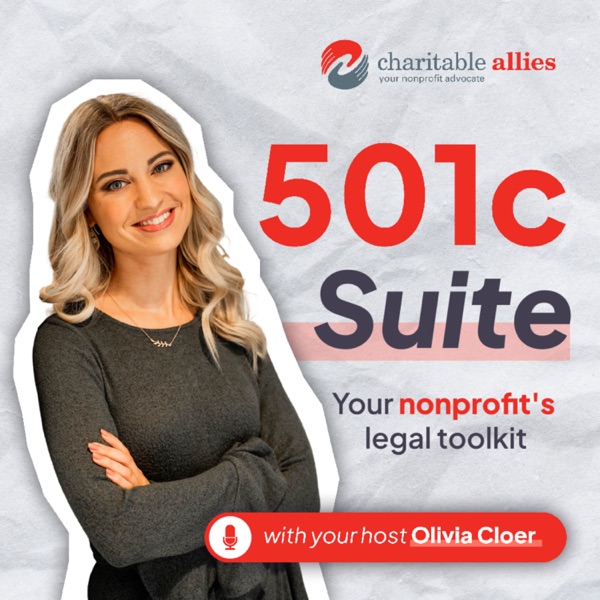
501c Suite
501c Suite is where charity meets clarity and law meets leadership. Hosted by Olivia Froedge, COO of Charitable Allies, the show empowers nonprofit founders and leaders with accessible legal insights, real-world stories, and strategic guidance. Learn how to protect your mission, stay compliant, and lead with confidence — without the legal jargon.
- Episodes
- 19
- Releases
- Every two weeks
- Typical length
- 26 min
- On air since
- 2025
- Latest episode
- 1 week ago
Episodes
19 episodes, newest first
-
25 min
EP 17. 2026 Group Exemption Updates: What Nonprofits Need to Know Before the January 2027 Deadline
Season 1, Episode 17
Show notes
The IRS has updated its rules for group exemptions, and if your nonprofit holds one, you have until January 22, 2027 to get compliant. That goes for denominations with local churches, national associations with chapters, and networks thinking about applying for the first time.
In this episode of the 501c Suite podcast, Olivia Froedge talks with Robert Miller, Managing Attorney of Charitable Allies, about what changed, who it affects, and what to do before the deadline. They cover how the IRS now expects central organizations to oversee their members, the new filing requirements, and the $3,500 fee for new applications, all in plain, practical terms.
Things You Will Learn:
• What a group exemption actually is, how it works, and which types of organizations typically use one.
• What existing group exemption holders must do differently under the new rules and what legacy protections they still have through grandfathering provisions.
• What it takes to file a brand new group exemption under the 2026 regulations, including the minimum requirements the IRS now mandates before they will even consider an application.Tools & Frameworks Covered:
• The Affiliation, Supervision, and Control Framework: The three-part structure the IRS now uses to evaluate whether a central organization is properly overseeing its subordinates, and why Robert recommends meeting all three even when only one is technically required.
• The Uniform Purpose Statement Requirement: A new standard for new group exemption filers that distinguishes a legal organizational purpose from a public-facing mission statement, and why getting this wrong at the document level creates downstream compliance problems.
• The Supplemental Group Ruling Information Form (SGRI): The formalized annual filing that replaces the old letterhead-based process for managing which organizations are on or off a group exemption letter, and why the shift to a standardized form matters for central organizations.#NonprofitLaw #NonprofitGovernance #501c3 #NonprofitCompliance #CharitableAllies
✅ SUBSCRIBE so you never miss an episode:
YouTube: https://www.youtube.com/@charitableallies/podcasts
Apple Podcast: https://podcasts.apple.com/us/podcast/501c-suite/id1854799490
Spotify: https://open.spotify.com/show/18IVmECOQ1MMOOthGrSkRh
Want more help with your nonprofit’s bylaws?
-
32 min
EP 16. Lessons From Building, Funding, and Leading a Successful Nonprofit
Season 1, Episode 16
Show notes
Many nonprofit founders begin with passion, a clear mission, and very little else. What separates the organizations that survive from the ones that struggle often comes down to the lessons learned along the way.
In this episode, Olivia Froedge sits down with social impact strategist, nonprofit founder, and content creator Amber Melanie Smith to explore her journey from a college student volunteering across the country to launching and leading Activate Good, a nonprofit that mobilized thousands of volunteers in North Carolina.
Together, they discuss the realities of startup funding, board leadership, founder burnout, delegation, and how nonprofit leaders can identify funding strategies that actually fit their mission. Amber also shares why understanding your personal mission can help you navigate leadership transitions and build impact that extends beyond any single organization.
Things You Will Learn:
• How nonprofit founders can identify funding strategies that align with their mission, audience, and organizational strengths.
• Why delegation is one of the most important growth decisions a nonprofit leader can make.
• How spending time with the people you serve leads to stronger programs and more meaningful impact.Tools & Frameworks Covered:
• Finding Your Best Fit Funding Model: helps nonprofit leaders identify fundraising approaches that fit their organization, rather than chasing every revenue opportunity.
• Community Immersion Approach: helps founders design programs based on real needs rather than assumptions.
• Personal Mission Exercise: helps leaders maintain clarity and direction through growth, transition, and career changes.
• Zero to $100,000 Nonprofit Fundraising System#NonprofitLeadership #NonprofitStartup #FundraisingStrategy #SocialImpact #CharitableAllies
✅ SUBSCRIBE so you never miss an episode:
YouTube: https://www.youtube.com/@charitableallies/podcasts
Apple Podcast: https://podcasts.apple.com/us/podcast/501c-suite/id1854799490
Spotify: https://open.spotify.com/show/18IVmECOQ1MMOOthGrSkRh
Want more help with your nonprofit’s bylaws?
-
28 min
EP 15. Program Service Revenue 101: How Nonprofits Bring in Revenue Beyond Donations & Grants
Season 1, Episode 15
Show notes
Somewhere along the way, a myth took hold that nonprofits are not supposed to make money, and it is costing organizations real sustainability. The truth is that charging for services, goods, and even intellectual property is not only legal for nonprofits. It is often essential to mission longevity.
In this episode of 501c Suite, Olivia Froedge is joined by Charitable Allies attorney Justin Fromke for a practical breakdown of program service revenue: what it is, what qualifies, where organizations tend to get tripped up, and when unrelated business income tax enters the picture.
From thrift stores and adoption fees to licensing curriculum and renting out buildings, they walk through the most common scenarios nonprofit leaders face and explain what the IRS actually looks for when evaluating whether revenue is mission-aligned.
If your organization has ever hesitated to charge for something it provides, this episode gives you the clarity to move forward with confidence.
Things You Will Learn:
• What program service revenue actually is and why so many nonprofit leaders misunderstand what they are allowed to charge for.
• How to determine whether a revenue-generating activity is related enough to your mission to avoid triggering unrelated business income tax.
• What steps to take before licensing intellectual property, renting organizational assets, or offering services outside your core exempt purpose.Tools & Frameworks Covered:
• The Comparability Analysis: Evaluates what other nonprofits and for-profits charge for similar services so organizations can set rates that are reasonable, mission-aligned, and defensible to the IRS.
• The Related vs. Unrelated Revenue Test: A practical framework for assessing whether a revenue-generating activity furthers the organization's exempt purpose or risks triggering UBIT.
• The IP Licensing Agreement: A formal structure for nonprofits sharing curriculum, trademarks, or other intellectual property that protects ownership, limits unauthorized use, and guards against providing excess benefit to outside entities.#NonprofitLaw #501c3 #NonprofitGovernance #NonprofitLeadership #CharitableAllies
✅ SUBSCRIBE so you never miss an episode:
YouTube: https://www.youtube.com/@charitableallies/podcasts
Apple Podcast: https://podcasts.apple.com/us/podcast/501c-suite/id1854799490
Spotify: https://open.spotify.com/show/18IVmECOQ1MMOOthGrSkRh
Want more help with your nonprofit’s bylaws?
-
26 min
EP 14. How to Design Performance Reviews That Build Trust, Develop Staff, and Reduce Legal Risk
Season 1, Episode 14
Show notes
Performance reviews do not have to feel like a reckoning. And if they do, that is a signal that something broke long before the meeting ever started. When leaders treat reviews as isolated events rather than part of an ongoing feedback culture, employees are left guessing for months, and organizations absorb the consequences in morale, retention, and legal exposure.
In this episode, Olivia Froedge of Charitable Allies walks nonprofit leaders through how to build a performance review process that actually serves the people in the room, covering review frequency at every stage of employment, how to structure goal-setting around objective and observable behaviors, what questions to ask and which ones to drop entirely, and how documentation from reviews can protect your organization when difficult employment decisions arise.
Things You Will Learn:
• When to schedule performance reviews based on where an employee is in their tenure, and why defaulting to annual-only leaves critical gaps in communication and development.
• How to build review rubrics around measurable behaviors and outcomes so that feedback is grounded, fair, and harder to dispute.
• Which common review practices quietly undermine trust, and what to do instead to keep the conversation productive and legally sound.Tools & Frameworks Covered:
• The Job Description Standard: Anchors performance measurement to what the employee originally agreed to, keeping evaluations fair and defensible from the very first review.
• The Dual Submission Review Process: Has both the manager and employee complete the same rubric independently before meeting, then compares responses together to generate honest, unfiltered dialogue.
• The Behavioral Evidence Rule: Requires managers to bring specific, observable examples to every review rather than impressions or attitudes, keeping feedback actionable and protecting the organization from claims of favoritism or discrimination.#NonprofitLeadership #NonprofitHR #PerformanceManagement #NonprofitGovernance #CharitableAllies
✅ SUBSCRIBE so you never miss an episode:
YouTube: https://www.youtube.com/@charitableallies/podcasts
Apple Podcast: https://podcasts.apple.com/us/podcast/501c-suite/id1854799490
Spotify: https://open.spotify.com/show/18IVmECOQ1MMOOthGrSkRh
Want more help with your nonprofit’s bylaws?
-
20 min
EP 13. How to Build a Feedback Culture That Improves Performance and Reduces Risk in Nonprofits
Season 1, Episode 13
Show notes
Most nonprofit teams are not struggling because of bad intentions. They are struggling because no one is clearly saying what needs to be said.
In this episode, Olivia Froedge of Charitable Allies explains why consistent, clear feedback is one of the most practical tools nonprofit leaders have to strengthen performance, reduce confusion, and protect their organization from unnecessary risk.
Through real examples and a simple, repeatable framework, she shows how to give both positive and corrective feedback without creating fear, why avoiding feedback actually damages trust, and how building this habit removes surprises from performance reviews. If you lead people, this episode will help you communicate in a way that supports your team and your mission at the same time.
Things You Will Learn:
• Why avoiding feedback creates uncertainty and weakens team performance over time.
• How to give feedback that is direct, useful, and focused on behavior rather than personality.
• How consistent feedback reduces legal risk and prevents breakdowns during performance reviews.Tools & Frameworks Covered:
• Ask Permission - Describe Behavior - Describe Impact - Give Feedback: it helps leaders deliver feedback that is clear, grounded, and actionable.
• No-Surprise Review Principle: ensures performance reviews reflect ongoing conversations.
• Feedback Frequency Tracking: helps managers build consistency and avoid long gaps without communication.Helpful Resources
#NonprofitLeadership #NonprofitManagement #EmployeeFeedback #TeamPerformance #CharitableAllies
✅ SUBSCRIBE so you never miss an episode:
YouTube: https://www.youtube.com/@charitableallies/podcasts
Apple Podcast: https://podcasts.apple.com/us/podcast/501c-suite/id1854799490
Spotify: https://open.spotify.com/show/18IVmECOQ1MMOOthGrSkRh
Want more help with your nonprofit’s bylaws?
-
25 min
EP 12. Nonprofit Risk Management: How to Protect Your Mission, People, and Programs
Season 1, Episode 12
Show notes
Most nonprofit leaders do not realize how vulnerable their organization is until one preventable incident puts the entire mission at risk.
In this episode of 501c Suite, Olivia Froedge talks with Quentin Collins, Director of Volunteer Operations at Trout Unlimited, about how nonprofit leaders can think more clearly and proactively about risk management before something goes wrong.
Using real examples from youth camps, volunteer-led programs, and outdoor events, they break down how to identify risk through population, activity, and location, how practical safeguards, waivers, and insurance work together, and why strong preparation protects not just participants, but also staff, volunteers, and the future of the organization.
Things You Will Learn:
• How to identify nonprofit risk by evaluating the population you serve, the activities you run, and the locations where they happen.
• Practical steps that make nonprofit programs safer, including training, waivers, and insurance working together.
• How to make better leadership decisions by weighing both the likelihood and the consequences of a risk.Tools & Frameworks Covered:
• PAL Framework (Population, Activity, Location): helps nonprofit leaders identify where risk is most likely to show up inside programs and events.
• Three-Layer Risk Prevention Stack: helps organizations reduce exposure through practical risk management, legally sound waivers, and insurance.
• Likelihood vs. Consequence Risk Matrix: helps leaders decide which risks are acceptable, which need mitigation, and which should be avoided entirely.Helpful Resources
• Preventing Liability and Risk for Nonprofit Leaders
• Trout Unlimited: Volunteer with TU#NonprofitLaw #NonprofitLeadership #501c3 #NonprofitRiskManagement #CharitableAllies
✅ SUBSCRIBE so you never miss an episode:
YouTube: https://www.youtube.com/@charitableallies/podcasts
Apple Podcast: https://podcasts.apple.com/us/podcast/501c-suite/id1854799490
Spotify: https://open.spotify.com/show/18IVmECOQ1MMOOthGrSkRh
Want more help with your nonprofit’s bylaws?
-
23 min
EP 11. How Fiscal Sponsorship Lets You Raise Grants and Donations Before You Have 501(c)(3) Status
Season 1, Episode 12
Show notes
Most founders assume they need 501(c)(3) status before they can raise a single grant dollar. But there is a legal pathway that changes everything. Fiscal sponsorship allows mission-driven organizations to accept tax-deductible donations and apply for grants, long before completing the IRS process, and understanding how it works can save emerging nonprofits months of lost momentum.
In this episode, host Olivia Froedge sits down with Gavin Funkhouser, Program Manager, Sponsorship Allies (FSA), to demystify the world of fiscal sponsorship from the inside out. Together, they break down the two primary models - Model A and Model C - exploring how each affects autonomy, fees, and day-to-day operations, and walk through real examples of who fiscal sponsorship is actually for, including seasonal charities, for-profit companies with charitable arms, and community startups that need a running start.
Things You Will Learn:
• How fiscal sponsorship works as a legal bridge for organizations not yet holding 501(c)(3) status, and why it is not just for startups.
• The key differences between Model A and Model C fiscal sponsorship, including how fees, autonomy, and administrative support vary between them.
• How to evaluate and choose a fiscal sponsor, including what questions to ask about IP ownership, fundraising minimums, and grant compatibility.Tools & Frameworks Covered:
• Model A vs. Model C Framework: helps organizations understand the trade-offs between full administrative integration and independent charitable operations when choosing a fiscal sponsor.
• Fee Percentage Analysis: helps nonprofits calculate the real cost of fiscal sponsorship against grant income, comparing sponsor rates (typically 4–15%) to determine financial fit before signing an agreement.
• Fiscal Sponsorship Agreement Review: helps organizations protect their programs and intellectual property by understanding the ownership, autonomy, and exit provisions written into their sponsorship contract before signing.Helpful Resources
• Charitable Allies: Fiscal Sponsorship Overview
• Fiscal Sponsorship Allies (FSA)#NonprofitLaw #FiscalSponsorship #501c3 #NonprofitLeadership #CharitableAllies
✅ SUBSCRIBE so you never miss an episode:
YouTube: https://www.youtube.com/@charitableallies/podcasts
Apple Podcast: https://podcasts.apple.com/us/podcast/501c-suite/id1854799490
Spotify: https://open.spotify.com/show/18IVmECOQ1MMOOthGrSkRh
Want more help with your nonprofit’s bylaws?
-
29 min
EP 10. How Nonprofits Can Know When It’s Time to Hire Their First Employee
Season 1, Episode 10
Show notes
Hiring too early can strain a nonprofit, but waiting too long can stall the mission.
In this episode, host Olivia Froedge breaks down how nonprofits can tell when it’s truly time to hire their first employee. She explains the three key factors to evaluate before making the leap: work, money, and support, then walks through what hiring actually looks like in practice, from compensation research and payroll realities to board approval and compliance setup.
Things You Will Learn:
• How to tell whether your nonprofit needs more volunteers or its first employee.
• How to calculate the real cost of hiring beyond base salary.
• How to prepare your nonprofit legally and operationally for its first hire.Tools & Frameworks Covered:
• Work, Money, Support framework: helps determine if your nonprofit is truly ready to hire
• Comparable compensation research: helps set fair, realistic pay for nonprofit roles
• PEO and payroll software options: help nonprofits manage payroll, taxes, and HR setup more confidently👉 Can I make my nonprofit my full-time job? - https://charitableallies.org/can-i-make-my-nonprofit-my-full-time-job/
#NonprofitLaw #NonprofitLeadership #501c3 #NonprofitHiring #CharitableAllies
✅ SUBSCRIBE so you never miss an episode:
YouTube: https://www.youtube.com/@charitableallies/podcasts
Apple Podcast: https://podcasts.apple.com/us/podcast/501c-suite/id1854799490
Spotify: https://open.spotify.com/show/18IVmECOQ1MMOOthGrSkRh
Want more help with your nonprofit’s bylaws?
-
26 min
EP 09. What 501(c)(3) Nonprofits Can and Can’t Do in Political Activity
Season 1, Episode 9
Show notes
Political activity is one of the easiest places for nonprofits to get confused and one of the riskiest places to get it wrong. In this episode, Olivia Froedge is joined by Katie Buckner, nonprofit attorney at Charitable Allies, to break down what 501(c)(3) organizations can and cannot do in election years, from voter education and lobbying to candidate involvement, issue advocacy, and the difference between (c)(3) and (c)(4) entities.
They unpack the fine lines nonprofit leaders need to understand, explain how lobbying rules actually work, and share practical guidance for staying compliant while still protecting your mission and speaking up on the issue that matter.
Things You Will Learn:
• How to tell the difference between permitted issue advocacy and prohibited partisan political activity
• How to evaluate whether your nonprofit’s lobbying activity is compliant and trackable
• How to decide when a (c)(3), a (c)(4), or a dual-entity structure may make senseTools & Frameworks Covered:
• Direct vs. Grassroots Lobbying: helps nonprofits understand what type of advocacy they are actually doing
• Substantial Part Test vs. 501(h) Election: helps leaders measure lobbying limits with more clarity
• c3 vs. c4 Structure Comparison: helps organizations choose the right compliance path for advocacy goalsAdditional Resource:
501(c)(3) Lobbying Limits: What Nonprofits Need to Know Before Advocating - https://charitableallies.org/501c3-lobbying-limits-what-nonprofits-need-to-know-before-advocating/
#NonprofitLaw #501c3 #NonprofitLeadership #NonprofitGovernance #PoliticalActivity
✅ SUBSCRIBE so you never miss an episode:
YouTube: https://www.youtube.com/@charitableallies/podcasts
Apple Podcast: https://podcasts.apple.com/us/podcast/501c-suite/id1854799490
Spotify: https://open.spotify.com/show/18IVmECOQ1MMOOthGrSkRh
Want more help with your nonprofit’s bylaws?
-
26 min
EP 08. Ask an Attorney: Real Nonprofit Leader Questions on Revenue, Compliance, and Governance
Season 1, Episode 8
Show notes
Most nonprofit challenges don’t start with bad intentions. They start with unanswered questions. In this “Ask an Attorney” episode from 501c Suite, Olivia Froedge is joined by Robert Miller, Managing Attorney at Charitable Allies, to answer real questions submitted by nonprofit leaders navigating revenue, compliance, and governance decisions.
From selling products and charging for services to donor restrictions, fiscal sponsorship, audits, church filing rules, entity classification mistakes, and removing board members, this episode tackles the kinds of questions nonprofit leaders regularly ask but rarely get clear answers to. Instead of abstract legal theory, Robert walks through practical explanations that help nonprofit teams understand the rules, reduce risk, and make more confident decisions.
If you’ve ever wondered how the law actually applies to day-to-day nonprofit operations, this episode brings real questions and straightforward legal education together in one place.
Things You Will Learn:
• Generate revenue through products or services without accidentally creating avoidable tax exposure.
• Handle donor restrictions and salary questions with clarity and legal confidence.
• Follow a clean governance process when facing board conflict or classification mistakes.Tools & Frameworks Covered:
• UBIT (Unrelated Business Income Tax): evaluate when revenue is mission-related vs. potentially taxable.
• Fiscal Sponsorship Model: accept tax-deductible donations while awaiting or bypassing separate exemption.
• Form 8940 (Miscellaneous Determination Request): correct entity classification issues like accidental private foundation status.#NonprofitLaw #NonprofitCompliance #501c3 #NonprofitGovernance #NonprofitLeadership
✅ SUBSCRIBE so you never miss an episode:
YouTube: https://www.youtube.com/@charitableallies/podcasts
Apple Podcast: https://podcasts.apple.com/us/podcast/501c-suite/id1854799490
Spotify: https://open.spotify.com/show/18IVmECOQ1MMOOthGrSkRh
Want more help with your nonprofit’s bylaws?
-
32 min
EP 07. New Nonprofit Compliance Basics: 990 Filings, SMART Goals, and Staying Tax-Exempt
Season 1, Episode 7
Show notes
Most nonprofit problems don’t start with bad intentions; they just don't have all the information they need.
In this episode, Olivia Cloer is joined by Will Gay, a Nonprofit Compliance Coordinator at Charitable Allies, to walk new nonprofit leaders through the most common early mistakes and how to prevent them, from skipping a real community needs assessment to setting vague goals, overlooking annual compliance filings, and letting bookkeeping get messy until 990 season becomes a scramble.
You’ll learn what it takes to form and maintain a nonprofit legally, how 990 filing rules and deadlines actually work, how revenue impacts IRS filing paths (including 1023-EZ vs. full), why fundraising can trigger multi-state registration, and how simple internal controls protect your mission when staff or volunteers change.
Things You Will Learn:
• Build a practical first-year plan that connects mission to measurable results.
• Set up a basic compliance system so you stay in good standing with the IRS and your state.
• Create financial habits that make 990 filing straightforward instead of stressful.Tools & Frameworks Covered:
• SMART Goals: turn your mission into trackable outcomes your team can budget and report on
• Compliance Order of Operations: reduce startup confusion and prevent missed steps
• Internal Controls (two-touch process): protect funds and continuity when people rotate in/out#NonprofitLaw #NonprofitCompliance #501c3 #NonprofitGovernance #NonprofitLeadership
✅ SUBSCRIBE so you never miss an episode:
YouTube: https://www.youtube.com/@charitableallies/podcasts
Apple Podcast: https://podcasts.apple.com/us/podcast/501c-suite/id1854799490
Spotify: https://open.spotify.com/show/18IVmECOQ1MMOOthGrSkRh
Want more help with your nonprofit’s bylaws?
-
22 min
EP 06. What We See Nonprofits Get Wrong About Board Officer Roles
Season 1, Episode 7
Show notes
In this episode of 501 C Suite, Olivia from Charitable Allies breaks down the four core board officer roles: board treasurer, secretary, president or chair, and vice chair, and explains how those roles look different in small versus larger nonprofits. Drawing from real world nonprofit experience, she walks through fiduciary duty, financial reports, meeting minutes, bylaws compliance, board conflict, and strategic planning. Olivia also addresses whether one person can hold multiple officer roles, why state rules matter, and why clearly defining board officer roles helps nonprofits reduce legal risk, avoid costly mistakes, and build sustainable operations. Listen through and share this episode with a nonprofit leader who needs clear, practical guidance on board governance.
Looking for a deeper breakdown of nonprofit board officer responsibilities?Get more guidance on the roles of the board chair, treasurer, secretary, and vice chair here: https://charitableallies.org/nonprofit-board-officer-roles/
Key Takeaways:
• Clearly defined board officer roles reduce board conflict and confusion as nonprofits grow.
• The treasurer, secretary, and chair each carry distinct responsibilities tied to fiduciary duty, bylaws compliance, leadership, and financial oversight.
• Writing, approving, and revisiting officer role descriptions helps nonprofits reduce legal risk and build sustainable operations.✅ SUBSCRIBE so you never miss an episode:
YouTube: https://www.youtube.com/@charitableallies/podcasts
Apple Podcast: https://podcasts.apple.com/us/podcast/501c-suite/id1854799490
Spotify: https://open.spotify.com/show/18IVmECOQ1MMOOthGrSkRh
Want more help with your nonprofit’s bylaws?
-
28 min
EP 05. How to Start a Nonprofit Legally and Avoid Early Mistakes
Season 1, Episode 6
Show notes
Starting a nonprofit can feel confusing, so this episode walks through each legal step in simple, practical terms.
Olivia explains how to start a nonprofit the right way, how to file for 501c3 status, and how to avoid the mistakes that slow down new founders. You will learn the full process from incorporation through tax exemption, how to prepare core documents, and how state fundraising rules work.
These insights help new and early stage leaders move forward with confidence and understand what questions to ask as they grow.
Key Takeaways:- The clear legal steps to start a nonprofit, including incorporation, core documents and choosing the right IRS form for 501c3 status.- Why bylaws, conflict of interest rules and your EIN matter for early governance and financial setup.- How state fundraising registration works and when nonprofits must complete it.- When founders can complete the process themselves and when professional support may help.
Learn how nonprofits avoid common mistakes and receive simple legal guidance to help you move forward with confidence.
#NonprofitLaw #NonprofitLeadership #501c3 #NonprofitGovernance #CharitableAllies #501cSuite
✅ SUBSCRIBE so you never miss an episode:
YouTube: https://www.youtube.com/@charitableallies/podcasts
Apple Podcast: https://podcasts.apple.com/us/podcast/501c-suite/id1854799490
Spotify: https://open.spotify.com/show/18IVmECOQ1MMOOthGrSkRh
Want more help with your nonprofit’s bylaws?
-
23 min
How a Candy Fundraiser Led to a Nonprofit Shutdown
Season 1, Episode 5
Show notes
In this special episode of 501C Suite, Interim CEO Olivia Cloer and managing attorney Robert Miller walk through a real-world nonprofit case involving a youth organization that was shut down after regulators uncovered widespread misuse of charitable funds. What began as a candy-selling fundraiser for at-risk youth led to multi-state investigations, lifetime bans on fundraising, and allegations tied to serious illegal activity.
Using only publicly reported information, they explain what happened, how regulators evaluated the organization’s actions, and what nonprofit founders, executive directors, and board members can learn about handling money, authority, and oversight responsibly.
Key Takeaways:
• Nonprofit leaders can be paid, but funds must be handled in ways that align with the organization’s exempt purpose.
• Regulators look closely at whether a nonprofit is serving the public or benefiting insiders.
• Independent board decisions, clear processes, and documentation reduce legal risk and support sustainable operations.Episode resources:
• https://www.washingtoninformer.com/at-risk-youth-charity-scam/
• https://sos.ga.gov/news/raffensperger-investigators-help-break-gangs-human-trafficking-racketeering
• https://apps.irs.gov/app/eos/
• https://thedailyrecord.com/2026/01/22/nonprofit-candy-selling-scheme-shut-down-dc-md-va/
• https://www.washingtonpost.com/dc-md-va/2026/01/22/candy-sale-scheme-maryland-virginia-dc/
✅ SUBSCRIBE so you never miss an episode:
YouTube: https://www.youtube.com/@charitableallies/podcasts
Apple Podcast: https://podcasts.apple.com/us/podcast/501c-suite/id1854799490
Spotify: https://open.spotify.com/show/18IVmECOQ1MMOOthGrSkRh
Want more help with your nonprofit’s bylaws?
-
31 min
EP 04. How to Prevent Losing 501c3 Status and Fix it If It Happens
Season 1, Episode 4
Show notes
This episode explains how nonprofits can stay in good standing with the IRS and what to do if 501c3 status is revoked. You will learn how to choose the right IRS Form 990, understand state annual report rules, and know when charitable solicitation registration is required. The conversation also covers the difference between retroactive and postmark reinstatement, how to use forms 1023 and 1023 EZ, and why turnover or life events often lead to missed filings. Real stories show how organizations recover their status and what steps help prevent future problems.
Not sure which reinstatement applies? Click on this link for more guidance.
https://charitableallies.org/how-can-i-get-501c3-status-back/
Key Takeaways
• How to choose the correct IRS Form 990 for your revenue and assets
• Why late filings can trigger automatic revocation
• What state annual reports and fundraising registrations require
• The difference between retroactive reinstatement and postmark reinstatement
• When to use Form 1023 EZ or the full Form 1023
• How turnover and life events often lead to missed filingsSubscribe for clear, practical nonprofit legal insights and visit Charitable Allies to get support for your organization.
✅ SUBSCRIBE so you never miss an episode:
YouTube: https://www.youtube.com/@charitableallies/podcasts
Apple Podcast: https://podcasts.apple.com/us/podcast/501c-suite/id1854799490
Spotify: https://open.spotify.com/show/18IVmECOQ1MMOOthGrSkRh
Want more help with your nonprofit’s bylaws?
-
20 min
EP 03. How Can Nonprofit Boards Avoid Mistakes and Meet Their Legal Duties?
Season 1, Episode 3
Show notes
In this episode, Olivia Cloer and nonprofit attorney Spencer Rehn walk through the three core legal duties that apply to every nonprofit board. You will learn how the duties of care, loyalty, and obedience work in real organisations, what state law expects from board members, and how your bylaws guide everyday decisions. The conversation explains why staying informed matters, how to manage conflicts of interest, and how to support healthy financial oversight.
With clear examples and straightforward explanations, this episode helps founders, board members, and nonprofit leaders identify common board governance mistakes and enhance their long-term operations.
#NonProfitLaw #NonprofitLeadership #501c3 #NonprofitGovernance #CharitableAllies #501cSuite
Chapters:
00:00 - Introducing Spencer Rehn
01:40 - What legal duties apply to nonprofit boards
02:46 - What the duty of care requires
07:23 - How the duty of loyalty works
10:29 - What the duty of obedience means
12:29 - How boards avoid financial mistakes
15:11 - When a board should get legal guidance
17:30 - Best practices for strong nonprofit governance
✅ SUBSCRIBE so you never miss an episode:
YouTube: https://www.youtube.com/@charitableallies/podcasts
Apple Podcast: https://podcasts.apple.com/us/podcast/501c-suite/id1854799490
Spotify: https://open.spotify.com/show/18IVmECOQ1MMOOthGrSkRh
Want more help with your nonprofit’s bylaws?
-
31 min
EP 02. Board Bylaws Demystified: Avoid Legal Pitfalls
Season 1, Episode 2
Show notes
Is your nonprofit’s board running on outdated bylaws or none at all? In this episode of 501c Suite, Olivia Cloer from Charitable Allies sits down with Robert Miller, an experienced nonprofit attorney, to make governance feel simple and actionable.
They unpack what truly belongs in your bylaws, how to set smart term limits and meeting rules, and why flexibility beats overcomplication. You will hear real examples of what happens when bylaws go wrong, how to navigate director removals with fairness, and why your fiscal year and voting rules matter more than you think.
Whether you are drafting bylaws for a new nonprofit or updating a legacy organization, this episode helps you strengthen your board, prevent burnout, and keep compliance effortless without the legal jargon.
What You’ll Learn:
• How to write bylaws that prevent gridlock and protect your mission
• Why clear term limits and reviews keep boards energized and compliant
• How to handle director removals, resignations, and fiscal year rulesEpisode Highlights:
00:00 – Introduction and why bylaws matter
00:31 – Welcome to guest attorney Robert Miller
01:41 – Real-world bylaw blunders and compliance risks
03:17 – What to include (and exclude) from your bylaws
04:08 – Board terms, limits, and meeting requirements
09:15 – The role of emeritus directors
11:49 – Why specific bylaws can backfire
13:40 – Best practices for board voting
15:18 – Handling director exits and removals
19:52 – Setting your fiscal year and IRS compliance
22:04 – Member vs. non-member organizations
25:21 – How long should quality bylaws last
28:24 – Updating and amending your bylaws
29:27 – Mini Myth: Should bylaws include your mission?
Tools / Frameworks Mentioned:
• Bylaw amendment procedures
• Board term limits and meeting frequency
• Quorum and voting standards
• Fiscal year documentation
• Director removal and resignation processClosing Insight:
"Simple, flexible bylaws are your board’s best ally. Focus on governance, not clutter."
✅ SUBSCRIBE so you never miss an episode:
YouTube: https://www.youtube.com/@charitableallies/podcasts
Apple Podcast: https://podcasts.apple.com/us/podcast/501c-suite/id1854799490
Spotify: https://open.spotify.com/show/18IVmECOQ1MMOOthGrSkRh
Want more help with your nonprofit’s bylaws?
-
4 min
EP 01. Legal Clarity for Nonprofit Leaders
Season 1, Episode 1
Show notes
There’s enough bad news in the nonprofit world; this podcast brings the good.
In the debut episode of 501c Suite, host Olivia Cloer, Interim CEO of Charitable Allies, introduces a space where nonprofit leaders can finally get clear, trusted legal guidance without the jargon or fear. Drawing on her experience in fundraising, governance, and direct service, Olivia explains how legal clarity helps leaders protect their mission and lead with confidence.
You’ll hear what to expect from upcoming episodes: quick legal Q&As that simplify complex rules, stories from nonprofit leaders who’ve been there, and timely insights tied to real-world challenges like starting a nonprofit or managing year-end giving.
Whether you’re building from the ground up or scaling for impact, 501c Suite gives you clarity you can act on. Because understanding the law shouldn’t be intimidating, it should empower you to grow.
#NonprofitLaw #NonprofitLeadership #501c3 #NonprofitGovernance #CharitableAllies #501cSuite
What You’ll Learn:
• How to turn complex legal requirements into clear, confident leadership steps
• Where to find trusted legal resources and community support for nonprofits
• What kinds of episodes to expect: plain-language answers, leader stories, and seasonal insightsEpisode Highlights:
00:00 – Welcome, sector pain points, and mission of 501c Suite
01:47 – Olivia’s journey: direct service, fundraising, governance
02:50 - Preview: episode formats (Q&A, stories, topical deep dives)
03:32 – Where to get resources and how to connect
Tools / Frameworks Mentioned:
• Nonprofit legal compliance checklists
• Free case studies and educational guides at https://CharitableAllies.orgClosing Insight:
“Knowledge protects your mission. Every nonprofit deserves an ally.”
✅ SUBSCRIBE so you never miss an episode:
YouTube: https://www.youtube.com/@charitableallies/podcasts
Apple Podcast: https://podcasts.apple.com/us/podcast/501c-suite/id1854799490
Spotify: https://open.spotify.com/show/18IVmECOQ1MMOOthGrSkRh
Want more help with your nonprofit’s bylaws?
-
1 min
501c Suite Trailer
Season 1
Show notes
501c Suite is where nonprofit law meets real-world leadership. Hosted by Olivia Cloer, Interim CEO of Charitable Allies, this podcast empowers nonprofit founders, executive directors, and board members with accessible, actionable legal education and inspiring stories from the field. Each episode breaks down the legal and operational challenges nonprofits face — from bylaws and board governance to UBIT and fiscal sponsorship — in plain English.
Our mission is simple: to help you protect your mission, stay compliant, and grow your impact. Whether you’re starting your first nonprofit, leading a growing organization, or supporting others as a board member or advisor, 501c Suite is your ally in building a stronger, smarter nonprofit sector. Through legal insights, expert interviews, and real case stories, we demystify the law so you can lead with confidence, clarity, and purpose.
Non-Profit lists
More Non-Profit shows picked out from the charts






More in Non-Profit
Placed highest on Apple Podcasts' Non-Profit chart right now