Podcast
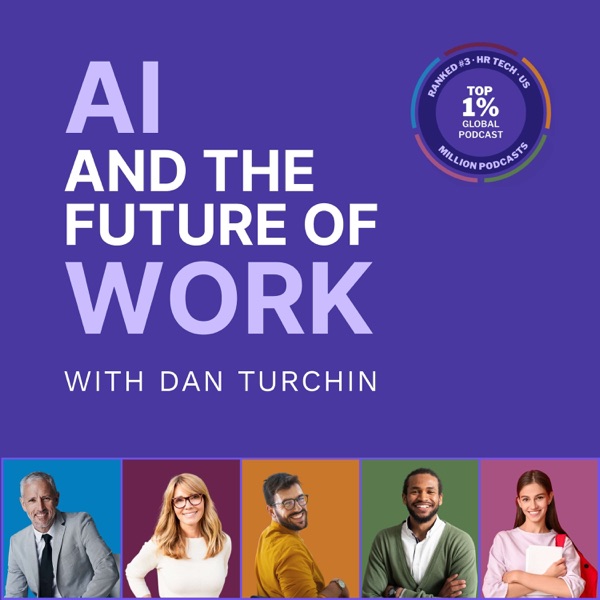
AI and the Future of Work: Artificial Intelligence in the Workplace, Business, Ethics, HR, and IT for AI Enthusiasts, Leaders
🏆 Ranked #3, Best Tech Podcasts — Million Podcasts (2026) | Top 1% global podcast. 450+ episodes. 10M+ downloads. Host Dan Turchin, PeopleReign CEO, explores how AI is changing the workplace. He interviews thought leaders and technologists from industry and academia who share their experiences and insights about artificial intelligence and what it means to be human in the era of AI-driven automation. Learn more about PeopleReign, the system of intelligence for IT and HR employee service: http://www.peoplereign.io.
- On air since
- 2019
- Episodes
- 391
- Releases · typical length
- Weekly · 43 min
- Latest episode
- 21 hours ago
Episodes
391 episodes, newest first
-
48 min
414: Josh Bersin, HR Tech Authority: When AI Hype Meets Reality, Implementation Is the Real Opportunity
Season 7, Episode 414
Show notes
AI is not about becoming something new. It is about becoming a better version of yourself.
What happens when AI hype meets reality? In this episode of AI and the Future of Work, Dan Turchin welcomes global HR analyst Josh Bersin back for the third time to talk AI strategy, AI adoption, change enablement, and what HR leaders should do next.
Josh Bersin is the CEO of The Josh Bersin Company and the founder of The Josh Bersin Institute, and one of the most respected global industry analysts in HR and workplace technology. He founded Bersin & Associates, which Deloitte acquired in 2012, and went on to build The Josh Bersin Company, which created Galileo, a generative AI expert assistant for HR leaders that the company bills as the world’s first.
The author of Irresistible, he recently published Superpowered: How AI Unlocks the Superpower of People, Leadership, and Teams, written with Dr. Kathi Enderes. Built on more than 100 case studies, it sets the stage for the superworker, the supermanager, and the supercompany.
Listen now if you are tired of vendor promises and want to hear what Josh is seeing inside companies.
In this conversation, we discuss:
• Why Josh says the AI bubble is starting to burst, and why he thinks a dose of reality is good.
• Why Josh says AI helps most when companies become better versions of themselves, and why he calls bold AI promises vendor selling points.
• How an insurance company and a global bank are approaching AI, and why Josh says institutional knowledge keeps people involved.
• What Josh means by change enablement, and why he says a company’s intellectual property lives in its people.
• How Josh thinks about organizing work beyond functional hierarchies, and what changes when AI can stitch the data together.
• What Josh hears from HR leaders about entry-level hiring and the talent pipeline, and what young employees bring to a company.Explore the conversation:
00:00 Show intro and listener mailbag
01:54 AI fun fact: The history of the org chart
02:42 Meet Josh Bersin, three-time guest and author of Superpowered
03:47 Agent overload: A flood of immature HR tech
05:05 Is the AI bubble bursting? A reality check on valuations
08:06 What makes a super company? Be a better version of yourself
10:45 Change enablement: Why organizations move slower than technology
13:15 Two real stories: An insurer and a global bank
17:09 Building trust in AI: Training, psychological safety, and Microsoft’s buyouts
21:30 Will the org chart survive? From functional silos to customer teams
26:28 Are entry-level jobs disappearing? What HR leaders are seeing
29:45 Buying AI tools: Incumbent vendors or startups?
36:49 Who wins in HR tech? Tools-first vs. process-first vendors
40:34 Exercising AI responsibly: Narrow agents and networks of specialists
42:39 Gaps in the HR tech landscape: Where the opportunities are
45:05 The chapter Josh would add: The AI bubble bursting
45:58 Where to find Josh Bersin, Superpowered, and Galileo
Resources:
• Subscribe to the AI & The Future of Work Newsletter
• Connect with Josh on LinkedIn or via his website https://joshbersin.com/
• Get Superpowered on Amazon
• Explore Galileo and the Global HR Excellence Certification
• Learn about the history of the org chart: The History of the Organization Chart
• Past episodes with Josh:• AI as a Liberating Technology: Josh Bersin on Turning Routine Tasks into Superworkers Driving Trust, Creativity, and Growth
• Josh Bersin, HRTech pioneer, author, and CEO, shares how the best performing teams use AI• Also mentioned in the episode:
-
30 min
SE 34: Max Wessel, SVP of Product at Workday | Live from Workday Rising 2026 Bonus
Show notes
Max Wessel is the SVP of Product at Workday, where he leads the applications teams and has spent the last year and a half on the AI transformation of its core applications. He founded his first company at 14, and before Workday he was CEO of Degreed and an Executive Vice President at SAP.
Recorded live from the floor of Workday Rising 2026, this lightning round explores how product work is changing as it gets easier to generate code, and what it takes for people to trust the AI they work with.
Max and host Dan Turchin dig into what it means to run Workday like "the world's largest startup," what generative UI means for the people using it, which decisions still need a person's judgment, and how teams may look different in 18 months.
What You'll Learn
• Why taste, judgment, and accountability matter when it's very easy to generate code
• What generative UI means, and why he doesn't want to chat with his e-commerce sites
• Why people grow suspicious of AI they can't inspect, and what makes it easier for employees to trust it
• Which decisions about pay, hiring, and job opportunities still need a person's judgment, and how Workday's responsible AI board changed what an agent can do
• Why teams may need more polymaths and fewer static job descriptions, and what he tells early career professionals who want to join them🎙️ Part of our Workday Rising 2026 compilation series. Listen to the full compilation here: https://www.buzzsprout.com/520474/episodes/20074420
Resources
• Subscribe to the AI & The Future of Work Newsletter
• Connect with Max on LinkedIn -
58 min
413: Steven Kotler, Author of We Are As Gods, on Information Overload, Identity Collapse, and How Flow Helps Us Reskill
Season 7, Episode 413
Show notes
Steven Kotler is a New York Times bestselling author and one of the world’s leading authorities on peak performance. He is the founder and executive director of Flow Research Collective, a leading organization researching peak performance, creativity, and human potential.
His latest book, We Are As Gods: A Survival Guide for the Age of Abundance, written with Abundance co-author Peter Diamandis, has been praised by Jensen Huang, Elon Musk, Sam Altman, Ray Kurzweil, and Eric Schmidt.
Steven has spent his career asking what happens when the impossible becomes possible, and what it demands of the people living through it. That makes him a rare voice on how the human brain copes when technology moves faster than evolution.
In this conversation, we discuss:
• Why Kotler links technological abundance to cognitive overload, fractured attention, and a growing struggle to maintain meaning and professional identity.
• What Kotler means by calling flow a cognitive upgrade, and why he sees it as essential to working alongside AI.
• How Kotler connects DARPA research on accelerated learning with the challenge of helping workers build expertise and retrain for AI-enabled work.
• Why Kotler argues that the choice between AI utopia and apocalypse distracts from practical responses to technological disruption.
• What emerging tools for assessing team synchrony and psychological safety could mean for Kotler’s vision of cooperation at scale.
• Why Kotler argues LLMs are more limited than people assume, and what humans in flow bring to the collaboration that those models cannot.Explore the conversation
00:00 Show intro and listener shoutout
01:52 Meet Steven Kotler, bestselling author and futurist
04:25 Kotler's backstory: Childhood magician and journalist
06:07 Why We Are As Gods: Stewart Brand and the Whole Earth Catalog
10:42 Abundance, meaning, and collapse: Defining the terms
13:54 Why meaning breaks down: The brain as a prediction engine
16:34 The dark side of abundance: Longevity and microplastics
19:47 Do we have the wrong brain for exponential change? Flow as an upgrade
24:35 From information overload to identity collapse
28:12 What do we do about it? Beyond utopia vs. dystopia
30:12 Reskilling at scale: Flow as accelerated learning
33:20 Cooperation at scale: COVID, group flow, and team neurotech
39:35 Where does human end? Cyborgs, counterculture, and speciation
43:38 Can LLMs reach superintelligence? Chips, valuations, and agency
45:11 What is human? Extended cognition and designer babies
49:38 Steven Kotler's why: Big-I impossibles and the future of flow science
56:44 Where to find Steven Kotler
Resources
• Subscribe to the AI & The Future of Work Newsletter
• Connect with Steven on LinkedIn
• Explore books by Steven Kotler
• On How SambaNova CEO Rodrigo Liang Raised More Than $1B to Compete with Nvidia-
Explore Google Workspace’s new report, Beyond AI Optimism: Closing the Ambition Gap, featuring insights from Dan Turchin on the state of AI adoption and what it takes to turn AI ambition into meaningful results. Download the report here: https://workspace.google.com/ai/business-transformation/
-
31 min
SE 33: John Bruce, VP of People Innovation and Technology at OneDigital | Live from Workday Rising 2026 Bonus
Show notes
John Bruce is the VP of People Innovation and Technology at OneDigital, which started about 25 years ago in employer benefits and has since grown into insurance and HR consulting. He has spent about 12 years in the Workday ecosystem, first on large global deployments and then moving in-house so he could stay with the work after launch.
Recorded live from the floor of Workday Rising 2026, this lightning round explores how a company puts AI agents to work without losing sight of the people doing the work.
John and host Dan Turchin dig into how OneDigital keeps people first as it brings in AI, how to talk with employees about automation, and what it meant for the first person in his family to go to college to see his headshot on the wall at Workday Rising.
What You'll Learn
• Why OneDigital calls its AI agents "coworkers," and who is responsible when one does something no one anticipated
• How John's team tries to talk its own agents into breaking the rules, and why that testing has to start again
• What he asks people when automation is about to take over part of their work, and how that conversation went with recruiting coordinators
• Why OneDigital lets every job candidate opt out of AI, even where the law doesn't require it, and what he does about the "ick factor"
• Why he expects automation to take away tasks more than jobs, and the human skill he hopes AI can't replace🎙️ Part of our Workday Rising 2026 compilation series. Listen to the full compilation here: https://www.buzzsprout.com/520474/episodes/20074420
Resources
• Subscribe to the AI & The Future of Work Newsletter
• Connect with John on LinkedIn -
42 min
David Eagleman, Neuroscientist and Author, on the Brain as a Neural Parliament, AI Hallucinations, and Rethinking Democracy with AI
Season 7
Show notes
David Eagleman is a world-renowned neuroscientist, New York Times bestselling author, and adjunct professor at Stanford University. He is the creator and host of the Emmy-nominated PBS documentary series The Brain, as well as the host of the top-ranking science podcast Inner Cosmos. After completing his undergraduate degree in literature, David earned his PhD in neuroscience and conducted postdoctoral research at the Salk Institute under Nobel laureate Francis Crick. A prolific neurotech entrepreneur, he co-founded Neosensory to pioneer sensory substitution wristbands for the deaf and hard of hearing, and has authored landmark books including Incognito and Livewired.
In this episode, David sits down with Dan for a special face-to-face conversation to examine why artificial neural networks simplified the cellular complexity of human neurons, how viewing the brain as a neural parliament explains cognitive decision-making, why the defensive activation theory reveals the evolutionary purpose of dreaming, and what the prospect of AI-driven governance means for the future of democracy.
In this conversation, we discuss:
• Why AI’s success forced Eagleman to reconsider whether intelligence requires the biological complexity of the human brain.
• What the brain’s continuous learning and competing internal drives suggest about the limits of LLMs and what might come next.
• Why Eagleman connects AI hallucinations to creative hypothesis-making, and where testing those ideas makes the difference.
• His case for an AI president, how citizen-specific agents might represent voters, and why transparency and explainability would be essential.
• His hypothesis that dreams defend the brain’s visual territory, and how sensory substitution lets deaf users interpret sound through touch.
• Why understanding consciousness remains an open scientific challenge, and how Eagleman hopes AI could accelerate answers to neuroscience’s toughest questionsExplore the conversation
00:00 Show intro and a special face-to-face episode
01:23 Meet Dr. David Eagleman, neuroscientist and author
02:50 From books in New Mexico to neuroscience: Eagleman's backstory
03:47 Can we engineer a brain? Neurons, neural networks, and LLMs
08:48 Continuous learning: how the brain differs from an LLM
10:25 Is recall intelligence? Remixing ideas and AI hallucinations
12:14 Beyond LLMs: the brain as a team of rivals and a neural parliament
17:37 A trillion dollars of compute: is brute force the best path to intelligence?
19:18 Studying with Francis Crick at the Salk Institute
20:23 Should AI help us lead or lead us? The case for an AI president
26:27 Who controls an AI leader? Open source, explainability, and Taylor Swift
29:04 Why we dream: defending the visual cortex from takeover
32:39 Brain plasticity and sensory substitution for the deaf
34:15 A prediction for 2036: at the foot of the mountain
36:12 Consciousness: the biggest open question in neuroscience
38:07 The ten unsolved questions of neuroscience
39:45 How AI could speed up science, and a mid-decade check-in
41:06 Where to find David Eagleman
Resources:
• Subscribe to the AI & The Future of Work Newsletter
• Connect with David on LinkedIn
• Further reading: David Eagleman’s tribute to his mentor, “Remembering a trail blazer – Francis Crick”.
• Other episode mentioned: on Why Stacking Tools Around an LLM Won't Get Us to AGI with Dr. Ben Goertzel, SingularityNET CEO and BGI Labs Founder-
Pick up a copy of The AI Playbook: Mastering the Rare Art of Machine Learning Deployment by Dr. Eric Siegel, featuring a six-step framework for taking predictive AI initiatives from concept to deployment. Get your copy at https://bizml.com/
Entrepreneurship lists
More Entrepreneurship shows picked out from the charts