Podcast
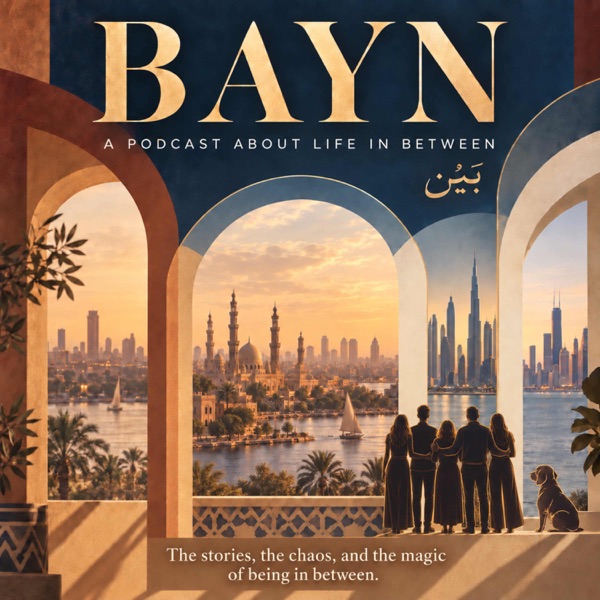
BAYN ‘بين’ - ‘Between’ In Arabic
BAYN (“between” in Arabic) is an Anglo-Arab storytelling podcast from an Egyptian‑American woman raised in Dubai who has spent her life moving between cultures, continents, and identities. Now she reflects on decades of global living, a 25‑year marriage, three kids in different life stages, and one opinionated beagle. Through honest authentic stories, BAYN explores what it means to belong everywhere and nowhere, to have all the answers and none at all, to grow through every chapter, and learn to embrace the beautiful imperfect space in between.
- On air since
- 2026
- Episodes
- 6
- Releases · typical length
- Daily · 6 min
- Latest episode
- 3 weeks ago
Episodes
6 episodes, newest first
-
1 min
Bayn | بين — Official Podcast Trailer
Show notes
Some stories don’t fit neatly into one place, one identity, or one answer.
Bayn | بين is a personal exploration of identity, belonging, and everything that exists in between.
Through stories, reflections, and honest conversations, we explore the questions that shape who we are.
Welcome to Bayn. A space for everything in between.
Get full access to Bayn at https://bayn1977.substack.com/subscribe
-
7 min
BAYN - Chapter Five - My Two Moms & A Bowl Of Beleela…
Show notes
She sat me on the balcony of our childhood home in Alexandria, distracting me by watching the passing cars in our narrow cobbled street, as the sea breeze lifted strands of hair from my sun-soaked face. She patiently scooped warm beleela (a sweet wheat and milk concoction) into my mouth. I hated beleela, but I think my grandma—who had raised eight children—knew the distraction would help her feed me with the least resistance.
My grandfather had been promoted to vice minister of maritime transport, and since Cairo has no sea, the family moved to Alexandria. I listened to the tram rattling through the city, as it had since the 1800s, while my grandmother patiently fed me and chatted rhetorically about which pharaonic month was approaching, with either a cold blast or fertile soil, or which jam she’d prepare next month: the date and cloves or the sour orange called “laring.”
I was wearing my red patent Mary Janes; no one could pry them off my feet unless I was asleep. I’m wearing them in all my childhood photos. My grandpa, dressed in his smart work suit, got into the chauffeured car downstairs. I waved, “Bye, Gedu!” Now it was just me and my Seto (one of the many Egyptian words of endearment for a grandmother). Seto is the one I chose for her.
I remember everything from that time: the couch covered in bayadat, the slipcovers from a time when furniture was made to last several lifetimes, and her knitting another tablecloth or sweater beside me. I would look forward to my aunts coming home from college or from an outing with a fiancé, and one of them giving me a bubble bath or dancing with me to an Abba song. It was a buzzing household, never a dull moment. Neighbors also often showed up unannounced, bringing tiny cookies called petit fours. They would sit gossiping over black tea with fresh mint.
I must have been about three, because soon after, my mother came to take me to Dubai, to live with her and my father. I hid behind the kitchen door while they called my name. We were going to miss our flight. Tears streamed down my face. I couldn’t bear leaving my Seto.
—————
Hello, and welcome to Bayn, which means “between” in Arabic. I’m Dalida, an Egyptian-American raised in Dubai and now living between cultures with my husband, our three kids, and a stubborn, middle-aged beagle. I share true stories about culture, family, and life in between. I change names for privacy, and I don’t preach or judge; some stories offer lessons, while others leave questions.
—————
My parents had thought it best to leave me with my grandparents while they worked as young doctors in Saudi Arabia, where life was very hard. When they moved to Dubai, things seemed stable. Then, just as they were preparing to bring me to join them, my older sister died… I’ll tell you about her in another episode. She deserves one of her own… Losing their firstborn eventually broke my parents’ marriage. As a last-ditch effort, they brought me to live with them, hoping I might help save it. I didn’t…
After my parents divorced—and before each remarried and had more kids—it was just me and my mom. The two of us became inseparable. She’d drop me off at school in her red car, go to work, and pick me up afterward. On the way home, we’d grab shawarmas (no pickles for me) or she’d cook something simple yet nutritious. Even though she hated to cook, she always made sure I ate well. She was a pediatrician after all. Our fridge was stocked only with essentials—no junk food or snacks that might invite grazing. I was never “forced” to eat anything. If I didn’t like bamya (an Egyptian okra dish I still detest), I had to endure the hunger pangs. I eat everything now, though enjoying it is another matter. Between the beleela and the bamya, I’ve apparently been refusing what’s good for me since I was two.
—————
People often say a baby’s first word is “Mama,” perhaps because the word is easy to pronounce or because a mother is often a baby’s most significant presence. I was blessed with two moms—my mother and grandmother—both strong women: a single mother who was a pediatrician, and a grandmother who had raised eight children, most of whom became doctors, dentists, or university professors.
Together, they set a high bar for future generations. They taught me to have a voice in my marriage, and to never settle on my own goals as an individual. My mother—being a single mother—taught me the importance of pursuing an education and having my “own” money, while my grandma always reminded me of her personal experience raising eight kids with the help of a husband who was a true partner. It was clear in my extended family that gender roles were blurry, which was not a very Middle Eastern or Muslim way…
I had the privilege of an upbringing in an extended family. Living with my grandparents made me an old soul, yet my mom and aunts taught me not to take myself too seriously.
I didn’t know then how much of me those women were holding up.
—————
Since then, I’ve dealt with the loss of most of these strong female presences. The loss of my sister made my parents treat me like a fragile doll. The loss of my mother broke me like nothing else—I thought—until my grandmother passed away. At that point I lost 100% of my mother figure since they were sharing that role.
In some way, I’m still sitting on that balcony: in my red patent Mary Janes, the tram going by, a bowl of beleela I’m refusing to finish, and a grandmother who knows exactly how to get me to eat it.
And in some way, I’m still riding around Dubai in my mother’s red car, munching on a shawarma sandwich with no pickles, just the way I like it.
—————
Until next time.
And maybe, before you go, think about this:
What’s your earliest memory of your mother? And what from your childhood is still with you today?
Get full access to Bayn at https://bayn1977.substack.com/subscribe
-
9 min
BAYN - Chapter Four - Dubai Wasn’t Always This Way…
Show notes
She wasn’t fasting. She was menstruating, and women are exempt from the fast then.
It was Ramadan in Dubai in the early ’80s. My mother was driving me back home from school, and she was eating an apple.
A local man saw her through the car window, cut us off, and asked us to follow him to the police station, where my mother was almost put in jail over an apple.
Luckily, my stepdad had connections to some higher-up Emiratis. He came and picked us up a couple of hours later. I was clueless at the time, but I remember I was terrified and confused: why did my strong-willed mother put up with this?
Several years later, my stepdad’s connections couldn’t help him. Despite being one of the top surgeons in the country at the time—when he treated the mother of a senior government official who unfortunately died of her illness—he was held responsible for her death, and his career was sidetracked. He went from joining his Emirati friends on their shopping trips in London by private jet to being swiftly deported.
At that point, I understood the dynamics. We were guests, and that meant we could be asked to leave at any time.
—————
Hello, and welcome to Bayn, which means “between” in Arabic. I’m Dalida, an Egyptian-American raised in Dubai and now living between cultures with my husband, our three kids, and a stubborn, middle-aged beagle. I share true stories about culture, family, and life in between. I change names for privacy, and I don’t preach or judge; some stories offer lessons, while others leave questions.
—————
When I think about Dubai, I have to hold two pictures at once: the place people know now, and the place I remember growing up. Dubai was not always this way. I watched a place become—in a relatively short time—something people around the world recognize. That changes how you look back at your own childhood. The city can feel deeply like home, and yet you can still feel like an alien in it.
Nationality and belonging there are complicated. Where you’re from is like a menu, with every nationality landing on page one, page two, or somewhere in the back—as an afterthought.
It was even more complicated at that time.
Picture sand, heat, a small city, and people from every walk of life.
There were working-class residents, local citizens, and expatriates—like us—who were divided further by nationality but shared one thing: an expiration date. Everyone knew their days in Dubai were numbered; after ten years or ten months, often without notice, they might have to leave. That could happen because of a nationalization wave, an unforeseen incident, or some other complication. So you planned for that day and felt as if you were at a station—but never at home.
—————
The way I remember it, life in Dubai was very different depending on who you were; working-class residents often lived in certain parts of the city and held service jobs, serving customers at restaurants, driving taxis around town, cleaning homes, and selling goods at countless stores, from the gold souq to the textile bazaar.
Then there were the expatriates, like us: doctors, teachers, managers, CEOs. Even among us there was a pecking order, and kids absorb these things without being told. As I remember it, Europeans and Americans sat near the top, then Arabs and North Africans like us, then Asians, many of whom worked blue-collar jobs. I didn’t question it then. I’m questioning it now.
Emirati citizens, “the locals” as we called them, wore the kandura and ghutra, and many wore a sweet, musky perfume you could smell before they reached you. I still gravitate toward scents that remind me of Dubai. My signature perfume is called Alien, which feels about right.
Life was simple and quaint in Dubai back then, compared to the progressive, glossy, and glamorous city of today, where many people aspire to live. There wasn’t much to do except eat, shop, and go to school or work. I went to a British school, so you’d never hear me say “erbs” instead of herbs or “ant” instead of aunt.
Our principal was English, and boy, was she tough. She always waited in the parking lot at drop-off to make sure there were no dress code violations (even though there was little you could do to violate the strict uniform code), but still, she’d find earrings that were too big, lip gloss that was too shiny, shoes that weren’t entirely flat, or skirts that were altered to be too short! She kept everyone in line—no matter who they were. Sadly, after she passed, her replacement bent the rules for the locals’ kids, and we started to see chunkier earrings and different shades of the approved colors.
Now that I have kids of my own, I’ve come around on uniforms: school spirit, less money spent, and no morning outfit crisis for a girl trying to catch the bus.
I had a Japanese friend who brought sushi and sashimi every day in her lunchbox, and I remember joking about the seaweed and raw fish, which I found unappealing at the time. Little did I know that sushi and sashimi would become popular foods around the world.
Other friends made me try tandoori chicken, kabsa (spiced rice with meat), and mansaf (with its flavorful yogurt sauce) before I was ten.
I was also exposed to many different dialects early on, not just flavors. Arabic alone has about 30 dialects, many sounding like separate languages, so with classmates from everywhere we often switched to English.
Once, a friend said something to my stepdad that was an insult in our dialect, but simply meant “your wife” in hers. It made us laugh, and she learned never to call the “wife” of an Egyptian man “el mara” again.
On weekends, the highlight was going horse riding with my best friend (I still call it horse riding—not horseback riding—even after living for decades here in the US).
Then we would swim with our horses to cool them off before we fed them and locked them up in their stalls. Our instructor was also British and always reminded me to hold the reins like “cups of tea.”
After that, we would go home and change into our colorful patent ballet flats, short bodycon skirts, and oversized T-shirts with embroidered badges (similar, now that I think of it, to what the waiters wore at TGI Fridays).
My friends had permed hair—mine was just frizzy—and my face was riddled with untreated acne (and a general expression of nonchalance). Lip gloss and concealer (to cover the acne) were all the makeup we needed. Laughing constantly and making fools of ourselves, as if no one was watching, was all we needed to feel pretty.
We’d head to the mall for a burger at Hardee’s, or attend a private party at one of Dubai’s huge mansions. Even those parties we went to were segregated in the sense that the kids from the British, American, and French schools would go to different parties than the ones I figure the local kids went to.
—————
But Dubai was a place where ethnicity shaped how people moved through the city. My younger brother was bullied just for being Egyptian, and ganged up on when he wouldn’t take it quietly. “Do people go to school on camels where you’re from? Do you eat koshari for breakfast?” Or simply: “Go back to your country.” I knew better. Maybe my mother’s apple incident helped me navigate my life there in a more diplomatic way than my brother?
—————
On the other hand, life was comfortable. You could walk on the beach with friends, ride your bike alone in the compound, take a cab anywhere, even as a kid. Crime was virtually nonexistent, though as my mother learned, what counted as a crime could be flexible.
There were good days and bad days. I still remember my childhood fondly, with the full-length poster of Cindy Crawford plastered on the back of my door, the Metallica posters on my wall, and the sound of Kylie Minogue’s music drifting through my Walkman.
My downtime was spent watching a romantic comedy or talking my friends’ ears off as I coiled the phone cable around my fingers and walked around the entire house with my phone that looked like a toy banana.
My mother was often on call, as doctors sometimes had to spend ni…
Get full access to Bayn at https://bayn1977.substack.com/subscribe
-
5 min
BAYN - Chapter Three - The $10,000 Question!
Show notes
Every morning, I shake his bowl, and my beagle comes running. He knows the sound of breakfast.
That Friday, I shook the bowl, and he came crawling.
—————
Hello, and welcome to Bayn, which means “between” in Arabic. I’m Dalida, an Egyptian-American raised in Dubai and now living between cultures with my husband, our three kids, and a stubborn, middle-aged beagle. I share true stories about culture, family, and life in between. I change names for privacy, and I don’t preach or judge; some stories offer lessons, while others leave questions.
—————
This week’s story is about the beagle. I wasn’t planning to tell it. I still feel that you don’t know me well enough yet for me to bring my family, or my dog, into this, and I haven’t prepared a script. I’m telling it from memory, while the emotions are still fresh.
A few days earlier, he had tried to jump onto the bed and didn’t quite make it. It was a little too high, and he fell backwards. I was across the room working (I work from home) and didn’t see how he landed. I picked him up, set him on the bed, and thought nothing of it. He ate, drank, and went on his walk as usual.
The next day he walked a little slower and seemed subdued. I figured he was bruised, so I gave him one of the arthritis painkillers his vet had prescribed earlier. He perked right up, and we went on with our day.
Then came Friday, and the crawling.
I called his vet immediately. She told me to go to the closest urgent care, since she wouldn’t have the equipment to help him. The urgent care team found a neurological problem: IVDD, or intervertebral disc disease, which is a bit like a herniated disc in humans. The fall had likely injured his spine.
They had no neurologist on call, so before sending me to the nearest pet emergency room, they catheterized him. His bladder was full, and he was in too much pain to crouch. Walking into the ER with him in my arms, I watched him finally relieve himself in the bushes by the entrance. The painkillers had given him just enough relief.
The ER confirmed it. He needed emergency surgery, and quickly. The paralysis had already spread from one hind leg to both, and without surgery he could be paralyzed for life.
The surgery would cost about $20,000.
I didn’t have $20,000 lying around, and I started to cry.
He is eight years old. He isn’t just a pet; he’s more like a son to me. My family jokes that he’s my favorite, even though I have an actual son. They aren’t entirely wrong.
Through my tears, the staff gently mentioned that there is always the option of euthanasia: a pill, a peaceful goodbye, a good life ending without pain.
I didn’t know what to decide, so I started making calls. With a little help from AI, I made a list of every clinic, hospital, urgent care, and emergency room in the area, and I called them one by one. I found quotes of $17,000 and $15,000, and the lowest was around $14,500. His pet insurance would cover a maximum of $3,000 minus a $500 deductible, meaning I’d get back $2,500 of whatever I paid up front. My friends and family told me a broken leg might have been fixed cheaply, or even for free, but there was nothing cheap about spinal surgery.
Then I remembered that my daughter’s university has a teaching hospital where future vets train. Their quote came back at $10,000 to $11,500. They gave me a range.
Before I said yes, I sat down with my family and we talked honestly about euthanasia. Then everyone pitched in, including my son, who works, and my daughter, who was interning. We paid the $10,000 and maxed out our credit cards.
He had his surgery, and he came home yesterday for six weeks of intensive care. That means no moving beyond very short potty breaks, plus physical therapy exercises around the clock. Thank God I work from home. It’s a lot, but I’m doing it happily.
—————
This podcast is about living in between, and I think this was a story about being caught between love and money, between hope and reason, and between what you can afford and what you can’t bear.
—————
Until next time.
And maybe, before you go, think about this:
If you were in my shoes, with no money to spare, what would you do for a beloved pet?
Would you let them go peacefully after a happy life, or would you give them a chance, as I did?
Get full access to Bayn at https://bayn1977.substack.com/subscribe
-
12 min
BAYN - Chapter Two - So Where Are You From?
Show notes
I will never forget how tough my first year in Egypt was. I had moved there for college and started at the American University in Cairo, where I stuck out like a sore thumb. I didn’t know the inside jokes from Egyptian movies and tamseleyat, which are the popular TV series there, because I was too busy watching Growing Pains and Beverly Hills 90210. I had no clue about the famous Egyptian celebrities, or the first thing about soccer, which is the national sport (there they call it football). I didn’t have classmates who were also my neighbors, my mother’s friends’ children, or fellow country-club members (there they call it el-nadi). Even my Egyptian dialect sounded alien and broken to people. The first question I heard was, “Where are you from?” In the country my family comes from!
—
Hello, and welcome to Bayn, which means “between” in Arabic. I’m Dalida, an Egyptian-American raised in Dubai and now living between cultures with my husband, our three kids, and a stubborn, middle-aged beagle. I share true stories about culture, family, and life in between. I change names for privacy, and I don’t preach or judge; some stories offer lessons, while others leave questions.
—
The first time I realized that “Where are you from?” was a complicated question…
I don’t actually remember…
And I think that’s because, for me, it was probably complicated before I was old enough to know that it was supposed to be simple!
You know the question.
Someone meets you, at a dinner party, a school event, a new job, in line somewhere, and eventually they ask: “So… where are you from?”
For some people, this is apparently a one-word answer.
Italy. Canada. Ohio.
I have always admired these people.
Because my answer usually requires… context.
“Well… I’m Egyptian.”
“But I grew up in Dubai.”
“And now I’m American.”
And then I watch the person’s face as they quietly try to put all of that onto one mental map.
Sometimes there’s a follow-up.
“So were you born in Egypt?”
Or: “How long did you live in Dubai?”
Or the classic: “But where are you REALLYYY from?”
And depending on how much energy I have that day… you may get the short version… or the director’s cut.
—
Growing up in Dubai, I didn’t think of myself as growing up in an unusually multicultural place.
It was just… normal.
Different accents were normal.
Different nationalities were normal.
Friends disappearing every summer to completely different parts of the world was normal.
People eating different food, celebrating different holidays, speaking different languages at home… normal.
You could spend the day surrounded by people whose families came from places thousands of miles apart and then go home that evening to your own little cultural universe.
And as a child, you don’t sit there thinking: “Wow. What a fascinating sociological environment in which I am developing my cultural identity.”
No.
You’re thinking about lunch. Or your friends. Or whether your mother is going to find out what you did.
And if you have an Egyptian mother, she sure will.
They always know.
At the time, it was just life.
But looking back now, I can see that something was happening quietly underneath all of that.
I was learning very early that there wasn’t only one way to live.
There wasn’t only one kind of family. One kind of food. One definition of normal.
And I think that stays with you.
But at home… I was Egyptian.
And Egyptians will understand this immediately:
There are certain things you don’t need explained.
There is a language beneath the language.
A look. A tone. A joke. An entire conversation that can happen with one raised eyebrow across a dinner table.
There’s the warmth. The food. The noise. The humor. The opinions.
So many opinions.
And family has a particular gravitational force.
You can move countries. You can cross oceans. You can become extremely independent.
And somehow there is still an aunt somewhere who would like to know why you have lost weight… or gained weight… or haven’t eaten enough.
Sometimes all three in the same conversation.
Egypt was heritage. Family. History. Something I inherited before I was old enough to decide what any of it meant.
But because I didn’t actually grow up in Egypt in the traditional sense, there was always another layer.
In Dubai, I was Egyptian.
Then sometimes I would be around Egyptians who had grown up entirely in Egypt and realize…
Oh.
Apparently I am also something else.
There were references I didn’t have. Like that the words “kol sana wenta tayeb” didn’t actually carry the literal meaning of “happy new year”, but meant the person wanted you to give them a tip.
Experiences I hadn’t lived. Like eating smoked fish and green onions with family during Sham El Nessim, the spring festival literally named “smelling the breeze,” and rooted in pharaonic times.
There were things that felt instinctive to them that weren’t instinctive to me. Like sensing danger, something my sheltered upbringing in Dubai never instilled in me.
But the first time it really hit me was in Cairo, my first year at AUC. I sat alone, eating my sandwich on the university steps by the library, while it seemed like everyone around me had a friend, or two, or ten. I felt so different. I even looked different. These girls looked like they’d stepped out of a Parisian fashion magazine, and carried themselves in a worldly way that made them appear to be much older.
And I think that may have been one of my earliest experiences of being between.
To belong to something completely… and still somehow stand half a step outside of it.
Years later, I moved to America.
And the question changed yet again.
Not the words.
Still: “Where are you from?”
But now the answer meant something different.
Because in America, I became much more conscious of the individual pieces of myself.
Egyptian. Raised in Dubai. Middle Eastern—or perhaps North African. An immigrant either way. Eventually, American.
And depending on who was asking, one part of the answer seemed to become more important than another.
Sometimes I would say Dubai and people assumed I meant I was Emirati.
Sometimes saying Egypt led to an entirely different set of questions.
Sometimes I would try to give the whole explanation and halfway through think:
Why am I giving this poor person my immigration documentary?
They just asked where I’m from.
But underneath the humor, there was something real happening.
Because every time someone asks you to define yourself, you have to decide which version of the truth to give them.
And when your identity is layered… every short answer feels a little incomplete.
There were moments when I felt completely at home in America.
There still are.
This is where so much of my adult life has happened. The ordinary routines that actually make a life a life.
And yet there are other moments when something tiny reminds me that another part of me comes from somewhere else.
A phrase. A smell. A family tradition. A joke that doesn’t translate properly.
A reaction I have that makes perfect sense to me and absolutely no sense to someone who didn’t grow up with the same cultural wiring.
And the reverse happens too.
I can go somewhere that is deeply familiar culturally… and suddenly notice all the ways that I have changed.
That’s the strange thing about living between worlds.
Sometimes you miss one place while you’re standing in another.
And then you go back to the place you missed… and realize you were also missing the person you used to be when you lived there.
That one took me a while to understand.
Maybe I’m still understanding it.
For years, I think some part of me assumed that eventually all these pieces would settle into one clean answer.
That someday I would reach a point where I could say:
Yes. This. This is where I belong. This is who I am.
Question answered. Case closed.
But life apparently had other plans.
Because then I had children.
And motherhood made the whole identity question even more complicated.
My children inherited the same family story… but not the same experience.
They have Egypt. They have America. They have Dubai through me, through stories, through family history, through the things I carried forward.
But they are building completely different relationships with all of it.
And even among three siblings growing up in the same family, identity doesn’t reproduce itself perfectly.
Each person takes different pieces.
One tradition matters more. One place feels more like home. One part of the family story resonates differently.
And there have been moments when my kids have looked at something from my childhood with an expression that can only be described as:
“You people lived like this?”
My kids think it’s insane that their dad and I didn’t have cell phones when we were dating. All we had were rotary landlines, so we agreed on a time and place beforehand. Once he was late to pick me up for the movies. I climbed back up five flights of stairs to call his house and yell at him, but his mother answered and said he’d fallen asleep and she couldn’t wake him. On the upside, I had until the next day to calm down.
That’s parenting across generations.
You spend half your time preserving traditions… and the other half explaining them.
And now I find myself getting older…
Somewhere along the way, my relationship with this question changed.
I don’t seem to need the answer as urgently anymore.
Maybe at 20, the question was: “Where do I fit?”
Then life becomes about other questions.
Where are we going to build our home?
What kind of family are we creating?
What are we keeping? What are we changing? What are we passing on to our kids?
And now, approaching midlife, I find myself asking something different.
Not: “Which one am I?”
But: “What did each one give me?”
What did being Egyptian give me? Probably my never ending optimism that borders on delusion.
What did growing up in Dubai give me? I’m almost sure it’s the gullibility of believing everything I’m told.
What did becoming American give me? More confidence in who I am and that I don’t need to explain the way I feel to anyone.
What did leaving places give me?
What did starting over give me? I’m still working on those last two.
And which parts have I chosen for myself along the way?
Because maybe identity isn’t a finished thing.
Maybe it isn’t a label you finally get right.
Maybe it’s more like a collection of stories.
The places. The people. The dinner tables. The airports. The goodbyes. The new beginnings.
The traditions you keep without even realizing you’re keeping them.
The traditions you intentionally let go.
The things your parents gave you.
The things you pass to your children.
And the things your children hand back to you and say:
“Yeah… we’re not doing that.”
—
So the next time someone asks me, “Where are you from?”
I will probably still give them the abbreviated version.
Because nobody standing beside me at a party needs the twelve-part limited series.
But inside, I know the answer is much longer.
—
Until next time.
And maybe, before you go, think about this:
When someone asks where you’re from, what answer do you give?
And what’s the much longer answer you carry inside?
This Substack is reader-supported. To receive new posts and support my work, consider becoming a free or paid subscriber.
Get full access to Bayn at https://bayn1977.substack.com/subscribe
Get full access to Bayn at https://bayn1977.substack.com/subscribe
Documentary lists
More Documentary shows picked out from the charts