Podcast
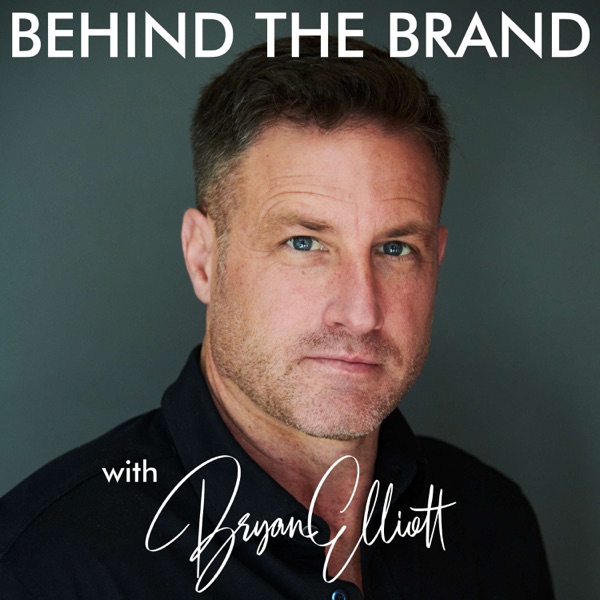
Behind the Brand with Bryan Elliott
Get Behind the Brand to learn how to build your brand. Get smarter and make more money in business by listening to my podcast with some of the smartest people on the planet. I’m Bryan Elliott, helping you build your brand.
Founded in 2008, Behind the Brand with Bryan Elliott is a show about innovators, entrepreneurs and the stories behind their success. It's like a backstage pass inside the brand strategy and marketing minds, companies and habits of some of the smartest and most interesting people on the planet. Host, Bryan Elliott decodes these stories to help you turn their wisdom into practical tactics that you can use to improve your life and grow your business. Why do this? I'm someone who loves to tell stories that I hope will inspire and educate others to find their reason for being. I basically invented the podcast I wish I had when I quit my corporate job and started my own business. I made a lot of mistakes and figured things out the hard way. I've been inspired by so many of my guests and I know you'll find a ton of value here as well. Podcast series / Marketing:
Executive Producer:
Bryan Elliott
https://thegoodbrain.com
E: producer@thegoodbrain.com
- Episodes
- 214
- Releases
- Twice a week
- Typical length
- 1 hr
- On air since
- 2019
- Latest episode
- 1 week ago
Episodes
214 episodes, newest first
-
49 min
Never Tell a Car Dealer Your Car Got Totaled. A Former Insider Explains Why
Season 18, Episode 210
Show notes
Tomi Mikula spent more than a decade inside dealerships. Now he negotiates against them for a $1,000 flat fee. Here is when to buy, where your money disappears, and how to walk out with the deal.
-
51 min
Adding the Right Amount of Mischief Can Make Anything GO VIRAL | Gabe Whaley
Season 18, Episode 209
Show notes
Adding the Right Amount of Mischief Can Make Anything GO VIRAL.
Gabe Whaley's art collective sells holy water sneakers, cartoon boots, a community-owned car and a wealth-ranking ATM. Here's what his customers buy, and how you can run the same play.
Gabe Whaley walked onto the TED stage and introduced himself as a traveling car salesman. Parked beside him sat a vintage PT Cruiser with faux wood side paneling. He was there to sell the keys.
"I have 5,000 of these keys, and every single last one of them works to that car," he told the audience. Buy one and you get access to the car. So do 4,999 other people. "Whatever happens beyond that is not necessarily my problem," he said. "Like I said, I'm just a car salesman."
The project is real. MSCHF, the art collective Whaley co-founded in 2016, released Key4All in the fall of 2022. Whoever found the PT Cruiser got to drive, until another key holder tracked the car down. For nine months, Whaley watched the PT Cruiser change hands hundreds of times, from New York to Philadelphia, across the Midwest, and out to the West Coast. Then the GPS went dark. Then a tow pound called. People kept showing up to claim the car, and every one of them held a working key.
MSCHF took the car back, no longer running, and put the PT Cruiser in a Los Angeles gallery. At the opening, Whaley noticed key holders who had flown in from around the country. They came to see the car. They stayed to meet each other, trading photos and stories about their own runs behind the wheel.
"This project was never about the car," Whaley said. "It was never about the keys. It was about the people."
His line holds the answer to the question I ask about every brand.
-
1 hr
The Lost Art of Magic | Justin Willman
Season 17, Episode 208
Show notes
Your Phone Taught You to Trust Nothing. Justin Willman Fills Theaters by Fooling You Honestly
A week before Justin Willman sat down with me for Behind the Brand, a stranger cornered him with a theory about his career. The man kept pushing one idea. "Come on, you do this just to make people feel stupid, right?"
Willman didn't get the logic. He has fooled people for a living since he was a teenager. Then he traced the idea back to the source.
"Our constant feed is something the other people are wrong, you're the smart one, you are the only sane one in this group," he told me. "And we're all being told that."
Magic runs the other direction. "It makes you feel like an untainted human again," he said. "You don't know everything. And we don't. But we like to be told we do, and our phones help us think we know everything."
His answer holds a lesson for every marketer fighting for attention on a screen.
-
55 min
Eight Sleep Sells a $1,999 Mattress Cover. Beds Have Nothing to Do With Its Business
Season 17, Episode 207
Show notes
Every afternoon during the 2026 Tour de France, a small crew from Eight Sleep raced the riders of UAE Team Emirates XRG to the next hotel. The crew, which the company calls the Night Shift, carried eight Pods into eight rooms, calibrated each one, and set the temperature before the riders walked in. The next morning the crew packed up and drove to the next stage. Twenty-one stages. Three weeks. One of those eight beds belonged to Tadej Pogačar.
"He can't sleep without our product," Eight Sleep co-founder and CEO Matteo Franceschetti told me.
I first interviewed Franceschetti on Behind the Brand in 2021. His company had raised an $86 million Series C at a $500 million valuation. In March 2026, Eight Sleep raised $50 million led by Tether at a $1.5 billion valuation. On September 23, the company launched Pod 6 at a starting price of $1,999. Franceschetti puts the old entry price near $3,000.
At Goodbrain, I push founders to answer two questions at the start of any new project. The first works from the inside out. What business are you really in? The second works from the outside in. What am I really buying when I buy your product? Eight Sleep gives a clear answer to both. Neither answer is a bed.
The company has no foam experts on staff.
Franceschetti's origin story starts with a complaint. "Elon Musk was taking me to Mars, but I was still spending a third of my life on a piece of dumb foam," he said. "How is it possible that we are building reusable rockets, but then I spend a third of my life, which could be 30 years, on a piece of dumb foam? It makes no sense."
He holds a low opinion of the mattress business. "They all buy the same foam," he said, and then charge many times more for the finished product. In his view, the last real innovation in the category came from a NASA contract. Aeronautical engineer Charles Yost invented memory foam in 1966 to make airplane seats safer in a crash.
"We don't have foam experts because we don't treat foam and we don't care about foam," Franceschetti said. "You can buy any mattress you like, cheaper or more expensive. It's your call. You put our product on top of that and you will finally get better sleep."
-
25 min
Your Pitch Starts Before the First Slide. Most Founders Miss the Opening | Vanessa Van Edwards
Season 17, Episode 206
Show notes
Vanessa Van Edwards studied hundreds of Shark Tank pitches and spent nearly 20 years on her new book, Conversation. Her verdict on smart founders is blunt. Here is what her playbook says about winning the room, and how she built a business where the book is the smallest piece.
Vanessa Van Edwards walked into a PTA meeting at her daughter's school and saw the problem in one glance. Every parent in the room was staring at a phone.
"Now my conversation is competing with their feed," she told me.
"How's the weather?" loses to Instagram every time. To win, her opener has to beat the feed today and give the other person a reason to stay off the phone next time, too.
Van Edwards founded Science of People, teaches at Harvard, and wrote Captivate and Cues, an instant Wall Street Journal bestseller. More than 75 million people have watched her on YouTube and in her TEDxLondon talk. Her new book, Conversation: How to Connect with Anyone and Make Every Interaction Count, came out from Portfolio on October 6. Vanessa told me that she researched the book for almost 20 years and kept holding the manuscript back. Then AI arrived, and she rushed to publish. We talk to our technology more than we talk to each other, she argues, and we have become "conversationally flabby."
She calls conversation skills career insurance in the age of AI. Master conversationalists get remembered faster, she told me. When an idea, an opportunity, or an invitation comes up, their names come to mind first.
-
1 hr 7 min
Sabrina Ramonov Hates Making Content. Her Content Built a Multimillion-Dollar Business.
Season 17, Episode 205
Show notes
She sold her first AI startup, then started posting TikToks. Her mom asked if she had run out of money. I believe the best way to learn anything is to model the people who are doing what you want to do at a high level.
Steal a page from Sabrina’s playbook and your chances of making your first million with AI are high.
When Sabrina Ramonov started posting TikTok videos, her mom had one question. Had she run out of money?
From a Silicon Valley point of view, the question made sense. Ramonov, then Sabrina Atienza, co-founded Qurious.io, an AI speech-analytics company, and sold the company to Pegasystems in January 2021. Forbes had already named her and her co-founder, George Ramonov, to its 30 Under 30 list in enterprise technology. Founders with an exit on the books rarely start filming themselves without makeup or fancy filters for strangers on the internet. "People thought I was being weird and cringe," she told me.
Build the tool you need
Ramonov does not love making content and she’s honest and unapologetic about it. She loves building, learning, and teaching. She is a phenomenal teacher. In my experience, being a great teacher requires equal parts patience and empathy. The “soft skills.” But these skills are hardly soft anymore as self-awareness, honesty, vulnerability and relatability are the new currency. Content is the tax she pays to reach millions of people. So she built software to cut the tax.
"I built it for myself because I'm really lazy with content creation," she said.
The tool is Blotato. On a typical Saturday, she batches 14 to 20 TikTok videos. Blotato works with AI agents, like ChatGPT and Claude, to automatically schedule social media posts across Instagram, Facebook, YouTube, Threads, X, Bluesky, and Substack. When a viewer comments a keyword, Blotato sends the prompts or resource they asked for via DM automation. The Starter plan costs $29 a month for 20 social accounts. She priced Blotato for the solo business owner "in the grind trying to make it work."
-
1 hr
This 24-year old Has the Largest Business Education Channel in the World
Season 17, Episode 204
Show notes
James Dumoulin built one of the biggest interview brands on the internet by walking up to strangers and asking how much money they make.
He co-founded School of Hard Knocks in 2021 with his brother Jack and friend Joshua Smith. The early channel gave business advice and stalled around 25,000 followers. So James flipped the format. He started cold-approaching millionaires and billionaires on the street, pointed the camera at them, and let them talk. His 2022 Mark Cuban interview changed everything.
Today School of Hard Knocks reaches more than 17 million followers and over 4 billion views across TikTok, Instagram, and YouTube. The clips run under five minutes. The business behind them runs on four engines: ad revenue, brand partnerships, high-ticket consulting, and School of Mentors, a paid community of nearly 6,000 entrepreneurs. In August 2025, James reported his biggest month yet, with 700,000 dollars in revenue and 400,000 in profit. At 23, he became a millionaire and put his first major check into a 200-unit apartment complex in Texas.
In this conversation, we cover the pivot, the real hit rate on cold approaches, the money behind the views, and what hundreds of interviews with the wealthy taught him about building wealth of his own.
Follow James and School of Hard Knocks: TikTok: https://www.tiktok.com/@theschoolofhardknocks Instagram: https://www.instagram.com/realjamesdumoulin/ YouTube: https://www.youtube.com/@theschoolofhardknocks
-
51 min
How to Build a Massive Social Following of One Million in 30 Days
Season 16, Episode 203
Show notes
Brendan Kane built a social media following of one million people in 30 days. Not with a big budget. Not with a team of 40 like Gary Vaynerchuk. Just relentless testing and a framework most people overlook entirely.
Kane is the founder and CEO of HookPoint and the author of three books: "1 Million Followers," "Hook Point: How to Stand Out in a Three Second World," and "The Guide to Going Viral." He has spent over 20 years decoding what makes content break through on social media, and his findings might surprise you.
In this episode, we dig into why storytelling is the only metric that matters, how formats rooted in 1920s entertainment still dominate today's feeds, and why 99% of creators are focused on the wrong things. Kane explains the science behind the three-second hook, what the algorithm is actually looking for, and how a creator with 10 followers can outperform one with 10 million.
We also get into the costly mistakes brands and entrepreneurs make when trying to grow on social, why copying what works for someone else usually fails, and how to find the format that fits your personality and goals before you create a single piece of content.
If you are trying to build a personal brand, grow an audience, or figure out why your content keeps falling flat, this one is for you.
Brendan Kane | https://HookPoint.com
-
52 min
Stop Being Liked. Start Being Needed. | Bestselling Author Robert Greene
Season 16, Episode 202
Show notes
Robert Greene has sold over twenty million copies of The 48 Laws of Power. His books are favorites of rapper 50 Cent and millions of people trying to get a grip on the dynamics of power. They've also been banned in prisons. He doesn't lose sleep over any of it.
In this episode, Greene takes me through the winding road that led to his first bestseller: 60-plus jobs, years living across Europe, a brutal rejection from a magazine editor, a stint in Hollywood watching power moves play out up close, and finally, a sunny afternoon in Venice where he improvised the pitch of his life to a book producer he'd just met.
Greene talks about why making yourself indispensable is the most important of his 48 laws, and what that actually looks like in practice. Don't make people like you. Make them need you. Spread your roots across a company, build a skill set nobody else has, and become the person who's too costly to lose.
He also gets into how he's handled critics throughout his career, the difference between knowing your life's task and being a con artist, and why every bad boss, dead-end job, and rejected manuscript ultimately ended up in his books.
His newest book at the time of this recording was The Daily Laws. Nothing in his career, it turns out, was wasted.
-
1 hr 20 min
Somnee Will Literally ReWrite Your Brain Waves to Help You Get Your Best Sleep
Season 16, Episode 201
Show notes
Most executives treat sleep as a variable. Something to compress when things get busy. Something to fix later. That’s the ROI brain talking: Sleep is overhead, not output.
The science disagrees. One in three people globally struggle with sleep, and the effects are not limited to grogginess. Poor sleep is linked to cognitive decline, impaired decision making, elevated anxiety, weakened immunity, and early onset dementia. If you aren’t sleeping well, you aren’t operating well. Full stop.
This is the market that Somnee is building into. The company was founded by four UC Berkeley neuroscientists, including Matt Walker, arguably the world’s leading expert on sleep science. Its product is a headband, worn for 15 minutes before bed, which reads your brainwave activity through clinical-grade EEG sensors on your frontal cortex, then uses neurostimulation to recalibrate your brain toward sleep-ready states.
Tim Rosa, Somnee’s CEO, describes it simply: If stress has your brain running at the equivalent of 220 beats per minute, the device reads that and brings it back to 90. It’s not a sleeping pill. It’s not a sleep tracker. It is the first consumer device that reads your brain and rewrites it.
“Sleep is foundational to overall health,” Rosa told me. “Not getting enough of it creates a cascade of problems. And you’re starting to see more research connecting poor sleep quality to cognitive decline as you age.”
The NBA invested in Somnee and ran a research pilot. The results: 31 additional minutes of sleep per night across the cohort. Time to fall asleep dropped from 24 minutes to eight minutes. The NFL Players Association invited Somnee to pitch during Super Bowl week. They won. Conversations are now active with the players union covering roughly 2,400 active players and more than 14,000 retired ones.
Elite athletes are the early adopters here because they understand that recovery is performance. But Rosa makes clear the product’s reach goes well beyond sports: “Whether you’re an executive, middle management, or showing up to work on time consistently, sleep affects everything.”
-
1 hr 10 min
Life Advice That Doesn't Suck from Best Selling Author Mark Manson
Season 16, Episode 201
Show notes
Life Advice That Doesn't Suck aka "The Subtle Art of Not Giving a F*ck" flips the self-help script. Instead of telling you to think positive and chase happiness, Mark Manson argues that life is full of problems and always will be. The goal isn't to avoid struggle. It's to pick the struggles worth having. What you choose to care about defines who you are.
Manson builds his case around a simple idea: you have a limited amount of attention, and most of us waste it on things that don't matter. Social approval, comfort, status. He pushes you to get honest about your values, because bad values produce bad problems. Choose better values, and your problems become more meaningful. It's not a feel-good read. It's a reality check.
-
1 hr 8 min
Here's How to Become Your Best Self According to James Clear
Season 16, Episode 200
Show notes
Perhaps one of the most aptly named individuals I’ve met, James Clear possesses a clairvoyant ability to articulate his understanding and mastery of habit formation.
His book Atomic Habits, which eclipsed the sales speed of The 7 Habits of Highly Effective People, has sold nearly 20 million copies and is one of the top books recommended by high performers.
However, he didn’t set out to write bestsellers. James’s journey from basement projects to a multi-million subscriber list is a testament to the power of resilience and adaptability. He turned early setbacks into a strategic advantage, proving that sometimes, the best plan is the one you never intended to follow.
Building a brand is like building a new habit. Despite aiming for consistency, Clear emphasizes that success in habit formation isn’t about rigid adherence but rather the ability to adjust.
Rather than fragile, unwavering discipline, Clear’s methodology is flexible enough to adapt to the relatable complexities of maintaining habits amidst life’s inevitable changes.
“The way to be consistent is actually to be adaptable,” he explains.
Your best asset could be the flexible mindset that keeps you on track even when life’s rhythms get a bit unpredictable. Rather than imploding upon routine and environmental changes, we should focus on accounting for the natural bouts of turbulence.
“Reduce the scope, but stick to the schedule,” says Clear, encouraging a flexible approach, adjusting the intensity of activities rather than skipping them entirely. This mindset is critical to avoiding discouragement and self-sabotage, which can derail long-term progress."
-
1 hr 2 min
Navy SEAL Jocko Willink Swears Success is at the Intersection of these TWO things
Season 16, Episode 199
Show notes
Jocko Willink’s story reads like an adventure novel that takes us from the serene landscapes of a small New England town into Navy SEAL training, the Iraq War battlegrounds, and a multifaceted civilian life of entrepreneurship and leadership consulting. “I always wanted to be a commando of some kind as soon as I realized that you could actually get paid to carry a machine gun,” he says.
Joining the Navy out of high school and going through the notoriously demanding BUD/S training, Jocko spent most of the next two decades on active duty as a SEAL, platoon commander, and then a task unit commander in his final deployment. Jocko took on the role of the officer in charge of all of the advanced training for the West Coast SEAL teams. His discipline and extreme personal ownership defined him not just as a soldier but as a leader among leaders.
Things are about to get real as I’m hunkered down in a small, dark bunker-style room blacked out with soundproofed walls. There’s a spotlight overhead, like a scene from a movie when someone is being interrogated. I’m sitting at a table filled with an assortment of large machetes and hunting knives.
This is Jocko’s San Diego podcast studio nestled in Victory MMA and Fitness. We talked in depth about his origin story and keen ability to spot, start, and invest in great business opportunities.
-
59 min
Here's What You Don't Understand About Strategy | Seth Godin
Season 16, Episode 198
Show notes
Seth told me, "It doesn’t matter how fast you’re going if you’re headed in the wrong direction." He's right.
Here’s my attempt to create a hierarchy for this idea:
1. Strategy = This is your approach, given all the factors, systems, games, players, and environments. It’s about who, how, and why.
2. Objectives = To-do items or steps on the path to help you achieve the goal. It’s about how you’re going to get there.
3. Tactics = The actions or individual steps for accomplishing the objectives. It’s about what you’re going to do.
“A goal might be part of strategy, but strategy is not a goal,” Seth explains. “Strategy is a goal along with a sketch that becomes a plan.”
Unlike a rigid plan, the strategy must allow for flexibility. It should act more like a compass than a fixed map, providing a directionally correct route to success rather than insisting on a singular path.
-
1 hr 35 min
Would You Risk It All for a Shot at Building a Billion-Dollar Brand With Gordon Ramsay?
Season 16, Episode 197
Show notes
Do you ever stare at a beautiful product and wonder what stories are hidden behind its journey?
The culinary poetry of the HexClad brand products begins with a hypnotizing hexagonal pattern with an intricate layer that looks like a futuristic industrial honeycomb. The brand’s hallmark design isn’t just for style points but is the result of countless refinements, merging non-stick convenience with the resilience of stainless steel.
How the AI Bubble Ate Y Combinator | Inc. Explains
The cool, polished handle reassures with its promise of quality craftsmanship. Lifting the pan, the perfectly balanced weight is designed for capable culinary precision from the likes of anyone with a basic desire to cook, all the way up to chefs with Michelin stars.
Daniel Winer designed the pan to cook the perfect steak, pasta or whatever dish today, tomorrow, and decades from now- and he stands by it with a lifetime guarantee.
-
58 min
The Hidden Talent Crisis: Red Hot Chili Peppers' Chad Smith Explains Why Cutting Music Programs Is Costing America Its Next Innovators
Season 16, Episode 196
Show notes
The Red Hot Chili Peppers’s Chad Smith is betting that music education is key to preserving the creative thinkers businesses need most...
In 2006, Sir Ken Robinson stood on a TED stage and asked a simple question: Do schools kill creativity?
76 million people have watched that talk. It’s still the most-viewed TED Talk in history. It was my honor to sit down with Sir Ken in 2014 and talk about this subject at length, and it’s still one of my most memorable interviews.
Robinson’s argument was clean. Creativity belongs in education the same way literacy, math, and science do. Instead, we rank it last. We fund it last. And when budgets get tight, we cut it first. That was nearly 20 years ago. Not much has changed. Except Chad Smith is doing something about it.
The Chad Smith Foundation launched in 2025 around three pillars: Inspiration, Access, and Support. This is followed by support via instruments, teachers, and places to play. The After-School Music Program, known as AMP, launched in Milwaukee in March 2026; Smith chose Milwaukee deliberately because his brother, Brad, and nephew, Lewis, who serves as executive director, are based there. It’s a pilot, intentional and methodical, built to figure out what actually works before scaling anywhere else.
For more information, visit http://chadsmithfoundation.org/
-
1 hr 35 min
Alex Hormozi Gave Away the Playbook. The World Got Rich!
Season 16, Episode 195
Show notes
Alex Hormozi built a portfolio of companies worth over $200 million before he turned 35. No outside funding. No famous co-founder. No viral moment that handed him an audience. He did it by studying the math of business more seriously than almost anyone in his generation, then teaching everything he learned in public. That last part is what separates him from most founders. He gave away the playbook.
The question worth asking is whether Hormozi is the greatest business educator of his era, or something bigger. His books have sold millions of copies. His content reaches tens of millions of people. But the real measure is what his audience does with it. Entrepreneurs are closing deals, pricing their offers, and scaling their teams using frameworks Hormozi posted for free on the internet. That kind of impact is hard to argue with. This episode, we find out what drives the man behind the movement and whether the GOAT conversation is even worth having.
-
24 min
Nobody Teaches THIS to Men—and they Should | Manscaped
Season 16, Episode 194
Show notes
Nobody warns you about the first time…
One morning you wake up, look in the mirror, and your face has started doing something on its own. You have hair! It starts by looking like peach fuzz or dirt above your lip. But it’s not a problem and you’re proud it’s there.
And usually without anyone showing you what to do or handing you a manual, you pick up a razor.
Just like that—and hopefully without nicks cut or other injuries— you're in the club. This is an exceptionally well designed electric razor without sharp cutting bits. Relax, you’re safe.
What they don't tell you about being in the club:
This four inches of real estate on each side of your face is sacred ground.Okay, maybe you’re outgoing and more people touch this area of your face than you realize. But that doesn’t mean this area is any less important. And if things go well in your life, a special person gets clearance to go there whenever you want.
So the thing you press against that ground matters. The ritual matters. You're not just removing hair. You're deciding, every single morning, what kind of man shows up today.
Some of us grow it out. We do this because we can. Others like it smooth like butter. Whatever the case. This is the one moment of the day that belongs to you. Men are simple. We've been told this is an insult. It's not. Simple means we know what we want. We want the game to be on.
The face, chest, pits and below the belt are the places a man actually has to manage. You can cover everything else with a hoodie. Bad day? Nobody sees it. Bad decisions? Hoodie covers the mustard on your shirt. But the face? The face is always on camera. It’s the money maker, bro.
Let’s get it.
Please support our sponsors!
This episode is brought to you by Magic Mind.
I talk to some of the sharpest founders and operators in the world on this show. And one thing I hear constantly is that the biggest challenge isn't having good ideas. It's having the mental stamina to execute them at a high level, day after day. That's exactly what Magic Mind is built for.
It's a 2-ounce daily shot with 12 clinically-backed ingredients, things like:
• Lion's Mane, and Cognizin® support memory, mental clarity, and neuroplasticity for sharper cognitive performance.
• Ceremonial-Grade Matcha, Rhodiola Rosea, Cordyceps, and Vitamin B Complex deliver sustained energy and mental stamina without jitters or crashes.
• L-Theanine, Ashwagandha, Turmeric, plus Vitamins C and D promote calm, balance your stress response, and support brain health.All designed to give you sharper focus, sustained energy, and a calmer stress response throughout your day. No jitters. No crash. Just steady, clean mental performance. I drink it in the morning before I sit down to work and lately about an hour before a tennis match. Two ounces, one shot, and I'm locked in.
If you want to feel that for yourself, go to magicmind.com and subscribe. Right now, new subscribers get 50% off their first order. That's https://magicmind.com/.
Check it out.
-
54 min
He Built a $250 Million Brand. Then He Left to Start Over | While on Earth
Season 16, Episode 193
Show notes
In 2015 Todd Meleney, a young inexperienced newcomer, helped build Nobull from a three-person startup to $250 million in annual revenue. Then just 18 months ago he walked away to do it again, from scratch, in one of the most competitive markets on the planet.
The result is While on Earth, a performance wellness footwear and apparel brand he launched in fall 2024 out of Providence, Rhode Island. Less than two years in, the brand is in hyper growth mode, operating primarily direct-to-consumer, with a product line expanding in 2026. Meleney also has three big-name pro athlete co-founders to help design, develop and legitimize the brand, including arguably the best player in the NFL who gave up a multi-million dollar deal with Nike to join them.
Meleney is a visionary entrepreneur who believes time is our most valuable currency, and he’s passionate about helping people reach their full potential through performance and wellness.
Before launching while on earth™, Todd was the award-winning CMO and first employee at NOBULL, where he oversaw marketing, content, and revenue from pre-launch to $200M+ in annual sales. He’s known for building a cult following and orchestrating some of the largest and most highly anticipated product launches in the athletic space.
In this episode, Todd talks about his philosophy behind while on earth and how he’s scaling the brand as an influential leader in athletic performance wear and wellness; lessons from growing NOBULL from the ground up and building an engaged community; collaborating with elite athletes like Christian McCaffrey and launching authentic brand partnerships that actually move the needle; his insights on marketing, product launches, and entrepreneurship in the performance wellness space.
-
1 hr 4 min
Eugene Alletto turned his $20 Rule into 33 Million Bedgear Customers
Show notes
Eugene Alletto went from making cold calls in a Wolf of Wall Street style boiler room to building bedgear into a top-10 sleep industry brand serving 33+ million customers. In this episode, he shares the counterintuitive strategies that turned bedding from a commodity into a personalized science.
Key Topics:
• Why he avoids big box stores and focuses on trained salespeople instead
• The "$20 shirt vs $2,500 suit" approach to testing business ideas
• How 300+ patents protected his innovations from larger competitors
• The four hiring values that built his company culture
• Why eliminating emotional decision-making transformed his leadership
• How his Italian last name predicted his destiny in the sleep businessBusiness Lessons:
• Start with small experiments, not big bets
• List what you don't want to do, then delegate those tasks first
• Distribution strategy matters more than product features
• Protect your innovations early with patents and trademarks
• Be proximity-ready for unexpected opportunitiesEugene breaks down how he turned a commodity market into a premium brand by solving real problems: spine alignment, temperature regulation, and personalized comfort. His mother's lesson about never playing the victim shaped both his personal resilience and business philosophy.
Whether you're bootstrapping a startup or scaling an existing business, Eugene's experience offers practical frameworks for building sustainable growth without burning through capital.
Special thanks to our sponsors:
About a year ago I was working out of a co-working space with a private office and studio in West Hollywood, and honestly? It was fine but felt more like a college dorm than a professional workspace.
I'm running a full service brand strategy consultancy and production company, meeting with serious clients, and I realized the environment wasn’t on brand for me.
Then I discovered Industrious - and here's something that blew my mind: they're actually the world's largest premium flexible workspace, with over 200 locations across 10 countries. But they don't feel corporate or stuffy at all.
What really sets them apart is their approach…
Unlike traditional co-working spaces, Industrious operates more like a hotel management model. They partner directly with landlords to create these incredible spaces, and the difference is night and day. When I walk my clients through the doors now, I can see the immediate shift in how they perceive me and my company. There's this elevation in credibility that you just can't put a price on. And I'm not alone - their members consistently report feeling "proud to bring clients here" and that the space "elevates my own sense of self so I can do better work."
The flexibility is incredible - I can scale my space up or down based on my team's needs. And with locations worldwide, I've got options whether I'm in LA or traveling for business to NYC and across the world. If you're tired of working from home or that coffee shop and you want a space that reflects your ambitions and style, you owe it to yourself to check out Industrious.
Head to https://www.industriousoffice.com/ or send me a note and I’ll personally set up a VIP tour for you in an Industrious office near you.
Marketing lists
More Marketing shows picked out from the charts










More in Marketing
Placed highest on Apple Podcasts' Marketing chart right now