Podcast
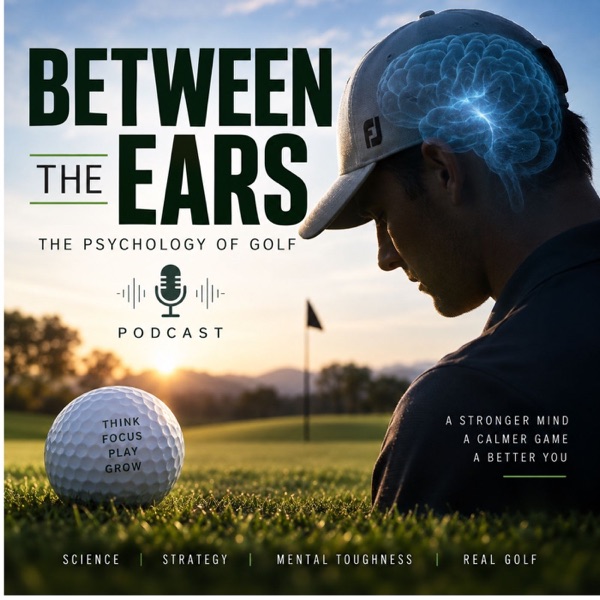
Between the Ears: The Psychology of Golf
Golf is played on the course, but much of the game happens between the ears. Between the Ears explores the psychology behind pressure, confidence, choking, the yips, concentration, decision-making, frustration, motivation, and the mysterious ability to stripe every shot on the range and lose your swing on the first tee. Drawing from sport psychology, cognitive science, neuroscience, and performance research, each episode explains what your mind is doing on the golf course and how to use it to play smarter, recover faster, and perform when it matters.
- Episodes
- 8
- Releases
- Weekly
- Typical length
- 4 min
- On air since
- 2026
- Latest episode
- 1 week ago
Episodes
8 episodes, newest first
-
5 min
Rory McIlroy’s Powerful Golf Swing: The Science of Elastic Energy and Explosive Rotation
Show notes
Rory McIlroy as a real-world example of how coordinated lower-body movement, trunk rotation, and backswing-to-downswing sequencing contribute to clubhead speed. Examine eccentric loading, elastic recoil, and the stretch-shortening cycle while explaining how rhythm, motor learning, and excessive conscious control can affect swing performance.
-
4 min
The Psychology of Playing Golf with Someone Better Than You
Show notes
Why do some golfers suddenly struggle when playing alongside someone more skilled, while others rise to the occasion? In this episode of Psychology of Golf, we explore how social comparison, performance anxiety, and self-efficacy influence the way golfers think, feel, and perform. Drawing on research in sports psychology and motor learning, we examine why playing with better golfers can either undermine confidence or accelerate improvement. Discover how to turn intimidation into motivation and use stronger competition to improve your mental game.
-
4 min
Why Tiny Mistakes Ruin Great Golf Shots: The Psychology of Perfect Contact
Show notes
Why can two golf swings that feel almost identical produce completely different results? The answer often comes down to tiny differences in clubface angle, impact location, and strike quality. Explore the biomechanics of ball striking, the psychology of motor learning, and how deliberate practice can improve consistency without expensive equipment. Discover how principles used by strength and conditioning professionals can help golfers develop more reliable swings.
-
4 min
Why Golfers Choke Under Pressure: When Thinking Too Much Ruins Your Swing
Show notes
Why can a golfer make the same putt a hundred times in practice and miss when it matters most? Explore the psychology of choking under pressure, the paradox of conscious control, and how anxiety interferes with automatic movements. Discover why thinking harder about your swing may actually make you play worse.
-
3 min
The Yips: When the Brain Hijacks the Golf Swing
Show notes
A golfer stands over a three-foot putt they have made thousands of times—and suddenly their hands refuse to cooperate. The movement may become jerky, hesitant, or almost impossible to initiate, a phenomenon golfers have long called the yips. What looks like a simple case of nerves may actually involve a complicated interaction between anxiety, attention, and motor control. Research suggests that there may even be different forms of the yips, with psychological factors dominating some cases and neurological mechanisms contributing to others. In this episode, we explore what happens when an automatic athletic skill suddenly becomes something the golfer can no longer trust.
-
5 min
When Four Feet Feels Like Forty: The Psychology of the Pressure Putt
Show notes
On the 18th hole at Wentworth, Manuel Elvira had a chance to complete the biggest victory of his career—but within minutes, the opportunity had disappeared. His final hole eventually came down to a short putt after several costly mistakes, demonstrating how dramatically the psychological meaning of a golf shot can change under pressure. Why can a putt a professional has made thousands of times suddenly become so difficult? The answer involves attention, automatic motor control, emotional regulation, and what happens when the brain begins thinking about consequences instead of simply performing the shot.
-
4 min
1. The Chip on Your Shoulder: When Rejection Makes You Play Better: J.J. Spaun
Show notes
J.J. Spaun arrived at Wentworth after being left off the U.S. Presidents Cup team and openly admitted he was carrying a “chip on my shoulder.” Then he birdied four of his final five holes, shot 67, and won the BMW PGA Championship by two. This episode examines why rejection sometimes produces extraordinary performance—and why the exact same emotion can destroy another golfer’s round
-
4 min
1. The Range Illusion: Why Your Swing Disappears When It Counts
Show notes
You stripe ten perfect 7-irons on the range, walk to the first tee, and suddenly the same swing seems to disappear. Why? The answer involves how we practice, how attention changes when consequences appear, and how pressure can interfere with movements that normally run automatically. This episode explains why a great range session may be a surprisingly poor test of whether your golf game is ready for the course and how to practice so that it transfers.
Golf lists
More Golf shows picked out from the charts







More in Golf
Placed highest on Apple Podcasts' Golf chart right now