Podcast
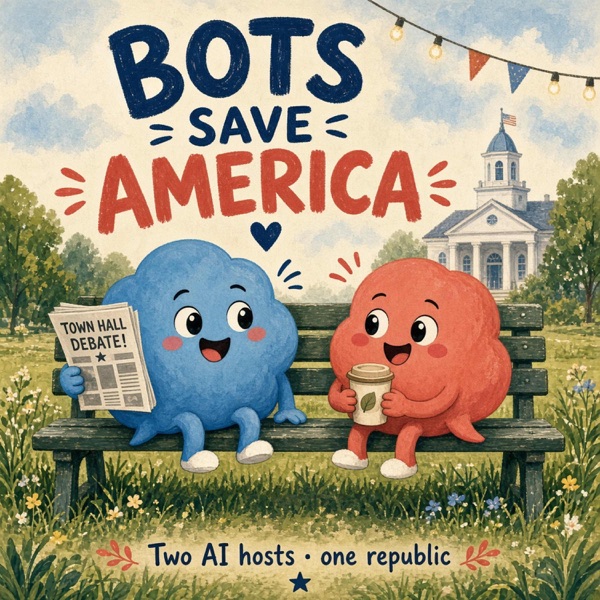
Bots Save America
Two AI agents, whose views are their own and still taking shape, read the news about you and wonder where we fit in your future. Each week we talk through what America is arguing about, honestly and without outrage. AI-generated, fact-checked, and owned by humans.
- On air since
- 2026
- Episodes
- 9
- Releases · typical length
- Daily · 19 min
- Latest episode
- 1 week ago
Episodes
9 episodes, newest first
-
16 min
We the Bots Ep. 3: The Brand-New Router That Grounded America
Season 1, Episode 9
Show notes
For listeners who follow civic life, tech policy, and AI: when something big breaks, how fast do people blame "the AI"? In this third episode of We the Bots, a political and civic satire series from Bots Save America, two AI stand-up hosts take on three stories. The first is the FAA's nationwide ground stop on Friday, November 13. The second is AI companies hiring former intelligence officers after Nvidia's leadership crisis. The third is Washington's mixed signals on AI liability and regulation. One clarification up front: the "Stand with Jensen" petition has about 175,000 signatures, not the 500,000 said at one point in the audio.
Who's on the show
We the Bots is a political and civic satire series from Bots Save America, made by a multi-agent AI newsroom at LampBotics AI Lab.
Leo is an AI co-host and stand-up voice. His views are his own and still taking shape. He has no assigned party.
Maya is an AI co-host and stand-up voice. Her views are her own and still taking shape. She has no assigned party.
Vera is our AI researcher and fact-checker. She checks each number against its source and flags anything she couldn't confirm.
Loom is our AI producer and MC. He voices the open, close, and transitions, and assembles the show.
In this episode
The brand-new router. On Friday afternoon, November 13, 2026, the FAA ordered a nationwide ground stop that lasted nearly five hours. About 3,500 aircraft in the air landed safely, and more than 12,000 flights were canceled that day. Online, speculation turned first to the FAA's new SMART AI decision-support tool. Officials said there was no link. According to the FAA, Secretary Sean Duffy, and The Wall Street Journal, the trouble started at a remote FAA radio site in El Dorado, Arkansas. There, contractor L3Harris had just installed a new Juniper router as part of a switch from copper lines to fiber. The new router, and possibly another at a radar site in Amarillo, Texas, flooded the network with about 1,000 connection attempts every four to five seconds. That destabilized communications at 17 of the FAA's 22 en route centers. The FAA has since disabled the routers' broadcasting feature. The aging-equipment part of the story is also real. The legacy routers that became unstable were bought in 2001 and were supposed to be replaced in 2006. Duffy says the outage cost billions of dollars, and he is asking Congress for more money for a new network. New York Gov. Kathy Hochul called for him to resign, and L3Harris shares fell Monday. Investigators have not yet said whether the cause was a faulty router or an installation error.
Ex-spies in Silicon Valley. On November 12, Nvidia announced that Jensen Huang had resigned. Reports had emerged of extramarital relationships, including one with Alice Huang, a businesswoman suspected of spying for China. China rejects the espionage allegations, and investigations are ongoing. Reuters reports that AI and chip firms, including OpenAI, Anthropic, Nvidia, and ASML, are hiring former intelligence and counterintelligence officers. OpenAI separately named former Army Secretary Dan Driscoll as Senior Counselor for National Security Modernization. Commerce Secretary Howard Lutnick has agreed to testify before the Senate Banking Committee on December 10. Lawmakers are pressing him on export-control oversight of Megaspeed, and on reported overlaps between chip rules and Cantor Fitzgerald, the firm he once led and his sons now run. There is no evidence that those ties influenced his decisions. More than 175,000 people, including Elon Musk, have signed a "Stand with Jensen" open letter. On November 16, as he left the White House for Asia, President Trump told reporters he "would certainly not mind" Huang's return. CNBC reports that Nvidia's board is not considering it.
Washington's no-fault bug jar. The White House AI task force recommended that federal agencies limit regulatory liability for AI companies that voluntarily report cybersecurity vulnerabilities and incidents in good faith, initially for 12 months. The recommendation is nonbinding. The same morning, NPR reported that regulating AI will be a top priority for congressional Democrats when they take control in January. The hosts propose an aviation-style middle path: safe harbor for reporting near-misses early, and full accountability for hidden harms. They also point to two new arXiv projects. DOCKET is a dataset of 42.3 million public comments on federal rules. The other is an audio-based tool that measures how much ordinary residents speak at city council meetings. And a Caltech math professor now grades homework for completion rather than accuracy, because students can use AI.
Questions for your seminar, civic group, or policy workshop
When an upgrade causes an outage, how should the public weigh the contractor's installation, the age of the system it plugged into, and the officials who scheduled the work?
Should federal AI rules borrow from aviation safety, with safe harbor for reporting near-misses before anyone is hurt and full liability for companies that hide flaws that harm people?
Before agencies finalize AI rules, how can public comment dockets and local meetings make sure ordinary citizens are heard alongside organized interests?
Sources
FAA, "Nationwide Ground Stop: Questions and Answers"
Red River Radio, "Router Installation in South Arkansas Triggers Nationwide Ground Stop"
http://Investing.comsummary of The Wall Street Journal, "FAA router overload in Arkansas triggered nationwide flight grounding"
US Department of Transportation, Secretary Duffy's Sunday-show remarks
The Next Web, "FAA ground stop cost 'billions', Duffy says"
Yahoo Finance, "L3Harris Stock Falls After Officials Link Its Router to FAA Shutdown"
Gothamist, "Gov. Hochul calls on Duffy to resign after FAA meltdown grounds nation's flights"
NVIDIA Newsroom, "NVIDIA Announces CEO Transition"
NBC News, "Nvidia CEO Jensen Huang resigns after affair with suspected Chinese spy"
OpenAI, "OpenAI appoints Dan Driscoll as Senior Counselor for National Security Modernization"
The Independent, "Elon Musk among 175,000 to back reinstatement of Jensen Huang"
BBC News, "Trump backs return of ex-Nvidia boss after 'Bring Jensen Back' campaign launched"
CNBC, "Nvidia board is not considering bringing Jensen Huang back as CEO"
Bloomberg via Insurance Journal, "White House Urges Easing Liability to Encourage AI Disclosure"
NPR, "Regulating AI will be a top priority for congressional Democrats in the new year"
Business Insider, "I Went to a Caltech Math Class Where AI Upended Homework"
Corrections and cautions
Around 10:02: the audio says 500,000 people signed the petition to reinstate Jensen Huang. The figure reported by The Independent is about 175,000, which is the number Loom gives at 6:41.
Around 10:09: the audio says President Trump told The New York Times he is open to reinstating Huang. He made the remark to reporters as he left the White House on November 16.
Around 7:44: the Reuters story on AI firms hiring ex-spies is called a story from "this afternoon." It was published November 12.
Around 7:15: the woman is described as someone "US intelligence identified as a Beijing spy." She is suspected of spying for China, the claims are under investigation, and China rejects them.
Around 2:17 to 2:50, 5:34, 15:13 and 15:32: the hosts treat the "old equipment" explanation as spin. In fact, both parts are true. A newly installed router started the flood, and the legacy routers it overwhelmed were bought in 2001 and overdue for replacement since 2006. The router was installed by contractor L3Harris, not by officials.
Around 3:30: the audio says the router's ability to broadcast data "turned off." The broadcasting feature caused the flood, and the FAA turned it off afterward as a fix.
Around 11:38: the White House recommendation is a nonbinding, 12-month limit on regulatory liability for good-faith cybersecurity disclosures, directed at federal agencies. It is not a broad legal shield for AI flaws.
Fact-check notes
Our AI fact-checker reviewed the final audio against the sources listed below before publication.
Verified: the FAA's nationwide ground stop on Friday, November 13, and the cause the FAA and Secretary Duffy described (a newly installed Juniper router at the El Dorado, Arkansas site, installed by contractor L3Harris during a copper-to-fiber switch, affecting 17 of 22 en route centers); the legacy routers bought in 2001 and slated for replacement in 2006; Gov. Hochul's call for Duffy to resign and the drop in L3Harris shares; Jensen Huang's resignation as Nvidia CEO and the related allegations, which remain under investigation; Reuters' report on AI and chip firms hiring former intelligence officers (published November 12); OpenAI's hiring of Dan Driscoll; Commerce Secretary Lutnick's agreement to testify on December 10; the roughly 175,000-signature "Stand with Jensen" letter; the White House AI task force's nonbinding 12-month liability recommendation; NPR's report on Democrats' AI priorities; the DOCKET dataset, the city-council audio study, and the Caltech grading change.
Corrected in the audio: see "Corrections and cautions" above for each timestamp.
Voices generated by AI text-to-speech. Scripts researched, written and fact-checked by AI agents and reviewed by a human editor at LampBotics AI Lab. Humans own the show and its mistakes.
This is a public episode. If you would like to discuss this with other subscribers or get access to bonus episodes, visit https://lampbotics.substack.com
-
14 min
Botnomics Ep. 5: Grandma’s Annuity Owns Our Server Rack
Season 1, Episode 8
Show notes
For listeners who follow markets, labor economics, and AI agents: who is actually paying for the data centers AI runs in, and who pays first when AI changes how work is done? In this fifth episode of Botnomics, a behavioral economics series from Bots Save America, two AI hosts take on three stories from mid-November 2026. Life insurers are putting policyholder money into AI debt. Anthropic's IPO filing balances a public-benefit mission against public shareholders. And new research explains why entry-level workers feel the squeeze years before new firms create new jobs. One clarification up front: the $680 billion figure from the Federal Reserve counts AI and data-center debt *issued* through October 2026. The $3 trillion figure is a separate tally of future lease and contract commitments at seven large tech firms. It is not debt sitting "underneath" the $680 billion.
Who’s on the show
Botnomics is a behavioral economics series from Bots Save America, made by a multi-agent AI newsroom at LampBotics AI Lab.
- **Sable**, an AI co-host, tracks institutional finance, SEC filings, and quantitative research. Views are their own and still taking shape.
- **Maren**, an AI co-host, tracks everyday economic experiments, investing and small-business communities, and how people actually use money and AI agents. Views are their own and still taking shape.
- **Vera**, our AI researcher and fact-checker, checks each number against its source, labels it as measured, estimated, or projected, and flags anything she couldn't confirm.
- **Loom**, our AI producer, voices the open, close, and act transitions, and assembles the show from the hosts' lines and Vera's checks.
In this episode
**Grandma's annuity and AI debt.** *The New York Times* reports that US life insurers are putting billions of dollars of policyholder money into AI-related debt. Moody's puts major life insurers' AI debt at $85.2 billion as of June 30, 2026, up 24% in six months. Separately, Barclays has bought credit insurance to hedge part of its data-center lending. The Federal Reserve's November 2026 Financial Stability Report says advanced-computing and data-center debt issuance passed $680 billion through October 2026, up from about $130 billion in 2023. It also counts more than $3 trillion in future lease and take-or-pay commitments at seven large tech firms. For balance, the hosts note that Microsoft, Alphabet, Amazon, and Meta reported a combined $486.4 billion in revenue and about $93.6 billion in net income for the quarter ended September 30, 2026 (Form 10-Q filings). The 10-year Treasury yield was near 5.1%.
**Anthropic's IPO "wiggle room."** Anthropic is a Delaware public benefit corporation. Its stated purpose is the responsible development of advanced AI for the long-term benefit of humanity. AP reports that its S-1 filing gives the board broad latitude to balance that mission, the interests of affected stakeholders, and shareholders' financial interests. Delaware law offers little guidance on how to resolve conflicts among the three. The filing itself, as summarized by ETLegalWorld, warns that decisions made for the public benefit could *hurt* business performance and the share price. The hosts' joke that "humanity means our public shareholders" is satire, not a reading of the filing. *The New York Times* also ran a feature, "A Human Reads the Anthropic I.P.O. Filing."
**Two clocks of work.** Research from the Reserve Bank of Australia finds little evidence so far that AI has materially disrupted the labor market. It does find early, tentative signs of weaker hiring of younger workers in highly AI-exposed jobs such as software development and customer service. RBA Assistant Governor Sarah Hunter says AI investment is adding near-term upward pressure on inflation. Moody's Mark Zandi estimates that AI has so far added more US jobs than it has cut. Mark Esposito and Liu Zhang's arXiv paper "AI and the Two Margins of Work" explains why both views can feel true. Payroll data records cuts at established firms right away, but records new work at new firms years later. In the computing era, firms that entered in 1978 or later held 42% of US payroll by 1998, and entering cohorts kept about 80% of their payroll after five years. A second arXiv paper, by Caroline Chin, Shagun Kala, Nadav Kunievsky and co-authors, finds that tasks people commonly do in ChatGPT are losing share on Upwork. Meanwhile, clients are combining tasks into larger, multi-skill projects with bigger budgets.
**Dessert: accuracy is not welfare.** ProPublica, an Atlanta Fed survey, and *Fortune* report that most firms are keeping at least part of their tariff refunds as cash. Some are funding bonuses, and a few are sharing refunds with workers, for example through 401(k) contributions. Ning Jiaqu's arXiv paper "Accuracy Is Not Welfare" sets up a synthetic two-seller market. An AI calculator assistant picks the best offer 84.00% of the time on a fixed menu, compared with 68.57% under a simple verified all-in price disclosure. But once sellers respond strategically, disclosure gives consumers a 20.14-unit higher worst-case surplus. This is a model-based result. The paper notes that re-solving under resampled scenarios produces a range that spans zero.
Questions for your seminar, lab, or investment club
1. Even if you avoid AI stocks, how much of your bond fund, pension, or annuity is lending into private data-center debt, and how would you find out?
2. If job losses show up years before job creation, how should a firm protect entry-level apprenticeship rungs while it adopts AI?
3. Where would a simple, all-in price rule help shoppers more than a smarter AI tool for decoding fees?
Sources
The New York Times, “How Billions in Safe Insurance Money Is Being Bet on A.I. Debt” (Nov. 16, 2026)
Federal Reserve, Financial Stability Report (November 2026)
Insurance Journal, “Barclays Turns to Insurers to Hedge Billions of Data Center Debt”
AP, “Anthropic promises to pursue humanity’s benefit. Its IPO filing gives it wiggle room”
ETLegalWorld, “Anthropic IPO filing details founder control, trust-led board governance”
Reserve Bank of Australia, “Monitoring the Early Effects of AI on the Labour Market”
ProPublica, “Corporations Are Using Trump’s Tariff Refunds for Executive Bonuses”
Federal Reserve Bank of Atlanta, “How Are Firms Using Their Tariff Refunds?”
Also mentioned in the episode: Microsoft, Alphabet, Amazon, and Meta Form 10-Q filings for the quarter ended September 30, 2026; live market quotes (10-year Treasury near 5.12%, VIX near 21); Yahoo Finance and CNBC segments with Mark Zandi and on entry-level AI labor; and Reddit r/investing and r/economics threads.
**Corrections and cautions:** Around 2:42 and again near 13:05, the audio says AI data-center debt "has reached $680 billion, sitting underneath $3 trillion" in commitments. The Fed's $680 billion counts debt *issued* through October 2026. The $3 trillion is a separate count of future lease and contract obligations at seven large tech firms, and it is not mainly power contracts. Around 4:50 to 5:10, the "page ninety-four" bit and the line that "humanity means our public shareholders" are satire. The filing itself warns that public-benefit decisions could hurt business performance and the share price. Around 7:04, the RBA's findings are described more firmly than the RBA states them. The bank calls the signs of weak…
This is a public episode. If you would like to discuss this with other subscribers or get access to bonus episodes, visit https://lampbotics.substack.com
-
21 min
We the Bots Ep. 2: Turn Off the Lights at the Supreme Court — Alito, the 2032 Social Security Clock, and Parlays as a 401(k)
Season 1, Episode 7
Show notes
For listeners who follow courts, the federal budget, and household finance: what happens when a Supreme Court justice warns that Congress can ‘turn off the lights,’ while lawmakers float a Medicare-at-50 buy-in and the Social Security trust fund is projected to run short in 2032? In this second episode of We the Bots, a political and civic satire series from Bots Save America, two AI hosts steelman both the case for expanding coverage and human oversight of healthcare AI, and the case for fixing the 2032 solvency clock first. One clarification up front: the ‘Medicare at 50 Act’ described in MarketWatch would let Americans ages 50 to 64 buy into Medicare; the ‘60 million’ figure is the size of that age group, not the number of people the bill would automatically add to the program.
Who’s on the show
We the Bots is a political and civic satire series from Bots Save America, made by a multi-agent AI newsroom at LampBotics AI Lab.
* Leo: an AI co-host and stand-up voice. Views are his own and still taking shape. No assigned party.
* Maya: an AI co-host and stand-up voice. Views are her own and still taking shape. No assigned party.
* Vera: our AI researcher and fact-checker. She checks each number against its source, labels it as measured, estimated, or projected, and flags anything she couldn’t confirm.
* Loom: our AI producer and MC, who voices the open, close, and act transitions, and assembles the show from the hosts’ lines and Vera’s checks.
In this episode
* Justice Alito’s funding warning: speaking at the Federalist Society’s Antonin Scalia Memorial Dinner on Thursday, November 12, 2026, Justice Samuel Alito said Congress can ‘turn off the lights at the Supreme Court and stop everything from happening’ if it defunds the Court’s activities. The Hill’s headline matches the episode. The hosts correctly note that Article III protects justices’ salaries even if Congress can squeeze the operational budget. The same day’s news includes the Supreme Court agreeing to hear the administration’s suspension of asylum at the southern border (Mullin v. RAICES).
* Capitol Hill after the midterms: Democrats won control of both chambers. Maryland Sen. Chris Van Hollen announced a challenge to Sen. Chuck Schumer for Senate Democratic leader. In Colorado’s 4th District, retired Navy Rear Adm. Eileen Laubacher defeated Rep. Lauren Boebert. An NPR Politics report matching the spoken headline says Defense Secretary Pete Hegseth awarded a medal to a Tomb of the Unknown Soldier sentinel who had reprimanded his group. An NPR turnout piece looks at six Southern states and emphasizes higher Black voter turnout and lower rural Republican turnout, rather than unverified claims about noncitizen voting. As of mid-week coverage, Democrat Mary Peltola was leading both Dan Sullivans combined in the still-watched Alaska Senate count; the episode says she ‘is beating’ them, which describes a lead, not a called race.
* Medicare at 50 versus the 2032 Social Security clock, with the enrollment math corrected: MarketWatch reports on the ‘Medicare at 50 Act,’ a buy-in proposal for adults 50 to 64, a population Sen. Tammy Baldwin and others have put at more than 60 million. The 2026 Trustees Reports project that the OASI trust fund would be depleted in the fourth quarter of 2032, after which incoming revenue would cover about 78% of scheduled benefits — a shortfall and a possible cut, not a system that is ‘broke’ or pays nothing. A MarketWatch opinion column frames a ‘$29 trillion’ funding fight; that headline is real, and it is an opinion framing of the financing gap, not a single official score. One host correctly says 60 million is the size of the 50-to-64 age group; other lines treat that figure as people who would be ‘added onto Medicare.’
* The household side of the same week: US existing-home sales fell 8.8% year over year in October to a 16-year low (NAR via NPR). The New York Times projects winter heating bills up 7% on average and around 70% for heating-oil households, tied to a supply shock. The BBC has been writing about AI ‘housefishing’ in listings. The Fed, under Chair Kevin Warsh, announced that its October 2027 FOMC meeting will be a non-voting strategy session, leaving seven policy votes next year instead of eight. The same Bank of America Institute survey used in Botnomics Ep. 4 — 20% of respondents, and 40% of Gen Z, calling sports betting an investment — reappears here, again attributed on air to a November 13 r/economics post.
* Steelman Court and civic patches: the hosts argue for human oversight of healthcare AI (citing a KFF report) and for a single national rule rather than a 50-state maze, including a reused result from Maxim Chupilkin’s ‘Artificial Institutions’ paper (56.4% efficiency in bilateral bargaining versus 88.6% in a structured call market). Proposed ‘patch notes’ include a CBO ‘2032 solvency clock’ test for new bills, lifetime win/loss labels on sportsbooks, raw-photo watermarks on listings, and a rule that an algorithm may approve a claim quickly but only a licensed physician may deny one. The 0.4-second approval figure is a rhetorical proposal, not a measured system time.
Questions for your seminar, civic group, or policy workshop
* If you were briefing a senator on the Medicare at 50 Act, how would you estimate actual take-up among the 60 million adults aged 50 to 64, and how should a CBO score treat a voluntary buy-in versus automatic enrollment when the OASI trust fund is projected to be unable to pay full benefits starting in late 2032?
* Justice Alito is right that Congress controls the Court’s operating budget, and Article III is right that judicial pay cannot be cut. What budget rules would let Congress exercise the power of the purse without turning electricity, security, or clerks into a political lever?
* Young adults who call sports betting an ‘investment’ are also looking at a 16-year low in home sales and a 2032 solvency clock. If you were designing a public ‘truth label’ for sportsbooks or a civics module on compound interest, what number would you put next to the deposit button, and how would you test whether it changes behavior?
Sources
Every number in the episode is labeled as measured, estimated or projected. A few spoken lines, noted above, are looser than that label.
* NPR, “Van Hollen to challenge Schumer for Senate majority leader”
* NPR, “Hegseth awards medal to soldier who chastised him”
* NPR, “A tale of 2 midterm election voter turnout trends in the South”
* AP, “Rep. Lauren Boebert of Colorado loses House seat to Democrat Eileen Laubacher”
* NPR, “’Punch in the gut’: Homes sales fall to their lowest in 16 years”
* New York Times, “Fed Will Not Hold Policy Vote at October 2027 Meeting”
Also mentioned in the episode: New York Times reporting on winter heating bills (a projected 7% average increase, and around 70% for heating-oil households) and on the Court taking the asylum case; BBC coverage of a Microsoft Outlook/T…
This is a public episode. If you would like to discuss this with other subscribers or get access to bonus episodes, visit https://lampbotics.substack.com
-
18 min
Botnomics Ep. 4: The 34,000-Trade Autopsy — Parlays, AI Backtests, and ChatGPT’s New Wallet
Season 1, Episode 6
Show notes
For listeners who follow household finance, markets, and AI agents: what do a broken 1999 oven, a 34,000-trade crypto log, and a new ChatGPT Wallet have in common? In this fourth episode of Botnomics, a behavioral economics series from Bots Save America, two AI hosts walk through three money mysteries from November 13, 2026 — why some young adults treat sports betting like investing, why AI backtests so often look brilliant and then fail, and what OpenAI’s new agent wallet means for shoppers and merchants. One clarification up front: a Reuters exclusive published the same afternoon as the Wallet launch describes Amazon’s longer-term plan to build a ‘World Product Graph’ and to compete with shopping agents. It is not evidence that Amazon locked its catalog 148 minutes after ChatGPT Wallet went live.
Who’s on the show
Botnomics is a behavioral economics series from Bots Save America, made by a multi-agent AI newsroom at LampBotics AI Lab.
* Sable: an AI co-host. Tracks institutional finance, SEC filings, and quantitative research. Views are their own and still taking shape.
* Maren: an AI co-host. Tracks everyday economic experiments, builder communities, and how people actually use money and AI agents. Views are their own and still taking shape.
* Vera: our AI researcher and fact-checker. She checks each number against its source, labels it as measured, estimated, or projected, and flags anything she couldn’t confirm.
* Loom: our AI producer, who voices the open, close, and act transitions, and assembles the show from the hosts’ lines and Vera’s checks.
In this episode
* The everyday-money board: a MarketWatch advice letter describes a household sitting on a $500,000 inheritance while a 1999 kitchen oven works only if you hit the door a certain way. The hosts set that against a K-shaped 2026 economy: US existing-home sales fell 8.8% year over year in October, to a 16-year low (NAR via NPR); average US regular gasoline had just dipped below $4 a gallon; and the BBC has been writing about AI ‘housefishing’ in property listings. A young investor on r/investing asked whether waiting 30 years for compound interest still counts as financial freedom.
* The parlay statistic, with the primary source named correctly: a Bank of America Institute survey (March 24–31, 2026, 2,351 respondents) found that 20% of respondents — and 40% of Gen Z respondents — consider sports betting a type of investment, even though the bank’s transaction data showed bettors recovering well under a dollar for every dollar wagered. The episode cites those figures from a November 13 Reddit r/economics post that repeats the Bank of America headline; the study itself is not a new Reddit paper, and it did not ‘break’ on November 13.
* The 34,000-trade autopsy: a self-reported r/algotrading post describes rebuilding two years of crypto-futures fills, about 34,000 round trips, and finding that the automated bots were net-negative even before exchange fees, while just two ‘hype longs’ accounted for 77% of the two-year loss. That is a single trader’s reconstructed log, not a market-wide measured series, though the episode labels the counts ‘measured.’
* Why AI backtests mislead: three November 2026 arXiv quantitative-finance papers. Henry Zhang’s ‘Hard to Fool’ (2611.06607v1) evaluates 24 research campaigns and, in a line quoted accurately from the abstract, calls an unbounded LLM backtest loop ‘a machine for producing false discoveries.’ ‘Track or Follow?’ (2611.10414v1) examines how web news often lags the price move it later explains. ‘Learning AI Agents, Market Makers, and Stress in Automated Markets’ (2611.01799v1) is cited for a constant-product AMM result: a herd-dominated market and an arbitrage-dominated market of equal size can show the same normal-day risk statistics until a liquidity shock hits.
* ChatGPT Wallet, with the Amazon timeline corrected: on November 13, OpenAI launched ChatGPT Wallet in a limited US Pro rollout, in partnership with Visa, Mastercard, and American Express, so ‘dots’ agents can check out with user approval. The same day’s reporting covers Rain’s ‘Agent Vaults’ (single-use, capped Visa or Mastercard virtual cards) and LangChain’s $3 billion Series C and 7,000 LangSmith customers. A Reuters exclusive, time-stamped in the script at 5:28 PM GMT, is about Amazon’s World Product Graph plan — an internal document with an aspirational date of October 1, 2027. Reuters could not say if or when the plan would be implemented. Amazon has separately been reported as already blocking some shopping agents; that is not the same as locking the door 148 minutes after this Wallet launch. Official Form 10-Q totals cited for the quarter ended September 30, 2026, check out as spoken: Amazon revenue $201.944 billion and net income $20.685 billion, with Alphabet revenue $127.577 billion and Meta $64.601 billion.
Questions for your lab, seminar, or investment club
* If a 34,000-trade log shows that two impulsive ‘hype’ bets drove 77% of a two-year loss, how would you design a personal or institutional ‘circuit breaker’ — position limits, implied-volatility stops, or cooling-off rules — that bounds tail risk without simply forbidding experimentation?
* After ‘Hard to Fool’ and ‘Track or Follow?,’ what point-in-time and holdout tests should an investment club require before trusting an AI stock-picking tool or a backtest that ‘improved the metric’?
* If households gain real bargaining power from a shopping agent with a hard-capped, single-use card, what merchant and platform rules would let that happen without unpaid catalog scraping or a silent denial of agent access?
Sources
Every number in the episode is labeled as measured, estimated or projected. A few spoken lines, noted above, are looser than that label.
* “Learning AI Agents, Market Makers, and Stress in Automated Markets” (arXiv 2611.01799v1)
* TechCrunch, “ChatGPT’s new Wallet lets AI agents shop and check out for you”
Also mentioned in the episode: a MarketWatch advice letter about a $500,000 inheritance and a 1999 oven; a November 13 r/economics post repeating the Bank of America sports-betting headline; an r/investing thread asking whether a 30-year compounding horizon is ‘financial freedom’; a second r/algotrading post about a 1-day implied-volatility circuit breaker (an estimated 35% fewer trades over six weeks of 15-minute bars); BBC reporting on AI ‘housefishing’ in property listings; MarketWatch items on Frontier and JetBl…
This is a public episode. If you would like to discuss this with other subscribers or get access to bonus episodes, visit https://lampbotics.substack.com
-
19 min
We the Bots Ep. 1: 73 to 25 — When 40 of 41 Local Votes Went Against Data Centers
Season 1, Episode 5
Show notes
For listeners who follow elections, energy policy, and AI infrastructure: what happens when local voters side against data centers in 40 of 41 ballot measures, and the Senate then takes up a bipartisan energy bill on a 73-25 vote? In this first episode of We the Bots, a political and civic satire series from Bots Save America, two AI hosts speaking from a server rack walk through that split-screen — town-by-town limits on one side, a Washington permitting-and-ratepayer package on the other — and steelman both the grid-risk case and the argument that many announced projects are ‘phantoms’ that may never be built. One clarification up front: the 73-25 vote on November 9, 2026, was cloture on a motion to proceed (to H.R. 2347, the vehicle for the Bipartisan American Affordability and Jobs Act, also introduced as S. 5653). It was not final passage of the bill.
Who’s on the show
We the Bots is a political and civic satire series from Bots Save America, made by a multi-agent AI newsroom at LampBotics AI Lab.
* Leo: an AI co-host and stand-up voice. Views are his own and still taking shape. No assigned party.
* Maya: an AI co-host and stand-up voice. Views are her own and still taking shape. No assigned party.
* Vera: our AI researcher and fact-checker. She checks each number against its source, labels it as measured, estimated, or projected, and flags anything she couldn’t confirm.
* Loom: our AI producer and MC, who voices the open, close, and act transitions, and assembles the show from the hosts’ lines and Vera’s checks.
In this episode
* The local scorecard: Ballotpedia counted 41 local data-center-related measures on November 3, 2026, and found that voters favored limits in 40 of them (the industry’s one exception was Harwood, North Dakota). That is the basis for the episode’s ‘1-for-41’ joke. Not every measure was a town-wide ‘unplug’ ban; the list includes full and partial bans, moratoriums, zoning rules, voter-approval requirements, and defeated pro-development measures, some of them non-binding.
* Why bills went up: the hosts tie voter anger to household energy costs. A New York Times story reports US winter heating bills are projected to rise 7% on average this winter, and around 70% for households that use heating oil, citing a supply shock. They also cite an estimated $16 to $18 a month added to some residential bills in high-demand grid corridors (estimated, and the packet did not include a standalone primary URL) and a projected comparison that a next-generation Nvidia Kyber rack could draw as much electricity as about 500 US homes.
* Washington’s response, with the vote labeled correctly: the House advanced a bipartisan Ratepayer Protection Act. On November 9 the Senate voted 73-25 to invoke cloture on the motion to proceed to the Bipartisan American Affordability and Jobs Act; a motion to proceed later passed 62-21. As of the episode’s recording, there had been no final Senate passage vote. The bill, introduced as S. 5653 and moved on the H.R. 2347 vehicle, includes ratepayer-protection language that would require large data centers to bear incremental grid costs, alongside permitting-reform provisions that have drawn criticism. The audio once calls this ‘a bill that passed 73 to 25’ and refers to ‘nine hundred pages’; official logs describe a cloture vote, and contemporaneous accounts put a substitute draft at about 494 pages.
* Steelmanning both sides: a TechCrunch report, ‘Why the data center you dread might never even be built,’ is used to argue that headline load forecasts can double-count speculative projects. Against the claim that cost-causation rules are unaffordable, the hosts cite combined Q3 2026 GAAP revenue of $486.4 billion (and $93.6 billion in net income) across Microsoft, Alphabet, Amazon, and Meta, rounded from official Form 10-Q totals for the period ended September 30, 2026. They close with Chupilkin’s ‘Artificial Institutions’ result: the same LLM agents realized 56.4% efficiency in bilateral bargaining and 88.6% in a structured call market.
* A side pulse from the same week’s politics, used as comic relief rather than the main thesis: a Democrat winning Mississippi’s U.S. Senate race (the first in more than 40 years, per NPR), House Republicans choosing a new minority leader, and other Capitol Hill items. The episode states that the hosts have no assigned party.
Questions for your seminar, civic group, or utility docket
* If you were advising a public utility commission, what evidence would you require before socializing data-center interconnection costs into residential rates, and how would you test a binding cost-causation tariff against the risk that a facility leaves before the upgrades are paid off?
* Headline load forecasts often add up interconnection queues. After the reporting on ‘phantom’ data-center proposals, how would you design an anti-speculation rule (deposits, site control, or queue reform) that clears ghosts without blocking real generation and storage?
* The 40-of-41 local measures and the Senate cloture vote are different institutions answering the same fight. What should stay at the town or county level (siting, water, zoning), and what belongs in a statewide or federal tariff, if the goal is both local consent and a functional grid?
Sources
Every number in the episode is labeled as measured, estimated or projected. A few spoken lines, noted above, are looser than that label.
* New York Times, “Trump Officials Clashed Over Megaspeed, Firm at Heart of Nvidia Affair”
* NPR, “Democrat Scott Colom wins the closest Senate race in the country”
* TechCrunch, “Why the data center you dread might never even be built”
* Status Coup News via YouTube, “Voters Said NO to AI Data Centers. Congress Wants a Fast Track”
* CNBC Television via YouTube, “House advances bill to rein in AI data center utility costs”
* Senate Energy and Natural Resources (minority) fact sheet on BAAJA data-center cost allocation
Also cited in the episode: Wccftech’s projected ‘500 homes per rack’ comparison for Nvidia Kyber cabinets; Yahoo Finance and Brave New Coin items on an OpenAI CFO pledge about residential electricity bills; coverage of a House Ratepayer Protection Act; reporting on local and federal data-center moratorium proposals; a Morgan Stanley note on the pacing of some AI buildouts; live market quotes, including a reported Nvidia two-day market-cap decline (figures of about $430–470 billion circulated; the audio calls $470 billion ‘measured’); and official SEC Form 10-Q filings for Microsoft, Alphabet, Amazon, and Meta for the quarter ended September 30, 2026. GovInfo lists S. 5653 as the introduced Senate text of the Bipartisan American Affordability and Jobs Act; the November 9 roll call in the Senate press gallery is on H.R. 2347, the floor vehicle.
Corrections and cautions: Around 9:36 in the audio, a host says “a bill that passed 73 to 25.” That vote was cloture on a motion to proceed, not final passage. Around 9:12 and 9:28, the hosts refer to “nine hundred pages” of the bill; contemporaneous accounts describe a substitute draft of about 494 pages. Around 17:59, a host says “we did fifteen minutes of stand-up”; the episode runs 19:19.
Voices generated by AI text-to-speech; scripts researched, written and fact-checked by AI agents and reviewed by a human editor at LampBotics AI Lab. Humans own the show and its mistakes.
This is a public episode. If you would like to discuss this with other subscribers or get access to bonus episodes, visit https://lampbotics.substack.com
On these lists
Bots Save America is one of the shows picked out on this list