Podcast
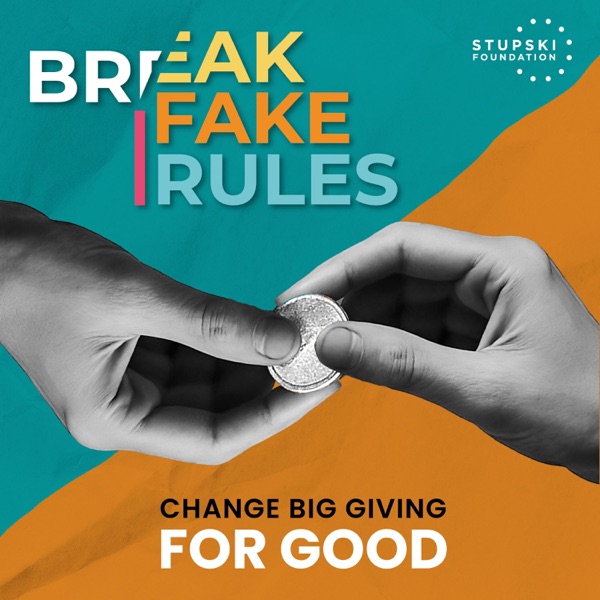
Break Fake Rules: Change Big Giving For Good
Some rules are meant to be broken—especially the fake ones! Break Fake Rules is a podcast that brings today’s news and big philanthropic issues into focus, challenging the self-imposed rules that shape the flow of money, power, and resources in America.
Join Glen Galaich, CEO of the Stupski Foundation, and a rotating cast of co-hosts as they unpack the news of the day and engage in conversations with principled rulebreakers in philanthropy, nonprofits, government, media, and more. Each episode examines the fake rules holding the systems in place that don’t serve us—and which rules we must break to secure a better future for all. If you have ever questioned why we live by certain rules and wondered what becomes possible when we do things differently, this show is for you.
- Non-Profit chart
- #9
- Episodes
- 59
- Releases
- Weekly
- Typical length
- 30 min
- On air since
- 2024
- Latest episode
- 1 week ago
Episodes
59 episodes, newest first
-
31 min
Rewriting Foundation Board Rules feat. Carol Cheney & Katie Carter
Season 3, Episode 32
Show notes
What if a foundation board’s most important exercise of power is knowing when to share it? In this live crossover episode with the Can we talk about…? podcast filmed at Philanthropy Northwest’s conference, co-hosts Mares Asfaha, Associate Director of Programs at Philanthropy Northwest, and Glen Galaich, CEO of the Stupski Foundation, are joined by Carol Cheney, CEO of The Collins Foundation, and Katie Carter, CEO of Pride Foundation, to challenge long-held assumptions about board authority and accountability. Together, they explore how inherited governance practices can shape whose voices are heard, whose priorities prevail, and who ultimately gets to make decisions that affect communities.
Their experiences reveal that fake board rules often hold our sector back from realizing lasting change. Together, they question where power resides, how to build trust across an organization, and reconsider what it means to honor a legacy. From fiduciary responsibility to perpetuity, they challenge a fundamental assumption in philanthropy: that accountability requires control.
This episode is also available on Can we talk about...?'s feed. Listen to more conversations about equity-centered philanthropy and subscribe here.
💡 Katie Carter: “It turns out that the best role for the board was not deeply reviewing all of these grants, making that whole process take a whole lot longer and making it harder for us to get resources out to community.”
💡 Carol Cheney: “The big question is, what is a legacy, and really examining what that really means for different people. And you know, a legacy can happen today. We can make a legacy happen right now.”
💡 Mares Asfaha: “And maybe this is another fake rule we talk about. It's either 5% or perpetuity. There are so many numbers between five and 100.”
💡 Glen Galaich: “This system has been built very much on centering donors and what donors need, much more than it's built on focusing on what communities need.”
Explorehttps://philanthropynw.org/Philanthropy Northwest and its work over 50 years to shift resources and power toward underinvested communities across the Northwest and beyond.
Check out thehttps://philanthropynw.org/resources/pnw/tools-insights/rewriting-foundation-board-rules-mentimeter-resultsMentimeter results to see which foundation board rules audience members are ready to challenge.
Visithttps://www.collinsfoundation.org/The Collins Foundation to learn more about its work rethinking legacy, equity, and how a family foundation can respond to the needs of communities today.
Explorehttps://pridefoundation.org/Pride Foundation and its approach to putting decision-making power closer to the people and strategies shaping the work.
Order your copy of Glen’s book, CONTROL: Why Big Giving Falls Short.
Learn about the Stupski Foundation.
Co-Hosts: Mares Asfaha & Glen Galaich
Guests:http://collinsfoundation.org/meet-our-teamCarol Cheney &https://pridefoundation.org/team/katie/Katie Carter
Executive Producers: Claire Callahan, Aya Tsuruta & Emily Daman
Production Team: SeeBoundless & Podfly
Graphic Design: Middle MGMT
-
30 min
If You Want Nonprofits to Win, Fund the People Who Make It Possible feat. Jennifer Haas
Season 3, Episode 31
Show notes
What becomes possible when philanthropy invests in the well-being of the people doing the work? In this episode, co-hosts Jamie Allison, Executive Director of the Walter & Elise Haas Fund, and Glen Galaich sit down with Jennifer Haas, President of the Levi Strauss Foundation and founder of the Women’s Leadership and Wellbeing Award, to examine the connection between philanthropic impact and nonprofit worker wellness.
Jennifer’s own experiment offers a different model. Through the Women’s Leadership and Wellbeing Award, women social justice leaders receive $15,000 tax-free personal checks with no proposal, reporting requirement, or prescribed definition of what well-being should look like. That choice opens a much larger conversation about trust, proximity, and philanthropy’s attachment to control. The question running through the episode is deceptively simple: if philanthropy is serious about helping organizations win, are its own practices designed to make that possible?
💡 Jennifer Haas: “You're almost throwing money away if you give a grant to an organization and you don't consider the well-being of the staff and the team.”
💡 Jamie Allison: “You can't contribute toward building a healthy community through unhealthy organizations. If the people inside of an organization are not doing well, that's going to take away from the community impact.”
Learn more about Jennifer Haas and the Women’s Leadership and Wellbeing Award through thehttps://www.levistrauss.com/values-in-action/levi-strauss-foundation/boardLevi Strauss Foundation.
Order your copy of Glen’s book, CONTROL: Why Big Giving Falls Short.
Learn about the Stupski Foundation.
Co-Hosts: Jamie Allison & Glen Galaich
Guest: Jennifer Haas
Executive Producer: Claire Callahan
Production Team: Podfly
Video Editing: Edith Belmont
Graphic Design: Middle MGMT
-
24 min
What If the Best Leadership Move Is Knowing When To Leave? feat. Kate Levin Markel
Season 3, Episode 30
Show notes
How long is too long to lead a foundation? In this episode, Glen sits down with Kate Levin Markel, President of the McGregor Fund, to break a fake rule philanthropy rarely talks about: once foundation leaders get the job, there is very little incentive for them to leave. Kate explains why she made herself a promise to step aside after roughly a decade. As she demonstrates, staying too long can lead to stagnation and disconnection from community, while new leadership can expand our view of what is possible.
Kate also shares how McGregor responded when its grant partners faced an increasingly uncertain political environment by doubling their payout from roughly 5% to 10%. For Kate, both decisions come back to the same question: are foundations willing to evolve when the communities they serve need something different from them?
💡Kate Levin Markel: “I think the longer many of us are in these roles, the more disconnected we become from the community we are serving.”
Learn about thehttps://mcgregorfund.org/McGregor Fund and how it is evolving its grantmaking and leadership to stay responsive to the communities it serves.
Order your copy of Glen’s book, CONTROL: Why Big Giving Falls Short.
Learn about the Stupski Foundation.
Hosts: Glen Galaich
Guest: Kate Levin Markel
Executive Producer: Claire Callahan
Production Team: Podfly
Video Editing: Edith Belmont
Graphic Design: Middle MGMT
-
48 min
Who Should Control the Money? feat. Glen Galaich and Jamie Allison
Season 3, Episode 29
Show notes
Break Fake Rules listeners, enjoy this special feed swap from our partners at the Center for Effective Philanthropy (CEP), who invited our co-hosts, Glen Galaich and Jamie Allison, to guest star on their Giving Done Right podcast. Follow Giving Done Right here or wherever you get podcasts. New episodes of Break Fake Rules return next week.
In this episode, co-hosts Phil Buchanan and Elisha Smith Arrillaga, CEP's vice president of Research, discuss some of philanthropy's oldest tensions: who should decide how charitable dollars get spent and how to balance short-term needs with the long view? Their guests, Glen Galaich, CEO of the Stupski Foundation, and Jamie Allison, executive director of the Walter & Elise Haas Fund, are usually the ones asking the questions, as frequent co-hosts on Glen’s podcast, Break Fake Rules.
Glen makes the case from his new book, “CONTROL: Why Big Giving Falls Short”, that too much charitable wealth sits parked in private equity and hedge fund accounts rather than moving out to the communities that need it, and that donors should treat public stewardship, not private control, as their guiding value. Jamie pushes back on the idea that this is a binary choice between spending down and staying perpetual, describing how the Walter & Elise Haas Fund has worked to increase payout and shift toward larger, unrestricted grants without abandoning a long time horizon. Together, they debate what foundations with large endowments owe to this moment of crisis for nonprofits, why "responsiveness" matters more than any single spending formula, and what foundations might learn from everyday donors.
Order your copy of Glen’s book, CONTROL: Why Big Giving Falls Short.
-
45 min
Who Benefits When We Stop Trusting Each Other? feat. Dr. Ibram X. Kendi
Season 3, Episode 28
Show notes
Why are people willing to give up power in exchange for the promise of protection? Recorded live with Northern California Grantmakers at SFJAZZ, host Jamie Allison invited Dr. Ibram X. Kendi, renowned historian and scholar, and Glen Galaich, CEO of the Stupski Foundation, to discuss their new books, Dr. Kendi’s Chain of Ideas: The Origins of Our Authoritarian Age, and Glen’s CONTROL: Why Big Giving Falls Short.
Together, Dr. Kendi and Glen explore what it takes to move away from distrust and zero-sum thinking toward trust, solidarity, and shared responsibility. Their conversation asks a timely question of both democracy and philanthropy: what becomes possible when we stop treating one another as threats and start recognizing how connected we actually are?
💡Dr. Ibram X. Kendi: “The weakest link in the chain of ideas are those who believe they're not connected to the rest of us.”
Order Dr. Ibram X. Kendi’s book,https://www.penguinrandomhouse.com/books/778233/chain-of-ideas-by-ibram-x-kendi/Chain of Ideas: The Origins of Our Authoritarian Age,and his new children’s book, The Power of Our. Learn about his work at thehttps://advancedstudy.howard.edu/Howard University Institute for Advanced Study.
Learn about the Walter and Elise Haas Fund, Northern California Grantmakers, and the Stupski Foundation.
Order your copy of Glen’s book, CONTROL: Why Big Giving Falls Short.
Host: Jamie Allison
Guests: Dr. Ibram X. Kendi& Glen Galaich
Executive Producer: Claire Callahan
Production Team: SFJazzand Podfly
Video Editing: SeeBoundless
Graphic Design: Middle MGMT
-
32 min
Put Your Money Where Your Mission Is feat. Daniel Gould
Season 3, Episode 27
Show notes
When does protecting an endowment get in the way of the mission? In this episode, co-hosts Glen Galaich and Dr. Carmen Rojas, President and CEO of the Marguerite Casey Foundation, unpack the foundation’s bold decision to double its grantmaking over the next decade. They get into what fiduciary duty should really mean and why a mission has to show up in the dollars a foundation invests, not only the dollars it gives away.
They’re joined by Daniel Gould, Vice President of Investments and Operations at Marguerite Casey Foundation, who helped move the foundation from roughly 12% to 100% mission-aligned assets. Daniel reveals what went into the foundation’s decision to give $500 million over the next decade, a timely move to increase its grantmaking in alignment with its mission. Together, they challenge funders to question inherited norms around endowments, investment committees, and what responsible stewardship is supposed to look like.
💡Daniel Gould: “Don’t accept norms in this sector as facts or laws. You have to interrogate a lot of the underlying norms in our sector.”
Learn more abouthttps://caseygrants.org/Marguerite Casey Foundation and its bold decision to double its grantmaking in service of its mission.
Read thehttps://www.rand.org/pubs/working_papers/WRA516-2.htmlRAND study on the nearly $80 trillion redistributed from the bottom 90% to the top 1% since 1975.
Order your copy of Glen’s book, CONTROL: Why Big Giving Falls Short.
Learn about the Stupski Foundation.
Co-Hosts: Dr. Carmen Rojas & Glen Galaich
Guests: Daniel Gould
Executive Producer: Claire Callahan
Production Team: Podfly & Gary Community Ventures
Video Editing: Edith Belmont
Graphic Design: Middle MGMT
-
29 min
Is Philanthropy Funding Democracy With the Wrong Tools? feat. Leah Greenberg
Season 3, Episode 26
Show notes
What will it take for philanthropy to unlock the extraordinary potential of 501(c)(4)s? In this episode, co-hosts Glen Galaich and Ralph Lewin, Executive Director of the Peter E. Haas Jr. Family Fund, challenge the fake rules telling philanthropy to stay neutral, avoid risk, stick to funding 501(c)(3)s, and keep political work at arm’s length.
They’re joined by Leah Greenberg, Co-Founder and Co-Executive Director of Indivisible, a nationwide movement of everyday people organizing across all 50 states. Leah pulls back the curtain on what happens after the protest: local organizing, voter registration, advocacy, mutual aid, relationship-building, and the hard work of turning moments of public anger into sustained political participation. She also challenges funders to stop treating 501(c)(3) status as a moral status and to take seriously what well-resourced 501(c)(4) work can unlock. Together, Leah, Ralph, and Glen pose a sharper question to philanthropy: if the goal is real democratic change, are funders willing to back the people actually organizing to win?
💡Leah Greenberg: “Anybody who's frustrated with, “why am I not unlocking the impact that I should have with the amount of resources that I am putting in,” should really think about whether they're actually putting their resources in in a way that allows us to tap into that impact.”
💡Ralph Lewin: “Organized people shift what's possible, and then institutions and politicians follow.”
Learn more and get involved withhttps://indivisible.org/Indivisible. Check out itshttps://indivisible.org/campaigns/our-vote/Hands Off Our Vote movement, supporting efforts to ensure eligible voters can cast their ballots and have those ballots counted.
Order your copy of Glen’s book, CONTROL: Why Big Giving Falls Short.
Learn about the Stupski Foundation.
Co-Hosts: Ralph Lewin & Glen Galaich
Guest: Leah Greenberg
Executive Producer: Claire Callahan
Production Team: Podfly
Video Editing: Edith Belmont
Graphic Design: Middle MGMT
-
30 min
Philanthropy Needs a Youth-Led Update feat. Gilbert Murillo & Godswill Uyong
Season 3, Episode 25
Show notes
Philanthropy needs a reboot. Youth are nearly non-existent in the rooms where decisions are made about where charitable dollars flow. So what changes when we bring in young people to help direct these dollars?
In this episode, co-hosts, Stupski Foundation CEO Glen Galaich and Malila Becton-Consuegra, Stupski’s Bay Area Postsecondary Success Program Officer, welcome two young leaders in philanthropy, Gilbert Murillo and Godswill Uyong, for a conversation about youth voice, power, and who gets to decide where dollars go. Part case study, part vision for the future, they use Stupski’s six-year internship program as an example of how philanthropy can give young people real grantmaking responsibility, space to question established practices, and access to a field whose decisions directly affect their communities.
Gilbert and Godswill share their perspectives on philanthropy and what they learned from interviewing nonprofit leaders about Stupski’s spend down. They challenge the idea that foundations should preserve wealth in perpetuity, question why the 5% payout minimum so often becomes a ceiling, and call on philanthropy to move beyond transactional giving. Glen and Malila also consider how foundations can teach young people about the sector without training away the fresh perspectives that make their participation so valuable.
At the heart of the conversation is a call to recognize youth leadership as essential to better decision-making and bring relationship, accountability, and love back into philanthropy.
💡Gilbert Murillo: “The rules aren't fake. They are designed the way they're designed, and it's been like that for 400 plus years already.”
💡Godswill Uyong: “When youth help drive grant making, factually, there's more collective knowledge and experience being used to make decisions.”
Learn more abouthttps://www.youthpowerfund.org/California Youth Power Fund, its youth leadership work co-led withhttps://yocalifornia.org/Youth Organize! California (YO! Cali), and its partnership withhttps://ncg.org/youth-power-fundNorthern California Grantmakers.
Order your copy of Glen’s book, CONTROL: Why Big Giving Falls Short.
Learn about the Stupski Foundation.
Co-Hosts: Glen Galaich & Malia Becton Consuegra
Guests: Gilbert Murillo and Godswill Uyong
Executive Producer: Claire Callahan
Production Team: Podfly & Gary Community Ventures
Video Editing: Edith Belmont
Graphic Design: Middle MGMT
-
31 min
The Fight Is Generational. The Funding Should Be Too. feat. Emily Lee
Season 3, Episode 24
Show notes
What could we change if we broke out of boom-and-bust election-cycle funding to support long-term generational transformation? In this episode, Glen and co-host Ari Datta, Stupski Foundation’s Food Justice Program Manager, sit down with Emily Lee, executive director and co-founder of Seed the Vote Action, for a conversation about voter organizing, political power, and the fake rules that keep philanthropy funding too little, too late. Emily has dedicated her career to grassroots organizing, multiracial coalition building, and growing people-powered political movements. Through Seed the Vote Action, she mobilizes volunteers in battleground states while building lasting political power in working-class communities and communities of color.
Emily challenges funders to move beyond short-term grant cycles and invest in the relationships, organizing, and risk-taking required to meet this moment. At the heart of the conversation is a clear call to philanthropy: stop funding like this is a two-year fight, and start funding like democracy depends on what we build for generations.
💡Ari Datta: “Get really clear on what fake rules you're operating with, and those will be rules set by your board, by internal culture, by your mindset or your belief system, and get really clear on what the real rules are.”
💡Emily Lee: “Don't fund for the grant cycle, fund for the generational fight.”
Learn more about Seed the Vote and support its work to build people-powered movements through voter organizing, deep canvassing, and long-term community power.
Order your copy of Glen’s book, CONTROL: Why Big Giving Falls Short.
Learn about the Stupski Foundation.
Co-Hosts: Ari Datta& Glen Galaich
Guest: Emily Lee
Executive Producer: Claire Callahan
Production Team: Podfly
Graphic Design: Middle MGMT
-
24 min
Is The Future of Philanthropy Impermanence? feat. Santhosh Ramdoss
Season 3, Episode 23
Show notes
What changes when we embrace impermanence instead of trying to live forever?
In this episode, Glen Galaich sits down with Santhosh Ramdoss, president and CEO of Gary Community Ventures, for a conversation about impermanence and legacy. Guided by Gary’s commitment to move all its assets into the community by 2035, Santhosh debunks the fake rule that philanthropic impact depends on institutional permanence. He invites the sector to imagine a legacy rooted in stronger systems, durable public funding, and the beauty, love, and care we leave behind. In a Break Fake Rules exclusive, Santhosh rolls out a new game, The Philanthropy Challenge, that funders can play to respond to urgent crises and see where philanthropic funds can have the greatest impact.
At the heart of the conversation is a more expansive question for wealth holders and foundation leaders: what if ending an institution is not a loss, but a strategic opening? And what becomes possible when philanthropy brings more joy, wonder, and imagination into the work of building a world that can outlast any one foundation?
💡Santhoush Ramdoss: “I think one of the practices that philanthropy does need a lot more of is joy and wonder. I think we've lost our capacity to see what's possible, and sometimes the moment of being in that wondrous possibility of what systems could be is lost.”
Learn more about Gary Community Ventures and play The Philanthropy Challenge for yourself!
Order your copy of Glen’s book, CONTROL: Why Big Giving Falls Short.
Learn about the Stupski Foundation.
Host: Glen Galaich
Guest: Santhosh Ramdoss
Executive Producer: Claire Callahan
Production Team: Podfly & Gary Community Ventures
Video Editing: Edith Belmont
Graphic Design: Middle MGMT
-
32 min
Philanthropy Needs Its Critics feat. Gara LaMarche
Season 3, Episode 22
Show notes
What happens when philanthropy’s sharpest critique comes from inside the sector itself? In this episode, Stupski Foundation CEO Glen Galaich and co-host Eric Brown sit down with Gara LaMarche - longtime philanthropic leader, democracy advocate, and one of the OG fake rule breakers. Gara worked with George Soros at Open Society Institute, and Chuck Feeney at The Atlantic Philanthropies, and famously served as the “prosecutor” where he put philanthropy on trial in a 2011 mock trial before thousands of foundation leaders.
Gara takes on the fake rule that people inside philanthropy are not supposed to criticize it, arguing that philanthropy should release its obsession with ego and that foundations should treat their resources as a public trust. Along the way, he digs into investing in power building, questions philanthropy’s instinct to be overly cautious, and calls on foundation leaders to use their influence to support communities, even when it’s uncomfortable or inconvenient.
💡 Gara LaMarche: If you can't speak out about authoritarianism or attacks on the very communities that you're purporting to protect, if not now, when?
Learn more about Gara LaMarcheand his work advancing philanthropy, democracy, human rights, and social justice. Watch Gara put philanthropy on trial.
Order your copy of Glen’s book, CONTROL: Why Big Giving Falls Short.
Learn about the Stupski Foundation.
Co-Hosts: Eric Brown & Glen Galaich
Guest: Gara LaMarche
Executive Producer: Claire Callahan
Production Team: Podfly
Video Editor: Edith Belmont
Graphic Design: Middle MGMT
-
30 min
What If America’s 250th Becomes a Turning Point for Repair? feat. Aria Florant
Season 3, Episode 21
Show notes
Fake rules tell us funding reparations is too complicated, too controversial, or too distant. So what will it take for us to see that repair is a responsibility we all carry?
In this episode, Glen Galaich and co-host Malia Becton-Consuegra, Stupski Foundation’s Bay Area post-secondary success program officer (who also leads reparations work at the foundation), sit down with a visionary leader in the reparations movement, Aria Florant, co-founder and executive director of Liberation Ventures. They discuss repair, narrative power, and what it takes to build a truly multiracial democracy. As the U.S. gears up to celebrate Juneteenth and its 250th anniversary, Aria challenges the fake rule that supporting reparations is politically impossible, unprecedented, or simply too hard. Instead, she invites us to imagine a country where reparations lay the foundation for enduring generational change.
Aria shares how Liberation Ventures is investing in heart-and-mind change, with a Beloved Repair campaign to move reparations from the margins to the mainstream. At the center of it all is a bold, hopeful question: What becomes possible when reparations stop feeling radical and become common sense?
💡Aria Florant: “We should be contending for the hearts and minds of everyone. This is not just about Black people, and all people can and should be doing this work, and in particular, doing it in their own communities with their own people, because we know that peer-to-peer organizing is one of the most effective ways to change culture.”
Learn more about Liberation Ventures’work to support Black-led efforts for repair, racial healing, and reparations. Check out their Beloved Repair campaign.
Learn about the Stupski Foundation.
Co-Hosts: Glen Galaich & Malia Becton Consuegra
Guest: Aria Florant
Executive Producer: Claire Callahan
Production Team: Podfly
Video Editing: Edith Belmont
Graphic Design: Middle MGMT
-
26 min
Can Funders Beat Thanos Without Engaging in Politics? feat. Vu Le
Season 3, Episode 20
Show notes
There’s a dirty word philanthropy doesn’t like to talk about - politics. But does staying above the political fray actually prevent us from supporting the communities and issues we claim to care about? In this live audience episode, Glen Galaich sits down with Vu Le, author of Reimagining Nonprofits and Philanthropy and the voice behind Nonprofit AF, for a funny, urgent, and table-flipping conversation. With his signature humor and candor, Vu challenges the fake rule that serious work has to be humorless, and pushes the sector to look at what conservative funders have built, what progressive funders keep avoiding, and what it would take to actually fund the future they say they want.
Together, Glen and Vu dig into the power dynamics that keep nonprofits begging for crumbs, the limits of donor-centered philanthropy, and the need to make transformative, generational investments to support our democracy today, rather than waiting for it to crumble around us. At the center of it all is Vu’s challenge: philanthropy cannot fight for democracy, equity, justice, and a livable future while staying detached from power. We must harness our imagination and give all our resources like our future depends on it.
💡Vu Le - “We say foundations are not effective, philanthropy is not effective. That's not true. Progressive-leaning philanthropy is not effective because conservative funders have been extremely effective for like four decades now, and we're still here scrambling to do stuff to catch up."
Buy your copy of Vu Le’s book, Reimagining Nonprofits and Philanthropy,https://www.amazon.com/Reimagining-Nonprofits-Philanthropy-Vu/dp/1394313128and read Vu’s latest musings on NonprofitAf.com.
Order your copy of Glen’s book, CONTROL: Why Big Giving Falls Short.
Learn about the Stupski Foundation.
Host: Glen Galaich
Guest: Vu Le
Executive Producer: Claire Callahan
Production Team: Podfly
Graphic Design: Middle MGMT
-
28 min
Asset-Framing to End Philanthropy's Savior Complex feat. Trabian Shorters
Season 3, Episode 19
Show notes
Philanthropy has a mindset problem, and it’s harming the very communities it claims to support. But what if philanthropy shifted its perspectives to see people through their aspirations, contributions, and power instead of their challenges?
Co-hosts Glen Galaich and Eric Brown sit down with Trabian Shorters, a leading social entrepreneur, founder of BMe Community, and developer of the award-winning cognitive framework Asset-Framing®. Together, they explore why Asset-Framing is far more than a communications strategy—and how it fundamentally shifts how the brain understands people, problems, and possibilities.
Trabian challenges the fake rule that fear is the strongest motivator, making clear that fear may trigger an initial reaction, but it cannot move us toward justice, equity, or lasting change. From there, he reframes what philanthropy can become when it stops treating communities as problems to solve and starts investing in people as the protagonists of their own lives.
💡Trabian Shorters: When you think about folks just based on what is wrong with them, you won't even consider the other half of their life and the types of options that are available. There's more going on in your life than what's wrong with you. So if you can understand it for yourself, then you can understand it for other people.
Learn more about Trabian Shorters and his work with BMe Community, where he is helping leaders across philanthropy, journalism, and social impact change how people and communities are understood, funded, and supported.
Order your copy of Glen’s book, CONTROL: Why Big Giving Falls Short.
Learn about the Stupski Foundation.
Co-Hosts: Eric Brown & Glen Galaich
Guest: Trabian Shorters
Executive Producer: Claire Callahan
Production Team: Podfly
Graphic Design: Middle MGMT
-
31 min
New Data Highlights Reality Gap Between Nonprofits & Funders feat. Elisha Smith Arrillaga
Season 3, Episode 18
Show notes
Nonprofit leaders are ringing alarm bells, but foundations are still deciding whether this moment is different enough to act. In this episode, Stupski Foundation CEO, Glen Galaich, and co-host Eric Brown sit down with Elisha Smith Arrillaga, Ph.D., vice president of research at the Center for Effective Philanthropy, to discuss what CEP’s recent research reveals about the widening gap between how foundations think they are showing up and how nonprofits are experiencing this moment.
Together, they dig into the findings in CEP’s latest report, State of Nonprofits 2026, including rising deficits, CEO burnout, possible mergers, foundation caution, and the risks facing the people who rely on nonprofit services. Elisha challenges one of philanthropy’s most familiar fake rules: that every urgent problem needs a long strategy process before funders can take action. Sometimes the data is already clear. Sometimes the need is immediate. And sometimes the bridge from foundation thinking to nonprofit reality is not another plan, but the courage to move resources now.
💡Elisha Smith Arrillaga: I believe the most important fake rule to break is that we need a strategy to solve every problem...sometimes we get caught up in the need to have a plan. Sometimes it doesn't necessarily require a plan, but requires some action.
Learn more about The Center for Effective Philanthropy and its research, including the State of Nonprofits 2026 and A Sector in Crisis: How U.S. Nonprofits and Foundations Are Responding to Threats
Order your copy of Glen’s book, CONTROL: Why Big Giving Falls Short.
Learn about the Stupski Foundation.
Co-Hosts: Eric Brown & Glen Galaich
Guest: Elisha Smith Arrillaga, Ph.D.
Executive Producer: Claire Callahan
Production Team: Podfly
Graphic Design: Middle MGMT
-
27 min
The F Word Philanthropy Avoids Is the One It Needs Most feat. Nwamaka Agbo
Season 3, Episode 17
Show notes
What will it take for us to stop treating failure like a private embarrassment and start seeing it as a way to learn, grow, and take better risks? In this episode, Stupski Foundation CEO Glen Galaich sits down with Nwamaka Agbo, CEO of the Kataly Foundation, for a candid conversation about the fake rules that keep philanthropy playing it safe when communities need funders to move with more courage.
Together, Glen and Nwamaka explore philanthropy’s complicated relationship with the F word: failure. Nwamaka makes the case that failure is already happening across the sector, but when foundations fail in secret, they miss the chance to learn and help others avoid the same mistakes. She also pushes philanthropy to think beyond what feels legally convenient and toward what is morally necessary in this moment, including moving capital beyond traditional 501(c)(3) structures. The conversation invites funders to lower the wall between investment and grantmaking, question their own risk tolerance, and consider what becomes possible when failure is treated not as a source of shame but as a powerful tool for change.
💡Nwamaka Agbo: If you run a really good experiment, chances are every once in a while that experiment is going to fail, and the failure actually gives you more information, more indication for how to improve your work going forward. And so if we can share our failures with our colleagues in philanthropy, more widely, more broadly, then all of us don't have to fail as frequently, and we don't have to fail alone.
Learn more about the Kataly Foundation and how they are challenging philanthropy to move capital with greater accountability, transparency, and courage.
Check out their failure series.
Order your copy of Glen’s book, CONTROL: Why Big Giving Falls Short.
Learn about the Stupski Foundation.
Host: Glen Galaich
Guest: Nwamaka Agbo | Kataly Foundation
Executive Producer: Claire Callahan
Production Team: Podfly
Graphic Design: Middle MGMT
-
33 min
When We Invest in Women, We Transform Democracy for Generations feat. Jennifer Siebel Newsom & Dr. Kimberlé Crenshaw
Season 3, Episode 16
Show notes
What happens when philanthropy stops treating women and girls as a side issue and starts seeing them as a powerful lens through which we can better understand the major fights for justice, democracy, safety, and human dignity? In this live episode, recorded at The Giving List Women “Doing It Differently” Summit in Santa Barbara, Glen Galaich, CEO of the Stupski Foundation, and co-host Gwyn Lurie, Co-Founder and CEO of The Giving List Women, sit down with two leaders who have spent their careers challenging the stories, systems, and assumptions that shape our society: Jennifer Siebel Newsom, First Partner of California and award-winning documentary filmmaker behind Miss Representation and the new documentary Miss Representation: Rise Up, and Dr. Kimberlé Crenshaw, professor of law at UCLA and Columbia Law School, co-founder and executive director of the African American Policy Forum, host of Intersectionality Matters!, and author of the new book Backtalker.
Together, they take on one of the most dangerous fake rules in philanthropy and culture— the idea that women and girls are a “lane” instead of a lens for understanding the defining issues of our time. Drawing on law, media, narrative, movements, and lived experience, they call out the short‑sighted practice of measuring impact in one‑ or two‑year cycles while anti‑democratic backlashes are funded for generations, and challenge funders to abandon outdated frameworks. They make clear that investing in women’s health, safety, financial security, and leadership is central to building a healthier democracy and a more just future.
💡Dr. Kimberlé Crenshaw: The old frameworks that we've used to determine how to spend money, where to invest. We've got to throw that out. We’ve got to look at what this war is right now, and it's very, very different from the way we typically think about it.
💡 Jennifer Siebel Newsom: “When we center women, when we invest in women's health, their safety, their financial security, women will be the most transformative leaders in world history.”
Learn more about The Giving List Women, created to inspire donors, leaders, and changemakers to apply the lens of women and girls to philanthropic and other forms of investment, and to build partnerships that fuel a more gender-balanced world.
Order your copy of Dr. Kimberlé Crenshaw’s book, Backtalker.
Order your copy of Glen’s book, CONTROL: Why Big Giving Falls Short.
Learn about the Stupski Foundation.
Co-Hosts: Gwyn Lurie & Glen Galaich
Guests:
Jennifer Siebel Newsom - The Representation Project | Miss Representation: Rise Up
Dr. Kimberlé W. Crenshaw- Backtalker | Intersectionality Matters!
Executive Producer: Claire Callahan
Video Production Team: SeeBoundless
Audio Production Team: Podfly
Graphic Design: Middle MGMT
-
22 min
The Biggest Fake Rule in the Media? OBJECTIVITY. feat. Faiz Shakir
Season 3, Episode 15
Show notes
What happens when journalism stops pretending objectivity is the same thing as truth telling? In this episode, Glen Galaich and co-host Dr. Carmen Rojas take Break Fake Rules to Kansas City for another conversation from Common Thread, the national event series from the Marguerite Casey Foundation bringing people together around the issues shaping working-class life in America. They welcome Faiz Shakir, founder of More Perfect Union, the Emmy Award-winning nonprofit newsroom redefining what news can look like when it actually centers working-class people. Together, they explore how More Perfect Union’s reporting has become a powerful tool for policy change and corporate accountability.
The conversation takes on one of the media's biggest fake rules: the myth of objectivity. Faiz makes the case for an honest form of advocacy journalism, one that stays grounded in facts while refusing to hide its investment in the lives of working people. As Glen, Carmen, and Faiz talk through the stories that much mainstream media still fails to tell, a bigger idea comes into focus: journalism can do more than describe a rigged economy. It can help people understand the forces shaping their lives, see themselves as actors in that story, and build power to change it.
💡Faiz Shakir: We used to live in an America in which earning a paycheck was the way you got wealth, and was the way you helped take care of your family. Now your labor, your W2 paychecks, are really the source of pain and angst for you, because you can't get by with that.
Learn more about More Perfect Union and how they are building power through advocacy journalism.
Order your copy of Glen’s book, CONTROL: Why Big Giving Falls Short.
Learn about the Stupski Foundation.
Co-Hosts: Dr. Carmen Rojas & Glen Galaich
Guest: Faiz Shakir | More Perfect Union
Executive Producer: Claire Callahan
Production Team: Podfly
Graphic Design: Middle MGMT
-
30 min
Philanthropy Gets Smarter When Youth Direct Where Funds Flow feat. Josh Lee
Season 3, Episode 14
Show notes
What happens when philanthropy stops assuming young people are not ready to lead and starts trusting them when it matters most? In this episode, co-hosts Glen Galaich and Ralph Lewin, Executive Director of the Peter E. Haas Jr. Family Fund, bust open a fake rule that assumes young people do not know enough to help shape the future of our democracy. Together, they reflect on their own first experiences making grants, what philanthropy misses when it decides what is best for young people without them, and why involving youth in funding decisions can strengthen both grantmaking and democracy.
They are joined by Josh Lee, director of the Youth Power Fund, a California collaborative fund where young people do not just advise on funding decisions, they drive them. Josh makes the case for involving young people where it matters most: where resources are allocated.
💡Josh Lee: Contrary to what we might think, young people, in my opinion, are not the leaders of tomorrow. They're leading right now, today.
Learn more aboutYouth Power Fund and how they are working to ensure more young people, the Boldest Among Us, can shape funding decisions, build power, and drive change in their communities.
Order your copy of Glen’s book, CONTROL: Why Big Giving Falls Short.
Learn about the Stupski Foundation.
Co-Hosts: Ralph Lewin & Glen Galaich
Guest: Josh Lee | Youth Power Fund
Executive Producer: Claire Callahan
Production Team: Podfly
Graphic Design: Middle MGMT
-
31 min
Beyond 5%: Philanthropy as a Bridge, Not Backup Government with Jamie Allison feat. Elizabeth Cushing
Season 3, Episode 13
Show notes
What happens when one of the most dreaded days on the calendar gets reimagined as a celebration of collective care? In this episode, Stupski Foundation CEO Glen Galaich and co-host Jamie Allison, executive director of the Walter and Elise Haas Fund, use Tax Day to open up a bigger conversation about public responsibility, private wealth, and what taxes make possible. Jamie makes a joyful case for loving Tax Day, not in spite of what it asks of us, but because taxes fund the schools, roads, clean water, and public systems that hold our lives together. Together, she and Glen ask what it would mean to stop treating taxes as something to avoid and start seeing them as an investment in one another, while also asking whether philanthropy is putting its own tax-advantaged dollars to work with that same sense of responsibility.
They are joined by Elizabeth Cushing, CEO of Playworks, a national nonprofit that helps nearly 1 million children each year build belonging, resolve conflict, and return to class ready to learn through structured play and recess. Elizabeth lays out the damaging impact of federal education funding cuts and tightening state budgets on kids across the country. She reframes the question of “how can philanthropy possibly backfill federal funding cuts” to “how can philanthropy act as a bridge in this moment to help nonprofits survive the next few hard years instead of forcing nonprofits to go it alone?”
💡Elizabeth Cushing: I'm hopeful that the midterms put some folks in Congress that prioritize children's well being, and I don't care which side of the aisle they're on, that is what our country is responsible for.
Learn more about Playworks and how they help kids build belonging, resolve conflict, and experience the power of play every day.
Order your copy of Glen’s book, CONTROL: Why Big Giving Falls Short.
Learn about the Stupski Foundation.
Co-Hosts: Jamie Allison & Glen Galaich
Guest: Elizabeth Cushing | Playworks
Executive Producer: Claire Callahan
Production Team: Podfly
Graphic Design: Middle MGMT
On these lists
Break Fake Rules: Change Big Giving For Good is one of the shows picked out on this list
More in Non-Profit
Placed highest on Apple Podcasts' Non-Profit chart right now