Podcast
Bridge the Gap
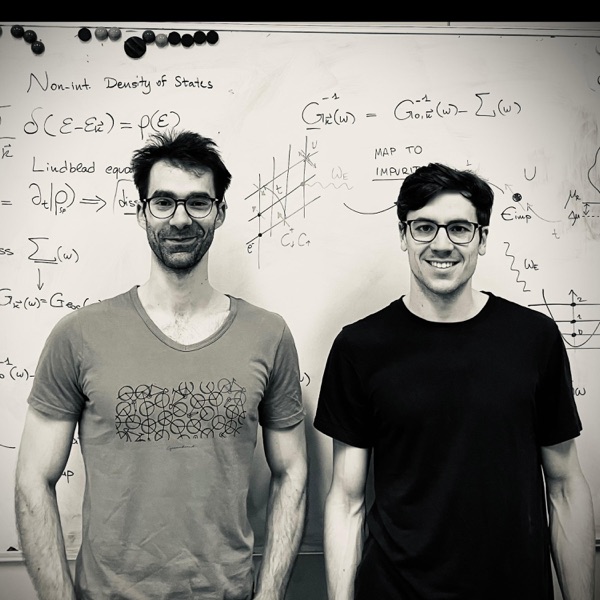
Curious about science or just here for a good story? This podcast brings research to life, breaking down complex topics into everyday language. Join us as we chat with real scientists about their cutting-edge work and the highs and lows of finding the balance between work and private life. Whether you are a science buff or a total beginner, tune in for insightful conversations, fascinating discoveries, and a glimpse into the world of research.
contact email address:
bridgethegap@tugraz.at
- Physics chart
- #146
- Episodes
- 20
- Releases
- Every two weeks
- Typical length
- 29 min
- On air since
- 2024
- Latest episode
- 1 month ago
Episodes
20 episodes, newest first
-
42 min
On exoplanets and star-quakes
Episode 19
Show notes
How can we detect exoplanets, i.e. planets orbiting other stars, potentially a few tens of lightyears away from Earth? What can we learn about their host stars from the way their light is dimmed by the planets themselves? These are only some of the questions we asked our guest, Kristina Kislyakova, who is Assistant Professor at the University of Vienna, and works on the evolution of the early solar system rocky planets and atmospheric losses to space among other interesting topics.
-
44 min
How do clouds affect climate?
Episode 18
Show notes
What is the effect of clouds on the global and local climate on Earth? How much of the solar radiation can they reflect back to space? How much of the surface heat can they trap? Can we describe and predict how the climate will be in 50 years? What can we know about the climate on Earth ten thousand years ago and how can artificial intelligence help us in this endeavour? Professor Aiko Voigt, from the University of Bonn, will talk about these and other related topics on today’s episode.
-
26 min
Enzymes
Episode 17
Show notes
What is a catalyst? And what is an enzyme instead? It turns out catalysts are fundamental in speeding up chemical reactions that would otherwise occur in a very, very long time. Enzymes, biological catalysts, take part in a lot of the chemical reactions in our body to keep us running. Can we engineer enzymes to produce specific compounds? Can we do it in an efficient and sustainable way? Do we need special solvents to do so? In this episode we dig into the chemistry of enzymes, how they work, and how we can exploit them to produce compounds that are useful in industry and science. Our guest, Xenia Georgiadou, a PhD candidate at Graz University of Technology will guide us through this fascinating and complex journey.
-
41 min
The Physics of Pasta Cacio e Pepe
Episode 16
Show notes
Who says phase transitions are only diagrams and critical lines? What if they could be understood through something as simple as making a smooth, cheesy sauce? In this episode, Ivan Di Terlizzi, from the Max Planck Institute for the Physics of Complex systems in Dresden, will tell us all about the physics of cheese in the classic Italian dish Pasta Cacio e Pepe. Don't miss this tasty and brainy episode!
Link to the paper: https://pubs.aip.org/aip/pof/article/37/4/044122/3345324/Phase-behavior-of-Cacio-e-Pepe-sauce -
29 min
How fast is ultrafast spectroscopy?
Episode 15
Show notes
The Heisenberg uncertainty principle prevents us from pinpointing an electron in real time with arbitrary accuracy. What this means is that if we were to shine light on an electron and excite it, we would not be able to follow its trajectory precisely. And yet, recent years have witnessed the development of so-called ultrafast spectroscopic techniques which allows us to indirectly reconstruct a movie of the elections evolution within a molecule. Peter Puschnig, Professor at University of Graz, Austria, will lead us through this fascinating world of ultrafast spectroscopy to hopefully answer fundamental (and cool) questions about electronic motions in real time.
-
25 min
Neurodegenerative diseases
Episode 14
Show notes
Neurodegenerative diseases are disorders characterised by a gradual, yet steady, loss or death of neurons, the brain cells, a condition that eventually leads to decline in motor and cognitive functions. Despite our best efforts, some aspects of these diseases are still obscure. Rina Demjaha is a medical doctor and a PhD candidate at the Medical University in Graz, Austria. With her we will explore some of the experimental techniques which are used to identify so-called biomarkers which could lead to an early diagnosis of such diseases.
-
25 min
Do metals and polymers get along well?
Episode 13
Show notes
Johanna Byloff is a PhD candidate at the ETH in Zurich, Switzerland. In this episode, she will talk about experimental techniques to stick together metals and polymers to obtain flexible, yet resistant, compounds which find applications in electronics, from smartphones to telescopes in orbit around Earth.
-
39 min
Solar physics
Episode 12
Show notes
How does a star like our Sun actually work? What fuels this giant ball of gas—and how does it change over time? And where do the elements of the periodic table really come from?
In this episode, we explore these cosmic questions with our guest, Professor Alexander Shapiro from the University of Graz. -
35 min
Biophysics
Episode 11
Show notes
What is biophysics? What does it study, and why is it so difficult to apply physics to predict the behavior of living organisms? Professor Douwe Bonthuis from Graz University of Technology takes us on a journey through the fascinating, yet complex, world of biophysics.
Multiscale modeling of aqueous electric double layers:
https://doi.org/10.1021/acs.chemrev.3c00307
Intrinsic lipid curvatures:
https://doi.org/10.1016/j.bbamem.2021.183709
Website with further information:
-
24 min
Plasma physics
Episode 10
Show notes
What if we told you there is a fourth state of matter all around us—one that powers neon signs, lights up the aurora and fuels fusion reactors? Christopher Albert, from Graz University of Technology, will help us unravel the mysteries of plasma: why it is so hard to tame, where it hides in nature, and how mastering it could revolutionize the way we think of energy.
-
27 min
Space and satellite communication
Episode 9
Show notes
Have you ever heard about Guglielmo Marconi? Ever wondered how we can communicate with satellites in orbit around Earth efficiently? And also, how many satellites are "up there"? These is just a short selection of the questions we ask in this episode. With us to discuss about "Space and satellite communication", Mirela Fetescu, researcher and engineer at Joanneum Research, in Graz.
-
28 min
Laser spectroscopy
Episode 8
Show notes
What is matter made of? If we could zoom in to unimaginably small scales, we’d see atoms and gases teeming with electrons in constant motion. Laser spectroscopy is one of the powerful tools scientists use to explore this microscopic world. Birgitta Schulze-Bernhardt will guide us through what we can uncover about the infinitesimally small and how this knowledge impacts the view of the world we live in. References: [1] RP Photonics Encyclopaedia: https://www.rp-photonics.com/encyclopedia.html [2] Optical frequency comb: https://www.nist.gov/topics/physics/optical-frequency-combs [3] Dual-comb spectroscopy: https://opg.optica.org/optica/fulltext.cfm?uri=optica-3-4-414&id=338991 [4] One of Birgitta's team recent paper: Fürst, L., Kirchner, A., Eber, A., Siegrist, F., Di Vora, R., and Bernhardt, B., Broadband near-ultraviolet dual comb spectroscopy, (2024), Optica, Vol. 11, Issue 4, 471, (2024), https://doi.org/10.1364/OPTICA.516783
-
24 min
Philosophy and Physics - Part 2
Episode 7
Show notes
What does one mean by philosophy of physics? How can philosophy help us understand the physical world? In particular, when it comes to quantum mechanics, human intuition seems to break down. Is the wave function real, or is it just a construct we use to make sense of experiments? Is reality truly based on probabilities? In this episode we continue our journey into the relationship between philosophy and physics with Axel Maas and Philip Berghofer from University of Graz. The first part of our conversation with them can be found at episode "Philosophy and Physics - Part 1"
References:
Axel Maas on Bluesky: https://bsky.app/profile/axelmaas.bsky.social
Axel Maas's webpage: https://particle.uni-graz.at/en/structures-and-observables/
Philip Berghofer's webpages: https://uni-graz.academia.edu/PhilippBerghofer, https://philippberghofer.com/
Some slides about philosophy of physics: https://static.uni-graz.at/fileadmin/_Persoenliche_Webseite/maas_axel/urania24.pdf
Book "Gauge symmetries, symmetry breaking, and gauge-invariant approaches": https://arxiv.org/abs/2110.00616
-
31 min
Philosophy and Physics - Part 1
Episode 6
Show notes
What does one mean by philosophy of physics? How can philosophy help us understand the physical world?
In particular, when it comes to quantum mechanics, human intuition seems to break down. Is the wave function real, or is it just a construct we use to make sense of experiments? Is reality truly based on probabilities? In this episode, Axel Maas and Philip Berghofer from the University of Graz will guide us through the challenges of reconnecting the physical world with the models we use to describe it.
References:
Axel Maas on Bluesky: https://bsky.app/profile/axelmaas.bsky.social
Axel Maas's webpage: https://particle.uni-graz.at/en/structures-and-observables/
Philip Berghofer's webpages: https://uni-graz.academia.edu/PhilippBerghofer, https://philippberghofer.com/
Some slides about philosophy of physics: https://static.uni-graz.at/fileadmin/_Persoenliche_Webseite/maas_axel/urania24.pdf
Book "Gauge symmetries, symmetry breaking, and gauge-invariant approaches": https://arxiv.org/abs/2110.00616
-
24 min
Pigments colors and other shades of physics
Episode 5
Show notes
If sunlight is often described as "white," why do we see so many colors? How are colors connected to the wavelengths of light? And what exactly is a wavelength? Anna Galler, a researcher at TU Graz, takes us on a journey through the world of light, pigments, and the fascinating physics behind every shade.
References:
[1] Kurt Nassau, "The Causes of Color" - published in the October 1980 issue of Scientific American, Volume 243, Number 4, on pages 124-154
[2] Kurt Nassau, "The Fifteen Causes of Color: The Physics and Chemistry of Color" - published in the journal Color Research & Application in February 1987 (Volume 12, Issue 1, pages 4-26).
-
30 min
Paper...
Episode 4
Show notes
What do you know about paper? It is a very common "object" in our everyday experience and still there is so much to discover about it! Karin Zojer, Professor at Graz University of Technology, leads us through the fascinating world of simulating real materials, paper included, highlighting the role of experiments in the process. Are you ready to dive in?
To tell us what you think about the podcast and/or if you want to take part in the audience participation section, send an email to bridgethegap@tugraz.at and we will get back to you and set you up. Every feedback is appreciated!
-
29 min
Superconductivity
Episode 3
Show notes
What if we could "kick" one electron now and have a current going on forever? Christoph Heil, Professor at Graz University of Technology, tells us that when things get really (really!) cool this is already possible. But it comes at a price...
To tell us what you think about the podcast and/or if you want to take part in the audience participation section, send an email to bridgethegap@tugraz.at and we will get back to you and set you up. Every feedback is appreciated!
References:
Christoph Heil’s group webpage:
"Talk Science to Me“ podcast episode:
https://letscast.fm/sites/talk-science-to-me-33062f96/episode/talk-science-to-me-29-supraleiter
"I Spy Science" Youtube video on superconductors:
A roadmap article from 2021 about superconductivity (open access):
-
37 min
Many-body physics
Episode 2
Show notes
"More is different". The famous quote from P. Anderson. What did he mean by that? Why is interaction between particles so interesting and difficult to describe? We continue on our journey through the fascinating realm of quantum physics: this time Markus Aichhorn, Professor at Graz University of Technology, will tell us about what happens when many particles interact at the quantum level...
To tell us what you think about the podcast and/or if you want to take part in the audience participation section, send an email to bridgethegap@tugraz.at and we will get back to you and set you up. Every feedback is appreciated!
References:
Ernst Peter Fischer: Die Stunde der Physiker, C.H.Beck; 2. Edition 2022
Alistair Rae: Quantenphysik, Illusion oder Realität, Reclam
-
49 min
Quantum physics
Episode 1
Show notes
Have you ever heard about the Schroedinger cat? And what about particles that move like waves? Quantum mechanics is full of wonders but provides answers that often challenge our intuition. Markus Aichhorn, Professor at Graz University of Technology, will walk us through these and other interesting aspects...
To tell us what you think about the podcast and/or if you want to take part in the audience participation section, send an email to bridgethegap@tugraz.at and we will get back to you and set you up. Every feedback is appreciated!
References:
Ernst Peter Fischer: Die Stunde der Physiker, C.H.Beck; 2. Edition 2022
Alistair Rae: Quantenphysik, Illusion oder Realität, Reclam
-
1 min
Bridge the Gap - Trailer
Show notes
To tell us what you think about the podcast and/or if you want to take part in the audience participation section, send an email to bridgethegap@tugraz.at and we will get back to you and set you up. Every feedback is appreciated!
Physics lists
More Physics shows picked out from the charts








More in Physics
Placed highest on Apple Podcasts' Physics chart right now