Podcast
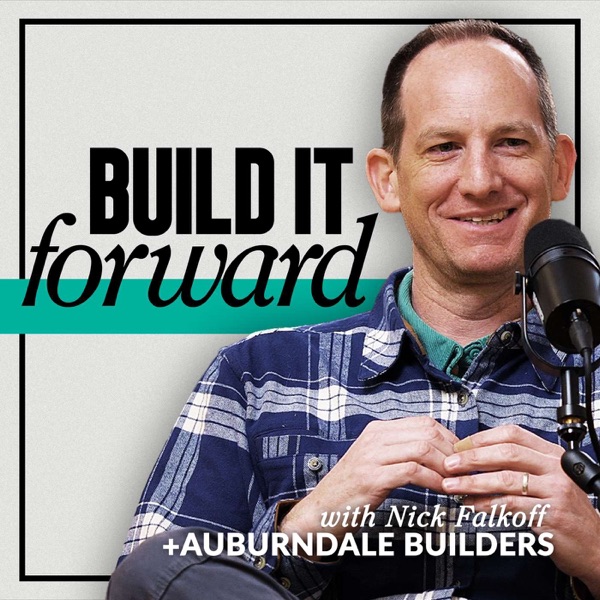
Build It Forward
Build It Forward is about the people, ideas, and decisions shaping the future of high-performance residential construction. Hosted by Nick Falkoff, GM of Auburndale Builders, and produced by PRMEABL_, the name is a play on “pay it forward.”
Conversations range from technical decisions and process to people, culture, history, and collaboration — exploring what’s working, what isn’t, and what might be interesting to try next.
These conversations are worth having, and worth sharing, because the best buildings come from communities that share what they know and build forward together.
- Episodes
- 12
- Releases
- Daily
- Typical length
- 41 min
- On air since
- 2026
- Latest episode
- 4 days ago
Episodes
12 episodes, newest first
-
50 min
Legends Learn From Legends with Steve Baczek and Kohta Ueno
Episode 12
Show notes
Summer Camp started because Joe Lstiburek wanted his young staff to learn from the mentors who taught him. In the early years, that meant three days of Gus Handegord at the front of a lecture hall, with a crowd of about 150 people trying to keep up with the equations.
In this conversation on Build It Forward, recorded in the Building Science Corporation Test Hut at Summer Camp 2026, Nick Falkoff sits down with two of BSC's earliest employees. Steve Baczek, an architect, joined in 1996 and calls himself the first employee. Kohta Ueno joined in 1998 after seeing Joe on an episode of NOVA, and today handles BSC's day-to-day consulting with Peter Baker.
They share stories from the early years: a production builder asking which ventilation system to use in the 3,000 houses he's building next year, flow hoods made from grocery store cardboard boxes, a garden hose proving that brick leaks, and Kohta's three red flags for building failures. They also get into how Joe made sure his staff understood the problem before leaving a job site, what Betsy Pettit built behind the scenes, and why so much of BSC's research is free on buildingscience.com.
Watch Can Buildings Make You Sick?, the NOVA episode that led Kohta to Building Science Corporation:
https://archive.org/details/CanBuildingsMakeYouSick?Thank you to Betsy Pettit for graciously hosting us.
Connect with Steve Baczek:
https://stevenbaczekarchitect.com | IG: @stevenbaczekarchitectConnect with Kohta Ueno and Building Science Corporation:
https://buildingscience.com | LinkedIn: https://www.linkedin.com/in/kohta-ueno-472a4Thank you to our production partner Benjamin Obdyke. Build Better™ with samples of their roof and wall products:
https://benjaminobdyke.com/get-a-sample-build-forward-podcastWork with Auburndale Builders on your high-performance build:
vision@auburndalebuilders.com01:06 How Summer Camp started
06:51 Theory meets builders who need real answers
13:09 Gus Handegord and the best wall to build
15:40 How Steve became BSC's first employee
18:29 Kohta, NOVA, and a cold call
20:29 Building America and production builders
24:05 Why brick always leaks
28:38 Red flags for building failures
32:40 Knowing what questions to ask
39:20 Betsy Pettit and the business behind BSC
45:31 The future of Building Science CorporationMusic:
Welcome to the Johnsons from the album Bird Mode by E*Lightning aka Jon Erickson, CPHB
https://open.spotify.com/artist/0J8B8c2DKgBKOopmjXK3E8Made with @PRMEABL at the Building Science Corporation Test Hut
#BuildItForward #AuburndaleBuilders #PassiveHouse #HighPerformanceBuilding #BuildingScience #BuildingScienceCorporation #BuildingForensics #GreenBuilding #NetZero #SteveBaczek #KohtaUeno #BenjaminObdyke #BuildBetter
-
49 min
What Building Science Misses About Healthy Homes with Ashley Murphree
Episode 10
Show notes
Ashley Murphree built herself a tiny house out of a shipping container using every good building science practice she knew. Something in it was still making her sick.
It was not mold. She knew the building well enough to rule that out. But despite testing and doing everything right, the symptoms continued. That experience opened up a question she has been chasing ever since: what else are we not accounting for when we call a building healthy?
In this conversation on Build It Forward, recorded in the Building Science Corporation Test Hut at Summer Camp 2026, Nick Falkoff sits down with Ashley, a mechanical engineer and former general contractor who runs Alchemech Engineering in California and designs systems for high-performance homes.
Ashley walks through what she has learned about sensitization and why an occupant who has already reacted to something needs a very different building than one who has not. She gets into the research of Dr. Robert Naviaux at UC San Diego on the mitochondria and the healing cycle, and why a so many different triggers can produce the same condition. She makes the case that we are still not putting large, well-sealed filters in the right places, and asks whether the portable air purifier sitting in the corner is now part of the architecture.
The second half turns to mechanicals. Air to water monoblock heat pumps, thermal storage as a battery with no precious metals in it, and why chilled water gives you dehumidification options that refrigerant does not. It ends on an idea for an exposed, cleanable coil you could hang on a wall.
Thank you to Betsy Pettit for hosting us.
Watch Ashley's Summer Camp presentation - Healthy Living in Tight, Compact Homes:
https://www.youtube.com/watch?v=EjxuDkuQCOQConnect with Ashley Murphree and Alchemech Engineering:
https://www.alchemech.com | IG: @alchemech.engineeringThank you to our production partner Benjamin Obdyke. Build Better™ with samples of their roof and wall products:
https://benjaminobdyke.com/get-a-sample-build-forward-podcastWork with Auburndale Builders on your high-performance build:
vision@auburndalebuilders.com00:42 Who Ashley Murphree is
03:26 How her own health changed her practice
04:53 More building triggers than just mold
06:42 Is the air purifier part of the architecture
11:24 What a healthy home client actually needs
12:50 Sensitization and why it changes the building
17:20 Dr. Robert Naviaux and the healing cycle
26:32 Why leaky is not the answer
28:28 Filtering everything, MERV levels, and wildfire smoke
33:36 Air to water heat pumps and thermal storage
44:19 A cleanable coil you could hang on the wallMusic:
Welcome to the Johnsons from the album Bird Mode by E*Lightning aka Jon Erickson, CPHB
https://open.spotify.com/artist/0J8B8c2DKgBKOopmjXK3E8Made with @PRMEABL at the Building Science Corporation Test Hut
#BuildItForward #AuburndaleBuilders #PassiveHouse #HighPerformanceBuilding #BuildingScience #HealthyHomes #IndoorAirQuality #GreenBuilding #NetZero #AshleyMurphree #BenjaminObdyke #BuildBetter
-
54 min
Building Plans Need Better Grammar with John Straube
Episode 9
Show notes
John Straube has spent a career breaking buildings on purpose and investigating the ones that failed by mistake.
Test huts exist so that when the experiment goes wrong, nobody gets hurt. The forensic work is the other half. As John puts it, the experiments he could never ethically run himself get run for him, by architects and builders, on real projects.
In this conversation on Build It Forward, recorded in the Building Science Corporation Test Hut at Summer Camp 2026, Nick Falkoff sits down with John, a building scientist and engineer who teaches at the University of Waterloo and consults through RDH.
John argues that most builders and designers never see enough failures to calibrate their own sense of risk, which is why they can walk along the edge of a canyon in the dark without knowing it. The conversation covers how he teaches people to read a detail, why a wall schedule should list what each layer does and not just what it is, the difference between an aesthetic mock-up and a performance mock-up, and why he thinks a code compliant building is the worst building you can legally build.
It closes on what makes a great building scientist, which turns out to have less to do with physics than with actually cutting wood and pouring concrete yourself.
Thank you to Betsy Pettit for graciously hosting us.
Connect with John Straube:
https://www.johnstraube.comThank you to our production partner Benjamin Obdyke. Build Better(TM) with samples of their roof and wall products:
https://benjaminobdyke.com/get-a-sample-build-forward-podcastWork with Auburndale Builders on your high-performance build:
vision@auburndalebuilders.com00:32 Who John Straube is and how he got here
02:13 Why test huts exist and what forensics teaches
05:29 Teaching students versus teaching professionals
08:42 If it doesn't get wet, it won't leak
11:18 Labeling what things do, not what they are
19:07 Having the uncomfortable conversation
21:29 Three kinds of mock-ups
23:58 Solving material compatibility
29:55 Why we are bad at judging risk
41:30 Code is the worst building you can legally build
49:26 What makes a great building scientistMusic:
Welcome to the Johnsons from the album Bird Mode by E*Lightning aka Jon Erickson, CPHB
https://open.spotify.com/artist/0J8B8c2DKgBKOopmjXK3E8Made with @PRMEABL at the Building Science Corporation Test Hut
#BuildItForward #AuburndaleBuilders #PassiveHouse #HighPerformanceBuilding #BuildingScience #BuildingScientist #GreenBuilding #NetZero #JohnStraube #BuildingEnclosure #BuildingScienceCorporation #BenjaminObdyke #BuildBetter
-
41 min
Be the Developer, the Architect, and the Builder - Vertical Integration with Tim McDonald
Episode 8
Show notes
Become the developer. Become the architect. Become the builder. Tim McDonald didn't do this because it seemed like a good idea. He did it because he couldn't figure out any other way to build what he was trying to build.
In this conversation on Build It Forward, recorded at Tim's home on the North Shore of Boston, Nick Falkoff sits down with Tim, co-founder of Onion Flats Architecture, for a conversation that spans nearly 30 years of design-build development in Philadelphia. Tim talks about how he came to passive house in 2008, why he sees it as the only serious answer to what climate change demands of buildings, and how the New Gravity concept helped bring passive house into affordable housing funding applications across 40 states.
The conversation also gets into where the work is headed: deep energy retrofits on existing multifamily buildings, panelized wall systems that wrap buildings from the outside while people are still living in them, and the case for why retrofitting existing buildings is more cost effective than tearing them down.
Connect with Tim McDonald and Onion Flats Architecture:
https://onionflatsarchitecture.comThank you to our production partner Benjamin Obdyke. Build Better™ with samples of their roof and wall products:
https://benjaminobdyke.com/get-a-sample-build-forward-podcastWork with Auburndale Builders on your high-performance build:
vision@auburndalebuilders.com00:31 Growing up inside a house being built
02:01 Why architects should never hand off their ideas
02:53 Japan and the design-build studio that changed everything
05:13 The turn toward passive house
09:32 Trial by fire and vertical integration
16:03 The New Gravity concept and affordable housing policy
25:39 Climate change as the new gravity
28:17 Passive house as the answer to resilience
32:26 Why existing buildings are the real opportunity
33:47 Panelized retrofits and the Dutch modelMusic:
Welcome to the Johnsons from the album Bird Mode by E*Lightning aka Jon Erickson, CPHB
https://open.spotify.com/artist/0J8B8c2DKgBKOopmjXK3E8Made with @PRMEABL
#BuildItForward #AuburndaleBuilders #PassiveHouse #HighPerformanceBuilding #BuildingScience #GreenBuilding #NetZero #OnionFlats #VerticalIntegration #DeepEnergyRetrofit #BenjaminObdyke #BuildBetter
-
12 min
Builders: The Goalposts Just Moved with Florence McGregor
Episode 7
Show notes
NESEA just turned 50. And according to Florence McGregor, that's not a moment to celebrate and coast. It's a moment to ask what's next.
In this conversation on Build It Forward, recorded at NESEA BuildingEnergy Boston 2026, Nick Falkoff sits down with Flo, Executive Director of NESEA, in the middle of the conference floor for a wide-ranging conversation about what the organization has become, where it still needs to go, and what it means to build a community that can hold both technical excellence and genuine human vulnerability at the same time.
They get into NESEA's incoming strategic plan and the priorities Flo hopes carry forward, including the organization's commitment to becoming more just, more sustainable, and actively anti-racist. The conversation also covers what this year's record student attendance means for the future of the industry, why the skills you can only learn in a room with other people matter as much as anything in a technical session, and how the Dumpster Fire Patriarchy workshop changed the way Nick thinks about his role as a builder and a leader.
The conversation ends a little abruptly -- conference duties called -- but not before covering a lot of ground worth watching.
For resources on ICE preparedness and know your rights guidance, visit:
studiohpdc.org/more/know-your-rights-immigration-enforcement-preparedness00:42 Construction as a patriarchal industry
01:26 What patriarchy costs the people who practice it
02:40 Sharing mistakes and the NESEA culture of vulnerability
03:24 NESEA's next five year strategic plan
04:16 Climate justice, anti-racism, and the technical work
05:00 Welcoming a record number of students this year
06:02 What the keynote opened up
07:20 The skills you can only learn in a room
08:20 Orienting students to a professional community
10:33 NESEA as an incubator -- growing your teamConnect with Florence McGregor and NESEA:
nesea.org | IG: @neseaorgWork with Auburndale Builders on your high-performance build:
vision@auburndalebuilders.comMusic:
Welcome to the Johnsons from the album Bird Mode by E*Lightning aka Jon Erickson, CPHB
elightning.bandcamp.comMade with @PRMEABL
#BuildItForward #AuburndaleBuilders #PassiveHouse #HighPerformanceBuilding #BuildingScience #GreenBuilding #NetZero #NESEA #BuildingCommunity #BuildingCulture #ClimateJustice
-
21 min
New Skills Builders Need Now with Ace McArleton
Episode 6
Show notes
The building industry has always demanded a wide range of skills. Ace McArleton thinks it's time to widen the circle a little further.
In this conversation on Build It Forward, recorded at NESEA BuildingEnergy Boston 2026, Nick Falkoff is joined by Ace McArleton, co-founder of New Frameworks, a Vermont-based natural building and high-performance construction company approaching its 20th year. Also at the table is Amy Lieb, Executive Director of Studio HPDC, a nonprofit working to connect emerging building science and technology with the businesses and workers who need to use it.
That includes the NESEA community itself, how it functions as an incubator for both technical and cultural ideas, and how it has shaped both New Frameworks and Studio HPDC over the years. It also includes something newer: what happens when ICE shows up at a job site, and how builders can prepare their teams practically, legally, and emotionally. Ace draws a direct line between embodied training in carpentry and embodied training for high-stakes encounters with law enforcement. Practice until it's in your body. Know your role before the moment arrives.
The conversation also gets into what technology really is, who it serves, praxis as a framework for building better, and why the NESEA community keeps pulling people back year after year.
For resources on ICE preparedness and know your rights guidance, visit: studiohpdc.org/more/know-your-rights-immigration-enforcement-preparedness
00:37 What is NESEA and how long have you been part of it
02:40 New Frameworks turns 20
02:58 Amy Lieb origin story -- a business card in the lunch line
05:30 What makes the NESEA community different
06:25 How NESEA has shaped New Frameworks
07:06 Technology, praxis, and what we make with our hands
08:04 What embodied training means in the building trades
10:06 When ICE shows up at your job site
13:49 Building a safe community to practice hard things
15:20 Empowerment, disempowerment, and drawing the circle
16:45 What high performance means nowConnect with Ace McArleton:
newframeworks.comLearn more about New Frameworks:
newframeworks.com | IG: @newframeworksConnect with Amy Lieb and Studio HPDC:
studiohpdc.org | IG: @studiohpdcLearn more about NESEA:
nesea.org | IG: @neseaorgWork with Auburndale Builders on your high-performance build:
vision@auburndalebuilders.comMusic:
Welcome to the Johnsons from the album Bird Mode by E*Lightning aka Jon Erickson, CPHB
elightning.bandcamp.comMade with @PRMEABL
#BuildItForward #AuburndaleBuilders #PassiveHouse #HighPerformanceBuilding #BuildingScience #GreenBuilding #NetZero #WorkforceDevelopment #NewFrameworks #StudioHPDC #NESEA #StrawBaleBuilding
-
21 min
Teaching Kids to Use Power Tools with Mason Lord
Episode 5
Show notes
Most kids never get the chance to hold a tool before someone tells them it's not for them. Mason Lord is trying to change that.
Mason is the founder of TradesUp and owner of Hudson Valley Preservation, a design-build company in Kent, Connecticut with 35 years of preservation and high-performance remodeling work behind it. His path into the trades started at age seven, in a neighbor's basement workshop, after losing his father in first grade. That early spark is the entire philosophy behind what he's building next with TradesUp.
The conversation moves through how a small idea, inviting local kids to a job site for a day, became an annual event drawing 500 people, where tradespeople set up hands-on experiences for kids ages 5 to 12. Why that age range matters. Why middle schoolers hesitate and little kids jump right in. Why the tradespeople keep showing up, year after year, without being asked twice. And what Mason sees as the real opportunity: not just recruiting for the trades, but putting kids at the top of a funnel so that even the ones who don't become carpenters grow up knowing how to walk into a lumberyard without flinching.
This conversation on Build It Forward, recorded at NESEA BuildingEnergy Boston 2026, also gets into the trades training center Mason is developing on the campus of the Eric Sloan Museum in Kent, the idea of building as something close to human instinct, and why the desire to work with your hands hasn't gone away just because shop class has.
00:44 Hudson Valley Preservation and how NESEA changed things
02:31 Starting a workforce development initiative
03:24 The Spark event -- 500 people, ages 5 to 12
05:09 Where Mason's spark started
05:43 TradesUp as the top of the funnel
06:42 Workshops, community events, and what's next
07:06 Building a trades training center at the Eric Sloan Museum
08:30 The desire to build hasn't gone away
15:11 What builders remember first
16:01 Planning for Play and the case for raw materials
17:57 What shop class took with it -- and what it didn'tConnect with Mason Lord:
IG: @masontheelderLearn more about Hudson Valley Preservation:
hvpcorp.com | IG: @hudsonvalleypreservationGet involved with TradesUp:
tradesup.org | IG: @tradesuporgLearn more about NESEA:
nesea.org | IG: @neseaorgWork with Auburndale Builders on your high-performance build:
vision@auburndalebuilders.comMusic:
Welcome to the Johnsons from the album Bird Mode by E*Lightning aka Jon Erickson, CPHB
elightning.bandcamp.comMade with @PRMEABL
#BuildItForward #AuburndaleBuilders #PassiveHouse #HighPerformanceBuilding #BuildingScience #GreenBuilding #NetZero #WorkforceDevelopment #Trades #TradesUp #HudsonValleyPreservation #NESEA
-
41 min
How Passive House Became the Gold Standard in America with Katrin Klingenberg
Episode 4
Show notes
Katrin Klingenberg didn't set out to build a movement. She was finishing her own home in Champaign-Urbana when a persistent phone call pulled her into a room full of building science legends and nothing was the same after that.
Recorded live at NESEA BuildingEnergy Boston 2026, this conversation on Build It Forward has Nick and Katrin tracing the origin of Phius, the early debates about whether European passive house standards could work in American climates, and the long road to developing a climate-specific standard that actually fits how we build here. They get into workforce development, the role of training and credentials, and what it looks like to think about passive house not just as a building standard but as a market transformation tool, one that Katrin believes should eventually make itself obsolete.
This is a conversation about what it takes to shift an industry and what comes next.
00:00:55 One Phone Call That Changed Everything
00:01:18 Building America's First Passive House
00:03:26 How Phius Came to Be
00:06:05 Finding the Community Already Cooking
00:07:06 Why the European Standard Didn't Translate
00:11:00 Turning a Building Method into a Movement
00:19:00 The Workforce Gap Holding the Industry Back
00:27:00 What a National Training Strategy Actually Looks Like
00:34:14 When Passive House Becomes Second NatureConnect with Katrin Klingenberg and Phius:
phius.org | IG: @phius_officialLearn more about NESEA:
nesea.org |IG: @neseaorgWork with Auburndale Builders on your high-performance build:
vision@auburndalebuilders.comMusic:
Welcome to the Johnsons from the album Bird Mode by E*Lightning aka Jon Erickson, CPHB
elightning.bandcamp.comMade with @PRMEABL
#BuildItForward #AuburndaleBuilders #PassiveHouse #Phius #NESEA #HighPerformanceBuilding #BuildingScience #GreenBuilding #NetZero #WorkforceDevelopment #BuildingEnergy #PassiveBuilding #KatrinKlingenberg
-
45 min
What's Missing in HVAC Today with Ross Trethewey
Episode 3
Show notes
In this conversation on Build It Forward, Nick Falkoff of Auburndale Builders sits down with Ross Trethewey of TE2 Engineering and This Old House to talk about where HVAC systems are heading, and why that future looks different from what most builders are used to today.
They start with the Studio HPDC barn as a real-world testing lab and how it can function as a community mechanical room, then get into what's driving change in the industry. From rising energy costs to the limits of traditional systems, they discuss why air-to-water heat pumps are gaining traction in the US and what still stands in the way.
Ross explains why lab data and energy models only tell part of the story, and why measuring real-world performance is important to fill in the gaps. That leads into predictive controls, system behavior over time, and how thermal storage and phase change materials could reshape how buildings use energy.
The back half focuses on what this means in practice. Where do these systems make sense today? How do trades adapt? And how do we move from "high-performance" as a concept to something we can actually implement?
Chapters
00:21 – The Studio HPDC barn as a high-performance learning lab
02:53 – Air-to-water heat pumps and the U.S. market shift
04:33 – How energy costs and market forces drive adoption
09:39 – Why real-world data matters more than lab data
15:50 – Predictive controls and system behavior over time
17:10 – Thermal storage and phase change materials explained
26:20 – Where air-to-water systems fit today
32:15 – Retrofit strategies and hybrid system approaches
36:18 – Measuring performance and where the industry is headingConnect with:
Ross Trethewey, TE2 Engineering
IG: @rosstrethewey
https://www.te2engineering.comStudio HPDC
IG: @studiohpdc
www.studiohpdc.orgWork with Auburndale Builders on your high-performance build:
vision@auburndalebuilders.comMusic
"Welcome to the Johnsons" from the album Bird Mode
by E*Lightning aka Jon Erickson, CPHB
elightning.bandcamp.comMade with PRMEABL_
#BuildItForward #AuburndaleBuilders #HighPerformanceBuilding #BuildingScience #HVACDesign #HeatPumps #AirToWater #Electrification #HomePerformance #MechanicalSystems #PassiveHouse #ThisOldHouse #BostonMA #CambridgeMA
-
33 min
Building a Culture of Asking Questions with Steve Baczek
Episode 2
Show notes
In this conversation on Build It Forward, Nick Falkoff of Auburndale Builders sits down with Steven Baczek, Architect, and Amy Lieb, Executive Director of Studio HPDC, to talk about carpentry training, learning culture, and how people actually grow in the trades over the course of a career.
The conversation explores how carpenters and builders learn on the job, why mentorship and asking good questions matter more than memorizing answers, and how training programs can help accelerate learning without replacing real-world experience. Steve draws on his background in the trades, architecture, and building science to explain why teaching the right questions is often more important than providing solutions.
This episode also looks at the cultural side of construction, from how builders and architects communicate to how crews develop confidence, discipline, and responsibility over time. It's a real, practical conversation about what it takes to keep learning in an industry that should never stop changing. #LongLiveOurBuildings
Chapters
00:00 – Introduction
01:00 – Steve's path from the trades to architecture
04:00 – Teaching trades and teaching culture
07:30 – Learning by asking better questions
11:00 – Why information is not the same as training
15:00 – Creating safe spaces to learn and ask questions
18:30 – Architects, builders, and responsibility
23:00 – Training as an investment, not a cost
27:30 – Learning never stops
32:00 – Closing thoughtsThis episode was filmed at Studio HPDC's 200-year-old Passive House teaching barn.
www.studiohpdc.orgConnect with:
Steven Baczek, Architect
Instagram: @stevenbazcekarchitect
www.stevenbaczekarchitect.comAmy Lieb
Studio for High Performance Design and Construction
Instagram: @studiohpdc
www.studiohpdc.orgWork with Auburndale Builders on your high-performance build:
vision@auburndalebuilders.comMusic:
"Welcome to the Johnsons" from the album Bird Mode
by E*Lightning aka Jon Erickson, CPHB
distrokid.com/hyperfollow/elightning/bird-mode-2Made with PRMEABL_
#BuildItForward #AuburndaleBuilders #HighPerformanceBuilding #BuildingScience #TradesEducation #CarpentryTraining #StudioHPDC #PassiveHouse #StevenBaczek
-
39 min
Building Community in High-Performance Construction with Ben Bogie
Episode 1
Show notes
In this first episode of Build It Forward, Nick Falkoff, General Manager of Auburndale Builders, sits down with Ben Bogie, Director of Building Science at Building Performance Cooperative, and Amy Lieb, Executive Director of the Studio for High Performance Design and Construction, to talk about why community plays such a critical role in advancing high-performance building.
Rather than focusing on a single product or system, this conversation zooms out to look at how builders, designers, educators, and tradespeople actually learn, grow, and improve over time. From local meetups and trade school partnerships to national networks like BS*+beer, the group explores how shared knowledge, hands-on learning, and personal relationships help people navigate an increasingly complex building industry.
The discussion also touches on workforce development, the gap between online information and real-world experience, and why creating welcoming, in-person spaces matters just as much as technical expertise.
Chapters
00:00 – Introduction
01:00 – Inside the Studio HPDC High-Performance Barn
03:00 – Why Community Matters in High-Performance Building
05:00 – Making Building Science Approachable
08:30 – Learning Through Hands-On Experience
11:00 – The Origins of BS*+beer
14:30 – Scaling Community Without Losing What Works
18:00 – Workforce Development and Trade Schools
22:00 – Teaching Core Concepts Without Overwhelm
27:00 – Where High-Performance Communities Go Next
33:30 – Monitoring, data, and making the invisible visible
38:00 – Closing thoughtsThis episode was filmed at Studio HPDC's 200-year-old Passive House teaching barn in Newton, MA.
www.studiohpdc.orgConnect with:
Ben Bogie, Building Performance Cooperative
IG: @benbogie
https://www.bpcgreenbuilders.comAmy Lieb, Studio HPDC
IG: @studiohpdc
www.studiohpdc.orgWork with Auburndale Builders on your high-performance build:
vision@auburndalebuilders.comMusic:
"Welcome to the Johnsons" from the album Bird Mode
by E*Lightning aka Jon Erickson, CPHB, CPHC, CPHV
elightning.bandcamp.comMade with PRMEABL_
-
54 min
Quality Building Is High-Performance Building with Josh Salinger
Episode 11
Show notes
Josh Salinger doesn't see any daylight between quality building and high-performance building. Design it well, use the right materials for the project, install them correctly, and test it when you're done. To Josh, that's just quality, and it gets you a building that lasts longer, is healthier, more resilient, more comfortable, and naturally energy efficient.
In this conversation on Build It Forward, recorded in the Building Science Corporation Test Hut at Summer Camp 2026, Nick Falkoff sits down with Josh, who runs Birdsmouth Design-Build in Portland, Oregon, and teaches the PHIUS builder training across North America.
It's a fitting place for it. Josh got into building through the carpenters who moved into his rental house and the customers across the bar who asked if he'd build them a fence. Years later, a conversation in this Test Hut led to writing for Fine Homebuilding and Green Building Advisor, and he traces his career back to the spot where he was standing.
Josh and Nick also get into how Birdsmouth Design-Build approaches retrofits, balanced ventilation in a leaky old house, why the firm went design-build, what's changed in the PHIUS builder training, and why giving away everything he's learned has only helped his business.
Thank you to Betsy Pettit for graciously hosting us.
Connect with Josh Salinger and Birdsmouth Design-Build:
https://birdsmouthpdx.com | IG: @birdsmouthpdxThank you to our production partner Benjamin Obdyke. Build Better™ with samples of their roof and wall products:
https://benjaminobdyke.com/get-a-sample-build-forward-podcastWork with Auburndale Builders on your high-performance build:
vision@auburndalebuilders.com00:24 The Test Hut and what it was built for
01:29 The passive house tour that changed his path
06:56 From bartender to builder
09:35 The Test Hut conversation that changed his career
15:06 Speaking up when something isn't right
19:03 Why Josh went design-build
24:36 What's changed in the PHIUS builder training
29:00 Where to start on a leaky old house
35:19 Building a retrofit report around client goals
42:16 Giving away everything you've learned
48:45 Quality building is high-performance buildingMusic:
Welcome to the Johnsons from the album Bird Mode by E*Lightning aka Jon Erickson, CPHB
https://open.spotify.com/artist/0J8B8c2DKgBKOopmjXK3E8Made with @PRMEABL at the Building Science Corporation Test Hut
#BuildItForward #AuburndaleBuilders #PassiveHouse #HighPerformanceBuilding #BuildingScience #DesignBuild #Retrofit #GreenBuilding #NetZero #JoshSalinger #BirdsmouthDesignBuild #BenjaminObdyke #BuildBetter
How To lists
More How To shows picked out from the charts





More in How To
Placed highest on Apple Podcasts' How To chart right now