Podcast
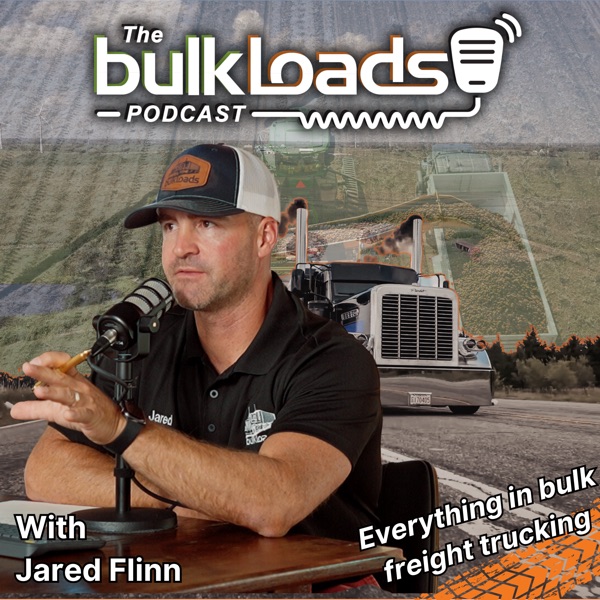
Bulkloads Podcast
A trucking podcast that covers all aspects of bulk freight trucking. Hosted by Jared Flinn, owner of multiple trucking-related businesses.
Jared brings on a new guest weekly to discuss technology, innovation, safety & compliance, insurance, trucking success stories, and much more related to the bulk freight trucking industry.
This podcast hits on all aspects of the industry, our audience includes bulk haulers, shippers, brokers, merchandisers, farmers, and more.
Check out our related businesses for bulk freight:
BulkLoads - www.bulkloads.com
Bulk Insurance Group - www.bulkinsurancegroup.com
Smart Freight Funding - www.smartfreightfunding.com
Transportation Management (TMS) - https://www.bulktms.com/
Permitting- https://www.bulkloads.com/tools/permitting/
- Episodes
- 378
- Releases
- Weekly
- Typical length
- 43 min
- On air since
- 2018
- Latest episode
- 1 week ago
Episodes
378 episodes, newest first
-
32 min
BLP: 380 2.5 Million Safe Miles, Now He Lobbies Congress
Season 4, Episode 380
Show notes
Watch on YouTube
Lewie Pugh drove for 25 years and logged 2.5 million safe miles before he ever set foot in a congressional office. Today he is Executive Vice President of OOIDA, and he describes himself as the closer: the one who follows the association's four Washington lobbyists into a meeting and puts an issue into plain language a lawmaker can actually understand. We sat down with him at OOIDA headquarters in Grain Valley, Missouri to talk about what moves in Washington, what does not, and why he thinks truckers get painted in a bad light by people who have never done the job.
He joined OOIDA in the mid nineties as a 22 year old with a new authority, ran for the board in 2004, and has now served 22 years. He is from a rural county in southeastern Ohio with about 12,000 people in it, has a vocational school education, and does not take for granted that someone with his background can testify in the halls of Congress. He talks about why he still misses the road, why he likes the DC work and the truck shows and hates the day to day office stuff, and what he tells members who call in angry or working off bad information: he is not going to tell them what they want to hear.
The conversation gets into the money and the mechanics. Truckers have been exempt from overtime under the Fair Labor Standards Act since 1938, which is why company drivers give away hours at loading docks, and Lewie explains why OOIDA is fighting to remove that exemption and why it would raise rates for owner-operators too. Where the surface transportation reauthorization stands. Why the Highway Trust Fund is running dry when federal fuel taxes have not been raised since 1993 and electric vehicles pay nothing at the pump. Why tolling and vehicle miles traveled taxes worry him more than a fuel tax increase. Why OOIDA stands with the railroads against longer and heavier trucks, with a story about hauling steel in Ohio that shows exactly how more weight turned into less money per hundred. He also clears up a common misconception: roughly 20 percent of OOIDA's membership are company drivers, and the organization advocates for them too.
Chapters: 0:00 Four Lobbyists and the Closer 0:52 Started by Truckers, Still Run by Truckers 1:45 What He Misses About the Road 3:29 2.5 Million Safe Miles 4:22 They Have Money, We Have Members 5:12 How to Actually Reach Your Lawmaker 6:04 A Vocational School Kid in the Halls of Congress 6:58 "A Source of Truth" 7:48 Telling Members What They Don't Want to Hear 9:31 Entry Level Driver Training Was Only a First Step 10:23 Joining OOIDA at 22 11:19 Why Company Drivers Belong Here Too 13:04 The Overtime Exemption Since 1938 13:56 Why It Would Help Owner Operators Too 14:50 Cautious Optimism in Washington 16:33 The Highway Bill and the Calendar 20:03 The Highway Trust Fund Is Going Broke 22:42 Tolling, VMT and the $90 Car Driver 24:29 Railroads as Allies and Opponents 25:20 Why OOIDA Opposes Longer and Heavier 26:12 The Steel Permit That Paid Less 27:54 DEF and Who Has to Use It 29:37 From a Laundromat to This Building 31:22 How to Reach OOIDA
-
44 min
BLP: 379 50 Years of Fighting for Truckers
Season 4, Episode 379
Show notes
Watch on YouTube Todd Spencer joined OOIDA as an owner-operator member in 1976 and has spent the half century since fighting for small business truckers. We sat down with him at OOIDA headquarters in Grain Valley, Missouri for a long conversation about the Owner-Operator Independent Drivers Association, the fights it has won, and the ones still ahead. He was elected to the board in 1978, came on staff in 1981 as editor of Land Line and communications director, back when the organization was small enough that he was not sure he would get paid, and became president in 2018 after decades as Jim Johnston's right hand.
He grew up in Missouri with a favorite uncle who drove, started hauling grain, shingles and building materials out of Kansas City through Nebraska, Kansas, Oklahoma and Iowa, and has slept in line at the river terminal waiting to unload like plenty of people watching this. He tells the story of four states that once pulled truckers off the scales and required them to take a drug test on the spot. A woman driving through Nebraska refused, called headquarters, and OOIDA sued Utah, Nebraska, Minnesota and New Jersey along with the federal agency behind the pilot program. They won in every state. He also walks through the split speed limit fight in Missouri and the Tennessee inspections that included searching a driver's living space, and why he believes a right you cannot assert is not really a right.
The conversation goes deep on how the industry changed. Why deregulation and investor capital turned JB Hunt, Werner and Swift from small companies into the dominant players, and why those companies are run by MBAs, attorneys and accountants instead of truckers. Why lease purchase programs and per mile pay exist at all. Why he calls the driver shortage a myth that carrier executives sell to lawmakers, and why he would raise the CDL age rather than lower it. What worries him about autonomous trucks and about bad actors overseas resetting electronic logging devices. And why, after 50 years, his answer is still the same: if you drive a truck, you ought to be a member.
Chapters: 0:00 Joining OOIDA in 1976 1:47 Hauling Grain, Shingles and Building Materials 2:40 Sleeping in Line at the Terminal 3:20 Jim Johnston, a Trucker's Trucker 4:26 Starting Out Under the ICC 5:20 The Oil Embargo and 250 Organizations 6:14 Driver Training, Decades in the Making 7:59 Using Technology to Exploit the System 8:53 Paid Before You Even Deliver 10:41 Why Big Business Is Not a Friend to Small Business 11:33 Lease Purchase and Per Mile Pay 12:27 When Trucking Became an Investment 14:15 The Most Important Person in the Supply Chain 15:59 Where Truckers Used to Come From 16:53 Veterans: Three Quarters Then, a Third Now 17:30 Taking Over as President in 2018 17:45 Insurance, Big Judgments and Who Profits 20:23 Professionalism and Preparing New Drivers 22:59 The Driver Shortage Myth 26:32 Why He Would Raise the CDL Age 27:26 How Other Countries Pay Their Drivers 29:13 Livestock Rules Written for the Cattle 30:59 Skin in the Game and Your State Lawmakers 31:52 Autonomous Trucks and Hacked ELDs 33:39 What He Wants Every Trucker to Know 35:25 The Split Speed Limit Fight in Missouri 37:10 Random Roadside Drug Testing in Four States 41:38 Tennessee, Cab Searches and Jail 43:23 "It's Worth a Whole Lot More Than the Effort"
-
40 min
BLP:378 Who Is OOIDA Actually Fighting?
Season 4, Episode 378
Show notes
Watch On YouTube
Plaintiff's attorneys, large carrier associations, and the autonomous vehicle lobby. Those are the fights OOIDA is in right now, and Rod Nofziger walked us through all of them. We sat down at OOIDA headquarters in Grain Valley, Missouri to talk about what the Owner-Operator Independent Drivers Association actually does, who it is up against, and why the fight never ends. Rod worked for the US House Committee on Transportation and Infrastructure before moving to DC law firms where OOIDA was a client, and he has been on staff 22 years. His father drove a truck, and he says he watched the industry work against him.
We go through the organization from the ground up. OOIDA was founded in 1973 by five or six angry owner-operators during the Middle East oil embargo, when fuel rationing had trucks running truck stop to truck stop and waiting in line. Its first office was a construction trailer chained to a light pole on the same property the headquarters sits on today. Jim Johnston, a founding member who never attended high school, became president two years in and held the job for 43 years. Rod worked beside him for seven of those and calls him the most insightful person he has ever met. Today the association runs truck insurance, a drug and alcohol consortium, permits and licensing, life and health benefits, Land Line Media, and a compliance group of mostly former truckers who take member calls at no extra cost.
The back half is the hard stuff. Legislation that would have pushed truck insurance minimums from $750,000 to $4.5 million per truck, and why Rod argues trucking is already over insured when FMCSA's own number puts the average liability claim at $18,000. Why OOIDA opposes raising truck weight limits even though some bulk haulers want them. Why it holds the line at 21 for CDL age, and who is pushing to lower it. What autonomous vehicle lobbyists are trying to do in Washington right now. He is also candid about membership declining, why younger drivers do not join organizations the way their fathers did, and the criticisms OOIDA hears about being in bed with ATA or being nothing but an insurance company.
Chapters: 0:00 From Capitol Hill to OOIDA 0:51 Goshen, Indiana and a Father Behind the Wheel 1:45 Why Is It Always a Fight? 3:26 93% of Carriers Have Five Trucks or Fewer 4:40 Jim Johnston, the Man Who Never Went to High School 6:07 1973, the Oil Embargo and Angry Truckers 7:52 A Trailer Chained to a Light Pole 8:44 Why "Independent" Is in the Name 10:28 Building the Washington DC Office 12:15 What Membership Actually Gets You 14:50 130,000 Members and What It Costs 15:40 Broker Transparency and Insurance Requirements 16:31 The Push to $4.5 Million Per Truck 17:27 Truck Parking, Bathroom Access, Hours of Service 18:17 Who Is OOIDA Fighting Against? 19:59 Weight Limits and the 1991 Moratorium 23:31 Autonomous Trucks and the AV Lobby 25:12 Why OOIDA Holds the Line at 21 26:30 Reaching a Younger Generation 29:34 Why Membership Has Dipped 31:19 "I'm Not Sure Small Business Truckers Would Exist" 33:03 Uncertainty, AI and What Comes Next 34:51 Pre-2000 Trucks and EPA Mandates 36:39 Clearing Up the Misconceptions
ABOUT BULKLOADS
We started 15 years ago connecting bulk carriers with shippers and brokers in the ag and bulk industry — and today we're much more than a load board. Our mission is simple: serve this industry, support small businesses and trucking families, and help them succeed.
-
1 hr 16 min
BLP:377 He Started With a Desk, a Chair, and a Seven Line Phone
Season 4, Episode 377
Show notes
Watch on YouTube From one desk, one chair, and a seven line phone in 1995 to a trucking, brokerage and transloading operation three decades later. Shannon Himango joins us to walk through the whole thing. He grew up in Two Harbors, Minnesota as a doctor's son who knew nothing about agriculture, got hired by Cargill out of St. Olaf with a degree in biology and economics, and got sent to East Dubuque, Illinois instead of the Geneva office he was hoping for. That is where he learned corn, beans, barge freight, rail freight, truck freight and how to trade the basis.
After Cargill came Amarillo, then a small regional shop in Levelland, Texas where he built a rail program and shorted the daylights out of the 1992 milo crop. He left that job over a values disagreement with 90 days of savings and a child on the way, and his phone started ringing the first day out. He brokered 300,000 bushels of corn that afternoon, spent every dollar of the commission on office furniture and a phone system, and opened The Titan Company on October 15, 1995. The business grew into commodity brokerage, freight brokerage and a truck fleet after he bought out his friend Joey's ten truck operation in 1996. Then came a $450,000 warehouse in Lubbock, sunflower seeds at six dollars a ton, and the morning he drove out at 3AM to find out why a hundred trucks were sitting in line waiting on loads.
That curiosity turned into Titan Transloading, an $8 million bet on a frac sand facility, unit trains unloading 400 truckloads at a time, and a partnership with Lansing Trade Group that he sold into in 2013 and 2014. Shannon also explains how he used single family real estate as a hedge against diesel prices, how a single phone call put him in the hydrochloric acid business for fifteen years, and what happened when COVID stopped the oil field with 148 trucks running and a bank note that did not stop. He talks openly about negative cash flow of $300,000 in a month, telling his team he might not make it, thinking he would lose everything, and how he came out of it with zero debt and reserves in the bank. We close on what he would tell anyone entering the grain business today, and why Titan is not offshoring its brokerage to AI.
Chapters: 0:00 A Doctor's Son Who Didn't Want Hospitals 1:39 Cargill Sends Him to East Dubuque 3:13 Why He Left Cargill for a Small Shop 5:35 Finding Home in Levelland, Texas 9:36 The Milo Short That Made $3 Million 11:56 Rail Programs and Shorting, Explained 16:37 Walking Away Over Values 20:36 Waiting to See If the Check Cleared 21:21 300,000 Bushels on Day One 22:57 Merchandiser vs Broker, the Difference 28:22 First Hires and Buying Joey's Ten Trucks 30:44 Commodities and Freight Under One Roof 32:19 The $450,000 Warehouse Gamble 34:38 A Hundred Trucks Lined Up at 3AM 36:17 Borrowing $8 Million 38:40 400 Truckloads Per Train 42:34 "Can You Transload Crude Oil?" 47:23 209 Bobby Street and a Promise to His Dad 48:12 Real Estate as a Diesel Hedge 52:55 How the Acid Business Started 56:03 148 Trucks When COVID Hit 57:35 Down $300,000 in a Month 1:00:41 The Drive That Changed His Mind 1:02:40 Selling the Trucks and Paying Off Every Dollar 1:04:41 Family and Life Today 1:09:24 Advice for Anyone Entering the Grain Business 1:12:32 AI, Offshoring, and Why Titan Won't
ABOUT BULKLOADS
We started 15 years ago connecting bulk carriers with shippers and brokers in the ag and bulk industry — and today we're much more than a load board. Our mission is simple: serve this industry, support small businesses and trucking families, and help them succeed.
-
35 min
BLP:376 Nobody Knows How Much Is in the Pile. These Two Fixed That.
Season 4, Episode 376
Show notes
Watch on YouTube Nobody really knows how much grain is in the pile. Rebulk is a Kansas City startup using LiDAR and a mobile app to scan bulk commodity piles and return exact volume and tonnage, and co-founders Warren and Cole joined us to explain how it works. Grain, feed, fertilizer, sand, salt, landscape rock, even raw tree logs with no defined pile shape. Walk around it with your phone, and the app tells you what is on the ground. Warren came out of Milk Movement building supply chain systems for the dairy industry, where he kept noticing feed piles that nobody could account for. Cole spent his career in software engineering at Garmin and Bayer Crop Science before moving into AI startups.
They met at a Kansas City entrepreneur event called Startup Crawl, became friends, and started a company doing social media transcription before pivoting to bulk inventory. Their first pilot was with Cargill at a partner dairy farm, with a 95 percent accuracy target they say they exceeded. The Andersons are now deploying their LiDAR units on fertilizer piles. They got into Y Combinator, spent three months in San Francisco, and moved back to Kansas City anyway because that is where bulk trucking, rail and agriculture actually meet. We also get into where this goes next: rail car inventory for covered hoppers you cannot scan, transload sites running flat, tank and silo storage, chain of custody from rail to truck to barge, and an accounting ledger that generates invoices off scale tickets instead of chasing faxed paperwork and Excel files. Warren and Cole talk honestly about selling technology into an industry that runs ten to fifteen years behind, why they do not charge a customer until they go live, and the advice they would give anyone sitting on an idea they have not built yet. 0:00 What Is Rebulk 0:34 Feed Piles Nobody Could Account For 2:47 The Cargill Pilot 4:10 Cole's Background and a Three Person Team 4:49 Cold Outreach and Landing The Andersons 7:26 What LiDAR Actually Is 8:22 From Fixed Sensors to a Phone App 9:29 What You Do With the Number 11:55 How Accurate Is It 13:03 Launch Date and What It Costs 13:58 Rail Cars, Transload and Barge 17:07 Could This Replace a $500,000 Scale? 18:54 Kansas City, Startup Crawl and Y Combinator 21:15 Advice for Anyone Sitting on an Idea 23:43 Selling Tech to Rural America 28:34 They Don't Charge Until You Go Live 31:07 Invoicing Straight Off Scale Tickets
-
36 min
BLP:375 From Finance Guy to Trucking CEO
Season 4, Episode 375
Show notes
Watch on YouTube
Frankie Wilmot didn't grow up in trucking — he married into it. A former finance guy, Frankie became CEO of Corcoran Transportation Group about four years ago, right as the industry was heading into one of its worst downturns in history. In this conversation, he takes us through the full story: two cousins who started competing trucking companies in Billings, Montana back in the 1960s, a business that split apart across a generation, and how it came back together into one operation running roughly 150 trucks across four specialized fleets — including an Alaska division that runs freight up ice roads to Prudhoe Bay. Frankie gets into what it actually took to consolidate four separate companies (four payrolls, four software systems, four everything) into one organization, why unfiltered growth kills more trucking companies than it saves, and how staying diversified across freight types has kept the business steady even when individual segments slow down. He also opens up about the challenge of leading a business he joined by marriage rather than blood, why 176 people depending on the company keeps him up at night in a good way, and why he believes truck drivers are the most underappreciated workers in the country.
Chapters:
0:00 – Intro: Meet Frankie Wilmot, CEO of Corcoran Transportation Group
0:51 – The History of the Corcoran Family Business
2:29 – Inside the Fleet: Four Divisions, 150 Trucks
4:06 – Billings, Montana & Where They Run
7:54 – The Business Behind the Freight: Grain, Doubles & More
9:28 – From Finance to Trucking: What Changed
11:46 – Trucking as the Backbone of Capitalism
13:14 – Family, Employees & Consolidating Four Companies Into One
15:41 – Lessons on Scaling & Avoiding Growth for Growth's Sake
22:06 – Drivers, Shops & How the Business Runs Day to Day
27:53 – Family, Faith & the Alaska Operation
33:00 – Why Truckers Are the Backbone of America
-
1 hr 20 min
BLP:374 From the Battlefield to the Brokerage
Season 4, Episode 374
Show notes
Watch on YouTube Ted Fyock Jr. spent six years as an Army armor officer, deployed to Iraq with the 3rd Infantry Division, and then built a career in consulting before starting Carolina Expressways, a bulk freight brokerage, from nothing. Jared Flinn sat down with Ted at Fort Hunt, Virginia, on land George Washington once owned, to walk the whole road. Winston-Salem roots and a family that has served in nearly every American conflict since the Revolutionary War. ROTC at Appalachian State and a commission in 2007, at the height of the surge. Kuwait, Baghdad, and Sadr City. Marrying at 24 and meeting his wife in Paris at the six month mark of a twelve month deployment. Then twelve years at Deloitte Consulting that ended when DOGE cut roughly $20 million of the contract work he was leading and a reduction in force followed. At Oktoberfest at his church, he turned to his wife and told her he was going to start a business. The back half is the freight education. Why he chose bulk instead of a saturated broker market, what his first Bulk Freight Conference in Branson did for a guy with zero industry experience, and the tuition he has paid in year one, including a truck hauling corn that was struck by a CSX train. He gets into how a brand new brokerage gets in a shipper's door, why veteran owned is more than a line on a website, how running supply for a tank company translates to moving hoppers, moving a skid steer to a private island, and where Carolina Expressways is headed by 2030. Faith, family, and 250 years of American opportunity close it out. CHAPTERS
00:00 Fort Hunt, Virginia, on land George Washington owned
01:34 A family that has served since the Revolutionary War
04:00 ROTC at Appalachian State and commissioning in 2007
05:11 What an armor officer actually does
07:05 Married at 24, then a year apart
10:21 Kuwait, Baghdad, and Sadr City
13:20 Coming home and the assignment at Walter Reed
17:53 Leaving the Army at the six year mark
19:55 Twelve years at Deloitte Consulting
23:01 DOGE, $20 million in contracts, and a layoff
27:02 "I think I'm going to start a business"
27:49 How Carolina Expressways got its name
33:05 Why he chose bulk freight
34:38 First trip to the Bulk Freight Conference in Branson
40:01 A load of corn and a CSX train
47:48 How a brand new broker gets in the door
57:41 Why veteran owned is more than a marketing line
01:00:38 The military is a logistics organization
01:06:19 Where Carolina Expressways goes by 2030
01:13:04 Faith, family, and 250 years of opportunity
-
32 min
BLP:373 They Sold the Company to Their Employees. Now they're Millionaires.
Season 4, Episode 373
Show notes
Watch on YouTube Emery Sapp & Sons is 100% employee owned, 3,000 employee owners strong, with 98 millionaires and about 600 trucks on the road every day. Jared Flinn sat down with co-CEO Robert Gillis in Columbia, Missouri to talk about what happens when a founder sells his company to the people who built it. Billy Sapp started in 1972 because the civil contractors wouldn't show up on time, so he did the work himself. In 1999 he and his partners sold the whole thing to their employees through an ESOP. Twenty six years later, 15 new millionaires were made in a single year, and most of them work in the field. Robert breaks down how the ESOP actually works, why about a quarter of every employee's salary goes into it, and why more owners don't take that path. He also gets into the $2.8 billion I-70 reconstruction between Kansas City and St. Louis, the $608 million stretch ESS won coming out of St. Louis, the broken gas tax that funds our roads, and the freight side of heavy civil, including the 600 company trucks plus the third party haulers, quarry trucks, and brokers it takes to keep aggregate moving. If you haul rock, asphalt, or aggregate, this is a look at the other end of the load. CHAPTERS
00:00 Meet Robert Gillis, co-CEO of Emery Sapp & Sons
01:55 Billy Sapp, 1972, and the problem that started the company
03:30 What an ESOP actually is, in plain terms
06:43 Why more owners don't sell to their employees
10:30 98 millionaires, and 59% of them work in the field
12:04 If it's in the dirt, on the dirt, or over the dirt
14:00 The $2.8 billion I-70 rebuild and the $608 million job
19:30 The gas tax problem nobody talks about
22:25 What trucking really means to a heavy civil contractor
23:56 600 company trucks and the third party haulers behind them
26:05 Why this company runs with two CEOs
31:08 3,000 retirements riding on your decisions
-
54 min
He Bought One Dump Truck Out of High School, Now He Runs 40 Trucks Across Kansas
Season 4, Episode 372
Show notes
Watch on YouTube
Jesse Knight bought a four-axle dump truck the fall after he graduated high school in 1992, because there wasn't enough family farm ground left for a third man. Thirty-five years later, Knight Trucking runs roughly 40 trucks out of Lebo, Kansas, split evenly between end dumps and pneumatics, hauling rock, sand, salt, and food-grade freight across the Midwest.
In this episode, Jared Flinn sits down with Jesse and his son Colby for a conversation two decades in the making, Jared first knocked on this door 20 years ago working truck logistics at Bartlett Grain. Jesse walks through the whole climb: leasing to a local rock hauler and sitting four months every winter, merging equipment with his dad and brother to form Knight Trucking in 1996, running the business out of his parents' house with his mom keeping the books, and then landing the I-70 milling and aggregate contracts that forced him to scale from a few trucks to nearly 60 almost overnight, while still driving one himself.
He's candid about the parts most operators won't discuss: why he walked away from construction work when the risk stopped matching the reward, why he converted his owner operator fleet into company assets, how he prices freight so the truck actually makes money, what the Peterbilt 386 rollout cost him in repainted hoods, and why chasing kosher certification for his food-grade salt trailers produced about six loads before the business dried up.
Colby shares his side too, diesel tech certificate, years in the shop, and getting handed the dispatch board when his dad left for a three-month trip. It closes on the two things Jesse says actually matter after 35 years: drivers who've stayed 10 to 30 years, and a family that never let the business divide it.
⏱️ TIMECODES
0:00 - 20 Years Later: Full Circle in Lebo, Kansas
1:22 - No Room Left on the Family Farm
1:58 - Buying the First Dump Truck in 1992
3:19 - Merging the Family Equipment: Knight Trucking is Born
5:38 - The I-70 Project: A Few Trucks to 60 in Months
8:30 - What Milling Actually Is (And Why It Takes So Many Trucks)
10:11 - How a "Snot-Nosed Kid" Won Big Construction Contracts
11:05 - Becoming a Spotlight Carrier for Cargill Deicing Salt
14:14 - Moving 200,000 Tons of Rock Across Kansas
16:51 - End Dumps vs. Hoppers: The Weight Disadvantage Nobody Talks About
20:27 - Colby's Story: From the Shop to the Dispatch Desk
23:42 - The Fleet Today: 50/50 End Dumps and Pneumatics
25:03 - Why He Rolled His Owner Operators Into Company Trucks
27:04 - "If I Tell Them I'll Keep Them Busy, I Mean It"
29:36 - Competing With the Big Kansas City Carriers
32:34 - The Kosher Certification That Produced 6 Loads
37:53 - Truck and Trailer Specs (And the Peterbilt 386 Nightmare)
42:54 - Surviving Fuel Volatility and Surcharges
43:53 - The Story Behind the Rocking K Brand
45:51 - Selling Out of the Farm and Cattle Side
48:46 - "It's the Drivers That Keep Driving Me"
49:37 - Why He Hates Watching Families Divide
-
1 hr 28 min
His Dad's Dying Words: "You're Not Welcome At Page" | So He Earned It Back
Season 4, Episode 371
Show notes
On his deathbed, Keith Titus told his son: "You're not welcome at Page. I have a plan, and you're not part of it."
Three years later, the plan had failed. The company was down from 230 trucks to 70, losing a million dollars a year, and the bank had cut them off. Then Dan's mom — a 27-year school bus driver who never worked a day in the business — made a decision that changed everything: she put every dollar of her husband's life insurance into the company. "I grew up on a dirt-poor farm. I've got no problem going back there."
In this episode, Dan Titus of Page Trucking sits down with us in upstate New York to share one of the most incredible comeback stories in bulk freight: five generations on the Titus family farm, a trucking company started in 1974 with $5,000 from his great-grandfather, losing his dad and grandfather a year apart, and rebuilding Page into 500 trucks, 900 trailers, and 650 families — hauling everything from grain to hazardous waste to 1,400° molten metal down the highway. Oh, and they heat their warehouses with Bitcoin miners.
⏱️ CHAPTERS
00:00 Outgrowing the building (again)
01:56 Five generations on the Titus farm — Cato, NY, since 1809
02:32 Dad starts brokering freight without Grandpa knowing
05:28 $5,000 from Great-Grandpa to start a trucking company
06:00 Why it's called "Page" — the $250 authority
08:07 Why his dad chose trucking over farming
13:24 "You're not welcome at Page" — his dad's dying plan
15:21 Mom inherits a collapsing business
21:05 Betting the life insurance money on the company
22:37 Half the pay, twice the hours — Dan comes home
25:45 Buying the business back from Mom
26:40 Teamsters, a $3M pension liability & near-bankruptcy
29:00 From 230 trucks… to 70… to 500 today
32:37 Closed-loop hauling: scrap, dross & aluminum
34:27 Hauling 1,400° molten metal on the highway
38:24 Overweight permits & custom trailer designs
43:40 The Goulet Trucking acquisition
51:42 Why waste hauling is huge in the Northeast
56:22 Heating warehouses with Bitcoin miners
01:04:18 Keith Titus — the next generation
01:09:45 No handouts: earning your way into the family business
01:14:25 The chip on his shoulder — out-innovating $20B competitors
01:20:38 "I'm not ready" — why Page will never sell
01:24:13 Raising sharks, not minnows
ABOUT BULKLOADS
We started 15 years ago connecting bulk carriers with shippers and brokers in the ag and bulk industry — and today we're much more than a load board. Our mission is simple: serve this industry, support small businesses and trucking families, and help them succeed.
-
1 hr 19 min
Rolling Coal, an $18M Fine, and Redemption: The PDI Story
Season 4, Episode 370
Show notes
They fined him $18 million. He built a diesel empire anyway. Jerad Wittwer grew up the son of a St. George milkman and rancher, overhauled his first engine at 13, and turned a passion for horsepower into Performance Diesel Inc. (PDI) — one of the most recognized names in diesel performance.
But the road there ran straight through one of the most controversial chapters in trucking: EPA investigations, deleted trucks, and an $18 million federal fine. In this episode, Jerad sits down with Jared Flinn for an unfiltered conversation about the whole journey — the rise, the reckoning, and the redemption.
He opens up about the mistakes he made at the top, how his faith and family pulled him back, and how PDI reinvented itself into a manufacturer building 12,000+ part numbers that beat OEM quality. Today the company is on track for $55–60 million in revenue, growing 22% a year — and Jerad still isn't for sale. This is a story about horsepower, risk, faith, and the relentless pursuit of building something better.
⏱️ CHAPTERS
0:00 – Welcome & St. George Roots
2:07 – His Grandpa, His Dad & the Milk Route
6:08 – Work Ethic & Overhauling His First Engine at
13 9:57 – Trade School & Early Mechanic Days
12:02 – Marriage, the Milk Route & a Walmart Detour
17:33 – Taking the Leap: Starting Performance Diesel
21:57 – The Tune-Up Boom Years
28:28 – "The Smoke Don't Mean It's Broke"
30:35 – Getting Into Semis & Manufacturing Parts
35:00 – When Emissions Regulations Hit
37:00 – The EPA Comes Knocking
44:58 – The $18 Million Fine
46:07 – The Comeback & Being the Only Company Released
47:36 – Reinventing PDI: 12,000 Parts & Better Than OEM
54:01 – Going Global & the "Gucci of Diesel"
55:45 – The Partner Buyout & Funding Growth
1:01:37 – Vision, Family & the $200 Million Goal
1:08:16 – The Future of Trucking: Autonomous & Electric
1:11:27 – Faith, Peace & Staying Grounded
1:16:14 – Dream It & Do It
-
44 min
1 Gas Station to 1,400 Employees: How Wallis Built a Fuel Empire
Season 4, Episode 369
Show notes
Bill Wallis went to work at 13 to help his family. He served in the 101st Airborne, came home, and bought a single gas station in Cuba, Missouri in 1968. Today Wallis Companies runs 67 stores, a 42 truck bulk fleet moving 120 loads a day, and employs around 1,400 people. In this episode, Matt and Alan take us inside the fuel hauling world most truckers never see: the predictive dispatch tech, the back to back state safety awards, why their turnover is almost zero, and the tribute show truck they built for Bill called "Blue Collar Roots."
CHAPTERS
0:00 Intro: Meet Matt and Alan
0:41 From a K9 trainer and a livestock hauler to Wallis
5:18 How Bill Wallis started it all in 1968
8:34 One gas station to 67 stores and 1,400 employees
12:40 The Covid pivot into ag hauling (and finding BulkLoads)
15:10 Inside the fleet: 42 trucks running 24/7
18:26 Where the fuel actually comes from
19:13 The art of maximizing every load
21:13 What keeps them up at night
25:37 Three generations of a family run company
32:30 Hauling hazmat: the safety culture
34:23 Winning the state fleet safety award twice
38:38 "Blue Collar Roots": the tribute show truck
Subscribe for more real stories from the people moving America's bulk freight.
#trucking #fuelhauling #familybusiness #bulkfreight #BulkLoads
-
51 min
We Doubled Our Trucking Company, Then 2025 Hit
Season 4, Episode 368
Show notes
Watch on YouTube: https://youtu.be/qF-YbIEGZJM
Rob and Kate have been together since high school. Years ago they took over the family farm and trucking operation, doubled the business, and then watched 2025 turn into the hardest year of their lives.
In this episode they get honest about what it actually takes to run a trucking company as a husband and wife team. The 16-hour days through the freight recession. The financial calls that kept them up at night. The hardest decision they ever had to make. And how they protected their marriage and their kids while fighting to keep the trucks moving.
If you run a fleet, drive for one, or you are trying to survive this market alongside the people you love, this conversation is going to hit home.
Chapters
00:00 A Different Company Than the Last Time We Talked
01:51 Building Trucking Jobs Young Families Actually Want
02:50 Why Kate Walked Away From Her Career
05:39 Cutting Costs by Bringing Everything In-House
08:00 How They Doubled the Business in 5 Years
09:14 "2025 Was a Bloodbath"
09:34 When the Freight Recession Followed Them Home
10:52 The Support That Got Them Through the Worst Year
13:23 Trauma Bonding and Mental Health in Trucking
15:40 Yin and Yang: How Two Opposites Run a Company
17:21 "I Haven't Seen Our Bank Account in 5 Years"
17:53 Why Rob Has to Pitch His Own Wife to Buy a Truck
22:15 "I Have a Name": More Than the Owner's Wife
22:46 The Hardest Call They Ever Had to Make
26:43 Retire at 52? Building the Long-Term Vision
29:10 Working Yourself Out of Your Own Business
30:05 The One Job Rob Can't Replace: Sales
34:07 Will Their Kids Take Over the Family Business?
38:01 Legacy Without Setting Your Kids Up to Fail
41:30 Real Advice for Surviving a Freight Recession
43:46 The Covid Mistake That Cost Them Later
45:36 Who's Really in Your Corner When It Gets Hard
50:06 Closing: People Serving People
BulkLoads.com - https://www.bulkloads.com/
Bulk Insurance Group - https://www.bulkinsurancegroup.com/
BulkLoads Factoring - https://www.smartfreightfunding.com/
BulkLoads TMS - https://www.bulktms.com/
BulkInsights - https://www.bulkfreightinsights.com/
-
43 min
The $1 Million Bet That Built a Trucking Dynasty
Season 4, Episode 367
Show notes
Tom Keller spec'd his first truck at 20 years old to haul watermelons off his family's farm. He'd drive a load to Indianapolis, not like the price, keep driving to Detroit, sell them, and set the cash on the kitchen table — then do it again the next morning.
That hustle became Keller Logistics Group: 350 trucks, four divisions, and $200 million in sales out of Defiance, Ohio.
In this episode, Jared Flinn sits down with Bryan Keller and Jonathan Wolfrum to unpack how a melon farmer's instinct for finding the next opportunity built a company that's survived every freight cycle since — including the recession that just leveled half the dry van market. They get into the speculative warehouse bets, walking away from General Motors, why they moved into bulk and ag freight, and what it actually takes to be named a Best Fleet to Drive For nine years running.
If you're a carrier, owner-operator, or fleet owner trying to figure out your next move, this one's full of plays you can run.
➡️ Hauling bulk or looking to grow your freight? Find loads and grow your operation at https://bulkloads.com
🎥 Want your story featured on the channel? Get featured at https://bulkloadsmedia.com
CHAPTERS
00:00 – Meeting Tom Keller
00:24 – The watermelon farm that started it all
01:22 – The Detroit melon run (cash on the kitchen table)
03:05 – From farm machinery to five trucks
04:10 – The thank-you card that landed Bryan the job
05:48 – "Bryan, we gotta be organized"
07:14 – Out-engineering the big carriers
08:58 – Scaling from 20 trucks and the warehouse gamble
12:39 – The 332,000 sq ft Dallas bet
15:04 – Walking away from General Motors
16:17 – The Campbell Soup phone call that changed everything
17:08 – Jonathan joins — 350 trucks today
20:48 – Faith, the prayer room, and "give to grow"
21:38 – Inside the Ignite Academy
25:29 – Why Keller moved into bulk and ag
29:54 – Farm roots run deep
32:12 – Breaking through growth plateaus with EOS
35:36 – Building a legacy, not a payday
36:39 – 9 years as a Best Fleet to Drive For
38:37 – The driver advisory board
42:53 – Closing thoughts
-
27 min
BLP 366: $10,000 to Replace a $300 Part? The Dealership Trap Explained
Season 4, Episode 366
Show notes
Watch this episode on YouTube: https://youtu.be/vMtf0ZtSbbA
Fleet maintenance isn't sexy — but it's one of the highest expenses in trucking, the most controllable, and by far the most ignored. Justin Brevik of Bosch FleetMe returns to the BulkLoads Podcast to break down exactly where fleets bleed money on maintenance and how to fix it, whether you run 3 trucks or 3,000.
Host Jared Flinn and Justin cover the real cost of letting a truck sit at a dealership, the oil-change myth costing you thousands, why tires are your #1 maintenance expense (and the cheap fix almost nobody does), and how to move your operation from reactive to preventative to predictive maintenance.
If you're an owner-operator, carrier, or fleet manager trying to protect your margins, this one pays for itself. Want to be featured on the BulkLoads Podcast? https://www.bulkloadsmedia.com/
⏱️ CHAPTERS
00:00 Joining Bosch's Fleet Maintenance Team
05:23 Fleet maintenance strategies
09:55 360-degree DVIR integration
11:18 Streamlining fleet breakdown response
14:40 Evaluating and training technicians
19:00 Dealership repair and staffing insights
22:11 Tire maintenance and oil changes
23:45 Fleet management tools overview
-
29 min
For This Business, Success isn't Measured in Trucks
Season 4, Episode 365
Show notes
Watch this episode on YouTube: https://youtu.be/OUVacbL2k7g
For Matt and Sharon Kill, the goal was never to have the biggest fleet. But it took growing to 21 trucks — and nearly losing what mattered — to figure that out.
The family started with nothing: one truck, a borrowed belt trailer, and a 1950s pay loader that lost steering every time you let off the throttle. After Matt got let go from John Deere, they accidentally built a four-way ag operation — trucking, manure spreading, farming, and feed commodity trading out of Saint Mary's, Ohio.
🎙️ Brought to you by BulkLoads — the bulk freight marketplace built for carriers, brokers, and shippers. Matt and Sharon have been members since the very beginning. Find loads, grow your operation, and connect with the bulk trucking community at https://bulkloads.com
━━━━━━━━━━━━━━━━━━━━━━ ⏱️ CHAPTERS ━━━━━━━━━━━━━━━━━━━━━━
00:00 Meeting the Kill family
01:00 From John Deere to a borrowed belt trailer: how it started
04:10 Four businesses under one roof
04:32 The roller coaster: scaling from 8 to 21 trucks
06:42 Inside Ohio's massive ag country
07:08 The poultry litter business explained
09:20 "We started from nothing" — the old equipment days
11:07 Buying totaled belt trailers for pennies
11:49 The hardest part of the job
13:15 "Maybe we should just give this up"
15:31 Matt's learning disabilities and building it anyway
16:26 Who runs what: the team behind the operation
18:27 Where the business goes from here
20:25 Why no two farming operations are the same
22:28 Best advice for someone starting in trucking
26:33 Building it together from day one
28:42 What they pull from the BulkLoads podcast
29:13 Thank you
-
55 min
Why This 31-Year-Old Says Fancy Trucks Are Killing Owner-Operators
Season 4, Episode 364
Show notes
Watch on YouTube: https://youtu.be/n2-i0RKCoWs
Craig Broerman left a corporate mechanical engineering career, sold the money meant for his grandparents' farm, and bought a belt trailer in 2019. Six years later, he and his cousin Alan Lennartz are running 7–10 trucks across the Midwest hauling DDGs, soybean meal, cottonseed, and industrial products — and they did it before either of them turned 32.
In this episode, Jared sits down with Craig and Alan on location in Portland, Indiana to talk about the BulkLoads find that changed everything, the phone call in a North Carolina cornfield that made Craig get out of the truck for good, the mistakes they made buying "shiny" equipment, and the insurance and scaling realities nobody warns young carriers about.
If you're an owner-operator, small fleet, or thinking about getting into bulk trucking — this one's a roadmap.
⏱ TIMECODES
00:00 – On location in Portland, Indiana
00:43 – From mechanical engineer to belt trailer owner
02:25 – Finding BulkLoads and the first direct customer
03:25 – Retiring his wife from her corporate job
04:40 – Alan's path: asphalt, COVID, and "buy a truck"
06:00 – The conversation that split the businesses
06:30 – The cornfield phone call that changed everything
09:40 – How they funded the first truck (the farm gamble)
11:00 – Why posted loads = desperation (and opportunity)
13:30 – Reading the cottonseed market before it shifted
15:30 – Playing the long game on rates and relationships
17:15 – Why Craig thinks 5 years ahead, not 5 days
20:30 – What's actually moving in/out of Ohio–Indiana ag country
22:18 – Why they can't run hoppers in this region
24:40 – The real ROI of the BulkLoads Conference
27:30 – Trust, transparency, and family in business
28:00 – Biggest mistakes: overpriced trucks and hiring too soon
31:30 – How they decide when to scale (and when to wait)
36:50 – Spec'ing equipment: powertrains, trailers, and tonnage
39:00 – 48' vs 53' Conestoga — three months of research
42:30 – DDG market shifts and lane risk
44:00 – The insurance ceiling nobody talks about
47:20 – Advice for young people getting into trucking and logistics
51:30 – Why this part of the country looks the way it does
🚛 ABOUT BULKLOADS BulkLoads is the freight marketplace built for bulk carriers, brokers, and shippers. From the load board to Smart Freight Funding, Bulk Insurance, Permitting, and BulkTMS — we're the operating system for bulk trucking.
👉 Become a member: https://bulkloads.com
🎙 Subscribe for more carrier stories every week 🎤 Join us at the next BulkLoads Conference
-
50 min
BLP 363: The $500K Lesson: Inside Blackwell Trucking's Pivot to Hopper Freight
Season 4, Episode 363
Show notes
Watch it on YouTube: https://youtu.be/xnLyii6krVg
What does it take to run a four-generation family business through cotton, cattle, pipeline restoration, AND a 7-truck hopper fleet — all at the same time?
This week we sat down with Bob Blackwell and his son-in-law Jared Reaves at Blackwell Trucking in Wayne, Oklahoma. Three generations of Blackwells have worked this land. Bob started chasing pipeline restoration jobs 25 years ago when one came across his field — and built Blackwell Trucking on the side just to keep his own equipment moving.
Then the last four years took a swing at them. Pipeline work went quiet. Solar customers walked off with over half a million dollars of unpaid work. Flatbed rates collapsed. And the family that had survived everything from boll weevils to a 1970s farm bankruptcy was looking for a way forward. Then Jared heard a podcast in his pig barn that changed everything. In this conversation we get into the full picture: how pipeline restoration actually works, why Bob won't buy stockers, the brutal economics of cattle and cotton, why he calls solar "a shell game," the wreck-truck rebuild, the engine that came apart in the shop, the role of faith in their business, and the very human moments behind the family's "GIG, GAP" philosophy — God Is Good, God Always Provides. If you're a carrier wondering whether there's a more consistent path than flatbed, a shipper looking for hard-working family operators, or a farm-and-ranch family trying to figure out the next chapter — this episode is for you.
▶ Find consistent hopper and bulk freight: https://bulkloads.com
▶ Are you a shipper looking for family carriers like the Blackwells? https://bulkloads.com
▶ Subscribe wherever you listen: Apple, Spotify, YouTube
CHAPTERS 00:00 — Meet the Blackwells: 3 Generations on the Same Land
00:55 — How a Pipeline Across Bob's Field Started Everything
02:30 — Why They Started Blackwell Trucking
03:00 — Today: 7 Trucks, Goal of 10
04:34 — The Podcast in the Pig Barn That Changed Everything
05:30 — Why Hoppers Are More Consistent Than Flatbed
06:00 — Working with Chris & Michael at RFG
06:50 — The End Game: Cutting Out the Middleman
07:30 — "It's a Turtle Race"
08:00 — Cattle, Wildfires, and What Bad Land Management Looks Like
09:30 — The Engine That Came Apart in the Shop
10:00 — What Pipeline Restoration Actually Is
12:53 — Inside a 100-Mile Pipeline Project
13:30 — The $500,000 Solar Disaster
14:30 — "Solar is a Shell Game"
17:30 — Three Generations of Blackwells
18:00 — Why Bob Won't Buy Stockers
20:40 — The 8-Cent Brangus Lesson That Changed His Cattle Operation
22:00 — When Bob Got Into Rodeo Stock
23:30 — Where He Markets His Cattle Today
25:40 — Cattle Prices: Then vs. Now
28:20 — Cotton Country: How an Entire Region Dried Up
29:30 — Milo, Sorghum, and Fallow-Ground Decisions
31:42 — "The Only Difference Between Farming and Vegas..."
32:30 — Why Weather Is 95% of the Business
33:30 — What They Do for Fun: Lake Murray
34:30 — How Jared Got Here: Saint Louis → Mizzou → Bartlett → Springfield
37:00 — Why Joplin Stockyards Surpassed Oklahoma City
38:30 — "The Wealthiest Companies Got Wealthy off the Backs of Farmers"
39:50 — Why Cotton Doesn't Pencil Anymore
41:00 — The Peanut Program and Government Subsidies
43:00 — The Soybean Crop That Paid for His Son's Birth
45:30 — Why Equipment Payments Don't Work Anymore
46:30 — Converting Cropland to Bermuda Grass
47:04 — How Faith Holds the Whole Operation Together
48:30 — "GIG. GAP. God Is Good. God Always Provides."
48:50 — The Check-in-the-Mail Moments
CONNECT WITH BLACKWELL TRUCKING Wayne, Oklahoma
CONNECT WITH BULKLOADS Website: https://bulkloads.com?utm_source=YouTube&utm_medium=Video&utm_campaign=Blackwell+Podcast #BulkLoads #FamilyTrucking #HopperFreight #AgTrucking #PipelineRestoration #CattleBusiness #SmallBusinessAmerica #TruckingPodcast
-
32 min
From a Coin Flip to 750 Trucks: Inside the 75-Year Wayne Transports Empire
Season 4, Episode 362
Show notes
Check this episode out on our YouTube: https://youtu.be/hc33VvhAS_I
In 1950, a teenager who'd dropped out of school to save the family farm bought one truck and started hauling gasoline. Today, Wayne Transports runs 750+ trucks, moves nearly 290,000 loads a year, and posts driver turnover rates a fraction of the industry average. In this episode, we sit down with the next generation of Wayne ownership to unpack the full story — the Korean War tragedy that almost ended the company before it started, the bank loan that gave it its name, the move from Milaca to Rosemount that unlocked decades of growth, and how the family handed the president's chair to a non-family member for the first time in company history… one month before COVID hit.
We also get into the operational side: the AI tools rebuilding their dispatch floor, the camera + safety stack keeping their fleet on the road, the acquisition playbook that's added 35 trucks a year, and why their turnover sits at 18% while the rest of the industry burns through drivers at 60-90%. If you run a fleet, drive for one, or want to understand how a real American trucking dynasty actually gets built — this one is for you.
🚛 Need freight? BulkLoads connects shippers and carriers across the bulk space — find your next load at https://www.bulkloads.com/
⏱ TIMECODES / CHAPTERS
00:00 — Meet the next generation of Wayne ownership
00:35 — Handing the presidency to the first non-family member (Jason Bucci)
01:37 — One month in, COVID hits: 86 drivers laid off overnight
02:30 — "If you can't keep it in the black, I'm coming back" — Wayne's mandate
03:00 — Memories of Grandpa Wayne, cinder blocks, and card games
05:00 — The 8th-grade coin flip that started everything
06:30 — Hauling cattle to the South Saint Paul Stockyards
07:30 — The Korean War tragedy that almost ended the company
08:11 — The bank loan, the collateral form, and how "Wayne Transports" got its name
09:08 — Building the Malacca shop and the 1979 move to Rosemount
09:45 — Deregulation in 1980 and the growth that followed
10:24 — From 250 trucks (2007) to 750+ today
12:07 — Why Rosemount? The Flint Hills Resources advantage
13:30 — Fleet breakdown: petroleum, chemical, dry bulk, asphalt, ag
15:58 — Company drivers vs. independent contractors — the right ratio
17:30 — 40-year drivers and what loyalty actually looks like
18:50 — The tech stack: Samsara, TMW Suite, Avion AI, Idelic safety
21:16 — Why customer demand forced the technology shift
22:30 — The "Traction" book and building a real culture
23:29 — How Wayne keeps turnover at 18% while the industry runs 60-90%
26:01 — Beyond trucking: Miko Maintenance, real estate, renewables
28:36 — The acquisition playbook — 30+ trucks added in a single year
31:00 — How Wayne finds (and earns) acquisition deals
#Trucking #FamilyBusiness #BulkFreight #FleetManagement #BulkLoads #TruckingPodcast #TankerTrucking
What surprised you most — the coin flip that started it all, the Korean War twist, or the 18% turnover number? Drop a timestamp + reaction below 👇 🚛
Looking for loads? BulkLoads has you covered → https://www.bulkloads.com/
Check out our companies! BulkLoads - https://www.bulkloads.com/
Insurance - https://www.bulkinsurancegroup.com/
Factoring - https://www.smartfreightfunding.com/
Transportation Management (TMS) - https://www.bulktms.com/
Bulk Freight Insights: https://www.bulkfreightinsights.com/
-
37 min
The Heavy Haul Operator Riding the AI Data Center Wave
Season 4, Episode 361
Show notes
Watch episode on YouTube: https://youtu.be/QILNrGk8Sfs
He started with one truck at 18 years old — and went bankrupt within a year. Most people would have quit. Kendal Mast didn't.
Today, KM Wood Products runs 60+ trucks, hauls some of the heaviest freight in the country, and has quietly become one of the biggest players in AI data center freight — with 65% of their entire fleet dedicated to it.
But the road here wasn't straight. Kendal rebuilt this company from zero multiple times, survived COVID with his family living in the truck, fired his entire driver pool to save key contracts, and learned million-dollar lessons the hard way.
This is one of the most raw, honest conversations we've had on the BulkLoads Podcast. If you're an owner-operator, a small fleet owner, or just someone trying to build something real — this one's for you.
🔔 Subscribe so you never miss an episode
⏱ TIMECODES
00:00 — Starting with one log truck at 18
01:02 — Switching to wood chips and surviving early failure
01:33 — Going OTR, hiring owner operators, and pivoting to flatbed
02:24 — COVID hits — lays everyone off and starts over with his family in the truck
03:05 — How he rebuilt to 60 trucks
04:11 — The partner situation that nearly destroyed key contracts
07:01 — Fleet breakdown: RGN, step deck, tanks, and heavy haul
08:02 — The 99-load gas plant project that changed his entire strategy
09:32 — Why he only chases projects with 20+ loads
10:56 — Oversized and super load regulations explained
12:43 — How permitting works state to state
14:18 — Managing fuel costs and surcharges in heavy haul
16:16 — Why the freight market is finally turning in 2026
17:00 — AI data centers driving 65% of their freight volume
19:01 — Moving MARTA tram cars into Atlanta
20:19 — How he connected with Jesse Bounds and 10-4 Coaching
22:26 — The two biggest things he learned from coaching
24:33 — Growth mindset — the plan to reach 100+ trucks
26:24 — Trailer rental and freight brokerage as side revenue
27:26 — How word of mouth and showing up wins more business than load boards
29:36 — Faith, peace, and giving it to God
31:23 — His 5am morning routine: sauna, Bible app, and prayer
33:07 — His biggest weakness as a leader
34:39 — Biggest mistakes: wrong accountant and a million-dollar lease deal
About BulkLoads: BulkLoads is the #1 bulk freight marketplace connecting carriers and shippers across the country. Whether you're hauling grain, fertilizer, heavy haul, or anything in between — we help you find the freight that fits your operation.
👉 Start finding loads today at BulkLoads.com
#BulkLoads #Trucking #HeavyHaul #DataCenterFreight #OwnerOperator #TruckingPodcast #FreightMarket #Flatbed #KMWoodProducts
Check out our companies!
BulkLoads - https://www.bulkloads.com/
Insurance - https://www.bulkinsurancegroup.com/
Factoring - https://www.smartfreightfunding.com/
Transportation Management (TMS) - https://www.bulktms.com/
On these lists
Bulkloads Podcast is one of the shows picked out on this list



More in Careers
Placed highest on Apple Podcasts' Careers chart right now