Podcast
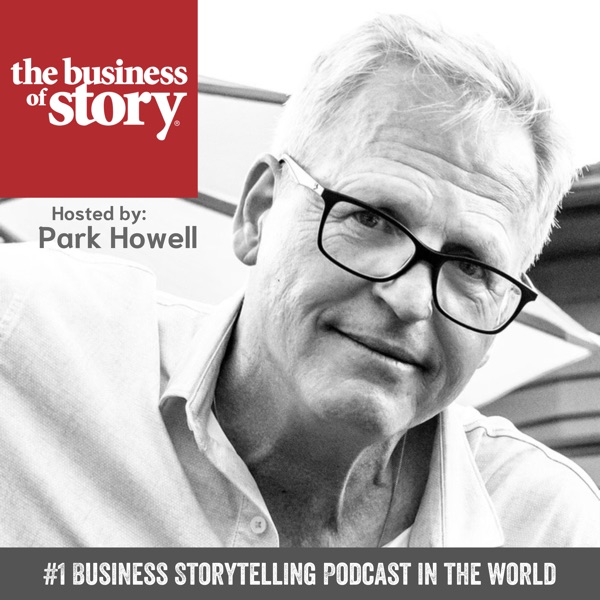
Business of Story
The Business of Story helps sales and marketing leaders excel through the stories they tell. Hosted by Park Howell, known as The World's Most Industrious Storyteller, this popular weekly show is ranked among the top 10% of downloaded podcasts internationally and is the #1 Business Storytelling Podcast according to Feedspot. #StoryOn!
- Episodes
- 592
- Releases
- Weekly
- Typical length
- 53 min
- On air since
- 2015
- Latest episode
- 1 day ago
Episodes
592 episodes, newest first
-
1 hr 3 min
#591: How The ABT Narrative Framework That Makes Your Message Endure, With Dr. Randy Olson
Show notes
Two minutes. 272 words. One speech that has endured 160 years. Abraham Lincoln's Gettysburg Address wasn't great because of beautiful language. It endured because of flawless narrative structure — the And, But, Therefore (ABT) framework.
In this episode, Park Howell is joined by Dr. Randy Olson for his tenth appearance on the Business of Story. Randy is a Harvard-trained evolutionary biologist, USC filmmaker, and creator of the And, But, Therefore (ABT) framework — the three-part narrative structure used by NASA, the Gates Foundation, and medical schools across the country to make complex messages clear, compelling, and impossible to forget.
Together, Park and Randy decode why Lincoln's two-minute Gettysburg Address has outlasted every two-hour oration delivered on that same battlefield — and what that means for every email, presentation, and brand story you need to endure.
What you'll learn in this episode:
•
Why Lincoln gave history's first two-minute lightning talk — and what it teaches every business communicator today
•
The six-element ABT framework and how to place your message in its most emphatic position for maximum impact
•
The Lincoln-Douglas debate metric that reveals whether your brand message is built to endure or built to evaporate
•
The team exercise that instantly exposes your narrative entropy — the fragmentation of your brand story — before it costs you
•
The "Liz moment" — the three things that happen when the ABT locks in and your audience starts repeating your message with perfect fidelity
Narrative entropy is the fragmentation of your brand story that renders it impotent. It is accelerating at AI speed. The ABT framework is the structure that stops it.
The ABT framework is also the narrative engine at the core of the StoryCycle Genie® — the only narrative-native, Artful Intelligence™-driven platform to help you find your brand story, define it, and get every soul behind it through the discipline of StoryOps™, coined by Park Howell and Sean Schroeder to help companies govern their brand story and stop narrative entropy in its tracks.
Connect with Dr. Randy Olson: Website: https://abtnarrative.com
Try the StoryCycle Genie®: https://storycyclegenie.com Learn the Story Cycle System™: https://businessofstory.com Follow Park on LinkedIn: [LINK] Subscribe to the Business of Story newsletter: [LINK]
#ABTFramework #AndButTherefore #NarrativeStructure #BusinessStorytelling #NarrativeEntropy #StoryOps #StoryCycleGenie #ParkHowell #RandyOlson #BrandStorytelling #ArtfulIntelligence #GettysburgAddress #BusinessOfStory
-
51 min
#590: Shift Left: Jason Stolarczyk on Governing Your Brand Story Before AI Amplifies the Chaos
Show notes
Most organizations let product, sales, and marketing each tell their own version of the brand story. In the AI era, that fragmentation doesn't stay quiet — it gets amplified at machine speed before anyone in leadership notices the drift.
Jason Stolarczyk spent more than 20 years building the narrative infrastructure behind some of the biggest stories in enterprise technology. From Microsoft and IBM to VMware, ServiceNow, and Palo Alto Networks, his integrated programs have generated millions in market reach and billions in pipeline — and inspired him to create Interpretation Friction™, a framework for fixing the gap where what a company believes, sells, and publishes stop matching.
In this conversation with Business of Story host Park Howell, Jason reveals why shifting left — stepping back before a single piece of content goes to market — is the most important discipline communications leaders can build in the AI era. He shares how ServiceNow proved that every $1 in upper funnel storytelling returned $90 in brand value, how Palo Alto Networks was positioned as the confidence infrastructure of the AI era, and why the VMware/Onion campaign — brilliant creative, no governing alignment — became the definition of empty calorie work.
What you'll discover in this episode:
• What shifting left means in communications strategy — and why one step back is worth two steps forward • How Jason's Interpretation Friction™ framework diagnoses the gap between what your company believes, sells, and publishes • Why narrative entropy is the default state — not the exception — and what WeWork's collapse proves about story governance • The $1-to-$90 brand value formula from ServiceNow and the operational system that made it possible • Why AI is not an architect — and what "slop" costs your brand when no governing story is in place • The three questions every brand must answer before any story goes to market • What the narrative qualified lead is and why it shortens sales cycles
Connect with Jason Stolarczyk on LinkedIn. Read his article: "The Executive the Interpretation Era Was Always Going to Need."
Grade your brand story free at storycyclegenie.ai/brand-story-grader.
Find full show notes, transcript, and resources at businessofstory.com/podcast/brand-story-governance-ai-narrative-entropy.
Subscribe on Apple Podcasts, Spotify, or wherever you get your podcasts.
-
53 min
#589. Tara Shuler Reveals How Speaking in Questions Slays the Invisible Monster Killing Your Sales
Show notes
Tara Shuler Reveals How Speaking in Questions Slays the Invisible Monster Killing Your Sales
Most salespeople believe objections are the problem. Sales trainer and convo control expert Tara Shuler says they are wrong. In this episode of the Business of Story podcast, host Park Howell sits down with Tara Shuler — high-ticket closer, corporate sales trainer, and author of Questions Close Deals — to reveal why your objections are a symptom of poor discovery, and how speaking entirely in questions transforms every sales conversation, difficult family negotiation, and leadership challenge you face.
What is speaking in questions in sales?
Speaking in questions is a trained sales methodology in which every response — including objections — is met with a redirecting question rather than a statement or pitch. Tara Shuler has practiced and drilled this technique for 15 years across high-ticket software sales, corporate training, and one-on-one coaching. The result: salespeople who guide buyers to their own decisions rather than pushing them toward a close.
What you will learn in this episode:
•
Why your sales objections are almost always a symptom of skipping proper discovery — and how to fix the beginning of your conversation, not the end
•
How speaking in questions eliminates the need for objection handling by uncovering the emotional why behind every buyer decision before the pitch ever starts
•
How to practice the question-first method starting tonight — with your spouse, your kids, and your colleagues — without telling them you are practicing
•
Why sales pressure causes trained salespeople to abandon every technique they know — and how Tara's gymnastics muscle memory framework builds the instinct to ask under fire
•
How Tara used sales questioning skills to convince her reluctant mother to move from Pennsylvania to Florida — and what that story teaches every leader about emotional discovery
•
Why generic AI will flatten your brand story — and why purpose-built tools like the StoryCycle Genie® deliver the narrative clarity no general platform can match
The episode's core insight:
"You're trying to figure out what their why is, and that's where the questions come into play. And then the arguments don't happen later because now you understand what you're fighting against. Because it's an invisible monster until you understand it." — Tara Shuler (00:12:28)
About Tara Shuler:
Tara Shuler is the founder of Convo Control, a sales training and coaching practice built on one foundational skill: speaking in questions. A competitive Level 9 gymnast turned high-ticket closer, Tara has spent 15 years closing large-ticket corporate software contracts, training sales teams, and coaching individuals to get out of their own way through disciplined question-based discovery. She is the author of three books — Questions Close Deals, Parenting a Parent, and Everything Is Sales — and the creator of the Convo Dojo, a live training format that puts salespeople under pressure so their muscle memory can do what their nervous brain cannot. Find Tara at convocontrol.com.
Resources mentioned in this episode:
Questions Close Deals by Tara Shuler — available on Amazon and in audiobook at convocontrol.com
Parenting a Parent by Tara Shuler — available on Amazon
Everything Is Sales by Tara Shuler — available on Amazon
The StoryCycle Genie® Brand Story Grader — free brand assessment at storycycle.ai
About the Business of Story:
The Business of Story is hosted by Park Howell, founder of Business of Story and creator of the Story Cycle System™ — the narrative infrastructure framework used by leaders, agencies, and brands to instill their conviction in their people and install it in their organization. New episodes publish weekly. Subscribe wherever you listen to podcasts.
Connect with Park Howell:
Website: businessofstory.com LinkedIn: linkedin.com/in/parkhowell StoryCycle Genie®: storycycle.ai
-
54 min
#588. Sean Schroeder: The False Summit Every Brand Builder Climbs
Show notes
You want your brand story to drive real business results — define it, refine it, get every soul behind it — and you will create a competitive advantage nobody can take from you. But getting to your brand story is not the victory. It's the false summit.
Host Park Howell sits down with Sean Schroeder — co-creator of the StoryCycle Genie® and architect of the Cognitive Mesh Architecture — to tell the origin story of a platform built to solve the real Everest of brand storytelling: operationalizing your brand story across every department, channel, and team member before narrative entropy destroys it.
What is narrative entropy? It's what happens when every SDR, salesperson, and department head starts writing from their own lived experience — telling their version of the brand story rather than what it actually is at the nexus. Without disciplined governance, your story doesn't hold. It decays.
What is StoryOps™? It's brand story governance applied everywhere — HR onboarding, customer service, DevOps, FinOps, project management — not just marketing. Brand strategy is a business communications discipline, and it needs to show up in every single slice of the organization.
What is Cognitive Mesh Architecture? It's the system that captures professional intelligence, decision-making lineage, and human judgment as content is created — giving every AI-generated brand asset full provenance so your brand voice compounds instead of drifts. Combined with Brightsy's MCP server, it delivers your brand narrative to every team member through the tools they already use.
What is the StoryCycle Genie®? It's the AI platform that compresses months of brand story creation and operationalization into weeks — for a fraction of the cost of traditional brand agencies.
Ready to see where your brand story stands? Go to storycyclegenie.ai, enter your URL, and get a free 14-point Brand Story Assessment in under a minute.
-
1 hr
#587. Parker Howell: How to Use AI as Your Slop-Free Creative Amplifier
Show notes
Most creatives are terrified of AI.
And honestly? That terror makes sense.
Sameness. Replacement. Theft.
Those three fears have colonized the creative internet. And they're not entirely wrong. Bad AI use produces a gray paste of mediocrity. It steamrolls voice. It scrapes without permission.
But here's what I've come to believe after years of building the Story Cycle System™ and developing what I call Artful Intelligence™:
The fear isn't about AI itself.
It's about how most people are using it. Like a vending machine. Like a ghostwriter. Like a replacement for thinking.
That's not intelligence. Artificial or otherwise.
The creatives who are thriving right now aren't using AI instead of their genius.
They're encoding their genius into AI and firing it at scale.
There's a difference so profound it changes everything.
You've spent years building deep expertise. You have frameworks. Hard-won instincts. A distinctive voice that took real living to develop.
You want to scale your creative output without losing what makes it yours.
But AI feels like a trap. The outputs look generic. You're afraid that leaning in means becoming a content machine producing work even you won't recognize as your own.
There's a third path.
One that treats AI not as a replacement or a crutch — but as your 100x creative amplifier.
I know this because our son Parker Howell has been living it.
Parker is the founder of Howell XR — XR filmmaker, VR game developer, fire dancer, jiu-jitsu practitioner, Reiki healer, hospice volunteer.
In the last 18 months he: → Built Monkey Tower VR in 9 months with 2 people → Won $50,000 in a Meta hackathon in 30 days → Built the Tunorama AI photo booth in 48 hours for $40 → Took SkateBoss from concept to prototype in 24 hours
That's not hype. That's what happens when someone stops treating AI as a productivity hack and starts treating it as an extension of their own creative intelligence.
Parker said something I keep coming back to:
"It's your editor, packed with all of your genius, that can fire a billion times a second."
Not a generic editor. Not someone else's genius. Yours.
Your patterns. Your frameworks. Your voice. Your decade of taste — baked into a system that never sleeps and never runs out of bandwidth.
That's not sameness. That's a creative superpower only you can build.
He also said something that stopped me cold:
"I feel like I unwittingly have designed my entire career for this moment in time."
A filmmaker who moved between disciplines without apology. A developer who didn't wait for permission to start building in VR. A creative who treated every seemingly unrelated skill as preparation for a future nobody had mapped yet.
That's the Artful Intelligence mindset.
And to anyone still sitting on the sidelines? Parker was direct:
"Just go make some slop. Don't show it to anyone. But just play with it."
No judgment. No stakes. Just play.
Because the fear of producing slop is keeping more talented people from their own creative abundance than any shortcoming in the technology.
The question isn't "will AI replace me?"
It's "how do I encode what I know into something that compounds?"
The creatives who answer that question — who train AI on their irreplaceable expertise — are building something that genuinely can't be commoditized.
Because it's them.
If you're a creative who wants to think bigger than you've ever thought, this episode is for you.
If you're an expert who wants to encode your genius into something scalable, this episode is for you.
If you've been afraid that embracing AI means losing yourself — this one is especially for you.
🎧 Listen and watch — link in the first comment.
#ArtfulIntelligence #BusinessOfStory #100xCreator #AICreativeAmplifier #StoryCycleSystem
-
44 min
#586. Magda Adamska: Four Strategic Traps That Destroy Even Iconic Brands
Show notes
What kills iconic brands like MTV, Nike, Blockbuster, and GoPro? Not bad marketing. Not weak products. But four specific strategic traps that fragment brand story governance — and silently destroy enterprise value from the inside out.
Brand strategist and BrandStruck founder Magda Adamska joins Park Howell on the Business of Story to reveal the four strategic traps that cause even the world's most powerful brands to collapse: the Comfort Trap, the Efficiency Trap, Over-Expansion, and Growth-at-All-Costs. Drawing from 250-plus brand strategy case studies spanning nearly 50 countries, Magda shows exactly how narrative entropy sets in when brand story loses its governance — and how AI accelerates the damage at light speed.
In this episode you will learn:
•
Why MTV had everything Spotify needed — and still failed to act
•
How Nike's pandemic data trap triggered a brand crisis still unfolding today
•
Why GoPro's move into media nearly destroyed the company
•
How a governed brand story acts as the one strategic guardrail that protects against all four traps
Magda Adamska is an independent brand consultant with over 20 years guiding C-suite executives through brand transformations and portfolio optimizations for MTV, Pearson, Nike, Nestlé, JP Morgan, Procter & Gamble, and Guinness World Records.
If you lead a brand, market one, or build them for clients, this episode is essential listening.
Visit brandstruck.co to explore 250-plus brand strategy case studies including free access to Nike, Lego, and IKEA.
-
50 min
#585. Attia Qureshi: How to Negotiate Sales and Marketing Into Telling One Story
Show notes
Most organizations don't have a brand storytelling problem. They have a negotiation problem.
When sales, marketing, and IT each champion their own version of the company story, the result is narrative entropy — the slow fragmentation of your brand message across every channel, every team, and every customer touchpoint. And in the age of AI-powered search, that fragmentation doesn't just confuse your audience. It gets scraped, amplified, and fed back into the market as your brand identity.
Attia Qureshi knows how to stop it.
A negotiation and influence expert with two decades of experience, Attia has brokered agreements in Fortune 500 boardrooms, university classrooms, and conflict zones around the world — including negotiating with cartel-controlled farmers on behalf of the U.S. State Department in Colombia. She is a former MIT faculty member, adjunct professor at the University of Michigan, founder of Attia Qureshi Consulting, and author of the national bestseller Never Settle: Persuasion and Negotiation Skills to Get What You Want, which Daniel Pink calls a book that will "train you how to move through the world."
In this episode of the Business of Story, Park Howell and Attia explore how relational, interest-based negotiation is the missing discipline inside StoryOps — the practice of developing, operationalizing, and governing your brand narrative across every department in your organization.
In this episode you will learn:
•
Why sales and marketing fight over brand story — and the negotiation framework that ends it
•
How to map the interests of every internal stakeholder so you can build genuine cross-departmental buy-in around one sovereign brand narrative
•
Why narrative entropy accelerates in the age of AI — and how StoryOps, powered by negotiation, is your best defense
Resources mentioned in this episode:
•
Attia Qureshi Consulting: atiaqureshi.com
•
Never Settle by Attia Qureshi and John Richardson — available at all major retailers
•
Free internal influence guide: atiaqureshi.com/story
•
Business of Story Brand Story Genie™: businessofstory.com
-
47 min
#584. Matt Beezley: AI Is Either Ignoring Your Brand or Reinventing it. Here's The Fix
Show notes
Your brand is being described right now on platforms you don't control — and AI is assembling those fragments into a story you'd never tell about yourself. Matt Beezley, Senior Strategist at Red Fan Communications and creator of the Brand Authority Index, calls it narrative entropy. And in this episode of the Business of Story, he explains exactly why it's the defining brand challenge of the AI search era.
Matt has spent more than a decade helping B2B companies across fintech, insurtech, sustainable technology, education, and supply chain find the story that holds through IPOs, acquisitions, and high-stakes go-to-market moments. He built Red Fan's brand positioning methodology from scratch — and then built the Brand Authority Index, a diagnostic tool that quantifies the signals large language models actually use to evaluate, cite, and recommend brands to potential buyers.
What those signals reveal should concern every brand marketer: over 80% of AI citations come from earned media, not your website. Query-based rankings barely correlate with what AI actually says about you. And if your brand is described differently on your website, LinkedIn, Crunchbase, and Google Knowledge Base, AI will either ignore you entirely or invent a Frankenstein version of your brand and serve it to buyers at the exact moment they're making a decision.
In this conversation, Park Howell and Matt unpack the concept of entity coherence — messaging consistency across every platform where your brand exists — and why it's the single highest-leverage fix available to brand communicators right now. They explore why gated content is killing your AI citation rate, how the prism model helps one core story speak to 25 different B2B buying stakeholders without fragmenting, and why the brands winning in generative engine optimization are doing the same things great marketers have always done — just doing them with discipline and consistency.
You will learn why AI detects and discounts AI-generated content, how a three-question monthly sales feedback loop starts closing the narrative entropy gap immediately, and why training AI on your own proprietary data produces results that are, in Matt's words, "light years better" than anything pumped out from a generic prompt.
If your brand is invisible in AI search — or worse, misrepresented — this episode is your diagnostic and your roadmap.
Connect with Matt Beezley and Red Fan Communications at redfancommunications.com and explore their Brand Authority Index diagnostic. Find Park Howell and the StoryCycle Genie™ at businessofstory.com, and subscribe to Park's Brand StoryOps™ for Agencies newsletter on LinkedIn.
-
45 min
#583. Lindsey Busfield: Own Your Niche. Govern Your Story. Win Your Market.
Show notes
What separates the brands that dominate their category from those that disappear into digital noise? Two things: a ruthlessly focused niche and a brand story governed with such precision that your ideal client finds no other logical answer.
Lindsey Busfield, co-founder of Optimize My Firm, built the nation's most recognized SEO agency for personal injury attorneys by doing exactly that — going so narrow, so deep, and so disciplined in her StoryOps™ that competitors simply can't follow.
In this episode of the Business of Story, host Park Howell and Lindsey unpack why niching down is the most powerful brand strategy available to any business, how governing your story with clarity, consistency, and coherence makes you the category king or queen of your market, and why AI-driven search now rewards exactly this kind of high-fidelity storytelling.
You'll discover:
• Why casting a wide net produces shallow results — and how radical niche focus turns your brand into the signal, not the noise
• How personal injury lawyers use story to win cases — and what every business can steal from that approach to govern their brand narrative
• How to build your digital footprint across SEO, AEO, and GEO so that Google, Perplexity, and every AI search engine serves you up as the definitive answer in your marketLindsey is also host of the Personal Injury Marketing Minute podcast and author of How Personal Injury Lawyers Get Leads: What Works, What Doesn't, and Why — available now on Amazon.
Connect with Lindsey Busfield: Website: optimizemyfirm.com Email: lindsey@optimizemyfirm.com LinkedIn: Lindsey Busfield
Learn more about the Business of Story and StoryOps™: storycyclegenie.ai
-
55 min
#582: Gavin McMahon: The Arrow of Coherence That Unifies Your Brand Storytelling
Show notes
Gavin McMahon: The Arrow of Coherence That Unifies Your Brand Storytelling Business of Story Podcast | Host: Park Howell
Most brand stories fragment the moment they leave the marketing department. Gavin McMahon has a name for what stops that — and it may be the most important concept in business storytelling you haven't heard yet.
Gavin McMahon is a recovering mechanical engineer, founder of a 25-year leadership and storytelling consultancy, and author of Story Business: Why Stories Rule the World and How They Can Reinvent Your Business. He joins Park Howell on the Business of Story podcast to introduce the Arrow of Coherence — the cause-and-effect narrative logic that connects every layer of an organization, from the C-suite to the front line, into a single governing story world.
The problem Gavin diagnoses is one every business leader will recognize: the synonymous mess. Most companies tangle purpose, vision, mission, and strategy into one undifferentiated blob of corporate language. The result? Thousands of employees making daily decisions — small and large, value-creating and value-destroying — without a coherent narrative to guide them. In a pre-AI world, that fragmentation was a slow burn. Today, ungoverned AI scales that fragmented story at machine speed.
The Arrow of Coherence is Gavin's answer. Borrowed conceptually from Nassim Nicholas Taleb's idea of an arrow of relationship, Gavin defines the Arrow of Coherence as the cause-and-effect logic that must shine through a brand — the same governing logic that makes the world of IKEA, Apple, or Patagonia feel coherent whether you encounter it in product design, customer service, or a thirty-year-old marketing campaign. When that arrow is present, every decision in the organization points the same direction. When it's absent, you have drift.
In this conversation, Park Howell and Gavin McMahon explore why brand storytelling is not a marketing function but an act of world building — and why the best brands govern their stories through something closer to a show Bible than a brand guideline. They discuss why the CEO is the most underutilized storyteller in any company, how to build a coalition of the willing to embed story culturally rather than hierarchically, and why AI will amplify your narrative entropy unless a governing Brand Brain is installed first.
Gavin also shares the two things he wishes he had known in the 1990s when he was leading digital transformation at Gartner — lessons about human decision-making, the stories people tell themselves, and why the truth is never driven by facts alone.
What you will learn in this episode:
What the Arrow of Coherence is and how to apply it to unify your brand story across every department and channel. Why most organizations suffer from a synonymous mess of purpose, vision, mission, and strategy — and the single narrative move that untangles it. How show Bibles differ from brand guidelines and why that distinction determines whether your story survives scale. Why your CEO is your most underutilized brand storyteller. How to use AI as a collaborator without surrendering your story to it. The three practical steps you can take today to start building your own Arrow of Coherence.
Gavin McMahon is the author of Story Business: Why Stories Rule the World and How They Can Reinvent Your Business. Learn more at storybusiness.com.
Park Howell is founder of The Business of Story, creator of the Story Cycle System™, and author of Brand Bewitchery and The Narrative Gym. Full episode show notes, transcript, and resources at businessofstory.com.
-
56 min
#581: Rain Bennett: Why Your Brand Story Belongs to Operations, Not Marketing
Show notes
Rain Bennett — award-winning documentary filmmaker and author of The Chief Storytelling Officer — joins Park Howell on the Business of Story to make the case that your brand story doesn't belong to marketing. It belongs to your entire organization. And if no one is governing it, AI is fragmenting it faster than you can fix it.
In this episode, Rain introduces his Narrative Operating System (NOS) — a living, governing architecture that threads a single coherent brand story through every department, every touchpoint, and every AI tool you deploy. He explains why the Chief Storytelling Officer is not a communications role but an engagement role, and why the brands winning today built their story alongside their product — never after it.
You'll discover:
— Why marketing, sales, and HR are telling three different brand stories right now — and what to do about it — How Rain's Narrative Operating System governs story across Vision, Mission, Brand, Product, Marketing, Sales, and Feedback Loops — Why the Chief Storytelling Officer is the most important role most companies haven't created yet — How to extract the story your organization is already living before you try to tell the story you want to tell — Why AI has turned narrative drift from a slow burn into an exponential emergency
Rain Bennett is the founder of Elamir, a documentary filmmaking studio producing human stories for the tech industry. His new book, The Chief Storytelling Officer, is available now at rainbennett.com/businessofstory — where listeners can also get a signed copy for $10.
Park Howell is the world's leading brand storytelling advisor. For 40 years he has helped organizations grow by up to 600% using his Story Cycle System™. He is the host of the Business of Story — one of the world's top-ranked business storytelling podcasts — and co-creator of StoryCycle Genie®, the AI-powered brand narrative platform.
Before you govern your story, know where it stands. Get your free Brand Story Grade — an A+ to F assessment across 14 narrative dimensions — in minutes at storycyclegenie.ai/brand-story-grader.
Story on.
-
53 min
#580. Sharon Toerek: Don't Sell What You Do. Profit from How You Think
Show notes
Sharon Toerek: Don't Sell What You Do. Profit from How You Think — Libsyn Description
Most marketing agencies are unknowingly giving away their most valuable asset — and AI has quietly turned that mistake into a legal emergency.
IP attorney Sharon Toerek, founder of Legal+Creative and host of The Innovative Agency podcast, joins Park Howell to reveal the intellectual property and AI legal risks every agency principal needs to understand right now.
Sharon is the agency industry's most trusted legal strategist on IP protection, trademark, copyright, and AI governance — and she's seen firsthand how fast agencies are falling behind.
In this episode you'll discover:
• Why generic AI-generated content may legally belong to no one — not your agency, not your client, not anyone — and what that means for every deliverable you produce • How feeding client data into generic AI tools is a hidden data privacy violation waiting to happen, and why most agencies don't realize they're doing it • The five moves every agency must make now — from internal AI policies to errors and omissions insurance — to protect their IP, govern their AI use, and build an agency worth far more when it's time to sell
Sharon also makes the case for the most important strategic shift in the agency business model: stop competing on execution and start commanding premium fees for your thinking and strategy.
Because what goes on between your ears is your most valuable and protectable asset.
Connect with Sharon Toerek: • legalandcreative.com • The Innovative Agency Podcast • LinkedIn: Sharon Toerek
Craft your vibrant brand story with the StoryCycle Genie®: storycyclegenie.ai
-
55 min
#579: Collin Henderson: The 5-Part Mindset Storytelling Method for Confidence
Show notes
What separates elite performers from everyone else isn't skill, strategy, or preparation. It's psychology.
Collin Henderson knows this firsthand. A former Division I wide receiver at Washington State University, seven-time author, and host of the Master Your Mindset podcast, Collin has spent his career cracking the code on peak performance — training number one NBA draft picks, Heisman football finalists, and top sales teams at Nike, Amazon, Salesforce, and Alaska Airlines.
His new book, The Oz Method: Psychological Secrets of Influence for Sales, Leadership, and Life (IdeaPress, 2026), delivers a parable-driven framework inspired by L. Frank Baum's classic — and it just might change the way you sell, lead, and communicate forever.
In this episode of the Business of Story, Collin reveals why sales psychology beats sales strategy every time. We unpack his five-part story framework — Set the Scene, Establish the Challenge, The Growth Journey, Face Your Fear, Resolution — and explore why the brain is hardwired to respond to problems before solutions. Collin also shares why your identity is the hidden ceiling on your performance, how "trauma, drama, daddy and mama" shapes the way high achievers either freeze or fly under pressure, and why boring will put you out of business faster than any competitor.
This is a masterclass in the psychology of influence, the neuroscience of storytelling, and the courage it takes to communicate when the moment gets biggest.
What you'll discover in this episode:
The five-part story framework every seller, leader, and communicator needs to master. Why psychological readiness trumps preparation in high-stakes moments. How to close the gap between what your team can do and what they actually deliver
Connect with Collin Henderson at thecolinhenderson.com and on LinkedIn and Instagram @ColinHendersonCoach. Find The Oz Method wherever books are sold.
Learn more about the Business of Story at businessofstory.com.
-
53 min
#578: Find Your One Word and Become Impossible to Ignore, With Brian Burkhart
Show notes
What does it take to stop competing on price and start commanding attention? One word. Your core belief.
In this episode of the Business of Story, host Park Howell sits down with Brian Burkhart, founder of Square Planet and one of America's top communication strategists, to reveal why most businesses become invisible commodities — and exactly what to do about it.
Brian has spent decades helping Fortune 500 leaders, CEDx speakers, and senior executives find the single galvanizing word that transforms how teams align, how audiences feel, and how brands compete. His insight is simple and powerful: if you can't name what you stand for, you won't stand out.
In this episode you'll discover:
• How to distill your core belief into one powerful word that galvanizes your entire organization
• Brian's 10-step ancient Stoic framework that works for any presentation, pitch, or keynote
• How to reverse-engineer your core beliefs directly from your daily actions
• Why your audience decides with feelings first — and how to make art that activates them
• The Mad Men "It's Toasted" moment that proves one idea beats every feature listBrian Burkhart defines art as "the unnecessary done on purpose to make someone feel." Sprinkles on cupcakes. Colorful hospital walls. Hotel turndown service. None of it is necessary. All of it creates enthrallment. And enthrallment is exactly what separates unforgettable brands from forgotten commodities.
Whether you're preparing a Monday morning presentation, a keynote, or a company-wide initiative, this episode gives you the tools to find your North Star — and make it impossible to ignore.
Guest: Brian Burkhart, Founder of Square Planet Contact: info@squareplanet.com Free 45-minute consultation: mention the Business of Story
Host: Park Howell, Founder of the Business of Story and creator of the StoryCycle System™ Learn more: businessofstory.com
-
51 min
#577: How Almost Nothing Changes Everything in Your Brand Storytelling, With Ryan Kohn
Show notes
What makes a brand story powerful enough to move millions of people on the world's most complex issue? Not more data. Not louder messaging. Not a bigger ask. The answer, according to serial entrepreneur Ryan Kohn, is radical simplicity — and a single theme that makes your audience feel the truth of your idea before they ever think about it.
Ryan Kohn is the founder of Point One, a global business initiative that asks companies to commit just 0.1% of their revenue to accelerate the clean energy transition. That is one dollar for every thousand in revenue. A rounding error for most businesses. But pooled together, it is enough to fully fund clean energy access for the entire world within 15 years.
In this episode of the Business of Story, Park Howell sits down with Ryan to unpack how he turned one of the most fatigued conversations in modern business — climate change — into one of the most compelling brand stories in the world. And what every brand builder can steal from it.
WHAT YOU WILL LEARN IN THIS EPISODE
How to find the single brand theme that compresses your biggest idea into your most powerful message. Ryan and his team distilled an impossibly complex global challenge into four words — almost nothing changes everything — and built an entire movement around it.
Why leading with your cause is killing your message. Ryan explains why Point One never leads with sustainability, climate, or clean energy — and why that counterintuitive decision is the reason the brand resonates where others have failed.
How to meet your audience inside the cultural moments they already love. Point One builds brand awareness through sport, music, art, and film rather than issue-led campaigns, reducing friction and expanding reach without alienating anyone.
Why simplicity is not a shortcut in brand storytelling — it is the destination. Ryan's rule is simple: if it is not simple, it does not land. This episode shows you exactly how to apply that principle to your own brand story.
How a 0.1% corporate commitment could change everything. Park runs Point One through the StoryCycle Genie live on air, surfacing the brand's core positioning statement and unique value proposition — and revealing just how precisely Ryan's team has already nailed their story.
ABOUT RYAN KOHN
Ryan Kohn is the co-founder of PROPER Snacks, the UK's leading premium snack brand and one of the first B Corps in the sector. From a kitchen-table idea to a global company selling over eight million snacks a month, he scaled PROPER into a household name and led its 85-person team before exiting to private equity in 2021. Alongside building PROPER, Ryan launched ventures spanning carbon-neutral property development and the UK's largest student events business, earning recognition as EY Entrepreneur of the Year.
Beyond business, Ryan has long championed impact initiatives — from co-founding campaigns alongside Riz Ahmed and HRH Prince William to serving as a board member of environmental charity Hubbub. He has co-authored a B Corp guide to achieving net zero, and has mentored the next generation of entrepreneurs through programmes including Virgin Start-Up and Tesco Back It.
Most recently Ryan founded Point One, a global initiative making it radically easy for businesses to support the clean energy transition. Point One asks companies to contribute just 0.1% of their revenue into a shared fund that helps unlock and accelerate clean energy projects, particularly in developing markets. By pooling these small fractions across everyday economic activity, Point One aims to create a new funding engine for global cooling and help fully fund the clean energy transition within 15 years.
WHY THIS EPISODE MATTERS FOR BRAND BUILDERS
This is not an episode about climate change. It is an episode about what happens when a brand story is so clear, so simple, and so true that it makes even the hardest yes feel like the easiest decision your audience has ever made. Ryan Kohn just happens to prove that principle in the most difficult storytelling arena in modern business.
If you have ever struggled to simplify a complex message, lost an audience to jargon, or wondered why your brand is not moving people the way you know it should — this conversation is for you.
CONNECT WITH RYAN KOHN AND POINT ONE Website: pointone.world
ABOUT THE BUSINESS OF STORY The Business of Story is the top-ranked podcast for brand storytelling strategy, hosted by Park Howell — founder of the Story Cycle System and one of the world's leading brand narrative strategists. Each week Park interviews the world's brightest brand builders, marketers, and communicators to reveal how purposeful storytelling drives growth, loyalty, and lasting impact.
Subscribe, leave a review, and visit BusinessOfStory.com to access tools, training, and resources that will make you a more powerful brand storyteller.
-
58 min
#576: The Power of Pull: Find Customers Who Are Already Sold, With Rob Snyder
Show notes
What if your best customers are already sold — before you ever say a word?
That's the promise of the PULL framework, and in this episode, startup advisor and author Rob Snyder breaks down exactly why smart, well-resourced founders keep pushing brilliant products onto people who aren't ready to buy — and what to do instead.
If you've run the demos, done the research, and still watched prospects disappear, this episode is your wake-up call.
You'll discover:
• Why doing everything "right" can still leave you in the pain cave
• The four-part PULL framework (Project, Unavoidable, List of options, Limitations) that predicts who will buy before you even pitch
• How to describe your product in the fewest possible words — and why less is always more
• Why your sales call should be a "see if they try to buy" call, not a convince-them-to-buy call
• How a repeatable customer success story does more selling than any pitch deck ever willRob Snyder is a Harvard MBA, former McKinsey consultant, startup founder, and author of The Power of Pull. He has advised hundreds of startups on how to find product-market fit faster by stopping the push and building for pull.
Connect with Rob: Website: robsnyder.org LinkedIn: linkedin.com/in/robsnyder
Get the book: The Power of Pull — available on Amazon
Learn more about the Story Cycle System™: businessofstory.com
#576: The Power of Pull: Find Customers Who Are Already Sold, With Rob Snyder
-
51 min
#575: Elliott Rayner on Why 81% of Your Team Can't Tell Your Story
Show notes
Only 19% of employees can consistently tell their company's story. That means 81% of your brand touchpoints are leaking narrative — and costing you customers. Elliott Rayner's groundbreaking research explains why, and what to do about it.
Elliott Rayner — fractional Head of Storytelling and author of The State of Storytelling 2026 — analyzed 25 emerging Chief Storytelling Officer job descriptions from the world's most sophisticated companies to uncover a seismic shift: the best organizations are no longer treating brand narrative as a creative function. They're operationalizing it.
In this episode, Elliott and host Park Howell reveal:
• Why Narrative Entropy is the silent killer of brand growth — and the single metric that exposes it instantly
• What a Chief Storytelling Officer actually does (hint: it's far less about creating stories and far more about creating alignment)
• The 3-question survey you can run inside your company this week to make the business case for StoryOps™
• Why "execution has become cheap but meaning has not" — and what that means for your competitive strategy in the AI age
• How to get your head of sales, legal, product, and finance all telling the same story without a fightWhether you're a CMO, a founder, a product marketer, or someone quietly operating as your organization's unofficial head of storytelling — this episode is your mandate and your blueprint.
Resources mentioned:
• Download Elliott's free report: The State of Storytelling 2026 — find it on his LinkedIn profile
• Elliott's Maven storytelling cohort: productnarratives.com
• Park Howell's StoryOps™ platform: storycycle.ai -
46 min
#574: Jason Swenk: Own Your Business Before It Owns You!
Show notes
Most agency founders built their business to buy back their time — then woke up to find the business owns them instead. Jason Swenk built and sold a seven-figure agency that served AT&T, Hitachi, and LegalZoom. Today he advises 7- and 8-figure agency owners through Agency Mastery, hosts the Smart Agency Masterclass podcast, and just released his book Operator to Owner. He's seen this trap from every angle.
In this episode, Jason shares the 5-Stage Founder Evolution framework that changes everything: Operator → Manager → Architect → CEO → Owner. These aren't revenue milestones. They're deliberate identity shifts that progressively remove the founder from daily operations — until the business can run without them.
What you'll learn in this episode:
• The 5 founder identity stages every agency owner must move through to achieve true business freedom
• Why chasing revenue without evolving your identity keeps you trapped — even at $10M
• How to build a business that runs without you so you can own it instead of being owned by itKey quote: "You could be a $10 million agency and be completely miserable and unprofitable and working all the time. I'd rather be a million dollar agency working 20 hours a week that I really enjoy life." — Jason Swenk
If your agency story feels fragmented — across your website, pitches, and team — visit storycyclegenie.ai for a free Brand Story Grade and find out what it's costing you.
Connect with Jason Swenk: Agency Mastery: agencymastery.com Smart Agency Masterclass Podcast: jasonswenk.com Book: Operator to Owner
Subscribe to Business of Story for weekly conversations that help leaders, entrepreneurs, and communicators use the science of story to win more business and live more meaningful lives.
-
55 min
#573: A Tech Titan's Warning: Better AI Won't Save Us. Better Humans Will, With Brett Hurt.
Show notes
Brett Hurt got the Lamborghini. He got the exits, the valuations, everything a tech titan is supposed to want. And then he felt nothing.
That emptiness became the most important moment of his career — and the catalyst for his new book, Love Conquers Fear: Humanity, AI, and the Age of Abundance for All.
Brett is the co-founder of data.world (acquired by ServiceNow), Bazaarvoice (unicorn IPO), and Coremetrics (acquired by IBM). He has invested in 151 startups, backed 52 VC funds including SpaceX, and was named Austin's Best CEO.
In this conversation with host Park Howell, Brett makes the case that the most urgent upgrade of the AI age is not technological — it's personal. We explore why love, not fear, is the only leadership strategy built for what's coming, why nuclear weapons are a greater existential threat than artificial intelligence, and how psychedelic therapy and Vedantic philosophy transformed the way Brett thinks about building companies, raising consciousness, and saving humanity from itself.
If you've ever wondered what you're actually building your work for, this episode is your answer.
Find Brett at loveconquersfear.org and on the Love Conquers Fear podcast, published every Tuesday.
-
45 min
#572: How to Simplify Complex Ideas to Get Your People to Act, With Rob D. Willis
Show notes
What if your deepest expertise is the very thing making you harder to understand? British music producer turned strategic story producer Rob D. Willis joins Park Howell on the Business of Story to explain why complexity kills communication — and how story structure gives your audience exactly the right combination of connections to get you, what you're about, and what you're asking them to do.
Rob has spent years helping tech founders, corporate leaders, and change-makers in Berlin and beyond simplify their most complex ideas into stories that move people to act. In this episode, he brings the frameworks, the neuroscience, and the real-world case studies to prove it.
What you'll discover:
• Why the curse of expertise turns your knowledge into noise — and how story is the antidote
• The four audience types (friendly, adversarial, apathetic, uneducated) that should reshape every high-stakes conversation
• How the Downing Street communication grid turns your story into a replicable action plan
• The three types of complexity — intrinsic, extraneous, and germane — and which one you actually control
• Why your brain runs on narrative, not logic (and what dopamine, cortisol, and oxytocin have to do with it)
• How a bank board member's "sand vs. stones" story changed the way Rob thinks about strategic communicationAbout Rob D. Willis: Rob D. Willis is a British music producer turned strategic story producer based in Berlin. He helps leaders and organizations cut through complexity by applying the structure of story to high-stakes communication. Find him on Instagram and LinkedIn at @robdwillis.
Resources mentioned in this episode:
• Connor Neal's four audience types framework
• The Downing Street communication grid (Alastair Campbell / Tony Blair)
• Paul Zak's research on narrative neuroscience
• StoryCycle Genie® at businessofstory.comWant to master the story of your business? Discover the Business of Story tools, courses, and the StoryCycle Genie® at businessofstory.com.
Subscribe to the Business of Story wherever you get your podcasts — and leave a review if this episode helped you turn your expertise into clarity.
Marketing lists
More Marketing shows picked out from the charts








More in Marketing
Placed highest on Apple Podcasts' Marketing chart right now