Podcast
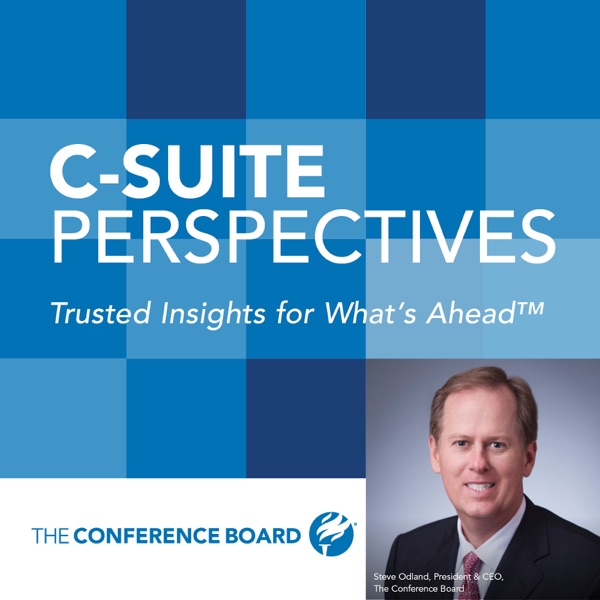
C-Suite Perspectives
Welcome to C-Suite Perspectives, a podcast series by The Conference Board. Hosted by our President & CEO, Steve Odland, this weekly conversation will take an objective, data-driven look at a range of business topics aimed at executives. Listeners will come away with what The Conference Board does best: insights for what's ahead™.
- Episodes
- 106
- Releases
- Twice a week
- Typical length
- 26 min
- On air since
- 2025
- Latest episode
- 1 day ago
Episodes
106 episodes, newest first
-
28 min
How to Redesign Work for Real Business Value from Agentic AI
Season 1, Episode 417
Show notes
AI agents can access records, initiate actions, and make decisions across multiple systems—but humans need to remain accountable for the consequences. As organizations give agents greater autonomy, leaders need clear boundaries, human oversight, and governance proportionate to the risks involved.
In this episode of C-Suite Perspectives, Steve Odland, President and CEO of The Conference Board, is joined by Allan Schweyer, Principal Researcher in the Human Capital Center at The Conference Board. They discuss what distinguishes autonomous agents from simpler AI tools and what companies must put in place before deploying them at scale.
Together, they discuss how to choose the right workflows for agentic AI and determine which tasks belong with people or agents, why the cost of governance must be included in the business case, and how organizational values should determine what agents are permitted to do. They also consider the importance of transparency, employee involvement, and protecting entry-level pathways as AI assumes more routine work.
More from The Conference Board:
· A Framework for Agentic AI and Work Redesign
· AI and the Workforce: Governing Risk, Opportunity, and Access
· From Principles to Practice: Governing AI in the Corporation
· Tokens and Talent: How AI Access Decisions Can Imperil Workforce Development
-
17 min
Europe's Workers Are Ready for AI—Are Their Organizations?
Season 1, Episode 416
Show notes
Europe's workers may be more prepared for AI-driven change than their employers. While 78% say their organization helped them adapt to recent major change, only 54% are confident it can effectively manage future change—a 24-percentage point gap showing that individual adaptability does not necessarily translate into organizational readiness.
In this episode of C-Suite Perspectives, Sara Murray, Managing Director, International at The Conference Board, speaks with Robin Maillard, Researcher in the Human Capital Center Europe at The Conference Board and author of The Reimagined Workplace 2026: Europe. They examine findings from the first European edition of the study, based on surveys of 475 workers across France, Germany, Italy, and the UK; and 83 senior human capital executives.
Together, they discuss why AI adoption is moving faster than organizational training and support; how direct managers can turn enterprise strategy into credible everyday change; and why hiring constraints make upskilling, internal mobility, and work redesign essential. They also explore the risk of a two-speed AI workforce and why meaningful choice over workplace attendance appears to matter more than the number of days employees work remotely.
More from The Conference Board:
•
The Reimagined Workplace 2026: Europe
•
•
Leadership Disrupted: Preparing for an AI-Enabled Workplace
•
Europe's AI Productivity Paradox: Rising Uptake, Shallow Diffusion
-
17 min
State of the Economy for October 2026: Consumer Confidence Rises, CEO Confidence Falls
Season 1, Episode 415
Show notes
Consumer confidence rebounded in October, while CEO confidence moved back into negative territory in the fourth quarter. What do these contrasting readings reveal about the US economic outlook?
In this episode of C-Suite Perspectives, The Conference Board's Senior Economist Alex Heil speaks with Associate Economist Allen Li about what consumers and business leaders are seeing beneath the confidence headlines. They discuss persistent concerns about prices and the job market; why consumers are continuing to spend while economizing; the outlook for hiring, wages, and capital investment; and how AI investment, cybersecurity, geopolitical uncertainty, and energy prices are shaping business decision-making.
Their central takeaway: the economy continues to show resilience, but leaders should look beyond the headline measures to understand the more nuanced risks and opportunities ahead.
For more from The Conference Board:
-
26 min
How to Build Retirement Income That Lasts: Prudential's Phil Waldeck
Season 1, Episode 414
Show notes
Americans are living longer, transforming retirement security from a question of how much people can save into a more complicated challenge: how to turn those savings into dependable income that will last for the rest of their lives. Even successful savers can find themselves reluctant to spend, uncertain whether their assets must support 10 years of retirement—or 40.
In this episode of C-Suite Perspectives, Steve Odland, President and CEO of The Conference Board, is joined by Phil Waldeck, Head of US Businesses at Prudential Financial, to examine how longevity, economic uncertainty, and the decline of traditional pensions are reshaping retirement planning.
Together, they discuss why workers need to think beyond account balances and develop retirement-income strategies, how automatic enrollment and contribution escalation can improve outcomes, and why employers remain one of the most trusted and effective channels for supporting financial security. They also explore the fear of running out of money during retirement; the growing need for accessible financial advice; the potential for AI to complement human guidance; and what longer lives mean for individuals, employers, and the US economy.
More from The Conference Board:
· How the National Debt Affects All Generations of Americans
-
28 min
Why Tariffs and Protectionism Are Here to Stay
Season 1, Episode 413
Show notes
Uncertainty dominates today's business environment and can leave leaders hesitant to make decisions. But beneath this ambiguity are five certainties that offer a basis for action: China's rise, the fracturing global economy, protectionism and tariffs, technological transformation, and the end of Pax Americana.
In this episode of C-Suite Perspectives, Steve Odland, President and CEO of The Conference Board, speaks with Dr. Lori Esposito Murray, global affairs consultant and former President of the Committee for Economic Development—now the CEO Center—about her article The New World Order: Five Certainties Amid Uncertainty, featured in the Foreign Policy Association's book Navigating an Age of Uncertainty.
Together, they examine how China is challenging Western economic and geopolitical leadership, why sanctions and competing payment systems are accelerating global fragmentation, and why tariffs are likely to remain a prominent policy tool beyond the next election. They also discuss the shift toward regional military powers as Pax Americana ends, the risks of declining transparency and international cooperation, and why business and government leaders must work together to shape global rules and standards for emerging technologies.
More from The Conference Board:
· How the National Debt Affects All Generations of Americans
· AI Policy and Regulation in the US: What Companies Need to Know
· Charting Pathways for US-China Economic Cooperation Amid Strategic Competition
-
27 min
What Will Define AI Winners: Former Cisco CEO John Chambers
Season 1, Episode 412
Show notes
AI is advancing so quickly that companies may need to rethink their strategies every nine to 12 months. But keeping pace is not simply a matter of adopting more technology: lasting gains will require companies to redesign business processes, establish clear metrics, build secure common architectures, and treat AI as a CEO-led transformation.
In this episode of C-Suite Perspectives, Steve Odland, President and CEO of The Conference Board, speaks with John Chambers, former Executive Chairman and CEO of Cisco Systems, about what business leaders can learn from the internet revolution as they navigate the faster and potentially more consequential AI era.
Together, they discuss why CEOs must own AI strategy, how companies can move from experimentation to measurable pilots, and why productivity gains should fund growth and new revenue opportunities—not simply reduce headcount. They also explore the cybersecurity risks posed by agentic AI; the need to combine speed with repeatable processes and governance; and the culture, workflows, and leadership practices that will separate the next decade's winners from the companies left behind.
More from The Conference Board:
· A Framework for Agentic AI and Work Redesign
· From Principles for Practice: Governing AI in the Corporation
· AI and the C-Suite: Implications for CEO Strategy in 2026
· Transforming Organizations for AI: Critical Factors for AI Success
-
23 min
How Solar and Battery Storage Can Meet Rising US Power Demand
Season 1, Episode 411
Show notes
After two decades of relatively flat US electricity consumption, power demand is growing again as AI, data centers, and advanced manufacturing expand. Solar and battery storage can add capacity relatively quickly and economically—but lengthy development and grid-interconnection processes could prevent new power from coming online fast enough.
In this episode of C-Suite Perspectives, David Young, President of The CEO Center at The Conference Board, speaks with David Zwillinger, CEO of DESRI, about what it will take to meet America's rising demand for reliable, affordable power.
Together, they discuss why solar accounted for 54% of new US generating capacity last year and how falling battery costs are making renewable energy more attainable and attractive. They also explore the role of natural gas and other energy sources in maintaining reliability, how developers can build community support, why the business case for renewables has shifted from ESG goals to cost and speed, and what CEOs and CFOs should understand about power agreements and transferable renewable energy tax credits.
More from The Conference Board:
· Wired for AI: What US Tech Giants' Growing Energy Appetite Means for Business
· Data Center Buildout Puts Pressure on Power Infrastructure, Input Costs
· Can the US Grid Keep Up with the Demand for AI?
· US Power Surge: How Businesses Can Prepare for Electricity Demand Spikes from AI
-
27 min
How NetApp CEO George Kurian Turns Disruption into Opportunity
Season 1, Episode 410
Show notes
An established company can be profitable and still lose its place in the future. Avoiding that fate requires treating disruption as an opportunity, preserving what remains valuable, and renewing the organization for the next era.
In this episode of C-Suite Perspectives, David Young, President of The CEO Center at The Conference Board, speaks with George Kurian, CEO of NetApp and a recipient of the 2026 Distinguished Leadership Award, about leading an established technology company through the rise of cloud computing into AI.
Together, they discuss how customer empathy informs strategy, why CEOs must be willing to say no, and how authenticity can help employees understand difficult decisions. They also explore NetApp's response to cloud computing and AI, the importance of cyber resilience and responsible risk-taking, and why business leaders should view themselves as stewards responsible for building institutions that will endure beyond their own tenure.
This episode is part of the Leadership in Challenging Times series from The CEO Center at The Conference Board. The series features discussions with the business leaders who are recipients of the Distinguished Leadership Awards.
-
26 min
Why the Best CEOs Act as Catalysts, Not Commanders
Season 1, Episode 409
Show notes
No CEO can personally master every technological, geopolitical, and economic challenge confronting a modern organization. The leadership advantage now comes from building a system that draws on the knowledge of the entire team—and enables the business to keep transforming without depending on one person for every answer.
In this episode of C-Suite Perspectives, Steve Odland, President and CEO of The Conference Board, speaks with Constantine Alexandrakis, CEO of Russell Reynolds Associates and author of The Catalyst CEO, about why the traditional command-and-control model is no longer enough.
Together, they explore why effective CEOs lead from the center of the organization rather than the top; how empowerment differs from abdication; and why humility, adaptability, resilience, and self-awareness are becoming essential leadership capabilities. They also discuss the board's role in transformation, how AI is changing jobs and workflows, and why CEOs must build cultures and leadership systems capable of continuous change.
More from The Conference Board:
· What Does It Really Take to Succeed in the C-Suite?
· A Framework for Agentic AI and Work Redesign
· Transforming Organizations for AI: Critical Factors for AI Success
-
28 min
Salary Budgets Are Flat—But Jobs and Skills Are Changing Fast
Season 1, Episode 408
Show notes
US salary increase budgets are projected to remain at 3.5% in 2027, unchanged from 2026. But stability in the headline number does not mean the workforce—or the way companies allocate compensation—is standing still.
In this episode of C-Suite Perspectives, Steve Odland, President and CEO of The Conference Board, speaks with Diana Scott, US Human Capital Center Leader at The Conference Board, about findings from the 41st annual US Salary Increase Budgets 2026–2027 study and what they mean for business and human capital leaders.
Together, they discuss why the average merit budget of 3.1% should reward performance rather than compensate for inflation; how companies can target limited pay dollars toward promotions, critical skills, retention, and equity; and why AI capabilities should be rewarded only when they create measurable business value. They also explore how automation is changing the mix of work even when overall headcount remains stable, the expanding role of CHROs in workforce transformation, and why transparency and a broader total rewards story are essential to maintaining employee trust.
More from The Conference Board:
· US Salary Increase Budgets 2026–2027
· The Evolving Role of the CHRO in the Boardroom
· A Framework for Agentic AI and Work Redesign
· Skilling for AI: Critical Factors for Navigating AI Disruption
-
21 min
How Better Boards Navigate Disruption and Transformation
Season 1, Episode 407
Show notes
Strategic errors rarely begin as obviously bad decisions but emerge when a strategy outlives the assumptions on which it was built—and leaders fail to recognize that disruptions or transformations have changed the game.
In this episode of C-Suite Perspectives, Sara Murray, Managing Director, International at The Conference Board, speaks with Vincent Giolito, Professor of Strategy and Organization at emlyon business school and Senior Fellow at The Conference Board, about how boards can identify strategic errors before they threaten the future of the company.
They discuss why boards must continually test strategic assumptions, recognize weak signals, and understand transformation as an ongoing process rather than a single event. They also explore the competencies boards need beyond financial expertise, why directors require "progressive lenses" that let them examine both operational details and the wider business landscape, and how ruthless empathy can help boards support CEOs while still challenging them when necessary.
More from The Conference Board:
•
•
Corporate Governance in an Era of Sustained Disruption
•
Modernizing Board Governance for Today's Risk Environment
•
AI Policy and Regulation in the EU: What Companies Need to Know
-
23 min
State of the Economy for September 2026: Consumer Confidence Takes a Tumble
Season 1, Episode 406
Show notes
US Consumer Confidence fell to 81.9 in September, marking a third consecutive monthly decline. In this episode of C-Suite Perspectives, The Conference Board's Eric Lundh and Allen Li examine what is driving greater consumer caution — from financial well-being and inflation concerns to signs of softer discretionary spending.
They also discuss The Conference Board's latest global economic forecast: how energy disruptions and trade uncertainty are weighing on growth; how AI investment and semiconductor demand are supporting parts of the global economy; and what to expect in the US, Asia, the Gulf region, and Europe through 2027.
-
31 min
Leading for the Next Generation: Graybar CEO Kathy Mazzarella
Season 1, Episode 405
Show notes
What changes when employees are not only part of a company but its owners? At Graybar, employee ownership has fostered a long-term approach to leadership—one that places trust, resilience, shared accountability, and responsibility to future generations alongside financial performance.
In this episode of C-Suite Perspectives, David Young, President of The CEO Center at The Conference Board, speaks with Kathy Mazzarella, Chairman, President, and CEO of Graybar. Mazzarella reflects on joining the company at 19, rising through roles to become CEO, and the defining experiences that prepared her to lead one of North America's largest employee-owned companies.
Together, they explore why leadership is an act of stewardship, how Graybar's ownership culture strengthens engagement and customer loyalty, and why resilience can matter more than an uninterrupted path to the top. They also discuss how leaders can use AI to improve productivity without sacrificing human judgment and trust, why the right decision for employees can also produce stronger business results, and what it means to leave both a company and its people better positioned for the future.
This episode is part of the Leadership in Challenging Times series from The CEO Center at The Conference Board. The series features discussions with the business leaders who are recipients of the Distinguished Leadership Awards.
-
32 min
Why Empathy Is a CEO's Strategic Advantage: Terumo CEO Antoinette Gawin
Season 1, Episode 404
Show notes
Leading a global organization does not mean making every decision yourself. It means creating enough strategic clarity for people to act, understanding the context behind difficult choices, and knowing when to step in—or step back.
In this episode of C-Suite Perspectives, David Young, President of The CEO Center at The Conference Board, is joined by Antoinette Gawin, President and CEO of Terumo Blood and Cell Technologies and a recipient of a 2026 Distinguished Leadership Award, to explore the experiences that shaped her leadership and how she empowers people to act across a complex global organization.
Together, they discuss why leaders have an obligation to speak when invited to the table, how strategic alignment can give teams greater operational autonomy, and why empathy is an underrated leadership attribute. They also examine the potential of blood and cell therapies, the role of AI and data in accelerating medical discovery, the need to expand access to innovation, the fragility of the global blood supply, and how regulation can protect patients without unnecessarily slowing progress.
This episode is part of the Leadership in Challenging Times series from The CEO Center at The Conference Board. The series features discussions with the business leaders who are recipients of the Distinguished Leadership Awards.
-
29 min
Why AI Alone Won't Fix Health Care Staffing: Covista CEO Steve Beard
Season 1, Episode 403
Show notes
The US has no shortage of people who want careers in health care—or employers eager to hire them. Yet tens of thousands of qualified nursing and medical-school applicants are turned away each year, revealing a constrained pipeline with too few classroom seats, faculty members, and clinical placements to train the workforce the country needs.
In this episode of C-Suite Perspectives, David Young, President of The CEO Center at The Conference Board, is joined by Steve Beard, Chairman and CEO of Covista, to examine why the health care workforce shortage begins long before employers try to fill open positions—and what it will take to build a larger, stronger, and more sustainable talent pipeline.
Together, they discuss how educational institutions can expand access without sacrificing quality; how employer-educator partnerships can connect tuition assistance, clinical training, and employment; and why reducing administrative burdens is essential to retaining clinicians. They also explore how AI can personalize health care education and give clinicians more time with patients, the policy changes needed to increase training capacity and remove barriers to practice, and the leadership required to drive continuous change at scale.
-
30 min
From Vinyl to AI: What the Music Industry Teaches Business About Disruption
Season 1, Episode 402
Show notes
Few industries have survived as many waves of disruption as music—from vinyl and MTV to streaming, AI, and now virtual artists. The performers who endure do more than react: they anticipate the next curve, reinvent without losing their identity, and keep experimenting before a crisis forces them to change.
In this episode of C-Suite Perspectives, Sara Murray, Managing Director, International at The Conference Board, is joined by Peter Corijn, Founder and CEO of VUCASTAR Consulting, Senior Fellow at The Conference Board, author, and recording artist under the name Paul Numi, to explore what business leaders can learn from the music industry about disruption and reinvention.
Together, they examine seven strategies for responding to a game changer; how artists including David Bowie, U2, Madonna, and Prince remained relevant; and why curiosity, resilience, diverse teams, and continuous experimentation underpin lasting success. They also discuss how leaders can innovate without abandoning their core identity, which capabilities organizations should develop before the next crisis, and whether generative AI can replicate the creativity and emotional experience that remain distinctly human.
More from The Conference Board:
•
Beyond AI Pilots: Building Future-Ready Companies
•
AI Is Transforming Organizations. How Will Yours Change?
•
-
24 min
How AI Is Changing Health Care - from Diagnosis to Discharge
Season 1, Episode 401
Show notes
Health care systems face a widening capacity challenge: an aging population and rising rates of chronic illness are increasing demand for care, while persistent workforce shortages limit how many patients clinicians can serve. AI could help close that gap—not by replacing health care workers but by reducing administrative burdens, improving workflows, and enabling the existing workforce to deliver more and better care.
In this episode of C-Suite Perspectives, Steve Odland, President and CEO of The Conference Board, is joined by Erka Amursi, Principal Researcher in the Human Capital Center at The Conference Board, to explore how AI can help health care organizations alleviate workforce shortages, increase productivity, and improve the delivery of care.
Together, they discuss how AI is already supporting diagnosis, documentation, patient monitoring, and administrative work; why the greatest gains will come from redesigning workflows and operating models; and which new skills health care workers will need. They also examine the risks of overreliance, bias, privacy violations, and unclear accountability—and why effective governance should treat AI as a copilot for clinicians rather than an autopilot for patient care.
-
22 min
How CEOs Lead Through Uncertainty: Zoetis CEO Kristin Peck
Season 1, Episode 400
Show notes
Leadership does not get easier—leaders get better at doing hard things. For Kristin Peck, navigating uncertainty requires discipline, a growth mindset, and the mental resilience to move forward without having all the answers.
In this episode of C-Suite Perspectives, David Young, President of The CEO Center of The Conference Board, is joined by Kristin Peck, CEO of Zoetis, to explore how she leads the world's largest animal health company through rapid change.
Together, they discuss how purpose and curiosity have shaped Peck's career, why culture is a competitive advantage, and how Zoetis uses innovation to address emerging needs in animal health. They also examine the connection between healthy animals, food security, and economic opportunity—and why empathy and "frustrated optimism" are essential qualities for today's business leaders.
This episode is part of the Leadership in Challenging Times series from The CEO Center at The Conference Board. The series features discussions with the business leaders who are recipients of the Distinguished Leadership Awards.
-
23 min
Can Climate Goals Survive the AI Energy Boom?
Season 1, Episode 399
Show notes
The era of corporate climate pledges is giving way to the harder work of execution. As 2030 deadlines approach and AI drives demand for energy and infrastructure, companies are confronting difficult questions about which emissions they can control, what they can afford, and how their goals may need to evolve.
In this episode of C-Suite Perspectives, Steve Odland, President and CEO of The Conference Board, is joined by Dr. Andrew Jones, Principal Researcher at the Governance & Sustainability Center of The Conference Board, to examine how companies set climate goals and the progress they are making across scope one, scope two, and scope three emissions.
Together, they discuss why companies have made the greatest progress on emissions from purchased electricity, the financial and operational challenges putting climate commitments at risk, how AI is reshaping energy demand and corporate emissions—and why revising a target does not necessarily represent a retreat.
-
22 min
How AI Is Reshaping the Future of Employee Reward
Season 1, Episode 398
Show notes
Reward is moving out of the HR back office and into the heart of business strategy. From improving frontline productivity to navigating AI and pay transparency, decisions about how employees are rewarded increasingly shape organizational performance, workforce trust, and a company's ability to compete.
In this episode of C-Suite Perspectives, Sara Murray, Managing Director, International at The Conference Board, is joined by John Beadle, Senior Research Fellow and Corporate Reward and Global Mobility Council Director at The Conference Board, to explore insights from the Future: Reward Europe 2026 event and what they reveal about the changing role of reward leaders.
They discuss why successful reward redesign begins with diagnosing the business problem, how global benefit standards are challenging traditional market-based approaches, and whether AI will make reward functions more effective or simply reduce head count. They also examine the unfinished work of EU pay transparency, differences between US and European compensation, the more disciplined use of ESG measures in incentive plans, and the emerging issues that should be on reward leaders' agendas for the year ahead.
More from The Conference Board:
•
What Employers Need to Know About EU's Pay Transparency Law
•
The New Reward Agenda: Strategy, AI, Transparency, and Trust
•
EU Workforce Regulation Outlook 2026: 5 CHRO Priorities
•
AI and the Workforce: Governing Risk, Opportunity, and Access
Business News lists
More Business News shows picked out from the charts








More in Business News
Placed highest on Apple Podcasts' Business News chart right now