Podcast
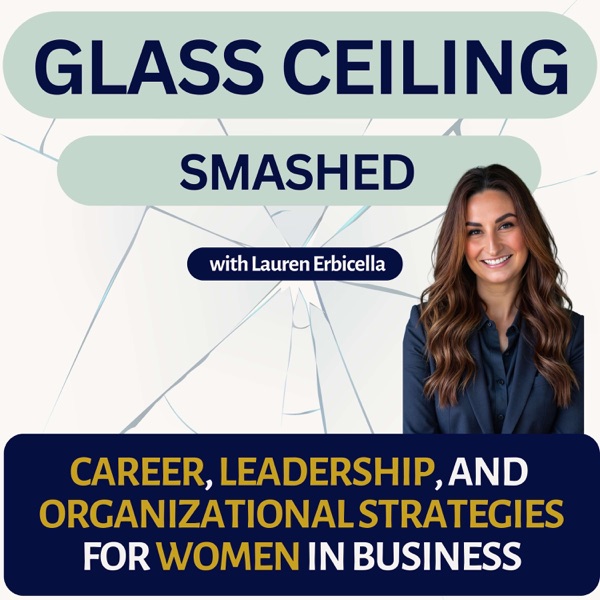
Career Growth Strategies for Women: Glass Ceiling, Smashed
Glass Ceiling, Smashed covers variety of topics related to business, communication skills, leadership development, career growth, and more!
This podcast is geared toward (though not specific to!) women wanting to climb the corporate ladder, improve their work/life balance, and become successful and respected leaders in their field.
This podcast also talks about sales strategies, process optimization and streamlining, and topics related to small and micro business owners and entrepreneurs.
Designed to educate and elevate, Glass Ceiling, Smashed puts a blunt, yet informational and supportive spin on all topics related to professional life.
Our host, Lauren Erbicella, is the founder of Windrose Coaching and Consulting. She focuses her services on 1:1 coaching related to career and leadership skills development. The consulting side of her business focuses on small/micro businesses and the joys, challenges, and experiences of those business owners and employees. Lauren holds a B.A. in Organizational Development and Leadership from Widener University, as well as an M.A. in Organizational Leadership from Gonzaga University. Lauren enjoyed over 20 years of professional experience in legal, tech, finance, and sales before deciding to take her expertise and channel it into helping others grow.
If you're a woman (or man, any other gender!) who wants to be respected, carry yourself with confidence, and lead yourself and others toward a more fulfilling career and life, you've found the place for you. Whether you're an experienced professional or a new college grad, I guarantee you'll learn something.
Everyone is welcome here, so let's go smash that glass ceiling together.
____________________________
This podcast is for you if you find yourself asking questions such as:
How do I ask for a promotion?
Why do high-performers fail to get promoted?
How do I ask for a raise?
How do I communicate better, more clearly, or more effectively?
How do I bridge the gender gap at work?
Do women make better leaders?
How can I be a better manager?
How do I get more respect at work?
What is strategy?
How do I become better at sales and establishing relationships?
What stats do I need to pay attention to to measure business growth?
What are the best leadership styles?
How can I simplify my business processes?
How do I give good feedback?
How can I change careers?
What skills do I need to become a leader?
How can I develop my employees?
How can I influence my coworkers when I'm not their boss?
What is the difference between management and leadership?
...and many more!
**If you have a request for a specific topic, please reach out at glassceilingsmashedpod@gmail.com**
____________________________
Glass Ceiling, Smashed is brought to you by Windrose Coaching and Consulting LLC. WRCC provides individual 1:1 career and leadership skills development coaching, as well as consulting services for small and micro businesses.
Visit our website (www.windrosecoachingandconsulting) to learn more about our services and pricing.
- Episodes
- 19
- Releases
- Weekly
- Typical length
- 22 min
- On air since
- 2026
- Latest episode
- 20 hours ago
Episodes
19 episodes, newest first
-
17 min
18 – Common Sense Isn't All That Common (and That's a Good Thing)
Season 1, Episode 18
Show notes
"Common sense is not that common."
"No one has any common sense anymore!"
We've all heard it, and plenty of us have said it. This episode takes a closer look at what common sense actually is, and why we don't share one global version of it.
We start with an idea from communication ethics scholars Arnett, Harden Fritz, and Bell McManus: common sense is a "common way of doing or knowing," which means it's only common to the people who share that way.
Then we walk through a (deliberately over-simplified) example about Jim's first day at a new job and the two office refrigerators, and why "it's common sense around here" isn't common sense to anyone who hasn't been told.
From there, we get into the research on why we assume other people see the world the way we do, including the curse of knowledge, the false consensus effect, and Michael Polanyi's idea of tacit knowledge: we know more than we can tell.
We also look at how cultures differ on things as basic as how direct feedback should be, using Erin Meyer's The Culture Map, and at Duncan Watts' argument that common sense fails us more often than we think.
Because a lot of this plays out at work, I close with four practical steps you can use:
• Say the unwritten rules out loud.
• Swap "it's common sense" for "here's how we do it here."
• Ask instead of assuming.
• When someone misses the "obvious," get curious about their experience before assuming carelessness.
Finally, I close with the notion that us not sharing one globalcommon sense is a good thing, and it's something to celebrate.
__________
Sources Cited in This Episode
(1) Arnett, R. C., Harden Fritz, J. M., & Bell McManus, L. M. (2018). Communication ethics literacy: Dialogue and difference. Kendall Hunt Publishing Company.
(2) Geertz, C. (1975). Common sense as a cultural system. The Antioch Review, 33(1), 5–26.
(3) Watts, D. J. (2011). Everything is obvious: Once you know the answer. Crown Business.
(4) Camerer, C., Loewenstein, G., & Weber, M. (1989). The curse of knowledge in economic settings: An experimental analysis. Journal of Political Economy, 97(5), 1232–1254.
(5) Heath, C., & Heath, D. (2006, December). The curse of knowledge. Harvard Business Review. https://hbr.org/2006/12/the-curse-of-knowledge
(6) Ross, L., Greene, D., & House, P. (1977). The "false consensus effect": An egocentric bias in social perception and attribution processes. Journal of Experimental Social Psychology, 13(3), 279–301.
(7) Polanyi, M. (1966). The tacit dimension. Doubleday.
(8) Meyer, E. (2014). The culture map: Breaking through the invisible boundaries of global business. PublicAffairs.
Additional Resources Used to Write This Episode
The Decision Lab. (n.d.). Curse of knowledge. https://www.thedecisionlab.com/reference-guide/management/curse-of-knowledge
PsyBlog. (n.d.). The false consensus effect. https://www.spring.org.uk/?p=5168
Farnam Street. (2011, July 27). Is everything obvious once you know the answer? https://fs.blog/is-everything-obvious-once-you-know-the-answer/
Writing Commons. (n.d.). Tacit knowledge. https://writingcommons.org/section/research/epistemology/tacit-knowledge/
Idiomation. (2015, September 1). Common sense is not so common. https://idiomation.wordpress.com/2015/09/01/common-sense-is-not-so-common/
__________
If the information contained in this episode gave you something to think about, Windrose Coaching and Consulting offers career and leadership skills mentoring and coaching to individuals seeking self-improvement. We also offer consulting services for small and micro businesses. To learn more about how we work, see our Services page.
If you want to support the show directly, you can do that here: https://www.buzzsprout.com/2630991/support. This podcast is a one-woman operation recorded in a bedroom closet with a very inexpensive mic, so any support goes straight toward better gear and more content. Every bit helps, and it's genuinely appreciated.
Not ready to jump into services just yet? Start with our downloadable guide Communicate with Confidence: 8 Tips to Enhance Your Communication Skills and Increase Your Credibility.
AND NOW AVAILABLE!!! The Annual Review Companion 2027
The Annual Review Companion 2027 is your guide to tracking your yearly progress so you can show up to your next annual review with alllllllll the receipts. Get yourself that raise and that promotion you deserve!
Find it in our store: https://glassceilingsmashedpod.myshopify.com/products/2027-annual-review-companion-spiral-bound
Follow us on socials:
Instagram: @windrosecoachingandconsulting
Threads: @windrosecoachingandconsulting
For business inquiries: GlassCeilingSmashedPod@gmail.com
-
28 min
17 - People Don't Hate Change, They Hate BEING Changed: Where Reorgs, Pivots, and Layoffs Go Wrong
Season 1, Episode 17
Show notes
Ask most leaders why their employees resist change and you'll hear some version of "people are creatures of habit, they'll come around." It's a convenient answer, and it lets leaders off the hook. This episode makes the case that people don't actually hate change. People change jobs, move, start businesses, and build new relationships all the time, and they do it with real energy. What they hate is having change done to them, especially when it's poorly communicated, constant, or explained in vague terms.
We start with why change is hard in the first place, drawing on Ashley Goodall's Harvard Business Review argument that predictability, agency, belonging, and meaning are what people need to do good work, and that we've built a business culture that treats constant disruption as a virtue. From there we look at why change initiatives so often stall at the top, with the Harvard Business Review's May 2026 article from three Boston Consulting Group authors on "false alignment" and the three patterns it creates: paralysis, hyperactivity, and tunnel vision.
Then we get into two of the most damaging habits I see in organizations: priority whiplash (the strategic focus that changes every few months) and layoff messaging that sounds like it was written by nobody. The numbers are worth hearing, including a 2025 Careerminds survey on how many people first heard about layoffs through gossip.
Here are the six things leaders can do differently:
• Make sure leadership is truly aligned before you announce anything.
• Protect your teams wherever you can, because a team is the most important unit of stability for most people.
• Give people something stable to count on, like weekly check-ins and other small rituals.
• Be discerning about priorities. If everything is a top priority, nothing is.
• Communicate like a human being: say what happened, why, what comes next, and what you don't know yet.
• Acknowledge the cost. Saying "this is a hard period and we know it" builds trust.
And because plenty of us are on the receiving end of change rather than leading it, I close with a short section on what you can do when you're the one being changed.
__________
Sources Cited in This Episode
(1) Goodall, A. (2024, July 9). Creating stability is just as important as managing change. Harvard Business Review. https://hbr.org/2024/07/creating-stability-is-just-as-important-as-managing-change
(2) Dhar, J., Ellmer, K.R., & Jameson, P. (2026, May). What really gets in the way of change. Harvard Business Review. https://hbr.org/2026/05/what-really-gets-in-the-way-of-change
(3) Gallup. (2024). U.S. employee engagement data, Q1 2024 [Web article]. https://www.gallup.com/workplace/643286/state-global-workplace-2024.aspx
(4) Careerminds. (2025, October). Layoff communications survey (N = 1,000 full-time U.S. workers). https://careerminds.com/blog/layoff-communications
(5) Trevor, C.O., & Nyberg, A.J. (2008). Keeping your headcount when all about you are losing theirs: Downsizing, voluntary turnover rates, and the moderating role of HR practices. Academy of Management Journal, 51(2).
(6) O.C. Tanner. (n.d.). Preserving company culture during layoffs. https://www.octanner.com/articles/company-culture-and-layoffs
(7) Staffbase & USC Annenberg School for Communication and Journalism. (2024, September 30). Employee communication impact study 2024 [Press release]. https://staffbase.com/press/releases/employee-communication-impact-study
Additional Resources Used to Write This Episode
Goodall, A. (2024). The problem with change: And the essential nature of human performance. Hachette Books.
Gavett, G. (2026, May 19). The Insider [Newsletter]. Harvard Business Review. https://hbr.org/2026/05/what-really-gets-in-the-way-of-change
Harvard Business Review Editors. (2026, June 18). The false alignment trap. The Leader's Agenda. https://www.harvardbusiness.org/insight/june-2026-the-leaders-agenda-the-false-alignment-trap/
__________
If the information contained in this episode gave you something to think about, Windrose Coaching and Consulting offers career and leadership skills mentoring and coaching to individuals seeking self-improvement. We also offer consulting services for small and micro businesses. To learn more about how we work, see our Services page.
If you want to support the show directly, you can do that here: https://www.buzzsprout.com/2630991/support. This podcast is a one-woman operation recorded in a bedroom closet with a very inexpensive mic, so any support goes straight toward better gear and more content. Every bit helps, and it's genuinely appreciated.
Not ready to jump into services just yet? Start with our downloadable guide Communicate with Confidence: 8 Tips to Enhance Your Communication Skills and Increase Your Credibility.
AND NOW AVAILABLE!!! The Annual Review Companion 2027
The Annual Review Companion 2027 is your guide to tracking your yearly progress so you can show up to your next annual review with alllllllll the receipts. Get yourself that raise and that promotion you deserve!
Find it in our store: https://glassceilingsmashedpod.myshopify.com/products/2027-annual-review-companion-spiral-bound
Follow us on socials:
Instagram: @windrosecoachingandconsulting
Threads: @windrosecoachingandconsulting
TikTok: @windrose_coaching
For business inquiries: GlassCeilingSmashedPod@gmail.com
-
22 min
16 - Silence is Not Agreement: Why Your Team Needs Disagreement (and how to do it well)
Season 1, Episode 16
Show notes
Ever sat in a meeting, heard something you completely disagreed with, and said nothing? Made a face, typed something in the chat and deleted it, or vented to your significant other on the drive home? You're in good company.
This episode is about disagreeing well, which is one of the most underrated professional skills out there. We start with why disagreement is good for teams, including economist Giampaolo Bonomi's "Disagreement Dividend" and the Harvard Business Review's take that research across every social science shows disagreement has real benefits. Then we get into the flip side: groupthink, where harmony (or the appearance of it) takes over for honest deliberation, and what that has cost organizations, including in the lead-up to the 1986 Challenger disaster.
From there, we dig into why good intentions aren't enough, based on a decade of research from Julia Minson (Harvard), Hanne Collins (UCLA), and Michael Yeomans (Imperial College London). Their work points to two gaps that send disagreements sideways: the intention-behavior gap (what we plan to do vs. what we do in the heat of the moment) and the behavior-perception gap (what we do vs. how it's received).
The fix is language you can actually use. Here are the five approaches we cover, with sample phrases for each:
• Indicate that you want to learn. Say out loud that you're curious about the other person's view.
• Acknowledge before you respond. Restate the core of what you heard, without pretending to agree (and without faking it).
• Find your common ground. Name the goal, value, or problem you both care about, so it becomes us-vs-the-problem instead of me-vs-you.
• Hedge your claims. A little intellectual humility makes you more credible, not less.
• Share your story. The experience behind your position can build more trust than another pile of data.
We close with a section for leaders on setting the tone, because how you respond the first time someone pushes back on your idea tells your whole team whether it's safe to be honest with you.
__________
Sources Cited in This Episode
Minson, J.A., Collins, H.K., & Yeomans, M. (2025, November–December). A smarter way to disagree. Harvard Business Review. Reprint R2506J. https://hbr.org/2025/11/a-smarter-way-to-disagree
Bonomi, G. (2024). The disagreement dividend (arXiv:2308.06607v7) [Working paper]. arXiv. https://arxiv.org/abs/2308.06607
Kawamoto, D. (2022, June 1). How to avoid groupthink: 13 tips for the workplace. Built In. https://builtin.com/articles/group-think
Presidential Commission on the Space Shuttle Challenger Accident. (1986, June 6). Report to the President by the Presidential Commission on the Space Shuttle Challenger Accident. NASA. https://www.nasa.gov/history/rogersrep/genindex.htm
Additional Resources Used to Write This Episode
Minson, J. (2025, October 6). A smarter way to disagree. Shorenstein Center on Media, Politics and Public Policy, Harvard Kennedy School. https://shorensteincenter.org/resource/a-smarter-way-to-disagree/
Teitel, A.S. (2018, January 25; updated 2026, January 12). How the Challenger disaster changed NASA. History.com. https://www.history.com/articles/how-the-challenger-disaster-changed-nasa
__________
If the information contained in this episode gave you something to think about, Windrose Coaching and Consulting offers career and leadership skills mentoring and coaching to individuals seeking self-improvement. We also offer consulting services for small and micro businesses. To learn more about how we work, see our Services page.
If you want to support the show directly, you can do that here: https://www.buzzsprout.com/2630991/support. This podcast is a one-woman operation recorded in a bedroom closet with a very inexpensive mic, so any support goes straight toward better gear and more content. Every bit helps, and it's genuinely appreciated.
Not ready to jump into services just yet? Start with our downloadable guide Communicate with Confidence: 8 Tips to Enhance Your Communication Skills and Increase Your Credibility.
AND NOW AVAILABLE!!! The Annual Review Companion 2027
The Annual Review Companion 2027 is your guide to tracking your yearly progress so you can show up to your next annual review with alllllllll the receipts. Get yourself that raise and that promotion you deserve!
Find it in our store: https://glassceilingsmashedpod.myshopify.com/products/2027-annual-review-companion-spiral-bound
Follow us on socials:
Instagram: @windrosecoachingandconsulting
Threads: @windrosecoachingandconsulting
TikTok: @windrose_coaching
For business inquiries: GlassCeilingSmashedPod@gmail.com
-
42 min
15 - Managing Up Isn't Sucking Up: How to Lead Your Boss
Season 1, Episode 15
Show notes
Link to Scott Mautz's Leading from the Middle: https://amzn.to/4yAicEr
This episode makes the case that managing up is the skill of building a working partnership with the person above you, one based on trust, that eventually puts you in a position to influence the way they think and decide.
I lean heavily on Chapter 4 of Scott Mautz's book Leading from the Middle (Wiley, 2021), “Leading Your Boss,” which lays out a seven-step plan, and I pull in the classic Harvard Business Review article on the topic, “Managing Your Boss” by John Gabarro and John Kotter, plus McKinsey research, Joseph Grenny's guidance on disagreeing with your boss, and practical tools for one-on-ones.
This isn't a data-heavy episode. It's a how-to.
___________________
Sources Cited in This Episode
Mautz, S. (2021). Leading from the Middle: A Playbook for Managers to Influence Up, Down, and Across the Organization (Chapter 4, “Leading Your Boss”). Wiley.
Gabarro, J.J., & Kotter, J.P. (1980, January–February). Managing your boss. Harvard Business Review. (Reprinted January 2005 as “Best of HBR 1980,” Reprint R0501J.)
Barta, T., & Barwise, P. (2017, April 27). Why effective leaders must manage up, down, and sideways. McKinsey Quarterly. https://www.mckinsey.com/featured-insights/leadership/why-effective-leaders-must-manage-up-down-and-sideways
Lew, C. (2019, August 15). How to manage up effectively. Know Your Team blog (now Canopy). https://canopy.is/blog/2019/08/15/how-to-manage-up-effectively/
Grenny, J. (2014, November 25). How to disagree with your boss. Harvard Business Review. https://hbr.org/2014/11/how-to-disagree-with-your-boss
Watkins, M.D. (2013). The First 90 Days: Proven Strategies for Getting Up to Speed Faster and Smarter (Updated and expanded ed.). Harvard Business Review Press.
Rogelberg, S.G. (2022, November–December). Make the most of your one-on-one meetings. Harvard Business Review. https://hbr.org/2022/11/make-the-most-of-your-one-on-one-meetings
Bowles, H.R., Babcock, L., & Lai, L. (2007). Social incentives for gender differences in the propensity to initiate negotiations: Sometimes it does hurt to ask. Organizational Behavior and Human Decision Processes, 103(1), 84–103.
McKinsey & Company and LeanIn.Org. (2025). Women in the Workplace 2025.
Additional Resources Used to Write This Episode
Atlassian. (2024). 7 tips for better 1-on-1 meetings. Inside Atlassian. https://www.atlassian.com/blog/inside-atlassian/1-on-1-meeting-tips
Peter Drucker's “listeners and readers” distinction, as described in Gabarro and Kotter's article above.
___________________
If the information contained in this episode gave you something to think about, Windrose Coaching and Consulting offers career and leadership skills mentoring and coaching to individuals seeking self-improvement. We also offer consulting services for small and micro businesses. To learn more about how we work, see our Services page.
If you want to support the show directly, you can do that here: https://www.buzzsprout.com/2630991/support.
This podcast is a one-woman operation recorded in a bedroom closet with a very inexpensive mic, so any support goes straight toward better gear and more content. Every bit helps, and it's genuinely appreciated.
Not ready to jump into services just yet? Start with our downloadable guide Communicate with Confidence: 8 Tips to Enhance Your Communication Skills and Increase Your Credibility.
AND NOW AVAILABLE!!! The Annual Review Companion 2027
The Annual Review Companion 2027 is your guide to tracking your yearly progress so you can show up to your next annual review with alllllllll the receipts. Get yourself that raise and that promotion you deserve!
Find it in our store: https://glassceilingsmashedpod.myshopify.com/products/2027-annual-review-companion-spiral-bound
Follow us on socials:
Instagram: @windrosecoachingandconsulting
Threads: @windrosecoachingandconsulting
For business inquiries: GlassCeilingSmashedPod@gmail.com
-
43 min
14 - Women's Health is a Workplace Issue (and it's time we treated it like one)
Season 1, Episode 14
Show notes
Picture a woman at her third appointment for the same health issue, doing math in her head about how many more half days she can take before her manager starts to wonder what's going on. This episode is about the connection between women's health and women's careers, built around the brand-new Gallup and Pivotal report, Women's Health: Barriers to Care, Barriers to Opportunity, a July 2026 survey of 5,232 U.S. adults, including 3,845 women.
From there, the episode goes life stage by life stage: pregnancy and postpartum care (including how women feel about returning to work, whether they go back too early, and what the research says that does to them), periods and reproductive conditions like endometriosis and PCOS, chronic pain and the years-long wait for a diagnosis, mental health, and menopause. For each one, I look at what the data says about how women feel about taking time away and how they say they're treated when they do.
I also dig into whether having a female manager versus a male manager changes any of this, and I cover the legal basics around pregnancy and accommodations.
Then, five things women can do:
• Keep two sets of records: health notes for your appointments, and a running record of your wins at work so a health-related absence doesn't erase your track record.
• Learn your rights before you need them, including FMLA and the Pregnant Workers Fairness Act.
• Make specific asks (a flexible schedule, remote days, adjusted deadlines) instead of general ones.
• Decide what you share, and with whom, and lean on a sponsor or ally to speak for you in rooms you're not in.
• Plan around leave: hand off with documentation, tell your sponsor what you want next, and ask for a re-entry conversation.
And six things employers and managers can do:
• Make leave financially possible, because the number one reason women return earlier than they want to is money.
• Don't wait for women to disclose. Comfort talking about it doesn't lead to disclosure, so support has to show up proactively.
• Train managers, both on having these conversations and on their legal responsibilities.
• Make flexibility the default instead of a favor.
• Keep health out of the promotion math, and ask women what they want instead of assuming.
• Check your own habits as a manager: how you respond to the request matters as much as the policy.
Sources Cited in This Episode
Gallup & Pivotal. (2026, September 18). Women's health: Barriers to care, barriers to opportunity. Gallup. https://www.gallup.com/file/analytics/714584/gallup-pivotal-report.pdf
Marken, S., & Kemp, A. (2026, September 18). Women's healthcare barriers extend into work and family life. Gallup. https://news.gallup.com/poll/714221/women-healthcare-barriers-extend-work-family-life.aspx
Pivotal. (2026, September). New Gallup survey reveals the costs of overlooking women's health. https://www.pivotal.com/articles/gallup-survey-reveals-costs-overlooking-womens-health
Dagher, R.K., McGovern, P.M., & Dowd, B.E. (2014). Maternity leave duration and postpartum mental and physical health: Implications for leave policies. Journal of Health Politics, Policy and Law, 39(2), 369–416. https://doi.org/10.1215/03616878-2416247
Pew Research Center. (2017, March 23). Americans widely support paid family and medical leave, but differ over specific policies.
Policy Center for Maternal Mental Health. (2025, March). The interconnection of paid family and medical leave and maternal mental health [Issue brief].
The Harris Poll. (2026, March). State of Maternal Health in America survey (N = 4,154 U.S. adults, including 1,516 women who are or have been pregnant), as reported in: 60% of US women face barriers to postpartum, mental health care. American Journal of Managed Care.
Schoep, M.E., Adang, E.M.M., Maas, J.W.M., De Bie, B., Aarts, J.W.M., & Nieboer, T.E. (2019). Productivity loss due to menstruation-related symptoms: A nationwide cross-sectional survey among 32,748 women. BMJ Open, 9(6), e026186.
Raves, D.M., Herrera, W.D., Darnell, M.E., Rice, T., Friedman, C., Moratti, S.C., Sims, S.T., Sihanath, W.B., Ehrhardt, S.N., & Phillips, A. (2025). A survey assessing the impact of symptoms related to the menstrual cycle and perceptions of workplace productivity: Considerations for employer-sponsored menstrual health programs. BMC Women's Health, 25, 418.
Nnoaham, K.E., et al. (2011). Impact of endometriosis on quality of life and work productivity: A multicenter study across ten countries. Fertility and Sterility, 96(2), 366–373.
Community Union. (2026, August). Menstrual health leave survey, as reported in: Most don't disclose menstrual health leave to managers. HR Magazine (UK). https://www.hrmagazine.co.uk/content/news/most-don-t-disclose-menstrual-health-leave-to-managers
The Fuchsia Tent & Society for Women's Health Research. (2026, October 1). Menopause at work: From echo chamber to mainstream practice [Survey of 1,110 U.S. employees; press release]. PR Newswire. (Peer-reviewed manuscripts in preparation.)
Hardy, C., Griffiths, A., Thorne, E., & Hunter, M. (2019). Tackling the taboo: Talking menopause-related problems at work. International Journal of Workplace Health Management, 12(1), 28–38. https://doi.org/10.1108/IJWHM-03-2018-0035
Chartered Institute of Personnel and Development (CIPD). (2019). Majority of working women experiencing the menopause say it has a negative impact on them at work [Press release; YouGov survey]. And: CIPD. (2023). Menopause in the workplace: Employee experiences in 2023.
McCann, C., & Tomaskovic-Devey, D. (2021, May). Pregnancy discrimination in the workplace. Center for Employment Equity, University of Massachusetts Amherst. https://www.umass.edu/employmentequity/pregnancy-discrimination-workplace
Lyra Health. (2025). State of workforce mental health 2025.
American Psychiatric Association. (2024). New polling data on workplace mental health [Morning Consult survey of 2,000+ U.S. adults].
Ipsos & National Alliance on Mental Illness (NAMI). (2026). Workplace mental health poll: Most employees say mental health talk is work-appropriate; stigma persists.
U.S. Equal Employment Opportunity Commission. (2023, 2024). What you should know about the Pregnant Workers Fairness Act; EEOC issues final regulation on the Pregnant Workers Fairness Act (April 2024).
Additional Resources Used to Write This Episode
Systematic review on return to work after giving birth and maternal mental health, Maternal and Child Health Journal
Abt Associates analysis of a 2012 U.S. Department of Labor survey, as reported by HuffPost and In These Times (2015): the source behind the “one in four new mothers return within two weeks” figure.
Qualitative study, Menopause in the Workplace: Qualitative Insights from Contrasting Work Environments (Taylor & Francis, 2026).
Bloomberg Law reporting (2025) and law-firm summaries (Littler, Ogletree, Fisher Phillips; May 2025) on the court ruling vacating the abortion accommodation portion of the EEOC's PWFA rule and the EEOC's signals about revisiting other parts of it.
_______________________
If the information contained in this episode gave you something to think about, Windrose Coaching and Consulting offers career and leadership skills mentoring and coaching to individuals seeking self-improvement. We also offer consulting services for small and micro businesses. To learn more about how we work, see our Services page.
If you want to support the show directly, you can do that here: https://www.buzzsprout.com/2630991/support. This podcast is a one-woman operation recorded in a bedroom closet with a very inexpensive mic, so any support goes straight toward better gear and more content. Every bit helps, and it's genuinely appreciated.
Not ready to jump into services just yet? Start with our downloadable guide Communicate with Confidence: 8 Tips to Enhance Your Communication Skills and Increase Your Credibility.
AND NOW AVAILABLE!!! The Annual Review Companion 2027
The Annual Review Companion 2027 is your guide to tracking your yearly progress so you can show up to your next annual review with alllllllll the receipts. Get yourself that raise and that promotion you deserve!
Find it in our store: https://glassceilingsmashedpod.myshopify.com/products/2027-annual-review-companion-spiral-bound
Follow us on socials:
Instagram: @windrosecoachingandconsulting
Threads: @windrosecoachingandconsulting
For business inquiries: GlassCeilingSmashedPod@gmail.com
-
20 min
13 - Overcoming Your Inner Critic: Imposter Syndrome, Self-Doubt, and Finding Your Executive Presence
Season 1, Episode 13
Show notes
This episode covers 1978 research that coined the term “imposter phenomenon,” and the mixed evidence on whether this phenomenon is found in women more than men.
Then, I'll get into a framework for recognizing which specific pattern of self-doubt shows up for you (the Perfectionist, the Expert, the Soloist, the Natural Genius, or the Superwoman), how to manage it day to day, and tactical ways to push past it (including a look at when “fake it till you make it” actually helps versus when it just adds another layer of crap on top of your exhaustion).
Finally, I'll talk about executive presence: what it actually is, the three components that make it up, why women are held to a different standard, and concrete ways to build your executive presence.
__________________
Sources Cited in This Episode:
Clance, P.R., & Imes, S.A. (1978). The imposter phenomenon in high achieving women: Dynamics and therapeutic intervention. Psychotherapy: Theory, Research & Practice, 15(3), 241–247.
Bravata, D.M., Watts, S.A., Keefer, A.L., Madhusudhan, D.K., Taylor, K.T., Clark, D.M., Nelson, R.S., Cokley, K.O., & Hagg, H.K. (2019). Prevalence, predictors, and treatment of impostor syndrome: A systematic review. Journal of General Internal Medicine, 35(4), 1252–1275.
Tulshyan, R., & Burey, J. (2021, February 11). Stop telling women they have imposter syndrome. Harvard Business Review.
Young, V. (2011). The Secret Thoughts of Successful Women: Why Capable People Suffer from Impostor Syndrome and How to Thrive in Spite of It. Crown Business.
Patzak, A., Kollmayer, M., & Schober, B. (2017). Buffering impostor feelings with kindness: The mediating role of self-compassion between gender-role orientation and the impostor phenomenon. Frontiers in Psychology, 8.
Hewlett, S.A. (2014). Executive Presence: The Missing Link Between Merit and Success. HarperBusiness.
__________________
Help us continue to create content through our SUPPORT link. No amount is too small!
______________________
If the information contained in this episode gave you something to think about, Windrose Coaching and Consulting offers career and leadership skills mentoring and coaching to individuals seeking self-improvement. We also offer consulting services for small and micro businesses. To learn more about how we work, see our Services page.
Not ready to jump into services just yet? Start with our downloadable guide Communicate with Confidence: 8 Tips to Enhance Your Communication Skills and Increase Your Credibility.
AND NOW AVAILABLE!!! The Annual Review Companion 2027
The Annual Review Companion 2027 is your guide to tracking your yearly progress so you can show up to your next annual review with alllllllll the receipts. Get yourself that raise and that promotion you deserve!
Find it in our store: https://glassceilingsmashedpod.myshopify.com/products/2027-annual-review-companion-spiral-bound
Follow us on socials:
Instagram: @windrosecoachingandconsulting
Threads: @windrosecoachingandconsulting
TikTok: https://www.tiktok.com/@glassceilingsmashedpod
For business inquiries: GlassCeilingSmashedPod@gmail.com
-
22 min
12 - Navigating Office Politics Doesn't Have to be a Scary Thing Anymore
Season 1, Episode 12
Show notes
Office politics has a bad reputation, but avoiding it entirely is practically impossible. Trying to avoid it can also be a career limiting move. This episode defines what office politics means and what happens when it goes unmanaged: more anxiety, lower job satisfaction, and a higher chance of wanting to quit.
Next, I get into some tactical advice for navigating a political environment:
• Setting firm boundaries
• Handling workplace conflict
• Speaking your mind assertively without triggering the likability penalty
From there, I'll talk about how men and women tend to navigate office politics differently, and how office politics tends to be presented differently to men versus women in the first place. I also cover why getting comfortable with office politics early in a career pays off long-term, how to start building that skill before you have years of tenure or reputation to lean on, and how office politics shift once a woman is the one leading the charge, including a classic study on the specific stages women executives moved through on their way up.
Sources Cited in This Episode
Kacmar, K.M., & Carlson, D.S. (1997). Further validation of the perceptions of politics scale (POPS): A multiple sample investigation. Journal of Management, 23(5), 627–658.
Ferris, G.R., Russ, G.S., & Fandt, P.M. (1989). Politics in organizations: The theory of political behavior in organizations. In R.A. Giacalone & P. Rosenfeld (Eds.), Impression Management in the Organization.
Bower, S.A., & Bower, G.H. (1976, updated edition). Asserting Yourself: A Practical Guide for Positive Change. Da Capo Press.
Bowles, H.R., Babcock, L., & Lai, L. (2007). Social incentives for gender differences in the propensity to initiate negotiations: Sometimes it does hurt to ask. Organizational Behavior and Human Decision Processes, 103(1), 84–103.
Moss-Racusin, C.A., & Rudman, L.A. (2010). Disruptions in women's self-promotion: The backlash avoidance model. Psychology of Women Quarterly, 34(2), 186–202.
Center for Creative Leadership. (2015). White Paper: Women and Political Savvy.
Massey University (Master of Science thesis). How do gender and political skill combine to influence career advancement?
Ferris, G.R., Treadway, D.C., Kolodinsky, R.W., Hochwarter, W.A., Kacmar, C.J., Douglas, C., & Frink, D.D. (2005). Development and validation of the political skill inventory. Journal of Management, 31(1), 126–152.
Munyon, T.P., Summers, J.K., Thompson, K.M., & Ferris, G.R. (2015). Political skill and work outcomes: A theoretical extension, meta-analytic investigation, and agenda for the future. Personnel Psychology, 68(1), 143–184.
Mainiero, L.A. (1994). On breaking the glass ceiling: The political seasoning of powerful women executives. Organizational Dynamics, 22(4), 5–20.
_____________________
Help us continue to create content through our SUPPORT link. No amount is too small!
______________________
If the information contained in this episode gave you something to think about, Windrose Coaching and Consulting offers career and leadership skills mentoring and coaching to individuals seeking self-improvement. We also offer consulting services for small and micro businesses. To learn more about how we work, see our Services page.
Not ready to jump into services just yet? Start with our downloadable guide Communicate with Confidence: 8 Tips to Enhance Your Communication Skills and Increase Your Credibility.
AND NOW AVAILABLE!!! The Annual Review Companion 2027
The Annual Review Companion 2027 is your guide to tracking your yearly progress so you can show up to your next annual review with alllllllll the receipts. Get yourself that raise and that promotion you deserve!
Find it in our store: https://glassceilingsmashedpod.myshopify.com/products/2027-annual-review-companion-spiral-bound
Follow us on socials:
Instagram: @windrosecoachingandconsulting
Threads: @windrosecoachingandconsulting
TikTok: https://www.tiktok.com/@glassceilingsmashedpod
For business inquiries: GlassCeilingSmashedPod@gmail.com
-
24 min
11 – Is Gen Z Unprepared for Corporate America, or is Corporate America Failing Them?
Season 1, Episode 11
Show notes
Gen Z gets blamed a lot for being “unprepared” for work, with some critics going as far as calling the generation “unemployable.” This episode asks a different question: is that actually a Gen Z problem, or a corporate America problem? Using the 2026 Gallup/Walton Family Foundation Voices of Gen Z study, alongside Deloitte's Global Gen Z and Millennial Survey and EY's Generation Survey, this episode breaks down what's actually going on with the generation currently entering, or about to enter, the workforce, split by age bracket rather than treated as one lump group.
This covers: the actual age range of Gen Z (they actually span a full 15-year period), how the portion already employed feels about their future, what's worked for them and where they feel let down, what the portion not yet in the workforce fears and expects, whether older and younger segments of Gen Z see things differently (they do), what type of leadership styles work best for them, what accommodations they ask for, and whether they actually prefer remote or in-office work.
The episode closes with what Gen Z actually needs to succeed in corporate America, based on everything covered:
• Real mentorship from someone who takes an interest in them and with whom they feel comfortable.
• Specific, frequent feedback instead of once-a-year evaluations.
• Workplace flexibility, which for most of them means hybrid, not full remote.
• A workplace culture where being honest about mental health and wellness doesn't quietly cost them.
And finally, the bigger question underneath all of it: is the real issue that Gen Z needs to adapt to corporate America, or that corporate America's expectations, built for a different labor market and a different generation's life circumstances, are overdue for a rebuild?
__________________________
Sources Cited in This Episode
Gallup & Walton Family Foundation. (2026). Voices of Gen Z study (multiyear, ongoing series, 2024–2026 releases).
Gallup & Walton Family Foundation. (2026, June). Gen Zers Missing Sense of Meaning or Purpose in Life.
Gallup & Walton Family Foundation, in partnership with Making Caring Common, Harvard Graduate School of Education. Voices of Gen Z: Gen Z Wants to Do Good: How Helping Others Supports Meaning and Wellbeing.
Gallup & Walton Family Foundation. (2025). Voices of Gen Z: What Helps Students Engage at School (4th annual report).
Gallup. (2025). Gen Z work-location preference data (hybrid/remote/on-site).
Deloitte Global. (2025). 2025 Gen Z and Millennial Survey.
EY. (2025). EY US 2025 Generation Survey.
Harris Poll & Fortune. (2024, January 23). Survey on generational power perceptions in the workplace.
Kowal Smith, A. (2025, November 20). Is Gen Z Failing At Work Or Is Work Failing Them? Forbes.
Additional Resources Used to Write This Episode
Secondary business press and industry-survey coverage (EY, Fortune, Newsweek, Forbes contributor commentary)
______________________
Help us continue to create content through our SUPPORT link. No amount is too small!
______________________
If the information contained in this episode gave you something to think about, Windrose Coaching and Consulting offers career and leadership skills mentoring and coaching to individuals seeking self-improvement. We also offer consulting services for small and micro businesses. To learn more about how we work, see our Services page.
Not ready to jump into services just yet? Start with our downloadable guide Communicate with Confidence: 8 Tips to Enhance Your Communication Skills and Increase Your Credibility.
AND NOW AVAILABLE!!! The Annual Review Companion 2027
The Annual Review Companion 2027 is your guide to tracking your yearly progress so you can show up to your next annual review with alllllllll the receipts. Get yourself that raise and that promotion you deserve!
Find it in our store: https://glassceilingsmashedpod.myshopify.com/products/2027-annual-review-companion-spiral-bound
Follow us on socials:
Instagram: @windrosecoachingandconsulting
Threads: @windrosecoachingandconsulting
TikTok: https://www.tiktok.com/@glassceilingsmashedpod
For business inquiries: GlassCeilingSmashedPod@gmail.com
-
24 min
10 - Running on Empty: Burnout, Who’s Most at Risk, and How to Prevent It
Season 1, Episode 10
Show notes
Picture the employee in your workplace most likely to burn out. If you pictured someone struggling, checked out, or not that invested in their job, this episode is here to challenge that picture, because research says the opposite. Burnout usually doesn't hit your weakest performers first. It hits your best ones: the most talented, most engaged, most invested people, who are often closest to the edge without anyone realizing it until it's too late.
This episode starts with the actual WHO definition of burnout (it's not just “having a bad week”), then gets into why high performers and highly engaged employees are at greater risk.
From there, I talk about four strategies for preventing burnout in yourself:
• Build an off-switch for work.
• Protect mental recovery time on your days off.
• Notice when your self-imposed standards are the problem.
• Ask for support before you're in crisis.
Then, five things managers can do to help, regardless of whether their team is already burned out or they're trying to prevent it from happening in the first place:
• Audit the balance between demands and resources on your team.
• Recognize effort, not just outcomes.
• Watch your high performers.
• If someone's already burned out, actually do something to help them.
• Model the boundaries you want your team to have.
The episode also covers where burnout rates stand since the pandemic, whether remote work helps with burnout, and why women report higher burnout rates than men.
______________________
Sources Cited in This Episode
World Health Organization. (2019, May 28). Burn-out an “occupational phenomenon”: International Classification of Diseases.
Moeller, J., Ivcevic, Z., White, A.E., Menges, J.I., & Brackett, M.A. (2018). Highly engaged but burned out: Intra-individual profiles in the US workforce. Career Development International, 23(1), 86–105.
Bentley University Center for Health and Business & unBurnt. (2026). When Burnout Looks Like Productivity: The New Risk to Innovation Capacity.
Sonnentag, S., & Fritz, C. (2015). Recovery from job stress: The stressor-detachment model as an integrative framework. Journal of Organizational Behavior, 36(S1), S72–S103.
Gallup. (2026). State of the Global Workplace: 2026 Report.
American Psychological Association. (2023, 2024, 2025). Work in America Survey.
Eagle Hill Consulting. (2025). Workforce Burnout Survey.
McKinsey & Company and LeanIn.Org. (2025). Women in the Workplace 2025.
______________________
Help us continue to create content through our SUPPORT link. No amount is too small!
______________________
If the information contained in this episode gave you something to think about, Windrose Coaching and Consulting offers career and leadership skills mentoring and coaching to individuals seeking self-improvement. We also offer consulting services for small and micro businesses. To learn more about how we work, see our Services page.
Not ready to jump into services just yet? Start with our downloadable guide Communicate with Confidence: 8 Tips to Enhance Your Communication Skills and Increase Your Credibility.
AND NOW AVAILABLE!!! The Annual Review Companion 2027
The Annual Review Companion 2027 is your guide to tracking your yearly progress so you can show up to your next annual review with alllllllll the receipts. Get yourself that raise and that promotion you deserve!
Find it in our store: https://glassceilingsmashedpod.myshopify.com/products/2027-annual-review-companion-spiral-bound
Follow us on socials:
Instagram: @windrosecoachingandconsulting
Threads: @windrosecoachingandconsulting
TikTok: https://www.tiktok.com/@glassceilingsmashedpod
For business inquiries: GlassCeilingSmashedPod@gmail.com
-
14 min
9 - Stop Talking About $10K Months and Start Talking About Growth Rates
Season 1, Episode 9
Show notes
If you spend any time on social media, I’m sure you’ve seen someone bragging about having s $10K business month. And if your business’s month looked nothing like that, might have felt a twinge of comparison, or even worse, defeat. This episode makes the case that a dollar amount with no context is pretty much meaningless, and walks you through what to track instead: month-over-month growth, year-over-year growth, percentage change, and revenue per hour.
Using a side-by-side example (a $10K month that's actually a 50% decline, versus a $3K month that's actually a 200% increase), this episode provides a simple formula for calculating your own growth rate, and shows you how to reframe your accomplishments from raw dollar amounts to data points and percentages on a resume or in an interview.
Plus, we’ll take a look at why that reframe (stating your impact as a growth rate instead of a dollar figure), is a useful, low-effort tool for women to employ, given what research says about the cost women face for self-promotion that men largely don't.
___________________________
Growth Rate Formula (mentioned in this episode):
(Current Period – Previous Period) ÷ Previous Period × 100 = Growth Rate %
Example: A $3,000 month after a $1,000 baseline month: ($3,000 – $1,000) ÷ $1,000 × 100 = 200% growth.
Example: A $10,000 month after a $20,000 baseline month: ($10,000 – $20,000) ÷ $20,000 × 100 = –50% (a decline).
___________________________
Sources Cited in This Episode:
Moss-Racusin, C.A., & Rudman, L.A. (2010). Disruptions in women's self-promotion: The backlash avoidance model. Psychology of Women Quarterly, 34(2), pp. 186–202.
___________________________
Help us continue to create content through our SUPPORT link. No amount is too small!
___________________________
If the information contained in this episode gave you something to think about, Windrose Coaching and Consulting offers career and leadership skills mentoring and coaching to individuals seeking self-improvement. We also offer consulting services for small and micro businesses. To learn more about how we work, see our Services page.
Not ready to jump into services just yet? Start with our downloadable guide Communicate with Confidence: 8 Tips to Enhance Your Communication Skills and Increase Your Credibility.
AND NOW AVAILABLE!!! The Annual Review Companion 2027
The Annual Review Companion 2027 is your guide to tracking your yearly progress so you can show up to your next annual review with alllllllll the receipts. Get yourself that raise and that promotion you deserve!
Find it in our store: https://glassceilingsmashedpod.myshopify.com/products/2027-annual-review-companion-spiral-bound
Follow us on socials:
Instagram: @windrosecoachingandconsulting
Threads: @windrosecoachingandconsulting
TikTok: https://www.tiktok.com/@glassceilingsmashedpod
For business inquiries: GlassCeilingSmashedPod@gmail.com
-
23 min
8 – Women are Underpaid and Underpromoted: Let’s Do Something About It
Season 1, Episode 8
Show notes
Women are still paid less, promoted less, and chosen less often for roles that “matter.” In this episode, I’ll talk about exactly how much less women are paid, promoted, and chosen, using the most current data available, and we need to pay attention to it because right now it is NOT moving in our favor.
First, I’ll talk about the pay gap. What is the data? Why do different sources report different figures? And why, after two decades of the pay gap holding fairly steady, has it started widening again?
Second, I'll address what happens when women and men perform equally well but get evaluated differently when it comes to raises, bonuses, and promotions. There’s some lovely (sarcastic usage here) research that shows that organizations that explicitly call themselves “meritocracies” actually show more bias in favor of men instead of keeping things on an even evaluation field.
From there, I get into the hiring issue: when a man and a woman are equally qualified candidates for the same role, who gets chosen? Surprisingly, the answer to this question is more context and industry dependent than you might think. There are actually some newer studies that show bias in favor of women in some settings. This is a complicated topic.
Then, I’ll touch on the promotion gap: the “broken rung,” as McKinsey called it, of the corporate ladder.. The broken rung is the first and biggest step where women start to fall behind men on the path to leadership.
Next, I’ll talk about why this all happens. Is it because women don't advocate for themselves as strongly as men do? The research on this topic is both surprising and disappointing, and it's more nuanced than “women just need to ask for raises more often” which you'll hear about as I address what happens to women specifically when they do ask for a raise or promotion.
Finally, I’ll close out with two dedicated segments: 1) what women can do to make themselves more visible and eligible for the raises and promotions they've earned, and 2) what male colleagues and managers can do to help elevate the women around them, because unfortunately, this isn't a problem women can solve by themselves.
This episode of chock full of info. Give yourself some time to digest it, maybe give it a second or third listen, if needed, and then get out there and take action!
________________________
Sources Cited in This Episode
U.S. Census Bureau. (2025). 2025 Current Population Survey Annual Social and Economic Supplement.
Pew Research Center. (2025, March 4). Gender pay gap in U.S. has narrowed slightly over 2 decades.
Castilla, E.J., & Benard, S. (2010). The paradox of meritocracy in organizations. Administrative Science Quarterly, 55(4), 543–576.
Bygren, M., Erlandsson, A., & Gähler, M. (2025). The when and whereabouts of gender hiring discrimination. SAGE Open, 15(2).
Moss-Racusin, C.A., Dovidio, J.F., Brescoll, V.L., Graham, M.J., & Handelsman, J. (2012). Science faculty's subtle gender biases favor male students. Proceedings of the National Academy of Sciences, 109(41), 16474–16479.
Erlandsson, A., Bygren, M., & Gähler, M. (2023). Is there a rating bias of job candidates based on gender and parenthood? A laboratory experiment on hiring for an accounting job. Acta Sociologica, 67(3), 371–386.
McKinsey & Company and LeanIn.Org. (2025). Women in the Workplace 2025.
Fortune. (2026, June 3). Women run a record 11% of Fortune 500 companies in 2026—but the gain came in a year of high-profile exits.
Artz, B., Goodall, A.H., & Oswald, A.J. (2018). Do women ask? Industrial Relations, 57(4), 611–636.
Bowles, H.R., Babcock, L., & Lai, L. (2007). Social incentives for gender differences in the propensity to initiate negotiations: Sometimes it does hurt to ask. Organizational Behavior and Human Decision Processes, 103(1), 84–103.
Additional Resources Used to Write This Episode
Fortune coverage of the 2025 and 2026 Fortune 500 female CEO count and trend (fortune.com).
General reporting on the McKinsey/LeanIn.Org “broken rung” concept and 2025 findings from LeanIn.org.
________________________
If the information contained in this episode gave you something to think about, Windrose Coaching and Consulting offers career and leadership skills mentoring and coaching to individuals seeking self-improvement. We also offer consulting services for small and micro businesses. To learn more about how we work, see our Services page.
Not ready to jump into services just yet? Start with our downloadable guide Communicate with Confidence: 8 Tips to Enhance Your Communication Skills and Increase Your Credibility.
AND NOW AVAILABLE!!! The Annual Review Companion 2027
The Annual Review Companion 2027 is your guide to tracking your yearly progress so you can show up to your next annual review with alllllllll the receipts. Get yourself that raise and that promotion you deserve!
Find it in our store: https://glassceilingsmashedpod.myshopify.com/products/2027-annual-review-companion-spiral-bound
Follow us on socials:
Instagram: @windrosecoachingandconsulting
Threads: @windrosecoachingandconsulting
TikTok: https://www.tiktok.com/@glassceilingsmashedpod
For business inquiries: GlassCeilingSmashedPod@gmail.com
-
28 min
7 - Decision Rights, not Decision Fights
Season 1, Episode 7
Show notes
Have you ever been in a meeting where you were supposed to make a decision, but a group consensus was impossible, so the meeting just ended up being a total waste of time because no decision was actually made? Surprisingly, that's not indicative of a communication problem. It's actually considered a decision-rights problem. Luckily, it's also something that can be fairly easily fixed if people just follow the rules.
In this episode, I get into a July 2026 Harvard Business Review study, “What Companies Get Wrong About Decision Rights,” by Lindy Greer, Jennifer Jordan, and Maxim Sytch, which covers the four most common ways companies get decision-making wrong.
Before getting to the four mistakes, I start by comparing the three frameworks companies actually use to try to fix this, and when each one is the better fit:
• RACI (Responsible, Accountable, Consulted, Informed): best for complex, cross-functional work where a lot of people need visibility into the outcome.
• RAPID (Recommend, Agree, Perform, Input, Decide): best for major, infrequent, org-wide decisions that keep stalling at a specific bottleneck in the chain of command.
• DARE (Decide, Advise, Recommend, Execute): best for fast, high-stakes situations where speed and a clear decider matter more than broad buy-in.
Here are the four mistakes companies make with these frameworks, no matter which one they use:
1. Assigning roles before the actual goal is clear.
2. Treating decision rights as a static spreadsheet handed down from a single leader instead of something the team builds together.
3. Not agreeing on what each role actually means in practice.
4. Letting people repeatedly act in the same role regardless of what the specific decision calls for.
I also share four ways to overcome these issues so that everyone can start on the same page:
1. Cocreate roles instead of dictating them.
2. Write out what each role looks like in actual behavior, not just in title.
3. Revisit roles regularly instead of treating them as one-and-done.
4. Redesign meetings around the roles you've assigned, with real time budgets for framing, debate, and the actual call.
Finally, I address how collaborative and participative decision-making (the kind more often associated with women leaders) fits into all of this, both in positive and negative ways.
___________________________
Sources Cited in This Episode:
Greer, L., Jordan, J., & Sytch, M. (2026, July–August). What companies get wrong about decision rights. Harvard Business Review.
Rogers, P., & Blenko, M.W. (2006, January). Who has the D? How clear decision roles enhance organizational performance. Harvard Business Review, 84(1), 52–61.
Eagly, A.H., & Johnson, B.T. (1990). Gender and leadership style: A meta-analysis. Psychological Bulletin, 108(2), 233–256.
Paustian-Underdahl, S.C., Smith Sockbeson, C.E., Hall, A.V., & Halliday, C.S. (2024). Gender and evaluations of leadership behaviors: A meta-analytic review of 50 years of research. The Leadership Quarterly, 35, Article 101822. https://doi.org/10.1016/j.leaqua.2024.101822
Additional Resources Used to Write This Episode:
General industry and consulting sources on the DARE decision-making framework.
___________________________
If the information contained in this episode gave you something to think about, Windrose Coaching and Consulting offers career and leadership skills mentoring and coaching to individuals seeking self-improvement. We also offer consulting services for small and micro businesses. To learn more about how we work, see our Services page.
Not ready to jump into services just yet? Start with our downloadable guide Communicate with Confidence: 8 Tips to Enhance Your Communication Skills and Increase Your Credibility.
AND NOW AVAILABLE!!! The Annual Review Companion 2027
The Annual Review Companion 2027 is your guide to tracking your yearly progress so you can show up to your next annual review with alllllllll the receipts. Get yourself that raise and that promotion you deserve!
Find it in our store: https://glassceilingsmashedpod.myshopify.com/products/2027-annual-review-companion-spiral-bound
Follow us on socials:
Instagram: @windrosecoachingandconsulting
Threads: @windrosecoachingandconsulting
For business inquiries: GlassCeilingSmashedPod@gmail.com
-
27 min
6 - The Quick Fix Trap: Stop Fixing the Same Problem Over and Over Again
Season 1, Episode 6
Show notes
Ever fix a problem at work, only to watch it come back a few months later? Of course you have.
First, this means you didn't fix the problem, you patched it.
Second, this happens in every organization, so for better or for worse, you're not alone.
And third, it does not mean you're bad at your job.
This episode gets into why we reach for the quick fix instead of solving the real problem, starting with the psychology behind it: present bias (the tendency to overvalue right-now relief instead of a bigger payoff later), and journalist Richard Fisher's SHORT framework for the five pressures that push us toward short-term thinking:
S - Salience
H - Habits
O - Overload
R - Responsibility
T - TargetsFrom there, we get into what quick fixes actually cost: financially, strategically, and personally.
Then I walk through Root Cause Analysis, specifically the 5 Whys, a method that's exactly what it sounds like: you ask “why” five times in a row until you land on the actual root cause instead of the surface-level symptom. Below is text of the example I use in the episode. A company keeps sending clients incorrect invoices. The walk through of all five whys results in uncovering that the real issue turns out to be a lack of documentation review, not data entry failures.
Problem: A client keeps receiving incorrect invoices.
1. Why? Because the billing team is entering the wrong information.
2. Why? Because the intake form is confusing, so clients fill it out inconsistently.
3. Why? Because the form was designed years ago and hasn't been updated since the entry process changed.
4. Why? Because there's no standard process for reviewing and updating forms when a process changes.
5. Why? Because nobody owns the responsibility of keeping forms in compliance with current processes.
So the real problem was never the incorrect invoices. It was the absence of process ownership and documentation standards. Fix that, and the invoice problem goes away, probably along with a few other problems you didn't even know were connected to the same root cause.
From there, I review four practical tips for putting this into action:
• Before implementing a fix, ask whether you're solving the symptom or the actual problem.
• Use the 5 Whys before you land on a solution.
• Document your findings, so the same problem doesn't get “solved” from scratch again by someone else six months from now.
• Leave time on your calendar for proactive problem-solving, not just reactive firefighting.
Lastly, I talk about why women in particular tend to get stuck fixing the same problems over and over more than their male colleagues, including research on “non-promotable tasks” and a look at how fear affects decision-making differently by gender.
Follow and subscribe so you don't miss an episode, and please leave a review - It helps more than you realize!
__________
Sources cited in this episode:
Fisher, R. (2020, October 21). Humanity is stuck in short-term thinking. Here's how we escape. MIT Technology Review. https://www.technologyreview.com/2020/10/21/1009443/short-term-vs-long-term-thinking/
Wedell-Wedellsborg, T. (2017, January–February). Are you solving the right problems? Harvard Business Review.
Senge, P.M. (1990). The Fifth Discipline: The Art and Practice of the Learning Organization. Doubleday/Currency.
Babcock, L., Recalde, M.P., Vesterlund, L., & Weingart, L. (2017). Gender differences in accepting and receiving requests for tasks with low promotability. American Economic Review, 107(3), 714–747.
Fiorenzato, E., Bisiacchi, P., & Cona, G. (2024). Gender differences in the effects of emotion induction on intertemporal decision-making. PLOS ONE, 19(3). https://doi.org/10.1371/journal.pone.0299591
Additional resources used to write this episode:
Harvard Business School Online blog, "Root Cause Analysis"
ThinkReliability blog, “Why Is Root Cause Analysis Important?”
Ohno, T. (1988). Toyota Production System: Beyond Large-Scale Production. Productivity Press
__________
If the information contained in this episode gave you something to think about, Windrose Coaching and Consulting offers career and leadership skills mentoring and coaching to individuals seeking self-improvement. We also offer consulting services for small and micro businesses. To learn more about how we work, see our Services page.
Not ready to jump into services just yet? Start with our downloadable guide Communicate with Confidence: 8 Tips to Enhance Your Communication Skills and Increase Your Credibility.
AND NOW AVAILABLE!!! The Annual Review Companion 2027
The Annual Review Companion 2027 is your guide to tracking your yearly progress so you can show up to your next annual review with alllllllll the receipts. Get yourself that raise and that promotion you deserve!
Find it in our store: https://glassceilingsmashedpod.myshopify.com/products/2027-annual-review-companion-spiral-bound
Follow us on socials:
Instagram: @windrosecoachingandconsulting
Threads: @windrosecoachingandconsulting
For business inquiries: GlassCeilingSmashedPod@gmail.com
-
21 min
5 - Say What You Need to Say: How to Improve the Feedback Conversation
Season 1, Episode 5
Show notes
Giving feedback, performance reviews, behavior assessments...They are some of the most dreaded conversations at work.
I don’t think I know anyone who looks forward to the feedback or performance review discussion, and for women, there's an extra layer of pressure (because there always is). As discussed in Episode 4 ( ) the pressure to be liked can make giving honest and specific feedback feel a bit risky.
This episode goes through five tips for giving feedback that actually help people improve the quality of the conversation AND the quality of the feedback itself:
1. Don't wait too long to give feedback
2. Be prepared for the conversation
3. Don't make it personal
4. Ask questions
5. Create an improvement action plan
This episode also addresses what research says about how feedback content tends to differ depending upon whether a man or woman is on the receiving end, and what you need to pay attention to as the one giving the feedback.
***Here's the book I mention in Tip #4 for improving listening skills and emotional regulation in difficult conversations: Burley-Allen, M. (1995). Listening: The Forgotten Skill (2nd ed.). Wiley.
__________
Follow and subscribe so you don't miss an episode, and please leave a review - It helps more than you realize!
__________
Sources cited in this episode:
Kouzes, J.M., & Posner, B.Z. (2023). The Leadership Challenge (7th ed.). Wiley.
Snyder, K. (2014, August 26). The abrasiveness trap: High-achieving men and women are described differently in reviews. Fortune.
Doldor, E., Wyatt, M., & Silvester, J. (2019). Statesmen or cheerleaders? Using topic modeling to examine gendered messages in narrative developmental feedback for leaders. The Leadership Quarterly, 30(5), Article 101308. https://doi.org/10.1016/j.leaqua.2019.101308 (Summarized for a general audience in: Doldor, E., Wyatt, M., & Silvester, J. (2021, February 10). Research: Men get more actionable feedback than women. Harvard Business Review. https://hbr.org/2021/02/research-men-get-more-actionable-feedback-than-women)
Jampol, L., & Zayas, V. (2021). Gendered white lies: Women are given inflated performance feedback compared with men. Personality and Social Psychology Bulletin, 47(1), 57–69. https://doi.org/10.1177/0146167220916622
__________
If the information contained in this episode gave you something to think about, Windrose Coaching and Consulting offers career and leadership skills mentoring and coaching to individuals seeking self-improvement. We also offer consulting services for small and micro businesses. To learn more about how we work, see our Services page.
Not ready to jump into services just yet? Start with our downloadable guide Communicate with Confidence: 8 Tips to Enhance Your Communication Skills and Increase Your Credibility.
AND COMING SOON: The Annual Review Companion 2027.
The Annual Review Companion 2027 is your guide to tracking your yearly progress so you can show up to your next annual review with alllllllll the receipts. Get yourself that raise and that promotion you deserve!
Follow us on socials:
Instagram: @windrosecoachingandconsulting
Threads: @windrosecoachingandconsulting
For business inquiries: GlassCeilingSmashedPod@gmail.com
-
12 min
4 - Being Liked vs. Being Respected: How it Affects Women's Career Growth
Season 1, Episode 4
Show notes
It sometimes feels like being liked and being respected should be (or are) the same thing.
Spoiler Alert: They're not the same, and confusing/conflating the two is one of the more common ways that women stall their careers.
In this episode, I go into detail on the difference between being liked and being respected. I walk through what happens in each of the four combinations of being liked/respected (listen for the combo that is a career-ender) and I get into research on how the liked/respected combo looks different for women than it does for men (doesn’t everything?).
Lastly, I provide some advice on how to build both likability AND respect while still being genuine in your interactions.
Sources cited in this episode:
Fiske, S.T., Cuddy, A.J.C. & Glick, P. (2007). Universal dimensions of social cognition: Warmth and competence. Trends in Cognitive Sciences, 11(2), 77–83.
Cuddy, A.J.C. (2015). Presence: Bringing Your Boldest Self to Your Biggest Challenges. Little, Brown Spark.
Flynn, F.J., Anderson, C., & Brion, S. (unpublished manuscript). The Heidi/Howard Roizen study, based on a Harvard Business School case. Widely cited via Sandberg, S. (2013), Lean In. Knopf.
Heilman, M.E. (2001). Description and prescription: How gender stereotypes prevent women's ascent up the organizational ladder. Journal of Social Issues, 57(4), 657–674.
Heilman, M.E., & Okimoto, T.G. (2007). Why are women penalized for success at male tasks? The implied communality deficit. Journal of Applied Psychology, 92(1), 81–92.
Zenger, J., & Folkman, J. (2013, April 4). New research shows success doesn't make women less likable. Harvard Business Review.
Follow and subscribe so you don't miss an episode, and please leave a review - It helps more than you realize!
If the information contained in this episode gave you something to think about, Windrose Coaching and Consulting offers career and leadership skills mentoring and coaching to individuals seeking self-improvement. We also offer consulting services for small and micro businesses. To learn more about how we work, see our Services page.
Not ready to jump into services just yet? Start with our downloadable guide Communicate with Confidence: 8 Tips to Enhance Your Communication Skills and Increase Your Credibility.
Follow us on socials:
Instagram: @windrosecoachingandconsulting
Threads: @windrosecoachingandconsulting
For business inquiries: GlassCeilingSmashedPod@gmail.com
-
13 min
2 - Five Things That Will Help You Communicate More Effectively and Gain Credibility
Season 1, Episode 3
Show notes
We communicate every single day through meetings, emails, conversations, and passing comments we don't even think twice about. The problem is, most of us have never been taught how to actually communicate WELL.
In this episode, I talk about five communication habits that change how people perceive you and respond to you.
In this episode I cover:
1. Why speaking in absolutes undermines your credibility
2. How one small word swap can change how your message is received
3. The filler word habit that's making you sound less confident than you are
4. What your body language says that your words don't
5. Why most of us are so much worse at listening than we realize, and what we can actually do about itI go into even more detail on these 5 topics, plus 3 additional tips in my Effective Communication Reference Guide. The guide also includes before-and-after examples and practice prompts for all 8 tips. You can find the downloadable guide here: Communicate with Confidence: 8 Tips to Enhance Your Communication Skills and Increase Your Credibility.
If the information contained in this episode gave you something to think about, Windrose Coaching and Consulting offers career and leadership skills mentoring and coaching to individuals seeking self-improvement. We also offer consulting services for small and micro businesses. To learn more about how we work, see our Services page.
Follow us on socials:
Substack: Inner Work, Outer Leadership
Instagram: @windrosecoachingandconsulting
Threads: @windrosecoachingandconsulting
For business inquiries: GlassCeilingSmashedPod@gmail.com
-
22 min
3 - Why Women are Seen as Being Less Strategic (and what to do about it)
Season 1, Episode 4
Show notes
You've been told to “think more strategically,” but has anyone ever actually told you what that means? Or why women get that feedback more often than men? Has anyone ever acknowledged to you that this feedback isn't accurate? Likely, your answer to all of these questions is "no."
In this episode, I talk about strategy what actually is (hint: it's not the same thing as a goal), I cover a simple framework for understanding what should be expected of you (strategically) at each level of your career, and I dive into some research on why women are consistently rated as less “strategic” than men early in their careers, even when they're outperforming them on almost everything else. I also revisit my own story of being passed over for a promotion based on this exact feedback.
Finally, I spell out what you can do when you receive this feedback, but it doesn't match your reality.
Sources cited in this episode:
Northouse, P.G. (2015). Leadership: Theory and practice (7th ed.). Sage.
Zenger, J. (2021, March 24). The Extremely Curious Case Of Women's Strategic Thinking. Forbes. https://www.forbes.com/sites/jackzenger/2021/03/24/the-extremely-curious-case-of-womens-strategic-thinking/
Follow and subscribe so you don't miss an episode, and please leave a review - It helps more than you realize!
If the information contained in this episode gave you something to think about, Windrose Coaching and Consulting offers career and leadership skills mentoring and coaching to individuals seeking self-improvement. We also offer consulting services for small and micro businesses. To learn more about how we work, see our Services page.
Not ready to jump into services just yet? Start with our downloadable guide Communicate with Confidence: 8 Tips to Enhance Your Communication Skills and Increase Your Credibility.
Follow us on socials:
Instagram: @windrosecoachingandconsulting
Threads: @windrosecoachingandconsulting
For business inquiries: GlassCeilingSmashedPod@gmail.com
-
16 min
1 - Motivation - What to Do When You (or Your Team) Just Don't Want to Anymore
Season 1, Episode 2
Show notes
Employee engagement in the U.S. hit a ten-year low in 2024. So if you've been feeling like something's off with the motivational vibes right now, you're right.
In this episode, I talk about what's happening with motivation and engagement right now, why motivation matters, and what a motivation reset looks like.
In this episode you'll learn:
• Why individual motivation dies and the question to ask yourself when you're struggling
• Why celebrating small wins matters when you're trying to rebuild momentum
• Six steps to reset a team
• Why diagnosing the problem before trying to fix it is important
• How to rebuild trust and psychological safety after a team has been through a tough time
• Why alignment on vision isn't automatic and how to fix itSources cited in this episode:
Meister, A. & Toegel, I. (2025). 6 Steps to Reset a Demotivated Team. Harvard Business Review. Published July 8, 2025.
gallup.com/workplace/654911/employee-engagement-sinks-year-low.aspx
Follow and subscribe so you don't miss an episode, and please leave a review - It helps more than you realize!
If the information contained in this episode gave you something to think about, Windrose Coaching and Consulting offers career and leadership skills mentoring and coaching to individuals seeking self-improvement. We also offer consulting services for small and micro businesses. To learn more about how we work, see our Services page.
Not ready to jump into services just yet? Start with our downloadable guide Communicate with Confidence: 8 Tips to Enhance Your Communication Skills and Increase Your Credibility.
Follow us on socials:
Substack: Inner Work, Outer Leadership
Instagram: @windrosecoachingandconsulting
Threads: @windrosecoachingandconsulting
For business inquiries: GlassCeilingSmashedPod@gmail.com
-
9 min
0 - Welcome to Glass Ceiling, Smashed
Season 1, Episode 1
Show notes
Glass Ceiling, Smashed has arrived.
A man repeats your idea in a meeting and gets the credit. You rewrite an email multiple times because you don't want "confident" to come across as "difficult." You get passed over for a promotion you earned. If any of that rings true, this show is for you.
In this first episode, Windrose Coaching and Consulting founder Lauren Erbicella introduces Glass Ceiling, Smashed: a podcast about business, communication, leadership, and corporate life for women who want to climb the ladder without losing themselves along the way. Lauren shares details of her 20+ years of professional experience, plus the story of watching a promotion she earned slip out of her fingers and only to get handed to two men instead. She'll also cover what's coming: episodes discussing tools for hard conversations, feedback, team leadership, and career strategy, delivered in digestible pieces.
Follow and subscribe so you don't miss an episode, and please leave a review - It helps more than you realize!
If this episode hit home, Windrose Coaching and Consulting offers career and leadership skills mentoring and coaching to individuals seeking self-improvement. We also offer consulting services for small and micro businesses. To learn more about how we work, see Services page.
Not ready to jump into services just yet? Start with our downloadable guide Communicate with Confidence: 8 Tips to Enhance Your Communication Skills and Increase Your Credibility.
Follow us on socials:
Substack: Inner Work, Outer Leadership
Instagram: @windrosecoachingandconsulting
Threads: @windrosecoachingandconsulting
For business inquiries: GlassCeilingSmashedPod@gmail.com
Careers lists
More Careers shows picked out from the charts









More in Careers
Placed highest on Apple Podcasts' Careers chart right now