Podcast
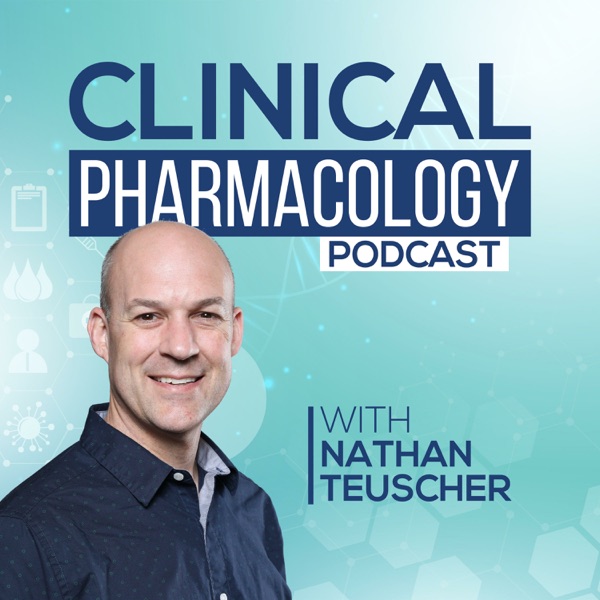
Clinical Pharmacology Podcast with Nathan Teuscher
I discuss clinical pharmacology and pharmacometrics topics from the perspective of drug development scientists. I share my expertise and knowledge about designing and conducting clinical pharmacology studies and discuss how to analyze the data using the most effective approaches. I draw from my experience of over 20 years working in drug development organizations and consultancies.
- Life Sciences chart
- #64
- Episodes
- 61
- Releases
- Monthly
- Typical length
- 25 min
- On air since
- 2023
- Latest episode
- 1 week ago
Episodes
61 episodes, newest first
-
23 min
Inter-occasion variability and shrinkage in PK modeling (Ep. 61)
Episode 61
Show notes
Today’s episode is about inter-occasion variability and η-shrinkage. Episodes 11, 36, 44, and 45 covered diagnostics, covariate search, estimation methods, and base-model selection. None of them treated occasion variability or shrinkage in population PK modeling. So in today's episode I'll explain what these terms mean and how they may impact your work.
Links mentioned in the episode:
• Paper by Karlsson and Sheiner
• Paper by Savic and Karlsson
• FDA guidance on Population PKCopyright Teuscher Solutions LLC. All rights reserved.
-
30 min
Exposure-Response modeling
Episode 60
Show notes
Today’s episode is about exposure response modeling. What is ER analysis? When is it used? How do you do it? And what tools can be used for ER modeling?
Links discussed in the show:
• ICH M15 Guideline
• You can connect with me on LinkedIn and send me a message
• Send me a message
• Sign up for my newsletterCopyright Teuscher Solutions LLC
All Rights Reserved
-
29 min
Renal and Hepatic Impairment (Ep. 59)
Episode 59
Show notes
Today’s episode is a discussion of renal and hepatic impairment. I review the biology of the kidney and liver and how we analyze pharmacokinetic data to assess their impact on drug exposure.
Links discussed in the show:
• You can connect with me on LinkedIn and send me a message
• Send me a message
• Sign up for my newsletterCopyright Teuscher Solutions LLC
All Rights Reserved
-
20 min
Beyond Small Molecules—Allometric Scaling for Biologics and Engineered mAbs (Ep. 58)
Episode 58
Show notes
Today’s episode is about allometric scaling with therapeutic antibodies. I discuss differences from small molecules, how to handle antibodies with engineered Fc regions (e.g. YTE or LS), and using allometry to extrapolate from adults to pediatrics for these antibodies.
Links discussed in the show:
• Haray and Tachibana’s article on allometric exponents for monoclonal antibodies
• Exponents for standard antibodies: CL = 0.8, Q = 0.75, Vc = 1/.0, Vp = 0.95
• Exponents for modified antibodies: CL = 0.55, Q = 6, Vc = 0.95, Vp = 0.95
• You can connect with me on LinkedIn and send me a message
• Send me a message
• Sign up for my newsletterCopyright Teuscher Solutions LLC
All Rights Reserved
-
24 min
Bioequivalence Testing: The Stats Behind Generic Drug Approvals (Ep. 57)
Episode 57
Show notes
In this episode I discuss bioequivalence testing and how it was developed to support generic drug approvals, but is now a mainstream tool for all of drug development. I discuss the basics of what bioequivalence means, how the studies are designed, and then how to perform the statistical analysis. I end with some examples of how this can be used for both generic drug and innovator drugs to support labeling.
Links discussed in the show:
• FDA Draft Guidance: Statistical Approaches to Establishing Bioequivalence (Dec 2022) – Excellent detail on methods, models, and SAS examples.
• FDA Guidance: Bioequivalence Studies with Pharmacokinetic Endpoints for Drugs Submitted Under an ANDA.
• Article: “Bioequivalence of generic drugs: a simple explanation for clinicians” (Andrade, 2015) – Great for the 80-125% intuition.
• R-script with example BE analysis (Be sure to copy this text into a file and name it "BE-example.R" then you can run it on your local R instance.
• You can connect with Nathan on LinkedIn and send me a message
• Send Nathan a message
• Sign up for Nathan’s newsletterCopyright Teuscher Solutions LLC
All Rights Reserved
-
19 min
Examining Volume of Distribution (Ep. 56)
Episode 56
Show notes
In this episode we’re going to define Volume of Distribution, look at the different types of Volume of Distribution parameters, talk about how we actually calculate it, examine what drives its value, and—most importantly—discuss why it matters for the decisions we make every day in drug development.
Links discussed in the show:
• Volume of Distribution
• Volume of Distribution in Drug Design
• You can connect with Nathan on LinkedIn and send me a message
• Send Nathan a message
• Sign up for Nathan’s newsletterCopyright Teuscher Solutions LLC
All Rights Reserved
-
45 min
Talking about data science with Mike Stackhouse (Ep. 55)
Episode 55
Show notes
This episode is an interview with Michael Stackhouse, the Chief Innovation Officer at Atorus Research. We discussed a variety of topics such as modern data science tools, why regulatory agencies want to get rid of SAS transport files in favor of Dataset JSON file formats, and how AI is being used in data programming and data science.
Links discussed in the show:
• Connect with Mike on LinkedIn
• Learn more about Atorus Research on their website
• You can connect with Nathan on LinkedIn and send me a message
• Send Nathan a message
• Sign up for Nathan’s newsletterCopyright Teuscher Solutions LLC
All Rights Reserved
-
38 min
Using Accelerator Mass Spectrometry in Clinical Pharmacology
Episode 54
Show notes
This episode is an interview with Dr. Wouter Vaes, the Chief Science Officer of Peregrion. We discuss how accelerator mass spectrometry is being used in early clinical development for drug metabolism and pharmacokinetics. We discuss using this technology to support development of oncology agents, determining absolute bioavailability without IV toxicology work, and more.
Links discussed in the show:
• You can contact Wouter by email: wouter.vaes@peregrion.com
• Connect with Peregrion on LinkedIn or their website
• Symposium on microtracer studies
• FDA guidance on safety testing of drug metabolites
• White paper on human ADME data
• You can connect with Nathan on LinkedIn and send me a message
• Send Nathan a message
• Sign up for Nathan’s newsletterCopyright Teuscher Solutions LLC
All Rights Reserved
-
21 min
Using AI tools for regulatory intelligence (Ep. 53)
Episode 53
Show notes
This episode is an interview with Aruna Dhontabhaktuni, Founder and CEO of RegKey, a regulatory intelligence platform that uses AI. The discussion touches on how companies can leverage large language model AI tools to accelerate regulatory strategy work.
Links discussed in the show:
• You can contact Aruna by email: arunad@regkey.ai
• Visit the RegKey website
• Connect with Aruna on LinkedIn
• You can connect with Nathan on LinkedIn and send me a message
• Send Nathan a message
• Sign up for Nathan’s newsletterCopyright Teuscher Solutions LLC
-
28 min
When to use model-informed drug development (Ep. 52)
Episode 52
Show notes
This episode is a collection of my thoughts on model-informed drug development and where different modeling modalities fit into the development schedule. These are just my opinions and each development program is different.
Links discussed in the show:
• You can connect with me on LinkedIn and send me a message
• Send me a message
• Sign up for my newsletterCopyright Teuscher Solutions LLC
All Rights Reserved
-
45 min
QSP Modeling with Ahmed Elmokadem (Ep. 51)
Episode 51
Show notes
In this episode I chat with Ahmed Elmokadem about QSP modeling. Ahmed, from Metrum Research Group, is an expert consultant in QSP modeling and how it can be used to provide a framework to connect mechanistic understanding with clinical pharmacology and decision-making.
Links discussed in the show:
• Connect with Ahmed on LinkedIn on on his website
• Ahmed’s book: Numbers that Dazzled the World
• You can connect with me on LinkedIn and send me a message
• Send me a message
• Sign up for my newsletter -
19 min
CDISC datasets and ACoP 2025 (Ep. 50)
Episode 50
Show notes
In this episode I discuss dataset-JSON, a new proposed data standard for CDISC files and explain some of the CDISC files I use in my clinical pharmacology work. I end with some brief thoughts about the ACoP 2025 meeting in Denver in October 2025.
Links discussed in the show:
• CDISC dataset-JSON
• CDISC files I use
• You can connect with me on LinkedInand send me a message
• Send me a message
• Sign up for my newsletterCopyright Teuscher Solutions LLC
All Rights Reserved
-
25 min
Statistics in Pharmacokinetics (Ep. 49)
Episode 49
Show notes
In this episode I discuss review statistics that are commonly used in pharmacokinetics and pharmacometrics work. I reviewed the basic theory of the normal distribution and then discussed various individual statistics that we use in PK work. I concluded with some examples of which statistics I use in my work.
Links discussed in the show:
• Link to message about harmonic mean
• You can connect with me on LinkedIn and send me a message
Copyright Teuscher Solutions LLC
All Rights Reserved
-
22 min
Clinical Trial Simulations (Ep. 48)
Episode 48
Show notes
In this episode I discuss clinical trial simulations. I review concepts of trial simulation including different variability terms and when to use them. I also share my thoughts on 3 different applications used in clinical trial simulation.
Links discussed in the show:
• Trial Simulator Software page
• Simulx Software page
• You can connect with me on LinkedIn and send me a message
• Send me a message
• Sign up for my newsletterCopyright Teuscher Solutions LLC
All Rights Reserved
-
20 min
Using R Shiny for Clinical Pharmacology (Ep. 47)
Episode 47
Show notes
In this episode I discuss R Shiny and how it can be used for building clinical pharmacology tools. I provide an overview of the technology, suggest a few example use cases, and then walk through a specific practical example of predicting AUC and Cmax for future doses from observed data. I end with a discussion of the benefits and challenges of using R Shiny for clinical pharmacology tools.
Links discussed in the show:
• Basics about R Shiny
• https://www.shinyapps.io/ for hosting shiny apps
• Example R Shiny app by Samer Mouskassi: ggplot with your data
• Example R Shiny app for AUC-Cmax predictions
• You can connect with me on LinkedIn and send me a message
• Send me a message
• Sign up for my newsletterCopyright Teuscher Solutions LLC
All Rights Reserved
-
27 min
What is useful about noncompartmental analysis? (Ep. 46)
Episode 46
Show notes
In this episode I discuss noncompartmental analysis. I categorize PK parameters calculated by NCA methods as either Important, Useful, or Questionable. I also share my thoughts on how to report PK parameters calculated using NCA methods in nonclinical and clinical reports. I want to hear your thoughts about this episode. Do you agree or disagree with my categorization of PK parameters? Why? Use the links below to let me know.
Links discussed in the show:
• You can connect with me on LinkedIn and send me a message
• Send me a message
• Sign up for my newsletterCopyright Teuscher Solutions LLC
All Rights Reserved
-
28 min
How to select a base PK model (Ep. 45)
Episode 45
Show notes
In this episode I review the process I follow for fitting a base pharmacokinetic (PK) model. I talk from the perspective of an individual PK model, but include some differences associated with population PK models. I go over exploratory data analysis, getting initial estimates, and how to choose between different base models.
Links discussed in the show:
• AIC and BIC
• You can connect with me on LinkedIn and send me a message
• Send me a message
• Sign up for my newsletterCopyright Teuscher Solutions LLC
All Rights Reserved
-
26 min
Different estimation methods used in modeling (Ep. 44)
Episode 44
Show notes
In this episode I discuss different algorithms used for pharmacometrics modeling. I describe difference between maximum likelihood and expectation maximization methods. I review the FO and FOCEI maximum likelihood algorithms. I then review SAEM, IMP, and QRPEM expectation maximization algorithms that are available. I conclude with an brief explanation of the difference between parameter estimation and parameter uncertainty.
Links discussed in the show:
• PMXRepo
• James Ousey LinkedIn page
• Manuscript by Liu and Wang, 2016
• You can connect with me on LinkedIn and send me a message
• Send me a message
• Sign up for my newsletterCopyright Teuscher Solutions LLC
All Rights Reserved
-
30 min
What is consulting life like? (Ep. 43)
Show notes
In this episode I discuss my experience as an independent consultant in the clinical pharmacology and pharmacometrics space. I talk about how I got from high school to become a consultant. I touched on the many different activities I do as an independent consultant. I shared a bit about how I handle compensation with clients and how I pay myself. And I ended with some brief comments about getting customers.
Links discussed in the show:
• Time management with Clockify
• Accounting and invoices with Wave
• Project management with Jira
• Project notes with Confluence
• Computing resources with AWS
• Microsoft 365 for email, sharepoint, and more as a small business
• Profit First
• You can connect with me on LinkedIn and send me a message
• Send me a message
• Sign up for my newsletterCopyright Teuscher Solutions LLC
All Rights Reserved
-
26 min
Population PK modeling with nlmixr (Ep. 42)
Episode 42
Show notes
In this episode I discuss using nlmixr for population PK modeling in R. I give an overview of the software package, describe the installation process, and walk through a simple example. Overall, nlmixr is a nice package that can be used for most modeling activities you encounter. It eliminates the need for a license since it is open-source. There are some challenges associated with using R for modeling with large datasets and long-running models. But once those are overcome, this could be a great package for all-around use.
Links discussed in the show:
• nlmixr website
• nlmixr on github
• Example R code – remove the .txt file type after download
• You can connect with me on LinkedIn and send me a message
• Send me a message
• Sign up for my newsletterCopyright Teuscher Solutions LLC
All Rights Reserved
On these lists
Clinical Pharmacology Podcast with Nathan Teuscher is one of the shows picked out on this list


More in Life Sciences
Placed highest on Apple Podcasts' Life Sciences chart right now