Podcast
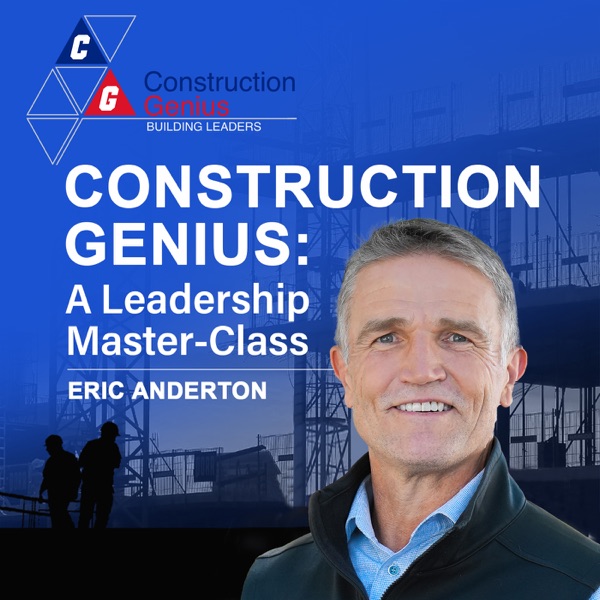
Construction Genius
Thomas Edison said, "Genius is 1% inspiration, 99% perspiration."
This show interviews hard-working construction company owners and executives who share their wisdom, perspectives, and lessons learned from decades of experience bidding, planning, and building profitable projects. Topics include leadership, strategic planning, conflict resolution, niche identification, succession planning, talent management, business development, and business growth.
Industry expert, Eric Anderton also shares his insights about how construction company owners can increase project profit by improving communication, running productive meetings, and attracting, developing, and retaining talented leaders.
Tune in each week and get practical inspiration for how to build people, projects, and profits.
"I know of no genius but the genius of hard work." John Ruskin
- Management chart
- #58
- Episodes
- 410
- Releases
- Weekly
- Typical length
- 36 min
- On air since
- 2019
- Latest episode
- 17 hours ago
Episodes
410 episodes, newest first
-
23 min
Time Management for Construction Leaders: Stop Fighting Fires
Episode 407
Show notes
Time management for construction leaders begins with your calendar. If you're a construction company owner or executive spending most of your week fighting fires, you're probably neglecting the work that could prevent those fires.
I coached a construction executive who claimed business development was his top priority. When I asked to see the time he'd scheduled for meeting key clients, there wasn't a single hour on his calendar.
His calendar revealed his real priorities.
In this solo episode of Construction Genius, I explain how construction company owners, presidents, and senior leaders can take control of their time, reduce interruptions, and become more effective at leading their businesses.
We cover: - How to use the Eisenhower Matrix to identify your most important leadership activities. - Why poor delegation, inadequate training, and weak accountability create constant interruptions. - How to protect time for construction business development, operational improvement, and employee development. - How to use time blocking to concentrate on strategic priorities. - Why 30 minutes of planning every Friday can change how you spend the following week.
One project manager I coached discovered he was losing three hours a day to interruptions. That's 660 hours a year, or more than 16 full workweeks.
If you're constantly dealing with project problems, employee issues, and unnecessary meetings, this episode gives you practical tools to start getting your time back.
FREE TIME MANAGEMENT FRAMEWORK Download Stop Being Overwhelmed and Start Being Effective, including the Eisenhower Matrix, interruption audit, time log, and weekly planning tools. https://ericanderton.activehosted.com/f/257
THE SHIFT: ONLINE CONSTRUCTION LEADERSHIP COURSE Develop your construction managers and executives into more effective leaders. https://theshift.constructiongenius.com
Construction Genius with Eric Anderton: Practical leadership, strategy, sales, and marketing advice for construction companies.
-
53 min
How to Spot a Trojan Horse in Your Construction Business
Episode 604
Show notes
Every construction business has chased an opportunity that looked great and turned into a money pit. Herb Sargent calls it the Trojan horse.
Herb is board chair of Sargent Corporation, a heavy civil contractor in Maine that turned 100 this year. Scott Peper is CEO and founder of Mobilization Funding. They wrote Field Tested: Lessons in Leading, Losing, and Winning in Construction together, and they walked me through how to spot the horse before you wheel it in.
Takeaways:
•
Set the number where you'll walk away before you start. Sargent lost money in ready mix every year for ten years.
•
Let your estimator tell you what the job costs before ego decides you have to have it.
•
"I gotta keep money coming in" usually means overbillings went to start other jobs.
•
Every growing owner becomes the bottleneck. Hand someone the keys for half a day, then debrief.
•
One 15-minute conversation about legacy got Sargent's best operator mentoring a 23-year-old foreman.
Connect with Herb Sargent:
LinkedIn: https://www.linkedin.com/in/herb-sargent-esop/
Sargent Corporation: https://sargent.us/
Starbuck and Sargent podcast: https://podcasts.apple.com/us/podcast/starbuck-sargent/id1856531285
Connect with Scott Peper:
LinkedIn: https://www.linkedin.com/in/scott-peper-9387288/
Mobilization Funding: https://mobilizationfunding.com/
The Mobilization Mindset podcast: https://mobilizationfunding.com/videos/
Pre-order Field Tested on Amazon: https://www.amazon.com/Field-Tested-Lessons-Leading-Construction/dp/B0HM2TXYS3
The Shift Leadership Course: https://theshift.constructiongenius.com/
-
16 min
The Meeting Structure That Gets Your Team to Agree in 30 Minutes
Episode 405
Show notes
Capable people can spend an hour in a meeting and leave without a decision. In this solo episode, Eric Anderton, founder of Construction Genius, walks through the meeting structure he's used with contractor clients for more than 20 years. Teams use it to agree in about 30 minutes on problems they've argued about for years.
Takeaways:
•
Write a precise question with a 90-day time frame before anyone walks in
•
Everyone writes ideas alone for two minutes, then shares one per turn. The owner goes last
•
Each person votes for the best third of the ideas. Nobody stacks votes
•
Close with a show of hands and ask holdouts what it would take to commit
•
Turn the decision into a one-page plan with a rally cry, areas of fierce focus and critical numbers
Free downloads:
Effective Meetings Assessment: https://ericanderton.activehosted.com/f/256
Kick-Ass Meetings ebook: https://www.constructiongenius.com/kam-2
Listener offer: The first ten contractors who email eric@constructiongenius.com with "Kick-Ass Meetings" in the subject line get a 60-minute Zoom session with Eric and their team at no charge. Eric normally charges $3,500. Tell him your problem and where you heard the offer. Offer good through 12/31/26.
Connect with Eric Anderton:
LinkedIn: https://www.linkedin.com/in/andertoneric/
Website: https://constructiongenius.com
-
48 min
How to Hire Business Developers Who Can Sell Large Commercial Projects
Episode 404
Show notes
Most contractors hire a business developer on one trait. Then they wait a year to find out it didn't work.
Neal Glatt is a sales and leadership coach who helps companies hire and develop salespeople. He explains what to test before you make the offer, and how to know within six months whether a new BD hire will pan out.
Takeaways:
- Industry experience alone is a poor reason to hire a salesperson. Neal's assessment looks at more than 220 data points
- If you can't write your sales process on one page as stages and steps, you have a process problem
- Build your process from the best sale you ever made
- Get involved six months to a year before the RFP goes out
- Ask who besides the person in front of you is involved in the final decision
- Run a five-minute phone screen and watch what the candidate does when you cut them off
Connect with Neal Glatt:
LinkedIn: https://www.linkedin.com/in/nealglatt
Website: https://nealglatt.com
Cassidy Gutter on LinkedIn: https://www.linkedin.com/in/cassidy-gutter-4a007822a
The Shift Leadership Course: https://theshift.constructiongenius.com
-
22 min
Year-End Close for Contractors: Check Your Numbers Before You Pay Bonuses
Episode 403
Show notes
You pay the Christmas bonuses. Then January hits, more job costs come in, and the profit you paid them on starts to shrink.
In part nine of the construction accounting series, Kathe Barrington, CPA, of KB CPA walks through a contractor's year-end close. She covers how to test your numbers before you spend, distribute or pay bonuses on them.
Takeaways:
•
Year-end prep starts in January. A hard close tells you which SOPs need work
•
Check December's closed jobs against January's job costs. Costs still landing means you closed too early
•
Take job losses as soon as you know them. Be conservative on pending change orders
•
Internal financials that don't match your reviewed statement cost you credibility with your bank and surety
•
Get Q3 right, pick the jobs you'll close by December 31, and get the numbers to your tax person in October
Kathe also tells the story of a job that took 11 years to close out.
The full Construction Accounting Series with Kathe Barrington:
Playlist: https://www.youtube.com/playlist?list=PLNqgaQ0mEF1w
•
Ep. 357 WIP Reports Made Simple: https://www.constructiongenius.com/wip-reports-made-simple-the-key-to-stopping-hidden-job-losses-ep.-357
•
Ep. 359 Use Your WIP to Protect Cash: https://www.constructiongenius.com/how-to-use-your-wip-to-protect-cash-and-grow-profitability-ep.-359
•
Ep. 364 Physical Progress vs. Financial Reporting: https://www.constructiongenius.com/physical-progress-vs.-financial-reporting-in-construction-projects-ep.-364
•
Ep. 368 Underbillings Bad. Overbillings Better: https://www.constructiongenius.com/underbillings-bad-overbillings-better-the-cash-flow-truth-construction-owners-cant-ignore-ep.-368
•
Ep. 377 Why Your Jobs Look More Profitable Than They Are: https://www.constructiongenius.com/why-your-jobs-look-more-profitable-than-they-are-indirect-allocations-and-overhead-in-construction-ep.-377
•
Ep. 388 Read Your Backlog Like a Banker: https://www.constructiongenius.com/how-to-read-your-backlog-like-a-banker
•
Ep. 396 Grow Bonding Capacity: https://constructiongenius.com/grow-bonding-capacity-banking-tax-moves-contractors/
•
Ep. 400 Projections: https://www.constructiongenius.com/construction-projections-cash-flow-margin-kathe-barrington
Connect with Kathe Barrington:
LinkedIn: https://www.linkedin.com/in/kathe-barrington-a6346337/
Facebook: https://www.facebook.com/p/Kathe-Barrington-CPA-100072271041746/
KB CPA: https://kbcpa.biz
-
13 min
Your Field Problems Start in Design: What the Suffolk and MIT AI Report Means for Contractors
Episode 402
Show notes
Suffolk and MIT just released a white paper on AI in construction. It estimates 17 to 20% in potential cost savings and 22 to 25% on schedule. In this solo episode, Eric Anderton reads it for a contractor running a $25 to $500 million company and pulls out the applications worth testing now. He also explains where those numbers came from before you expect them on your next job.
Takeaways:
•
Many field production problems get locked in during design, months before the crew shows up
•
Design changes hit quantities, purchasing and installation. AI could get those effects onto the schedule sooner
•
A contractor is using AI to turn hundreds of schedule activities into a three-week look-ahead with a risk list
•
Tie your procurement log and lead times to the schedule so a late delivery flags the work it puts at risk
•
None of it works without accurate project data and someone who owns the decision
Connect with Eric Anderton: https://www.linkedin.com/in/andertoneric
Read the report: Construction in the Age of AI, from Suffolk and MIT
https://suffolk.com/wp-content/uploads/2026/09/Suffolk_MIT_AI_Whitepaper_FINAL.pdf
-
19 min
The $20 Million Job You Should Walk Away From
Episode 401
Show notes
A $20 million project lands in your lap with three or four red flags attached. You want the revenue. You want the backlog. In this solo episode, Eric Anderton walks through the three-for-three test he uses with his coaching clients: right client, right project, right location. He also tackles a harder problem. What do you do with a technically excellent superintendent whose behavior no longer matches your company's values? Two decisions, and Eric shows you exactly how they can start reinforcing each other if you let them.
Takeaways:
- Why profit history matters more than revenue when deciding which projects to take again
- The three-for-three test for qualifying clients, projects, and locations
- How to define a seat by its outcomes and behaviors before judging the person in it
- The three real options for a values mismatch: train, move, or fire
- Why the size of the number never fixes the size of the risk
Connect with Eric Anderton:
https://www.linkedin.com/in/andertoneric
If you want the full niche analysis spreadsheet Eric uses with his coaching clients, email eric@constructiongenius.com with "Niche Analysis" in the subject line.
-
23 min
Construction Projections: Seeing Cash and Margin Trouble Before It Costs You
Episode 400
Show notes
Your WIP shows today. Your backlog shows what's booked. Neither tells you where your cash and crews are headed. That's what projections do, and most contractors either do them badly or skip them.
In Part 8 of the series, CPA Kathe Barrington shows construction owners how to build projections that actually predict trouble early.
What you'll take away:
•
Why projections belong to your CFO, and where owners still need to stay involved
•
How far out to project (18 months internally, fiscal year-end for the bank)
•
The job-cost bell curve, and how to plan cash, billings, and manpower around the peak
•
Why cushion in your estimates can hurt your credibility with bank and bonding
•
A 30-60-90 day plan to get your projections under control
Kathe's line for owners who play games with their numbers: you lose the truth about your own margins, and every future estimate inherits the lie.
The full Construction Accounting Series with Kathe Barrington:
•
Ep. 357 WIP Reports Made Simple: https://www.constructiongenius.com/wip-reports-made-simple-the-key-to-stopping-hidden-job-losses-ep.-357
•
Ep. 359 Use Your WIP to Protect Cash: https://www.constructiongenius.com/how-to-use-your-wip-to-protect-cash-and-grow-profitability-ep.-359
•
Ep. 364 Physical Progress vs. Financial Reporting: https://www.constructiongenius.com/physical-progress-vs.-financial-reporting-in-construction-projects-ep.-364
•
Ep. 368 Underbillings Bad. Overbillings Better: https://www.constructiongenius.com/underbillings-bad-overbillings-better-the-cash-flow-truth-construction-owners-cant-ignore-ep.-368
•
Ep. 377 Why Your Jobs Look More Profitable: https://www.constructiongenius.com/why-your-jobs-look-more-profitable-than-they-are-indirect-allocations-and-overhead-in-construction-ep.-377
•
Ep. 388 Read Your Backlog Like a Banker: https://www.constructiongenius.com/how-to-read-your-backlog-like-a-banker
•
Ep. 396 Grow Bonding Capacity: https://constructiongenius.com/grow-bonding-capacity-banking-tax-moves-contractors/
•
Full playlist: https://www.youtube.com/playlist?list=PLNqgaQ0mEF1w
Connect with Kathe Barrington: https://kbcpa.biz
-
40 min
Fixing Performance Reviews for the Field with Ryan Englin
Episode 399
Show notes
Ryan Englin, founder of Core Matters and creator of the FieldCon software platform, returns to talk about the two things most construction leaders dodge: accountability and performance reviews. Ryan and Eric get practical about why these conversations feel so hard and how to make them routine.
The short version. Accountability starts with a commitment the employee actually agreed to. The longer you wait to address a problem, the more painful it gets. And the annual review is the worst way to give feedback.
In this episode: - Why you can't hold someone accountable to something they never committed to - The foreman story that shows how delay turns a small issue into a confrontation - Why focusing on the agreed outcome beats focusing on the person - How to redesign reviews around the gap between self-rating and manager-rating - Running reviews monthly or quarterly so nothing is ever a surprise
Connect with Ryan Englin:
Core Matters: https://corematters.com/
FieldCon: https://fieldcon.io/
LinkedIn: https://www.linkedin.com/in/ryanenglin/
Core Matters on LinkedIn: https://www.linkedin.com/company/corematters
-
38 min
You're the Bottleneck: Building the Banks of the River So Your Team Can Flow, with Scott Borroughs
Episode 398
Show notes
A superintendent's wife wakes up at 2 a.m. to find him pacing the bedroom for the third night straight. She tells him, "This isn't going to work. For anybody." That superintendent was Scott Borroughs, and the project was Deep Space, Epic Systems Systems850,000 square foot auditorium, built 80 feet down through limestone.
Scott Borroughs is the Vice President of Field Operations at JP Cullen, a fifth-generation Wisconsin contractor. As general superintendent on Deep Space, he became the decision-making funnel that choked the project, then rebuilt the way he led. In this episode, we walk through how he did it, and how you can do the same without losing control of the work.
What you'll learn:
•
How to recognize when you've become the bottleneck on your own project
•
The "banks of the river" framework: define the banks, let people flow between them
•
How to step back from the weeds without feeling like you've stopped working
•
What to do when your team solves a problem differently than you would
•
How JP Cullen turned one project's lessons into ten company-wide SOPs
•
Why you should never confuse activity with accomplishment
Connect with Scott Borroughs on LinkedIn: https://www.linkedin.com/in/scott-borroughs-63999a19
JP Cullen: https://jpcullen.com
The Epic Systems Deep Space Auditorium project: https://jpcullen.com/portfolio/epic-deep-space-auditorium
-
22 min
ChatGPT in Construction: A Working Contractor on What Works, What Fails, and What to Do First
Episode 397
Show notes
You're a contractor, you're busy, and you're tired of LinkedIn consultants telling you that you'll be left behind if you don't embrace AI right now. Smart move to tune out the hype — but here's the catch: while you're waiting for the noise to die down, a few of your competitors are quietly using these tools to save hours every week. Not on flashy stuff. On the boring stuff. Meeting minutes, SOPs, pulling scope language out of a 200-page addendum.
Dimitri Sidiropoulos is the Vice President of Delphi Plumbing and Heating, a heavy mechanical self-performing public works contractor in New York City. He's not a tech bro — he's a working contractor who decided to actually try ChatGPT for a year inside his construction company. In this conversation, Eric and Dimitri get into what works, what doesn't, where it saves him hours, where the proposal bot he tried to build had to be abandoned, and where that last 20% will nail you if you're not paying attention.
If you've been waiting for someone to give you a no-hype, on-the-ground answer to "should I actually be using ChatGPT?" — grab a notepad. This is the conversation.
What you'll learn:
•
Why the first move with AI isn't asking it to do work — it's letting it interview you
•
How Dimitri spent three days in back-and-forth with ChatGPT to give it real context about his business
•
The "Jarvis to Iron Man" framework: AI enhances the operator, it doesn't replace the brain
•
Where ChatGPT shines: meeting minutes, SOPs, pulling scope from addenda, three/five/ten-year strategic planning
•
Where it falls down: custom proposal bots, takeoffs of pipe and fittings, anything that depends on means and methods
•
Why "80% of the way there in five minutes" beats "80% of the way there in a day and a half"
•
How to ask AI for its sources so you can spot hallucinations early
•
Why writing emails with AI can hurt the relationships you've built
•
The first move on Monday morning if you're an AI-skeptic contractor
Connect with Dimitri
•
Delphi Plumbing & Heating: https://www.delphiph.com/
•
Dimitri on LinkedIn: https://www.linkedin.com/in/dimitri-sidiropoulos-b4485190
•
Delphi on LinkedIn: https://www.linkedin.com/company/delphiph
-
27 min
How to Grow Bonding Capacity: Banking and Tax Moves for Contractors
Episode 396
Show notes
Every construction company answers to three masters. The bank. The bonding company. The taxman. Same financial statements, three different things they want from you.
Kathe Barrington is a CPA who builds the construction accounting that bankers and bonding agents actually read. In Part 7 of our series, we work through how to stop being at the mercy of all three and get them working as one team.
What you'll learn:
•
Why one set of books gets three different recommendations, and what to do about it
•
How paying less tax can quietly shrink your bonding capacity
•
Why bank and bonding both care about equity, retained earnings, and working capital
•
How WIP accuracy and consistent margins build outside trust
•
The one meeting almost no contractor runs, and why it changes everything
Kathe Barrington is a CPA with 30+ years of experience, 20 focused on construction. Through KB CPA she is a fractional accounting resource for commercial GCs and specialty contractors that need construction-literate financial support without a full-time CFO or controller.
Connect with Kathe Barrington
LinkedIn: https://www.linkedin.com/in/kathe-barrington-a6346337
Facebook: https://www.facebook.com/p/Kathe-Barrington-CPA-100072271041746
KB CPA: https://kbcpa.biz
-
46 min
How MEP Contractors Make Money With Prefab
Episode 395
Show notes
Prefabrication won't save your MEP company on its own. Run it wrong and it quietly bleeds you. In this episode, Jake Olsen, CEO of Stratus, explains how to make fab actually pay off. He's a structural engineer with more than twenty years in construction and construction tech, and he's blunt about where the money goes.
In this conversation you'll learn:
•
Why prefab is really a labor strategy, and how "geographic arbitrage" keeps your crews busy
•
Why MEP fab is neither manufacturing nor field construction, and why that matters
•
How overproducing and carrying too much work-in-progress strands your cash
•
Where prefab actually gets won, and it's in preconstruction, not the shop
•
The two biggest money-losers in any fab shop: material handling and rework
If you run fabrication, or you're thinking about building a shop, this episode will change how you set your expectations.
Connect with Jake Olsen: https://www.linkedin.com/in/mrjakeolsen/Learn more about Stratus: https://www.stratus.build/
-
39 min
Selling to Your Employees: How ESOPs Work for Construction Company Succession
Episode 394
Show notes
Most construction owners think they have four exit options. Pass it to a kid. Sell to an employee. Sell to a competitor. Sell to private equity. The reality is harder. Private equity passes on most contractors. Competitors often aren't buying. That's why ESOPs are now the fastest-growing succession trend in construction.
Kelly Finnell, CEO of EFS ESOP Consultants, has done 22 ESOPs for general and specialty contractors in recent years. In this episode, Kelly explains how the deal is actually structured, what the owner walks away with, and where most owners are wrong about "leaving money on the table."
What you'll learn:
•
Why construction is the fastest-growing industry for ESOPs in the country
•
The three sources of capital that fund an ESOP: bank loan, seller note, excess cash
•
How two contractors with $3M EBITDA sold for $25M to an ESOP after $12M offers from a strategic buyer
•
Why an owner is not personally on the hook for the ESOP bank loan
•
How to manage the repurchase obligation so it doesn't crush you in a down year
•
The first two moves to make if you're 58 and seriously considering this path
Connect with Kelly Finnell on LinkedIn: https://www.linkedin.com/in/esopcoach/
Kelly's Website: www.execfin.com
Kelly's Book, The ESOP Coach: https://www.amazon.com/ESOP-Coach-Ownership-Succession-Paperback/dp/B010CKUN9U
National Center for Employee Ownership: https://www.nceo.org/
Free Succession Planning Guide: https://www.constructiongenius.com/free-succession-planning-guide
-
48 min
Question Everything: How to Innovate Construction Materials and Methods
Episode 393
Show notes
Sam Fertik went from running a 20-course tasting restaurant in Manhattan to building homes out of concrete and steel that he says last a thousand years. He's the CEO and Founder of Carbon Custom Builders. In this episode, Sam and Eric trace the chef-to-contractor journey and the one question that reshaped his whole business. Why are we still building houses the way we did in 1850?
What you'll learn:
•
What ICF (Insulated Concrete Forms) is and why it turns homebuilding into a repeatable science
•
Why the average home lasts 30 years and how concrete-and-steel construction changes that
•
How a chef's recipe mindset applies directly to running a construction company
•
The "go to the biggest problem" lesson and why owners have to be both visionary and implementer
•
Why Sam says sales is the one thing that kills a small business
Connect with Sam Fertik and Carbon Custom Builders:
•
Website: https://www.carboncustombuilders.com/
•
LinkedIn: https://www.linkedin.com/in/sam-fertik/
•
-
37 min
Get Off the Bid List: Build a Construction Business Development System That Wins Negotiated Work
Episode 392
Show notes
Most contractors are stuck on the bid list and don't know it. They tell themselves they're a preferred contractor. The numbers say otherwise.
In this episode, Matthew Neuberger of Neuberger and Company joins Eric to break down why business development inside most construction companies fails, and the simple system that fixes it. Matthew runs a Sandler training franchise focused on contractors, so he sees this every day.
What you'll learn:
•
Why 60 to 70 percent of a growing contractor's revenue comes from inbound calls, not bid invitations
•
The three-part business development system: owner list, contact cadence, weekly review
•
The four signals that tell you which owners belong on your list
•
Why a CRM and a LinkedIn presence are not business development
•
How to use Eric's EAR framework to make BD accountability stick
Matthew is offering a free business development assessment that pinpoints where your process is leaking revenue.
Free Assessment: https://neuberger-sandler-22152421.hs-sites.com/tcc-eval-form
Connect with Matthew Neuberger on LinkedIn: https://www.linkedin.com/in/neubergerco/
-
23 min
How to Read Your Backlog Like a Banker: Timing, Diversification, and Gross Profit Discipline
Episode 391
Show notes
How's your backlog right now? In Part 6 of the Construction Accounting Series, Eric sits down again with CPA Kathe Barrington to unpack what backlog really is, and what it isn't. They dig into why committed-but-unstarted jobs belong on your WIP the day you're awarded, how to use backlog to forecast labor, equipment, and cash, and why a backlog that looks great in aggregate can still leave you with a nine-month hole in the schedule.
Kathe lays out the ideal backlog-to-revenue ratio, the red flag of growing backlog with compressing gross profit, how client and project-type concentration creates fragility, and who needs to be in the room for the monthly backlog review. If you want backlog to function as a real planning tool, not a vanity number. This conversation is the blueprint.
What You'll Learn
•
What backlog actually is - remaining contract, remaining cost, and remaining gross profit to complete
•
Why letters of intent and verbal awards should NOT count as backlog
•
Why unstarted-but-committed jobs belong on your WIP the day you're awarded (and what bank & bonding are looking for)
•
How to translate a WIP snapshot into a month-by-month forecast of labor, equipment, and cash
•
How far out you should be forecasting labor (hint: 6–12 months minimum)
•
The ideal backlog-to-revenue ratio - and why 3–6 months makes Kathe nervous
•
How backlog profiles differ between GCs and subs, and what that means for planning
•
The aggregate-number trap: why jobs bunched up at the same finish line signal trouble
•
When you can tighten margins as you scale - and when compressing gross profit becomes dangerous
•
Client and project-type concentration risk - diversification as insurance
•
How often to review backlog (monthly, with the financials) and who belongs in the room
•
The questions that should drive the conversation beyond the numbers
•
How to use backlog data when the market shifts - lessons from 2008 and COVID
•
The three questions Kathe asks first when she takes on a new client's books
Connect with Kathe
LinkedIn: Kathe Barrington, KB CPA
Facebook: Kathe Barrington / KB CPA
The Construction Accounting Series with Kathe Barrington
This is Part 6 of an ongoing series. Catch up on the full run:
•
Part 1 — Ep. 357: WIP Reports Made Simple: The Key to Stopping Hidden Job Losses
•
Part 2 — Ep. 359: How to Use Your WIP to Protect Cash and Grow Profitability
•
Part 3 — Ep. 364: Why the Field and Accounting Are Both Right (Physical Progress vs. Financial Reporting)
•
Part 4 — Ep. 368: Underbillings Bad. Overbillings Better: The Cash Flow Truth Construction Owners Can't Ignore
•
Part 5 — Ep. 377: Why Your Jobs Look More Profitable Than They Are: Indirect Allocations and Overhead in Construction
-
29 min
Get the Most Out of Every Project Meeting: ChatGPT 201 for Construction Leaders
Episode 390
Show notes
Your meeting transcripts are the most valuable data set your company throws away. This is ChatGPT 201, part two of our AI for construction companies series with Dylan Davis, AI consultant and coach and my collaborator on the Construction Genius GPT course. We take one task every contractor has, the meeting follow-up email, and turn it into a repeatable AI workflow you can run every week.
What you'll learn:
•
What makes an AI workflow instead of a one-off prompt
•
How to find your best automation targets inside the bid, the build, and the bill
•
How to teach ChatGPT your writing style with three to five sample emails
•
How to make the AI grade its own work before you see it
•
Why you should let the AI write the prompt, and how projects make it repeatable
•
What to do when the output is bad (hint: it's your fault)
Get on the waitlist for the Construction Genius GPT Course: https://ericanderton.activehosted.com/f/255
Connect with Dylan Davis: https://www.linkedin.com/in/dylantdavis/
Dylan's YouTube Channel: https://youtube.com/@dylandavisAI
-
1 hr 2 min
Unapologetically Hardcore: Applying Elon Musk's Algorithm to Construction Leadership, with Eric Jorgenson
Episode 389
Show notes
Elon Musk builds rockets. You build buildings. Different industry. Same problems. Bad requirements, bloated processes, too many parts, slow cycle time.
Eric Jorgenson is the CEO of Scribe Media and the author of The Book of Elon, a curated collection of Elon Musk's most useful ideas drawn from his tweets, interviews, and public conversations. In this episode, we walk through Elon's five-step algorithm and apply it directly to how construction companies get work, plan work, and build work.
What you'll learn:
•
Why questioning requirements and deleting parts is 80 percent of the algorithm
•
How the idiot index reveals where your supply chain is taking you for a ride
•
First principles thinking vs. reasoning by analogy, with concrete construction examples
•
Why fast is actually cheap and how it breaks the construction trilemma
•
How to attack the bottleneck instead of running the calendar
•
How to give people hardcore feedback without making it personal
Get The Book of Elon (free digital version): https://www.elonmuskbook.org/
Connect with Eric Jorgenson on LinkedIn: https://www.linkedin.com/in/erjorgenson/
Eric's newsletter: https://www.ejorgenson.com/newsletter
Eric's podcast, Smart Friends: https://www.ejorgenson.com/podcast
Free Succession Planning Guide: https://www.constructiongenius.com/free-succession-planning-guide
-
38 min
AI Won't Fix a Badly Run Company: AI 101 for Construction Leaders
Episode 388
Show notes
AI won't fix a badly run company. But if you're already running a good one, it can save you hours every week on the work that eats your time: RFIs, change order drafts, meeting summaries, estimating.
Dylan Davis is an AI consultant and coach, and my collaborator on the Construction Genius GPT course, where we teach construction professionals to use AI on real work. This is part one of our new series on AI for construction companies: AI 101, in plain English, with zero hype.
What you'll learn:
•
What AI actually is (a prediction machine) and where it fits in everyday construction work
•
Why context, not prompting, is the last competitive lever left
•
The What-Why-How framework for getting useful output every time
•
Why the first answer is the start, not the finish, and how to iterate like a pro
•
Which model to use for which task: ChatGPT, Claude, or Gemini
•
How to keep your company data safe, and the one thing Dylan won't let AI do
•
Three moves to make on day one of your AI journey
Get on the waitlist for the Construction Genius GPT Course: https://ericanderton.activehosted.com/f/255
Connect with Dylan Davis on LinkedIn: https://www.linkedin.com/in/dylantdavis/
Dylan's website: https://offerings.gradientlabs.co/
Dylan's YouTube Channel: https://www.youtube.com/@dylandavisAI
Free Succession Planning Guide: https://www.constructiongenius.com/free-succession-planning-guide
Management lists
More Management shows picked out from the charts








More in Management
Placed highest on Apple Podcasts' Management chart right now