Podcast
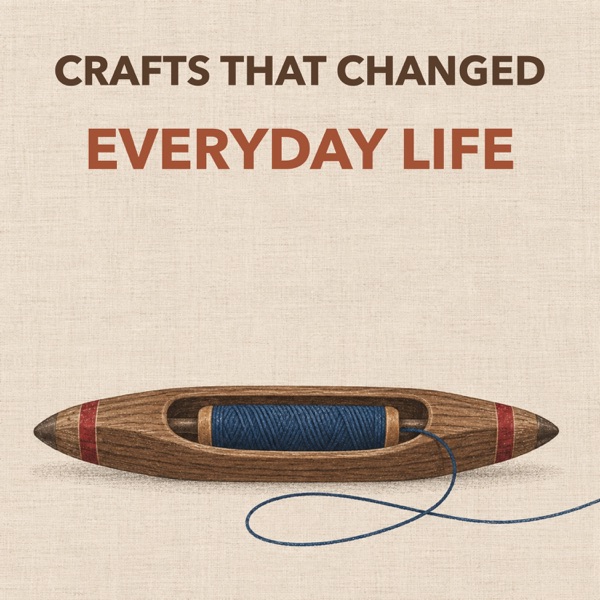
Crafts That Changed Everyday Life
Crafts That Changed Everyday Life follows the tools, materials, and skilled processes behind woven cloth, glazed pottery, bound books, blown glass, and more. Each episode connects a clear making problem with the history of how people solved it across different places and traditions.
- On air since
- 2026
- Episodes
- 7
- Releases · typical length
- Daily · 9 min
- Latest episode
- 2 months ago
Chart history since Oct 26
| Now | Chart | Peak | Since Oct 26 |
|---|---|---|---|
| Off | Crafts Last on it Nov 14 at #200 | #122 |
Episodes
7 episodes, newest first
-
9 min
Why Mortise and Tenon Joints Hold
Show notes
See how a fitted projection and cavity can turn separate pieces of wood into a durable structure. Shoulders, grain direction, friction and pegs all help explain why mortise and tenon joints endure.
Inside this episode:
- The basic geometry
- Wood is strong in different directions
- The shoulders resist rotation
- Friction helps, but shape does more
- The joint can deformSources include Construction and Building Materials, mortise-and-tenon behavior and Heritage Science, traditional timber joints.
This episode is a researched narrative summary. Historical records may be incomplete, translated differently, or interpreted differently by scholars. We distinguish documented facts, estimates, disputed interpretations, and later stories where material. Corrections are logged and incorporated into future editions.
Follow Crafts That Changed Everyday Life for more researched stories about the crafts and tools that shaped daily life.
-
9 min
How Papermakers Turn Pulp Into Sheets
Show notes
Follow suspended plant fibers as they are gathered, pressed and dried into a continuous sheet. Small choices in fiber preparation and formation shape the paper's texture, strength and appearance.
Inside this episode:
- Paper starts with fibers
- The mould captures a layer
- Couching builds a post
- Why the fibers stay together
- Drying sets the sheetSources include Georgia Tech Paper Museum, Washi Sheet Formation, Cellulose, hydrogen bonding in paper, and Paper strength review.
This episode is a researched narrative summary. Historical records may be incomplete, translated differently, or interpreted differently by scholars. We distinguish documented facts, estimates, disputed interpretations, and later stories where material. Corrections are logged and incorporated into future editions.
Follow Crafts That Changed Everyday Life for more researched stories about the crafts and tools that shaped daily life.
-
9 min
How Blacksmiths Shape Steel With Heat
Show notes
Enter the forge to understand how heat, force and repeated shaping change a piece of steel. The story focuses on the craft and material science, not on hazardous how-to instruction.
Inside this episode:
- Steel remains solid
- The forge supplies controlled heat
- The hammer moves material
- Drawing out and upsetting
- Punching and driftingSources include Victoria and Albert Museum, Metalworking Techniques and National Park Service, Blacksmithing at Herbert Hoover.
This episode is a researched narrative summary. Historical records may be incomplete, translated differently, or interpreted differently by scholars. We distinguish documented facts, estimates, disputed interpretations, and later stories where material. Corrections are logged and incorporated into future editions.
Follow Crafts That Changed Everyday Life for more researched stories about the crafts and tools that shaped daily life.
-
8 min
How a Loom Organizes Threads
Show notes
This episode explores Warp, weft, shedding and the mechanical problem that looms solve across different traditions. The story keeps the mechanisms clear and the research grounded for a casual listener.
Inside this episode:
- Two directions
- Tension creates a working field
- The shed
- Heddles hold the order
- The weft makes the journeySources include Victoria and Albert Museum, What is tapestry?, Metropolitan Museum of Art, How Medieval and Renaissance Tapestries Were Made, and Metropolitan Museum of Art, Tapestries and How They Are Made.
This episode is a researched narrative summary. Historical records may be incomplete, translated differently, or interpreted differently by scholars. We distinguish documented facts, estimates, disputed interpretations, and later stories where material. Corrections are logged and incorporated into future editions.
Follow Crafts That Changed Everyday Life for more researched stories about the crafts and tools that shaped daily life.
-
8 min
What Holds a Bound Book Together
Show notes
This episode explores Sections, sewing, adhesive, boards and spines across major binding structures. The story keeps the mechanisms clear and the research grounded for a casual listener.
Inside this episode:
- A book is a moving object
- Folds create sections
- Sewing links the text block
- The spine is a controlled hinge
- Boards protect and carrySources include Library of Congress, Bach to Baseball Cards, Library of Congress, Rebacking Gouverneur Morris's Encyclopedie, and Library of Congress, Why We Bind.
This episode is a researched narrative summary. Historical records may be incomplete, translated differently, or interpreted differently by scholars. We distinguish documented facts, estimates, disputed interpretations, and later stories where material. Corrections are logged and incorporated into future editions.
Follow Crafts That Changed Everyday Life for more researched stories about the crafts and tools that shaped daily life.
Crafts lists
More Crafts shows picked out from the charts