Podcast
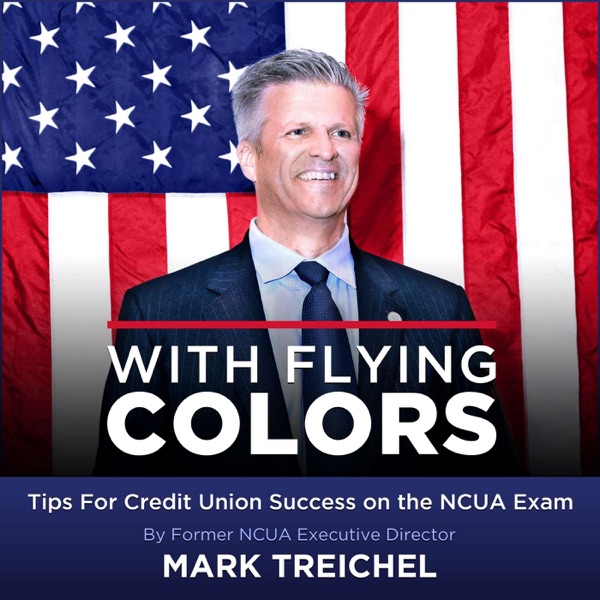
Credit Union Exam Solutions Presents With Flying Colors
Tips for Credit Unions Success on the NCUA Examination. Brought to you by Mark Treichel's Credit Union Exam Solutions.
- Episodes
- 393
- Releases
- Twice a week
- Typical length
- 26 min
- On air since
- 2022
- Latest episode
- 1 day ago
Episodes
393 episodes, newest first
-
22 min
NCUA Drops Office-by-Office Detail From Its 2027 Budget
Episode 458
Show notes
www.marktreichel.com
https://www.linkedin.com/in/mark-treichel/
NCUA has released its 2027 staff draft budget, and this is Mark Treichel's first take: what it is, what changed, and what's missing. It's a two-year budget, 2027 and 2028, so NCUA can keep operating if it doesn't have a full board or can't get a vote. Mark sets the 2028 figures aside to keep it simple.
Headline numbers
• Budget just over $325 million, up 2.9% — $9.2 million over the 2026 approved amount. That increase is essentially pay: NCUA is required to maintain comparability with the other banking regulators and has a union contract it has to live up to, and it typically pays non-union staff similarly.
• 972 full-time equivalents (FTEs), up five from last year and down 23% from the peak of 1,255 in the 2025 budget, after the buyouts.
• Overhead transfer rate (OTR) of 62% — a number NASCUS will comment on.
• Operating fee down 49 basis points, after a large drop last year tied to the reorganization and buyouts.
• Operating budget up 8.2%: pay and benefits and contracted services up, travel down a little, rent, communications, utilities, and administrative up a little.
• Roughly 70% paid by federal credit unions through the operating fee and their share of the OTR; roughly 30% by state charters, for insurance-related exam work.
Also in this episode
• Why calling it a "staff draft" is a little funny, and why the budget used to be Mark's Super Bowl as NCUA Executive Director.
• The reorganization: target date now December 2027; prioritize statutory and most critical work, consolidate units with like functions, raise the supervisor-to-employee ratio, use technology for efficiency. The Office of the Chief Economist has been rolled into the Office of Examination and Insurance (E&I). About $1 million of a $16 million reorganization fund was spent.
• The Office of National Examinations and Supervision (ONES): the draft doesn't say what's happening. ONES' budget is down 1.2%; the large credit union analytic tool, paid from the insurance fund, is up 7.2%, mostly tied to stress testing.
• AI becomes SI: $4.3 million earmarked for superintelligence/AI after Executive Order 14434. "It's a name, it's not a mandate." Some of the five new positions go to AI, paired with a zero-trust cybersecurity push. The artist formerly known as Prince, and the time "lump sum" became "pay policy."
• Questions the draft doesn't answer: will examiners use AI and credit union data in exams; what governance and model risk controls apply; how results are explained to credit unions; which vendors, and where the data goes.
• New initiatives: the GENIUS Act and stablecoin issuers, the 21st Century Road to Housing Act, and possibly a new position — Mark's words, not NCUA's, likely on the stablecoin side. Deregulation year two turns to more complex rules; Mark guesses commercial lending and risk-based capital, and "time will tell."
• Line items: $300K to digitize chartering; cybersecurity $4.7 million including a $3 million firewall refresh; CDRLF grant system $605K; e-discovery $300K; board priorities $500K; Asset Management and Assistance Center (AMAC) liquidation tracking tool $106K, charged directly to the Share Insurance Fund.
• Material loss reviews: Jackson Area Federal Credit Union could be a large one. MLRs appear once in the draft, in the audit and financial management support category (4.4% of contracts, about $3.2 million). The inspector general's budget rises from 4.1 to 4.8 — Mark's guess is contracting, potentially tied to MLRs.
• What's missing: the draft has gone from a peak of 109 pages in 2021 to 26. What came out, year by year — and in 2027, positions by office and per-office line items for pay, travel, rent, admin, and contracts.
• Three possible reasons the office detail is gone, two good and one bad — and why Mark doesn't think it's the bad one.
• Why Congress required a public draft, what the law says, the fair counterpoints, and what to watch and ask for. Mark plans a follow-up after the hearing.
-
54 min
The Escalation Ladder: What Every Credit Union Leader Needs to Know About Informal Enforcement Actions
Episode 332
Show notes
www.marktreichel.com
https://www.linkedin.com/in/mark-treichel/
As CAMEL codes continue to deteriorate across the industry, credit unions are seeing more examiner findings, documents of resolution, and other informal enforcement actions show up in their exam reports. In this episode, Mark Treichel is joined by former NCUA veterans Steve Farrar and Todd Miller to break down what each of these actions means, how they connect, and what credit union leaders should do when they receive them.
Topics covered in this episode:
The hierarchy of exam report actions — from supplementary facts to regional director letters, and how issues escalate from one level to the next.
What examiners are really telling you with a high volume of findings, and why a long list of minor issues may signal something bigger.
The SMART principle for documents of resolution — Specific, Measurable, Achievable, Results-oriented, and Timely — and where it breaks down in practice.
Why the negotiation process between examiners and credit unions matters, and what happens when that conversation gets shortcut.
The cost problem: when corrective actions require millions of dollars in resources that examiners may not have considered.
What boards should and shouldn't do when asked to approve a DOR at the joint conference.
Corporate governance as NCUA's emerging focal point, and why expectations from larger institutions are creeping down to smaller credit unions.
The critical role of communication — on both sides — in preventing exam report issues from escalating unnecessarily.
Key takeaway: Credit unions that invest in open communication with their examiners, understand the escalation path, and proactively build governance frameworks are far better positioned to manage regulatory expectations — before problems compound.
-
19 min
WFC Classic: Letters of Understanding and Agreement (LUAs) & What You Need to Know
Episode 336
Show notes
Mark Treichel, Steve Farrar, and Todd Miller discuss Letters of Understanding and Agreement—when NCUA uses them, what boards need to understand before signing, and how to satisfy one once it's in place.
What You'll Learn
The difference between published and unpublished LUAs and why it matters for reputation risk
Why dissenting board members are still accountable after an LUA is signed
How to negotiate LUA terms before committing
What "achieving intended results" means for satisfying an LUA
When to bring in outside counsel
Key Takeaways
LUAs signal serious problems. Most credit unions receiving one are classified as troubled. NCUA has exhausted informal options.
Voting no doesn't protect you. Every board member is accountable once the board signs, regardless of how they voted.
Negotiate before you sign. Ensure timeframes are realistic and you have resources to deliver.
Focus on root causes. If everything's a priority, nothing is. Identify the fundamental issues.
No expiration date. LUAs stay open until NCUA says you've completed actions AND achieved results.
Guest Background
Steve Farrar: 30+ years at NCUA; wrote the enforcement manual
Todd Miller: Nearly 35 years at NCUA; former Director of Special Actions
Connect
Questions about LUAs or other enforcement actions? Contact Credit Union Exam Solutions at marktreichel.com
-
8 min
Incidental Powers: You Don’t Need a General Counsel Opinion to Petition the NCUA Board
Episode 457
Show notes
www.marktreichel.com
https://www.linkedin.com/in/mark-treichel/
NCUA’s deregulation project is moving again. John Crews has his first package, three proposed rules out for comment, and in this solo episode Mark Treichel walks through one of them: the incidental powers rule.
The bottom line: this is a clarifying rule, not a new power. One sentence is being struck from the petition section, and two sections are being touched, the petition section and the scope section. There are zero new requirements, zero new costs, and zero new information collections for federal credit unions. The message is that a federal credit union does not need an Office of General Counsel (OGC) opinion before petitioning the NCUA board to approve a new incidental powers activity.
In this episode:
• Where incidental powers fit: the express powers in the Federal Credit Union Act versus the activities NCUA has pre-approved as necessary or requisite to the business
• The pre-approved categories, from certification services and charitable donation accounts to excess capacity, finder activities, stored value products, and trustee and custodial services
• The two doors: asking OGC whether an activity already fits a pre-approved category, or petitioning the NCUA board directly
• The 2001 problem: the preamble said an OGC opinion wasn’t required; the rule said you should get one
• What the scope section drops, and why the rule doesn’t apply to corporate credit unions
• What stays the same: the categories, the application contents, and approval for one federal credit union meaning approval for all
• Why a call to OGC can still be a smart thing to do
• State charters: this is not your rule
• The comment deadline: on or about December 14, a 60-day period from October 15 publication
Read the proposed rule: [Federal Register link]
Questions about an activity your credit union is considering? Reach out to Mark at marktreichel.com.
-
54 min
Examiner Findings, DORs, and Regional Director Letters — What They Mean and How to Respond
Episode 331
Show notes
Show Notes:
As CAMEL codes continue to deteriorate across the industry, credit unions are seeing more examiner findings, documents of resolution, and other informal enforcement actions show up in their exam reports. In this episode, Mark Treichel is joined by former NCUA veterans Steve Farrar and Todd Miller to break down what each of these actions means, how they connect, and what credit union leaders should do when they receive them.
Topics covered in this episode:
The hierarchy of exam report actions — from supplementary facts to regional director letters, and how issues escalate from one level to the next.
What examiners are really telling you with a high volume of findings, and why a long list of minor issues may signal something bigger.
The SMART principle for documents of resolution — Specific, Measurable, Achievable, Results-oriented, and Timely — and where it breaks down in practice.
Why the negotiation process between examiners and credit unions matters, and what happens when that conversation gets shortcut.
The cost problem: when corrective actions require millions of dollars in resources that examiners may not have considered.
What boards should and shouldn't do when asked to approve a DOR at the joint conference.
Corporate governance as NCUA's emerging focal point, and why expectations from larger institutions are creeping down to smaller credit unions.
The critical role of communication — on both sides — in preventing exam report issues from escalating unnecessarily.
Key takeaway: Credit unions that invest in open communication with their examiners, understand the escalation path, and proactively build governance frameworks are far better positioned to manage regulatory expectations — before problems compound.
-
10 min
NCUA’s Fidelity Bond Proposal: What Changes for Your Board
Episode 456
Show notes
www.marktreichel.com
https://www.linkedin.com/in/mark-treichel/
NCUA’s proposed rule on fidelity bonds came out October 15, approved by the board on October 13 — the board of one, John Crews. In a very short summary, NCUA proposes to roll back the 2019 procedural mandates in Parts 704 and 713. In this solo episode, Mark walks through what changes, what doesn’t, and what boards should be thinking about before the 60-day comment period closes in mid-December.
The proposal at a glance. Four sections amended: 704.18, 713.2, 713.4, and 713.5. The 2019 procedural mandates on board review, signer rotation, and the sunset of bond forms are rolled back. It’s deregulatory by design. Boards get more flexibility on the process but still owe the credit union adequate coverage for the risk.
How Part 713 got here. 1999: Part 713 created, with the fidelity bond rules moved out of 701.20 and rewritten for clarity. 2005: higher minimum coverage; maximum deductible raised from $200,000 to $1 million for some credit unions. 2019: the process tightened — board review of every application, approval by resolution in the minutes, a rotating non-employee signer, post-liquidation coverage, and a ten-year form sunset. 2021: a technical fix when CAMEL became CAMELS. 2026: rollback proposed.
Why 2019 tightened the process. Losses. Bond issuers rescinded coverage when the person who signed the application already knew about the fraud.
Change one: review, approval, and delegation. The board or a duly authorized individual on the board, supervisory committee, or audit committee reviews and approves the bond. No board resolution is required in the proposed text. Delegation is an option, not a mandate.
Who signs. A board member, or a duly authorized supervisory or audit committee member, who is not an employee. Who cannot sign: the CEO, the manager, or any other employee — the people NCUA sees as most likely to know of a fraud or a pending claim. “Duly authorized” can come from a specific board delegation or by virtue of assigned duties; Mark’s interpretation is that a position description could do it.
Change two: signer rotation goes away. NCUA’s reasoning: a real burden for small credit unions with few non-employee directors to rotate through. The non-employee signer requirement stays, oversight stays with the board, and the annual coverage review is unchanged.
Change three: no more ten-year sunset on bond forms. The Act lets the NCUA Board approve the form of the bond and sets no limit. What stays: NCUA-approved forms only; NCUA can review any form at any time and rescind approval; amended forms and limiting riders still need NCUA approval.
Taking the “should” out of coverage. 713.5(b) — the board should purchase additional coverage as circumstances warrant — is purely advisory and restates existing fiduciary responsibilities. 713.5(c) — increased coverage tied to cash on hand and money in transit — is a two-factor formula NCUA calls prescriptive and ambiguous. Both proposed for removal. Minimum coverage amounts are unchanged. Deductible provisions are renumbered.
Corporate credit unions. Parallel changes: the same delegation option, the ten-year form sunset removal, form approval. A question for comment on whether NCUA should drop the corporate board’s duty to buy coverage above the minimum when necessary. And a one-word fix: “and” becomes “or,” so an amended form or a limiting rider each needs NCUA approval on its own. NCUA says the effect is none.
What doesn’t change. Annual board review. Minimum coverage. Post-liquidation coverage. Approved forms only.
What boards should be thinking about. Nothing changes until a final rule. If you delegate, put it in writing. Keep the signer truly independent. Without the formula, your analysis carries the weight. Weigh in if you have a view — corporates especially.
Comments are due mid-December. NCUA contact: Damon Frank, Office of General Counsel, 703-518-6540.
-
28 min
WFC Classic: Facing the Challenges of a CAMEL Code 4
Episode 366
Show notes
| WFC Classic: Facing the Challenges of a CAMEL Code 4
-
26 min
4 Failed Credit Unions, 10 Failure Themes: What the Inspector General Found
Episode 455
Show notes
www.marktreichel.com
https://www.linkedin.com/in/mark-treichel/
The NCUA Office of Inspector General (OIG) did four limited reviews of credit unions that failed: Teamsters Local 92 Federal Credit Union in Canton, Ohio; Team Financial Federal Credit Union in Houston, Texas; North Bay Credit Union in Santa Rosa, California; and Copper and Glass Federal Credit Union in Glassport, Pennsylvania. They are OIG Reports 26-06, 26-07, 26-08 and 26-10.
Three ended in assisted mergers. Copper and Glass went to conservatorship and liquidation. The losses to the National Credit Union Share Insurance Fund (NCUSIF) totaled $8.62 million, and 83 percent of that came from the two big ones, North Bay and Copper and Glass. None of the four hit the statutory material loss threshold, which is why the OIG did a limited review. Jackson Area will be different — that one they’re going to have to do.
I downloaded all four reports and pulled out ten failure themes, scored as central finding, indicator, or not raised. The scoring is my take on their words. Four themes were central in every report: unreliable books or no reconciliation, weak internal controls and segregation of duties, thin or inexperienced staff, and board and audit oversight gaps. The basics broke everywhere, and the exotic broke once.
In this episode:
• Why NCUA has zero tolerance for accounting issues — and why it does an exam, not an audit
• What fewer exam visits mean for a well-run credit union, and for the insurance fund
• Two-person staffs, relatives on staff, and a teller cited for insider transactions who was promoted to manager with sole access
• Eight years on a fictitious fidelity bond at Team Financial
• How each problem surfaced: a regular exam, a call to the OIG fraud hotline, a joint exam with the state — and 60 months at Copper and Glass
• North Bay’s complexity pattern: a fintech subsidiary, a cannabis CUSO, a core conversion, and commercial loans over statutory limits
• If you’re acquiring a failed credit union, why I’d usually take it as a liquidation rather than a merger
• What the OIG memos don’t tell us, including the CAMELS path
• Eight questions to ask your board this quarter
OIG reports are on the NCUA website under About Us: https://ncua.gov/about/inspector-general
Mark Treichel spent 33 years at NCUA, eight as Executive Director, and now helps credit unions work through NCUA exams, Documents of Resolution (DORs), and enforcement matters at Credit Union Exam Solutions (CUES). www.marktreichel.com
-
26 min
WFC Classic: So You Are A CAMELS 3 - Now What?
Episode 363
Show notes
WFC Classic: So You Are A CAMELS 3 - Now What?
-
16 min
CAMELS: The Top Has Never Looked Better - The Bottom Is Showing Stress
Episode 454
Show notes
www.marktreichel.com
https://www.linkedin.com/in/mark-treichel/
NCUA’s second-quarter 2026 CAMELS data is out. There’s been no NCUSIF (National Credit Union Share Insurance Fund) briefing yet — that typically comes in September or October — but the CAMELS counts and the June financial data are on NCUA’s website. In this solo episode, Mark Treichel walks through what the numbers show and what they might mean for your credit union.
The headline: an industry bifurcating, pulling apart at both ends. CAMELS Code 1s are at 21.3%, the highest share going back to 2016 in the data Mark tracks. Code 3s are down to 14.5%, the lowest in ten years. Code 4s are up seven to 100 while the industry shrinks, and seven credit unions have negative net worth — up from three at the end of 2025 and zero at the end of 2022.
In this episode:
• Why Code 3s keep falling: NCUA’s resources, friendlier coding, and fewer “warning shot” and “CYA” Code 3s — all before the FFIEC (Federal Financial Institutions Examination Council) CAMELS proposal takes effect
• The industry count: 4,211 credit unions, down from 4,450 at year-end 2024 and 5,844 ten years ago; merger attrition of roughly 140–150 a year
• 83% of credit unions are Code 1 or 2 (up from 82.7%); 2.5% are Code 4 or 5 (up from 2.4%)
• The eight-quarter view: Code 3s from 718 in the third quarter of 2024 to 611; Code 4s from 138, down to 93, and back to 100
• Six Code 5s — four under $50 million, one between $50 and $100 million, one over $1 billion — and why a falling Code 5 count typically means liquidations or mergers
• The Jackson Area resolution: Five Star assumed the shares and members, and the assets stayed with the insurance fund
• Capital: aggregate net worth ratio of 11.4%; 30 credit unions below 6% (seven negative, one at 0–2%, five at 2–4%, 17 at 4–6%); a refresher on the prompt corrective action (PCA) tiers
• Getting on NCUA’s merger registry, and using NCUA or Callahan’s data to find potential partners
• Earnings: net interest margin 3.49% (bottomed at 2.57% in 2022), loan yields 6.1%, cost of funds 1.71% (peak 1.93% at end of 2024), ROA (return on average assets) 91 basis points, up from 63 at the end of 2024; provision expense 55 basis points vs. a 0.40–0.48 pre-pandemic range
• Asset quality: delinquency 96 basis points (peak 103 at end of 2025); charge-offs 78 basis points, trailing four quarters $13.4 billion vs. $13.2 billion the year before
• Participation loans: delinquency 1.11%, highest in the data set and more than double the 54 basis points at end of 2022; balances $88 billion, up from $72 billion at end of 2023
• Indirect lending: 88 basis points, off its 102 peak at end of 2024
• Liquidity: share mix of money markets 18%, regular shares 28%, certificates 29%, all other 25.46%; certificates up from 18.4% in 2016; net long-term assets just under 35%; share growth 5.2% vs. loan growth 4.9%
• CAMELS by asset size: 4.5% of credit unions under $50 million are Code 4 or 5, versus none over $10 billion; Code 3s run 22% under $50 million and 4% over $10 billion
• Where the pendulum goes from here
• Four things to take to your boardroom
For a deeper look at the June financials, see the companion episode with Todd Miller and Steve Farrar of Credit Union Exam Solutions. [Link to companion episode]
Questions about your exam? Find Mark on LinkedIn or at info@marktreichel.com.
-
29 min
CAMELS Code 4 Reality: The Examination Burden No One Talks About
Episode 334
Show notes
What really happens when your credit union gets coded a CAMEL 4?
Mark Treichel brings back Steve Farrar and Todd Miller — two former NCUA executives with 60+ years of combined experience — to give you the unvarnished truth about life as a Code 4 credit union.
They cover the examination burden (expect your PCO 12-20 weeks per year), the administrative record NCUA starts building from day one, how the Fed, FHLB, and Fannie Mae all learn your status, what your board needs to understand about accountability and resources, and why getting assigned to Special Actions might actually be a good thing.
If your credit union is facing trouble — or you want to understand what trouble looks like before it arrives — don't miss this one.
-
15 min
Data-Driven Supervision: What Your Call Report Tells NCUA Before an Examiner Arrives
Episode 453
Show notes
www.marktreichel.com
https://www.linkedin.com/in/mark-treichel/
Mark Treichel recorded this episode after presenting to a credit union supervisory committee on the 5300 and the call report — why it matters to NCUA, and why it should matter to you. The first half is the risk view from NCUA’s side of the table. The second half is what the rules actually ask of the supervisory committee.
NCUA collects and analyzes call report information to assess a credit union’s financial condition and evaluate existing and potential risks to the National Credit Union Share Insurance Fund. Its risk-focused exam program relies heavily on the accuracy of that data, and inaccurate information impairs an examiner’s ability to properly identify and assess risk. With the agency down 27% of staff, good data is what lets NCUA decide where to send people.
Mark’s read on direction — stated as his opinion — is data-driven supervision. The proposed strategic plan commits to more closely integrating advanced analytics and enhanced decision-making support tools into examination scoping, scheduling, and CAMELS rating processes, under strategic objective 1.3. The 2024 annual report says that by analyzing much of a credit union’s financial and operational condition remotely, it may be possible to reduce the frequency and scope of on-site examinations. He traces the virtual exam idea back to Mark McWatters’ time on the board and Larry Fazio’s budget work at Examination and Insurance, and notes a rumor — he emphasizes that it is a rumor — that NCUA may be redoing MERIT or adding functions to it.
Then the six reasons the 5300 carries weight: it is NCUA’s primary lens between exams, it sets your capital classification and prompt corrective action, it is a legal filing an officer declares true and correct, it is a public document anyone can pull, it drives the 1% NCUSIF deposit and the equity ratio that decides whether NCUA charges a premium, and it works as a proxy for whether your internal controls function.
The supervisory committee half turns on one word. The rule’s verb is ensure, not prepare. Management prepares the call report; the committee ensures the credit union meets measurement and filing requirements and that reports are promptly prepared and accurate. The committee owns the auditor relationship, and total assets on the year-end call report determine which annual audit the credit union must obtain. Mark walks through internal audit as the committee’s engine, where the committee adds value versus what belongs to management, NCUA’s recommended practices from the Examiner’s Guide — noting that a guide is not a regulation — and closes with five questions a committee can put to management every quarter.
NCUA uses your call report to scope exams, time them, and feed your rating — and with the agency down 27% of staff, that data carries more weight than it used to. Mark Treichel covers the six reasons the 5300 matters, what the supervisory committee rule actually requires (ensure, not prepare), and five questions to put to management every quarter.
-
14 min
WFC Classic: Fraud and Why NCUA Must Be Onsite
Episode 423
Show notes
## Episode Summary
Mark Treichel discusses the importance of on-site exams by NCUA (National Credit Union Administration) in detecting and preventing fraud in credit unions. He explores the concept of the Fraud Triangle and explains why a physical presence is crucial in maintaining the integrity of financial institutions.## Key Points
1. NCUA Chairman Todd Harper emphasized the need for increased travel budget to accommodate on-site exams.
2. Recent credit union failures involved fraud as a contributing factor.
3. The Fraud Triangle consists of three elements: pressure, opportunity, and rationalization.
4. Physical presence of examiners can deter fraudulent activities by reducing opportunities.
5. While virtual examinations have their place, on-site visits remain essential for thorough oversight.## Notable Quotes
- "As examiners return on site, they have found an increase in record keeping deficiencies, problems with internal controls, and instances of fraud." - NCUA Chairman Todd Harper
- "The opportunities available for committing the fraud motivate the fraudsters to commit the fraud." - Mark Treichel## Conclusion
Mark Treichel argues that while the pandemic has shown that many examination procedures can be done remotely, NCUA should maintain a balance between virtual and on-site examinations to effectively prevent and detect fraud in credit unions.## Resources Mentioned
- Credit Union Exam Solutions: marktreichel.com -
36 min
FDIC and OCC Define Safety and Sound & What Credit Unions Should Take From It
Episode 451
Show notes
www.marktreichel.com
https://www.linkedin.com/in/mark-treichel/
Safety and soundness has been referred to in examinations from here to eternity, and until now nobody could tell you where it was defined. The FDIC and the OCC have finalized a rule that puts a definition on “unsafe or unsound practice” for the first time, for both enforcement actions under 12 USC 1818 and supervisory activities. NCUA did not join.
Mark Treichel is joined by Steve Farrar and Todd Miller of Credit Union Exam Solutions to work through what the rule actually says, why it reads a great deal like a section buried in NCUA’s own National Supervision Policy Manual, and what credit unions should take from a rule that does not apply to them.
Steve Farrar spent the first part of his NCUA career in the field, predominantly as a problem case officer working conservatorships, liquidations, and assisted mergers. He then spent fifteen years in the central office in the Division of Risk Management, training examiners in problem resolution and working on the enforcement manual and risk-based capital, and finished as a vice president of the Central Liquidity Facility. Todd Miller spent 34 years at NCUA — fourteen as a problem case officer and examiner in the Western Region, a decade as a regional capital markets specialist with a hand in writing much of the agency’s interest rate risk and liquidity policy, and another decade as a director of special actions supervising problem case officers and regional specialists.
The conversation covers where unsafe and unsound actually lives in the Federal Credit Union Act and in Part 741, the two-part test in the final rule, the shift from “merely possible” to “likely,” the exclusion of reputation risk that is not tied to financial condition, the tailoring provision that forces a directive to get more specific as potential losses grow, the two changes between the proposal and the final rule, and the new supervisory observations category that lets examiners share expertise without creating a requirement that goes to the board. It closes with Todd reading NCUA’s DOR criteria straight out of the NSPM — which, as he points out, rhymes.
-
24 min
WFC Classic: Documents of Resolutions & Project Management
Episode 420
Show notes
Document of Resolutions can be complex or simple. Regardless, they usually have many steps that NCUA doesn't realize, but you need to track. We discuss the ins and outs of DOR project management in this archive episode.
-
47 min
NCUA's New Exam Entry Letter: What Changed and What It Means for Your Exam
Episode 450
Show notes
www.marktreichel.com
https://www.linkedin.com/in/mark-treichel/
NCUA started sending a rewritten exam entry letter to credit union CEOs in late July and early August. It is not a formatting change. For the first time, the letter states what the exam is actually about.
Mark Treichel is joined by Todd Miller and Steve Farrar of Credit Union Exam Solutions to go through the new template line by line and compare it against the one it replaced.
The old template did not define or limit the substantive focus of the exam. Scope was whatever the exam team decided it was. The new template says the exam will focus on safety and soundness, significant compliance with applicable laws and regulations, and whether there is material financial risk. Steve traces that phrase across all three federal banking regulators and back to the Silicon Valley Bank failure. Todd points out that "material" is not defined by NCUA or anyone else, and that you can drive a truck through the barn door of what counts.
Underneath all of it is staffing. Todd puts NCUA’s reduction at 27 percent and the FDIC’s at roughly a third. Examiners are playing triage, and the letter is the agency telling them what to stop looking at.
The conversation covers what the letter now makes explicit that used to live as an unwritten rule in the national supervisory policy manual — including that examiners are supposed to work with management on corrective actions before the DOR is drafted, and that supplementary facts and informal discussion items are not actionable concerns. Todd’s read is that this took a tool away from examiners. Mark’s read is that the pressure does not disappear — it moves into supplementary facts, into the scope workbook, and into the close section the credit union never sees.
Also covered: why compensation, vendor contracts, and pricing being off limits sits badly next to a decade of third-party due diligence pressure, and why it costs small credit unions the most; the mandatory exit meeting; the codified right to record joint conferences and exit meetings, and why recordings matter on appeal; VPN access and the two-week notice; CUSO records; direct examiner contact with external auditors; and the disappearance of unencrypted media and chain-of-custody transfers.
Steve closes with a practical checklist for the day the letter lands: name the point person, resolve ambiguous requests before you upload anything, ask for extensions early and say why, and put someone on version control.
-
38 min
Commercial Loan Underwriting That Satisfies NCUA
Episode 417
Show notes
Guest: Vin Vieten, former NCUA Senior Credit Specialist
Key Topics:
- Financial analysis for commercial lending
- Credit proposal best practices
- Global cash flow analysisKey Takeaways:
1. Financial Analysis:
- Should be well-organized, consistent, and comprehensive
- Analyze 3+ years of financial performance to establish trends
- Examine income statement, balance sheet, and cash flow
- Provide value to borrowers through expert financial review2. Credit Proposals:
- Use a standard, logical format
- Include key information like ownership structure, industry analysis, repayment ability
- List all direct and related debt to show total relationship exposure
- Assign and justify an appropriate risk rating
- Highlight exceptions to policy on the cover page3. Global Cash Flow:
- Analyzes borrower, guarantor, and related entities to understand overall risk
- Depth of analysis depends on transaction complexity and risk level
- Should drive understanding of risk, not just regulatory compliance
- Default expectation is to obtain guarantees; exceptions must be well-documentedResources Mentioned:
- NCUA Examiner's Guide on financial analysis and credit approval documents
- Preamble to the proposed MBL rule from July 2015 -
6 min
SAR Confidentiality: The Line Between the Filing and the Facts Underneath It
Episode 452
Show notes
www.marktreichel.com
https://www.linkedin.com/in/mark-treichel/
On September 2, five agencies signed a joint statement on suspicious activity report (SAR) confidentiality: the Federal Reserve, the FDIC, the OCC, the NCUA, and the Financial Crimes Enforcement Network (FinCEN). Every prudential regulator plus the Bank Secrecy Act (BSA) rule maker on the same page. That is not one agency freelancing.
The subject is narrow and the headline is simple. SAR confidentiality rules do not prevent a credit union from communicating with a member about a potentially fraudulent transaction, or about an action taken on their account — a hold, a closure. What stays confidential is the existence of the SAR itself and its contents. Two different things, and for years a lot of compliance programs have treated them as one.
Mark Treichel, former NCUA Executive Director, walks through the operative sentence in the statement — a SAR, or information that would reveal a SAR exists, does not include the underlying facts, transactions, and documents that the SAR is based on — and explains why that is a legal test rather than a question of institutional risk tolerance.
He then takes it where it actually lands: on the CEO's desk. Internal guidance written more restrictively than the rule requires is not a safe harbor. It is a credit union's own policy manufacturing member service and complaint handling exposure, and it gets asked about under the consumer compliance side of the exam, separate and apart from the BSA/AML module. Examiners will ask how you communicate with members during a fraud hold. "We say nothing, ever" is a harder answer to defend than it was a week ago.
The episode closes with a three-step gap analysis a BSA officer can finish this week, and a broader question worth sitting with: where else in the program did the safe answer quietly become the house rule?
-
44 min
WFC Classic: Understanding Risk Management: Culture, Appetite & Action
Episode 414
Show notes
Overview
In this episode, we break down the fundamentals of risk management for credit unions — what it really means, why it matters at every asset size, and how boards and executives can build a resilient framework that supports safe, sustainable growth.blog risk appetite
What We Cover
• The Three Pillars of Risk Management
• Risk Culture — how tone from the top determines effectiveness.
• Risk Appetite — defining how much risk is acceptable before strategy becomes unsafe.
• Risk Management System — the controls, processes, and oversight that put culture and appetite into action.blog risk appetite
• Why Size Matters — and Doesn’t
• Practical guidance for smaller credit unions: clear limits, strong oversight, and effective supervisory committees.
• What larger credit unions need: formal risk appetite statements, risk departments, and comprehensive reporting frameworks.blog risk appetite
• Common Pitfalls
• The “capital trap”—why even strong net worth can’t compensate for unmanaged concentration risk (e.g., taxi medallion credit unions).
• Siloed risk decisions.
• Hoping limit breaches “self-correct.”blog risk appetite
• Best Practices for a Strong Framework
• Align appetite with capital and strategy.
• Use clear metrics to monitor risk.
• Establish formal limit-breach processes.
• Encourage staff to raise risk concerns without hesitation.
• Maintain strong documentation and communication.blog risk appetite
Key Takeaway
Risk management isn’t about eliminating risk — it’s about managing it in a way that protects members while enabling growth. A clear culture, aligned risk appetite, and well-designed system create the foundation for long-term success. -
5 min
What’s Coming This Fall: Exam Letters, Bylaws, and a Rule NCUA Might Need
Episode 449
Show notes
www.marktreichel.com
https://www.linkedin.com/in/mark-treichel/
Recorded August 30. A short episode looking ahead at the last four months of the year, plus one development worth flagging now.
NCUA sent out a letter on how the exam process is going to work this coming cycle. It went to credit union CEOs. It was not posted on NCUA’s website. Mark has a copy and will cover it in an upcoming episode with Steve Farrar and Todd Miller of the Credit Union Exam Solutions team.
An attorney pointed out that an item on bylaws went out the same way — to CEOs, not listed online. That’s two communications in short order that credit unions received directly and that the public record does not reflect. Mark has thoughts on why NCUA may be handling it that way. He does not agree with it.
Also in this episode: the FDIC and OCC’s new final rule on safety and soundness and whether NCUA needs one of its own; what is likely to land on NCUA’s agenda in the remaining four months; a coming episode on ten things a new chairman should do for clarity and sunshine; the ex-regulator panel of John McKechnie, Geoff Bacino, and Alonzo Swann returning in the fourth quarter, probably after John Crews’s first board meeting; the Inspector General’s report to Congress; and new YouTube shorts that will not appear on the podcast feed.
Management lists
More Management shows picked out from the charts











More in Management
Placed highest on Apple Podcasts' Management chart right now