Podcast
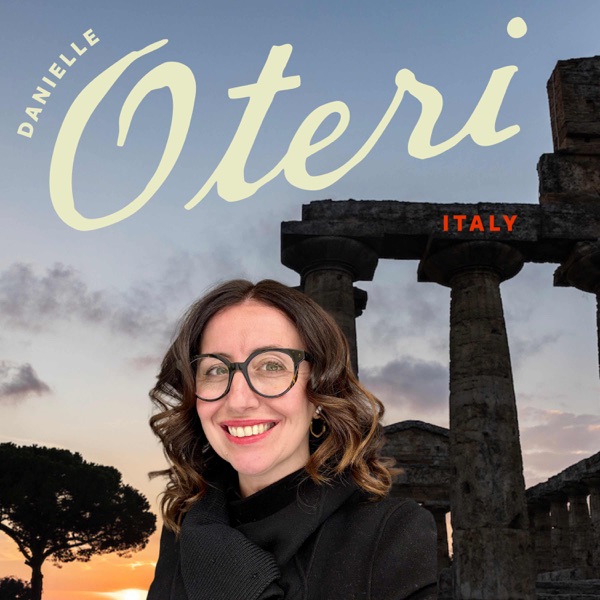
Danielle Oteri's Italy
Discover the best of authentic Italy with travel expert and art historian Danielle Oteri. Each episode delivers inspiring stories and practical tips to help you confidently plan your next Italian adventure, covering art, archaeology, culture, food, wine, and history. Listeners get trusted recommendations and insider insights that unlock unforgettable experiences across Italy.
- On air since
- 2024
- Episodes
- 54
- Releases · typical length
- Every two weeks · 28 min
- Latest episode
- 5 days ago
Episodes
54 episodes, newest first
-
42 min
Ep 47: Part two on Niccolò dell’Arca’s Lamentation in Bologna, with historian Lauren Mancia
Show notes
My Instagram post about Niccolò dell’Arca’sLamentationin Bologna is over and has more than a million views; it’s undeniable that these works of art aren't just remarkable, but something people connect to deeply. That’s why I recorded this follow-up episode to go deeper and fold ourselves into the emotion these sculptures invite us to experience.
To do so, I invited my friend Lauren Mancia, who is a professor of history at Brooklyn College and the CUNY Graduate Center. Lauren (and really I should be saying Dr. Mancia) is one of my buddies from my years at the Met Cloisters. The corps of lecturers I worked with included people with all kinds of specialties, and at different points in our studies. Some were still in graduate school, and others had been working and teaching for years. Lauren was one of the most gifted speakers among us, and I was really excited to learn about the new path she has taken in her work exploring the life of monastics through movement.
When I was in Bologna looking at the Lamentation group, I remembered this beautiful article she wrote about the inspiration for her new path: her young daughter encountering a different Lamentation group for the very first time, being deeply moved by it, and then mimicking each of the figures, which would have made the Renaissance artist who made it endlessly happy. Lauren talks about it in the episode and shares how we, too, might look at art this way, as people did throughout the Middle Ages and into the Renaissance.
Please share your thoughts on this episode with Lauren and me here in the comments.
This is a public episode. If you'd like to discuss this with other subscribers or get access to bonus episodes, visit https://www.danielleoteri.com/subscribe
-
28 min
Ep. 47: The Lamentation: Niccolò dell’Arca and the Screaming Terracotta of Bologna
Show notes
As someone who writes about history and non-Instagrammy places to visit in Italy, I definitely never go viral on Instagram.
Until two days ago.
I shared photos from my visit to The Lamentation by Niccolò dell’Arca in Bologna, which didn’t move past my core followers for a day, then suddenly took off.
The most frequent comment is that it looks so modern, or that the artist was ahead of his time, and that’s because of the raw emotion it portrays. If you think of most Renaissance paintings of the Virgin Mary, she is serene, not sobbing. Women in general are shown with smooth foreheads, perfect golden locks, and gazes that never meet yours—a little too Botoxed, if you ask me —and, in fact, women did put drops of belladonna in their eyes to dilate their pupils and achieve that blissed-out/spaced-out look of passivity. (Belladonna not coincidentally means beautiful woman.) The women in this series instead are howling and screaming.
Information about this series is sparse, and most of what I found on the first two pages of Google was inaccurate. So I went deep into the scholarly research and put together a podcast episode that walks you through it.
You’ll hear about:
* Who Niccolò dell’Arca was (a bit of a weirdo) and why he sculpted this in terracotta
* The hospital and the flagellant confraternity that the figures were made for
* Why public grief, specifically women’s grief, was banned in 15th-century Bologna
* The signature scroll that touches Christ’s shoulder, and how it connects to Michelangelo’s Pietà. Yup, you have never heard of Niccolò dell’Arca, but big Mike did, and he was a huge influence on him.
* Why I think that this might be the single best piece of art in all of Italy for those who don’t already love art to have their mind changed. Bold, I know. But you read my stuff because you know I’m not shy about sharing my opinions.
Below, you’ll find my photos with plenty of close-ups of these remarkable figures. Get the tissues ready.
I’m doing an Emilia-Romagna deep dive on Substack soon with my full Bologna recommendations. This will be for paid subscribers only, as I spent a small fortune testing a lot of terrible restaurants in Bologna and, as someone who doesn’t work on comps and commissions, I share the best stuff through paid subscriptions.
Until then, check out Laura Itzkowitz’s “72 Hours in Bologna” for recommendations on everything else to do if you visit Bologna.
Tell me what you think in the comments.
This is a public episode. If you'd like to discuss this with other subscribers or get access to bonus episodes, visit https://www.danielleoteri.com/subscribe
-
22 min
Ep. 46: More Wisdom For How To Plan Multigenerational Travel to Italy
Show notes
If you loved Ep. 38: How To Plan Multigenerational Travel, this episode is part 2, especially if you’ve accepted the unpopular but very good advice that renting a villa in Tuscany is a bad idea. This episode offers a better alternative.
A quick recap of resources and upcoming events:
* Tuesday, October 6th at 7 pm ET is the next Ask Me Anything About Italy for paid subscribers. This live Q&A with me happens monthly. If you can’t attend live, send me your questions at danielle@danielleoteri.com. I’ll answer them live, and you can watch the replay, available the following day.
* Thursday, October 8th at 7 pm ET is a new online class for people with Italian roots. “Finding Your Way Back to Italy” debunks Ellis Island myths and explains why Italians left Italy en masse starting in the 1870s. This history is surprising, but it shouldn’t be—it’s beautiful, but also complex, and you will learn a lot about yourself and your family by understanding the underpinnings of the stories and ways of being you inherited. Click here to register.
Danielle Oteri's Italy is a reader-supported publication. To receive new posts and support my work, consider becoming a free or paid subscriber.
This is a public episode. If you'd like to discuss this with other subscribers or get access to bonus episodes, visit https://www.danielleoteri.com/subscribe
-
40 min
Ep. 45: A Permanent State of Astonishment
Show notes
There are hundreds of books about Italy’s art and food, but you can count on one hand the number of books available about Italy’s nature. The oldest is Pliny’s Natural History, written in the 1st century CE, before he died on a rescue mission to Pompeii. The newest is Edward Cutler’s magnificent “This Beautiful Country,” a joy and a humbling reminder of how much we overlook every day.
I hope you enjoy this episode and let me know what you think in the comments.
Danielle Oteri's Italy is a reader-supported publication. To receive new posts and support my work, consider becoming a free or paid subscriber.
This is a public episode. If you'd like to discuss this with other subscribers or get access to bonus episodes, visit https://www.danielleoteri.com/subscribe
-
46 min
Ep. 44: Discovering Italy’s Atlantis: Baia and the Sybil’s Cave at Cuma
Show notes
Joseph Walker, author of Buried Italy and the voice behindItalian History with Joseph, spent the early 1990s exploring the submerged Roman resort of Baia and harvesting grapes in the ancient amphitheater at Cuma.
Before Baia had snorkeling schools and glass-bottom boats, Joseph Walker was hiring a local fisherman to take him out into the Gulf of Pozzuoli and swimming down into what turned out to be the nymphaeum of Claudius and Nero. That dive became his life’s work. He arrived in Italy with the U.S. Navy in the late 1980s and never really left. This episode is a long, winding conversation about the Campi Flegrei, the volcanic zone west of Naples where myth and geology keep colliding. Joseph and I share a lot of interests, and this conversation could have gone on for hours.
What we discuss:
* How Walker found Portus Julius and started bringing tourists to see the underwater ruins.
* The Cave of Cumean Synil, how it predates Virgil by roughly 600 years, and Walker’s case for Etruscan involvement in its construction
* The amphitheater at Cuma that isn’t on the archaeological park’s tourist map, and the harvest feast that Walker got invited to as a young man
* Lago d’Averno as one of the mythological entrances to Hades, and the Oscan cult of death that came before the Greeks arrived
* Naples’ own relationship to death and the ritual of adopting bones at the Fontanelle Cemetery
* Bradyseism, the rising and falling of the Campi Flegrei landmass, and the current push to reopen sites like the Piscina Mirabilis to tourism
* How the region’s volcanic history may connect to the extinction of the Neanderthals
We also got into Puglia a bit and discussed:
* Castel del Monte and Frederick II’s use of the octagon as a symbol linking heaven and earth
* The mosaic floor at the Cathedral of Otranto, its King Arthur panel, and the monastery library destroyed in the 1480 Ottoman sack
Find Joseph Walker:https://italianhistorywithjoseph.com/oteri — includes a free download of seven “Buried Italy” sites and a free chapter of the book (the Narnia chapter, cut from the final edit).
Danielle Oteri's Italy is a reader-supported publication. To receive new posts and support my work, consider becoming a free or paid subscriber.
This is a public episode. If you'd like to discuss this with other subscribers or get access to bonus episodes, visit https://www.danielleoteri.com/subscribe
Places & Travel lists
More Places & Travel shows picked out from the charts