Podcast
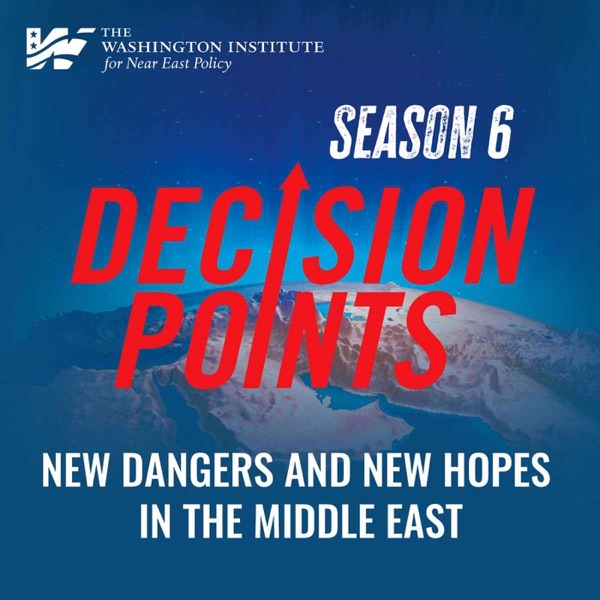
Decision Points
Decision Points is the podcast that gets beyond the noise on tough choices in the Middle East. Hosted by David Makovsky of The Washington Institute, the show brings together top policymakers and experts from Washington and the region for candid conversations about the forces and factors driving Middle East policymaking.
Season Six tackles the toughest U.S. foreign-policy debates, from the brink of war in Iran to the painful aftermath in Gaza and the new government in Syria. In each episode, Makovsky sits down with top American, Israeli, and Arab policy experts and former officials to clarify the options and understand the stakes. This season asks: Is the Middle East headed for more war and uncertainty? Or could America help the region move toward greater security and progress?
David Makovsky directs the Washington Institute’s Koret Project on Arab-Israel Relations and is a leading expert on the Israeli-Palestinian conflict and U.S.-Israel relations. He served as a senior advisor to the special envoy for Israeli-Palestinian negotiations at the U.S. Department of State in 2013-14 and is the author of four books on Arab-Israeli relations.
Hosted on Acast. See https://acast.com/privacy for more information.
- Episodes
- 82
- Releases
- Every two weeks
- Typical length
- 40 min
- On air since
- 2019
- Latest episode
- 6 days ago
Episodes
82 episodes, newest first
-
55 min
Where Does Israel Go After Its Rollercoaster Election? With Dennis Ross, Gili Cohen, David Makovsky and Felicia Schwartz
Season 6, Episode 16
Show notes
In this special episode, recorded live on October 28 as a Washington Institute panel, moderator Felicia Schwartz sits down with analysts Gili Cohen, David Makovsky, and Dennis Ross to understand the results and the policy implications of Israel's first election since Hamas's October 7, 2023, assault.
Is the bloc led by incumbent Israeli Prime Minister Binyamin Netanyahu or opposition leader Gadi Eisenkot better positioned to form a viable governing coalition? What drove the historic surge in voting by Arab citizens of Israel, and will they play an expanded role in Israeli politics? What are the implications of a possible renewed round of U.S. or Israeli bombing of Iran? Will the elections change anything in Gaza or spur Israel to rein in extremist settler violence in the West Bank? And what could a caretaker Netanyahu government, an Eisenkot-led coalition, or a national-unity government mean for waning American public support for Israel and the future of the U.S.-Israel relationship?
Gili Cohen is the diplomatic correspondent for Kan, Israel's public broadcaster.
David Makovsky is a former State Department official, the director of the Washington Institute's project on Arab-Israel relations, and the host of "Decision Points."
Ambassador Dennis Ross, the Washington Institute's counselor, served as the chief U.S. Middle East peace negotiator during the Clinton administration and as the top Middle East official on the National Security Council in the Obama administration.
Moderator: Felicia Schwartz is a national security reporter at MS NOW, and she formerly covered Israel and the Palestinian territories for The Wall Street Journal.
This episode is an edited version of the original October 28, 2026 event.
Hosted on Acast. See https://acast.com/privacy for more information.
-
56 min
Israel's Most Consequential Election? with Tamar Hermann, Yaakov Katz, and Amit Segal
Season 6, Episode 15
Show notes
In this special episode, recorded live as a Washington Institute Policy Forum, host David Makovsky sits down with leading Israeli experts Tamar Hermann, Yaakov Katz, and Amit Segal to discuss the stakes in Israel's first election since Hamas's October 7th attacks, the Gaza war, and the start of the 2026 Iran war. What are Israeli voters' main priorities? What will drive the wrangling over forming a new governing coalition? And what will the showdown between Israeli Prime Minister Binyamin Netanyahu and opposition leader Gadi Eisenkot mean for Israel’s democracy, its relationships with its regional neighbors and Europe, and the U.S.-Israel special relationship?
Prof. Tamar Hermann is one of Israel’s leading pollsters. She is a senior research fellow at the Israel Democracy Institute and the academic director of its Viterbi Family Center for Public Opinion and Policy Research.
Yaakov Katz is an Israeli-American author and journalist, a senior fellow at the Jewish People Policy Institute, and the co-founder of the Middle East-America Dialogue. He is a former editor-in-chief of The Jerusalem Post, where he is now a columnist.
Amit Segal is chief political analyst for Israel’s Channel 12 News, the anchor of Channel 12’s “Meet the Press” show, and a columnist for the Israeli daily newspaper Israel Hayom.
Hosted on Acast. See https://acast.com/privacy for more information.
-
39 min
Can Israel Win Back the American People? with Stanley Greenberg and Victoria Coates
Season 6, Episode 14
Show notes
Recent polling shows that U.S. public opinion on Israel has plunged to historic lows after the grueling two-year war in Gaza and amid the unpopular U.S.-Israeli war with Iran. Is American public support for Israel undergoing a fundamental shift, or is the current backlash temporary? What role will changing American public attitudes toward Israel play in the midterm elections and in U.S. Middle East policy moving forward?
Host David Makovsky sits down with veteran Democratic pollster Stanley Greenberg and former senior Trump National Security Council official Victoria Coates to go beyond the numbers, understand why so many Americans have soured on today's Israel, and explain what can be done.
Victoria Coates served in 2019-20 as deputy national security advisor for the Middle East and North Africa and served earlier in the first Trump administration as senior director for strategic communications at the National Security Council. She is the vice president of the Heritage Foundation’s Davis Institute for National Security and Foreign Policy.
Stanley Greenberg is a New York Times best-selling author and a polling adviser to presidents, prime ministers, and CEOs worldwide. He was the senior pollster for President Bill Clinton and Vice President Al Gore, as well as for British Prime Minister Tony Blair, South African President Nelson Mandela, and Israeli Prime Minster Ehud Barak.
Hosted on Acast. See https://acast.com/privacy for more information.
-
39 min
What's Next for Hamas, 3 Years After October 7th?
Season 6, Episode 13
Show notes
Almost three years after Hamas’s October 7, 2023, assault on Israel, the Palestinian jihadist group has been battered but not destroyed. Hamas has consolidated its control over the most densely populated portion of Gaza. Meanwhile, President Trump’s 20-point peace plan for Gaza remains stalled, and Israel holds the bulk of the Strip. U.S. presidential envoy Jared Kushner recently met directly with Hamas leaders, even as the new Board of Peace is struggling to make progress toward Hamas's disarmament and Gaza's reconstruction.
Will Hamas really disarm, or is it just stalling? Could Hamas ever transform itself into a widely accepted Palestinian political party, as Turkey and Qatar urge? And is there a way toward a better new chapter for Palestinians in Gaza?
Host David Makovsky sits down with former U.S. and Israeli intelligence officials, Matthew Levitt and Neomi Neumann, to discuss the future of Hamas and Gaza.
Matthew Levitt is a senior fellow at The Washington Institute and the director of its program on counterterrorism and intelligence. He served in 2005-07 as deputy assistant secretary for intelligence and analysis at the U.S. Department of the Treasury.
Neomi Neumann is an adjunct fellow at The Washington Institute. She formerly served as the head of the research unit at Israel’s Shin Bet domestic-security agency and with Israel’s Ministry of Foreign Affairs.
Hosted on Acast. See https://acast.com/privacy for more information.
-
40 min
Are Israel and Turkey on a Collision Course? With Tamir Hayman and James Jeffrey
Season 6, Episode 12
Show notes
The recent NATO summit in Ankara raised the already high temperatures between Israel and Turkey, two major regional powers. President Trump says he's considering selling U.S. F-35 stealth fighters to Turkey despite the opposition of Israeli Prime Minister Binyamin Netanyahu. Meanwhile, Israel and Turkey remain at loggerheads over Turkey's support for the Muslim Brotherhood and Hamas even as Israel and Turkey compete for influence in Syria and the Eastern Mediterranean. As Netanyahu and Turkish President Recep Tayyip Erdogan jockey for favor with President Trump and face rising criticism from Congress, are two key American allies headed for a collision?
Host David Makovsky discusses the increasingly tense Israeli-Turkish relationship with Tamir Hayman, a former head of Israel's military intelligence service, and James Jeffrey, a former U.S. ambassador to Turkey.
Tamir Hayman, a major general in the reserves of the Israel Defense Forces (IDF), is executive director of the Institute for National Security Studies, a think tank in Tel Aviv, Israel. He served as chief of the IDF's Intelligence Directorate from 2018-21.
James F. Jeffrey is a distinguished fellow at the Washington Institute and a former U.S. ambassador to both Turkey and Iraq. He served as U.S. special envoy to the Global Coalition to Defeat ISIS in the first Trump administration and as a deputy national security adviser in the George W. Bush administration.
Hosted on Acast. See https://acast.com/privacy for more information.
-
39 min
Can Gaza Have a Brighter Future? With Ghaith al-Omari and Shira Efron
Season 6, Episode 11
Show notes
The Gaza war is over, but the misery on the ground continues. Reconstruction in the Gaza Strip has stalled; Hamas refuses to disarm; and the world's attention has moved on to the Iran war and other issues. Gaza remains bitterly divided: Hamas retains its grip on Gaza's densely populated coast, and Israeli Prime Minister Binyamin Netanyahu recently said that he had directed Israel's military to seize 70% of the strip. With President Trump's 20-point peace plan stalled, Palestinians in Gaza continue to endure appalling humanitarian conditions.
Host David Makovsky sits down with former Palestinian Authority peace negotiator Ghaith al-Omari and American-Israeli security expert Shira Efron to discuss ways to make progress in postwar Gaza.
Ghaith al-Omari is a senior fellow at the Washington Institute and a former advisor to the Palestinian Authority's negotiating team during the 1999–2001 permanent-status talks with Israel.
Dr. Shira Efron is RAND Corporation's distinguished Israel policy chair and has also worked at Israel Policy Forum, the Center for American Progress, and other think tanks.
Hosted on Acast. See https://acast.com/privacy for more information.
-
39 min
The Aftershocks of the Iran War, with Amb. Barbara Leaf and Kirsten Fontenrose
Season 6, Episode 10
Show notes
The conflict may be over, but the shockwaves of the Iran war are still spreading. The United Arab Emirates and other Gulf states endured Iranian drone and missile strikes; Iran withstood weeks of bombardment from the U.S. and Israel, which have perhaps the world’s two strongest air forces; and leaders across the region have been left wondering if they can rely on the U.S. for security. Gulf countries face a choice between uniting against Iran or accommodating the increasingly IRGC-dominated regime in postwar Tehran. Israeli Prime Minister Binyamin Netanyahu fears that President Trump will blame Israel for the war’s shortcomings and constrain Israel’s ability to act against Hezbollah in Lebanon. Meanwhile, the Lebanese government will struggle to resist Iran and Hezbollah’s efforts to sideline Beirut and scuttle its peace talks with Israel. Host David Makovsky sits down with former top U.S. Middle East diplomat Barbara Leaf and former National Security Council official Kirsten Fontenrose to understand the regional fallout of the war.
Kirsten Fontenrose served in 2018 as senior director for the Gulf at the National Security Council and is now a nonresident senior fellow at the Atlantic Council.
Ambassador Barbara Leaf served from 2022-25 as assistant secretary of state for Near Eastern affairs, from 2014-18 as U.S. ambassador to the United Arab Emirates, and from 2013-14 as deputy assistant secretary of state for the Arabian Peninsula. She is now senior international policy advisor at the law firm Arnold & Porter.
Hosted on Acast. See https://acast.com/privacy for more information.
-
40 min
The AI Race in the Middle East, with Avner Golov and Grant Rumley
Season 6, Episode 9
Show notes
Artificial intelligence is becoming increasingly central to U.S. strategy in the Middle East. AI has played a pivotal role in the current Iran war, even as the U.S. is deepening its AI investments in the region. Israel and the Gulf are also jockeying to become key partners in the regional AI landscape. Host David Makovsky sits down with two top analysts, former Israeli National Security Council aide Avner Golov and former Pentagon official Grant Rumley, to understand the opportunities and pitfalls that AI poses for American policymaking in the Middle East.
Avner Golov is vice president of research and alliances at MIND Israel, a Tel Aviv-based strategic-advisory firm, and a former senior director for foreign policy on Israel's National Security Council.
Grant Rumley is a senior fellow at The Washington Institute, where he directs the program on great power competition. From 2018-21, he served on the Office of the Undersecretary of Defense for Policy's Middle East team in roles including deputy chief of staff, Israel director, Jordan director, and Syria director.
Hosted on Acast. See https://acast.com/privacy for more information.
-
40 min
What the U.S. and Israeli Militaries Have Learned So Far From the Iran War with Eliot Cohen and Amir Eshel
Season 6, Episode 8
Show notes
Conflicting statements from President Trump leave open the question about whether the Iran war is any closer to being over or whether the significant impasse over the nuclear program remains an impediment.
Regardless of the outcome of the conflict, the Iran war has highlighted extraordinary and unprecedented coordination between the U.S. and Israeli militaries even as Iran has throttled the Strait of Hormuz.
What do both US and Israeli militaries learn from this war?
The allies’ special relationship is coming under increasing scrutiny from segments of both major American political parties, and leaders from both the U.S. and Israeli Prime Minister Netanyahu are talking openly about tapering down American military aid to the Jewish state. Are we witnessing the peak of this longstanding military partnership?
To discuss military lessons learned from the war until now, host David Makovsky sits down with Amir Eshel, former head of the IDF air force and Eliot A. Cohen, former Counselor at the Department of State.
Amir Eshel, a major general, is the former commander of the Israeli Air Force, former head of IDF Planning and Director General of the Israeli Ministry of Defense.
Eliot A. Cohen is a military historian, the author of 11 books, and a columnist at The Atlantic. He served as Counselor of the State Department during the George W. Bush administration and is a former dean of the School of Advanced International Studies at Johns Hopkins University.
Hosted on Acast. See https://acast.com/privacy for more information.
-
34 min
Will Israel Vote Out Netanyahu? with Gili Cohen and David Horovitz
Season 6, Episode 7
Show notes
One of Israel’s most important election cycles is underway. Opposition parties see a rare chance to oust Benjamin Netanyahu, the country’s longest-serving prime minister, who now heads the most right-wing coalition in Israeli history. Amid the echoes of the wars in Iran, Gaza, and Lebanon, Israeli voters’ choices may shape their country—and the Middle East—for decades to come.
This will be Israel’s first election since Hamas’s October 7, 2023, assault, Israel’s subsequent wars against Hamas in Gaza and Hezbollah in Lebanon, and the 2025 and 2026 Iran wars. Netanyahu’s supporters say he deserves reelection for leading Israeli successes on several military fronts since October 7th, including fighting shoulder-to-shoulder with the U.S. against Iran. Yet Israelis will vote as their country has become increasingly isolated, including a striking plunge in Israel’s standing in U.S. public-opinion polls. Israelis are also arguing about an independent investigation into the failures of October 7th, rising settler violence in the West Bank, drafting ultra-Orthodox Israelis to serve in the country’s military, and Netanyahu’s ongoing push to slash the power of the Israeli judiciary. Could the 2026 elections be Netanyahu’s last stand?
Host David Makovsky sits down with two veteran Israeli journalists, Gili Cohen and David Horovitz, to understand how Israel’s looming elections will shape the country’s politics and policies.
Gili Cohen covers the Israeli Prime Minister’s Office for Kann News, an arm of the Israeli Public Broadcasting Corporation.
David Horovitz is the founding editor of The Times of Israel.
Hosted on Acast. See https://acast.com/privacy for more information.
-
35 min
Can Israel and Lebanon Move from War to Diplomacy? with Fouad Makhzoumi, Robert Satloff and Sarit Zehavi
Season 6, Episode 6
Show notes
Lebanon and Israel held diplomatic talks for the first time in decades after Israel's months-long campaign against Hezbollah. But the ceasefire is shaky: Israel displaced close to a million Lebanese civilians amid fighting with Hezbollah and northern Israelis, with memories of weeks in bomb shelters, fear returning to normal life with Hezbollah still armed.
Host David Makovsky sits down in back-to-back conversations with Lebanese lawmaker Fouad Makhzoumi, Israeli analyst Sarit Zehavi, and Middle East expert Robert Satloff to unpack what’s at stake--and what’s possible-- in Lebanon.
Fouad Makhzoumi is a leading Lebanese member of parliament representing many Sunnis in Beirut.
Dr. Robert Satloff is the Segal Executive Director of The Washington Institute, an independent, nonpartisan Middle East policy think tank.
Sarit Zehavi is the founder and president of Alma, an Israeli institute specializing in security challenges along the Lebanese border. She served for 15 years in the Israeli military's Intelligence Corps and later with its Northern Command.
Hosted on Acast. See https://acast.com/privacy for more information.
-
40 min
Who’s Calling the Shots in Iran? With Suzanne Maloney and Raz Zimmt
Season 6, Episode 5
Show notes
After nearly six weeks of war, the U.S. and Iran agreed on April 8 to a fragile two-week ceasefire. But Vice President JD Vance left Pakistan Sunday after 21 hours of high-level talks with the Iranians without making progress toward a deal to end the war. President Trump then threatened to blockade the Strait of Hormuz, the key oil-shipping route that Iran has throttled. However uncertain the road ahead may be, one thing is increasingly clear: in a postwar Iran, the hard-line Islamic Revolutionary Guard Corps looks set to further dominate the regime’s complex policymaking structure. Host David Makovsky sits down with two leading Iran experts, Suzanne Maloney and Raz Zimmt, to explore how decisions may be made in Tehran during the ceasefire and beyond.
Dr. Suzanne Maloney is vice president and director of the Foreign Policy program at the Brookings Institution in Washington and a former member of the State Department's Policy Planning staff.
Dr. Raz Zimmt is the director of the Iran and the Shiite axis research program at the Institute for National Security Studies in Tel Aviv, Israel.
Hosted on Acast. See https://acast.com/privacy for more information.
-
40 min
Is the Iran War Bringing Israel and the UAE Closer Together? With Amir Hayek and Nadim Koteich
Episode 4
Show notes
As part of Iran’s retaliation for the U.S.-Israeli war, Tehran has targeted the United Arab Emirates with more than 2,000 ballistic missiles and drones. Senior Emirati officials warn that their confrontation with Iran won’t be fleeting and will strengthen their relationship with Israel, including deeper security coordination. But if Iran’s regime emerges from the war intact and vengeful, the Gulf states may have to take a warier stance.
Amir Hayek was Israel’s first ambassador to the United Arab Emirates. Nadim Koteich is a columnist at Asharq al-Awsat and the former general manager of Sky News Arabia.
"Decision Points" is produced by David McGuffin with Zack Apt and Nava Goldstein.
Hosted on Acast. See https://acast.com/privacy for more information.
-
40 min
The Iran War's Second Front—Israel vs. Hezbollah with Hanin Ghaddar and Assaf Orion
Season 6, Episode 3
Show notes
As the Iran war shakes the Middle East, Hezbollah has fired missiles into northern Israel, and Israel has struck Hezbollah-related targets across Lebanon, including in the capital Beirut, leaving hundreds dead and hundreds of thousands of Lebanese civilians displaced. In this episode of "Decision Points," Washington Institute Senior Fellows Hanin Ghaddar and Assaf Orion join host David Makovsky to explore how Lebanon became the second front in the U.S.-Israeli conflict with Iran. They break down Israeli military objectives in this new round of fighting against Hezbollah and discuss ways to disarm the radical Iran-backed militia.
Hanin Ghaddar is the former managing editor of Lebanon's NOW news website, a former reporter for several Lebanese newspapers, and an expert on Shia politics in the Levant. Assaf Orion is a former Israeli brigadier general and a fellow at the Institute for National Strategic Studies, a Tel Aviv-based think tank.
"Decision Points" is produced by David McGuffin with Nava Goldstein and Zack Apt.
Hosted on Acast. See https://acast.com/privacy for more information.
-
55 min
What Are America's Objectives in the Iran War? With Dennis Ross, Dana Stroul, Holly Dagres, and Robert Satloff
Season 6, Episode 2
Show notes
In this special episode of Decision Points, Washington Institute experts Dennis Ross, Dana Stroul, Robert Satloff, and Holly Dagres sit down with the Institute's managing director, Michael Singh, to assess the joint U.S.-Israeli air campaign against Iran and Tehran's intensifying retaliation. They explore President Trump's goals in the conflict, assess the responses from Gulf states targeted by Iran, and discuss the key factors they're watching as the war continues.
Dennis Ross is the former lead U.S. negotiator on Middle East peace and a former top Middle East advisor for both Democratic and Republican administrations.
Dana Stroul is the Washington Institute's research director and served as the Pentagon's top Middle East expert in the Biden administration.
Robert Satloff is the Washington Institute's executive director.
Holly Dagres is a senior fellow at the Washington Institute specializing in Iranian society and the curator of "The Iranist," a newsletter on Iran.
Moderator: Michael Singh is the Washington Institute's managing director and a former senior director for the Middle East at the National Security Council under President George W. Bush.
This episode is an edited version of the original March 2nd event.
Decision Points is produced by David McGuffin with Nava Goldstein and Zack Apt.
Hosted on Acast. See https://acast.com/privacy for more information.
-
41 min
Will Trump Go to War with Iran? with Jake Sullivan and Eyal Hulata
Season 6, Episode 1
Show notes
The United States and Iran stand on the brink of war. The Pentagon has deployed a huge amount of air power in the Middle East, and President Trump has set a 10-15 day deadline to decide whether to strike.
In the first episode of Season Six, Decision Points host David Makovsky is joined by former U.S. national security advisor Jake Sullivan and former Israeli national security advisor Eyal Hulata. They assess whether the United States and Iran are plunging toward conflict or whether a negotiated outcome is still possible—and explore the risks of both war and diplomacy. Drawing on their experience at the highest levels of government, Sullivan and Hulata examine the lessons that should guide policy makers through this crisis.
Decision Points is produced by David McGuffin with Nava Goldstein and Zack Apt.
Hosted on Acast. See https://acast.com/privacy for more information.
-
1 min
Season 6 Trailer Trailer
Season 6, Episode 1
Show notes
Decision Points is the podcast that gets beyond the noise on tough choices in the Middle East. Hosted by David Makovsky of The Washington Institute, the show brings together top policymakers and experts from Washington and the region for candid conversations about the forces and factors driving Middle East policymaking.
Season Six tackles the toughest U.S. foreign-policy debates, from the brink of war in Iran to the painful aftermath in Gaza and the new government in Syria. In each episode, Makovsky sits down with top American, Israeli, and Arab policy experts and former officials to clarify the options and understand the stakes. This season asks: Is the Middle East headed for more war and uncertainty? Or could America help the region move toward greater security and progress?
David Makovsky directs the Washington Institute’s Koret Project on Arab-Israel Relations and is a leading expert on the Israeli-Palestinian conflict and U.S.-Israel relations. He served as a senior advisor to the special envoy for Israeli-Palestinian negotiations at the U.S. Department of State in 2013-14 and is the author of four books on Arab-Israeli relations.
Hosted on Acast. See https://acast.com/privacy for more information.
-
46 min
Israel into 2025: Building on Regional Successes, Avoiding Domestic Fractures
Show notes
Israeli society has been through the gambit of emotions in 2024: from the national trauma of the aftermath of October 7th and repeated failed hostage negotiations, to major military achievements that have shifted the regional security landscape. As the nation looks ahead to 2025, healing internal divisions within Israel remains elusive despite the major moves to restore regional deterrence during the second half of 2024.
Profound internal divisions abound. Much of the Israeli public sees the government as maneuvering to avoid a national Commission of Inquiry to investigate the failures of October 7th. At the same time, the looming prospect of permanent exemption of the ultra-orthodox from the military draft is widely unpopular, and the government’s approach to hostage negotiations has sparked widespread dissent and mass protests. Taken together, it seems that if this government fails, it will not be due to external threats, but rather because of internal divisions on these key domestic issues.
How will tensions between the Trump administration’s desire to end the war and the Israeli right’s push to remain in Gaza indefinitely play out? How much the public react to a partial hostage deal that may be close at hand? How are domestic political controversies influencing Israel’s geopolitical strategy and do they impact the durability of the current coalition? And what role – if any – does Netanyahu’s ongoing trial play in this critical moment?
In this episode of Decision Points, David Makovsky is joined by Yossi Klein Halevi. Yossi is a veteran keen observer of Israeli society and is a Senior Fellow at the Shalom Hartman Institute in Jerusalem. He is the author of several acclaimed books on the conflict, including the New York Times bestseller Letters to My Palestinian Neighbor, and co-host of the Institute’s podcast, For Heaven’s Sake. Together, they discuss the challenges of restoring regional deterrence while striving for internal cohesion as Israel enters 2025.
Hosted on Acast. See https://acast.com/privacy for more information.
-
1 hr 4 min
After Assad: Navigating Syria's Power Vacuum and Regional Fallout
Show notes
After just a few days of fighting, Bashar al-Assad's regime has fallen, and Assad has fled to Russia. However, the collapse of the Assad regime is far from a fairytale ending. The rebels responsible for toppling Assad, Hayat Tahrir al-Sham (HTS), are designated as a terrorist organization by the United States, and history shows that power vacuums in the Middle East often lead to prolonged instability and conflict.
HTS currently holds a dominant position, but Syria’s balance of power remains precarious. Competing factions are poised to challenge HTS, creating a volatile security landscape. Meanwhile, the fall of the Assad regime has significant implications for Israel. Syria has been a critical component of Iran’s axis, serving as a conduit for weapons and illicit materials to reach the West Bank and Jordan.
At this critical juncture, the future of Syria hangs in the balance. How much influence will Russia, Turkey, and Iran exert in shaping Syria’s trajectory? Who will ultimately fill the power vacuum? And what role will the U.S. and Israel play in this tense and rapidly evolving environment?
In this episode of Decision Points, David Makovsky is joined by Andrew Tabler and Tamir Hayman. Andrew Tabler, a senior fellow at the Washington Institute, previously served as Senior Advisor to the Special Envoy for Syria Engagement at the State Department and as Director for Syria Affairs at the White House National Security Council. Tamir Hayman, the current Director of INSS—Israel’s leading national security think tank—served as Head of IDF Intelligence, focusing on Iranian entrenchment in Syria, and previously led efforts to provide humanitarian assistance in southern Syria.
Hosted on Acast. See https://acast.com/privacy for more information.
-
52 min
Inside the Middle East: How War, Ceasefires, and Trump’s Arrival Are Reshaping the Middle East
Season 5, Episode 17
Show notes
The past few weeks in the region have been some of the most eventful in recent history. Hizbullah, the crown jewel of Iran’s proxy network, has suffered a devastating blow, Iran’s air defense systems have been dismantled, and a fragile ceasefire between Israel and Lebanon has been established. At the same time, the election of President Trump has introduced an entirely new level of unpredictability, sending shockwaves throughout the region.
How is the war reshaping perceptions within the Middle East, particularly regarding the Israel-Lebanon ceasefire? How does the concept of Iran’s “ring of fire” hold up in this new reality? What does Saudi Arabia’s approach to normalization with Israel mean for its leadership and the future of Gaza? And how are these shifting dynamics influenced by the Trump administration?
On this episode of Decision Points, David Makovsky is joined by Bernard Haykel, a leading authority on Middle Eastern politics, religion, and society, and someone who has spent more time with Saudi Crown Prince Muhammad bin Salman (MBS) than perhaps any American over the last decade. Bernard will soon be releasing his book on MBS, and as a scholar with a personal connection to the region—having grown up during Lebanon’s civil war—he brings a unique insider perspective on the Middle East’s complexities.
Hosted on Acast. See https://acast.com/privacy for more information.
News Commentary lists
More News Commentary shows picked out from the charts












More in News Commentary
Placed highest on Apple Podcasts' News Commentary chart right now