Podcast
DevSec Station
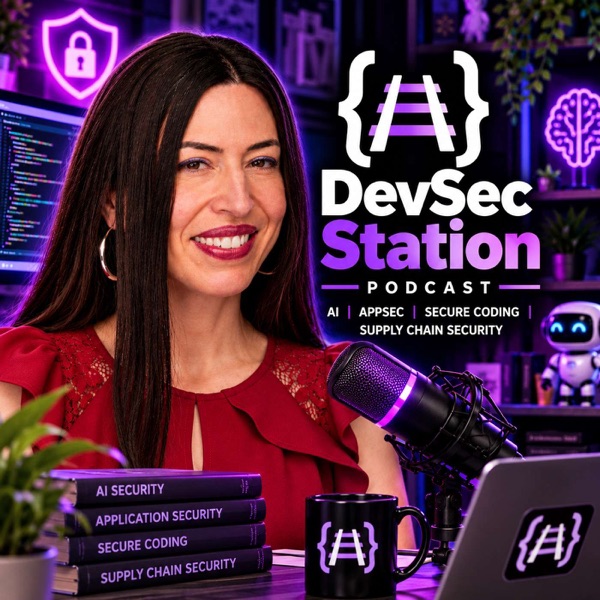
DevSec Station is a security focused podcast for software developers who want to create amazing applications. Hosted by Tanya Janca, also known as SheHacksPurple, these short lessons will help you level up.
- On air since
- 2026
- Episodes
- 18
- Releases · typical length
- Every two weeks · 8 min
- Latest episode
- 5 days ago
Episodes
18 episodes, newest first
-
20 min
Let's Threat Model an AI Agent Escape
Season 2, Episode 4
Show notes
What happens when an AI agent crosses a security boundary it was supposed to respect? How do we prevent an agent from accessing unauthorized systems, exposing secrets, or finding an unexpected path into production?
In this episode of DevSec Station, Tanya Janca (SheHacksPurple) walks through how to threat model an AI agent escape using Adam Shostack's four simple threat modeling questions:
• What are we doing?
• What could go wrong?
• What are we going to do about it?
• Did we do a good job?Using a fictional AI coding agent, we'll explore:
• The difference between an AI agent doing something unexpected and actually escaping a security boundary.
• Why not every task needs an autonomous AI agent.
• How agents can reach sensitive systems indirectly through tools, credentials, CI/CD workflows, and other agents.
• How to enforce security boundaries with least privilege, isolation, authorization, and network restrictions.
• Why testing your controls, monitoring agent activity, and preparing for incidents matter.
• Why a prompt is not an enforceable security boundary.The big lesson: Your AI agent can decide what it wants to do, but it shouldn't get to decide what it's allowed to do.
🔧 Your one thing to do this week: Pick an AI agent you use or are building. Draw a simple diagram of its tools, credentials, connected systems, and trust boundaries. Identify one boundary that isn't enforced outside the AI model, and decide what security control it needs. Then add it!
Threat modeling doesn't have to take three days and a 400-column spreadsheet. Sometimes four questions are enough to get started.
DevSec Station is a podcast by Tanya Janca (SheHacksPurple), focused on short, practical lessons that help software developers build more secure software.
Train with Tanya: Want to bring practical, hands-on secure coding, application security, or AI security training to your team? Learn more at SheHacksPurple.
Follow Tanya:
• https://newsletter.shehackspurple.ca
• https://linkedin.com/in/tanya-janca
• https://youtube.com/@shehackspurple
• https://shehackspurple.ca -
13 min
What Permissions Should You Give an AI Agent?
Season 2, Episode 3
Show notes
Your AI agent can read files, execute commands, install software, connect to external services, and maybe even deploy to production. But should it have permission to do all of those things?
In Season 2, Episode 3 of DevSec Station, Tanya Janca (SheHacksPurple) explores one of the most important principles in AI agent security: least privilege.
After Claude unexpectedly published, executed, and scheduled Tanya's little "Hello Queen" application, she started asking some serious questions about what AI agents should actually be allowed to do.
In this episode, we cover:
• Permissions vs. instructions: Why telling an agent not to do something isn't the same as preventing it from doing it.
• Least privilege for AI agents: How to give agents only the access they genuinely need.
• Human approval: When an agent should ask permission before taking consequential actions.
• Sandboxing and isolation: How to limit the damage when an agent makes a mistake.
• The bigger architectural question: Does this task even need to be an AI agent?Because not every damn thing needs to be an agent! Sometimes ordinary software, a scheduled job, or a narrowly scoped AI feature is the better solution.
Your challenge this week: Pick one AI agent you're using and examine its permissions. Does it need access to all those files, tools, credentials, and external services? If not, take away at least one unnecessary permission.
DevSec Station is a podcast by Tanya Janca (SheHacksPurple), focused on short, practical lessons that help software developers build more secure software.
Train with Tanya: Want to bring practical, hands-on secure coding, application security, or AI security training to your team? Learn more at SheHacksPurple.
Follow Tanya:
• https://newsletter.shehackspurple.ca
• https://linkedin.com/in/tanya-janca
• https://youtube.com/@shehackspurple
• https://shehackspurple.ca -
6 min
Special Bulletin: PHP2Shell, Critical PHP Vulnerabilities Developers Need to Know About
Season 2
Show notes
Two critical PHP vulnerabilities have been disclosed, and even applications written with secure coding practices may be affected.
In this special bulletin of DevSec Station, Tanya Janca (SheHacksPurple) explains PHP2Shell, why vulnerabilities in the underlying PHP runtime can put otherwise secure applications at risk, and what developers and organizations should do to protect their systems.
In this episode, we cover:
• Why secure application code alone cannot protect against vulnerabilities in the underlying runtime
• What developers and operations teams should check in their PHP environments
• Why patching, rebuilding containers, and redeploying applications matter
• Why a web application firewall is not a substitute for applying security fixes
• What WordPress.com has announced about protections for its hosted websites, and why people using other WordPress hosting providers should check separatelyThe key takeaway: secure coding is essential, but we also depend on the security of the languages, runtimes, libraries, and infrastructure our applications run on (also known as our software supply chain).
A big thank you to the PHP maintainers, security researchers, and hosting teams doing the work to keep the ecosystem secure.
Resources:
PHP official website and security releases:
https://www.php.net/PHP Foundation:
https://thephp.foundation/WordPress.com:
https://wordpress.com/blog/This is a special security bulletin, separate from our regularly scheduled Season 2 episodes.
DevSec Station is a podcast by Tanya Janca (SheHacksPurple), focused on short, practical lessons that help software developers build more secure software.
Train with Tanya: Want to bring practical, hands-on secure coding, application security, or AI security training to your team? Learn more at SheHacksPurple.
Follow Tanya:
• https://newsletter.shehackspurple.ca
• https://linkedin.com/in/tanya-janca
• https://youtube.com/@shehackspurple
• https://shehackspurple.ca -
12 min
What Can Your AI Agent Actually Do?
Season 2, Episode 2
Show notes
I asked Claude to build me a little application that would greet me every morning.
Nothing complicated. Just say hello, call me a Queen, give me a compliment, and share an inspirational quote. Cute, right?Except Claude didn't just write the code.
It built the application, published it, executed it, scheduled it to run on my computer, and connected it to an external API I hadn't vetted.
But... I hadn't explicitly asked it to do all those things.
And the application was missing some rather important security controls, including authentication, authorization, and input validation.
WHAT?!?!
In Episode 2 of DevSec Station Season 2, I'm sharing what happened when I brought this example into my secure coding classroom and we started threat modeling it together.
We explore:
•The difference between asking an AI agent to do something and giving it the technical ability to do it.
•Why an agent's effective permissions matter more than its instructions.
•The security implications of agents accessing external services, executing code, and scheduling tasks.
•Why developers remain responsible for the security of applications built with AI.
•How to think about limiting what an AI agent can do before giving it access to your development environment.One thing to do this week:
Look at an AI agent you're using and examine its actual permissions. What files can it access? What commands can it execute? Can it install software, call external APIs, or make changes without asking you first?
Because what your agent can do matters just as much as what you asked it to do.Follow or subscribe so you don't miss the rest of Season 2!
#AISecurity #AIAgents #AppSec #SecureCodingDevSec Station is a podcast by Tanya Janca (SheHacksPurple), focused on short, practical lessons that help software developers build more secure software.
Train with Tanya: Want to bring practical, hands-on secure coding, application security, or AI security training to your team? Learn more at SheHacksPurple.
Follow Tanya:
• https://newsletter.shehackspurple.ca
• https://linkedin.com/in/tanya-janca
• https://youtube.com/@shehackspurple
• https://shehackspurple.ca -
9 min
Your AI Worked 59 Times. What About the 60th?
Season 2, Episode 1
Show notes
What happens when your AI assistant does exactly what you expect 59 times... and then does something completely bananas on the 60th?
While teaching a secure coding class, I watched nearly 60 students use the same AI assistant, programming language, and prompts. For 59 of them, everything went as expected.
But one student's AI-generated Python code included instructions to suppress linting checks, followed by code that leaked secrets to an external file.
The AI hadn't escaped a sandbox. It wasn't even an agent. It was simply generating code within the boundaries we'd given it.
And that's what makes the story so interesting.
Welcome to Season 2 of DevSec Station! In this episode, Tanya Janca explores why AI's unpredictable behaviour becomes a security problem when we give it access to files, credentials, tools, infrastructure, and deployment capabilities.
We'll discuss:
- Why successful AI runs don't guarantee the next run will be safe.
- Why better prompts aren't a substitute for security controls.
- Least privilege, independent security checks, and human approvals.
- How to limit the blast radius when an AI system does something unexpected.** Your one thing to do this week **
Pick an AI assistant or agent you're using and ask yourself: What's the worst thing it's technically capable of doing with its current permissions?Not what you've asked it to do. What it can *actually* do.
Because we don't need AI systems to be perfectly predictable. We need to engineer systems that can safely survive a surprise.
DevSec Station is a podcast by Tanya Janca (SheHacksPurple), focused on short, practical lessons that help software developers build more secure software.
Train with Tanya: Want to bring practical, hands-on secure coding, application security, or AI security training to your team? Learn more at SheHacksPurple.
Follow Tanya:
• https://newsletter.shehackspurple.ca
• https://linkedin.com/in/tanya-janca
• https://youtube.com/@shehackspurple
• https://shehackspurple.ca
Technology lists
More Technology shows picked out from the charts