Podcast
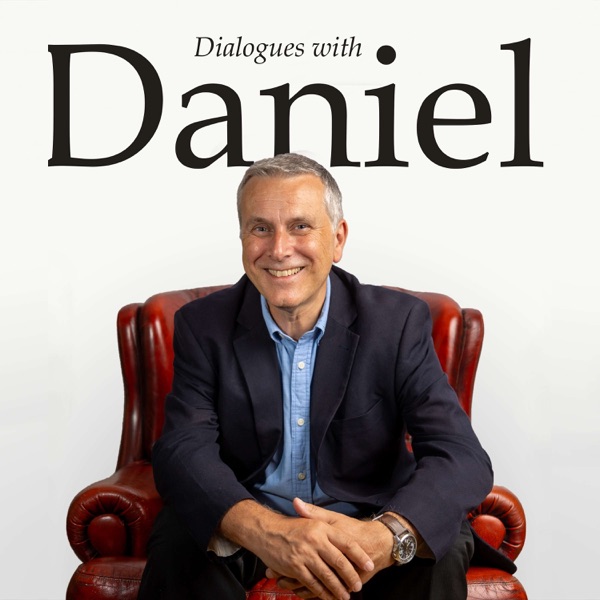
Dialogues with Daniel
A series of conversations with academics, friends, pioneers and generally interesting people, hosted by veterinary behaviourist Professor Daniel Mills
- Natural Sciences chart
- #68
- Episodes
- 49
- Releases
- Every two weeks
- Typical length
- 1 hr 9 min
- On air since
- 2020
- Latest episode
- 2 days ago
Episodes
49 episodes, newest first
-
1 hr 13 min
🐾 Pet Behaviour Odysseys – Season 2, Episode 2: The Reality of Living with a Reactive Dog
Season 3, Episode 2
Show notes
When owning a dog makes your world smaller rather than bigger, how do you cope?
For many people, dog ownership brings companionship, social connections and new experiences. But living with a reactive dog can turn those expectations upside down, bringing isolation, anxiety, frustration and the constant pressure of managing situations that other owners take for granted.
In this episode, we continue our conversations with Katherine and Debbie, exploring the emotional realities of life with Ross and Roscoe.
Drawing on scientific research alongside personal experiences, we discuss the judgement owners can face, the challenges of keeping dogs and others safe, the overwhelming amount of sometimes conflicting advice available, and the emotional highs and lows of making progress.
We also explore why quick fixes and one-size-fits-all approaches can be counterproductive, and how understanding each dog's individual needs, including their physical health, is essential.
Perhaps the most important message is that progress isn't necessarily about changing who your dog is, but about learning to understand and support the dog you have.
This is an honest, sometimes emotional, but ultimately hopeful conversation about acceptance, resilience and the importance of finding the right support.
🎧 Join us for Episode 2 of Pet Behaviour Odysseys.
#petbehaviourodysseys #whatmakesyouclick #PBO #professordanielmills #profdsm #reactivedog #DogBehaviour #AnimalWelfare #VeterinaryBehaviour #DogOwners https://companionanimalconsulting.com/
-
40 min
Pet Behaviour Odysseys is back! Season 2: Episode 1 Living with a Reactive Dog
Season 3, Episode 1
Show notes
In this new season, Milly and Daniel return to discuss the experience of reactive dog ownership; something which Milly has first hand experience of with Amber. We introduce you to Ross and Roscoe and their dedicated carers. These are individuals who sought to navigate the Odyssey of reactive dog ownership and care, striving to strike a balance between their dog's needs and their own.
What's it really like to share your life with a reactive dog?
For many owners, it's a journey marked by unexpected challenges, isolation, frustration and sometimes guilt. But it's also a journey of understanding, acceptance and discovering new ways to enjoy life together.
Despite very different backgrounds and experiences, the stories of all three carers reveal some striking similarities. They have all faced the emotional challenges of living with a reactive dog, the judgement of others and the frustration of being told their dogs simply need more training.
Through their honest and sometimes moving accounts, we explore why reactivity isn't simply a training problem, how our expectations of dog ownership can be challenged, and why understanding the individual dog is so important.
This season isn't about quick fixes or miracle cures. It's about listening to real experiences, challenging misconceptions and exploring how we can improve quality of life for both dogs and their owners.
🎧 Join us for the beginning of two very personal odysseys.
If you have ever owned a reactive dog, you will know how isolating and stressful it can be; how difficult it can be to make realistic, humane decisions. This series is dedicated to you.
If you know anyone with a reactive dog, please help them by letting them know about this series. We hope that by sharing these experiences, carers will feel reasured and confident enough to make better decisions.
#petbehaviourodysseys #whatmakesyouclick #PBO #professordanielmills #profdsm #reactivedog #DogBehaviour #AnimalWelfare #VeterinaryBehaviour #DogOwners https://companionanimalconsulting.com/
-
18 min
A podcast, based on my presentation: A History of Veterinary Behavioural Medicine and Animal Welfare Science
Season 4, Episode 1
Show notes
For over a century, our scientific understanding of animals has undergone a massive paradigm shift. We’ve moved away from viewing animals merely as biological machines to recognising them as psychologically complex, sentient beings whose quality of life depends on dynamic interactions between brain, body, and environment.
Here is an AI generted podcast that discusses my recent resentation "A History of Veterinary Behavioural Medicine and Animal Welfare Science" that highlights how veterinary behavioural medicine and animal welfare science evolved through four key conceptual revolutions:
1. The Behaviorist Era: Focused on learning history, antecedents, and external consequences to modify observable behaviour.
2. The Medical Model (Veterinary Psychiatry): Framed behavioural issues as neurological or physical disorders requiring formal diagnoses and medical interventions.
3. The Psychobiological Synthesis: Applied affective neuroscience (pioneered by the late great Jaak Panksepp) to ground animal emotions in biologically conserved systems.
4. The Emergins Systems & Ecosystem Approach: Seeks to highlight how biological, psychological, and environmental factors interact over an individual's entire lifespan.
💡The core clinical question has evolved from "What is the animal doing?" to "What is the animal experiencing?". This shift allows the veterinary profession to move beyond merely caring about disease prevention and productivity to comprehensively caring for individual animals by protecting their emotional well-being and quality of life.
#VeterinaryMedicine #AnimalBehaviour #Ethology #AffectiveNeuroscience #VeterinaryScience
#petbehaviourodysseys #whatmakesyouclick #PBO #professordanielmills #profdsm #reactivedog #DogBehaviour #AnimalWelfare #VeterinaryBehaviour #DogOwners https://companionanimalconsulting.com/
-
58 min
Reflections
Season 2, Episode 10
Show notes
In this final episode we look back with Becky and Craig on their personal pet behaviour Odyssey and how far they have come. They share the insights they have gained and how this has helped to built their relationship. They discuss the many positives of the journey but also the challenges they met on the way. Every client is an individual and every case is a unique learning opportunity for us as clinicians, so we share what we learned on the way too. However we leave the last word to Becky and we hope you find her words inspirational.
Thank you for listening. We hope this was useful to youo.
If you liked this video please help to spread the word and share it with your friends, like, subscribe and turn on notifications (click/tap on the bell by the subscribe button).Footnote for those seeking professional support:
If you are in the UK and would like help with your pet’s behaviour, we encourage you to seek professional advice. A list of Certificated clinical animal behaviourists, including the presenters of this show can be found at www.ccab.uk/.
You can also find further details of the Lincoln Animal Behaviour Clinic at animalbehaviourclinic.lincoln.ac.uk/.
In Europe, if you want to find a veterinary behaviourist you can find a list of Diplomates (individuals who have the highest level of training available in the field) at https://www.ecawbm.org/diplomates-list.
In North America, you can find a directory of certified applied animal behaviorists at https://www.animalbehaviorsociety.org/web/committees-applied-behavior-directory.php and board certified veterinary behaviorists at: https://www.dacvb.org/search/custom.asp?id=4709.#petbehaviourodysseys #whatmakesyouclick #PBO #professordanielmills #profdsm #reactivedog #DogBehaviour #AnimalWelfare #VeterinaryBehaviour #DogOwners https://companionanimalconsulting.com/
-
47 min
Support for Change
Season 2, Episode 9
Show notes
When we ask clients to do something it is important that we support them throughout the process. What a client needs at this time is not the same as what they need to encourage initial action. At this time things like reinforcement for progress, become particularly important, as do helpful relationships that support the change process. Again this is something that is perhaps not as widely appreciated as it should be. This aspect of treatment forms the basis of the current episode. Becky and Craig discuss the highs and lows of their Odyssey. They also share with us, what it was that made them think they were making progress. They thus provide invaluable insight for others. What an owner sees as an important marker of success and what a clinician sees as important in this regard are not always the same initially. We must listen to our clients and help them achieve meaningful goals.
If you liked this video please help to spead the word and share it with your friends, like, subscribe and turn on notifications (click/tap on the bell by the subscribe button).
Footnote for those seeking professional support:
If you are in the UK and would like help with your pet’s behaviour, we encourage you to seek professional advice. A list of Certificated clinical animal behaviourists, including the presenters of this show can be found at www.ccab.uk/.
You can also find further details of the Lincoln Animal Behaviour Clinic at animalbehaviourclinic.lincoln.ac.uk/.
In Europe, if you want to find a veterinary behaviourist you can find a list of Diplomates (individuals who have the highest level of training available in the field) at https://www.ecawbm.org/diplomates-list.
In North America, you can find a directory of certified applied animal behaviorists at https://www.animalbehaviorsociety.org/web/committees-applied-behavior-directory.php and board certified veterinary behaviorists at: https://www.dacvb.org/search/custom.asp?id=4709.#petbehaviourodysseys #whatmakesyouclick #PBO #professordanielmills #profdsm #reactivedog #DogBehaviour #AnimalWelfare #VeterinaryBehaviour #DogOwners https://companionanimalconsulting.com/
-
48 min
Taking Action
Season 2, Episode 8
Show notes
Individualising treatment for a given client and their pet is essential and so we have to go beyond the theoretical techniques used in human and animal behaviour modification. In the last episode we looked at the COM-B model of human behaviour change. COM-B stands for Capability, Opportunities and Motivations underpinning human Behaviour change. We also introduced the Theoretical Domains, like an individual’s knowledge, beliefs about their capabilities, emotions, ability to visualize a goal and so forth and the Intervention Functions used to make these as optimal as we can for the client. In this episode we return to the dog side of things in our discussion with Becky and Craig . We talk about the importance of avoidance of triggers, and diary keeping but expand on two protocols we have developed at Lincoln. The safe haven and sensitive carer routines. These may be somewhat different to other versions of the protocol that are commonly discussed by behaviourists and trainers. It is important to pay attention to certain details if they are to work as we would hope.
When choosing interventions it is important that they are right for that client and so we introduce the concept of the APEASE criteria, from the human behaviour change literature, for assessing their suitability. These are important considerations: I detail here what each letter in the acronym APEASE stands for:
A is for acceptability
P for practical
E for effective
A for affordable
S for safe
Equitable, i.e is it fair
We discuss these further in the current episode, and the last E is an important ethical consideration and may be where some quick fixes fall down.
Footnote for those seeking professional support:
If you are in the UK and would like help with your pet’s behaviour, we encourage you to seek professional advice. A list of Certificated clinical animal behaviourists, including the presenters of this show can be found at http://www.ccab.uk/.
You can also find further details of the Lincoln Animal Behaviour Clinic at animalbehaviourclinic.lincoln.ac.uk/.
In Europe, if you want to find a veterinary behaviourist you can find a list of Diplomates (individuals who have the highest level of training available in the field) at https://www.ecawbm.org/diplomates-list.
In North America, you can find a directory of certified applied animal behaviorists at https://www.animalbehaviorsociety.org/web/committees-applied-behavior-directory.php and board certified veterinary behaviorists at: https://www.dacvb.org/search/custom.asp?id=4709.
#petbehaviourodysseys #whatmakesyouclick #PBO #professordanielmills #profdsm #reactivedog #DogBehaviour #AnimalWelfare #VeterinaryBehaviour #DogOwners https://companionanimalconsulting.com/
-
54 min
The Path to Treatment
Season 2, Episode 7
Show notes
In this episode we talk about the process of implementing treatment. In particular we discuss the less often discussed issue of human behaviour change, with a focus on how we consider the underpinning capability, opportunities and motivation of a client to enable more effective change. We introduce the theoretical domains framework. This is a synthesis of lots of different evidence based approaches for bringing about human behaviour change. At its simplest it is a list of about 14 different ways in which we can help people bring about change. By doign this we can more accurately set expectations for change. Find out more by listening to the episode, and please do give us a rating if you have enjoyed the episode.
Footnote on seeking help:
If you are in the UK and would like help with your pet’s behaviour, we encourage you to seek professional advice. A list of Certificated clinical animal behaviourists, including the presenters of this show can be found at www.ccab.uk/.
You can also find further details of the Lincoln Animal Behaviour Clinic at animalbehaviourclinic.lincoln.ac.uk/.
In Europe, if you want to find a veterinary behaviourist you can find a list of Diplomates (individuals who have the highest level of training available in the field) at https://www.ecawbm.org/diplomates-list.
In North America, you can find a directory of certified applied animal behaviorists at https://www.animalbehaviorsociety.org/web/committees-applied-behavior-directory.php and board certified veterinary behaviorists at: https://www.dacvb.org/search/custom.asp?id=4709.#petbehaviourodysseys #whatmakesyouclick #PBO #professordanielmills #profdsm #reactivedog #DogBehaviour #AnimalWelfare #VeterinaryBehaviour #DogOwners https://companionanimalconsulting.com/
-
48 min
Separation Related Issues
Season 2, Episode 6
Show notes
Separation related problems are commonly misunderstood, and the term separation anxiety is an unhelpful misnomer. Indeed our scientific understanding of separation related problems is rapidly being revised in light of new research. It is now clear there are four common forms of the condition, which represent different responses to the frustration that arises when a pet is left at home. These are typically described as
a Exit frustration related
b Reactive excited
c Reactive inhibited
d. Boredom related, inhibited-conflicted
If you think your dog might have one of these problems, you can find out more by using the App we developed with ZigZag and Tech4Animals, just visit https://separation.zigzag.dog/
In this episode we discuss the nature of separation related problems as they applied to Drax and the implications of a more scientific assessment. We also explore the role of attachment. These dogs are not hyper-attached (even if they follow their owner around the whole time), rather what is seen as hyper-attachment is often a sign of insecure attachment. The owner’s behaviour is important in this regard, but it is not the only thing driving the problem. It is not the owner’s fault. Effective intervention involves individualised treatment, so if you want to learn more listen to the episode, and please don’t forget to share this with others. We'd really appreciate it if you could give us a rating if you have enjoyed the show.
#petbehaviourodysseys #whatmakesyouclick #PBO #professordanielmills #profdsm #reactivedog #DogBehaviour #AnimalWelfare #VeterinaryBehaviour #DogOwners https://companionanimalconsulting.com/
-
51 min
Coming to Lincoln
Season 2, Episode 5
Show notes
In the previous episode, we explored Becky and Craig's initial experience of seeking help for Drax, the challenges with finding a professional service and the strain associated with having a loved one with behavioural issues.
In this episode, we look at how we tend to structure our pet behaviour service, especially with regards to identifying where clients are in relation to what is known as the Cycle of Change. This views change as a process not an event and there are several stages involved. It begins with contemplating change (before that we are in a state of precontemplation and thus not considering changing); we then need to help clients make the necessary preparations for change (e.g. developing key skills they will need) if we wish them to succeed making long-term changes; only then are they in a good state to take action (which is what most behaviour advice texts focus on); finally we need to consider the support required by clients to help them to maintian this action.
We take this "process perspective" of change and thus do not rush into action straight away. It is important to us that clients appreciate this process and what is involved, and we recognise that this is not necessarily the way things are done by others. Our first consultation is very much focused on helping owners understand the nature of the problems they face, managing risk and laying the ground work for change. We can only help clients if we can help them build their capabilities and motivations, while enabling opportunities for them to develop the behaviours needed to help their pet. We elaborate and discuss this furtehr in this episode.
We hope you enjoy the episide.
#petbehaviourodysseys #whatmakesyouclick #PBO #professordanielmills #profdsm #reactivedog #DogBehaviour #AnimalWelfare #VeterinaryBehaviour #DogOwners https://companionanimalconsulting.com/
-
41 min
Seeking help
Season 2, Episode 4
Show notes
In this episode we pick up from where we finished Episode 1. We discuss in more detail the minefield that is the unregulated fields of animal training and behaviour.
We explore Becky's and Craig's experience of seeking help from various sources for the behaviours that Drax was exhibiting. We discuss how things progressed; but more importantly, how they each felt on this part of their Odyssey.
We highlight the stresses and strains associated with owning a pet with problem behaviour and introduce the listener to the value ofa validated ‘pet caregiver burden’ questionnaire. Milly and Daniel discuss how important this can be to us, as clinicians, in hleping us understand the nature of the stresses felt by a client, and how this can shape the focus of the assistance we give as a result. We illustrate this by discussing the results of the questionnaire which Becca completed for us. This described how she felt before coming to the Lincoln Animal Behaviour Clinic, and also how things changed as we made progress. This not only helped us, but Becca also explains how important this was to her, Craig and ultimately Drax too!
You can read a bit more about the questionnaire here: https://www.sciencedirect.com/science/article/pii/S1558787823000576
Footnote for those seeking professional support:
If you are in the UK and would like help with your pet’s behaviour, we encourage you to seek professional advice. A list of Certificated clinical animal behaviourists, including the presenters of this show can be found at http://www.ccab.uk/.
You can also find further details of the Lincoln Animal Behaviour Clinic at animalbehaviourclinic.lincoln.ac.uk/.
In Europe, if you want to find a veterinary behaviourist you can find a list of Diplomates (individuals who have the highest level of training available in the field) at https://www.ecawbm.org/diplomates-list.
In North America, you can find a directory of certified applied animal behaviorists at https://www.animalbehaviorsociety.org/web/committees-applied-behavior-directory.php and board certified veterinary behaviorists at: https://www.dacvb.org/search/custom.asp?id=4709.
#petbehaviourodysseys #whatmakesyouclick #PBO #professordanielmills #profdsm #reactivedog #DogBehaviour #AnimalWelfare #VeterinaryBehaviour #DogOwners https://companionanimalconsulting.com/
-
36 min
The Odyssey Begins
Season 2, Episode 3
Show notes
Episode 1: Welcoming a dog into your life – the Odyssey begins
In this episode we introduce you to Becky, Craig and Drax.
We find out how Drax came into Becky's and Craig's life, including the emotional background that so often underpins the decision to acquire a pet. We discuss their love and joy with Drax during these early days in their home, before they felt that things were not turning out quite how they had expected and hoped. Their love and commitment persisted, but the joy became tinged with sadness and frustration as they started to feel there was a problem that was seriously impacting their quality of life.
This led them to navigating the unfamilar and unchartered territory of training and behaviour, as they tried to get professional advice and support.
Who should they turn to for help?
Footnote for those seeking professional support:
If you are in the UK and would like help with your pet’s behaviour, we encourage you to seek professional advice. A list of Certificated clinical animal behaviourists, including the presenters of this show can be found at http://www.ccab.uk/.
You can also find further details of the Lincoln Animal Behaviour Clinic at animalbehaviourclinic.lincoln.ac.uk/.
In Europe, if you want to find a veterinary behaviourist you can find a list of Diplomates (individuals who have the highest level of training available in the field) at https://www.ecawbm.org/diplomates-list.
In North America, you can find a directory of certified applied animal behaviorists at https://www.animalbehaviorsociety.org/web/committees-applied-behavior-directory.php and board certified veterinary behaviorists at: https://www.dacvb.org/search/custom.asp?id=4709.
#petbehaviourodysseys #whatmakesyouclick #PBO #professordanielmills #profdsm #reactivedog #DogBehaviour #AnimalWelfare #VeterinaryBehaviour #DogOwners https://companionanimalconsulting.com/
-
3 min
Pet Behaviour Odysseys - series trailer Trailer
Season 2, Episode 2
Show notes
Find out more about the new spodcast series eries Pet behaviour odysseys exploring the experience of having a problem pet, focusing especially on the client’s experience. The series is hosted by myself, Daniel Mills, Professor of Veterinary Behavioural Medicine at the University of Lincoln, and my colleague at the Lincoln Animal Behaviour Clinic, Clinical Animal Behaviourist, MillyJones. Each week we are joined by Becca and Craig, who have been on a pet behaviour odyssey, with their little dog Drax, who had a combination of both separation related problems and interdog reactivity.
Each week, we examine a different part of Drax’s family’s journey and we hope the series will be of interst to anyone who might be challenged by their pet’s behaviour and those who help others in these situation.
#petbehaviourodysseys #whatmakesyouclick #PBO #professordanielmills #profdsm #reactivedog #DogBehaviour #AnimalWelfare #VeterinaryBehaviour #DogOwners https://companionanimalconsulting.com/
-
3 min
Pet Behaviour Odysseys - series announcement Trailer
Season 2, Episode 1
Show notes
Pet behaviour odysseys is a podcast series exploring the experience of having a problem pet, focusing especially on the client’s experience. Each week myself, Daniel Mills and my colleague at the Lincoln Animal Behaviour Clinic, MillyJones, are joined by a family who have been on the pet behaviour odyssey.
The current eight part series is dedicated to the journey associated with an adorable little daxi called Drax and his family – Becca, Craig and their young daughter. Drax came to us with a combination of both separation related problems and interdog reactivity.
Each week, we examine a different part of Drax’s family’s journey and we hope the series will reassure and inspire anyone who might be challenged by their pet’s behaviour. We also hope it will be of interest to those working in this field as I know it can sometimes appear to be a lonely and at times stressful profession. Whatever your situation, I hope you appreciate that you are not alone.
#petbehaviourodysseys #whatmakesyouclick
#petbehaviourodysseys #whatmakesyouclick #PBO #professordanielmills #profdsm #reactivedog #DogBehaviour #AnimalWelfare #VeterinaryBehaviour #DogOwners https://companionanimalconsulting.com/
-
1 hr 8 min
#33 Celia Haddon
Season 1, Episode 33
Show notes
In this episode I get to chat with longstanding friend, journalist and best selling cat author, Celia Haddon, with whom I have recently co-authored my latest book "Being your cat - what's really going on in your feline's mind" (https://www.amazon.co.uk/Being-Your-Cat-Inside-Felines/dp/178840405X/ref=monarch_sidesheet). I learn that trying to interview a journalist is not an easy thing to do, and perhaps the tables get turned on me. We discuss a lot of cat literature and out views on living and also writing about cats. Hope you enjoy it.
#petbehaviourodysseys #whatmakesyouclick #PBO #professordanielmills #profdsm #reactivedog #DogBehaviour #AnimalWelfare #VeterinaryBehaviour #DogOwners https://companionanimalconsulting.com/
-
1 hr 34 min
#32 Bob Cook
Season 1, Episode 32
Show notes
Bob Cook is a pioneering equine veterinarian and emeritus professor at Tufts University, working in the field of ear, nose and throat medicine, who has championed a reconsideration of how we interact and communicate with horses. In his career he has identified many performance and medical problems which he was the first to attribute to the use of the bit. I got to know Bob, through his work on headshaking in horses and his work directly inspired some of my own PhD on this topic (and coincidentally 2 other people I worked with also called Cook! another point we discuss in this chat) I was therefore very privileged when he reached out to me quite a few years and asked if we could collaborate on some work he was doing. This was eventually published as: Cook, W. R., & Mills, D. S. (2009). Preliminary study of jointed snaffle vs. crossunder bitless bridles: Quantified comparison of behaviour in four horses. Equine veterinary journal, 41(8), 827-830. Bob has been pioneering a move towards bit-free riding for many years and we discuss this at length, along with his concerns about the bit and so much more. We also discuss shoes and saddles. I hope you enjoy the discussion.
We mention a few websites and details are below.
https://worldbitlessassociation.org/resources/
I would particularly recommend his recent publications here:
https://worldbitlessassociation.org/resources/does-use-of-a-bit-endanger-the-health-and-safety-of-horse-and-rider-professor-robert-cook-july-2022/
https://worldbitlessassociation.org/resources/the-effect-of-bit-induced-pain-in-the-horse-on-the-feelings-of-riders-about-riding-2022/
another great article we refer to can be found here: https://en.weltexpress.info/2021/09/29/pain-free-horsemannship/
Bob has always been willing to discuss his ideas and share his knowledge so it was a treat for me to finally catch up with him face-o-face through this chat. You can check out his website here: https://bitlessbridle.com/#petbehaviourodysseys #whatmakesyouclick #PBO #professordanielmills #profdsm #reactivedog #DogBehaviour #AnimalWelfare #VeterinaryBehaviour #DogOwners https://companionanimalconsulting.com/
-
1 hr 9 min
#31 Turid Rugaas
Season 1, Episode 31
Show notes
I catch up with Turid Rugaas, who I first met at a conference at Cambridge, where she introduced her ideas on calming signals and reading dogs to many people in the UK for the first time. I immediately got where she was coming from, unlike some of the audience, as we both remember. We get to chat here about her early life (with horses) but also the issue of control, and our shared concern over what seems to be a growing tendency not to allow a dog to make mistakes, and learn from them. A focus on control using external reinforcement might not be helping dogs develop emotional resilience. A great chat.
#petbehaviourodysseys #whatmakesyouclick #PBO #professordanielmills #profdsm #reactivedog #DogBehaviour #AnimalWelfare #VeterinaryBehaviour #DogOwners https://companionanimalconsulting.com/
-
1 hr 22 min
#30 Debbie Horwitz
Season 1, Episode 30
Show notes
In this episode I chat to long standing friend Debbie Horwitz. It is very informal and just like old times. needless to say we chat about cats (mainly our own cats) but also dogs. Debbie has one of the most amazing videos that she leant me a long time ago, of a dog showing a sequence of signals before airsnapping in front of the technician who is ignorign all the other signals. I have taught so many students using this video, and I am sure so many more have benefited from it. I can't share it here, for privacy reasons but many of you might know it. Anyway in this episode I find out something I never knew about this video which makes it all the more remarkable. List and find out! :-)
#petbehaviourodysseys #whatmakesyouclick #PBO #professordanielmills #profdsm #reactivedog #DogBehaviour #AnimalWelfare #VeterinaryBehaviour #DogOwners https://companionanimalconsulting.com/
-
1 hr 9 min
#29 Kersti Seksel
Season 1, Episode 29
Show notes
I finally got to catch up and chat withKersti, who is a veterinary behaviourist certified in Australia, UK and North America. So she really does see the field from many perspectives. For her MSc she did a pivotal study which looked at what puppies actually gain from socialisation classes. We discussed this and other things when we caught up. Please don't forget to subscribe to be kept informed when new episodes become available, and if you enjoy it a like helps spread awareness of the site to others. Thanks
#petbehaviourodysseys #whatmakesyouclick #PBO #professordanielmills #profdsm #reactivedog #DogBehaviour #AnimalWelfare #VeterinaryBehaviour #DogOwners https://companionanimalconsulting.com/
-
1 hr 3 min
#28 Linda Case
Season 1, Episode 28
Show notes
A book that anyone with an interest in companion animal including horse behaviour should read is "beware the straw man". In my latest podcast I get to catch up with its author Linda Case - The Science Dog. A terrific communicator of science, who has a wonderful way of highlighting how we need to think about the various bits of science coming out. She has a particular passion for nutrition as well, so needless to say we end up chatting a lot about what you should and should not feed your dog. All good common sense based on science. Despite the glitches int he internet, we had a great chat, and I am grateful to Sedrick Vangronsveld for his editing skills. This would eb a lot later coming out, if it was not for his expertise. Hope you enjoy it.
#petbehaviourodysseys #whatmakesyouclick #PBO #professordanielmills #profdsm #reactivedog #DogBehaviour #AnimalWelfare #VeterinaryBehaviour #DogOwners https://companionanimalconsulting.com/
-
1 hr 25 min
#27 Pilley and Chaser
Season 1, Episode 27
Show notes
Pilley Bianchi, also known as Debbie Pilley, is the daughter of the late John Pilley, the Psychology Professor who owned Chaser, the dog with the largest vocabulary of any dog ever recorded. In this episode, we catch up to chat about her life with both of these characters and her thoughts about their legacy, alongside her own own insights into how animals learn.
We discuss both of our experiences about what helps dogs understand language better and what does not, as well as some of the wider philosophical points extending from this concerning dog cognition, consciousness and their welfare as a result; as well the wider legacy of Chaser and her father's philosophy on life.
If you have read her father's book "Chaser", you might just find this episode answers some of the questions you asked yourself as your read it. They were certainly some of the questions I had and so the episode is a great addition to it. If you haven't read it (why haven't you?), I would recommend it as a fascinating and uplifting read - ideal for the holiday!
Pilley Bianchi is also a very accomplished and multi-talented artist in her own right (see: https://www.pilleybianchi.com/about) and has a light hearted Christmas song out that you can listen to here - https://www.youtube.com/watch?v=wUPaUvpn_N8, (no it does not feature my tuneless singing you will be pleased to hear). Anyway I hope you enjoy this Christmas special and wish you all a great 2022. Thanks for watching and listening to the podcasts.
PS you can of course listen to this at any time of year! :-)#petbehaviourodysseys #whatmakesyouclick #PBO #professordanielmills #profdsm #reactivedog #DogBehaviour #AnimalWelfare #VeterinaryBehaviour #DogOwners https://companionanimalconsulting.com/
On these lists
Dialogues with Daniel is one of the shows picked out on this list

More in Natural Sciences
Placed highest on Apple Podcasts' Natural Sciences chart right now