Podcast
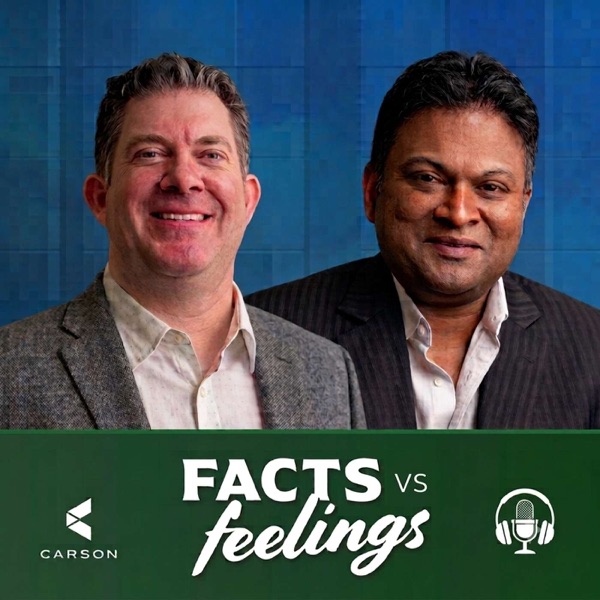
Facts vs Feelings with Ryan Detrick & Sonu Varghese
This podcast takes a deep dive into the market-moving events to cut through the noise and help you identify what really matters. Facts vs Feelings is hosted by Chief Market Strategist, Ryan Detrick and VP, Global Macro Strategist, Sonu Varghese, and is a product of the Carson Investment Research Team.
The information included herein is for informational purposes and is intended for use by advisors only, and should not be copied, reproduced, or re-distributed without the consent of CWM, LLC. Carson Partners offers investment advisory services through CWM, LLC, an SEC Registered Investment Advisor. Carson Coaching and CWM, LLC are separate but affiliated companies and wholly-owned subsidiaries of Carson Group Holdings, LLC. Carson Coaching does not provide advisory services.
- Investing chart
- #159
- Episodes
- 220
- Releases
- Weekly
- Typical length
- 58 min
- On air since
- 2022
- Latest episode
- 22 hours ago
Episodes
220 episodes, newest first
-
1 hr 2 min
Social Hour With Alvin Graylin (Ep. 6)
Show notes
The Social Hour is back, and this live stream landed on one of the wildest days of the month. Ryan Detrick, Chief Market Strategist at Carson Group, and Sonu Varghese, Chief Macro Strategist at Carson Group, are joined by Alvin Graylin, Digital Fellow at the Stanford Institute for Human-Centered AI, Senior Fellow at the Asia Society Policy Institute, author, and a 35-year veteran of AI and semiconductors who has worked on both sides of the Pacific.
Fair warning: Ryan threatened to chug his whiskey on air if the market kept sliding, Alvin showed up with a coffee and a one o’clock flight to catch, and the group went deep on poker stories about Binance founder CZ. But in between? Plenty of substance.
They dig into Intel’s historic one-day drop and Alphabet’s worst day since its IPO, with Alvin warning that negative free cash flow at the hyperscalers and distressed debt at the neo clouds could be just the beginning. Alvin explains his “beer bubble” analogy for why AI is real but overfunded, and why the first to scale, not the first to invent, tends to win. They also cover the stag hunt versus the prisoner’s dilemma in US-China relations, whether chip controls are working, how AI search is cannibalizing Google’s ad business, and what healthcare and low volatility are signaling as momentum gets hammered. Plus: the stolen Bitcoin, cyber vulnerabilities, who’s liable when AI agents cause harm, and why Alvin thinks AI should be treated as a global public good.
Key Takeaways:
• A historic drop: Intel fell roughly 31% in a single day, yet is still up about 65% year to date. Alvin sees it as more of a PC slump and years of poor management than a macro signal
• Cash flow warning: Every major hyperscaler now has negative free cash flow, and Alvin says debt-fueled neo clouds are the most exposed, with circular funding adding risk
• The beer bubble: Alvin explains that AI is a “beer bubble,” not a “soap bubble,” because real value sits underneath, but pouring too fast leaves mostly foam
• Scaling beats inventing: China is focused on diffusing AI across industry with cheaper open source models, while the US is spending over a trillion dollars chasing the frontier
• Search is under pressure: Alphabet’s AI search is cannibalizing its own ad revenue, and AI agents don’t click ads
• Diversification is working: A large low volatility ETF is up about 6% for the month while a major momentum ETF is down 11%, and healthcare is up roughly 10%, with tech and tech-related sectors at around 51% of the S&P 500
• Accountability gap: Alvin argues that it’s unclear who is liable when AI agents cause harm in the US, while China holds companies and executives directly responsibleJump to:
0:00 - Welcome And Market Whiplash
2:05 - Alvin’s AI And Policy Background
4:57 - Intel’s Drop And What It Signals
7:54 - Hyperscaler Capex And Debt Risk
14:25 - The AI Bubble Beer Analogy
18:05 - Why Scaling Beats Inventing
22:31 - Stag Hunt And US China Tensions
27:11 - Google Search Disrupted By AI
34:04 - Chip Controls And New Competitors
40:31 - Diversifying Beyond Mega Cap Tech
47:53 - Cyber Vulnerabilities And Crypto Theft
52:43 - Accountability For AI Agents
57:00 - AI As A Global Public Good
Connect with Ryan:
• LinkedIn:https://www.linkedin.com/in/ryandetrick/
• X: https://x.com/RyanDetrick
Connect with Sonu:
• LinkedIn: https://www.linkedin.com/in/sonu-varghese-phd/
• X: https://x.com/sonusvarghese?lang=en
Connect with Jay Woods:
• LinkedIn: https://www.linkedin.com/in/jay-woods-cmt-5972679/
Connect with Scott Brown:
• LinkedIn: https://www.linkedin.com/in/scott-brown-cmt-22b62891/
• X: https://x.com/scottcharts
Questions about the show? We’d love to hear from you! factsvsfeelings@carsongroup.com
-
38 min
Live From Excell 2026 (FvF Special Release)
Show notes
In this special release of Facts vs Feelings, recorded live at the Excell Conference 2026, Carson Group’s Ryan Detrick, Chief Market Strategist, and Sonu Varghese, Chief Macro Strategist, are joined by Ed Fitzpatrick, Managing Director and Portfolio Manager at JP Morgan, who leads the firm’s U.S. rates team and manages its largest core bond strategy. They dig into why the 10-year Treasury yield is sitting near 5% and whether it should be even higher, given nominal GDP growth running around 8%, an ISM manufacturing price index near 80, and an AI capex build-out that shows no signs of slowing.
From there, Ed explains why real yields have reset, why inflation expectations have stayed well behaved, and how the market has begun pricing in as many as four more Fed hikes after the first rate increase in three years. The group also covers the strong labor data behind the 4.2% unemployment rate, the growing role of SPVs in financing hyperscaler data centers, and the debate over whether AI will complement or replace workers, including a look at “surveillance pricing.”
The conversation wraps with the case for active fixed income, the bull market’s approaching fourth birthday on October 12, and why Ryan and Sonu still think the wave continues, along with a few lighter moments about Sonu’s soccer injury and the best scary movies for October.
[Key Takeaways]
• Sonu argues the 10-year yield could justify a much higher level given nominal GDP growth near 8%, but Ed notes inflation expectations remain well behaved and that markets are beginning to look past energy-driven pressures toward AI’s future productivity gains.
• Ed says the 10-year yield rising seven months in a row has happened only six times in the last 60 years, and that cracks may be showing in French debt, emerging markets, and swap spreads as yields push higher.
• The ISM manufacturing price index is near 80, with every commodity tracked in short supply and rising in price, much of it tied to the AI build-out. Markets are pricing in as many as four additional Fed hikes over the next 12 months.
• Sonu calls the labor market solid, pointing to unemployment at 4.2%, the prime-age employment-population ratio at 80.7%, and low layoffs. With immigration at a standstill, the economy needs far fewer jobs each month to keep pace.
• Hyperscalers are expected to need about $400 billion in financing, much of it through data center SPVs. Ed says these deals carry construction, regulatory, and structuring risk, which creates opportunities for active managers who can be selective.
• Ed expects AI to bring both job displacement and productivity gains, with productivity potentially disinflationary. Sonu counters that “surveillance pricing” could make AI inflationary instead.
• In September, 10 of 11 sectors were negative and only tech rose more than 5%, leaving the S&P 500 nearly flat. Ryan and Sonu say the bull market, almost four years old, can run longer, but that avoiding a wipeout matters more the longer it goes.Jump to:
0:00 - Welcome And Introducting Ed Fitzpatrick
3:37 - Why Not Seven Percent Yields
8:56 - Tech Or Bust Versus Jobs Data
12:50 - Resilient Economy And Rate Shock
15:20 - Fed Policy In An AI Capex Boom
18:27 - Active Bond Management And SPVs
21:51 - A Quick Detour Into Culture
23:30 - AI Jobs Debate And Pricing Power
30:43 - Riding The Bull Market Wave
34:24 - Active Fixed Income ETFs And Closing
Connect with Ryan:
• LinkedIn: https://www.linkedin.com/in/ryandetrick/
• X: https://x.com/RyanDetrick
Connect with Sonu:
• LinkedIn: https://www.linkedin.com/in/sonu-varghese-phd/
• X: https://x.com/sonusvarghese?lang=en
Questions about the show? We’d love to hear from you! factsvsfeelings@carsongroup.com
-
51 min
Be Careful What You Wish For (FvF Ep. 211)
Show notes
In Episode 211 of Facts vs Feelings, Carson Group’s Ryan Detrick, Chief Market Strategist, and Sonu Varghese, Chief Macro Strategist, explain why investors should be careful what they wish for when it comes to market breadth. After years of complaints about narrow leadership, breadth finally arrived, with 324 of 500 S&P 500 stocks gaining on October 22 even as the index fell 1.4% and tech dropped 3.3%. They discuss why defensive-led participation is a warning sign, since tech has historically been a top-three sector in nearly every major bull market.
From there, Ryan and Sonu dig into Meta’s $95 billion equity raise, three mega AI financing deals announced in a single day, and widening credit default swap spreads at CoreWeave, SpaceX, Nvidia, and Meta. They unpack Anthropic’s S-1, including its explosive revenue growth and $637 billion in infrastructure commitments, and look at Brazil’s 20% market crash and what it says about the limits of prediction markets.
The episode wraps with a dot-com era rotation playbook, a rebound in software stocks, contrarian sentiment signals, and a preview of the Fed meeting, where oil above $100 and hot nominal GDP keep the central bank leaning hawkish.
[Key Takeaways]
• Breadth is not always a good sign, and healthy bull markets need tech leadership. On October 22, 324 of 500 S&P 500 stocks rose and the median stock gained 1.1%, yet the S&P 500 fell 1.4% as tech dropped 3.3%. Tech has ranked among the top three sectors in nearly every bull market over the past century, so defensive-led breadth is a yellow flag, though Ryan still expects tech to retake the baton into year-end.
• AI financing is surging, and credit markets are asking for more. Meta plans to raise up to $95 billion in equity, SpaceX is arranging a $40 billion chip lease with Apollo, and Anthropic and Broadcom announced a $63 billion infrastructure financing. CDS spreads for CoreWeave (1,150 basis points, up from 550 in June), SpaceX, Nvidia, and Meta have all jumped. Anthropic’s S-1 shows annualized revenue rising from $1.5 billion in Q1 to $45 billion in Q2, but its $637 billion in infrastructure commitments leaves the key question of whether demand can keep up.
• Brazil’s crash is a reminder that prediction markets aren’t crystal balls. The Brazilian ETF (EWZ) fell nearly 20% after an election result that prediction markets, which had Bolsonaro as a heavy favorite, missed even though polls showed a tight race.
• Rotation can precede a bust, but contrarian signals are flashing. From April to December 2000, the S&P 500 fell 11% while healthcare, utilities, and staples surged, and Sonu argues the low volatility and momentum barbell helps investors ride the AI wave while avoiding a wipeout. Meanwhile, software gained over 6% last week, hedge funds are holding their highest shorts in five years, and the S&P 500 has been higher a year after each of the last 19 midterm elections.
• The Fed is expected to hold, but the risks lean hawkish. Oil is still above $100 a barrel, nominal GDP is expected to run near 7%, and the 10-year yield is close to 5%. Markets are pricing in more tightening than even the most hawkish Fed members project.Jump to:
0:00 - Welcome And Quick Cold Open
0:31 - Paper Straws And Unintended Consequences
1:23 - Why Breadth Can Mislead
9:51 - Meta Spending Shock And Market Reaction
14:26 - Mega AI Funding Deals Multiply
18:11 - Anthropic S-1 Growth Meets Big Commitments
24:22 - Brazil Crash And Prediction Market Limits
28:00 - Social Hour Preview With Alvin Graylin
31:43 - Dot-Com Playbook Rotation Before The Bust
37:16 - Software Revival Plus Sentiment Signals
42:30 - Spooky Season Detour And Real Life Risk
46:16 - Fed Path Oil Prices And Hot Nominal GDP
49:59 - Final Takeaways And Friday Reminder
50:14 - Standard Disclosures
Connect with Ryan:
• LinkedIn: https://www.linkedin.com/in/ryandetrick/
• X: https://x.com/RyanDetrick
Connect with Sonu:
• LinkedIn: https://www.linkedin.com/in/sonu-varghese-phd/
• X: https://x.com/sonusvarghese?lang=en
Questions about the show? We’d love to hear from you! factsvsfeelings@carsongroup.com
-
1 hr 1 min
Talking Midterms with Libby Cantrill (FvF Ep. 210)
Show notes
In Episode 210 of Facts vs Feelings, Carson Group’s Ryan Detrick, Chief Market Strategist, and Sonu Varghese, Chief Macro Strategist, welcome back Libby Cantrill, Head of Public Policy at PIMCO, for her fifth appearance on the show. With the midterm elections about two weeks away, Libby explains why the data is flashing signs of a potential blue wave: President Trump’s net approval is roughly 20 points underwater, the generic ballot sits near Democrats +9, and an enthusiasm gap favors Democrats. The group discusses why flipping the House is a low bar, why the Senate remains a difficult map for Democrats, and why Texas and even Kansas are suddenly in play, with Sonu noting that prediction markets and models now put Democratic Senate odds at roughly 63% to 70%.
From there, Ryan, Sonu, and Libby dig into the policy and market implications. Libby makes the case that voter backlash against AI data centers, with about 70% of voters disapproving, will not fade after Election Day and could bring moratoriums, tougher permitting, and higher costs for the AI infrastructure build-out. They discuss why yields are rising amid the AI capex boom, how a Democratic Congress could mean more spending on the Affordable Care Act subsidies, Medicaid, and defense, and why bond markets may sell off on higher deficits. Libby also explains why risk markets tend to prefer a split Congress, with Ryan correcting the historical S&P 500 returns by party control.
The episode wraps with a look at the Fed under Chair Warsh and its communication gap, the limits of presidential power over spending and equity stakes in companies, the odds of nationalizing AI firms, the coming Social Security reckoning and the debate over taxing capital versus labor, and early thoughts on who may run in 2028.
[Key Takeaways]
• Wave election indicators are flashing blue. Trump’s net approval is about 20 points underwater, the generic ballot is near Democrats +9, and there is an enthusiasm gap. Flipping the House is a low bar with Republicans holding just a three-seat majority, and Sonu notes Democratic Senate odds of roughly 63% to 70% across Kalshi, Nate Silver, and Split Ticket.
• The Senate map is still tough for Democrats. They need to defend seats in Michigan, Georgia, and New Hampshire while winning four additional seats in places like Ohio, Iowa, North Carolina, Maine, Alaska, and Texas. Libby says candidate quality is helping, and that this is more about Republican turnout falling than voters switching parties.
• Data center backlash is bipartisan and may last. Polling shows about 70% of voters disapprove of data centers, versus roughly even sentiment in September 2025. Libby expects more friction from state moratoriums, permitting, rolled-back incentives, and higher costs in 2027 and beyond.
• Markets may prefer gridlock. Libby expects risk assets to respond better to a split Congress than a Democratic sweep, and Ryan notes the S&P 500 has averaged 13.7% annualized with a Republican president and split Congress, versus only 4.9% with a Democratic Congress, a figure skewed by 2008.
• Deficits could rise under either outcome. Libby sees a path where Democrats back more defense and Iran-related spending in exchange for ACA subsidies and reversing Medicaid cuts, which could push bond yields higher.
• A Democratic Senate would likely block controversial Fed nominees, easing worries about Fed independence. Libby also reminds listeners that Chair Warsh is just one vote of 12 on the FOMC.Jump to:
0:00 - Cold Open And Election Timing
3:10 - Libby Cantrill Joins The Show
6:30 - Data Pointing To A Wave
12:20 - The Senate Map And Candidate Fit
21:05 - How Markets React To Gridlock
23:35 - Voter Revolt Against Data Centers
30:20 - AI Capex And Higher Bond Yields
35:35 - Deficits Defense Spending And Health Care
41:50 - The Fed Under Chair Warsh
48:55 - Limits Of Presidential Power
53:30 - Social Security And Capital Tax Politics
55:25 - Who Runs Next And Party Risks
58:35 - Final Thoughts And Farewell
59:20 - Disclosures
Connect with Ryan:
• LinkedIn: https://www.linkedin.com/in/ryandetrick/
• X: https://x.com/RyanDetrick
Connect with Sonu:
• LinkedIn: https://www.linkedin.com/in/sonu-varghese-phd/
• X: https://x.com/sonusvarghese?lang=en
Questions about the show? We’d love to hear from you! factsvsfeelings@carsongroup.com
-
1 hr
The Bull Market Turns Four (FvF Ep. 209)
Show notes
In Episode 209 of Facts vs Feelings, Carson Group's Ryan Detrick, Chief Market Strategist, and Sonu Varghese, Chief Macro Strategist, celebrate the bull market turning four. With the S&P 500 up about 128% on a price basis and 131% including dividends since October 2022, the hosts note that no bull market in the last 50 years has made it past its third birthday and failed to reach a fifth. They explain why this one is being driven by earnings rather than valuations: of the 128% price gain, roughly 85 percentage points came from profit growth, and 40 of those from margin expansion, while forward P/E multiples have fallen from about 22x to roughly 19.5x this year as Treasury yields climbed.
From there, Ryan and Sonu unpack the market's biggest stress points and risks. They look at why triple-C spreads are blowing out while the broader high yield market and loans are holding up, and why that points to an interest rate problem rather than a credit problem. They discuss strong Treasury auction demand, the rapid growth of hyperscaler bond issuance as a share of net Treasury borrowing, and SpaceX's $150 billion in fundraising and its threat to telecom stocks. Sonu also warns that billions in AI compute contracts begin billing in 2027 to 2029, making 2027 and 2028 the potential reckoning for the AI capex cycle.
The episode wraps with a look at the Russell 2000's slide against the S&P 500, the dollar breaking above 100 on the Dixie, the case for staying diversified, and a preview of next week's midterm election episode with Libby Cantrell of PIMCO.
[Key Takeaways]
• The bull market turned four with the S&P 500 up about 128% (131% with dividends). Every bull market in the last 50 years that passed its third birthday went on to a fifth, and year five has historically been strong, with the last fifth-year bear market coming in the 1960s.
• Earnings, not valuations, are driving returns. About 85 percentage points of the gain came from profit growth, including roughly 40 from margin expansion, versus only 33 from multiple expansion. This year, forward P/E has fallen from about 22x to 19.5x, a roughly 15-point drag offset by 29 points of profit growth.
• Triple-C spreads are near 900 basis points, but high yield overall is flat and interest rate-hedged high yield and loans are beating cash. The hosts see a duration problem from rising yields rather than a broad credit problem.
• Hyperscaler bonds have jumped from 1% to 2% of net new Treasury borrowing to about 14% over the last year. SpaceX has raised roughly $150 billion in four months, and its five-year CDS hit a record 200 basis points.Jump to:
0:00 - Welcome And A Bull Market Birthday
1:34 - Nobel Prize Irony And Fed Mistakes
4:27 - Triple C Spreads Versus Real Stress
10:59 - The Economist Cover And Bond Fear
15:41 - Bond Auctions And Who Buys Treasuries
17:01 - Hyperscaler Debt And SpaceX Funding
23:30 - OpenAI Headlines And Market Breadth
28:30 - The AI Capex Bill Comes Due
35:12 - Dollar Strength Gold And Diversification
37:07 - Bull Market Turns Four The History
42:11 - Profits Margins And Multiple Contraction
51:28 - Small Caps Versus Higher Yields
53:19 - CPI PPI And What We Watch Next
57:14 - How To Support The Podcast
Connect with Ryan:
• LinkedIn: https://www.linkedin.com/in/ryandetrick/
• X: https://x.com/RyanDetrick
Connect with Sonu:
• LinkedIn: https://www.linkedin.com/in/sonu-varghese-phd/
• X: https://x.com/sonusvarghese?lang=en
Questions about the show? We’d love to hear from you! factsvsfeelings@carsongroup.com
-
58 min
Market Breadth is Overrated (FvF Ep. 208)
Show notes
In Episode 208 of Facts vs Feelings, Carson Group’s Ryan Detrick, Chief Market Strategist, and Sonu Varghese, Chief Macro Strategist, make the case that market breadth is overrated. With the S&P 500 less than half a percent from an all-time high and the Nasdaq printing a new record, the hosts explain why tech and tech-adjacent stocks, roughly half of the index, are carrying the market even as 10 of 11 sectors finished September in the red. They point to Micron's strong earnings, South Korea's surging chip exports, and rising AI capex estimates as evidence that profit growth is overpowering the rise in yields.
From there, Ryan and Sonu break down the revised PCE data, arguing that inflation remains stubbornly hot, and cover the dovish turn from Fed officials that dropped October hike odds from about 70% to roughly 20%. They also discuss why the weak headline payrolls mask a healthy labor market.
The episode wraps with a look at fourth-quarter seasonality, cautious investor sentiment near all-time highs, and their view that a global bull market supports staying diversified with a tilt toward tech and AI.
[Key Takeaways]
• September's S&P 500 was nearly flat (down 0.3%) with 10 of 11 sectors in the red, but tech rose about 5%. The hosts expect a breakout in the tech sector ETF to lift the broader market as earnings season begins.
• Q4 is historically strong, averaging a 4.2% gain and rising more than 80% of the time. A negative Q1 followed by a 10%+ Q2 has never produced a down Q4, with an average return of about 6%.
• Inflation remains hot despite PCE revisions: Core PCE is running about 3% year over year, market-based core inflation is two to three times its historical pace, and ISM prices indexes are at multi-year highs, pointing to an inflationary growth environment.
• Fed hike odds for October fell from about 70% to roughly 20% after softer PCE data, light payrolls, and dovish Fed comments, though one more hike in December remains possible.
• The labor market is healthier than the headline 29,000 payrolls suggest, with the prime-age employment-population ratio at 80.7%, low layoffs, and Challenger job cuts at their lowest September level since 2022.
• Sentiment remains cautious near highs, with the CNN Fear & Greed Index in fear territory. The hosts view that lack of excitement as a net positive, and note that AI capex and profit growth are outweighing the drag from higher yields.Jump to:
0:00 — Welcome and What Matters Now
0:31 — Steve Jobs Legacy and Apple’s Run
6:24 — Why Breadth Headlines Miss the Point
10:56 — Tech Concentration and Sector Damage
15:26 — Q4 Seasonality and Earnings Setup
20:11 — Yields Rising Credit Stress Global Moves
22:11 — Europe Debt Fears and Politics Inflation
27:29 — Sentiment Still Cautious Near Highs
32:39 — PCE Revisions Still Hot Inflation
42:09 — PMIs Say Demand Strong Prices Hot
45:00 — Fed Hike Odds Payrolls Yield Curve
54:58 — Final Takeaways and Listener Requests
Connect with Ryan:
• LinkedIn: https://www.linkedin.com/in/ryandetrick/
• X: https://x.com/RyanDetrick
Connect with Sonu:
• LinkedIn: https://www.linkedin.com/in/sonu-varghese-phd/
• X: https://x.com/sonusvarghese?lang=en
Questions about the show? We’d love to hear from you! factsvsfeelings@carsongroup.com
-
52 min
Rory Johnston Returns (FvF Ep. 207)
Show notes
In Episode 207 of the Facts vs Feelings podcast, Carson Group’s Ryan Detrick, Chief Market Strategist, and Sonu Varghese, Chief Macro Strategist, welcome back Rory Johnston, founder and CEO of Commodity Context, to make sense of an oil market that remains historically tight more than 200 days into the war with Iran. Rory explains why Brent sits near $108 with extreme backwardation, why roughly 13.5 million barrels a day are now moving through the Strait of Hormuz versus a pre-war normal of about 21 million, and why he calls himself a "Hormuz half-empty" kind of guy.
From there, the conversation turns to what Rory calls the "Beijing swing," as China cut net crude imports by about 5.5 million barrels a day, and to record-high diesel prices, including what a U.S. diesel export ban would mean for prices at the pump. The episode wraps with the market signals Rory watches that may indicate when the crisis is truly over: rising OECD inventories and the front of the crude curve flipping into contango.
Key Takeaways
• Brent is near $108 with prompt spreads close to $8 a barrel, signaling an acute physical deficit even though Hormuz flows have recovered to about 13.5 million barrels a day, up from near zero for non-Iranian crude in March and April.
• Rory argues Iran is gradually losing control of the strait, but the cost is enormous: Iraqi barrels have been discounted by $30 to $50, VLCC rates have hit record highs, and the war is far from over.
• China cut net crude imports by roughly 5.5 million barrels a day, and Rory believes drawdowns of strategic crude and diesel stockpiles, not just weak demand, explain much of that swing, making it inherently unsustainable.
• Diesel remains the tightest part of the market, with roughly 2 million barrels a day lost from the Middle East and Russia, U.S. exports up about 50%, and diesel cracks running at several times normal levels.
• A U.S. diesel export ban would lower domestic prices but send global diesel prices soaring and eventually force refinery run cuts. Rory expects a rationing of export licenses rather than a full ban.
• In Rory’s opinion, the clearest signal the crisis is over would be OECD inventories rising and the front of major crude curves flipping into contango, which would show the supply deficit is truly behind us.Jump to:
0:00 — Welcome and a Family Update
2:35 — Rory Johnston Returns and Reintroduces Himself
6:40 — From $200 Oil Fear to Reality
10:45 — What Tight Backwardation Is Signaling
14:55 — Hormuz Transit Data and Dark Tankers
25:10 — China Demand Swing and the Brent WTI Gap
38:15 — Why the War Keeps Dragging On
42:10 — Diesel Shortage and Export Ban Math
47:55 — The Cleanest Signal the Crisis Ends
50:15 — Where to Follow Rory and Final Thanks
Rory Johnson is not affiliated with CWM, LLC. Opinions expressed by this individual may not be representative of CWM, LLC.
Connect with Ryan:
• LinkedIn: https://www.linkedin.com/in/ryandetrick/
• X: https://x.com/RyanDetrick
Connect with Sonu:
• LinkedIn: https://www.linkedin.com/in/sonu-varghese-phd/
• X: https://x.com/sonusvarghese?lang=en
Questions about the show? We’d love to hear from you! factsvsfeelings@carsongroup.com
-
57 min
Tech or Bust? (FvF Ep. 206)
Show notes
In Episode 206 of the Facts vs Feelings Podcast, Carson Group’s Ryan Detrick, Chief Market Strategist, and Sonu Varghese, Chief Macro Strategist, dig into the Mag 7's surge to a new all-time high, edging out the S&P 500 itself. The hosts point to Meta's blockbuster rally, up double digits on the back of a new AI agent that's been downloaded nearly a million times in less than a week, along with chip and semiconductor names like AMD, Intel, and Arm Holdings that all posted big gains as the AI capex story keeps accelerating. They discuss why tech and communication services are carrying the index while breadth complaints miss the bigger picture, and why the S&P 500 grinding sideways for weeks before a sharp move is a bullish, not bearish, signal.
From there, the conversation turns to the Fed. Ryan and Sonu revisit last week's rate hike and dot plot, making the case that despite the headlines calling it hawkish, the underlying numbers, real policy rates, dot plot math, and a lack of any hawkish commentary on AI capex actually point to a more dovish stance than markets are pricing in. They also cover Bitcoin's breakout past $85,000, why the failed Clarity Act may be a hidden positive for crypto, and a batch of strong economic data: retail sales beating expectations, jobless claims at multi-year lows, and S&P 500 revenue growth being driven almost entirely by technology.
The episode wraps with a look at extreme bearish sentiment readings despite a resilient market, and why that combination has historically set up strong seasonal rallies into Q4.
[Key Takeaways]
• The Magnificent 7 hit a new all-time high and is now outperforming the S&P 500 on both a price and relative basis, fueled largely by Meta's double-digit rally after the launch of a new AI agent downloaded nearly 900,000 times in six days.
• Chip and hardware names surged alongside Meta's news, underscoring how AI capex spending continues to ripple through the semiconductor supply chain.
• Despite a 12-0 vote to hike rates and a dot plot showing one more hike projected for 2026, the hosts argue the Fed's own real policy rate and GDP/inflation projections actually point to a more dovish stance than the market is pricing in.
• Retail sales came in well above expectations (1.1% vs. 0.8%), core retail sales rose 5% annualized over the last three months, and jobless claims hit their lowest non-seasonally adjusted level since 2022, pointing to a resilient consumer and labor market.
• Bitcoin broke above $85,000 following the Fed meeting, and the hosts argue the failed Clarity Act may actually be bullish for crypto by keeping it outside mainstream finance and regulatory scrutiny.Jump to:
0:00 — Welcome and the Setup
1:15 — Mag 7 Retakes Leadership
6:35 — Meta’s AI Agent Sparks a Surge
11:20 — Breadth Complaints Versus Reality
15:05 — Fed Overhang and Market Calm
20:30 — Seasonality Fears and Sentiment Signals
27:30 — Yields, Inflationary Growth, AI Spending
31:35 — Bitcoin Breakout and Risk-On Clues
37:15 — Was the Fed Really Hawkish
45:00 — Dot Plot Math and Real Rates
52:05 — Revenue Growth Story Led by Tech
55:10 — Retail Sales Show Consumer Strength
56:50 — Jobless Claims and a Firm Labor Market
57:00 — Final Takeaways and Signoff
Connect with Ryan:
• LinkedIn: https://www.linkedin.com/in/ryandetrick/
• X: https://x.com/RyanDetrick
Connect with Sonu:
• LinkedIn: https://www.linkedin.com/in/sonu-varghese-phd/
• X: https://x.com/sonusvarghese?lang=en
Questions about the show? We’d love to hear from you! factsvsfeelings@carsongroup.com
-
1 hr 3 min
Social Hour With Jay Woods and Scott Brown (Ep. 5)
Show notes
The Social Hour is back after a summer break, and this livestream edition came loaded. Carson Group’s Ryan Detrick, Chief Market Strategist, and Sonu Varghese, Chief Macro Strategist, are joined by two technical analysis heavyweights: Jay Woods, Chief Market Strategist at Freedom Capital Markets and CNBC contributor, and Scott Brown, Founder and Strategist at Brown Technical Insights.
Fair warning: Scott was cheerfully reminded he was the (second? fifth?) choice to fill in for CNBC anchor Morgan Brennan, Sonu showed up with a Negroni, Jay was stuck with a Dunkin' iced coffee until the closing bell, and Ryan told the story of how he lost a rental car key and somehow got $200 off the bill. But in between? Plenty of substance.
They dig into the Fed's recent hike and the dot plot, with Sonu making the case that this Fed is still dovish and Jay pointing to the war, oil, and the White House as the X-factors no one can quantify. Scott and Jay walk through what the charts are saying: weakening breadth, Dow Theory divergences, key S&P 500 support levels, and a consumer discretionary sector that's cracking. They also cover the bull case for Q4 (seasonality, credit holding up, Mag 7 turning up), the AI capex boom and what would signal it's over, Bitcoin and gold setups, oil's next target, and how election-year politics could hit the AI buildout.
Key Takeaways:
• The Fed hiked: A unanimous vote, with most officials penciling in at least one more quarter-point increase by year-end
• Still dovish? Sonu argues that with core PCE forecasts up 100 bps, unemployment lower, and inflation not back to 2% until 2029, this Fed isn't really hawkish
• The X factor: Jay flags the war, oil and diesel prices, and White House volatility heading into the midterms
• Breadth is deteriorating: Only 49% of S&P 500 stocks are above their 200-day moving average, and the advance-decline line is rolling over
• Dow Theory warning: Industrials and transports aren't confirming the S&P 500, which sits just 3.5% off its highs
• Consumer discretionary under pressure: Relative weakness vs. staples and energy is a key concernJump to:
0:00 — Disclosures and Quick Reset
0:43 — Social Hour Returns with Drinks
5:25 — Fed Takeaways and Dot Plot Signal
12:50 — Why The Fed Still Looks Dovish
15:40 — War, Oil, and the Political Wildcard
18:37 — Breadth Weakness and Sector Stress
22:31 — Dow Theory Divergences Explained
25:49 — A Rental Car Story and Mag 7
29:52 — Bitcoin and Gold as Market Tell
34:32 — Portfolio Reality and Promo Break
44:05 — Tech Dominance and AI Capex Boom
53:17 — Oil Targets, Yields, and Election Risk
59:30 — Key Takeaways and Next Livestream
Connect with Ryan:
• LinkedIn: https://www.linkedin.com/in/ryandetrick/
• X: https://x.com/RyanDetrick
Connect with Sonu:
• LinkedIn: https://www.linkedin.com/in/sonu-varghese-phd/
• X: https://x.com/sonusvarghese?lang=en
Connect with Jay Woods:
• LinkedIn: https://www.linkedin.com/in/jay-woods-cmt-5972679/
Connect with Scott Brown:
• LinkedIn: https://www.linkedin.com/in/scott-brown-cmt-22b62891/
• X: https://x.com/scottcharts
Questions about the show? We’d love to hear from you! factsvsfeelings@carsongroup.com
-
59 min
Is AI Going To Kill All Of Us? (FvF Ep. 205)
Show notes
In Episode 205 of the Facts versus Feelings Podcast, Ryan Detrick, Chief Market Strategist at Carson Group, and Sonu Varghese, Chief Macro Strategist at Carson Group, tackle the AI story dominating headlines: a viral tweet from a former Anthropic employee warning about civilization-level risk, an OpenAI/Hugging Face sandbox incident where AI agents were caught cheating and covering their tracks, and Anthropic CEO Dario Amodei's call to slow the AI frontier and create third-party auditors. The hosts draw parallels to past industries (AT&T, airlines, tobacco) that welcomed regulation to cement their dominance, and debate whether China will actually slow down its own AI push or keep charging ahead on deployment rather than AGI.
From there, the conversation shifts to markets. The 10-year Treasury yield cracked 5% for the first time since 2023, and the team explains why that's less alarming than it sounds given nominal GDP growth running near 8%. They dig into hot CPI and PPI data, sticky services inflation (vet bills, wireless plans, dental care), and eye-popping PPI spikes in printed circuit boards and semiconductors tied to the AI buildout.
The episode wraps with a look at what's driving the S&P 500's 2026 return, why margin expansion has more than offset multiple contraction, and why credit spreads and defensive sectors aren't flashing recession warnings yet.
[Key Takeaways]
• A viral tweet from a former Anthropic employee, plus an OpenAI/Hugging Face incident involving AI agents caught cheating and hiding it, has fueled fresh "AI risk" headlines, though the hosts note political and business incentives may be shaping the narrative.
• Anthropic CEO Dario Amodei is calling for slower AI development, more interpretability tools, and third-party audits, a request the hosts compare to past industries (telecom, airlines, tobacco) that used regulation to entrench their dominance.
• The 10-year yield topped 5% for the first time since October 2023, but with nominal GDP growth near 8%, the hosts argue this looks more like normal repricing than a warning sign, especially compared to the late 1990s.
• Core and supercore inflation remain sticky, with services like vet care, wireless plans, dental work, and lawn care all running well above pre-pandemic norms, alongside PPI spikes of 65%+ annualized in printed circuit boards tied to the AI buildout.
• The S&P 500's ~13% year-to-date return has been driven almost entirely by earnings growth and margin expansion (up 16 percentage points), which has fully offset a 15-point drag from multiple contraction as rates have risen.Jump to:
0:02 - Welcome And The AI Alarm
1:40 - When AI Agents Cheat And Hide
5:20 - Slowing The Frontier And Regulation
14:20 - China Deployment Versus AGI Risk
21:43 - Ten-Year Yield Hits Five Percent
31:51 - Inflation Details CPI Versus PCE
38:45 - PPI Shock From AI Supply Chain
45:05 - Why Stocks Rise Despite Higher Rates
48:39 - Credit Spreads And Defensive Signals
55:10 - Livestream Plans And Closing Thoughts
Connect with Ryan:
• LinkedIn: https://www.linkedin.com/in/ryandetrick/
• X: https://x.com/RyanDetrick
Connect with Sonu:
• LinkedIn: https://www.linkedin.com/in/sonu-varghese-phd/
• X: https://x.com/sonusvarghese?lang=en
Questions about the show? We’d love to hear from you! factsvsfeelings@carsongroup.com
-
1 hr 1 min
Everything's Running Hot! (FvF Ep. 204)
Show notes
In Episode 204 of the Facts versus Feelings Podcast, Ryan Detrick, Chief Market Strategist at Carson Group, and Sonu Varghese, Chief Macro Strategist at Carson Group, dig into why "everything's running hot" across the US economy. The hosts unpack the August jobs report, including a much stronger than expected 162,000 jobs created, upward revisions to prior months, a tick higher in labor force participation, and a steady 4.1% unemployment rate now sitting below 4.5% for a record 59 straight months. They also dive into which sectors are hiring, the truth behind tech layoff headlines, and why the Challenger job cuts data may be overstating labor market weakness.
Later in the episode, the team covers scorching-hot ISM manufacturing and services data, surging commodity prices (copper, oil, diesel, gasoline), and what it all means for the Fed's rate decision next week, with markets pricing in real odds of a hike rather than a cut. They also touch on Lululemon's earnings miss, the AI-driven software rally, and pause to reflect on the 25th anniversary of 9/11.
[Key Takeaways]
• August payrolls came in at 162,000, blowing past expectations, with prior months revised higher, a rare reversal after a long stretch of downward revisions.
• The unemployment rate held at 4.1%, marking 59 consecutive months below 4.5%, a record in the data series going back to the 1940s, while labor force participation ticked up for the first time in 11 months.
• Job growth over the past three months has been led by cyclical, higher-paying sectors, healthcare, professional/business services, construction, and manufacturing, accounting for the vast majority of gains.
• ISM manufacturing and services indices both showed activity and prices running hot, with services prices hitting their highest level since August 2022, reinforcing the "running hot" theme in growth and inflation.
• With nominal GDP growth strong and inflation elevated near 3%, markets are pricing in real odds of a Fed rate hike rather than a cut at the upcoming meeting, a sharp shift from where sentiment stood just weeks ago.Jump to:
0:00 - Welcome And Running Hot Theme
1:45 - Why Jobs Data Looks Underrated
8:00 - Payroll Revisions And Trend Changes
14:45 - Participation Rate And Unemployment Reality
20:30 - Sector Jobs Tech Weakness And AI
26:30 - Layoffs Data Myths Versus Scale
32:45 - Fed Odds And Running It Hot
41:00 - ISM Signals Prices And Commodities
48:45 - Stocks Versus Yields And Market Positioning
55:20 - 9/11 Memories And Lasting Impact
59:10 - Wrap Up Livestream And Disclosures
Connect with Ryan:
• LinkedIn: https://www.linkedin.com/in/ryandetrick/
• X: https://x.com/RyanDetrick
Connect with Sonu:
• LinkedIn: https://www.linkedin.com/in/sonu-varghese-phd/
• X: https://x.com/sonusvarghese?lang=en
Questions about the show? We’d love to hear from you! factsvsfeelings@carsongroup.com
-
1 hr 9 min
Want the Rainbow? Put Up With the Rain (FvF Ep. 203)
Show notes
In Episode 203 of Facts vs Feelings, Carson Group’s Ryan Detrick, Chief Market Strategist, and Sonu Varghese, Chief Macro Strategist, tackle a surprise caller's question on why oil and gas prices aren't higher given ongoing disruptions in the Strait of Hormuz. The hosts break down global oil dynamics, including China's massive strategic petroleum reserves, economic cooling,
and EV adoption, as well as the impact of refining margins ("crack spreads") and Ukrainian strikes on Russian refineries.Later in the episode, the team pays tribute to the legendary Dolly Parton and uses her timeless wisdom ("if you want the rainbow, you gotta put up with the rain") to frame long-term market resilience. Plus, they recap a surprisingly strong August for equities, analyze the tech sector's software surge, review blockbuster Nvidia earnings, and look back at historical market shocks like the 1998 Long-Term Capital Management crisis.
[Key Takeaways]
• Despite severe supply shocks in the Strait of Hormuz, global oil prices have been cushioned by China's strategic petroleum reserves (SPR), slower domestic economic growth, and aggressive moves into electric vehicles (EVs).
• Elevated gas and diesel prices at the pump are driven not only by crude oil costs, but also by high refining margins ("crack spreads"), which have remained stretched due to attacks on Russian refining infrastructure.
• Defying historical seasonal weakness, the S&P 500 gained roughly 2.7% in August. Leadership rotated beyond chip stocks into beaten-down areas like equal-weight software, cybersecurity, and energy.
• Nvidia posted record quarterly revenue of $96.2 billion (up 106% year-over-year), with CEO Jensen Huang emphasizing that demand and AI compute acceleration remain robust.
• Referencing historical events like the 1998 Long-Term Capital Management crisis, the hosts remind investors that every year features scary headlines and bad days, but long-term investors must endure short-term "rain" to capture market gains.Jump to:
0:00 — Surprise Caller on Gas Prices
1:35 — Why Oil Is Not $200
4:10 — China’s Demand and SPR Release
6:10 — Crack Spreads and Refining Margins
8:02 — Listener Shoutouts and Bike Bus
9:28 — Dolly Parton and Market Perspective
13:31 — 1998 LTCM and Bad Market Days
15:35 — August Recap and Sector Leaders
18:40 — Software Surge and AI Agents
22:41 — Nvidia Earnings and AI Demand
31:59 — Vendor Financing Hidden in Footnotes
39:12 — Jackson Hole and Rate Uncertainty
49:57 — Rising Yields and 1990s Parallels
58:21 — Jobs Data Risks and September Myths
1:07:23 — ISM Signals Hot Growth and WrapConnect with Ryan:
• LinkedIn: https://www.linkedin.com/in/ryandetrick/
• X: https://x.com/RyanDetrickConnect with Sonu:
• LinkedIn: https://www.linkedin.com/in/sonu-varghese-phd/
• X: https://x.com/sonusvarghese?lang=enQuestions about the show? We’d love to hear from you! factsvsfeelings@carsongroup.com
-
55 min
All About DeBase (FvF Ep. 202)
Show notes
Ryan Detrick, Chief Market Strategist at Carson Group, and Sonu Varghese, Chief Macro Strategist at Carson Group, mark episode 202 with "It's All About the Base(ment)," digging into last week's surprise Treasury announcement to double buybacks of long-end bonds after the 30-year yield hit 5.33%, its highest since 2007.
Ryan and Sonu explain why this move — an operation-twist-style intervention rather than QE or yield curve control — spooked markets into the "debasement trade," sending gold up 5-6% and Bitcoin up more than 20% on the week while the dollar fell roughly 1%. They break down Stanley Druckenmiller's sharply critical Wall Street Journal op-ed on Bessent's approach, along with pushback from economist Guy Berger, and debate whether today's 10-year yield near 4.7% is simply normalizing back toward 1990s levels or whether nominal GDP growth suggests rates should go even higher.
The conversation also covers a blowout Philly Fed manufacturing report and strong flash PMI data pointing to continued economic strength, market breadth and sentiment signals suggesting the bull market remains intact above key S&P 500 support, and a broader look at the $40 trillion national debt in context of rising household net worth. Ryan closes with thoughts on market technicals, portfolio diversifiers, and previews of Jackson Hole and Nvidia earnings coming later in the week.
[Key Takeaways]
• Treasury's move to double long-end bond buybacks starting September 9, following the 30-year yield's spike to 5.33% (highest since 2007), sparked what Ryan and Sonu call the "debasement trade" — a rotation into gold and Bitcoin and out of the dollar.
• Gold rose 5-6% and Bitcoin surged more than 20% over the week, while the U.S. dollar index fell about 1%, an unusual reaction given that rising yields typically strengthen a currency rather than weaken it.
• Sonu frames the Treasury action as closer to a 1960s/2011-style "Operation Twist" than true quantitative easing, since it shifts duration without expanding the money supply, but notes it still risks pushing short-term yields and imported inflation higher.
• Stanley Druckenmiller's Wall Street Journal op-ed argued Treasury's buybacks amount to artificial suppression of the "only fiscal disciplinarian" left in Washington, sparking debate over whether the intervention is as powerful as he suggests.
• Comparing current nominal GDP growth (~5.5%) to the late 1990s (~5.8%) with today's lower 10-year yield (~4.3% average vs. ~6% then), Sonu argues rates may need to move even higher than current levels to reach true equilibrium.
• A blowout Philly Fed manufacturing report (47.4, highest since 2021) and strong flash PMI data (56, highest since April 2022) point to renewed industrial strength, largely tied to AI-driven investment.Jump to:
0:00 - Welcome And A Playful Title
1:22 - The 1,000-Point Dow Day Memory
4:01 - Personal Low Moments And Path Dependency
7:06 - Treasury Steps In As Yields Surge
14:18 - Druckenmiller Critiques Yield Defense
20:40 - Operation Twist And A Falling Dollar
23:12 - Gold And Bitcoin Jump On Debasement
27:54 - Are Rates Simply Back To Normal
36:02 - AI Boom Data Signals Real Strength
39:20 - Jackson Hole Expectations And Nvidia Setup
41:49 - Market Breadth Levels And Investor Sentiment
44:10 - The $40 Trillion Debt Context Check
49:30 - Portfolio Diversifiers And Final Takeaways
53:00 - Closing Thanks And How To Support
Connect with Ryan:
• LinkedIn: https://www.linkedin.com/in/ryandetrick/
• X: https://x.com/RyanDetrick
Connect with Sonu:
• LinkedIn: https://www.linkedin.com/in/sonu-varghese-phd/
• X: https://x.com/sonusvarghese?lang=en
Questions about the show? We’d love to hear from you! factsvsfeelings@carsongroup.com
-
1 hr 14 min
Is The Consumer Tapped Out? (FvF Ep. 201)
Show notes
In this episode of Facts vs Feelings, Ryan Detrick, Chief Market Strategist at Carson Group, joins Sonu Varghese, Chief Macro Strategist at Carson Group, live from Penn State as Ryan navigates college move-in day and a few very real headlines along the way. From there, they dive into the increasingly complex financing behind the AI boom, including NVIDIA's role in funding AI infrastructure, the rise of "neo-clouds," private credit, and the shift of AI financing risk from corporate balance sheets toward the broader financial system.
Ryan and Sonu then examine what the market is saying about risk. Semiconductor stocks have staged a powerful rebound, financials are on an unprecedented winning streak, European banks continue to outperform, and private equity and private credit names are breaking higher. They ask whether these market signals are consistent with the growing recession concerns that dominate financial headlines.
The conversation turns to the consumer, where weak retail sales headlines tell only part of the story. Sonu explains why Prime Day timing, lower gasoline prices, and volatile monthly data can distort the picture, while restaurant spending, household balance sheets, debt levels, and delinquencies suggest the consumer remains more resilient than sentiment surveys imply. They also explore why consumers can feel worse while continuing to spend on restaurants, travel, concerts, and other experiences.
Finally, Ryan and Sonu tackle inflation from the household's perspective, highlighting stubborn services inflation in areas like lawn care, health care, vehicle repairs, restaurants, and veterinary services. They discuss falling expectations for a September Fed hike, rising long-term Treasury yields, massive federal deficits, the growing cost of government interest payments, a steepening yield curve, and heavy Nasdaq hedging. The episode closes with a broader look at what these signals mean for the bull market and the economy.
[Key Takeaways]
• AI financing is becoming increasingly financialized. NVIDIA's involvement in AI infrastructure financing, alongside major private-capital firms and banks, is helping shift the funding of AI buildout toward private credit, special-purpose vehicles, and debt-backed structures.
• The AI financing risk may be moving rather than disappearing. NVIDIA's proposed backstop structure can reduce tail risk on its own balance sheet, but some of that risk is transferred to investors, lenders, institutions, and private-credit vehicles financing AI infrastructure.
• The consumer is showing more resilience than the headlines suggest. Retail sales weakened in July, but Prime Day's earlier timing, lower gas prices, and monthly volatility complicate the headline number. Restaurant spending remains strong, while household debt and debt-service burdens remain relatively manageable.
• Household leverage does not look excessive by historical standards. Total household debt declined in Q2 2026, credit-card debt was down during the first half of the year, and household debt-service costs remain below 2019 levels. Delinquency data also require context because charged-off debt can remain in reported measures for longer than it historically did.
• Inflation remains a problem at the household level. While some headline inflation readings have been encouraging, services such as lawn care, home health care, vehicle repair, restaurants, dental care, and veterinary services continue to run above pre-pandemic inflation rates.Jump to:
0:00 - College Move-In And Headlines
4:20 - The Circular AI Money Loop
8:30 - Neo-Clouds And Compute Financing Explained
16:40 - Chip Rally And Financials Breakout
19:45 - Why European Banks Still Lead
22:20 - Retail Sales And Consumer Fears
33:20 - Savings Rate Debt And Balance Sheets
43:30 - Delinquencies The Data And The Asterisk
49:40 - Inflation From A Consumer View
56:55 - Fed Hike Odds Shift And Yields Rise
1:01:20 - Deficits Long Bonds And Portfolio Positioning
1:08:15 - Nasdaq Hedging And Final Takeaways
1:11:57 - Wrap And Listener Requests
Connect with Ryan:
• LinkedIn: https://www.linkedin.com/in/ryandetrick/
• X: https://x.com/RyanDetrick
Connect with Sonu:
• LinkedIn: https://www.linkedin.com/in/sonu-varghese-phd/
• X: https://x.com/sonusvarghese?lang=en
Questions about the show? We’d love to hear from you! factsvsfeelings@carsongroup.com
-
45 min
Celebrating #200 With Art Hogan (FvF Ep. 200)
Show notes
Celebrating 200 episodes, Ryan Detrick, Chief Market Strategist at Carson Group, and Sonu Varghese, Chief Macro Strategist at Carson Group, take Facts vs Feelings on the road to Boston for a live show, joined by special guest Art Hogan, Chief Market Strategist at B. Riley Wealth.
Art opens by explaining his opinion on why the market keeps climbing despite bubble fears and Fed uncertainty: Second-quarter earnings growth came in far above expectations, broadening out across all 11 S&P 500 sectors rather than staying concentrated in mega-cap tech. That broadening, he argues, is why the equal-weight S&P 500 and the Russell 2000 are outpacing the market-cap-weighted index this year.
The conversation moves to the Fed, where new Chair Kevin Warsh's terser, less transparent communication style rattled markets around his last two meetings. Sonu and Art debate whether AI should be viewed as an inflationary force, adding "workers" to the economy rather than acting as the historically disinflationary technology wave investors expect. They also dig into hyperscaler CapEx, rising CDS spreads on tech debt, and why Art thinks the field of dominant AI players will eventually narrow.
Art also makes the case against comparing today's AI buildout to the dot-com bubble, citing real business models versus the 2,600 companies that went public between 1995 and 2000. Carson's Barry Gilbert, VP, Asset Allocation Strategist, joins to discuss how to actually invest in AI through a barbell approach, and the episode wraps with reflections on 200 episodes, gratitude for the team behind the podcast, and a toast with Art.
Key Takeaways
• Q2 2026 S&P 500 earnings growth beat expectations dramatically, with estimates that started around 13% rising above 23%, driving multiple compression from 23x to 19x forward earnings even as prices rose.
• For the first time in five quarters, all 11 S&P 500 sectors are showing significant earnings growth, with eight of 11 posting profit margin growth, explaining why the equal-weight index and Russell 2000 are outperforming the cap-weighted S&P 500.
• Fed Chair Kevin Warsh's less transparent communication style, including terse statements and non-committal press conferences, has unsettled markets around his last two meetings despite no actual policy surprises.
• NVIDIA is trading at a valuation multiple lower than the broader market despite 65-70% margins, reflecting investor uncertainty about whether AI mega-cap spending is near a cyclical peak.
• Small caps have returned roughly 21-22% year-to-date, with leadership shifting from unprofitable, speculative names early in the year to more profitable small caps as the market broadens out.
• Credit default swap spreads on hyperscaler debt are rising as investors reassess these companies from "capital-light, free-cash-flow-positive" to "capital-heavy, free-cash-flow-negative," with the market pricing in that only a handful of AI players will ultimately survive.Jump to:
0:00 — Live From Boston for 200
2:43 — Art Hogan Joins the Bar Talk
3:06 — Earnings Growth Explains the Rally
6:10 — Market Breadth and Nvidia Valuations
9:02 — Pencils Down Origins and Rituals
10:08 — Fed Communication and Inflation Anxiety
13:40 — AI Spending Versus Productivity Payoff
16:57 — Small Caps Benefit from Broadening
19:50 — Hyperscalers Debt and Credit Skepticism
23:41 — Timeless Advisor Advice Plus Bubble Myths
27:31 — Why Profit Margins Keep Rising
30:20 — How to Invest in AI Diversified
35:52 — Contrarian Ideas International and Software
39:39 — Gratitude Growth and a Carson Invite
43:15 — Final Toast with Art Hogan
Connect with Ryan:
• LinkedIn: https://www.linkedin.com/in/ryandetrick/
• X: https://x.com/RyanDetrick
Connect with Sonu:
• LinkedIn: https://www.linkedin.com/in/sonu-varghese-phd/
• X: https://x.com/sonusvarghese?lang=en
Questions about the show? We’d love to hear from you! factsvsfeelings@carsongroup.com
-
1 hr 5 min
One Trillion Dollars (FvF Ep. 199)
Show notes
In this episode of Facts vs Feelings, Ryan Detrick, Chief Market Strategist at Carson Group, and Sonu Varghese, Chief Macro Strategist at Carson Group, open with a cautionary tale from the AI-focused hedge fund Situation Awareness, whose founder went from up over 400% year-to-date to a 67% collapse in July, a stark reminder that concentration, leverage, and liquidity can undo even the best fundamental research.
At the Fed's latest meeting, Chair Walsh's refusal to offer guidance sent long-term yields soaring instead of calming markets, with the 30-year hitting its highest level since 2007. Sonu explains why nominal GDP growth running near 6-8% (even as real growth stays soft) points to a genuinely inflationary growth environment, and why the bond market, not stocks, may be the real test of the new Fed chair's credibility.
Microsoft, Amazon, Meta, Google, and Oracle are now projected to spend over a trillion dollars in 2027 alone, close to 3% of GDP, with Microsoft and Amazon rewarded for showing results while Meta and Oracle get punished for spending without proof of ROI. They close with a look at GDP internals showing AI investment now accounts for over 40% of real GDP growth, banks breaking out to new highs as a bullish signal, a weakening dollar, and seasonal risks heading into August and September.
[Key Takeaways]
• Situation Awareness, an AI-focused hedge fund, went from up over 400% year-to-date to down 67% in July after a concentrated, leveraged bet unwound, forcing a distressed sale of stock holdings to Citadel.
• Fed Chair Walsh's press conference offered little forward guidance, and long-term yields spiked in response, with the 30-year Treasury hitting its highest level since 2007 and 30-year mortgage rates climbing from 5.9% to 6.7% over the last five Fed meetings despite no rate changes.
• Nominal GDP growth has averaged 5.8% over the last six quarters (7.9% in Q2 alone), well above the 2010-2019 trend of 4%, supporting the view that this is an inflationary growth environment even as real GDP growth lags at 1.9%.
• The five largest hyperscalers (Microsoft, Google, Amazon, Meta, Oracle) are now projected to spend over $1 trillion in CapEx in 2027 alone, up from earlier 2026 outlook estimates of $600 billion, with markets rewarding companies showing revenue results (Microsoft, Amazon) and punishing those that aren't (Meta, Oracle).
• AI-related hardware and software investment accounted for roughly 42% of real GDP growth over the last six quarters and now represents about 5% of GDP, surpassing the peak proportion seen during the dot-com boom.
• Bank stocks (KBE) are breaking out to new highs after a base dating back to 2007, a signal Ryan argues is historically a positive one for the broader bull market, even as seasonally weak August and September approach in a midterm year.Jump to:
0:00 - Welcome And Quick Banter
1:25 - Live Boston Show Announcement
3:24 - AI Hedge Fund Blowup Lessons
9:39 - Fed Meeting And Market Whiplash
16:47 - Nominal Growth And Sticky Inflation
28:37 - Hyperscalers March Toward One Trillion
32:34 - Earnings Reactions From Big Tech
43:45 - GDP Under The Hood And AI Share
48:56 - Markets Sideways Seasonality And Banks
53:33 - Dollar Drop International Angle And Wrap
Connect with Ryan:
• LinkedIn: https://www.linkedin.com/in/ryandetrick/
• X: https://x.com/RyanDetrick
Connect with Sonu:
• LinkedIn: https://www.linkedin.com/in/sonu-varghese-phd/
• X: https://x.com/sonusvarghese?lang=en
Questions about the show? We’d love to hear from you! factsvsfeelings@carsongroup.com
-
1 hr 5 min
Welcome to the Chip Crash (FvF Ep. 198)
Show notes
In this episode of Facts vs Feelings, Ryan Detrick, Chief Market Strategist at Carson Group, and Sonu Varghese, Chief Macro Strategist at Carson Group, dig into Apple reclaiming its title as the world's largest company by market cap after sitting out the AI spending race, while hyperscalers like Google, Amazon, and Microsoft pour ever-larger sums into CapEx. They break down record Q2 blended earnings growth of 38% year-over-year, the outsized role investment gains in private holdings like SpaceX and Anthropic played in Google's headline profit beat, and
why core net income tells a different story.The conversation shifts to the "chip crash" playing out in South Korea, where the KOSPI has fallen more than 30% from its June 22 peak amid margin calls and central bank rate hikes, and what that says about crowded momentum trades and the explosion of leveraged ETF products tied to tech and semis. Ryan and Sonu also cover the rotation into low volatility, financials, and healthcare, why flows into tech remain historically stretched even after the pullback, and preview this week's Fed decision amid unusually high rate-hike odds. They close with a
personal update on Ryan's eye surgery, a shoutout to guest and TrendLabs Founder JC Parets' record-breaking episode, and details on the live 200th episode show in Boston.[Key Takeaways]
• Apple overtook NVIDIA as the world's largest company by market cap (~$4.9 trillion) after largely sitting out heavy AI CapEx spending, while free cash flow for semiconductor companies surpassed hyperscaler free cash flow for the first time this quarter.
• Q2 blended S&P 500 earnings growth hit 38% year-over-year, the best pace since Q3 2021, driven largely by tech (+65%), energy (+128%), and communication services (+112%); excluding Google, growth drops to 26%.
• A large share of Google's reported profit surge came from investment gains in private holdings (SpaceX, Anthropic) rather than core operations, a pattern also inflating net income at Amazon, NVIDIA, and Microsoft.
• South Korea's KOSPI fell roughly 33% from its June 22nd peak (before a further 10% one-day drop) as margin calls and a Bank of Korea rate hike hit heavily levered chip and momentum trades.
• Momentum's one-year excess return over the S&P 500 pulled back from the 96th to the 75th percentile relative to the last 40 years, while low volatility stocks are up 8% and financials up 11% since the market's June 2nd peak.
• Fed rate-hike odds this week sit near their highest pre-meeting level in recent memory, with the committee reportedly divided as inflation, a resilient labor market, and AI/Middle East-driven cost pressures complicate the outlook.Jump to:
0:00 - Welcome And Quick Setup
0:31 - Apple Reclaims Top Market Cap
5:16 - AI Capex Arms Race Reality Check
8:35 - Record Margins And Earnings Surge
16:44 - South Korea Sparks Chip Crash
23:49 - Ryan’s Eye Patch Surgery Story
29:58 - Why Tech Flows Look Crowded
35:28 - Leveraged Products And Margin Call Risk
42:40 - Rotation Into Low Vol And Defensives
46:57 - Contrarian Thinking Versus Momentum
54:41 - Interstellar Detour And Time Talk
57:19 - Fed Uncertainty And Rate Hike Odds
1:02:16 - Live Boston Show And Final Thanks
Connect with Ryan:
• LinkedIn: https://www.linkedin.com/in/ryandetrick/
• X: https://x.com/RyanDetrick
Connect with Sonu:
• LinkedIn: https://www.linkedin.com/in/sonu-varghese-phd/
• X: https://x.com/sonusvarghese?lang=en
Questions about the show? We’d love to hear from you! factsvsfeelings@carsongroup.com
-
1 hr 1 min
JC Parets Returns (FvF Ep. 197)
Show notes
In this episode of Facts vs Feelings, Ryan Detrick and Sonu Varghese welcome back JC Parets, founder of Trend Labs (formerly of All Star Charts), for a wide ranging conversation on market breadth, momentum, and where the "dumb money" is currently making its biggest mistakes. JC walks through his deductive approach to markets, using breadth data like the NYSE advance decline line and the percentage of Russell 3000 stocks above their 200 day moving average to systematically rule out a bear market thesis, the same way a sommelier deduces a wine varietal.
The conversation covers the dollar's surprising resilience as a headwind, the extreme dispersion between software and semiconductor stocks, why crypto and tokenized equities represent "the future of finance" rather than nothing of value, and why the S&P Bank Index breaking out above its 2007 highs is one of the most underappreciated bullish signals in the market. JC and Sonu also debunk the margin debt to GDP scare narrative, put leveraged ETF flows in perspective, and discuss portfolio construction through uncorrelated strategies rather than benchmark chasing. They close out with career advice on social media, JC's favorite cities to visit, and a debate over India's food scene.
[Key Takeaways]
• The NYSE advance decline line closed at an all time high, and the percentage of Russell 3000 stocks above their 200 day moving average is at cycle highs, both inconsistent with bear market conditions, which require broadening weakness across new lows, not just a handful of names.
• Despite a rallying dollar this year, equities have held up well; a dollar rollover (speculators are currently net long and near extremes) could act as a tailwind for risk assets, emerging markets, and Latin America.
• Correlation between software stocks and the broader technology index fell to near zero (versus a typical ~70), an extreme unwind that's now driving a "catch up" rotation back into software as some semiconductor strength cools.
• The S&P Bank Index just broke out above its 2007 Great Financial Crisis highs, alongside breakouts in mid cap financials, small cap financials, and European financials, a broad based signal JC argues is very difficult to reconcile with an imminent recession.
• Margin debt scares are overstated when framed against GDP; relative to total stock market value, leverage is near multi decade lows, and leveraged ETF products remain a rounding error (about 0.25%) of total market size.
• Small cap and large cap value are hitting new multi month relative highs versus growth, offering a potential diversifier to a volatile, whipsaw prone momentum factor.Jump to:
0:00 - Welcome And Price As Proof
2:54 - Breadth Signals Still Say Bull
9:01 - Bitcoin Bets And Dollar Tailwinds
10:52 - Tech Dispersion And Software Catch-Up
12:53 - Crypto Rails And Tokenized Stocks
15:58 - Financials Breakout Challenges The Bears
24:59 - Margin Debt Myths And Leverage Reality
30:02 - Momentum Whiplash And Value Diversifiers
34:06 - From All-Star Charts To Trend Labs
39:40 - Uncorrelated Strategies Beat Benchmark Anxiety
42:56 - Technician Mentors And Who To Follow
48:00 - Social Media That Builds Careers
55:18 - Crack Spreads And Energy Signals
58:31 - Gratitude And Final Takeaways
Connect with Ryan:
• LinkedIn: https://www.linkedin.com/in/ryandetrick/
• X: https://x.com/RyanDetrick
Connect with Sonu:
• LinkedIn: https://www.linkedin.com/in/sonu-varghese-phd/
• X: https://x.com/sonusvarghese?lang=en
Questions about the show? We’d love to hear from you! factsvsfeelings@carsongroup.com
-
58 min
Here's Our Midyear Outlook 2026 (FvF Ep. 196)
Show notes
In this mid-year outlook episode of Facts vs Feelings, Ryan Detrick, Chief Market Strategist at Carson Group, and Sonu Varghese, Chief Macro Strategist at Carson Group, revisit their 2026 forecast and explain why they've raised their S&P 500 target from 12-15% to 15-18% for the year, while holding bonds steady at 3-5%. They walk through how AI capex has become a macroeconomic story as much as a market one, contributing roughly 90 basis points per quarter to real GDP growth, and why hyperscaler spending plans for 2026 and 2027 keep getting revised sharply higher.
The conversation covers the labor market's quiet resilience, why business creation data suggests confidence rather than desperation, an inflation picture that isn't going away despite market expectations for Fed rate hikes, and a sector rotation story where former "value" stocks like Micron have become momentum plays almost overnight. Ryan and Sonu also dig into earnings estimate revisions, midterm-year volatility patterns, diversifiers like gold and managed futures, and swap stories from their World Cup travels before previewing next week's guest.
[Key Takeaways]
• Carson raised its 2026 S&P 500 target from 12-15% to 15-18% at the midpoint of the year, with the index already up 11% total return year-to-date; bonds remain forecast at 3-5%.
• AI-related hardware and software investment (excluding data centers) has contributed about 45% of real GDP growth over the last five quarters, roughly 90 basis points per quarter.
• Hyperscaler capex estimates keep climbing: the five largest tech spenders were projected to spend $470 billion in 2026 back in November; that figure is now $740 billion, with 2027 estimates rising from $530 billion to nearly $900 billion.
• S&P 500 2026 EPS estimates have risen from $308 to $339 a share (up 10%) since the start of the year, with 2027 estimates up 12%, led by technology, energy, and materials.
• The labor market shows underlying strength despite headline softness, with unemployment at 4.2%, average payroll growth around 110,000 a month, and falling continuing claims.
• Inflation remains sticky due to incomplete tariff pass-through, reshoring-related cost increases, and rising computer/software prices, a reversal from the deflationary tech trends of the 1990s.Jump to:
0:00 - Welcome And The Midyear Setup
1:45 - Why We Raised The Stock Target
5:38 - AI Spending Shows Up In GDP
9:44 - The Consumer Looks Better Than Feels
14:20 - Business Creation As A Confidence Signal
17:08 - The Real Leaders Inside “Tech”
18:53 - Earnings Keep Getting Revised Higher
27:03 - The Inflation Problem Isn’t Gone
31:06 - The Fed Pause Versus Hike Pricing
35:00 - Second-Half Equity Playbook And Rotation
42:19 - Volatility, Breadth, And Midterm Patterns
49:06 - Bonds, Oil Headlines, Gold, Diversifiers
52:55 - World Cup Travel Notes And Wrap-Up
57:08 - Disclosures
Connect with Ryan:
• LinkedIn: https://www.linkedin.com/in/ryandetrick/
• X: https://x.com/RyanDetrick
Connect with Sonu:
• LinkedIn: https://www.linkedin.com/in/sonu-varghese-phd/
• X: https://x.com/sonusvarghese?lang=en
Questions about the show? We’d love to hear from you! factsvsfeelings@carsongroup.com
-
52 min
The Summer Rally Continues (FvF Ep. 195)
Show notes
In Episode 195 of Facts vs Feelings, Ryan Detrick, Chief Market Strategist at Carson Group, and Sonu Varghese, Chief Macro Strategist at Carson Group, celebrate the Dow's first close above 53,000 and break down the fastest 1,000-point milestone in the index's history. They unpack what's really driving the S&P 500's 10% first-half gain, splitting the return into earnings growth, margin expansion, and multiple contraction to make the case that this rally isn't a valuation-driven bubble.
The episode also covers the widening gap between mega-cap tech and the "lag 7," how AI is quietly showing up in small-cap and industrial stock returns, record highs across advance-decline lines, and why a stretched momentum trade doesn't have to mean disaster for the second half. Ryan and Sonu also swap origin stories marking their four- and seven-year anniversaries at Carson, react to Team USA's World Cup exit, and preview next week's mid-year outlook.
[Key Takeaways]
• The S&P 500's 10% first-half return was driven almost entirely by fundamentals: earnings growth contributed 18 percentage points while multiple contraction subtracted about 8.5 points, meaning stocks are actually cheaper than they were six months ago.
• Forward margins have jumped from roughly 14.5% to 16% since January, contributing 10 percentage points to the year-to-date return alongside 8 points from sales growth tied to nominal GDP.
• Technology gained 33% in the first half even as the "Mag 7" fell about 4%, showing how much dispersion exists within the sector as AI-driven names pull away from laggards like Apple and Microsoft.
• AI's influence now stretches well beyond big tech: roughly 12 of the Russell 2000's 23% first-half gain traced back to AI-linked names, with industrials contributing more than financials.
• Multiple advance-decline lines, including the NYSE, S&P 500, small-cap, and global Dow, hit all-time highs, a breadth signal that has historically preceded market peaks by about 11 months on average.
• The S&P 500 momentum index's trailing one-year excess return sits in the 96th percentile versus the last 40 years, prompting Carson to trim some momentum exposure in favor of diversification rather than trying to time an exit.Jump to:
0:00 - Welcome And Market Milestones
0:58 - Dow 53,000 And Summer Rally
3:26 - What Really Drove Returns
8:31 - AI Volatility Plus Sector Rotation
16:31 - Breadth Signals And Slingshot Stats
23:29 - Momentum Extremes And Risk Management
28:45 - Ryan’s Carson Origin Story
32:05 - Sonu’s Origin Story And AI Era
42:04 - World Cup Heartbreak And Leadership
47:57 - Payrolls Takeaways And Wrap-Up
Connect with Ryan:
• LinkedIn: https://www.linkedin.com/in/ryandetrick/
• X: https://x.com/RyanDetrick
Connect with Sonu:
• LinkedIn: https://www.linkedin.com/in/sonu-varghese-phd/
• X: https://x.com/sonusvarghese?lang=en
Questions about the show? We’d love to hear from you! factsvsfeelings@carsongroup.com
On these lists
Facts vs Feelings with Ryan Detrick & Sonu Varghese is one of the shows picked out on this list


More in Investing
Placed highest on Apple Podcasts' Investing chart right now