Podcast
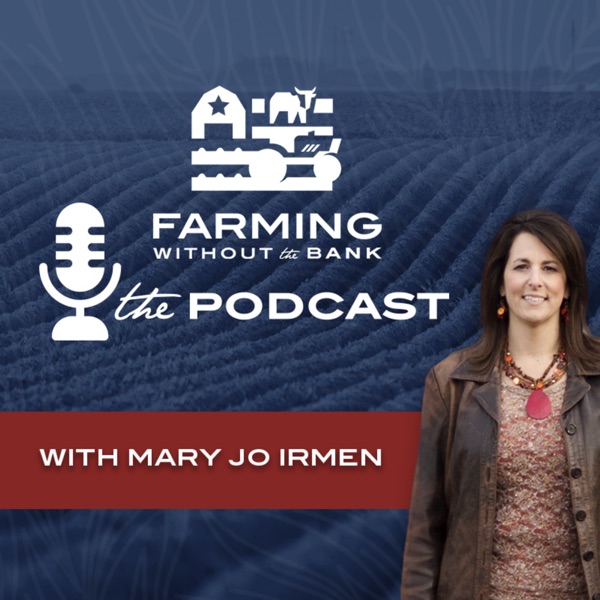
Farming Without the Bank Podcast
Welcome to the Farming Without the Bank podcast, the show with a no-B.S. approach to money, hosted by a farm strategy expert and authorized IBC practitioner.
Join us as we get real and expose the flaws of traditional financial institutions in order to help farmers take control of their finances, create peace of mind, grow their wealth, and leave a legacy.
- Episodes
- 378
- Releases
- Weekly
- Typical length
- 25 min
- On air since
- 2019
- Latest episode
- 4 days ago
Episodes
378 episodes, newest first
-
18 min
What If the Cattle Market Collapses? Why Debt-Free Isn't Enough (Ep. 378)
Show notes
Your CPA isn't being difficult — they've just never been taught how this works. In Ep. 378, Mary Jo Irmen answers the question she gets more than any other: how does money actually flow through a whole life policy?
She walks the full loop out loud: income comes in, you pay your premium, your cash value grows, you borrow against it for an income-producing asset like cattle, and the income from that asset pays the loan back. Same bucket of income, same premium, year after year. Then she flips it — what happens when you borrow for something that doesn't produce income, like a pickup — and why that is no different from asking a bank for money you can't repay.
She also answers a client's hardest question: "What if it all falls apart?" If the cattle market collapses, your cows, trailers and squeeze chutes aren't worth what they're worth today, because who's going to buy them? Debt-free doesn't protect you from that. Money still earning uninterrupted compound interest and dividends does.
What you'll learn in this episode:
- How cash moves through a whole life policy — premium in, loan out, repayment back - Why borrowing for a cash-flowing asset pays itself back and borrowing for a pickup doesn't - The "defined benefit plan" angle that lets you deduct premiums and still keep access to cash - Why an unpaid loan isn't fatal — your death benefit is the collateral - Using extra premium in year one as a revolving line for seed, fertilizer, feed, chemical and vet bills - Why your checking account already does this same job, and what changes when the policy does it - The real risk of being debt-free while every asset you own sits inside one industry - What Mary Jo says to readers who call six carriers and get told "you can't do that"
Buy the book: https://www.FarmingWithoutTheBank.com/Book Email Mary Jo: MaryJo@WithoutTheBank.com
Audio Production by Podsworth Media - https://podsworth.com
-
25 min
5 Things Successful Farmers Do Differently (And 1 Bonus) (Ep. 377)
Show notes
They weren't given the farm. They just think differently.
In Episode 377 of the Farming Without the Bank podcast, Mary Jo Irmen breaks down the 5 things she sees over and over in her most successful farm and ranch clients — the things that separate the top 3% from the other 97%, no matter the industry.
After working with thousands of farmers, Mary Jo shares why her clients: 1. Have no arrival syndrome — they're constantly learning 2. Were NOT given anything — most had to buy it, earn it, or build it 3. Are often starting a farm from scratch — even leaving family operations to do it 4. Are problem solvers, not victims — when markets drop or the banker says no, they pivot 5. Have a problem solvers mindset — not a victim mindset 6. Plus the bonus #6: They know their numbers and run it like a business
If you've ever thought "it's easy for them, they were handed it" — this episode will change how you see success in farming and ranching.
Buy the book: https://www.FarmingWithoutTheBank.com/Book Email Mary Jo: MaryJo@WithoutTheBank.com
Audio Production by Podsworth Media - https://podsworth.com
-
25 min
Farmers Are Going Broke Trying to Avoid Taxes (Ep. 376)
Show notes
It's that time of year — everything's on sale for tax purposes. But is buying that $300,000 piece of equipment to save $36,000 actually keeping you broke?
Mary Jo breaks down why avoiding taxes is the #1 reason farmers struggle with cash flow, how tiered taxes really work, and what to do instead with year-end tax planning.
In this episode:
- Why capital gains are tiered (0% up to $98,900 married in 2026) and why most farmers fear them for no reason - How ftax brackets really work — you're not saving 37%, you're often saving 12-24% - Cash vs. financing math: $300k at 7% for 7 years = $55,665/yr payment + $89,662 in interest to save $36,000 - The stacking payments trap: year 1, year 2, year 3 equipment loans + land payments - What successful operations do: pay the tax, keep the difference, operate on cash infinite banking alternative to make the bank Plan B, not the only plan - Pot bellies, balers, squeeze chutes & trailers — maintenance costs nobody calculates
Buy the book: https://www.FarmingWithoutTheBank.com/Book Email Mary Jo: MaryJo@WithoutTheBank.com
Chapters: 00:00 Year End Tax Temptations 02:00 Capital Gains Tiers Explained 05:00 How Tax Brackets Work 06:39 What Deductions Really Save 09:26 Equipment Purchase Math 11:41 Borrowing Creates Payments 14:00 Stacking Debt Over Years 17:24 Upkeep Costs Add Up 21:05 Beat Parkinson's Law 22:44 Trailer Rental Opportunity 23:51 Final Tax Decision Checklist 24:47 Next Steps And Scheduling
Audio Production by Podsworth Media - https://podsworth.com
-
20 min
Local Agent vs Expert: Why Face-to-Face is Costing Farmers Money (Ep. 375)
Show notes
Is it really THAT easy to borrow against life insurance? Yes — and Mary Jo Irmen proves it in this Farming Without the Bank Q&A.
Mary Jo answers the comments from her Farming for Profit clip, breaks down exactly how a policy loan works when structured correctly for infinite banking (pay premium, access whole life insurance cash value in 10 days, fill out an online form, ACH to your account — no payback date, no what-is-it-for questions), and why borrowing is completely different than withdrawing.
Plus: what is a 1035 exchange and when you should NOT do one (real $70-80k case study from this week), what happens to clients when Mary Jo retires, and why doing business face-to-face locally doesn't mean you're getting expert advice.
Black Sheep Summit clients: Check your email! Client-only summit is this January — held only once every 3 years. With Kody Anderson, Flint Rasmussen + client panel.
Buy the book: https://www.FarmingWithoutTheBank.com/Book Email Mary Jo: MaryJo@WithoutTheBank.com
Audio Production by Podsworth Media - https://podsworth.com
-
26 min
What Real Client Meetings Can Teach Us About Farm Estate Planning (Ep. 374)
Show notes
Real meetings, real numbers, real lessons. Mary Jo recaps recent client meetings — from a 64 and 65-year-old couple buying land for their boys, to a 22-year-old starting with a $4,000 policy, to $100,000+ policies.
You'll hear why leaving land without a plan leaves debt + operating expenses to the kids, why helping one child and not the other creates future fights, why divided interest beats undivided interest, how two guys who quit drinking turned their financial lives around, how a 50s entrepreneur beat Parkinson's Law with '08-'09 rentals, storage units and businesses, and why a timber farm shrank from 10,000+ acres by selling land to solve problems.
It doesn't matter where you start — $4,000 or $100,000 — just get started.
Learn infinite banking , estate planning , and financial freedom for farming and agriculture families with Farming Without the Bank.
Buy the book: https://www.FarmingWithoutTheBank.com/book Email Mary Jo: MaryJo@WithoutTheBank.com
Chapters: 00:00 $4K to $100K policies — just get started 00:31 Welcome back — why I'm recapping real meetings 01:43 64 & 65 buying land — kids inherit debt + operating costs 04:23 Fairness trap — helping the struggling kid only 05:49 Divided vs undivided interest — will they farm together? 07:34 Quit drinking, turned life around — love these clients 08:10 Trucker income jump — trailer rentals for cash flow 09:10 Farm hand buyout opportunity — navigating transition 12:03 22-year-old county + farm + side jobs — $4K starter + skid steer 12:45 50s multi-millionaire — handicapped daughter + market risk 14:02 Beat Parkinson's Law — '08-'09 rentals to storage to business 15:36 3D printers in front of you — stop being paralyzed, move 16:57 Excavation + multi-state ranches run like a business 18:48 Surgeon buys farm — chasing rate of return vs control 20:03 Only ag-focused IBC practitioner — farmers think generations ahead 22:25 Timber farm 10,000 to small thousands acres — insurance as operating expense 24:39 Wrap — not all will start, some super ready 25:11 Schedule with Mary Jo or John
Audio Production by Podsworth Media - https://podsworth.com
-
27 min
When It Actually Makes Sense to MEC Your Life Insurance (Ep. 373)
Show notes
Is a MEC really as bad as everyone in infinite banking says?
In Farming Without the Bank Episode 373, Mary Jo Irmen and John Hasche break down when a Modified Endowment Contract actually makes sense.
Most life insurance agents will tell you: never MEC, never MEC, never MEC. But what if you just sold a dairy, a farm, or a business and have a one-time lump sum of $2-3 million with no future cash flow to pay premiums? Mary Jo and John walk through a real client case study — 54-year-old son and 82-year-old dad splitting ~$3M after liquidating a California dairy — and compare the numbers.
In this episode:
• What is a MEC? FIFO vs. LIFO, why loans become taxable, and why the death benefit is still income tax-free
• Why a MEC can't be reversed + the 30-day letter you must open
• Case study #1: $2M single-pay on a 54-year-old — $4.4M death benefit day one, $1.8M cash value, when taxes hit in year 4 and why borrowing every year resets your basis
• Why age matters: $132k/year of taxable growth at 69, $178k at 79, $200k+ at 89
• Case study #2: $2M single-pay on 82-year-old dad — $2.4M death benefit, only ~$60k/year growth to pay tax on, $3M+ at age 97
• 3 times a MEC does work: borrow years 1-3 to buy a cash-flowing asset then stop, older insureds, long-term care / trust-owned policies
• The 1035 exchange loophole: how existing cash value can fund a single-pay without MECing
• The 10% penalty under age 59 1/2 most people forget
• Why you can't get this answer by email — goals, retirement plans, ranch vs. rentals, and future cash flow determine the strategyIf you came into a large lump sum and want a single-pay premium without paying premiums forever, don't guess if a MEC is right for you. Book a meeting and walk through the numbers.
Chapters: 00:00 MECs Aren't Always Bad 00:29 How MEC Taxation Works 03:45 Age Matters With MECs 04:27 Avoiding Accidental MECs 06:36 Client Case Lump Sum 09:24 Single Pay MEC Numbers 11:46 Basis Reset And Taxes 15:11 Alternative Insure Dad 18:25 When MEC Strategy Fits 20:41 More MEC Use Cases 23:04 Client Education Matters 26:12 Wrap Up And Next Steps
Buy the book: https://www.FarmingWithoutTheBank.com/book Email Mary Jo: MaryJo@WithoutTheBank.com
Audio Production by Podsworth Media - https://podsworth.com
-
17 min
Why the Generational Bickering in Farming Has to Stop (Ep. 372)
Show notes
Are boomer farmers actually greedy? Or are younger farmers stuck in victim mentality?
In Episode 372 of Farming Without the Bank, Mary Jo Irmen tackles the generational war in agriculture head-on — silent generation, boomers, Gen-X, millennials, and Gen Z. Young farmers say boomers are greedy for wanting top dollar for land. Boomers say millennials and Gen Z are lazy. Both sides are wrong.
Mary Jo breaks down why farmland is retirement, how auctions set the price, why no one owes you a discount, and how small to mid-size farms ARE making money when they run it like a business. Plus the rental house story, the free corn stalks story, and how to actually buy the neighbor's farm by building relationships and using buying farmland strategies with farming without the bank .
Stop categorizing. Start building. Learn how to fund farm succession and buy land without begging the bank.
Buy the book: https://www.FarmingWithoutTheBank.com/book Email Mary Jo: MaryJo@WithoutTheBank.com
Chapters: 00:00 - Stop Calling Boomers Greedy 01:45 - Why This Episode Had To Happen 03:00 - Victim Mentality Gets You Nowhere 04:30 - It's Their Land, It's Their Retirement 06:30 - Auctions Set The Price, Not Greed 08:15 - The Rental House and Free Corn Stalks Stories 10:15 - Small Farmers ARE Making Money 12:00 - Side Gigs and Off-Farm Jobs To Get Started 13:30 - You Won't Buy Land By Insulting The Owner 15:00 - Millennials and Gen Z Are NOT Lazy 16:30 - How To Actually Buy The Farm
Audio Production by Podsworth Media - https://podsworth.com
-
17 min
Trolls vs. Productive People: Who Wins? (Ep. 371)
Show notes
It's TROLL DAY on Farming Without the Bank Ep 371 with Mary Jo Irmen — and the trolls brought their best hate comments.
Mary Jo reads them all and answers back: charging her own son 9% interest (vs 11% at the bank), helping a client farm 6,000 acres from scratch, why dividend-paying whole life insurance beats parking cash, and why the rich get richer when money is redistributed.
If you've ever been told "never finance anything," "never charge your kids interest," or "no one buys a farm as an investment" — this episode breaks down the broke mindset vs. abundance mindset behind those comments, and how to use infinite banking and farm finance principles to keep control of your money.
Buy the book: https://www.FarmingWithoutTheBank.com/book Email Mary Jo: MaryJo@WithoutTheBank.com
Chapters: 00:00 Why Comment At All 00:17 Welcome To Troll Day 01:34 Rocky And Ray On Debt 03:21 Policy Question And Scam Claims 04:25 Money Skills And Wealth Mindset 07:09 Farm Investment Trolls 09:35 Charging Kids Interest Explained 13:02 Victim Mentality Vs Abundance 16:49 Final Thoughts And Book Plug
Audio Production by Podsworth Media - https://podsworth.com
-
15 min
Stop Lending to Your Kids From ONE Policy (Do This Instead) (Ep. 370)
Show notes
Lending money to your kids from ONE policy is a recipe for a family fight. In this episode, Mary Jo Irmen shares 2 creative strategies she used this week to solve real client problems around kids, money, and fairness.
If you have 3 kids and help one start a business and another go to college — how do you make it fair to the third kid when you die? And what do you do when your 16-year-old has $30K from 4-H/cattle sales but can't own a policy or do extra premium in year one?
Mary Jo breaks down exactly what to do.
IN THIS EPISODE:
• Why 3 kids = 3 separate policies on MOM (same amount, same insured) is the fairest way to lend
• How Susie's loan gets repaid from HER death benefit — no tracking payments, no sibling fights
• Why you CAN'T just "put policies on the kids" — human life value & 30x income rule explained
• The minor money hack: Use your 15/16 year old's cash to buy a policy on YOU, make them beneficiary, then transfer ownership at 18
• Why kids under 18 can have MORE insurance than at age 25
• Why your agent needs to ask about family dynamics BEFORE selling you a policyChapters: 00:00 Why Strategy Matters 00:47 Podcast Intro and Focus 01:17 Three Kids Unequal Help 02:44 Separate Policies Per Child 04:06 Limits Insuring Adult Kids 05:34 Minor Money Workaround 09:15 Ownership and Cash Value 10:32 Insurance Value Rules 12:03 Experience Drives Creativity 13:51 Wrap Up and Next Steps
Buy the book: https://www.farmingwithoutthebank.com/book Email Mary Jo: MaryJo@WithouttheBank.com
Audio Production by Podsworth Media - https://podsworth.com
-
21 min
Why Farmers Stay Broke & How to Actually Keep More of Your Money (Ep. 369)
Show notes
Mary Jo's back with three money topics every farmer and rancher needs to hear. The thread running through all of them: it's not how much money you make — it's how you USE it.
In this episode: the private equity news making headlines in the life insurance world (and why Mary Jo's clients don't need to panic), the "no medical exam up to $4 million" hook being pitched to farmers on Instagram, and the scarcity mindset that's holding back the entire agriculture industry — including why letting your hired man run a few cows might be the smartest move you make.
What you'll learn:
• Why private equity in life insurance isn't the crisis the headlines suggest
• The truth behind "express underwriting" and no-medical-exam policies
• Why lying on an application means your claim won't get paid
• "If you can't manage a dollar, you can't manage a million"
• The scarcity mindset — and why helping your employees succeed helps YOU⏱️ Chapters: 0:00 Intro & What's On Today's Mind 1:12 Private Equity in Life Insurance (Mass Mutual in the News) 4:05 The "$4M No-Medical" Hook Targeting Farmers 11:19 It's Not What You Make, It's How You Use It 15:08 Let Your Hired Man Run Cows? The Scarcity Mindset 21:23 Wrap-Up & How to Reach Mary Jo
📧 Questions or a topic you want covered? Email Mary Jo at maryjo@withoutthebank.com 📚 Grab the books: https://www.farmingwithoutthebank.com/book
#FarmingWithoutTheBank #InfiniteBanking #ScarcityMindset #Agriculture #AmericanFarming
Audio Production by Podsworth Media - https://podsworth.com
-
1 hr 42 min
Why You Need to Plan for Long-Term Care Before the Crisis Hits (Ep. 368)
Show notes
The biggest threat to your farm's legacy isn't the bank — it's an unplanned long-term care event. In this episode, Mary Jo Irmen sits down with long-term care expert Michelle Prather, author of Who's Wiping Your Assets?, to unpack why modern long-term care insurance is nothing like the outdated "flip phone" policies you may be picturing.
Michelle breaks down the reality most families ignore until it's too late: there's a 91% chance you or your spouse will need care — and care today can run $8,000 to $15,000 a month, fast liquidating the very assets you spent a lifetime building. For the agriculture community — often "land rich, cash poor" and laser-focused on legacy — the stakes are even higher.
You'll learn:
- Why long-term care isn't just for the elderly — cancer, strokes, and farm accidents don't check your age first - The difference between old rigid policies and new flexible ones (including home care and caregiver respite) - How to fund coverage tax-efficiently using IRA distributions or cash-value life insurance — sometimes saving six figures versus paying premiums traditionally - Why lifetime coverage matters, especially for couples and women - The critical reason you must plan before a crisis — as Michelle puts it, "my house is already on fire" is no time to shop for coverage
Long-term care isn't about nursing homes. It's about protecting your assets, your family, and your dignity — so the next generation inherits the farm, not the bills.
Get the book: https://FarmingWithoutTheBank.com Email: MaryJo@WithoutTheBank.com
Schedule an appointment with Michelle: https://link.captivationhub.com/widget/bookings/without-the-bank-care-income-planning
Chapters: 00:00 Introduction 00:46 Meet Michelle Prather — Long-Term Care Expert 01:15 Why Long-Term Care Planning Matters for Farmers 02:30 Premium Examples: What Coverage Actually Costs 05:00 Payment Options: Single-Pay vs. 10-Pay vs. 20-Pay 07:30 What Triggers a Long-Term Care Payout 14:56 Lifetime Coverage vs. Limited Benefit Periods 25:00 Old "Flip Phone" Policies vs. New Flexible Policies 29:45 Why Having a Good Agent Matters 34:59 Are Long-Term Care Premiums Tax-Deductible? 37:59 Funding Premiums with IRAs & Annuities 43:50 The Death Benefit in New Policies 48:50 Health Conditions & Eligibility: When It's Too Late 53:00 Elimination Periods & Paying Family for Care 1:04:45 Premium Waivers & Joint Policies 1:07:00 Long-Term Care for the Wealthy 1:15:52 Long-Term Care with Limited Assets & Medicaid 1:24:58 Paying Premiums with Cash-Value Life Insurance 1:41:27 Michelle on Working with the Farming Community 1:49:30 Final Thoughts & Contact Info
-
18 min
5 Things to Watch for When Buying a Policy (Ep. 367)
Show notes
Buying a whole life insurance policy for infinite banking? Many agents have no idea what they're actually selling you — and it could cost you decades of compound growth.
In this episode, Mary Jo breaks down the 5 things you MUST check before you sign anything, based on a real client who bought from a local agent instead of coming to her first (and what he got wrong):
1️⃣ Does it have cash value in Year 1? (If not, you bought traditional whole life — not a policy designed for infinite banking) 2️⃣ Is there a Paid-Up Additions (PUA) rider — and how flexible is it? 3️⃣ Is there term insurance riding on it, and does the death benefit drop off later? 4️⃣ Is it a dividend-paying policy, and where are those dividends going? 5️⃣ Is your agent talking about a "rate of return"? (If so, it's not whole life — run)
Mary Jo also shares the real story of her husband's policy losing $500,000 in death benefit overnight when a level term rider dropped off — a mistake she now makes sure her clients never repeat.
⏱️ TIMESTAMPS 0:00 – Why Mary Jo won't give advice on a policy she didn't sell you 1:46 – The 5 things to check before buying a whole life policy 8:12 – How her husband's policy lost $500K in death benefit overnight 14:35 – Recap: the 5-point checklist 15:57 – Why "just tell me how to use it" doesn't work that way
Want Mary Jo or John to review an illustration you've already been sold — or one someone's trying to sell you? Email the show. We'll tell you exactly what to watch for.
📚 Grab the books: Farming Without the Bank + Becoming Your Own Banker (bundle available)
#InfiniteBanking #WholeLifeInsurance #infinitebankingsystem #infinitebankingconcept
Audio Production by Podsworth Media - https://podsworth.com
-
19 min
Your $6,000 Annual Premium Grows to $843,000? Here's How (Ep. 366)
Show notes
Mary Jo Irmen walks through a real whole life insurance policy illustration for a 27-year-old client paying just $6,000 a year — and the numbers might surprise you.
In this episode, Mary Jo breaks down what the cash value growth actually looks like year by year, what happens when you add extra premium in year one, and why so many people have been waiting too long to get started when they didn't need to.
What you'll learn in this episode:
- Why $500/month ($6,000/year) is enough to build serious cash value over time - How compound interest and dividends work once your policy "crosses over" (around year 4) - The paid-up additions rider and why it accelerates your break-even point to year 7 - What happens if you put in an extra $11,000 in year one — and how that impacts your cash value at age 82 - Why paying in $211,000 over a lifetime can result in $843,000+ in accessible cash value - How health ratings affect death benefit (not cash value as much as you think) - Why you should stop waiting until you "have enough" — and just start
Ready to get started? 📧 Email Mary Jo: maryjo@withoutthebank.com 📧 Email John: john@withoutthebank.com 📚 Grab the book bundle (Farming Without the Bank + BYOB + Life): https://www.farmingwithoutthebank.com/book
Chapters: 00:00 Cash Value vs Death Benefit 00:44 Why Start Small Now 03:19 Case Study Setup 03:46 6000 Premium Walkthrough 06:10 When Cash Value Overtakes Premium 06:34 Avoiding MEC and Long Term Results 07:47 Using Cash Value Loans 08:51 Term Blend and Death Benefit 09:37 Adding Extra Year One 11:37 Break Even Faster 14:22 Age and Health Impact 16:51 Dividend Assumptions and Next Steps 17:53 Books and Contact Info 18:56 Closing Remarks
Audio Production by Podsworth Media - https://podsworth.com
-
16 min
You Don't Need $100,000 to Start Infinite Banking - Here's Why (Ep. 365)
Show notes
Are you waiting until you have more money before starting infinite banking? Mary Jo Irmen explains why you may not need $100,000—or even a large amount of money—to begin.
In this episode of Farming Without the Bank, Mary Jo discusses why people often delay after reading the book, how to identify a comfortable starter premium, and why starting with a smaller policy can be better than waiting indefinitely. She also explains how a system of multiple policies works, how to use future cash flow from paid-off loans or side work, and why planning ahead for family land and estate needs matters.
The goal is not to force a premium that does not fit your situation. It is to make the appointment, look at the numbers, and determine what is realistic for you right now. As Mary Jo explains, the numbers in the book are examples—not requirements. Sometimes, you simply need to subtract a zero and start where you are comfortable.
Chapters: 00:00 Stop Waiting To Start 00:57 Podcast Intro And Big Question 01:11 Why People Delay After Reading 02:51 Using Policies Not Saving 03:52 Finding A Starter Premium 06:13 System Of Multiple Policies 07:35 Family Land And Dad Policy 10:23 Create Cash Flow Ideas 13:24 Make The Appointment 14:53 Reread And Next Steps
#FarmingWithoutTheBank #InfiniteBanking #WholeLifeInsurance
-
26 min
Who's Really Calling About Infinite Banking? Real Meetings, Real People (Ep. 364)
Show notes
What does infinite banking look like in the real world? From bankers and veterans to city kids buying their first ranch — here's a glimpse into the conversations happening behind closed doors.
In Episode 364 of the Farming Without the Bank podcast, Mary Jo Irmen shares a candid recap of recent client meetings that span the full spectrum of agriculture and financial planning — and proves that it doesn't matter where you start, it matters how you think.
In this episode, you'll hear about:
Two bankers whose own clients brought them the infinite banking book — and what they learned A real enforced illustration breakdown on a universal life insurance policy (the numbers are eye-opening) Why military veterans MUST get whole life insurance before any PTSD or TBI diagnosis A mobile vet couple running their ranch like a true business with smart LLC structure A veteran looking to buy land — and the insurable interest challenge that comes with PTSD A mobile home repair entrepreneur dominating a four-state niche Hired hands getting a leg up by running cattle through a feedlot A nurse with a dream to build a rural hospice center And the story of a city kid with zero farming background who bought land, found a mentor, and built a real cattle operation from scratch
💡 Key takeaways:
You CAN start farming from scratch. You CAN build from nothing. The people who make it aren't lucky — they just refuse to take no for an answer.
📧 Questions or comments? Email Mary Jo: maryjo@withoutthebank.com
#FarmingWithoutTheBank #InfiniteBanking #WholeLifeInsurance #FarmFinance #StartFarming #AgriculturalFinance #beginnerfarmer
Chapters: 00:00 Ag Dreams Big Small 00:30 Podcast Updates Format 01:34 Staying In Your Lane 02:29 Bankers React To IBC 04:01 Dad Policy Cost Spiral 07:04 No Lapse Rider Warnings 09:09 More Meetings New Faces 09:37 Vet Clinic Ranch LLC 11:22 Veteran Land Insurance 14:07 Taxes Tennessee Homestead 15:11 Niche Success Mobile Homes 16:16 Hired Hands Build Equity 18:47 Hospice Land Vision 20:06 Starting From Scratch 24:01 Cowboy School Mentorship 25:34 Wrap Up And Feedback
-
24 min
Farmland Was Paid Off Until This 'Strategy' Created $38 Million in Debt (Ep. 363)
Show notes
An Iowa widow is suing her financial advisor and two life insurance companies after a premium-financed IUL strategy left her family farm buried in $38 million of debt. Mary Jo has been warning about this exact scheme for years — now there's a real lawsuit to prove it.
In Episode 363 of Farming Without the Bank, Mary Jo Irmen breaks down the November 2024 lawsuit involving a debt-free Iowa farm family who was sold $23 million in IUL coverage — with $2.5 million in annual premiums financed through bank loans secured by their paid-off farmland. The strategy was sold as a way to protect the farm from estate taxes. Instead, it put the entire farm at risk.
In this episode:
• The full story behind the Iowa widow's lawsuit (agent Davis, Emeritus, and PacLife)
• How premium financing works — and why it's especially dangerous for farm families
• How unethical agents exploit estate tax fears to target debt-free farmers
• The difference between "churning" and "twisting" — and why neither costs agents their license
• Why the original $5 million policy would have been enough all along
• Red flags to watch for if someone is pitching this strategy to you or your familyThe original $5 million policy would have covered everything. Instead, the debt hit $38 million. Don't let this happen to your farm.
If you've been presented with a premium-financed IUL strategy — or know someone who has — reach out before signing anything. Mary Jo and John will review it at no charge.
📧 Mary Jo: maryjo@withoutthebank.com 📧 John: john@withoutthebank.com
#FarmingWithoutTheBank #IULInsurance #PremiumFinancing #FarmEstatePlanning #FarmlandProtection
Chapters: 00:00 Premium Finance Warning 00:29 Why This Must Be Shared 03:23 The Iowa Lawsuit Begins 03:36 Agent Background Questions 05:40 Churning and Twisting Explained 08:33 How The Farm Got Pitched 12:10 Premium Financing Mechanics 14:14 Why The Numbers Collapse 19:50 Who To Trust For Advice 22:56 Share and Get Help
-
1 hr 7 min
Fake Bids, Hidden Fees & Shady Auctioneers: Land Auctions Exposed (Ep. 362)
Show notes
One wrong auction company can cost you the true value of your land — and you'd never know it.
👉 Find more Farming Without the Bank here: https://www.youtube.com/channel/UCXYvzroUouEMsTGKFw5nJHQ 👉 Get the book: https://www.farmingwithoutthebank.com/book
Amber Haugland of Haugland's Action Auction joins the show to pull back the curtain on a side of the land auction world most farmers never see coming. Whether you're selling the family farm, bidding on land next door, or starting to think about your estate, this episode could save you tens of thousands of dollars.
IN THIS EPISODE: ✅ How to vet an auction company before you sign a single thing ✅ The "fake bid break" tactic — and exactly what to watch for in real time ✅ Why comparing commission rates alone will get you burned ✅ Sealed bid + live top-5 auction: why it consistently gets sellers the best price ✅ What buyers should NEVER tell an auction company ✅ Online auctions: the transparency problems and hidden buyer fees ✅ Owner financing through auction — how it works and why more people don't know about it ✅ Why naming your auction company in your estate plan prevents family war ✅ The ripple effect unethical auctioneers are having on farmland prices for everyone
Chapters 00:00 Step Back First 00:35 Podcast Intro 01:54 Seller Due Diligence 04:24 Marketing That Works 05:22 Verify Mailers Sent 08:10 Commission And Hidden Fees 11:27 Pressure Tactics Warning 12:38 Auction Types Explained 12:55 Phony Bids And Breaks 16:48 Sealed Bid Strategy 20:11 Online Auctions Problems 25:00 Reserves And Starting Bids 29:43 Market Distortion Fallout 35:02 Don't Tip Your Hand 37:39 True Land Value Metrics 39:12 Survey Cost Surprise 40:56 Buyer Prep and Price Discipline 42:19 Auction Red Flags and Transparency 42:58 Funny Money and Asking Who 45:22 Tenant Offers vs Auction 49:00 Keep Your Cards Close 50:33 Owner Financing Options 52:36 Risks and Screening Buyers 56:31 Sibling Disputes and Estate Planning 01:03:02 Sell Sooner and Enjoy It 01:07:52 Wrap Up and Contact Info
Connect with Amber Haugland: 🌐 https://hauglandsactionauction.com 🌐 https://hauglandinsuranceservices.com
📘 Get the Book: https://www.farmingwithoutthebank.com/book 📩 Questions? MaryJo@WithoutTheBank.com
#LandAuction #Farmland #FarmingWithoutTheBank #estateplanning
-
26 min
We Paid Into This Policy for Decades and Got Nothing | Real Numbers Every Farmer Needs to See (Ep. 361)
Show notes
Are you wondering if your life insurance policy will actually be there when your family needs it? Mary Jo Irmen walks through multiple real-life life insurance policy review illustrations showing exactly how flexible premium universal life, variable universal life (VUL), and adjustable universal life policies perform over time — and why so many of them collapse before you're likely to die, leaving your family with no death benefit and no cash value.
What you'll learn in this episode:
• What an in-force illustration is and how to request one from your carrier
• Why universal life policies often reach zero cash value before the insured's death — leaving families with NO death benefit
• Real example: $82,000 paid into a policy → zero payout at death
• How a VUL policy on a 38-year-old lapses completely by age 79
• The difference between "current charges" and "max charges" — and why it matters for your life insurance policy lapse risk
• Why whole life insurance (with paid-up additions rider) is the superior alternative for farm estate planning and farm succession planning
• How whole life insurance cash value grows predictably compared to universal life
• Why IUL (indexed universal life) and variable universal life insurance carry hidden risks most agents don't explain
• What to ask your agent when you get your in-force illustration
• How whole life insurance for farmers fits into a financial planning and infinite banking strategy📋 Get your in-force illustration and email it to Mary Jo before your appointment — MaryJo@withoutthebank.com📗 Get the books: 👉 Life Without the Bank + Nelson Nash's Infinite Banking book bundle: withoutthebank.com
Chapters: 00:00 Policy Collapses Shock 00:46 Podcast Intro and Goal 01:35 How to Read In Force 03:27 Flexible Premium UL Example 07:02 VUL Charges and Lapse 13:18 VUL Falls Apart at 70 17:17 Adjustable UL Lapses at 87 19:11 90 Year Old Policy Runs Out 20:39 Why This Keeps Happening 24:36 Wrap Up and Next Steps
-
41 min
We Tried Virtual Fence on Goats & Sheep (Real Farm Results) (Ep. 360)
Show notes
What if you could finally have goats and sheep — without building miles of netting or chasing escapes? That's exactly what virtual collars made possible for Meg Greske, and she breaks down EVERYTHING in this episode.
👉 Follow Mary Jo Here: https://www.youtube.com/channel/UCXYvzroUouEMsTGKFw5nJHQ 👉 Get the book: hhttps://www.farmingwithoutthebank.com/book
Mary Jo sits down with client and regional conservation consultant Meg Greske (Oklahoma Conservation District) to dig into real-world results of using NoFence virtual collars on sheep and goats — from cost and training to wool vs. hair breed differences, company comparisons, and whether the data privacy concerns are worth worrying about.
In this episode: 💲 Real cost breakdown: NoFence collars ($240–$270/collar + ~$3–4/month after year 1) 🐐 Why goats train fast — and why wool sheep take weeks longer 🆚 NoFence vs. Halter vs. Gallagher vs. Moneal vs. Vence — what's actually different 📡 Base station drama: why Halter just went base-station-free and what it means 🔒 The "tinfoil hat" question: data privacy, tracking, and who owns your herd data 🐑 OSU research on animal stress — is virtual fence cruel? (No. Here's the proof.) 📈 How virtual collars are making intensive rotational grazing feasible for small producers 💰 Grants & cost share: SHIP program, EQIP applications, and what's coming ⏳ Should you buy NOW or wait for better tech?
Chapters 0:00 - "Buy Now or Wait?" (Cold Open) 0:50 - Intro: Meet Meg Greske 2:19 - NoFence Collar Costs & Pricing Breakdown 3:19 - Comparing the Companies: NoFence, Halter, Gallagher, Vence & Moneal 5:08 - Halter Just Went Base-Station-Free 6:40 - Base Stations: History & Why They're Becoming Obsolete 8:41 - Collar Lifespan & Battery Life 11:32 - Training Sheep & Goats: Wool vs. Hair Breed Differences 13:22 - Minimum Size Requirements & Flocking Behavior 14:05 - Running Sheep, Goats & Cattle Together 16:33 - App Ease of Use & Customer Support 18:24 - Grants & Cost-Share Programs (SHIP, EQIP) 20:43 - Data Privacy: Who Owns Your Herd Data? 22:12 - Terrain, Cell Service & Connectivity 24:42 - Intensifying Rotational Grazing With Virtual Fencing 27:18 - Goats for Hire: Brush Clearing as a Business 28:44 - Training Process Step-by-Step 29:44 - Animal Welfare & OSU Stress Research 30:46 - Health Monitoring & Future Tech Integration 32:07 - Buy Now or Wait? Meg's Final Answer 34:35 - Could Virtual Collars Work for Horses? 38:04 - Meg's Diversified Ranch Operation 39:35 - How to Reach Meg & Outro
🔔 Subscribe for weekly episodes: https://www.youtube.com/channel/UCXYvzroUouEMsTGKFw5nJHQ 📅 Client Summit — January 2027, Chandler, AZ. Watch your email for the save-the-date! 📖 Learn more: https://farmingwithoutthebank.com 💌 Email: maryjo@withoutthebank.com 📧 Meg's contact: mgcows@gmail.com
-
1 hr 8 min
Will No-Fence Collars Save You Money? (Ep. 359)
Show notes
What does it actually cost to run No Fence virtual fencing on a real cattle farming operation — and can you finance it without losing compound interest? Idaho rancher Tyson Coles has run the system for 4 full seasons and shares the real numbers.
👉 Follow Mary Jo Here: https://www.youtube.com/@MaryJoIrmen?sub_confirmation=1 👉 Get the book: https://www.farmingwithoutthebank.com/book
In this episode, Mary Jo sits down with rancher Tyson Coles to break down exactly how No Fence GPS cattle collars work, what they cost, and how they've transformed his operation. Tyson shares the actual dollars saved on labor, fuel, and equipment — plus a jaw-dropping story of moving an entire herd through an irrigation canal solo, a job that used to take 6 people and 4 hours. Mary Jo also walks through how she finances technology purchases using the Infinite Banking Concept — keeping uninterrupted compound interest working inside a whole life policy while still putting new equipment to work on the ranch.
In this episode: - How No Fence GPS collars work (without shocking your cattle) - Real ROI: labor savings, fuel costs, and heavier calves at weaning - Battery life, solar charging & reliability in rough terrain - The "reduced movement" health alert that saved a calf's life - Using Infinite Banking to finance ag tech without breaking your cash flow
💰 Get 10% off No Fence collars: https://www.nofence.com ⭐Use code TysonGraze10 at checkout. (This code is case sensitive.)
Follow Tyson on social Media: Facebook: https://www.facebook.com/tysonandstefanie.coles Instagram: https://www.instagram.com/colesfamilyfarm
Chapters 0:00 The $12,500 Return on Collars 0:48 Meet Tyson Coles: 4 Seasons with No Fence 2:17 No Fence Collar Pricing Breakdown 7:00 First Test: Grazing Cover Crops in October 9:39 How to Train Cattle with Virtual Fencing 11:46 Battery Life, Solar Charging & Replacements 15:19 Cost Breakdowns 20:08 Collar Durability & Lifespan 21:07 How Easy Is the App? (Even for Kids) 24:10 Managing Multiple Pastures & Locations 29:06 HerdNet Bluetooth: Sub-Minute Updates 30:32 Feeding Cows Remotely from 9 Hours Away 34:12 Health Alerts: Reduced Movement Detection 36:13 When to Collar Calves 38:00 Rotational Grazing Under Center Pivots 44:33 Collar Fitment & How to Find Lost Collars 47:21 Using Virtual Fencing for Sorting 48:30 Full ROI Breakdown 50:13 Grazing Standing Corn Instead of Ensiling 51:50 Weaning Weights Jump 100+ Pounds 56:40 Moving an Entire Herd Through a Canal — Solo 1:00:17 Any Downsides? Honest Assessment 1:02:33 Grants Available: EQIP & State Programs 1:04:58 Data Privacy: Is Your Herd Info Reported? 1:06:07 Discount Code & How to Reach Tyson 1:08:41 Financing Collars with Infinite Banking
On these lists
Farming Without the Bank Podcast is one of the shows picked out on this list

More in Investing
Placed highest on Apple Podcasts' Investing chart right now