Podcast
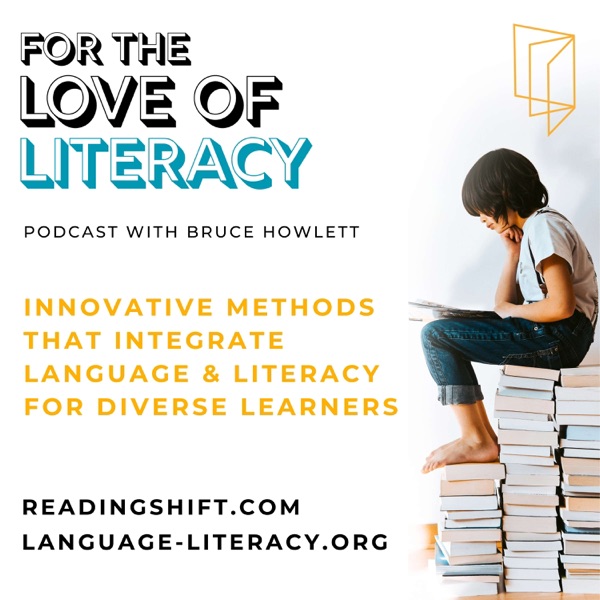
For The Love Of Literacy with Bruce Howlett
For the Love of Literacy provides podcasts about the exciting advances in literacy instruction, from morphology and orthography (the spelling system), to meaningful sight word memorization, and sentence construction and comprehension. We focus on the often overlooked aspects of literacy and their links to language development.
We tie learning to read, spell and writing to their roots in spoken language. This makes teaching and learning these abilities much easier because literacy learning is driven by language learning. The major components of spoken language plus vocabulary knowledge strongly predicting and largely determining growth in reading, spelling and writing.
Our guests are not just knowledgeable the links between language and language but know how to implement this learning in the classroom.
You will hear from noted researchers including Linnea Ehri, Marcia Henry and Peter Bowers as well as teachers who have developed lessons that engage students and enrich language abilities. Check back weekly to discover more Fulfilling Literacy Lessons and Clarifying conversations. Feel free to reach out to me at Bruce@ReadingShift.com.
- Episodes
- 27
- Releases
- Every two weeks
- Typical length
- 1 hr 2 min
- On air since
- 2025
- Latest episode
- 1 day ago
Episodes
27 episodes, newest first
-
1 hr 11 min
Rich, Engaging Multicomponent Literacy Intervention for Adolescents - Katharine Barden
Season 2, Episode 10
Show notes
What do adolescents need from a literacy intervention? Can you just take an intervention for younger pupils and use it with teenagers? Dr Katharine Barden, a literacy specialist and former linguistics researcher, discusses why she created LIfTT, the Literacy Intervention for Teens and Tweens, to meet the specific literacy needs of adolescents.
Katharine is passionate about making multicomponent literacy instruction easy to implement by providing ready-to-use resources accompanied by detailed guidance for educators. In this episode, she describes why adolescents need a multicomponent intervention that incorporates teaching at different levels of linguistic structure. In particular, integrating morphology and etymology alongside phonics is essential to make sense of English spelling, and Katharine explains how this is implemented in a structured and cumulative way within LIfTT.
You can find out more about LIfTT on Katharine’s website, The Literacy Hub:
http://www.theliteracyhub.co.uk/
The Literacy Hub also includes reviews of literacy-related books and resources, a blog about current issues in literacy teaching, and you can sign up for The Literacy Hub Newsletter.
You can also contact Katharine below:
LinkedIn: http://www.linkedin.com/in/dr-katharine-barden-845707273
Bluesky: @katharinebarden.bsky.social
-
1 hr 4 min
Beyond the Alphabetic Principle: Bringing Etymology into Literacy Instruction - Anya Maloney
Season 2, Episode 9
Show notes
Why doesn’t sounding out a word always tell us how to spell it? Bruce Howlett welcomes speech-language pathologist and literacy specialist Anya Maloney to explore common misconceptions about the alphabetic principle and how English spelling works. Anya explains how borrowing, pronunciation changes, and other historical influences shaped a system that represents pronunciation, meaning, and word history. Through examples of unexpected spellings and expansive word families, she shows how etymology can help students understand spelling, connect related words, and deepen their vocabulary. The conversation offers educators a fuller picture of English spelling and accessible ways to bring word history into literacy instruction.
Anya’s website: https://languagelearninglink.com/
SWIRV FB page:
https://www.facebook.com/share/19hwRYQN1g/?mibextid=wwXIfr
The History of English podcast: https://historyofenglishpodcast.com/
Apple Podcast link: https://podcasts.apple.com/us/podcast/the-history-of-english-podcast/id538608536
-
51 min
Infusing England's Rigid Phonics Mandates with Morphological Word Study - Andrea Dalland, Tanya Watt, Jo Johnson & Susannah Thorne
Season 2, Episode 8
Show notes
England's phonics‑first mandates struggle to engage all learners, leaving about a third of students with limited reading abilities—even when they have received years of instruction. The mandates miss opportunities to build vocabulary, comprehension and curiosity, essential literacy skills.
Meet a team of educators working to enrich instruction with Structured Word Inquiry, which blends morphology and spelling. This approach blends deep inquiry into words, offering a meaning‑rich alternative to traditional spelling instruction. Students learn that English spelling is a logical system to explore rather than a code that fails to account for all spellings.
Bullet points:
• England’s phonics‑first system—driven by Ofsted pressure, scripted SSP lessons, and high‑stakes checks—creates a bottleneck where many children stall, repeat ineffective drills, and miss out on broader reading development.
• Structured Word Inquiry offers a scientific, meaning‑centered alternative that integrates morphology, etymology, and phonology, turning word study into investigation rather than rote decoding.
• SWI boosts engagement, supports dyslexic and neurodivergent learners, and re‑energizes the teaching of early reading and spelling by replacing rigid scripts with flexible, evidence‑based tools like word sums, matrices, and word families.
• Policy shifts and grassroots UK advocacy are opening space for richer instruction, with accessible entry points—such as simple word sums and weekly SWI drop‑ins—helping teachers begin immediately.Contacts:
Andrea Dalland:
Tanya Watt: ,
Jo Johnson Language and Literacy Support: jojohns2021@gmail.com.
Susannah Thorne:
Link for the UK SWI Cohort FB group:
https://www.facebook.com/groups/1401185435025834/
The FB group for the Drop-In:
https://www.facebook.com/groups/1536607167483053/
The International Drop-In meets every Thursday at 12:30pm London time.
The Zoom link is available in the FB group
-
58 min
The Word Mapping Project: Engaging Every Learner in Vocabulary, Morphology, Spelling & Writing Instruction - Sean Morrisey
Season 2, Episode 7
Show notes
Do you want to get excited about teaching words, vocabulary, spelling, and writing instruction? Do you want to see your students embrace these subjects as enriching and empowering abilities — not just another academic task? Sean Morrissey points the way with The Word Mapping Project, a series of clear, consistent 35-minute lessons that integrate these language and literacy abilities using cognitive learning principles that make instruction stick.
Sean, a school psychologist who became a classroom teacher, discusses the excitement that comes from seeing diverse groups of students embrace reading, spelling, vocabulary, and writing tasks they once avoided. Sean makes integrating this innovative and enriching approach simple enough all teachers to embrace, including classroom and content area teachers, EL and intervention specialists, SLPs and tutors.
Website: http://www.wordmappingproject.com/
X handle: https://x.com/smorrisey @smorrisey
Substack: https://seanmorrisey.substack.com/
-
1 hr 1 min
Building Executive Function Skills into Literacy Sessions - Beth Coppoc Gunshor
Season 2, Episode 6
Show notes
Do your students struggle to stay focused, avoid distractions, begin and complete assignments, or remember directions? Would you like to help them resist impulses, switch between tasks, and manage their thoughts and behaviors?
Speech-Language Pathologist Beth Coppic Gunshor discusses how these executive function (EF) skills play out when working with students, turning abstract concepts into practical activities that build academic and life-defining skills. Learn how Beth uses self-talk, whiteboard clocks, and flashlights to help her students remember past events so they can visualize the future to decide what action to take right now.
Resources mentioned during For the Love of Literacy’s podcast on literacy and executive function with Beth Coppoc Gunshor
Cognitive Connections: Sarah Ward and Kristin Jacobson
Video about working clock, starting at 30 minutes
Tera Sumpter: Seeds of Learning
Gretchen Wegner: Anti-Boring Learning Lab
Michael Mcleod: GrowNow ADHD
Video of Dimensional Change Card Sort Test
Center on the Developing Child: Building the Brain’s “Air Traffic Control” System: How Early Experiences Shape the Development of Executive Function
-
1 hr 4 min
Two Dyslexic Adults: What We Wish Our Teachers Knew About Language and Learning: Sara Lee talks with Marie Foley & Bruce Howlett
Season 2, Episode 5
Show notes
“If only we, as dyslexics, had learned how the English writing system works—from words to sentences—when we were in elementary school! Maybe we wouldn’t have struggled with language and literacy.”
For decades, non-dyslexic individuals have been telling dyslexics how they learn, often focusing strictly on early literacy skills. This offers a very limited view of dyslexia. Listen to two adult dyslexics, literacy instructor Marie Foley and For the Love of Literacy host Bruce Howlett, discuss their decades-long struggle with reading comprehension, complex word spelling, and written expression. Your understanding of dyslexia will be transformed.
In this episode, Bruce hands over hosting duties to linguist Sara Lee. Sara works with Marie and Bruce on grammar and syntax, taking them beneath the surface of words and sentences while exploring new learning methods. Today, Marie and Bruce are utterly fascinated by language and its many connections to literacy. Best of all, written and spoken English finally make sense!
-
41 min
Vocabulary Development Through Morphology, Semantics and Complex Text - Elfrieda Hiebert
Season 2, Episode 4
Show notes
If your students read accurately but with limited fluency, comprehension or interest then Elfrieda “Freddy” Hiebert’s talk will be of great benefit. Freddy summarizes her decades of research, showing how vocabulary depth and richness are key components of reading comprehension and written expression.
Dr. Hiebert has created two essential materials: Teaching Words and How They Work, and TextProject.Org. Teaching Words centers literacy instruction on vocabulary development and how children learn, understand and read complex words. She notes that most students read with high accuracy, but with limited fluency and vocabulary depth.
To address this widespread problem, Freddy’s TextProject.org provides free resources for teaching vocabulary development and semantics, or word meaning. The site includes ready-to-use word webs, Exceptional Expressions and Super Synonyms as well as reading material for emerging readers, content areas and Teen Reads.
The subtitle of Teaching Words is Small Changes for Big Vocabulary Results. Dr. Hiebert talks about the importance of small changes, not wholesale shifts, for improving instruction.
-
1 hr 2 min
Connecting Math and Literacy Learning Difficulties - Meghan Hicks & Jennifer Petrich
Season 2, Episode 3
Show notes
Many students who struggle with literacy also struggle with math.
• Understanding the number system requires engaging linguistic, cognitive, executive functions and conceptual understanding -- just like literacy.
• Meaning is as important to math learning as it does in literacy.
• Math that is taught as a series of isolated procedures, facts and “islands of knowledge” disconnected from meaning will make little sense - just as it does with reading.
• Math makes sense when students learn the structure of math, including its syntax and vocabulary, and approach it as a coherent system. This also diminishes math anxiety.Bruce Howlett’s Seven Layers of Literacy Approach: https://www.readingshift.com/
Megan Hicks: scienceofthesentence@gmail.com
The Sentence Studio http://www.scienceofthesentence.com/
Jen Petrich:
• Literacy Dr website: https://www.theliteracydr.com/
• · D.O.T.S. course info and registration: https://www.theliteracydr.com/pd/dots
• · Wednesdays with Literacy Dr (free drop-in) info and registration: https://www.theliteracydr.com/drop-in
• · Literacy Dr videos https://www.theliteracydr.com/videos
• · List of Resources for Further Learning -
1 hr 3 min
Enriching Structured Literacy Through Integrated Word Study - Sarah Mitchell
Season 2, Episode 2
Show notes
Why do so many students continue to struggle with spelling and writing even after years of phonics instruction? In this episode, Sarah Mitchell explores the missing layer between decoding instruction and deeper literacy transfer: integrated word study.
Drawing on research, classroom experience and practical teaching examples, Sarah explains how word-building using a six-layer “word study map” that develops sounds, meaning, spellings, connections, morphemes and sentences in the same lesson. The more connections a child has with a word the easier it is to recognize, comprehend and use it while writing.
The conversation explores the implementation gap many teachers experience — understanding the theory but still feeling unsure how to apply it during real lessons — and introduces practical ways to make literacy instruction more connected, efficient and meaningful for older students.
Sarah Mitchell
Author - Teaching Structured Literacy Series
Contact Info: admin@teachingstructuredliteracy.com
Structured Literacy for Older Students:
https://www.facebook.com/groups/360409786946482Founder - Morphology Hub
Website: http://www.morphologyhub.com/Social media: YouTube @sarahmitchell3941
-
1 hr 5 min
Scripts, Sentences and Structures: Helping Students Unlock Meaning - Louise Hewitt, Meghan Hicks & Mary Beth Steven
Season 2, Episode 1
Show notes
Teaching about morphemes (the meaningful components of words), sentence structure (syntax) and grammar (the framework for organizing words and sentences) isn’t hard, once you learn about two new resources: Mary Beth Steven’s Dramatic Scripts and Meghan Hicks and Louise Hewitt’s The Sentence Studio. In fact, you can learn about these vital components of language as you teach your students by using their scripts, sentence and text practices. Their common goal is to create insightful readers and articulate writers.
These educators recognize that word study, syntax and grammar go to the heart of reading comprehension and written expression. They also focus on responsive teaching that brings these topics alive through rich highly engaging activities.
Mary Beth Steven book, Enhancing the Teaching of Morphology and Grammar with Dramatic Scripts for the Classroom, uses plays to build reading comprehension while creating a collaborative classroom. Meghan and Louise’s new instructional guide, The Sentence Studio, teaches grammar and syntax with fables and a groundbreaking BubbleMap analysis strategy. Educators and students discover the artistry of sentence structure while unlocking the meaning that lies within every sentence
You can find more information about Mary Beth’s book on her classroom blog
You can purchase The Sentence Studio and access free downloads and other supporting resources at Meghan and Louise’s website
-
1 hr 23 min
Meet the Students (A.K.A. Humans) of the Boring (into words) Scholars Collective - Sara Leland & Students
Season 1, Episode 18
Show notes
Title: Meet the Students / Humans of the Boring (into words) Scholars Collective
Listen Sara Leland’s students, five humans who have dyslexia, ADHA and/or autism. With Sara’s guidance and support they grew to love literacy. They joined together and built a website http://www.boringscholarscollective.site. The boring scholars used their writing, creative and artistic skills to express their love of reading and writing through the website. Learn how they became word detectives, deeply investigating the spelling, meaning and history of words.
Sara shares how she develops a fascination for words in children who may have struggled with basic skills. She explains that the ultimate purpose of education is human development, helping children to grow into capable, curious, creative and empathic citizens. You’ll also learn how a philosopher views language, filled with metaphors and narratives, fueled by critical thinking.
Sara’s own website is:
Sara can be contacted through the site or by email at:
sara.wordscholars@gmail.com
-
59 min
The Sentence Pathway to Decoding and Comprehension -- Xiuhong Tong & S. Hélène Deacon
Season 1, Episode 17
Show notes
If you have ever wondered why your students struggle with word reading, or read accurately but with limited comprehension, then you may want to flip your approach to reading instruction. Start at the sentence level by using Xiuhong Tong and Hélène Deacon’s groundbreaking Linguistics Pathways Model, which provides two parallel paths leading to reading comprehension.
The first pathway leads to word recognition by morphological decoding. Deacon and Tong show how word reading and meaning arise from an awareness of how morphemes—the meaningful components that compose all words—are linked to graphemes. Unlike phonics decoding, students develop word reading, spelling and vocabulary knowledge in unison, which supports reading comprehension.
The second pathway is a syntax to sentence pathway. Syntax, the blueprint for creating and understanding sentences, is the layer of language that most directly supports reading comprehension and fluency. Together, words are not only read with meaning but as part of meaningful sentences – which largely determines text comprehension.
Xiuhong Tong and S. Helene Deacon 2025. The Linguistic Pathways Model: Capturing the Multiple Dimensions of Reading Development. Reading Research Quarterly
-
1 hr 5 min
Four Powerful Word, Sentence, Text and Cognitive Routines for Teaching Writing - Meghan Hicks
Season 1, Episode 16
Show notes
Meghan Hicks returns to talk about how teaching structure at the word, sentence, and text levels can help students make sense of the writing process. We often discuss literacy as a system and the importance of students understanding how it works. Meghan explains the broader system and how her students discover that the whole is much greater than the sum of its parts.
You’ll learn that syntax—how sentences are constructed from words, phrases and clauses—isn’t an abstract language concept. Rather, it is a straightforward way to improve reading comprehension and sentence construction. Meghan explains a simple sentence diagramming method that provides visual representations of sentence structure.
Meghan also dives into the cognitive aspects of writing, starting with thinking. Students who can structure their thoughts are better able to structure their sentences. You learn about the four categories of thinking and how they influence students’ writing.
You can contact Meg at ThinkWriteReadCommunity@gmail.com
or visit the Think~Write~Read Community
Bruce Howlett's Seven Layers of Literacy Project - https://www.readingshift.com/
-
53 min
Respecting the Social, Emotional & Academic Needs of Dyslexic Individuals -- Bonnie Feeney & Jen Petrich
Season 1, Episode 15
Show notes
Bonnie Feeney, a dyslexic mother and Jen Petrich, her PhD neuroscientist daughter discuss dyslexia from a unique perspective—one of from a journey of personal discovery and the other from studying brain science. Hear how their journeys came together, enriching both their lives.
Learn the difficulties that dyslexics confront within and beyond the classroom. Dyslexics share more than a diagnosis and supporting them requires more than just a reading intervention. They deserve our respect and understanding.
For decades, Bonny experienced biases and judgments that included narrow instruction that didn’t develop her interest in language. Jen became a neuroscientist not to help her mother, but to understand neurodiversity and find methods that support students broadly. Bonny began to listen in on Jen’s tutoring sessions with students and realized that this type of word and sentence inquiry made sense to her.
A note from Jennifer Petrich: I would like to clarify a comment I made on this podcast episode that doesn’t reflect my true beliefs. In recounting someone else’s experience, I used language and framing that I no longer align with, including referring to a good IQ and not being dumb. I believe that measures like IQ do not define a person’s worth or fully capture their abilities, and I’m mindful that words we use—especially casually—can reinforce harmful assumptions. This was an unfiltered moment, and I’m committed to being more thoughtful and aware of my language and biases moving forward.
Bruce Howlett’s Seven Layers of Literacy Approach: https://www.readingshift.com/
Literacy Dr website:
https://www.theliteracydr.com/
D.O.T.S. course info and registration:
https://www.theliteracydr.com/pd/dots
Wednesdays with Literacy Dr (free drop-in) info and registration:
https://www.theliteracydr.com/drop-in
Literacy Dr videos:
https://www.theliteracydr.com/videos
List of Resources for Further Learning:
-
1 hr 1 min
Co-Creating a Community of Sentence Scholars - Rebecca Marsh & Meghan Hicks
Season 1, Episode 14
Show notes
“Just thinking about grammar and syntax raises my anxiety.” Whether you share that reaction or you just feel shaky on some aspects of writing and sentence structure, you aren’t alone. Such a complex topic is not mastered in a one-and-done class. Yet it takes intellectual courage to become a student again and not to give up, especially when we are already acknowledged experts in our professions. In these days of mandated curricula, it isn’t easy to step out of the paradigm that currently dictates how education unfolds; but these two educators, Rebecca and Meghan, have found that it is still possible to create a community of true scholarship with your students—whether youths or adults.
Meghan Hicks talks about “The Boy’s Writing Group” where her teenage students uncover the power of written communications and self-expression. The Boys learn to review and revise their sentences as a group, discovering how writing gives them a voice to express their thoughts, ideas and feelings. Unlocking the power of sentences enriches students and teachers’ lives This is particularly important in the age of limited interest in book reading, mindless Internet scrolling, social media and AI.
You can contact Meg at ThinkWriteReadCommunity@gmail.com or visit the Think~Write~Read Community
You can contact Rebecca at editforclarity@gmail.com.
-
1 hr 8 min
Spelling-Meaning Connections for Memory and Comprehension - Kimberly Murphy with Peter Bowers
Season 1, Episode 13
Show notes
“Spell what you mean, not just what you hear,” is researcher and speech pathologist Kim Murphy’s advice to students. While spelling instruction often focuses on pronunciation, spelling-meaning instruction makes so much more sense to students and their teachers. Graphemes (letter patterns) and morphemes, the meaningful core of every written word, spell words in predictable and consistent ways, even as their pronunciation shifts.
Joined by Peter Bowers, creator of Structured Word Inquiry, Kim shows that yes, English spelling is complex, but it doesn’t have to be confusing. In fact, students enjoy learning spelling-meaning connections, as they make sense and are easier to memorize and recall accurately when writing.
Kim and Pete also explain why spelling lists pale in comparison to morphological word sums and matrices, which organize the spelling of words around a common base. As a bonus, Kim shows how spelling-meaning connections benefit reading comprehension. Bruce@ReadingShift.com https://www.readingshift.com/
Kim Murphy:
Contact Kim at The Scottish Rite Childhood Language Centerin Richmond, VA.
Perfetti, C., & Stafura, J. (2014). Word knowledge in a theory of reading comprehension. Scientific Studies of Reading, 18(1), 22-37. https://doi.org/10.1080/10888438.2013.827687
Free access link https://www.lrdc.pitt.edu/perfettilab/pubpdfs/WordKnowledge.pdf
This article describes the Reading Systems Framework, in which the lexicon, or word knowledge, is a central connection point between word identification with reading comprehension. Aligned with the Lexical Quality Hypothesis (Perfetti, 2007; Perfetti & Hart, 2002), the lexicon is seen as a ‘pressure point’ in the reading system.
Murphy, K.A., & Justice, L.M. (2019). Lexical-level predictors of reading comprehension in third grade: Is spelling a unique contributor? American Journal of Speech-Language Pathology, 28(4), 1597-1610. https://doi.org/10.1044/2019_AJSLP-18-0299
Free access link https://digitalcommons.odu.edu/cgi/viewcontent.cgi?article=1052&context=cdse_pubs
This study examines the contributions of lexical-level skills to reading comprehension, and whether spelling adds anything unique to the prediction of reading comprehension. Spelling was scored using binary (correct-incorrect) and non-binary (partially correct) methods. Results showed that spelling uniquely predicted reading comprehension, above and beyond the contribution of word recognition and vocabulary combined when scored using Correct Letter Sequences. This highlights the importance of including assessment of spelling skills when evaluating children for reading comprehension difficulties.
Murphy, K.A., & Diehm, E.A. (2020). Collecting words: A clinical example of a morphology-focused orthographic intervention. Language, Speech, and Hearing Services in Schools, 51(3), 544-560. https://doi.org/10.1044/2020_LSHSS-19-00050
This paper describes a morphology-focused orthography intervention for children with word-level reading and spelling difficulties, using Structured Word Inquiry. Results comparing pre- and post-test scores showed that children improved in reading and/or spelling, and that their largest gains were in spelling affixes correctly. The study supports the use of interventions that integrate morphology with orthography and phonology to improve children’s literacy skills.
-
1 hr 14 min
Language Enriching Literacy Ideas for DLD - Kathleen Love and Beth C. Gunshor
Show notes
Language issues are a surprisingly common source of reading, spelling and writing difficulties. Developmental Language Disorder (DLD) is impacting students in your classrooms and offices. Listen to Speech-Language Pathologists Kathleen Love and Beth Coppoc Gunshor as they share about observing, supporting and teaching students with language challenges, including DLD. They provide practical methods that boost oral and written language abilities using word and sentence activities rooted in meaning. Find out the importance of showing students how words are built from meaningful parts (morphemes), as well as how to unravel complex sentences so they make sense. Walk away with a better understanding of how to support the language needs of students.
Bio description & links
Kathleen’snewsletter shares her latest musings about literacy, provides access to a ton of free curated resources, and alerts people to community events. More information about her course for literacy interventionists, Using Morphology in Literacy Intervention, can be foundhere. She also shares regularly and freely atInstagram and onFacebook, and her website ishttp://raincityreading.com. There you’ll also find hermorphology merchandise shop with shirts and wall calendars!
Beth can be reached through her website, and also found on Instagram or Facebook. She has t-shirts and stickers for sale that are related to Structured Word Inquiry.
-
1 hr
Fostering Fascination With Words & Sentences - Mary Beth Steven, Lisa Barnett, Skot Caldwell
Season 1, Episode 12
Show notes
Three experienced teachers show how to get even your most resistant students to become fascinated by words and sentences. They explain how to turn memory-draining spelling homework into an activity that enriches vocabulary, sight word mapping and provides a deep understanding of how words are constructed. If morphology and the English spelling system doesn't make sense to you and your students, they will by the end of the podcast.
Mary Beth, Lisa and Skot explain how structured word inquiry, a method developed by Peter Bowers, gets students deeply involved in investigations of a word's spelling, meaning and history. They describe how students with reading and behavior problems become fascinated by word investigations that significantly boosts their reading, spelling and comprehension abilities.
Too many reading methods don't emphasize the importance of sentence writing and comprehension, which limits their students literacy abilities. Mary Beth, Lisa and Skot explain how sentence investigations excite students as much as word inquiry. Understanding how sentences are composed of phrases reveals its meaning. Drawing students' attention to the relationships between words and phrases significantly boost comprehension--and interest, too.
Skot Caldwell worked for more than 25 years in “high needs” public schools in Kingston, Ontario. After annually reinventing his “spelling” program and having found nothing really effective, he met Pete Bowers and joined him on a learning journey through Real Spelling and the development of Structured Word Inquiry. His students became “Word Scientists” happily investigating language.
https://smallhumansthinkbig.wordpress.com/category/word-inquiry/ skotcaldwell@hotmail.com
Lisa Barnett is a literacy-focused educator with over 30 years of experience in general and special education. She is the founder and director of Empower Learning Center where she tutors privately, consults, and trains educators worldwide in English orthography. She is the author of Vocabulary & Morphology using Structured Word Inquiry. There is a wonderful For the love of Literacy Podcast about this very practical book.
Links to Lisa & Katie’s book, SWI resources, dyslexia resources, blog about SWI & more. Lisa offers a few workshops, too.
LinkTree: https://linktr.ee/empowerlc
Website: https://www.seethebeautyindyslexia.com/elc.html
Blog: https://barnettsbuzzingblog.edublogs.org/
Email: EmpowerLC.lisa@gmail.com
Mary Beth Steven is a retired teacher whose teaching took a dramatic turn once she discovered Structured Word Inquiry. Mary Beth offers two online classes, Bringing Structured Word Inquiry into the Classroom and Getting a Grip on Grammar. Information can be found in the tabs at her blog, Mrs. Steven’s Classroom Blog (https://mbsteven.edublogs.org/ ). She sells interactive books for teaching grammar, SWI and a book of dramatic scripts to enhance teaching grammar and morphology in the classroom!
Mary Beth YouTube Channel with over 200 videos demonstrating what SWI and grammar teaching . (https://www.youtube.com/@MaryBethSteven)
-
1 hr 9 min
Building a Strong Foundation for Structured Literacy Teaching - Sue Hegland & Liisa Freure
Season 1, Episode 11
Show notes
Would you like to:
• understand how the English spelling system, or orthography, can be taught in so it makes sense to students and teachers, alike?
• integrate morphemes, the meaningful core of every word, into your reading, spelling and vocabulary instruction?
• Alternatives to memory and attention demanding practices like sight word spelling, syllable types, and spelling rules?In this episode, Sue Scibetta Hegland, author of Beneath the Surface of Words, chats with Liisa Freure—founder of Fundamental Learning and an elementary, ESL, and special education teacher—about the fascinating, complex, yet logical system behind English spelling. Both passionate advocates for Structured Literacy, Sue and Liisa talk about why teaching spelling can be even more challenging than teaching reading, and how understanding the spelling system can strengthen literacy for all students. Using engaging examples, they show how exploring the structures and interconnected meanings of words can capture students’ interest, improve comprehension, and help them become confident readers and writers.
Sue Hegland:
Website: Learning About Spelling -Spelling Always Makes Sense
Beneath the Surface of Words - The Book
Amazon (US)
KendoreLearning (U.S.)
Amazon (Canada)
Select Educational Supplies (Australia)
Silver Eye(Australia)
Liisa Freure – Fundamental Learning
Sue Scibetta Hegland began her career doing research and instructional design, but that changed in 2003, when she learned that one of her children is dyslexic. Trained in the Orton-Gillingham approach to literacy instruction, she has been studying and teaching about often overlooked aspects of the English orthographic system since 2014. Sue is a former school board member, serves as Editor-in-Chief for IDA’s Fact Sheet publications, and is the founder of the website LearningAboutSpelling.com. Sue is the author of the book Beneath the Surface of Words: What English Spelling Reveals and Why It Matters.
Liisa Freure is the founder of Fundamental Learning, an organization dedicated to teaching the structure of the English language clearly and meaningfully. She has taught Kindergarten through Grade 8, ESL, and Special Education. Holding a Master’s in Education, Liisa has extensive experience in professional development, curriculum design, and provincial assessments. She trained with the Orton-Gillingham Academy, where she became an Accredited Training Fellow. Liisa has held leadership roles with the International Dyslexia Association Ontario Branch, including serving two terms as President, and currently serves on the IDA’s Fact Sheet Editorial Board. Her&a
-
1 hr 2 min
A School Year Rich in Words - Ann Whiting & Lyn Anderson
Season 1, Episode 10
Show notes
A wonderful plan for teachers, starting with five-year-old students on up to secondary school, to create a community of students who love exploring language, starting with the written and spoken word.
Based on Ann Whiting and Lyn Anderson's beautiful books, A Field Guide to Words and A Year in Words. Children learn how the English spelling system, or orthography, works and how it is the foundation of reading, spelling and writing. Children learn to explore the three components of the spelling system, morphology (meaning), phonology (pronunciation) and etymology (history). They learn to build morphological matrices using word sums (con + struct + ion) as well as how to analyze the graphemes (letter or letters) that write morphemes. Handwriting instruction is woven into writing lessons.
Language lessons are integrated into other areas with a strong emphasis on the words and concepts needed to understand science. Hearing how they weave the cycle , for example, across the curriculum will inspire you.
Lyn Anderson and Ann Whiting
How To lists
More How To shows picked out from the charts








More in How To
Placed highest on Apple Podcasts' How To chart right now