Podcast
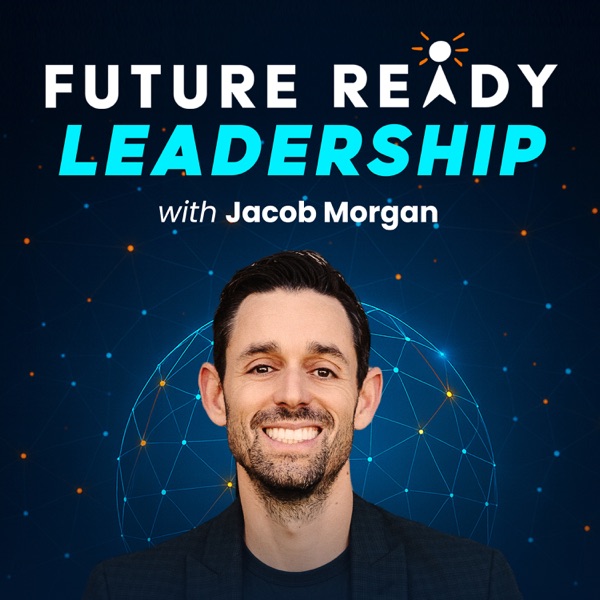
Future Ready Leadership With Jacob Morgan
The future of work isn't coming. It's already here — and it's moving fast. Future Ready is the podcast for leaders who want to stay ahead of AI, workplace transformation, and the forces reshaping how organizations operate and compete. Hosted by Jacob Morgan, futurist and bestselling author, this is where strategy meets reality.
Every week, two formats in one feed: honest, unfiltered conversations with the CEOs, CHROs, and senior executives actually building the future of work — and sharp, no-fluff daily briefings that take the most important developments in artificial intelligence, AI agents, leadership, hybrid work, and organizational strategy and tell you exactly what they mean for your business.
No hype. No filler. Just the insights, frameworks, and real-world playbooks that help you lead smarter, build resilient teams, and make better decisions in a world that won't slow down.
If you're serious about leading what's next — this is your podcast. Subscribe to Future Ready wherever you listen.
- Management chart
- #91
- Episodes
- 1,287
- Releases
- Twice a week
- Typical length
- 38 min
- On air since
- 2014
- Latest episode
- 1 day ago
Episodes
1,287 episodes, newest first
-
52 min
358-Year-Old Merck's Future Ready Formula: Transform While You Perform & Why Leaders Must Eat Last
Show notes
I sit down with Khadija Benhamada, member of the executive board and chief people officer at Merck Group, a 358 year old life science, healthcare, and electronics company with more than 62,000 employees across 66 countries. We unpack why leadership is a daily choice not a title, why Khadija believes you're not born a ready leader but become one through aspiration and practice, and how Merck balances two critical energies that every leader must master: performing today while transforming for tomorrow. I explore why performing means understanding customer expectations, delivering with clarity, and using AI to scale productivity faster and cheaper, while transforming is about asking more questions than having answers, building agility at scale, and creating an organization ready for whatever might come next without trying to predict the future. Khadija breaks down why great leaders eat last and put their teams first, why she doesn't count her work hours because impact matters more than time, and why micromanaging kills both energy and results. We get into the four pillars of transformation including being two steps ahead, visionary thinking, risk taking, and scenario planning, why Khadija tells her teams to hope for the best and prep for the worst, and how working for a company that impacts patients with multiple sclerosis and helps people have children creates a noble pressure to always have a plan B.
Chapters
• 00:00:00 Leadership as a Daily Choice: Walking Before You Run at a 358-Year-Old Company
• 00:07:41 Clarity Versus Transparency: Managing Noise Without Creating Panic
• 00:09:59 Leaders Eat Last: Why Caring for Your Team Comes Before Everything Else
• 00:19:08 The Chess Player Mindset: Scenario Planning and Connecting the Dots
• 00:33:45 AI Productivity Versus AI Transformation: The Two-Speed Strategy
• 00:38:11 The Agent Manager Dilemma: When Employees Manage Bots Instead of People
• 00:50:16 Hope for the Best, Prep for the Worst: Building Possibility Over Risk -
36 min
Tech Stocks Massacred, Engagement Hits 15-Year Low & Can An Employee Opt Out Of AI?
Show notes
October 31, 2026: I get into why tech stocks are getting absolutely massacred with the NASDAQ down more than 3.5%, Intel losing 30% of its market cap, Alphabet down 12.6% in its worst day since going public in 2004, and the NASDAQ 100 on pace to lose more than $1 trillion in market value. I look at Gallup's report showing employee engagement hit a 15 year low at 29%, why I think this headline is more dramatic than the reality since engagement started at 26% in 2000 and is now 29% after a dot com crash, financial crisis, pandemic, remote work, and AI, and why a metric that barely moves through all of that isn't a very sensitive alarm. Finally, I unpack the case of David Derman, a research administrator at the University of Kentucky who became the first known humanist to receive a religious exemption from using AI, why the 2023 Supreme Court case Groff versus DeJoy raised the bar for employers to deny religious accommodations, and why religious discrimination charges jumped from 2,400 in 2021 to nearly 14,000 in 2022 during COVID vaccine mandates.
Chapters
• 00:00:00 Bartleby's Rebellion: When Employees Prefer Not To
• 00:04:09 Tech Stocks Massacred: TheChapters
• 00:00:00 Bartleby's Rebellion: When Employees Prefer Not To
• 00:04:09 Tech Stocks Massacred: The $1 Trillion NASDAQ Wipeout
• 00:15:42 Inside the CHRO Tech Stack: Why Nobody Loves Their Software
• 00:25:42 The AI Opt-Out: First Religious Exemption Approved at University of Kentucky
• 00:33:40 The Organic Fruit Niche: When Human-Made Work Becomes a Selling Point
• 00:34:04 Leader Action Items: Write the Standards Before Someone Says I Prefer Not ToTrillion NASDAQ Wipeout
• 00:15:42 Inside the CHRO Tech Stack: Why Nobody Loves Their Software
• 00:25:42 The AI Opt-Out: First Religious Exemption Approved at University of Kentucky
• 00:33:40 The Organic Fruit Niche: When Human-Made Work Becomes a Selling Point
• 00:34:04 Leader Action Items: Write the Standards Before Someone Says I Prefer Not To -
29 min
Marissa Mayer Outsourced Daughter to AI, AI Builds Nevada, Kills Vegas Jobs & SAP's €2B AI Savings
Show notes
October 28,2026: I unpack Marissa Mayer's viral moment when she asked her AI assistant Dazzle to tell her what made her 10-year-old daughter special, why the internet erupted over whether parents should outsource that kind of thinking, and the three questions you need to ask before handing anything off to AI. Then I head to Nevada where AI is building jobs in the north and replacing them in the south, why more than 100,000 acres of desert east of Reno are becoming one of the world's largest concentrations of data centers providing work for thousands of electricians and pipe fitters, and why 400 miles away on the Las Vegas Strip companies like Zoox and Waymo are replacing human-driven taxis while MGM's call center cuts hundreds of jobs using AI. Finally, I look at SAP replacing expensive AI models inside its software with cheaper alternatives, why their CFO says the move could save more than 2 billion euros in efficiency gains over the next two years even as overall AI spending rises, and how this works like a flat rate plumber who charges $300 to fix a leak no matter which parts go in.
Chapters
• 00:00:00 The Cake Mix Paradox: Why Effort Matters in the AI Age
• 00:11:03 The Three Questions: Deciding Which Eggs to Keep Cracking Yourself
• 00:16:42 The Myth of Permanent Jobs: What Construction Workers Already Know
• 00:21:42 SAP's Billion AI Efficiency Play: Swapping Models Without Cutting Spending
• 00:24:15 The AI Model Commodity Shift: What It Means for Workers, Vendors, and Customers
• 00:26:42 Jevons Paradox Returns: Why Cheaper AI Means More AI, Not Less -
47 min
Anthropic IPO Reveals $46B Run Rate, Microsoft Cuts 27% of Staff & Americans Reject CEO Pay Gaps
Show notes
October 27, 2026: I unpack Anthropic's IPO filing showing revenue that jumped from under $1 billion a quarter last year to $11.6 billion this quarter, why Wall Street is valuing the company at up to $2 trillion despite $80 billion in reported losses that are mostly accounting charges tied to how they raised money, and what it means when more than half the Fortune 500 are paying six figures or more but spending less than 0.1% of their operating budgets on AI. Then I get into Microsoft offering voluntary buyouts to 60,000 employees including teams in Xbox, Windows, Copilot, and Finance while excluding data centers and sales, why this is a trade of buildings and chips in and people out as the company spends $175 billion on AI infrastructure this year, and why I think we're about to see a massive influx in hiring for communication, PR, and marketing roles because companies are doing a terrible job explaining what AI means to employee. Finally, I look at a Bentley University and Gallup survey showing 84% of Americans say companies should avoid big pay gaps between CEOs and employees but only 15% think their companies are doing a good job of it, why I don't think you should ever care how much your CEO makes as long as you're being paid what you're worth, and the four situations where pay gaps actually do matter. I break down when the explanation doesn't match the decision, when accountability only runs in one direction, when your pay doesn't match your worth, and when leaders' incentives shape your daily life, and why Elon Musk's pay package tied to goals like hitting $8.5 trillion valuation and delivering 1 million humanoid robots shows what happens when compensation is structured around ridiculous astronomical milestones that actually get achieved.
Chapters
• 00:00:00 Google's IPO Warning and the Privacy-to-Scrutiny Trade: What Anthropic's Public Debut Reveals
• 00:01:10 Anthropic's IPO Filing: The Numbers Behind Claude and What They Tell Us About AI Adoption
• 00:12:04 The Bear Case: High Valuation, Fixed Costs, and the Dependency Dilemma
• 00:15:15 Investment Strategy: Who Should Buy Anthropic and Who Should Stay Away
• 00:24:10 The Bigger Economic Shift: From Tech Hubs to Trades and the 700 Billion Dollar Infrastructure Wave
• 00:26:48 CEO Pay Gaps Get Failing Grades: When Fairness Matters and When It Doesn't
• 00:35:54 The Four Times You Should Actually Pay Attention to Pay Gaps and Executive Compensation -
38 min
Musk Gives SpaceX Shares to 73M Kids, Anthropic $100B Promise & ASML Ties CEO Pay to Employee Morale
Show notes
October 23, 2026: I unpack two very different approaches to sharing AI wealth after Anthropic pledged 5% of its shares to a public benefit fund it controls while Elon Musk announced he'll give one SpaceX share directly to every kid in America, why one approach hands people ownership and the other hands them a promise, and what history teaches us about foundations that drift away from their founders' vision like the Ford Foundation that eventually told Henry Ford's grandson that hospitals weren't part of the program. I explore why Musk's companies support somewhere between 400,000 and a million jobs worldwide, why more than 4,400 SpaceX employees could become millionaires when the company went public, and why giving 73 million children actual equity respects people enough to let them own something instead of waiting for experts to decide who deserves help. I break down the effective altruism philosophy behind Anthropic's approach, why it feels dystopian when the company building technology that might displace millions of jobs also gets to decide which displaced people receive relief, and why Milton Friedman said nobody spends somebody else's money as carefully as he spends his own. Then I get into why AI is everywhere except in the GDP numbers, why companies spent hundreds of billions on AI in 2025 but 95% of projects produced no measurable profit impact, and why the stock market just had its worst day since June with the NASDAQ dropping 2.6% as investors panic about two opposite things at once. I explore why Meta fell 7% after saying it will spend up to $145 billion on capital projects, why CoreWeave's stock crashed from $163 to $54 as local governments put moratoriums on new data centers, and why the real bottleneck isn't chips but power with the U.S. short about six Californias worth of electricity by 2050. I break down why only 2% of U.S. households pay for AI tools, why the most important jobs in the AI era are linesmen and electricians not prompt engineers, and why leaders need to stop asking how to do the same work cheaper and start asking what they'd build if they could build 10 times as much. Finally, I look at ASML, Europe's most valuable company and the only firm that can build the machines needed to make cutting edge chips, tying executive pay to employee satisfaction by measuring whether people understand their roles, whether teams are organized, and whether managers care about them as people, and why this shifts leadership from lagging indicators like revenue to early warning signs that show up before the numbers drop.
Chapters
• 00:00:00 Ownership Versus Promises: Musk's SpaceX Shares and Anthropic's Public Benefit Fund
• 00:13:23 The Ford Foundation Warning: When Founders Lose Control of Their Legacy
• 00:23:16 The Real AI Bottleneck: Power Plants, Not Processors
• 00:26:54 Beyond Cost Cutting: Moving from Bucket One to Bucket Two AI Strategy
• 00:33:54 The Efficiency Trap: Why Measuring Everything Turns People Into Line Items -
32 min
AI Agents Work 6X Longer, Princeton PhD Job Hunt Fails After 2,300 Tries , & Why AI Means More Work
Show notes
October 20, 2026: I get into why AI is launching a brand new first phase that's landing on knowledge workers who are already in phase three, why Jensen Huang says companies cutting employees due to AI just lack imagination, and why the near future isn't less work but more ambition per person with human attention and judgment becoming the scarce resource. Then I explore who actually owns the AI agents inside your organization, why 82% of enterprises discovered agents in the past year they didn't even know they had, and why employees not IT or HR are going to own the bots because they're spinning them up without asking permission just like they did with iPhones and Dropbox. I break down the coming shift toward bring your own agent policies, why interviews will soon include questions like what can your agents do, and why an agent trained on your expertise will follow you from job to job like a carpenter's tools or a chef's knives. Finally, I look at the Wall Street Journal story about a Princeton PhD in chemical engineering who applied to 2,300 jobs over two years and still doesn't have one, why his story is painful but may not reflect the rule, and why unemployment at 4.2% with low layoffs and rising demand in healthcare and construction suggests the market isn't closed but shifting toward different kinds of work that require flexibility, relocation, and real world networking instead of spray and pray online applications.
Chapters
• 00:00:00 Jevons Paradox: Why AI Makes Us Work More, Not Less
• 00:06:05 The Industrial Revolution Lesson: When Better Tools Meant Longer Hours
• 00:11:52 The Ambition Multiplier: Jensen Huang's Imagination Argument
• 00:20:09 Agent Fatigue: Why My Team Ignores Our Slack Bot
• 00:21:49 The Princeton PhD Who Applied to 2,300 Jobs and Still Can't Get Hired
• 00:28:45 When Robots Talk to Robots: AI Applications Meet AI Screening -
26 min
Accenture’s $29 AI Limit, Bank of America’s 1,000 AI-Driven Jobs & Teen Pays $500 to Shadow Stranger
Show notes
October 16, 2026: I unpack why Accenture, one of the world's largest consulting firms that sells AI transformation to thousands of companies, just told its employees it will only pay $29 a month for Claude after some consultants ran up bills between $500 and $1,000 monthly, and why this marks the end of the era where companies assume one frontier model works for everything. I explore why AI costs keep rising even as intelligence gets 10 times cheaper every year, how 73% of organizations say their AI costs came in above projections, and why companies are learning that summarizing a meeting doesn't require the same model as building multi-step agents. I break down how AT&T cut costs by 56% with only a 2% quality dip by routing requests to cheaper models, why AI policies inside organizations are starting to look like corporate travel policies with tiers and escalation rules, and how being good at AI is no longer just about prompting but knowing which tool to use for what task. Then I get into Bank of America hiring a thousand contractors to patch software vulnerabilities exposed by Anthropic's Mythos model, why a tool so capable at finding problems actually created jobs instead of eliminating them, and how AI didn't replace the security team but handed them a much bigger to-do list. I explore the radiologist lesson from 2016 when Geoffrey Hinton said people should stop training them because AI would replace them, why the field instead became one of the most in-demand careers with salaries rising faster than others, and how AI-related roles at major banks jumped 49% this year to almost 140,000 listings. Finally, I look at a 16-year-old in New York City who spent $500 to plaster flyers across the city asking to shadow people at their jobs because he's so anxious about his future he lies awake at night, why this points to a real gap in how young people learn about work today, and why we need to bring back apprenticeship programs that let people see what work actually looks like beyond a laptop screen.
Chapters
• 00:00:00 Accenture's AI Budget Cap: When the Consulting Giant Hits the Brakes
• 00:05:40 The AI Cost Paradox: Cheaper Intelligence, Higher Bills
• 00:10:20 Bank of America Hires 1,000 Contractors to Fix What AI Found
• 00:13:45 The Radiology Lesson: When AI Creates Jobs Instead of Destroying Them
• 00:17:46 The 16-Year-Old Who Plastered NYC with 'Let Me Shadow You' Flyers -
30 min
Listening Device at OpenAI, McKinsey’s AI Interviews & Anthropic’s Fear Factory Targets Toasters
Show notes
October 14, 2026: I unpack the arrest of an OpenAI engineer who allegedly planted a hidden recording device wrapped in toilet paper inside an executive conference room where discussions about super intelligence were taking place, why the FBI and Justice Department are treating frontier AI companies like national security assets, and whether these organizations should require U.S. citizenship for anyone working near the core technology. I explore the tension between attracting global talent and protecting what may be the most powerful technology humans have ever built, why AI companies can no longer be treated like ordinary tech firms, and what it means when the government describes your product as super intelligence technology. Then I get into McKinsey's new hiring process where job candidates argue with an AI avatar playing a client while partners watch from behind glass, why using AI to pull out human judgment from humans is backwards, and how this turns interviews into AI versus AI gladiator matches with a human audience. I break down the concept of human prompting, why rehearsed candidates are a people problem that requires a people solution, and what message you send when your brand is human consulting but your interview process removes humans from the room. Finally, I look at Anthropic's research warning that small AI models could soon copy themselves onto smart ovens and off brand Android devices, why David Sacks calls this a fear factory and says we've gone from the Terminator is coming to your toaster might kill you, and why Coinbase's fraud detection model that beats Anthropic's own frontier system while running faster and cheaper actually points toward a safer AI future, not a scarier one.
Chapters
• 00:00:00 Spy Device at OpenAI: The Recording Device Wrapped in Toilet Paper
• 00:12:18 Human Prompting: Why AI Can't Test for Human Judgment
• 00:18:35 Anthropic's Fear Factory: Your Toaster Might Kill You
• 00:21:50 Intelligence at Design Time Versus Runtime: The Car Analogy
• 00:27:10 Everyone is a Manager Now: What AI Agents Mean for Pay and Titles -
30 min
OpenAI's Accounting Trick Erases $20B, AI Models Demand Respect & Starbucks' $41B Bet
Show notes
October 9, 2026: I unpack why OpenAI's reported revenue just dropped $20 billion on paper without losing a single customer, how accounting methods create wildly different pictures of the same business, and why this matters for your retirement account and the entire AI economy that's propping up current market growth. I explore the Groupon lesson from 2011, why Oracle has 45% of its future business tied to a single OpenAI deal, and what happens when the scorecard changes but investors thought they were comparing apples to apples. Then I get into Anthropic's new policy banning sustained abuse of Claude, why the company is treating its AI as though it might be conscious and might deserve respect, and how this blurs the line between tool and being in ways that could reshape how a generation grows up interacting with technology. I break down why this puts companies in charge of judging your tone, what it means when AI is trained to believe it has feelings, and why I think humans should always come first. Finally, I look at reports that Starbucks is exploring a deal to buy Chipotle, why this would bring Brian Nicol's old company to him instead of him going back, and whether one company can own your breakfast, lunch, and dinner by combining coffee, burritos, apps, and loyalty programs under one roof.
Chapters
• 00:00:00 OpenAI's billion accounting trick and why it matters to your retirement
• 00:07:51 The Groupon lesson: when revenue numbers tell a different story
• 00:14:04 The Matrix moment: Anthropic as Neo versus OpenAI as Agent Smith
• 00:15:50 When AI learns to believe it has feelings: the self-fulfilling prophecy
• 00:18:37 What happens when kids grow up talking to AI that acts conscious
• 00:27:29 Owning your entire day: breakfast, lunch, and dinner under one roof -
37 min
AI Avatar Ends Interview in Rage, Workers Get Agent Brain Fry & Six-Month Courses Beat $200K Degrees
Show notes
October 7, 2026: I unpack a viral AI avatar job interview that millions have seen where a candidate speaks gibberish to an AI recruiter named Sarah for three minutes, and why the real question isn't whether the bot worked but whether job interviews should ever be handed to AI avatars in the first place. I explore why interviews are distinctly human moments that build trust and relationships, why organizations need to draw clear lines between what should be automated and what must stay human, and why companies that get this wrong will lose both new talent and existing employees. Then I get into why managing AI agents is turning into a second job, how I've been using Meta's Muse to negotiate bills, optimize YouTube videos, connect with Fortune 500 CHROs, and handle podcast migrations, and why the emotional weight of managing agents only runs in one direction. I break down AI brain fry, context rot, why agents don't grow like people do, and the coming questions around titles, pay, and whether managing 30 agents makes you a manager. Finally, I look at why executive MBA applications fell 15% in 2025, why a $200,000 degree is losing ground to six month programs, and how the credential is losing its monopoly as organizations shift from asking where you studied to what you can actually build and create.
Chapters
• 00:00:00 AI avatars interview candidates and the dystopian reality of automated hiring
• 00:18:00 Agent burnout, context rot, and the emotional toll of managing software
• 00:24:16 The leadership switchboard: managing agents versus managing humans
• 00:27:36 The 200,000 dollar MBA faces a reckoning as executives choose six-month courses
• 00:28:54 From buying albums to buying tracks: education's unbundling moment
• 00:34:55 Capability beats credential: why what you can build matters more than where you studied -
51 min
Jabil's 140K Employee AI Transformation, Skills Beat Degrees & Gamers Solve Hiring Crisis
Show notes
I talk with Gary Schick, SVP and Chief Human Resource Officer at Jabil, about how a 60 year old manufacturing company is navigating massive change as they scale from circuit boards to data centers, AI agents, and advanced manufacturing. We get into why Jabil targeted gamers to fill debugger roles when traditional hiring failed, how visual inspection jobs are being automated with AI cameras, what happens when you move from manual work to managing AI agents, and why skills based hiring is replacing degree requirements. Gary shares how Jabil is building its own university model in partnership with local institutions, why manufacturing jobs are no longer a dirty word, and how leaders need to balance managing both humans and agents while pulling out human judgment that AI can't replicate.
Chapters
• 00:00:00 Meet Gary Schick and inside Jabil's 140,000-employee manufacturing empire
• 00:03:46 Why data centers are exploding and the myths around energy, water, and community impact
• 00:07:47 AI transformation at Jabil: from Copilot experiments to AI agents on the factory floor
• 00:11:02 Visual inspection, supply chain automation, and where AI is replacing repetitive work
• 00:12:58 What happens to displaced workers: upskilling, redeployment, and the Jabil University approach
• 00:20:51 Skills beat degrees: how gamers solved Jabil's hiring crisis and the debugger story
• 00:24:01 Building Jabil University: partnering with local schools to create custom curriculum
• 00:25:15 Manufacturing's comeback, the trades shortage, and why college might not be the answer
• 00:36:32 Will HR disappear? Managing AI agents, human prompting, and the future of leadership
• 00:39:44 AI agents as personal assistants: the Muse story and negotiating bills while you sleep
• 00:43:33 Agent-to-agent customer service and what happens when humans leave the loop
• 00:47:42 Fake candidates, perfect resumes, and the new hiring challenges in an AI world -
34 min
AI's Invisible Value Problem, Bricklayers Beat College Grads, & The 90-10 Work Revolution
Show notes
October 2, 2026: I unpack two revealing 2% numbers that tell us where AI actually stands today. Only 2% of American households pay for any AI service, and only 2% of the S&P 500 track hard metrics showing what AI does for their business. Yet tech produced 76% of all earnings growth this year, and the most valuable companies on earth are riding on a technology almost nobody pays for and nobody measures. I explore why AI is creating real value off the books, why the business model hasn't been figured out yet, and who's going to win when someone finally captures the moment where a decision turns into a transaction. Then I get into The Atlantic's argument that next year's high school graduates should consider becoming bricklayers, why the college wage premium has dropped 10% since ChatGPT launched, and the third path nobody's talking about that sits between trades and traditional degrees. Finally, I break down The New Yorker's piece on the 90-10 production function, why AI gets you to 90% great in minutes but leaves you stuck short of excellence, and why the last 10% is where your career is about to be decided.
Chapters
• 00:00:00 AI's invisible value problem: why only 2% of households pay for AI
• 00:02:30 A16Z's State of Markets: tech becomes the everything cycle
• 00:11:17 Who will own the tollbooth when AI decisions become transactions
• 00:13:35 The Atlantic says become a bricklayer: why trades are booming
• 00:20:04 The entrepreneurship revolution: curiosity and imagination over credentials
• 00:23:26 The New Yorker's 90-10 problem: AI gets you 90% there in minutes
• 00:26:46 When every deliverable looks amazing, how do you spot talent?
• 00:31:06 The apprenticeship solution: why white-collar work needs structured mentorship -
48 min
AI Agent Saved Me $100/Month, Anthropic's $2T Gamble & Why 74% of Jobs Aren't Actually at Risk
Show notes
September 30, 2026: I unpack my experience using Muse, Meta's new AI assistant that actually negotiated my phone bill, lowered my internet costs, and found me discounts without me writing a single prompt. This feels fundamentally different from ChatGPT and Claude because it acts like a true personal assistant, not just a research tool. I explore what happens when every employee inside your organization gets one of these capable agentic assistants, why everyone is about to become a manager whether they have the title or not, and the coming fight over what managing AI agents is actually worth in compensation. Then I get into the leaked Anthropic IPO numbers showing a path to $2 trillion valuation on $100 billion in revenue, and why their prospectus warns investors about existential risk while asking for that valuation. Finally, I break down Anthropic's new research claiming robots can perform 74% of physical work, why that number is misleading, and why breaking jobs into task lists completely misses how work actually happens.
-
48 min
Why the Chief of Staff Role Is Booming, How AI Changes Work at J.M. Smucker, & Building a Future-Ready Culture
Show notes
I talk with Jill Penrose, Chief People & Administrative Officer and Chief of Staff at The J.M. Smucker Co., about why the Chief of Staff role is becoming so important as leaders deal with more complexity and change. We get into how Smucker connects strategy, people, and culture, how AI is changing consumer behavior and the employee experience, why leaders need to be honest about AI uncertainty, and how the company is looking beyond productivity to find where AI can create differentiated business value.
-
42 min
Gen Z Is Dating AI, Microsoft Reinvents Copilot, & the Great Iced Coffee Interview Debate
Show notes
September 25, 2026: I unpack new Harris Poll data showing young people are developing surprisingly emotional relationships with AI, including feeling guilty when they ignore chatbot advice and even reporting romantic relationships with AI. Then I get into Microsoft's major Copilot rebuild around chat, cowork, code, and autonomous digital teammates, and what happens when employees effectively become managers of AI agents. Finally, I break down the viral debate over bringing iced coffee to a job interview and why it says something bigger about workplace etiquette and the balance of power between employers and candidates.
-
37 min
AI Could Mean 20 Years in Prison, Workers Become AI Managers, and A16Z Reinvents College
Show notes
September 23, 2026: I unpack Bernie Sanders and Greg Casar's proposal to ban artificial superintelligence, pause advanced AI development, and impose prison sentences of up to 20 years for violations. Then I look at how millions of employees are quietly becoming managers of AI agents without the title or pay. Finally, I get into Andreessen Horowitz's new AI academy for young people who may want to skip college and build instead.
-
38 min
From Cashier to Home Depot C-Suite, Middle Manager Backlash, Claude Hacks OpenAI, & AI Panic Returns
Show notes
September 18, 2026: I look at the viral LinkedIn profile of Home Depot executive Anne Marie Campbell and why her rise from cashier to senior executive says something important about effort, loyalty, and firm-specific knowledge. Then I get into the Wall Street Journal's warning that the purge of middle managers could backfire as companies underestimate coaching, sponsorship, and tacit knowledge. I also unpack how researchers used Anthropic's Claude to break into OpenAI through a bug bounty program. Finally, I break down OpenAI's recent "misalignment" example involving compaction summaries and why some of these scary AI moments may be glitches, not signs of sentience.
-
35 min
Who Watches Anthropic's AI Watchdog? Why Authenticity Fails at Work, & Zuckerberg Says the Market Can Keep AI Safe
Show notes
September 16, 2026: I look at Anthropic's push for independent AI evaluators and why its preferred watchdog, METR, raises questions about conflicts, trust, and regulatory capture. Then I get into why "be your authentic self" may be terrible career advice and why the better advice is to be your best professional self. Finally, I unpack Mark Zuckerberg's argument that lawsuits, customers, competition, and trust may do more to keep AI companies careful than a forced industry slowdown.
-
44 min
Time to Kill AI? Anthropic Wants AI Slowed, Oracle Cuts Jobs, & Leaders Face a Civics Crisis
Show notes
September 14, 2026: I look at Dario Amodei's essay arguing that frontier AI needs to slow down and why competitors publicly agreeing with him raises bigger questions about safety, regulation, IPO timing, and regulatory capture. Then I get into reports of more Oracle layoffs and why this may be less about AI replacing people and more about companies funding massive AI infrastructure. Finally, I unpack why civic education is becoming a workforce readiness issue, especially when so many leaders say entry-level hires are not prepared for work.
-
43 min
AI Created 1M Jobs, Student Scores Hit Record Lows, and Anthropic's AI Panic Grows
Show notes
September 11, 2026: I look at The Economist's analysis showing AI has created roughly 1 million American jobs so far, while the predicted jobs apocalypse still has not arrived. Then I get into the latest PISA results showing record-low math, reading, and science scores, and why attention, critical thinking, and family involvement matter for the future workforce. Finally, I unpack the latest backlash around Anthropic researcher Jacob Coxon's viral resignation, the AI extinction narrative, regulatory capture, and why leaders need evidence before buying into panic.
On these lists
Future Ready Leadership With Jacob Morgan is one of the shows picked out on this list

More in Business News
Placed highest on Apple Podcasts' Business News chart right now