Podcast
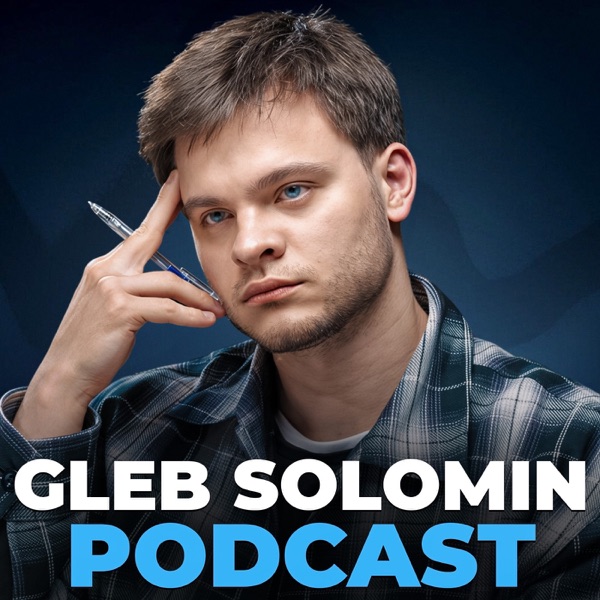
Gleb Solomin Podcast
I'm Gleb. Born in a small village in the North Caucasus. Graduated with honors in engineering geology from Moscow State University. I started recording these conversations at 19 from a dorm room — no capital, no industry connections, no audience. For years, almost no one was watching. I kept going. My Russian-language channel has now crossed 1M subscribers, built guest by guest, on my own editorial terms. Now, I'm bringing that same dedication to English for a global audience.
- Episodes
- 3
- Releases
- Every few months
- Typical length
- 1 hr 12 min
- On air since
- 2026
- Latest episode
- 17 hours ago
Episodes
3 episodes, newest first
-
1 hr 12 min
What Do Scientists Know About UFOs? Sabine Hossenfelder on the Fermi Paradox
Show notes
Is the speed of light really not an absolute limit? Could time travel be possible? And are some of the most popular theories in modern physics impossible to test?
In this episode, Gleb Solomin speaks with Sabine Hossenfelder, a theoretical physicist, PhD, and one of the world's best-known science communicators. They discuss some of the biggest mysteries in modern physics: the origin of the Universe, the nature of time, the possibility of extraterrestrial civilizations, artificial intelligence, free will, and the theories causing the most controversy among scientists today.
In this episode:
• Why might the speed of light not be the limit for transmitting information?
• Are we searching for alien civilizations in entirely the wrong places?
• Is time travel possible according to modern physics?
• Why might free will be an illusion?
• Could artificial intelligence ever become truly conscious?
• Are we living inside a computer simulation?
• Why is the multiverse impossible to prove?
• What do we actually know about the Big Bang and the first moment of the Universe?
• Why does Sabine consider many modern cosmological theories closer to mathematical stories than science?Watch the full video on YouTube: https://youtu.be/AoQalV3g77U
Chapters:
• 00:00 Teaser
• 01:40 Who Is Sabine Hossenfelder?
• 03:00 Why Haven't We Found Aliens Yet?
• 07:46 Can We Travel Faster Than Light?
• 13:06 Is Time Travel Possible?
• 16:30 The Time Paradox Einstein Couldn't Explain
• 18:16 Is Our Future Predetermined?
• 21:40 Do Humans Have Free Will?
• 28:48 When Will AI Become Smarter Than Humans?
• 33:00 Are We Living in a Simulation?
• 36:50 How Could We Prove That Our World Is a Simulation?
• 37:41 Why Are Scientists Afraid to Study UFOs?
• 40:52 "Intelligent Life Exists Somewhere in the Galaxy"
• 41:45 What Was Orbiting Earth 50 Years Ago?
• 44:41 Does the Multiverse Exist?
• 46:04 Why Don't Scientists Know How the Universe Began?
• 50:54 Did the Big Bang Really Happen?
• 53:08 How Old Is the Universe, Really?
• 53:43 Has String Theory Failed?
• 58:20 Was the Universe Fine-Tuned for Life?
• 1:00:54 A $40 Billion Particle Collider
• 1:06:36 Should Elon Musk Decide the Future of Science?
• 1:11:09 Will We Ever Meet Aliens? -
1 hr 14 min
Cambridge Professor: Lose Weight WITHOUT Dieting (5 Rules)
Show notes
Is calorie counting really a good way to judge how healthy a food is? Does carrying extra weight always mean something is wrong with your health? And does sugar really “feed” cancer?
In this episode, we speak with Giles Yeo, Professor of Molecular Neuroendocrinology at the University of Cambridge. For more than 25 years, he has studied the genetics of obesity, eating behavior, and the mechanisms through which the brain regulates appetite.
In this episode:
— Why don’t calories tell the whole story when it comes to nutritional value?
— How does genetics influence appetite, overeating, and weight gain?
— When does excess body fat actually become dangerous to your health?
— Is sugar really addictive, and does it “feed” cancer?
— Why might orange juice be more harmful than Coca-Cola?
— Do intermittent fasting and Ozempic actually work?
— Which principles of healthy eating matter more than constantly counting calories?▶︎Gleb Solomin's X Account: https://x.com/gleb_solomin200
▶️︎ Follow Giles Yeo:
X: https://x.com/GilesYeo?s=20
Instagram: / gilesyeo▶︎ For business inquiries: adv@glebsolomin.com
-
42 min
"You Can’t Even Imagine the Scale of the Catastrophe" — Roman Yampolskiy on Superintelligence
Show notes
Most AI researchers think alignment is a hard problem. Roman Yampolskiy argues it's an impossible one.
Yampolskiy is a computer scientist at the University of Louisville and one of the longest-standing voices in AI safety research. For over a decade he has argued that controlling a system more intelligent than ourselves isn't a challenge the field will eventually solve — it's a structural limit we can't get past. His position sits at the far end of AI safety discourse, and most of the field disagrees with him. In this conversation we get into why he holds it, what he thinks the rest of the community is missing, and what the next decade looks like if he's right.
What we cover:
The impossibility argument: why he sees alignment not as a problem to solve, but as a wall.
His timeline for ASI, and what — if anything — could meaningfully slow it down.
Why he's skeptical of the alignment work being done at the frontier labs.
What happens to economies, employment, and human agency in the years before ASI arrives.
Whether any policy or technical move in 2026 actually buys time.
If Yampolskiy is wrong, this is one researcher's pessimism. If he's right, almost nothing else we're doing matters.
Careers lists
More Careers shows picked out from the charts









More in Careers
Placed highest on Apple Podcasts' Careers chart right now