Podcast
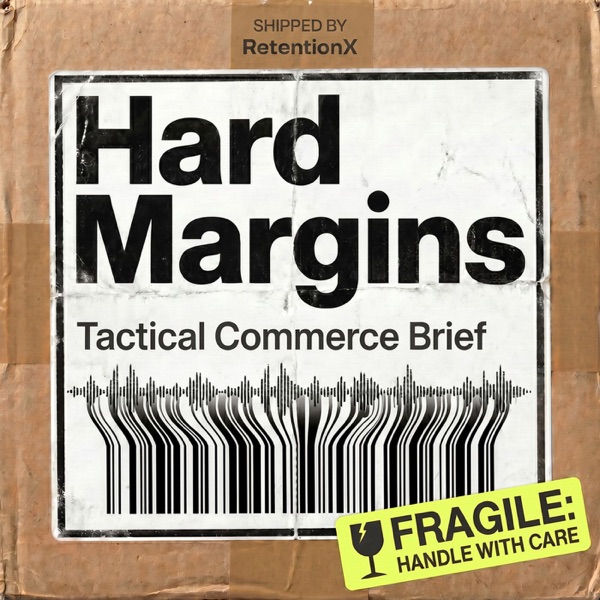
Hard Margins
Hard Margins is a weekly podcast for DTC operators building serious eCommerce businesses on Shopify. Hosted by Alex Orley, each episode breaks down one high-leverage idea for growing more profitably, covering customer lifetime value, contribution margin, cohort economics, product portfolio strategy, and retention. No fluff, no vanity metrics. Just the frameworks that separate the brands that compound from the ones that plateau. Brought to you by RetentionX, the integrated growth platform built for Shopify brands.
- Episodes
- 36
- Releases
- Weekly
- Typical length
- 9 min
- On air since
- 2026
- Latest episode
- 1 week ago
Episodes
36 episodes, newest first
-
9 min
Future Revenue Coverage
Season 1, Episode 36
Show notes
Most eCommerce brands plan every quarter as if the whole number has to be earned from scratch, even though customers who replenish, reorder or subscribe will already deliver part of it. This week we walk through Future Revenue Coverage, which is the share of next quarter’s target your existing customers should deliver, and shows how it splits the plan into protecting the revenue you already have and creating the rest.
-
10 min
Customer Maintenance Capex
Season 1, Episode 35
Show notes
Most brands book all their acquisition spend as growth, but part of it is maintenance capex: the cost of replacing customers who stop buying, and it has to be covered before the business grows at all. We split acquisition into maintenance and growth, and use the last two episodes on half-life and dilution to show how retention frees up more of the same budget for real growth.
-
8 min
Customer Equity Dilution
Season 1, Episode 34
Show notes
A brand can add 40% more customers, increase total customer equity, and still lower the average economic quality of the customer base — all in the same quarter. This episode covers customer equity dilution: how to measure the quality of a new cohort against the base it enters, where to cut it, and what belongs on the acquisition scorecard next to customer count.
-
9 min
Your Customer Half Life
Season 1, Episode 33
Show notes
If you stopped acquiring customers today, how long would it take for half your existing customer revenue to disappear? This episode makes the case for Customer Base Half-Life as a CEO-level number, what it tells you that revenue, growth and LTV don't, how to estimate it, and how to read it by channel, product, promotion and cohort.
-
9 min
Were They Already Loyal?
Season 1, Episode 32
Show notes
Most loyalty reporting compares members to non-members and calls the gap proof the program is working, when a good part of that gap usually existed before anyone enrolled. This episode goes through how to separate the loyalty your customers brought with them from the loyalty the program actually built — and what to measure before you raise the rewards budget.
-
10 min
Not Every Second Order Is Retention
Season 1, Episode 31
Show notes
Not every second order is retention. Some of it is your returns process finishing the first sale. This episode shows how exchanges and replacements inflate repeat rate, and what changes once you count only the orders that were real decisions.
-
9 min
Why Samples Matter and How To Do Them Right
Season 1, Episode 30
Show notes
Most brands spend weeks arguing over discount depth and thirty seconds deciding what free product goes in the box, even though the sample can lift the current basket and the next order without touching the price list. This episode covers how to pick the sampled product from downstream customer behavior, how to use a gift-with-purchase threshold instead of a discount, and how to measure the result cleanly so you stop crediting the sample for purchases it never caused.
-
7 min
Introducing: The AI Analyst
Season 1, Episode 29
Show notes
This week we're launching the AI Analyst, the biggest thing we've ever shipped at RetentionX: it reads your entire store overnight and lands a finished diagnosis on your phone by morning, telling you what changed, why it changed, what it's costing you in dollars, and the fix already drafted. No team, no hours in dashboards, no second job as a data detective, just the answer waiting when you wake up.
-
11 min
The 60-Day Proof Gap.
Season 1, Episode 28
Show notes
This week we break down "proof coverage," the ratio between how long a product takes to show results and how much of that window a customer's first order actually covers, arguing that selling a 30-day supply of a product that needs 90 days to work quietly manufactures churn and disbelievers. We lay out three fixes, a starter pack framed as "complete the 90-day routine," subscription positioned as continuation after proof, and an honestly labeled single unit, plus a five-move operator playbook for measuring and closing the gap.
-
9 min
How to Discount.
Season 1, Episode 27
Show notes
Two mathematically identical discounts—say "$30 off" versus "10% off" on a $300 product—convert at different rates, because customers don't do the math, they react to whichever version feels bigger. This episode breaks down how to frame the same offer by price band so you lift conversion without ever giving away more margin.
-
8 min
Discounts Turn "Ready to Buy" Into "Waiting To Buy."
Season 1, Episode 26
Show notes
Your best full-price customers might be buying less often than they used to, and there's a good chance your own promo calendar taught them to wait for a discount instead of buying when they're ready. This week breaks down the hesitation window: why regular discounting quietly costs you both margin and orders, how to catch it with a simple holdout test, and five moves to stop training your best customers to wait.
-
8 min
Stop Using One Cadence For Everyone
Season 1, Episode 25
Show notes
In this episode, we make the case that most retention programs are built around a calendar the business controls rather than the rhythm the customer actually buys on — and that the mismatch between those two things is responsible for more LTV leakage than most teams realize. We walk through why order count, product type, and replenishment timing should each shape when you show up, and what to actually measure to know whether your cadence is working or just adding noise.
-
32 min
John Feeney of Nutravita on Acquiring the Right Customers, Not the Most Customers.
Season 1, Episode 24
Show notes
John Feeney has run e-commerce from both the agency chair and the operator's seat, and his core rule cuts against instinct: acquire the right customer, not the most customers. We get into why deep discounts buy you the wrong buyers, how to run acquisition and retention as separate self-funding budgets, and why product-level LTV separates real growth from hitting a ceiling.
-
9 min
The Acquisition Treadmill Ratio
Season 1, Episode 23
Show notes
In this episode, we introduce the Acquisition Treadmill Ratio — the share of monthly revenue that had to be bought from brand-new customers all over again — and make the case that a growing topline can hide a business that effectively restarts every thirty days. We walk through four principles that explain why the ratio hides so well behind healthy-looking platform metrics, and five operator moves to start shifting the revenue composition from acquisition-dependent to repeat-based.
-
42 min
Founder Interview: Matt Nastos Runs Growth for 100+ Premium Brands
Season 1, Episode 22
Show notes
After running acquisition for 100+ premium brands, Matt Nastos has a blunt verdict: paid is an accelerant, not an engine, and most brands that say their ads aren't working have a product problem they're trying to buy their way out of. We cover creators as the new wholesale, the hidden trifecta that wholesale's collapse took with it, and the channel-by-channel economics of where the money actually goes.
-
8 min
Who Are Your VIP's, Actually?
Season 1, Episode 21
Show notes
Most brands define their best customers in a meeting — a round-number threshold that usually describes almost no one in the actual file. This episode walks through RFM end to end: how recency, frequency, and monetary value reveal your real VIPs, and exactly what to do with that map across email, paid, promo, and service.
-
8 min
LTV is an Ops Metric
Season 1, Episode 20
Show notes
In this episode, we make the case that most teams are measuring LTV too narrowly — and that when you broaden the lens, customer quality has a direct and measurable impact on every department in the business, not just on revenue. We walk through the operational leverage that comes from a better customer file, why support capacity is a growth lever, and five concrete moves to start treating retention as a driver of organizational efficiency, not just a driver of repeat purchases.
-
7 min
Six Claude Workflows For Commerce
Season 1, Episode 19
Show notes
In this episode, we explain why connecting Claude directly to your store data produces generic or incorrect answers — not because of the model, but because raw data connections give Claude a database to assemble rather than a structured intelligence layer to read. We walk through RetentionX's just-launched Claude MCP, why a pre-computed commerce layer eliminates hallucination and unlocks second and third-order questions, and six pre-built workflows that make it useful from the first query.
-
8 min
The Price - CAC Spiral
Season 1, Episode 18
Show notes
In this episode, we break down the Price–CAC Spiral — the self-reinforcing loop where rising acquisition costs trigger deeper discounts, which compress margin, which force price increases, which raise conversion friction, which drives CAC higher again. We walk through four principles that explain why the spiral is so hard to see from inside it, and five operator moves that actually break it — starting with why the real fix is almost never louder marketing, and almost always stronger customer economics.
-
8 min
Stop Optimizing for Lower CAC in Isolation
Season 1, Episode 17
Show notes
In this episode, we make the case that CAC is an input cost, not a performance metric, and that optimizing it in isolation is one of the most reliable ways to make a business look more efficient while quietly making it worse. We walk through why payback is the metric that actually connects marketing decisions to the P&L, where LTV is made or destroyed after acquisition, and what to do differently across channel strategy, entry products, and retention sequencing.
On these lists
Hard Margins is one of the shows picked out on this list


More in Marketing
Placed highest on Apple Podcasts' Marketing chart right now