Podcast
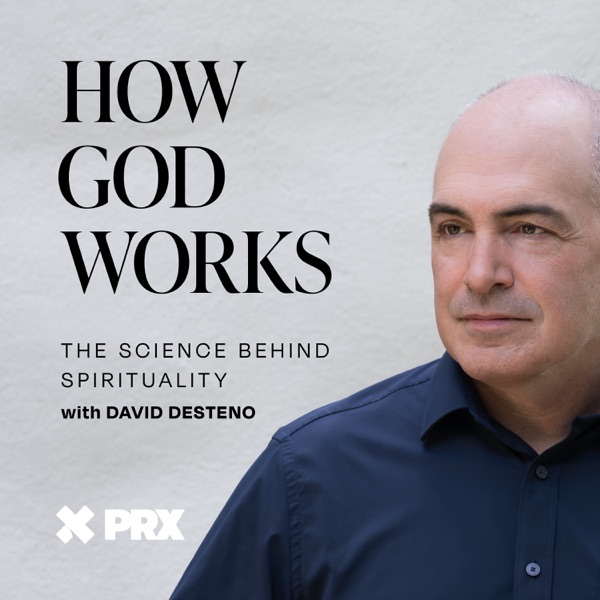
How God Works: The Science Behind Spirituality
While religion and science often seem at odds, there’s one thing they can agree on: people who take part in spiritual practices tend to live longer, healthier, and happier lives. The big question is: Why? In How God Works, professor Dave DeSteno takes us on a journey to find out how spirituality impacts our minds and bodies, as well as the world in which we live.
He speaks to leading scientists and philosophers, religious thinkers, and thought leaders to explore what we can learn from the world’s faith traditions to help us meet some of life’s biggest challenges. Along the way, he’ll look at how we can adapt and use spiritual practices in our own lives, whatever our beliefs, including none at all.
It’s by working across the boundaries that usually divide us – science versus religion, one faith versus another – that we’ll find new ways to make life better for everyone.
- Philosophy chart
- #36
- Episodes
- 122
- Releases
- Every two weeks
- Typical length
- 41 min
- On air since
- 2021
- Latest episode
- 2 days ago
Episodes
122 episodes, newest first
-
38 min
Faith and Fashion
Season 11, Episode 4
Show notes
Let's face it, religion isn't known for being particularly fashion-forward. Many might even say they’re directly opposed—vice and virtue, decadence versus humility, maximalism versus modesty. But lately, scholars from both the fashion world and Christian theology are arguing that maybe the story isn't quite so simple.
On this episode, we’ll talk to the pastor, theologian, and professor Robert Covolo about the long history of fashion in Christianity and clothing as a form of communication, a way to construct identity, interact in complex societies, and even connect with the divine. Whether or not the ultimate goal is to get closer to God or to one another, fashion and beauty can open our hearts and minds to something beyond ourselves.
Robert Covolo is the Executive Director of the Center for Faith + Work Los Angeles and a Professor at the Honors College at Azusa Pacific University. He is the author of Fashion Theology. Learn more about his work on his website.
-
44 min
Economic Inequality
Season 11, Episode 3
Show notes
Money may not buy happiness. But it turns out that the way it’s distributed can affect everything from happiness and a sense of meaning to physical health and mortality.
On this episode, we’ll explore the role economic inequality plays in the wellbeing of individuals and societies, and ask how religion fits into the picture. We’ll talk to psychologist Keith Payne about how our sense of where we stand in society can influence our behavior, our health, and even how religious we are. And we’ll also talk to religious studies scholar Bart Ehrman about Christianity’s complicated relationship with wealth, from the teachings of the historical Jesus to the establishment of modern welfare institutions and the rise of Protestant movements like the Prosperity Gospel.
Keith Payne is a Professor of Psychology and Neuroscience at the University of North Carolina, Chapel Hill. He is the author of the books The Broken Ladder and Good Reasonable People. Learn more about his work on his website.
Bart Ehrman is the James A. Gray Distinguished Professor Emeritus of Religious Studies at the University of North Carolina at Chapel Hill, and the author or editor of over thirty books on Christianity and the New Testament, including Love Thy Stranger: How the Teachings of Jesus Transformed the Moral Conscience of the West. Find out more about his work on his website.
-
52 min
One Nation... Under God?
Season 11, Episode 2
Show notes
The United States is a country founded on the separation of church and state. But what did the founders really mean by that? Should religion be banished from public life and policy debates? Or could it serve a purpose in the pursuit of happiness and freedom for all?
On this episode, recorded during the Aspen Ideas Festival, we'll explore what the US founding fathers really thought about the different roles religion could play in society, how that view has changed through history, and what it means for the upcoming US elections.
David French is an American political commentator and current opinion columnist for The New York Times. He is a senior fellow of the Trinity Forum, a former senior editor for The Dispatch, and former staff writer for National Review.
Jeffrey Rosen is CEO Emeritus of the National Constitution Center, a professor of law at the George Washington University Law School, and a contributing editor for The Atlantic.
-
42 min
Rethinking Purpose
Season 11, Episode 1
Show notes
These days, it seems like advice for how to “find your purpose” is everywhere. But what if purpose isn’t some hidden answer waiting to be found? And what if anxiously searching for our one true calling actually makes it harder to live with purpose?
On this episode, we explore some other approaches to the problem. Clinical psychologist Ross White tells us about how psychological flexibility can help us form purpose over time, and stay connected to it, even as our lives change. And we talk to philosopher Edward Slingerland about what early Chinese thinkers like Confucius and Zhuangzi would have made of our modern obsession with inventing a meaningful path from scratch.
Ross White is an Honorary Professor of Clinical Psychology at Queen’s University, Belfast and the Founding Director of Strive2Thrive. He is the author of the book The Tree That Bends: How a flexible mind can help you thrive, as well as the article “Your purpose isn’t something you find, it’s something you form.”
Edward Slingerland is a Professor of Philosophy at the University of British Columbia and a Visiting Professor in the Department of Religion at Dartmouth. He is the author of many books, including Trying Not to Try and the forthcoming title, Learning to See: Literature, Moral Perception and Early Confucian Virtue Ethics. Find out more about his work on his website.
-
3 min
Season 11 Trailer Trailer
Season 11
Show notes
Join us for Season 11 of How God Works, starting next week!
-
45 min
HGW Presents: Oh God Now What Bonus
Show notes
How God Works will be back with all new episodes in September. In the meantime, we're excited to feature an episode from our friends at Oh God Now What, hosted by Niala Boodhoo.
*
In the debut episode, "Voting Your Morals," host Niala Boodhoo welcomes public theologian Curtis Chang and Rabbi Jill Jacobs. Using their expertise as religious thought leaders, they help us navigate aligning beliefs with how we vote. And they offer perspective and tools for strengthening democracy outside of high-stakes elections.
Chang is the Executive Director of Good Faith, which helps politically ‘homeless’ Christians navigate a deeply divided world. Rabbi Jacobs is the CEO of T’ruah, which empowers rabbis and cantors to lead Jewish communities in advancing democracy and human rights.
-
46 min
Bonus Episode: God, Code, and Consciousness (Aspen Ideas)
Show notes
As humans increasingly turn to AI for moral guidance and answers to life’s biggest questions, the lines between technology and religion are blurring—even leading some in Silicon Valley to wonder if AI might have a spiritual life of its own or be destined to change the world’s religious landscape. What does the impulse to see a god in the machine reveal about our enduring hunger for meaning, belonging, and spiritual growth?
Dave explores these questions and more with psychologist Paul Bloom, author Elizabeth Oldfield, and theologian Paolo Benanti in a discussion recorded live at the 2026 Aspen Ideas Festival.
Paul Bloom is a professor of psychology at the University of Toronto and the Brooks and Suzanne Ragen Professor Emeritus of Psychology at Yale University. He's also the author of seven books, including his latest “Psych: The Story of the Human Mind.”
Elizabeth Oldfield hosts “The Sacred” podcast, dedicated to conversations about being human, finding wisdom, building a more tolerant society, and what spirituality and religion might offer in answer to those questions. She is also the author of Fully Alive: Tending to the Soul in Turbulent Times.
Paolo Benanti is a professor of moral philosophy at Luiss Guido Carli University in Rome and a professor of technology ethics at Seattle University. A Franciscan priest and leading global voice on AI ethics, he advises the Vatican on emerging technologies and the rise of generative AI and chatbots.
-
35 min
Aliens and Spirituality (Encore Presentation)
Show notes
Religion is often about powerful beings coming down from the skies and humans yearning to go up to join them. Does that mean we can swap aliens in for God? More and more people seem to think so. In fact, many spiritually-minded people are looking to UFOs as opportunities to commune with enlightened alien teachers. Some believe they’re even aliens themselves, sent here to prepare us for a new age. But when religion gets mixed with conspiracy theory, things can sometimes take a darker turn.
Join Dave as he speaks with religious studies professor Diana Walsh Pasulka, about what belief in UFOs might share with other religions, and with anthropologist Susannah Crockford about how and why conspiracy theories are giving rise to a new spiritual movement.
Diana Walsh Pasulka is the author of Encounters: Experiences with Nonhuman Intelligence and American Cosmic: UFOs, Religion, Technology. Find out more about her work on her website.
Susannah Crockford is the author of Ripples of the Universe: Spirituality in Sedona, Arizona, and the host of the show Miss Information, a podcast about the ways online misinformation and conspiracy theories infiltrate wellness communities and conservative Christian spaces.
-
45 min
Searching for Signs
Season 10, Episode 8
Show notes
Throughout history, humans have searched for signs and symbols to help them navigate uncertainty. From ancient Chinese divination texts and Greek oracles to astrology, tarot cards, and modern occult practices, divination has appeared in nearly every culture on Earth. And while some might think of these practices as relics of a more superstitious age, divination turns out to be far more central to human history, and human nature, than most of us would ever guess.
On this episode, we explore the surprisingly rich history of divination and what it reveals about our enduring need for meaning, guidance, and answers in the face of uncertainty. We talk to historian Michelle Pfeffer about divination's deep roots in both religion and science, and to sociologist and tarot reader Melissa Lavin about why practices like tarot are resonating with so many people today.
Dr. Michelle Pfeffer is a historian of science and religion at the University of Oxford. She recently co-curated the exhibition Oracles, Omens and Answers at the Bodleian Libraries, and co-edited the accompanying book Divination, Oracles & Omens.
Dr. Melissa Lavin is a sociologist at SUNY Oneonta and a tarot reader. She is the author of the forthcoming book Greater Secrets: Managing Fate Through the World of Tarot, available for purchase in February 2027.
-
37 min
Humor and Judaism: A Conversation with Robby Hoffman
Season 10, Episode 7
Show notes
According to a 2020 Pew Research Center survey, more American Jews cite having a sense of humor as important to their Jewish identity than things like keeping kosher and studying Torah.
Humor has long been associated with Jewish identity—from Jerry Seinfeld to Mel Brooks, Adam Sandler to Joan Rivers.
On this episode of How God Works, we'll talk with the latest member of the long tradition of highly successful Jewish comedians, Emmy award-winning actor, writer and comedian, Robby Hoffman, about how Jewish people have shaped comedy, how comedy has shaped the Jewish people, and the role humor plays in her life and approach to faith. We’ll also ask if humor itself can be a spiritual practice—a way to cope with life’s difficulties and maybe even touch the transcendent.
Robby Hoffman is a writer, actor and comedian. Her Netflix stand-up special Robby Hoffman: Wake Up debuted in December 2025. She recently appeared on the HBO series Rooster. She was also nominated for an Emmy in 2025 for her guest role on HBO’s Hacks. She is the host of the Too Far podcast on Patreon. Learn more about her work on her website where you can also find tickets to her tour.
Also mentioned on this episode:
Jennifer Caplan, learn more about her work and find links to her books on her website.
-
1 hr 3 min
Rethinking Sin… Again
Season 10, Episode 6
Show notes
We’ve all done things we’re not proud of. But why do some people seem to struggle so much more than others when it comes to avoiding harmful behavior? And what does it mean for how we think about blame and accountability if the answer has something to do with our genes?
On this episode, we’re rethinking sin from the perspective of behavioral genetics. We’ll talk to psychologist Kathryn Paige Harden about the surprising ways ancient religious debates are still shaping modern science, what genetics can actually tell us about why we fall short, and what it all means for how we think about accountability and repair, both for ourselves and as a society.
Kathryn Paige Harden is a Professor of Psychology at the University of Texas at Austin, where she directs the Developmental Behavior Genetics lab and serves as Director of Clinical Training. She is the author of Original Sin: On the Genetics of Vice, the Problem of Blame, and the Future of Forgiveness, and The Genetic Lottery: Why DNA Matters for Social Equality. Learn more about her work on her website.
Also mentioned on this episode:
Elaine Pagels, author of Adam, Eve, and the Serpent
Robert Sapolsky, author of Behave: The Biology of Humans at Our Best and Worst and Determined: A Science of Life Without Free Will
Elizabeth Oldfield, author of Fully Alive: Tending to the Soul in Turbulent Times and former How God Works guest.
-
58 min
Deus Ex Machina
Season 10, Episode 5
Show notes
We’ve always assumed that if there IS a God, that God made us. But what if it ends up being the other way around… and we’re already further along than we think? Artificial intelligence is now offering moral advice, generating new forms of scripture, even simulating conversations with the divine. For some users, the line between useful tool and spiritual authority is already starting to blur. Why does it feel so natural for us to imagine there’s a ghost in the machine? And what happens when the people building AI start to talk and think about their creation in religious terms?
On this episode, we’ll talk to journalist Sigal Samuel about where AI is showing up in religious spaces and how what it becomes will have major consequences for human agency and how we understand our place in the world. And we’ll talk to psychologist Paul Bloom about the quirks of human psychology that make us so prone to see minds, intention, and perhaps even the divine, in the machine. Along the way we’ll also ask: Can AI be morally formed? Could it ever have something like its own spiritual yearning? And if it could, what might it mean for us?
Sigal Samuel is a senior reporter at Vox, where she covers religion, ethics, and the future of consciousness and AI. Check out her writing in Vox’s Future Perfect column and follow her on X or Bluesky.
Paul Bloom is a professor of psychology at the University of Toronto and the author of several books, including Just Babies: The Origins of Good and Evil and Against Empathy. Learn more about his work at his website.
Also mentioned on this episode:
Stewart Elliott Guthrie, author of Faces in the Clouds: A New Theory of Religion
William Paley, author of Natural Theology (watch on a beach example)
Catholic priest and philosopher Pierre Teilhard de Chardin, and futurist Ray Kurzweil, who have both influenced the philosophical movement of transhumanism.
-
45 min
Doubt (Part II)
Season 10, Episode 4
Show notes
Uncertainty about faith can be anxiety provoking and even cause people to leave religion altogether. But that's not the way it works in all traditions. In fact, some are exactly the opposite.
In the second of a special two-part series exploring the promise and perils of doubt in faith, we talk with Rabbi Angela Buchdahl about how debate and questioning are central to the Jewish faith—both as methods for seeking truth and living a spiritual life. We also explore the guardrails that Jewish ritual and wisdom offer for channeling doubt productively to foster growth on a personal level and in the Jewish tradition itself.
Rabbi Angela Buchdahl is the Senior Rabbi of Central Synagogue in New York City. She is the author of Heart of a Stranger: An Unlikely Rabbi's Story of Faith, Identity, and Belonging.
-
39 min
Doubt (Part I)
Season 10, Episode 3
Show notes
Religion can help provide answers to many questions in life - big and small. And in doing so, give a sense of security and understanding of the world and our place in it. But what happens when doubt starts to creep in? As more and more people leave organized religion, is doubt the cause, or could learning how to embrace doubt actually be the answer to the modern crisis of faith?
In the first of this special two part series on doubt and spirituality, we'll talk with author, poet and lecturer Christian Wiman, about what it means to have certainty that God exists, while also harboring major doubts about how to approach the divine.
And we'll talk to psychologist Julie Exline about how doubt tends to affect those who experience it, and her recommendations for constructive ways to embrace uncertainty for spiritual and personal growth.
Christian Wiman is a Professor at Yale University and is an author and editor of numerous publications. His most recent books include My Bright Abyss and Glimmerings: Letters on Faith Between a Poet and a Theologian. To engage with more of his work, click here.
Julie Exline,Ph.D. is the Research Director and Bonner-Lowry Professor of Psychiatry and Neurobehavioral Sciences at the University of Virginia School of Medicine.
-
43 min
What Women Want
Season 10, Episode 2
Show notes
In conversations about women’s rights, religion and feminism are often cast as incompatible. But religious women tend to see it differently.
In this episode, we’ll explore how religious women around the world are defining what liberation looks like on their own terms, and ask what we can all learn from their efforts, regardless of what we believe. We’ll talk to writer and lawyer Dania Suleman about how women of faith are defending their religious freedom in secular spaces while also challenging gender inequality within their own communities. And we’ll talk to Dr. Dianne Stewart about African heritage religions, where women have often held spiritual authority in ways that challenge familiar assumptions about gender and hierarchy.
Dania Suleman is the author of A Different Cloth: Reimagining Faith and Feminism.
Dr. Dianne Stewart is the Samuel Candler Dobbs Professor of Religion and African American Studies at Emory University, and the author of Obeah, Orisa, and Religious Identity in Trinidad, Volume II, Orisa. Learn more about her work, and her many other publications, at her website.
Also mentioned this episode:
Asma Lamrabet is the author of Women in the Qur’an: An Emancipatory Reading. Learn more about her work on her website.
Learn more about Hind Makki’s Side Entrance Project here.
Chandra Talpade Mohanty is the author of the essay “Under Western Eyes: Feminist Scholarship and Colonial Discourses”
-
31 min
DIY Spirituality?
Season 10, Episode 1
Show notes
About 70% of all Americans consider themselves spiritual in some way, whether it be a belief in the soul, spirits or just the idea that something's going on beyond the natural world and what science can prove. But that doesn't mean they're ordering off the menu of organized religion.
In this episode, we’ll talk to religion professor Liz Bucar, about this “spiritual salad bar” approach: where people pick and choose ingredients from various religions. What’s lost if we take these traditions out of their intended context? And could it even be causing harm?
We’ll explore this through the lens of yoga - practiced by one in every six Americans alive today.
Practicing yoga regularly does have proven health benefits, but it’s rooted in a much deeper spiritual and religious tradition that many people aren’t even aware of. With Liz, we’ll explore how restoring some religion to secular or new age spiritual practices can make them more ethical, meaningful and effective.
Liz Bucar is a professor of religion at Northeastern University. She is the author of four books and her writing, teaching, and public lectures cover a wide range of topics but generally focus on how a deeper understanding of religious difference can change our sense of what is right and good. She is the author of the forthcoming book Beyond Wellness, which you can pre-order here. Learn more about her work on her website.
-
2 min
Season 10 Trailer Trailer
Show notes
Join us for Season 10 of How God Works, starting next week!
-
1 hr 22 min
Uniter or Divider? Explore Religion in Modern America. A How God Works Live Event (From the Archive) Bonus
Show notes
We’ll be back on March 15 with an all-new season of How God Works! In the meantime, we’re excited to share one of our favorite episodes — our very first live event.
If you ask people what they think about religion, you often get one of two answers: Religion is the source of war, violence, abuse, and hypocrisy OR a route to love, kindness, tolerance, and mercy.
Put another way, it’s either what divides us or it’s the thing that can actually bring us together. In a country deeply divided over social, political, and moral issues that seems to be moving further apart by the day, the answer’s not likely to be a simple one.
How God Works held its first live event in December to explore just that. Why does something that has the potential to connect us so deeply also have the ability to divide us so profoundly? And, regardless of what we believe, is there something we can learn from what religion gets right to find a way to come together?
In a wide-ranging and often moving discussion, Dave spoke to a panel of leading spiritual thinkers and social scientists who have experienced both sides of the issue, including Central SynagogueRabbi Angela Buchdahl, award-winning author and Christian HistorianDiana Butler Bass, The University of North Carolina’sDeepest Beliefs Lab directorKurt Gray, and The Aspen Institute’s Religion and Society Program’s executive directorSimran Jeet Singh.
-
37 min
The Spiritual (and Political) Crisis in the US (From the Archive) Bonus
Show notes
A brand-new season of How God Works returns March 15! In the meantime, we’re revisiting a powerful episode from our archive that feels particularly relevant today.
Anger, loneliness, and despair are hitting record levels in the US. Our social and political fabrics are fraying. Is the turn away from religion in the US part of the problem? And if so, might a spiritual renaissance (even among the secular left) help us find new ways to flourish? Join Dave as he talks with podcast host Krista Tippett and US Senator Chris Murphy about the role spirituality (or the lack thereof) plays in our individual and societal wellbeing.
Krista Tippett is the host of the acclaimed podcast and radio show On Being. Learn more about the On Being Project’s work in the world here, and be sure to check out their YouTube channel for a rich selection of inspiring and informative videos.
Chris Murphy is a U.S. Senator representing the State of Connecticut. Learn more about his work on his website, and read his column on the need for a spiritual revival among the political left here.
-
35 min
Mattering
Season 9, Episode 8
Show notes
Feeling that our life is meaningful - that we add value to the world and are valued by the people around us, isn’t just a good feeling, it's a fundamentally necessary one. In fact, the need to matter is a universal human motive, second only to the needs of food and shelter. On this episode we'll talk to author Jennifer Wallace about her new book on the topic of mattering, why we’re in a “mattering deficit,” the worrying impact this is having on our physical and emotional health, and what we can do to change that. And Duke researcher Patty Van Cappellen will share studies showing how spirituality and religious community can instill a deep sense of meaning in life that contributes to true human flourishing.
Jennifer Wallace is an award-winning journalist and the author of Mattering. You can find more about her work on her website.
Patty Van Cappellen, Ph.D., is an associate research professor at the Social Science Research Institute and the Department for Psychology and Neuroscience at Duke University.
Philosophy lists
More Philosophy shows picked out from the charts






More in Philosophy
Placed highest on Apple Podcasts' Philosophy chart right now