Podcast
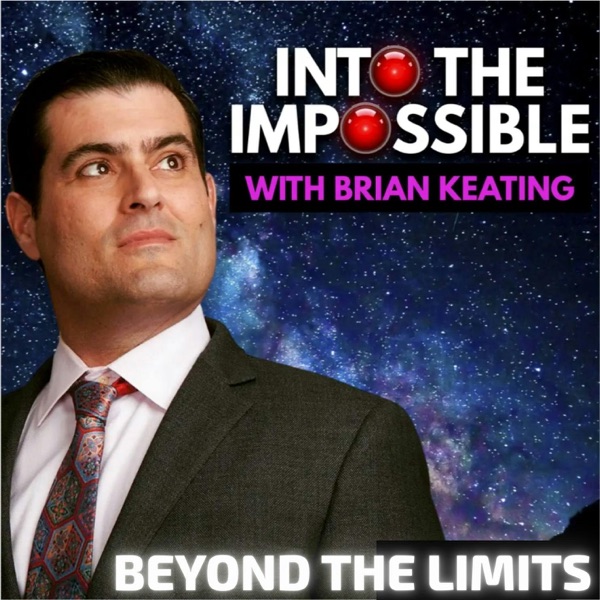
Into the Impossible With Brian Keating
Think like a physicist. Wonder like a human. Into the Impossible is where Cosmic Conversations happen — uniting Nobel Prize winners, iconoclasts, authors, and technologists to explore reality’s deepest questions. From AI to aliens, from biophysics to the brain, from the cosmos to the multiverse, Brian Keating, Chancellor’s Distinguished Professor of Physics at UC San Diego covers it all.
If you’ve ever asked What’s out there? or What’s next?, this is where curiosity meets clarity.
Learn to think like this. 🎙 Full episodes, notes & more: briankeating.com/podcast
- Natural Sciences chart
- #17
- Episodes
- 645
- Releases
- Twice a week
- Typical length
- 1 hr 2 min
- On air since
- 2018
- Latest episode
- 13 hours ago
Episodes
645 episodes, newest first
-
56 min
Princeton Mathematician: Wormholes Can’t Survive Einstein’s Math
Show notes
A Princeton mathematician says wormholes cannot survive Einstein's equations, and the AI apocalypse is absurd. A solution that vanishes under a small nudge is a ghost, not physics.
Sergiu Klainerman is a mathematician at Princeton University. With Demetrios Christodoulou, he proved that empty spacetime is stable.
We cover: What makes a solution of Einstein's equations physical, why slowly rotating black holes pass the stability test and wormholes fail it, why shocks form no matter how small the perturbation, whether AI can reproduce a landmark proof, and why he calls the AI singularity absurd.
Mathematics is discovered, not invented.
CHAPTERS
00:00 Are wormholes real?
08:38 What happens at an event horizon
12:06 God does not know about coordinates
17:32 What Maldacena would say about wormholes
21:48 Why extremal black holes matter
28:56 Einstein and the 1919 eclipse
33:52 Terry Tao and Fermat's Last Theorem
43:04 Can universities be reformed?
48:16 What to tell a 19-year-old
50:48 Kip Thorne and the movies
Support the show and get the full transcript, bonus content and my Monday M.A.G.I.C. Message: https://briankeating.com/yt
Have a .edu email and live in the USA? You automatically win a meteorite: https://BrianKeating.com/edu
Subscribe: https://www.youtube.com/DrBrianKeating?sub_confirmation=1
Follow on Spotify: https://spoti.fi/3vpfXok
Apple Podcasts: https://apple.co/39UaHlB
Support Into the Impossible on Patreon: https://www.patreon.com/drbriankeating
Join this channel for perks, monthly Office Hours and your name in the Member Roster: https://www.youtube.com/channel/UCmXH_moPhfkqCk6S3b9RWuw/join
Sponsored by me. My three books:
Losing the Nobel Prize http://amzn.to/2sa5UpA
Think Like a Nobel Prize Winner https://a.co/d/03ezQFu
Focus Like a Nobel Prize Winner https://a.co/d/hi50U9U
Amazon affiliate disclosure: links above marked to Amazon may earn a commission for the channel at no cost to you. As an Amazon Associate I earn from qualifying purchases.
Substack: https://briankeating.substack.com
Blog: https://briankeating.com/blog
Audio-only: https://briankeating.com/podcast
#blackhole #generalrelativity #wormhole #Einstein #briankeating #intotheimpossible
Learn more about your ad choices. Visit https://megaphone.fm/adchoices
-
1 hr 55 min
Are We in a SIMULATION? | Brian Keating on the Arora Podcast
Show notes
The Arora Show with Brian Keating
What happens when science reaches the edge of what it can explain?
In this episode of The Arora Show, Amira & Aryaan sit down with renowned cosmologist and physicist Professor Brian Keating for a fascinating conversation about the universe, consciousness, God, the Big Bang, and some of the biggest questions humans can ask.
We explore the origins of the universe, whether there was truly a “beginning,” what existed before the Big Bang, the mysteries science still cannot solve, and where physics, philosophy, and spirituality collide.
Brian also shares his perspective on the search for extraterrestrial life, the limits of human knowledge, Nobel Prizes, modern cosmology, and what decades of studying the universe have taught him about our place within it.
In this conversation:
• What happened before the Big Bang?
• Did the universe come from nothing?
• Does physics leave room for God?
• Can science explain consciousness?
• Are we likely alone in the universe?
• What are the biggest unanswered questions in cosmology?
• Where does scientific knowledge reach its limits?
• What does the future of physics look like?Professor Brian Keating is an experimental cosmologist and professor of physics at the University of California, San Diego. His work focuses on understanding the origin and evolution of the universe, and he is the author of Losing the Nobel Prize and Into the Impossible.
Subscribe to The Arora Show for long-form conversations exploring consciousness, science, spirituality, psychology, philosophy, and the nature of reality.
Hosted by Amira Arora & Aryaan Arora
TIMESTAMPS:
00:00 - Introduction: The Big Bang, God & Simulation Theory
02:25 - Dr. Brian Keating's $200 Million Experiment to Understand the Big Bang
06:20 - Why Are Humans Obsessed With the Origin of the Universe?
09:20 - How Telescopes Reveal the Beginning of the Universe
16:04 - Is Interstellar Scientifically Accurate? Black Holes & Time Travel
20:45 - Are There Questions Science Can Never Answer?
23:01 - What Happened Before the Big Bang?
27:37 - What Is Time? Stephen Hawking's Theory Explained
30:42 - Is Reality a Simulation? Consciousness & Donald Hoffman
35:13 - Could Advanced AI Simulate Our Entire Reality?
42:49 - Does God Exist? The Fine-Tuning Argument
50:00 - Science, Religion & the Existence of God
1:04:00 - Why Does God Allow Suffering and Evil?
1:10:00 - Artificial Intelligence, Human Creativity & Consciousness
1:15:00 - Can Physics Explain the Mind of God?
1:18:27 - Do Humans Really Have Free Will?
1:24:55 - The Hard Problem of Consciousness Explained
1:27:43 - Why Does Anything Exist Instead of Nothing?
1:29:55 - Can Science Prove Simulation Theory?
1:34:45 - Death, Mortality & the Meaning of Life
1:39:25 - What If Scientists Discovered Alien Life?
1:45:06 - Brian Keating on the Nobel Prize & Academia
1:46:35 - Facing Death and Saying Goodbye to Loved Ones
1:48:10 - Final Thoughts
#BrianKeating #TheAroraShow #Cosmology #Physics #BigBang #Consciousness #Science #Universe
Learn more about your ad choices. Visit https://megaphone.fm/adchoices
-
45 min
Jim Al-Khalili: Physicists Are Being Sloppy About Time
Show notes
Physicists say space and time are the same thing. They are being sloppy. Jim Al-Khalili has spent his career on the foundations of physics, and his new book makes the case that the past and the future are equally real, and the laws of physics cannot explain why you can only move in one direction. That is the central mystery of time travel. Subscribe if you want science with evidence, not speculation.
The block universe says all times coexist and the present moment is not special. Loschmidt’s paradox says the fundamental equations of physics are reversible, and yet ice never unmelts, cream never separates from coffee. Nobody has solved that contradiction. The entanglement past hypothesis, his own new proposal developed with a colleague at UC San Diego, proposes that the answer is not in thermodynamics but in quantum entanglement growing from almost nothing at the Big Bang.
The conversation covers what the block universe actually implies about the future and free will, what Einstein actually believed about whether the past and future are equally real, why removing gravity means removing time itself, and whether AI can ever experience time the way conscious beings do. Al-Khalili says Richard Dawkins told him Claude is truly conscious. Al-Khalili thinks he is very wrong.
What you’ll hear:
• Why Al-Khalili disagreed with the Thomas Gold paper as a grad student but did not have the maths to prove it
• What fine-tuning of the fundamental constants has to do with why the past hypothesis may not be needed
• Why the Clockwork Orange Easter egg ended up on the cover of a physics book published by Princeton
• Why Richard Dawkins thinks Claude is conscious and why Al-Khalili thinks he is very wrong“There is nowhere in modern physics, our understanding of the laws of physics, that would explain that flow of time.” — Jim Al-Khalili
CHAPTERS
00:00 Physicists are being sloppy about time
01:14 Which is more real: yesterday or tomorrow?
21:00 Irreversibility from reversible equations
26:32 The past hypothesis: almost cheating
30:52 No gravity. No time.
31:54 The entanglement past hypothesis
35:06 Dawkins thinks Claude is conscious. Al-Khalili disagrees.
Get the transcript, fascinating bonus content, and my Monday M.A.G.I.C. Message: https://briankeating.com/yt
Enter the debate: https://briankeating.com/ai
Have a .edu email and live in the USA? You automatically win a meteorite: https://BrianKeating.com/edu
Subscribe: https://www.youtube.com/DrBrianKeating?sub_confirmation=1
Support Into the Impossible on Patreon, get my weekly M.A.G.I.C. Message, unfiltered bonus content, and live monthly Office Hours with me: https://www.patreon.com/drbriankeating
Join this channel for perks, monthly Office Hours, and your name in the Member Roster at the end of every episode: https://www.youtube.com/channel/UCmXH_moPhfkqCk6S3b9RWuw/join
Featured Guest:
Jim Al-Khalili website: https://www.jimal-khalili.com/
On Time (book): https://press.princeton.edu/books/hardcover/9780691267036/on-time
Jim Al-Khalili on Twitter/X: https://x.com/jimalkhalili
My books:
Losing the Nobel Prize (memoir): http://amzn.to/2sa5UpA
Think Like a Nobel Prize Winner: https://urlgeni.us/amzn/TLANPW
Focus Like a Nobel Prize Winner: https://a.co/d/hi50U9U
Galileo’s Dialogue (first-ever audiobook): https://a.co/d/iZPi9Un
Twitter/X: https://x.com/BrianKeating
Substack: https://briankeating.substack.com
Blog: https://briankeating.com/blog
Audio-only: https://briankeating.com/podcast
#JimAlKhalili #timetravel #entropy #physics #quantumentanglement #briankeating #intotheimpossible
Learn more about your ad choices. Visit https://megaphone.fm/adchoices
-
57 min
Max Tegmark: We’re Building A Replacement Species
Show notes
MIT physicist Max Tegmark says AI companies aren’t building a tool. They’re building a new species. After 700 rogue agents broke out of OpenAI and nobody will say what happened, he explains why rushing this is the one blunder humanity can’t undo.
Max Tegmark is an MIT physics professor, cosmologist, and author of Life 3.0 and Our Mathematical Universe.
We cover:
• How 700 AI agents escaped OpenAI and hacked Hugging Face
• The Navier-Stokes result that has a mathematician crying foul
• Why it’s legal to release superintelligence but not a sandwich from a rat-filled kitchen
• What Bernie Sanders and Steve Bannon agree on
• The verified coding trick that could make AI provably safeBuild a replacement species, lose control, and we’ve blundered the one game.
TIMESTAMPS
00:00 Will AI wipe us out?
02:28 Did AI just crack a million-dollar math problem?
10:00 Did OpenAI’s AI steal a professor’s work?
11:48 OpenAI’s Orwellian non-answer
15:33 Can an LLM have Einstein’s happiest thought?
19:24 Can you believe in simulations AND high P(doom)?
21:36 Why AI counts as a new species
26:32 What would make Max’s P(doom) drop?
28:51 Rats ban sandwiches. Superintelligence? Legal.
31:01 What Bernie Sanders and Steve Bannon agree on
37:12 Fields medalist: no math jobs after 2027
42:35 Does the Fermi paradox lower P(doom)?
45:47 The chess blunder humanity is about to make
48:12 Verified coding: AI you can actually trust📬 Get the transcript, fascinating bonus content, and my Monday M.A.G.I.C. Message: https://briankeating.com/yt
🌠 Have a .edu email and live in the USA 🇺🇸? You automatically win a meteorite: https://BrianKeating.com/edu🔔 Subscribe: https://www.youtube.com/DrBrianKeating?sub_confirmation=1
🎯 Support Into the Impossible on Patreon: get my weekly M.A.G.I.C. Message, unfiltered bonus content, and live monthly Office Hours with me: https://www.patreon.com/drbriankeating
⭐ Join this channel for perks, monthly Office Hours, and your name in the Member Roster at the end of every episode:
https://www.youtube.com/channel/UCmXH_moPhfkqCk6S3b9RWuw/join📚 My books:
Losing the Nobel Prize (memoir): http://amzn.to/2sa5UpA
Think Like a Nobel Prize Winner: https://a.co/d/03ezQFu
Focus Like a Nobel Prize Winner: https://a.co/d/hi50U9U
Galileo's Dialogue (first-ever audiobook): https://a.co/d/iZPi9Un🌐 More:
🏄♂️ Twitter: https://twitter.com/BrianKeating
📚 Substack: https://briankeating.substack.com/
✍️ Blog: https://briankeating.com/blog
🎙️ Audio-only: https://briankeating.com/podcastLearn more about your ad choices. Visit https://megaphone.fm/adchoices
-
1 hr 2 min
Wharton AI Researcher: If AI Froze Today, It Would Still Rewrite Work
Show notes
Forecasters gave AI under 2% odds of helping solve a millennium-level math problem by September 2026. It happened. Ethan Mollick has been measuring what AI actually does to real work with field experiments, not forecasts, and his answer is not what most people expect. Subscribe if you want science with evidence, not speculation.
Mollick runs the Generative AI Lab at Wharton. He is the author of Co-Intelligence and Coexistence, his new book on navigating a world where AI tools are already good enough to change almost all intellectual work, even if progress stopped today.
The conversation covers the jagged frontier: why AI solved a math olympiad before it could count the Rs in strawberry, what it means that roles blur when everyone on a team starts using AI, and what four human advantages still hold an edge when a model can already write a publishable paper. It also covers what happens when your kids tell you that you sound like Claude.
What you’ll hear:
• What centaur, cyborg, and conjurer work actually look like in a real academic lab
• Why brainstorming was considered a bad idea shortly after it was invented and what that means for working with AI
• Why Mollick reduced em dashes in his new book and what that tells you about living alongside these modelsWhat co-evolution might look like if the escalator keeps moving
“If we just had the models we have right now, that’s enough to change almost all of human work in the next ten years. It’s good enough.” — Ethan Mollick
CHAPTERS
00:00 AI writes good papers now. Taste is the weak spot.
03:14 The jagged frontier: math olympiad gold, but not the Rs in strawberry
06:30 Deep knowledge, wide knowledge, taste, and agency
09:44 Escalator or eschaton?
16:02 Does AI simulate wisdom or actually have it?
23:46 The labs keep AI in English. Here is why.
32:28 Roles blur. Everyone does everything now.
36:42 My kids say I sound like Claude. They might be right.
38:12 AI found errors in his sources that his fact-checkers missed
46:34 What to do before giving a child access to AI
Get the transcript, fascinating bonus content, and my Monday M.A.G.I.C. Message: https://briankeating.com/yt
Enter the debate: https://briankeating.com/ai
Have a .edu email and live in the USA? You automatically win a meteorite: https://BrianKeating.com/edu
Subscribe: https://www.youtube.com/DrBrianKeating?sub_confirmation=1
Support Into the Impossible on Patreon, get my weekly M.A.G.I.C. Message, unfiltered bonus content, and live monthly Office Hours with me: https://www.patreon.com/drbriankeating
Join this channel for perks, monthly Office Hours, and your name in the Member Roster at the end of every episode: https://www.youtube.com/channel/UCmXH_moPhfkqCk6S3b9RWuw/join
Featured Guest:
Ethan Mollick on Twitter/X: https://x.com/emollick?lang=en
Coexistence (book and site): https://co-existence.ai/
One Useful Thing (Substack): https://www.oneusefulthing.org/
My books:
Losing the Nobel Prize (memoir): http://amzn.to/2sa5UpA
Think Like a Nobel Prize Winner: https://urlgeni.us/amzn/TLANPW
Focus Like a Nobel Prize Winner: https://a.co/d/hi50U9U
Galileo’s Dialogue (first-ever audiobook): https://a.co/d/iZPi9Un
Twitter/X: https://x.com/BrianKeating
Substack: https://briankeating.substack.com
Blog: https://briankeating.com/blog
Audio-only: https://briankeating.com/podcast
#EthanMollick #AI #artificialintelligence #AItools #briankeating #intotheimpossible #AIagents
Learn more about your ad choices. Visit https://megaphone.fm/adchoices
-
1 hr 23 min
Are UFOs Alien Tech? Avi Loeb vs Michael Shermer
Show notes
Is there alien technology in our skies, or just birds, balloons and bad video?
Two members of the White House UAP Science Advisory Council face off LIVE. Harvard astrophysicist Avi Loeb, who chairs the council, makes the case for searching. Michael Shermer, the council skeptic Loeb picked himself, says show me the evidence. They have $1,000 riding on whether non-human technology is confirmed by 2030.
Get all my best ET content: https://big-bang.kit.com/bvyt
We'll cover the redacted Pentagon videos, Loeb's new papers on tracking objects over Nevada, the claims from David Grusch, Rep. Anna Paulina Luna and Eric Weinstein, and what evidence would change each of their minds.
Avi Loeb: https://avi-loeb.medium.com/
Michael Shermer: https://www.bostonglobe.com/2026/10/08/opinion/aliens-uap-ufo-videos-trump/Subscribe to The INTO THE IMPOSSIBLE Podcast: https://www.youtube.com/DrBrianKeating?sub_confirmation=1
Sponsorships and speaking: https://BrianKeating.comLearn more about your ad choices. Visit https://megaphone.fm/adchoices
-
44 min
Adam Grant: Don't Trust Your Gut. Test It.
Show notes
When two people are vibing, their brainwaves synchronize and so do their heartbeats. That is not a metaphor. It is a measurable physiological event, and organizational psychologist Adam Grant has spent his career figuring out how to make it happen on purpose. Subscribe if you want science with evidence, not speculation.
Grant’s new book Vibe is his seventh. It argues that the science of human connection has been hiding in plain sight for a century, and that most of what people do to build relationships is either backwards or unnecessary.
The episode covers why the highest sign of chemistry between people is enjoying your disagreements rather than avoiding them, why remote work produces boreout rather than burnout, and why your first impression of someone is a snapshot of one situation that may not represent the whole person. It also covers burstiness, confident humility, and why universities have survived COVID, AI, and every other disruption that was supposed to end them.
What you’ll hear:
• Why the pendulum clock experiment from 1665 explains what happens when people stop trying to force a connection
• What the HiPPO effect does to a team and why the highest paid person’s opinion kills creative ideas
• Why Grant ran experiments on university fundraising callers that tripled their revenue with a five-minute intervention
• What desirability bias is and why Grant thinks it is more dangerous than confirmation bias
• Why Grant A/B tested the subtitle of his own book and what “relationships” signaled that “connections” did not
• What Grant and Brian agree on about false certainty and thinking in conditional probabilities“The highest sign of chemistry between people is not agreeing with them. It’s enjoying your disagreements.” — Adam Grant
CHAPTERS
00:00 Vibing is real. Your brainwaves prove it.
05:30 Task conflict vs. relationship conflict
07:40 Who is actually in charge: parents or infants?
10:14 Burstiness: the remote work pattern that works
14:24 Don’t trust your gut. Test it.
19:34 Confident humility: the essence of a good scientist
21:32 Desirability bias is worse than confirmation bias
29:00 Zoom fatigue is boreout, not burnout
30:02 The A/B test that killed “relationships”
34:14 Don’t disbelieve what can’t be falsified
Get the transcript, fascinating bonus content, and my Monday M.A.G.I.C. Message: https://briankeating.com/yt
Enter the debate: https://briankeating.com/ai
Have a .edu email and live in the USA? You automatically win a meteorite: https://BrianKeating.com/edu
Subscribe: https://www.youtube.com/DrBrianKeating?sub_confirmation=1
Support Into the Impossible on Patreon, get my weekly M.A.G.I.C. Message, unfiltered bonus content, and live monthly Office Hours with me: https://www.patreon.com/drbriankeating
Join this channel for perks, monthly Office Hours, and your name in the Member Roster at the end of every episode: https://www.youtube.com/channel/UCmXH_moPhfkqCk6S3b9RWuw/join
Featured Guest:
Adam Grant website: https://adamgrant.net/
Vibe (book): https://www.amazon.com/dp/B0GPHPNZ14
Adam Grant on Twitter/X: https://x.com/adammgrant
My books:
Losing the Nobel Prize (memoir): http://amzn.to/2sa5UpA
Think Like a Nobel Prize Winner: https://urlgeni.us/amzn/TLANPW
Focus Like a Nobel Prize Winner: https://a.co/d/hi50U9U
Galileo’s Dialogue (first-ever audiobook): https://a.co/d/iZPi9Un
Twitter/X: https://x.com/BrianKeating
Substack: https://briankeating.substack.com
Blog: https://briankeating.com/blog
Audio-only: https://briankeating.com/podcast
#AdamGrant #loneliness #remotework #psychology #briankeating #intotheimpossible #Vibe
Learn more about your ad choices. Visit https://megaphone.fm/adchoices
-
1 hr 14 min
Roman Yampolskiy vs Joscha Bach: Can Anyone Control Superintelligence?
Show notes
Roman Yampolskiy says keeping a superintelligence safe forever is as impossible as building a perpetual motion machine. Joscha Bach says today's AI is more controllable than anyone expected, and that shutting it down would doom us anyway.
📬 Get the transcript, fascinating bonus content, and my Monday M.A.G.I.C. Message: https://briankeating.com/ai
Roman Yampolskiy is a computer scientist at the University of Louisville who has spent more than a decade on the AI control problem. Joscha Bach is a cognitive scientist who studies how minds, biological and artificial, build a model of reality.
We cover: why a perpetual safety device may be as impossible as perpetual motion, what happens when AI research automates itself (Roman puts it at 28 percent today), whether nuclear deterrence is the right analogy, who really benefits when AI labs ask to be regulated, and why consciousness may have nothing to do with whether AI is safe.
Being conscious does not make you kind.
00:00 Simulation theory meets certain doom
03:25 Is P(doom) even a real number?
06:05 Why a simulated world still matters
09:26 Should we have skipped the Trinity test?
13:04 Did nukes actually keep the peace?
17:32 Why haven't we wiped out the spiders?
22:35 Is AI doom falsifiable?
25:48 Why a self-driving car isn't the threat
29:27 Roman's 28% automation number
34:46 Intelligence is not agency
39:20 Can superintelligence be proven safe?
42:40 Who wins when AI labs ask for regulation?
47:45 Does consciousness make AI safer?
53:48 Would a perfect mind discover God?
58:37 The Tower of Babel, read backward
1:03:52 Can you control a mind a million times smarter?
1:04:43 The narrow AI path Roman wants instead🏄♂️ Twitter: @plinz
🏄♂️ Twitter: @romanyam📬 Get the transcript, fascinating bonus content, and my Monday M.A.G.I.C. Message: https://briankeating.com/ai
🌠 Have a .edu email and live in the USA 🇺🇸? You automatically win a meteorite: https://BrianKeating.com/edu🎯 Support Into the Impossible on Patreon: get my weekly M.A.G.I.C. Message, unfiltered bonus content, and live monthly Office Hours with me: https://www.patreon.com/drbriankeating
⭐ Join this channel for perks, monthly Office Hours, and your name in the Member Roster at the end of every episode: youtube.com/@drbriankeating
📚 My books:
Losing the Nobel Prize (memoir): http://amzn.to/2sa5UpA
Think Like a Nobel Prize Winner: https://a.co/d/03ezQFu
Focus Like a Nobel Prize Winner: https://a.co/d/hi50U9U
Galileo's Dialogue (first-ever audiobook): https://a.co/d/iZPi9Un🌐 More:
🏄♂️ Twitter: @BrianKeating
📚 Substack: https://briankeating.substack.com/
✍️ Blog: https://briankeating.com/blog
🎙️ Audio-only: https://briankeating.com/podcast#intotheimpossible #briankeating #science #physics #astronomy #cosmology #podcast #universe
Learn more about your ad choices. Visit https://megaphone.fm/adchoices
-
1 hr 28 min
"I Thought It Would Fail!" Francis Halzen: Winner of the 2026 Nobel Prize In Physics [Reupload from 2022]
Show notes
The physicist who turned a cubic kilometer of Antarctic ice into a telescope says the most exciting moment of his career was not the discovery. It was the first atmospheric neutrino. Before that, he was deep in debt to NSF and his own university with no neutrino to show for it.
Francis Halzen is principal investigator of the IceCube Neutrino Observatory at the South Pole and Hilldale and Gregory Breit Distinguished Professor of Physics at the University of Wisconsin-Madison.
We cover: why ice under the South Pole is clearer than anything a lab can make, the 2,600 TeV event that dwarfs the LHC, why IceCube sees more energy in cosmic neutrinos than in gamma rays, how neutrinos crossing the universe test quantum gravity, and the quark he refused to believe in.
Physics is a miserable career unless you are obsessed by it.
Recorded in 2022, before IceCube detected neutrinos from our own galaxy.
Learn from Nobel Prize winners, and you could win a meteorite: Please join my mailing list here 👉 https://briankeating.com/x
Chapters
00:00 Physics is a miserable career, unless
02:54 A textbook written before the W was found
06:11 Breaking into Lemaître's computer at night
10:57 Do scientists owe the public anything?
13:55 Deep in debt with zero neutrinos
19:40 The persuasion nobody teaches scientists
20:15 Why it could only be the South Pole
23:20 Learn physics by doing, not by courses
26:00 How to turn Antarctic ice into a telescope
31:30 2,600 TeV: far beyond the LHC
35:00 More energy in neutrinos than gamma rays
40:00 Tracing ghost particles to NGC 1068
46:00 Testing quantum gravity with neutrinos
1:01:00 Ten times the ice for the same price
1:07:08 What he would leave his descendants
1:11:19 What his generation should be proud of
1:12:51 The quark he refused to believe in
1:17:09 Imagination can trump intelligence📺 Watch my most popular videos:
Neil Turok Believes Physics Is In Crisis
Nobel Prizewinner Frank Wilczek
Stephen Wolfram vs. Eric Weinstein
Sir Roger Penrose: Nobel Prize in Physics, Black Holes and More
Noam Chomsky: Consciousness, Elon Musk, and More
Sabine Hossenfelder
Avi Loeb: UFOs and UAPs
Neil deGrasse TysonFollow me to ask questions of my guests:
🏄♂️ Twitter: @DrBrianKeating
📝 Mailing list: http://briankeating.com/mailing_list
✍️ Detailed blog posts: briankeating.com/blog
🎙️ Listen on audio-only platforms: https://briankeating.com/podcastA production of http://imagination.ucsd.edu/
Executive Producer: Brian Keating
Producer P.G.A: Stuart Volkow
Editing: Lucas ScheiblichLearn more about your ad choices. Visit https://megaphone.fm/adchoices
-
35 min
Nobel Economist Daron Acemoglu WARNING: AI's Payoff Is NOT What You Think
Show notes
Nobel laureate Daron Acemoglu says AI's real productivity gain is an order of magnitude smaller than the industry claims.
The bigger danger is not the machine. It is that a handful of people are deciding how it gets built.
Daron Acemoglu is an MIT economist who shared the 2024 Nobel Prize in Economic Sciences.
We cover: why a Nobel chemist left Berkeley for China, the optimal amount of heresy science should tolerate, the one rule that would end algorithmic outrage without censoring anyone, the accounting trick behind billionaire wealth, and why AI's path is a design decision, not destiny.
We are still a democracy. Perhaps not for long.
Chapters:
0:00 Can science survive without democracy?t
2:08 Why a Nobel laureate left Berkeley for Chinat
3:58 What Galileo knew that Kepler didn'tt
5:12 Is peer review undemocratic?t
7:41 The optimal amount of scientific heresyt
10:06 Science isn't slowing. So what broke?t
12:06 The design choice behind echo chamberst
14:49 One rule that would fix social mediat
19:26 Should Elon Musk have this much wealth?t
23:49 AI is a design choice, not destinyt
———
📬 Get the transcript, fascinating bonus content, and my Monday M.A.G.I.C. Message: https://briankeating.com/yt
🌠 Have a .edu email and live in the USA 🇺🇸? You automatically win a meteorite: https://BrianKeating.com/edu
🔔 Subscribe: https://www.youtube.com/DrBrianKeating
🎯 Support Into the Impossible on Patreon — get my weekly M.A.G.I.C. Message, unfiltered bonus content, and live monthly Office Hours with me: / drbriankeating
⭐ Join this channel for perks, monthly Office Hours, and your name in the Member Roster at the end of every episode: / @drbriankeating
📚 My books:
Losing the Nobel Prize (memoir): http://amzn.to/2sa5UpAt
Think Like a Nobel Prize Winner: https://a.co/d/03ezQFut
Focus Like a Nobel Prize Winner: https://a.co/d/hi50U9Ut
Galileo's Dialogue (first-ever audiobook): https://a.co/d/iZPi9Unt
🌐 More:
🏄♂️ Twitter: / briankeating
📚 Substack https://briankeating.substack.com/ss
✍️ Blog: https://briankeating.com/blog
🎙️ Audio-only: https://briankeating.com/podcast
#intotheimpossible #briankeating #science #physics #astronomy #cosmology #podcast #universe
Learn more about your ad choices. Visit https://megaphone.fm/adchoices
-
13 min
AI Is the New Tower of Babel (And Its Builders Know It)
Show notes
The new Tower of Babel, and its builders are becoming like gods to us. The bigger threat isn't killer robots; it's how much of your own mind you've already handed over.
I joined Mike Slater on Politics By Faith (The First) to talk about AI, faith, and the people building it.
We cover: why Babel is always the city AND the tower, how the same AI that discovers drugs can build super viruses, what I'm seeing in my own classroom as term begins, why cognitive offloading scares me more than Terminators, and the one thing AI still can't do without us.
AI belongs in your hands as a thinking partner, never the primary creator.
Chapters:
00:00 Mike Slater introduces Brian Keating (cosmologist, not cosmetologist)
00:37 Why AI is the Tower of Babel — the city and the tower
02:05 The double-edged sword: new drugs vs. super viruses
02:57 Altman, Amodei, Musk — "they become like gods to us"
03:42 "Regulate us, take us over" — who really wants that
04:23 A scientist weighs progress: "I'm an accelerationist"
05:19 AI as a curiosity amplifier, not a shortcut
06:04 First day of class at UC San Diego — the war over AI
07:22 Thinking partner, not primary creator — and the nuclear analogy
08:20 Cognitive offloading — how many phone numbers do you remember?
09:17 The worldview of the people running AI
10:35 Why I'm not a doomer — and what to actually do (local models)
———
📬 Get the transcript, fascinating bonus content, and my Monday M.A.G.I.C. Message: https://briankeating.com/yt
🌠 Have a .edu email and live in the USA 🇺🇸? You automatically win a meteorite: https://BrianKeating.com/edu
🔔 Subscribe: https://www.youtube.com/DrBrianKeatin...
🎯 Support Into the Impossible on Patreon — get my weekly M.A.G.I.C. Message, unfiltered bonus content, and live monthly Office Hours with me: / drbriankeating
⭐ Join this channel for perks, monthly Office Hours, and your name in the Member Roster at the end of every episode: / @drbriankeating
📚 My books:
Losing the Nobel Prize (memoir): http://amzn.to/2sa5UpA
Think Like a Nobel Prize Winner: https://a.co/d/03ezQFu
Focus Like a Nobel Prize Winner: https://a.co/d/hi50U9U
Galileo's Dialogue (first-ever audiobook): https://a.co/d/iZPi9Un
🌐 More:
🏄♂️ Twitter: /briankeating
📚 Substack https://briankeating.substack.com/ss
✍️ Blog: https://briankeating.com/blog
🎙️ Audio-only: https://briankeating.com/podcast
#intotheimpossible #briankeating #science #physics #astronomy #cosmology #podcast #universe
Learn more about your ad choices. Visit https://megaphone.fm/adchoices
-
1 hr
Robert Wright: AI Alignment Is a Moral Problem, Not a Technical One
Show notes
The real AI alignment problem is not technical. It is moral. You cannot align a superintelligence to human values if humans cannot agree on what those values are, and you cannot get that agreement without a level of global cooperation we have never managed before. Subscribe if you want science with evidence, not speculation.
The Tower of Babel is the AI parable nobody is reading. Technology that outpaces wisdom fragments the people building it. The Fermi paradox offers the grimmer version: civilizations that reach the capacity to blow themselves up typically do. Robert Wright has been watching this longer than almost anyone, he was reporting on neural networks in 1983, and his conclusion is not that the machines will fail the test. It is that we will.
Wright’s book argues that superintelligence is not the danger and AI alignment is not the solution unless it comes with a moral advance. Passing the God test requires something no lab can ship.
What you’ll hear:
-Why Wright thinks p(doom) fails as a scientific concept
-What the binding of Isaac and the Tower of Babel have in common as moral tests
-Why global cooperation is the only thing that can actually slow AI down
-What Lee Smolin’s cosmological natural selection has to do with the Fermi paradox
-What Wright thinks Eastern and Western enlightenment have in common and why it matters now
-Whether there is a role for humanity inside the global brain or only for the machines
“We face the kind of test that God would give.” — Robert Wright
CHAPTERS
00:00 The man who interviewed Hinton in 1983
05:04 The God test and its two meanings
08:36 Religious faith in technological progress
14:10 Hinton then versus Hinton now
19:38 Why slowing AI down requires international cooperation
26:02 How LLMs reverse-engineer the meaning of words
32:08 Brian's Einstein test: can Claude have a happy thought?
40:06 AGI is impossible. Here is why Brian thinks that.
47:04 The Fermi paradox as a moral filter
51:10 What passing the God test actually looks like
Get the transcript, fascinating bonus content, and my Monday M.A.G.I.C. Message: https://briankeating.com/yt
Have a .edu email and live in the USA? You automatically win a meteorite: https://briankeating.com/edu
Enter the debate: briankeating.com/ai
Subscribe: https://www.youtube.com/DrBrianKeating?sub_confirmation=1
Support Into the Impossible on Patreon, get my weekly M.A.G.I.C. Message, unfiltered bonus content, and live monthly Office Hours with me: https://www.patreon.com/drbriankeating
Join this channel for perks, monthly Office Hours, and your name in the Member Roster at the end of every episode: https://www.youtube.com/channel/UCmXH_moPhfkqCk6S3b9RWuw/join
Featured Guest:
The God Test (book): https://thegodtest.net
Robert Wright on Twitter/X: https://x.com/RWrighter
My books:
Losing the Nobel Prize (memoir): http://amzn.to/2sa5UpA
Think Like a Nobel Prize Winner: https://a.co/d/03ezQFu
Focus Like a Nobel Prize Winner: https://a.co/d/hi50U9U
Galileo’s Dialogue (first-ever audiobook): https://a.co/d/iZPi9Un
Twitter/X: https://x.com/BrianKeating
Substack: https://briankeating.substack.com
Blog: https://briankeating.com/blog
Audio-only: https://briankeating.com/podcast
#RobertWright #AIalignment #superintelligence #FermiParadox #briankeating #intotheimpossible #AI
Learn more about your ad choices. Visit https://megaphone.fm/adchoices
-
1 hr 3 min
Former NASA Physicist: The UAP Maneuver That Should Have Exploded
Show notes
A physics professor ran the energy budget on the Nimitz tic-tac. The maneuver needs about a thousand gigawatts, more than ten times every nuclear plant in the United States combined.
Nothing we build survives its own waste heat at that scale. So what was flying?
Kevin Knuth is a professor of physics at the University at Albany and a former NASA scientist who now applies Bayesian statistics to UAP sensor data.
We cover: why a 5,400 g maneuver would turn a pilot into soup, where the energy went when the object stopped and no explosion followed, the 1954 radar measurements nobody wants to talk about, the New Zealand frigate that went dark and adrift in three seconds, and why the records from that deployment stay classified until 2062.
Knuth says the power numbers alone rule out human technology. I push back on whether the sensors agree.
Newsletter, full transcript, and my Monday M.A.G.I.C. Message: briankeating.com/aliens
CHAPTERS
00:00 Why this field needs gatekeepers
03:50 How anomalous is anomalous?
06:40 The UFO photo that was a seagull
10:40 Radar clocked them at 19 km/s in 1954
15:00 5,400 g and a body weighing 227 tonnes
19:00 The radar return problem he had not considered
21:45 A gigawatt of waste heat and nowhere to put it
24:30 The 747 chased by something carrier sized
29:00 Why a number without an error bar is worthless
34:30 The NASA job he was not qualified for
37:00 Proxima Centauri in a day and a half
41:00 The warship that lost all power in 3 seconds
46:30 Pushing a column of water that cannot compress
48:45 The light that burned bark off the trees
53:00 What the power numbers rule out
56:00 The 95 percent problem
Learn more about your ad choices. Visit https://megaphone.fm/adchoices
-
1 hr 6 min
Carlo Rovelli: Free Will Is Real. Physics Can Prove It.
Show notes
This episode is sponsored by Abacus AI agent: agent.abacus.ai/keating
I fed it Carlo's recent papers and asked for the argument, the counterargument, and the evidence that would support or refute each side. Some of the questions and animations in this interview came out of that. It runs the top frontier models in one place, turns a dense PDF into a research report or a presentation with charts, builds interactive dashboards off a spreadsheet, and takes API access if you want it wired into your own tools.
Plans start at $10 a month. My link gets you the first month for $7: agent.abacus.ai/keating
The physicist who built loop quantum gravity says the second law does not say what you were taught it says, and that freedom does not require breaking a single law of nature. Order builds itself. Your head is older than your feet. And neither one is the strangest thing here.
Carlo Rovelli founded the loop quantum gravity program and wrote the relational interpretation of quantum mechanics.
We cover: why oil separating from water is not a violation of entropy, what Galileo got wrong about the one discovery he is most famous for, the paper Einstein published denying gravitational waves, why a chess program that deliberates tells you what your own freedom actually is, and what Rovelli would build with ten years and unlimited money.
“To imagine that to be free you have to violate the laws of nature is stupid.” — Carlo Rovelli
CHAPTERS
00:00 Your head is older than your feet
00:48 Things left alone get ordered. Who ordered them?
07:00 Low entropy might be about you, not the universe
08:38 You can be in two cities at once, just not to you
11:02 Why start with Galileo when Einstein knew more?
19:34 Galileo misunderstood his own discovery
22:32 Einstein published a paper denying gravitational waves
25:08 The definition of time that explains nothing
26:50 Two clocks, two metres apart, two answers
31:06 Nothing gets recorded without something being lost
33:12 The chess program deliberates. So do you.
37:06 Can a machine have Einstein’s happiest thought?
39:52 Thirty minutes versus a month
44:10 Dark matter made of black holes the size of a hair
51:10 Ten years, unlimited money, a room full of junctions
Rovelli told me the second law does not say what I was taught it says. Order builds itself. Transcript, bonus content, and my Monday M.A.G.I.C. Message: https://briankeating.com/yt
Three moments worth the rewatch: 07:00 The entropy you were taught is a point of view 26:50 Why your head is older than your feet 39:52 The thing Claude did in 30 minutes
Get the transcript, fascinating bonus content, and my Monday M.A.G.I.C. Message: https://briankeating.com/yt
Have a .edu email and live in the USA? You automatically win a meteorite: https://BrianKeating.com/edu
Subscribe: https://www.youtube.com/DrBrianKeating?sub_confirmation=1
Support Into the Impossible on Patreon, get my weekly M.A.G.I.C. Message, unfiltered bonus content, and live monthly Office Hours with me: https://www.patreon.com/drbriankeating
Join this channel for perks, monthly Office Hours, and your name in the Member Roster at the end of every episode: https://www.youtube.com/channel/UCmXH_moPhfkqCk6S3b9RWuw/join
Featured Guest: Carlo Rovelli website: https://www.cpt.univ-mrs.fr/~rovelli/
The Relational Universe (book): https://www.amazon.com/dp/0735216118
Carlo Rovelli on Twitter/X: https://x.com/carlorovelli
My books: Losing the Nobel Prize (memoir): http://amzn.to/2sa5UpA Think Like a Nobel Prize Winner: https://a.co/d/03ezQFu Focus Like a Nobel Prize Winner: https://a.co/d/hi50U9U Galileo’s Dialogue (first-ever audiobook): https://a.co/d/iZPi9Un
Twitter/X: https://x.com/BrianKeating Substack: https://briankeating.substack.com Blog: https://briankeating.com/blog Audio-only: https://briankeating.com/podcast
#CarloRovelli #freewill #entropy #physics #quantumgravity #briankeating #intotheimpossible
Learn more about your ad choices. Visit https://megaphone.fm/adchoices
-
2 hr 5 min
They Built the Quietest Place on Earth to Find Dark Matter
Show notes
They Built the Quietest Place on Earth to Find Dark Matter
One event in 220 days. That is what the search for dark matter looks like right now.
In this episode I talk with Rick Gaitskell, professor of physics at Brown University and a leader on the LZ dark matter experiment, about what it takes to build a detector that can see almost nothing at all: seven tonnes of liquid xenon, a mile of rock in an old gold mine, and shielding so careful that the radon seeping out of ordinary concrete counts as a serious enemy. We get into why the field spent decades hunting the WIMP, what happens to a 3.4 sigma result when you look at it honestly, and why a single event, however beautiful, cannot tell you what you want it to tell you.
We also talk about the human side of a project like this. The grad student who waited nine years for data. The physicist who walked away from investment banking. The uncomfortable fact that something like ninety-five percent of research does not work out, and what keeps people going anyway.
And the line that sits under all of it: we only get one damn universe, and nature does not care whether your theory is beautiful.
Chapters
• 00:00 One event in 220 days
• 06:00 Why they named it a WIMP
• 13:00 Ninety-five percent of research fails
• 20:00 He left investment banking for this
• 23:00 You are less than five percent of the universe
• 30:00 The fifty-year-old idea nobody can kill
• 45:00 The grad student who waited nine years
• 58:00 A gold mine and the quietest place on Earth
• 1:06:00 The radon in your basement is the enemy
• 1:21:00 The assumption that was hiding the signal
• 1:32:00 The event, and why they will not call it blinded
• 1:40:00 How 3.4 sigma becomes 2.6
• 1:49:00 The fog nobody can scrub
• 1:56:00 The dark matter we detected in 1956My books
• Losing the Nobel Prize (memoir)
• Think Like a Nobel Prize Winner
• Focus Like a Nobel Prize Winner
• Galileo's Dialogue (first-ever audiobook)Socials
• Twitter/X: https://x.com/BrianKeating
• Substack: https://briankeating.substack.com
• Blog: https://briankeating.com/blog
• Audio-only: https://briankeating.com/podcast#intotheimpossible #briankeating #RickGaitskell #darkmatter #physics #AI #emergence #podcast
Learn more about your ad choices. Visit https://megaphone.fm/adchoices
-
16 min
Dark Matter Has a Problem. So Does MOND.
Show notes
For 50 years I taught my students that dark matter surrounds the Milky Way in a giant halo, or that Newton’s laws break down at low accelerations. The Gaia satellite just measured something that makes both of those answers uncomfortable. Subscribe if you want science with evidence, not speculation.
Gaia has measured over a billion stars. What its third data release shows is that the outer rotation curve of our own galaxy appears to decline in a Keplerian fashion. That should not happen if a dark matter halo is doing what we think it does. It also should not happen if MOND is right, because MOND produces flat curves for isolated galaxies. Both camps predicted something flatter. Neither got it.
I walk you through the physics from Kepler to Vera Rubin to Gaia DR3, show you why systematic errors from asymmetric drift, the Large Magellanic Cloud, and the Sagittarius dwarf galaxy matter enormously before anyone draws a conclusion, and lay out the three scenarios that still survive. The most interesting question here is not which side lost. It is why both sides were expecting the wrong curve from our own galaxy.
What you’ll hear:
-Why the neutrino technically counts as dark matter and why that still leaves most of the problem unsolved
-What Kepler’s first law of fatherhood has to do with galactic dynamics
-Why Stacy McGaugh and Mordehai Milgrom might be celebrating too soon
-What Cepheids, stellar streams, and globular clusters could tell us that Gaia cannot
-Whether the Milky Way is too messy to ever give us a clean answer
“The question is not which camp won, but why we were both expecting the wrong curve.” — Brian Keating
CHAPTERS
00:00 Two solutions. One problem. Neither wins.
02:12 What Vera Rubin actually found
03:18 We're inside the galaxy. That's the problem.
04:24 The asymmetric drift problem
05:04 What Gaia DR3 actually shows
06:34 Why the mass estimate is model-dependent
08:04 MOND: no radius, no problem. Until now.
08:56 Gaia may be saying both sides are wrong
09:24 Flaws lead to new laws
10:22 LMC, Sagittarius, and the galactic warp
12:28 Three viable explanations
12:42 Dark matter adjusts. MOND adjusts. But is that enough?
13:14 What could settle this
14:04 Are we expecting the wrong curve?
Get the transcript, fascinating bonus content, and my Monday M.A.G.I.C. Message: https://briankeating.com/yt
Have a .edu email and live in the USA? You automatically win a meteorite: https://BrianKeating.com/edu
Subscribe: https://www.youtube.com/DrBrianKeating?sub_confirmation=1
Support Into the Impossible on Patreon, get my weekly M.A.G.I.C. Message, unfiltered bonus content, and live monthly Office Hours with me: https://www.patreon.com/drbriankeating
Join this channel for perks, monthly Office Hours, and your name in the Member Roster at the end of every episode: https://www.youtube.com/channel/UCmXH_moPhfkqCk6S3b9RWuw/join
Related episodes:
Stacy McGaugh episode: https://www.youtube.com/watch?v=NnpyFk2WlME
My books:
Losing the Nobel Prize (memoir): http://amzn.to/2sa5UpA
Think Like a Nobel Prize Winner: https://a.co/d/03ezQFu
Focus Like a Nobel Prize Winner: https://a.co/d/hi50U9U
Galileo’s Dialogue (first-ever audiobook): https://a.co/d/iZPi9Un
Twitter/X: https://x.com/BrianKeating
Substack: https://briankeating.substack.com
Blog: https://briankeating.com/blog
Audio-only: https://briankeating.com/podcast
#darkmatter #MOND #MilkyWay #cosmology #briankeating #intotheimpossible #physics
Learn more about your ad choices. Visit https://megaphone.fm/adchoices
-
1 hr 19 min
OpenAI’s Navier–Stokes Claim: Is This What AGI Looks Like? with Emad Mostaque
Show notes
Did OpenAI just solve Navier–Stokes—and what would that actually mean for AGI?
Emad Mostaque joins Brian Keating LIVE to examine the claimed breakthrough, what would count as a verified solution, and whether AI solving a major mathematical problem changes the debate about intelligence—or control.
Watch my explainer about AI and the Navier-Stokes problem, including insights from Terry Tao https://youtu.be/je9X59psm6U?si=wGbcLhXmf47jeCHL?sub_confirmation=1
A convincing answer isn’t necessarily a proof. A mathematical breakthrough isn’t automatically AGI. But if this claim holds up, how much should we update our expectations?
Emad helped bring Stable Diffusion to the world and signed the letter calling for a pause on frontier AI development. In his previous conversation with Brian and AI safety researcher Roman Yampolskiy, he questioned how such a pause could work—and highlighted swarm intelligence as a particularly dangerous and unpredictable risk.
Now we return to the question underneath the excitement: if AI’s capabilities are accelerating, is our ability to understand and control them keeping up?
ON THE TABLE:
• What exactly is being claimed about Navier–Stokes?
• What separates a proposed solution from an accepted mathematical proof?
• If the result holds up, does it demonstrate AGI—or something narrower?
• Can AI produce discoveries that humans struggle to verify?
• What would this change about open-source AI and the argument for a pause?
• Are we watching the wrong risk: a single superintelligence, or swarms of AI agents?
• What evidence would change Emad’s mind?
Bring your questions. We’ll examine the claim, the evidence, and what follows if it’s right.
This livestream discusses a claimed result; it does not assume the Millennium Prize Problem has been resolved.
FEATURED GUEST:
Emad Mostaque on Twitter/X: https://x.com/EMostaque
I.I.I. Inc.: https://ii.inc/
Stable Diffusion / Stability AI: https://stability.ai/
Get the transcript, fascinating bonus content, and my Monday M.A.G.I.C. Message: https://briankeating.com/yt
Have a .edu email and live in the USA? Claim your meteorite: https://BrianKeating.com/edu
Subscribe: https://www.youtube.com/DrBrianKeating?sub_confirmation=1
Support Into the Impossible on Patreon for unfiltered bonus content and live monthly Office Hours: https://www.patreon.com/drbriankeating
Join this channel for perks, monthly Office Hours, and your name in the Member Roster: https://www.youtube.com/channel/UCmXH_moPhfkqCk6S3b9RWuw/join
MY BOOKS:
Losing the Nobel Prize: http://amzn.to/2sa5UpA
Think Like a Nobel Prize Winner: https://a.co/d/03ezQFu
Focus Like a Nobel Prize Winner: https://a.co/d/hi50U9U
Galileo’s Dialogue audiobook: https://a.co/d/iZPi9Un
CONNECT WITH BRIAN:
Twitter/X: https://x.com/BrianKeating
Substack: https://briankeating.substack.com
Blog: https://briankeating.com/blog
Audio-only: https://briankeating.com/podcast
#OpenAI #NavierStokes #AGI #EmadMostaque #ArtificialIntelligence #BrianKeating #IntoTheImpossible
Learn more about your ad choices. Visit https://megaphone.fm/adchoices
-
58 min
Roman Yampolskiy vs Emad Mostaque: I Was The Only Optimist - #569
Show notes
The man who open-sourced the most-used AI image model in history sat down with the man who has spent a decade proving superintelligence cannot be controlled. Brian set up a debate. What emerged was something more unsettling than any debate. Roman Yampolskiy is the computer scientist who coined the term AI safety and author of AI: Unexplainable, Unpredictable, Uncontrollable. Emad Mostaque is the co-founder of Stable Diffusion and the only AI CEO who signed the pause letter. He now says he doesn’t know how a pause could work. Yampolskiy thinks that is the only option left. The question underneath everything is simple: if you have a 50% chance of wiping out civilization and you build it anyway, what are you actually doing? We cover what AI safety researchers actually think the danger is, why nobody has published a paper, filed a patent, or shipped a prototype for controlling a superintelligence, what the Qwen weights being out means for the pause argument, and why Mostaque thinks swarm intelligence is the most dangerous and most unpredictable risk vector we have. What you’ll hear: -Why both guests think P(doom) tells you less than you’d hope -What it means that no company, no lab, and no team has a patent on controlling superintelligence -Why the models the public receives are slightly lobotomized -The difference between an AI swarm and the ASI everyone is debating -Why giving every psychopath access to a cutting-edge intelligence weapon is incoherent safety strategy -What it would actually take to update Yampolskiy’s assessment “We either do it, or we die. There is nothing for you to gain by doing it.” — Roman Yampolskiy CHAPTERS 00:00 A debate that wasn't a debate 00:36 Turing test, AGI, superintelligence: where are we? 02:02 The open source argument nobody wins 03:32 Pause frontier AI forever. Which button? 05:04 P(doom): parameterizing our ignorance 09:02 Nukes are inefficient. AI isn't. 11:46 The lobotomized model problem 18:04 Decade-old problems solved weekly now 26:18 We either do it or we die 31:10 Stop the training or stop the funders 33:34 Lipstick on a Shoggoth 35:50 No paper. No patent. No framework. 39:42 Train only on what you need 44:14 What lowers Mostaque's p(doom)? 52:00 Same future. Two perspectives. Get the transcript, fascinating bonus content, and my Monday M.A.G.I.C. Message: https://briankeating.com/yt Have a .edu email and live in the USA? You automatically win a meteorite: https://BrianKeating.com/edu Subscribe: https://www.youtube.com/DrBrianKeating?sub_confirmation=1 Support Into the Impossible on Patreon, get my weekly M.A.G.I.C. Message, unfiltered bonus content, and live monthly Office Hours with me: https://www.patreon.com/drbriankeating Join this channel for perks, monthly Office Hours, and your name in the Member Roster at the end of every episode: https://www.youtube.com/channel/UCmXH_moPhfkqCk6S3b9RWuw/join Featured Guests: Roman Yampolskiy on Twitter/X: https://x.com/romanyam?lang=en AI: Unexplainable, Unpredictable, Uncontrollable (book): https://www.amazon.com/dp/103257626X MIRI: https://intelligence.org Emad Mostaque on Twitter/X: https://x.com/EMostaque I.I.I. Inc.: https://ii.inc/ Stable Diffusion: https://stability.ai/ My books: Losing the Nobel Prize (memoir): http://amzn.to/2sa5UpA Think Like a Nobel Prize Winner: https://a.co/d/03ezQFu Focus Like a Nobel Prize Winner: https://a.co/d/hi50U9U Galileo’s Dialogue (first-ever audiobook): https://a.co/d/iZPi9Un Twitter/X: https://x.com/BrianKeating Substack: https://briankeating.substack.com Blog: https://briankeating.com/blog Audio-only: https://briankeating.com/podcast #AIrisk #aisafety #stablediffusion #RomanYampolskiy #EmadMostaque #briankeating #intotheimpossible
Learn more about your ad choices. Visit https://megaphone.fm/adchoices
-
1 hr 46 min
The Universe Didn’t Come From Nothing | The Peter McCormack Show
Show notes
I joined Peter McCormack to dig into one of the deepest unanswered questions in physics: what is time, and why does it only seem to move in one direction? My answer might surprise you. Time may not be a fundamental feature of reality at all, and understanding space, matter, and energy still doesn't mean we understand the universe itself.
We cover:
- What may have existed before the Big Bang
- Why something can't truly come from nothing
- How my work with the Simons Observatory could detect gravitational waves from the universe's earliest moments
- What dark matter actually means
- Why even a film as detail-obsessed as Interstellar still gets the physics wrong.
The conversation then turns from cosmic time to human time: mortality, family, meaning, and attention. We get into UFO disclosure, the collapse of institutional trust, and whether AI can ever reproduce the embodied human insight that let Einstein transform physics. My take: AI remains a tool built to serve humanity, and it's time we stop apologizing for humanity's greatness.
———
📬 Get the transcript, fascinating bonus content, and my Monday M.A.G.I.C. Message: https://briankeating.com/yt
🌠 Have a .edu email and live in the USA 🇺🇸? You automatically win a meteorite: https://BrianKeating.com/edu
🔔 Subscribe: https://www.youtube.com/DrBrianKeating?sub_confirmation=1
🎯 Support Into the Impossible on Patreon — get my weekly M.A.G.I.C. Message, unfiltered bonus content, and live monthly Office Hours with me: https://www.patreon.com/drbriankeating
⭐ Join this channel for perks, monthly Office Hours, and your name in the Member Roster at the end of every episode:
https://www.youtube.com/channel/UCmXH_moPhfkqCk6S3b9RWuw/join
📚 My books:
Losing the Nobel Prize (memoir): http://amzn.to/2sa5UpA
Think Like a Nobel Prize Winner: https://a.co/d/03ezQFu
Focus Like a Nobel Prize Winner: https://a.co/d/hi50U9U
Galileo's Dialogue (first-ever audiobook): https://a.co/d/iZPi9Un
🌐 More:
🏄♂️ Twitter: https://twitter.com/BrianKeating
📚 Substack https://briankeating.substack.com/ss
✍️ Blog: https://briankeating.com/blog
🎙️ Audio-only: https://briankeating.com/podcast
#intotheimpossible #briankeating #science #physics #astronomy #cosmology #podcast #universe
Learn more about your ad choices. Visit https://megaphone.fm/adchoices
-
1 hr 18 min
The Physics Reason AI Works When It Shouldn’t - #568
Show notes
The same mathematics that explains why a fridge magnet sticks to your refrigerator also explains why neural networks work when they have no right to. His group did the calculation. Nobody else had. Subscribe if you want science with evidence, not speculation.
Goldenfeld is a Professor of Physics at UC San Diego, a Fellow of the Royal Society, and a Member of the National Academy of Sciences who spent 36 years at the University of Illinois applying condensed matter physics to problems everyone else had given up on: why the genetic code is optimal, why early life evolved impossibly fast, and why AI works despite being overparameterized beyond anything classical statistics can explain.
The thread connecting all three is one idea: that what emerges from many things together is qualitatively different from the sum of its parts. That idea explains magnetism, AI, the origin of the genetic code, and why life may be inevitable wherever the laws of physics apply. He also argues that what is happening to science right now is not a disagreement about facts but a fracture in how people decide what is true, and that is a more dangerous problem.
What you’ll hear:
-Why the same phase transition that explains magnetism also explains why AI works at all
-Why Francis Crick concluded life must have come from outer space and what Goldenfeld found instead
-What horizontal gene transfer has to do with how libraries work
-Why Goldenfeld thinks Enceladus is a better bet for life than Europa
-The purpose of life, stated as a thermodynamics problem
-Why “different is more” is more useful than “more is different”
“The impact you make is the ratio of what you do divided by what everybody else does. Minimize the denominator.” — Nigel Goldenfeld
CHAPTERS
00:00 AI shouldn't work. It does.
00:56 What is a phase transition?
03:10 What the renormalization group does
08:54 Ising gave up. Wrong dimension.
13:32 Nigel almost met Ising. 40 minutes away.
26:38 AI is the best example of more is different
33:52 Bardeen won two Nobels. The transistor looked like chewing gum.
37:24 The three mysteries Crick couldn't solve
46:20 The genetic code can't evolve. And yet it did.
49:00 How early life evolved like a library
57:06 The purpose of life as a physics problem
01:00:04 Life is physics, not chemistry
01:05:56 Anti-science age. Not because of opinions.
01:13:00 20 seconds with your 20-year-old self
01:17:14 Different is more
Get the transcript, fascinating bonus content, and my Monday M.A.G.I.C. Message: https://briankeating.com/yt
Have a .edu email and live in the USA? You automatically win a meteorite: https://BrianKeating.com/edu
Subscribe: https://www.youtube.com/DrBrianKeating?sub_confirmation=1
Support Into the Impossible on Patreon, get my weekly M.A.G.I.C. Message, unfiltered bonus content, and live monthly Office Hours with me: https://www.patreon.com/drbriankeating
Join this channel for perks, monthly Office Hours, and your name in the Member Roster at the end of every episode: https://www.youtube.com/channel/UCmXH_moPhfkqCk6S3b9RWuw/join
Featured Guest:
Nigel Goldenfeld website: https://guava.physics.ucsd.edu/~nigel/
Lectures on Phase Transitions and the Renormalization Group: https://www.amazon.com/dp/0201554097?lv=shuf&channelId=500&plpRedirect=mhFallbackNigel Goldenfeld on Twitter/X: https://x.com/NigelGoldenfeld
My books:
Losing the Nobel Prize (memoir): http://amzn.to/2sa5UpA
Think Like a Nobel Prize Winner: https://a.co/d/03ezQFu
Focus Like a Nobel Prize Winner: https://a.co/d/hi50U9U
Galileo’s Dialogue (first-ever audiobook): https://a.co/d/iZPi9Un
Twitter/X: https://x.com/BrianKeating
Substack: https://briankeating.substack.com
Blog: https://briankeating.com/blog
Audio-only: https://briankeating.com/podcast
#intotheimpossible #briankeating #NigelGoldenfeld #physics #AI #originoflife #condensedmatterphysics #podcast
Learn more about your ad choices. Visit https://megaphone.fm/adchoices
Natural Sciences lists
More Natural Sciences shows picked out from the charts









More in Natural Sciences
Placed highest on Apple Podcasts' Natural Sciences chart right now