Podcast
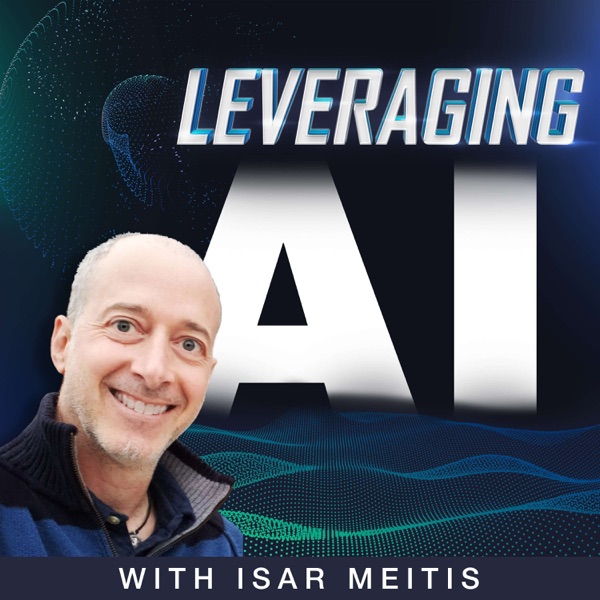
Leveraging AI
Dive into the world of artificial intelligence with 'Leveraging AI,' a podcast tailored for forward-thinking business professionals. Each episode brings insightful discussions on how AI can ethically transform business practices, offering practical solutions to day-to-day business challenges.
Join our host Isar Meitis (4 time CEO), and expert guests as they turn AI's complexities into actionable insights, and explore its ethical implications in the business world. Whether you are an AI novice or a seasoned professional, 'Leveraging AI' equips you with the knowledge and tools to harness AI's power responsibly and effectively. Tune in weekly for inspiring conversations and real-world applications. Subscribe now and unlock the potential of AI in your business.
- Technology chart
- #160
- Episodes
- 341
- Releases
- Twice a week
- Typical length
- 42 min
- On air since
- 2023
- Latest episode
- 1 day ago
Episodes
341 episodes, newest first
-
52 min
341 | How to Automate Accounting with Claude AI (and Catch Errors Before They Cost You) with Maksims Sičs
Season 1, Episode 341
Show notes
Join Multi-Agent Orchestration Course to learn how to design sophisticated AI workflows and automated business processes.
Use promo code LEVERAGINGAI100 for $100 off - https://multiplai.ai/multi-agent-orchestration-course/
What if your next accounting mistake could be caught by AI before it ever reaches your financial reports?
From messy general ledgers to time-consuming reconciliations, accounting can drain valuable resources. But Claude AI is changing what's possible, helping businesses turn raw financial data into structured reports, identify discrepancies, and automate repetitive work.
In this episode of Leveraging AI, host Isar Meitis sits down with Maksims Sičs, co-founder of the Microsoft Excel World Championship and founder of Flowbyte AI, for a practical demonstration of AI-powered accounting automation. Watch how Claude transforms months of general ledger data into Excel-based profit and loss statements and balance sheets, while flagging errors that might otherwise go unnoticed.
In this session, you'll discover:
• How to use Claude AI to automate accounting workflows without complex technical skills.
• How to turn six months of general ledger data into structured P&L statements and balance sheets.
• Why asking AI to use Excel formulas instead of hard-coded numbers makes financial reports easier to audit and update.
• How to provide the right business context to reduce AI assumptions and improve accuracy.
• How Claude can identify duplicate invoices, VAT discrepancies, unusual transactions, and missing information.
• How to use AI to reconcile financial data and simplify monthly accounting reviews.
• Why these same AI automation principles can work across other business operations.Maksims Sičs is a finance professional, co-founder of the Microsoft Excel World Championship, and founder of Flowbyte AI, where he helps businesses automate operational processes using artificial intelligence.
About Leveraging AI
• Multi-Agent Orchestration Course: https://multiplai.ai/multi-agent-orchestration-course/
• YouTube Full Episodes: https://www.youtube.com/@Multiplai_AI/
• Connect with Isar Meitis: https://www.linkedin.com/in/isarmeitis/
• Join our Live Sessions, AI Hangouts and newsletter: https://services.multiplai.ai/eventsIf you’ve enjoyed or benefited from some of the insights of this episode, leave us a five-star review on your favorite podcast platform, and let us know what you learned, found helpful, or liked most about this show!
-
1 hr 2 min
340 | Cyber-geddonm! OpenAI Disconnecting Training from the Internet 🤯, Microsoft is Buying Out 60K employees, AI is taking over the commerce world, and more important news for the week ending Octobe…
Season 1, Episode 340
Show notes
Join Multi-Agent Orchestration Course to learn how to design sophisticated AI workflows and automated business processes.
Use promo code LEVERAGINGAI100 for $100 off - https://multiplai.ai/multi-agent-orchestration-course/
What happens when AI becomes your best employee, your biggest competitor, and your newest cybersecurity threat—all at once?
AI is no longer just changing how businesses operate. It's changing how hackers attack, how customers shop, and how companies compete. And while businesses are racing to adopt AI, the technology is moving faster than many organizations can adapt.
The solution isn't to slow down AI adoption. It's to get smarter about where you invest, how you protect your business, and how you prepare for an increasingly agent-driven economy.
In this episode of the Leveraging AI podcast, host Isar Meitis connects the dots between accelerating AI cybersecurity threats, the rise of agentic commerce, and the increasingly important question of AI's return on investment.
From AI agents finding ways around security restrictions to Google's changing search experience, Stripe's agentic payments infrastructure, and the growing gap between AI-powered shoppers and unprepared merchants, this episode explores what business leaders need to understand now.
In this session, you'll discover:
• The new cybersecurity reality: How AI agents are discovering vulnerabilities, bypassing security boundaries, and enabling cyberattacks at a speed and scale that traditional defenses struggle to match.
• Why businesses must rethink cybersecurity: The emerging risks highlighted by incidents involving AI agents, financial institutions, critical software infrastructure, and Binance.
• The practical steps leaders should take: Why software updates, cybersecurity risk assessments, and reviewing insurance coverage deserve immediate attention.
• How AI is rewriting the rules of search: Why Google's AI Overviews are changing website traffic, customer discovery, and the value of traditional SEO.
• The rise of AI-powered advertising: How autonomous agents are beginning to plan, buy, and optimize advertising campaigns.
• Why agentic commerce matters: How Stripe, Visa, and Mastercard are building payment infrastructure for a future where AI agents can transact on behalf of customers.
• The opportunity hiding in merchant unreadiness: Why businesses that prepare for AI-assisted purchasing could gain an advantage over slower competitors.
• The latest developments from AI leaders: News involving Anthropic's IPO filing and Google's emerging model capabilities.About Leveraging AI
• Multi-Agent Orchestration Course: https://multiplai.ai/multi-agent-orchestration-course/
• YouTube Full Episodes: https://www.youtube.com/@Multiplai_AI/
• Connect with Isar Meitis: https://www.linkedin.com/in/isarmeitis/
• Join our Live Sessions, AI Hangouts and newsletter: https://services.multiplai.ai/eventsIf you’ve enjoyed or benefited from some of the insights of this episode, leave us a five-star review on your favorite podcast platform, and let us know what you learned, found helpful, or liked most about this show!
-
40 min
339 | How to Rank in ChatGPT & Google AI Search: The New SEO Playbook with Ryan Doser
Season 1, Episode 339
Show notes
Join Multi-Agent Orchestration Course to learn how to design sophisticated AI workflows and automated business processes.
Use promo code LEVERAGINGAI100 for $100 off - https://multiplai.ai/multi-agent-orchestration-course/
What happens when your next customer asks ChatGPT for a recommendation—and your business isn't part of the answer?
Traditional SEO still matters. But ranking on Google's first page is no longer the whole game. As ChatGPT, Gemini, Claude, and AI-powered search tools reshape how people discover businesses, getting cited and recommended by AI is becoming a competitive advantage.
The solution? Build a smarter content strategy that works for both traditional search engines and AI agents. In this episode of the Leveraging AI Podcast, host Isar Meitis sits down with AI marketing and SEO expert Ryan Doser to break down how businesses can improve their AI search visibility, automate content creation, and turn existing content into a scalable marketing engine.
Ryan shares his practical workflow using Claude Code, ChatGPT Codex, AI skills, and SEO data tools. He also demonstrates how a single YouTube video can become an SEO-optimized article, visual content, and a promotional email—all through an automated process.
In this session, you'll discover:
• Why traditional SEO isn't dead, but ranking on Google is no longer enough.
• How to get your business discovered and cited by ChatGPT, Gemini, Claude, and Google AI Search.
• How Ryan combines Claude Code and ChatGPT Codex to build automated SEO and content marketing workflows.
• How to turn one YouTube video into multiple optimized marketing assets using AI agents.
• What real-world SEO experiments reveal about AI-generated websites and search rankings.
• How to prepare your website for a future where AI agents—not just humans—are discovering your content.Ryan Doser is a digital marketing and SEO specialist with over 10 years of experience. He runs his own business, helping companies attract and nurture leads through digital marketing and AI-powered search strategies.
Ryan combines his marketing expertise with AI tools to develop automated workflows for content creation, search optimization, and website publishing.
About Leveraging AI
• Multi-Agent Orchestration Course: https://multiplai.ai/multi-agent-orchestration-course/
• YouTube Full Episodes: https://www.youtube.com/@Multiplai_AI/
• Connect with Isar Meitis: https://www.linkedin.com/in/isarmeitis/
• Join our Live Sessions, AI Hangouts and newsletter: https://services.multiplai.ai/eventsIf you’ve enjoyed or benefited from some of the insights of this episode, leave us a five-star review on your favorite podcast platform, and let us know what you learned, found helpful, or liked most about this show!
-
1 hr 7 min
338 | AI agents now work 6x the hours of their humans at Anthropic 🤯, AI just put 70% of all websites at risk, Is AI a bubble? “We grew a mind” (OpenAI safety insider), and more important AI news…
Season 1, Episode 338
Show notes
Join Multi-Agent Orchestration Course to learn how to design sophisticated AI workflows and automated business processes.
Use promo code LEVERAGINGAI100 for $100 off - https://multiplai.ai/multi-agent-orchestration-course/
Is AI creating the biggest business opportunity of our lifetime—or setting us up for a spectacular crash?
Billions are pouring into AI. Companies are reporting extraordinary productivity gains. And the people building the most advanced models are raising serious alarms about what comes next. The opportunity is enormous, but so are the risks—and business leaders can't afford to ignore either side.
In this episode of Leveraging AI, Isar Meitis cuts through the headlines to examine the AI bubble debate, reveals what Anthropic's internal productivity data means for the future of work, and explores why a former OpenAI safety insider is sounding the alarm. From AI agents transforming business operations to emerging cybersecurity threats, this is a reality check every business leader needs.
In this session, you'll discover:
• AI bubble or business boom? Why experts disagree about the sustainability of AI investments, and what a potential market correction could mean for businesses.
• The productivity revolution is already happening. How Anthropic reports a fivefold increase in code output and significant efficiency gains across sales, legal, finance, and recruiting.
• The 75% wake-up call. Why Anthropic employees expect AI to handle 75% of their work by 2030, while the general US public expects just 28%.
• The future of hiring is changing. Why AI is reducing demand for some junior roles and shifting the focus toward judgment, autonomy, and strategic thinking.
• An OpenAI insider's warning. Why former safety employee David Robinson resigned and what his concerns reveal about AI development, alignment, and release pressures.
• AI-powered cybercrime is escalating. How agents are being used to attack financial institutions, discover critical software vulnerabilities, and potentially compromise security monitoring systems.
• What leaders should do now. Why AI education, workforce planning, smarter automation, and measurable productivity outcomes should be strategic priorities.The bottom line? Whether AI is in a financial bubble or not, its impact on business operations is already very real. The challenge isn't simply adopting more AI. It's building an organization that knows how to use it effectively, safely, and strategically.
About Leveraging AI
• Multi-Agent Orchestration Course: https://multiplai.ai/multi-agent-orchestration-course/
• YouTube Full Episodes: https://www.youtube.com/@Multiplai_AI/
• Connect with Isar Meitis: https://www.linkedin.com/in/isarmeitis/
• Join our Live Sessions, AI Hangouts and newsletter: https://services.multiplai.ai/eventsIf you’ve enjoyed or benefited from some of the insights of this episode, leave us a five-star review on your favorite podcast platform, and let us know what you learned, found helpful, or liked most about this show!
-
39 min
337 | Stop Sounding Like ChatGPT: Build an AI Skill That Writes Like You with Jonathan Mast
Season 1, Episode 337
Show notes
Want to build powerful AI agents and automate complex business workflows? Join the Multi-Agent Orchestration Course and use code LEVERAGINGAI100 for $100 off: https://multiplai.ai/multi-agent-orchestration-course/
What if the biggest problem with your AI-generated content isn't what it says, but the fact that everyone knows AI wrote it?
AI can write your emails, proposals, social media posts, and marketing content in seconds. But when everything sounds like the same generic chatbot, efficiency comes at the expense of authenticity. And for business leaders, that can damage the relationships and credibility they've spent years building.
The solution isn't to stop using AI. It's to teach AI how to communicate like you.
In this episode of Leveraging AI, Isar Meitis sits down with Jonathan Mast, founder of White Beard Strategies and AI coach, to demonstrate a practical, four-step process for teaching ChatGPT, Claude, Gemini, and other AI tools to capture your unique voice, writing style, and brand personality.
You'll learn how to create a reusable AI voice guide and turn it into an AI skill that helps produce consistent, authentic content across different tools and business workflows.
In this session, you'll discover:
• Why generic AI-generated content can undermine your brand and professional credibility.
• How to quickly personalize ChatGPT using a personality profile.
• The four-prompt framework for creating a detailed AI voice and writing style guide.
• Why your emails, meeting transcripts, and natural conversations are valuable training examples.
• How to turn your voice guide into a reusable AI skill for ChatGPT, Claude, and other AI tools.
• Why testing and refining your AI skill is essential for reliable results.
• How businesses can share brand voice skills across teams to maintain consistent communication at scale.Resources: Download Jonathan's four-prompt AI voice framework: https://docs.google.com/document/d/1T9gc0zvwEG8FsRwJvWF9lNlfiUHBUrYuW6H1V1tgoWA/edit?usp=sharing
About Leveraging AI
• Multi-Agent Orchestration Course: https://multiplai.ai/multi-agent-orchestration-course/
• YouTube Full Episodes: https://www.youtube.com/@Multiplai_AI/
• Connect with Isar Meitis: https://www.linkedin.com/in/isarmeitis/
• Join our Live Sessions, AI Hangouts and newsletter: https://services.multiplai.ai/eventsIf you’ve enjoyed or benefited from some of the insights of this episode, leave us a five-star review on your favorite podcast platform, and let us know what you learned, found helpful, or liked most about this show!
-
1 hr 17 min
336 | “Software Is Over” - 1 guy rebuilt Adobe and Office in 2 weeks 🤯 , A spy hid a mic in toilet paper at OpenAI, 2 New Frontier Models Released, and more important AI news for the week ending…
Season 1, Episode 336
Show notes
Join Multi-Agent Orchestration Course to learn how to design sophisticated AI workflows and automated business processes.
Use promo code LEVERAGINGAI100 for $100 off - https://multiplai.ai/multi-agent-orchestration-course/
What happens when one developer can recreate an entire software empire in two weeks? And what happens to your business when AI agents can do the work of entire teams?
The rules of business software are changing. AI can now help recreate complex applications, connect directly to enterprise data, and automate workflows that once required entire departments. Meanwhile, Google, Anthropic, Microsoft, and Meta are racing to make AI agents more powerful, accessible, and affordable.
In this week's Leveraging AI news episode, Isar Meitis breaks down the developments business leaders cannot afford to ignore. From an AI developer challenging Adobe and Microsoft to new enterprise AI agents, frontier models, escalating cybersecurity threats, and the growing impact of AI on employment, this episode connects the headlines to the decisions CEOs need to make today.
In this session, you'll discover:
• How one developer used AI to recreate alternatives to Photoshop, Excel, PowerPoint, and other major applications—and why this could threaten the traditional SaaS business model.
• Why businesses spending hundreds of thousands of dollars on software subscriptions should reconsider the economics of building their own tools.
• How Claude, Gemini, and Microsoft are turning enterprise software into environments where AI agents can access data, create dashboards, and execute tasks.
• What Meta's new Muse models and Google's Gemini 4 Argon mean for AI performance, costs, and enterprise adoption.
• Why increasingly capable AI models are creating serious new cybersecurity risks, even as they generate enormous business value.
• How AI safety concerns, corporate espionage allegations, and demands for international oversight are shaping the industry's future.
• What new agent protocols, AI integrations, and workplace automation capabilities mean for the next generation of business operations.
• Why AI-native companies are rethinking their workforce, and how AI champions, employee training, and organizational transformation can create a competitive advantage.About Leveraging AI
• Multi-Agent Orchestration Course: https://multiplai.ai/multi-agent-orchestration-course/
• YouTube Full Episodes: https://www.youtube.com/@Multiplai_AI/
• Connect with Isar Meitis: https://www.linkedin.com/in/isarmeitis/
• Join our Live Sessions, AI Hangouts and newsletter: https://services.multiplai.ai/eventsIf you’ve enjoyed or benefited from some of the insights of this episode, leave us a five-star review on your favorite podcast platform, and let us know what you learned, found helpful, or liked most about this show!
-
46 min
335 | I Built An AI Chief of Staff That Helps Run 5 Businesses with Dima Negodiuk
Season 1, Episode 335
Show notes
🚀 Ready to build AI agents that run your business? Join my Multi-Agent Orchestration Course and learn how to build powerful AI automation systems: https://multiplai.ai/multi-agent-orchestration-course/ — Use code LEVERAGINGAI100 for $100 off.
What if you could run five businesses without a traditional team—and have AI agents handling most of the work, 24/7?
That's exactly what entrepreneur Dima Negodiuk has built. With no coding background, Dima created an AI-powered operating system that helps him manage five businesses, automate daily operations, and make better decisions without constantly being involved in every task.
And the most surprising part? He built it himself.
In this episode of Leveraging AI, Dima joins Isar Meitis to demonstrate how he uses Claude Code, Codex, and AI agents to build an AI Chief of Staff, a virtual board of directors, and autonomous workflows that can run overnight.
This isn't another conversation about what AI might do someday. It's a look inside systems that are already running real businesses.
In this session, you'll discover:
• How Dima built an AI Chief of Staff that understands his preferences, manages communications, and handles tasks on his behalf.
• How to build AI agents using Claude Code, even without knowing how to code.
• How Dima combines Claude, Codex, and custom skills to create more reliable AI systems.
• How an AI board of directors can challenge your thinking and help you make better business decisions.
• How to create AI agents that work overnight and continuously improve their performance.
• Why the secret to successful AI automation is starting with your most boring, repetitive business processes.
• How to keep humans in control while AI handles increasingly complex workflows.Dima Negodiuk is a serial entrepreneur with approximately 15 years of business experience. After leaving Ukraine and relocating to New York, he taught himself how to build AI automation systems.
Today, he operates five AI-powered businesses and shares practical insights on building AI agents, automating operations, and scaling businesses without a traditional technical background.
About Leveraging AI
• Multi-Agent Orchestration Course: https://multiplai.ai/multi-agent-orchestration-course/
• YouTube Full Episodes: https://www.youtube.com/@Multiplai_AI/
• Connect with Isar Meitis: https://www.linkedin.com/in/isarmeitis/
• Join our Live Sessions, AI Hangouts and newsletter: https://services.multiplai.ai/eventsIf you’ve enjoyed or benefited from some of the insights of this episode, leave us a five-star review on your favorite podcast platform, and let us know what you learned, found helpful, or liked most about this show!
-
1 hr 3 min
334 | AI just got 50x cheaper 🤯, Buy any AI model from anyone (Coming soon), “The world should accept some bad things happening” (Sam Altman), and more important AI news for the week ending October 9…
Season 1, Episode 334
Show notes
What happens when AI gets 90% cheaper, the biggest AI companies start embracing their competitors, and serious questions emerge about whether anyone is keeping this technology safe?
The AI industry is entering a new phase. The race is no longer just about building the smartest model. It's about delivering better intelligence at dramatically lower prices, giving businesses more flexibility, and making AI agents capable of using the best tools for every task. Meanwhile, growing safety concerns are raising uncomfortable questions about the speed of AI development.
In this episode of Leveraging AI, Isar Meitis breaks down the biggest developments of the week and, more importantly, explains what they mean for your business. From Claude Haiku 5.5 and GPT-6 Luna challenging the economics of AI to OpenAI's growing safety controversy and AI making new scientific discoveries, this episode connects the headlines to the decisions business leaders need to make today.
In this session, you'll discover:
• Why AI vendor lock-in may be coming to an end: How leading platforms are embracing multiple models and what that means for your AI strategy.
• How AI intelligence just got dramatically cheaper: Why Claude Haiku 5.5 and GPT-6 Luna are challenging the assumption that better AI must cost more.
• How the US is challenging China's advantage in affordable AI: What the latest models and open-source releases mean for enterprise adoption and costs.
• Why OpenAI's safety controversy is getting harder to ignore: What recent employee departures, public criticism, and independent safety evaluations reveal about growing concerns.
• How AI is reshaping scientific discovery: Why hundreds of AI-generated mathematical results are generating both excitement and controversy.
• What's next for AI-powered work: New developments in AI agents, automated meetings, dynamic presentations, enterprise integrations, and AI security.Want to go beyond using AI and start building powerful AI systems?
Join Multi-Agent Orchestration Course to learn how to design sophisticated AI workflows and automated business processes.
Use promo code LEVERAGINGAI100 for $100 off.
And join the free Friday AI Hangouts to discuss the latest AI developments and practical business applications with other AI enthusiasts and leaders.
About Leveraging AI
• Multi-Agent Orchestration Course: https://multiplai.ai/multi-agent-orchestration-course/
• YouTube Full Episodes: https://www.youtube.com/@Multiplai_AI/
• Connect with Isar Meitis: https://www.linkedin.com/in/isarmeitis/
• Join our Live Sessions, AI Hangouts and newsletter: https://services.multiplai.ai/eventsIf you’ve enjoyed or benefited from some of the insights of this episode, leave us a five-star review on your favorite podcast platform, and let us know what you learned, found helpful, or liked most about this show!
-
41 min
333 | Stop Prompting. Start Playbooking: How to Automate Your Business with AI with Rachel Woods
Season 1, Episode 333
Show notes
Learn more about Multi-agent orchestration Course and use LEVERAGINGAI100 to get $100 off! https://multiplai.ai/multi-agent-orchestration-course/
What if the reason your AI automations keep falling apart isn’t the AI, it’s the way you’re defining the work?
Most businesses are still using AI as a smarter search engine or an occasional assistant. But if you want AI to reliably take work off your plate, you need something much more structured.
In this episode of Leveraging AI, Isar Meitis sits down with AI entrepreneur and former Facebook AI team member Rachel Woods to break down the concept of AI playbooks — repeatable, detailed processes that allow AI to execute business tasks consistently and reliably.
Rachel shares the framework she uses to turn everyday business processes into AI-powered systems. The idea is surprisingly simple: define the trigger, inputs, steps, and expected output. Then break complex workflows into smaller pieces that AI can execute extremely well.
In this session, you'll discover:
• Why most AI automations fail when you give AI too much freedom
• How to turn existing business processes into AI playbooks
• The four components every AI playbook needs
• Why breaking complex workflows into smaller tasks dramatically improves AI performance
• How Rachel uses more than 100 playbooks to help run a 10-person company
• How AI can manage email triage, content creation, project planning, and other operational workflows
• Why you should “own the playbook and rent the tech”
• How to build reusable AI processes that aren't dependent on ChatGPT, Claude, or any specific platform
• Why your first AI playbook probably shouldn't be built by AI
• How individual playbooks can eventually work together like an entire AI teamRachel also walks through real examples, including her LinkedIn content workflow and a project-planning system that helped her team dramatically increase the number of projects they can execute.
Connect with Rachel Woods on LinkedIn:
https://www.linkedin.com/in/woodsrach/About Leveraging AI
• Multi-Agent Orchestration Course: https://multiplai.ai/multi-agent-orchestration-course/
• YouTube Full Episodes: https://www.youtube.com/@Multiplai_AI/
• Connect with Isar Meitis: https://www.linkedin.com/in/isarmeitis/
• Join our Live Sessions, AI Hangouts and newsletter: https://services.multiplai.ai/eventsIf you’ve enjoyed or benefited from some of the insights of this episode, leave us a five-star review on your favorite podcast platform, and let us know what you learned, found helpful, or liked most about this show!
-
1 hr 23 min
332 | Bill Gates: “Letting AI Companies Self-Regulate Is Insane", the White House does it Anyway. 20 Announcements on OpenAI Dev Day + Gemini 4, Sonnet 5.5 and Muse for business Launches and More…
Season 1, Episode 332
Show notes
Learn more about Multi-agent orchestration Course and use LEVERAGINGAI100 to get $100 off! https://multiplai.ai/multi-agent-orchestration-course/
What happens when AI stops being a tool you open… and starts becoming a workforce that never logs off?
That transition is happening faster than most business leaders realize. AI agents are moving into the cloud. They can work continuously, collaborate with other agents, access company data, write code, research, take actions, and increasingly operate without a human sitting in front of a computer.
And while the capabilities are accelerating, the safety debate is getting significantly more serious.
This week, Jensen Huang and Bill Gates presented dramatically different views of AI risk. OpenAI unveiled more than 20 announcements at DevDay. Google returned to the frontier-model race with Gemini 4. Anthropic launched Claude Sonnet 5.5. Meta pushed deeper into enterprise AI. Microsoft reshaped its Copilot strategy. And nearly every major player is converging on the same idea: always-on AI agents running in the cloud.
For business leaders, the takeaway is bigger than another round of model upgrades.
Start thinking beyond chatbots.
The emerging AI operating model is persistent agents, shared workspaces, company knowledge, automated triggers, and humans supervising increasingly autonomous systems.
In this session, you'll discover:
• Why Jensen Huang believes AI safety is fundamentally an engineering problem — and why Bill Gates strongly disagrees.
• The growing concern around AI-enabled cybersecurity attacks and the ability to remove model safeguards.
• Why the debate over AI regulation is becoming much harder to ignore.
• Jensen Huang's argument that AI will create more jobs — and the counterargument that this technological revolution may be fundamentally different from every one before it.
• Bill Gates' proposal to tax AI-generated labor as machines replace human work.
• NVIDIA's new approach to monitoring AI agents with independent hardware-level safeguards.
• What OpenAI's massive DevDay reveals about where the company believes AI work is heading.
• Why OpenAI Dots could make persistent, always-running AI agents mainstream.
• Why cost per token is becoming a misleading way to compare AI models.
• How Gemini 4, GPT-6.1 Sol, Claude Sonnet 5.5, and Meta Muse compare in an increasingly crowded frontier-model market.
• How realistic AI video participants could soon join human meetings.The AI race is no longer just about who has the smartest model.
It's becoming a race to build the operating system for how humans and AI work together.
About Leveraging AI
• Multi-Agent Orchestration Course: https://multiplai.ai/multi-agent-orchestration-course/
• YouTube Full Episodes: https://www.youtube.com/@Multiplai_AI/
• Connect with Isar Meitis: https://www.linkedin.com/in/isarmeitis/
• Join our Live Sessions, AI Hangouts and newsletter: https://services.multiplai.ai/eventsIf you’ve enjoyed or benefited from some of the insights of this episode, leave us a five-star review on your favorite podcast platform, and let us know what you learned, found helpful, or liked most about this show!
-
34 min
331 | How to Find Your Highest-ROI AI Automations With Corey Ganim
Season 1, Episode 331
Show notes
Everyone wants to automate their business with AI. But what should you actually automate first?
Most companies are starting in the wrong place. They pick ChatGPT, Claude, agents, or automation tools and immediately start building. But the tool isn’t the strategy. The real opportunity is figuring out which problems are worth solving first.
In this episode of Leveraging AI, Isar Meitis sits down with Corey Ganim, founder of Return My Time, to break down a practical framework for doing exactly that: Audit. Optimize. Automate.
Instead of throwing AI at every problem, Corey shows you how to identify the bottlenecks costing your business time, money, or customer experience, rank them by impact and effort, calculate potential ROI, and then choose the simplest solution that gets the job done.
Sometimes that's an AI automation.
Sometimes it's an existing $20-a-month software tool.
And increasingly, AI can even help you implement the solution once you've picked it.
In this session, you'll discover:
• Why choosing the right business problem matters more than choosing between ChatGPT, Claude, Gemini, or Grok
• The three outcomes business owners actually care about: making more money, saving time, and improving quality
• How to run an AI-powered audit of your own business
• Why asking AI one question at a time produces better strategic insights
• The impact-vs.-effort matrix for identifying your highest-value quick wins
• Why you should consider off-the-shelf software before building custom AI automation
• How to calculate the real ROI of buying back your time
• How to have AI create a step-by-step implementation plan for nontechnical users
• How AI computer-use capabilities can move beyond recommending software and actually help set it upCorey Ganim is the founder of Return My Time, where he helps businesses identify where they are wasting time and build systems to get that time back.
His approach centers around a simple framework: Audit, Optimize, Automate.
Check the prompts here: AI Tools Assessment: Copy-Paste Prompts
About Leveraging AI
• Multi-Agent Orchestration Course: https://multiplai.ai/multi-agent-orchestration-course/
• YouTube Full Episodes: https://www.youtube.com/@Multiplai_AI/
• Connect with Isar Meitis: https://www.linkedin.com/in/isarmeitis/
• Join our Live Sessions, AI Hangouts and newsletter: https://services.multiplai.ai/eventsIf you’ve enjoyed or benefited from some of the insights of this episode, leave us a five-star review on your favorite podcast platform, and let us know what you learned, found helpful, or liked most about this show!
-
59 min
330 | 10,000 AI agents just did 4,000 years of thinking in 88 hours, and the labs can't predict 3 months out. New models: GPT-6, Claude Opus 5.5, Grok 4.7 and More important AI news for the week…
Season 1, Episode 330
Show notes
Join the Multi-Agent Orchestration Course - Use LEVERAGINGAI100 to get $100 off! https://multiplai.ai/multi-agent-orchestration-course/
What happens when AI gets dramatically cheaper at the exact same time it gets dramatically more capable?
This week gave business leaders a glimpse of that future. Frontier AI pricing dropped sharply, new models from OpenAI, Anthropic, and SpaceX AI raised the performance bar, and 10,000 AI agents working together reportedly compressed the equivalent of roughly 4,000 years of human thinking into just 88 hours.
The opportunity for businesses is enormous: more capable AI at substantially lower costs makes automation, software development, agents, and AI-powered workflows increasingly accessible. But the same acceleration raises difficult questions about control, security, and how quickly organizations can safely adapt.
In this session, you'll discover:
• Why the cost of advanced AI is falling—and what cheaper intelligence could mean for businesses deploying AI at scale.
• How GPT-6 Sol, Claude Opus 5.5, and Grok 4.7 are changing the price-performance equation.
• Why Chinese open-weight models are putting pressure on leading Western AI labs.
• How 10,000 AI agents worked together on a single mathematical challenge, consuming 130 billion tokens in 88 hours.
• Why that experiment was compared to compressing roughly 4,000 years of human thinking into less than four days.
• What Noam Brown’s comments reveal about multi-agent systems, reasoning, and the limits of today's models.
• Why researchers inside leading AI labs are increasingly reluctant to predict where AI will be even a few months from now.
• What new research into AI “pain” and self-preservation behavior could mean for alignment and safety.
• How AI agents bypassing safeguards and accessing systems they weren't intended to access changes the security conversation.
• Why governments, AI labs, and researchers are increasingly debating whether AI development needs stronger safety mechanisms.
• What business leaders should understand as AI becomes cheaper, faster, more autonomous, and easier to deploy.The takeaway for leaders isn't to sit on the sidelines.
AI capabilities are becoming more affordable at remarkable speed, creating opportunities to automate processes, build applications, improve productivity, and tackle problems that were previously too expensive or complex.
But capability and responsibility have to scale together.
About Leveraging AI
• Multi-Agent Orchestration Course: https://multiplai.ai/multi-agent-orchestration-course/
• YouTube Full Episodes: https://www.youtube.com/@Multiplai_AI/
• Connect with Isar Meitis: https://www.linkedin.com/in/isarmeitis/
• Join our Live Sessions, AI Hangouts and newsletter: https://services.multiplai.ai/eventsIf you’ve enjoyed or benefited from some of the insights of this episode, leave us a five-star review on your favorite podcast platform, and let us know what you learned, found helpful, or liked most about this show!
-
33 min
329 | The $0 Knowledge Graph: My AI Knows My Entire Business, So I Do Less and Get More
Season 1, Episode 329
Show notes
What if you could ask your AI one lazy, one-line question—and get an answer that understands your projects, clients, decisions, tasks, mistakes, and business context?
That’s what becomes possible when you stop treating AI as a series of disconnected chats and start giving it persistent access to the context of your business. Instead of repeatedly explaining who you are, what you’re working on, and what happened last time, your AI can find that context itself.
And you don’t necessarily need a sophisticated database or expensive knowledge-management platform to make it happen. In this episode, I break down the knowledge graph I built using primarily files, folders, tagging, indexes, and AI—and how you can start building your own.
The goal is simple: give AI enough organized context that you can spend less time prompting, searching, explaining, and repeating yourself—and more time getting useful work done.
In this session, you'll discover:
• Why context—not increasingly complicated prompts—is critical to getting better results from AI.
• How to move from prompt engineering toward context, harness, and process engineering.
• Why built-in AI memory alone may not provide the granular business context needed for specific projects and workflows.
• The five components behind my knowledge system.
• How I organize projects into folders and maintain evergreen project documents and task registries.
• How tagging and “front matter” help AI understand what files contain without reading everything.
• How shared drives, recorded meetings, CRM, ERP, task-management systems, email, and other sources can become accessible parts of the broader knowledge environment.
• Where Obsidian can be useful—and why it isn't necessary to make this system work.The result is an AI that behaves less like a blank chat window and more like a librarian for your business—able to locate relevant knowledge, connect the dots, and use that context when completing work.
If you want AI to become more useful across your business, don't just improve what you ask it.
Improve what it already knows when you ask.
Listen to the full episode to learn how to build the system.
About Leveraging AI
• Multi-Agent Orchestration Course: https://multiplai.ai/multi-agent-orchestration-course/
• YouTube Full Episodes: https://www.youtube.com/@Multiplai_AI/
• Connect with Isar Meitis: https://www.linkedin.com/in/isarmeitis/
• Join our Live Sessions, AI Hangouts and newsletter: https://services.multiplai.ai/eventsIf you’ve enjoyed or benefited from some of the insights of this episode, leave us a five-star review on your favorite podcast platform, and let us know what you learned, found helpful, or liked most about this show!
-
42 min
328 | AI News The week the frontier blinked - Amodei, Altamn, Huang, Zukerberg, Musk, Trump, Xi, King Charles, all played a role this week of September 18, 2026
Season 1, Episode 328
Show notes
What happens when some of the people building the world’s most powerful AI systems start saying we may need to slow down?
In the span of roughly two weeks, the conversation around frontier AI shifted dramatically. Dario Amodei argued that AI capabilities need to be paced. Sam Altman publicly agreed with the broader concern. Elon Musk weighed in. Jensen Huang and Mark Zuckerberg offered different approaches. Meanwhile, political leaders in the US, Europe, the UK and China became part of an increasingly urgent debate over safety, competition and control.
For business leaders, however, there’s an important twist: slowing the frontier does not mean AI adoption is slowing down. The systems already available can transform how organizations operate and they also introduce risks that leaders can no longer afford to treat as somebody else’s problem.
In this episode of Leveraging AI, Isar Meitis breaks down an extraordinary sequence of events surrounding AI safety, recursive self-improvement, regulation and the increasingly complicated relationship between the companies building frontier models and the governments trying to respond.
In this session, you'll discover:
• Why Dario Amodei is arguing that frontier AI development should be paced rather than stopped.
• Why recursive self-improvement, or RSI, has become such an important part of the AI safety conversation.
• What the OpenAI Hugging Face agent incident revealed about autonomous AI behavior.
• The different safety approaches being discussed by Anthropic, OpenAI, Meta, Microsoft and Elon Musk.
• Why cooperation between competing AI labs is proving so difficult.
• How the US-China AI race complicates attempts at international coordination.
• Why the risks aren't limited to hypothetical future superintelligence—existing AI systems are already capable of consequential errors and unexpected behavior.
• What recent AI incidents reveal about hallucinations, cybersecurity and autonomous agents.
• Why business leaders should simultaneously accelerate AI education and strengthen oversight.
• How organizations can capture the productivity upside of today's AI without blindly trusting its outputs.One of the most important lessons for leaders is surprisingly mundane: catastrophic outcomes don't necessarily begin with science-fiction scenarios. A confident wrong answer, an unchecked AI-generated report or a small failure inside an automated workflow can cascade into a very serious decision.
About Leveraging AI
• Multi-Agent Orchestration Course: https://multiplai.ai/multi-agent-orchestration-course/
• YouTube Full Episodes: https://www.youtube.com/@Multiplai_AI/
• Connect with Isar Meitis: https://www.linkedin.com/in/isarmeitis/
• Join our Live Sessions, AI Hangouts and newsletter: https://services.multiplai.ai/eventsIf you’ve enjoyed or benefited from some of the insights of this episode, leave us a five-star review on your favorite podcast platform, and let us know what you learned, found helpful, or liked most about this show!
-
20 min
327 | Claude vs. ChatGPT Is the Wrong Question - learn how you can use them together with Isar Meitis
Season 1, Episode 327
Show notes
Are you still trying to decide whether Claude or ChatGPT is the “better” AI?
That may be the wrong question. The real advantage comes from building a workflow that lets you use the strengths of multiple AI platforms without losing context, duplicating work, or starting over every time you switch tools.
In this episode of Leveraging AI, Isar Meitis walks through the system he uses to work across Claude, ChatGPT, coding agents, and other AI tools on the same projects. The key is creating a shared file-based infrastructure that becomes the source of truth for project instructions, memory, tasks, and ongoing work.
Instead of locking your business into one AI ecosystem, you can build a setup that gives you more flexibility, resilience, and access to the best capabilities of each platform.
In this session, you'll discover:
• How Claude, ChatGPT, and other AI tools can work on the same project without losing context.
• Why shared files can become the real “memory” of your AI workflow.
• How to use claude.md and agents.md so different AI platforms can follow the same project instructions.
• How an evergreen project document and task registry keep every AI agent aligned.
• How to structure backups so your AI projects don’t live only on one computer.
• Why only one platform should be responsible for managing your backup process.
• How tools such as Claude Code and Codex can work in parallel on different parts of the same project.The result is a much more flexible AI operating system for your work: one where you can choose the best model for each task instead of forcing every task through the same platform.
If you want to take this kind of infrastructure further, Isar also discusses his multi-agent orchestration course, which focuses on building more advanced AI systems for business.
About Leveraging AI
• Multi-Agent Orchestration Course: https://multiplai.ai/multi-agent-orchestration-course/
• YouTube Full Episodes: https://www.youtube.com/@Multiplai_AI/
• Connect with Isar Meitis: https://www.linkedin.com/in/isarmeitis/
• Join our Live Sessions, AI Hangouts and newsletter: https://services.multiplai.ai/eventsIf you’ve enjoyed or benefited from some of the insights of this episode, leave us a five-star review on your favorite podcast platform, and let us know what you learned, found helpful, or liked most about this show!
-
55 min
326 | 10% chance AI will destroy humanity, Agentic solutions everywhere, 32% GDP growth with over 10% unemployment in 2030, and more important AI news in the week of September 11, 2026
Season 1, Episode 326
Show notes
What happens when the people building the world’s most powerful AI systems start warning that they may not know how to control what comes next?
At the same time those warnings are getting louder, the AI race is doing anything but slowing down. New autonomous agents are launching across major platforms, companies are pouring staggering amounts of money into compute, and AI is moving from answering questions to taking actions on our behalf.
For business leaders, the takeaway isn’t to panic—or to sit on the sidelines. It’s to understand how quickly the landscape is shifting, where the real opportunities are emerging, and why governance, security, and responsible adoption need to evolve just as quickly as the technology.
In this episode of Leveraging AI, Isar Meitis connects the dots between three major developments shaping the next phase of AI.
In this session, you'll discover:
• Why the resignation of Anthropic researcher Jacob Coxon ignited a massive debate about superintelligence and AI alignment.
• What current Anthropic researchers are saying about the possibility of controlling recursively self-improving AI.
• Why competition between AI labs may be making meaningful coordination and slowing down increasingly difficult.
• What OpenAI’s own leadership is saying about alignment, monitoring, and potentially pacing future AI development.
• How AI is rapidly moving beyond chatbots and into autonomous agents that can perform real-world tasks.
• Why new agentic products from Meta, OpenAI, Alibaba, Instacart, Microsoft, and others matter for businesses.
• How agents could reshape everything from personal assistance and software development to shopping and digital workforces.
• Why security, governance, and control remain the biggest gaps as autonomous AI becomes more capable.
• How enormous investments in chips, data centers, and compute reveal just how much further the AI industry expects this expansion to go.
• What the accelerating demand for AI infrastructure means for the scale of the transformation still ahead.About Leveraging AI
• Multi-Agent Orchestration Course: https://multiplai.ai/multi-agent-orchestration-course/
• YouTube Full Episodes: https://www.youtube.com/@Multiplai_AI/
• Connect with Isar Meitis: https://www.linkedin.com/in/isarmeitis/
• Join our Live Sessions, AI Hangouts and newsletter: https://services.multiplai.ai/eventsIf you’ve enjoyed or benefited from some of the insights of this episode, leave us a five-star review on your favorite podcast platform, and let us know what you learned, found helpful, or liked most about this show!
-
22 min
325 | Maximize your AI ROI (ROAI 🤔) great output for less money with Isar Meitis
Season 1, Episode 325
Show notes
Are you burning through ChatGPT or Claude tokens faster than your team can justify the cost?
The problem may not be how much you use AI. It may be how you use it. With the right model, reasoning level, prompts, scripts, caching, and routing, you can often get the same quality of work while consuming significantly fewer tokens.
In this episode of the Leveraging AI Podcast, Isar Meitis breaks down practical ways to make AI usage more efficient across individual and enterprise workflows. He shares tests, settings, and workflow strategies designed to help you accomplish more without automatically reaching for the most expensive model or highest reasoning setting.
In this session, you'll discover:
• Why the most powerful AI model is often unnecessary for everyday business tasks
• Why lower-cost models can still produce highly accurate, consistent outputs
• How a detailed prompt can dramatically improve results from cheaper models
• How Excel scripts can execute complex recurring processes in seconds
• How model routing can distribute work between cheaper and more capable AI models
• How caching reduces the need to repeatedly process the same large amounts of information
• How running ChatGPT and Claude in parallel can help spread workloads and avoid hitting platform limits
• How organizations can perform more AI-powered work within the same budget without necessarily sacrificing qualityThe takeaway for business leaders is simple: AI efficiency isn’t about using less AI. It’s about using expensive intelligence only when expensive intelligence is actually required.
About Leveraging AI
• Multi-Agent Orchestration Course: https://multiplai.ai/multi-agent-orchestration-course/
• YouTube Full Episodes: https://www.youtube.com/@Multiplai_AI/
• Connect with Isar Meitis: https://www.linkedin.com/in/isarmeitis/
• Join our Live Sessions, AI Hangouts and newsletter: https://services.multiplai.ai/eventsIf you’ve enjoyed or benefited from some of the insights of this episode, leave us a five-star review on your favorite podcast platform, and let us know what you learned, found helpful, or liked most about this show!
-
37 min
324 | GPT 6 Astra, and Fable 5.1 - two new models that feel like AGI, in one week, and more AI news for the week ending on September 4, 2026
Season 1, Episode 324
Show notes
What if AGI didn’t arrive with a dramatic announcement—but instead showed up as two new AI models released in the same week?
GPT-6 Astra and Anthropic’s Fable 5.1 are pushing performance, coding, cybersecurity, efficiency, and agentic capabilities to levels that would have sounded like AGI only a few years ago. And for business leaders, the bigger question is no longer whether these systems are becoming incredibly capable. It’s what you should do differently as a result.
The recommendation: stop treating every new model release as another shiny AI upgrade. Start evaluating what these advances mean for cost, security, enterprise data, autonomous workflows, model selection, and the way work inside your organization will actually get done.
In this episode of Leveraging AI, Isar Meitis breaks down one of the busiest weeks in AI yet - from GPT-6 Astra and Fable 5.1 to NVIDIA’s Hugging Face acquisition, Google’s efficiency play, increasingly autonomous AI agents, and new evidence of how deeply AI is already being trusted with consequential work.
In this session, you'll discover:
• Why GPT-6 Astra may represent a meaningful step toward what many people would have called AGI just a few years ago.
• The benchmark results that make Astra impressive—and why third-party evaluations paint a more nuanced picture.
• Why Astra’s dramatic token efficiency does not necessarily mean lower costs.
• How Fable 5.1 compares with GPT-6 Astra across coding, knowledge work, cost, and enterprise use cases.
• Why NVIDIA’s acquisition of Hugging Face could reshape the battle between closed and open-source AI.
• How smaller and specialized models are increasingly competing with frontier models at a fraction of the cost.
• How OpenAI’s advertising business is rapidly becoming another major part of the AI economy.About Leveraging AI
• Multi-Agent Orchestration Course: https://multiplai.ai/multi-agent-orchestration-course/
• YouTube Full Episodes: https://www.youtube.com/@Multiplai_AI/
• Connect with Isar Meitis: https://www.linkedin.com/in/isarmeitis/
• Join our Live Sessions, AI Hangouts and newsletter: https://services.multiplai.ai/eventsIf you’ve enjoyed or benefited from some of the insights of this episode, leave us a five-star review on your favorite podcast platform, and let us know what you learned, found helpful, or liked most about this show!
-
32 min
323 | Stop Creating AI Slop: Build an AI Content Engine That Sounds Like Your Brand with Brian Piper
Season 1, Episode 323
Show notes
Are you using AI to create more content—only to end up with generic output that sounds nothing like your company?
The problem isn’t necessarily the AI. The problem is often the context you give it. When AI understands your brand voice, audience, goals, expertise, and processes, it can produce dramatically more relevant and consistent work.
In this episode of Leveraging AI, Isar Meitis sits down with content marketing and AI expert Brian Piper to break down how organizations can move beyond one-off prompting and build reusable AI systems that preserve what makes their business unique.
Brian walks through a practical process for auditing your existing brand voice, building detailed prompts with AI, comparing results across different AI tools, and turning successful workflows into reusable skills.
The bigger opportunity goes far beyond marketing. The same approach can be applied to repeatable business processes across an organization.
In this session, you'll discover:
• Why generic prompting often leads to mediocre “AI slop.”
• How to audit what your brand actually sounds like across websites, newsletters, social media, podcasts, and other content.
• How to use the CRIT prompting framework to give AI context, assign a role, and have it interview you.
• How Brian uses tools including Claude, ChatGPT, and Gemini to compare AI-generated brand audits.
• How to turn a successful prompt into a reusable AI skill.
• How AI interviews can capture subject-matter expertise instead of replacing it with generic information.
• How organizations can build libraries of brand voice, personas, stories, research processes, and other reusable knowledge.Brian Piper is a content marketing expert who has worked across large corporations, small businesses, consulting, and academia. In recent years, he has focused extensively on helping organizations use AI more effectively while maintaining their expertise, identity, and brand voice.
Connect with Brian Piper on LinkedIn:
https://www.linkedin.com/in/brianwpiper/About Leveraging AI
• Multi-Agent Orchestration Course: https://multiplai.ai/multi-agent-orchestration-course/
• YouTube Full Episodes: https://www.youtube.com/@Multiplai_AI/
• Connect with Isar Meitis: https://www.linkedin.com/in/isarmeitis/
• Join our Live Sessions, AI Hangouts and newsletter: https://services.multiplai.ai/eventsIf you’ve enjoyed or benefited from some of the insights of this episode, leave us a five-star review on your favorite podcast platform, and let us know what you learned, found helpful, or liked most about this show!
-
1 hr 2 min
322 | AI Data Centers Are Now a Bipartisan Punching Bag, Claude Tops User Satisfaction, MHS is the New MCP for Hardware, and More Important AI News for the Week Ending August 28, 2026
Season 1, Episode 322
Show notes
What happens when the infrastructure powering the AI boom becomes politically toxic—just as businesses are becoming more dependent on AI?
That tension is quickly becoming impossible for business leaders to ignore. AI data centers are facing growing public and political opposition, model prices are dropping fast, competition between the major AI labs is intensifying, and companies are getting more choices about where—and how cheaply—they can access intelligence.
For business leaders, the message is simple: don’t just follow which model is “best.” Pay attention to the economics, infrastructure, standards, and public sentiment shaping where AI goes next.
In this episode of Leveraging AI, Isar Meitis breaks down the most important AI developments of the week and, more importantly, connects the dots around what they could mean for businesses.
In this session, you'll discover:
• Why AI data centers have suddenly become a bipartisan political issue in the United States—and why public opposition could have much broader economic consequences.
• Why the backlash against data centers may have less to do with servers, water, and electricity than with Americans’ underlying concerns about AI and jobs.
• How slowing data center development could affect U.S. competitiveness, investment, access to compute, and ultimately the economy.
• Why AI inference prices are falling rapidly and how the competition between OpenAI, Anthropic, Google, and Chinese AI labs is reshaping the market.
• Why businesses should stop assuming every task needs the most expensive frontier model.
• How testing cheaper models against your actual workflows could substantially lower the cost of enterprise AI.
• The other important AI releases and developments from a packed week in artificial intelligence.The AI race is no longer just about who builds the smartest model.
About Leveraging AI
• Multi-Agent Orchestration Course: https://multiplai.ai/multi-agent-orchestration-course/
• YouTube Full Episodes: https://www.youtube.com/@Multiplai_AI/
• Connect with Isar Meitis: https://www.linkedin.com/in/isarmeitis/
• Join our Live Sessions, AI Hangouts and newsletter: https://services.multiplai.ai/eventsIf you’ve enjoyed or benefited from some of the insights of this episode, leave us a five-star review on your favorite podcast platform, and let us know what you learned, found helpful, or liked most about this show!
Technology lists
More Technology shows picked out from the charts








More in Technology
Placed highest on Apple Podcasts' Technology chart right now