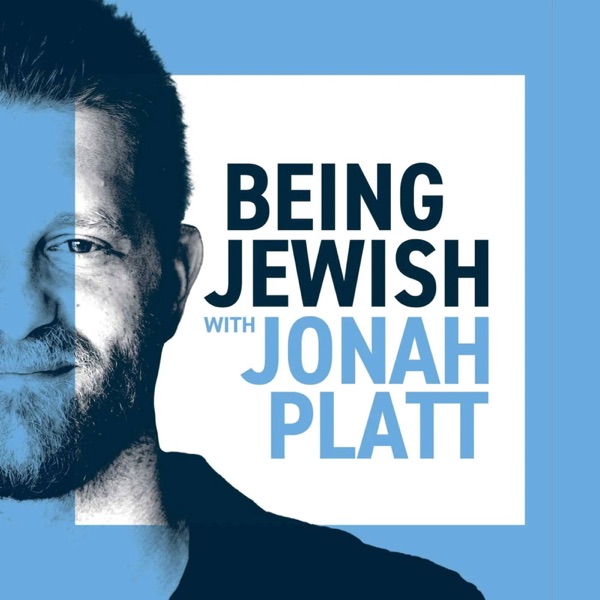
Podcast
Martini Judaism
For those who want to be shaken and stirred.
Join one of American Judaism’s most prolific thought leaders and his special guests as they talk about the current state of Judaism, American culture, politics, religion, and spirituality.
- Episodes
- 77
- Releases
- Every two weeks
- Typical length
- 54 min
- On air since
- 2022
- Latest episode
- 6 days ago
Episodes
77 episodes, newest first
-
56 min
Why American Jews Are Divided
Show notes
For me, it is the second half of her subtitle: what to do about it.
Kwall’s final chapter, “A Self-Help Blueprint for American Jews,” proposes a foundation of shared commitments around which a broad Jewish center might gather. Israel’s right to exist as a Jewish democratic state. The legitimacy of criticizing its government. Opposition to antisemitism wherever it appears. Condemnation of terrorism, including violence by Jewish extremists. Sympathy for innocent Palestinians. A two-state solution as an aspiration. She outlined these principles in a recent presentation at Yeshiva University.
There is plenty there to argue about. Try bringing those principles to your next Shabbat dinner.
But that, I think, is where the book becomes most useful. It gives us something concrete to discuss—and asks us to examine our own habits as participants in that discussion. Can we describe another Jew’s convictions in terms that she would recognize? Can we hear criticism without assuming betrayal? Can we acknowledge suffering without treating compassion as a concession?
Learning a second Jewish language requires practice. Shared study. Personal relationships. Time spent in Jewish communities whose assumptions differ from our own.
The tribes are here to stay. The work is to keep them talking—and to give them reasons to care about one another’s future.
Learn more about your ad choices. Visit https://megaphone.fm/adchoices
-
1 hr 2 min
Dara Horn Has A Final Solution To The Jewish Question
Show notes
What is the most important story in Judaism?
You might think that it is the Exodus from Egypt. Or, even, perhaps, the giving of the Torah at Mount Sinai.
Nope.
The most important story in Judaism is not in the Torah -- though, if it were, it would be somewhere towards the beginning of this week's Torah portion.
I am talking about the story about how Abraham, at the age of thirteen, broke his father's idols -- and simultaneously invented monotheism. (Abraham was a gifted child, of course).
Jewish history is the history of iconoclasts, and lately, no one is doing it better than Dara Horn -- novelist, and penetrating observer of contemporary Jewish life.
Not only an observer -- a critic who holds nothing back -- with a rare talent for giving titles to her books that are, well, iconoclastic. What can you say about a book that proclaims People Love Dead Jews -- and her new book, equally provocatively titled -- The Final Solution to the Jewish Question: A Love Story for the Living.
Yes (gulp): she actually uses that phrase "final solution" in the title.
Dara has much to say in this new book, but here is my favorite takeaway.
It's about antisemitism -- a subject that is on the mind and on the lips of every Jew I know.
Learn more about your ad choices. Visit https://megaphone.fm/adchoices
-
59 min
What Does It Mean To Be Made In God's Image?
Show notes
For years I believed that the phrase "made in the image of God" had become a pious slogan Jews slap on almost every issue -- a phrase in danger of becoming a cliche. In an article in Commentary, and in my book Tikkun Ha'Am/Repairing Our People: Israel and the Crisis of Liberal Judaism, I asked out loud: have we overused that phrase? Do we even know what it means?
I can now say, with confidence, that we know what it means -- thanks to Tomer Persico, who teaches at the Shalom Hartman Institute and who is the author of In God's Image: How Western Civilization Was Shaped by a Revolutionary Idea.
Learn more about your ad choices. Visit https://megaphone.fm/adchoices
-
1 hr 1 min
Is Antisemitism an “Exceptional Hatred?”
Show notes
In 1977, a man named Frank Collin announced that he planned to march his fellow neo-Nazis through Skokie, Illinois, a Chicago suburb where roughly one in ten residents had survived the death camps. Chicago had already blocked him from marching there, and his history of violence and property damage offered the city an easy “no.”
PS. Frank Collin was the son of a German Jewish Holocaust survivor.
The ACLU took his case anyway, on First Amendment grounds, and Skokie became the defining American test of whether even the most hateful speech deserves protection.
That fight did not end in 1978. It resurfaced in Charlottesville in 2017, where marchers carrying torches chanted “Jews will not replace us” under the same constitutional canopy that had once shielded Collin.
And it has resurfaced again, right now, on college campuses, where students and administrators are still arguing over what speech the law should protect and what speech should count as harassment.
Skokie did not settle anything. It just wrote the opening chapter.
I learned about Collin, and much more, from James Loeffler, a historian at Johns Hopkins and the author of a new book called Exceptional Hatred: Antisemitism and the Fight over Free Speech in Modern America.I spoke with him for this week's Martini Judaism podcast.
Learn more about your ad choices. Visit https://megaphone.fm/adchoices
-
49 min
The Truth About "Jewish Lightning"
Show notes
Rabbi Jeff Marx has written a new book, Jewish Firebugs: Arson and Antisemitism from the Civil War to World War I, and he does something almost nobody has tried before. He tells the story behind the charge that Jews deliberately set fires in order to collect insurance money – “Jewish lightning.”
In fact, there were real Jewish arsonists who operated in American cities for roughly sixty years, and Jeff tells those stories. He begins with the 1867 "Jew risks" affair, when major fire insurance companies instructed their agents to deny policies to Jews outright. He follows the stereotype through three decades of trade-press obsession, into vaudeville sketches and silent films, and into real criminal networks of torches, public adjusters, and fire brokers.
So, yes: there were actual Jewish arsonists. But, they were extremely few in proportion to the population -- approximately 200 individuals, or roughly one one-thousandth of one percent of New York City’s population. Despite this tiny number, their cases became front-page news and were syndicated across the United States.
But, then again, there were also Italian, Greek, and Black Americans. The fact that Jewish suspects were framed through ethnicity while others were not raised a central question for the book: why did Jewish arson cases become the basis for a broader ethnic stereotype?
We talk about why he chose arson over the more familiar stories of Jewish bootlegging and gambling; about the progression from caricatures, stereotypes, and most dangerously, antisemitic narratives which emerge when stereotypes depict Jews as malevolent conspirators, echoing European tropes of Jews plotting harm; and about what it meant to write this history with his own parents watching over the dedication page, with their own whispers of -- you guessed it -- shanda.
Learn more about your ad choices. Visit https://megaphone.fm/adchoices
-
57 min
The Intellectual Roots of Feminism’s Antisemitism
Show notes
It turns out that every corner of progressive culture has a price of admission, and Jews are finding it progressively more difficult to pick up that tab.
Add feminism to the list. That's the case Kara Jesella makes in her new book, "Feminist Antisemitism: An Intellectual History," which I discussed with her on my podcast.
Jesella majored in women's studies at Vassar College, where her real education in Jewish feminism came from her college rabbi, she told me. She spent years as a journalist before going back to school for a Ph.D. in performance studies at New York University. She finished that doctorate in 2021 — the same day that she watched former classmates post infographics calling Jews colonizers. And Oct. 7, 2023, she says, is when she stopped being patient about any of it.
Learn more about your ad choices. Visit https://megaphone.fm/adchoices
-
51 min
Is It Time To Retire the Term ‘Zionism’?
Show notes
View Zionism from one angle, and it is Theodor Herzl, seeking to rescue the Jews of Europe. From another, it is seeking to resurrect Jewish culture. From another, it is a spiritual connection to the Land; from yet another, a socialist utopia. The images change, depending on where you are, and where we are at this moment of history.
That is the subject of my podcast with Nadine Epstein, editor-in-chief of Moment magazine, and Gil Troy, the historian and Zionist educator. Several months ago, Epstein wrote a lead essay that argued, in some detail, that we should retire the word “Zionism” because 136 years of accumulated meanings can no longer clarify anything.
Troy had the opposite instinct: we don’t destroy a word just because those who hate it — and its supporters who have distorted it — have made it more challenging.
Learn more about your ad choices. Visit https://megaphone.fm/adchoices
-
53 min
How Do We Confront the Hatred in Rock Music?
Show notes
Author and musician Daniel Rachel has written a new, disturbing and quite overdue book, "This Ain’t Rock ‘n’ Roll: Pop Music, the Swastika and the Third Reich." And I interviewed him about it for my podcast.
The book documents something that has been hiding in plain sight for more than 60 years. As Rachel writes:
For over seventy-five years, musicians have been drawn to the language and provocative imagery of Nazism, fascinated by its power, menace and underlying sexuality. They have flirted with the theatrical spectacle of the Third Reich, displayed the swastika, flaunted memorabilia, worn Nazi uniforms and marveled at the grandiose rallies of 1930s Germany.
Decades ago, Woody Guthrie had a guitar with the words inscribed on it: "This machine kills fascists." We never thought that future rock stars might have guitars that could say they celebrate fascists.
The worst part is the rock music industrial complex industry spent seven decades simply looking the other way. And so did the audiences, including me.
Learn more about your ad choices. Visit https://megaphone.fm/adchoices
-
54 min
Europe’s Stained Glass Is Stained With Antisemitism
Show notes
I have done my share of traveling in Europe, and when I am there, I visit cathedrals.
Most are majestic, and they are filled with Christian art that would take a decent docent a decade to unpack for me.
I have never been to Brussels, though I would like to visit. And when I am there, I expect to make a special trip to the Cathedral of St. Michael and St. Gudula. That is the subject of Flora Cassen's new book, "Stained Glass: A Reflective History of Antisemitism."
The cathedral is, by all accounts, a masterpiece. Built between the 13th and 15th centuries, it rises above the old town on its own little hill, and when the lights hit the stonework at night, it looks like lace carved out of sky.
But I imagine myself stepping inside. I would look intensely and intentionally at the stained-glass windows — the ones donated by Belgium’s first two kings in the 19th century. And inside that beautiful space, an erudite guide might tell a story about a Jew who, in 1370, was accused of torturing Communion wafers.
It is an expression of one of the libels that tormented Jews during the Middle Ages — one of the most bizarre — the host desecration libel. It resulted in six Jews burned at the stake and the rest expelled from the city.
And there it is. In the windows. In the tapestries. In the chapel. In the capital of the European Union. Today.
Flora's book is itself a modern medieval tapestry — of Jewish and European history and family memoir, the story of a 15th-century Jewish woman named Beatrice de Luna — also known as Dona Gracia — and the story of Flora’s own grandmother, Pola, who fled the Nazi occupation of Belgium through the Congo.
So, why does this book matter, and why do you need to read it?
It is because of what you already know. Antisemitism is rising — on university campuses, in social media feeds, even in food co-ops in Brooklyn.
Learn more about your ad choices. Visit https://megaphone.fm/adchoices
-
54 min
The Lesson Southern Jews Knew First
Show notes
When I reflect on my rabbinical career, I realize I have spent nearly a third of it south of the Mason-Dixon Line. Yes, that includes about 10 years in South Florida — and lest you see South Florida as a mere extension of Long Island, when I moved to Miami in 1981, it still had traces of an old Southern Jewish community. I enjoyed my time in the South. I found the people gracious, the communities strong, and I did good work there.
However, I never fully grasped Southern Jewish sociology. I famously and infamously missed social cues. I never fully understood what it meant to be a Jew in the South.
If only I had sat at the feet of Nick Lemann, with whom I had a conversation for our podcast.
His new book, "Returning: A Search for Home Across Three Centuries,"is the story of his German Jewish family, who journeyed from a small village in the Rhine Valley to the sugar plantations of Louisiana and into the elegant, complicated world of New Orleans high society. They prospered. They assimilated. They sent their children to Harvard. They built beautiful homes under live oaks and hosted cocktail parties with silver trays and crustless duck sandwiches.
And yet, even at the height of their success, a quiet awareness lingered: Acceptance was real, but never complete.
Learn more about your ad choices. Visit https://megaphone.fm/adchoices
-
55 min
How To Love Israel, Even When It Is Hard
Show notes
I was talking recently with a young man about his social life. He described an evening that did not sound like the stuff of romantic legend.
The dinner seemed to be going well. The wine flowed, as did the conversation -- with just enough spark to suggest possibility. He leaned into the moment, sensing chemistry, feeling that quiet optimism that accompanies a promising first date.
And then she leaned forward, lowered her voice, and asked a question that changed everything.
“I really like you,” she said. “I feel attracted to you.
"But I need to know something. Are you a Zionist?”
He had expected something more intimate, something more personal. Instead, he found himself fumbling through an answer about loving Israel, supporting Israel, caring about Israel.
Let’s just say there would be no second date.
The young woman, by the way, was also Jewish.
There is an elephant in the Jewish living room, and that elephant is: Israel.
That is the subject of my podcast conversation with Dr. Yehuda Kurtzer, president of the Shalom Hartman Institute of North America and one of the most compelling interpreters of contemporary Jewish life. Yehuda writes and teaches with intellectual rigor and moral urgency. He spends his days helping Jews think more honestly about power, responsibility, and identity. He embodies the name Yisrael itself — the one who wrestles — because he refuses easy answers and insists on staying in the struggle.
Learn more about your ad choices. Visit https://megaphone.fm/adchoices
-
54 min
Why Judy Blume Matters
Show notes
I had weird reading habits when I was a kid.
For one thing, no one ever told me that there were certain books that boys should read, and certain books that girls should read, and that there was a mechitza (a barrier in a traditional synagogue that separates the sexes) between the two of them.
What did I know? That was how I came to devour the entire Harriet the Spy series.
Because, well, I liked spies.
And then, there was Judy Blume, born Judith Sussman, in 1938.
Judy Blume is one of the most important Jewish writers of the twentieth century.
Judy Blume? The lady who wrote about training bras and embarrassing gym classes?
Yes, that Judy Blume. OK, she’s not Philip Roth or Saul Bellow, or Cynthia Ozick. And, yes, the "serious" literary establishment never really invited her into their club.
They might have been wrong.
Mark Oppenheimer has just published the definitive biography of Blume: Judy Blume: A Life. As I read the biography, and as I reflected on my podcast interview with Mark, I kept thinking: someone needs to make the Jewish case for Judy Blume.
Learn more about your ad choices. Visit https://megaphone.fm/adchoices
-
46 min
Whom Does Your God Love? A Jewish Case for the Stranger. With Shai Held
Show notes
What does the Torah actually say about immigrants — and what does it demand of us?
Rabbi Jeff Salkin sits down with one of the Jewish world's leading theologians, Rabbi Shai Held, to explore the Bible's most repeated commandment: love the ger — the stranger, the sojourner, the immigrant. Held argues that "immigrant" is not just the most accurate translation of ger, it's the most morally urgent one. When the Torah says to love the immigrant, it's making a claim on us every single day.
Together, Salkin and Held trace the Torah's radical counter-vision to Egypt — a society built not on cruelty and power, but on empathy and care for the vulnerable. They explore what it means to imitate God by loving those whom God loves, why the stories of Abraham, Sarah, and Lot are really lessons in empathy, and how the Holocaust's legacy shapes the Jewish moral imagination.
And they end with the question Rabbi Held says belongs on the doorpost of every house of worship in the world: It's not whether you believe in God. It's whom your God loves.
Rabbi Shai Held is President, Dean, and Chair of Jewish Thought at the Hadar Institute, which he co-founded. His most recent book is Judaism Is About Love: Recovering the Heart of Jewish Life.
Learn more about your ad choices. Visit https://megaphone.fm/adchoices
-
12 min
Why a War With Iran Means Confronting Radical Evil Bonus
Show notes
On Purim, Jews read Esther — a story of survival in the face of annihilation.
This episode connects that ancient warning to today’s confrontation with Iran. Is this war, self-defense, or tragic necessity? We explore Amalek, radical evil, human rights, and what it means to hold both the sword and the prayer book in a dangerous world.
Learn more about your ad choices. Visit https://megaphone.fm/adchoices
-
54 min
How American Jewish immigrants invented childhood
Show notes
Michael Kimmel’s Playmakers reveals how Jewish immigrants built America’s toy industry—and reshaped modern childhood. From teddy bears to superheroes, they turned outsider grit into imagination, comfort, and cultural revolution. This isn’t just toy history; it’s a story of identity, reinvention, and why play became one of America’s most powerful ideas.
Learn more about your ad choices. Visit https://megaphone.fm/adchoices
-
54 min
Being a Rabbi in the Midst of an Earthquake + Elan Babchuck
Show notes
As the ground shifts beneath our feet, where is our faith?
For your consideration: Rabbi Elan Babchuck. He is the founding director of Glean Network, an incubator for faith-rooted innovation; the executive vice president of the National Jewish Center for Learning and Leadership (CLAL); Fellow with the Faith & Media initiative advocating for improved representation of faith in media; and a nationally recognized commentator on religion, technology, and the evolving needs of communities today.
And what ahs this to do with earthquakes?
In 1837, there was a devastating earthquake in northern Israel that caused major damage to the holy city of Tiberias. Rabbi Babchuck’s great-great-great grandfather was a rabbi in Tiberias at the time, and he had to rebuild a community that had quite literally been leveled.
That experience found its way into Elan’s family story, and it became his own job description.
Because that is what Rabbi Babchuck does now: he teaches us how to live Jewishly in the midst of earthquakes.
Learn more about your ad choices. Visit https://megaphone.fm/adchoices
-
31 min
Jews and Hats: A Thousand-Year-Old Love Story
Show notes
When did Jews start covering their heads? Certainly not in the Bible. The practice emerged during rabbinic times, and not everywhere.
Learn more about your ad choices. Visit https://megaphone.fm/adchoices
-
50 min
Reform Judaism's Wide Open Doors + Rabbi Rick Jacobs
Show notes
Why Do Jewish? Love, Obligation, and the Courage to Show Up
Imagine a familiar conversation in any household across the world.
“Do we have to go to the school concert tonight?”
There’s no law. No statute. No external requirement.And yet—you go.
Why? Because love creates obligation. Not the other way around.
That deceptively simple truth sits at the heart of my conversation with Rabbi Rick Jacobs, president of the Union for Reform Judaism, on this episode of Martini Judaism.
For generations, Jews have argued about obligation. Traditional Jews often point to halacha—Jewish law—as the source of Jewish responsibility. Reform Jews, by contrast, have insisted on autonomy, conscience, and choice. So the question remains stubborn and unavoidable: Why do Jewish at all?
Rabbi Jacobs and I explore that question through the lens of relationship—an idea shared by three of the thinkers who shaped us both: Martin Buber, Franz Rosenzweig, and Eugene Borowitz. Each, in his own way, taught that Jewish obligation does not descend from heaven like a decree. It rises from love, belonging, and covenant.
Buber taught that mitzvot come alive when they are responses to encounter.
Rosenzweig insisted that commandment follows love, not the other way around.
Borowitz reminded Reform Jews that autonomy without commitment is hollow—and that obligation grows out of relationship with God, tradition, and the Jewish people.You don’t attend your child’s concert because you signed a contract.
You go because you love your child—and because love binds.Judaism works the same way.
This episode isn’t about guilt or coercion. It’s about relationship. And about the quiet, demanding truth that love creates the strongest obligation of all.
Learn more about your ad choices. Visit https://megaphone.fm/adchoices
-
48 min
Antisemitism Is as American as Apple Pie + Pamela Nadell
Show notes
Historian Pamela Nadell joins us to confront an unsettling truth: antisemitism didn’t come to America—it was born here. In her powerful new book, Antisemitism: An American Tradition, Nadell traces how hatred of Jews took root in the New World, evolved with the nation itself, and continues to shape our politics, culture, and conscience.
Learn more about your ad choices. Visit https://megaphone.fm/adchoices
-
47 min
How do you go from hatred to hope? + Arno Michaelis
Show notes
The Days of Awe are upon us. They always hit me with a familiar, bracing urgency: Look at your life. Consider your words, your choices. Where have you failed? Whom have you harmed? What will it take to begin again?
If we’re honest, most of us spend these days trying to clean up the usual messes: the casual slight, the simmering resentment, the careless word that cut deeper than we knew. We rehearse our regrets, and we whisper our promises to do better.
But once in a while, a life comes along that reminds us just how radical, how shattering, how possible teshuvah (repentance) really is.
That life belongs to Arno Michaelis. Check out our podcast with him.
Learn more about your ad choices. Visit https://megaphone.fm/adchoices
On these lists
Martini Judaism is one of the shows picked out on this list



More in Judaism
Placed highest on Apple Podcasts' Judaism chart right now