Podcast
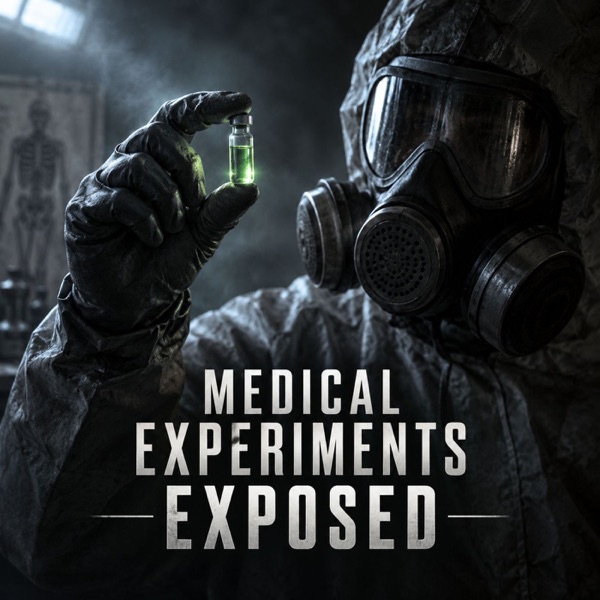
Medical Experiments Exposed
Ever wondered about the dark side of medical history? Medical Experiments Exposed uncovers the hidden truths behind the most shocking and controversial medical experiments throughout time. We delve into the ethical quandaries, scientific breakthroughs, and human stories often omitted from textbooks, revealing the real price of progress.
Join us as we meticulously research and narrate the untold accounts of human experimentation, from ancient practices to 20th-century scientific trials. Each episode brings to light the forgotten patients and the pioneering, often morally ambiguous, doctors who shaped modern medicine. This podcast offers a critical look at the evolution of medical ethics and the boundaries pushed in the name of science.
New episodes are released daily, Monday through Sunday, at 4:00 AM, ensuring a fresh, compelling story awaits you every day. Prepare for deep dives into historical medical practices, groundbreaking but often horrifying research, and the fascinating origins of contemporary treatments. We provide a thorough, accessible exploration of these complex topics.
Medical Experiments Exposed is for anyone fascinated by the intersection of science, ethics, and human history. If you're curious about medical history, the darker side of science, or the origins of modern medicine, this is your essential listen. Subscribe now and confront the past.
- On air since
- 2026
- Episodes
- 140
- Releases · typical length
- Daily · 27 min
- Latest episode
- 3 weeks ago
Episodes
140 episodes, newest first
-
25 min
The Doctor, The Syringe, and the Crown That Fell in London
Show notes
The Doctor, The Syringe, and the Crown That Fell in London
A sapphire cross fell from the Imperial State Crown onto wet cobbles as George V’s coffin passed through London - a public jolt that mirrored a private one: two days earlier a doctor had recorded using a syringe of morphine and cocaine on the king. Why did the palace tell the nation a peaceful death while a physician’s diary later revealed something far more deliberate?
In this episode, we recount the king’s final days at Sandringham, the bulletin written on a menu card, and the hidden diary of Lord Dawson of Penn that contradicts the official account - and we ask what it means when institutions decide the public cannot bear the full truth.
Person: George V
Date: 23 January 1936
Location: Sandringham to Wolferton station to Westminster Hall
Person: Lord Dawson of Penn
Event: Injection of morphine and cocaine into the king’s jugular vein on 20 January 1936- The sapphire cross pattee detached from the Imperial State Crown and fell onto the wet cobblestones during the funeral procession.
- George V died at 11:55 p.m. on 20 January 1936 after injections, according to Lord Dawson’s diary.
- Lord Dawson wrote the official bulletin on a menu card at 9:25 p.m. stating the king was “moving peacefully to its close.”
- The coffin procession from Sandringham to Wolferton station covered 2.5 miles on foot three days after the king’s death.
- George V was 70 years old in January 1936 and had chronic bronchitis with oxygen tanks at his bedside.Tired of ads? Listen to this podcast and 200+ more ad-free on OBOMEDIA.
Try it free for 7 days, cancel anytime: https://obomedia.com/en/gratis?ref=desc-7195845© 2026 Created by an independent creator of the OBOMEDIA Network. All rights reserved.
This episode and its content (audio, text, and related materials) are the property of their respective creator, who is solely responsible for them, and are distributed by the OBOMEDIA Network on platforms such as Apple Podcasts, Spotify, Amazon Music, and Pocket Casts. Reproduction, distribution, editing, or commercial use, in whole or in part, without the creator's prior written permission is prohibited. For permissions, licensing, and business inquiries: business@obomedia.com. -
28 min
Awake on the Table: When Your Surgeon Becomes the Threat
Show notes
Awake on the Table: When Your Surgeon Becomes the Threat
Imagine lying on an operating table, chest open, heart stopped, and hearing every word above you while your body is paralyzed - anesthesia awareness is real and the film Awake builds a thriller around that documented phenomenon. The movie claimed a rate of one in 700 for awareness, spawned a public dispute between an anesthesiology organization and a patient advocate, and left a question that won't let go: what happens when the person with the scalpel is the one who wants you dead?
In this episode, we lay out the facts of the film Awake and the real medical issue it dramatizes, describing the plot, the key players, and the controversy over anesthesia awareness - and we ask whether the ethical and forensic questions the film raised have been resolved.
Person: Clay Beresford Jr.
Event: Heart transplant surgery with anesthesia awareness
Date: November 30, 2007 (film release)
Budget: $8.6 million
Box office: $32.7 million worldwide- The film Awake was released on November 30, 2007 and was not screened in advance for critics by Metro-Goldwyn-Mayer.
- The production budget for Awake was $8.6 million and it earned $32.7 million worldwide.
- Awake claims an anesthesia awareness rate of one in 700, a figure that triggered public dispute between a professional anesthesiology organization and a patient advocate.
- The surgeon Dr. Jack Harper, portrayed in the film, has four malpractice suits and plans to sabotage a donor heart by injecting it with Adriamycin.
- Clay and Samantha marry at midnight the night before surgery as part of a long-con strategy to keep Clay away from his preferred surgeon and ensure surgical access.Tired of ads? Listen to this podcast and 200+ more ad-free on OBOMEDIA.
Try it free for 7 days, cancel anytime: https://obomedia.com/en/gratis?ref=desc-7195845© 2026 Created by an independent creator of the OBOMEDIA Network. All rights reserved.
This episode and its content (audio, text, and related materials) are the property of their respective creator, who is solely responsible for them, and are distributed by the OBOMEDIA Network on platforms such as Apple Podcasts, Spotify, Amazon Music, and Pocket Casts. Reproduction, distribution, editing, or commercial use, in whole or in part, without the creator's prior written permission is prohibited. For permissions, licensing, and business inquiries: business@obomedia.com. -
23 min
Three Hundred Thousand Units: When Treatment Silenced a Child
Show notes
Three Hundred Thousand Units: When Treatment Silenced a Child
The moment a doctor injected three hundred thousand units of penicillin into a boy's spine-thirty times the prescribed ten thousand-the child convulsed, developed hemiparesis, and later could not hear. Which caused the deafness: the meningitis that nearly killed him, or the massive intrathecal overdose that followed treatment?
In this episode, we lay out the clinical timeline, the documented overdose, and the legal battle that reached Scotland’s highest courts to determine causation. How did courts weigh the simultaneous violence of bacterial meningitis against an unambiguous thirty-fold drug error?
Person: the boy (identified by family name in records)
Event: intrathecal injection of benzylpenicillin
Date: discharged on 24 December (year not specified)
Dose prescribed: 10,000 units
Dose administered: 300,000 units- The administered dose was 300,000 units of penicillin delivered into the subarachnoid space.
- The prescribed intrathecal dose was 10,000 units, making the overdose thirty times the intended amount.
- Immediate toxic effects reported included convulsions and hemiparesis following the injection.
- The child survived the bacterial meningitis and was discharged from hospital on 24 December.
- The central legal question was whether the meningitis or the penicillin overdose caused the permanent deafness.Tired of ads? Listen to this podcast and 200+ more ad-free on OBOMEDIA.
Try it free for 7 days, cancel anytime: https://obomedia.com/en/gratis?ref=desc-7195845© 2026 Created by an independent creator of the OBOMEDIA Network. All rights reserved.
This episode and its content (audio, text, and related materials) are the property of their respective creator, who is solely responsible for them, and are distributed by the OBOMEDIA Network on platforms such as Apple Podcasts, Spotify, Amazon Music, and Pocket Casts. Reproduction, distribution, editing, or commercial use, in whole or in part, without the creator's prior written permission is prohibited. For permissions, licensing, and business inquiries: business@obomedia.com. -
29 min
The Thumb‑Sized Tissue That Unmasked a Fatal Surgical Lie
Show notes
The Thumb‑Sized Tissue That Unmasked a Fatal Surgical Lie
A thumbnail‑sized fragment of gland preserved in a jar became the only physical trace that proved a twenty‑two‑year‑old Singaporean had been operated on for a disease she did not have. That tiny tissue travelled between pathologists and across countries to expose discrepancies between hormonal tests, scans, and a surgeon’s claims-so how did routine medical care become a fatal deception?
In this episode, we tell the sequence of events from the collapse on 24 March 1985 through the surgery on 6 June 1985 and the months that followed, laying out the medical details, family actions, and expert testimony that raised the central question: why was surgery performed when hormone levels and imaging did not support a pituitary tumor?
Person: Chong Yun Jing
Date: 6 June 1985
Location: Mount Elizabeth Medical Centre, Singapore
Surgeon: Dr. Lim Djoe Phing
Pathologist: Dr. Seah Han Cheow- A tissue fragment the size of a thumbnail was the only physical evidence remaining after the rest of the body had been cremated.
- Chong collapsed on 24 March 1985 and remained under medical attention until surgery in June 1985.
- Surgeon Dr. Lim removed a pituitary gland fragment and recorded the diagnosis as pituitary tumor post‑operation.
- Endocrinologist Dr. John A. Tambyah later testified that Chong’s hormonal readings were normal, not abnormal as claimed.
- Radiologist Dr. Low Chen Hoong testified that one scan is insufficient and at least four radiological assessments are required to confirm a brain tumor.Tired of ads? Listen to this podcast and 200+ more ad-free on OBOMEDIA.
Try it free for 7 days, cancel anytime: https://obomedia.com/en/gratis?ref=desc-7195845© 2026 Created by an independent creator of the OBOMEDIA Network. All rights reserved.
This episode and its content (audio, text, and related materials) are the property of their respective creator, who is solely responsible for them, and are distributed by the OBOMEDIA Network on platforms such as Apple Podcasts, Spotify, Amazon Music, and Pocket Casts. Reproduction, distribution, editing, or commercial use, in whole or in part, without the creator's prior written permission is prohibited. For permissions, licensing, and business inquiries: business@obomedia.com. -
26 min
Born a Harm: The Court That Said Existence Was an Injury
Show notes
Born a Harm: The Court That Said Existence Was an Injury
Existence as injury: in 1980 a California appeals court allowed a wrongful life suit on behalf of a child with Tay-Sachs, ruling that "such a plaintiff both exists and suffers, due to the negligence of others." Could a court really treat being born as the legal harm, and what did that mean for medicine and law?
In this episode, we walk through the facts of Curlender v. Bio-Science Laboratories, the medical realities of Tay-Sachs, and the legal leap that asked whether nonexistence could be preferable to life. How did a single genetic test, a skipped amniocentesis, and a laboratory's assurances produce a case that reshaped legal thinking about who can be wronged?
Person: child-plaintiff represented by legal guardian
Date: 1980 (California Court of Appeal decision)
Case: Curlender v. Bio-Science Laboratories
Disease: Tay-Sachs (infantile form)
Medical test: genetic screening and missed detection leading parents to skip amniocentesis- The court's key sentence: "such a plaintiff both exists and suffers, due to the negligence of others." (seven words)
- Tay-Sachs leads to death usually before age five in the classic infantile form.
- If both parents carry the Tay-Sachs mutation, each pregnancy has a 1-in-4 chance of producing an affected child.
- The parents relied on Bio-Science Laboratories' representation that its genetic test was reliable and therefore did not pursue amniocentesis.
- Before Curlender in 1980, no American high court had held that existence itself could be the legal injury.Tired of ads? Listen to this podcast and 200+ more ad-free on OBOMEDIA.
Try it free for 7 days, cancel anytime: https://obomedia.com/en/gratis?ref=desc-7195845© 2026 Created by an independent creator of the OBOMEDIA Network. All rights reserved.
This episode and its content (audio, text, and related materials) are the property of their respective creator, who is solely responsible for them, and are distributed by the OBOMEDIA Network on platforms such as Apple Podcasts, Spotify, Amazon Music, and Pocket Casts. Reproduction, distribution, editing, or commercial use, in whole or in part, without the creator's prior written permission is prohibited. For permissions, licensing, and business inquiries: business@obomedia.com.
On these lists
Medical Experiments Exposed is one of the shows picked out on this list