Podcast
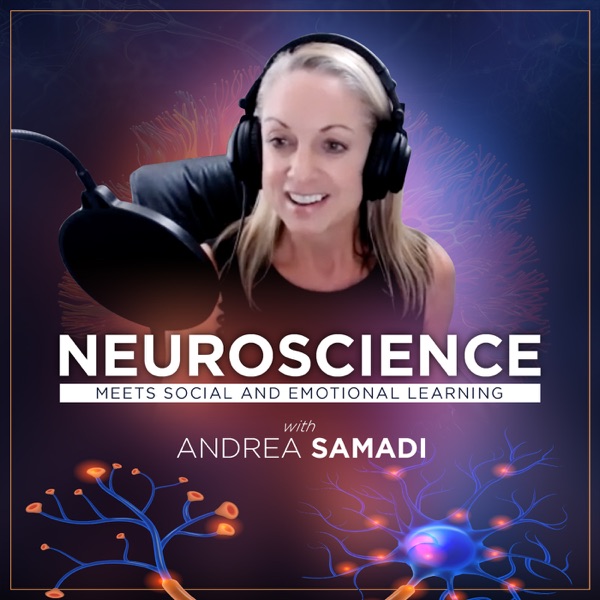
Neuroscience Meets Social and Emotional Learning
Welcome to the Neuroscience Meets Social and Emotional Learning Podcast
The Neuroscience Meets Social and Emotional Learning Podcast was created to bridge the gap between cutting-edge neuroscience research and its practical application in education, business, leadership, athletics, health, and personal development.
Since launching in 2019, the podcast has grown into a global platform, reaching listeners in more than 190 countries, publishing 400+ episodes, and sharing conversations with many of the world's leading experts in neuroscience, psychology, education, medicine, and human performance.
Our mission is simple:
To make neuroscience understandable, practical, and actionable—helping people learn, lead, and perform at their highest potential.
Every episode translates complex brain science into evidence-based strategies that listeners can immediately apply to improve learning, strengthen emotional intelligence, optimize health, build resilience, and achieve measurable improvements in performance.
The Evolution of the Podcast
The podcast has evolved over seven years, with each season building on the discoveries of the last.
Season 1 – Foundations of Neuroscience & Social and Emotional Learning
Introduced the neuroscience behind social and emotional learning (SEL) and emotional intelligence, providing educators and leaders with practical strategies for implementation in schools and workplaces.
Season 2 – High Performance Across Domains
Expanded into education, sports, and business, exploring how social, emotional, and cognitive strategies contribute to high performance.
Season 3 – Motivation, Mindset & Peak Performance
Connected influential business principles and motivational thinking with modern neuroscience to explore how mindset shapes achievement and productivity.
Seasons 4 & 5 – Mental Health, Wellness & Applied Neuroscience
Focused on stress management, mental health, cognitive resilience, and practical neuroscience strategies for improving well-being and performance.
Seasons 6–8 – Brain Health & The Science of Learning
Explored educational neuroscience, brain health, and the Science of Learning, demonstrating how understanding the brain improves learning across every stage of life.
Seasons 9 & 10 – Neuroscience 101
Returned to the fundamentals, simplifying core neuroscience concepts and building a strong foundation for understanding learning, behavior, and performance.
Seasons 11–13 – The Neuroscience of Self-Leadership
Examined self-awareness, emotional regulation, habits, decision-making, identity, and purpose, showing how neuroscience can help people lead themselves before leading others.
Season 14 – Reflect
Reviewed the podcast's most impactful interviews, identifying recurring themes and timeless lessons from years of conversations with world-leading experts.
Season 15 – Apply
Moved from reflection to implementation by organizing key insights into practical, evidence-based strategies that listeners could apply immediately in their own lives.
Season 16: The Brain's Operating System for Human Performance
Season 16 marks the next evolution of the podcast, introducing The Brain's Operating System for Human Performance—an evidence-based framework developed from more than 400 episodes and years of conversations with leading experts.
The framework is organized into three interconnected phases:
Phase 1 – Regulation & Safety
Every high-performing brain begins with regulation. This phase explores how sleep, stress regulation, trauma, autonomic balance, recovery, and psychological safety create the biological foundation for learning, resilience, and peak performance.
Phase 2 – The Motivation Loop
Once the brain is regulated, motivation becomes possible. This phase explores how beliefs, thoughts, attention, dopamine, reward, and repetition shape behavior, build lasting habits, and sustain meaningful achievement.
Phase 3 – The Movement Loop
Movement is not simply exercise—it is one of the brain's most powerful inputs. Through evidence-based research on exercise, neuroplasticity, recovery, sleep, metabolism, and performance, this phase demonstrates how movement changes the brain, strengthens the body's ability to adapt, and leads to measurable improvements in cognitive function, resilience, health, leadership, and human performance.
The Movement Loop is built around one simple framework:
•
Movement is the input.
•
Adaptation is the biological process.
•
Performance is the measurable outcome.
Season 16 provides practical, science-backed strategies that listeners can apply immediately to learn, lead, and perform at their highest potential.
Looking Ahead
The Brain's Operating System for Human Performance continues to evolve.
Future seasons will expand the framework through two additional phases:
Phase 4 – The Connection Loop (Working Title)
Exploring how trust, relationships, communication, belonging, and collaboration shape the brain and create the conditions for teams, organizations, and communities to thrive.
Phase 5 – The Purpose Loop (Working Title)
Bringing the entire framework together by exploring how purpose, identity, leadership, and contribution transform high performance into meaningful, lasting impact.
As this framework continues to grow, it will be accompanied by The Brain's Operating System Workbook—a practical guide designed to help readers apply each phase to their own lives through self-assessments, guided reflections, evidence-based exercises, and implementation tools.
Together, the podcast and workbook are designed to form a complete learning system—providing both the science and the practical application needed to create lasting change.
- Episodes
- 419
- Releases
- Weekly
- Typical length
- 31 min
- On air since
- 2019
- Latest episode
- 1 week ago
Episodes
419 episodes, newest first
-
50 min
The Biology of Support: How Connection Shapes Learning, Growth and Performance
Season 16, Episode 420
Show notes
Episode 410 explores what effective neuroscience reveals about emotion, connection, and learning. Andrea Samadi revisits conversation clips with Lucy Biven to distinguish observable behavior from private affect, examine the brain’s opioid and seeking systems, and introduce the connection loop for understanding others.
The episode also offers practical models—Ask, Respond, and Check Back for offering support, and Ask, Try, and Review for receiving guidance—applied to school, sports, and the workplace to build belonging and improve performance.
Welcome back to Neuroscience Meets Social and Emotional Learning Podcast, where we bridge neuroscience, social and emotional learning, and human performance so we can create measurable improvements in our well-being, achievement, leadership, productivity, and results.
I’m Andrea Samadi, and welcome to Episode 410.
On this episode, we will learn:
✔ What affective neuroscience can teach us about emotion, connection, and learning.
✔ Why the support we offer may differ from the comfort someone actually feels.
✔ How Panksepp’s SEEKING system helps us understand curiosity, exploration, and motivation.
✔ How to offer useful support: Ask → Respond → Check back.
✔ How to be coachable and apply feedback: Ask → Try → Review.
✔ How these practices connect to our Connection Loop, with examples for school, sports, and the workplace—helping us learn, grow, and perform.
Today, we begin our first anchor interview in Phase 4—Perception, Emotion, and Social Intelligence, revisiting two clips from our conversation with Lucy Biven.
WHERE WE ARE IN THE JOURNEY
Whether you’ve been following this series from the beginning or you’re joining us for the first time, welcome. I’m grateful you’re here.
Let’s take a moment to see where we are—and where we’re heading—on this journey through what I call The Brain’s Operating System for Human Performance.
Think of this as a framework for understanding how our brain “comes online” in different ways—how we become ready to learn, motivated to act, able to focus, and available to connect with others.
Of course, our brain is always active. “Coming online” is a metaphor for how we gain access to these capacities—and how that access changes with our physical state, our experiences, and the demands around us.
You might be focused at work, yet find it difficult to stay open and curious during a challenging conversation.
Our five phases help us explore these capacities and how they support one another—so we can better understand ourselves, respond more thoughtfully to others, and create measurable improvements in how we learn, connect, lead, and ultimately how we perform.
In Phase 1—Regulation and Safety, we explored the conditions that help us settle, engage, and become ready to learn.
In Phase 2—Neurochemistry and Motivation, we examined what sparks our interest, moves us toward action, and helps us persist.
In Phase 3—Movement, Learning, and Cognition, we connected movement with attention, learning, and performance.
Now, in Phase 4—Perception, Emotion, and Social Intelligence, we bring that understanding into our relationships. How do we experience one another? What shapes our reactions? And how can understanding our own inner world help us better understand someone else?
Next, in Phase 5—Integration and Human Performance, we’ll bring these foundations together and explore how to apply them to meaningful, measurable improvements in everyday life.
These phases overlap and influence one another. We revisit them as our needs and circumstances change.
Once we complete Phase 5—likely around January 2027—I plan to take some time away from recording new episodes to write The Journey of the Mind Workbook.
The workbook will help us put what we’ve learned on this podcast into practice through a pathway:
Understand → Reflect → Apply → Measure → (the end result) Become (more).
We’ll reflect on what these ideas mean in our own lives, choose actions to practice, and measure what changes over time.
OUR PHASE 4 CONNECTION LOOP
In Episode 409, we introduced our Connection Loop:
Perception → Affect → Emotion → Mindsight → Relationships → Belonging and Performance.
We begin with Perception: How am I interpreting what is happening?
We consider Affect: What is the private felt quality of this experience? Does it feel pleasant or unpleasant, calming or activating?
We explore Emotion: What response am I experiencing in my body and behavior? What do I feel moved to do?
Through Mindsight, we ask: Can I reflect on my own inner experience while remaining curious about another person’s?
That awareness influences our Relationships: How will I listen, communicate, respond, or repair a misunderstanding?
And we consider Belonging and Performance: Are our interactions helping people feel included, participate, learn, and contribute?
This is our organizing framework for the phase. These processes interact; they don’t always unfold in this order.
Today, we begin by looking beneath the behavior we can see.
Think about a student who withdraws, a colleague who responds sharply, or someone you care about who suddenly becomes quiet.
We can observe what they do. But what are they experiencing?
INTRODUCING LUCY BIVEN
To help us explore these questions, we’re returning to Lucy Biven, whom we first met on Episode 270[i] in January 2023.
Lucy co-authored The Archaeology of Mind with Jaak Panksepp and wrote A Short-Cut to Understanding Affective Neuroscience. She is the former Head of the Department of Psychotherapy at the Child and Adolescent Mental Health Service in Leicestershire, England.
Her journey into neuroscience began with a question her clinical experience alone couldn’t fully answer.
As she described in our original conversation, she was appointed by the Michigan Supreme Court to help develop and implement a plan to transfer a two-and-a-half-year-old girl from the caregivers she regarded as her parents to her biological parents.
Lucy and her colleagues were concerned about the child’s emotional development. Yet the child went on to do well.
That left Lucy asking: Where did it all go right?
Her search for answers led her to neuroscience and Jaak Panksepp’s work on the emotional systems of the mammalian brain.
Listen today for a distinction Lucy makes between emotional responses that can be observed and the private feeling experience she calls affect. Terminology varies across theories of emotion, but this distinction is important for understanding her perspective.
As you listen, hold one question in mind:
What might I understand differently if I became more curious about the feeling beneath the behavior?
Think of an interaction you’re navigating right now. How might your response change if you became curious about what the other person is experiencing, beyond the behavior you can see?
Let’s listen to the first clip.
CLIP 1: THE BIOLOGY OF CONNECTION—FROM FEELING SUPPORTED TO BEING READY TO LEARN
In this clip, Lucy describes animal research suggesting that early social deprivation can affect the brain systems involved in comfort, distress, and attachment.
She explains that “The body produces its own opioids—chemical messengers involved in pain relief and reward, as well as aspects of social connection. These messengers act on receptors in the brain.”
The broader point is that experiences of care and isolation can influence the biology underlying our emotional lives. This gives us a powerful question to consider:
What if someone’s difficulty receiving comfort is part of what we need to understand to help them thrive in school, sports, or their work place?
We often focus on what someone needs to do: pay attention, accept feedback, practice a skill, or work with a team. But we also can consider how they experience the support we offer.
A teacher might say, “You can ask me for help,” yet a student remains silent. A coach might offer encouragement, yet an athlete still feels overwhelmed after a mistake. A manager might offer guidance, yet an employee worries that asking questions will make them look incapable.
In each situation, support is being offered—but we don’t yet know whether it feels supportive to the person receiving it.
That matters because learning and improving involve uncertainty. We need to ask questions, make mistakes, receive feedback, and try again. If those moments feel threatening or embarrassing, participating can become harder.
Our role is to become curious: “What would make it easier for you to ask for help?” “Would you prefer feedback privately?” “What helps you regroup after a mistake?” or “How else can I help you to keep moving forward?”
Then we can follow through consistently and notice what helps.
This brings us back to Affect in our Connection Loop: the person’s inner experience or what the experience feels like to that person. Through Mindsight, (or seeing the mind of another) we can become curious about that experience. We use what we learn to strengthen Relationships and create conditions that support Belonging and Performance.
To help someone thrive, we need to understand both the challenge they face and what helps them feel supported enough to engage with it.
Here are three takeaways.
First, connection has a biological dimension.
By this, we mean that relationships involve activity in our brains and bodies, as well as our thoughts about another person.
In this first clip, Lucy focuses on the brain’s endogenous opioid system. “Endogenous” means produced within the body. These natural chemical messengers—including endorphins—act on opioid receptors and help regulate pain, reward, and aspects of social comfort and attachment.
Think of the chemical messenger as a signal and the receptor as a structure that receives it. How this system functions contributes to how comforting or rewarding social contact feels.
Lucy describes animal research examining how social deprivation affects this system. The broader biological connection is that our social experiences can influence the systems involved in emotional experience—and those systems can influence how we experience relationships.
This doesn’t mean we can look at a student who withdraws and conclude that they have fewer opioid receptors. Nor does a simple receptor count determine someone’s capacity to feel loved.
It means that when we ask, “Does this person feel supported?” we are asking about an experience that involves both their relationships and their biology.
For school, sports, and workplaces, that encourages us to look beyond whether we offered reassurance and ask: Did our support help this person feel more able to engage, learn, or try again?
Feeling comforted involves more than hearing reassuring words. Our emotional systems participate in how we experience closeness and support. Again, Lucy’s example invites us to consider that care is something we experience internally as well as something another person offers.
Think about a moment when someone you trust sat beside you during a difficult experience. The problem may have remained, but perhaps you felt less alone and more able to face it.
In school, sports, or our work environments, that gives us a useful question: What helps another person to feel supported enough to participate, ask for help, and try again?
Encouragement matters. So does the relationship, the circumstances, and how the person experiences our approach. Here, we can pay attention to whether our support is helping another person to engage with us.
And if they aren’t engaging? That’s a reason to pause and become curious. It doesn’t automatically mean they don’t care, don’t trust us, or don’t want help.
We might ask ourselves: Have I made the next step clear? Is this a difficult time? Would a private conversation feel easier? Do they need space, a different kind of support, or someone else to connect with?
Then we can offer a small, manageable invitation:
“I noticed you’ve gone quiet. Would you like to talk now, or should I check back later?”
“Would it help if we worked through the first step together?”
“You don’t have to explain everything. What would make this next step easier?”
If they still don’t engage, we can respect that response, keep appropriate expectations clear, and follow through on an agreed check-in. Sometimes support means remaining available without pressing for immediate closeness.
In our Connection Loop, this is moves us from Perception (how we interpret an experience) to Mindsight (understanding our own minds first, and being curious about others): we notice the behavior, (in another person) recognize that we don’t yet understand the person’s inner experience, and adjust how we approach the relationship.
The question becomes: What conditions might make participation more possible for this person?
Since the end goal is to move us towards belonging, and performance, where we participate, learn, contribute and grow together.
Second, effective support bridges the gap between what we intend and what someone actually experiences.
We may intend to reassure someone, but our words don’t always land as we hope.
CLASSROOM EXAMPLE
A teacher saying, “This is easy—you’ve got this,” may intend to build confidence. A struggling student might hear, “I should already understand this” and feel pressure. The teacher could instead say, “Which part is confusing? Let’s work through the first step together” to take the pressure off the student.
SPORTS EXAMPLE
A coach saying, “Shake it off,” may intend to help an athlete move forward. The athlete might need a moment to regroup and a specific cue might direct them to do this: “Take a breath. On the next attempt, focus on your foot placement” gives them a focused direction on what to do next.
WORKPLACE EXAMPLE
A manager might say, “My door is always open,” meaning, “Come to me when you need help.”
But an employee might still think, “If I admit I don’t understand this assignment, will my manager think I can’t do my job?”
What matters is how the manager responds to a question they are asked.
If the employee says, “I’m not sure how to start this report,” the manager could respond: “Thanks for asking. Let’s look at an example, then identify your first step.”
The employee now has useful guidance—and an experience of asking for help without being embarrassed or dismissed. That can make it easier to ask questions again.
We don’t have to guess what someone needs. We can ask: “What part still feels difficult?” “Would it help to talk it through, see an example, or have a moment to think?”
Then we listen, adjust, and check whether our response helped.
The goal is for support to make participation more possible: the student asks a question, the athlete attempts the skill again, or the employee raises a concern before it becomes a larger problem.
In our Connection Loop, Mindsight helps us understand the person’s experience; responsive Relationships help build Belonging; and that support creates opportunities for learning and Performance.
Third, behavior gives us clues, but it doesn’t tell us the whole story.
We can see someone withdraw, reject receiving help, become frustrated, or stop participating. We cannot directly see what that experience feels like from the inside.
Silence might reflect confusion, embarrassment, exhaustion, concentration, or a wish for space. We need more information before deciding what it means.
This is where Mindsight enters our Connection Loop: remembering that another person has an inner world that may differ from what we imagine or understand.
Instead of saying, “It looks like you don’t care,” when someone withdraws, we might say, “I noticed you stopped participating. How are you experiencing this?”
We can maintain expectations while becoming more thoughtful about how we help someone meet them. Understanding what is happening may reveal a clearer instruction, a different way to offer feedback, or an opportunity to repair trust.
Across all three takeaways, the practice is the same: notice what we can observe, become curious about what we cannot see, and check whether our response helps.
We can’t read minds. In a future episode, we’ll explore how facial cues can help us notice possible emotions—but those cues are invitations to ask, rather than proof that we know what someone feels.
Our goal is to understand enough to offer support that helps someone engage, learn, and take their next step forward.
That is how we move from recognizing someone’s emotional experience to building relationships that support belonging, learning, and ultimately higher performance.
PUTTING CLIP 1 INTO PRACTICE
While writing this episode, I thought about how I experience support.
When I’m struggling, I like to talk things through with someone who has been successful in that area. What do they see that I might be missing? What would they try that I haven’t considered?
For me, feeling supported often means being heard, gaining a fresh perspective, and leaving with something concrete to try.
Someone else might need encouragement, quiet company, or time to process.
Our starting point is to learn what support means to the person in front of us. When offering support try three steps:
Ask → Respond → Check back.
In school, imagine a student staring at a blank page.
Ask privately: “I noticed you haven’t started. Can you show me where you’re getting stuck?”
They say, “I understand the question. I just don’t know how to start.”
Respond: “Let’s say your first idea out loud. Then you can write it in your own words.”
Check back: “Did talking it through help?”
You’ve helped the student cross a specific barrier (where they were stuck) while keeping the learning goal in place.
In sports, imagine an athlete becoming hesitant after a mistake.
Ask: “What’s making the next attempt difficult?”
They say, “There are too many things I’m trying to remember.”
Respond: “Let’s choose one skill to focus on.”
Choose a skill that’s appropriate to the athlete’s ability.
Check back: “Did narrowing the focus help?”
In the workplace, imagine an employee becoming quiet after receiving feedback.
Ask: “What still needs clarification?”
They say, “I’m not sure what to change.”
Respond: “Let’s identify the top priority and look at one example together.”
Check back: “Did that example give you enough direction to get started?”
In each case, we’re checking both the person’s experience (asking where they are stuck) and offering support.
If someone doesn’t want to talk, offer options:
“Would you prefer to write down your question, talk privately later.
If they still don’t engage, we can respect that response, keep expectations clear, and follow through on an agreed check-in. Sometimes support means remaining available without pressing for an immediate response.
WHERE CLIP 1 FITS IN OUR CONNECTION LOOP
This clip’s strongest anchor is Affect: the private felt quality of an experience. How does an experience feel? Is it pleasant/unpleasant, calming or activating?
We are practicing Mindsight when we recognize that behavior doesn’t give us direct access to someone’s inner experience, so we ask and listen. If you want to revisit EP 28[ii] with Dr. Dan Siegel, he explains what Mindsight looks like in action, and he even created a mediation to further develop this skill, that we reviewed on EP 60[iii].
Our response shapes our Relationships. Consistent, responsive support can help strengthen Belonging and create opportunities for learning that eventually lead to higher Performance. Feeling included matters in its own right, even when progress takes time.
These examples don’t tell us anything about a person’s opioid receptors. They show how we can put curiosity and responsive care into practice.
The question to carry into your next conversation is:
What does support look like for this person—and did my response help them take their next step?
CLIP 2: CONNECTION HELPS US LEARN FROM ONE ANOTHER
Our second clip shifts from receiving comfort to receiving guidance.
Listen for how someone else’s perspective can help us improve—and how, through practice, we make that learning our own.
Lucy describes a coach helping a runner improve through specific feedback. The coach notices something the runner might not recognize alone and offers an adjustment the runner can practice and evaluate.
Lucy connects this example with the SEEKING system. Let’s pause to understand what she means.
GRAPHIC: Panksepp’s Emotional Circuits of the Mammalian Brain]
Jaak Panksepp (who co-authored the famous The Archeology of Mind book with Lucy, created a framework that identifies seven primary emotional systems of the mammalian brain. For this clip, our focus is SEEKING, which involves exploration, interest, and the motivation to pursue possibilities.
If a coach simply says, “Run faster,” the runner may want to improve but have no idea what to change.
When the coach suggests a specific adjustment to their arm movement, the runner has something to investigate:
“Could this help my speed? Let me try.”
The feedback gives curiosity a direction. The runner can practice the adjustment, notice what changes, and discuss the result with the coach.
The coach helps the runner see a possibility. Through practice, the runner discovers whether it helps—and begins making that learning their own.
This connects back to Phase 2—Neurochemistry and Motivation. Here in Phase 4, we’re exploring the relationship that supports this process: how another person’s perspective can help us discover an opportunity to improve.
THREE KEY TAKEAWAYS
First, useful feedback makes improvement actionable.
“Do better” gives someone an expectation without explaining how to meet it.
Specific feedback identifies something they can work on: “Try this adjustment, then let’s review what changes.”
The person receiving guidance should leave with a clearer understanding of what to do next.
Second, being coachable means being willing to understand and test feedback.
We don’t have to accept every suggestion as correct. We can listen, ask questions, and try an appropriate adjustment before deciding whether it helps.
Instead of immediately defending our current approach, we might ask:
“Can you show me what you mean?”
“What are you noticing that I might be missing?”
“How will I know if this change is helping?”
This brings me back to how I experience support. I value talking with someone who has been successful in an area where I’m struggling. But seeking their perspective is only the beginning. I also need to remain open to examining their suggestions, and make them my own.
Sometimes my first thought might be, “I’ve tried that, and it didn’t work.”
A useful next question is:
“I’ve tried something similar. Can you show me what you did differently?”
There may be a detail I missed. Or I may need to explain why the suggestion doesn’t fit my situation. Either way, curiosity helps us have a more useful conversation.
Third, improvement becomes ours through application.
Hearing advice is the beginning. We build skill by practicing, noticing the result, and adjusting.
Ask yourself:
“What will I do differently on my next attempt?”
Over time, we may become better able to recognize and correct the issue ourselves. That growing independence is what Lucy points toward when she says the learning becomes yours.
PUTTING CLIP 2 INTO PRACTICE
When receiving guidance, try:
Ask → Try → Review.
Ask for enough detail to understand the suggestion. Try one appropriate adjustment. Then review the result to decide what to keep or change.
In school, a student receives the comment, “Your answer needs more evidence.”
Ask: “Can you show me where evidence would strengthen my answer?”
Try: Add one relevant example and explain how it supports the point.
Review: “Does this make my reasoning clearer? Can I do this in the next paragraph myself?”
In sports, a coach suggests changing an athlete’s arm movement while running.
Ask: “Can you show me the adjustment—and which part to focus on first?”
Try: Practice the adjustment using one clear cue from the coach.
Review: Ask your coach “Was that closer to what you meant? What did we notice about my form or pace?”
Some adjustments take practice before we can judge whether they’ve actually helped to impact a change.
At work, a colleague suggests making a presentation clearer.
Ask: “Where did you lose the main point?”
Try: Revise that section so the recommendation comes first, followed by the supporting evidence.
Review: Ask your colleague “Is the recommendation easier to understand now?”
The person giving feedback also has a responsibility: make it specific, invite questions, and allow time for practice and improvement.
WHEN SUPPORT ALSO REQUIRES ACCOUNTABILITY
But what happens when the same mistake keeps happening—and it affects other people?
Let’s take our sports example one step further.
Imagine an athlete repeatedly moving out of position, leaving an opening for the opposing team.
For an initial mistake, the emphasis can be on education: talk it through, explain the expectation, and practice the adjustment.
The coach asks the player his perspective:
“Walk me through what you saw before you moved.”
That helps the coach understand the difficulty. Did the athlete miss a cue? Misunderstand their role? Know what to do but struggle to execute it? That’s using Mindsight-to see through the eyes of the player.
The coach responds:
“Here’s the cue to watch for. When you see it, hold your position until your teammate is ready. Let’s practice that situation.”
The athlete asks:
“Can you show me what that looks like—and watch me try it?” This is the player using Mindsight. Seeing the mind of the coach.
Now both people have something specific to work on to apply the feedback, through the lens of the coach who has offered the advice for change.
Mistakes are part of developing a skill. The goal is to build a shared way of playing that reduces avoidable risks while helping athletes to make better decisions with the knowledge of their coach.
If the same costly mistake continues, the coach needs to investigate further.
Does the athlete understand the instruction? Can they apply it in practice? What makes it harder during competition?
Depending on the situation and level of competition, accountability might include a change in playing time or responsibilities. That conversation should explain both the decision and the pathway forward for change:
The Coach Shares “This situation keeps leaving a gap for the other team, so I’m adjusting your role for now. Here’s what we’ll work on, what improvement looks like, and when we’ll review your progress.”
The athlete can respond:
“What should I focus on in practice to show I’m ready for that responsibility again?”
Support and expectations work together when both people understand the next step.
Some lessons may help the whole team. Others are better addressed privately. The coach can teach a shared principle while preserving the athlete’s dignity while learning to correct their mistake.
Follow-up matters, too. Brief notes about the conversation—the person’s perspective, the agreed adjustment, and the next check-in—give both people a reference for reviewing progress.
What did we agree to practice? What changed? What still needs work?
This example applies in the classroom and workplace as well as in sports. Sometimes a difficulty raised by one person reveals something others also need help with.
In the classroom, a teacher and student might agree to work on supporting written answers with evidence. They record one next step: “Include an example and explain how it supports your point.”
At the next check-in, they review a new paragraph together: “Where did you apply that strategy? What can you now do independently? Where would another example help?”
If the teacher notices the same difficulty across several students’ work, that becomes an opportunity for a whole-class lesson.
The teacher might say:
“I’m noticing that we’re including examples, but we need more practice explaining how those examples support our ideas. Let’s work through one together.”
Using a teacher-created example, the class identifies the main point, selects evidence, and discusses the connection between them. Students then apply the strategy to their own writing.
The teacher checks a few new responses to see who understands and who needs further guidance. A question raised by one student has helped uncover a shared learning need—without making that student the focus of the lesson.
In the workplace, a manager and employee might agree that project updates need a clearer recommendation. They note the adjustment needed,
At their next meeting, they review an update: “Was the advice clear? Did the employee understand what action was needed? What should we refine?”
If several updates have the same issue, the manager can bring the learning to the team:
On the next team call, the manager can share that “We’ve had a few employees with the same challenge. We used this advice to move forward.” The manager can ask the team for other advice that might help everyone.
The team reviews the new advice, and suggestions to implement it.
What do others recommend? Why? What action or next step is needed next?
The manager invites questions and asks team members to something new. At their next meeting, they review whether the advice made a difference.
This also gives the manager an opportunity to reflect: “Have I explained how to effectively execute the expectation”
Across these settings, the practice expands from individual support to shared learning:
Notice a pattern → Teach or clarify together → Practice → Check progress.
Individual conversations still matter. Some people will need different explanations or additional practice. But when several people encounter the same difficulty, we can examine the instruction, expectations, or process they share.
Brief notes help us remember what we agreed to try and assess whether it helped in the next meeting.
Follow-up turns one conversation into an ongoing learning process—and sometimes, an opportunity for the whole class or team to improve together.
These questions keep feedback connected to learning.
WHERE CLIP 2 FITS IN OUR CONNECTION LOOP
Let’s look at this interaction from both perspectives: the coach (manager or teacher) offering support and the athlete (student or employee) receiving guidance.
Perception: How am I interpreting what is happening?
The coach notices a repeated mistake and asks:
“What am I assuming about why this keeps happening?”
The athlete hears the correction and wonders:
“What is my coach thinking— is there something specific I need to understand?” (using Midsight)
Both can check their interpretations through conversation.
Affect: What does this experience feel like?
The feedback may feel uncomfortable or overwhelming to the athlete, student or employee. Coming from experience, feedback can be difficult to receive, but it can really help us when we are open to it.
The coach (or teacher or manager) asks:
“How is this landing? Would it help to focus on one adjustment?” to make the feedback more specific.
The athlete replies:
“One instruction at a time would help me.”
Emotion: What response am I noticing?
The coach (teacher or manager) may notice frustration and pause before repeating the instruction more forcefully. Remember to use Mindsight here.
The athlete (student or employee) may notice they feel embarrassment and an urge to withdraw and not reveal that they are aware they are missing something. Instead of doing that, they can put that experience into words:
“I’m frustrated because I’m trying, but I’m not sure I’m doing it correctly.”
Now they have something they can discuss.
Mindsight: Can I reflect on my experience while remaining curious about yours?
The coach (teacher or manager) considers:
“I know what I mean. Have I explained it in a way this athlete (student or employee) can use?”
The athlete (student or employee) considers:
“I don’t like hearing this, but what might my coach see that I’m missing?”
Both make room for another perspective.
Relationships: How do we respond to one another?
The coach (teacher or manager) demonstrates a new skill, invites questions, and follows up.
The athlete (student or employee) asks for clarity, practices, and describes what they notice.
Here, our two practices work together:
Offering support: (Coach/Teacher/Manager) Ask → Respond → Check back.
Receiving guidance (Athlete/Student/Employee) : Ask → Try → Review.
The person offering support checks whether their help is useful. The person receiving guidance tests what they’ve learned.
Belonging and Higher Performance: (which is the entire goal of this lesson). What conditions are we creating—and what progress can we observe as we understand the biology of connection, and how we learn through feedback?
The coach (teacher/manager) communicates:
“You are a valued member of this team, and you have a responsibility we need to work on.”
The athlete (student/employee) can acknowledge difficulty, ask for help, and work toward meeting the expectation.
Together, they review whether the new skill is recognized, the adjustment has been made, and progress or improvement becomes more consistent over time with practice,
Belonging matters throughout that process, including when improvement takes time. Feeling valued can support participation, while clear instruction and practice give the athlete/student/employee opportunities to improve.
These elements overlap. Our Connection Loop helps us reflect on both people’s experiences and how their individual responses shape what happens next.
THE PRACTICE TO CARRY FORWARD
Choose one interaction this week.
When offering support, ask:
“Did I understand what this person needed, and was my response useful?”
When receiving guidance, ask:
“Did I understand the suggestion, and what happened when I tried it?”
Notice whether someone asks a question, attempts the task again, explains what they need, or becomes more independent. Notice, too, whether you need to adjust your own approach.
Lucy’s example reminds us that another person can help us recognize a possibility we hadn’t seen ourselves. Our part is to ask, practice, and reflect—until we can use that learning ourselves.
What can I learn from the person guiding me—and what will I try next to make that learning my own?
CLOSING EPISODE 410
To review and conclude this week’s EP 410, let’s bring these two clips together.
Lucy Biven has helped us explore two connected questions:
What helps someone to experience support? That’s understanding the Biology of Connection.
And how can guidance help them to learn and improve? That’s how we learn through feedback.
And sometimes, we are the person who needs someone else’s perspective.
There are two ways to practice the same interaction. (You can see a graphic in the show notes to explain each clip).
CLIP 1
When offering support: You the Ask → Respond → Check back
Start by asking where the person is struggling. Respond with support that addresses that difficulty. Then check back to find out whether it helped.
A teacher might ask, “Where are you getting stuck?”
The student says, “I don’t know how to start.”
The teacher responds, “Let’s talk through your first idea together.”
Later, the teacher checks back: “Did that help you begin? What do you need now?”
CLIP 2 When receiving guidance: Ask → Try → Review
Ask for enough detail to understand the suggestion you are given to improve something.
Try that adjustment.
Then review the result to decide what to keep or change.
Let’s return to Lucy’s running example.
The runner might ask, “You mentioned my arm movement. Can you show me what to adjust?”
The coach demonstrates the change and gives the runner one specific cue to practice.
The runner tries it, then asks, “Was that closer to what you meant? What did you notice?”
Together, they review the attempt. Did the runner make the intended adjustment? Did it help their form or pace? Does it need more practice before they can judge the result?
The coach checks whether the guidance is clear and useful. The runner tests what they’ve learned.
That is how they turn feedback into an opportunity for progress.
And this brings us back to our Connection Loop—from both sides of the interaction: offering support and receiving guidance.
Let’s stay with the coach and runner.
Perception: How am I interpreting what is happening?
The coach notices the runner becoming quiet after feedback. Instead of assuming they aren’t interested, the coach asks, “How are you understanding the adjustment I suggested?”
The runner may initially think, “My coach is disappointed in me.” They can check that interpretation by asking, “Is this something you want me to focus on in my next practice?”
Both are checking their assumptions and making sure their perceptions are what is really happening.
Affect: What does this experience feel like?
The coach’s feedback may feel uncomfortable or overwhelming to the runner, even though it was intended to help.
The coach can ask, “Was that too much information at once?” keeping the runner’s feelings in mind.
The runner can notice their own experience: “I’m feeling overwhelmed. One instruction at a time would help.”
Emotion: What response am I noticing?
The coach might feel frustrated when the runner doesn’t make the adjustment. Recognizing that frustration gives the coach a chance to pause before repeating the instruction a second time.
The runner might feel embarrassed and want to withdraw. Recognizing that response creates an opportunity to say, “I’m frustrated because I’m trying, but I’m not sure I’m doing it correctly.”
Naming the experience gives them something they can talk about and move beyond.
Mindsight: Can I reflect on my experience while remaining curious about yours?
The coach considers, “I know what I mean, but have I explained it in a way this runner can use my advice?”
The runner considers, “This feedback feels uncomfortable, but there may be something useful here that I don’t understand yet.”
The coach asks, “Would a demonstration help?”
The runner replies, “Yes. Can you show me, then watch me try?”
Relationships: What do we do with that understanding of what we are learning?
The coach demonstrates one adjustment, invites questions, and checks back.
The runner asks for clarification, tries the adjustment, and describes what they notice.
This is where our two practices (clip 1- the biology of connection and clip 2-leanring through feedback) work together:
The coach (teacher or manager) : Ask → Respond → Check back.
The runner (student or employee) : Ask → Try → Review.
Both need to contribute to making the exchange useful.
Belonging and Performance: What conditions are we creating, and what progress can we observe?
The coach/teacher/manager communicates, “You’re a valued member of this team, and this is a skill we can work on.”
The runner/student/employee has room to acknowledge the difficulty they are experiencing and keep learning.
Together, they check: Was the cue or instruction understood? Did they make the intended adjustment? Did they become more able to recognize the changes on their own?
Belonging matters throughout that process.
These processes overlap. Our Connection Loop helps us reflect on both people’s experiences and responses while giving feedback to others and how we take feedback ourselves.
This week, notice one time when you offer support—and one when you receive guidance.
When offering support, ask: “Did I understand what the other person needed, and was my response useful?”
When receiving guidance, ask: “Did I understand the suggestion, and what happened when I tried it?”
For me, writing this episode reinforced how much I value being heard, gaining a different perspective, and leaving with something concrete to try.
My responsibility is to remain open enough to learn—and curious enough to discover what support means to someone else.
Today, we took a closer look at a very complex topic—affective neuroscience, the study of the neural foundations of emotion—and connected it to moments we recognize in school, sports, work, and our own lives.
It’s a reminder that we don’t have to understand everything the first time we hear it. With patience, useful guidance, and opportunities to practice, ideas that once felt out of reach can begin to make sense.
That’s what we’ve explored here with Lucy Biven: how we support someone who is struggling, and how we remain open to learning from someone else.
Sometimes progress begins with a question, a different explanation, or the willingness to try again.
As we continue through Phase 4, give yourself—and the people around you—room to learn.
In our next episode, Episode 411, we’ll continue Phase 4 with Marc Brackett and his famous book, Permission to Feel as it relates to the connection loop. Building on Lucy’s distinction between observable behavior and inner experience, we’ll turn toward understanding and naming our emotions—and considering how we respond to them. I
Will see you next time.
RESOURCES:
Watch the Full Interview and Featured Clips
Explore the emotional foundations of connection with Lucy Biven, co-author with Jaak Panksepp of The Archaeology of Mind and author of A Short-Cut to Understanding Affective Neuroscience.
Full Interview: Lucy Biven on Understanding Affective Neuroscience
Clip 1: The Biology of Connection—From Feeling Supported to Being Ready to Learn Explore the biological dimension of social comfort and why understanding someone’s emotional experience matters for connection and learning.
Clip 2: Connection Helps Us Learn From One Another Discover how specific feedback, openness to coaching, and practice help us turn another person’s guidance into skills of our own.
Phase 4 Roadmap:
409[iv] — Daniel Siegel
Mindsight: understanding our inner world and the minds of others
410[v] — Lucy Biven
The emotional foundations of the brain
411[vi] — Marc Brackett
Recognizing, understanding, and regulating emotions
412[vii] — Greg Wolcott
Developing our discussion of perception and human performance
413[viii] — Lori Desautels & Michael McKnight
Applying nervous system awareness to relationships and learning
414[ix] — Dan Hill
Reading emotional signals and facial expressions
415[x] — Mary Helen Immordino-Yang
How emotion and social meaning shape learning
REFERENCES
[i] Neuroscience Meets Social and Emotional Learning Podcast EP 270 https://andreasamadi.podbean.com/e/lucy-biven/
[ii] Neuroscience Meets SEL Podcast #28 with Dr. Daniel Siegel on “Mindsight: The Basis for Social and Emotional Intelligence” https://podcasts.apple.com/us/podcast/clinical-professor-psychiatry-at-ucla-school-medicine/id1469683141?i=1000456048761
[iii]Neuroscience Meets SEL Podcast #60 https://andreasamadi.podbean.com/e/the-science-behind-a-meditation-practice-with-a-deep-dive-into-dr-dan-siegel-s-wheel-of-awareness/
[iv] Neuroscience Meets SEL Podcast #28 with Dr. Daniel Siegel on “Mindsight: The Basis for Social and Emotional Intelligence” https://podcasts.apple.com/us/podcast/clinical-professor-psychiatry-at-ucla-school-medicine/id1469683141?i=1000456048761
[v]Neuroscience Meets Social and Emotional Learning Podcast EP 270 https://andreasamadi.podbean.com/e/lucy-biven/
[vi]Neuroscience Meets Social and Emotional Learning Podcast EP 22 https://andreasamadi.podbean.com/e/founding-director-of-the-yale-center-of-emotional-intelligence-on-his-new-book-permission-to-feel/
[vii]Neuroscience Meets Social and Emotional Learning Podcast EP 7 https://andreasamadi.podbean.com/e/greg-wolcott-on-building-relationships-in-todays-classrooms/
[viii] Neuroscience Meets Social and Emotional Learning Podcast EP 16 https://andreasamadi.podbean.com/e/lori-desautels-and-michael-mcknight-on-the-future-of-educational-neuroscience-in-our-schools-and-communities/
[ix]Neuroscience Meets Social and Emotional Learning Podcast EP 163 https://andreasamadi.podbean.com/e/dan-hill-phd-the-faces-guy-on-how-to-read-the-emotions-in-others-for-schools-sports-and-the-workplace/
[x]Neuroscience Meets Social and Emotional Learning Podcast EP 100 https://andreasamadi.podbean.com/e/professor-mary-helen-immordino-yang-on-the-neuroscience-of-social-and-emotional-learning/
-
31 min
Phase 4 Launch: The Connection Loop — Perception, Emotion & Social Intelligence
Season 16, Episode 419
Show notes
In this episode Andrea Samadi launches Phase 4 of the Brain's Operating System for Human Performance, focusing on perception, emotion, and social intelligence. She introduces the Connection Loop as a roadmap for understanding how we see ourselves and others, how emotions shape interactions, and how Mindsight supports deeper listening and reflection.
Using a classroom story from Dr. Dan Siegel, Andrea draws four practical takeaways—expand your perception by listening, notice your inner reaction before responding, make room for individuality and belonging, and turn shared insight into action. She also presents the Third Energy framework to show how meaningful connections can create lasting contributions.
Listeners are invited to try one conversation with curiosity, check their assumptions, and take one follow-up action to translate understanding into change that influences classrooms, workplaces, and relationships.
EP 409 — Introducing Phase 4: The Connection Loop—Perception, Mindsight, and What We Create Together
Welcome back to Neuroscience Meets Social and Emotional Learning Podcast, where we bridge neuroscience, social and emotional learning, and human performance so we can create measurable improvements in our well-being, achievement, leadership, productivity, and results.
I’m Andrea Samadi, and today we officially launch Phase 4 of The Brain’s Operating System for Human Performance: (where we will cover) Perception, Emotion, and Social Intelligence. In this phase, we’ll explore how we see ourselves and others, how we understand and respond to emotions, and how these abilities shape our relationships, learning, leadership, and ultimately, our performance.
We have spent our first three phases exploring the foundations of individual capacity. Now, we bring those foundations into our relationships.
Because we can be regulated, motivated, and capable—and still misunderstand the person beside us.
We can enter a conversation intending to help and leave someone feeling unheard.
Or we can listen in a way that changes our understanding and opens a possibility we had not considered.
In this episode, we will:
✓ Review how our first three phases prepared us for this next step.
✓ Introduce the Connection Loop, our roadmap for exploring perception, emotion, relationships, belonging, and performance.
✓ Revisit a clip from Dr. Daniel Siegel about mindsight, identity, and connection.
✓ Turn the lessons from that clip into practical actions for classrooms, workplaces, and relationships.
✓ Introduce the Third Energy Framework—how the imprint of a meaningful relationship can become a contribution that reaches others and make a significant contribution to the world.
✓ Begin preparing for the upcoming Journey of the Mind workbook, planned to be released summer 2027, which will help us bring all five phases into a personal roadmap for growth.
As you listen today, keep one question in mind:
How can understanding another person change what I do next?
WHERE WE HAVE BEEN
In Phase 1—Regulation and Safety, we asked:
Is our nervous system regulated and safe enough to learn, connect, and perform?
We explored sleep, rhythm, breath, recovery, and relational safety—the conditions that support readiness for learning and life.
In Phase 2—Neurochemistry and Motivation, we asked:
What moves us to act—and what helps us sustain that action?
Through the Motivation Loop, we examined belief, attention, action, feedback, reward, and recovery.
Then, in Phase 3—Movement, Learning, and Cognition, we asked:
How do we build the physical and cognitive capacity required for learning and performance?
We explored how movement prepares us, attention supports learning, repetition strengthens skills, and recovery allows adaptation. We also considered nutrition and what our own observations and health data can tell us about capacity.
In Episode 408, we brought those lessons together and asked how to turn information into wisdom: how to use what we learn to make meaningful changes.
Together, these phases helped us explore how to regulate our system, sustain effort, and build capacity.
Phase 4 asks how we use that capacity to understand ourselves and connect with others.
INTRODUCING THE CONNECTION LOOP
With every interaction, with another person, we bring our own history, our own expectations, emotions, and ways of seeing the world.
The person across from us brings theirs.
Two people can experience the same conversation and leave with different interpretations.
One feels encouraged. The other feels pressured.
One thinks the conversation went well. The other leaves wondering whether it was safe to speak honestly.
That brings us to the central question of Phase 4:
How does the way we perceive ourselves and others shape emotion, relationships, learning, leadership, and performance?
Throughout this phase, we will explore a reflection framework I call the Connection Loop:
Perception → Affect → Emotion → Mindsight → Relationships → Belonging and Performance.
Today, we introduce this roadmap. Our upcoming episodes will help us examine its parts more deeply.
We begin with perception:
How am I interpreting what is happening?
Then we consider affect—how an experience feels:
Does this feel pleasant or unpleasant, calming or activating?
Someone’s tone might leave us feeling uneasy. A welcoming expression might help us feel comfortable.
We then explore emotion:
What emotional response am I experiencing? What is happening in my body, and what do I feel moved to do?
Recognizing and naming an emotion can help us understand that response.
Through mindsight, we ask:
Can I reflect on my own internal world while remaining curious about another person’s?
That awareness influences our relationships:
How will I listen, communicate, respond, or repair a misunderstanding?
And our interactions shape belonging and performance:
Can we participate, learn, contribute, and grow together?
These processes overlap and influence one another. The loop gives us a way to slow down an interaction and notice what we might otherwise overlook.
It also returns us to perception: what happens in one relationship can influence what we expect from the next.
Let’s begin with that starting point—how we see.
PERCEPTION: THE STARTING POINT
When I worked with Bob Proctor[i] in my late twenties, one lesson that stayed with me was the importance of examining a problem from more than one perspective.
He described writing a problem on a piece of paper and placing it in the middle of a table. This helped him step back and examine it more objectively.
He would then ask how someone he respected might approach it.
What would that person notice?
What questions would they ask?
What possibility might they see that he had overlooked?
To hear how he would work on his perception faculty, (perception is one of six our intellectual factors of our mind that we cover on EP 294[ii]) and how he was sure he was looking at a problem from all angles, watch this video here[iii] (perception is at 1:05) where he explains that if he had a problem he wanted to solve, he would write it on a piece of paper, and put the paper in the middle of the table and ask “is this problem in me, or is it on the paper?” and he works on the problem until it’s on the paper, and out of him. Then he can look at the problem “objectively, as a stranger might.”
The part I loved the most, was that he would always challenge you to keep thinking, and would say next, “how would (author) Napoleon Hill look at this?” We covered Napoleon Hills famous Think and Grow Rich[iv] book on this podcast, and it amazes me to this day that Proctor studied this book for most of his life, and it shows, especially when it comes to his problem-solving abilities.
He said he “would attempt to get into Napoleon Hill’s energy and get his perception of it (his problem).” He would keep going with this process and would ask “how would Thomas Edison look at this problem” or “how would Henry Ford look at this?” And he would “mentally think, if I were them, how would I look at this?” Try this, if you want to CHANGE your perception of a problem you have. With this process (you might pick people who are leaders in your industry) you will eventually be able to see the opportunity in the problem if you can do this.
I still use this practice.
Recently, I considered a problem through the imagined perspective of someone I respect. Within minutes, I noticed an opportunity I had missed.
My circumstances had not immediately changed. My interpretation had.
I moved from feeling stuck to seeing a possible next step.
You can try this yourself. Choose a person whose judgment you value and ask:
How might they approach this situation?
That question may help you identify another explanation, an overlooked option, or a more useful response.
But when we bring this practice into relationships, there is another step.
Imagining another perspective can help us question our assumptions. Understanding a real person also requires listening to what they tell us.
We cannot assume that what we would feel in their position is what they actually feel.
Their experience may reveal something our own perspective cannot provide.
That is why we are opening Phase 4 with Dr. Daniel Siegel.
Although mindsight appears later in our Connection Loop, it helps us examine our starting point—perception.
It invites us to notice our interpretations, reflect on our reactions, and recognize that another person has an internal world we do not automatically understand.
INTRODUCING DR. SIEGEL’S CLIP
In our original Episode 28[v], recorded in the first year of this podcast, Dr. Siegel joined us to discuss Mindsight: The Basis for Social and Emotional Intelligence.
During that conversation, he shared a story about eighth-grade students in Canada.
A Black student expressed feeling ashamed of having Black skin. His white classmates asked why, and the discussion opened into questions about racism in Canada and around the world.
This is a painful experience to share. It raises a question for anyone who teaches, leads, parents, or works with others:
How do we respond when someone reveals an experience we have not lived?
As you listen, notice how Siegel describes the depth of the students’ discussion and collaboration.
He uses the term MWE, bringing together me and we—our individuality and our interconnectedness.
Listen for what becomes possible when learning includes understanding one another.
[PLAY DR. DANIEL SIEGEL CLIP: CANADIAN STUDENTS, RACISM, AND “MWE”] Watch Video Clip Here
WHAT CAN WE LEARN FROM THIS STORY?
What stands out to me is that this conversation begins with an experience the students do not all share.
One student expresses a painful feeling. His classmates have an opportunity to listen and examine something they might otherwise have missed.
Dr. Siegel describes the depth of their discussion and collaboration. His story invites us to consider learning that includes how we understand and participate with one another.
We do not know every student’s internal response or what happened afterward. But we can use the story to reflect on our own interactions.
Here are four takeaways—and ways to put them into action.
TAKEAWAY ONE: ANOTHER PERSON’S EXPERIENCE CAN EXPAND OUR PERCEPTION
We each interpret the world through the lens of our experience.
When someone describes something unfamiliar, we have an opportunity to recognize what our own lens may leave out.
In Siegel’s story, the student shares an experience his classmates have not lived. Their discussion creates an opportunity to explore that difference.
The question for us is:
What might this person help me understand that I have not seen before?
Put this into action:
In your next difficult conversation, pause before explaining your position.
Ask:
“Can you help me understand what that experience was like for you?”
Listen before offering advice or comparing their experience to your own.
Then check your interpretation:
“What I’m hearing is that you felt overlooked. Have I understood that correctly?”
In a classroom, offer opportunities to share without asking any student to represent an entire racial, cultural, or social group.
In a workplace, ask whose experience is missing from a decision.
At home, remember that two people can experience the same event differently.
The practice is to leave the conversation understanding something you did not understand when you entered it.
TAKEAWAY TWO: MINDSIGHT INCLUDES NOTICING OURSELVES
Understanding another person also involves noticing what is happening within us. Self-awareness, or to know thyself, we covered on EP 2[vi] on this podcast. It was definitely the starting point when I was creating our podcast roadmap.
When someone challenges our perspective, we may feel uncomfortable, defensive, or eager to explain ourselves.
Those responses can influence what we hear—and what we miss.
Mindsight invites us to ask:
What am I feeling?
What am I assuming?
Am I listening to understand, or preparing my response?
Later, in Episode 414 with Dan Hill, we will explore how facial expressions can offer emotional clues. Those clues may help us ask better questions; context and conversation remain essential.
Put this into action:
Use three steps: pause, notice, ask.
Pause before responding.
Notice your reaction privately:
“I’m feeling defensive.”
“I want to explain myself.”
“This challenges something I believed.”
Then ask a question:
“I may be missing something. Can you tell me more?”
Before giving your perspective, summarize what you heard and invite correction.
This creates room for a more thoughtful response.
TAKEAWAY THREE: MWE MAKES ROOM FOR INDIVIDUALITY AND BELONGING
Siegel’s idea of MWE brings me and we together.
Each person has a distinct history, identity, and voice.
Belonging includes being heard, respected, and involved while remaining ourselves.
The question is:
Can each person participate without having to hide an important part of their experience?
Put this into action:
In a classroom, team meeting, or family discussion, ask:
“Have we made room for everyone who wants to contribute?”
“What would help you participate?”
Offer different ways to contribute: speaking, writing, reflecting first, or following up privately.
When someone shares a difficult experience, ask:
“What support would be useful?”
If the conversation reveals discrimination or exclusion, identify what needs to change and follow through.
Leaders have a responsibility to take concerns seriously, address disrespect, and change practices that prevent participation.
Group members can invite input without pressure, respect differences, and notice whose ideas are being overlooked.
The person who feels excluded can, when safe and willing, share their experience and identify support that would help. They should not have to prove that their pain matters or fix the environment themselves.
Listening begins the response. Action and follow-up help us determine whether the conditions have improved.
TAKEAWAY FOUR: COLLABORATION CAN EXPAND WHAT WE UNDERSTAND
Siegel describes the depth and creativity of the students’ discussion.
His story invites us to consider performance that includes our ability to listen, learn from differences, and contribute to shared work.
We can ask:
What became possible because we learned together?
Put this into action:
After a shared task or meaningful discussion, reflect on both the result and the interaction.
“What did we accomplish?”
“Which perspective expanded our thinking?”
“Did everyone have a meaningful opportunity to contribute?”
“What will we do differently because of what we learned?”
Choose one change for the next interaction. Invite input earlier, check an assumption, or give people more time to respond.
Then ask whether that change helped.
This is how shared understanding begins to influence future behavior.
BRINGING THE FOUR TAKEAWAYS TOGETHER
Dr. Siegel’s clip gives us four practices to carry into Phase 4:
✓ Listen for what your perspective may be missing.
✓ Notice your own response before deciding how to respond.
✓ Create belonging that makes room for individual differences.
✓ Turn shared understanding into a change in how you work together.
These practices bring our Connection Loop into everyday life:
Perception → Affect → Emotion → Mindsight → Relationships → Belonging and Performance.
And when something we learn through a connection changes what we contribute afterward, we now begin to explore what I call, the Third Energy:
FROM THE CONNECTION LOOP TO THE THIRD ENERGY
Siegel’s story shows us the possibilities that can open when people listen, reflect, and learn together.
It also leaves us with a question:
What happens when the conversation ends—and the influence continues?
Someone’s experience may change our perspective. That understanding may then shape how we teach, lead, support others, or respond to injustice.
This brings us to an idea I call the Third Energy Framework.
The Third Energy is the new possibility that emerges when two people intentionally connect, grow, and contribute together—creating something that continues to grow beyond each individual.
I call it “third” because each person brings something into the relationship, and through their connection, something new can emerge.
I use “energy” as a metaphor for the inspiration, creativity, and possibility that meaningful connection can awaken.
This is my reflection framework. Siegel’s story helps us explore connection and shared understanding; the Third Energy asks what we might carry forward afterward.
Although the graphic begins with two individuals, we can also consider these possibilities within a group.
Every significant relationship leaves an imprint. The Third Energy is the lasting contribution that emerges from that imprint.
An imprint might be a changed perspective, greater confidence, or an insight we remember years later.
The contribution takes shape when we use that influence to make something possible for others.
The framework follows six stages:
Two Individuals → Meaningful Connection → Mutual Growth → Shared Insight → Contribution → Collective Ripple.
THE SIX STAGES OF THE THIRD ENERGY FRAMEWORK
ONE: TWO INDIVIDUALS—WHAT EACH PERSON BRINGS
Each person brings experiences, perspectives, strengths, and hopes.
In Siegel’s story, the students enter the discussion with different lived experiences. Recognizing those differences gives us a starting point.
What do we each bring—and what might we learn from one another?
TWO: MEANINGFUL CONNECTION—HOW WE LISTEN
Curiosity, attentive listening, and honest conversation can create conditions for meaningful connection.
In the classroom story, a student’s experience becomes part of a shared discussion.
Are we giving what someone shares thoughtful attention?
THREE: MUTUAL GROWTH—HOW WE EXPAND ONE ANOTHER
A connection may help us question an assumption, develop confidence, or consider a different approach.
Growth can look different for each person, and we should not assume what someone gained from an interaction.
The classroom conversation offers an opportunity for students to reconsider what they understand about identity, racism, and connection.
What is this exchange helping us reconsider or understand?
FOUR: SHARED INSIGHT—WHAT WE DISCOVER TOGETHER
Through conversation, a new understanding or possibility may emerge.
Siegel’s idea of MWE offers one way to reflect on the story: individuality and interconnectedness can be held together.
What are we beginning to understand through this exchange?
FIVE: CONTRIBUTION—HOW INSIGHT BECOMES ACTION
This stage asks what we do with that understanding.
We do not know what the students did afterward. We can, however, consider possible actions: challenging racism, changing a classroom practice, or responding more thoughtfully when someone shares a painful experience.
What will we create, share, or change because of what we learned?
SIX: COLLECTIVE RIPPLE—HOW OTHERS CARRY IT FORWARD
A contribution may reach beyond the original relationship.
Someone uses an idea, adapts a practice, or carries a lesson into another setting.
We can see one example here: Siegel shared this story with me, I am revisiting it with you, and you may bring a lesson from it into your own classroom, workplace, or relationships.
Its further influence depends on what we choose to do.
Who could benefit—and what might they carry forward?
The imprint is what stays with us. The contribution is what we do with it. The ripple is how others carry it forward.
REVIEW AND CONCLUSION:
To review and conclude this week’s EP 409, Introduction to Phase 4 of our Brain’s Operating System, we introduced three connected ideas.
The Connection Loop is our roadmap for exploring how we perceive, feel, understand, and relate.
Dr. Siegel’s classroom story helped us consider how listening can expand perception and make room for individuality, belonging, and collaborative learning.
The Third Energy Framework asked what we might contribute and make a greater impact outside of ourselves, because of that understanding.
You do not need to remember every stage today. Begin with one conversation and one action.
Before the conversation, ask:
What am I assuming?
During it, ask:
What does this person want me to understand?
Notice your own response, listen, and check your interpretation:
“Have I understood you correctly?”
Afterward, ask:
What did I learn—and what will I do because of it?
Choose one action: offer support, follow up, repair a misunderstanding, or change a practice that prevents participation.
Then record:
What I assumed. What I learned. What I changed. What happened next.
These reflections will help prepare us in the future, when we will bring all five phases together through:
Understand → Reflect → Apply → Measure → Become.
With repeated practice, we can build a personal roadmap grounded in what actually helps us grow.
CONCLUSION
Our journey began with regulation and safety, moved into motivation, and then explored how we build capacity.
Now, Phase 4 brings that capacity into connection.
How does the way I perceive and respond to another person shape what becomes possible between us?
This week, notice one assumption. Give someone room to share their experience. Let what you learn inform one action.
A conversation may change how we see.
That changed perspective may influence how we teach, lead, or support someone else.
And what we contribute may become something others carry forward.
That is the possibility we will explore through the Third Energy.
Think of one person who changed how you see the world.
What did they help you understand—and what could you offer someone else because of it?
Thank you for joining me for Episode 409 and the launch of Phase 4: Perception, Emotion, and Social Intelligence.
Next, in Episode 410, we will revisit Lucy Biven to explore affect, emotion, and the brain’s core emotional systems.
Until then, choose one conversation. Listen with curiosity. Check your understanding.
And REMEMBER: What we learn from one another becomes part of who we become. Carry one lesson forward through action.
See you next time.
Phase 4 Roadmap:
409[vii] — Daniel Siegel
Mindsight: understanding our inner world and the minds of others
410[viii] — Lucy Biven
The emotional foundations of the brain
411[ix] — Marc Brackett
Recognizing, understanding, and regulating emotions
412[x] — Greg Wolcott
Developing our discussion of perception and human performance
413[xi] — Lori Desautels & Michael McKnight
Applying nervous system awareness to relationships and learning
414[xii] — Dan Hill
Reading emotional signals and facial expressions
415[xiii] — Mary Helen Immordino-Yang
How emotion and social meaning shape learning
REFERENCES:
[i] Bob Proctor on the Six Higher Faculties of the Mind (Perception 1:05) https://www.youtube.com/watch?v=gyVZdlupYvU&t=60s
[ii]Neuroscience Meets SEL Podcast EP 294 https://andreasamadi.podbean.com/e/beyond-our-5-senses-understanding-and-using-the-six-higher-faculties-of-our-mind/
[iii] Bob Proctor on the Six Higher Faculties of the Mind (Perception 1:05) https://www.youtube.com/watch?v=gyVZdlupYvU&t=60s
[iv]Neuroscience Meets SEL Podcast EP 196 https://andreasamadi.podbean.com/e/the-neuroscience-behind-the-15-success-principles-of-napoleon-hill-s-classic-boo-think-and-grow-rich/
[v] Neuroscience Meets SEL Podcast #28 with Dr. Daniel Siegel on “Mindsight: The Basis for Social and Emotional Intelligence” https://podcasts.apple.com/us/podcast/clinical-professor-psychiatry-at-ucla-school-medicine/id1469683141?i=1000456048761
[vi] Neuroscience Meets SEL Podcast EP 2 https://andreasamadi.podbean.com/e/self-awareness-know-thyself/
[vii] Neuroscience Meets SEL Podcast #28 with Dr. Daniel Siegel on “Mindsight: The Basis for Social and Emotional Intelligence” https://podcasts.apple.com/us/podcast/clinical-professor-psychiatry-at-ucla-school-medicine/id1469683141?i=1000456048761
[viii]Neuroscience Meets Social and Emotional Learning Podcast EP 270 https://andreasamadi.podbean.com/e/lucy-biven/
[ix]Neuroscience Meets Social and Emotional Learning Podcast EP 22 https://andreasamadi.podbean.com/e/founding-director-of-the-yale-center-of-emotional-intelligence-on-his-new-book-permission-to-feel/
[x]Neuroscience Meets Social and Emotional Learning Podcast EP 7 https://andreasamadi.podbean.com/e/greg-wolcott-on-building-relationships-in-todays-classrooms/
[xi] Neuroscience Meets Social and Emotional Learning Podcast EP 16 https://andreasamadi.podbean.com/e/lori-desautels-and-michael-mcknight-on-the-future-of-educational-neuroscience-in-our-schools-and-communities/
[xii]Neuroscience Meets Social and Emotional Learning Podcast EP 163 https://andreasamadi.podbean.com/e/dan-hill-phd-the-faces-guy-on-how-to-read-the-emotions-in-others-for-schools-sports-and-the-workplace/
[xiii]Neuroscience Meets Social and Emotional Learning Podcast EP 100 https://andreasamadi.podbean.com/e/professor-mary-helen-immordino-yang-on-the-neuroscience-of-social-and-emotional-learning/
-
45 min
Movement to Mastery: Closing Phase 3 of the Brain’s Operating System
Season 16, Episode 418
Show notes
Episode 408 wraps Phase 3 by integrating what we learned about how movement, attention, practice, nutrition, and recovery work together to build capacity for learning and performance. Andrea Samadi reviews the movement loop—move, prepare, focus on what’s salient, encode through practice, then recover and reflect—and shares practical ways to apply these ideas in daily life.
Listen for guidance on measuring habits, finding gaps between effort and recovery, choosing one manageable practice to repeat, and turning observed patterns into actionable change. This episode closes Phase 3 and prepares listeners for Phase 4 on perception, emotion, and social intelligence.
In this Episode 408, we will cover:
The key lessons from Phase 3—how movement, attention, learning, nutrition, and recovery work together to build greater capacity.
The complete Movement Loop—connecting readiness and focused attention with learning, adaptation, and performance.
Insights from EP 402–407—bringing our expert reviews together into practical daily actions.
Our five bonus episodes—what my personal data helped me notice about recovery, resting heart rate, sleep, and daily habits.
Turning data into wisdom—using observation, reflection, and application to make more thoughtful choices.
Your next step—identifying one gap and choosing one repeatable practice to support the challenges ahead.
We’ll close by introducing Phase 4—Perception, Emotion, and Social Intelligence, where we’ll explore how we bring that capacity into our relationships.
EP 408 — From Movement to Performance: What We Learned About Building Capacity
Welcome back to Neuroscience Meets Social and Emotional Learning Podcast, where we bridge neuroscience, social and emotional learning, and human performance so we can create measurable improvements in our well-being, achievement, leadership, productivity, and results.
I’m Andrea Samadi, and if you’ve been following along through Season 16, you’ll know that we have been building what I call The Brain’s Operating System for Human Performance—a neuroscience-based framework designed to help us understand how the different systems of the brain and body work together to influence how we learn, adapt, connect, lead, and ultimately perform.
Today, we are bringing Phase 3—Movement, Learning, and Cognition to a close with one final integration episode:
From Movement to Performance: What We Learned About Building Capacity.
Before we move forward, to Phase 4 where we will cover Perception, Emotion and Social Intelligence, let’s pause and ask:
What have we learned—and how can we use it?
How We Arrived Here
Today, we’re bringing everything we’ve explored in Phase 3—Movement, Learning, and Cognition together to understand how we build greater capacity.
How does movement, attention, learning, nutrition, and recovery work together to help us meet the demands of today—and prepare for bigger challenges tomorrow?
This has been our most interview-rich phase so far with 174 of our 408 episodes fitting into this category of movement, learning and cognition. We’ve connected insights from researchers, educators, and performance experts, with each conversation adding another piece to our understanding of how increasing our capacity develops, and leads us to improved learning and performance.
And for the first time, I added five bonus episodes to bring my own data into the picture.
That gave us two ways to explore this phase: through what our experts taught us and through what I could observe in my own daily life.
Now comes the next step: turning that information and data into wisdom.
A number, or data piece, can show us a pattern. Reflection helps us consider what that pattern means. Applying what we learn—and observing the result—helps us decide what to do next.
For me, that has meant asking whether my routines support recovery, whether more effort is helping me build capacity, and where a familiar habit might need to change.
That’s the purpose of today’s integration episode: to connect the pieces, recognize the lessons that matter, and choose how we’ll use them.
What have we learned—and how will it change what we do?
Because the value of this journey comes from applying what we’ve explored to our lives—in our classrooms, our workplaces, our relationships, and the small daily habits that build our capacity to meet bigger challenges ahead.
Our Brain’s Operating System for Human Performance, which we’ve been exploring this year, is built around five interconnected phases. Each phase adds another layer to our understanding of how we regulate, stay motivated, learn, connect, and ultimately how we perform.
At the end of Phase 5, I’ll bring this journey together in a workbook designed to help us to apply this framework to our life.
We’ll have a practical map for identifying where we are, recognizing the area that needs our attention, and choosing daily practices that support the change we want to make. We’ll reflect, take action, measure our progress, and adjust as we learn.
The goal is to help all of us to understand ourselves more clearly—and build a personal approach to improving our well-being, learning, relationships, and performance, one phase and one practice at a time.
In Phase 1—Regulation and Safety, we asked:
Is our nervous system safe enough to learn?
We explored how sleep, rhythm, breath, and connection help create the conditions for learning. We saw why regulation matters when we’re asking ourselves—or someone else—to focus, engage, and grow.
In Phase 2—Neurochemistry and Motivation, we asked:
What drives sustained effort?
We examined how belief, attention, action, feedback, reward, and recovery influence our motivation to keep going.
Then, in Phase 3—Movement, Learning, and Cognition, we asked:
How does movement support the brain’s ability to learn, think, remember, and perform?
We explored how movement prepares us for learning, how attention opens the gate to encoding, and how recovery supports adaptation.
Next, Phase 4—Perception, Emotion, and Social Intelligence will expand our focus to how we understand ourselves and others.
And in Phase 5, we’ll bring these systems together to explore integration and human performance.
Throughout this journey, one idea continues to emerge:
Performance begins long before the moment we need to perform.
It takes shape in our daily habits—how we move, where we direct our attention, what we practice, and whether we allow time to recover.
Why Phase 3 Matters
We often think about learning as something that happens in a classroom, inside a book, during a meeting, or in front of a computer.
But throughout Phase 3, we’ve explored how the body contributes to that process of learning.
Movement can help prepare the brain for learning. Attention helps us engage with what matters. Practice helps us strengthen what we’re learning. And recovery gives us time to adapt.
These ideas led us to our guiding principle:
Movement changes the brain. Adaptation changes the body.
Together, they help us understand why building capacity involves both what we do and how we recover from what we do.
By capacity, I mean our ability to meet the demands of our lives—to think clearly, learn effectively, sustain effort, and have energy available for the people and responsibilities that matter to us. I can speak from experience here that it does us no good to exhaust ourselves with our daily responsibilities, and have nothing left for our families.
That capacity can look different for each of us.
For a student, it might mean staying engaged long enough to understand a difficult concept in class.
For an educator, it might mean having the energy and attention to respond thoughtfully throughout the school day.
For a leader, it might mean making a clear decision under pressure.
For a parent, it might mean being present at the end of a demanding day.
And for any of us, it might mean developing the tiny but important daily habits that help us to approach tomorrow with greater readiness.
Connecting the Dots: The Movement Loop
As we moved through Phase 3, I created the Movement Loop to connect these ideas:
Movement → Readiness → Salience and Relevance → Focused Attention → Encoding and Repetition → Recovery and Integration → Learning and Performance → Capacity.
Let’s explain that sequence into everyday language so it can make sense, as we work on applying these concepts in our lives.
It begins with movement.
We move our bodies to help prepare ourselves to engage in whatever it is we want to learn.
We identify something meaningful—something worth our attention.
We focus on it, work with it, and return to it through practice.
We allow time for recovery and integration. We rest and recover.
Then we apply what we’ve learned and reflect on the result.
That experience helps guide our next cycle.
The Movement Loop gives us a way to look at the whole process. If we’re struggling, we can ask where we might need support.
Are we arriving ready to learn?
Does the task feel relevant?
Are distractions pulling our attention away?
Have we practiced enough to remember and use the information we are learning?
Are we allowing enough recovery? This is something I know I need to work extra hard on doing. I usually want to keep going, without stopping, resting, or recovering.
Those questions help us turn a broad goal like “I want to perform better” into a specific daily action.
Can you see areas where you could use some extra attention, like I did with the importance of recovery? This will make it easier to tighten up our movement loop and close the gaps we can see.
Now, let’s review the six episodes that brought us here.
EP 402[i]: Introducing the Movement Loop—How We Build Capacity
In Episode 402, we opened Phase 3 by looking at movement through a wider lens: as an input that can begin a process of adaptation and support how we learn, think, and perform.
We introduced three ideas that would guide us through this phase:
Movement is the input—what we do.
Adaptation is the process—how the brain and body respond over time.
Performance is the output—what we become able to do.
Then the cycle begins again.
That was the starting point of our Movement Loop.
Throughout Phase 3, we would examine the connections between movement, attention, learning, recovery, and performance—and ask how our daily practices could help us build greater capacity.
But before we could observe change, we needed a starting point.
That’s where awareness came in.
What feels strong right now? Where do we know we’re on track? Where are we struggling? And what would improvement look like?
Perhaps we want more consistent energy, clearer thinking, stronger learning, or better recovery during a demanding season.
Those questions give our daily habits a purpose—and give us something to observe as we put the ideas into practice.
Put it into practice:
Choose one area to focus on for a week: movement, attention, energy, learning, recovery, or consistency.
Notice where you are today. Then choose one manageable action that supports the change you want to make.
Briefly record what you notice:
What helped? For me—was I able to get more sleep to improve my recovery?
What made the day harder? What could I do to have made it easier?
What might I adjust?
For me, that area right now is rest and recovery. Making room for rest can be difficult, especially when there is so much I want to accomplish. But I notice that when I’m under-recovered, I’m not bringing my best attention, energy, or patience to the day. And those who get me at the end of the day (my family) are not getting the best of me when I’m not recovered.
Recognizing that gap gives me a place to begin.
Your starting point may be different. Choose the area that matters most to you, and give it your attention for one week.
The lesson:
We build capacity through daily actions—and awareness helps us decide which actions need our attention.
Every walk, workout, opportunity to learn, and period of recovery gives us something to build on.
That was the invitation of Episode 402: to begin seeing performance as something we build—
one movement, one recovery, one adaptation, one day at a time.
EP 403[ii]: Use Movement to Prepare for Learning
In Episode 403, with Dr. Chuck Hillman and Paul Zientarski, we explored the relationship between physical activity and cognition, including attention, executive function, and academic performance.
Their work brought this conversation into the classroom and helped us to think about how movement can support our readiness to learn.
It also raised a question we can all use:
How are we preparing ourselves before we ask the brain to do demanding work?
We prepare for a workout. We prepare for a presentation. We can also prepare for focused learning.
Put it into practice:
Try a short walk before a demanding task, a study session, or an important meeting.
In a classroom, consider a brief movement break before a period of focused learning.
Then notice whether it helps you—or your students—begin with greater alertness and engagement.
The lesson here is simple:
Movement can be part of our preparation for learning.
How do I put this into practice? This one can be tricky, because I can move, (get in a good amount of exercise) and then be ready to sit down at my desk to focus and work, when someone might need me. I have to stick to the work I’m committed to completing first, or I’ve moved to prepare for my own learning, and if something else needs my attention, I’m not putting it towards what I want to do, and I’ll be disappointed because I know I’ve not used my time wisely or effectively. So once you have prepared yourself for learning, how are you ensuring that you are protecting your learning time?
EP 404[iii]: How Movement Begins the Process of Building Capacity
In Episode 404, with Dr. John Ratey, we revisited Spark and looked at his work through the lens of our Movement Loop.
When I first interviewed Dr. Ratey in 2021, I thought I was learning why exercise is good for the brain.
Returning to that conversation, after years of interviewing neuroscientists, physicians, performance experts, and educators, I could see a bigger connection:
Movement begins a process that can support how we learn, adapt, and perform.
Movement is the input. It helps activate the brain and prepare us to engage.
But what do we do with that readiness?
We direct our attention toward something meaningful. We learn, practice, and apply. Then we allow time for recovery and integration.
Together, these steps help us understand how movement fits into the larger process of building capacity.
That’s the connection we explored in Episode 404: movement can prepare us for the work we are about to do.
I could also recognize this in my own experience.
On the days I move first, I often notice clearer thinking, more creativity in my writing, and an easier time connecting ideas. I feel more prepared for work—and more patient and present with my family if I’ve been able to protect recovery.
Those observations give the Movement Loop a practical meaning for me.
Put it into practice:
Choose a challenge that requires your attention: writing, studying, planning, problem-solving, or preparing for an important conversation.
Build a manageable period of movement before it.
Then use that readiness deliberately. Focus on the task, practice what you’re learning, and give yourself time to recover.
Notice what changes:
Is it easier to begin?
Can you think more clearly?
Are you more patient or present?
What helps you to return ready the next day?
The lesson:
Movement starts the loop. What we do with that readiness—and how we recover—helps us build capacity for the challenges ahead in our future.
EP 405[iv]: Recovery Turns Effort Into Capacity
In Episode 405, we brought Dr. Kristen Holmes back into our roadmap intentionally—to examine recovery through a new lens.
In Phase 1—Regulation and Safety, we explored recovery as readiness. We covered our sleep, HRV, strain, and stress--all to ask:
Is our system prepared for today?
In Phase 3—Movement, Learning, and Cognition, we returned to those same ideas with a different question:
Is the system (not only prepared for today) but is it ready to adapt for tomorrow?
That shift connects recovery to the larger process of building capacity.
Dr. John Ratey helped us understand how movement provides a stimulus. Dr. Holmes helped us to think about what happens afterward—whether we’re allowing enough recovery to adapt to the demands we place on ourselves.
This brought us back to the Movement Loop:
Movement provides the stimulus.
Recovery supports adaptation.
Adaptation can improve performance.
Over time, that process can build greater capacity.
Then the loop begins again.
One question stood out from this episode:
When I’m Moving--Am I creating more strain—or am I creating more capacity?
Working longer or pushing harder can increase the demand without giving us the recovery we need to benefit from that effort.
Building capacity means paying attention to how we respond—and adjusting what we do next.
I found that that I needed to prioritize recovery, in order to ensure I was adapting.
Put it into practice:
Choose one way to observe your readiness and recovery. You might use your sleep patterns, wearable trends, energy, concentration, or how you feel after a demanding day.
Look for patterns over time.
Then ask:
Are my current habits helping me to recover?
Am I returning ready to engage, or carrying yesterday’s fatigue into today?
What could I adjust to better support tomorrow?
That adjustment might mean protecting sleep, changing the intensity of a workout, taking a break between demanding tasks, or creating a realistic stopping time for work.
Make one adjustment, repeat it, and observe how you respond.
This dives deeper into the measurement theme we explored with Dr. Holmes who taught me to measure my important biometrics using a wearable device.
What we measure can tell us what we need to adjust.
What we adjust can become a repeatable practice.
And repeated practice, paired with appropriate recovery, can support adaptation.
The lesson:
Recovery helps us turn today’s effort into capacity for tomorrow. Any it’s this capacity that contributes to improved performance.
That is where Dr. Kristen Holmes fits into Phase 3—as a critical part of our understanding of how change takes shape.
EP 406[v]: Attention Is the Gate—How Movement Becomes Learning
In Episode 406, with Dr. John Medina, we asked:
Once movement prepares the brain, what helps that readiness become lasting learning?
His Brain Rules helped us connect the cognitive side of our Movement Loop—from readiness and attention to memory, integration, and application.
We brought those connections together through five lessons.
First, movement prepares the brain.
Movement can support the alertness and readiness we bring to a learning task. We explored the role of the reticular activating system—the RAS—in helping us become awake and alert.
But readiness still needs direction.
Second, attention selects what matters.
Something must stand out and feel relevant.
Salience helps us notice it. Relevance connects it to our goals, interests, needs, or previous experiences. Attention then directs our focus toward it.
This gave us one of the central ideas of the episode:
Movement creates readiness. Attention provides direction.
Third, retrieval and repetition strengthen what we have placed our attention on.
Recognizing an idea when we see it again is different from being able to explain or use it.
We learned that encoding begins the memory. Retrieval asks us to bring the information back to mind. Returning to it over time gives us further opportunities to strengthen our access to it.
That’s why we practiced closing our notes and asking:
What can I remember and explain on my own?
Fourth, meaningful interaction helps us work with an idea.
We can explain it, draw it, demonstrate it, connect it to an experience, or apply it to a problem.
I recognize this in creating the podcast. When I organize an idea into a framework or a visual graphic, I can see how the pieces connect. That helps me explain, remember, and use what I’m learning.
Fifth, recovery is part of learning.
We explored how sleep supports the consolidation and integration of newly learned information.
The lesson continues beyond the moment we finish studying or practicing. Making room for recovery belongs in our plan for learning.
Together, these ideas completed a more detailed picture of the Movement Loop:
Movement → Readiness → Salience and Relevance → Focused Attention → Encoding → Retrieval and Repetition → Recovery and Integration → Application and Performance.
Put it into practice:
Use our Move–Focus–Learn protocol with something you want to understand and remember.
First, move. Take a brief walk or movement break to help prepare yourself to engage.
Next, focus. Choose one meaningful learning target. Ask why it matters, and reduce a distraction you can control.
Then, learn. Work with the idea: explain it, sketch it, or apply it.
Close your notes and ask:
What do I remember?
Can I explain it in my own words?
Where could I use it?
Revisit it later, and give recovery a place in the process.
The lesson:
Movement prepares us. Attention directs us. Practice strengthens learning. Recovery supports integration. And application helps us use what we’ve learned when it matters.
That is how Episode 406 connected movement-supported readiness with lasting learning and performance. We covered the importance of understanding the research and application of repetition on some of our earlier episodes. EP 37[vi] with John Dunlosky and EP 38[vii] with Todd Woodcroft.
EP 407[viii]: Fueling Sustainable Change—Listening to Your Body and Leading by Example
In Episode 407, with Jason Wittrock, we expanded our discussion of how to increase our capacity to include nutrition, body awareness, and the influence of our daily example.
Revisiting this interview almost six years later brought two lessons to mind.
The first was learning to listen to our own bodies.
Jason encouraged us to question the idea that one calorie target or macronutrient ratio will work for everyone, every day.
Tracking can help us recognize patterns. We can use that information to better understand the foods and habits that leave us feeling nourished, satisfied, and energized.
We explored beginning with food quality, noticing hunger and fullness, and observing our energy, concentration, mood, and physical performance.
The question became:
What am I learning about what helps my body function well? What are we putting in? How do we feel?
The second lesson was about the influence of our example.
When we change a habit, the people around us may question it or show little interest. We may not immediately see whether our choices are having any influence.
That was part of my own personal experience.
When I first interviewed Jason, I couldn’t see how the habits I was practicing might influence my family. Years later, my daughters remembered—and began making some of those choices for themselves.
The example I provided was available when they were ready to use it.
That gave this episode a deeper meaning for me:
The habits we practice can shape our own lives and offer an example that others may draw on later.
Within Phase 3, this broadened our understanding of adaptation.
Movement provides a stimulus. Nutrition, sleep, recovery, and consistency help shape how we respond. Our environments—and the examples within them—can also influence the habits we develop.
Put it into practice:
Choose one habit you can repeat.
It might be preparing one nourishing meal, keeping useful ingredients ready for a busy day, slowing down while you eat, or noticing your hunger and fullness.
It might also be protecting time for movement, sleep, or recovery.
Ask yourself:
How does this habit affect my energy, focus, and well-being?
What makes it easier to repeat?
What example am I making available to the people around me?
Observe your response. Adjust what isn’t helping. Continue what works for you.
And give the people around you room to discover their own reasons for change.
The lesson:
Sustainable change grows through habits we can repeat—and our example may continue to matter long after we first put those habits into practice.
Episode 407 brought us back to a question that runs through this entire phase:
Are my daily choices supporting the capacity I want to build—for myself and for the life I share with others?
The Bonus Episodes: Bringing My Own Data Into the Picture
Phase 3 was also the first phase where I added bonus episodes to bring my own data into the picture.
Alongside our expert reviews, I wanted to ask:
What could I see when I looked at these ideas through years of tracking my own movement, sleep, and recovery?
These bonus episodes became a personal case study—a way to connect what we were learning with patterns I could observe in my own life.
In “Five Years, 1,905 Recoveries[ix]” I stepped back to look at the longer story. Years of recovery tracking gave me a way to examine patterns beyond a single good or difficult day.
The question was:
What can we learn when we look at our habits and recovery over time?
It encouraged me to consider the bigger picture: the routines I had maintained, the changes I had made, and the patterns that became more visible when I looked across time.
In “Find Your Gap[x],” I explored how measurement can help us identify where our effort and results aren’t lining up. A gap in any phase can impact the whole system.
We might be consistent with movement, yet still need to pay closer attention to recovery. Or we might have a goal without a clear way to observe whether our daily habits are supporting it.
Tracking can help us identify a question worth investigating—and choose a more specific next step.
This bonus episode connected directly to building capacity:
Where is the gap between what I’m doing and what I’m trying to achieve?
If there's one idea I hoped you would remember from this episode, it's this:
Don't just chase the outcome. Study the system producing it.
If your results aren't where you want them to be...
find the gap.
Because the gap may not be in your effort.
It may be in your recovery.
And when you find the gap in your recovery system...
you unlock your next level of adaptation, capacity, and performance.
In “The Hidden Story Behind Your Resting Heart Rate,[xi]” I looked more closely at a metric that can be easy to overlook.
Instead of focusing only on a daily number, I explored the trend and what it might reveal alongside changes in my habits and other recovery measures.
It reminded me to look at the relationship between the numbers and the life happening around them.
What had changed? What had stayed consistent? What else did I need to consider?
BECOME A STUDENT OF YOUR OWN PHYSIOLOGY
This brings us back to something Dr. Kristen Holmes reinforced in Episode 405:
What gets measured gets improved.
But after looking at this data, I want to expand that idea.
What gets measured gives us information.
What gets measured consistently reveals patterns.
And what gets measured over time can reveal a story.
That's the opportunity I hoped that you would take away from this episode.
Become curious about your own physiology.
Not obsessed with it.
Not controlled by a score.
Curious.
Learn your baseline.
Notice when something changes.
Put that change into the context of your life.
Experiment thoughtfully.
And then zoom back out and see what happened.
Because ultimately, we're not collecting data just to collect more data.
We're trying to turn:
Data → Awareness → Action → Adaptation.
And that brings us right back to our Movement Loop:
Movement → Brain Activation → Attention → Learning → Recovery → Adaptation → Performance → Greater Capacity.
Your resting heart rate is only one metric.
But it gives us a perfect example of what adaptation can look like when we stop staring at today's number and start paying attention to the larger pattern.
I suggested to look at your own data.
Go back three months.
Six months.
A year if you can.
And ask yourself:
“What story has my body been trying to tell me?”
You might be surprised by what you find. I watch my RHR like a hawk. It can tell me when I’m recovered (what I’m working on now) and when I’m not.
In “The 4:00 AM Tradeoff,[xii]” I examined my early-morning routine and the question it raised about sleep.
Getting up early creates time for the things I value the most. But what might I be giving up when I shorten my opportunity to sleep?
This episode helped me to look at whether a routine that supports one part of my life might need adjusting to better support another.
It brought recovery into a practical decision for me:
Does the way I organize my morning support the way I want to feel and perform throughout the day?
And in “When Sleep Isn’t Rest,[xiii]” I explored sleep stress and the difference between spending time asleep and experiencing a calmer night.
Looking at those patterns brought another layer to our discussion of recovery:
What was happening during the hours when I thought I was resting?
It encouraged me to look beyond sleep duration and consider what my overnight data could add to the picture.
Together, these five bonus episodes added something important to Phase 3.
The expert episodes helped us understand the principles. The bonus episodes helped me examine those principles through my own experience.
My data couldn’t 100% establish what caused every change, and my results won’t be everyone’s results. But it helped me ask better questions, notice patterns, and make more thoughtful adjustments.
That became another lesson from this phase:
We can use measurement to guide reflection—and reflection to guide our next action.
We don’t all need five years of data or a wearable to begin. We can start by noticing our energy, attention, sleep, consistency, and readiness.
The purpose of this review of Phase 3 is to understand ourselves well enough to ask:
Where is my gap?
What could I adjust?
And what will I observe to see whether that adjustment helps my results? Gives me more capacity? Improves my overall performance?
That’s how Phase 3 became more than a review of movement, learning, and cognition. It became an opportunity to bring the science into daily life—and learn from what happened next.
From Understanding to Application
Together, our six core episodes and five bonus episodes give us something practical to consider.
Prepare. Focus. Practice. Recover. Reflect on what we can improve.
Let’s imagine how this might work when we’re facing a bigger challenge.
Maybe you’re preparing an important presentation.
You begin by identifying what matters: What do you want your audience to understand?
You take a short walk, return to your workspace, and choose one section to create.
You give that section your attention.
Then you close your notes and explain the main idea aloud. You notice what is clear and what still needs work.
You return to practice, while making room for your everyday life—your meals, breaks, and sleep.
After the presentation, you reflect on what worked and what you would change.
You’ve brought the Movement Loop into a real situation.
An educator can apply these ideas to a lesson. A student can use them while studying. A parent can use them to structure homework time. A leader can use them to prepare for a demanding conversation.
The challenge changes, but the questions remain useful:
How can I prepare?
What deserves my attention?
What needs practice?
What recovery do I need?
What can I learn from the result?
And now, with the bonus episodes in mind, we can add:
What am I noticing over time?
Are my daily practices supporting the outcome I want?
Your Phase 3 Integration Challenge
As we close this phase, choose one practice you’ll carry forward this week.
It might be:
A walk before focused work. A movement break before a lesson. A brief recall exercise after learning. A more consistent wind-down routine before going to sleep (that’s mine). Time to eat during a busy day. (This is also mine).
Choose the practice that addresses a gap you’ve noticed.
Give it a specific place in your day, then reflect on whether it helps.
For example:
“Before my first demanding task, I’ll take a short walk and notice how ready I feel to begin.”
Or:
“After studying, I’ll close my notes and explain the main idea in my own words.”
Or:
“I’ll make a stopping time for evening work and see how I feel the next morning.”
Start with something manageable. Repeat it. Observe what changes. Adjust as needed.
What is one small daily practice that could help you meet a bigger challenge?
Review and Conclusion
To review this week’s Episode 408—From Movement to Performance: What We Learned About Building Capacity In Phase 3—we brought together six core episodes and five bonus episodes to connect movement, attention, learning, recovery, and energy within our daily life.
From our core episodes, we learned to:
Begin with awareness.
Use movement to prepare for learning.
Make movement a consistent practice.
Give recovery a place in our schedule.
Direct our attention, retrieve, and apply what we learn.
Notice how we fuel our day.
And through the bonus episodes, I brought my own data into the picture.
I looked at the longer story of recovery, explored how to find a gap, examined resting heart rate trends, questioned the tradeoff of a 4:00 AM wake-up, and considered what sleep stress could reveal about my nights.
Together, these episodes helped us connect understanding with what we are seeing and what needs to change.
They also gave us a way to reflect on our own lives.
Where is the gap?
Perhaps we’re putting in effort but overlooking recovery.
Perhaps we’re moving consistently but struggling to protect focused attention.
Perhaps we’re learning valuable ideas but haven’t yet made time to apply them.
Or perhaps a familiar routine deserves another look.
Identify one place to begin.
Choose a practice you can repeat, and let your observations guide your next step.
This brings us back to the principle that has guided Phase 3:
Movement changes the brain. Adaptation changes the body.
Our daily actions create opportunities for progress, and recovery helps us make room for adaptation. When we repeatedly give ourselves time to recover, the brain and body adapt, rewire, and get stronger. We create more energy, make better decisions, and find ourselves getting higher achievements. A cycle of movement, adaptation and performance will ultimately transform your life.
With that, we bring Phase 3—Movement, Learning, and Cognition—to a close.
Looking Ahead to EP 409
In our next episode, EP 409, we begin Phase 4—Perception, Emotion, and Social Intelligence.
In Phase 3, we explored how to build capacity through movement, attention, learning, and recovery.
Next, we’ll explore how we bring that capacity into our interactions with others.
We’ll begin with perception:
How do we interpret what happens around us?
What meaning do we give an experience?
How might that meaning influence the way we feel and respond?
From there, we’ll introduce our Phase 4 pathway:
Perception → Affect → Emotion → Mindsight → Relationships → Belonging and Performance.
We’ll carry one practical question into this next phase:
How can becoming more aware of our interpretations help us respond thoughtfully and connect with others more effectively?
The capacity we’ve explored in Phase 3 comes with us—into the conversations we have, the decisions we make, and the relationships we build.
Thank you for joining me through Phase 3 of The Brain’s Operating System for Human Performance.
I’m Andrea Samadi, and I look forward to continuing this journey with you in Phase 4.
RESOURCES:
Phase 1 “Regulation and Safety” Anchor Episodes
Episode 384 — Dr. Baland Jalal Curiosity, Sleep & Imagination → How curiosity, sleep, and imagination prepare the brain for learning and creativity. Episode 385 — Dr. Bruce Perry Trauma, Rhythm & Relational Safety → Why regulation and safety are the foundation for learning and performance. Episode 386 — Thoryn Stephens Biometrics & Performance → Turning HRV, sleep, and metabolic data into actionable performance strategies. Episode 387 — Dr. Sui Wong Lifestyle Medicine & Brain Health → How autonomic balance and healthy habits build long-term brain resilience. Episode 388 — Rohan Dixit HRV & Self-Regulation → Developing nervous system awareness through real-time biofeedback and HRV.
Phase 2 “Neurochemistry and Motivation” Anchor Episodes
Episode 393 — Bob Proctor Belief → Why our beliefs determine the actions we take and the results we create. Episode 394 — Dr. Caroline Leaf Thought Patterns → How our thoughts shape neurochemistry, behavior, and long-term performance. Episode 395 — Dr. John Medina Attention & Reward → Why attention determines what the brain values, remembers, and learns. Episode 396 — Dr. Anna Lembke Neurochemistry & Reinforcement → How dopamine reinforces behavior and why sustainable motivation matters more than borrowed dopamine. Episode 397 — Dr. Chuck Hillman Movement & Brain Activation → How physical movement prepares the brain for learning, focus, and performance. Episode 398 — Dr. Friederike Fabritius Neuroleadership & Energy → How to manage brain energy and sustain high performance over time.
Phase 3 “Movement, Learning and Cognition” Anchor Episodes
Episode 402 — Phase 3 Introduction Movement, Adaptation & Performance → Introducing how movement, learning, and recovery work together to build capacity. Episode 403 — Dr. Chuck Hillman & Paul Zientarski Exercise, Cognition & Academic Performance → How physical activity supports attention, executive function, and readiness to learn. Episode 404 — Dr. John Ratey Spark, Neuroplasticity & Learning Readiness → How exercise supports brain health and creates conditions for learning and adaptation. Episode 405 — Kristen Holmes Recovery, Readiness & Capacity → Why balancing strain with sleep and recovery helps us adapt and sustain performance. Episode 406 — Dr. John Medina Attention, Memory & Learning → How focused attention, encoding, repetition, and retrieval help turn movement-supported readiness into lasting learning. Episode 407 — Jason Whittrock Metabolic Health, Fuel & Brain Energy → Exploring how nutrition, appetite awareness, and metabolic health fit into building energy and performance capacity. Episode 408 — Phase 3 Integration From Movement to Performance: What We Learned About Building Capacity → Bringing movement, attention, learning, and recovery together into daily practices before entering Phase 4.
REFERENCES:
[i]Neuroscience Meets Social and Emotional Learning Podcast EP 402 https://andreasamadi.podbean.com/e/movement-loop-how-everyday-action-rewires-your-brain-and-boosts-performance/
[ii]Neuroscience Meets Social and Emotional Learning Podcast EP 403 https://andreasamadi.podbean.com/e/movement-first-how-a-20%E2%80%91minute-walk-lights-up-the-brain/
[iii] Neuroscience Meets Social and Emotional Learning Podcast EP 404 https://andreasamadi.podbean.com/e/movement-matters-how-every-move-rewires-the-brain/
[iv] Neuroscience Meets Social and Emotional Learning Podcast EP 405 https://andreasamadi.podbean.com/e/movement-isnt-enough-how-recovery-drives-real-adaptation/
[v] Neuroscience Meets Social and Emotional Learning Podcast EP 406 https://andreasamadi.podbean.com/e/move-focus-learn-how-movement-opens-the-door-to-lasting-learning/
[vi] Neuroscience Meets Social and Emotional Learning Podcast EP 37 https://andreasamadi.podbean.com/e/kent-states-dr-john-dunlosky-on-improving-student-success-some-principles-from-cognitive-science/
[vii] Neuroscience Meets Social and Emotional Learning Podcast EP 38 https://andreasamadi.podbean.com/e/assistant-coach-to-the-winnipeg-jets-todd-woodcroft-on-the-daily-grind-in-the-nhl/
[viii]Neuroscience Meets Social and Emotional Learning Podcast EP 407 https://andreasamadi.podbean.com/e/from-keto-coffee-to-lifelong-habits-jason-wittrock-on-sustainable-nutrition/
[ix]Neuroscience Meets Social and Emotional Learning Podcast BONUS 1 5 Years, 1905 Recoveries https://andreasamadi.podbean.com/e/five-years-1905-recoveries-how-daily-movement-rewires-your-brain/
[x]Neuroscience Meets Social and Emotional Learning Podcast BONUS 2 Find Your Gap https://andreasamadi.podbean.com/e/find-the-gap-how-recovery-unlocks-predictable-performance/
[xi]Neuroscience Meets Social and Emotional Learning Podcast BONUS 3 The Hidden Story Behind Your RHR https://andreasamadi.podbean.com/e/the-hidden-story-behind-your-resting-heart-rate/
[xii]Neuroscience Meets Social and Emotional Learning Podcast BONUS 4 The 4:00am Trade-Off https://andreasamadi.podbean.com/e/is-your-4-am-hike-costing-you-rem-the-movement-vs-sleep-trade%E2%80%91off/
[xiii] Neuroscience Meets Social and Emotional Learning Podcast BONUS 5 When Sleep Isn’t Resthttps://andreasamadi.podbean.com/e/when-sleep-isnt-rest-what-sleep-stress-reveals-about-recovery/
-
36 min
Fueling Sustainable Change—Listen to Your Body and Lead by Example (with Jason Whittrock)
Season 16, Episode 417
Show notes
In this episode Andrea Samadi revisits a 2020 conversation with trainer Jason Wittrock, exploring how movement, recovery, and nutrition interact to support learning, adaptation, and performance. They discuss sustainable eating strategies—like focusing on food quality, experimenting to find what works for you, and using tracking as a short-term tool rather than a lifetime rule.
The episode also highlights the power of example: staying consistent with healthy habits even when others resist, trusting the process, and choosing one manageable change to practice until it becomes part of your life.
Welcome back to the Neuroscience Meets Social and Emotional Learning Podcast, where we bridge neuroscience, social and emotional learning, and human performance so we can create measurable improvements in our well-being, achievement, leadership, productivity, and results.
I’m Andrea Samadi, and if you’ve been following along through Season 16, you’ll know that we have been building what I call The Brain’s Operating System for Human Performance—a neuroscience-based framework designed to help us understand how the different systems of the brain and body work together to influence how we learn, adapt, connect, lead, and ultimately perform.
Today, we are completing Phase 3: Movement, Learning, and Cognition, where we have been following this central pathway:
Movement creates the stimulus.
Recovery allows the brain and body to respond.
Adaptation is the change that follows.
And improved performance is the outcome we are working toward.
Throughout this phase, we have explored how movement activates the brain, how exercise primes attention and learning, and how recovery determines our readiness to perform.
We have also examined how sleep, cardiovascular fitness, strength, nutrition, and metabolic health influence the way the brain and body adapt over time.
For this final episode of Phase 3, we are returning to a conversation that played an important role in my own health journey.
Today, we revisit my interview with personal trainer and fitness model Jason Wittrock, who first appeared on this podcast in Episode 94[i] in November 2020.
On this episode, we explore:
✔ Why food quality can matter more than rigidly chasing numbers ✔ How hunger and fullness provide useful information ✔ Why tracking should teach us—not control us ✔ How experimentation builds body awareness ✔ Why consistency matters more than short-term perfection ✔ How leading by example can influence others—even when we cannot see it yet
I first discovered Jason in late 2016 or early 2017, when I was standing at a crossroads with my health. I knew I needed to make some changes, but I didn’t yet know what those changes should look like.
I had heard people talking about keto coffee and the potential benefits of a ketogenic diet, including increased energy, greater mental clarity, and weight loss.
So, like many people searching for answers, I went to YouTube and typed in, “How do you make keto coffee?”
One of Jason Wittrock’s[ii] videos appeared.
That video became the beginning of a much larger journey for me—one that changed the way I thought about nutrition, energy, exercise, and metabolic health.
What made Jason stand out wasn’t only the information he shared. It was the intention behind it.
He would speak quickly and enthusiastically about what he was doing, what he was eating, and why—and then he would say something simple:
“Hey, I’m just trying to help.”
And I believed him.
Jason also emphasized something that has remained with me ever since: it isn’t enough to follow a diet or health plan for 30 or 45 days. If we want lasting results, the changes must become part of the way we live.
That message stuck—all these years later.
I began making keto coffee, experimenting with new foods, learning what macronutrients were, and discovering what worked best for me. I began paying much closer attention to how nutrition affected my energy, mental clarity, and physical performance. I still make the occasional keto coffee and have MCT Oil next to the blender, and Kerrygold Pure Irish Butter in the fridge. ‘
What started with one YouTube video became part of a much broader investigation into the habits that support brain health, my metabolic health, as well as longevity.
And this is exactly why Jason’s work belongs at the conclusion of Phase 3.
Movement is a powerful signal—but the body does not adapt to movement in isolation.
Adaptation is also shaped by how we fuel the body, regulate blood sugar, support metabolic flexibility, sleep, recover, and repeat our habits consistently over time.
Exercise, nutrition, sleep, fasting, and recovery are not completely separate health strategies. They are interacting signals that tell the brain and body how to respond, rebuild, and perform.
As we revisit this interview, you’ll hear some of my questions from the earlier years of my health journey. Science continues to evolve, and so have many of my habits and perspectives.
But the central lesson remains highly relevant:
Lasting change rarely begins with having every answer.
Sometimes, it begins with one trusted voice, one new idea, and the willingness to take the first step.
Almost six years after recording this interview, I can say that I still trust Jason’s guidance on nutrition. As I reviewed these clips, they almost brought tears to my eyes because I could see how accurately his words predicted what would unfold years later.
It was almost as if he were saying, “Keep going. Trust the process.”
And when I look at the lasting changes in my own life and family, I can now see what he meant.
CLIP 1: ESCAPING THE CAGE OF CONSTANT TRACKING
In Clip 1, (click to watch VIDEO clip) Jason challenges the idea that we need a perfect calorie target or precise macronutrient formula to improve our health.
He explains that nutritional needs vary from one person to another—and even from one day to the next. This makes it difficult for an online calculator or outside expert to determine exactly what an individual body needs at every moment.
From Jason’s perspective, one potential benefit of a well-formulated ketogenic diet is that it may help some people experience steadier energy, fewer cravings, and greater awareness of their natural hunger and fullness cues.
Instead of constantly counting calories or tracking every gram of protein, fat, and carbohydrate, he encourages people to begin with the quality of the foods they eat and then observe how their bodies respond.
Jason uses the image of a lion in the wild compared with a lion in a cage.
The lion in the wild responds naturally to hunger and fullness. The lion in the cage represents someone constrained by spreadsheets, calorie targets, and rigid food rules.
His central message is that nutrition should be sustainable enough to support your life—not so complicated that tracking the plan becomes your life.
KEY TAKEAWAYS FROM CLIP 1
There is no single perfect formula for everyone.
Calorie and macronutrient recommendations are estimates. Individual needs vary according to activity, sleep, stress, health, body composition, personal goals, and many other factors.
When I first watched one of Jason’s “What I Eat in a Day” videos, it gave me a starting point. At that time, I didn’t really know what to prepare for breakfast, lunch, and dinner. I ate healthy foods, rarely ate sugar, but knew I could improve with what I was using as energy.
Jason’s meals gave me a basic framework. From there, I adjusted the foods and portions to make his approach work for me. If you want to see a more recent video of what he eats in a day, you can visit his Instagram[iii] page.
Food quality matters.
Jason recommends beginning with nutrient-dense, minimally processed foods rather than focusing exclusively on calories or macronutrient percentages.
This was a huge paradigm shift for me.
At the time, I could tell you the calorie count of almost any food. But after listening to Jason, I stopped thinking only about calories in and calories burned.
Instead, I began noticing which foods left me feeling satisfied, energized, and full.
Hunger and fullness provide useful information.
Learning to recognize physical hunger, satisfaction after eating, cravings, changes in energy, and fullness can help us understand how different foods affect us.
This was another eye-opener for me.
I began experimenting with intermittent fasting and eating within a defined window. This practice helped me learn what hunger actually felt like without immediately becoming afraid of it.
With time, my body became more accustomed to recognizing hunger cues and waiting until it was time to eat.
This became useful when I was traveling. If I couldn’t find a restaurant or food choice that worked for me, I learned that I could wait rather than eat something simply because I was uncomfortable with feeling hungry.
I also learned that drinking water could sometimes help that hunger feeling to feeling pass.
Tracking can be helpful—but it is only a tool.
Tracking may help someone understand portions, macronutrients, (how much protein, carbs or fats are in a certain food) or eating patterns. But when tracking becomes rigid, stressful, or obsessive, it can make a healthy lifestyle more difficult to sustain.
I used an app to track my carbohydrates, proteins, and fats during the first few months. Once I understood what worked for me and found meals I could repeat, I no longer needed the tracker.
The tracking served its purpose: it taught me something. But it didn’t need to control me indefinitely.
Experimentation builds self-awareness.
Instead of blindly following someone else’s formula, Jason encourages us to test different foods and routines while paying attention to our energy, appetite, mood, sleep, and performance.
I liked Jason’s food choices, so I used many of his meals as a starting point and adjusted the portions for my own body and needs.
Sustainability (the long-term vision) matters more than short-term perfection.
The most effective nutritional approach is one that supports your health while remaining realistic enough to continue over time.
I had always believed that I ate healthy foods, but I didn’t fully understand how to build meals that worked for me until I began following Jason’s work.
His guidance helped me move from generally trying to “eat healthy” to understanding how specific choices affected my energy, focus, and performance. Now I know what breakfast foods work best for me when I have a long day, without access to food, and what refuels me after a long hike, as well as what helps me to wind down before sleep.
The goal is greater freedom—not another cage.
Jason’s lion metaphor reminds us that a nutrition plan should help us reconnect with our bodies rather than make us feel controlled by numbers, rules, and spreadsheets.
Once we learn what works for us, it becomes easier to stay on track without constantly measuring everything.
I still eat many of the same foods for breakfast, lunch, and dinner. My youngest daughter has now discovered the meals that work best for her and has become an excellent cook who prepares her own food every week.
There is still one person in our house who insists he will never change the way he eats.
I’m keeping my fingers crossed that he might try the carrots and celery I have ready to go--someday.
HOW CAN WE PUT THE IDEAS FROM CLIP 1 INTO PRACTICE?
First, begin by improving the quality of one meal each day.
Build it around minimally processed foods that include some protein, healthy fat, fiber, and vegetables that are appropriate for your chosen nutritional approach. Like me, once you connect with someone you trust, you can learn from them.
Second, pause before eating and ask yourself:
Am I physically hungry, or am I responding to stress, habit, boredom, or simply the availability of food?
This concept is still important for me. I sometimes reach for a snack when I’m stressed or rushing. In those moments, I can pause and consider whether a glass of water—or a few quiet minutes—would meet the real need more effectively.
Third, slow down while eating.
Give your brain and body enough time to recognize satisfaction. Halfway through the meal, pause and notice whether you are still hungry, comfortably satisfied, or already full.
Bob Proctor, who has appeared often throughout this podcast, used to say often:
“Do you taste your food?”
Are you eating slowly and mindfully enough to notice how your food actually tastes?
I noticed something interesting recently while eating at a steak restaurant. I had removed alcohol from my diet at the beginning of August after realizing that I didn’t really enjoy it.
After the first month, I began noticing that I could taste food differently. At this restaurant, I experienced the flavor of shrimp cocktail in an entirely new way.
That is a story for another episode, but it reminded me that when we slow down and pay attention, we may notice something we have missed before.
Fourth, observe how different meals affect you.
Notice your energy, cravings, mood, focus, digestion, exercise performance, and hunger during the hours that follow.
Fifth, experiment with one change at a time.
If you change everything at the same time, it becomes hard to identify which food or habit produced the result.
Sixth, use numbers selectively.
Tracking your food for a short period can provide useful information, but it does not need to become a permanent requirement.
Let the data teach you rather than control you.
Seventh, remember that ketosis (or intermittent fasting) is not the only path to understanding your appetite or metabolic health.
Some people feel better following a ketogenic approach, while others do well with a balanced diet that includes high-quality carbohydrates.
The important question is whether the approach is safe, nourishing, sustainable, and effective for you.
Finally, if you take medication or have diabetes or concerns involving your kidneys, liver, gallbladder, pancreas, cardiovascular health, or eating behaviors, speak with a qualified healthcare professional before beginning a ketogenic diet, intermittent fasting, or another significant dietary change.
The goal is not to copy someone else’s perfect formula.
The goal is to gather information, listen carefully to your body, and gradually uncover the nutritional approach that helps you feel and perform at your best.
CLIP 2: PUSHING THROUGH THE BACKLASH
In Clip 2, (click the link to watch the video clip) Jason and I discuss one of the most difficult parts of creating a healthy lifestyle: continuing to make intentional choices when the people around us do not understand or support what we are doing.
I described the challenge of teaching my daughters healthy eating habits while they watched their friends eat fast food and sugary foods.
As a parent, it can feel as though you are the “bad guy” when you establish boundaries or offer healthier choices that your children do not yet appreciate.
Jason explained that these lessons might not make sense to them when they are young, because eating well did not feel necessary to them at that stage of their lives. They really want to fit in.
But that did not mean they weren’t paying attention.
His message was to keep leading by example.
The people around us may resist our choices, criticize us, or even think we are being extreme—but they are still watching.
When improving their own health eventually becomes important or necessary, they may remember the habits, choices, and lessons they witnessed.
The main idea is simple but powerful:
Push through the immediate backlash, because the example you set today may become someone else’s roadmap tomorrow.
KEY TAKEAWAYS FROM CLIP 2
People may resist what they do not yet need—or what they did not choose.
Health advice can seem unnecessary to someone who has not experienced a problem, consequence, or don’t have a personal desire to change.
We each need to arrive at the point where we want the change for ourselves.
Resistance does not mean your example is being ignored.
People may question your choices while quietly observing your consistency, discipline, and results.
When Jason predicted that I would notice the effects of my healthy eating choices years later, I had no idea how accurate he would be.
Years after this interview, my youngest daughter now meal-preps. She is a wonderful cook, and I can learn from the foods she prepares each week.
My oldest daughter (also meal preps) and thanked me for not making junk food and fast food a normal part of their childhood.
They definitely ate some of these foods when they grew older, but they were grateful that those foods had not formed the foundation of what they ate when they were young. I’ll never forget when she said “Hey Mom, thanks for making us eat healthy when we were little.”
I remember being shocked—and grateful—that I had stayed true to what I believed was right.
At the time, I sometimes wondered whether I was depriving them of experiences their friends enjoyed. People thought I was from a different planet when I told them I had never bought fast food for the kids. Years later, I could see that my example had made an impact, even when there was little evidence of it in the moment in those early years.
Timing matters.
We cannot force another person to change before they are ready.
But we can make sure that helpful information and a positive example are available when their moment arrives.
Leading by example can be more powerful than lecturing.
Consistently demonstrating healthy habits gives other people a practical model they can use later.
Children absorb more than they appear to.
Even when children complain about boundaries we give them, or reject healthy choices, they are still learning what their family values and what healthy behavior looks like.
Backlash is not necessarily evidence that you are doing something wrong.
Making a change can disrupt established family or social patterns. Resistance may simply reflect that the new behavior is unfamiliar or that it challenges what others are accustomed to doing.
Consistency creates a future roadmap.
When health becomes personally meaningful to the people watching us, they may remember the lessons they once resisted and finally know where to begin.
HOW CAN WE IMPLEMENT THE IDEAS FROM CLIP 2?
First, connect your choices to a clear personal reason.
When you understand why you are exercising, eating differently, or protecting your health, other people’s opinions are less likely to pull you off course.
For me, these habits help me think more clearly and feel better. They also allow me to take greater ownership of my energy and performance.
Second, expect some resistance.
When you change a familiar pattern, the people around you may feel confused, defensive, or inconvenienced.
Prepare for that response without automatically interpreting it as failure.
Third, be yourself instead of constantly trying to persuade other people.
Continue preparing healthy meals, exercising, recovering, and making intentional choices. Allow others to observe your consistency, energy, and results.
Fourth, share with others your results, but don’t expect them to join you.
You can explain why a choice matters to you while giving other people the time and space to make their own decisions.
Fifth, avoid turning food into a battle—especially with children.
Provide healthy options, explain their purpose (food as fuel) and allow some flexibility. This took me some time. When our girls were teenagers, I eventually took them through a fast food window, but made them place their own order.
Sixth, focus on what you can control.
You cannot control whether someone follows your example. You can control the example you provide.
Seventh, recognize small signs of influence.
Someone asking a question, trying one healthy food, joining you for a walk, or remembering something you said may be enough evidence that the lesson has made an impact on them.
Eating was one area where I eventually saw that I had influenced my immediate family—but it took years for that influence to become visible.
Exercise was another.
I have always been a regular hiker, and I took my daughters onto the trails almost as soon as they were old enough to go outside with me.
For years, we hiked Camelback Mountain together during their spring break. Then one day, they came to me and said,
“We aren’t going hiking anymore.”
When I asked why, they told me that there was almost nothing they hated more than hiking.
I wasn’t upset about their choice to boycott the trails. I could hike or run on my own, which I often preferred. But I wondered why they didn’t enjoy the mountains or being outside.
Years later, my oldest daughter began hiking with her friends and asked whether she could buy a pair of hiking shoes.
I wanted to ask, “Why? I thought you hated hiking.”
But I realized that all those years on the trails had not been wasted. She had been taking in the experience.
She simply wanted to experience the trails with her friends as a teenager—and that made complete sense.
This brings us back to Jason’s central message:
The people around you are taking notes.
They may not use those notes today. But when change becomes relevant or necessary, your example may help them know where to begin.
Push through the backlash—not by arguing with others, but by staying steady enough for your actions to speak loud and clear for you.
REVIEW AND CONCLUSION
To review and conclude Episode 407, Jason Wittrock’s message gives us two important lessons.
The first is about learning to listen to our own bodies.
Jason encourages us to move away from the belief that one perfect formula, calorie target, or macronutrient ratio will work for everyone.
Tracking can teach us valuable information, especially in the beginning. But the goal is not to remain trapped inside a spreadsheet.
The goal is to use what we learn to recognize the foods and habits that help us feel nourished, satisfied, energized, and capable of performing at our best.
Begin with food quality.
Notice your hunger and fullness cues.
Observe your energy, focus, mood, digestion, and physical performance.
Experiment carefully.
Let the data inform you without allowing it to control you.
Jason’s second lesson is about the influence of our example.
When we change our habits, not everyone around us will understand. Some people may question our choices. Others may resist them.
Our children, partners, friends, or colleagues may not see the value in what we are doing because the need for change has not yet become personal to them.
But they are still taking notes.
This may be the most meaningful part of revisiting this interview almost six years later.
At the time, I could not see whether the choices I was making were influencing my family. I could only continue doing what I believed was right.
Years later, the evidence appeared.
My daughters remembered.
They began making some of those choices for themselves—not because I forced them to, but because the example was available when they were ready to use it.
This brings us back to the central pathway of Phase 3:
Movement creates the stimulus.
Recovery creates the capacity to respond.
Adaptation is the change that follows.
And improved performance is the result.
But this episode reminds us that movement is only one of the signals shaping adaptation.
Nutrition matters.
Sleep matters.
Recovery matters.
Consistency matters.
And the environments and examples surrounding us matter. In a HUGE way!
The brain and body adapt to what we repeatedly do—not merely to what we intend to do occasionally.
If there is one action I hope you take from this episode, it is to choose one habit you can practice consistently enough for it to become part of who you are.
It might be improving one meal.
It might be slowing down and tasting your food.
It might be paying attention to genuine hunger and fullness.
It might be drinking water instead of automatically reaching for a snack.
It might be walking, strength training, sleeping longer, or giving your body the recovery it needs to adapt.
Choose one action.
Observe how your body responds.
Adjust what does not work.
And repeat what does.
This is how we move from information to implementation—and from implementation to adaptation.
I’ll also connect this episode to a couple others that were important at the time I interviewed Jason.
EP 51[iv] was with Kelly Schmidt, my own athletic trainer who taught me how to meal prep.
EP 90[v] was focused on health and wellness with Luke DePron, who was the fitness trainer who taught me to always have celery and carrots in the fridge.
EP 160[vi] was with Chrissy Barth, a Functional Sports Registered Dietician who offered some great advice for fueling athletes.
Many of the interviews in 2020 were focused on health and wellness and are great places to review. Health and wellness does go through different phases, but many of them remain constant. Exercise and eating healthy never goes out of style.
As we bring today’s conversation to a close, we are not quite finished with Phase 3.
Before we move forward, we have one final step: integration.
Our next Episode 408, From Movement to Performance: What We Learned About Building Capacity, we will bring together the major ideas we have explored throughout Phase 3: Movement, Learning, and Cognition.
We’ll examine how movement prepares the brain to learn, how attention opens the gate to encoding, how recovery allows adaptation to occur, and how our daily habits influence our long-term capacity to learn, perform, and remain healthy.
Episode 408 will help us connect these individual pieces into one complete pathway:
Movement creates readiness.
Readiness supports attention.
Attention opens the gate to learning.
Recovery enables adaptation.
And adaptation builds the capacity for sustained performance.
With that final integration, we will bring Phase 3 to a close—and prepare to take the next step in our journey.
Because human performance does not happen in isolation.
Once we have strengthened our individual capacity—our ability to move, focus, learn, recover, and adapt—we must ask what happens when that brain and body encounter another person.
How do we perceive someone else?
How does that perception create an affective response within the body?
How do those internal signals become emotions?
And how do those emotions influence trust, communication, connection, belonging, leadership, and performance?
That is where we are going in Phase 4: Perception, Emotion, and Social Intelligence.
We will follow a new pathway:
Perception leads to affect.
Affect contributes to emotion.
Emotion influences mindsight.
Mindsight shapes relationships.
And relationships create—or disrupt—the belonging and psychological safety required for people to learn, lead, and perform at their best.
Phase 3 has helped us understand how to build the capacity of the individual brain and body.
Phase 4 will ask what happens when that brain and body enter a relationship with another human being.
Because we do not simply respond to the world as it is.
We respond to the world as we perceive it.
And that perception shapes nearly everything that follows.
Thank you for continuing this journey with me.
I’ll see you next time for our final Phase 3 integration episode, From Movement to Performance: What We Learned About Building Capacity—before we begin Phase 4 and explore how perception shapes our emotions, our relationships, and the impact we create in the world.
See you next time!
FOLLOW JASON WHITTROCK
Jason Whittrock Instagram https://www.instagram.com/jason.wittrock/?hl=enb
Watch our Full YouTube interview from 2020 here https://www.youtube.com/watch?v=4Ae2xADwj_I
CLIP 1: ESCAPING THE CAGE OF CONSTANT TRACKING
CLIP 2: PUSHING THROUGH THE BACKLASH
https://www.youtube.com/channel/UCOfJHaFLpfbi87xPoAa_NbQ
https://www.instagram.com/jason.wittrock/
REFERENCES:
[i] Neuroscience Meets Social and Emotional Learning Podcast EP 94 https://andreasamadi.podbean.com/e/personal-trainer-and-fitness-model-jason-wittrock-on-health-nutrition-intermittent-fasting-and-the-ketogenic-diet/
[ii] Jason Whittrock “What I Eat in a Day” https://www.instagram.com/p/DdcMmZ2DycK/?img_index=5
[iii] Jason Whittrock Instagram https://www.instagram.com/jason.wittrock/?hl=enb
[iv]Neuroscience Meets Social and Emotional Learning Podcast EP 51 https://andreasamadi.podbean.com/e/fitness-expert-kelly-schmidt-on-easy-to-implement-fitness-and-nutrition-tips-to-maximize-home-workouts-and-meal-planning/
[v]Neuroscience Meets Social and Emotional Learning Podcast EP 90 https://andreasamadi.podbean.com/e/host-of-the-live-great-lifestyle-podcast-luke-depron-on-neuroscience-health-fitness-and-growth/
[vi]Neuroscience Meets Social and Emotional Learning Podcast 160 https://andreasamadi.podbean.com/e/functional-sports-registered-dietician-chrissy-barth-on-high-performance-fuel-for-athletes/
-
41 min
When Sleep Isn't Rest: What 'Sleep Stress' Reveals About Recovery (Bonus Episode) Bonus
Episode 416
Show notes
In this episode Andrea Samadi explains the concept of sleep stress — a wearable-device measured how physiologically activated your body remains during sleep — and places it within a neuroscience-based movement and recovery framework.
She reviews the autonomic nervous system (sympathetic vs. parasympathetic), how WHOOP estimates sleep stress from heart rate and HRV, and why trends over weeks matter more than single nights. Using her six-month data, Andrea shares how recovery habits and removing alcohol coincided with an 89% drop in nightly high sleep stress.
The episode ends with practical steps and a seven-day experiment to help you observe and reduce nighttime physiological activation by changing daytime behaviors, sleep environment, and training timing so your body can better recover and adapt.
When Sleep Isn’t Rest—What “Sleep Stress” Reveals About Recovery:
The Story Behind My 89% Drop in Sleep Stress
Welcome back to the Neuroscience Meets Social and Emotional Learning Podcast, where we bridge neuroscience, social and emotional learning, and human performance so we can create measurable improvements in our well-being, achievement, leadership, productivity and results.
I’m Andrea Samadi, and if you’ve been following along through Season 16, you’ll know that we have been building what I call The Brain’s Operating System for Human Performance—a neuroscience-based framework designed to help us understand how the different systems of the brain and body work together to influence how we learn, adapt, connect, lead and ultimately perform.
We are currently in Phase 3: Movement, Learning and Cognition, where we have been following a central pathway:
Movement → Adaptation → Performance
Movement creates a stimulus.
But movement alone does not make the brain or body stronger. We must be able to recover from that stimulus before adaptation can occur, to give us our desired outcome of improved performance.
This is why our recent bonus episodes have moved beyond exercise itself and into the recovery signals that help us understand whether our bodies are successfully handling the demands we are placing upon them.
In Bonus Episode 3[i], we explored the hidden story behind my resting heart rate. My data showed that it was not merely a measure of fitness—it was also reflecting the total load my body was carrying. During the higher-stress months of January and February, my resting heart rate remained elevated at approximately 56–58 beats per minute. As I placed greater emphasis on sleep, hydration, Zone 2 movement, sauna, meditation and recovery, it gradually fell to 54 and then 53 beats per minute. The lesson was that a lower resting heart rate signals that the body is working less during rest, and recovering more efficiently. The idea is to learn what your baseline is, and see how you can improve this number for a more efficient RHR.
In Bonus Episode 4[ii], we explored restorative sleep and learned that sleep quality is not measured by duration alone. Deep sleep supports physical restoration and repair, while REM sleep plays an important role in memory, learning and emotional processing. Because longer REM periods tend to occur later in the night/morning time my regular 4:00 AM wake time may give me less opportunity for that REM-rich portion of sleep—which is the tradeoff I’m choosing--since waking early allows me to exercise. Two additional hours in bed would not guarantee two more hours of REM, but they could create a greater opportunity for more REM sleep. The lesson was not to choose sleep over movement or movement over sleep. It was to protect enough sleep while still making room for movement, so the brain and body have the opportunity to adapt.
Throughout these bonus episodes, I’m sharing patterns from my WHOOP wearable device[iii] data—not because everyone’s numbers should look like mine, but to demonstrate what can happen when we measure consistently, look for trends and test small changes. The goal is not comparison. It is to help each of us better understand our own baseline and use that information to improve our habits, recovery and results.
While examining my own sleep data for these recent bonus episodes, another question came to my mind. It was while looking this sleep stress score.
What if we are sleeping—but our physiology remains unusually activated throughout the night? How would we even know if this was happening? This is another measurement I can see with this wearable device.
What if our eyes are closed and we are technically asleep, but the body is still working harder than usual? What if our sleep isn’t giving us the rest and recovery that we need.
This brings us to today’s question:
What is Sleep Stress?
One of the most valuable metrics I have been tracking this year is not simply how long I sleep or how much deep and REM sleep I achieve. Those are all important to me, but something stood out with these sleep scores to me, this year.
It is the amount of time my body spends in a state of elevated physiological stress while I am asleep.
When I examined my most recent six-month trend, I noticed something that kind of stopped me in my tracks.
My average time in WHOOP’s high sleep-stress zone (monthly score from January 2026 till now) initially rose from 21 minutes to a peak of 35 minutes (around April/May) where I noticed my sleep scores were terrible with International travel, but I can’t blame everything on just the travel and times zones. I knew I was off track with rest and recovery. How much I was off, I’m not sure because Whoop confirmed my scores with the times zones might have been inaccurate, but either way, even if my sleep stress peaked at let’s say 25 minutes, it still showed me that I was doing something to keep my body stressed out while I was sleeping.
As I paid attention to rest and recovery, the scores began to improve in May, June, July, August…until now.
35 minutes of high sleep stress went…to 18…to 14…to 5…and finally to just 4 minutes of sleep stress each night.
That is an approximately 89% decrease from my six-month peak.
The data cannot tell me that one specific behavior caused this change. But it does suggest that my body has become progressively less physiologically activated while I was asleep.
And this helped me see recovery in a new way.
Sleep duration tells us how long we slept.
Sleep stages estimate the type of sleep we experienced throughout the night.
Sleep stress gives us another window into how physiologically activated the body remained during that sleep.
In today’s BONUS EP 5 we will explore:
What Sleep Stress measures The sympathetic and parasympathetic branches of the nervous system Where Sleep Stress fits into the Movement Loop What I noticed in my six-month results What the results show—and what they cannot prove How you can monitor nighttime physiological stress And practical tips to help your body settle and recover
Let’s begin with the nervous system and what’s working behind the scenes while we are asleep.
The Autonomic Nervous System
To understand Sleep Stress, we first need to understand the autonomic nervous system and how ACTIVATION and RECOVERY work together. We covered this topic on a very early EP 59[iv] with Suzanne Gundersen on “Putting the Polyvagal Theory into Practice” and then again with educational neuroscientist Dr. Lori Desautels and Michael McKnight[v]. You can review those episodes if you want a deeper dive here.
The autonomic NS is the part of the nervous system that regulates many of the functions that happen automatically, without requiring conscious thought.
It helps manage:
Heart rate Blood pressure Breathing Digestion Temperature regulation Energy use And our physiological responses to changing demands in our life experiences
Two of its primary branches are the sympathetic nervous system and the parasympathetic nervous system.
The sympathetic nervous system helps mobilize the brain and body when we need energy, alertness or action. It is often called the fight-or-flight system.
We need this sympathetic activation to wake up, exercise, concentrate, solve problems, respond to challenges and perform under pressure.
When sympathetic activity rises, heart rate may increase, breathing may become faster and energy becomes more readily available for action.
That is exactly what we want when climbing a mountain, completing an intense workout, delivering a presentation or responding to an immediate challenge.
The problem is not activation itself.
The problem may arise when the body has difficulty shifting out of that activated state after the challenge has passed.
The parasympathetic nervous system supports the restorative side of this process.
It is often described as the rest-and-digest system because it helps the body conserve energy, digest food and create conditions that support rest and recovery.
When our parasympathetic NS is activated, heart rate generally slows and the body becomes less physiologically activated.
But the sympathetic and parasympathetic systems are not simple on-and-off switches.
They continually interact throughout the day and night. Healthy regulation depends on our ability to move flexibly between activation and recovery as our life circumstances change. I’m sure you’ve heard people talking about how they “regulate” themselves, or take themselves from a high stress state, to lower stress state usually through intentional breathing, (I’ve just started to add this technique), physical movement (my go-to way to get back to myself when I have time) and some people use sensory grounding to get themselves out of anxious loops.
American neuroscientist Dr. Andrew Huberman suggests the physiological sigh as a breathing technique “to reduce stress and anxiety in real-time, while they are still engaging in life.”[vi] He does say that this pattern of breathing is something that we all engage in when we are in deep sleep (our dogs do it too), a double inhale, followed by an extended exhale. He says it works well to reduce stress because “it offloads a lot of carbon dioxide all at once.”
Until I started to look at this sleep stress number, I didn’t realize that even during healthy sleep, our autonomic activity fluctuates.
Deep sleep is generally associated with greater parasympathetic influence, while REM sleep can include more variable heart rate, breathing and sympathetic activity.
This means that brief periods of increased physiological stress during sleep are not automatically signs that something is wrong.
The more useful question is:
Can my body move flexibly between activation and recovery—or is it remaining unusually activated for extended periods?
What Does WHOOP Mean by Sleep Stress?
WHOOP estimates physiological stress using signals that include heart rate and heart-rate variability, or HRV, compared with your personal baseline.
Its Sleep Stress view shows the proportion of the night spent in low, medium and high physiological stress zones.
This is an important distinction:
A wearable does not directly measure your thoughts or emotions.
It cannot know whether you are worried, excited, digesting a late meal, fighting an infection or recovering from a difficult workout.
It also does not directly measure the sympathetic and parasympathetic branches of the nervous system.
Instead, it uses cardiovascular signals to estimate how physiologically activated your body appears relative to what is normal for you.
Elevated nighttime stress can potentially be influenced by:
Mental or emotional strain Alcohol Illness or an emerging infection A late or heavy meal Intense exercise close to bedtime Accumulated training strain Dehydration Heat or an uncomfortable sleep environment Travel and disrupted routines Hormonal changes Certain medications Or sleep-disordered breathing
Sleep Stress should therefore be treated as a signal to investigate, not a diagnosis.
One elevated night may not mean very much.
The greatest value comes from observing your own patterns across several weeks and comparing those patterns with your behaviors, environment, training and health.
Where Sleep Stress Fits in the Movement Loop
Our original Phase 3 framework was:
Movement → Adaptation → Performance
But we can now expand this pathway:
Movement → Physiological Load → Recovery → Adaptation → Performance
Movement provides a challenge to the brain and body.
That challenge creates physiological load.
Recovery gives the body an opportunity to respond to the load, repair what was challenged and build additional capacity.
That process is adaptation.
And the capacity created through adaptation supports future performance.
Sleep Stress sits within the recovery stage of this loop.
It helps us investigate whether the body is successfully downshifting from the demands of the day or remaining more activated than usual during the recovery window.
This does not mean that every increase in nighttime stress prevents adaptation.
The body is dynamic. Exercise, digestion, illness, temperature and different stages of sleep can all affect nighttime physiology.
But if elevated Sleep Stress becomes a repeated pattern, it may indicate that the body is carrying more load than it is currently absorbing.
This is why Sleep Stress belongs in Phase 3:
Movement supplies the challenge.
Recovery determines how effectively we absorb it.
Adaptation builds capacity.
And capacity supports performance.
What My Six-Month Results Show
When I examined my 6-month Sleep Stress results from March 17 through September 12 when I was writing this episode, I first looked at six consecutive monthly windows:
March 17–April 15: 21 minutes of average high Sleep Stress April 16–May 15: 35 minutes May 16–June 14: 18 minutes June 15–July 14: 14 minutes July 15–August 13: 5 minutes August 14–September 12: 4 minutes
The pattern was not a straight decline.
My average high Sleep Stress initially increased from 21 to 35 minutes. That April-to-May period (with International Travel) was the highest point in the six-month window—a 67% increase from the preceding month.
The nightly graphs also show more frequent and more substantial periods in WHOOP’s high-stress zone during that time.
The data cannot tell me exactly what caused the increase. It may have reflected accumulated emotional stress, training load, disrupted routines, sleep timing, travel, temperature, or several factors interacting at once.
But after that 35-minute peak, the direction changed:
35 → 18 → 14 → 5 → 4 minutes
That is an approximately 89% reduction from the peak.
This was not the result of one isolated night or a single unusually good week. It was a progressive decline across four consecutive monthly windows.
When I switched to WHOOP’s full six-month view, however, I initially noticed what appeared to be a contradiction.
My six-month average was 16 minutes in the high-stress zone—60% higher than my preceding six-month average of 10 minutes.
How could my current Sleep Stress be improving so dramatically while the six-month comparison still showed an increase?
The answer is that a six-month average is a lagging measure. You can see my 6 month data in the show notes.
This graph includes the elevated spring period, particularly the April-to-May peak of 35 minutes. Those earlier nights continue to pull the six-month average upward, even though my more recent results are much lower.
The percentage of each night spent in WHOOP’s different stress zones makes the recent change especially clear.
During the April-to-May peak:
6% of my sleep was in the high-stress zone 27% was in the medium-stress zone 67% was in the low-stress zone
By August 14 through September 12:
High-stress sleep had fallen to 1% Medium-stress sleep had fallen to 10% Low-stress sleep had risen to 89%
This may be the most meaningful finding in the entire six-month trend.
I did not simply spend less time in WHOOP’s high-stress zone. A much larger proportion of my night shifted into the low-stress zone.
From spring into early summer, my high Sleep Stress had already begun to decline as I was focused on my health routine it kept dropping—from 35 minutes to 18 and then 14 minutes.
I was living my life as usual.
Three observations help explain what I think this pattern means.
Observation One The Spring Peak Was Worth Investigating
The 35-minute average represented a 67% increase from the preceding monthly window. The nightly graphs also show more frequent and more substantial periods in WHOOP's high-stress zone during that time.
Something was placing a greater physiological demand on my system, but the screenshots cannot tell me precisely what it was. The increase could have reflected emotional stress, training load, disrupted routines, sleep timing, travel, illness, temperature or several factors interacting at once.
This is why wearable data becomes more useful when it is paired with context. The number shows us what changed. A behavior log helps us investigate why it may have changed.
Observation Two The Improvement Began Before August
My Sleep Stress did not suddenly improve in one week. After the April-to-May peak, it declined across four consecutive monthly windows: 35 minutes fell to 18, then 14, then 5 and finally 4 minutes.
That suggests an ongoing recovery shift rather than one isolated good night. By the latest monthly window, 89% of my sleep appeared in WHOOP's low-stress zone, compared with 67% during the spring peak.
My body appeared to be spending progressively more of the night in a lower state of physiological activation relative to my baseline.
Observation Three One Change May Have Strengthened the Trend
Then, on August 7, I changed one thing.
My movement, training, sauna, hydration and sleep practices remained relatively consistent. The clearest variable I intentionally changed was this:
I stopped drinking alcohol.
The timing matters. My July 15-August 13 average, which contained only the first week of the alcohol-free experiment, was already down to 5 minutes. Because most of that monthly window occurred before August 7, alcohol removal cannot explain the entire decline.
But after I removed alcohol, my Sleep Stress remained at its lowest level and fell again to 4 minutes. During the same period, my HRV increased, my resting heart rate decreased and my overall recovery improved.
These measures are related rather than completely independent-WHOOP's Stress Monitor itself uses patterns in heart rate and HRV. Still, when several parts of my recovery picture begin telling a consistent story after one clearly defined change, the pattern becomes more compelling.
The data does not prove that removing alcohol caused every improvement. The most responsible conclusion is that my recovery had already begun improving and alcohol removal may have helped reinforce and sustain that progress.
My Biggest Aha Moment
My biggest realization was this:
I was not improving my sleep only by changing what I did at night-such as cooling the room, using a sleep mask or limiting phone use before bed.
I was improving my nights by changing my days.
This is exactly what Dr. Kristen Holmes suggested we do on EP 4054.
Everything we do during the day contributes to the total load our bodies must process:
The emotional stress we carry The timing and intensity of exercise The food we eat The time we eat it Alcohol Hydration Light exposure Travel Work demands And whether we create moments of recovery between those demands
The night can become a physiological reflection of everything that came before it.
For years, many of us have assumed that being exhausted guarantees a good night’s sleep.
But exhaustion and regulation are not the same thing.
We can be deeply tired and still physiologically activated.
The goal is not to exhaust the body until it shuts down.
The goal is to help the body transition from meeting the demands of the day into the conditions required for recovery.
How Can YOU Measure Nighttime Stress?
WHOOP provides a specific Sleep Stress view, but you do not need WHOOP to begin observing your recovery patterns.
Depending on the wearable or device you use, you may be able to track:
Sleeping heart rate Resting heart rate Overnight HRV Respiratory rate Skin-temperature deviation Sleep disruptions Restlessness Blood-oxygen trends And recovery or readiness scores
The most important consideration is your personal baseline.
Your HRV, resting heart rate and respiratory rate should not be judged against someone else’s ideal number.
Begin by learning what is normal for you.
Then look for:
Sudden deviations Repeated elevations Changes lasting several nights Connections with specific behaviors (I noticed that sleep stress was ALWAYS there after no more than 1-2 glasses of wine) And whether multiple measures change together (I noticed that after a long hike, if I chose to have a drink that night, even one glass of wine, sleep stress would be there the next day). There was no escaping what elevated it for me.
Even without a wearable, you can begin tracking subjective signs of recovery.
Each morning, ask:
How many times did I awaken? Did I feel restored when I woke up? Was my mind calm or racing before bed? Did I wake with tension, a racing heart or unusual warmth? How was my energy, mood and focus the following day?
You can then compare those observations with factors such as:
Alcohol Meal timing Exercise timing Emotional stress Illness Travel And changes in your sleep environment
The purpose is not to become anxious about every fluctuation.
The purpose is to find patterns that help you make better decisions. It did help me to have a wearable to notice just how consistent my sleep stress was with certain behaviors.
Can you measure Sleep Stress without a wearable?
Not in the same way. Without overnight heart-rate and HRV data, we cannot calculate WHOOP’s Sleep Stress score—and we may not consciously feel that our physiology remained activated.
That was true for me. I did not feel stressed while I was sleeping. I needed the data to show me that my body was experiencing something my conscious mind could not detect.
Without a wearable, we can still watch for indirect clues: repeated awakenings, morning fatigue, an elevated morning pulse, daytime sleepiness or a bed partner noticing snoring, gasping or restlessness. A sleep diary can help connect those clues with our daytime behaviors.
The wearable did not create the stress. It made an invisible physiological pattern visible.
How Can We Lower Sleep Stress?
There is no single method guaranteed to lower nighttime stress because the underlying cause may differ from one person to another.
The following ideas are best approached as individual experiments.
Examine Alcohol
Alcohol can make us feel sleepy, but sedation is not the same as restorative sleep.
Try reducing or removing alcohol for several weeks and observe what happens to your Sleep Stress, HRV, resting heart rate, awakenings and morning energy.
Look for a trend rather than expecting every night to improve.
This isn’t the first time I’ve removed alcohol while creating certain conditions for my body to perform at its best over the past 7 years of this podcast, and prior. I remember first hearing Dr. Daniel Amen talking about how alcohol isn’t a health food, and that he suggests no amount to be healthy for the brain. When I first heard him say this, I did think, “Oh come on, Dr. Amen, say it’s not so” because I don’t eat junk food (we’ll cover this topic next) so I would almost look to find some research that would allow even just small amounts.
You can hear what Dr. Huberman[vii] suggests on his riveting episode on this topic, and I’m sharing that my reduction with sleep stress was significant enough for me to decide that cutting it out of my diet would be a permanent decision. This is a personal decision though and what might be significant for me with my results, might not be what you notice.
Finish Eating Earlier
A large or heavy meal close to bedtime may keep the body active through digestion.
Experiment with finishing dinner earlier and leaving a consistent interval before sleep.
Then observe whether your nighttime heart rate, Sleep Stress or restlessness changes.
I’ve always had dinner around 5pm and don’t eat anything after 6:30pm (except the occasional hot chocolate).
Create an Evening Wind Down
The brain and body need a transition between daytime demands and sleep.
Your off-ramp might include:
Dimming the lights Reducing stimulating content Reading Meditation Slow breathing NSDR Gentle stretching A warm shower or bath Writing down tomorrow’s priorities Or following a consistent bedtime routine
The purpose is to give the nervous system repeated cues that the demands of the day are ending. I like an Epsom salt bath when I’m home to transition from a work day, to night time.
Balance Training With Recovery
Exercise generally supports sleep and long-term health, but timing and intensity can affect individuals differently.
If you repeatedly notice elevated nighttime stress after late, intense workouts, experiment with completing those sessions earlier.
You might replace a late high-intensity session with walking, gentle mobility or recovery work and then compare the results.
I did notice that on days I go to the gym after work, I do have higher stress that next morning. It’s not always easy to fit everything in early mornings.
Practice Regulation During the Day
Do not wait until bedtime to address accumulated activation.
Small recovery periods throughout the day can include:
Brief movement breaks Time outdoors Slow breathing Space between meetings Short periods without digital stimulation Meditation
Recovery does not begin when your head hits the pillow.
It is built into the rhythm of the entire day.
Optimize the Sleep Environment
Examine the physical conditions surrounding your sleep:
Is the room comfortably cool? Is it dark? Is it quiet? Are notifications turned off? Are pets or other interruptions waking you? Does your bedding help regulate temperature? Has travel disrupted your routine?
Sometimes the source of elevated nighttime activation is due to your environment.
Pay Attention to Possible Health Signals
A sudden increase in nighttime stress—especially when accompanied by changes in resting heart rate, respiratory rate or skin temperature—may occur when the body is fighting an illness.
Persistent changes deserve attention, particularly if they are accompanied by loud snoring, gasping during sleep, chest symptoms, unusual shortness of breath or significant daytime sleepiness.
A wearable cannot diagnose sleep apnea, an infection or another medical condition.
Its role is to help us notice when something has changed and decide whether further evaluation may be appropriate.
A Seven-Day Sleep Stress Experiment
This week, select only one or two variables to change.
Your experiment does not have to involve alcohol like mine did. I honestly just stopped enjoying it, so it was an easy variable for me to pick. Don’t ask me to give up coffee though. I won’t be participating in any caffeine reduction experiments.
Choose one variable that may be influencing your nighttime physiology, keep everything else as consistent as possible, and watch the trend—not one isolated score.
You might:
Avoid alcohol Finish dinner earlier Move intense exercise away from bedtime Create a 20-minute evening wind down routine Practice five minutes of slow breathing Or make the bedroom cooler and darker
Each morning, record:
Time in high Sleep Stress, if available HRV Resting heart rate Respiratory rate Number of awakenings And how restored you feel on a scale from 1 to 10
At the end of the week, ask:
What changed?
What remained consistent?
Which behaviors appeared to help my body settle?
Which behaviors were followed by greater nighttime activation?
Do not try to produce a perfect score.
The goal is to identify a pattern you can repeat.
Review and Conclusion
To close out this BONUS EP4, where we explored Sleep Stress—not as another score to chase, but as a window into what the body may be experiencing while we sleep.
We learned that Sleep Stress estimates how physiologically activated the body remains during the night. It is different from sleep duration, which tells us how long we slept, and sleep stages, which estimate the kinds of sleep we experienced.
To understand this metric, we looked at the two primary branches of the autonomic nervous system.
The sympathetic nervous system mobilizes energy so we can move, focus, respond and perform.
The parasympathetic nervous system supports conservation, digestion, restoration and recovery.
Neither branch is inherently good or bad. We need activation to meet life’s demands, and we need the ability to downshift when those demands have passed.
Healthy regulation is not the absence of stress. It is the flexibility to move between activation and recovery.
We also learned that WHOOP does not directly measure either branch of the autonomic nervous system. It uses patterns in heart rate and heart-rate variability, compared with our personal baseline, to estimate physiological stress.
That makes Sleep Stress a useful signal—but not a diagnosis and not proof of what caused a particular change.
This metric fits within the recovery stage of our expanded Movement Loop:
Movement → Physiological Load → Recovery → Adaptation → Performance
Movement creates the challenge.
But the challenge alone does not build greater capacity.
The body must be able to absorb the load, recover from it and adapt.
When I examined my own six-month results, I saw my average high Sleep Stress rise from 21 minutes to a spring peak of 35 minutes. It then declined across four consecutive monthly windows:
35 → 18 → 14 → 5 → 4 minutes
That represented approximately 89% reduction from the highest month
The proportion of my sleep in WHOOP’s low-stress zone also increased from 67% during the spring peak to 89% in my most recent monthly window.
My recovery had already begun improving before I had cut out alcohol on August 7, so alcohol removal cannot explain the entire decline.
But when I kept the rest of my routine relatively consistent and removed alcohol, my Sleep Stress remained at its lowest level. At the same time, my HRV increased, my resting heart rate decreased and my overall recovery improved.
This does not prove that one behavior caused every change. But it gives me good reason to believe that removing alcohol helped reinforce an already improving recovery pattern.
And that brings me to the most important lesson from this experiment:
I did not improve my recovery by asking my body to do more.
I improved it by creating better conditions for my body to recover from everything it was already doing.
So tonight, instead of asking only:
“How many hours will I sleep?”
Think about--
“What am I doing today that will help—or prevent—my body from settling tonight?”
Because the night does not begin when we close our eyes.
It carries the accumulated effects of how we moved, trained, ate, worked, regulated and recovered throughout the day.
Movement creates the stimulus.
Recovery allows us to absorb it.
Adaptation builds our capacity.
And greater capacity prepares the brain and body to perform tomorrow.
I’ll see you next time for Episode 407, where we will revisit Jason Wittrock’s work through a current and carefully defined lens.
We’ll examine his experience with nutrition and fasting as the perspective of an applied practitioner and personal case study, while comparing those ideas with current evidence surrounding nutrition, blood-sugar stability, metabolic flexibility, recovery and performance.
Because if recovery determines how well we adapt to a challenge, metabolism determines whether the brain and body have the energy required to power that adaptation.
And the brain and body cannot sustain performance without the energy required to power the system.
I’ll see you next time.
REFERENCES:
[i]Neuroscience Meets Social and Emotional Learning Podcast BONUS EP 3 https://andreasamadi.podbean.com/e/the-hidden-story-behind-your-resting-heart-rate/
[ii]Neuroscience Meets Social and Emotional Learning Podcast BONUS EP 4 https://andreasamadi.podbean.com/e/is-your-4-am-hike-costing-you-rem-the-movement-vs-sleep-trade%E2%80%91off/
[iii] whoop.com
[iv]Neuroscience Meets Social and Emotional Learning Podcast EP 59 https://andreasamadi.podbean.com/e/suzanne-gundersen-on-the-polyvagal-theory-in-practice/
[v]Neuroscience Meets Social and Emotional Learning Podcast “The Future of Educational Neuroscience” https://andreasamadi.podbean.com/e/lori-desautels-and-michael-mcknight-on-the-future-of-educational-neuroscience-in-our-schools-and-communities/
[vi] Dr. Andrew Huberman Breathing Techniques to Reduce Stress and Anxiety. The Physiological Sigh https://www.youtube.com/watch?v=kSZKIupBUuc
[vii] Dr. Andrew Huberman https://www.hubermanlab.com/subtopics/effects-of-alcohol-on-the-brain-and-body
-
46 min
Attention Is the Gate—How Movement Becomes Lasting Learning with Dr. John Medina
Season 16, Episode 415
Show notes
Episode 406 explains how movement prepares the brain but does not guarantee learning. It traces the full sequence—movement, RAS-driven readiness, salience and relevance, focused attention, encoding, retrieval and repetition, and recovery and sleep—that turns activation into lasting memory and performance.
The episode offers practical steps in a Move–Focus–Learn protocol: use brief movement to create readiness, clearly identify and remove distractions for one learning target, interact with material in meaningful ways, practice retrieval and spaced repetition, and protect recovery to support consolidation.
Listeners are encouraged to test these simple experiments for school, work, or personal learning to make experience more usable and improve attention, memory, and performance.
ON THIS EPISODE, YOU’LL LEARN:
✔ Why movement prepares the brain but does not guarantee learning
✔ How attention directs the capacity movement creates
✔ Why meaning and emotional relevance capture attention
✔ The difference between paying attention and actually learning
✔ How retrieval and repetition help new information stick
✔ How seeing, hearing, explaining, and applying an idea can help us remember it
✔ How restorative sleep supports memory and learning
✔ A practical Move–Focus–Learn Protocol for school, work, or your own personal learning
The central idea is simple:
Movement opens the window.
Attention determines what enters.
Repetition strengthens what remains.
And recovery helps the brain integrate what it has experienced.
Welcome back to the Neuroscience Meets Social and Emotional Learning Podcast, where we bridge neuroscience, social and emotional learning, and human performance so we can create measurable improvements in our well-being, achievement, leadership, productivity, and results.
I’m Andrea Samadi, and if you’ve been following along through Season 16, you’ll know that we have been building what I call The Brain’s Operating System for Human Performance—a neuroscience-based framework designed to help us understand how the different systems of the brain and body work together to influence how we learn, adapt, connect, lead, and ultimately, how we perform.
We are currently in Phase 3, focused on Movement, Learning, and Cognition.
As I prepared for this phase, I went back through more than 400 episodes of the podcast and organized them according to the five phases of this framework. I wanted to see whether any patterns would emerge.
And some did.
Phase 1, Regulation and Safety, includes 57 episodes.
Phase 2, Neurochemistry and Motivation, includes 41 episodes—the smallest category, possibly because this is the area I have explored the least with my learning.
Phase 3, Movement, Learning, and Cognition, includes 174 episodes—the largest category by far.
Phase 4, Perception and Social Intelligence, includes 68 episodes.
And Phase 5, Integration and Meaning, includes 71 episodes.
When I saw that 174 episodes—more than 40 percent of the entire podcast—fit into Movement, Learning, and Cognition, it immediately showed me where much of my curiosity has been directed over the years.
I have always been fascinated by learning:
How do we prepare the brain to learn?
What captures our attention?
Why do some ideas (or people) remain with us while others disappear?
How does knowledge become something we can retrieve, apply, and actually use to improve our lives?
And while I am spending most of my spare time hiking, or at the gym over the years, I wonder, how does this movement that I’m doing help to improve my attention, or memory, and finally, where does recovery fit into this process? The past few weeks, I’m finally connecting the dots with how important recovery is with this equation.
I’m also learning how to determine what’s important to me. John Medina’s Brain Rules book explains what holds our attention. He reminds us that “we don’t pay attention to boring things (or people).[i]
As we continue through these five phases of The Brain’s Operating System for Human Performance, I’m especially curious about how we will move beyond understanding these lessons, to begin implementing what we are learning, and connecting more ways to improve how we learn, adapt, connect, lead, and ultimately perform in our day to day lives.
That will become an important part of the upcoming workbook—which is a practical way for each of us to identify what we have already strengthened, where gaps may remain, and which specific actions can help us to improve our own learning, well-being, and performance.
Because the purpose of this 5 Phase Framework is not simply to collect more information about the brain.
It is to understand how the systems connect—and then use that understanding to create meaningful change.
“Attention Is the Gate—How Movement Becomes Learning.”
For today’s Episode 406, we’ll connect Dr. John Medina’s Brain Rules to the Movement Loop we have been building throughout Phase 3—and answer the next important question:
Once movement activates and prepares the brain, what determines whether that readiness becomes lasting learning?
You can review our full interview with John Medina from EP 42[ii] from February 2020. (find the link in the reference section of the show notes).
INTRODUCTION: THE MISSING STEP
We have spent this phase so far, examining how movement changes the brain.
Dr. Chuck Hillman and Paul Zientarski[iii] showed us that movement prepares the brain for learning.
Dr. John Ratey[iv] helped us understand how exercise influences neurochemistry, BDNF, and neuroplasticity.
Dr. Kristen Holmes[v] showed us that recovery helps determine whether strain becomes adaptation.
And our restorative-sleep episode explored where some of that recovery, adaptation, and integration may occur.
But one important question remains:
A brain can be activated, chemically prepared, and physiologically ready—but what determines what it actually learns?
The answer begins with attention.
Movement may create the readiness to learn, but readiness alone is not learning.
The brain must still select what matters, focus on it, interact with it, encode it, revisit it, and eventually integrate it.
That gives us the pathway we will explore today:
Movement creates readiness. But what is the filter in our brain that helps us to focus on the things that are most important to us. What gives us the ability to pay attention to something? The RAS- or The Reticular Activating System.
Before we continue, let’s remind ourselves what the RAS is.
The RAS—or reticular activating system—is a network of neurons extending through the brainstem that helps regulate wakefulness, alertness, and our readiness to respond to incoming information.
We explored this system previously in Episode 272, “Priming the Reticular Activating System to Achieve Our Goals.”
In that episode, we described the RAS as a type of filter that helps us notice information connected to what we have identified as important.
For example, once you decide that you are interested in a particular type of car, you may suddenly begin seeing that car everywhere. That’s the RAS filtering system in our brain. The cars were already there, but your attention now has a reason to prioritize them.
In Episode 272[vi], we applied this idea to goal-setting. When we clearly identify an intention, we may become more likely to notice relevant information, opportunities, and connections that were previously present but did not receive our attention.
That explanation gave us a useful starting point.
But here in Episode 406, we can add more precision.
The RAS is not a tiny gatekeeper sitting in the brain and personally deciding what we will learn. It is part of a broader network that helps maintain the level of arousal and alertness required for our attention.
It helps the brain become available to notice whatever it is that is important to us.
Then salience, relevance, emotion, intention, and our current goals help determine what receives priority.
Focused attention directs our limited cognitive resources toward the selected information.
Next, encoding and repetition help strengthen what we want to focus on.
And recovery and sleep help to further support its consolidation and integration.
So our expanded Movement Loop now looks like this: you can see an image in the show notes to expand this understanding.
Movement supports brain activation.
RAS helps the brain become awake, alert, and ready to pay attention.
Salience and relevance (or what matters the most to us) helps to determine what receives priority.
Our focused attention selects what gets our priority.
Encoding and repetition further strengthens this pathway.
Recovery and sleep (that we’ve dove deep into) support consolidation and integration.
And together, these processes increase the likelihood that experience becomes learning—and that learning becomes available for future performance.
Whatever it is that we have put our attention on, is now made usable.
This shows us how our understanding has evolved since Episode 272, three years ago.
Then, we were asking:
How can our intention help us notice what matters with the attainment of our goals?
Now, years later, with more understanding, we are asking:
Once the brain is alert and something important has captured our attention, what sequence of events must occur for that information to become lasting learning?
We are no longer asking only what must remain top of mind so we can notice opportunities connected to our goals.
We are asking what happens next:
How does something we notice become something we understand? How does something we understand become something we remember? And how does something we remember become knowledge or a skill we can retrieve, apply, and use to improve our performance?
This is where Dr. John Medina’s Brain Rules help us to connect the pieces.
Let’s begin with Lesson One:
Lesson 1: Movement Creates Readiness—Not Guaranteed Learning
Movement can increase alertness, circulation, and readiness for cognitive work.
But why might movement have such a powerful relationship with the brain?
Dr. John Medina explains this through an evolutionary lens. His point is that the human brain did not develop while we were sitting motionless at desks or staring at screens. It developed while human beings were moving through changing outdoor environments, solving immediate problems, and continually responding to the world around them.
Let’s listen to how he explains it.
“The human brain was designed to solve problems related to surviving in an outdoor setting, in unstable meteorological conditions—and to do so in constant motion.
The constant motion is where the exercise comes in. But the rest of that—the more a school, or any of us, can recreate the world of the Serengeti, the place where this brain actually grew up, the better things are.
And exercise, particularly outdoor exercise, is a terrific example of this idea.”
When Medina refers to the Serengeti, I don’t think he is suggesting that schools should literally recreate the dangers or conditions of an ancient environment.
He is giving us an evolutionary picture of the conditions under which the human brain developed:
We moved.
We navigated changing environments.
We encountered new sensory information.
We solved problems.
We adapted to uncertainty.
And we did these things together rather than remaining physically still for most of the day.
Outdoor movement may bring several of these conditions together. We are moving our bodies while also responding to changes in light, temperature, terrain, sound, distance, and direction.
This helps explain why movement belongs at the beginning of our Movement Loop.
But it also brings us to an important distinction:
Movement creates readiness. It does not guarantee learning.
A student can move before class and still become distracted.
A leader can exercise before work and still spend the morning reacting to notifications.
An athlete can warm up physically without becoming mentally focused on the strategy or skill required next.
Movement can help activate the system.
The RAS in the brain helps us become awake and alert.
But the brain must still determine what stands out, what is relevant, and what deserves focused attention.
Movement opens the window.
Attention determines what enters through it.
Our Key lesson:
Movement prepares the brain. Attention directs the preparation.
PUT THIS INTO ACTION
Before your next period of demanding cognitive work, use movement to create a window of readiness.
Take a five-to-ten-minute walk, complete a brief movement break, stretch, or choose another form of movement appropriate for your ability and environment.
But do not move without deciding what comes next.
Before you begin, identify the specific task you will return to:
“When this movement break ends, what will receive my attention?”
For a student, it might be the first problem on a math assignment.
For a leader, it might be the one decision that requires uninterrupted thinking.
For an athlete, it might be the cue, strategy, or skill that needs to remain at the center of practice.
Movement creates the opportunity. A clear intention helps direct what happens next.
Your experiment is:
Move briefly, choose one target that you want to complete with this intention, and begin that task immediately after the movement ends.
Lesson 2: Attention Is the Gate
In EP 395[vii], we examined what captures attention:
Meaning Emotion Relevance Intention Reward Human connection
Now today’s episode shows how we move beyond why the brain notices something and explains what attention does after movement has prepared the system to learn.
Attention acts as a filter.
The brain encounters more information than it can consciously process, so it must select what receives priority.
This creates the bridge:
Brain activation creates capacity. Attention distributes that capacity.
Our Key lesson:
What the brain does not attend to has little opportunity to become lasting learning.
Andrea’s Application
This distinction between brain capacity and cognitive efficiency became personal for me when I reviewed the results of my 2020 brain scan. We covered this topic on EP 84[viii] and we will do a thorough review of what was learned with our brain scans at Dr. Daniel Amen’s CA Clinic.
The evaluation that I received after my scan was completed with Dr. Shane Creado, suggested that I had areas of strong capacity, but that my brain appeared to be working harder than necessary to complete certain tasks in the cognitive testing. A possible contributor we discussed was sleep deprivation.
I want to be careful here: a SPECT scan is not a direct measurement of attention or learning, and my results cannot tell us that insufficient sleep caused a specific attention pattern.
But the experience gave me a useful way to think about what we are learning today.
Having cognitive capacity does not necessarily mean that we are using that capacity efficiently.
I may be motivated, active, and ready to work—but if I am under-recovered, under-slept, distracted, or trying to process too many competing inputs, my brain may have to expend more energy to sustain focus.
This helped me understand the Movement Loop at a more personal level:
Movement can help activate my brain.
Attention gives that activation a target.
But recovery may influence how efficiently I can sustain that attention and use it for learning.
My scan did not define what my brain could do. It gave me another reason to examine the conditions under which my brain performs at its best.
PUT THIS INTO ACTION
Before asking yourself—or someone else—to focus, make the target of attention clear.
Start by completing this sentence:
“The most important thing to notice right now is…”
Then reduce the competition around it.
We all know to do this. Silence unnecessary notifications. Close unrelated tabs. Remove extra materials from view. Avoid asking the brain to switch repeatedly between tasks.
If you are teaching, make the relevance visible:
“Why does this matter?”
“What should students be listening or looking for?”
“How does this connect to something they already know?”
If you are working independently, write your one priority clearly where you can see it.
Remember, the goal is not to force the brain to attend to everything. The goal is to help it identify (with your RAS-that filter in your brain) what deserves your priority.
Your experiment is:
Choose one target, (something you want to accomplish) remove as many unnecessary sources of interference as possible, and create one meaningful reason to pay attention.
This also helps explain why keeping your desk clear, your closet organized, or your car tidy may make you feel calmer and more focused. How we do anything is how we do everything.
Every object, notification, unfinished task, or piece of visual clutter can become another potential signal competing for your attention. That does not mean everything must be perfectly organized before you can begin (while some of us would prefer to work this way), perfection can become its own form of interference. Just get started.
It simply means that when you reduce unnecessary visual and mental competition, you make it easier for the brain to recognize the priority in front of you.
Clear the space.
Name the target.
Create the relevance.
Then give the task your full attention.
Lesson 3: Attention Is Necessary—but It Is Not Enough
Paying attention to information once does not guarantee that it will be remembered.
This is where Dr. Medina’s memory rules enter:
Repeat to remember. Remember to repeat.
The first refers to giving new information more than one opportunity to be encoded.
The second points toward revisiting information over time.
This allows you to extend the Movement Loop:
Movement prepares the brain and body. Attention selects what to focus on. Retrieval and Repetition strengthens our focus. Recovery helps us to integrate what we are learning.
PUT THIS INTO ACTION
After learning something new, do not immediately reread it.
First, look away from the material and try to retrieve it.
Ask yourself:
“What were the three most important ideas?”
“How would I explain this without looking at my notes?”
“What can I remember on my own?”
Retrieval reveals the difference between recognizing information and actually being able to access it.
Then return to the material, check what you missed, and retrieve it again later—after an hour, the next day, or several days afterward.
For students, this could mean closing the textbook and explaining the lesson to a partner.
For professionals, it could mean summarizing a meeting before reviewing the notes.
For personal learning, it could mean recording a short voice memo explaining the idea from memory.
Your experiment is:
Learn it once, retrieve it without looking, and schedule a brief return to it later. See if you can remember it.
Attention begins the pathway. Retrieval and repetition help strengthen it.
Andrea’s Application
This lesson reminded me of one part of the cognitive testing that accompanied my brain scan at Amen Clinics: a Continuous Performance Test, or CPT.
In the version I completed, letters appeared on a computer screen. The instruction was to press a button whenever a letter appeared—except when the letter was X.
This type of task may sound simple, but it requires you to remain attentive over time, respond consistently, and inhibit your automatic response when the target letter appears.
My results indicated that this was an area in which I did not perform as strongly.
Looking back, I remember hearing the basic instruction: press the button for every letter except X. But I do not remember fully appreciating that the speed and consistency of my responses also mattered.
This gave me an important real-life lesson:
Hearing an instruction is not the same as accurately encoding everything the task requires.
Before beginning something important, pause and ask:
“What exactly am I being asked to do?”
“What details determine successful performance?”
“Can I explain the instructions back in my own words?”
And, when appropriate, write down the key steps before beginning.
This applies in a classroom, during a meeting, while completing an assessment, or whenever accuracy matters.
First, attend to the full instruction.
Then restate or retrieve it.
Clarify anything that is missing.
And only then begin the task.
My experience showed me that attention is not just about working harder or concentrating more intensely. It is also about identifying the correct target—and making sure we understand the complete task before directing our effort toward it.
Lesson 4: Learning Becomes Stronger When It Has More Than One Path
Dr. Medina’s Brain Rule #9 about sensory integration and vision(meaning our brains learn and remember best when multiple senses—like sight, sound, and touch—are engaged at the same time) give you the practical learning background to involve ALL of your senses.
While teaching and learning you can ask:
Can I see it? Can I hear it? Can I explain it? Can I demonstrate it? Can I connect it to something I already know? Can I apply it physically or practically?
The goal is not sensory stimulation for its own sake. It is to provide clear, relevant pathways through which the learner can interact with the information.
Our Key lesson:
The more meaningfully we interact with information that we are learning, the more opportunities the brain has to encode and retrieve it.
PUT THIS INTO ACTION
Choose one idea you want to remember and interact with it in at least two meaningful ways.
You might:
See it in a diagram.
Hear it explained.
Say it in your own words.
Write or draw it.
Teach it to someone else.
Demonstrate it physically.
Connect it to a previous experience.
Or apply it to a real problem.
The goal is not to add noise or stimulation. More input is not automatically better.
Each interaction should make the idea clearer, more relevant, or easier to retrieve.
For example, instead of only reading about the Movement Loop, you could draw the sequence, explain it aloud, and identify where it appears in your own daily routine.
Your experiment is:
Take one important idea and represent it in two different, meaningful ways.
The more deeply we work with information, the more opportunities the brain has to encode and retrieve it.
Andrea’s Application
If you have been listening to this podcast for a while, I’m sure you have noticed that when I organize an idea into a framework—or represent it in a visual graphic—it begins to come to life. I can see how the pieces from past episodes connect, can explain the concept more clearly, and retrieve and apply it to my life more easily. It’s also difficult to forget something when there’s a visual image connected to it if you are the type of learner who needs to see something to make it stick in your memory.
LESSON 5: RECOVERY HELPS LEARNING CONTINUE AFTER ATTENTION ENDS
So far, we have followed learning through four important steps:
Movement prepares the brain and body.
RAS helps “turn on the lights,” allowing us to become awake, alert, and ready to respond.
Next, the brain begins identifying what might be important to us.
Salience refers to something that stands out—perhaps because it is new, unexpected, emotional, or connected to a possible reward or threat.
Relevance refers to how closely that information connects to our goals, needs, experiences, or interests.
In simple terms:
Salience asks, “What stands out?”
Relevance asks, “What matters to me?”
Attention through the RAS next directs the brain’s spotlight toward the information selected for deeper processing. Imagine a flashlight shining on whatever it is that you have picked to be important to learn.
Encoding creates the initial memory.
Retrieval and repetition strengthen it.
But learning does not necessarily end when we close the book, leave the classroom, finish the meeting, or stop practicing.
The brain still needs time to stabilize, organize, and connect what we learned.
This is where recovery and sleep enter the Movement Loop.
SLEEP IS AN IMPORTANT PART OF LEARNING
Sleep is not a period when the brain simply switches off.
While we sleep, the brain continues processing information from the day. Newly encoded memories may be reactivated, strengthened, reorganized, and connected with knowledge we already have.
This is called memory consolidation.
In simple terms, consolidation helps make a new memory more stable and easier to access later.
Deep non-REM sleep and REM sleep may support different but overlapping parts of this process.
Deep sleep is associated with physical restoration and the consolidation of certain facts and experiences.
REM sleep has been associated with emotional learning, procedural skills, creative connections, and integrating new experiences with older memories.
But we should not think of these as completely separate jobs. Deep sleep and REM are parts of a repeating sleep cycle, and both may contribute to learning.
This is why I use the phrases:
Deep sleep helps me recover from the hard work I did that day.
REM may help me integrate what I experienced and what it meant to me.
The word “may” matters because sleep is more complex than saying that deep sleep only restores the body and REM alone integrates learning.
The most important lesson is this:
What we focus on while we are awake gives the brain something to work with while we sleep.
Retrieval and repetition strengthen the information before sleep.
Then sleep provides conditions that can help stabilize, organize, and connect what we learned.
THE MOVEMENT LOOP IN SIMPLE TERMS
Let’s put the complete cognitive side of the Movement Loop into simple language.
MOVE—to prepare the brain and body.
BECOME READY—RAS- in the brain helps us become awake, alert, and available to respond.
NOTICE—salience helps something stand out because it is new, emotional, unexpected, rewarding, or potentially threatening.
RELEVANCE—relevance helps the brain recognize how that information relates to our goals, needs, interests, or previous experiences.
ATTENTION—directs our mental resources or a spotlight toward the selected information.
ENCODE—begins forming a memory of what we are focused on.
RETRIEVE AND REPEAT—strengthens the memory and makes it easier to access again.
RECOVERY and CONSOLIDATION—so the brain and body can restore, and sleep can support memory consolidation.
Leading us to--
INTEGRATION—to connect the new learning with what we already know.
APPLY—Making the learning available and ready to use when we need it.
So, in its expanded form, the Movement Loop looks like this:
Movement → RAS-Supports Readiness → Salience and Relevance (what’s important to us)→ Focused Attention → Encoding (forms the memory of what we are focused on)→ Retrieval and Repetition (to strengthen the neural pathway) → Recovery and Consolidation (important for the brain and body to be rested and recovered)→ Integration (connect new learning with what we already know)→ NEW Learning and Performance (ready and available for us whenever we need it).
Here is an even easier way to remember how we LEARN:
Move.
Wake or Get Ready.
Notice.
Focus.
Form a Memory.
Strengthen it.
Recover it.
Connect it.
Use it.
Movement prepares the system.
The RAS helps us become alert.
Salience and relevance identify possible priorities.
Attention selects the target.
Encoding begins the memory.
Retrieval and repetition strengthen it.
Recovery and sleep help stabilize it.
Integration connects it.
And application makes it useful.
These stages do not always occur in a perfectly straight line.
We may notice something before we are fully focused on it.
We may need several rounds of encoding and retrieval.
We may sleep on an idea and understand it differently the following day.
Or we may try to apply what we learned and discover that part of the pathway still needs strengthening.
That is why this is a loop rather than a one-way process.
Application produces feedback.
That feedback shows us what we understand, what we can retrieve and use, and what still requires attention, repetition, or recovery.
Then that feedback guides the next cycle of learning.
We move again.
We become ready.
We direct our attention toward what matters.
And with each cycle, we build learning that becomes more accessible, adaptable, and useful in our performance.
PUT THIS INTO ACTION
Before ending your next learning or work session, take one minute to ask:
“What is the most important thing I want to remember?”
Without looking at your notes, write down the central idea in your own words.
Then decide when you will retrieve it again—perhaps later that day or the following morning.
After that, give yourself permission to recover.
When your attention is fading, another exhausted hour may not be as valuable as a break or a full night of sleep.
The following day, try to retrieve the idea again before looking at your notes.
Notice what remained accessible and what needs another repetition.
Your experiment is simple:
Summarize it.
Sleep on it.
Retrieve it again.
Because learning begins while we are awake—but recovery and sleep help the brain continue the work.
The Move–Focus–Learn Protocol
BRINGING THE FIVE ACTIONS TOGETHER
Here is the full Move–Focus–Learn experiment:
Test this in school, work or personal learning:
Use a brief walk or appropriate movement break before demanding cognitive work. This is what I told Dr. Medina 6 years ago is the only way I’m able to stay focused on writing difficult topics, like this one. Identify the one thing that deserves your attention next. Pick one priority you will focus on. Remove interference. Reduce unnecessary notifications, competing tasks and distractions. This can take a few minutes ahead of time, but keeps the learning slate clean so to speak. Create relevance. Ask, “Why does this matter to me—or to this learner?” Interact with the information you want to learn. Explain it, visualize it, discuss it, demonstrate it or apply it. Retrieve it. Close the book or screen and recall the important ideas without looking. Repeat it later. Return to the information after time has passed. Protect recovery. Allow sleep and recovery to support the next stage of learning.
REVIEW AND CONCLUSION
As we close out Episode 406, I want to return to the question we began with:
Once movement activates and prepares the brain, what determines whether that readiness becomes lasting learning?
The answer is not one single process.
Learning emerges through a sequence of connected conditions:
The brain and body must become ready.
Something must stand out and feel relevant.
Attention must select it.
The information must be encoded.
It must be retrieved and revisited.
And recovery and sleep must provide opportunities for consolidation and integration.
Dr. John Medina’s Brain Rules helped us follow this sequence through five key lessons.
LESSON 1: EXERCISE PREPARES THE BRAIN
Movement helps create biological conditions that support alertness, attention, and cognition.
The RAS contributes to this process by helping us become awake, alert, and ready to respond.
But movement creates an opportunity—not a guarantee.
A prepared brain still needs direction.
LESSON 2: ATTENTION SELECTS WHAT MATTERS
The brain encounters far more information than it can consciously process.
Salience helps us notice what stands out.
Relevance connects that information to our goals, needs, interests, or previous experiences.
Attention then directs the brain’s spotlight toward the selected target.
Movement may create greater readiness, but attention determines where that readiness goes.
LESSON 3: RETRIEVAL AND REPETITION STRENGTHEN WHAT ATTENTION BEGINS
Paying attention once may create familiarity, but familiarity is not the same as learning.
Encoding begins the memory.
Retrieval asks the brain to locate that information again.
Repetition gives us additional opportunities to strengthen our access to it.
This is why explaining an idea without looking at our notes can be more useful than simply rereading it.
Attention begins the pathway.
Retrieval and repetition help make it last.
LESSON 4: MEANINGFUL INTERACTION HELPS LEARNING STICK
We can strengthen encoding by interacting with an idea in more than one meaningful way.
We might see it, hear it, explain it, draw it, demonstrate it, or apply it.
The goal is not to add as much stimulation as possible.
The goal is to give the brain clear and relevant ways to understand, represent, and later retrieve the information.
This is something I have experienced while creating this podcast.
When I organize an idea into a framework or bring it to life in a visual graphic, I can see how the pieces connect. That helps me explain the idea more clearly, remember it more easily, and apply it more effectively.
LESSON 5: RECOVERY ALLOWS LEARNING TO CONTINUE
Learning does not necessarily end when we close the book, leave the classroom, finish the meeting, or stop practicing.
During sleep, newly encoded information may be reactivated, stabilized, reorganized, and connected with existing knowledge.
Deep non-REM sleep and REM sleep may contribute to this process in different but complementary ways.
This is why recovery is not separate from learning.
Recovery is part of the learning process.
PUTTING THE MOVEMENT LOOP TOGETHER
The complete cognitive side of the Movement Loop now looks like this:
Movement prepares the brain and body.
RAS-supported arousal helps us become awake and alert.
Salience and relevance help identify possible priorities.
Attention selects the target.
Encoding begins the memory.
Retrieval and repetition strengthen it.
Recovery and sleep support consolidation.
Integration connects the new learning with what we already know.
And application makes that learning available when we need it.
Or, in its simplest form:
Move.
Wake.
Notice.
Focus.
Form.
Strengthen.
Recover.
Connect.
Use.
Movement creates readiness.
Attention provides direction.
Encoding begins the memory.
Retrieval and repetition strengthen the pathway.
Recovery supports consolidation and integration.
And application turns what we have learned into improved performance.
Together, these processes help turn activity into lasting learning.
FINAL THOUGHT
This is not the first time we have explored Dr. John Medina’s work, but each return has allowed us to ask a different question.
In Episode 42[ix], we asked:
How should schools and workplaces change when we understand the brain?
In Episode 370[x], we asked:
How can neuroscience and emotional regulation improve learning environments?
In Episode 395[xi], we asked:
What captures attention and motivates behavior?
And here in Episode 406, we asked:
How does an activated and attentive brain convert an experience into learning?
That question has helped us add important detail to the Movement Loop.
Movement alone does not create learning.
Attention alone does not create lasting memory.
Repetition without meaning may not produce understanding.
And effort without recovery may not give the brain the conditions it needs to consolidate and integrate what happened.
Each part of the process matters.
Before we close, consider these questions:
What are you preparing your brain to notice? Where is your attention going after you move? Are you interacting with important information deeply enough to encode it? Are you retrieving what you are learning—or merely rereading it? And are you protecting the recovery that allows learning to continue?
Because what we repeatedly attend to, retrieve, and apply begins to shape what we know, what we can do, and how we perform.
PREPARING FOR EPISODE 407
Movement can prepare the brain.
Attention can direct it.
Encoding can begin the memory.
Retrieval and repetition can strengthen it.
And recovery can help consolidate and integrate it.
But every part of this process requires energy.
The brain needs energy to direct attention, form memories, regulate behavior, and sustain performance.
The body needs energy to move, adapt, recover, and begin the cycle again.
So in Episode 407, we will revisit Jason Wittrock’s work through a more current and carefully defined lens.
We’ll examine his experience with nutrition and fasting as an applied practitioner and personal case study, while comparing those ideas with current evidence surrounding nutrition, blood-sugar stability, metabolic flexibility, recovery, and performance.
Because the brain and body cannot sustain performance without the energy required to power the system.
I’ll see you next time as we ask:
How does metabolic health influence our capacity to move, learn, recover, and perform?
RESOURCES
Clip 1 with Dr. John Medina https://www.youtube.com/shorts/zDItOHAc8qQ
Full Interview with Dr. John Medina https://www.youtube.com/watch?v=CFzg5nQnEMs
REFERENCE
[i] John Medina’s Brain Rule #4 https://brainrules.net/article/attention/
[ii] Neuroscience Meets Social and Emotional Learning Podcast EPISODE 42 with Dr. John Medina on “Implementing Brain Rules in Schools and Workplaces of the Future” https://andreasamadi.podbean.com/e/dr-john-medina-on-implementing-brain-rules-in-the-schools-and-workplaces-of-the-future/
[iii]Neuroscience Meets Social and Emotional Learning Podcast EPISODE 403 https://andreasamadi.podbean.com/e/movement-first-how-a-20%E2%80%91minute-walk-lights-up-the-brain/
[iv]Neuroscience Meets Social and Emotional Learning Podcast EPISODE 404 https://andreasamadi.podbean.com/e/movement-matters-how-every-move-rewires-the-brain/
[v] Neuroscience Meets Social and Emotional Learning Podcast EPISODE 405 https://andreasamadi.podbean.com/e/movement-isnt-enough-how-recovery-drives-real-adaptation/
[vi]Neuroscience Meets Social and Emotional Learning Podcast EPISODE 272 https://andreasamadi.podbean.com/e/brain-fact-friday-on-priming-the-reticular-activating-system-to-achieve-our-goals-in-2023/
[vii] Neuroscience Meets Social and Emotional Learning Podcast EPISODE 395 https://andreasamadi.podbean.com/e/theory-of-mind-the-missing-link-between-attention-reward-and-motivation/
[viii]Neuroscience Meets Social and Emotional Learning Podcast EPISODE 84 https://andreasamadi.podbean.com/e/how-a-spect-scan-can-change-your-life-part-3-with-andrea-samadi/
[ix] Neuroscience Meets Social and Emotional Learning Podcast EPISODE 42 with Dr. John Medina on “Implementing Brain Rules in Schools and Workplaces of the Future” https://andreasamadi.podbean.com/e/dr-john-medina-on-implementing-brain-rules-in-the-schools-and-workplaces-of-the-future/
[x]Neuroscience Meets Social and Emotional Learning Podcast EPISODE 370 https://andreasamadi.podbean.com/e/brain-rules-revisited-how-neuroscience-can-transform-classrooms/
[xi]Neuroscience Meets Social and Emotional Learning Podcast EPISODE 395 https://andreasamadi.podbean.com/e/theory-of-mind-the-missing-link-between-attention-reward-and-motivation/
-
30 min
The 4:00 AM Tradeoff: Movement, REM and Recovery (Bonus Episode) Bonus
Season 16, Episode 414
Show notes
In this episode Andrea Samadi explores how movement and sleep work together in a "brain operating system" for human performance, focusing on restorative sleep (deep + REM), personal WHOOP data, and the trade-offs created by early-morning exercise.
She shares four lessons and a simple experiment to help listeners protect REM and deep sleep while maintaining an active life, emphasizing weekly rhythms, small changes, and tracking patterns rather than chasing perfect numbers.
SEASON 16 | BONUS EPISODE 4
RESTORATIVE SLEEP
Where Adaptation Happens
Why deep sleep restores the body, REM helps integrate experience, and healthy habits must work together.
ON BONUS EPISODE 4, YOU’LL LEARN:
✔ What restorative sleep really measures
✔ How deep sleep and REM support different forms of recovery
✔ Why REM percentage and duration tell different stories
✔ What my six-month sleep data revealed
✔ The hidden tradeoff behind my 4:00 AM hiking routine
✔ What happened when I slept just 21 minutes longer
✔ Why healthy habits can sometimes compete
✔ How to protect sleep without giving up movement
✔ 4 Lessons and a simple experiment for discovering your own best rhythm
Episode Introduction
Welcome back to the Neuroscience Meets Social and Emotional Learning Podcast, where we bridge neuroscience, social and emotional learning, and human performance to create measurable improvements in well-being, achievement, leadership, productivity and results.
I’m Andrea Samadi, and throughout Season 16 we have been building what I call the Brain’s Operating System for Human Performance—a neuroscience-based framework for understanding how the systems of the brain and body work together to influence how we learn, adapt, connect, lead and ultimately perform.
We are currently in Phase 3: Movement, Learning and Cognition.
Movement is the foundation of this phase because it affects far more than our muscles.
When we move, we activate processes throughout the brain and body.
Movement supports neurogenesis—the development of new neurons—particularly in areas involved in learning and memory.
It strengthens connections between neurons through synaptic plasticity. We covered neurogenesis on EP 141[i] if you want to revisit that episode, if you are as curious as I am about how to regrow our brain cells.
Movement that we are learning in this phase, also influences brain chemicals such as dopamine, serotonin, norepinephrine and acetylcholine, which affect motivation, mood, attention and learning.
Movement can also strengthen our resilience by helping us manage stress and become more emotionally flexible.
It builds sleep pressure, (the longer we stay awake, the more adenosine accumulates that increases our need or “pressure” to rest) which can support deeper, more restorative sleep.
And over time, these changes may contribute to greater creativity, insight, endurance and human potential.
But movement only creates the stimulus.
The benefits don’t come from movement alone.
They come from the way the brain and body respond to that movement—and that response is called adaptation.
Movement changes the brain.
Adaptation changes the body.
Recovery is what connects the effort we make today with the strength, resilience and capacity we hope to build tomorrow.
Without adequate recovery, we can receive the stimulus without fully receiving the benefit.
That is why sleep belongs inside the Movement Loop.
Sleep is not separate from movement, learning or performance. It is one of the primary places where the brain and body respond to what we have asked them to do.
Throughout Season 16, I’ve been sharing some of my own health and performance data as a living case study—not because everyone should try to reproduce my numbers, but because our individual trends can help us understand how neuroscience shows up in everyday life.
I thought that if I was curious about understanding my numbers—and using them to improve my health, well-being and productivity—then other people might benefit from what I’ve learned along the way.
My data has helped me see that movement, recovery and performance cannot be understood in isolation.
They work together as a system:
Movement creates the stimulus.
Recovery creates the conditions for adaptation.
Restorative sleep is one of the places where that adaptation unfolds.
And this brings us to one of the most important recovery metrics I’ve learned to follow:
Restorative sleep.
We often celebrate what happens while we’re awake:
Our productivity.
Our focus.
Our learning.
Our movement.
Our performance.
But much of the adaptation supporting those abilities happens while we sleep.
Deep sleep supports physical restoration.
REM sleep supports emotional processing, memory integration and cognitive flexibility.
Together, these stages help convert the demands of one day into greater capacity for the next.
This episode began with one honest question about my own routine:
THE QUESTION: What am I gaining by waking at 4:00 AM to hike—and what might I be giving up by not sleeping longer?
This is not simply an episode about sleeping more. It is about creating a rhythm in which two essential health behaviors—sleep and exercise—support one another instead of competing for the same limited hours.
You will see my data exactly as it is. Sleep is one of the weaker links in my current health routine, which makes it a useful place to learn. The goal is not to judge the data. The goal is to let the data ask a better question.
Lesson 1: Restorative Sleep Contains Two Stories
WHOOP (the wearable device that I use to measure sleep) defines restorative sleep as the combined time spent in deep sleep, also called slow-wave sleep, and REM sleep. Combining the two creates a useful overview, but separating them reveals two different parts of the story.
Deep Sleep or Slow-Wave Sleep: Physical Restoration
Deep sleep is concentrated more heavily in the earlier part of the night and supports processes associated with physical restoration. It is relevant after hiking, Zone 2 exercise, strength training and other demanding activity because sleep is part of how the body responds to the strain we create.
During deep sleep:
Tissue repair is supported. Growth hormone release increases. Immune function is supported. Energy is restored. The body adapts to physical strain.
REM Sleep: Integration
REM stands for rapid eye movement sleep and is known as the “mentally restorative” stage of sleep. This is where most dreams occur, and short-term memories are converted into long-term memories.
During REM, the brain is highly active while most voluntary muscles remain temporarily inhibited. I’ll never forget the part of our interview with Dr. Jaland Balal[ii], when he explained that this feature is what keeps us safe from moving around too much while we are sleeping, keeping our sleeping partners safe.
REM has been associated with:
Emotional processing Memory integration Aspects of learning Cognitive flexibility Creative associations Connecting new information with previous experiences
Memory is supported across several sleep stages—not by REM alone.
REM helps the brain process, connect and integrate.
REM periods also tend to become longer as the night progresses.
That means shortening the end of the sleep window may disproportionately reduce the opportunity for the longer, more REM-rich cycles that occur toward morning.
Deep sleep helps restore the body.
REM helps integrate the brain.
We need both.
That second sentence is personally meaningful because I have logged my dreams for years. A dream is not a diagnosis or a literal solution, and dreams can occur outside REM. But a dream log gives me a qualitative record of recurring emotions, images, relationships, problems and emerging ideas that my mind may still be processing.
Since I enjoy learning, interviewing, writing, teaching and connecting ideas across neuroscience and social-emotional learning, REM matters for more than dream recall (which by itself is fascinating and something we will look deeper at in Phase 5 with Integration and Meaning).
Lesson 2: My Data Revealed a Duration Gap
When I looked at my WHOOP trends, the total restorative-sleep number was only the beginning.
Metric
My average
Six-month restorative sleep
2 hr 43 min
Lifetime REM
1 hr 37 min
Last 90 days REM
1 hr 18 min
Last 30 days REM
1 hr 20 min
Recent REM percentage
About 20%
When I looked at six months of WHOOP data, my average restorative sleep was:
2 hours and 43 minutes per night.
That number gave me the total time spent in deep sleep and REM—but it did not tell me how those two stages were distributed.
When I separated them, another story emerged.
My lifetime REM average was approximately:
1 hour and 37 minutes per night.
But over my more recent periods, that changed:
Last 90 days: approximately 1 hour and 18 minutes Last 30 days: approximately 1 hour and 20 minutes Recent REM percentage: approximately 20% of my total sleep
Twenty percent is within a commonly reported adult range.
But compared with my own lifetime average, my recent REM duration was approximately 17–19 minutes lower per night.
That distinction matters.
My REM percentage may appear healthy while my total REM duration is still lower than my personal historical average.
So my real question became:
Not “Is my REM normal?” but “What conditions help my brain produce more of its own normal REM?”
This is the value of tracking.
THE DATA LESSON: A population range provides context. Your baseline provides the story. Your trend gives you a question to test.
Lesson 3: The 4:00 AM Tradeoff
I love hiking early. It gives me cardiovascular conditioning, time outside, morning light, mental clarity and consistency. In Arizona, it also helps me finish before extreme heat heats around 8am.
But if I go to bed at 8:30 PM and wake at 4:00 AM, I create a maximum sleep opportunity of seven and a half hours. That is time in bed—not necessarily time asleep. It does not include the time required to fall asleep or periods of wakefulness during the night.
If I remain in bed until 6:00 AM, I create two additional hours of sleep opportunity. Those two hours would not equal two hours of REM. They would contain a mixture of sleep stages and perhaps brief wakefulness. But because REM episodes generally lengthen later in the night, the added opportunity may protect some of the more REM-rich portion of sleep.
If you want to understand sleep cycles, I highly recommend taking Dr. Mathew Walker’s Masterclass[iii] The Science of Better Sleep.
What the Early 4am Wake Gives Me
Early movement and consistency Cardiovascular conditioning Time outdoors and morning light The mental and emotional benefits of hiking
What Might it Cost Me
Up to two hours of total sleep opportunity (lost) Part of one or more later sleep cycles (lost) Greater opportunity for REM and dream recall (important to me) Time for memory and emotional processing across sleep (important to me)
The accurate interpretation is not that I lose two hours of REM. It is that I may give up two hours of sleep opportunity containing some of the night’s more REM-rich cycles.
That led to my central realization: healthy behaviors (like my early wake to hike) can compete when their timing is not coordinated.
MY AHA MOMENT: Am I creating better sleep through movement—or repeatedly borrowing from the final part of sleep to make that movement happen?
My wearable cannot prove that early wake times caused the change. Consumer wearables estimate sleep stages; they do not measure them with clinical polysomnography. But the pattern gives me a reasonable hypothesis to test. That is what self-tracking should do: not make us anxious about a number, but help us ask a better question.
A Real-Time Clue: What 21 More Minutes Revealed
While preparing this episode, my data gave me a real-time example of the tradeoff. On Thursday, August 27, I woke at 4:21 AM instead of 4:00 AM.
That night I recorded three hours and two minutes of restorative sleep—the highest total of the week. It included one hour and seven minutes of deep sleep and one hour and 55 minutes of REM. That REM duration was approximately 35 minutes above my recent 30-day average.
My graph in the show notes showed a substantial REM period close to the end of the sleep window. Twenty-one additional minutes cannot explain a 35-minute difference, and one night cannot establish cause. Sleep varies from night to night. But the observation supports the hypothesis that a 4:00 AM alarm may sometimes interrupt a REM period already underway.
I also remembered my dream and added it to my dream log. That gave me another kind of data: not just how long I slept, but what my mind may have been processing, integrating or connecting.
One night is a clue—not proof. Watch the trend.
The lesson is not that 4:21 AM is a magical wake time. The lesson is that the final portion of sleep may be more valuable than its length makes it appear. A small extension may sometimes allow the brain to finish a cycle that an earlier alarm (or your natural body’s alarm) would interrupt.
Lesson 4: Build a Rhythm, Not a Perfect Day
The remedy I’ve concluded is not to stop hiking, (I would be miserable) and it is not to maximize sleep or exercise in isolation (I wouldn’t feel productive sleeping in longer). The solution is to create a weekly rhythm in which movement provides the stimulus and sleep protects the opportunity for adaptation.
For me, that rhythm can include two kinds of days:
1. Early-Hike Days (twice a week)
When a 4:00 AM wake time is necessary, (and possible). I can treat bedtime as part of the training plan. If family responsibilities the night before make a very early bedtime unrealistic, I can recognize that constraint and adapt. But it is important that I get to bed by 8:30pm if I want to wake up 4am.
2. Sleep-Protected Mornings
On selected non-hiking days, I can remain asleep until approximately 5:00 or 6:00 AM and move later. These mornings create more opportunity for later sleep cycles and give me a comparison condition for my experiment. What happens if I stay in bed longer?
The goal is not a perfect day. The goal is a sustainable week.
The Movement Loop is not: Move → Move More → Keep Pushing.
It is: Movement → Recovery → Adaptation → Performance → Greater Capacity.
For you, the listener, are you giving yourself enough time to recover? To Adapt? To Increase Performance? That leads to greater capacity? Or, did you notice, like me, that there was a trade off with your schedule?
Tips to Implement: Run Your Own Restorative-Sleep Experiment
You do not need my wake time, my REM number or a WHOOP device to learn from your own pattern. Use this five-step experiment for two to four weeks.
Establish your baseline. Record your usual bedtime, wake time, estimated sleep duration, morning energy and—if available—deep and REM sleep for at least seven nights.
The Whoop device rewards users who go to bed, and wake at the same time, calling it sleep consistency.
Choose one change. Add 20–60 minutes of sleep opportunity on selected mornings, or move bedtime earlier before early-training days. Avoid changing every variable at once.
Stanford Professor, Dr. Andrew Huberman[iv] suggests that if you can find a way to add heat to your sleeping environment in the final 2 hours of your sleep, it can increase your REM sleep.
Sleeping just 21 more minutes for me made a notable difference.
Protect movement differently. On sleep-protected mornings, move later, shorten the session or choose a lower-intensity option instead of skipping movement entirely.
This was the game changer for me. I opted for a walk on sleep protected days.
Track a small set of outcomes. Use total sleep, restorative sleep or dream recall if available, morning clarity, afternoon energy and exercise quality. Optional wearable metrics include recovery, HRV and resting heart rate.
This is where you have to notice what you see from this ONE change. It might be obvious like mine—I noticed that extra time led to a dream that I could recall.
Review the pattern—not the best night. Compare at least one or two weeks of early mornings with sleep-protected mornings. Look for a repeatable combination that supports both recovery and movement.
The patterns will reveal whether the ONE thing you changed made a difference for you.
If you do use a wearable, remember that sleep stages are estimates. Use the device to compare patterns under similar conditions, not to diagnose a sleep disorder or chase a perfect stage score.
KEY QUESTION: Can I preserve the benefits of movement without repeatedly borrowing the time my brain and body need for recovery?
A Bigger Experiment Is Still Underway
I have also removed one significant sleep disruptor and am tracking what happens to my REM, sleep stress, HRV, resting heart rate and recovery. I do not want to draw conclusions too early. I want enough data to distinguish a temporary response from a genuine physiological shift, so I will return to that experiment in a future episode.
For now, the question is narrower: how can I protect restorative sleep while continuing to live an active life?
Review
To review and conclude this week’s BONUS EP 4, let’s bring the four lessons—and the data—together.
Lesson 1: Restorative Sleep Contains Two Stories
Restorative sleep combines two important stages:
Deep sleep and REM sleep.
Deep sleep supports physical restoration and adaptation.
REM supports emotional processing, memory integration, cognitive flexibility and creative association.
We need both.
Every morning, I look at my restorative-sleep total and hope it is closer to three hours than two. But this episode taught me not to stop at that combined number.
The total gives me the overview.
Deep sleep and REM tell me how that restoration was distributed.
And REM is personally meaningful to me for another reason: I have recorded my dreams for years.
Dream recall does not provide a literal interpretation of everything happening in my life. But it gives me a qualitative record of the emotions, experiences, problems and ideas my mind may still be processing.
So Lesson 1 is:
Restorative sleep is not one number. It contains the story of how the body restores—and how the brain integrates.
Lesson 2: My Data Revealed a Duration Gap
Over the past six months, my average restorative sleep has been two hours and 43 minutes.
My recent REM has represented approximately 20% of my total sleep—a percentage that may appear reasonable.
But when I looked at duration rather than percentage, I discovered that my recent REM was approximately 17–19 minutes below my lifetime average.
REM percentage and REM duration answer different questions.
Percentage tells me how my sleep was distributed.
Duration tells me how much actual time my brain spent in that stage.
That distinction matters because someone can have a reasonable REM percentage but still receive less total REM when the overall sleep window is shortened.
So Lesson 2 is:
A percentage can look healthy while duration still reveals a gap.
This is why personal baselines are so valuable.
Our trends help us identify the question we need to investigate.
Lesson 3: The 4:00 AM Wake Time Creates a Tradeoff
My data led me to examine my 4:00 AM wake time.
Waking at 4:00 does not mean I am losing two hours of REM.
It means I may be giving up two hours of total sleep opportunity—time that could contain approximately one to one-and-a-half later, more REM-rich sleep cycles.
Then, while I was preparing this episode, I received an early clue.
When I slept just 21 minutes longer—waking at 4:21 instead of 4:00—my restorative sleep reached three hours and two minutes.
That included one hour and seven minutes of deep sleep and one hour and 55 minutes of REM—approximately 35 minutes more REM than my recent 30-day average.
I also remembered my dream and added it to my dream log.
Twenty-one additional minutes cannot explain the entire 35-minute difference, and one night does not prove causation.
But the graph showed a substantial REM period close to the end of my sleep window. That gave me a clue worth investigating:
My 4:00 AM wake time may sometimes interrupt a REM period that is already underway.
So Lesson 3 is:
The final portion of sleep may be more valuable than its length makes it appear.
This does not mean that 4:21 is a magical wake time.
It means that a small extension may sometimes allow the brain to finish a cycle that an earlier wake time would interrupt. Dr. Huberman, and Dr. Holmes offered tips to stay in bed longer, to capture REM rich sleep time.
Lesson 4: Build a Rhythm, Not a Perfect Day
My early-morning hikes provide cardiovascular conditioning, time outside, morning light, mental clarity and emotional regulation.
They support my health.
They also make me happy.
The remedy is not to stop exercising and become miserable.
The remedy is to protect sleep as well as I realistically can and arrange movement around a more complete sleep window.
That might mean saving selected mornings for longer sleep.
It might mean moving later on non-hiking days.
It might mean moving bedtime earlier when possible.
And it might mean shortening a workout when sleep has been limited.
The goal is not to maximize sleep or exercise in isolation.
It is to create a sustainable weekly rhythm in which both can happen.
So Lesson 4 is:
The best routine is not the one that produces a perfect number. It is the one that allows the whole system to work.
Now let me ask you:
Do you know how much restorative sleep you receive?
Do you look beyond the total and examine both deep sleep and REM?
Are you tracking percentages—or actual duration?
Does your schedule give you enough sleep opportunity?
And could one healthy behavior in your life be unintentionally competing with another?
My restorative-sleep average gave me the overview.
My REM duration revealed the tension.
My 4:00 AM wake time created the hypothesis.
My additional 21 minutes gave me an early clue.
My next step is to test a better rhythm.
That is what measurement is supposed to do.
Not judge us.
Not pressure us to produce a perfect number.
Guide us toward a better decision.
I hope this deeper look at restorative sleep encourages you to identify one small experiment of your own—not to chase a perfect number, but to discover the rhythm that helps you learn, adapt and perform at your best.
We’ll see you next time as we return to Dr. John Medina’s work—not to repeat what we have already learned about attention, but to answer the next question in the Movement Loop: once movement activates the brain, how does attention determine what becomes learning?
From there, we’ll revisit Jason Wittrock’s work through a new lens: how metabolic health, nutrition and energy availability help the brain and body sustain movement, recovery and performance.
Resources and Episode Pathway
Phase 1: Regulation & Safety
The Foundation Core Question: Is the nervous system safe enough to learn?
Everything begins with regulation.
Before we can focus, learn, lead, or perform, the brain first asks one fundamental question:
Am I safe?
Throughout Phase 1, our guests showed us that regulation isn't simply about reducing stress—it's about creating the biological conditions that allow the brain to learn, adapt, and thrive.
Together we explored:
Baland Jalal – how sleep, curiosity, imagination, and creativity prepare the brain for learning. https://andreasamadi.podbean.com/e/hypnagogic-genius-capture-your-best-ideas-at-the-edge-of-sleep/
Dr. Bruce Perry – why regulation, rhythm, and relationships form the foundation of every healthy nervous system. https://andreasamadi.podbean.com/e/safety-first-why-a-regulated-brain-is-the-key-to-learning/
Dr. Sui Wong – how lifestyle medicine and autonomic balance build lifelong brain resilience. https://andreasamadi.podbean.com/e/your-eyes-the-brain-s-early-warning-system/
Rohan Dixit – how heart rate variability gives us real-time feedback on our ability to regulate stress. https://andreasamadi.podbean.com/e/breathe-to-reset-how-hrv-tech-reveals-hidden-stress/
Dr. Kristen Holmes – how recovery metrics reveal our physiological readiness to perform. https://andreasamadi.podbean.com/e/kristen-holmes-from-whoopcom-on-unlocking-a-better-you-measuring-sleep-recovery-and-strain/
Dr. Antonio Zadra – how sleep and dreaming consolidate memories, regulate emotions, and generate insight. https://andreasamadi.podbean.com/e/when-brains-dream-how-sleep-integrates-emotion-insight-and-creativity/
Together these conversations taught us that sleep and stress regulation aren't optional—they're the operating system that allows every higher brain function to work.
Phase 2: Motivation & Neurochemistry
The Direction Core Question: What moves us into action?
Once the brain feels safe, it becomes ready to pursue goals.
In Phase 2, we explored the internal chemistry that transforms intention into action.
Our experts helped us understand that sustainable motivation isn't about willpower—it's about aligning our beliefs, thoughts, attention, energy, and movement.
Together we discovered:
Bob Proctor — our beliefs determine the direction of our lives. https://andreasamadi.podbean.com/e/belief-first-the-neuroscience-of-motivation/
Dr. Carolyn Leaf — our thinking literally changes our brain chemistry. https://andreasamadi.podbean.com/e/thoughts-as-biology-how-your-mind-shapes-neurochemistry/
Dr. John Medina — attention determines what the brain encodes and remembers. https://andreasamadi.podbean.com/e/theory-of-mind-the-missing-link-between-attention-reward-and-motivation
Dr. Anna Lembke- Dopamine, Motivation and Why the Brain Repeats Behavior https://andreasamadi.podbean.com/e/dopamine-nation-the-pleasure%E2%80%93pain-balance-that-drives-motivation/
Dr. Friederike Fabritius — managing our energy allows high performance to become sustainable. https://andreasamadi.podbean.com/e/fun-fear-focus-closing-the-motivation-loop/
Dr. Chuck Hillman & Paul Zientarski — movement activates the brain, preparing it to learn. https://andreasamadi.podbean.com/e/move-to-learn-how-movement-activates-the-brain-and-fuels-motivation/
By the end of Phase 2, we introduced what became The Motivation Loop, showing how beliefs influence thoughts, thoughts influence actions, actions create results, and results reinforce future beliefs.
Phase 3: Movement, Learning & Human Performance
The Transformation Core Question: How does movement change the brain—and how does recovery transform that change into performance?
Now we're taking the next step.
Phase 3 builds on everything we've learned so far.
If Phase 1 created a regulated nervous system... If Phase 2 created motivation and direction...
Phase 3 explains how the brain and body actually become stronger.
Together we've explored this process through conversations with:
Dr. Chuck Hillman & Paul Zientarski — why movement activates the brain before learning. https://andreasamadi.podbean.com/e/movement-first-how-a-20%E2%80%91minute-walk-lights-up-the-brain/
Dr. John Ratey — how exercise builds a healthier, younger brain. https://andreasamadi.podbean.com/e/movement-matters-how-every-move-rewires-the-brain/
Dr. Kristen Holmes — why recovery determines adaptation and readiness. https://andreasamadi.podbean.com/e/movement-isnt-enough-how-recovery-drives-real-adaptation
Dr. John Medina — how attention transforms movement into lasting learning.
Jason Whitrock — how metabolism and cellular energy fuel long-term performance.
WHERE WE ARE GOING NEXT Phase 4 — Connection, Emotion & Social Intelligence
The Human System Core Question: How do we thrive with other people?
The brain didn't evolve in isolation—it evolved through relationships. In Phase 4, we'll explore emotional intelligence, empathy, communication, trust, leadership, and psychological safety to understand how our relationships shape learning, well-being, and performance.
Phase 5 — Integration & Human Performance
The Complete System Core Question: How do all the systems work together?
In our final phase, we'll bring everything together—regulation, motivation, movement, emotion, relationships, learning, and recovery—into one integrated framework. We'll discover how these systems work together to create measurable improvements in our well-being, achievement, leadership, productivity, and results.
Selected Sleep References
“What Is Restorative Sleep?” https://www.whoop.com/us/en/thelocker/what-is-restorative-sleep/ Patel AK, Reddy V, Shumway KR, Araujo JF. “Physiology, Sleep Stages.” StatPearls/NCBI Bookshelf. https://www.ncbi.nlm.nih.gov/books/NBK526132/ Goldstein AN, Walker MP. “The Role of Sleep in Emotional Brain Function.” Annual Review of Clinical Psychology. https://pmc.ncbi.nlm.nih.gov/articles/PMC4286245/ Paller KA, Creery JD, Schechtman E. “Memory and Sleep: How Sleep Cognition Can Change the Waking Mind for the Better.” Annual Review of Psychology. https://pmc.ncbi.nlm.nih.gov/articles/PMC7983127/
REFERENCES:
[i]Neuroscience Meets Social and Emotional Learning Podcast EPISODE 141 https://andreasamadi.podbean.com/e/brain-fact-friday-on-neurogenesis-what-hurts-or-helps-your-brain-cells/
[ii]Neuroscience Meets Social and Emotional Learning Podcast EPISODE 384 Review of our Interview with Dr. Baland Jalal https://andreasamadi.podbean.com/e/hypnagogic-genius-capture-your-best-ideas-at-the-edge-of-sleep/
[iii] http://www.masterclass.com Mathew Walker The Science of a Better Sleep
[iv] https://www.instagram.com/p/DbO7dKLO-c8/?hl=en Dr. Andrew Huberman on ways to increase REM sleep.
-
31 min
The Hidden Story Behind Your Resting Heart Rate: What Your RHR Can Reveal About Stress, Recovery & Adaptation (Bonus Episode) Bonus
Season 16, Episode 413
Show notes
Andrea Samadi shares her personal resting heart rate data to show why measuring over time matters more than fixating on a single score. She explains how trends reveal stress, recovery, and adaptation, and why comparing yourself to your own baseline is the most useful approach.
Learn practical steps to measure consistently, contextualize changes, experiment with one behavior, and use your physiological data to make intentional improvements in sleep, recovery, and performance.
BONUS EPISODE 3: ON THIS EPISODE, WE’LL COVER
✔ What resting heart rate can reveal about stress, recovery, and adaptation over time ✔ The story hidden in my own data — from a high of 57 bpm in February to 53 bpm in August ✔ Why the six-month trend matters — and what my 2% lower average may be telling me ✔ How stress and training load can show up in your physiology before you consciously recognize it ✔ Why recovery and nervous-system regulation matter for building a more resilient baseline ✔ How to find your own RHR baseline instead of comparing yourself with someone else ✔ How to look for deviations and patterns across weeks and months—not individual days ✔ How to connect RHR with sleep, HRV, recovery, training, stress, and life events ✔ How to run your own personal experiment: change one variable, measure, and see what happens ✔ The bigger lesson: What gets measured over time can reveal a story you couldn't see day to day.
Welcome back to the Neuroscience Meets Social and Emotional Learning Podcast, where we bridge neuroscience, social and emotional learning, and human performance so we can create measurable improvements in our well-being, achievement, leadership, productivity, and results.
I’m Andrea Samadi, and if you’ve been following along through Season 16, you’ll know that we’ve been building what I call The Brain’s Operating System for Human Performance—a neuroscience-based framework designed to help us understand how the different systems of the brain and body work together to influence how we learn, adapt, connect, lead, and ultimately how we perform.
We are currently in Phase 3 where we are covering Movement, Learning and Cognition.
If you just finished Episode 405[i] with Dr. Kristen Holmes, you know we've been looking at recovery as an essential part of our Movement Loop.
Movement → Brain Activation → Attention → Learning → Recovery → Adaptation → Performance → Greater Capacity.
And Kristen's work has reinforced something I've learned after years of tracking my own physiology:
What gets measured gets improved.
But this week, I wanted to dive into my own personal data to show us something I think is easy to miss:
Sometimes what gets measured over time reveals a story you simply couldn't see day to day.
When we're looking at a wearable every morning, it's easy to become focused on today's number.
Today's recovery score.
Today's HRV.
Today's resting heart rate.
Was it higher? Was it lower?
But one number—or even one week—rarely tells us very much about the direction we're actually moving.
It's when we begin to zoom out that patterns emerge.
And that's exactly what happened when I looked more closely at my resting heart rate this year.
What initially looked like a collection of numbers began to tell a much bigger story about stress, recovery, consistency, and adaptation.
So my hope for this episode isn't that you compare your resting heart rate to mine.
Your numbers will be different.
My hope is that this episode encourages you to become curious about your own data.
Maybe you track sleep.
Maybe it's HRV.
Resting heart rate.
Recovery.
Exercise.
Blood pressure.
Steps.
Or even something as simple as your energy, mood, or ability to focus.
Take one metric and zoom out.
Look at three months.
Six months.
Maybe even a year.
And instead of asking, “Is today's number good or bad?”
Ask a different question:
“What is the trend that I’m seeing here, trying to tell me?”
Is something improving?
Is something slowly moving in the wrong direction?
Does your physiology change during periods of higher stress? (like you will see mine did).
Can you see what happens when you sleep more consistently, exercise differently, recover better, or change one habit?
Because sometimes the most valuable insight isn't found in today's score.
It's hidden in the pattern.
And once you can see the pattern, you have information you can actually use.
That's really the purpose of sharing my personal data with you today.
Not to say, “Here's what worked for me, so you should do exactly the same thing.”
But to show you what can happen when we become students of our own physiology.
We measure. Find the tool that works best for you.
We notice. Patterns…ups and downs.
We experiment. We become intentional with our behaviors to change/improve the numbers.
We adjust and try something new/different.
And then we measure again.
Because ultimately, what gets measured gets improved—but what gets measured over time can reveal the story that you tell you more than just a bunch of numbers.
And sometimes that story shows us exactly where our next opportunity for change might be.
And that's exactly what happened with my resting heart rate.
Earlier this year, I watched my monthly average climb to 56...and then 57 beats per minute. You can see my data in the show notes. Sept and October were even, at 54, and then something happened in November that took my RHR up, and it kept climbing. I know what was happening in those months to cause the increase. And I went all out to protect my recovery. I worked on rest, hydration, extra exercise, and recovery sessions.
Then it began coming down.
in March 54 in April 53
The 56 in May isn’t the most accurate representation of what was happening with my data, as we travelled internationally and there were 5 days my whoop didn’t calculate my score correctly (something to do with the change in time zones) so I’m not going to say that I was stressed out during a relaxing vacation.
But something happened that caught my attention. You can see it with the graphics in the show notes.
My newest six-month WHOOP average dropped from 55 to 54 beats per minute—2% lower than the previous six months. This NEW result was highlighted in GREEN for me to notice the improvement.
For the first time in this story, the baseline itself had moved.
And that's what we're going to dive into today.
Because this episode isn't really about whether 53 is a good resting heart rate.
It's about something much more useful:
Do you know your baseline with YOUR RHR—and do you know which direction it's moving?
Even better, if you can forsee that it will be moving up, like I knew it was going to in January/February, do you have strategies in place to buffer the stress, and keep this number as close as you can to your baseline?
Let’s dive into this bonus episode.
The Story Behind My Resting Heart Rate: Do You Know Yours?
There’s a number I’ve been watching for the past year. I watched it raise higher (when I’m stressed) and go lower when I’m doing all the right things to rest and recover.
When I zoom out and look at this number over the past year, it tells a fascinating story about my fitness, recovery, stress, and the way my body is adapting.
That number is my resting heart rate.
And today I want to ask you:
Do you know yours?
Because one of the biggest lessons I’ve learned from nearly five years of tracking my physiology is something we’ve talked about throughout this podcast:
What gets measured gets improved.
But I think I need to add something to that.
What gets measured over time reveals the story.
And my newest data makes that clearer than ever.
PART 1 — WHAT IS RESTING HEART RATE?
Resting heart rate, or RHR, is simply the number of times your heart beats per minute while your body is at rest.
Normal Ranges and Fitness[ii]
Average adults: 60 to 100 bpm.
Active adults: 55 to 85 bpm.
Athletes: 40 to 60 bpm, because their heart muscle is strong and pumps blood with ease
For adults, resting heart rate varies considerably between individuals. Fitness, genetics, age, sleep, stress, illness, medications, hydration, alcohol, temperature and training load can all influence it. So I'm not interested in comparing my resting heart rate with someone else's.
I'm interested in comparing me with me.
That's where wearable data becomes useful.
Instead of asking:
“Is 53 good?”
I'm asking:
“What is happening to my baseline over time?”
And that distinction matters.
PART 2 — MY RHR STORY BEGAN WITH A RISE
When I first looked at this data, I focused on January and February.
My monthly resting heart rate had climbed:
January: 56 bpm.
February: 57 bpm.
Those numbers weren't alarming. I was experiencing higher levels of stress than usual at that time, and I was even prepared for the stress.
But relative to my baseline, (55 bpm) the rise caught my attention.
And that's an important distinction.
A wearable isn't diagnosing why something happened.
It can't look at 57 and tell me:
“Andrea, this is stress.”
But it can show me that something has changed.
Then I can look at the rest of my life.
How am I sleeping?
How am I training?
What's my stress level?
Am I recovering?
What has changed?
That's when data becomes feedback.
I was ready to implement some stress reduction strategies to get my RHR and nervous system back to its baseline.
PART 3 — THEN THE PATTERN CHANGED
After February, here's what happened:
March: 54. April: 53. May: 56 (International Trip impacted this data) June: 53. July: 55. August: 53.
And I love this part of the story because it wasn't a perfectly straight line.
My RHR didn't simply go:
57...56...55...54...53.
Real physiology rarely works like that.
There were fluctuations.
May went back to 56.
July went to 55.
But my resting heart rate kept returning to 53.
April: 53.
June: 53.
August: 53.
That's when I began wondering whether I was seeing something more meaningful than a few good months.
And now I have another piece of evidence.
PART 4 — THE NEW SIX-MONTH RESULT
My newest WHOOP six-month report covers February 23 through August 21, 2026.
And this is where the story gets interesting.
My previous six-month average resting heart rate was:
55 bpm.
My newest six-month average is:
54 bpm.
WHOOP shows that as:
2% lower than the previous six months.
One beat per minute doesn't sound dramatic.
But I'm not looking for dramatic.
I'm looking for adaptation.
Something to show me that my body responded to the extra recovery that I was implementing to buffer the higher stress.
For the first time in this particular story, the six-month average itself has moved down.
And that means I'm no longer looking only at a few isolated low readings.
The trend is beginning to move.
PART 5 — THE AVERAGE WAS HIDING THE STORY
This may be my favorite lesson from this entire experiment.
Earlier, when I looked at a different six-month window, my average RHR was 55 bpm.
And the previous six months?
Also 55.
If I had stopped there, I could have concluded:
Nothing changed.
But underneath that average was a changing pattern.
My RHR had risen to 57 in February. This makes sense to me when I glance at the data.
Then it repeatedly returned to 53 with my focus being on rest/recovery.
And eventually the rolling six-month average moved from 55 to 54.
This is why one measurement rarely tells the whole story.
Trends matter.
And sometimes your body is changing before the average catches up.
PART 6 — 57 TO 53
There's another way to look at the data.
February was my highest monthly average in this January–August period:
57 bpm.
August is:
53 bpm.
That's approximately 7% lower than that February high.
I want to be careful with this number because I'm comparing two monthly endpoints—not two six-month averages.
So I wouldn't call this a 7% improvement in my overall cardiovascular health.
But it is another signal inside the larger pattern.
What was happening in February? What is currently happening in August?
And when multiple signals begin pointing in the same direction, (showing an improvement) I’m paying attention.
PART 7 — WHAT CHANGED?
This is where I think self-experimentation becomes powerful.
I didn't respond to the higher numbers by simply exercising harder.
I've spent this year becoming much more intentional about recovery and regulation.
Sleep.
Daily movement.
Zone 2 work.
Meditation.
Hydration.
Infrared sauna.
Red-light therapy.
Paying attention to training strain.
And increasingly, listening to what my physiology is telling me instead of automatically pushing through fatigue.
I've also been experimenting with removing alcohol at different times this year, and the changes I've seen in recovery, HRV, sleep stress and resting heart rate have given me another variable to continue watching.
I can't take this dataset and say:
“This one behavior caused my RHR to fall.”
There are too many variables.
But I can say:
The environment surrounding my physiology changed—and my trend changed with it.
That's worth paying attention to.
PART 8 — WHY DOES A LOWER RHR MATTER?
In many people, particularly when associated with aerobic fitness, a lower resting heart rate can reflect a heart that is able to pump blood efficiently with fewer beats at rest.
Training can increase stroke volume—the amount of blood pumped with each heartbeat.
That means the heart may not need to beat as frequently to deliver the same cardiac output at rest.
Autonomic regulation also plays a role.
The sympathetic nervous system helps mobilize us for action.
The parasympathetic nervous system supports rest-and-recovery processes.
Resting heart rate reflects influences from both, along with many other physiological factors.
That's why I don't view RHR as a standalone score.
I view it as one piece of my physiological dashboard.
RHR.
HRV.
Sleep.
Recovery.
Training load.
And, most importantly:
How I actually feel.
PART 9 — THIS CONNECTS DIRECTLY TO THE MOVEMENT LOOP
Remember the Movement Loop we've been building in Phase 3:
Movement → Brain Activation → Attention → Learning → Recovery → Adaptation → Performance → Greater Capacity.
My RHR data brings us directly back to the part of the loop I don't want us to overlook:
Recovery → Adaptation.
Exercise provides the stimulus.
But we don't become fitter during the stimulus itself.
The body needs an opportunity to respond to that stimulus.
To repair.
To replenish.
To adapt.
And eventually, that adaptation may become visible in our trends.
That's why recovery isn't the opposite of performance.
Recovery is part of the process that makes performance possible.
PART 10 — THE BIGGER LESSON
This episode isn't really about whether your resting heart rate should be 53.
Mine doesn't need to be yours.
Your number might be completely different.
The question is:
Do you know your baseline?
And more importantly:
Do you know which direction it's moving?
What increases it?
What decreases it?
Because your physiology is constantly responding to the way you're living.
Training.
Sleeping.
Recovering.
Working.
Traveling.
Eating.
Drinking.
Managing stress.
And sometimes those changes are happening quietly beneath the surface.
Until you measure them.
PART 11 — HOW TO IMPLEMENT THIS IN YOUR OWN LIFE
So now I want to turn this over to you.
I've shown you my resting heart rate story.
What's yours?
And you don't need five years of WHOOP data to begin looking for it.
You just need enough information to establish your baseline, and then you need to become curious about what causes that baseline to change.
Here's how I would start.
STEP 1 — FIND A WAY TO MEASURE YOUR RESTING HEART RATE CONSISTENTLY
First, find the measurement tool that works for you.
Maybe that's WHOOP.
Maybe it's an Apple Watch, Garmin, Oura Ring, Fitbit, or another wearable.
Or maybe you're tracking your resting heart rate another way.
The specific device isn't the most important part of this experiment. You can even just count your pulse beats that you get in one minute while resting.
Just stay consistent as you measure.
If you're going to look for a trend, you want to compare measurements collected under reasonably consistent conditions.
We're not trying to find the lowest number we can possibly produce.
We're trying to understand our normal pattern.
STEP 2 — LEARN YOUR BASELINE
Next, don't start by asking:
“Is my resting heart rate good?”
Start with:
“What is normal for me?”
Look at your data over time.
If you have it, look at your last month.
Then three months.
Six months.
And eventually a year.
What number—or range—does your RHR tend to return to?
For me, I knew that my baseline was somewhere around the mid-50s.
That's why 56 and 57 caught my attention.
Those numbers weren't necessarily concerning when compared with somebody else's resting heart rate. Someone else I know has a RHR of 80 and that’s in the normal range.
The higher scores mattered to me, because they represented a change from my baseline.
That's the first lesson:
Compare yourself with yourself.
STEP 3 — LOOK FOR THE DEVIATIONS
Once you understand your baseline, look for the places where your data moves away from it.
Don't immediately label the change as good or bad.
Just become curious.
When did your RHR rise?
When did it fall?
Was it one unusual night?
Several days?
Several weeks?
Or did your monthly average actually begin to move?
This is where we stop looking at individual dots and begin looking for a pattern.
STEP 4 — PUT YOUR LIFE NEXT TO YOUR DATA
Now comes the part that I think is the most interesting.
Take the RHR graph and mentally place your life beside it.
Ask yourself:
What was happening here?
Was work unusually stressful?
Were you traveling?
Were you sleeping less?
Were you sick?
Had your training load increased?
Were you drinking more—or less—alcohol?
Had you changed your exercise routine?
Were you recovering differently?
What was happening emotionally?
What was happening physically?
This was important in interpreting my own data.
When I saw my RHR increase in January and February, I knew what was happening in my life during those months.
And when I saw May increase, I also had context: I had been traveling internationally, and I knew there were issues with several days of my wearable data.
Context changes interpretation.
A graph can show you what changed.
Your life can help you investigate why.
STEP 5 — LOOK AT MORE THAN ONE METRIC
Here's another important point.
Don't interpret resting heart rate completely by itself.
Put it next to other information.
What was happening with your HRV?
Your sleep?
Your recovery?
Your training load?
Your energy?
Your stress?
And most importantly:
How did you feel?
One metric gives us a clue.
Multiple signals moving together can give us a much richer picture.
Think of it as your own physiological dashboard.
You're looking for relationships between the signals rather than allowing one number to define whether you're doing well.
STEP 6 — CHOOSE ONE VARIABLE TO EXPERIMENT WITH
Now we move from observation to action.
Ask:
“What is one behavior I could change consistently and then watch what happens?”
Maybe it's getting to bed earlier.
Maybe it's improving hydration.
Adding more Zone 2 exercise.
Building recovery days into your training.
Meditating.
Walking.
Changing your alcohol intake.
Or simply protecting more downtime during a stressful period.
Choose something that's meaningful and realistic for you.
Then give it time.
This is important because we're not trying to manipulate tomorrow morning's score.
We're trying to see whether consistent behavior begins to influence a trend.
STEP 7 — MEASURE AGAIN
And now we come back to the beginning.
Measure.
Notice.
Experiment.
Adjust.
And measure again.
You might even keep a very simple note beside your data:
What changed this month?
You could write:
Higher workload.
Travel.
Better sleep.
Started Zone 2.
Stopped drinking alcohol.
Illness.
Vacation.
More recovery.
Over time, you begin creating something much more useful than a collection of numbers.
You're creating a map of how your body responds to your life.
DISCOVER YOUR RHR STORY
So here's the experiment I want to leave you with.
Pull up your resting heart rate data.
And ask yourself these five questions:
What is my baseline? When does my RHR move above or below that baseline? What was happening in my life when it changed? What other physiological signals moved with it? What is one behavior I could intentionally change and measure over time?
Then zoom out.
Don't judge yourself by tomorrow morning.
Look for the story.
Because the goal isn't to achieve somebody else's resting heart rate.
The goal is to understand your own physiology well enough to recognize when something changes.
And then have strategies available to respond.
That's where measurement becomes useful.
It moves us from simply collecting information...
to using information to make better decisions.
REVIEW — WHAT DID WE LEARN?
Before we close, let's pull everything together.
We started with one simple metric:
resting heart rate.
We learned that RHR tells us how many times our heart beats per minute while we're at rest—but the number becomes much more useful when we stop comparing ourselves with other people and begin comparing ourselves with ourselves.
Then we looked at my own story.
My RHR rose to:
56 bpm in January.
And then:
57 bpm in February.
Because I understood what was happening in my life at the time, those increases gave me information I could use.
Rather than simply pushing harder, I became increasingly intentional about recovery.
Then the pattern began to change.
My RHR repeatedly returned toward 53.
And eventually something even more interesting happened.
My newest six-month average moved from:
55 bpm → 54 bpm.
WHOOP identified that as:
2% lower than my previous six-month average.
One beat per minute.
Not dramatic.
But that's exactly the point.
We're not looking for dramatic. We're looking for patterns.
We're looking for evidence that the system may be adapting over time.
And that's why my biggest lesson from this experiment isn't:
“My resting heart rate is 53.”
It's:
“I understand my resting heart rate better than I did before.”
I know my baseline.
I know some of the circumstances that push it higher.
I'm beginning to understand some of the behaviors associated with it moving lower.
And most importantly, I know to keep watching the trend.
CONCLUSION — BECOME A STUDENT OF YOUR OWN PHYSIOLOGY
This brings us back to something Dr. Kristen Holmes reinforced in Episode 405:
What gets measured gets improved.
But after looking at this data, I want to expand that idea.
What gets measured gives us information.
What gets measured consistently reveals patterns.
And what gets measured over time can reveal a story.
That's the opportunity I hope you take away from this episode.
Become curious about your own physiology.
Not obsessed with it.
Not controlled by a score.
Curious.
Learn your baseline.
Notice when something changes.
Put that change into the context of your life.
Experiment thoughtfully.
And then zoom back out and see what happened.
Because ultimately, we're not collecting data just to collect more data.
We're trying to turn:
Data → Awareness → Action → Adaptation.
And that brings us right back to our Movement Loop:
Movement → Brain Activation → Attention → Learning → Recovery → Adaptation → Performance → Greater Capacity.
Your resting heart rate is only one metric.
But it gives us a perfect example of what adaptation can look like when we stop staring at today's number and start paying attention to the larger pattern.
So sometime after listening to this episode, open your own data.
Go back three months.
Six months.
A year if you can.
And ask yourself:
“What story has my body been trying to tell me?”
You might be surprised by what you find.
COMING NEXT — BONUS EPISODE 4
And there's one part of my own physiological dashboard that I deliberately haven't explored deeply today.
Sleep.
Because recovery doesn't end when we stop exercising.
Some of the most important recovery processes happen while we're asleep.
So before we return to Dr. John Medina and move deeper into attention, learning, and cognition, I want to stay with the recovery side of our Movement Loop for one more bonus episode.
In Bonus Episode 4, we're going to investigate restorative sleep.
What exactly is restorative sleep?
How can we measure it?
What can our sleep data tell us?
And perhaps most importantly:
How can we use that information to improve the way we recover, adapt, and perform?
We'll apply the same approach we used today.
Not just:
“How did I sleep last night?”
But:
“What story is my sleep telling me over time?”
Because movement creates the stimulus.
Recovery creates the opportunity to adapt.
And sleep may be one of the most important places where that recovery takes place.
I'll see you next time for Bonus Episode 4: The Story Behind My Restorative Sleep.
REFERENCES
[i]Neuroscience Meets Social and Emotional Learning Podcast EPISODE 405 “Movement Isn’t Enough: How Recovery Drives Adaptation”
https://andreasamadi.podbean.com/e/movement-isnt-enough-how-recovery-drives-real-adaptation/
[ii] Health Direct “What is RHR?” https://www.healthdirect.gov.au/resting-heart-rate
-
46 min
The Science of Recovery—How Dr. Kristen Holmes Helps Us Turn Stress Into Greater Capacity
Season 16, Episode 412
Show notes
In this episode Andrea Samadi explores Phase 3 of the Brain's Operating System—movement, learning, and cognition—focusing on the recovery and adaptation side of the "movement loop." She revisits Dr. Kristen Holmes’ insights on measuring strain, sleep, and recovery to show how movement provides the stimulus while recovery enables lasting adaptation and greater capacity.
The episode offers practical steps: identify your stimulus, track recovery, find your weakest link, and use feedback to train smarter—not just harder—so measurement becomes a tool for meaningful change.
IN EPISODE 405, WE WILL COVER:
✔ Why recovery is not the absence of work—it is where adaptation occurs
→ How recovery allows the brain and body to absorb stress and build greater capacity.
✔ Where Dr. Kristen Holmes fits into the Movement Loop
→ Movement creates the stimulus; recovery determines how effectively we adapt.
✔ Why measuring your data matters
→ What gets measured can be adjusted, repeated, and improved.
✔ How to identify your personal recovery patterns
→ Using sleep, HRV, resting heart rate, strain, stress, and daily behaviors to uncover what helps—or limits—your performance.
✔ Why your recovery formula is uniquely yours
→ The habits that improve one person’s readiness may not produce the same results for someone else.
✔ How recovery helps create more predictable performance
→ When you understand your patterns, you can make better daily decisions instead of leaving your results to chance.
✔ How repeated behaviors become adaptation
→ Measure → Adjust → Repeat → Recover → Adapt → Build Capacity.
✔ Where the larger journey is taking us
→ A preview of The Journey of the Mind Workbook and its five-step process:
Understand → Reflect → Apply → Measure → Become
✔ What comes next in the Movement Loop
→ A Bonus Episode applying recovery science to real-world data, followed by Dr. John Medina on how an activated brain turns experience into attention, learning, and lasting change.
EP 405 — From Recovery to Adaptation: Revisiting Dr. Kristen Holmes in Phase 3
WELCOME BACK
Welcome back to the Neuroscience Meets Social and Emotional Learning Podcast, where we bridge neuroscience, social and emotional learning, and human performance so we can create measurable improvements in our well-being, achievement, leadership, productivity, and results.
I’m Andrea Samadi, and if you’ve been following along through Season 16, you’ll know that we’ve been building what I call The Brain’s Operating System for Human Performance—a neuroscience-based framework designed to help us understand how the different systems of the brain and body work together to influence how we learn, adapt, connect, lead, and perform.
Our roadmap has five phases:
Phase 1 — Regulation & Safety Where we built the foundation by asking:
Is the nervous system regulated enough to learn and grow?
Phase 2 — Neurochemistry & Motivation Where we explored the systems that drive us to act, persist, and pursue meaningful goals.
And now, we are here—Phase 3: Movement, Learning & Cognition.
This is where movement becomes the catalyst for learning, adaptation, and performance.
The central idea of Phase 3 is that the brain does not change through information alone.
It changes through experience.
Through movement.
Through challenge.
Through recovery.
And through the repeated process of adapting to what we ask our brain and body to do.
I called the framework we are building in this phase: The Movement Loop:
Movement (the stimulus) → Brain Activation (the brain responds) → Attention (the brain becomes engaged and ready to learn) → Learning (new information and experience begin changing neural pathways) → Recovery (the brain consolidates and restores) → Adaptation (the brain and body adjust to the repeated challenge) → Performance (the adaptation shows up in what we can do) → Greater Capacity (we become capable of more)
Movement is the stimulus. Brain activation is the response. Attention opens the door to learning. Learning creates change. Recovery helps that change stick. Adaptation builds the system. Performance reveals the result. Greater capacity is what we gain.
And then we repeat the cycle.
In our last episode, EP 404, we revisited the groundbreaking work of Dr. John Ratey, who helped us understand the front end of this loop.
Dr. Ratey showed us that:
Movement changes the brain.
Exercise activates the brain.
It supports attention.
It prepares us for learning.
And it creates the biological conditions that allow the brain to change.
But that leaves us with an important question.
What happens after we create the stimulus?
Because movement alone isn’t enough.
Training alone isn’t enough.
And more strain does not automatically equal more improvement.
At some point, the brain and body have to recover from what we’ve asked them to do
And that’s where today’s episode begins with the back end of the movement loop.
WHERE THIS JOURNEY IS GOING
Before we move into today’s episode, I want to zoom out for a moment and share where I believe this entire journey is taking us.
Because as we’ve been building The Brain’s Operating System for Human Performance—making sense of the interviews we’ve gathered over the past seven years and organizing them into five phases we can all understand and apply—I realized we are doing something much bigger than simply reviewing past episodes.
I had to stop for a moment and look at what we’ve built so far.
And that’s when something became clear:
We are mapping a journey.
We aren’t finished yet—we are only in Phase 3—but as we continue into Phases 4 and 5, I think you’ll begin to see the bigger picture.
This is about more than learning how the brain works or connecting social and emotional learning skills to our daily lives.
It’s about asking:
What will we actually do with everything we’ve learned once we’ve traveled through all five phases?
That’s what led me to what I’m calling The Journey of the Mind.
We could just as easily call it The Journey of the Brain because we now understand how deeply connected the mind and brain are.[i]
But for me, Journey of the Mind has a much older meaning.
That phrase takes me all the way back to the late 1990s, when I had the opportunity to watch an unpublished video program with that title, created by my mentor, Bob Proctor.
I had no idea where that experience would lead me.
But it planted a seed.
It encouraged me to stop looking outside of myself for every answer...
and to begin looking inward.
To become curious about my thoughts.
My beliefs.
My habits.
My potential.
And ultimately, the relationship between what happens inside of us and the results we create outside of us.
That idea influenced my early writing and eventually became part of the path that led me here.
And now, all these years later, I can see that the podcast has evolved into its own Journey of the Mind.
Only now, we have neuroscience to help us understand what is happening along the way.
We have hundreds of experts.
Years of research.
Stories.
Experiments.
Data.
And our own lived experience.
The five phases give us a way to bring all of that together.
We began with Regulation and Safety, because before we can grow, the nervous system needs a stable foundation.
Then we moved into Neurochemistry and Motivation, where we explored what drives our behavior.
Now, in Phase 3, we are looking at Movement, Learning and Cognition—how experience changes the brain and how recovery and adaptation help us build greater capacity.
Next, we’ll move into Connection, Emotion and Social Intelligence, because none of us develops in isolation.
And finally, we’ll reach Integration, Meaning and Human Performance, where these systems begin to come together.
And when we reach the end of Phase 5, I want to bring the entire journey into something practical.
THE JOURNEY OF THE MIND WORKBOOK
I’m currently developing a companion workbook for these five phases.
The Journey of the Mind Workbook will help us take what we’ve learned and apply it to our own lives through a simple process:
Understand. Reflect. Apply. Measure. Become.
Understand the science.
Reflect on our own patterns.
Apply what we are learning.
Measure what changes.
And then ask the bigger question:
Who are we becoming?
Because the goal isn’t simply to know more about neuroscience.
It’s to use what we know.
To identify our gaps.
Recognize what is working.
Build a clearer understanding of how we learn, recover, connect, perform, and grow.
And become more intentional about the future we are creating.
The workbook is still taking shape, but it’s coming.
And my hope is that when we reach the end of these five phases, we won’t just have more information.
We’ll have a map.
A clearer understanding of our brain.
A deeper understanding of ourselves.
A way to measure our growth.
And a framework for becoming who we are capable of being.
Now, let’s return to where we are today...
Phase 3: Movement, Learning and Cognition.
Before we go further, I want to give you a quick roadmap for today’s episode.
We’re going to explore Kristen Holmes’ work through 15 short parts, each one helping us move step-by-step through the recovery and adaptation side of the Movement Loop. (The left side of the loop).
We’ll begin by clarifying the difference between readiness and adaptation.
Then we’ll look at the stimulus–recovery–adaptation cycle, revisit Kristen’s original idea that what gets measured gets improved, and connect that to what I’ve learned from tracking my own data over the past five years.
From there, we’ll explore the difference between training harder and training smarter, why movement is information, why the goal is not maximum strain, and how these same principles apply to learning and performance far beyond exercise.
We’ll also return to one of my favorite ideas from Kristen’s original interview:
Your competitive advantage is often built in your downtime.
And finally, we’ll bring everything back to the Movement Loop and ask the question that really matters:
Is what I’m doing building more strain—or building greater capacity?
So think of these 10 parts as a guided walk through the second half of the loop...
from recovery...
to adaptation...
to performance...
and ultimately to greater capacity.
PART 1 — WHY ARE WE RETURNING TO DR. KRISTEN HOLMES?
When we first interviewed Dr. Kristen Holmes in 2021 for EP 134[ii], she was Vice President of Performance Science at WHOOP.
At the time, I had recently turned 50.
I purchased WHOOP because I wanted to improve what I knew was my weakest link:
sleep.
And in that original conversation, Dr. Holmes introduced ideas that I’ve now carried with me for more than five years.
One of them was this:
“What gets measured gets improved.”
Another was the idea that what we do in our downtime may actually give us our greatest competitive advantage.
At the time, I understood this at one level.
Sleep matters.
Recovery matters.
Strain matters.
Your habits outside of the workout matter.
But after five years of looking at my own data, I understand her message differently.
And I think this is one of the most important things about revisiting experts over time.
We hear something at one stage of our development...
and then years later, we hear the same idea again with an entirely different level of understanding.
We revisited this same 2021 interview earlier in this season during Phase 1: Regulation & Safety on EP 390.[iii]
So why are we covering this topic again?
Because I realized that Dr. Holmes’ work sits at a critical intersection inside our Brain’s Operating System.
In Phase 1, her work helped us understand regulation and readiness.
Her message was:
Can your system handle what you are asking it to do today?
But in Phase 3, the question changes.
Now we’re asking:
Is what I’m doing today actually helping my system adapt?
That’s very different.
In Phase 1, recovery helped us understand whether the system was ready.
In Phase 3, recovery helps us understand whether the system is changing.
And that’s why we’re returning to Dr. Kristen Holmes.
Not to repeat what we learned.
But to take it one level deeper.
Just a note here: while I’ve been using WHOOP to measure my movement, sleep, strain, and recovery, WHOOP is only one tool. There are many other ways to track these patterns—from other wearable devices and apps to simple measures like sleep duration, resting heart rate, exercise intensity, energy levels, and how recovered you feel. The important point isn’t the device you use. It’s learning to pay attention to your own patterns and using that feedback to make better decisions.
PART 2 — READINESS VS. ADAPTATION
Now let’s return to the Movement Loop we opened this episode with:
Movement → Brain Activation → Attention → Learning → Recovery → Adaptation → Performance → Greater Capacity
In our last episode, Dr. John Ratey helped us understand the front end of this loop—how movement activates the brain, supports attention, and creates the conditions for learning.
Today, Dr. Kristen Holmes helps us move into the recovery and adaptation side of the loop—what happens after we create the stimulus.
This is where we ask a different kind of question.
In Phase 1, we looked at Kristen’s work through the lens of readiness:
What is my capacity today?
How much strain can I tolerate?
How well did I sleep?
What does my HRV tell me?
How recovered am I?
Do I have the capacity to push?
Or would backing off today serve me better?
That was the Phase 1 question:
Am I ready?
But now, in Phase 3, we move one step further around the loop.
Now we are asking:
Am I adapting?
Is the movement I’m doing helping me become stronger?
More resilient?
More efficient?
Better able to recover?
More capable than I was before?
That is the shift from readiness to adaptation.
And this is where Dr. Kristen Holmes’ work becomes essential to Phase 3.
Because movement may provide the stimulus...
but recovery is what gives the brain and body the opportunity to respond to that stimulus, adapt, and ultimately build greater capacity.
Or would backing off today serve me better?
That was our Phase 1 lens.
And it was foundational.
Because if the nervous system is depleted, overstressed, or under-recovered, everything downstream is affected.
But Phase 3 takes us another step forward.
Now we are not only asking:
Am I ready?
We are asking:
Am I adapting?
ADAPTATION asks:
What is changing because of what I repeatedly do?
Am I becoming stronger?
More resilient?
More efficient?
Better able to tolerate stress?
Better able to recover?
More capable than I was before?
And this is where I think recovery is frequently misunderstood.
Recovery isn’t simply what happens when we stop working.
Recovery is not the opposite of performance.
Recovery is part of the process that creates future performance.
That distinction changes everything.
Because the goal is not simply to recover enough to get through today.
The goal is to recover in a way that allows the brain and body to become better prepared for tomorrow.
So I want to give you one sentence to keep in mind throughout this entire episode:
Movement provides the stimulus. Recovery allows the adaptation.
That’s where Kristen Holmes’ work enters Phase 3.
Dr. Ratey helped us understand why movement activates the brain and creates the stimulus for change.
Dr. Holmes helps us to understand what has to happen afterward if that stimulus is going to become something useful.
Something the body can integrate.
Something the brain can learn from.
Something that eventually becomes greater capacity.
PART 3 — THE STIMULUS–RECOVERY–ADAPTATION CYCLE
Think about exercise for a moment.
When you challenge your body, you create stress.
That’s not necessarily a bad thing.
In fact, some level of challenge is exactly what we need. It’s called hormesis, right?
The challenge is the signal.
It tells the system:
Something is being asked of me.
But the signal alone isn’t what we are looking for.
What matters is what your body does afterward.
You place a demand on the system.
Then the body needs time and resources to respond to that demand.
We can think of it very simply:
STIMULUS → RECOVERY → ADAPTATION → GREATER CAPACITY
The stimulus is the challenge.
Recovery is the response period.
Adaptation is the change.
And greater capacity is the result.
The purpose of training isn’t simply to create more strain. (Which is what I did for years).
The purpose is to create a strain that your system can successfully recover from and adapt to.
And that idea changed the way I began looking at my own movement.
For years, I thought:
Harder must be better.
Longer must be better.
More must be better.
If I could hike for three hours, that had to be better than walking for one.
If I could push harder, I assumed I would get better results.
If I felt exhausted after a workout, I often assumed that meant I had accomplished more.
But the data started showing me something different.
Sometimes more strain simply created...
more strain.
And if I wasn’t sleeping enough...(because I was repeating the same thing without enough rest)
if I wasn’t recovering...
if I was stacking high strain on top of stress...
then I wasn’t necessarily building greater capacity.
I could actually be interrupting the very adaptation I was trying to create.
This is why one of the most important questions in Phase 3 becomes:
How much challenge can my system absorb, recover from, and adapt to?
Not:
How much can I force myself to do?
And this takes us directly back to the lesson Kristen Holmes gave us five years ago.
Because if we want to know whether the stimulus we’re creating is actually working...
we need feedback.
We need to see the patterns.
We need to understand the relationship between what we do and how our system responds.
Which brings us to Part 4:
PART 4 — WHAT GETS MEASURED GETS IMPROVED
In our Phase 1 episode with Dr. Holmes, I shared something that has become very important to me over the past five years.
Once you begin measuring your sleep, your recovery, your strain, and your habits...
you stop guessing.
And when you stop guessing, patterns begin to emerge.
For me, some of those patterns took years to understand.
I began seeing that:
Too much strain + not enough sleep = poor recovery.
Over and over again.
I knew intuitively that I was pushing too hard.
But knowing something and changing behavior are two very different things.
The data eventually forced me to look at the pattern honestly.
There were times when I was training hard...
waking early...
cutting sleep short...
and then wondering why my recovery didn’t improve.
I was giving my system a stimulus.
But I wasn’t giving it enough opportunity to adapt.
That distinction matters.
Because the goal is not simply:
How much can I do?
The better question is:
How much can I do, recover from, and adapt to?
That is a completely different way of approaching human performance.
PART 5 — MY UNDERSTANDING OF RECOVERY HAS CHANGED
When I first bought WHOOP in 2021, my weakest link was sleep.
I knew I needed to improve it.
And I did.
Not perfectly.
But significantly.
What I find interesting now is that as one weakness improves, another one becomes easier to see.
That’s the value of measurement.
Your weakest link can change.
In 2021, mine was sleep.
Today, I can see other areas much more clearly.
Strength training is one.
Balancing different kinds of movement is another.
And this is where I began looking beyond total exercise time.
Instead, I started asking:
How much time am I spending in lower intensity movement?
How much time am I spending at higher intensity?
What happens to my recovery when I increase strain?
How much sleep do I need after harder training?
How quickly do I recover?
What habits seem to help me recover faster?
What habits tank my recovery?
That’s a completely different mindset than:
Did I work hard today?
PART 6 — TRAIN HARDER VS. TRAIN SMARTER
One of the biggest lessons I pulled from Kristen Holmes’ work was the difference between training harder and training smarter.
In our Phase 1 review, I shared one example that really challenged my assumptions.
I went on a walk along the canal near my house.
Nothing extreme.
I was walking my dogs and wearing a weighted vest.
And during this much more moderate activity, I was able to reach Zones 4 and 5 for short periods.
That surprised me, because those higher-intensity zones could sometimes be difficult for me to reach even during much longer hikes.
I noticed the same thing when I started comparing different trails here in Arizona.
When I first moved to AZ, Camelback Mountain—especially the Echo Canyon Trail—was my go-to hike.
I used to hike it after work and again on the weekends.
It was short, steep, and intense—about a 2.5-mile round trip on Echo Canyon, with the Cholla side a bit longer.
So when I later moved to another part of the Valley and started hiking Telegraph Pass at South Mountain, I initially thought:
This isn’t going to give me the same workout.
Telegraph Pass felt less intense.
It didn’t have that same steep, all-out challenge I was used to on Camelback.
But once I started measuring my hikes, or learning new trails that were longer, I saw something I didn’t expect.
The longer, lower-intensity hikes were sometimes producing more overall strain than the shorter, harder hikes.
That honestly shocked me.
Because I had always assumed that if something felt harder, it must be giving me better results.
But the data showed me that wasn’t always true.
A longer period of sustained effort—even at a lower intensity—could place a greater total load on my system than a shorter burst of very difficult exercise.
And that taught me something important:
How hard something feels in the moment is not always the same thing as the total load it places on your body.
That was one of the moments when measurement changed the way I thought about exercise.
I stopped asking only:
How hard did that feel?
And started asking:
How did my body actually respond?
And this is where data becomes useful.
Not because the number knows everything.
But because the number can reveal something we might otherwise miss.
It can become feedback.
And feedback helps us learn.
PART 7 — MOVEMENT IS INFORMATION
Movement is not just calories burned. I hardly ever think about calories anymore. There was a time when I could tell you almost exactly how much effort it took to burn off certain foods. But I think about movement very differently today.
Movement is not punishment for what we ate. Movement is not simply exercise.
Movement is information.
Every time we move, we send signals to the brain and body about the demands being placed on the system.
How much strength do I need? How much endurance? How much balance, coordination, speed, or cardiovascular capacity?
And when we repeatedly expose ourselves to manageable challenge, the system begins to learn from those signals.
It responds.
It adjusts.
And, with adequate recovery, it adapts.
So movement isn’t just something we do to burn energy.
Movement is one of the ways we teach the brain and body what we want them to become capable of doing.
PART 8 — THE GOAL IS NOT MAXIMUM STRAIN
This brings me to what may be the biggest takeaway from today’s episode.
The goal is not maximum strain.
The goal is the right amount of strain for your current capacity.
Because too little challenge may not create enough stimulus.
But too much challenge without adequate recovery can work against the very adaptation we’re trying to create.
And this is where Kristen Holmes’ message about strain and recovery becomes so powerful.
In Phase 1, we used recovery to ask:
Should I push today?
In Phase 3, we can use recovery to ask:
Is my current training producing the adaptation I want?
That is a much bigger question.
And it applies far beyond exercise.
PART 9 — THE SAME PRINCIPLE APPLIES TO LEARNING
Think about learning.
We don’t learn best by forcing information into the brain endlessly without rest.
We need exposure.
Attention.
Practice.
Then space.
Sleep.
Recovery.
Integration.
And then we return to the material again. Spaced Repetition.
The brain changes through repeated cycles of challenge and recovery.
So while we’re talking today about Kristen Holmes, recovery, movement, and strain...
the same architecture appears in learning.
It appears in work.
It appears in leadership.
It appears in stress management.
It appears almost anywhere humans are trying to grow.
Challenge alone doesn’t guarantee growth.
Challenge + recovery + repetition creates the conditions for adaptation.
PART 10 — YOUR COMPETITIVE ADVANTAGE IS STILL BUILT IN YOUR DOWNTIME
One of my favorite ideas from my original conversation with Kristen was something we revisited in Phase 1.
Listen to Dr. Holmes’ CLIP here.
She talked about the importance of what we do in our downtime.
That what happens outside of the performance itself may give us our competitive advantage.
Five years later, I think I finally understand how deep that idea goes.
Your workout may last an hour.
Your hike may last two hours.
Your presentation may last 45 minutes.
Your game may last an afternoon.
But adaptation is happening across the rest of the day.
What are you doing with the other hours?
Are you sleeping?
Hydrating?
Fueling?
Managing stress?
Allowing the nervous system to come back down?
Giving the body what it needs to repair?
That downtime isn’t empty time.
It's part of the training.
PART 11 — RECOVERY IS AN ACTIVE PROCESS
This is another mindset shift that helped me.
I used to think of recovery as:
Doing nothing.
Resting.
Taking a day off.
But recovery can actually be very intentional.
For me, over the past several years, that has included things like:
prioritizing sleep hydration meditation breathing spending time outside lower-intensity movement infrared sauna red light therapy
And again, the point isn’t that everyone should copy my routine.
The important question is:
What actually helps your system recover?
That takes us back to one of the central ideas of our recent Bonus Episodes.
PART 12 — FIND YOUR GAP
In Bonus Episode 2[iv], we introduced the idea of finding your gap.
Instead of copying someone else’s recipe for high performance, identify the variable that is currently limiting you.
Maybe your gap is sleep.
Maybe it’s hydration.
Maybe it’s high stress.
Maybe it’s too much intensity.
Maybe it’s not enough movement.
Maybe it’s inconsistent recovery habits.
Maybe it’s strength.
The point is that your gap is personal.
And it can change.
This is one of the most useful things measurement can give us.
It can show us:
Where is the breakdown in my loop?
Let’s return to the Movement Loop.
Movement → Brain Activation → Attention → Learning → Recovery → Adaptation → Performance → Greater Capacity
Where is your gap?
Are you not moving enough?
Are you moving but not recovering?
Are you recovering but not challenging yourself enough to create adaptation?
Are you pushing constantly without allowing your system to consolidate the gains?
If you can locate your gap, you know where to begin.
PART 13 — THE MOVEMENT LOOP THROUGH DR. KRISTEN HOLMES
Let’s walk through the entire loop now through the lens of Dr. Ratey and Dr. Holmes’ work.
MOVEMENT
We create a stimulus.
We challenge the brain and body.
BRAIN ACTIVATION
Movement changes our physiological and neurological state.
This is where Dr. Ratey’s work helps us understand why movement prepares the brain.
ATTENTION
An activated brain is better positioned to engage.
LEARNING
The brain receives information and experience.
But learning isn’t finished simply because we experienced something.
RECOVERY
Now the system needs space.
This is where Kristen Holmes enters the loop.
How well did we sleep?
How much stress are we carrying?
What was our total strain?
How prepared is the system to absorb what we’ve done?
ADAPTATION
This is where the system changes.
Over time, repeated cycles of challenge and recovery create new capacity.
PERFORMANCE
We begin to see the result.
We move differently.
Think differently.
Learn more efficiently.
Handle greater demands.
Recover faster.
GREATER CAPACITY
And this is what makes the loop a loop.
Because now tomorrow’s starting point may be different from yesterday’s.
The system has adapted.
So we can begin again.
The WHOOP wearable device may have started with elite athletes, but optimizing performance isn’t only for elite athletes. Any of us can measure our patterns, learn from the feedback, and use that information to build greater capacity.
PART 14 — THIS CHANGES HOW I THINK ABOUT PERFORMANCE
For most of my life, I thought performance was primarily about effort.
Work harder.
Try harder.
Push harder.
And effort still matters.
But effort without adaptation can become a dead end.
What I’m learning through this phase is that performance is much more dynamic.
You need the stimulus.
You need the challenge.
You need the work.
But you also need recovery.
Because recovery is what allows the system to absorb the work.
And that leads me to an important sentence I want us to remember:
The goal isn’t to prove how much stress you can tolerate. The goal is to become capable of more over time.
That’s adaptation.
PART 15 — FIVE YEARS LATER, DR. HOLMES’ MESSAGE MEANS SOMETHING DIFFERENT
When we first interviewed Kristen Holmes in 2021, the idea that what gets measured gets improved resonated with me immediately.
That idea is partly why I bought a wearable device in the first place.
I wanted data.
I wanted answers.
I wanted to improve sleep.
But five years later, I think the lesson is bigger than measurement.
Measurement itself isn’t the goal.
The goal is feedback.
And feedback only becomes useful when we do something with it.
Measure.
Write it down somewhere.
Observe what’s happening month to month and year to year.
Adjust.
Recover.
Adapt.
Repeat.
Measurement closes the learning/performance loop.
That’s why Dr. Holmes’ work was worth revisiting here in Phase 3.
Not simply because she studies recovery.
But because measurement gives us information about whether the behaviors we repeat are actually creating the changes we want.
PRACTICAL APPLICATION — HOW TO USE THIS THIS WEEK
So let’s make this practical.
You do not need WHOOP.
You do not need a wearable.
You don’t need complicated equipment.
You simply need to start paying attention.
Identify your current stimulus.
What are you asking your body and brain to adapt to right now?
Maybe it’s:
exercise strength training a new learning goal a demanding work schedule stress adapting to intensive heat in your new sauna
Know what you’re asking the system to do.
Identify your recovery.
Ask:
How am I sleeping? How am I managing stress? Am I giving myself enough downtime? How do I feel the day after harder efforts? What patterns do I notice?
Watch the relationship between effort and recovery.
Does more effort always give you better results?
Or is there a point where more becomes counterproductive?
Find your gap.
What is your weakest link right now?
Don’t try to fix everything.
Start there.
Look for evidence of adaptation.
Ask yourself:
Am I becoming more capable?
Can I handle something today that used to be difficult?
Am I recovering faster?
Am I stronger?
More focused?
More resilient?
If the answer is yes, your loop is working.
REVIEW AND CONCLUSION
To review and conclude this week’s episode 405, let’s bring this episode together.
We brought Dr. Kristen Holmes back into our roadmap intentionally.
In Phase 1: Regulation and Safety, Dr. Holmes helped us understand recovery as readiness.
Sleep.
HRV.
Strain.
Stress.
Recovery.
The question was:
Is the system prepared for today?
Today, in Phase 3: Movement, Learning and Cognition, we’ve looked at those same ideas through a different lens.
Now the question is:
Is the system adapting for tomorrow?
That’s the progression.
Dr. John Ratey helped us understand that movement provides the brain with a powerful stimulus.
Kristen Holmes helps us understand that the story doesn’t end with the stimulus.
We need recovery.
Because:
Movement provides the stimulus.
Recovery allows the adaptation.
Adaptation improves performance.
Performance builds greater capacity.
And then the loop begins again.
ONE QUESTION TO TAKE WITH YOU
Before you move on with your day, I want you to ask yourself one question:
Am I creating more strain…or am I creating more capacity?
They are not the same thing.
You can push harder without improving.
You can work longer without adapting.
You can accumulate strain without building capacity.
The goal is not simply to do more.
The goal is to create a system where you can become more.
FINAL TAKEAWAY
And this brings us right back to Kristen Holmes’s message from 2021:
What gets measured gets improved.
But today, I would add something to it:
What gets measured can be adjusted.
What gets adjusted can be repeated (in this new way)
And what gets repeated—paired with the right amount of recovery—can become adaptation.
That is how capacity grows.
And that is where Kristen Holmes fits into Phase 3—not simply as an expert on recovery, but as a critical part of the science of change.
And this idea—turning what we measure into meaningful change—is also shaping the larger vision for this podcast.
At the start of this episode, we mentioned I’m developing a companion workbook called Journey of the Mind—a practical guide designed to help us move beyond simply listening to these ideas and begin applying them in our own lives.
The workbook will guide us through five steps to apply what we have covered on this podcast.
Understand.
Reflect.
Apply.
Measure.
Become More. With each episode we’ve covered.
And this workbook began with an unexpected spark of inspiration.
So, I want to offer one quiet acknowledgment:
To the person who quietly helped illuminate this path for me—thank you.
Sometimes, the people who influence the direction of our lives may never fully realize what their presence helped awaken.
My vision from that the spark of inspiration I received will travel through this work and reach you listening—inspiring you to move forward on your own path and create a life that is more intentional, meaningful, and fulfilling than the one you knew before.
Because inspiration doesn’t end with the person who first awakens it.
It moves through us.
And when we act on it, one spark can grow into something that serves many others—far beyond what either person could have created individually.
We’ll explore the transformative power of human connection more deeply in Phase 4. Then, in Phase 5, we’ll examine how connection, meaning, and contribution can become something that continues growing beyond us.
But until then, we’ll continue building this journey—one insight, one application, and one measurable change at a time.
COMING NEXT
Before we move on to Dr. John Medina and the next part of the Movement Loop, we’ll cover our next Bonus Episode and show you what adaptation can actually look like in real life.
In Bonus EP 3, I’m going to take you inside one of the clearest changes I’ve seen in my own data over the past several years:
my resting heart rate.
We’ll look at where it started, how it changed, what may have contributed to that change, and why resting heart rate can become a useful window into how the body is adapting over time.
Because this is really what Phase 3 is about.
Not simply moving more.
Not simply collecting data.
But asking:
Is what I’m doing actually changing my capacity?
Then, for EP 406 we’ll return to the research of Dr. John Medina and explore the next critical link in the Movement Loop:
Attention.
Because movement can activate the brain—but activation alone doesn’t guarantee learning.
The brain must first notice what matters.
It must direct its attention.
Hold that attention long enough to encode new information.
And return to that information if it is going to become something we can remember and use.
Dr. Ratey helped us understand how movement prepares the brain.
Dr. Kristen Holmes helped us understand how recovery allows the brain and body to adapt.
And Dr. Medina will help us understand what happens between those two points:
How does an activated brain turn experience into learning?
Because movement may open the door—
but attention determines what enters and stays behind that door.
And we’ll reinforce one of the central ideas of this journey:
What we repeatedly do shapes who we become.
The question is: Are those repeated actions expanding our capacity and moving us toward our highest level of performance—or quietly holding us back?
That’s where we’ll turn next as we continue building the Movement Loop.
I’ll see you next time.
EP 405 — KEY TAKEAWAYS
✔ Why Kristen Holmes belongs in both Phase 1 and Phase 3
✔ The difference between recovery for readiness and recovery for adaptation
✔ Why movement alone does not create improvement
✔ The relationship between stimulus → recovery → adaptation → greater capacity
✔ Why the goal is not maximum strain, but the right dose of strain
✔ How recovery completes the Movement Loop
✔ Why your weakest link can change as you improve
✔ How measurement provides feedback for better decisions
✔ Why downtime is part of the performance process
✔ The difference between accumulating strain and building capacity
THE MOVEMENT LOOP
Movement → Brain Activation → Attention → Learning → Recovery → Adaptation → Performance → Greater Capacity → Repeat
Remember:
Movement provides the stimulus.
Recovery allows the adaptation.
The goal isn't maximum strain.
The goal is greater capacity.
RESOURCES:
Watch the full interview from 2021 here https://www.youtube.com/watch?v=TOgivjYhhW8
CLIP 1 Dr. Kristen Holmes https://www.youtube.com/shorts/Lg7FiWJKZc4
Phase 1: Regulation & Safety
The Foundation Core Question: Is the nervous system safe enough to learn?
Everything begins with regulation.
Before we can focus, learn, lead, or perform, the brain first asks one fundamental question:
Am I safe?
Throughout Phase 1, our guests showed us that regulation isn't simply about reducing stress—it's about creating the biological conditions that allow the brain to learn, adapt, and thrive.
Together we explored:
Baland Jalal – how sleep, curiosity, imagination, and creativity prepare the brain for learning. https://andreasamadi.podbean.com/e/hypnagogic-genius-capture-your-best-ideas-at-the-edge-of-sleep/ Dr. Bruce Perry – why regulation, rhythm, and relationships form the foundation of every healthy nervous system. https://andreasamadi.podbean.com/e/safety-first-why-a-regulated-brain-is-the-key-to-learning/ Dr. Sui Wong – how lifestyle medicine and autonomic balance build lifelong brain resilience. https://andreasamadi.podbean.com/e/your-eyes-the-brain-s-early-warning-system/ Rohan Dixit – how heart rate variability gives us real-time feedback on our ability to regulate stress. https://andreasamadi.podbean.com/e/breathe-to-reset-how-hrv-tech-reveals-hidden-stress/ Dr. Kristen Holmes – how recovery metrics reveal our physiological readiness to perform. https://andreasamadi.podbean.com/e/kristen-holmes-from-whoopcom-on-unlocking-a-better-you-measuring-sleep-recovery-and-strain/ Dr. Antonio Zadra – how sleep and dreaming consolidate memories, regulate emotions, and generate insight. https://andreasamadi.podbean.com/e/when-brains-dream-how-sleep-integrates-emotion-insight-and-creativity/
Together these conversations taught us that sleep and stress regulation aren't optional—they're the operating system that allows every higher brain function to work.
Phase 2: Motivation & Neurochemistry
The Direction Core Question: What moves us into action?
Once the brain feels safe, it becomes ready to pursue goals.
In Phase 2, we explored the internal chemistry that transforms intention into action.
Our experts helped us understand that sustainable motivation isn't about willpower—it's about aligning our beliefs, thoughts, attention, energy, and movement.
Together we discovered:
Bob Proctor — our beliefs determine the direction of our lives. https://andreasamadi.podbean.com/e/belief-first-the-neuroscience-of-motivation/ Dr. Carolyn Leaf — our thinking literally changes our brain chemistry. https://andreasamadi.podbean.com/e/thoughts-as-biology-how-your-mind-shapes-neurochemistry/ Dr. John Medina — attention determines what the brain encodes and remembers. https://andreasamadi.podbean.com/e/theory-of-mind-the-missing-link-between-attention-reward-and-motivation Dr. Anna Lembke- Dopamine, Motivation and Why the Brain Repeats Behavior https://andreasamadi.podbean.com/e/dopamine-nation-the-pleasure%E2%80%93pain-balance-that-drives-motivation/ Dr. Friederike Fabritius — managing our energy allows high performance to become sustainable. https://andreasamadi.podbean.com/e/fun-fear-focus-closing-the-motivation-loop/ Dr. Chuck Hillman & Paul Zientarski — movement activates the brain, preparing it to learn. https://andreasamadi.podbean.com/e/move-to-learn-how-movement-activates-the-brain-and-fuels-motivation/
By the end of Phase 2, we introduced what became The Motivation Loop, showing how beliefs influence thoughts, thoughts influence actions, actions create results, and results reinforce future beliefs.
Phase 3: Movement, Learning & Human Performance
The Transformation Core Question: How does movement change the brain—and how does recovery transform that change into performance?
Now we're taking the next step.
Phase 3 builds on everything we've learned so far.
If Phase 1 created a regulated nervous system... If Phase 2 created motivation and direction...
Phase 3 explains how the brain and body actually become stronger.
Together we've explored this process through conversations with:
Dr. Chuck Hillman & Paul Zientarski — why movement activates the brain before learning. https://andreasamadi.podbean.com/e/movement-first-how-a-20%E2%80%91minute-walk-lights-up-the-brain/ Dr. John Ratey — how exercise builds a healthier, younger brain. https://andreasamadi.podbean.com/e/movement-matters-how-every-move-rewires-the-brain/ Dr. Kristen Holmes — why recovery determines adaptation and readiness. Dr. John Medina — how attention transforms movement into lasting learning. Jason Whitrock — how metabolism and cellular energy fuel long-term performance.
WHERE WE ARE GOING NEXT
Phase 4 — Connection, Emotion & Social Intelligence
The Human System Core Question: How do we thrive with other people?
The brain didn't evolve in isolation—it evolved through relationships. In Phase 4, we'll explore emotional intelligence, empathy, communication, trust, leadership, and psychological safety to understand how our relationships shape learning, well-being, and performance.
Phase 5 — Integration & Human Performance
The Complete System Core Question: How do all the systems work together?
In our final phase, we'll bring everything together—regulation, motivation, movement, emotion, relationships, learning, and recovery—into one integrated framework. We'll discover how these systems work together to create measurable improvements in our well-being, achievement, leadership, productivity, and results.
REFERENCES:
[i] A Neurologist Looks at Mind and Brain, published October 1, 2003, by Phirose Hansotia.
[ii] Neuroscience Meets Social and Emotional Learning Podcast EPISODE 134 with Dr. Kristen Holmes “Unlocking a Better You: Measuring Sleep, Recovery and Strain.” https://andreasamadi.podbean.com/e/kristen-holmes-from-whoopcom-on-unlocking-a-better-you-measuring-sleep-recovery-and-strain/
[iii] Neuroscience Meets Social and Emotional Learning Podcast EPISODE 390 https://andreasamadi.podbean.com/e/what-gets-measured-gets-improved-sleep-recovery-peak-performance/
[iv]Neuroscience Meets Social and Emotional Learning Podcast BONUS EP 2 https://andreasamadi.podbean.com/e/find-the-gap-how-recovery-unlocks-predictable-performance
-
31 min
Find Your Gap: How Recovery Unlocks Predictable Performance (Bonus Episode) Bonus
Season 16, Episode 411
Show notes
In this bonus episode Andrea Samadi introduces the Predictable Performance System, a practical roadmap from her Brain’s Operating System. She shows how measuring patterns—not chasing daily scores—plus consistent movement and targeted recovery behaviors create reliable adaptations and better performance over time.
Andrea shares two real-world experiments (including a nine-day green recovery streak), five clear steps—measure, move, recover, adapt, perform—and a simple 7-day challenge to help you discover the single habit that unlocks more consistent results.
On BONUS EPISODE 2, we will cover:
Why high performance isn’t about being “green” every day (using a wearable device) What nearly 2,000 recovery scores taught me about consistency and performance Why your daily inputs matter more than any single recovery score How I reached a personal best of 9 green recoveries in a row What happened when hard training caused my recovery to drop—and why that wasn’t failure How another WHOOP user improved his recovery by identifying one key gap: hydration How to find your own gap in sleep, hydration, stress, movement, training load, or recovery The Predictable Performance System™: Measure → Move → Recover → Adapt → Perform → Repeat Why recovery is the bridge between today’s effort and tomorrow’s capacity How to create your own 7-Day Predictable Performance Experiment The key question to ask yourself: “What is the one missing input that could unlock my next level of performance?”
The goal: Find your gap. Uncover your recipe. Build the system that works for you.
BONUS EPISODE 2
The Predictable Performance System™
How Small Daily Inputs Create Better Recovery, Adaptation and More Consistent Results
WELCOME BACK
Welcome back to the Neuroscience Meets Social and Emotional Learning Podcast, where we explore how understanding the brain can help us create measurable improvements in our well-being, achievement, leadership, productivity, and results.
I'm Andrea Samadi, and over the past several months, we've been building something much bigger than a collection of interviews.
We've been building what I call The Brain's Operating System—a roadmap for understanding how our brain and body work together to create optimal human performance.
Before we jump into today's second Bonus Episode, let's quickly remember where we've been.
PHASE 1 — REGULATION & SAFETY
Everything begins with regulation.
Before the brain can learn, perform, or grow, it first needs the biological conditions that support safety and stability.
In Phase 1, we explored sleep, stress regulation, trauma, resilience and the nervous system.
The lesson was simple:
Regulation creates the conditions for growth.
PHASE 2 — NEUROCHEMISTRY & MOTIVATION
Then we asked:
What moves us into action?
We explored dopamine, beliefs, motivation, habits, attention and sustained effort.
We learned that motivation isn't simply about willpower.
Our brain is continually learning:
What's worth pursuing?
What should I repeat?
Where should I invest my energy with?
Phase 2 gave us some direction.
PHASE 3 — MOVEMENT, LEARNING & COGNITION
And now we're deep inside Phase 3.
This is where movement becomes much more than exercise.
Movement activates the brain.
It supports attention.
Learning.
Memory.
Metabolism.
And when movement is paired with adequate recovery, something important happens:
Adaptation.
That's where our system begins to change.
So the basic sequence we've been studying is:
Movement → Recovery → Adaptation → Performance.
But while studying this process, another question kept coming back to me.
Why do some people consistently improve...while others feel like they're starting over every Monday and they are searching for the right formula.
That question led me to today's framework:
THE PREDICTABLE PERFORMANCE SYSTEM™
And this Bonus Episode is where I want to put the science into action.
Throughout The Brain's Operating System, these Bonus Episodes will give me an opportunity to step away from the interviews and show you what happens when I apply what we're learning to my own life.
I'll share the experiments.
The data.
What worked.
What didn't.
And most importantly...
what we can learn from it, so we can ALL apply this information to our own lives.
Because neuroscience becomes much more useful when we can turn what we know into something we can actually do.
THE QUESTION THAT STARTED THIS EXPERIMENT
Over the past five years, I've tracked close to 2,000 recovery scores using WHOOP (wearable device).
And recently something happened that surprised me.
I recorded nine green recoveries in a row (which meant for 9 days in a row, I had mastered recovery (my body’s ability to take on strain and perform). This recovery score is calculated overnight using my RHR, HRV, RR, SpO2 (blood O2) and skin temperature. Factors like strain, stress and lifestyle choices affect this Recovery Score.
That was a personal record.
For years, I could put together a few strong days.
Sometimes even a strong week. My record for years was 7 days in a row.
But eventually something would interrupt the pattern.
I'd train too hard.
Sleep poorly.
Travel.
Get busy.
Or simply fail to give myself enough time to recover.
So when I reached nine consecutive green recoveries, instead of just celebrating the streak, I became curious.
I asked:
What changed?
Because I wasn't on vacation.
My work hadn't disappeared.
I was still recording the podcast.
Still exercising.
Still traveling.
Waking up early.
Eating the same diet.
In those green days most of the days I avoided alcohol (something I have learned from measuring everything I ingest—this will automatically tank my recovery score) but I did have one drink a couple of these days and still managed to keep a green score. Something that was highly unusual.
I kept wondering what was I doing differently. Life hadn't suddenly become easy.
So what was different?
I went back through my data.
And I stopped looking at individual scores.
Instead, I started looking for patterns.
That distinction changed everything.
DON'T CHASE THE SCORE. STUDY THE PATTERN.
When I first started tracking recovery, I'd look at each morning individually.
Green?
Great.
Yellow?
What did I do wrong?
Red?
I must have done something terribly wrong!
Looking at the patterns, I did learn that after a 4-hour hike, even one alcoholic drink will kick my recovery score into the red unrecovered zone. When you push your body hard, it’s just not worth it to ingest a neuro-toxin. At least for me, it’s not worth it.
We are all different, and that’s why measuring your own data is a valuable activity. What tanks my score, might not tank yours.
Now I’m wondering what happens repeatedly?
What tends to happen before my strongest recoveries?
What happens before my worst ones? (the recipe was beyond clear here).
What habits disappear when my recovery starts declining?
And which habits consistently appear when it improves?
That's where the story became much clearer.
It wasn't one workout.
It wasn't one supplement.
It wasn't one perfect night's sleep.
And it definitely wasn't motivation.
It was the accumulation of small behaviors being repeated consistently.
And that led me to one of the most important lessons from this entire experiment:
The recovery score doesn't create the result.
The behaviors that happened before the recovery score create the conditions for the result.
I learned my recipe to create a RED recovery, and how to create a GREEN.
The wearable device simply gives us feedback on how well we are doing with our recipe for success.
THE DATA TELLS TWO STORIES
When I looked at the data, I realized I actually had two experiments happening.
The first was mine. I had the recipe for how to recover, and how to tank my score.
The second belonged to another WHOOP user.
And together, they revealed something much more interesting than either story alone.
STORY ONE — MY DATA
When I zoomed out across 6 months, my average recovery was around 58%.
That's real life.
There were excellent weeks.
There were difficult weeks.
Travel. When I was away internationally, sometimes without internet, the data didn’t record correctly, but this is a good picture of what my scores look like.
Work.
Training.
Stress.
Vacations.
Life happens.
But recently that monthly average climbed to approximately 63%—an 11% improvement over the month before.
For me, that mattered.
Historically, when my monthly recovery averages climbed substantially, it was often because I had removed myself from normal life.
Maybe I was on vacation.
Maybe I was completely unplugged.
But this time I wasn't.
I was working.
Training.
Recording.
Traveling.
Living normal life.
Life didn't become easier.
My daily system became more consistent.
And eventually that consistency produced something I'd never seen before:
Nine green recoveries in a row.
But here's what happened next. If you look at the graph…I just went about life as usual.
I trained hard.
My recovery dropped.
And that became perhaps an even more important part of the experiment.
Because this time I didn't panic.
I didn't interpret one lower score as failure.
I simply returned to the consistent behaviors that had been working in my GREEN streak.
Sleep.
Hydration.
Movement.
Stress management.
Recovery time.
And within a few days, the stronger recovery scores returned.
That taught me something important:
Predictable performance does NOT mean perfect performance.
It means that you’ve got to find a system you know how to return to.
My GREEN scores are now predictable.
STORY TWO — FIND THE LEVER
Around the same time, another WHOOP user turned to me and asked “why am I stuck in RED (unrecovered) everyday?”
His pattern looked completely different.
His monthly recovery average was around 41%.
Lots of yellow.
Lots of red.
And very little improvement.
Instead of randomly changing everything, we looked at the inputs.
Sleep.
Stress.
Training load.
Recovery time.
Hydration.
And one variable stood out to me.
Hydration.
So rather than redesigning his entire life, we focused on consistently improving that one behavior.
When I say he improved hydration, we increased not just water, but we added an electrolyte drink (Liquid IV sugar free[i]) to his water to replenish minerals like sodium and potassium that he was losing from sweating in the 115 degree weather we are experiencing at the moment in AZ.
Then we watched the data.
His recovery pattern improved.
More yellows appeared.
His averages increased.
And his recovery became more consistent. Today I asked him what he’s noticed with this one change, and he let me know that his scores have been creeping up slowly. No green scores yet, but he’s high yellow, which shows me that he’s cracking his recovery recipe.
Now, that doesn't mean hydration is the magic answer for everyone.
That's not the lesson.
The lesson is:
Find YOUR lever.
For one person, it might be hydration.
For someone else, it might be sleep.
Alcohol.
Stress.
Training volume.
Late-night eating.
Travel.
Or simply not allowing enough recovery between difficult training sessions.
Your job isn't to copy someone else's system perfectly.
Your job is to use feedback to discover what matters most for you.
Find your gap in your recovery system and you unlock more consistent, predictable performance.
TAKEAWAY #1
STOP GUESSING. START MEASURING.
You cannot recognize a pattern you aren't observing.
And you don't need WHOOP to do this. Just find what tool works best for you.
You could track five simple things each morning:
Sleep How well did I sleep? Energy How energetic do I feel? Stress How stressed or regulated do I feel? Movement What did I do yesterday? Recovery behaviors Did I hydrate, recover and give my body what it needed?
Give each category a simple score out of 10.
Then look at the entire week.
Not just one day.
TIP TO IMPLEMENT:
For the next seven days, spend 30 seconds each morning recording:
Hours of sleep Energy from 1–10 Stress from 1–10 Yesterday's movement One recovery behavior
Don't change anything yet.
First, collect information.
Look for patterns before looking for the solution.
THE BIG REALIZATION
As I studied both experiments, the framework became obvious.
Recovery isn't something that simply happens to us.
There are many things we can't control.
But every day we can influence the probability of recovering well.
Our choices create patterns.
Patterns create trends.
Trends influence adaptation.
And over enough time...
those adaptations influence performance.
Which brings us to the system.
THE PREDICTABLE PERFORMANCE SYSTEM™
There are five steps.
STEP 1 — MEASURE
Awareness comes first.
Track enough information to recognize trends.
But remember:
The goal isn't to become obsessed with data. (I’m borderline obsessed with mine).
The goal is to use data to make better decisions.
ASK YOURSELF:
What's improving? What did I do to get this improvement? Write it down.
What's declining? What did I do to tank my score? Write it down.
And what repeatedly happens before each pattern?
Learn your recovery recipe. What works for you? What does not work?
TIP:
Look at your weekly average instead of judging yourself by one day.
One bad night doesn't define your health.
One hard workout doesn't destroy your fitness.
One red recovery doesn't erase your progress.
Look for the trend.
Learn what your personal recipe for success is.
STEP 2 — MOVE
Movement is the input.
This is where Phase 3 begins.
Movement challenges the system.
We don’t want to aim for a month of all green or high recoveries, because then we aren’t challenging our system.
Movement activates the brain and body and provides the stimulus from which adaptation can occur.
But movement doesn't always mean crushing yourself in the gym.
It might mean:
Walking.
Strength training.
Hiking.
Mobility.
Cycling.
Running.
Playing a sport.
Or simply interrupting long periods of sitting.
TIP TO IMPLEMENT:
Ask yourself each morning:
"How will I move today?"
Don't leave movement to chance.
Put something on the calendar.
Even a 20-minute walk counts.
Consistency matters.
STEP 3 — RECOVER
This is the step I underestimated for years.
I understood effort.
I understood discipline.
I understood training.
But I didn't fully appreciate that the work isn't complete when the workout ends.
The brain and body still have to process the stimulus.
So recovery becomes an active part of the performance system.
Protect sleep.
Hydrate.
Manage stress.
Build recovery into the schedule.
And learn when not to push.
TIP TO IMPLEMENT:
Create what I call your Recovery Minimums.
Choose three behaviors that you protect even during busy weeks.
For example:
My Recovery Minimums
✓ Consistent sleep (going to bed and waking up at the same time) ✓ Daily hydration (I use liquid IV in the day and LMNT hot chocolate at night) ✓ Daily movement (I walk every morning, hike on the weekends, fit in gym workouts and strength training) to keep movement going. ✓ Stress regulation (always a work in progress, but breath work is my current way to manage stress) ✓ Time for recovery (I stack meditation and infrared sauna use together to save time).
Your list may look different.
But decide what your minimums are before life gets busy and you aren’t putting time into recovery.
STEP 4 — ADAPT
This is the part we usually can't see.
And it's one of the reasons people quit too early.
Adaptation happens behind the scenes.
You train.
You recover.
And your system responds.
Over time, movement becomes easier.
Your capacity expands.
Your cardiovascular system becomes more efficient.
Skills become more automatic.
Your tolerance for challenge increases.
Then one day...
something that once felt difficult feels normal.
TIP TO IMPLEMENT:
Don't only measure outcomes.
Look for evidence of adaptation.
Ask:
Is this workout getting easier? Am I recovering faster? Is my resting heart rate trending differently? Am I sleeping better? Look for how many wakes you have each night. Can I handle more work without feeling depleted? Is my concentration improving? Am I stronger? Do I have more energy?
Those are clues that the system is adapting.
STEP 5 — PERFORM
This is where most people want to start.
Results.
Achievement.
The High Performance.
But performance isn't Step One.
It's Step Five.
First we provide the stimulus. We move.
Then we recover.
Then we adapt.
And eventually...
performance becomes evidence that the earlier steps worked.
You will notice you can sit longer, stay focused on one task, and see tasks through to completion.
This changes the question from:
"How can I perform better today?"
to:
"What can I do today that makes better performance more likely tomorrow?"
That's a very different way of thinking.
TAKEAWAY #2
DON'T TRY TO FIX EVERYTHING.
One of the most useful things we learned from the second recovery experiment was that sometimes one behavior acts as a bottleneck.
For the person with the low recovery score, hydration appeared to be an important lever. Stick to changing ONE thing at a time. When I first saw his HRV, I wanted to go there, but we started with hydration.
So here's something you can try.
Look at your own patterns and ask:
"What is the ONE behavior that would make everything else work better?"
Maybe it's getting to bed earlier.
Maybe it's drinking more water.
Maybe it's moving every day.
Maybe it's reducing alcohol.
Maybe it's taking a recovery day.
Maybe it's managing evening stress.
Start there.
TIP:
Run a seven-day experiment.
Change one variable.
Keep everything else reasonably consistent.
Track what happens.
Then evaluate.
Don't guess.
Test.
This has been the most eye-opening part of finding my own personal recipe for high performance. Once you uncover yours, you can create your own predictable formula for high performance.
TAKEAWAY #3
CREATE A BASELINE YOU CAN RETURN TO.
One of the biggest changes in my thinking came after the nine-green streak ended.
My recovery dropped after hard training.
But I knew what to do.
I returned to the system.
That's resilience.
Not maintaining perfect conditions forever.
But knowing how to return to your baseline when life knocks you away from it.
Ask yourself:
"When everything gets busy, what behaviors bring me back?"
Write them down.
That becomes your reset protocol. That’s how I was able to create high recoveries the past few days making my monthly recovery a 16% increase over last month.
TAKEAWAY #4
RECOVERY IS THE BRIDGE
While developing this framework, I kept seeing the same image in my mind.
A bridge.
On one side is today's effort.
On the other side is tomorrow's capability.
Recovery is the bridge connecting the two.
Without sufficient recovery, today's effort may never fully become tomorrow's capacity.
With recovery, we give the brain and body an opportunity to adapt.
Today's habits create the conditions for today's recovery.
Recovery supports tomorrow's adaptation.
Adaptation creates future capacity.
And expanded capacity improves performance.
That's the system.
YOUR 7-DAY PREDICTABLE PERFORMANCE EXPERIMENT
Here's your action step from today's episode.
For the next seven days:
MEASURE
Track sleep, energy, stress and how overall recovered you feel each day. If you don’t have a device to do this, just rank yourself on a scale of 0-10.
MOVE
Do something intentional every day.
RECOVER
Protect the recovery behaviors you've identified as most important. Mine are daily meditation, journaling, hydration, breath work and sauna use.
LOOK FOR ADAPTATION
Notice what begins becoming easier or more consistent.
Where do you feel stronger?
REVIEW YOUR PERFORMANCE
At the end of seven days, ask:
What improved?
What got worse?
What behavior had the biggest effect?
What should I repeat next week?
That's it.
You're not trying to create a perfect week.
You're trying to learn how your own system works.
I don’t know what your recipe for high performance will look like, but once you’ve got this recipe, your life will never be the same.
THE BIG TAKEAWAY
After nearly 2,000 recovery scores, here's what I believe matters most.
Don't chase the score.
Chase the behaviors that create the score. (Notice what they are—write them down).
Don't chase one perfect workout.
Build consistency.
Don't panic when the data drops.
Investigate.
Don't change ten things at once.
Find the lever.
And above all...
don't confuse effort with adaptation.
Sometimes the thing that moves us forward isn't doing more.
It's allowing the work we've already done to become part of us.
The goal isn't perfect recovery.
The goal isn't nine green days (while I’ve got my eye on how I can make this 10)…
The goal isn't controlling every variable in our lives.
The goal is to create a system that makes better outcomes more likely.
Better days become better weeks.
Better weeks become better months.
And over enough time...
what once felt difficult can become your new normal.
REVIEW AND CONCLUSION
To review and conclude BONUS EPISODE 2:
Find the Gap—How Recovery Unlocks Predictable Performance, here's where we are in The Brain's Operating System.
Phase 1 taught us to regulate.
Before we can learn, perform, or grow, we need the biological conditions that support safety and stability.
Phase 2 taught us what drives us to act.
We explored motivation, dopamine, beliefs, attention, and the internal chemistry that moves us toward a goal.
And now...
Phase 3 is teaching us how we change.
We move.
We create a stimulus.
We recover.
The brain and body adapt.
Our capacity expands.
And eventually, that adaptation shows up as better performance.
That's why today's framework matters.
Because when performance feels inconsistent, the answer isn't always to work harder.
Sometimes we need to ask:
Where is the gap in my system?
Is it movement?
Sleep?
Hydration?
Stress?
Recovery time?
Consistency?
Because when we can identify the gap, we can begin to change the input.
And when we change the input consistently...
we create new conditions for adaptation.
That's how performance begins to change.
So remember the sequence:
Measure. Move. Recover. Adapt. Perform.
And then repeat.
Because performance isn't a finish line.
It's feedback from the system you're building.
When we complete Phase 3, we'll soon move into Phase 4—Connection, Emotion & Social Intelligence, where another layer enters the system:
Other people.
Relationships.
Emotion.
Trust.
Communication.
Empathy.
Leadership.
And then in Phase 5—Integration & Human Performance, we'll bring everything together:
Regulation.
Motivation.
Movement.
Recovery.
Emotion.
Relationships.
Learning.
Purpose.
And performance.
Because ultimately, no system works in isolation.
Human performance is the result of all of these systems working together.
FINAL TAKEAWAY
If there's one idea I hope you remember from today's episode, it's this:
Don't just chase the outcome. Study the system producing it.
If your results aren't where you want them to be...
find the gap.
Because the gap may not be in your effort.
It may be in your recovery.
And when you find the gap in your recovery system...
you unlock your next level of adaptation, capacity, and performance.
Thank you for joining me for this second Bonus Episode.
If today's framework helped connect the dots for you, I'd love to hear what you discover.
What's the one habit that has the greatest impact on your recovery and performance?
Sleep?
Movement?
Hydration?
Stress management?
Recovery time?
And if you try the 7-Day Predictable Performance Experiment, pay attention to what your own data teaches you.
Not whether every day is perfect.
But what patterns begin to emerge.
Until next time...
Keep measuring. Keep moving. Keep recovering. Give your brain and body time to adapt. And keep building the systems that make better performance more predictable.
Have an incredible week and we’ll see you on EP 405 where we revisit Dr. Kristen Holmes and dive deep into more ways to improve our recovery.,
RESOURCES:
Phase 1: Regulation & Safety
The Foundation Core Question: Is the nervous system safe enough to learn?
Everything begins with regulation.
Before we can focus, learn, lead, or perform, the brain first asks one fundamental question:
Am I safe?
Throughout Phase 1, our guests showed us that regulation isn't simply about reducing stress—it's about creating the biological conditions that allow the brain to learn, adapt, and thrive.
Together we explored:
Baland Jalal – how sleep, curiosity, imagination, and creativity prepare the brain for learning. https://andreasamadi.podbean.com/e/hypnagogic-genius-capture-your-best-ideas-at-the-edge-of-sleep/ Dr. Bruce Perry – why regulation, rhythm, and relationships form the foundation of every healthy nervous system. https://andreasamadi.podbean.com/e/safety-first-why-a-regulated-brain-is-the-key-to-learning/ Dr. Sui Wong – how lifestyle medicine and autonomic balance build lifelong brain resilience. https://andreasamadi.podbean.com/e/your-eyes-the-brain-s-early-warning-system/ Rohan Dixit – how heart rate variability gives us real-time feedback on our ability to regulate stress. https://andreasamadi.podbean.com/e/breathe-to-reset-how-hrv-tech-reveals-hidden-stress/ Dr. Kristen Holmes – how recovery metrics reveal our physiological readiness to perform. https://andreasamadi.podbean.com/e/kristen-holmes-from-whoopcom-on-unlocking-a-better-you-measuring-sleep-recovery-and-strain/ Dr. Antonio Zadra – how sleep and dreaming consolidate memories, regulate emotions, and generate insight. https://andreasamadi.podbean.com/e/when-brains-dream-how-sleep-integrates-emotion-insight-and-creativity/
Together these conversations taught us that sleep and stress regulation aren't optional—they're the operating system that allows every higher brain function to work.
Phase 2: Motivation & Neurochemistry
The Direction Core Question: What moves us into action?
Once the brain feels safe, it becomes ready to pursue goals.
In Phase 2, we explored the internal chemistry that transforms intention into action.
Our experts helped us understand that sustainable motivation isn't about willpower—it's about aligning our beliefs, thoughts, attention, energy, and movement.
Together we discovered:
Bob Proctor — our beliefs determine the direction of our lives. https://andreasamadi.podbean.com/e/belief-first-the-neuroscience-of-motivation/ Dr. Carolyn Leaf — our thinking literally changes our brain chemistry. https://andreasamadi.podbean.com/e/thoughts-as-biology-how-your-mind-shapes-neurochemistry/ Dr. John Medina — attention determines what the brain encodes and remembers. https://andreasamadi.podbean.com/e/theory-of-mind-the-missing-link-between-attention-reward-and-motivation Dr. Anna Lembke- Dopamine, Motivation and Why the Brain Repeats Behavior https://andreasamadi.podbean.com/e/dopamine-nation-the-pleasure%E2%80%93pain-balance-that-drives-motivation/ Dr. Friederike Fabritius — managing our energy allows high performance to become sustainable. https://andreasamadi.podbean.com/e/fun-fear-focus-closing-the-motivation-loop/ Dr. Chuck Hillman & Paul Zientarski — movement activates the brain, preparing it to learn. https://andreasamadi.podbean.com/e/move-to-learn-how-movement-activates-the-brain-and-fuels-motivation/
By the end of Phase 2, we introduced what became The Motivation Loop, showing how beliefs influence thoughts, thoughts influence actions, actions create results, and results reinforce future beliefs.
Phase 3: Movement, Learning & Human Performance
The Transformation Core Question: How does movement change the brain—and how does recovery transform that change into performance?
Now we're taking the next step.
Phase 3 builds on everything we've learned so far.
If Phase 1 created a regulated nervous system... If Phase 2 created motivation and direction...
Phase 3 explains how the brain and body actually become stronger.
Together we've explored this process through conversations with:
Dr. Chuck Hillman & Paul Zientarski — why movement activates the brain before learning. https://andreasamadi.podbean.com/e/movement-first-how-a-20%E2%80%91minute-walk-lights-up-the-brain/ Dr. John Ratey — how exercise builds a healthier, younger brain. https://andreasamadi.podbean.com/e/movement-matters-how-every-move-rewires-the-brain/ Dr. Kristen Holmes — why recovery determines adaptation and readiness. Dr. John Medina — how attention transforms movement into lasting learning. Jason Whitrock — how metabolism and cellular energy fuel long-term performance.
WHERE WE ARE GOING NEXT
Phase 4 — Connection, Emotion & Social Intelligence
The Human System Core Question: How do we thrive with other people?
The brain didn't evolve in isolation—it evolved through relationships. In Phase 4, we'll explore emotional intelligence, empathy, communication, trust, leadership, and psychological safety to understand how our relationships shape learning, well-being, and performance.
Phase 5 — Integration & Human Performance
The Complete System Core Question: How do all the systems work together?
In our final phase, we'll bring everything together—regulation, motivation, movement, emotion, relationships, learning, and recovery—into one integrated framework. We'll discover how these systems work together to create measurable improvements in our well-being, achievement, leadership, productivity, and results.
REFERENCES:
[i] Liquid IV https://www.liquid-iv.com/collections/hydration-multiplier-sugar-free
-
21 min
Dr. John Ratey and The Movement Loop: How Movement Becomes Human Performance Bonus
Season 16, Episode 410
Show notes
In this episode Andrea Samadi explores Phase Three of the Brain’s Operating System — how movement acts as the essential input that activates the brain, sharpens attention, boosts learning, and improves social and emotional readiness. Drawing on Dr. John Ratey’s insights and related neuroscience research, she explains the chain reaction from exercise to brain activation, learning, and adaptation.
The episode also emphasizes the vital role of recovery in consolidating gains so movement leads to lasting performance improvements, and invites listeners to adopt movement as a daily catalyst for clearer thinking, better learning, and greater resilience.
Dr. John Ratey and The Movement Loop
On this episode 404, we will:
Explore where Dr. John Ratey's groundbreaking research fits within the Movement Loop. Understand how movement activates the brain and prepares us to learn. Discover why attention is the gateway to learning and performance. Connect Dr. Ratey's work with Dr. Chuck Hillman, Dr. John Medina, Kristen Holmes, and Jason Whitrock to see the bigger picture. Learn how movement becomes lasting human performance by building our capacity over time.
How Movement Becomes Human Performance
Welcome back to the Neuroscience Meets Social and Emotional Learning Podcast.
I'm Andrea Samadi, and on this podcast, we bridge the science behind social and emotional learning, emotional intelligence, and practical neuroscience so we can create measurable improvements in well-being, achievement, productivity, and results.
If you've been following along through Season 16, you'll know we've been building what I call The Brain's Operating System for Human Performance—a neuroscience-based framework that explains how movement, recovery, and adaptation work together to improve our health, learning, leadership, and performance.
Over the past seven years and more than 400 episodes, I've had the privilege of interviewing neuroscientists, physicians, psychologists, educators, and high performers from around the world. As I looked across those conversations, I realized they weren't isolated ideas—they were pieces of a much larger system.
I've organized that system into five interconnected phases that mirror how we grow and develop throughout life. And as we work through each of these phases, we are sharpening our saw for productivity, learning and high performance, really, with the brain and body in mind.
Phase 1 is Regulation and Safety, we launched on EP 384[i] with Dr. Baland Jalal on Sleep, Safety and Curiosity. This phase is where we build the foundation by understanding the nervous system, stress, emotions, and the importance of creating internal and external safety before learning or productivity can take place.
Phase 2 is Neurochemistry and Motivation, where we explore how dopamine, reward, purpose, and emotional regulation influence our choices, habits, and sustained effort.
Today, we're in Phase 3: Movement, Learning, and Cognition. This is where movement becomes the catalyst that prepares the brain to pay attention, learn, adapt, and ultimately perform at a higher level.
In Phase 4, we'll discover how perception and social intelligence shape the way we understand ourselves, communicate, build trust, and strengthen relationships.
And finally, in Phase 5, we'll bring everything together through integration and meaning—understanding how our experiences become wisdom, resilience, purpose, and lifelong growth.
Each phase builds on the one before it, because meaningful human performance isn't created in a single breakthrough—it's built one system at a time.
Together, they create what I believe is the brain's operating system for human performance. If we want to improve the entire big picture of our results, we can dive deeper into these 5 phases to see what areas we could sharpen a bit. I’ve put the individual episodes of each phase in the show notes for a deeper dive.
Today's episode is one of those foundational pieces of Phase 3. Because before we can improve performance, we first need to understand how movement changes the brain.
In Episode 402[ii], we introduced The Movement Loop, built around one simple idea:
Movement is the input—it's what we do. Recovery enables adaptation—it's how the brain and body grow stronger. Performance is the outcome—the results we can see, feel, and measure.
Every cycle expands our capacity to learn, lead, and perform.
Every movement we make sends a signal to the brain and body. That signal activates the brain— increasing blood flow, neurotransmitters, and neuroplasticity—preparing us to pay attention and learn. When movement is followed by adequate recovery, the brain and body adapt. Those adaptations become the foundation for better performance—whether that's learning more effectively, thinking more clearly, leading with greater confidence, or improving our physical health.
Then, in Episode 403[iii], Dr. Chuck Hillman helped us understand why movement changes the brain.
We learned that every step increases blood flow, stimulates the release of Brain-Derived Neurotrophic Factor—BDNF, often called fertilizer for the brain—and prepares the neural networks responsible for attention, learning, memory, and executive function.
But understanding why movement changes the brain is only part of the story.
Today's episode answers a different question:
What does that actually look like in real life? How does movement change our brain?
To answer that question, we're returning to one of my favorite interviews from March of 2021 with Harvard psychiatrist and bestselling author Dr. John Ratey, whose groundbreaking book Spark helped change the way millions of people think about exercise and the brain.
Now, you might be wondering...
"Andrea, didn't we already review Dr. Ratey's work in Episodes 375[iv] and 376[v]?"
We did.
But today isn't simply another review.
Today we're looking at Dr. Ratey's work through an entirely new lens.
When we first interviewed Dr. Ratey in 2021, I knew movement was important. But after spending the past several years interviewing experts like Dr. Chuck Hillman, Dr. John Medina, Dr. Kristen Holmes, Jason Whitrock, and hundreds of others—and measuring my own health and performance data that we'll explore throughout this season's bonus episodes—I now understand exactly where Dr. Ratey's research fits inside the Movement Loop.
As I looked across all of those conversations, I realized they weren't isolated ideas.
They were pieces of one much larger system.
Today we're in Phase 3: Movement, Learning, and Cognition—the phase where movement becomes the catalyst for attention, learning, adaptation, and ultimately, human performance.
In the coming phases, we'll discover how perception shapes our relationships, and finally how everything integrates into meaning, purpose, and lifelong growth.
Today's conversation with Dr. Ratey is one of the foundational building blocks of Phase 3.
Why This Matters
If you've listened to this podcast for a while, you've probably heard me talk about movement as one of the few true non-negotiables in my day.
Before my workday begins, I've already made time to move—not because I'm training for a race or trying to burn calories, but because I know how profoundly movement changes the way my brain performs.
The research is clear. Movement prepares the brain to pay attention, learn more effectively, regulate emotions, solve problems, and perform at a higher level.
I've experienced these benefits firsthand. On the days I move first, I think more clearly, I'm more productive, and I'm better equipped to handle whatever challenges the day brings. And I imagine many of you listening have experienced the same thing. Once you begin noticing how movement changes your thinking, it becomes much easier to make it a consistent part of your life.
Why This Season Exists
That's why my hope for Season 16 isn't simply to convince you that exercise is good for you.
My goal is much bigger than that.
It's to demonstrate why movement is the first step in The movement loop—and to show how every movement you make begins a chain reaction that improves learning, health, leadership, and performance.
With every cycle, we don't just improve today's performance.
We expand our capacity for tomorrow.
As we continue exploring the Movement Loop, I hope you'll begin to see movement differently—not as another item on your to-do list, but as the input that starts an entire system of growth.
Because movement isn't the goal.
Movement is the beginning of everything that follows.
CLIP 1: Movement Primes the Brain for Learning
Reflection: Where This Fits in the Movement Loop
Let’s review Clip 1 with Dr. Ratey.
When we listen to his clip through that lens, every sentence he shares fits into a specific step of the process.
Reviewing Dr. Ratey, through the lens of The Movement Loop.
Step 1: Movement — The Input
Everything begins with movement.
Movement is the signal we send to the brain and body that says:
"It's time to wake up. It's time to adapt."
Without movement, nothing else in the loop begins.
As Dr. Ratey says, movement is what "turns on the thinking parts of the brain."
Step 2: Brain Activation — The Brain Wakes Up
This is exactly what we learned from Dr. Chuck Hillman in Episode 403[vi].
Movement immediately increases blood flow to the brain.
It activates neurotransmitters.
It stimulates Brain-Derived Neurotrophic Factor, or BDNF, helping create the ideal environment for learning.
Dr. Hillman explained what is happening biologically.
Dr. Ratey in this clip explains what we experience.
You suddenly feel more alert.
More awake.
More ready to think.
These are two perspectives describing the same process.
Step 3: Attention — The Gateway to Learning
This is where Dr. Ratey's words become especially powerful.
He says movement helps us:
stay with an idea, focus longer, evaluate information, scan our memory, and even simply stay seated long enough to think through something difficult.
That isn't just better concentration.
That's improved attention, and attention is the gateway to learning.
Without attention, very little learning takes place.
Movement prepares the brain to pay attention.
At this point in the interview, he was referencing the fact that I had told him that I couldn’t write podcast episodes on this topic without moving my body first. In the early days of this podcast, I found the science very difficult to understand. A couple of times I did think that this topic was over my head, and almost considered giving up. Almost, but very grateful for where the learning took me that I stuck it through.
Step 4: Learning — Building New Neural Connections
Once attention improves, learning becomes possible.
Now the brain can:
process information, make connections, strengthen memories, and solve problems more effectively.
This is why Dr. Ratey says movement helps us become better learners, better thinkers, better workers, and better students.
Movement isn't improving muscles first.
It's improving the brain's ability to learn.
Step 5: Social and Emotional Readiness
One part of this interview that has become even more meaningful over time is Dr. Ratey's explanation of social connection.
Exercise doesn't only improve cognition.
It also changes our emotional state.
We're more motivated.
We regulate our emotions more effectively.
We become more socially connected.
Dr. Ratey explains that movement increases oxytocin—the hormone associated with bonding and trust—making us more open to connecting with others.
That's important because learning has always been social.
Whether we're in a classroom, at work, or with our families, our ability to connect with other people influences how well we learn, communicate, and perform.
Movement prepares us socially as well as cognitively.
Step 6: Recovery and Adaptation — Where Lasting Change Happens
Now here's the part I didn't fully appreciate back in 2021.
Everything Dr. Ratey has described prepares the brain for learning.
But those immediate benefits only become lasting improvements if they're followed by recovery.
Recovery is when the brain consolidates learning.
It's when new neural connections are strengthened.
It's when adaptation occurs.
This is where Kristen Holmes' work on recovery fits perfectly into the Movement Loop. We recently reviewed our 2021 interview with Kristen Holmes on EP 390[vii] “What Gets Measured Improves: Sleep, Recovery and Strain” and it was Dr. Holmes who was (not the first person to notice I could improve my recovery scores) but was stern enough with me about how important that it was, and how I was leaving a lot off the table by not getting enough sleep/recovery to match the strain I was pushing towards each day.
Movement starts the process.
Recovery completes it.
And together (this won’t happen if one is missing) they create adaptation—the biological changes that make us stronger, healthier, and more resilient over time.
The Big Takeaway
When I first interviewed Dr. John Ratey in 2021, I thought he was teaching us why exercise is good for the brain.
Today, after years of interviewing neuroscientists, physicians, performance experts, and educators, I see something much bigger.
Dr. Ratey wasn't simply describing the benefits of exercise.
He was describing the beginning of a biological process.
Movement is the input.
Movement activates the brain.
The activated brain becomes ready to focus, learn, regulate emotions, and connect with others.
Learning, when supported by recovery, leads to adaptation.
Adaptation creates better performance.
And every time we move through that cycle, we expand our capacity to meet tomorrow's challenges.
That's the Movement Loop.
It's not just a framework for understanding exercise.
It's a framework for understanding how the brain changes, how we grow, and how human performance is built—one movement at a time.
Review and Conclusion: The Movement Loop and Dr. Ratey
To review and conclude what we've learned today.
Dr. Ratey's interview wasn't simply about why exercise is good for the brain.
It was about how movement begins a chain reaction that changes the way we learn, think, and perform.
We discovered that:
Movement is the input.
Every movement sends a signal to the brain and body that it's time to change.
Movement activates the brain.
Blood flow increases.
Neurotransmitters increase.
BDNF begins preparing the brain for learning.
The activated brain becomes ready.
Attention improves.
Executive function sharpens.
Emotions become easier to regulate.
We're even more prepared to connect with other people.
That readiness makes learning possible.
New neural pathways begin to form.
The brain starts building stronger and more efficient networks.
But learning doesn't end when the workout ends.
Recovery allows the brain to consolidate what movement started.
Recovery creates adaptation.
Adaptation creates better performance.
And every time we complete that cycle, we expand our capacity for whatever challenge comes next.
That's the Movement Loop.
This is something I've learned through years of interviewing experts, but also through measuring my own health and performance.
The days I move first are always the days I think more clearly.
I'm more creative with what I write as well as making connections that are important to me in my day to day life.
More productive- with the entire day (family and work).
More patient (with my kids and family)
More present and clear.
Movement doesn't solve every problem.
But it prepares us to solve problems better, and increases our capacity and productivity.
And that's a lesson I'll keep coming back to throughout this season.
Coming Next…
But there's still one important question we haven't answered.
If movement activates the brain...
why do some people consistently improve --while others seem to work just as hard without seeing the same results?
Is it genetics?
Motivation?
Discipline?
Or is there something happening between today's effort and tomorrow's performance?
Next week, in Bonus Episode 2, we'll answer that question.
We'll explore what I call The Predictable Performance System and look at years of my own recovery data to understand why recovery isn't simply the opposite of training—it's the bridge between today's habits and tomorrow's performance.
Because the difference between predictable and unpredictable results...
isn't luck.
It's recovery. It’s how we are balancing how much we push with how much we are able to rest/recover.
Until next time...
Keep moving.
Protect your recovery.
Build your capacity.
And continue designing your brain's operating system for lifelong learning, health, leadership, and human performance.
Thanks for joining me.
I'll see you next week.
RESOURCES:
Clip 1 Movement and the Brain Dr. Ratey
https://www.youtube.com/shorts/bbB4NzsnyQ0
Clip 1 Social Connection Dr. Ratey https://www.youtube.com/shorts/bbB4NzsnyQ0
Phase 1: Regulation & Safety
The Foundation Core Question: Is the nervous system safe enough to learn?
Everything begins with regulation.
Before we can focus, learn, lead, or perform, the brain first asks one fundamental question:
Am I safe?
Throughout Phase 1, our guests showed us that regulation isn't simply about reducing stress—it's about creating the biological conditions that allow the brain to learn, adapt, and thrive.
Together we explored:
Baland Jalal – how sleep, curiosity, imagination, and creativity prepare the brain for learning. https://andreasamadi.podbean.com/e/hypnagogic-genius-capture-your-best-ideas-at-the-edge-of-sleep/ Dr. Bruce Perry – why regulation, rhythm, and relationships form the foundation of every healthy nervous system. https://andreasamadi.podbean.com/e/safety-first-why-a-regulated-brain-is-the-key-to-learning/ Dr. Sui Wong – how lifestyle medicine and autonomic balance build lifelong brain resilience. https://andreasamadi.podbean.com/e/your-eyes-the-brain-s-early-warning-system/ Rohan Dixit – how heart rate variability gives us real-time feedback on our ability to regulate stress. https://andreasamadi.podbean.com/e/breathe-to-reset-how-hrv-tech-reveals-hidden-stress/ Dr. Kristen Holmes – how recovery metrics reveal our physiological readiness to perform. https://andreasamadi.podbean.com/e/kristen-holmes-from-whoopcom-on-unlocking-a-better-you-measuring-sleep-recovery-and-strain/ Dr. Antonio Zadra – how sleep and dreaming consolidate memories, regulate emotions, and generate insight. https://andreasamadi.podbean.com/e/when-brains-dream-how-sleep-integrates-emotion-insight-and-creativity/
Together these conversations taught us that sleep and stress regulation aren't optional—they're the operating system that allows every higher brain function to work.
Phase 2: Motivation & Neurochemistry
The Direction Core Question: What moves us into action?
Once the brain feels safe, it becomes ready to pursue goals.
In Phase 2, we explored the internal chemistry that transforms intention into action.
Our experts helped us understand that sustainable motivation isn't about willpower—it's about aligning our beliefs, thoughts, attention, energy, and movement.
Together we discovered:
Bob Proctor — our beliefs determine the direction of our lives. https://andreasamadi.podbean.com/e/belief-first-the-neuroscience-of-motivation/ Dr. Carolyn Leaf — our thinking literally changes our brain chemistry. https://andreasamadi.podbean.com/e/thoughts-as-biology-how-your-mind-shapes-neurochemistry/ Dr. John Medina — attention determines what the brain encodes and remembers. https://andreasamadi.podbean.com/e/theory-of-mind-the-missing-link-between-attention-reward-and-motivation Dr. Anna Lembke- Dopamine, Motivation and Why the Brain Repeats Behavior https://andreasamadi.podbean.com/e/dopamine-nation-the-pleasure%E2%80%93pain-balance-that-drives-motivation/ Dr. Friederike Fabritius — managing our energy allows high performance to become sustainable. https://andreasamadi.podbean.com/e/fun-fear-focus-closing-the-motivation-loop/ Dr. Chuck Hillman & Paul Zientarski — movement activates the brain, preparing it to learn. https://andreasamadi.podbean.com/e/move-to-learn-how-movement-activates-the-brain-and-fuels-motivation/
By the end of Phase 2, we introduced what became The Motivation Loop, showing how beliefs influence thoughts, thoughts influence actions, actions create results, and results reinforce future beliefs.
Phase 3: Movement, Learning & Human Performance
The Transformation Core Question: How does movement change the brain—and how does recovery transform that change into performance?
Now we're taking the next step.
Phase 3 builds on everything we've learned so far.
If Phase 1 created a regulated nervous system... If Phase 2 created motivation and direction...
Phase 3 explains how the brain and body actually become stronger.
Together we've explored this process through conversations with:
Dr. Chuck Hillman & Paul Zientarski — why movement activates the brain before learning. https://andreasamadi.podbean.com/e/movement-first-how-a-20%E2%80%91minute-walk-lights-up-the-brain/ Dr. John Ratey — how exercise builds a healthier, younger brain. Dr. Kristen Holmes — why recovery determines adaptation and readiness. Dr. John Medina — how attention transforms movement into lasting learning. Jason Whitrock — how metabolism and cellular energy fuel long-term performance.
WHERE WE ARE GOING NEXT
Phase 4 — Connection, Emotion & Social Intelligence
The Human System Core Question: How do we thrive with other people?
The brain didn't evolve in isolation—it evolved through relationships. In Phase 4, we'll explore emotional intelligence, empathy, communication, trust, leadership, and psychological safety to understand how our relationships shape learning, well-being, and performance.
Phase 5 — Integration & Human Performance
The Complete System Core Question: How do all the systems work together?
In our final phase, we'll bring everything together—regulation, motivation, movement, emotion, relationships, learning, and recovery—into one integrated framework. We'll discover how these systems work together to create measurable improvements in our well-being, achievement, leadership, productivity, and results.
REFERENCES:
[i] Neuroscience Meets Social and Emotional Learning Podcast EPISODE 384 https://andreasamadi.podbean.com/e/hypnagogic-genius-capture-your-best-ideas-at-the-edge-of-sleep/
[ii] Neuroscience Meets Social and Emotional Learning Podcast EPISODE 402 “Phase 3 Intro: How Movement Builds the Brain https://andreasamadi.podbean.com/e/movement-loop-how-everyday-action-rewires-your-brain-and-boosts-performance/
[iii] Neuroscience Meets Social and Emotional Learning Podcast EPISODE 403 “How movement Activates the Brain and Learning” https://andreasamadi.podbean.com/e/movement-first-how-a-20%E2%80%91minute-walk-lights-up-the-brain/
[iv] Neuroscience Meets Social and Emotional Learning Podcast EPISODE 375 https://andreasamadi.podbean.com/e/how-exercise-primes-the-brain-insights-from-dr-john-rady/
[v] Neuroscience Meets Social and Emotional Learning Podcast EPISODE 376 https://andreasamadi.podbean.com/e/move-eat-connect-3-science-backed-keys-to-brain-health-ep-376/
[vi] Neuroscience Meets Social and Emotional Learning Podcast EPISODE 403 “How movement Activates the Brain and Learning” https://andreasamadi.podbean.com/e/movement-first-how-a-20%E2%80%91minute-walk-lights-up-the-brain/
[vii] Neuroscience Meets Social and Emotional Learning Podcast EPISODE 390 https://andreasamadi.podbean.com/e/what-gets-measured-gets-improved-sleep-recovery-peak-performance/
-
16 min
Five Years, 1,905 Recoveries: How Daily Movement Rewires Your Brain (Bonus Episode)
Season 16, Episode 409
Show notes
Andrea Samadi shares a five-year self-experiment using a WHOOP wearable to track sleep, recovery, movement, and biological age. She reveals how daily low-intensity movement and consistent recovery—not one intense workout—produced lasting improvements in heart rate, recovery scores, and biological age.
Andrea distills five lessons: movement prepares the brain, consistency beats intensity, recovery is where adaptation happens, small habits compound over time, and every step is an investment in your future brain. Practical takeaways include walking daily, adding 2–3 strength sessions per week, protecting sleep, and tracking trends instead of perfection.
In this Bonus Episode you'll learn:
Why recovery matters more than you think. What 1,905 recoveries taught me about human performance. Why consistency beats intensity. How movement changes the brain. How to create lasting biological adaptation. Why every walk is an investment in your future brain.
EPISODE BONUS
Move Today. Recover Tonight. Younger Tomorrow.
Five Years. 1,905 Recoveries. One Lesson That Changed Everything.
Welcome Back
Welcome back to the Neuroscience Meets Social and Emotional Learning Podcast.
I'm Andrea Samadi.
Over the past seven years, I've had the privilege of interviewing many of the world's leading experts in neuroscience, psychology, learning, leadership, health, and human performance. Throughout Season 16, we've been connecting those conversations into a simple framework I call The Brain's Operating System for Human Performance—a practical way of understanding how the brain and body work together to help us learn better, think more clearly, live healthier, and perform at our highest potential.
In Episode 402[i], we introduced The Movement Loop, built around one simple idea:
Movement is the input.
Adaptation is the process.
Performance is the outcome.
Then, in Episode 403[ii], Dr. Chuck Hillman helped us understand why movement changes the brain.
Every step increases blood flow.
Exercise stimulates Brain-Derived Neurotrophic Factor—BDNF—often called fertilizer for the brain.
Movement strengthens the neural networks responsible for learning, memory, attention, and executive function.
But after recording those episodes, I found myself asking a different question.
What happens when we apply those principles consistently—not for days, weeks, or even months—but for years?
Today's bonus episode is my attempt to answer that question.
Not from another research study.
Not from another interview.
And definitely not to give you one more thing to add to your already busy schedule.
Instead...
I'd like to share a five-year experiment I never realized I was conducting—one that completely changed the way I think about health, movement, recovery, and human performance.
Five Years Looking for the Answer
When I started wearing a WHOOP device back in April of 2021, just before my fiftieth birthday, I thought I was buying a fitness tracker.
I thought it would help me train harder.
I thought it would reward intensity.
Instead...
It spent the next five years teaching me something far more valuable.
How to recover.
Over those five years I've tracked nearly everything I could measure.
Sleep.
Movement.
Recovery.
Resting heart rate.
Heart rate variability.
VO₂ Max.
Biological age.
Blood work.
Thousands of workouts.
And more than 1,905 recoveries.
Nearly two thousand mornings of waking up and asking my body the same question.
How well did I recover?
At first, I didn't really know what I was looking for.
I simply assumed the harder I trained...
the healthier I'd become.
The Mystery
Then WHOOP introduced a new metric.
WHOOP Age.
The first time I looked at it, I honestly couldn't believe what I was seeing.
My biological age measured 48.7 years old.
I was fifty-five.
More than six years younger biologically than chronologically.
Of course, my first question wasn't, "That's great."
My first question was...
Why?
What was I doing that created this result?
Naturally, I assumed it was my hardest hikes.
My toughest strength workouts.
The mornings I pushed myself until I was completely exhausted.
But that's not what the data showed.
Not even close.
The biggest contributor wasn't intensity.
It was consistency.
Daily walks.
Steady hikes.
Hours spent moving in Heart Rate Zones 1 through 3.
The very workouts I used to think "didn't count."
Ironically, even today, after finishing a workout, I still catch myself hoping to see more time in Zone 4 or Zone 5.
Old beliefs don't disappear overnight.
Part of me still believes harder must be better.
But five years of data kept telling me a different story.
A Belief I Had to Unlearn
For most of my life, I believed exercise was supposed to leave me exhausted.
If I wasn't completely out of breath...
If I wasn't drenched in sweat...
If I wasn't barely able to walk back to my car...
I assumed I hadn't worked hard enough.
Maybe you've felt that way too.
We grew up hearing...
"No pain, no gain."
But neuroscience—and my own data—kept challenging that belief.
The movement that felt the easiest...
was quietly producing the greatest return.
Daily walks.
Easy hikes with friends.
Walking my dogs along the canal.
Consistent aerobic movement.
Those weren't "easy days."
Those were adaptation days.
And slowly, my definition of success began to change.
The Moment Everything Changed
A few days ago something happened.
After nearly five years...
and more than 1,905 recoveries...
I recorded my highest recovery ever.
98%.
For a few moments I celebrated the score.
Then something much more meaningful hit me.
That number wasn't created overnight.
It wasn't the result of one perfect night's sleep.
Or one incredible workout.
Or one supplement.
Or one recovery tool.
It represented five years of learning to work with my biology instead of against it.
That's when everything finally clicked.
Recovery isn't passive.
Recovery is where adaptation happens.
It's where muscles rebuild.
It's where the brain consolidates learning.
It's where the nervous system recalibrates.
It's where hormones rebalance.
It's where your cardiovascular system grows stronger.
It's where yesterday's movement becomes tomorrow's performance.
Movement starts the conversation.
Recovery is where your body answers.
The Missing Piece
That's when I realized something I wish someone had explained to me years ago.
Movement isn't the goal.
Recovery isn't even the goal.
Adaptation is the goal.
Movement is simply the signal that tells your biology...
"Build something stronger."
Recovery is when your body actually does the work.
Adaptation is the result.
Performance becomes the evidence.
That is The Movement Loop.
Move.
Recover.
Adapt.
Perform.
One connected system.
What My Data Shows
When I stopped looking at individual workouts and started looking at years of trends, the story became remarkably clear.
My resting heart rate dropped.
My recovery improved.
My biological age became younger.
My weekly movement consistently averaged more than seven hours in Heart Rate Zones 1 through 3.
None of those changes happened because of one extraordinary workout.
They happened because of thousands of ordinary choices repeated over and over again.
That's how biology changes.
Quietly.
Consistently.
Patiently.
Five Lessons Five Years and 1,905 Recoveries Taught Me
Looking back over nearly five years—and more than 1,905 recoveries—I realize I wasn't simply collecting health data. I was watching my brain and body adapt in real time.
Here are the five lessons I wish I had understood when I first started this journey.
Lesson 1: Movement prepares the brain.
One of the biggest insights from Dr. Chuck Hillman's research is that movement doesn't just strengthen our muscles—it prepares our brains to learn and perform.
Every walk increases blood flow.
Every hike stimulates Brain-Derived Neurotrophic Factor, or BDNF, helping the brain build and strengthen neural connections.
I've noticed this in my own life. On the days I move first, I think more clearly, focus longer, solve problems more easily, and simply show up as a better version of myself.
Movement isn't something I do after work anymore.
It's how I prepare for my work.
Lesson 2: Consistency beats intensity.
For years, I believed the hardest workout was the best workout.
My data taught me something completely different.
The biggest improvements in my health didn't come from one exhausting hike or one intense strength session.
They came from showing up every single day.
Walking the canal.
Taking the dogs out.
Choosing another easy hike. Stopping to talk with people on the trails. It took me years to ask one person their name, after seeing them on the trails for over 10 years!
Repeating those small decisions (and actions) over and over again.
The body doesn't transform because we occasionally do something extraordinary.
It transforms because we consistently do the ordinary.
Lesson 3: Recovery is where adaptation happens.
This may have been the biggest surprise of all.
For years, I thought recovery meant taking a break from making progress.
Now I understand that recovery is the progress.
Recovery is where muscles rebuild.
It's where the brain consolidates learning.
It's where the nervous system recalibrates.
It's where your body responds to the signal that movement created.
Without recovery, movement is simply stress.
With recovery, movement becomes adaptation.
Lesson 4: Small daily habits create extraordinary results.
When I recorded my highest recovery ever—98%—(just this week) I realized something important.
That number wasn't created by one perfect night of sleep.
It wasn't one workout.
It wasn't one supplement.
It wasn't one infrared sauna session.
It represented thousands of small decisions repeated consistently over five years.
Morning sunlight.
Walking.
Strength training.
Prioritizing sleep.
Breathwork.
Meditation.
Recovery.
None of those habits seem remarkable on their own.
Together, they completely changed my biology.
And then I was able to create PREDICTABLE results with recovery, once I fully understood it.
Lesson 5: Every step is an investment in your future brain.
This may be the most important lesson of all.
Most of us exercise because we want to look better or feel better today.
But neuroscience tells us something even more powerful.
Every walk you're taking today is helping build the brain you'll rely on years from now.
Every time you move, you're strengthening the systems that support attention, memory, emotional regulation, cardiovascular health, and resilience.
You may not notice those changes tomorrow.
I certainly didn't.
It took me nearly five years—and 1,905 recoveries—to truly appreciate what my body had been quietly building all along.
That's why I no longer think of movement as exercise.
I think of it as one of the greatest investments I can make in my future health, my future brain, and the quality of my life.
Because every step you take today is a vote for the person you're becoming tomorrow.
Practical Application
If you're wondering where to start...
Start walking.
Walk before work.
Walk after dinner.
Walk with your family.
Walk with your dog.
Strength train two or three times each week. It doesn’t take a lot to see noticeable gains.
Protect your sleep.
Track trends instead of chasing perfection.
Then tomorrow morning ask yourself one simple question.
Not...
"How hard should I train today?"
Instead...
How can I move today?
One question.
One decision.
Repeated consistently.
That's how change begins.
Review and Conclusion
As we wrap up this bonus episode, let's step back and look at what we've learned throughout this first part of Phase 3.
Movement prepares the brain.
Recovery builds the body.
Adaptation changes our biology.
Performance becomes the evidence.
Five years ago, I thought movement was the goal.
Today I know better.
Movement is the signal.
Recovery is the builder.
Adaptation is the transformation (that we can see)
Performance is the evidence (or what we were aiming for in the first place).
After nearly 1,905 recoveries, I finally understand why recovery matters.
Not because it helps us rest.
Because it helps us become.
Looking back, I wasn't simply collecting health data.
I was watching neuroscience unfold in real time.
The greatest improvements in my health didn't come from my hardest workouts.
They came from thousands of ordinary decisions repeated consistently over time.
We can go back to our early episodes[iii] to hear the importance of repetition.
That's how human performance is built.
Not through one breakthrough moment.
But through daily choices that quietly reshape the brain, strengthen the body, and prepare us for whatever comes next.
So wherever you're listening today...
Whether you're heading out for a walk...
Driving home from work...
Finishing a workout...
Or simply deciding how you'll move tomorrow...
Remember this.
Every step is a vote for your future self.
Move today.
Recover tonight.
Adapt tomorrow.
Live younger tomorrow.
Until next time...
Keep moving.
Keep learning.
Keep adapting.
Because every step you take today is helping build a healthier, stronger, and more resilient version of yourself tomorrow.
REFERENCES:
[i] Neuroscience Meets Social and Emotional Learning Podcast EPISODE 402 “Phase 3 Intro: How Movement Builds the Brain https://andreasamadi.podbean.com/e/movement-loop-how-everyday-action-rewires-your-brain-and-boosts-performance/
[ii]Neuroscience Meets Social and Emotional Learning Podcast EPISODE 403 “How movement Activates the Brain and Learning” https://andreasamadi.podbean.com/e/movement-first-how-a-20%E2%80%91minute-walk-lights-up-the-brain/
[iii]Neuroscience Meets Social and Emotional Learning Podcast EPISODE 38 https://andreasamadi.podbean.com/e/assistant-coach-to-the-winnipeg-jets-todd-woodcroft-on-the-daily-grind-in-the-nhl/
-
35 min
The Movement Loop: How Movement Activates the Brain for Learning, Adaptation & Performance
Season 16, Episode 408
Show notes
Welcome back to Season 16 of the Neuroscience Meets Social and Emotional Learning Podcast.
I'm Andrea Samadi, and this is where we bridge neuroscience, social and emotional learning, and human performance so we can create measurable improvements in our well-being, achievement, leadership, productivity, and results.
In this episode 403 The Movement Loop: How Movement Activates the Brain for Learning, Adaptation & Performance we will cover:
✔ Why movement is the biological input that prepares the brain for learning, adaptation, and performance.
✔ How Dr. Chuck Hillman's groundbreaking neuroscience research explains what happens inside the brain during and immediately after exercise.
✔ Why even one bout of physical activity can improve attention, executive function, and learning readiness.
✔ How Paul Zientarski translated neuroscience into practice through Naperville Central High School's internationally recognized Zero Hour PE Program.
✔ The science behind brain activation, neuroplasticity, positive stress, and cognitive reserve.
✔ Why movement isn't a break from learning—it's preparation for learning.
✔ How teachers, coaches, parents, and workplace leaders can use movement to improve focus, decision-making, creativity, and performance.
✔ How to apply the Movement Loop in everyday life using practical strategies you can begin today.
✔ Why movement is the input, adaptation is the process, and performance is the result.
If you're just joining us, Season 16 explores Phase 3 of the Brain's Operating System for Human Performance—the Movement Loop. This season asks one central question: How does movement change the brain, adaptation change the body, and together create measurable improvements in performance? If you'd like the full overview of the five-phase framework, I encourage you to start with Episode 402.
In Episode 402[i], we introduced Phase 3 of the Brain's Operating System for Human Performance—where we introduced The Movement Loop.
We discovered one powerful idea.
Movement is the input.
When you move, your body sends a powerful biological signal to the brain that says:
"Prepare. Activate. Adapt."
Adaptation is the process.
With movement, repetition, and recovery, the brain and body strengthen, rewire, and become more efficient.
Performance is the output.
The changes become visible in everyday life—clearer thinking, better decisions, stronger health, and improved performance.
Then the loop begins again.
Today we're asking the next question.
Why does movement come first?
Not simply because exercise is good for our bodies.
But because movement is one of the most powerful biological signals we can send to the brain.
Before we can focus...
Before we can learn...
Before we can adapt...
The brain must first be activated.
That's why movement isn't the outcome.
It's the beginning.
When we first interviewed Dr. Chuck Hillman on Episode 123[ii], (back in April 2021) I wanted to understand how his neuroscience research inspired Paul Zientarski's revolutionary Zero Hour PE Program at Naperville Central High School.
It was Naperville's extraordinary performance on the Trends in International Mathematics and Science Study (TIMSS) that caught the eye of Dr. John Ratey. Naperville District 203 entered the international comparison as if it were its own "country" and ranked #1 in the world in science and #6 in the world in math. Those results made Dr. Ratey ask, "What are they doing differently?" That question ultimately led him to Naperville, (IL) where he discovered Zientarksi’s Zero Hour PE initiative and made it the opening case study in his book Spark. We will cover this story on our next episode
Then years later, we revisited that conversation in Episode 397[iii] through the lens of motivation—exploring how movement increases engagement and helps us want to move more.
But looking back through the lens of Phase 3, I realized I had been asking the wrong question.
The bigger question isn't whether movement motivates us.
The bigger question is:
What happens inside the brain the moment we begin to move?
That's the question we're answering today.
And it's the reason movement sits at the beginning of the Brain's Operating System for Human Performance.
Let's begin where every performance story begins...
with movement.
As we begin Phase 3, Dr. Chuck Hillman's research helps us understand why movement is the first step in the Movement Loop.
In our interview, he mentioned that his lab has consistently demonstrated that even a single bout of physical activity can improve attention, cognition, and academic performance.
But what fascinated me most wasn't simply that exercise works.
It was why it works.
Listen carefully as Dr. Hillman explains how movement acts as a positive biological stressor that prepares the brain for learning.
EP 403 — Clip 1 Summary
Movement is the First Signal
As we begin Phase 3 of the Brain's Operating System, the first question is simple:
Why does movement come first?
Dr. Chuck Hillman has spent his career studying how physical activity changes the brain—from childhood through older adulthood. His research doesn't just focus on exercise, but on understanding how different life experiences shape brain health across the lifespan.
One insight from our conversation completely changed how I think about movement.
Dr. Hillman explained that even a single session of exercise can improve attention, cognition, and academic performance in children. His team is now studying why that happens, exploring how exercise acts as a positive stressor that activates biological pathways supporting brain function.
But what struck me even more was why he chose to study children in the first place.
Rather than waiting until someone reaches their 60s and begins experiencing cognitive decline, his goal is to help children build a stronger brain from the very beginning—to create what he calls a cognitive reserve that may protect brain health throughout life.
That idea captures exactly what Phase 3 is all about.
Movement isn't simply something we do to stay fit.
It's one of the earliest investments we can make in the future health and performance of our brain.
______
This is the first piece of the Movement Loop.
Movement isn't valuable because we eventually become fitter.
This is what many of us used to think? I can’t be alone in this…I used to move for fitness alone.
Until I studied the brain…and learned that:
It's valuable because it immediately changes the state of the brain.
Before learning improves...
Before memory improves...
Before performance improves...
The brain has to be activated.
That's exactly what movement does.
Key Takeaways from Dr. Hillman
There are three ideas I'd like all of us to remember from this first clip.
Movement is Information
The Neuroscience
Every movement you make sends information throughout your nervous system.
As your muscles contract, they don't just move your body—they communicate with your brain. Your heart pumps faster, blood flow increases, oxygen and glucose are delivered more efficiently, and neurons begin communicating more actively.
Movement also changes your brain's neurochemistry. Exercise increases the release of neurotransmitters like dopamine, norepinephrine, and serotonin, which help regulate attention, motivation, mood, and learning. At the same time, it stimulates the production of growth factors such as brain-derived neurotrophic factor (BDNF), which supports neuroplasticity—the brain's ability to form and strengthen new neural connections.
That's why I like to think of movement as sending a message to the brain:
"Wake up. Pay attention. Get ready to learn."
Movement isn't simply burning calories.
It's providing your brain with the biological conditions it needs to perform at its best.
Stress Isn't Always Harmful
The Neuroscience
When we hear the word stress, we usually think of chronic stress—too much cortisol, too little recovery, and the negative effects that follow.
But the brain actually needs short, manageable challenges to become stronger.
Exercise is an example of what's often called eustress, or positive stress.
When you exercise, your body briefly increases stress hormones like cortisol and activates your sympathetic nervous system. At the same time, it stimulates beneficial signaling molecules and growth factors that help the brain adapt.
Dr. Hillman's research explores how these temporary changes—including biomarkers like cortisol and salivary alpha-amylase—may help explain why even a single bout of exercise improves attention and cognition.
The important point is that the stress is temporary.
When it's followed by recovery, your brain and body adapt.
Without recovery, stress becomes harmful.
With recovery, stress becomes the signal that drives growth.
That's why adaptation sits in the middle of the Movement Loop.
The challenge isn't the goal.
The adaptation is.
Activation Comes Before Performance
The Neuroscience
One of the biggest misconceptions about learning is that we can simply decide to pay attention.
The brain doesn't work that way.
Before the prefrontal cortex—the part of the brain responsible for focus, planning, decision-making, and executive function—can perform well, it must first be activated.
Movement helps create that activation.
Exercise increases cerebral blood flow, raises arousal to an optimal level, and improves communication across large-scale brain networks involved in attention and cognitive control.
Think of it like warming up an orchestra before a concert.
Before the musicians can perform together, they first need to tune their instruments.
Movement helps the brain tune itself.
That's why research consistently shows improvements in attention and executive function immediately after moderate physical activity.
Performance doesn't begin when you sit down to work.
Performance begins the moment you prepare your brain.
That's why movement sits at the beginning of the Movement Loop.
One final thought
Movement isn't magic.
It changes the brain because it changes the brain's biology.
It increases blood flow.
It changes neurochemistry.
It activates neural networks.
It stimulates neuroplasticity.
And when those changes are repeated over time—and supported by recovery—they become adaptation.
That's why movement is the input.
Adaptation is the process.
Performance is the result.
TIPS to IMPLEMENT
So what can we do with this research?
Here are three simple ways to put the Movement Loop into practice this week.
✅ 1. Move with purpose.
Before asking your brain to perform...
Prepare it.
Take a 10–20 minute walk.
Ride your bike.
Do a short workout.
Climb the stairs instead of taking the elevator.
Don't think of movement as taking time away from your work.
Think of it as the first step toward doing your best work.
I always park my car at the back of the parking lot, not afraid add bits of movement into the day.
✅ 2. Prepare the brain before expecting learning.
Whether you're a parent...
A teacher...
A coach...
Or a leader...
Create opportunities to move before asking people to think.
Movement isn't a reward after learning.
It's preparation before learning.
I discovered this one early on with this podcast. I can’t focus on this topic, without moving first.
✅ 3. Start measuring brain performance—not just physical performance.
The next time you move, don't just ask:
"How many calories did I burn?"
Ask:
Did I think more clearly today? Did I focus more easily? Did I feel more energized? Did I recover better tonight? Am I becoming more resilient?
Those are the real returns on your investment.
Movement for me, is at the root of each of these questions. If I lacked movement (and sometimes I can’t fit it in) I’ll notice it show up in one of these questions, and know how important it is to get it back on track.
Final Reflection
Remember...
Movement is the input.
It's what we do.
Every step you take sends a message to your brain:
"Prepare. Activate. Adapt."
The more consistently you send that signal, the more opportunities your brain and body have to change.
Over time, those changes become visible.
You think more clearly.
You learn more effectively.
You recover more efficiently.
You perform at a higher level.
But here's the part I find most fascinating.
When I look at the Movement Loop...
I don't stop at Performance.
I look at the final circle.
Confidence.
Because confidence is what keeps the loop alive.
I’ll be the first to say I can’t always do this. Something gets in the way.
It's not always easy to move.
Some days we're busy.
Some days we're tired.
Some days we simply don't feel like it.
But every time you complete the loop, you collect another piece of evidence.
"I showed up."
"I felt better afterward."
"I handled that challenge differently."
"I'm becoming stronger than I was yesterday."
Those moments become evidence.
Evidence builds confidence.
And confidence makes it easier to begin again tomorrow.
That's how lasting change happens.
Not through one workout.
Not through one perfect week.
But by repeating the loop.
Again.
And again.
And again.
Because every movement today is an investment in the person you're becoming tomorrow.
Movement is the input.
Adaptation is the process.
Performance is the result.
And confidence is what inspires us to begin again.
Brain Activation Creates Readiness to Learn
Paul Zientarski explains how Naperville Central High School achieved remarkable academic results through its Zero Hour PE Program and the use of heart rate monitoring. His work around getting students to move was inspired by Dr. Hillman’s research.
In this clip, Paul Zientarski describes how Dr. Chuck Hillman's research transformed physical education from something schools did for physical health into something they could use to improve learning itself.
The research that ignited him showed that after just 20 minutes of walking, students demonstrated measurable increases in brain activation and performed better on cognitive tasks.
For Paul, this wasn't simply evidence that exercise works.
It explained why movement belongs at the beginning of the school day.
Movement wasn't taking time away from learning.
It was preparing the brain to learn.
Looking at this through the lens of the Movement Loop, we can now see what was happening biologically.
Movement activated the brain.
An activated brain was better able to pay attention.
Better attention improved learning.
Repeated learning created adaptation.
And over time, those adaptations translated into stronger academic and life performance.
That's why movement is the first step in Phase 3.
Key Takeaways
✔ 1. Brain activation is the bridge between movement and performance.
Movement doesn't improve learning—or performance—directly.
It first changes the brain into a state that's ready to focus, solve problems, make decisions, and learn.
Whether you're in a classroom, on the athletic field, or leading a team at work, performance begins with brain activation.
✔ 2. Readiness comes before instruction/teaching/learning.
One of Paul Zientarski's greatest insights was that not every student needed more movement. Sometimes they needed more recovery.
By monitoring students' heart rates, he learned to recognize when a student was physiologically ready to learn and when the brain and body needed time to recover.
That's a lesson for all of us.
Teachers can observe energy before beginning a lesson.
Coaches can balance challenge with recovery.
Leaders can recognize when their teams need a reset before asking for peak performance.
The question isn't simply,
"What am I teaching?"
It's, "Are people ready to learn?"
✔ 3. Small actions create lasting adaptation.
One walk.
One movement break.
One active lesson.
One walking meeting.
None of these seem significant on their own.
But repeated consistently, they become the biological signals that drive adaptation.
Small actions, repeated often, create lasting change.
✔ 4. Performance begins long before the moment that matters.
A student's success doesn't begin when they open the exam.
An athlete's success doesn't begin when the whistle blows.
A leader's success doesn't begin when the meeting starts.
Performance begins much earlier—
when we prepare the brain to perform.
✔ 5. Movement isn't a break from work.
It's preparation for better work.
Whether you're teaching a lesson...
Coaching a team...
Leading a meeting...
Or solving a complex problem...
Movement should be viewed as part of the performance process—not time taken away from it.
Tips to Implement
Prepare the brain before expecting performance.
Before teaching...
Before coaching...
Before presenting...
Before solving difficult problems...
Ask one question:
"Is the brain ready to perform?"
Sometimes the best way to improve performance is to begin with five to ten minutes of purposeful movement.
Build movement into the rhythm of the day.
Instead of viewing movement as a separate activity, make it part of how you work and learn.
Teachers can begin lessons with movement.
Coaches can use dynamic warm-ups with a cognitive focus.
Leaders can replace one seated meeting each week with a walking meeting.
Movement becomes the signal that says,
"It's time to focus."
Balance challenge with recovery.
Paul didn't simply encourage students to move more.
He also recognized when they needed recovery.
High performance isn't created by constant effort.
It's created by alternating challenge with recovery.
That's true in classrooms.
It's true in sports.
And it's true in the workplace.
Think beyond fitness.
Don't ask,
"How do I fit exercise into my day?"
Instead ask,
"How can movement improve everything I do afterward?"
That one shift changes movement from another task on your calendar...
into the first step toward better thinking, better learning, better leadership, and better performance.
Closing Reflection
Every time we move...
We send a message to the brain.
"Prepare. Activate. Adapt."
That's why movement isn't just something we do for our bodies.
It's one of the most practical performance tools available to teachers, coaches, leaders, parents, and anyone who wants to think more clearly, learn more effectively, and perform at a higher level.
Because in the end...
Movement is the input. (What we do.)
Adaptation is the process. (How the brain and body change.)
Performance is the result. (What we're capable of becoming.)
Paul Zientarski didn't change physical education at Naperville HS. He changed the purpose of physical education. Instead of asking, "How do we build fitter students?" he helped us ask, "How do we build brains that are ready to learn?"
EP 403 Review and Conclusion
As we review and close out this episode, I'd like to leave you with one final thought.
When we first interviewed Dr. Chuck Hillman, I was fascinated by what exercise did for the brain.
When we interviewed Paul Zientarski, I was inspired by how he translated that research into a school that changed lives.
But looking back through the lens of Phase 3, I realize they were teaching us something even bigger.
They were teaching us where human performance begins.
Not with talent.
Not with intelligence.
Not with motivation.
It begins with a biological signal.
Movement.
Every step you take...
Every walk...
Every workout...
Every hike...
Every time you choose to move...
You're telling your brain:
"Prepare. Activate. Adapt."
That's the first instruction your brain receives.
From there, everything else becomes possible.
Movement activates the brain.
An activated brain pays attention.
Attention makes learning possible.
Learning creates adaptation.
Adaptation improves performance.
And performance builds confidence.
Confidence is what inspires us to move again tomorrow.
That's the Movement Loop.
A Personal Journey
This season has become personal for me.
For years, I interviewed experts and shared their research.
Over the past year, I began testing these ideas (their research) in my own life.
Not to become a better athlete.
Not to chase perfect numbers on my wearable device (as much as I would like to have them).
But to see whether the neuroscience actually showed up in everyday life.
It did.
The more consistently I moved...
The more consistently I recovered...
The more my brain and body adapted.
My recovery improved.
My resting heart rate dropped.
My hikes became easier.
My thinking became clearer.
Those weren't isolated improvements.
They were evidence that the Movement Loop was working.
And with every small improvement...
my confidence grew.
Not because someone told me I was improving.
Because I could see it.
I could measure it.
I could feel it.
That confidence became more than the result of movement.
It became something I began carrying into other areas of my life.
Into my work.
Into my relationships.
Into the challenges I was willing to take on.
And that's when I realized something...
Confidence doesn't end the Movement Loop.
It becomes the beginning of another part of the Brain's Operating System.
But...
that's a conversation for another episode.
Your challenge for the week
So before our next episode, I'd like to leave you with a simple challenge.
Don't focus on changing your life overnight.
Just begin the loop.
Tomorrow morning...
Before work...
Before studying...
Before an important conversation...
Move.
Even if it's just for ten or twenty minutes.
Then ask yourself one question:
How did that movement prepare my brain today?
Start paying attention.
Notice your focus.
Notice your energy.
Notice how you think.
Because once you begin looking for the changes...
You'll start seeing them everywhere.
Write down what you notice…because if you don’t write things down, you won’t remember that the change occurred.
Looking ahead
In our next episode, we'll continue exploring Phase 3 with one of the pioneers in this field, Dr. John Ratey, author of Spark.
If Dr. Hillman showed us that movement activates the brain...
Dr. Ratey helps us understand why exercise has been called "Miracle-Gro for the brain" and how movement literally changes the brain's ability to learn, adapt, and grow.
We'll continue building the Movement Loop...
one step at a time.
Until next time...
Remember...
Movement is the input. It's what we do.
Adaptation is the process. It's how the brain and body change.
Performance is the result. It's the measurable improvement we experience in our thinking, learning, health, leadership, and daily lives.
And perhaps most importantly...
Confidence is what keeps the loop alive.
Because every step you take today is building the brain you'll depend on tomorrow.
By the end of this season, my hope is that we don't just understand the neuroscience of human performance—we put it into practice.
That we begin moving with purpose. That we notice how our brain and body respond. That we embrace adaptation as part of the process. And that we experience measurable improvements in our thinking, learning, health, leadership, and everyday performance.
I'm Andrea Samadi, and this has been the Neuroscience Meets Social and Emotional Learning Podcast. I'll see you next time.
EP 403: How did movement prepare my brain today?
EP 404: How did today's movement help my brain learn?
EP 405: How did recovery help my brain adapt?
EP 406: How did attention improve my performance?
EP 407: How will I keep the loop going?
RESOURCES:
Full interview Dr. Chuck Hillman https://www.youtube.com/watch?v=6ip5s2iDFLE&list=PLb5Z3cA_mnKhiYc5glhacO9k9WTrSgjzW&index=88
Full interview Paul Zientarski
https://www.youtube.com/watch?v=UHYNEhxkxfE
Paul Zientarski’s clip https://www.youtube.com/shorts/DmtkP_licdA
REFERENCES:
[i] Neuroscience Meets Social and Emotional Learning Podcast EPISODE 402 “Phase 3 Intro: How Movement Builds the Brain https://andreasamadi.podbean.com/e/movement-loop-how-everyday-action-rewires-your-brain-and-boosts-performance/
[ii] Neuroscience Meets Social and Emotional Learning Podcast EPISODE 123 https://andreasamadi.podbean.com/e/northeastern-university-professor-chuck-hillman-phd-on-the-impact-of-exercise-on-the-brain-and-learning/
[iii] Neuroscience Meets Social and Emotional Learning Podcast EPISODE 397
-
26 min
How Movement Builds the Brain, the Body & Human Performance (Phase 3 Introduction)
Season 16, Episode 407
Show notes
Season 16, Episode 402 explores the Brain's Operating System for Human Performance, focusing on Phase 3: movement, adaptation, and performance. Andrea Samadi explains how movement triggers neurochemicals and blood flow, recovery enables adaptation, and measurable performance follows.
The episode shows how consistent, purposeful movement plus prioritized recovery creates lasting biological change—improved sleep, lower resting heart rate, higher VO2 max, and clearer thinking—and offers simple strategies to build the movement loop into daily life.
EP 402 — Introducing Phase 3
Movement, Adaptation & Performance
Watch Andrea teach this episode on YouTube https://youtu.be/Btaihnb5HPs
On EP 402, We'll Cover:
Why movement is the missing link in human performance—and why the brain evolved to move before it learned. The Brain's Operating System for Human Performance—how the first three phases connect to create lasting change. The Movement Loop—my new framework explaining how movement leads to adaptation and ultimately performance. The science of adaptation—why the workout isn't what changes you, but the body's response during recovery is. My personal performance experiment—how tracking recovery, resting heart rate, heart rate variability, VO₂ Max, sleep, body composition, and biological age revealed measurable evidence of neuroscience in action. How the world's leading experts helped build this framework—and how their research fits together into one repeatable system. A preview of Phase 3—what you'll learn from Dr. Chuck Hillman, Dr. John Ratey, Kristen Holmes, Dr. John Medina, Jason Whitrock, and the bonus episodes throughout this season. Practical strategies you can begin using immediately to help your brain learn more effectively, your body adapt more efficiently, and your performance improve over time.
Opening
Welcome back to Season 16 of the Neuroscience Meets Social and Emotional Learning Podcast.
I'm Andrea Samadi, and this is where we bridge neuroscience, social and emotional learning, and human performance so we can create measurable improvements in our well-being, achievement, leadership, productivity, and results.
Seven years ago, when we launched this podcast, I started with one simple question:
If results matter—and they matter now more than ever—how exactly are we using our brain to create those results?
This question stemmed from the fact that very few of us were ever taught how the brain actually learns.
How motivation begins.
How emotions shape decisions.
How relationships influence performance.
Or how movement changes the brain.
That single question has taken us on an incredible journey through neuroscience, psychology, education, leadership, and human performance.
But something unexpected happened along the way.
I thought I was collecting interviews.
Instead...
I discovered that I was uncovering a system.
Looking back now, over the past 7 years, I realized every expert was describing the same mountain (or obstacle to overcome) but just from a different side (or with a different strategy).
One explained motivation.
Another explained attention.
Another explained learning.
Or repetition.
Another explained recovery.
Another explained movement.
None of them contradicted each other.
They completed each other.
That was the moment I realized...
I wasn't collecting interviews.
I was assembling a blueprint.
A Personal Discovery
But there was still one question I couldn't answer.
How would these ideas actually work together in everyday life?
Could they work for anyone? Not a pro athlete who has all day to train, but a regular person, like me, who was determined to improve their health, well-being and productivity and results.
That's when I stopped being just the interviewer...
and participated in the experiment.
Over the past year, I wasn't trying to become younger. I think our 50s, 60s and beyond, are an incredible time to practice and perfect our health beyond what we might have been able to do without as much effort in our 40s or younger.
Looking back, I can honestly say that I wasn't trying to lower my resting heart rate. It just started to show up in my data when I did certain things, in a certain way.
I wasn't trying to improve my WHOOP age (with my wearable device) or optimize my daily recovery score.
I was simply trying to answer another question.
If movement really changes the brain...
Could I actually measure this?
Can how much I move improve my data, and can I move too much (push too hard) and measure that as well?
So I began paying much closer attention to my own data, and looking at what it meant.
Not because I wanted better numbers. Well I did want better numbers, but I also wanted evidence. Something that could be replicated for others.
There’s lots of ways to measure our data with wearable devices. I used the Whoop wearable, something I have been wearing for the past 5 years.
I was focused on my daily recovery.
My resting heart rate.
Heart rate variability.
VO₂ Max.
Sleep (specifically how much stress I had while sleeping), REM sleep, and restorative sleep.
Body composition (how much fat and how much muscle)
Then I looked at my hiking performance (did I need to run fast with a weighted vest to get zone 4 and 5), or could I walk along the canal with my dogs, and get my heart rate up that high without having to drive to the mountain.
I looked at how high my heart rate went up with strength training.
Week after week...
Month after month...
A pattern began to emerge.
The improvements weren't random.
They were connected.
When I moved consistently...some easier workouts walking with one or two harder push hiking days, with some days at the gym on the stair climber, and others on the elliptical.
My recovery improved.
My resting heart rate dropped.
My biological age became younger.
My body became stronger.
My mind became clearer.
Long hikes felt easier.
The numbers weren't the story.
Adaptation was.
For the first time, I wasn't just reading neuroscience week after week.
I was watching it happen inside my own body.
And that's when something clicked.
Movement starts the change.
Recovery allows the change.
Adaptation becomes the change.
And performance is simply the evidence that the change occurred.
That realization became the foundation for everything you're about to hear this season.
The Brain's Operating System
As I reviewed hundreds of conversations with world-leading researchers over the past seven years, I realized these ideas weren't isolated discoveries.
They fit together.
Like pieces of one much larger puzzle.
Today, I call that framework...
The Brain's Operating System for Human Performance.
It's built on five interconnected phases.
Each one depends on the one before it.
Phase 1 — Regulation & Safety[i]
Before the brain can learn...
it must first feel safe.
Phase 2 — Neurochemistry & Motivation
Meaning creates motivation.
Motivation creates action.
Action begins change.
Phase 3 — Movement, Adaptation & Performance
Movement changes the brain.
Adaptation changes the body.
Together they create lasting performance.
Phase 4 — Perception & Social Intelligence
Understanding ourselves.
Understanding others.
Building trust.
Strengthening relationships.
Phase 5 — Integration & Meaning
Where knowledge becomes wisdom.
Experience becomes insight.
Performance becomes purpose.
Performance doesn't begin at the finish line.
It begins with the foundations.
And every phase strengthens the next.
Why Phase 3 Matters
For decades we've treated learning as though it happens inside classrooms...
inside books...
inside meetings...
inside our heads.
But evolution tells a very different story.
The brain didn't evolve to sit still.
It evolved to move.
Movement came first.
Learning followed.
Every step we take increases blood flow.
Releases powerful neurochemicals like BDNF.
Sharpens attention.
Improves executive function.
Creates the biological conditions for learning.
Movement isn't simply exercise.
It's the input that begins one of the most remarkable biological cycles in the human body.
The Power of Loops
I had to create another loop to show how this works.
Nature rarely works in straight lines.
Our hearts beat in rhythms.
Our lungs breathe in cycles.
Sleep follows repeating stages.
The seasons repeat.
Life itself is built on loops.
Human performance is no different.
The greatest mistake we've made is thinking performance is a destination. Or an end result that we will celebrate when we get there.
Neuroscience shows us it's actually a cycle.
One that repeats every single day.
I call it...
The Movement Loop.
One of the biggest shifts I've made while building this framework is changing the way I think about exercise.
Most of us think the workout is the goal. Or we think “I’ve got to go the gym” and I’m not sure about you, but my old way of thinking used to be something along the lines of “to burn fat, or calories, or so I can create a deficit with the workout.”
But Neuroscience—and exercise physiology—tell us something very different.
The workout is only the beginning.
Think of it by looking at the movement loop.
Movement is the Input
Every system begins with an input.
For our bodies, that input is movement.
Whether it's a walk around the neighborhood, a strength-training session, a yoga class, or a hike in the mountains, movement sends a message to the brain and body.
It says:
"Something is being asked of you."
The brain responds immediately.
Blood flow increases.
Attention sharpens.
Neurochemicals like BDNF are released.
The nervous system begins preparing for change.
Movement isn't what changes us.
Movement is what tells the body that change is needed.
Adaptation is the Process
This is where the real transformation happens.
Not while we're exercising.
But afterward.
During recovery.
While we sleep.
While proteins rebuild muscle.
While neural pathways strengthen.
While the cardiovascular system becomes more efficient.
While the brain reorganizes itself through neuroplasticity.
Adaptation is the body's remarkable ability to respond to the demands we've placed upon it.
If we repeat the right inputs consistently, the body doesn't simply recover.
It becomes more capable.
This is why recovery isn't the opposite of growth.
Recovery is the process that makes growth possible.
Performance is the Output
Performance is simply the visible result of this successful adaptation.
It's thinking more clearly during an important meeting.
Remembering information more easily.
Feeling stronger day to day.
Recovering faster after stress.
Leading with greater confidence.
Sleeping more deeply.
Seeing your resting heart rate decline.
Watching your VO₂ Max improve.
Noticing your biological age become younger.
Performance isn't one great day. Or one workout.
It's the evidence that your brain and body have adapted over time to your repeated efforts.
Then the Cycle Begins Again
The beautiful part is that the process never ends.
Today's performance becomes tomorrow's starting point.
As you become more capable, your brain and body are ready for the next challenge.
So you move again.
You recover again.
You adapt again.
You perform at an even higher level.
This is why I call it The Movement Loop.
It's not a one-time event.
It's a lifelong cycle of growth.
Every walk.
Every workout.
Every good night's sleep.
Every recovery day.
Every healthy habit.
You're sending your brain and body another message:
"I’m becoming a little more capable than yesterday."
That's how sustainable human performance is built.
Not through one extraordinary effort.
But through thousands of ordinary repetitions that, over time, create extraordinary results.
Movement
The body moves.
The brain responds.
↓
Brain Activation
Blood flow increases.
BDNF and other neurochemicals are released.
The brain becomes ready to learn.
↓
Attention
Executive function improves.
Focus sharpens.
Mental readiness increases.
↓
Learning
New neural pathways strengthen through repetition and experience.
Knowledge becomes skill.
↓
Recovery
Sleep, regulation, and restoration allow the brain and body to rebuild.
Recovery isn't the opposite of growth.
Recovery is what makes growth possible.
↓
Adaptation
The nervous system becomes more efficient.
The cardiovascular system becomes stronger.
Metabolism improves.
The brain becomes more resilient.
The body becomes more capable.
↓
Performance
Performance isn't a single event.
It's a capacity.
The ability to think clearly.
Learn faster.
Recover better.
Move more efficiently.
Lead with greater confidence.
↓
Confidence
Success reinforces belief.
Belief increases motivation.
Confidence encourages us to move again.
And the cycle repeats.
The Movement Loop doesn't end with performance.
Performance creates confidence.
Confidence inspires more movement.
And every repetition builds a stronger brain and a stronger body.
Throughout this phase we'll explore every step of this loop with some of the world's leading experts.
Movement changes the brain.
Adaptation changes the body.
Performance changes your life.
The Experts
EP 403 — Dr. Chuck Hillman & Paul Zientarski
Movement is the Trigger
We'll discover why exercise is one of the most powerful ways to prepare the brain for learning through BDNF, executive function, cognition, and academic performance.
Key takeaway: Every adaptation begins with movement.
EP 404 — Dr. John Ratey
The Brain Adapts
We'll revisit the groundbreaking work from his book Spark to understand how exercise literally rewires the brain through neuroplasticity and prepares us for learning.
Key takeaway: Exercise changes the brain before it changes performance.
EP 405 — Kristen Holmes
Adaptation Happens During Recovery
We'll explore why sleep, recovery, nervous system regulation, and capacity building determine whether the body actually adapts.
This is also where I'll share my own WHOOP data—including recovery trends, resting heart rate, and biological age—to show how adaptation becomes measurable.
Key takeaway: Recovery builds capacity. Consistency creates adaptation.
EP 406 — Dr. John Medina
Learning Creates Better Performance
Attention, memory, and learning science come together to explain how movement-supported learning becomes real-world performance.
Key takeaway: What we learn shapes how we perform.
EP 407 — Jason Whitrock
Adaptation Changes the Body
We'll explore metabolic health, brain energy, body composition, VO₂ Max, and performance capacity while connecting the neuroscience of movement with measurable physiological adaptation.
This is where I'll bring together my own data on muscle gain, fat loss, cardiovascular fitness, and healthy aging.
Key takeaway: Movement changes the brain. Adaptation changes the body. Together they transform performance.
Bonus Episodes
Throughout Phase 3 I'll also be sharing several bonus episodes using my own health data as a living case study.
We'll explore:
Why recovery is built—not found (so we need to build it into our day strategically). The story behind my resting heart rate. How adaptation changed my body. How it works when you Move Today so you can become Younger Tomorrow. Restorative Sleep Sleep Stress
These episodes connect neuroscience to real-world data and show what happens when consistent habits become measurable biological change.
Because neuroscience isn't just something we study.
It's something we can measure.
It's something we can experience.
And ultimately...
it's something we can use to become healthier...
stronger...
more resilient...
and more capable throughout every stage of life.
Key Takeaways for Today
Movement is the input. (what we do) Every meaningful change begins with movement. It prepares the brain for learning by increasing blood flow, oxygen, and neurochemicals like BDNF that support attention, learning, and neuroplasticity.
The actions we choose every day that provide the brain and body with a stimulus for change.
Movement Exercise Walking Strength training Recovery habits Nutrition Sleep
Adaptation is the process. The workout doesn't change you. Your body's response during recovery does. Every period of quality sleep, recovery, and restoration is an opportunity for your brain and body to become stronger and more efficient.
Adaptation — What Happens The brain and body respond to those inputs by becoming more efficient and more capable.
Neuroplasticity Increased BDNF Stronger neural pathways Improved cardiovascular fitness Muscle repair and growth Better metabolic health Nervous system regulation
Performance is the output. High performance isn't something we find—it's something we build. Every repetition of the Movement Loop increases your capacity to learn, lead, recover, and perform.
Output — The Result The measurable improvements we experience because of adaptation.
Better focus Faster learning Higher energy Greater resilience Lower resting heart rate Improved VO₂ Max Better body composition Higher performance Greater healthspan
What gets measured becomes visible. Tracking meaningful metrics—such as recovery, resting heart rate, VO₂ Max, sleep, or body composition—helps you see adaptations that would otherwise go unnoticed and reinforces the habits creating them. Your brain and body are one interconnected system. Better thinking, stronger physical health, emotional resilience, and sustained performance all emerge from the same biological process of movement, adaptation, and continuous growth.
Tips to Implement This Week
✓ Move with purpose every day. Aim for 30–60 minutes of purposeful movement—whether it's a brisk walk, strength training, cycling, yoga, or hiking. Remember, consistency matters more than intensity. Every movement is a signal to your brain and body to adapt. A walk after dinner, when kept consistent, can have an incredible impact on your overall health improvement. You don’t need to go all out for results to show up.
Start paying attention to your body’s signals.
You don’t need a WHOOP or smartwatch to begin.
Simply notice how you feel before and after movement.
Ask yourself:
Do I think more clearly? Is my mood better? Do I have more energy? Am I sleeping better?
Your body is always giving you feedback.
Learn to listen.
✓ Protect your recovery. Treat tonight's sleep as part of today's workout. Prioritize restorative sleep, manage stress, and allow your brain and body the time they need to repair, rebuild, and become stronger. We are all at different stages here. This one is always a work in progress for me. I ran into someone I used to see every Saturday on the hiking trails this morning, and I asked him where he had been, or if he was hiking at a different time. I used to see him like clockwork and I noticed he wasn’t there as usual. He told me that he was protecting his sleep, and worked out indoors more when the weather was getting hot. In order to beat the heat in AZ, early mornings are the best time for this, but this guy knew to protect his recovery. I thought it was brilliant that he was able to practice what he knew to be important.
✓ Measure one meaningful metric.
Choose one health measure—such as your resting heart rate, sleep quality, daily steps, recovery score, or VO₂ Max—and observe how it changes over time. You're not looking for perfection; you're looking for patterns that reveal adaptation. I’ll share what I noticed over time on our bonus episodes by watching certain metrics.
This has been one of my biggest discoveries.
For years I assumed harder was always better.
But when I compared my data…you can see 2 of my data charts in the show notes.
I found something surprising.
A long hike and a morning walk created very different responses.
My hikes pushed my cardiovascular system into higher heart-rate zones.
My walks kept me primarily in Zone 1 while reducing stress and supporting recovery.
Both improved my health.
They simply trained different systems.
Instead of asking…
“Was today’s workout hard enough?”
Ask…
“What system am I training today?”
✓ Move before you think. Before beginning a challenging project, studying for an exam, or making an important decision, spend five to ten minutes moving your body. Then notice how your focus, mood, creativity, and mental clarity improve.
✓ Think in loops, not isolated workouts. Instead of asking, "Did I exercise today?" ask yourself:
"How did I support tomorrow's brain today?"
Every walk.
Every workout.
Every healthy meal.
Every recovery day.
Every night of restorative sleep.
Each one is another step around the Movement Loop—helping your brain learn, your body adapt, and your performance improve over time.
Review & Conclusion
Review and Conclude EP 402, Phase 3: Movement, Adaptation & Performance.
As we close today, I hope you're (like I did) beginning to see movement differently.
Not simply as exercise. Or to burn calories.
Not simply as another item on your to-do list.
But as the biological signal that tells your brain and body it's time to grow.
Throughout Phase 3, we'll discover that movement does far more than strengthen muscles.
It sharpens attention.
It accelerates learning.
It builds resilience.
It strengthens the nervous system.
It improves recovery.
And over time, it transforms both the brain and the body through the remarkable process of adaptation.
This season isn't about becoming an elite athlete.
It's about becoming someone who understands how lasting performance is built.
Together, we'll explore one simple but powerful truth:
Movement is the input (what we do)
Adaptation is the process (what happens when we do it)
Performance is the output (what we get from doing it)
Then the cycle begins again.
That's the Movement Loop.
Every walk.
Every workout.
Every night of restorative sleep.
Every healthy choice.
Every recovery day.
Each one is another opportunity to build a stronger brain, a healthier body, and a greater capacity to learn, lead, and perform.
Because when movement changes the brain...
the brain changes the body.
And when the brain and body begin working together...
performance is no longer something we chase.
It's something we build—
one movement,
one recovery,
one adaptation,
one day at a time.
Next week, we'll begin our journey around the Movement Loop with EP 403, revisiting Dr. Chuck Hillman and Paul Zientarski, where we'll discover why every lasting transformation begins with movement—and why a single step today can change the trajectory of our brain, our health, and our performance tomorrow.
Thank you for joining me, and I'll see you next week.
RESOURCES:
Phase 1 Anchor Episodes
Episode 384 — Dr. Baland Jalal Curiosity, Sleep & Imagination → How curiosity, sleep, and imagination prepare the brain for learning and creativity. Episode 385 — Dr. Bruce Perry Trauma, Rhythm & Relational Safety → Why regulation and safety are the foundation for learning and performance. Episode 386 — Thoryn Stephens Biometrics & Performance → Turning HRV, sleep, and metabolic data into actionable performance strategies. Episode 387 — Dr. Sui Wong Lifestyle Medicine & Brain Health → How autonomic balance and healthy habits build long-term brain resilience. Episode 388 — Rohan Dixit HRV & Self-Regulation → Developing nervous system awareness through real-time biofeedback and HRV.
Phase 2 Anchor Episodes
Episode 393 — Bob Proctor Belief → Why our beliefs determine the actions we take and the results we create. Episode 394 — Dr. Caroline Leaf Thought Patterns → How our thoughts shape neurochemistry, behavior, and long-term performance. Episode 395 — Dr. John Medina Attention & Reward → Why attention determines what the brain values, remembers, and learns. Episode 396 — Dr. Anna Lembke Neurochemistry & Reinforcement → How dopamine reinforces behavior and why sustainable motivation matters more than borrowed dopamine. Episode 397 — Dr. Chuck Hillman Movement & Brain Activation → How physical movement prepares the brain for learning, focus, and performance. Episode 398 — Dr. Friederike Fabritius Neuroleadership & Energy → How to manage brain energy and sustain high performance over time.
REFERENCES:
[i] Neuroscience Meets Social and Emotional Learning Podcast EPISODE 384 “How Learning Begins in the Brain: Sleep, Safety and Curiosity (Revisiting Dr. Baland Jalal) https://andreasamadi.podbean.com/e/hypnagogic-genius-capture-your-best-ideas-at-the-edge-of-sleep/
-
38 min
Trust as the Foundation with Greg Hill: How Great Leaders Create the Conditions for Learning, Growth and Performance
Season 16, Episode 406
Show notes
In episode 401 Andrea Samadi welcomes Greg Hill to explore why trust is the essential foundation for learning, growth, and high performance. They discuss how trust creates psychological safety, encourages risk-taking and creativity, and acts as a multiplier for organizational results.
Greg shares practical leadership practices—truthfulness, consistency, competence, and genuine care—and personal stories about marathon training to show how movement builds confidence and supports clear thinking, resilience, and sustained motivation. This episode launches Phase 3: Movement, Adaptation, and Learning in the podcast's brain operating system series.
Welcome back to Season 16 of the Neuroscience Meets Social and Emotional Learning Podcast. I'm Andrea Samadi, and on this podcast, we bridge the science behind social and emotional learning, emotional intelligence, and practical neuroscience so we can create measurable improvements in well-being, achievement, productivity, and results.
Watch the full YouTube interview here https://youtu.be/kfvSFMQZ3dk
On EP 401, You Will Learn:
✔ Why trust is the foundation of learning, growth, and high performance.
✔ How psychological safety changes the brain, reducing threat and increasing engagement.
✔ Why great leaders create environments where people feel safe enough to learn, take risks, and perform at their best.
✔ How trust influences attention, confidence, decision-making, and long-term success.
✔ The connection between movement, trust, and the brain's readiness to learn as we launch Phase 3: Movement, Learning & Cognition.
✔ Practical leadership strategies from Greg Hill to build trust with your team, family, classroom, or organization.
Before the brain can learn, grow, adapt, or perform at its highest level, it must first feel safe enough to trust. In this episode, Greg Hill explains why trust is the hidden foundation of every high-performing individual and team.
Trust → Engagement → Movement → Brain Activation → Attention → Learning → Memory → Performance → Confidence.
Over the past several months, we've been building what I've called The Brain's Operating System for Human Performance.
In Phase 1, we explored Regulation and Safety, learning why the brain performs best when the nervous system feels regulated, balanced, and secure.
In Phase 2, we examined Motivation and Neurochemistry, uncovering what drives action, what sustains effort, and what breaks the motivation loop.
Next we will move into Phase 3: Movement, Adaptation and Learning. The theme for Phase 3 did change and I’ll explain that once we dive into EP 403.
But before we can get there, we are going to go a bit deeper into something the brain needs to feel safe: trust.
EP 401 — Trust: The Foundation of Learning
Question: What must happen before learning or any change can occur?
Trust → Safety → Engagement → Action → Learning
Before movement changes the brain, the brain must feel safe enough to engage.
With Trust.
Because trust creates psychological safety.
Safety creates engagement.
Engagement creates action.
And action creates learning.
When trust is present, people are more willing to take risks, embrace challenges, learn from mistakes, and move beyond what is comfortable. When trust is absent, the brain shifts its energy toward protection rather than growth.
We've explored the importance of trust before on this podcast. Back on EP 207[i], we spoke with Greg Link, co-founder of the Covey Leadership Center and founder of FranklinCovey's Global Speed of Trust Practice. Greg Link shared how trust accelerates relationships, strengthens organizations, and serves as a multiplier for performance.
Today's conversation takes that idea one step further.
Throughout my career, whenever I've met someone who consistently brings out the very best in others, I've wanted to understand why.
What are they doing differently?
What principles guide them?
How do they create environments where people feel safe enough to grow, learn, and perform at their highest levels?
That's why I invited today's guest, Greg Hill, to join us.
I've had the opportunity to work directly with Greg for over a year and a half, and one thing stood out immediately: I always knew that Greg trusted me to do my best work.
That trust wasn't something we talked about. It was something he demonstrated. I felt it every day.
Over time, I began to notice that this wasn't unique to my experience. Greg seemed to create the same environment for everyone around him. People wanted to do their best work, not because they had to, but because they felt trusted, valued, and supported by him.
It made me curious.
Was there something deeper happening beneath the surface?
Could trust be one of the hidden factors that unlocks learning, growth, confidence, and high performance?
Greg Hill is a respected leader, mentor, and trusted advisor who has spent years helping people and organizations reach their highest potential through relationships built on trust, accountability, and genuine human connection.
Today, we'll explore the neuroscience of trust, its connection to leadership and performance, and why trust may be one of the most important foundations for learning, growth, and human potential.
As we launch Phase 3, you'll hear why trust may be the bridge between motivation and action, and why people are often willing to enter the learning cycle only when they feel safe enough to take the first step.
Welcome to Episode 401.
Let's meet Greg Hill.
Greg Hill, welcome to the podcast, and thank you for joining me. I've been looking forward to this conversation for quite some time because I've experienced firsthand the impact you've had on people around you, and today I'd love to explore some of the principles you've learned over the years that have helped you build trust, develop leaders, and bring out the best in others.
Question #1
Greg, when most people hear the word trust, they think about whether they trust another person (in relationship to them). But I've always wondered if trust begins long before that. What do you believe are the foundations of trust, and what is it about certain leaders that makes people naturally feel safe enough to trust them?
Question #2
Why is trust so important for performance?
Stephen R Covey said that “trust is the one thing that affects everything else you’re doing. It’s a performance multiplier and it takes your trajectory upwards.”
Why do you think this happens? Why do we perform best when we are in an environment where trust exists? Also, what happens when trust is absent?
Question #3
We've spent the past season exploring regulation, safety, motivation, and performance.
I wonder how do you foster trust and safety with those you work with? Is it an intentional part of your philosophy, or is it just something that comes naturally to you?
Question #4 (Movement Connection)
As we launch our phase on Movement, Adaptation and Learning, I couldn't help but notice that many high-performing leaders seem to have some form of movement practice in their lives. For me it's hiking mountains. For you it was marathon running.
What role has movement played in helping you think clearly, manage stress, make decisions, and perform at your best throughout your career?
Final Question
As we begin this new phase focused on movement, adaptation and learning,
What is one thing every leader, educator, parent, or coach can do right away to build more trust and create an environment where people can learn, grow, and perform at their best?
Thank you, Greg, I appreciate the time you took to share your thoughts on trust and leadership as we launch Phase 3 of our podcast. Your ideas have helped to explain why people are willing to enter the learning cycle in the first place, with trust that reduces threat, increases attention, strengthens relationships, and creates the conditions for growth. You’ve been an incredible mentor and leader in my life and I’m grateful that we are able to stay in touch.
Final Thoughts
Next week, we'll begin Phase 3: Movement, Adaptation and how this all ties into our performance, exploring what happens after engagement occurs and how movement literally changes the brain's ability to learn, remember, think, and perform.
Because when trust creates safety, movement creates change.
If Phase 1 taught us how to regulate the brain, and Phase 2 taught us what motivates the brain, today's episode showed us what creates the conditions for growth. Trust reduces threat and opens the door to learning. Next episode (in 2 more weeks), we'll discover what happens when movement steps through that door and begins changing the brain itself.
See you the middle of July.
REFERENCES:
[i] Neuroscience Meets Social and Emotional Learning Podcast EPISODE 207 with Greg Link on “Unleashing Greatness with Neuroscience, SEL, Trust and the 7 Habits” https://andreasamadi.podbean.com/e/co-founder-of-coveylink-greg-link-on-unleashing-greatness-with-neuroscience-sel-trust-and-the-7-habits/
-
48 min
Episode 400: Sales Leadership Under Pressure with Majid Samadi: 7 Lessons Learned from 7 Years of Neuroscience
Season 15, Episode 405
Show notes
In this milestone episode (400), Andrea Samadi celebrates seven years of the Neuroscience Meets SEL Podcast with her husband Majid Samadi. They reflect on the journey of translating neuroscience into practical strategies for performance, learning, and well-being.
Together they review core lessons — everything begins with the brain, safety before performance, how thoughts shape biology, the power of movement, recovery as a performance strategy, and the central role of relationships and support. Majid also shares leadership insights from his decades in educational sales, including stress management, motivation, continuous learning, and the guiding motto: do the right thing.
They close by looking ahead to the next phase on movement, learning and cognition and invite listeners to subscribe for future episodes.
Sales Leadership Under Pressure: Applying the Neuroscience of High Performance to Real-World Leadership
Guest: Majid Samadi Listen to YouTube interview here https://youtu.be/SSZH3qwPqf8
Intro: Top 7 Lessons from the past 7 years
Guest: Majid Samadi (Interview begins at 10:16)
EP 400: Sales Leadership Under Pressure with Majid Samadi
In this milestone 400th episode, Andrea welcomes back her husband, Majid Samadi, who first appeared on Episode 1 when the podcast launched in 2019.
Together, they reflect on seven years, fifteen seasons, and 400 episodes of exploring the neuroscience behind achievement, leadership, learning, motivation, and human potential.
In this episode, we will cover:
✔ The Top 7 Lessons Learned from 7 Years and 400 Episodes
✔ Why understanding the brain changes the way we learn, lead, and perform
✔ The neuroscience of stress, self-regulation, and leadership under pressure
✔ How high-performing leaders sustain motivation without burning out
✔ The connection between movement, learning, cognition, and peak performance
✔ Why relationships are the foundation of leadership and long-term success
✔ The role trust plays in building high-performing teams
✔ Leadership lessons learned through organizational change, uncertainty, and growth
✔ How the definition of success evolves over a lifetime and career
✔ Why no meaningful achievement happens alone
As Andrea reflects on the lessons learned from hundreds of conversations with neuroscientists, educators, physicians, psychologists, business leaders, and peak performers, she shares the one lesson that stands above all the rest:
Behind every meaningful accomplishment is someone who believed in you enough to help you keep going.
Welcome back to Season 15 of the Neuroscience Meets Social and Emotional Learning Podcast. I'm Andrea Samadi, and on this podcast, we bridge the science behind social and emotional learning, emotional intelligence, and practical neuroscience so we can create measurable improvements in well-being, achievement, productivity, and results.
Over the past 399 episodes, we’ve explored the neuroscience behind performance, learning, stress, motivation, and human potential. For this milestone Episode 400, I wanted to do something different.
Instead of interviewing another neuroscientist, or reviewing past episodes, we’re going to explore what happens when these ideas are applied in the real world.
Joining me is someone listeners heard on EP 1[i] my husband, Majid Samadi, where we laid out the framework for future episodes, EP 200[ii] (Why we launched this podcast), and EP 300[iii] (a special episode with my Mom, Hazel MacPhail, where she taught us “how to live the good life”).
I’ll never forget EP 1, when I asked Majid if he would record with me to help me to launch this podcast thing I wanted to start. He had just come home from working LAUSD (in California) and he put his suit jacket on my desk, and sat down in front of the microphone. I showed him the questions I would ask him, and off we went. I learned that when you start something, it doesn’t have to be perfect. Just start.
What 15 Seasons Taught Me
Before we begin today's conversation, I wanted to take a moment to reflect on what I've learned over the past seven years and 400 episodes of the Neuroscience Meets Social and Emotional Learning Podcast. I had sketched out a framework, and had some ideas of what I wanted to cover on at least the first 50 episodes.
When I started this idea in 2019, I thought I was creating a platform to share neuroscience research (as it connected to Social and Emotional Learning).
What I didn't realize was that the journey would change me.
After hundreds of interviews with neuroscientists, physicians, educators, psychologists, business leaders, and peak performers, there are a few lessons that stand above all the rest. I’ll always say it took me 50 episodes to get started. I found it really difficult to ask questions and breathe at the same time.
Lesson #1: Everything begins with the brain.
Whether we're talking about achievement, learning, leadership, health, relationships, or performance, success starts with understanding how the brain works.
When we understand the brain, we stop fighting ourselves and start working with ourselves. We all have our own journey here. Mine started when an educator, Jeff Kleck, from EP 246[iv] challenged me to add neuroscience to my work. This was around 2014 when I had partnered with AZ Department of Education with a character ed/leadership program, and Jeff Kleck told me that I wouldn’t go wrong if I wrote a whole new book that focused on the brain and learning. That’s when I sat down, and started to study some of the leading researchers in this field.
I’ve heard similar stories from other authors like Dr. Doug Fisher, who told me that he sat in classes with medical students to unwrap how the brain learns best.
Lesson #2: Safety comes before performance.
One of the most important themes of Season 15 has been that a dysregulated nervous system cannot perform at its best.
Before growth, before learning, before leadership, the brain must feel safe.
This lesson applies in our homes, our schools, our workplaces, and our relationships.
I’ll never forget asking Dr. David Stephen on EP 388[v] about a situation where I was under unusual stress, and my eyesight (or ability to read) stopped working. He explained the neuroscience behind this example, that I’ll never forget and his solution to my problem that was to eat glucose before any important meeting or presentation.
Lesson #3: Our thoughts become biology.
Through experts like Dr. Caroline Leaf, Bob Proctor, Dawson Church, and many others, I learned that our thoughts are not just ideas.
They influence our chemistry, our attention, our habits, and ultimately our results.
What we repeatedly think becomes what we repeatedly do.
This one I’ve believed since my days working in the seminar industry with Bob Proctor. He would hammer this concept into everyone’s mind in every seminar. I just always thought this was something he really believed in, until I heard the SAME thing from Dr. Caroline Leaf, and Dr. Korotkov from Russia. It’s also behind Dr. Joe Dispenza’s work. To this day, I watch the words I think and say out loud.
Lesson #4: Movement changes the brain.
This lesson became personal.
The science is clear: movement improves attention, memory, mood, resilience, and learning.
But over the years, I experienced it firsthand through hiking, walking, strength training, and building daily movement into my life.
This is how I’ve always been. I remember putting on my rollerblades when I was 16 and rollerblading to the local YMCA that wasn’t really in my neighborhood.
Motivation got me moving.
Movement changed my brain.
And this is how I still find the energy to sit at my desk and write podcasts episodes every Saturday. I have to exercise (or move) first, and then I can create. Over time this has probably been my healthiest habits.
Lesson #5: Recovery drives performance.
For years I focused on doing more.
The neuroscience taught me something different.
Growth doesn't happen during effort.
Growth happens during recovery.
Sleep, stress regulation, recovery, and reflection are not luxuries—they are performance strategies.
This took me years to finally put into practice.
Lesson #6: Relationships change everything.
If there is one lesson that appears in every field of neuroscience, it is this:
We are wired for connection.
The quality of our relationships influences our health, happiness, resilience, leadership, and longevity.
And that brings me to perhaps the most important lesson of all.
Lesson #7: No meaningful achievement happens alone.
People often see the finished podcast episode.
They don't see the support system behind it.
For 400 episodes, there has been one person supporting this mission from behind the scenes.
My husband, Majid.
While I was researching, writing, recording, editing, and building this platform, Majid was encouraging me when things were difficult, celebrating the wins, offering perspective when I needed it, and helping me continue when the path wasn't always clear.
Many of these episodes were written because someone believed in me enough to keep me going.
The podcast may have my name on it, but it has always been supported by both of us.
As we celebrate Episode 400, that's the lesson I want to leave everyone with.
Achievement is rarely a solo journey.
Behind every meaningful accomplishment is a person, a mentor, a teacher, a spouse, a friend cheering you along the way from the sidelines, or a community that helped make it possible.
The neuroscience taught me how the brain works.
Life taught me that relationships are what make everything work.
And that's why there is no better person to join me for Episode 400 than Majid Samadi.
Welcome Majid! Thank you for taking the time to record this milestone episode with me. I know your time is limited. Before we get started, can you share what it is that you do when you are not being strong armed to record podcast episodes for me?
So, we have been covering 5 phases in Season 15, showing how the brain comes online and changes with each phase. So I’ve got some questions for you that will cover each phase. Does that sound good?
🧠 PHASE 1 REGULATION & SAFETY
Leading Through Stress
“We began Season 15 with a fundamental question: Is the brain safe enough to learn, think, and perform?”
Questions
1. You’ve led teams through growth, uncertainty, organizational change, and high-pressure environments. When stress is elevated, what do you notice first in yourself? How have you learned to shield this stress from those who report to you, or take the brunt of it off of them?
2. Looking back, have there been moments when pressure impacted your decision-making, and what did you learn from those experiences?
3. Many leaders spend years operating in “go mode.” How do you recognize when you’re pushing too hard? What advice have you given to your colleagues when you see them pushing too hard?
4. What habits help you reset your nervous system and regain perspective when demands are high?
5. If leadership performance begins with self-regulation, what advice would you give leaders who feel overwhelmed right now?
⚡ PHASE 2: MOTIVATION & DRIVE: Sustaining Performance Without Burning Out
“In Phase 2, we explored the Motivation Loop—meaning, belief, attention, action, reward, and recovery.”
Questions
6. What has motivated you throughout your career, and has that motivation changed over time?
7. When facing major challenges, what keeps you moving forward when results aren’t immediate?
8.What role does purpose play in maintaining motivation?
9. Have you ever achieved a goal that didn’t feel as rewarding as you expected?
10. What have you learned about balancing ambition with recovery/rest?
🚶♂️ PHASE 3: LEARNING, MOVEMENT & COGNITION
Staying Sharp in a Fast-Paced World
“Our next phase explores how movement, learning, and cognition work together to support performance.”
Questions
11. Leadership requires continuous learning. How do you continue growing while managing significant responsibilities?
12. When information is incomplete and decisions need to be made quickly, how do you approach decision-making?
13. What habits have helped you stay mentally sharp over the years?
14.How important has physical health been in supporting your professional performance?
15.What’s one lesson you’ve learned about the connection between health and leadership that you wish you understood earlier?
🤝 PHASE 4
SOCIAL INTELLIGENCE & RELATIONSHIPS: The Human Side of Leadership
“Some of the most important neuroscience research shows us that performance happens through relationships.” This is where I think you excel. I remember being at a meeting, that you would have been at, except you moved onto a new position with your promotion to where you are now. I can’t even tell you how many people approached me from Senior Leadership (top of the company) to people I had never even heard of, asking how you are.
Questions
16. When you think about the best leaders you’ve worked with, what qualities stand out?
17. How do you build trust within a team?
18. What have you learned about motivating different personalities?
19. How do you navigate difficult conversations while maintaining strong relationships?
20. Why do you think you made a lasting impact on so many people?
🧭 PHASE 5
INTEGRATION, INSIGHT & MEANING
Lessons from the Journey
“Our final phase focuses on integration—bringing everything together.”
Questions
21.
Looking back across your career, what leadership lesson took the longest to learn?
22. How has your definition of success evolved?
MILESTONE QUESTION
“If there was one principle that has guided you through leadership, business, family, setbacks, and success—what would it be?”
Majid, I want to thank you for taking the time out of your day off today when you could have been cleaning the garage, to record this episode with me. I want to thank you for supporting me with this podcast the past 7 years. I couldn’t have done this without you.
And next week, we’re taking the next step as we launch Phase 3 of our season on Movement, Learning, and Cognition.
Because once we understand how to regulate stress and sustain motivation, the next question becomes:
How do we optimize the brain to learn, think, adapt, and grow?
We’ll begin that journey in Episode 401 with Greg Hill, where we’ll explore one of the most important ingredients in high-performing teams: Trust.”
REFERENCES:
[i]Neuroscience Meets Social and Emotional Learning Podcast EPISODE 1 https://andreasamadi.podbean.com/e/the-why-behind-setting-up-a-social-and-emotional-learning-program-in-your-school-or-emotional-intelligence-training-for-your-workplace/
[ii]Neuroscience Meets Social and Emotional Learning Podcast EPISODE 200 https://andreasamadi.podbean.com/e/our-200th-milestone-episode-with-majid-samadi-returning-guest-from-episode-1-on-why-we-began-this-podcast/
[iii]Neuroscience Meets Social and Emotional Learning Podcast EPISODE 300 https://andreasamadi.podbean.com/e/my-mom-hazel-macphail-with-majid-samadi-on-leaving-a-legacy-how-to-live-the-good-life/
[iv]Neuroscience Meets Social and Emotional Learning Podcast EPISODE 246 https://andreasamadi.podbean.com/e/jeff-kleck-on-using-neuroscience-to-inspire-thinkers-in-schools-sport-and-the-workplace/
[v]Neuroscience Meets Social and Emotional Learning Podcast EPISODE 388 https://andreasamadi.podbean.com/e/the-glucose-protocol-how-fueling-your-brain-restores-clarity/
-
29 min
Phase 2 Review: The Motivation Loop: How to Keep Effort Worthwhile
Season 15, Episode 404
Show notes
Episode 399 reviews Phase 2 of Season 15 and introduces the Motivation Loop — the sequence of meaning, belief, attention, action, reward, and recovery that drives sustained effort.
The episode explains common loop breakers (loss of meaning, negative thoughts, distracted attention, too much challenge, poor recovery, and no visible progress) and how to diagnose which link is failing.
Practical takeaway: identify your gap, reconnect purpose, protect attention, celebrate small wins, and balance challenge with recovery to keep motivation alive.
In This Episode 399, We Will Cover:
✅ The Motivation Loop — what it is, why it matters, and how it influences behavior, focus, effort, and achievement.
✅ What Keeps the Loop Alive — the role of meaning, belief, attention, action, reward, recovery, and growth.
✅ What Breaks the Loop — how loss of meaning, negative thoughts, distraction, lack of progress, poor recovery, and burnout weaken motivation.
✅ The Neuroscience of Motivation — why the brain repeats what it rewards and how dopamine reinforces behavior.
✅ The Difference Between Challenge and Burnout — finding the sweet spot where effort creates growth instead of exhaustion.
✅ My Personal Motivation Loop Story — how I watched my own loop begin to break in real time while pushing too hard with hiking and what I learned from it.
✅ How to Repair a Broken Loop — practical strategies to restore motivation before burnout takes hold.
✅ The Anterior Mid-Cingulate Cortex (AMCC) — the brain region associated with persistence, self-regulation, resilience, and doing hard things.
✅ Why Doing Hard Things Grows the Brain — how meaningful challenges strengthen the neural circuits responsible for sustained effort.
✅ Finding Your Gap — using our Brain's Operating System framework to identify where your system may be out of alignment.
✅ The Biggest Lessons from Phase 2: Neurochemistry & Motivation — insights from Bob Proctor, Dr. Caroline Leaf, Dr. John Medina, Dr. Anna Lembke, Dr. Chuck Hillman, and Friederike Fabritius.
✅ What's Next — a preview of Episodes 400 and 401 on Leadership and Trust, and our transition into Phase 3: Movement, Learning & Cognition.
Key Question of the Episode
"When motivation begins to disappear, have we lost our drive—or is there simply a broken link in the loop?"
Aha Moment
The goal isn't to push harder.
The goal is to identify the broken link, repair it, and keep the loop alive.
EP 399: The Motivation Loop: What Keeps It Going—and What Breaks It?
Welcome back to the Neuroscience Meets Social and Emotional Learning Podcast.
This week, we're wrapping up Phase 2: Neurochemistry and Motivation.
Over the past several months, we've explored some of the most important drivers of human behavior, attention, effort, learning, and performance.
Through the work of Bob Proctor, Dr. Caroline Leaf, John Medina, Dr. Anna Lembke, Chuck Hillman, and Friederike Fabritius, we've been focused on one fundamental question:
What drives sustained effort and forward movement?
Today, I want to zoom out and connect everything we've learned into one simple framework:
The Motivation Loop.
More importantly, we'll look at:
What keeps the loop going What causes it to break How we can strengthen it over time And why doing hard things may actually help grow parts of our brain responsible for persistence and self-regulation.
The Brain's Operating System of Human Performance
Before we dive into the Motivation Loop, let's remember what we’ve covered so far.
One of the biggest insights from neuroscience is that high performance doesn't happen in one part of the brain.
It happens through a sequence.
Just like a computer has an operating system, our brains have an operating system for learning, achievement, and human performance.
Over the past several months, we've been building that system one phase at a time.
Phase 1: Regulation & Safety REGULATE
The first question we asked was:
"Is the nervous system safe enough to learn?"
Before motivation...
Before focus...
Before performance...
The brain must first feel regulated.
Through guests like Bruce Perry, Kristen Holmes, Antonio Zadra, and Sui Wong, we learned that:
Sleep matters Recovery matters Rhythm matters Our Stress levels matter
A dysregulated brain struggles to learn.
No regulation.
No learning.
Phase 2: Neurochemistry & Motivation ENGAGE
Once the brain is regulated, we move to the next question:
"What drives behavior, focus, and sustained effort?"
This is the phase we've just completed.
We explored:
Dopamine Belief Thought patterns Attention Reward Burnout Energy
And perhaps the biggest lesson from this phase was:
The brain repeats what it rewards.
This became the foundation of what I've called:
The Motivation Loop: What Keeps the Loop Going?
Looking at this graphic, notice the green side first.
The healthy loop begins with:
Meaning and Purpose
When we know why something matters, effort becomes easier to sustain.
This was Bob Proctor's message and the message that launched author Simon Sinek’s entire career (Knowing Your Why).
People can tolerate enormous challenges when the goal is meaningful.
Example: Learning a New Skill
Imagine someone deciding to learn a new language.
At first:
Progress is slow. Mistakes are frequent. The work feels uncomfortable.
But they have a purpose.
Maybe they want to connect on a deeper level with family.
Maybe they want to travel.
Maybe they want a new career opportunity.
Purpose keeps them engaged long enough to continue with the hard work.
Belief Shapes Thought
If I believe I can improve, my thoughts become more constructive.
This was Dr. Caroline Leaf's work.
Our thoughts influence our neurochemistry.
Positive thoughts don't guarantee success.
But they keep us moving toward it.
Attention Drives Growth
This was John Medina's contribution.
Attention determines what the brain decides matters.
The brain learns what we repeatedly focus on.
What we attend to, we strengthen.
Action Creates Progress
Once attention is focused, behavior follows.
We study.
We practice.
We train.
We learn.
Reward Reinforces Behavior
This was Dr. Anna Lembke's work.
The reward doesn't have to be huge.
Sometimes it's simply noticing progress.
The brain says:
"That effort produced a result."
And the loop continues.
Example: Exercise
A person begins walking 20 minutes every day.
Week 1:
No major changes.
Week 2:
Energy improves.
Week 3:
Sleep improves.
Week 4:
Resting heart rate begins dropping.
The brain notices progress.
The effort feels worthwhile.
The loop strengthens.
The behavior repeats.
We have spent a lot of time on understanding how to keep the loop from breaking.
How the Loop Breaks
Now let's look at the red side. How the loop breaks.
The loop rarely breaks all at once.
Usually one link weakens first.
Then the others follow.
Loop Breaker #1: Loss of Meaning
What Happened?
A student studies only to pass a test.
The test ends.
The reason disappears.
Motivation disappears.
The loop breaks because there is no longer a compelling "why."
What Could Have Prevented It?
Reconnect to purpose.
Instead of:
"I have to study for this test."
Shift to:
"I'm building skills for the future version of myself."
Bob Proctor taught us that goals are not just about achievement.
They're about growth.
Loop Repair
Ask:
"Why does this matter beyond today?"
When meaning returns, motivation returns.
Loop Breaker #2: Negative Thought Patterns
What Happened?
Someone starts a health journey.
After a difficult week they think:
"I'm failing."
"Nothing is changing."
"I'll never get there."
Their attention shifts toward evidence of failure.
The loop weakens.
What Could Have Prevented It?
Focus on progress instead of perfection.
Dr. Caroline Leaf would remind us that thoughts influence neurochemistry.
A better question might be:
"What is improving that I haven't noticed yet?"
Loop Repair
Look for small wins.
Better sleep More energy More consistency Better habits
Progress fuels dopamine.
Dopamine fuels effort.
Loop Breaker #3: Distracted Attention
What Happened?
You sit down to work.
A text arrives.
Then email.
Then social media.
Then another interruption at your office door.
Attention becomes fragmented.
Learning slows.
Progress slows.
Reward disappears.
What Could Have Prevented It?
Protect your attention.
John Medina taught us:
Attention determines what the brain decides matters.
Loop Repair
Create:
30-minute focus blocks Phone-free work periods (with notifications turned off) One-task-at-a-time sessions
The brain rewards completion.
Not multitasking.
Loop Breaker #4: Too Much Challenge
What Happened?
This one surprises many people.
Doing hard things strengthens the brain.
But doing impossible things breaks the loop.
A person starts:
A new diet A new exercise plan A new business A new habit
And tries to change everything at once.
The challenge becomes overwhelming.
What Could Have Prevented It?
Start smaller.
The AMCC grows when challenges are difficult but achievable.
Loop Repair
Ask:
"What's the smallest difficult thing I can consistently repeat?"
Not:
"What's the hardest thing I can do today?"
Loop Breaker #5: Poor Recovery/Low Energy
What Happened?
This is actually my hiking example that I’ve mentioned previously.
Everything was working.
My recovery improved.
My WHOOP age improved 6.4 years younger than my actual age.
My fitness improved- v02 max increased.
Then I increased the challenge.
Longer hikes.
More strain.
More effort. But not enough recovery time in between.
I could actually see the reward disappearing in real time.
The effort at the end of these longer hikes felt exhausting instead of energizing. I know that doing difficult things makes my brain stronger, but I was close to giving up on something I really enjoyed.
What Could Have Prevented It?
Recovery needed to increase alongside challenge.
The mistake wasn't hiking, or making the hike more challenging.
The mistake was believing:
More is always better.
Loop Repair
Alternate:
Hard days Easy days
Increase recovery as strain increases.
As Friederike Fabritius taught us:
Performance isn't built through effort alone.
It's built through effort and recovery. Once I put more attention on recovery before pushing again, the broken motivation loop repaired, and the end of those difficult hikes became energizing again (with the right amount of rest).
Loop Breaker #6: No Visible Progress
What Happened?
A salesperson makes:
50 calls 100 calls 150 calls
No results.
The brain begins asking:
"Why bother?"
The reward disappears.
What Could Have Prevented It?
Measure leading indicators instead of outcomes.
Instead of focusing only on sales:
Track:
Calls completed Meetings booked Relationships built Skills improved
Loop Repair
Celebrate effort metrics.
Not just outcome metrics.
The brain needs evidence that effort matters.
Also, if the strategy you are using is not yielding results, try a different one. Ask others who are having success, what they are doing, and how they are getting results. Once you can identify where your loop is breaking, fixing it requires doing something that you were not doing before.
The Big Lesson
Every loop break in this phase points back to one question:
What link failed?
Was it:
Meaning? Thoughts? Attention? Progress? Recovery? Challenge?
Because the loop rarely breaks all at once.
Usually one link weakens first.
And the good news is:
If you can identify the broken link, you can repair the loop.
What About Doing Hard Things?
One of the most fascinating concepts we explored this phase was the work surrounding the:
Anterior Mid-Cingulate Cortex (AMCC)
This area of the brain appears to play an important role in:
Persistence Self-regulation Attention control Doing things we don't feel like doing
Research suggests this area strengthens when we repeatedly choose meaningful challenges.
Not impossible challenges.
Not burnout.
Not exhaustion.
Meaningful challenges.
Example
Choosing:
The workout you don't feel like doing. The difficult conversation you've been avoiding. The presentation that makes you nervous. The study session when you'd rather scroll your phone.
Every time we choose effort over comfort, we may be strengthening the neural systems responsible for persistence and researchers also would say, the will to live.
The Secret to Keeping the Loop Going
After everything we've learned this phase, the answer is surprisingly simple:
The loop stays alive when effort feels worthwhile.
That means:
✅ Meaning
✅ Purpose
✅ Focus
✅ Progress
✅ Recovery
✅ Challenge
But not too much challenge.
Because challenge without recovery becomes burnout.
And recovery without challenge becomes stagnation.
The sweet spot lies in the middle.
Instead of blaming ourselves, we can start diagnosing the system to build a stronger, more resilient version of ourselves.
How to Use the "Find Your Gap" Framework
Whenever you feel:
Stuck Unmotivated Burned out Distracted Overwhelmed Plateaued
Ask yourself:
Which phase is broken?
Because the problem is rarely "everything."
Usually it's one phase creating a bottleneck for the others.
Phase 1 Gap: Regulation & Safety
Ask:
Am I sleeping well? Am I recovered? Is stress overwhelming me? Is my nervous system regulated?
Signs This Is Your Gap
Anxiety Exhaustion Brain fog Poor sleep Irritability
Example
A teacher can't focus.
They assume they need more motivation.
But they're sleeping 5 hours a night.
The real gap isn't motivation.
It's regulation.
Solution
Fix:
Sleep Recovery Stress management
First.
Phase 2 Gap: Neurochemistry & Motivation
Ask:
Do I still know why this matters? Am I seeing progress? Has the reward disappeared? Have I lost momentum?
Signs This Is Your Gap
Procrastination Lack of drive Loss of enthusiasm Feeling stuck
Example
This was your hiking example.
You still had the ability.
You still had the discipline.
You simply stopped feeling rewarded by the effort.
Solution
Repair the Motivation Loop:
Reconnect to purpose Reduce challenge temporarily Improve recovery Look for progress
Phase 3 Gap: Movement, Learning & Cognition
Ask:
Am I moving enough? Am I physically engaged? Am I learning new things? Is my brain being challenged?
Signs This Is Your Gap
Low energy Mental sluggishness Poor concentration Feeling mentally flat
Example
Someone spends 10 hours at a desk.
Their motivation is fine.
Their sleep is fine.
But they're sedentary.
Movement is the missing ingredient.
Solution
Move first.
The research from Chuck Hillman and John Ratey suggests movement often improves:
Attention Mood Learning Memory
Phase 4 Gap: Perception, Emotion & Social Intelligence
Ask:
Am I seeing this situation clearly? Am I understanding others? Do I feel connected?
Signs This Is Your Gap
Conflict Miscommunication Isolation Emotional reactivity
Example
A leader thinks:
"Nobody supports my vision."
But the real issue is communication.
The gap isn't motivation.
It's perception.
Solution
Improve:
Listening Emotional awareness Perspective-taking Relationships
Phase 5 Gap: Integration, Insight & Meaning
Ask:
Does this align with who I want to become? Am I moving toward something meaningful? Do I have clarity?
Signs This Is Your Gap
Success without fulfillment Feeling lost Lack of direction Constantly chasing goals
Example
Someone has achieved everything they wanted professionally.
But they still feel empty.
The gap isn't performance.
It's meaning.
Solution
Reconnect with:
Values Purpose Identity Contribution to the World.
The Most Powerful Question
At the end of every week, ask:
"Where is my gap?"
Is it:
🟦 Regulation?
🟪 Motivation?
🟥 Movement?
🟧 Relationships?
🟩 Meaning?
Because once you identify the gap, the solution becomes much easier to see.
REVIEW and CONCLUSION
EP 399: The Motivation Loop — What Keeps It Going and What Breaks It?
As we wrap up this week's episode, let's review the most important lessons we've learned throughout Phase 2: Neurochemistry and Motivation.
Over the past several months, we've explored a powerful question:
What drives behavior, focus, sustained effort, and ultimately achievement?
Through the work of Bob Proctor, Dr. Caroline Leaf, Dr. John Medina, Dr. Anna Lembke, Dr. Chuck Hillman, and Friederike Fabritius, we discovered that motivation is not something we simply have or don't have.
Motivation is a system.
And when that system is working properly, it creates a cycle that reinforces growth, learning, and forward movement.
What Keeps the Motivation Loop Going?
We learned that the healthy Motivation Loop begins with:
✅ Meaning and Purpose
When we know why something matters, we are more likely to stay engaged long enough to see results.
As Bob Proctor taught us, goals are not just about what we achieve. They're about who we become in the process.
✅ Healthy Thought Patterns
Dr. Caroline Leaf reminded us that our thoughts influence our neurochemistry.
What we repeatedly think affects what we repeatedly feel, and ultimately what we repeatedly do.
✅ Focused Attention
Dr. John Medina showed us that attention determines what the brain decides matters.
What we consistently focus on becomes stronger.
What we ignore often fades.
✅ Earned Rewards
Dr. Anna Lembke taught us that the brain repeats what it rewards.
Progress—even small progress—creates reinforcement.
The brain says:
"That effort was worth it. Let's do it again."
✅ Movement and Action
Dr. Chuck Hillman showed us that movement doesn't just strengthen the body.
It activates the brain for learning, attention, memory, and performance.
✅ Sustainable Energy
Friederike Fabritius reminded us to find the sweet spot with challenge, and that sustained performance depends on balancing challenge with recovery.
Without recovery, motivation eventually collapses.
What Breaks the Loop?
We also learned that the Motivation Loop rarely breaks all at once.
Usually, one link weakens first.
A loss of meaning.
Negative thought patterns.
Distracted attention.
No visible progress.
Poor recovery.
Or too much challenge without enough reward.
When that happens, the brain begins asking:
"Why am I doing this?"
And when effort no longer feels worthwhile, motivation begins to disappear.
My Personal Aha Moment
One of the biggest insights for me came from observing my own Motivation Loop.
Over the past several months, I've been tracking my health and performance using WHOOP.
I was seeing incredible results:
Improved cardiovascular fitness Lower resting heart rate Better recovery A lower biological age
Everything suggested the loop was working.
Then I started pushing harder.
Longer hikes.
More strain.
More effort.
At first, I assumed more effort would produce more progress.
Instead, I noticed something unexpected.
I stopped enjoying it.
The same hikes that once energized me began to feel draining (near the end).
The reward signal weakened.
The effort no longer felt worth the cost.
And that's when I realized something important:
I was watching my Motivation Loop break in real time.
My gap wasn't movement.
My gap wasn't motivation.
My gap was balancing strain (or effort) with recovery.
I had increased the challenge without increasing recovery.
And the brain responded exactly the way neuroscience predicts it would.
Once I recognized the broken link, the solution wasn't to push harder.
The solution was to restore balance.
Review of The AMCC and Doing Hard Things
One of the most fascinating discoveries we explored this phase was the role of the:
Anterior Mid-Cingulate Cortex (AMCC)
This area of the brain appears to strengthen when we repeatedly choose meaningful challenges.
Not impossible challenges.
Not burnout.
Meaningful challenges.
The AMCC is associated with:
Persistence Focus Self-regulation Resilience Doing things we don't feel like doing
Every time we choose effort over comfort, we may be strengthening the very circuits that help us stay committed when life becomes difficult.
Which means:
The goal isn't to avoid hard things.
The goal is to find the right amount of challenge that promotes growth without breaking the loop.
Find Your Gap
Perhaps the most important lesson from this entire phase is this:
When motivation declines, don't immediately assume you've lost your drive.
Instead ask:
Where is my gap?
Is it:
Regulation? Motivation? Movement? Relationships? Meaning?
Because when one part of the system falls out of alignment, the entire system feels the impact.
And once we identify the gap, we can begin repairing it.
Looking Ahead
As we conclude Phase 2, we've learned how to:
REGULATE the brain.
ENGAGE the brain.
Next, we'll explore how to APPLY these principles in leadership and performance with two special milestone episodes:
EP 400 — Leadership Under Pressure with Majid Samadi
EP 401 — Advanced Leadership and Trust with Greg Hill
And then we'll officially launch:
Phase 3: Movement, Learning & Cognition
Where we'll answer the next big question:
How does movement shape how the brain learns?
We'll explore movement, exercise, BDNF, attention, memory, executive function, and cognitive performance.
Because if motivation gets us moving...
Movement may be one of the most powerful tools we have to change the brain itself.
Final Thought
Peak performance isn't about doing more.
It's about aligning the systems that drive our results.
We can improve this by:
Finding our gaps.
Strengthening the weakest link.
Keep the loop alive.
And remember:
The brain repeats what it rewards.
We'll see you next week for Episode 400. Until then, keep doing hard things, keep strengthening your brain, and keep moving forward.
-
24 min
Fun, Fear, Focus: Closing the Motivation Loop with Friederike Fabritius
Season 15, Episode 403
Show notes
Episode 398 revisits neuroscientist Friederike Fabritius (from November 2022) to explain how three ingredients — fun (dopamine), fear (productive challenge), and focus — create the neurochemical conditions for sustained motivation and flow.
You'll also learn why individual neurosignatures matter and how designing environments that match your brain, rather than forcing yourself to change, makes effort easier and motivation durable.
Welcome back to Season 15 of the Neuroscience Meets Social and Emotional Learning Podcast.
I'm Andrea Samadi, and on this podcast, we bridge the science behind social and emotional learning, emotional intelligence, and practical neuroscience so we can create measurable improvements in well-being, achievement, productivity, and results.
In This Episode 398, Closing the Motivation Loop, with Friederike Fabritius, We Will Cover:
✔ How FUN, FEAR, and FOCUS create the neurochemical conditions for sustainable motivation
✔ Why dopamine is more than a pleasure chemical—and how it fuels motivation, anticipation, effort, and reinforcement
✔ How FUN creates dopamine and keeps us engaged in meaningful work
✔ Why the right amount of FEAR (challenge) drives growth without causing burnout
✔ How FOCUS converts energy, attention, and motivation into measurable results
✔ The connection between FUN, FEAR, FOCUS, and the Motivation Loop
✔ Why different brains require different motivation strategies
✔ Understanding your unique "Neurosignature" and how it influences performance
✔ How dopamine interacts with other neurochemicals like testosterone, estrogen, serotonin, and oxytocin
✔ Why sustainable motivation begins with self-awareness
✔ The Stress vs. Performance Curve and finding your optimal challenge zone
✔ How under-challenge leads to boredom and over-challenge leads to burnout
✔ Why peak performance occurs when challenge matches your brain's needs
✔ How to design environments that support attention, motivation, and performance
✔ Why the strongest motivation loops are powered by alignment—not willpower
✔ Practical strategies to create the conditions where your brain naturally wants to engage and perform
✔ How self-awareness, energy management, and neurochemistry work together to sustain long-term success
✔ What keeps the Motivation Loop repeating—and what causes it to break
✔ How to close Phase 2: Neurochemistry & Motivation and prepare for Phase 3: Movement, Learning & Cognition
🧠 Big Takeaway
✔ Sustainable motivation isn't something we force—it’s something we create by aligning our beliefs, thoughts, attention, neurochemistry, movement, and environment so that effort becomes meaningful, progress becomes rewarding, and the Motivation Loop continues to repeat.
The Big Idea for EP 398
This week, we continue our journey through Phase 2: Neurochemistry and Motivation, where we've been exploring one central question:
What drives sustained effort and forward movement?
How do we sustain this cycle over months, years, and even decades without burning out?
If EP 392-397 have taken us around the motivation loop, Friederike Fabritius today is the person who explains how to keep the loop repeating as we look at energy and sustainability.
Today we will revisit Friederike Fabritius to help us to close the motivation loop.
Looking at our roadmap graphic we began with:
Belief (Bob Proctor)[i] → Why you start something (The power of our beliefs and internal drive).
Thought Patterns (Dr. Caroline Leaf)[ii] → What we think and how what we think shapes our neurochemistry and results.
Attention & Reward (Dr. John Medina)[iii] → Showed us that attention determines what the brain decides matters.
Neurochemistry & Reinforcement (Dr. Anna Lembke)[iv] → Showed us why dopamine reinforces behavior and why motivation can break when we rely on borrowed dopamine.
Movement (Chuck Hillman)[v] → How movement activates the brain and fuels action for learning and performance.
Neuroleadership & Energy (Friederike Fabritius) → How to sustain all of it, over time
This is the missing piece.
For today’s episode, 398, we’ll review 2 clips from Friderike Fabritius through the lense of our motivation loop.
CLIP 1-FUN, FEAR & FOCUS = The Ingredients That Keep The Loop Alive
🎥 CLIP 1: The Neurochemical Formula for Sustainable Motivation
Let’s revisit Friederike Fabritius who explains that only 20% of people feel passionate about their jobs, and 40% never experience flow. Her solution? Three ingredients that create the optimal neurochemical environment for peak performance: FUN, FEAR, and FOCUS.
We’ve already covered this concept in EP 373[vi], but today we revisit this clip through the lens of the Motivation Loop.
Belief creates direction
↓
Fun creates dopamine
↓
Fear creates urgency
↓
Focus creates execution
↓
Success reinforces belief
↓
Loop repeats
Looking back now, I see that Friederike’s Formula: Fun, Fear and Focus weren't just workplace performance tools.
They were actually the mechanism that keeps the motivation loop alive.
Let’s listen to CLIP 1.
💡 Key Takeaway #1
FUN Creates Dopamine and Fuels Motivation
Friederike explains that when we genuinely enjoy the task we're doing—not the reward afterward—our brain releases dopamine.
This is important because dopamine isn't just the "pleasure chemical."
As Dr. Anna Lembke taught us in EP 396, dopamine is the chemical of:
✔ Motivation
✔ Anticipation
✔ Pursuit
✔ Reinforcement
In the Motivation Loop, dopamine helps answer the question:
"Is this effort worth it?"
When the answer is YES, we keep moving forward.
Motivation Loop Connection:
Belief → Fun → Dopamine → And then we will put in the needed Effort
The more meaningful and enjoyable the work feels, the more likely we are to stay engaged and continue the cycle.
🔑 Tip to Implement
Ask yourself:
What part of my work do I genuinely enjoy?
Does the work you are doing REALLY excite you?
Look for ways to spend more time in tasks that naturally spark curiosity, creativity, learning, or growth.
If a task feels boring, connect it to a larger purpose or outcome that matters to you.
REFLECTION: I’m doing this RIGHT now, as I’m working on something in my work life that I’m really excited about. When the dots connect with what you are doing, you will put in the effort needed for the execution of what you are doing, as well as the energy to help you to overcome the obstacles that will come your way.
💡 Key Takeaway #2
FEAR Creates Productive Tension
Friederike isn't talking about chronic stress or anxiety (that we know tanks our sleep and overall performance).
She's talking about challenge.
The right amount of pressure pushes us into action.
Without challenge, motivation declines and we drift toward boredom and apathy.
Too much pressure creates overwhelm and burnout.
The sweet spot is what psychologists call the Flow Zone—where challenge meets skill.
Motivation Loop Connection:
Dopamine → Challenge → Effort → Progress
Challenge gives the brain a reason to stay engaged.
Without challenge, there is no growth.
🔑 Tip to Implement
Ask yourself:
Have I become too comfortable?
Create a healthy challenge this week:
✔ Learn a new skill
✔ Take on a project slightly beyond your comfort zone
✔ Set a meaningful deadline
✔ Ask others for feedback so you can be sure that your efforts will be successful.
Growth requires just enough discomfort to keep the brain engaged.
💡 Key Takeaway #3
FOCUS Converts Energy Into Results
John Medina taught us in EP 395 that attention determines what the brain decides matters.
Friederike's third ingredient—FOCUS—is where motivation becomes action.
Without focus:
dopamine gets scattered attention gets divided effort becomes inconsistent
With focus:
attention narrows performance improves progress becomes visible
Motivation Loop Connection:
Attention → Focus → Results → Reinforcement
The brain repeats what it sees working.
Focus allows us to generate the results that reinforce future motivation.
🔑 Tip to Implement
Protect one block of uninterrupted focus every day.
Even 30–60 minutes of distraction-free work can create momentum that carries into the rest of the day.
Ask yourself:
What is the ONE task today that deserves my best attention? Then complete the task.
I love creating LISTS and check off items that I accomplish from this list, which in itself gives me an extra boost of dopamine.
The Bigger Lesson Here
Looking back at everything we've covered in Phase 2, I think Friederike's FUN, FEAR, and FOCUS framework may be one of the simplest ways to understand how the Motivation Loop keeps repeating.
FUN provides the dopamine.
FEAR provides the challenge.
FOCUS provides the execution.
When these three elements are balanced, we enter a state of flow where effort feels rewarding, progress reinforces belief, and motivation becomes self-sustaining.
Reflection
Ask yourself:
✔ Do I have enough FUN in my work to create dopamine?
✔ Do I have enough FEAR or challenge to prevent boredom?
✔ Do I have enough FOCUS to turn effort into results?
Because when FUN, FEAR, and FOCUS work together, the Motivation Loop doesn't break—it repeats.
🎥 CLIP 2: Different Brains, Different Motivation Loops
In clip 2, Friederike reminds us that there is no one-size-fits-all formula for motivation.
People respond differently to challenge, stress, rewards, and work environments because of differences in their neurochemistry and what she calls their neurosignature. Revisit EP 258[vii] to review our interview on The Brain Friendly Workplace and EP 257.[viii]
As we've seen throughout Phase 2, dopamine plays a central role in motivation. But dopamine doesn't work alone. It interacts with other neurochemicals like testosterone, estrogen, serotonin, and oxytocin, creating unique patterns that influence how each of us performs under pressure.
This helps explain why the same environment can energize one person and exhaust another.
💡 Key Takeaway #1 Sustainable Motivation Requires Self-Awareness
One of the biggest lessons from Phase 2 is that motivation is personal.
What motivates one person may completely demotivate another.
Some people thrive under pressure and tight deadlines.
Others perform best with collaboration, connection, and psychological safety.
Friederike suggests that instead of trying to change people, we should first understand how their brains work.
Motivation Loop Connection
Belief → Effort → Feedback → Repeat
The loop works best when the environment matches the person.
When there is a mismatch between our neurochemistry and our environment, effort becomes draining instead of energizing.
Over time, the loop breaks.
🔑 Tip to Implement Clip 2 to Sustain our Motivation
Ask yourself:
When am I performing at my best?
Under pressure or with preparation? Working independently or collaboratively? With structure or flexibility?
Look for patterns rather than trying to force yourself into someone else's formula for success.
I know that I work best with just enough pressure to push me to perform, but not too much that my brain shuts down. I like to work independently, with the ability to collaborate with others to fill in the gaps, so that together, we are stronger.
For example, Friederike says that “people high in dopamine are curious, energetic, and future-oriented. Inventors and entrepreneurs tend to have this neurosignature. They get bored easily and are always looking for the next new exciting project.”
How do you perform at your best? Understanding your own neurosignature will help you here.
💡 Key Takeaway #2 Peak Performance Happens When Challenge Matches Your Brain
Back in EP 373, Friederike introduced us to the Stress vs. Performance Curve.
Too little challenge leads to boredom and apathy.
Too much challenge leads to anxiety and burnout.
Peak performance exists in the middle.
What this clip adds is that everyone's optimal stress point is different.
Motivation Loop Connection
This is where many motivation loops break.
If challenge is too low:
➡ Dopamine drops
➡ Attention drifts
➡ Effort decreases
If challenge is too high:
➡ Stress overwhelms focus
➡ Recovery suffers
➡ Burnout follows
The goal is not maximum stress.
The goal is optimal stress.
🔑 Tip to Implement
Think about the past year.
Ask yourself:
When did I feel most energized and productive?
Then ask:
Was I under-challenged, over-challenged, or appropriately challenged?
Adjust your workload accordingly.
💡 Key Takeaway #3 Stop Trying to Fix Yourself and Start Designing Your Environment
This may be Friederike's most important insight.
She says we spend too much time trying to mold people to fit jobs.
Instead, we should shape environments that allow different brains to thrive.
This aligns perfectly with what we've learned from:
Dr. John Medina on attention Dr. Anna Lembke on dopamine Dr. Chuck Hillman on movement Dr. Caroline Leaf on thought patterns
The brain performs best when the environment supports success.
Motivation Loop Connection
The strongest motivation loops are not powered by willpower.
They're powered by alignment.
When your environment supports your strengths:
✔ Attention improves
✔ Effort feels easier
✔ Results improve
✔ Dopamine reinforces behavior
✔ The loop repeats
🔑 Tip to Implement
Rather than asking:
"What's wrong with me?" when something isn’t working as you would like.
Ask:
"What conditions help me perform at my best?"
Then intentionally create more of those conditions to support you to perform at your best.
Self-awareness is critical here, because what we once felt aligned to, can definitely change over time.
🧠 The Bigger Lesson
As we close the Motivation Loop with Friederike's work, one theme keeps emerging:
Sustainable motivation isn't about forcing ourselves to work harder.
It's about understanding our unique neurochemistry and creating the conditions where our brain naturally wants to engage, focus, and perform.
The people who sustain motivation over the long term aren't necessarily the most disciplined.
They're often the people who understand themselves best.
And when we align our environment with our neurosignature, the Motivation Loop becomes easier to repeat—and much harder to break.
REVIEW AND CONCLUSION
To wrap up this week's Episode 398, where we revisited Friederike Fabritius and explored how to keep the Motivation Loop repeating, we covered two powerful insights about sustainable performance and long-term success.
💡 CLIP 1: The Neurochemical Formula for Sustainable Motivation
We learned that sustainable motivation is not about pushing harder or relying on willpower alone.
Friederike's framework of FUN, FEAR, and FOCUS gives us a practical blueprint for creating the neurochemical conditions that allow motivation to thrive.
✔ FUN creates dopamine and helps us enjoy the pursuit of meaningful work.
✔ FEAR creates productive tension and challenge, pushing us to grow beyond our comfort zone.
✔ FOCUS converts energy into action, helping us turn effort into measurable results.
When these three elements are balanced, we enter a state of flow where effort feels rewarding, progress becomes visible, and motivation naturally reinforces itself.
💡 CLIP 2: Different Brains, Different Motivation Loops
We also learned that there is no universal formula for peak performance.
Each of us has a unique neurosignature that influences how we respond to challenge, stress, rewards, and work environments.
Rather than trying to force ourselves into someone else's model for success, Friederike encourages us to better understand our own brain and create environments that support our own individual strengths.
When our environment aligns with our neurochemistry:
✔ Attention improves
✔ Effort feels more natural
✔ Energy is sustained
✔ Results improve
✔ The Motivation Loop continues
The most successful people are not necessarily those with the strongest willpower. Today, we have uncovered that the most successful people are those who understand themselves best and intentionally create the conditions that allow them to thrive.
As we close out Phase 2: Neurochemistry and Motivation, one lesson stands above all others.
Sustainable motivation isn't something we force.
It's something we create.
Throughout this phase we've learned that motivation begins with belief, is shaped by our thoughts, strengthened through attention and movement, reinforced by dopamine, and sustained through energy management and self-awareness.
When these systems work together, effort becomes meaningful, progress becomes rewarding, and the Motivation Loop continues to repeat.
And when the loop repeats long enough, something remarkable happens.
The behaviors that once required effort become part of who we are.
Next week, in Episode 399, we'll step back and review the entire Motivation Loop, exploring what helps us repeat the loop and what causes it to break through burnout, distraction, overwhelm, and unhealthy reward-seeking.
We'll connect everything we've learned from Bob Proctor, Dr. Caroline Leaf, Dr. John Medina, Dr. Anna Lembke, Dr. Chuck Hillman, and Friederike Fabritius into one practical framework that we can ALL apply to our own lives.
And then we'll prepare for our milestone Episode 400 as we transition into our next phase on Movement, Learning, and Cognition.
Until next time, keep moving forward, keep learning, and keep creating the conditions that allow your brain to perform at its best.
See you next week
RESOURCES:
Watch Full Interview 1 with Friederike Fabritius https://www.youtube.com/watch?v=iHK3UG8-Or0
Clip 1 Fun, Fear, Focus PART 1 https://www.youtube.com/shorts/DZkTBIb-JNk
Clip 1B Fun, Fear, Focus, PART 2 https://www.youtube.com/shorts/rEnJXHJIgbg
Clip 2 Men vs Women https://www.youtube.com/shorts/S4Wxat_I2vU
Watch Full Interview 2 with Friederike Fabritius
https://www.youtube.com/watch?v=Mmv9PmuioFs
THE BRAIN FRIENDLY WORKPLACE https://friederikefabritius.com/books/the-brain-friendly-workplace/
[i] Neuroscience Meets Social and Emotional Learning Podcast EPISODE 393 https://andreasamadi.podbean.com/e/belief-first-the-neuroscience-of-motivation/
[ii] Neuroscience Meets Social and Emotional Learning Podcast EPISODE 394 https://andreasamadi.podbean.com/e/thoughts-as-biology-how-your-mind-shapes-neurochemistry/
[iii] Neuroscience Meets Social and Emotional Learning Podcast EPISODE 395 https://andreasamadi.podbean.com/e/theory-of-mind-the-missing-link-between-attention-reward-and-motivation/
[iv] Neuroscience Meets Social and Emotional Learning Podcast EPISODE 396 https://andreasamadi.podbean.com/e/dopamine-nation-the-pleasure%E2%80%93pain-balance-that-drives-motivation/
[v]Neuroscience Meets Social and Emotional Learning Podcast EPISODE 397 https://andreasamadi.podbean.com/e/move-to-learn-how-movement-activates-the-brain-and-fuels-motivation/
[vi]Neuroscience Meets Social and Emotional Learning Podcast EPISODE 373 https://andreasamadi.podbean.com/e/fun-fear-focus-neuroscience-hacks-for-peak-performance/
[vii] Neuroscience Meets Social and Emotional Learning Podcast EPISODE 258 with Neuroscientist Friederike Fabritius on “The Brain Friendly Workplace” https://andreasamadi.podbean.com/e/neuroscientistwallstreet-journalbestselling-authorfriederike-fabritius-onhernew-bookthe-brainfriendly-workplacewhy-talented-peoplequitand-how-tomake/
[viii]Neuroscience Meets Social and Emotional Learning Podcast EPISODE 257 https://andreasamadi.podbean.com/e/brainfactfriday-adeepdiveintothebrainfriendlyworkplaceby-friederike-fabritiusunderstanding-our-neurosignature-for-improvedhappinessandproductivity/
-
35 min
Move to Learn: How Movement Activates the Brain and Fuels Motivation (with Dr. Chuck Hillman and Paul Zientarski)
Season 15, Episode 402
Show notes
Season 15, Episode 397 revisits research and real-world practice showing movement is more than fitness: it activates the brain, boosts attention, enhances learning, and sustains motivation. Dr. Chuck Hillman’s studies reveal how even short bouts of exercise light up brain activity, while Paul Zientarski's Naperville program demonstrates how heart-rate monitoring and purposeful movement improve readiness, recovery, and academic performance.
In EP 397: Movement, Motivation, and Brain Activation with Dr. Chuck Hillman and Paul Zientarski, we explore why movement may be one of the most powerful tools we have for improving brain function, learning, motivation, and performance.
In this episode, we cover:
✅ Why most children are not meeting the recommended daily physical activity guidelines and what we can do to change that.
✅ How exposing children to a variety of activities helps them discover movement they enjoy—and are more likely to continue throughout their lives.
✅ Why there is no perfect exercise program, and why the best exercise is the one you'll consistently do.
✅ How enjoyment, reward, and dopamine reinforce healthy habits and keep the Motivation Loop repeating.
✅ What Naperville Central High School learned from heart rate monitoring and how recovery impacts performance.
✅ Why peak performance requires both effort and recovery.
✅ How exercise changes the brain, improving attention, learning, memory, and cognitive performance.
✅ The groundbreaking research behind Spark: The Revolutionary New Science of Exercise and the Brain and how it changed the way educators think about learning.
✅ Why movement is not a break from learning—but one of the most effective ways to prepare the brain for learning.
✅ How movement fits into our Phase 2 Motivation Loop, helping transform motivation into action and sustaining long-term performance.
The biggest takeaway?
Movement isn't just exercise. It's activation. It's preparation. It's performance.
When we move our bodies, we activate the brain systems responsible for attention, learning, motivation, and success.
The episode highlights practical takeaways: expose children to varied enjoyable activities, prioritize consistency over intensity, use movement as cognitive preparation, and track recovery to protect motivation. Movement becomes a bridge between motivation and sustained performance—improving focus today and long-term brain health tomorrow.
Welcome back to Season 15 of the Neuroscience Meets Social and Emotional Learning Podcast.
I'm Andrea Samadi, and on this podcast, we bridge the science behind social and emotional learning, emotional intelligence, and practical neuroscience so we can create measurable improvements in well-being, achievement, productivity, and results.
Movement, Motivation, and Brain Activation with Dr. Chuck Hillman and Paul Zientarski
This week, we continue our journey through Phase 2: Neurochemistry and Motivation, where we've been exploring one central question:
What drives sustained effort and forward movement?
So far, we've learned that motivation begins with belief and meaning from Bob Proctor[i], is shaped by our thought patterns with Dr. Caroline Leaf,[ii] strengthened through attention and reward with Dr. John Medina[iii], and powered by the brain's dopamine-based motivation system through Dr. Anna Lembke's[iv] work.
But today, we arrive at a fascinating question:
What happens when we actually move?
Because motivation isn't just something that happens in the mind.
The brain was designed to work in partnership with the body.
And according to our review of today's two guests, one of the most powerful ways to activate attention, learning, memory, and motivation is through movement itself.
This week we're revisiting insights from two pioneers whose work helped transform our understanding of movement and learning.
First, Dr. Chuck Hillman, one of the world's leading researchers on exercise and brain function, whose groundbreaking research has shown how physical activity improves attention, executive function, learning, memory, and academic performance from EP 123[v] back in April 2021.
Next, we will review Paul Zientarski, the former Physical Education Coordinator and football coach at Naperville Central High School, (In Illinois) whose work with the school's innovative Zero Hour PE Program helped put Naperville on the map for extraordinary academic achievement. Alongside his colleagues at Naperville, Paul demonstrated that exercise wasn't simply improving fitness—it was preparing students' brains to learn.
Together, Dr. Hillman provides the science, while Paul Zientarski helps to demonstrate what that science looks like in the real world.
Their combined work shows us that movement is far more than a physical activity. It is a powerful tool for activating the brain, enhancing learning, improving focus, and supporting the motivation needed for sustained performance.
In other words, movement is the bridge between motivation and sustaining our performance.
Let's dive in with Dr. Chuck Hillman and discover the science behind The Power of Movement and Brain Activation.
CLIP 1: Getting Kids Moving for Life Summary
In this clip, Dr. Chuck Hillman highlights a growing concern: the vast majority of children are not meeting the recommended physical activity guidelines.
Current recommendations suggest that children should engage in at least 60 minutes of moderate-to-vigorous physical activity each day, including aerobic exercise and activities that strengthen bones and muscles.
Dr. Hillman explains that the challenge isn't simply knowing the guidelines—it's finding ways to engage children in movement when many adults aren't meeting the recommendations themselves. This is why childhood is such an important time to expose young people to a wide variety of physical activities, helping them discover forms of movement they enjoy and can continue throughout their lives.
Key Takeaways
✔ Most children are not getting enough physical activity. Many young people fall short of the recommended 60 minutes of daily movement needed for optimal physical and cognitive development.
✔ Movement supports both brain and body health. Exercise is not just about fitness—it supports attention, learning, memory, emotional regulation, and overall well-being.
✔ Children need exposure to different activities. Not every child will enjoy the same sport or activity. The goal is to help them discover movement they genuinely enjoy.
✔ Parents and adults model behavior. Children are more likely to be active when the adults around them value and participate in physical activity.
✔ Early habits can last a lifetime. The activities children enjoy today often become the healthy habits they carry into adulthood.
Tips to Implement
Expose Children to Variety 👉 Encourage participation in different activities such as swimming, hiking, martial arts, dance, gymnastics, tennis, soccer, cycling, walking or get creative and I’m sure there are many that I’ve missed. I had no idea what parkour was when my kids were little, but they did love going to climbing gyms, and trying to beat the odds of getting to the end of those obstacle courses. I think that’s what parkour is, but I didn’t know it was called that until I read someone explaining it as a great way to cross-train.
Focus on Enjoyment First 👉 Instead of emphasizing performance or competition, help children discover activities that are fun and rewarding. Scavenger hunts, with prizes, or adventure walks are great ways to add mystery and intrigue to walking outdoors.
Be an Active Role Model 👉 Let children see you prioritize movement, whether it's walking, exercising, hiking, or participating in recreational sports. Our kids hiked with us as a part of our weekend activity, until they asked to pick their own sport. We always tried to make our hikes fun, stopping on the trail when our girls were little to spark their imagination with imaginary chocolate rivers, where we would take a sip of the chocolate water (pretending of course) or imagine we were walking through a haunted forest and we would tell ghosts stories along the way.
Schedule Daily Movement 👉 Treat physical activity as an essential part of the day, just like schoolwork, meals, and sleep. When it’s a non-negotiable segment of the day, it never gets left off the list of things to do.
Celebrate Participation 👉 Reinforce effort, consistency, and enjoyment rather than focusing solely on outcomes or performance.
Connection to the Motivation Loop
When children find activities they enjoy: → They pay more attention. → They experience positive emotions and reward. → Dopamine reinforces the behavior. → The habit becomes easier to repeat. → Movement becomes part of their identity.
In other words:
The goal isn't just to get children moving today—it's to help them develop a lifelong relationship with movement. I’ll never forget when both my girls came to me and thanked me for prioritizing fitness and health in their lives. They didn’t fully understand it’s value until they were teenagers, and kept going to the gym, exercising and eating healthy, on their own. It made the effort well worth it for me, for all of the times I felt like I was dragging them, against their will, until one day, no dragging was needed.
Question for Listeners
"If movement is one of the most powerful tools for activating the brain, how can we help children find forms of exercise they will want to continue for the rest of their lives?" The answer for me is to role model the way, but I wonder what other examples our listeners would come up with.
CLIP 2: Finding Movement That Lasts a Lifetime Summary
In this clip, Dr. Chuck Hillman emphasizes that the goal is not simply to get people exercising—it's to help them find physical activities they genuinely enjoy and can sustain throughout their lives.
He explains that movement doesn't have to look the same for everyone. Some people enjoy running, while others may prefer hockey, boxing, tennis, swimming, hiking, dancing, or simply walking. The key is finding an activity that is meaningful and enjoyable enough that you'll continue doing it consistently.
The long-term benefits come not from a single workout, but from a lifetime of movement.
Key Takeaways
✔ The best exercise is the one you'll actually do.
Dr. Chuck Hillman emphasized that long-term benefits come from finding movement you genuinely enjoy. Consistency matters far more than the specific type of exercise you choose.
This lesson resonates with me personally. While many people love running on pavement, I've never enjoyed it. The impact on my joints makes it feel more like a chore than something I look forward to doing. But trail running in the mountains feels completely different. I enjoy being outdoors, surrounded by nature, and the softer terrain makes the experience much more enjoyable.
The goal isn't to force yourself into someone else's exercise routine.
The goal is to discover activities that make you want to come back tomorrow.
Because when movement becomes enjoyable:
→ We do it more often. → The brain experiences reward. → Dopamine reinforces the behavior. → The habit becomes sustainable.
And that's where the real benefits begin.
✔ Movement should be enjoyable. When we enjoy an activity, we're more likely to repeat it and make it part of our lifestyle.
✔ Physical activity is a lifelong investment. The cognitive, emotional, and health benefits accumulate over years and decades.
✔ Everyone's movement journey is different. What works for one person may not work for another. The goal is to find your own path.
✔ Small actions repeated over time create powerful results. Long-term success comes from sustainable habits, not short bursts of motivation.
Tips to Implement
Find Your Movement 👉 Make a list of physical activities you genuinely enjoy—or enjoyed as a child—and revisit them.
Focus on Consistency 👉 Instead of asking, "What's the best workout?" ask, "What can I realistically do every week?"
Pair Movement with Enjoyment 👉 Walk with a friend, listen to a podcast, hike outdoors, or join a recreational sport.
Start Small 👉 Commit to 10–20 minutes of movement daily rather than setting unrealistic goals that are difficult to maintain.
Think Long-Term 👉 Choose activities you can imagine yourself doing 10 or 20 years from now.
Connection to the Motivation Loop
Enjoyment creates reward.
When movement feels rewarding: → We repeat it. → Dopamine reinforces the behavior. → The habit becomes easier to maintain. → Energy and motivation increase over time.
The goal isn't just movement.
The goal is finding movement that keeps the loop repeating for life.
Question for Listeners
"What form of movement brings you enough enjoyment that you'd still be doing it 10 years from now?"
This question reminded me of something I remembered from Dr. John Ratey’s book Spark The Revolutionary New Science of Exercise and the Brain[vi] that we’ve covered often on this podcast.
He said the message that he hoped to deliver from writing that book was to help readers understand how to balance or manage their brain with exercise. He gave an example that stuck in my mind of a student, Jessie, who learned how to keep what she learned in high school (balancing exercise with her studies) by running laps up and down the stairs in her dorm in college, to balance the stress of her studies, by keeping active.
The revolutionary idea that Dr. Ratey covers in his book wasn't that exercise is good for us—we already knew that.
The revolutionary idea was that exercise may be one of the most powerful tools we have for improving how the brain learns.
CLIP 1: What Heart Rate Monitoring Taught Us About Performance Summary
Paul Zientarski explains how Naperville Central High School achieved remarkable academic results through its Zero Hour PE Program and the use of heart rate monitoring.
What made their approach unique wasn't simply getting students to exercise—it was learning how to measure readiness and recovery.
By monitoring students' heart rates, Paul and his team discovered that elevated resting heart rates often signaled that a student was under stress, not fully recovered, getting sick, or dealing with physical strain. Instead of pushing those students harder, they adjusted their workload and allowed for recovery when needed.
This taught them an important lesson:
Peak performance is not about pushing harder every day. It's about knowing when to push and when to recover.
Key Takeaways
✔ Your body gives you clues before performance declines. Changes in resting heart rate can signal stress, illness, fatigue, or insufficient recovery. I remember wearing a HR monitor 20 years ago, years before I started to track my numbers with the Whoop device. I wasn’t looking at signs I needed more balance though, I remember wearing it to push myself harder while exercising.
✔ More effort isn't always the answer. Sometimes the highest-performing choice is recovery, not additional work. This was probably the biggest AHA for me tracking my data with the Whoop wearable. After years of getting told I was pushing too hard, and not resting enough, I finally started to listen.
✔ Recovery is part of the performance equation. The students who performed best learned how to balance effort and recovery.
✔ Awareness creates better decisions. The more information we have about our body's readiness, the better we can manage our energy.
✔ Performance begins with self-regulation. Understanding how your body responds to stress is a valuable skill for lifelong success.
Tips to Implement
Track Your Readiness 👉 Use a wearable device, measure resting heart rate, HRV, or simple self-awareness check-ins before demanding work. I look at my RHR every morning, HRV score and now I’m looking at how stressed I am in the day, as well as while sleeping. These numbers all determine how hard I will push during workouts.
Watch for Early Warning Signs 👉 Fatigue, irritability, poor focus, elevated resting heart rate, and low motivation often indicate a need for recovery. I know the outside influences that tank these numbers for me, and if I want to perform at my best, avoiding these known stressors, and focusing on what improves performance, makes the most sense.
Adjust Instead of Quit 👉 If your body is showing signs of overload, reduce intensity rather than abandoning your routine altogether. I’ll never forget when I realized that walking at a fast pace was just as good a workout as going on the elliptical at the gym. When you measure your activity, it’s fun to add new activities to your list, instead of quitting when something isn’t bringing the same amount of joy as it once did.
Build Recovery Into Your Schedule 👉 We’ve covered this topic often with various episodes, but be sure to prioritize sleep, movement, hydration, and downtime as performance tools—not rewards.
Listen to Your Data 👉 Don't ignore signals from your body. Often your physiology knows you need recovery before your mind recognizes it.
Connection to the Motivation Loop
When stress accumulates and recovery is neglected:
→ Energy drops → Attention decreases → Effort feels harder → Reward becomes less noticeable → The loop begins to break
But when recovery is prioritized:
→ Energy improves → Attention sharpens → Learning increases → Progress becomes easier to recognize → Motivation strengthens
In other words:
Recovery protects the motivation loop.
Without recovery, the system eventually breaks down.
Question for Listeners
"Are you paying attention to the signals your body is giving you—or are you waiting until burnout forces you to listen?"
The brain decides what is worth repeating, but it can only do that when the body has enough energy to support the effort.
CLIP 2: Movement Changes the Brain Summary
In this clip, Paul Zientarski explains how Dr. Chuck Hillman's research at the University of Illinois transformed the way he viewed exercise and learning.
What caught Paul's attention was a simple but powerful finding: students performed better cognitively after just a short bout of physical activity. Brain imaging showed that after a 20-minute walk, students' brains became significantly more active, demonstrating that movement immediately impacts how the brain functions.
For Paul, this provided scientific evidence for what he had been observing in schools for years—that exercise doesn't just improve physical fitness; it prepares the brain for learning.
Key Takeaways
✔ Movement creates immediate changes in the brain. Even a short walk can increase brain activation and cognitive performance.
✔ Exercise prepares the brain to learn. Physical activity enhances the brain's readiness for attention, focus, and memory.
✔ The brain responds quickly to movement. You don't need months of training to experience benefits—many occur after a single session.
✔ Science validates what educators have observed. Students often learn better when movement is incorporated into their day.
✔ Exercise is brain training. Movement should be viewed as a tool for improving cognitive performance, not just physical health.
Tips to Implement
Take a Brain Walk 👉 Before studying, working, writing, or attending an important meeting, take a 20-minute walk.
Move Before You Need Focus 👉 Don't wait until your energy crashes. Use movement proactively to prepare your brain.
Build Movement Into Learning 👉 Encourage students, teams, and employees to move before challenging mental tasks.
Use Exercise as a Cognitive Tool 👉 Think of movement as preparation for performance, just like reviewing notes before an exam.
Create a Daily Activation Habit 👉 Schedule short movement sessions throughout the day to keep your brain engaged and alert.
Connection to the Motivation Loop
This clip connects directly to the Attention + Reward stage of our Motivation Loop.
When we move:
→ Brain activation increases → Attention improves → Learning becomes easier → Progress becomes more noticeable → The brain experiences reward
And when the brain experiences reward, dopamine reinforces the behavior, making us more likely to repeat it.
In other words:
Movement helps create the brain state needed for motivation, learning, and sustained performance.
It's not just exercise.
It's activation.
Question for Listeners
"What might happen if you treated a 20-minute walk as part of your workday—not as a break from productivity, but as a tool to improve it?"
Looking at our Phase 2 roadmap:
Belief creates direction. Thought patterns shape chemistry. Attention focuses effort. Movement activates the brain. Energy sustains performance.
That's how the motivation loop keeps moving forward.
REVIEW AND CONCLUSION
To review and conclude this week's EP 397, Movement, Motivation, and Brain Activation, where we revisited two clips from Dr. Chuck Hillman and two clips from Paul Zientarski, we explored how movement may be one of the most powerful tools we have for activating the brain and sustaining motivation.
✔ CLIP 1: Getting Kids Moving for Life
Dr. Chuck Hillman reminded us that most children are not meeting the recommended physical activity guidelines, and that childhood is the ideal time to expose young people to a wide variety of activities.
We learned that the goal isn't simply to get children moving today.
The goal is to help them discover forms of movement they enjoy enough to continue throughout their lives.
When movement becomes enjoyable:
→ Attention increases → Positive emotions emerge → Dopamine reinforces the behavior → Healthy habits become part of identity
The result is a lifelong relationship with movement and health.
✔ CLIP 2: Finding Movement That Lasts a Lifetime
Dr. Hillman also emphasized that there is no perfect exercise program.
The best exercise is the one you'll actually do.
We learned that consistency matters more than the specific activity we choose. Whether it's hiking, swimming, dancing, tennis, trail running, cycling, or walking, long-term benefits come from finding movement we genuinely enjoy.
This clip reinforced an important principle from our Motivation Loop:
Enjoyment creates reward, and reward drives repetition.
✔ CLIP 3: What Heart Rate Monitoring Taught Us About Performance
Paul Zientarski shared how Naperville Central High School used heart rate monitoring to better understand readiness, recovery, and performance.
We learned that peak performance isn't about pushing harder every day.
It's about understanding when to push and when to recover.
Changes in resting heart rate and other physiological signals often reveal stress, fatigue, illness, or insufficient recovery before performance begins to decline.
Recovery is not the opposite of performance.
Recovery is part of performance.
✔ CLIP 4: Movement Changes the Brain
Paul also explained how Dr. Chuck Hillman's research helped validate what educators in Naperville had observed for years.
Movement doesn't simply improve physical fitness.
Movement changes the brain.
Even a short bout of physical activity can increase brain activation, improve attention, enhance learning, and prepare the brain for higher levels of performance.
The revolutionary insight is that exercise isn't just something we do for our body.
Exercise is brain training.
The Bigger Lesson from EP 397
As we continue through Phase 2 of our roadmap, today's episode helped us understand where movement fits into the Motivation Loop.
Belief creates direction.
Thought patterns shape neurochemistry.
Attention determines what the brain decides matters.
Movement activates the system.
Energy sustains performance.
And when all of these elements work together, the loop repeats.
What stood out most to me is that movement may be one of the simplest and most accessible ways to influence our brain chemistry, attention, motivation, learning, and performance.
It's not just exercise.
It's activation.
It's regulation.
It's preparation.
And it may be one of the most powerful tools we have for keeping the Motivation Loop moving forward.
Next week, in EP 398, we'll close out this loop with Friederike Fabritius, exploring how to align our neurochemistry, energy, and performance for long-term sustainability.
Then, in EP 399, we'll step back and review the entire Motivation Loop, examining what helps us keep the loop repeating—and what causes the loop to break, leading to disengagement, stagnation, and burnout.
Finally, we'll celebrate a major milestone with EP 400, reflecting on 400 episodes of learning, growth, and practical neuroscience as we prepare to transition into Phase 3: Movement, Learning, and Cognition.
Because once we understand what drives motivation...
The next question becomes:
How do we use movement to improve learning, strengthen cognition, and create predictable results?
That's where we're headed next.
A Personal Reflection on Movement, Brain Health, and Aging
As we close this week's episode, I wanted to share something that surprised me.
Throughout this phase on motivation, learning, and cognition, I've been tracking my own health metrics closely with WHOOP.
This week, when I checked my score Sunday morning, I noticed my WHOOP Age dropped to 48.7 years old—more than 6 years younger than my chronological age. I’ll be 55 next month.
When I looked at what was driving this improvement, three factors stood out:
✔ 7:23 hours per week in Heart Rate Zones 1–3 ✔ A Resting Heart Rate of 48 bpm ✔ A VO₂ Max of 39 ml/kg/min
What fascinated me most was that these are the exact same behaviors Dr. Chuck Hillman has spent his career researching.
Movement doesn't just strengthen our muscles or improve cardiovascular fitness.
It changes the brain.
It improves blood flow, supports neuroplasticity, increases attention, strengthens memory, and helps us learn more effectively.
But my biggest takeaway wasn't what I expected.
My aha moment came when I realized that the metric giving me the biggest return wasn't my hardest workouts.
It was the time I spent in Zones 1–3.
The walks with the dogs early morning along the canal near our house.
The easier hikes (pushing is only needed to hit Zone 4/5 and I don’t need a lot of pushing…just some days of extra effort).
The low-impact movement.
The activities that don't always feel like they're "doing enough."
For years, I thought the answer was to push harder.
Now I'm seeing that some of the greatest benefits come from simply moving consistently.
That's what surprised me.
The movement that gives me the most time back in my week—and feels the most sustainable—is also one of the biggest contributors to improving my healthspan.
And as we're now learning from longevity research, those same habits that improve brain function today may also help us slow biological aging tomorrow.
So while this week's episode was about movement, motivation, and brain activation, the bigger lesson might be this:
Every step we take today is an investment in our future brain, our future health, and our future quality of life.
Movement isn't just helping us learn better.
It's helping us age better.
And perhaps the best part is that it doesn't always require doing more.
Sometimes it simply requires moving more often.
That's a powerful reason to keep the loop going.
Final Question
If movement can improve your attention, learning, memory, motivation, and even slow biological aging...
How are you using movement today to create a healthier, stronger, and younger version of yourself tomorrow?
#MovementMatters #Healthspan #BrainHealth #HealthyAging #Longevity #VO2Max #WHOOP #Neuroscience #LearningAndMemory #BrainActivation #ExerciseScience #CognitiveHealth #Neuroplasticity #ChuckHillman #PaulZientarski #NeuroscienceMeetsSEL #AndreaSamadi #MoveToLearn #HealthyBrain #KeepTheLoopGoing
We’ll see you next week.
RESOURCES:
YouTube Interview with Dr. Chuck Hillman https://www.youtube.com/watch?v=6ip5s2iDFLE
Clip 1 Dr. Hillman https://www.youtube.com/shorts/OlmMF0YBBWo
Clip 2 Dr. Hillman https://www.youtube.com/shorts/ooBP4HBwhU8
Clip 1 Paul Zientarski https://www.youtube.com/shorts/bxSB_OvbD4U
Clip 2 Paul Zientarski https://www.youtube.com/shorts/DmtkP_licdA
REFERENCES:
[i] Neuroscience Meets Social and Emotional Learning Podcast EPISODE 393 https://andreasamadi.podbean.com/e/belief-first-the-neuroscience-of-motivation/
[ii] Neuroscience Meets Social and Emotional Learning Podcast EPISODE 394 https://andreasamadi.podbean.com/e/thoughts-as-biology-how-your-mind-shapes-neurochemistry/
[iii] Neuroscience Meets Social and Emotional Learning Podcast EPISODE 395 https://andreasamadi.podbean.com/e/theory-of-mind-the-missing-link-between-attention-reward-and-motivation/
[iv]Neuroscience Meets Social and Emotional Learning Podcast EPISODE 396 https://andreasamadi.podbean.com/e/dopamine-nation-the-pleasure%E2%80%93pain-balance-that-drives-motivation/
[v]Neuroscience Meets Social and Emotional Learning Podcast EPISODE 123 https://andreasamadi.podbean.com/e/northeastern-university-professor-chuck-hillman-phd-on-the-impact-of-exercise-on-the-brain-and-learning/
[vi] Spark: The Revolutionary New Science of Exercise and the Brain by John J. Ratey, MD (January 10, 2008) https://www.amazon.com/dp/B07D7GQ887/ref=dp-kindle-redirect?_encoding=UTF8&btkr=1
-
23 min
Dopamine, Motivation and Why the Brain Repeats Behavior with Dr. Anna Lembke
Season 15, Episode 401
Show notes
Host Andrea Samadi welcomes Dr. Anna Lembke to explain how pleasure and pain share the same neural circuitry and how dopamine governs motivation. The episode explores why overconsumption of easy rewards dulls motivation, creates withdrawal-like deficits, and shifts the brain toward pain.
Through clear takeaways—delay borrowed rewards, try temporary abstinence, create friction for temptations, and practice purposeful effort—the episode shows how recalibrating the brain’s reward system restores enjoyment in ordinary activities and builds sustainable motivation.
Welcome back to Season 15 of the Neuroscience Meets Social and Emotional Learning Podcast.
I'm Andrea Samadi, and on this podcast, we bridge the science behind social and emotional learning, emotional intelligence, and practical neuroscience so we can create measurable improvements in well-being, achievement, productivity, and results.
Season 15 Orientation
This season, we're exploring what I call:
The Brain's Operating System for Human Performance.
Instead of looking at neuroscience, health, learning, motivation, and emotional intelligence as separate topics, (like we did for the past 14 seasons) we're exploring how these systems come online in sequence.
Each phase builds on the one before it:
✔ Phase 1 — Regulation & Safety Is the nervous system safe enough to learn?
✔ Phase 2 — Neurochemistry & Motivation What drives behavior, focus, and sustained effort?
✔ Phase 3 — Movement, Learning & Cognition
✔ Phase 4 — Perception, Emotion & Social Intelligence
✔ Phase 5 — Integration, Insight & Meaning
By the end of this year my hope is that we can step back and ask:
Where am I out of alignment? Is it regulation? Is it my thinking? Is it my focus? Or Belief? Is it how I’m learning or connecting with others? Or do I need some work with integration, insight and meaning?
Because once we can see our gap…
We can begin to close it.
“The goal is not more effort—it’s better alignment.”
“And when these systems are aligned…
Effort feels easier Learning becomes faster And results become more consistent
Because peak performance is not about doing more.
It’s about aligning the systems that drive our results.
Recap Where We've Been
In EP 392[i], we introduced the Motivation Loop and explored how the brain decides what is worth doing.
In EP 393[ii], we looked at how our beliefs trigger neurochemistry that drives action, feedback, and repetition.
In EP 394[iii] we looked at how our thought patterns impact our neurochemistry and results with Dr. Caroline Leaf.
Then in EP 395[iv], reviewing Dr. John Medina's work on Theory of Mind, we explored something equally important:
The brain pays attention to what it believes matters.
Dr. Medina showed us that attention and reward are deeply connected.
When the brain predicts something will be valuable, relevant, or meaningful, attention increases.
And when attention and reward align:
✔ Learning improves
✔ Memory strengthens
✔ Motivation increases
✔ Behaviors become repeatable
But that leaves us with an important question:
What creates that sense of reward in the first place?
What makes the brain continue pursuing something?
What makes us stay motivated and what makes us lose interest?
And why can effort sometimes feel rewarding—and other times feel exhausting?
Today's Episode
To answer those questions, we're turning to Dr. Anna Lembke, author of the book: Dopamine Nation who we first met September 2021 on EP 162.[v]
Her work helps to explain the neurochemical engine underneath the Motivation Loop that we’ve been covering.
While John Medina helped us understand how attention and reward influence learning, Dr. Lembke helps us understand:
✔ Why the brain seeks reward
✔ How dopamine drives motivation
✔ Why pleasure and pain operate on the same neural system
✔ And what happens when the balance gets disrupted
Because the real goal isn't simply just feeling good.
The goal is understanding how the brain learns to associate effort with reward.
And when that happens, something powerful occurs:
Effort itself becomes rewarding.
That's where sustainable motivation begins.
EP 393 — Motivation Loop ↓ EP 394 — Belief triggers neurochemistry ↓ EP 395 — Theory of Mind: Attention + Reward determine what matters ↓ EP 396 — Dopamine Nation: Why the brain seeks reward and how effort becomes rewarding
It keeps the loop intact and shows listeners that Medina answered "What gets our attention?" while Lembke answers "Why does the brain keep pursuing it?".
CLIP 1: The Neuroscience of Pleasure and Pain Based on Dr. Anna Lembke's Dopamine Nation CLIP SUMMARY
Let’s see what Dr. Anna Lembke has to say about the neuroscience of pleasure and pain. In this clip, Dr. Lembke explains one of the most important concepts in modern neuroscience:
Pleasure and pain are processed in the same brain system and work like opposite sides of a balance.
Whenever we experience something pleasurable—whether it's social media, sugar, shopping, gaming, alcohol, or even achievement—the brain's balance tips toward pleasure.
But the brain is always seeking equilibrium.
To restore balance, it responds by tipping the scale in the opposite direction, creating a corresponding feeling of discomfort, craving, dissatisfaction, or pain.
The more often we seek quick pleasure, the harder the brain works to compensate.
Over time, this can leave us in what Lembke calls a "dopamine deficit state" where we need more stimulation just to feel normal.
The surprising solution?
Activities that require effort and involve manageable discomfort—exercise, cold exposure, fasting, learning difficult skills, and meaningful human connection—can help restore balance and rebuild motivation.
KEY TAKEAWAYS & HOW TO PUT THEM INTO ACTION 1. The Brain Is Always Seeking Balance
IMAGE CREDIT: Dr. Anna Lembke Dopamine Nation.
Dr. Lembke explains that pleasure and pain are not separate systems. They operate like opposite sides of a seesaw.
When we repeatedly tip the brain toward pleasure, (you can see an image in the show notes with some examples like with eating chocolate, shopping or using social media) the brain compensates by tipping toward pain to restore balance.
Brain Rule:
Every pleasure has a neurobiological cost.
Put This Into Action
Ask yourself:
Where am I getting large rewards with very little effort?
Examples might include:
✔ Social media
✔ Sugar
✔ Constant news consumption
✔ Streaming
✔ Or Online shopping
The goal isn't to eliminate pleasure.
The goal is just with our awareness.
Because what we measure, we can begin to manage.
2. Overconsumption Changes the Brain
What feels exciting today becomes normal tomorrow.
The brain adapts to repeated dopamine spikes through a process called neuroadaptation.
Over time:
✔ Rewards feel weaker
✔ Cravings increase
✔ Motivation decreases
✔ More stimulation is needed to create the same feeling
Put This Into Action
Choose one highly stimulating habit and observe it for a week.
Notice:
✔ How often you engage in it
✔ What triggers it
✔ How you feel afterward
Simply collecting data can reveal patterns you didn't realize existed.
3. Not All Dopamine Is Created Equal: Borrowed vs. Earned Dopamine (we have covered this topic previously).
Dr. Lembke's pleasure-pain balance helps explain an important distinction:
Borrowed Dopamine
Borrowed dopamine comes before effort.
Examples include:
✔ Scrolling social media
✔ Energy drinks before a workout
✔ Sugar when stressed
✔ Online shopping
✔ Gaming
✔ Endless entertainment
These rewards feel good immediately.
But because they require little effort, they often weaken motivation over time.
The brain begins expecting reward before work.
Earned Dopamine
Earned dopamine comes after effort.
Examples include:
✔ Finishing a difficult workout
✔ Completing a challenging project
✔ Climbing to the summit of a hike
✔ Finishing a podcast episode (for me)
✔ Learning a new skill
✔ Solving a difficult problem
These rewards feel different.
The brain learns:
Effort leads to reward.
And over time:
Effort itself becomes rewarding.
This strengthens the Motivation Loop.
Put This Into Action
Ask yourself:
Where am I borrowing dopamine?
And where am I earning it?
For the next week, look for opportunities to delay rewards until after effort.
Examples:
Instead of:
Reward → Effort
Try:
Effort → Reward
Instead of checking your phone before starting work...
Complete one task first.
Instead of rewarding yourself before your workout...
Reward yourself after the workout.
Instead of seeking immediate comfort...
Lean into a small challenge.
Each time you do this, you're teaching your brain:
"Reward follows effort."
And that's how motivation becomes sustainable.
4. Temporary Abstinence Reveals the Truth
One of Dr. Lembke's most powerful strategies is taking a break from a highly rewarding behavior.
When we step away from constant stimulation, the brain's reward system has an opportunity to recalibrate.
Only then can we see whether a behavior is serving us—or controlling us.
Put This Into Action
Consider a short experiment.
Choose one behavior that may be overstimulating your reward system and reduce or eliminate it temporarily.
Notice:
✔ Energy
✔ Focus
✔ Motivation
✔ Mood
✔ Cravings
The goal isn't punishment.
The goal is information.
5. Lasting Change Requires Systems, Not Willpower
Many people believe success comes from discipline alone.
Dr. Lembke argues that creating the right environment is often more powerful.
Instead of relying on willpower every day, create barriers that make unwanted behaviors harder to access.
Put This Into Action
Ask yourself:
How can I create more friction between myself and temptation?
Examples include:
✔ Turning off notifications
✔ Keeping unhealthy foods out of sight
✔ Scheduling device-free time
Small environmental changes often produce large behavioral results.
CLIP 2 How Chronic Overstimulation Creates a Dopamine Deficit State When The Motivation Loops Breaks
In this clip, Dr. Anna Lembke explains why many people struggling with depression, anxiety, insomnia, low motivation, or emotional distress may actually be experiencing the consequences of chronic overstimulation.
Her first recommendation is often surprisingly simple:
Remove the "drug of choice" for a period of time.
The "drug" isn't necessarily alcohol or drugs. It can be social media, gaming, shopping, sugar, constant entertainment, or any behavior that repeatedly floods the brain's reward pathways.
Lembke explains that people often feel worse before they feel better because the brain has adapted to high levels of dopamine stimulation.
When the stimulation is removed, the brain temporarily experiences withdrawal-like symptoms as it works to restore balance.
Over time, however, the brain's pleasure-pain system recalibrates, allowing people to experience pleasure from ordinary, everyday rewards again.
Her larger message is:
We live in a society with unprecedented access to pleasure, and many of us have unintentionally shifted our pleasure-pain balance toward pain.
The solution is not necessarily more pleasure.
The solution is restoring balance.
How Chronic Overstimulation Creates a Dopamine Deficit State KEY TAKEAWAYS & HOW TO PUT THEM INTO ACTION 1. Feeling Worse Can Be a Sign of Healing
One of the biggest misconceptions about behavior change is that improvement should feel good immediately.
The brain doesn't work that way.
When a highly stimulating behavior is removed:
✔ Cravings increase
✔ Discomfort rises
✔ Mood may temporarily decline
This is often the brain recalibrating rather than failing.
Put This Into Action
When reducing an overstimulating habit, don't judge success by how you feel in the first few days.
Instead ask:
"Could this discomfort be evidence that my brain is adjusting?"
Sometimes the discomfort isn't a sign you're moving backward.
It's a sign you're recovering.
2. The Brain Adapts to Excess Dopamine
The brain is remarkably efficient.
When exposed to constant stimulation, it reduces its sensitivity to reward.
What once felt exciting becomes normal.
What once felt normal may eventually feel boring.
This is why people often need more stimulation to achieve the same feeling.
Put This Into Action
Identify your "drug of choice."
Ask yourself:
What do I consistently turn to when I'm stressed, bored, anxious, or uncomfortable?
Examples:
✔ Social media
✔ Sugar
✔ Streaming
✔ Shopping
✔ Gaming
✔ Constant notifications
Awareness creates choice.
3. Modern Life Makes Overstimulation Easy
This is one of the central themes of Dopamine Nation.
For most of human history, pleasure was scarce.
Today:
✔ Entertainment is unlimited
✔ Food is always available
✔ Social media never stops
✔ Information is endless
The challenge is no longer finding pleasure.
The challenge is regulating access to it.
Put This Into Action
Look for places where you can create friction between yourself and temptation.
Examples:
✔ Turn off notifications
✔ Keep unhealthy foods out of sight
✔ Schedule screen-free time
✔ Create boundaries around technology use
Small barriers often create significant behavioral change.
4. Sustainable Motivation Lives Near Baseline
The goal isn't to feel intensely excited all the time.
The goal is to restore the ability to enjoy ordinary rewards.
IMAGE CREDIT: Dr. Anna Lembke Dopamine Nation
Put This Into Action
Reconnect with activities that once felt naturally rewarding.
Ask yourself:
What activities did I enjoy before constant digital stimulation?
Examples:
✔ Reading
✔ Walking
✔ Meaningful conversation
✔ Learning something new
✔ Creative work
As the reward system recalibrates, many people discover these activities become enjoyable again (if the pleasure for them had disappeared).
5. Doing Hard Things Strengthens the Brain
One of the most exciting findings in neuroscience involves the Anterior Mid-Cingulate Cortex (AMCC), sometimes called the "Do Hard Things" circuit.
This region appears to strengthen when we voluntarily engage in difficult activities.
Examples:
✔ Exercise
✔ Learning challenging skills
✔ Delayed gratification
✔ Difficult conversations
✔ Endurance challenges
The brain learns:
"I can handle discomfort."
Put This Into Action
Ask yourself each morning:
What's one hard thing I can do today on purpose?
Because we’ve learned that doing hard things is valuable. Every time you choose effort over comfort, you're strengthening the circuits that support resilience, persistence, and long-term motivation.
REVIEW & CONCLUSION
To review and conclude this week’s EP 396,
Clip 1 taught us that pleasure and pain share the same neural circuitry.
Clip 2 teaches us what happens when that balance is disrupted.
The lesson isn't that pleasure is bad.
The lesson is that when pleasure becomes too easy and too abundant, the brain stops valuing effort.
But when we reduce overstimulation, embrace manageable discomfort, and begin earning our dopamine instead of borrowing it, something remarkable happens:
Motivation returns.
Effort feels worthwhile.
And the Motivation Loop begins working the way it was designed to work.
As we close today's episode, let's return to our Phase 2 roadmap.
If you're looking at this graphic, you'll notice that Dr. Anna Lembke sits right in the center.
And that's intentional.
Because everything we've covered so far in Phase 2 flows through this central motivation system.
We began with Bob Proctor and the power of belief.
Belief creates expectation.
Expectation shapes what we think is possible.
Then Dr. Caroline Leaf showed us how our thoughts influence our neurochemistry.
The thoughts we repeatedly think shape the chemical signals that influence our behavior and performance.
Last week, Dr. John Medina helped us understand attention and reward.
The brain pays attention to what it believes matters.
And what gets rewarded gets repeated.
Today, Dr. Anna Lembke helped us understand the missing piece.
She showed us that dopamine is not simply about pleasure.
It's about motivation.
It's about anticipation.
It's about pursuit.
And ultimately, it's about what the brain decides is worth the effort.
When dopamine becomes disconnected from effort through constant stimulation and easy rewards, the Motivation Loop begins to break.
But when reward becomes connected to effort, challenge, growth, and progress, the loop strengthens.
And that's where sustainable motivation begins.
THE "DO HARD THINGS" CONNECTION
One final insight from today's episode.
Dr. Lembke's work helps explain why doing hard things matters so much.
Every time we choose effort over immediate gratification...
Every time we choose growth over comfort...
Every time we voluntarily do something difficult...
We strengthen the brain circuits that support persistence, resilience, and long-term motivation.
The brain begins learning:
Effort is worth it.
And eventually:
Effort becomes rewarding.
That's when motivation becomes self-sustaining.
Not because the work gets easier.
But because the brain learns that the effort itself has value.
Dr. Anna Lembke isn't just another stop in the loop—she's the core motivation system that sits in the center of everything.
But there's 2 more pieces still to cover in the Motivation Loop we haven't explored yet.
We've learned that belief shapes expectation.
Thoughts shape neurochemistry.
Attention and reward determine what matters.
And dopamine helps the brain decide what is worth pursuing.
But once we're motivated...
How do we turn that motivation into action?
That's where we'll turn next.
Next Week: Dr. Chuck Hillman Movement, Motivation, and Brain Activation
We'll explore:
✔ How exercise activates the brain
✔ Why movement improves attention and learning
✔ The connection between physical activity and motivation
✔ How movement strengthens cognitive performance
✔ Why action often comes before motivation
✔ And how movement helps keep the Motivation Loop moving forward
Because in Phase 2, we're not just asking:
What makes effort feel worth it?
We're also asking:
What helps us take action once motivation is present?
And Dr. Chuck Hillman's research shows that movement may be one of the most powerful ways to activate the brain for learning, performance, and sustained effort.
Until next time, I'm Andrea Samadi, reminding you that when we understand how the brain works, we can align our thoughts, emotions, behaviors, and actions to create measurable improvements in well-being, achievement, productivity, and results.
Thanks for listening, and I'll see you next week.
RESOURCES:
Full Interview with Dr. Lembke from Sept 2021 https://www.youtube.com/watch?v=5Pu82wZRZwo
CLIP 1: The Neuroscience of Pleasure and Pain
CLIP 2 How Chronic Overstimulation Creates a Dopamine Deficit State
REFERENCES:
[i] Neuroscience Meets Social and Emotional Learning Podcast EPISODE 392 https://andreasamadi.podbean.com/e/belief-first-the-neuroscience-of-motivation/
[ii]Neuroscience Meets Social and Emotional Learning Podcast EPISODE 393 https://andreasamadi.podbean.com/e/belief-first-the-neuroscience-of-motivation/
[iii]Neuroscience Meets Social and Emotional Learning Podcast EPISODE 394 https://andreasamadi.podbean.com/e/thoughts-as-biology-how-your-mind-shapes-neurochemistry/
[iv] Neuroscience Meets Social and Emotional Learning Podcast EPISODE 395 https://andreasamadi.podbean.com/e/theory-of-mind-the-missing-link-between-attention-reward-and-motivation/
[v]Neuroscience Meets Social and Emotional Learning Podcast EPISODE 162 https://andreasamadi.podbean.com/e/medical-director-of-addictive-medicine-at-stanford-university-dr-anna-lembke-on-dopamine-nation-finding-balance-in-the-age-of-indulgence/
How To lists
More How To shows picked out from the charts








More in How To
Placed highest on Apple Podcasts' How To chart right now