Podcast
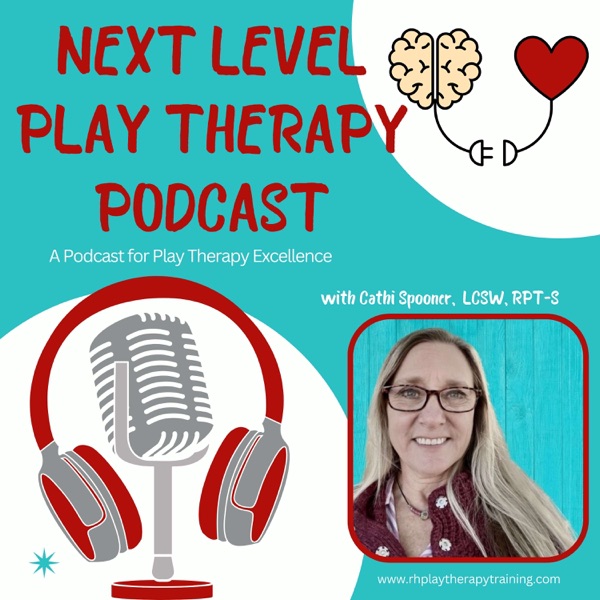
Next Level Play Therapy: A Podcast for Play Therapy Excellence
Join me on Next Level Play Therapy, a podcast for child and adolescent therapists seeking to elevate your play therapy services. Hosted by Cathi Spooner, LCSW, RPT-S, at Renewing Hearts Play Therapy Training.
Each episode delves into the nuances of play therapy, exploring innovative techniques, evidence-based practices, and practical strategies for providing exceptional therapeutic experiences. These engaging discussions cover a wide range of topics, including building rapport with children, how to make sure you get great outcomes for clients, therapeutic toys and tools and strategies to use in sessions, addressing trauma and attachment issues, engaging parents, promoting emotional regulation, and nurturing resilience for children and their families.
Whether you're an experienced therapist looking to refine your skills or a novice clinician venturing into the world of play therapy, the Next Level Play Therapy podcast equips you with the knowledge and insights to enhance your play therapy practice. With interviews featuring experts in play therapy, exploration of best practices, discussion of game-changing principles and strategies, this podcast equips you with the tools to unlock the amazing power of play therapy to transform the lives of children, adolescents, and families.
Tune in to Next Level Play Therapy and take a journey towards becoming an exceptional play therapist as we navigate the next level strategies that lead to profound healing and growth for children and their families.
- How To chart
- #168
- Episodes
- 144
- Releases
- Weekly
- Typical length
- 42 min
- On air since
- 2024
- Latest episode
- 6 days ago
Episodes
144 episodes, newest first
-
41 min
Second-guessing? / STOP
Episode 144
Show notes
Do you feel like a fraud as a play therapist?
Imposter syndrome in play therapy is one of the most common struggles for new play therapists and child therapists, and it's usually a lie your brain is telling you.
If you're overwhelmed, second-guessing every play therapy session, and worried your clients are suffering because you're not good enough, you're not alone.
Every play therapist I've trained has felt this way.
In this free podcast episode, you'll learn how to recognize imposter syndrome and build real confidence using play therapy, so you can make a difference for the kids and families you serve.
In this podcast you'll learn:
✅ What imposter syndrome in play therapy is, and why it's rooted in perfectionism
✅ Signs you're struggling, including avoiding or over-accommodating parents
✅ 4 tips to overcome imposter syndrome and stop second-guessing yourself
✅ Why learning a play therapy model builds confidence with clients and parents
Join my free Facebook Community Play and Expressive Arts Therapy Playground.
Check out my free resources for mental health professionals working with children, adolescents, and families who want to integrate play therapy and expressive arts into their clinical work.
I work with individuals and agencies to develop successful strategies and meet the treatment needs of your child and adolescent clients and their families using play therapy & expressive arts.
Contact me to schedule a free 30-minute video call if you're ready to level up your skills
-
47 min
Play Therapy Not Working? 4 Ways to Get Unstuck
Episode 143
Show notes
Is play therapy working for your client, or are you stuck in the "I don't know if this is helping" loop?
In this free weekly podcast episode for play therapists and child and adolescent therapists, you'll learn 4 practical ways to tell if play therapy is working and what to do when nothing seems to help.
You've tried the play therapy activity books, searched Pinterest for play therapy ideas, and used what you learned at your last play therapy training.
Your supervisor was supportive, but they don't practice play therapy. If you're worried you're failing your client, this podcast is for you.
In this episode you'll learn:
✅ How to revisit your case conceptualization and ground yourself in your play therapy model
✅ Why safety and therapeutic rapport come before insight, and how to check your expectations
✅ How to get useful feedback from parents, caregivers, and the child
✅ Why play therapy consultation helps you see what's happening in the playroom
For play therapists and child and adolescent therapists at any stage of their play therapy journey. Join my free webinar, How to Provide Play Therapy Without Second-Guessing Yourself, Even With Complex Cases.
We'll focus on building the confidence to trust your clinical decisions, even when a case gets complicated.
📅 Sunday, October 25, 2026 at 4:00 pm PT / 7:00 pm ET
🔗 Save your free spot here → https://www.rhplaytherapytraining.com/f/pta-webinarJoin my free Facebook Community Play and Expressive Arts Therapy Playground.
Check out my free resources for mental health professionals working with children, adolescents, and families who want to integrate play therapy and expressive arts into their clinical work.
I work with individuals and agencies to develop successful strategies and meet the treatment needs of your child and adolescent clients and their families using play therapy & expressive arts.
Contact me to schedule a free 30-minute video call if you're ready to level up your skills
-
49 min
Family Play Therapy: 3 Signs a Parent Is Ready (and 3 Signs They're Not)
Episode 142
Show notes
In family play therapy, the caregiver's readiness matters as much as the child's. Because the parent-child relationship is the vehicle for healing, a parent has to be emotionally and mentally prepared to enter their child's world without taking it over.
In this free weekly podcast, we break down how to assess parent readiness for family play therapy sessions, so you can decide when to bring a caregiver into the playroom and when more preparation is needed first.
You'll learn:
✔ 3 signs a parent IS ready for joint family play therapy: following the child's lead without correcting, showing curiosity about the child's inner world, and staying regulated during moments of distress
✔ 3 signs a parent is NOT ready yet: demanding quick fixes and immediate compliance, using the session to lecture or interrogate the child, and being too consumed by their own unresolved stress or trauma
✔ What to do when a parent isn't ready, including how parent consultation sessions and individual therapy referrals can build the caregiver's capacity to show up
✔ How to keep the door open to family play therapy without pushing caregivers before they can succeed.
Who this is for: Play therapists, child therapists, adolescent therapists, and mental health professionals who work with children and families and want more confidence in caregiver assessment, parent consultation, and family play therapy.
Key takeaway: A parent who isn't ready yet doesn't mean family play therapy is off the table. It usually means the work starts with the caregiver, so the family play therapy sessions are set up for real connection and healing.
Want to go deeper? If you're ready to build your skills in play therapy and learn how to involve caregivers in the healing process, explore Play Therapy Academy: https://www.rhplaytherapytraining.com/play-therapy-academy
Listen to the podcast, bring your questions and your toughest caregiver scenarios, and let us know in the comments: what signs do you look for when deciding if a parent is ready?
👍 Like, subscribe, and turn on notifications so you never miss an episode.
Join my free Facebook Community Play and Expressive Arts Therapy Playground.
Check out my free resources for mental health professionals working with children, adolescents, and families who want to integrate play therapy and expressive arts into their clinical work.
I work with individuals and agencies to develop successful strategies and meet the treatment needs of your child and adolescent clients and their families using play therapy & expressive arts.
Contact me to schedule a free 30-minute video call if you're ready to level up your skills
-
42 min
Family Play Therapy: Why Treating Just the Child Limits Outcomes
Episode 141
Show notes
If you're a play therapist or child therapist meeting with kids weekly while updating parents on the side — this episode is for you.
Individual play therapy is powerful. But when the family system stays the same, even the best playroom work has a ceiling.
In this free weekly podcast, we're exploring one of the most important clinical questions in play therapy: when does individual work hit its limits — and what changes when you bring the family into the room?
We cover:
• Where individual-only play therapy runs out of room
When the family system stays unchanged, progress in the playroom has a ceiling — no matter how skilled you are.
• What changes when the family is in the room
Observe relational patterns firsthand, coach attachment-focused parenting strategies in real time, and create change where the problem actually lives — in the parent-child relationship.
• When family play therapy isn't the right fit
Family play therapy isn't always the right next step. We'll walk through the clinical situations where family play therapy sessions may not serve the child.
• Why a strategic family play therapy framework matters
Inviting parents into the playroom isn't enough. A structured framework is what turns "everyone's in the room" into lasting change in outcomes.
Listen to the podcast and share with a colleague!
This episode connects directly to this month's Consultation Call theme: bringing caregivers into the room. Come with your questions and cases.
Join my free Facebook Community Play and Expressive Arts Therapy Playground.
Check out my free resources for mental health professionals working with children, adolescents, and families who want to integrate play therapy and expressive arts into their clinical work.
I work with individuals and agencies to develop successful strategies and meet the treatment needs of your child and adolescent clients and their families using play therapy & expressive arts.
Contact me to schedule a free 30-minute video call if you're ready to level up your skills
-
45 min
Congruence & Co-Regulation in Play Therapy
Episode 140
Show notes
Congruence & Co-Regulation in Play Therapy: How Nervous System Attunement Heals Kids
What does it really mean to use "therapeutic use of self" in the playroom? In this podcast episode, we go beyond the buzzwords to explore how congruence and co-regulation actually help children build their own capacity for emotion regulation.
This is part three in our series on the nervous system in play therapy — and why oversimplifying this concept can get in the way of the deep, lasting healing our clients need.
In this podcast episode, we cover:
🔹 Congruence in the Playroom — What it really means to match your internal experience with what you express, and why "performing" calm or warmth isn't the same as being a regulated, authentic presence
🔹 The Coregulation Connection — How your nervous system state becomes the mechanism through which children learn their own emotions are safe, workable, and useful
🔹 Self-Awareness for Therapists — Why you have to be congruent with yourself before you can be congruent with a child, and how "resonance circuits" let your nervous system attune to theirs
🔹 Supporting Parents & Caregivers — Creating safety for caregivers so they see you as a true partner in their child's healing, and recognizing what activates your own insecurity or imposter syndrome in session
🔹 Therapist Self-Care — The "put your own oxygen mask on first" principle, and why your own therapy and a supportive play therapy community aren't optional extras — they're part of doing this work well
Ray, D. C., Jayne, K. M., & Stulmaker, H. L. (2014). A way of being in the playroom: Experience-expression congruence model (EECM). International Journal of Play Therapy, 23(1), 18–30.
Johnston, T. E., Gross, J. J., Chen, W., McEvoy, P., Becerra, R., & Preece, D. A. (2025). Emotion beliefs and emotion regulation strategy use. Personality and Individual Differences, 240, 113066.
#PlayTherapy #TherapistSelfCare #NervousSystemRegulation #Coregulation #ChildTherapy #EmotionRegulation #TherapeuticUseOfSelf #TraumaInformedCare #PlayTherapist #ChildDevelopment
Join my free Facebook Community Play and Expressive Arts Therapy Playground.
Check out my free resources for mental health professionals working with children, adolescents, and families who want to integrate play therapy and expressive arts into their clinical work.
I work with individuals and agencies to develop successful strategies and meet the treatment needs of your child and adolescent clients and their families using play therapy & expressive arts.
Contact me to schedule a free 30-minute video call if you're ready to level up your skills
-
42 min
Window of Tolerance in Play Therapy: Why Kids "Bail" on Deep Play
Episode 139
Show notes
You're 20 minutes into a play therapy session. The child is in it — deep in the sandtray, the story, the metaphor. And then, without warning, they bail. Silliness. A different toy. A total tonal 180.
If you've ever second-guessed yourself in that moment — wondered if you lost the thread, if they're avoiding, if the work "didn't land" — this episode is for you.
That shift isn't resistance. It isn't disengagement. It's regulation happening in real time.
A child's nervous system was never built to sustain 45 straight minutes in emotional intensity — and clinicians who miss this often misread the most important therapeutic moment in the room.
In this week's podcast for play therapists and child therapists, we're unpacking:
✅ Why the exit out of deep affect is a nervous-system-driven event, not a client "resisting the work"
✅ How to distinguish regulation-seeking behavior from true avoidance or disengagement in session
✅ What this means for pacing, containment, and how you structure session flow around a child's window of tolerance
✅ How to track these shifts clinically — and use them as data, not disruptionThis is a working conversation for play therapists who want to sharpen their read on nervous system cues in the playroom and stop treating natural regulatory rhythm as a problem to manage.
This is also one small piece of what we go deeper on inside Play Therapy Elevation CIRCLE — my community for play therapists who want ongoing case consultation, clinical skill-building, and support that goes beyond a single play therapy training.
More on that soon — for now, come learn, bring your questions, and let's dig into the work together.
Join my free Facebook Community Play and Expressive Arts Therapy Playground.
Check out my free resources for mental health professionals working with children, adolescents, and families who want to integrate play therapy and expressive arts into their clinical work.
I work with individuals and agencies to develop successful strategies and meet the treatment needs of your child and adolescent clients and their families using play therapy & expressive arts.
Contact me to schedule a free 30-minute video call if you're ready to level up your skills
-
47 min
Explosive Emotions in Kids: A Brain-Based Approach for Play Therapists
Episode 138
Show notes
Free Podcast Training for Play Therapists: How the Brain Constructs "Explosive" Emotions in Kids
Join Renewing Hearts Play Therapy Training with Cathi Spooner, LCSW, RPT-S podcast as we go beyond simple redirection strategies to explore how the brain actually constructs emotional experiences in dysregulated children and why it matters for play therapists.
If you're a child and adolescent therapist working with kids who have "explosive" emotions — the "angry tornado" in your playroom, or desperate parents asking "what do I do when this happens at home?" —
This weekly podcast episode gives you a fresh clinical lens for nervous system regulation, grounded in the Theory of Constructed Emotions and Attachment Theory.
In this episode, we cover:
🧠 Developmental Expectations — Why a child's developing neural circuitry matters for self-regulation (and why "just calm down" doesn't work).
🌪️ Constructed Emotions — How the brain uses interoception and environment to construct emotions that predict what needs to happen next.
🔗 Attachment as Bio-Regulation — Exploring attachment as a bioregulatory system, and the brain as a "prediction machine."
🎭 Play Therapy Application — Why emotion vocabulary is the key to building true resiliency, and how to use play therapy with intention.
👨👩👧 Caregiver Co-Regulation — How to teach parents to model regulated states so kids can borrow their calm.
💬 Drop a comment: what's the hardest "explosive" moment you've navigated in the playroom or with a caregiver?
References mentioned:
• Dr. Pascal Vrticka (Substack article #36): The Bioenergetic Map of Social Connection
• Hoemann, Xu, & Feldman Barrett (2019): Emotion Words, Emotion Concepts, and Emotional Development in ChildrenAttachment Insights #36 (https://pvrticka.com/attachment-insights/#36), and the full version on Substack is available here: https://pvrticka.substack.com/p/the-bioenergetic-map-of-social-connection.
Website: https://pvrticka.substack.com/p/attachment-and-caregiving-as-social-allostatic-inference)
#PlayTherapy #ChildTherapist #NervousSystemRegulation #AttachmentTheory #EmotionRegulation
Join my free Facebook Community Play and Expressive Arts Therapy Playground.
Check out my free resources for mental health professionals working with children, adolescents, and families who want to integrate play therapy and expressive arts into their clinical work.
I work with individuals and agencies to develop successful strategies and meet the treatment needs of your child and adolescent clients and their families using play therapy & expressive arts.
Contact me to schedule a free 30-minute video call if you're ready to level up your skills
-
44 min
Stop Guessing: 3 Keys to Decode Behavior in Play Therapy
Episode 137
Show notes
What do you do when your 6-year-old client is kicking things in the lobby or a 7-year-old starts using cursing in a family session?
If you've ever felt like your play therapy questions are falling flat or a client’s behavior is spiraling out of control, you aren't alone.
After 30+ years as a child and adolescent psychotherapist, I’ve learned that these moments aren’t failures—they are data.
In this podcast, I break down a 3-step framework to help you decode dysregulated behavior using neuroscience and attachment theory so you can move past the "acting out" and access deep healing.
What you’ll learn in this episode:
• Behavior as Communication: Why children don't actually want to be "bad" and how to shift your mindset from "what are they doing?" to "what is activating this response?"
• The Role of Neuroscience: How predictive processing, beliefs, and emotions influence a child's nervous system and your treatment decisions.
• Mastering Co-Regulation: How to use your own regulated state to help a distressed child feel seen, safe, and organized.
• Your Roadmap to Success: How your play therapy model (including Integrative Play Therapy) guides your decision-making in the playroom.About Cathi Spooner: I help play therapists and mental health professionals integrate neuroscience and attachment into their practice so they can work with more confidence and help their clients achieve lasting change.
Join my free Facebook Community Play and Expressive Arts Therapy Playground.
Check out my free resources for mental health professionals working with children, adolescents, and families who want to integrate play therapy and expressive arts into their clinical work.
I work with individuals and agencies to develop successful strategies and meet the treatment needs of your child and adolescent clients and their families using play therapy & expressive arts.
Contact me to schedule a free 30-minute video call if you're ready to level up your skills
-
36 min
Stop Processing Your Hardest Play Therapy Sessions Alone
Episode 136
Show notes
Have you ever finished a challenging play therapy session, watched the child walk out the door, and then just sat there — processing everything alone with no one who truly understands what happened in that room?
If that feels familiar, this free weekly podcast episode is for you.
Most play therapists think of community — a membership, a consultation group, a peer network — as emotional support that’s optional. A nice-to-have. A place to vent. More of a luxury than a necessity
But in this episode, play therapy trainer and educator Cathi Spooner, LCSW, RPT-S, makes the case that community is far more than that.
Community is a clinical tool that ensures your clients get the best support possible for healing because you get the clinical support you need.
And play therapists who practice without it aren't just lonelier — they're making harder clinical decisions, experiencing more burnout, and serving their clients at a fraction of their potential.
This is the episode that connects everything — and introduces Play Therapy Elevation CIRCLE, now open for enrollment through August 29, 2026 at 11:59 PM.
In this episode, you'll discover:
🎯 Why community is a clinical tool — not an emotional luxury — and the specific clinical outcomes that change when play therapists practice in connection instead of isolation
🎯 What happens to your clinical thinking, decision-making, and confidence when you have play therapists around you who speak your language and understand your cases
🎯 A full inside look at Play Therapy Elevation CIRCLE (PTEC) — including monthly group consultation calls, the monthly book club, weekly play therapy tips, and the community itself
🎯 The real cost of the "I'll wait" mindset — and why the growth starts the moment you're in community of like-minded play therapists, not before
This episode is for you if:
→ You're the only play therapist in your agency — or you're in private practice navigating complex cases alone
→ You process your hardest cases in silence with no one who truly understands play therapy
→ You've been thinking about joining a play therapy community but keep putting it off
→ You want to know exactly what's inside Play Therapy Elevation CIRCLE before enrolling
→ You're a child/adolescent therapist, registered play therapist, or play therapist-in-training working with children, teens, and families
Play Therapy Elevation CIRCLE (PTEC)
The ongoing community for play therapists who are done going it alone.M<
Inside PTEC, you get:
✔️ Monthly group consultation calls — bring your real cases and get real clinical support
✔️ A monthly book club — clinically relevant reading to keep your thinking fresh and sharp
✔️ Weekly play therapy tips — practical, immediately applicable tools for the playroom
✔️ A private community of play therapists who speak your language
Join my free Facebook Community Play and Expressive Arts Therapy Playground.
Check out my free resources for mental health professionals working with children, adolescents, and families who want to integrate play therapy and expressive arts into their clinical work.
I work with individuals and agencies to develop successful strategies and meet the treatment needs of your child and adolescent clients and their families using play therapy & expressive arts.
Contact me to schedule a free 30-minute video call if you're ready to level up your skills
-
38 min
Stop Guessing: 3 Indicators Play Therapy is Working
Episode 135
Show notes
Tired of feeling like you’re just "playing" without a clear way to track progress in play therapy?
As play therapists, we often hear the same question from parents: "How is my child actually doing?"
And maybe you’re struggling to answer that question yourself, let alone explain it to parents.
If you find yourself unsure how to tell if your clients are progressing in play therapy or if play therapy is working, this free weekly podcast episode is for you.
In this episode, we’re diving into why measuring progress in play therapy feels so difficult without a solid clinical framework.
We’ll discuss how to track progress in the playroom and determine if you’re on the right course helping clients heal.
What we’ll cover:
• The Framework Gap: Why most play therapists watch for the wrong indicators (and what to do about it).
• Stage-Specific Progress: How "success" looks different in the early, middle, and late stages of healing.
• The 3 Essential Categories of Progress:• Therapeutic Relationship: Identifying shifts from guardedness to vulnerability.
• Play Themes & Content: Recognizing when chaotic play transforms into mastery and resolution.
• Regulation & Agency: Spotting the growth in self-regulation and emotional tolerance.Stop second-guessing your clinical decisions and start reporting to parents with confidence. Learn how to name exactly what is happening in the playroom and why it matters for the child’s healing journey.
Let’s connect in the comments: What do YOU currently look for as indicators that play therapy is working?
Drop your thoughts below!
#PlayTherapy #ChildTherapy #PlayTherapyFramework #MentalHealthProfessionals #TherapistTraining #ClinicalProgress
Join my free Facebook Community Play and Expressive Arts Therapy Playground.
Check out my free resources for mental health professionals working with children, adolescents, and families who want to integrate play therapy and expressive arts into their clinical work.
I work with individuals and agencies to develop successful strategies and meet the treatment needs of your child and adolescent clients and their families using play therapy & expressive arts.
Contact me to schedule a free 30-minute video call if you're ready to level up your skills
-
34 min
How to Stop Dreading Your Complex Play Therapy Cases
Episode 134
Show notes
Are you dreading that "challenging" case on your schedule?
The client who wreaks your room or doesn’t talk during their play therapy session? Or the parent session with a parent that seems to avoid you yet calls you frequently between sessions telling you everything that’s not working?
As play therapists, we often define a challenging case by the severity of the trauma, the intensity of the behaviors, or the complexity of the family system.
But what if the "challenge" isn't the case itself, but how you make sense of the problem and the clinical framework you're using to navigate it?
In this week’s free podcast episode, we are redefining what it means to work with complex cases.
We’ll explore why one play therapist feels overwhelmed while another feels manageable with the exact same client—and how a clear play therapy clinical framework makes all the difference.
In this podcast, we cover:
• Redefining "Challenging": Why complexity doesn’t have to mean chaos.
• The Power of Getting to the Root of the Problem: Moving beyond the psychosocial assessment form to create a "living map" for every play therapy session.
• Trusted Framework vs. White-Knuckling: How to stop guessing and start making intentional clinical decisions.
• Seeing REAL Progress: Learn to identify the stages of healing so you know exactly why you’re choosing specific interventions—whether directive or non-directive.When you can identify why something is happening AND you have a framework guiding your clinical decisions, challenging cases stop being something you dread and start being something you can engage with intentionally.
Don’t let your caseload lead to burnout. It’s time to move from "hoping it works" to knowing why it’s working.
Join the Conversation: When you hit a wall with a challenging play therapy case, what is the very first thing you do? Do you seek consultation, dive into research, or take a moment to pray? Let’s be honest in the comments—we’re all in this together!
🔗 CONNECT WITH RENEWING HEARTS PLAY THERAPY TRAINING:
🌐 Website: www.rhplaytherapytraining.com
Register for the free webinar - How to Provide Play Therapy Without Second-Guessing Every Clinical Decision, Even With Complex Cases: https://www.rhplaytherapytraining.com/f/ptec-webinar
Join my free Facebook Community Play and Expressive Arts Therapy Playground.
Check out my free resources for mental health professionals working with children, adolescents, and families who want to integrate play therapy and expressive arts into their clinical work.
I work with individuals and agencies to develop successful strategies and meet the treatment needs of your child and adolescent clients and their families using play therapy & expressive arts.
Contact me to schedule a free 30-minute video call if you're ready to level up your skills
-
47 min
5 Ways Community Improves Play Therapy Results, Especially When Clients Wreck Your Playroom
Episode 133
Show notes
Stop clinical isolation and help your play therapy clients progress faster. What does that mean?
A classic example of working in isolation and figuring things out on your own is figuring out what do you do when your client “wrecks” your playroom?
Do you set limits? Do you let them wreck your playroom week after week after week? Do you refer them to someone else?
Are you a play therapist or RPT feeling the weight of clinical isolation? This episode is for you!
When we work alone, a "stuck case" can stay stuck for weeks. But when you have a community, that same case becomes a collective problem to solve.
In this week's podcast episode, we’re moving beyond the struggle to show you what becomes possible for your clients—and your career—when you stop doing this work in isolation.
5 Ways Community Accelerates Client Progress:
• Unlock Stuck Cases Faster: Peer perspective can shift in minutes what might take you weeks to figure out alone.
• Regulation & Presence: Having a "backup plan" reduces your clinical anxiety, allowing you to be more present and therapeutic for the child.
• A Collective Toolkit: Multiply your interventions by tapping into the diverse training and experience of a professional circle.
• Confident Parent Work: Communicate with clarity and keep parents engaged in the therapeutic process.
• Clinical Self-Trust: Build the confidence to act on your instincts without the drain of constant second-guessing.Ready to Elevate Your Practice?
If you’re tired of the "lonely island" of private practice or being the only kid therapist in the building, join the waitlist for the Play Therapy Elevation CIRCLE.
Get the clinical support and fresh ideas you need to thrive: 👉 https://www.rhplaytherapytraining.com/f/ptec-waitlist
💬 COMMUNITY QUESTION: Which of these 5 areas is the missing piece in your practice right now? Let’s talk in the comments! 👇
#PlayTherapy #RegisteredPlayTherapist #ChildTherapy #ClinicalSupport #PlayTherapyInterventions #RPT
Join my free Facebook Community Play and Expressive Arts Therapy Playground.
Check out my free resources for mental health professionals working with children, adolescents, and families who want to integrate play therapy and expressive arts into their clinical work.
I work with individuals and agencies to develop successful strategies and meet the treatment needs of your child and adolescent clients and their families using play therapy & expressive arts.
Contact me to schedule a free 30-minute video call if you're ready to level up your skills
-
42 min
The Dangerous Lie Every Isolated Play Therapist Believes
Episode 132
Show notes
Do you ever feel like the only play therapist who hasn’t figured it out? You’re not alone—and that thought might be exactly what’s keeping you stuck.
In this week’s podcast episode, we’re exposing the "dangerous lie" of play therapy isolation.
When you're the only kid therapist in your building, it's easy to look at social media "wins" and conclude that everyone else has it together while you're struggling.
I’m here to tell you: that feeling isn’t a "you" problem; it’s a structural problem.
In this episode, we cover:
• The Isolated Play Therapist Belief: Why your brain concludes you’re failing when you don’t have a clinical reference point.
• Challenging Mistaken Beliefs: Why self-doubt and "late-night Googling" are actually nearly universal experiences for play therapists working in isolation.
• The Power of Community: How connecting with other play therapists (like in Play Therapy Elevation CIRCLE) provides immediate relief and clinical clarity.
• The Critical Mindset Shift: Moving from "I must be broken" to "I just need better support structure."Stop white-knuckling your way through hard play therapy cases. Your clients need the supported, confident version of you. Let's talk about how to find her.
GET ON THE WAITLIST: Ready to step out of isolation? Join the waitlist for the Play Therapy Elevation CIRCLE, my online membership designed to ensure you never have to do this work alone: 🔗 https://www.rhplaytherapytraining.com/f/ptec-waitlist
JOIN THE CONVERSATION: Have you ever had a moment where you connected with another play therapist and felt that instant relief of "oh thank goodness, it's not just me"? Drop it in the comments below! 👇
Join my free Facebook Community Play and Expressive Arts Therapy Playground.
Check out my free resources for mental health professionals working with children, adolescents, and families who want to integrate play therapy and expressive arts into their clinical work.
I work with individuals and agencies to develop successful strategies and meet the treatment needs of your child and adolescent clients and their families using play therapy & expressive arts.
Contact me to schedule a free 30-minute video call if you're ready to level up your skills
-
40 min
The #1 Mistake Play Therapists Make on Parent Calls
Episode 131
Show notes
Getting frantic phone calls from parents about meltdowns, outbursts, and behavior problems is a stressful reality for play therapists.
When a parent says, “My doctor (or therapist) said play therapy isn’t working,” it’s easy to feel the weight of responsibility to fix everything immediately.
In this week’s podcast episode, Cathi Spooner of Renewing Hearts Training teaches you how to handle these "dreaded" calls with confidence, even when you don't have all the answers yet.
You’ll learn how to shift from being an "answer-giver" to a "container-holder," building trust and maintaining clinical authority.
In this podcast, we cover:
• Step 1: Regulate First – Why one intentional breath changes your nervous system and the entire tone of the call.
• Step 2: Validate Before You Explain – The #1 mistake therapists make when parents say therapy isn’t working.
• Step 3: Honest Uncertainty – How to name what you know (and what you don’t) to actually strengthen a parent's confidence in you.Stop navigating these challenging clinical moments alone.
Learn how to transform stressful phone calls into opportunities for deeper clinical connection.
Ready to stop feeling isolated and alone as a play therapist and get access to feedback and support?
If you want to move from knowing these steps to executing them with a community of play therapists backing you up, check out the Play Therapy Elevation CIRCLE. Something exciting is coming soon—don’t miss out!
Join the waitlist for Play Therapy Elevation CIRCLE and be the first to know when enrollment opens: https://www.rhplaytherapytraining.com/f/ptec-waitlist
Connect with Cathi: www.rhplaytherapytraining.com
#PlayTherapy #ChildTherapy #ParentConsultation #TherapistTips #MentalHealthProfessionals #CathiSpooner #RenewingHeartsTraining
Join my free Facebook Community Play and Expressive Arts Therapy Playground.
Check out my free resources for mental health professionals working with children, adolescents, and families who want to integrate play therapy and expressive arts into their clinical work.
I work with individuals and agencies to develop successful strategies and meet the treatment needs of your child and adolescent clients and their families using play therapy & expressive arts.
Contact me to schedule a free 30-minute video call if you're ready to level up your skills
-
40 min
More Years of Experience Won't Fix What's Actually Making You Doubt Yourself as a Play Therapist
Episode 130
Show notes
I want to talk about something that a lot of play therapists are silently betting their entire career on — the idea that *more time and more experience* is what's going to eventually make them feel confident and capable in the play therapy room.
That one day they'll hit some magic number of years and the self-doubt will just... disappear.
The second-guessing will stop.
The anxiety before parent calls will go away.
They'll finally feel like they know what they're doing.
And I want to lovingly, respectfully push back on that — because I think that belief is keeping a lot of really talented play therapists stuck for longer than they need to be.
During this week’s podcast episode, I want to talk about what we silently say in our minds and don’t dare talk about it for fear of judgment and rejection.
This week I want to talk about what are the beliefs and behaviors feeding the self-doubt, imposter syndrome, and second-guessing clinical decisions keeping amazing play therapists from achieving confidence.
If you’ve secretly thought experience is the only reason you’re lacking confidence as a play therapist, then you don’t want to miss this episode.
Join my free Facebook Community Play and Expressive Arts Therapy Playground.
Check out my free resources for mental health professionals working with children, adolescents, and families who want to integrate play therapy and expressive arts into their clinical work.
I work with individuals and agencies to develop successful strategies and meet the treatment needs of your child and adolescent clients and their families using play therapy & expressive arts.
Contact me to schedule a free 30-minute video call if you're ready to level up your skills
-
41 min
5 Signs You’re a Play Therapist Struggling with Clinical Isolation
Episode 129
Show notes
Do you find yourself replaying play therapy sessions on your drive home, wondering if you made the right clinical decision? You aren't alone.
In this free weekly podcast episode, we’re diving into the 5 signs you’re second-guessing yourself as a play therapist and why clinical isolation might be your biggest hurdle.
Being the only play therapist in your building can be incredibly lonely.
When you don't have a peer group who speaks the language of sand trays and metaphors, it’s easy for "reflective thinking" to turn into an "anxious loop."
Today, we walk through the clinical signs of self-doubt and how to shift from isolation to confidence.
What You’ll Learn:
• Sign 1: The difference between healthy reflection and the "anxious loop."
• Sign 2: Why you dread parent phone calls (it’s not why you think!).
• Sign 3: Why Google isn't a substitute for a play therapy community.
• Sign 4: Addressing the "Am I actually helping?" doubt.
• Sign 5: The "Blank Phone List" – identifying your clinical support system.
• How to move from isolation to clinical confidence.Join the Podcast (or watch the replay)
If you’re tired of carrying the full clinical burden alone, it’s time to find your people.
✨ Join the Play Therapy Elevation CIRCLE Waitlist here: https://www.rhplaytherapytraining.com/f/ptec-waitlist
Connect with Cathi Spooner - Renewing Hearts Training: http://www.rhplaytherapytraining.com/
#PlayTherapy #ChildTherapy #TherapistSelfCare #ClinicalSupervision #MentalHealthProfessionals
Join my free Facebook Community Play and Expressive Arts Therapy Playground.
Check out my free resources for mental health professionals working with children, adolescents, and families who want to integrate play therapy and expressive arts into their clinical work.
I work with individuals and agencies to develop successful strategies and meet the treatment needs of your child and adolescent clients and their families using play therapy & expressive arts.
Contact me to schedule a free 30-minute video call if you're ready to level up your skills
-
40 min
Why Play Therapists Shouldn't Work Alone: Overcoming Clinical Isolation
Episode 128
Show notes
Are you the only play therapist in your agency? Or perhaps you're in private practice and feel like you're navigating complex cases entirely on your own?
Many play therapists accept isolation as "just the reality" of the field.
We push through, hoping that with enough time and experience, we’ll eventually "figure it out."
But here is the honest truth: Clinical isolation is a liability—for you and your clients.
In this free weekly podcast, we’re breaking down why the "solo endeavor" mindset is holding you back and how connecting with a play therapy community is the key to better clinical results and reduced burnout.
In this episode, we discuss:
• The Structure of Isolation: Why graduate programs and agencies often leave play therapists without the specific support they need.
• The Clinical Cost: How second-guessing your decisions and processing complex issues, like trauma, in a vacuum slows down client progress.
• The Mindset Shift: Moving from "I can handle this" to "I need a community that speaks play therapy."
• Clinical Confidence: How having a "backup plan" and a peer network improves the quality of your work in the playroom.Stop second-guessing your clinical decisions and start building the support network you deserve. Your clients (and your personal life) will thank you.
Connect with Cathi & Renewing Hearts Training: www.rhplaytherapytraining.com
#PlayTherapy #ChildTherapy #PlayTherapistSupport #ClinicalIsolation #TherapistBurnout #RenewingHeartsTraining
Join my free Facebook Community Play and Expressive Arts Therapy Playground.
Check out my free resources for mental health professionals working with children, adolescents, and families who want to integrate play therapy and expressive arts into their clinical work.
I work with individuals and agencies to develop successful strategies and meet the treatment needs of your child and adolescent clients and their families using play therapy & expressive arts.
Contact me to schedule a free 30-minute video call if you're ready to level up your skills
-
39 min
The Isolated Play Therapist Syndrome: Why You’re Feeling Burned Out
Episode 127
Show notes
If you're a play therapist — especially in your first few years — and you're the only one in your agency or you're in private practice figuring this out by yourself, this is for you.
You went into this work because you genuinely believe in the power of play therapy to heal kids. You're passionate about this.
You're not here because it was easy — you're here because it matters to you
And the reality is that you’re probably the only “kid therapist” in your agency or maybe you’re in private practice in an office surrounded by adult therapists asking you to keep the noise down in your office because it’s distracting their sessions.
In today’s free podcast episode we’re talking about what’s not being talked about out loud 👇
the cost of trying to be a play therapist without a strong community to support you and the impact this has on your clinical decision-making (and if we’re being honest - your own emotional well-being).
We’re discussing The Isolated Play Therapist Syndrome.
What it is and why it’s keeping your clients from making progress and leaving you feeling overwhelmed, second-guessing your clinical decisions, and wondering if you’re good enough.
If you’re feeling isolated, overwhelmed, and frustrated as a play therapist, then you don’t want to miss this episode.
Join my free Facebook Community Play and Expressive Arts Therapy Playground.
Check out my free resources for mental health professionals working with children, adolescents, and families who want to integrate play therapy and expressive arts into their clinical work.
I work with individuals and agencies to develop successful strategies and meet the treatment needs of your child and adolescent clients and their families using play therapy & expressive arts.
Contact me to schedule a free 30-minute video call if you're ready to level up your skills
-
41 min
Jungian Play Therapy 101: Symbols, Archetypes & Clinical Ideas
Episode 126
Show notes
What is Jungian Analytic Play Therapy, and how does it actually work in the playroom?
In this podcast, we dive deep into the symbolic world of Jungian theory with guest Jared Andes, LCSW, RPT-S.
We explore how Jungian Analytical Play Therapy uses archetypes and other concepts to facilitate healing, and we compare this model to other popular play therapy approaches.
Join us for an insightful conversation as we explore the transformative power of Jungian Play Therapy!
Whether you are a seasoned practitioner or new to this model, this episode will provide you with practical ideas.
In this free weekly podcast episode, we’ll cover:
• What is Jungian Play Therapy? An introduction to the core concepts.
• Practical Ideas for the Playroom: Symbolic play and therapeutic techniques you can use.
• Comparative Analysis: How Jungian Play Therapy differs from—and where it aligns with—other popular models.
• Live Q&A: Get your questions answered by Jared!Connect with Jared Andes:
Website: http://www.fullspectrumcounseling.org/
Facebook: https://www.facebook.com/profile.php?id=61584175263892
Instagram: https://www.instagram.com/jared_andes_therapy
Join my free Facebook Community Play and Expressive Arts Therapy Playground.
Check out my free resources for mental health professionals working with children, adolescents, and families who want to integrate play therapy and expressive arts into their clinical work.
I work with individuals and agencies to develop successful strategies and meet the treatment needs of your child and adolescent clients and their families using play therapy & expressive arts.
Contact me to schedule a free 30-minute video call if you're ready to level up your skills
-
39 min
The Trauma Roadmap: Using Neuroscience & Attachment in Play Therapy
Episode 125
Show notes
Are you tired of leaving your play therapy sessions wondering if you’re actually helping or just "playing"?
You’ve invested in the play therapy training, you’ve gathered the strategies, and you have a playroom full of tools.
But if you’re like many play therapists, having more information has only led to more confusion.
When you’re in the middle of a play therapy session with a traumatized child or teen, it’s easy to second-guess your decisions and feel overwhelmed by which direction to take.
The secret isn’t another weekend workshop or a new set of play therapy activities—it’s having a reliable Play Therapy Roadmap.
In this week’s podcast, we’re discussing how to move from clinical overwhelm to grounded confidence.
We’ll explore why a trauma-informed play therapy model acts as your professional GPS, guiding your decision-making through every stage of the healing process.
We’ll be diving into:
• The Play Therapy GPS: Why a play therapy model is essential for knowing exactly where you are (and where you’re going) in treatment.
• The Neuroscience & Attachment Lens: How grounding your work in these two pillars simplifies your clinical choices.
• Healing the "Second-Guessing": How to tell if your interventions are truly helping your traumatized clients heal.
• The Power of Community: Why the "secret ingredient" to clinical success is never practicing in isolation.Stop wondering if you’re doing enough and start using a play therapy framework that provides clarity for you and better outcomes for your clients.
Don't forget to subscribe and follow for more weekly insights on mastering trauma-informed play therapy!
#PlayTherapy #Neuroscience #AttachmentTheory #TraumaInformed #CathiSpooner #ClinicalSupervision #PlayTherapistLife #MentalHealthProfessionals
Join my free Facebook Community Play and Expressive Arts Therapy Playground.
Check out my free resources for mental health professionals working with children, adolescents, and families who want to integrate play therapy and expressive arts into their clinical work.
I work with individuals and agencies to develop successful strategies and meet the treatment needs of your child and adolescent clients and their families using play therapy & expressive arts.
Contact me to schedule a free 30-minute video call if you're ready to level up your skills
How To lists
More How To shows picked out from the charts










More in How To
Placed highest on Apple Podcasts' How To chart right now