Podcast
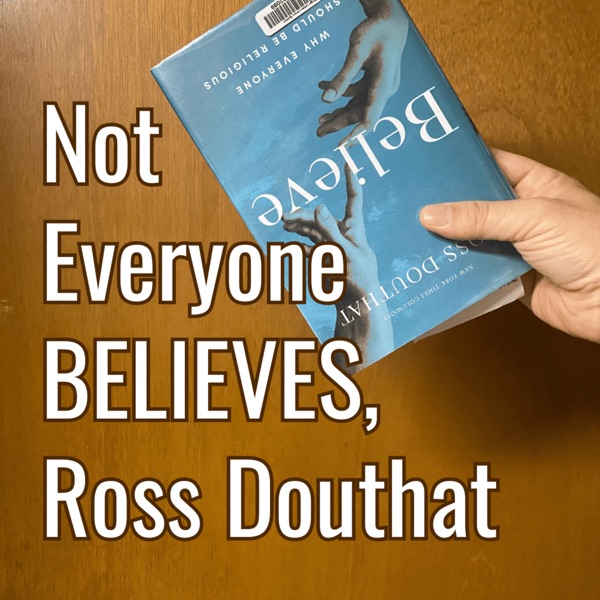
Not Everyone Believes Ross Douthat
Ross Douthat wrote a book called Believe - Why Everyone Should Be Religious. This podcast reviews that book, page by page, to seek whether the arguments Ross Douthat makes for Christianity hold up to skeptical scrutiny. Can a Christian apologist withstand the critical review of a reader who doesn’t begin with the author’s Christian bias?
- Episodes
- 29
- Releases
- Daily
- Typical length
- 20 min
- On air since
- 2026
- Latest episode
- 16 hours ago
Episodes
29 episodes, newest first
-
16 min
Following Magical Omens Is Not Rational, Ross Douthat
Season 1, Episode 29
Show notes
Ross Douthat promised to build a rational argument in favor of religion, but in chapter 5 of his book he is telling readers that whenever they get a momentary feeling about a religion, it’s a magical omen coming straight from the creator of the entire universe, a supernatural message crafted specifically for them.
Welcome back for another episode of Not Everyone Believes Ross Douthat. This is a podcast that reads through a book that has the title Believe: Why Everyone Should Be Religious.
Imagine that, living in a world where nobody makes the decision to step away from religion and look at it from the outside. It seems like we would be missing something in that scenario. That's definitely the case with this book.
The author is Ross Douthat. He is an ideologically extremist right wing Christian nationalist pundit on 60 Minutes, a TV show that used to be regarded as a serious journalistic endeavor, but has been taken over by Donald Trump and his supporters on the threat of losing the FCC licensure and a whole bunch of other punishments from the federal government.
The United States federal government under Donald Trump as president, and Donald Trump personally, were threatening to persecute and prosecute CBS, because they didn't like what 60 Minutes had to say about Donald Trump through accurate reporting. They didn't like what 60 Minutes had to say about certain political truths, so they hounded CBS. They threatened the television network until CBS gave in, surrendered, and allowed a right wing ideologue, Barry Weiss, to come in and to appoint Ross Douthat as a member of the new team at 60 Minutes, which would be friendly to Donald Trump. It was a sad day when that happened.
What we're dealing with right now, though, is this book, Believe which Ross Douthat had published in 2025 to coincide with the inauguration of Donald Trump's second term as president, as a Christian Nationalist, and telling everyone that they should just go along with it and believe in this religious ideology of extremism.
We're now on page 146, and on that page, we have Ross Douthat, telling us once again that when you're choosing a religion, you shouldn't choose a smaller religion. As he says, “You don't have to pull every text off the shelves of a bookstore of all religions. The big books will do for a start.”
Ross Douthat never gets beyond that start. He argues that the bigger an idea is, the more popular it is, the more likely it is to be true. According to him, that's a sign that Christianity is true, because it's the most popular religion ever. Yeah, the most popular is necessarily true.
What we're going to see moving forward in this chapter is that Ross Douthat is always referring to major religions. Major religions are of a certain variety because they are associated with social power. Major religions are tools of social control. They are, therefore, elitist kinds of ideological tools. They are not from the outside. Christianity in our society is in control of the U.S. Federal government, and has the support of 60% of the population. If you are looking for an elite in the United States of America, look for a Christian.
Certainly, if you want to be in Donald Trump's cabinet, that's what you've got to be. Donald Trump's cabinet is supporting Christianity directly, even though we're supposed to have a First Amendment, under which we're not supposed to have the government promoting religion in general or any religion specifically. Nonetheless, Christianity has got the full endorsement of the U.S. Federal government and kids are being coerced, families are being coerced to join back into Christian churches.
That's the context of why we're reading through this book. It's not just out of idle intellectual curiosity or a persnicketiness about the truth. It's because Christianity right now is the dominant ideology of power.
Christianity is not just a bunch of ideas. It is a propaganda machine. It is a tool to get people to obey, to conform, to join in and do what seems to be popular.
Today we're going to go on to page 147, where Ross Douthat is making a claim here that seems kind of wild to me.
He's saying that when it comes to choosing a religion, you just ought to let things leap out at you, to kind of strike you as ideas, and if they do, that's a sign from God.
Once again, Ross Douthat is rejecting rationality. He's rejecting logic. His argument in this paragraph at the top of page 147 is that if an idea or a religious sect or a religious leader grabs your attention, then it's probably a supernatural magical message from God.
Here's the text as he wrote it:
“If you've never experienced belief before, if you feel yourself to have a completely open mind and suddenly a specific text or figure leaps out at you, a story speaks to you like nothing else, then you should take the possibility that God is speaking to you very seriously. At the very least, it's a strong signal that this is where you're supposed to start.”
This whole idea that your life has something that is supposed to happen, and that when happens, it's because it's part of a plan, that you're living within a story that was written by a magical creature, is running throughout Ross Douthat's book. It's an idea that has absolutely no evidence to back it up.
This is classic wish fulfillment. It isn't rationality. It's a kind of irrationality. It's a kind of delusion.
Ross Douthat is supporting this idea in order to say that if you're religious, you should just follow wherever your attention happens to lead, and if you happen to hear a message that's Christian, for example, well then that's a signal from God that you're supposed to be a Christian. Of course, in the United States where the majority of the population, 60%, not a big majority, a shrinking majority, but it's still a majority of the population is Christian, and Christian churches are everywhere, and Christian churches are allowed to go without paying any taxes, and Christian is the ideology that is in charge of our fascist government, guess what message you're going to hear: Christianity.
Ross Douthat knows you're going to hear this message, and he's telling you that whenever you hear about Christianity, it's an omen. It's an omen. It's a message from God, from the universe speaking just to you. It’s been arranged by the ruler of the universe for you to hear that radio show, to pick up that book, to see that billboard that promotes Christianity. It wasn't an accident. There was magic involved getting your brain to pay attention to that.
In this claim, Ross Douthat is going back way, way back before the development of logic, before the development of reason and rationality. Before the development of science. He's going way back to this magical thinking where whatever happens is supposed to happen, so you should just kind of let things happen to you and presume that they're good, that everything is a good idea whenever you hear a message.
Just believe. This is the message that is underneath this book, the idea that you should just be gullible. You should just believe, believe, believe, whenever you hear a message. Believe, when you hear that message from authority, especially.
You should just believe. Don't think. Don't doubt. Don't have skeptical inquiry. Don't examine ideas. Just go along with it.
This is the ideology of fascism, of religious totalitarianism, which, of course, Ross Douthat is a servant of. That why he's at 60 Minutes.
That, Ross Douthat, is why not everyone believes.
I'm not going to pretend that there are no people in the United States of America who are willing to go along with Ross Douthat's proposal that you should just be gullible and just believe whatever people in power tell you, just go along with a dominant ideology and don't think about it too hard, don't worry your little head about anything. No, in fact, we know that quite a large number of Americans are willing to go along with that sort of thing.
Still, not everyone believes. Not everyone believes. Half of the American population, when they're willing to work at it, when they're willing to think real hard, they understand that you can't just take the the word of your political leaders, of religious organizations, of religious ideologies for granted.
You can't just go along with whatever the priest tells you to do, because you know that the priests have often told you to just give them all your money. Give away all control over your own personal life. Maybe they've told you to do rather unscrupulous sexual things, or maybe they've told you to go on and abuse others in the name of their God.
Throughout chapter five, Ross Douthat is of making a real scatter brained argument about what kind of religion you should have. He's pretending to be open-minded, even though we know that at the end he's going to be arguing that you actually should go with Christianity and everything else is wrong.
We know that his Roman Catholic religion in particular teaches that Roman Catholics are right and everyone else is wrong, and you should not belong to any other religion, and that's it, period. Catholics teach that they’re right, they have the Truth.
In this chapter, where Ross Douthat is saying, well, if you like this idea, you should just go along with, maybe try out this religious path, or if you like another idea, well, if you like that, then you should try another religious path, and maybe you should just try a whole bunch of different things, and, you know, commit to something that feels right to you, sort of, you know, as in this paragraph, if a book or a TV show happens to pop up, well, then you should take that sign from God that that's what you should do. It's really kind of loosey-goosey. It's not consistent with the standard he promotes in the rest of the book.
Ross Douthat can't keep an idea straight in his head. He claims that there is an absolute Truth, a master designer, the supernatural, magical being or fantastical. He claims that this designer of the universe has set things up, everything up so that you will find the one true religion, and now he's saying, you should just follow your nose. Do whatever.
The choices Ross Douthat is making in the language as he writes this book are not loose and free and accidental. In chapter 5, you will find that Ross Douthat is referring consistently to any idea of a transcendent reality or a divinity or any kind of religious path in any sense as “God”. He's using that name for it, and I want you to keep in mind that that is a Christian name for the Christian divinity, for the Christian magical supernatural creature that is supposed to have created and controlled the universe.
“God” is not a neutral term. Again and again, even in this chapter where Ross Douthat is pretending to consider that there might be possibilities other than Christianity for some religious people, Douthat is making the Christian god the default the natural destination for all religious paths.
Ross Douthat chose the title for this book, Believe: Why Everyone Should Be Religious. What he really means is that everyone should be Christian. Ross Douthat is trying to tell everyone to conform not just to religion in general, but to his particular religion.
In a time when that religion is very closely linked to brutal, violent, anti-democratic fascism, we all should be suspicious of that command to conform. That's why not everyone believes Ross Douthat.
-
15 min
The Flawed Logic In Ross Douthat's Arguments for Christianity
Season 1, Episode 28
Show notes
We are on page 140 out of just a little bit over 200 pages in Ross Douthat’s book, Believe: Why Everyone Should Be Religious. It's a small book.
Ross Douthat couldn't really summon much in the way of ideas for this book, which is surprising, because Christianity, which is what this book is really arguing for, has a history of a couple thousand years. This is the best that Ross Douthat could come up with?
Anyway, we are on page 140 of his book. This podcast, Not Everyone Believes, Ross Douthat, covers a detailed examination of Douthat’s arguments in favor of religion broadly, and Christianity specifically.
On this page, Ross Douthat is warning against the dangers of nature, and against the world, and how how awful nature is, and how you must not belong to a religion that worships nature, because nature is bad, bad, bad. Ross Douthat seems to thinks that nature is demonic.
Ross Douthat’s own words on this are as follows:
“The peril of polytheism is linked to the source of its appeal by positing supernatural forces that are linked to the natural world rather than fully outside or above it, delivers a kind of intimacy, but also an inherent danger, because one thing that's clear about physical nature is that it's extremely perilous, filled with predators and traps, things that will kill you, without thinking twice in places to get near permanently lost, which is why the darkest forms of polytheism can get very dark indeed, treating the book of nature as a moral template, and worshiping gods of strength and cruelty, as in Aztec, human sacrifice and bloody Viking conquest. If you go looking for the face of God entirely in imminent forms and secondary powers, there's always a danger that you'll end up worshiping a demon.”
This, of course, is what Ross Douthat’s religion teaches him. It teaches him that every potential spirit or god that does not belong to Christianity, that is not the Christian God itself, all of those are just demons that are dangerous and evil and wicked and bad.
Ross Douthat conveniently forgets who invented those demons, and for that matter, who invented the natural world, full of peril and bad things that will kill you, and do mean things to you, in which you can get lost. That would be God, the Christian God. Christians believe that their god made all these supposedly terrible things.
Now, of course, that's not true. There is no God, certainly not as proposed in Christianity.
There is no evidence that any supernatural being created this world. There is no evidence that demons exist, but Ross Douthat believes in the literal reality of demons. He has made it clear already that if you deviate from the true path of religion, you will be set upon by demons. Demons will appear, and they will control you and do wicked, terrible things to you.
Of course, according to his own religion, those demons were created by the Christian God. Ross Douthat forgets that part.
Here's the other thing that Ross Douthat doesn't deal with in this paragraph that I just read to you. He has described the physical nature of the universe as extremely perilous. However, earlier in this book, Douthat wrote that it's remarkable how the universe seems to be attuned to life, and claimed that's evidence that God must exist, that there must be a designer who made it that way.
Once again, we see that Ross Douthatis not capable of holding any thought in his mind consistently for very long at all. That makes him incapable of maintaining a rational argument that lasts for very long.
One thing I haven't done in this podcast is to identify and explain the structure of what rational thought is, of what logic is and how it works. Pre-Christian philosophers developed these rules of logic and they really aren't very very difficult to understand.
Here is one basic principle of logic: You cannot say that something is both true and untrue. You cannot say that Proposition X is true and then say that Proposition X is not true. If you do that kind of thing, your argument is illogical. Irrational, not reasonable.
That’s a basic rule of logic. It’s a fundamental of reasoned thinking.
It's not very complex, but Ross Douthat, on page 140, is saying that the world, the physical world that we live in, is perilous and it's terrifying. It's awful, even though earlier, he said that the world is welcoming to life in remarkable ways.
So he's saying that Proposition X is both true and untrue, Proposition X being that the world is a lovely place, so wonderful, that only a divinely all-powerful and all good god could have made it. It must have been a designer.
Here's another basic rule of logic: Disproving one proposition, one idea does not mean that another idea is necessarily true.
In logic, they often give an idea the label of a letter, just so that you can keep it straight, so that you can see clearly the structures of an argument.
So here on page 140, we have a couple of different propositions. One is that the physical world and any spirits that might represent that world are dangerous.
We'll call that first claim Proposition A.
There is another proposition in this paragraph, which I'll call proposition Q. Proposition Q is that a spirit, a god that is outside of nature is not dangerous, is not perilous.
Those are 2 propositions, and in logic, just because you disprove proposition A, it doesn't mean that proposition Q is true. It just means proposition A is false.
Do you get that? That's basic logic. Ross Douthat doesn't understand that basic foundational rule in logic.
Think about it in terms of a grocery store. If proposition A = I'm going to buy a watermelon, and proposition Q =I'm going to buy macaroni and cheese, if you go into a grocery store with the object of buying just one piece of food, and you conclude through some process that you’re not buying proposition A, the watermelon, does that mean necessarily that you're going to buy the macaroni and cheese?
No, it doesn't. You could buy a chocolate bar. You could buy a can of soup. You could buy ice cream, et cetera, et cetera, et cetera, et cetera. There are a huge number of possibilities out there.
Also, it may well be that both the macaroni and cheese and the melon are wrong for you. It could be both of them are tainted with some kind of poison. Just because the watermelon is poisonous doesn't mean that the macaroni and cheese has not been tainted with poison also.
Do you understand that?
At the same time, we have this idea that just because (if we accept Ross Douthat's proposition) that any spirit and any religion that is rooted in nature is evil and demonic, that doesn't mean that a monotheistic religion with a supposedly transcendent god is not wicked and dangerous as well.
Both could be true.
You see, how logic and reason and rationality are just not part of Ross Douthat’s skill set here?
Of course, the most plausible proposition of them all is that really, none of these supernatural things exist, because Ross Douthat hasn't provided any solid evidence that any of these things are true at all.
So, we could have a transcendent god that belongs to a realm outside of the physical world as we know it, a realm that is perilous and dangerous and full of wickedness. The god that lives there could be the worst thing ever. In fact, if that god designed this world full of peril, you would expect the god to be cruel
Would you go into a grocery store where you found out that the lettuce is tainted with deadly bacteria and then go and buy the spinach that's been on the shelf right next to that lettuce? That would be risky. You might start to think the green grocer is just not reliable. Ross Douthat considers none of these things.
In this paragraph from chapter five, there's something really simple and basic, that he doesn't explore. Ross Douthat doesn't prove it. He doesn't provide any evidence that there is an inherent link between nature-based religions or polytheism, and dangerous kinds of religious practices or spirits.
He provides a couple of examples of things that he doesn't like: Pagan Vikings and Aztec human sacrifice. We know, however, that the same god of Christianity that Ross Douthat worships, demanded that his prophet Abraham conduct a human sacrifice, that Abraham climb a mountain with his son, and then tie his son up and slit his throat and burn his body as an offering to the God of the Bible.
Human sacrifice seems to have been a big part of it of the cult of God.
That same God, as a part of the religious worship of him, has demanded that people go out and slaughter children and babies, to commit genocide.
As a character, the Christian god is bad news And aren't we lucky that that Christian god appears not to be real? Oh yes, we are.
If you want to involve us in a church that worships a violent, vengeful kind of god that asks his followers to conduct human sacrifice of their own children, upon his own whim, well, that's why not everyone believes, Ross Douthat.
-
17 min
Truth Isn't Proven In An Ideological Deathmatch, Ross Douthat
Season 1, Episode 27
Show notes
We're getting to the part of the book now where Ross Douthat is repeating himself. It kind of looks like, the way that this book reads, Douthat really struggled to find a lot of things to say, to fill up a book.
In this new chapter, chapter five, called Big Faiths and Big Divisions, but so far Ross Douthat is just repeating what he’s already said in this chapter. I’ve reading through seven pages of this chapter to get to this point where we're going to be today. It's the same old idea that he's written about before: You should go along like a lemming with everybody else. You should believe in religion because that's what most people are doing. You should believe in a religion, specifically that the most people believe in, because large numbers of people are always right.
Oh, the wisdom of crowds. You know what happened with the wisdom of crowds this last week? There were these prediction markets where you can gamble on public events, such as the election of the leader of Brazil, and the prediction markets were all saying that Bolsonaro, the right wing Christian nationalist would.. Win the election, become the new leader of Brazil, and Silva, the more progressive, not quite so Christian nationalist, candidate would lose. Those prediction markets were profoundly wrong.
Stock market crashes are another example of this idea, where often crowds are wrong. Remember NFTs? Those were blockchain enabled graphics or other forms of media that had hidden within them these kind of crypto ledgers and nobody could ever really figure out what they were about, but there was a bunch of hype and so people just rushed in to buy them. Matt Damon was out there promoting them, saying, boy, you are going to miss the boat if you don't go along with this trend. Then, they all ended up being worth practically nothing, selling for fractions of a penny each, when they had been selling for thousands and even tens of thousands of dollars on the market before.
It was all a deception. There were people who owned a lot of these things and they were doing self trading to make it look like there was a demand for these things when there really wasn’t. A lot of people went along with it, and a lot of people were wrong.
George W. Bush’s rush to invade and occupy Iraq is another example of the stupidity of crowds. The majority of Americans believed Bush’s lies. They believed that Saddam Hussein had terrible weapons of mass destruction that made it necessary to for the USA to go to war. They were wrong. There were no Iraqi weapons of mass destruction. The crowds were not wise. The crowds were bloody idiots.
Ross Douthat seems to be overlooking the fact sometimes the majority of people are just plain wrong.
So, on page 131 of Ross Douthat’s book, he has been, for several pages, making this same argument all over again. It makes me feel like he's just trying to puff up the page count in this book so that it doesn't come off as what it really is, which is just a pamphlet without very many thoughts behind it.
On page 131, Ross Douthat has come up with a particular argument that I want to examine because it relates to Christian doctrine in particular.
The first paragraph reads:
“It’s a reasonable bet that the big, resilient, long enduring faith traditions, Christianity, and Islam, Hinduism, and Buddhism, are more likely to stand in a strong relationship, to the truth about existence, than religions that flared and died, that subsist in cultural isolation, or that came into existence the day before yesterday.”
Ross Douthat seems to think that he's being clever, trying to have a kind of survival-of-the-fittest argument, but not with biological species. It's with religions instead.
Actually, the more up to date versions of the models of biological evolution through natural selection can indicate to you is that some species, or even some ideas can, survive for a long while, and then they can go extinct, because conditions change. Conditions are not permanent.
There's not one eternal truth, one strength, that everything is trying to be closer to. Biological evolution is not the story of a bunch of life forms trying to become human, with humans obviously being the best and everything else out there being a failed version of humanity, in which a jellyfish doesn't do very well at being human, but monkeys do better.
You can have species that have very small numbers, but they're very well adapted to small, niche environments. On the other hand, you can have adaptations come along that would have been great in another situation, but because they came up in a situation that was badly suited for those adaptations the animals that carry those adaptations don't survive. The species goes extinct.
It’s not that the animal was bad. It's not that the animal is wrong. It just had a mutation in the wrong circumstances.
That’s where Ross Douthat just can't match the sophistication of the idea of biological evolution through natural selection. Ross Douthat is caught up in the childish idea that there is Truth and that everything is in the universe is just either true or false is either in accord with that Truth and with God, or it's not.
Douthat argues in this chapter that maybe you can have different distinctions of Truth according to that one absolute standard of God, but God is what Truth is, and everything is either more true or less true than the Truth that God defines, more or less true than Christianity.
That's not how adaptation through natural selection works, though, so this idea Ross Douthat has come up with of religions competing against each other in a competitive marketplace, with the survivors being closer to the truth, it really doesn't hold water.
For example, there could be a religion like, oh, I don't know, let's say Christianity. This religion has small numbers for a long time and is really struggling to gain adherents Then it's picked up opportunistically as a tool by the Roman Empire. The emperor decides to use this religion to gain power and to control people. Thus, Christianity gets the military power of the Roman Empire. The violence of the empire spreads that religion, not because it has truth merit, but because the Romans are slaughtering anybody who doesn't agree with that religion.
When soldiers go and kill all of the members of another religion, does that show that a religion is more true? According to Ross Douthat's argument, it does.
This idea of the wisdom of crowds doesn't even hold water within Christianity. In Christianity, starting in Judaism, but then going forward into Christianity, you have all of these stories about how people actually tend to make the wrong decision.
You can find this religious idea of the stupidity of large numbers of people in the idea that people are naturally sinners and naturally mistaken. They just keep on making the wrong decisions.
The Christian belief is that human intuition just can’t be trusted. There's thestory of what happened in the book of Genesis when God was a genocidal killer and he killed off all of the people because he made them, but then they all ended up doing the wrong thing. All of humanity was thoroughly wrong about pretty much everything, according to the Bible.
If we were to follow the logic of Ross Douthat, we would say that whatever all those people were doing, because most of them were doing, it must have been right. Whatever the most people do is closer to the truth.
This genocidal story from the book of Genesis, the story of God sending this flood to kill almost all people on Earth, clearly shows that this idea of Ross Douthat’s doesn’t work, even within Christian faith.
It's not just the book of Genesis, of course. We can also go to the story of Moses. Moses got those 10 commandments, right? God gave Moses a whole bunch of tablets with a bunch of laws that everyone was supposed to follow.
You know what happened next. The Jews who were wandering through the desert, trying to get back to their promised land, started worshiping other gods, the Golden Calf and that sort of thing.
This comes up all the time, over and over again in the Old Testament. Moses had to get angry and kill a bunch of his followers for believing the wrong thing, just to get the others back in line.
Once again we have the idea of killing people for not believing the same thing that you do. That's a trend in Christianity, isn't it?
That trend, of course, continues in the New Testament, in the Book of Revelation. I hate to break it to all of you Christians out there that think you're going to be raptured up, but the New Testament seems to say that only 144,000 Christians are the true believers. It's a relatively small number, and they're the only ones who are going to get saved from being tortured by God, killed by God, then raised from the dead to be tortured again by God.
So once again, you have this idea in Christianity, the Christian text itself in the New Testament, that the true faith is harbored by a small number of people, not by a large number of them.
Ross Douthat is trying to do something that makes him feel like he's being a little bit more liberal, which is to say, okay, okay, yes, there is one really True religion, and that's my religion. That's Roman Catholicism. Yes, that is the True, truest of True religions, but maybe there can be other ones that have little elements of truth, and maybe they're damning themselves to hell, and eternal destruction and torture and punishment for having something's wrong, but hey, the other religions are not completely wrong, so that's better than being an atheist, at least.
Once again, Ross Douthat is ignoring what Christian doctrine and the Bible actually says. When we go back to those commandments of Moses, one of the favorites that is included by Christians in what they like to call the Ten Commandments. Is this one: “Thou shall have no other god but me.” You shall not follow any other god but me. There's only one, and everything else is wrong, wrong, wrong, wrong, wrong, wrong.
So what's the lesson of chapter five so far from Ross Douthat’s book? It's that Ross Douthat can't even maintain the doctrines of his own religion, and those doctrines just don't match external reality.
That is why not everyone believes, Ross Douthat.
-
12 min
The Work Demons Do For Ross Douthat
Season 1, Episode 26
Show notes
Demons are no more real than the Christian god is. Nonetheless, Ross Douthat has summoned demons to do his dirty work.
Welcome back to Not Everyone Believes, Ross Douthat.
I said at the beginning of this podcast, in the first episode, that we were going to be going page by page, line by line, and okay, I'm not examining every word of Ross Douthat’s book, but boy, he just packs in a whole lot of nonsense very densely.
If you're just hearing this podcast for the 1st time, let you know what book it is that we're talking about. We're talking about a book by Ross Douthat, who is formerly from the New York Times, as an opinion writer. He's really just a professional pundit. He's now with 60 Minutes, which is controlled by Donald Trump and the Republican Party. Now 60 Minutes has become an ideological kind of rag on the television.
Ross Douthat is the author of the book Believe: Why Everyone Should Be Religious. We are now in the 4th chapter and we're at the bottom of the page, 119.
Today's episode is going to be brief because I'm just talking about one paragraph. This one paragraph shows how nonsensical. Ross Douthat’s whole perspective is and what it's really all about. It reads like this:
“For some, a small but meaningful minority, welcome is the straightforward answer, and if you're setting out to discover Satanism, then you probably aren't going to be talked into joining a more mainstream faith without some hard experience first, but other spiritually mind open-minded people experience a chronic uncertainty about how to handle negative encounters, and the mere appearance of the dark or negative or devilish, no less than the appearance of a ghost or monster in the horror movie isn't by itself enough to convince them, not to keep opening doors and looking into basements and wandering down corridors that might be better left unexplored.”
This paragraph at 1st appears just to be about monsters and demons, devils, dark things, negative things, going places, they're not supposed to go, thinking things are not supposed to think doing things that are against the rules of God.
We all know that monsters don't exist. Devils, demons, ghosts, they don't actually exist. There's no evidence for them.
If at this point, you don't get that. I really don't know what to do with you because there's no photographs, there's no, you know, genetic samples from them, no videos, and we have so much research equipment that's all around the world right now, that if there were ghosts and demons and monsters showing up, We would see them. We would see them. They're not there.
Why is Ross Douthat talking about these imaginary magical creatures? Yes, it is ridiculous and irrational for him to believe in these things. Nonetheless, they are doing work for him. Ross Douthat’s writing in this paragraph shows us what that work is.
First of all, when it comes to Satanism, Ross Douthat doesn't even bother to engage with what Satanism actually is. Satanists don't believe in gods. They don't believe in the literal reality of Satan. They believe in actually kind of a more atheist approach.
Satanists use Satan as a symbolic character to represent independent thinking and rebellion against tyranny, against authoritarianism that is represented by the Christian God. The Christian god is a tyrant, an authoritarian. The Christian god set up a world that's full of death, that's full of misery and suffering.
Of course, no, God hasn't really done these things, because God doesn't exist. We're talking about God as a character.
God is a symbol of kingship. That's why Christians love calling their god the “King of Kings, the Lord of Lords”. The Christian god is a monarch. It’s an authoritarian tyrant that Christians are worshiping.
Ross Douthat says that you need to worry about demons because they're negative. Negative sounds so, you know, bad. It sounds so wrong.
But hey, wait a minute. You know what negative really is? Negative is the right to say no. Negative is the right to set boundaries that other people are not allowed to cross, when it comes to your own life.
Being negative enables you to say no, you're not allowed to touch me in that way., no, you're not allowed to take my things, no, you're not allowed to come into my house in the middle of the night and bother me, no, you don’t have the right to tell me who to love and how to live my life.
The thing with Christians like Ross Douthat Is that they're terrified by other people saying no to them. They are terrified by other people rejecting the beliefs that they believe everyone must have, as Ross Douthat said earlier in this book when he talked about the obligation of religious belief.
Ross Douthat believes that obeying the kingship of his god, the cosmic dictator, is the only way that you can save yourself from being tortured by that same god. That's what the Book of Revelation is all about. That kind of punishment after death was not there in Judaism. That's something that was invented by the followers of Jesus. Christianity invented the threat of Hell and divine torture. They invented a sacred cult of pain as a manifestation of their worship of tyranny, of the power of one monarch.
Christianity is the worship of monotheism. Monotheism is mythological monarchy, mythological dictatorship, authoritarianism with magical beings.
With that, along come those devilish characters. What do the devils and the demons represent? In Christian cosmology, they represent angels who said no to God.
They said, no, we don't like what you're doing, and we're going to make our own choices. To punish them God, tried to kill them all, and tortured them and imprisoned them. We're supposed to be afraid of the demons, but all this while, God is still threatening us with torture if we don't obey.
Again, remember this isn't really happening. There are no gods. There are no demons, there are no devils. So, what is the actual project?
The actual project is an ideological system that supports totalitarian dictatorships that supports tyrannical kings, queens, monarchs, the idea that power should be concentrated in the hand of one person.
The role of everybody else is not to question is simply to obey. Look at what is happening in the United States of America right now. It’s a Christian restoration of ugly, ruthless authoritarianism.
It's not for nothing that Ross Douthat fails to even try to engage with the idea of Satanism as it actually is, as a metaphorical kind of social movement.
Satanists don't believe that Satan is real or gods are real. What they believe in is the value of independent thinkers.
All that Ross Douthat says about Satanism is this:
“If you're setting out to discover Satanism, then you probably aren't going to be talked into joining a more mainstream faith.”
It’s telling that Ross Douthat only supports mainstream faith. Conformity is what his Christianity is all about. It's all about getting everybody to do the same thing, the thing that human priests and human dictators want you to do, what they tell you to do. Conform. Obey.
He's simply deciding that Satanists aren't going to be convinced.
Well, has he even tried to reason with Satanists? Has he even tried to actually talk with them?
Ross Douthat doesn't want to construct any rational arguments against Satanism because in order to do that, he would have to publicly acknowledge what Satanism really is, not what the Catholic Church says, it is.
If Ross Douthat were to do that, he would have to acknowledge that Satanists are rebelling against tyranny, that they're standing up for freedom, the freedom of people to think as they want to, to act as they want to, without cruelty. They're standing against the concentration of power in the hands of a few.
Ross Douthat doesn't even engage in a rational discussion with that idea. Once again, he's betraying the promise that he made at the beginning of the book.
Ross Douthat is not being an honest writer. He is not being an honest thinker. He's simply using scare tactics.
He's comparing independent thinkers, skeptics, atheists, and nonconformists to monsters. He is saying that they are actually in league with real monsters that literally exist.
Ross Douthat is doing that in order to scare you, to intimidate you, so that you stop thinking for yourself. It's a really cheap trick.
That's why not everyone believes, Ross Douthat
-
23 min
Why Not Believe God Is Bad And Demons Are Good, Ross Douthat?
Season 1, Episode 25
Show notes
Ross Douthat writes about why you ought to belong to not just a religion, but to a church. Religious belief in itself really isn't the goal for Ross Douthat. Belief is part of what he'd like you to do, but really what's much more important is that he wants you to belong to a religious organization. Organized religion, he says, has benefits. We’ll get to one of those.
On page 118, Ross Douthat is trying to do away with an objection to what he's talking about. He is dismissing one of the most frequent criticisms of organized religion.
Even for those people who believe in magic and the supernatural and gods, spirits, you know, fairies, stuff like that. They will point out that organized religion is pretty vapid. It's pretty empty. It's filled with a lot of people who really can't be trusted, um, who who don't do what they preach, all of that morality that Ross Douthat was talking about. A lot of people in organized religion end up doing a lot of immoral stuff.
On page 118, Ross Douthat is arguing against that. He is acknowledging, “Certainly, in a society where professed faith is a default, and almost everyone is participating in a religious tradition, there is a grave temptation toward hypocrisy, fake piety, the kinds of empty spiritual practice that the world's great religions warn against, almost as often as they warn against active impiety, or unbelief, and there are certainly communities in our own society where this socially conditioned pretense of religion still exists, but in most regions of contemporary culture, and certainly for most people hesitating on the threshold of religion, the dangers of hypocrisy and fake piety are relatively distant ones, while the dangers inherent in spiritual individualism are more immediate and pressing. If your reason for avoiding institutional religion is the fear of the Inquisition or the Salem witch trials or even just the stifling atmosphere of some pre Vatican II Catholic parishes or Protestant small towns, you are letting a danger that's increasingly remote push you away from the things that are necessary to mitigating today's perils, today’s problems, isolation rather than Pharisaism, narcissism, rather than authoritarianism, a world that leaves you alone in despair, rather than a society that's always nosing in your business.”
Ross Douthat is saying that if you're worried about religious authoritarianism, well, that's just a distant concern. That's not a big deal.
What you need to worry about is people doing what they want and just being individuals. That's the real threat.
I’ve got to ask you something: If you take a look at what's happening in the United States of America, do you really think freedom and individualism is wrecking this country?
We're about to have an election, a midterm election. Donald Trump is not on the ballot because it's not a presidential election year, but it is a de facto kind of test of his popularity, because a whole bunch of Republican members of Congress who have been giving Donald Trump pretty much everything that he wants, letting him do whatever he wants, not holding him to account.
They're up for election now, and in republican majority districts as well as democratic majority of districts, those Republican candidates are profoundly unpopular. This is one of the most stark anti-Republican voting moods in the electorate in a long time. In about a week and a half, I guess about a week, it's happening soon. We're going to see exactly how far that rejection of Donald Trump is going.
I just did early voting today, and if you live in a Democratic majority area where you can trust the Board of Election not to do shenanigans on behalf of Donald Trump, I encourage you to do early voting. Get it out of the way, make sure that it's not difficult for you to do voting. That's what early voting was set up to do to empower people, to empower democracy and the freedoms that it protects, which is why Donald Trump hates it so much.
Donald Trump also hates Donald Trump hates when people reject Christianity. He is so into Christianity and he talks about it all the time. You know Donald Trump was raised in a Christian church.
A lot of people say that Donald Trump has never set foot in a Christian church in his life. That's not true. The church that he went to when he was a young lad, and the one where he got his religious confirmation, there are photographs of him in that church.
You know what that church did? It forbade, it outlawed, it banned African-American couples from being members of the church. That church taught hatred. That church taught Donald Trump that religion and discrimination and oppression go hand in hand and you should use religion as a tool of oppression, of discrimination, of inflicting suffering on your enemies. That's the kind of Christianity that Donald Trump was raised on, and that's exactly what he's doing today.
We have a Christian Nationalist government that is taking food away from hungry people, not just here in the United States, but around the world. We have a country that is waging war, is encouraging war, that is threatening Greenland, is threatening Canada. We're bombing schools.
We're driving prices up. Donald Trump recently said, well, the oil companies are making a great profit on the oil, so what if the American people have to pay a little bit extra? That is the voice of Christian Nationalism.
Donald Trump is the same guy who's saying, yes, we're a Christian nation now.
He said that If I'm elected, you're going to have Christian visibility, this is going to be about showing what Christian Americans are really all about. Trump had the support of the majority of Christian voters in America, and you know what, he still does.
There's a Pew Research poll that shows that only one third of Christian Americans are planning to vote against Donald Trump's Christian nationalist fascist agenda.
We have people being shot dead in the streets by secret police. We have electronic surveillance all across the country being set up under a Christian nationalist authoritarian regime. We have concentration camps in which people are dying, in which people are being disappeared, children being separated from their parents. People are being shipped off to countries they've never been to, where people speak languages that they don't know, where there are yet more concentration camps.
This is being done in the name of Jesus, in the name of God, and yet, Ross Douthat is saying that there's not any big risk of any kind of religious hypocrisy, no religious danger. No religious authoritarianism. It's not a risk. He's saying it's just not happening.
Take a look at what's happening with digital fascism, the way that you're being watched all the time, not just with those flock surveillance cameras, but through your phone, through your activities on the web, through everything that you buy, every kind of electronic communication that you have. It's being swept up by the government and by corporations.
This is all being done to create a religious authoritarian state. At the same time, Ross Douthat is saying here on page 118 of his book, Believe, that the real risk is that you're free to be an individual who makes your own decisions about what you believe and what you don't. That, to me, is absolutely shocking.
There's something that Ross Douthat said at the end of this, that what the real danger is, what today's perils are really all about. Over on the next page, we have a new section of this 4th chapter. This new section is called Not Every Door Should Be Opened.
What is it about? You know what it's about?
It's about demons.
Yeah, we have Donald Trump wrecking, threatening to take away your right even to vote in the United States, absolutely ruining American democracy and replacing it with a corrupt kind of authoritarianism that is defined by Christianity.
Now Ross Douthat says that's not the big deal. What you need to worry about, says Ross Douthat, is demons.
I'm going to read to you a little bit of what Ross Douthat has to say about the demonic threat in his own words.
“Institutions offer spiritual protections that aren't available on your own. If the supernatural is potentially real, it is also potentially dangerous with more substantial stakes than most interactions in the natural and the everyday. Part of the point of the evolved technology of organized religion is to provide safety and security to travelers in this landscape to connect a secret to cosmic powers that are friendly to the human race, to help discern the difference between experiences worth pursuing and roads best left untaken, and to provide direct protection against the forces and experiences that seem destructive and demonic. ‘Don't mess around with demons’ might seem like too basic a message to require the structure of an entire religion to convey and reinforce, but in fact, what happens in horror movies, the people who go into that room or open that book or hold that seance, with predictably disastrous consequences, also happens in real life.”
Ross Douthat is saying not to worry about the technologies of Christian Nationalist authoritarian fascism to spy on your life, to send out fake messages and propaganda, to manipulate you, to control you. Don't worry about the way that Bitcoin is being used for public officials like the President of the United States to take massive bribes, so that only rich people get what they need and everyone else has to do without.
You know what that's about. The rising prices don’t come from nowhere. Inflation comes from Christian nationalist fascism and the political corruption that undergirds that and undermines our democracy.
No, no, Ross Douthat is saying, don't worry about that, because what's important is that the Catholic Church has technologies, religious technologies, to protect you from demons. Do you know what religious technologies he's talking about? He's talking about exorcisms and sprinkling holy water on you.
Ross Douthat is saying, you need to belong to a church so that you can have guys in funny costumes mutter Latin phrases that are magic somehow, and sprinkle holy water on you, to protect you from demons, because demons and evil spirits are what you need to be worried about.
Ross Douthat is saying that all the scary monsters in horror movies are real, but fascism is not real.
Ross Douthat is saying also that if you are a Christian, but you don't belong to a church, and the right church, the kind that practices exorcisms, like the Catholic church, well then, you don't get any protection.
When he's talking about friendly cosmic powers, Ross Douthat said that the role of Christian churches is to introduce you to, “cosmic powers that are friendly to the human race.”
Who is he talking about? Who are the cosmic powers that are friendly to the human race? Is he talking about the Christian character that they call God, Jehovah, Yahweh? Is that the guy who is friendly to the human race?
Do I have to remind you what the Christian Bible says that God did to people in the past? Of course, there's the Book of Job, in which God thought it would be fun, just to prove a point, to torture a man for years and years and kill his family and make him absolutely miserable. That was fun for God.
Earlier, God encouraged genocide of entire cities of people just because they didn't worship him. God didn’t just provoke nasty battles in which a lot of soldiers got killed. God encouraged his followers to go and kill babies.
Are you pro-life? How can a person say they're pro-life and be pro-Bible? I wonder about that.
In the book of Genesis, where God decided, even though he made people, he didn't like them very much. God decided, “I’m going to kill them. I'm going to kill them all. I'm going to keep just one family together, and they're going to interbreed with each other and commit acts of incest to repopulate the earth, but I'm going to kill, kill, kill, kill. I'm going to drown everybody.”
This is the character that is supposed to be a “cosmic power that's friendly to the human race.”
Then we go to the New Testament. It’s not accurate to say that the Old Testament was brutal, but Jesus was all about bringing peace and love and changed everything to make it nice. That's not how it ended up, because actually, in the Gospels, Jesus repeatedly threatens genocide against anyone who refuses to worship him. He says to entire cities of people that they’re going to wish that they had worshiped him and not turned him away and not refused to worship him as a god king, because Jesus is going to commit acts that are worse than what was done against Tyre and Sidon. Tyre and Sidon were two cities that were destroyed in genocides.
In these passages, Jesus is saying, effectively, I'm going to kill you. I'm going to kill you all if you don't worship me, and it's going to be worse than those genocides in Tyre and Sidon.
People say that Jesus told all these lovely parables. Do you know the parable that he told about the king who rightfully ordered people to be brought in front of him and to be executed? Jesus said, I'm gonna be like that king.
Elsewhere, in the gospels, Jesus said, don't think I've come here to bring peace. I have come to bring a sword and divide people. Jesus came with a sword, and he said that, if you don't hate your own children in order to love me better, you're not a follower of me. Jesus actually preached hate.
Then there is the Book of Revelation. The Christian churches included Revelation in the Bible because it threatened bloody annihilation to everyone who is not a Christian. That part of the Bible threatens massive death and destruction with the approval of God, so that God will kill almost everybody on earth. Jesus announces that he will kill people in really nasty ways, torturing them first, and then bring them back from the dead, and then torture them more, just because they're not Christian.
Ross Douthat says that Christian churches are there for introducing you to that guy, that killer? Why? Because you need protection from demons.
It says in the Book of Revelation that it's God who's bringing on the monsters. God is bringing on the monsters.
Ross Douthat is talking about demons. He's saying that these monsters are real, but there's no evidence that demons actually exist. There's no evidence that angels exist. There's no evidence that gods exist. No evidence. None. Not a single bit.
There's nothing more a bunch of stories that Christians like to tell about this supernatural stuff. They’re the same kind of stories that people used to tell about Medusa and the cyclops and minotaurs and centaurs and griffins. People used to love to tell those stories, and some people believed that they were true. We now know that they are not true. In the same way, demons are not real.
Let's speak from a perspective of reality for a second here. If God is such a nasty person who is constantly torturing and killing people, and blaming them for what he's done, never taking responsibility, making people suffer pain because of God's own mistakes, if that's real, and you think that that's real, why do you think that demons are the real problem?
Maybe demons aren’t the biggest you have to deal with.
I want Ross Douthat to address this point, because he said he's going to be reasonable. He promised to be logical and said he was going to be writing based on the facts that we can gather from our own senses.
What are the facts that prove that demons are dangerous and evil and to be avoided? What is the evidence?
I'll tell you. Ross Douthat provides zero evidence that demons are dangerous and evil.
We are at page 119 of his book, out of what is barely more than 200 pages. There are just 206 pages of content in Ross Douthat’s book. We're over halfway through, and Ross Douthat hasn't provided any evidence that any of these magical creatures even exist, much less identified any evidence for what kinds of personalities different magical creatures have.
Maybe demons are the good guys, because God's kind of a jerk. Do you want me to feel differently about that? Do you want me to ignore fascism so that you can protect me from magical creatures that you can't even provide evidence for? Why would any sane person go along with that?
Ross Douthat can't vouch for their character of demons being evil anymore than you can vouch for the character of his god and the angels being good.
Ross Douthat has provided us with nothing to go on here. Zero.
That is why Not Everyone Believes, Ross Douthat.
Not everyone believes.
-
15 min
Why Should I Let A Church Tell Me How To Live, Ross Douthat?
Season 1, Episode 24
Show notes
Why Should I Let A Church Tell Me How To Live, Ross Douthat? Clifford Cook
On page 117 of his book Believe, Ross Douthat suddenly announces that people should submit themselves to the moral commands of Christian churches. Why? Ross Douthat has provided no rational reason to think that religions have any moral authority. He just takes it for granted.
Even if we believe that gods exist, there is no reason in particular to believe that they are morally good. There certainly isn’t much reason to think that churches can be relied upon for moral leadership.
Not Everyone Believes, Ross Douthat.
We are now on page 116 and 117 of chapter 4 of the book Believe: Why Everyone Should Be Religious, by right wing Christian pundit Ross Douthat.
Here's where things get really unhealthy, in a social way.
The title of this section of the chapter is No Believer Is An Island, and it starts out nice, with the idea that if you become religious, you can have community. You can make friends.
The argument that he's making is all well and good, but you can make friends and have community in lots of different ways. You could join a club. You could go back to school. You could engage with the people at work, or what about the people in your neighborhood?
You don't have to have a religion in common to have community to make friends. You could try a new hobby. You could volunteer. There are so many ways to get involved in community without religion.
At the top page 117 is where this book really gets sketchy.
“The key argument for being part of a religious community, to whatever extent, in a fulsome form, if possible, but an attenuated form if that's all you can manage at the start, is that it makes you more likely to actively practice your religion, to take its dictates and admonitions seriously, to seek the will of Providence regularly, rather than intermittently, to live out the moral vision that the faith holds up.”
Whoah. The moral vision that the faith holds up, and dictates and admonitions, and the will of Providence?
This is all of a sudden, the will of Providence.
Ross Douthat said he was going to be reasonable about this. He said he was going to be rational and logical, but all of a sudden now he's talking about Providence, which is a Christian thing. Of course he's talking about Christianity. There's no real sense that he's talking about how you could become Bahai or Sufi or Buddhist. He's only talking about Christianity.
That's not what bothers me most about what he’s written on this page. He's saying you should join a community that's religious because you can make friends, and being with people is good… and also the morality and the dictates and admonitions that come from this invisible being that is magical and all powerful and all knowing, but nobody ever sees it.
Nobody ever sees this god, this Providence. It's like the Wizard of Oz, only it's not even behind the curtain. There's just nothing there.
Ross Douthat’s focus is about joining a community so that you can have a social network that then begins to give you admonitions and dictates, so that you take them seriously. It's telling you how to live, all of a sudden.
This is what's dangerous. It’s dangerous when you have people who need community, but then that community turns on you and tries to control your life.
This is not an unusual experience with religion. It is a common experience with religion.
If you happen to fit with that moral sensibility, well, I guess it works out for you, though it might not work out for your family, might not work out for your country.
What happens when we have a moralistic religion that tries to take control and forms very tight-knit social groups is that we have a lot of people who start to feel that Christianity isn't for them. They look at some of the moral decisions that go on and they feel queasy about it. They feel queasy about the judgment of outsiders, about the judgment of the way that people love and the way that people live and the things that they do. They look at the intertwining of that in religious communities with demands for money, and money, and more money, and more time, and more time, getting more and more involved, so that people are ending up giving their time and their money all the time. They have little life outside of the church.
Then they have moral qualms, and they want to leave, but now they've got to leave everyone that they know, everything that they have known, all of the investment that they've put in to that community. They lose it all. So, a lot of people will just stay.
A lot of people will just stay in the community of the church, even though they don't agree with it, because the social cost is just too high. That's a form of social control. It's a form of coercion.
We could talk about cults. People say, don't join a cult, because a cult will try to control you. A lot of Christian churches, not every one but a lot of them, will also try to control you.
People are told that there is absolute moral certainty that's given from an invisible being that you can't ever see, you can't ever talk to. And now, you have friends and family who are in the church, tight knit, and they're telling you you've got to stay there because there are also invisible evil spirits who will get you, if you leave.
It puts people in these really tight and twisted, unhealthy kinds of situations, and a lot of the time violence results.
Sometimes, your family just shuns you. Sometimes the people you thought were your friends, they just turn their backs on you when you want to leave religion. They make it really hard.
That puts to the test that claimed that this is a religion of love. When a person decides to leave a religion and your friends and family abandon you, turn their backs on you, that's not love. That's just mutual dependence.
It’s a trap. Even in this one sentence that I read to you, I’m going to read it to you again because I want you to listen for this thing.
Ross Douthat starts out saying, hey, you just start out doing whatever version you want, you know, and then where do we end up?
“The key argument for being part of a religious community, to whatever extent, in a fulsome form, if possible, but an attenuated form, if that's all you can manage at the start, is that it makes you more likely to actively practice your religion to take its dictates and admonitions seriously to seek the will of divine Providence regularly, rather than intermittently, to live out the moral vision that the faith holds up.”
In this one sentence from the beginning, you go from being like, hey, whatever you can manage to living out your entire life, according to the morality of this religion, to taking its dictates and admonitions. Ross Douthat just can't stop himself from doing that.
He tries over and over again to be appealing, to be accepting, to try to have an open door and just say, look, we're not gonna try to control you. You do whatever you want, and then by the very end of that same sentence, they've taken over your entire life.
At this point, I'm beginning to think that the title of this book is not honest: Believe, Why Everyone Should Be Religious. I think what Ross Douthat actually wants you to do is not to believe. He just wants you to be religious. He wants you to be part of a religious community. I think what Ross Douthat really wants is for Christian religion to have social control.
Halfway down the page, he’s talking about how religion is like soccer. If you read about soccer and you watch soccer on TV, you're not really into it. You have to join the team and you have to play consistently.
There we go again. You have to play consistently. You can't just join the team and be as involved as you want. You have to become a part of it. You have to go to soccer practice early in the morning and again at night and live and breathe soccer. You have to let it take over your whole life, but in a moral sense, not just in a physical exercise sense.
If you just read about soccer, he says, well, I don't believe that you really have shown an effort. So, if you don't get divine revelation and you don't see God, you don't see any miracles, well, that's just because you're not trying hard enough. You have to join all the way, even if you don't believe. This is what he's been saying over several pages now. Even if you don't believe, even you're like those Catholics, just be part of the church, just go to church all the time. Give the church your money. Go to every mass that you can. Just be involved, show the effort.
That's all he wants is for you to be under the church’s social control, and if you don't see any of the supernatural stuff that he promises you will see if only you hand over your entire life and let them tell you what kind of person to be and how to live, well, then it's your fault if the magical spirits don't show up because obviously you haven't been giving the effort.
There is no way you can win with this religion. I would not step anywhere close to that church. They want to control your life, and they don't care what you actually think just so long as you're there, obeying their commands and giving them your money.
That is why not everyone believes, Ross Douthat.
-
22 min
Why Join A Christian Church If You’re Not Hot For It, Ross Douthat?
Season 1, Episode 23
Show notes
We are at page 115 of Ross Douthat’s book, Believe: Why Everyone Should Be Religious, but we are also referencing back to page 112, because it's really confusing to me to try to figure out exactly what the author Ross Douthat is getting at here.
Ross Douthat has said a lot of really judgmental stuff about how very important it is that you be a member of the right religion, we've talked about how Ross Douthat is referencing the Book of Revelation, in particular on page 112, where he says it's “better to face the consequences of even a mistaken commitment or decision than to hear at the last the fateful judgment, ‘Because you are lukewarm, neither hot nor cold, I will spit you out of my mouth.’”
That's a quote from the Book of Revelation, in which Jesus is saying over and over again, I'm going to kill everyone on earth who refuses to submit to my authority and worship me as a god.
It’s not a little mealy mouthed thing; Submit to my authority or die, and I might well torture you for five months straight. Seriously, that's one of the tortures of the Book of Revelation, and that torture not coming from demons. It's coming from an army of angels that is released by an angel who was sent by Jesus.
God sent this army, this army of monsters to earth, or that's the prediction, maybe, of what's going to happen. God is going to send these monsters who are scorpions in the tail, but they have the body of locusts and the heads of human beings with crowns and metal armor and long hair and sharp teeth, and they'll sting you and the sting will give you utter agony for five months straight, and people will beg the angels of God to please just kill them to end the agony.
The Bible, the New Testament says, no, Jesus is not going to allow that. Jesus is going to force people to suffer for five months straight because he doesn't want to give them relief from their pain because they have refused to worship him. That's some pretty serious stuff.
Now, on page 115, there's this on the other hand, from Ross Douthat
He says, “This submission,” this submission to Christianity, “doesn't require total certainty about the tradition you're joining. Some religions explicitly allow for all kinds of uncertainty, just as modernity has multiplied religious options, it has also multiplied religious institutions that try to accommodate the uncertain pilgrims. This accommodation might be more extensive in a tradition like Hinduism, with its extreme multiplicity of schools, than in the more dogmatic traditions of the West, but the liberal religious programs in Christianity and Judaism exist, in part, to offer the benefits of Western monotheism, to people who aren't sure about all its doctrinal claims or communal. Requirements, to offer general maps to questers who aren't sure about the entire guidebook.”
Ross Douthat is saying, well, you can join Christianity, just join one of these churches that doesn't require you to have all of the rules of Christianity. They're more lax about it in these parts, and Hindus, they let you do pretty much anything.
First of all, Hinduism isn't always really that low key about things. There are Hindu nationalists, and Hindu fundamentalists who are pretty hardcore, and engage in acts of mass religious violence against Muslims, for example. Let's not play around with those non-Christian religions, all right?
There are religious traditions that are more low key and easygoing.vThere are Quakers, although Quakers sometimes, they can be nasty sometimes.
There are Unitarian universalists, yes, but here's the thing. Isn't belonging to that kind of congregation just saying, hey, believe whatever you want to believe about, religion and Christianity and Jesus and all that stuff or something else, even if it's not Jesus, it's all okay?
You know, you figure it out. You go at your own pace. Isn't that exactly what Ross Douthat was saying you must not do, when he's talking about how you can, you shouldn't be lukewarm?
You shouldn't be in between, he said. You should be hot, or you should be cold. You should not believe something, or you should believe it very strongly. That's what that's Ross Douthat was saying just two pages ago, so that's kind of confusing.
Now, earlier on page 112. Here's what he says. He's trying to kind of have it both ways. He's saying, well, maybe you start out. You start out just anything goes, whatever, just get into church.
So, what Ross Douthat says is, “As a starting place for someone with no definite ideas about religion, beyond the sudden realization of its importance, there is nothing wrong with this approach,” the approach of just, you know, remixing religion and personalizing it for yourself, taking what you like and not taking the other parts. He continues, “Just as you wouldn't expect someone newly introduced to the concept of politics to immediately become an ideological activist or someone unexpectedly dropped into a novel PhD program to become immediately bound to a single interpretive school, becoming newly interested in religion, should at first be a mind opening experience, a chance to explore without prejudice, to take ideas seriously without the temptations of team spirit, and not only ideas, but experiences, different forms of communion, of worship, of prayer.”
Of course, Ross Douthat is also saying, oh, well, don't accept atheism that way, wth that kind of open mind? Remember what he wrote earlier? He said an open mind is not a good idea. You actually want to close your mind. “Open-minded, open-mindedness is not necessarily a virtue.”
That's where he talks about not being lukewarm. So Ross Douthat is kind of all over the place.
What it really looks like to me is that Ross Douthat is trying to say that there is an absolute right and wrong, and that there is a right religion, and there is one true path, and you can't do multiple paths, and you can't just say, oh, I'll be a Hindu today, and a Christian tomorrow, and you can't just take the parts of Christianity that you want. There is truth and God wants you to be absolute and on fire for religion.
But hey, Ross Douthat also wants people to become Christians. So, at this point, Ross Douthat seems to have a two-step process. Ross Douthat wants to get you in the door. He wants to sell you on Christianity.
Then, once you get comfortable, at first, you’ll get love bombed by everyone and everyone will be saying, oh, hey, don't hurry yourself, don't commit. Why don't you just try things out and see if our church is for you? Come on back, have a cup of coffee. We're so happy to have you.
Then as you go on further, people are going to start to make demands. Isn't that the experience that people have with church? It starts out with, oh, we're open-minded and everybody's on a path, and then you go to the Book of Revelation idea. You’ve got to be on the team. You’ve got to be all for it. You’ve got to be for the church, and you've got to obey our rules, and you've got to change your life, or you're not on the team, and you're either with us, or you're against us.
It's a bait and switch. It's a classic bait and switch. It's the kind of thing that happens to people going into church all the time.
I wanted to read something else to you from Ross Douthat’s book, though, because it also lets you know a little something that lies underneath that absolute obedience.
Ross Douthat starts to talk about his own church, the Roman Catholic church. This is, again, on page 115 in the middle.
“The more conservative confessions, ask more of their practitioners. My own Catholic church expects converts to profess fidelity to all the church believes and teaches, but in practice, they too are filled with people who maintain private heresies, or private doubts, who feel agnostic 2 days out of 7, but who have made the sensible decision, that it's better, better to live inside the tradition they consider most plausible while holding doubts than to reject. In the name of those difficulties.”
Okay, so what Ross Douthat is saying here is that actually, the Roman Catholic Church is full of a bunch of people who don't really believe what the Roman Catholic Church teaches. They have doubts. They have skepticism. They think that a lot of what the Roman Catholic Church teaches is complete BS.
But do you know what they do? They don't talk about it. They don't share it. They don't go public with their doubts, their skepticism. They are decent people who keep their thoughts quiet and to themselves and pretend that they believe fervently just like everyone else.
This is what Ross Douthat claims is a virtuous church, one in which people are dishonest, one in which people lie about what's really on their minds, one in which people imitate faith, pretend to have faith, to go along with the crowd, to go along with community.
I just want to point out that this is in direct contradiction to the promise Ross Douthat made at the beginning of this book, that he was going to give us a rational, reasonable basis for belonging to a religion and for believing in that religion, not for posing with a religion. The thing about rationality, the thing about reason and logic, is that it has to be debated and discussed. If you are rational with your suspicions, with your thoughts, you need to be able to talk about them.
It's not rational to have skepticism to have doubts about the truth of something and then to just shut up about it and not talk about it. That's the opposite of rationality.
That is a herd mentality, which is the metaphor for Christianity, that you're a sheep. You're a member of the flock, and Jesus is the good shepherd, and you should just be a frickin’ sheep. You don't have to know what Jesus is all doing. You don't have to know what the priests are doing. Just obey.Just go along with it and just trust that it's all okay.
Do you know what a rational animal is not? A rational animal is not a sheep. Sheep are not the animals that are known for their debating and their logical skills, but what Ross Douthat is arguing for is that you just become a sheep, and you can have your doubts, and that's great, so long as you just shut up and you keep them quiet so that you don't disturb the congregation. Ross Douthat is promoting the opposite of rationality.
What’s more, Ross Douthat is not even being biblically consistent about it. Let me go back to page 112 here in chapter 4. Ross Douthat is saying, “You wouldn't expect someone newly introduced to the concept of politics to immediately become an ideological activist.”
Is that what Christianity teaches? There's this little bit from the New Testament.
It's a story of the road to Damascus. Saul is a Jew. He’s a skeptic of all the claims of the Christians that Jesus has risen from the dead.
They ask where's the body?
“Oh, well, he floated up into the sky,” Christians respond. “That's why we can't find the body. That's why he's not walking around.”
Everyone else is saying, “This sounds pretty damn suspicious.” Saul kind of makes fun of Christians for this.
Anyway, Saul is traveling, walking along the road to Damascus and guess what? Wow, Jesus appears to him. Jesus is not like a voice in the wind whispering. He's not there in the form of like a bird that reminds you of something mystical. He’s not indirect. This is certainly not like the story in which Ross Douthat shares that there was a radio playing a love song in the bedroom, and that makes him think that maybe there are ghosts. The story of Saul not that kind of nonsense.
Jesus appears, floating down from the sky, and there are lights. So, in the Bible, Jesus actually appears to people. There's none of this “Does God exist?” Doubt. God just shows up and says hello.
You will notice that in our present day reality, Jesus never appears. Jesus is never ready to have people take a selfie of him. Why is that? Maybe it's because Jesus isn't real, or if Jesus ever was actually a person, he died 2000 years ago.
Anyway, that's just one possibility. I know it's kind of crazy for me to say it, but well, I’m just spitballing here.
Anyway, in the story of the New Testament of Saul on the road to Damascus. Do you know what happens when Saul sees Jesus? He's all in. He falls down to his knees, and he's like, “Wow, I guess you really are real. I can't believe I didn't believe in you. That was really stupid of me. What can I do?”
From that moment, Saul becomes hot for Jesus. He's not lukewarm. He's not cold. He's not tepid. He's not room temperature. He's hot for Jesus. He goes around, and he becomes Paul. He changes his name and everything, and now he's like the Christian’s Christian.
Paul is like, “Yeah, man, I'm so Christian, the whole world has to be Christian.” He spends the rest of his life going around to all of these cities and telling everyone else how they should be the right kind of Christian, and be Christian, and here's how you do it, and here's the right way, and here's the wrong way, and let me write nasty letters to you if you're not getting it right. This idea that, wow, gosh, you can't just expect someone who just learns about religion to be serious about it at first, that's not what the Bible says.
So which is it, Ross Douthat? Do you believe or do you not? What is it that you really want? I think Ross Douthat doesn't actually trust his own religion when it comes down to it. He doesn't trust his own religion.
He's saying you've got to be mealy mouthed about it. He’s saying you can't force people. You can't ask them to commit to believing in things, at least not at first, even though later on the church going to tell them, “You’ve got to do it our way or the highway, or you're going to go to Hell and burn forever and be tortured by the angels of God as the rest of the world is slaughtered all around you.” You will get to that, but he wants to soft pedal it.
He's trying to do market research with religion. Sometimes Ross Douthat thinks that it's truth, and sometimes he thinks it's really just a sales tactic.
When you act inconsistent like that, people notice. People notice that you're not even staying true to your own thing. So why should anyone else want to be true to that, just so that we can join a church and give away 10% of our income in tithing to the church, and watch as our lives get consumed by this organization that begins to demand control over what we do, over who we love, how we live, and how we vote?
Boy, churches are big time political machines now, under Donald Trump. All of that separation of church and state stuff is out the window.
Christianity is running hot and cold at the same time. Choose a temperature! What is it going to be, Ross Douthat? Ross Douthat doesn't seem to understand his own religion.
That's why not everyone believes, Ross Douthat. We don't even know what the hell you're saying.
-
22 min
Christianity Is A Map Into Fantasyland, Ross Douthat
Season 1, Episode 22
Show notes
Ross Douthat’s book Believe claims that it can offer a rational argument for belief in religion, but here on page 114, Ross Douthat is now arguing exactly the opposite.
I suppose we shouldn't be surprised by that, because in the second half of his book, Ross Douthat is trying to get you to become a conservative Christian, a Catholic specifically. He's trying to get you to join his religion.
This is taking up half of the book that he promised would not be about promoting one religion over others. So much for honesty.
Anyway, Ross Douthat starts on page 114 with the argument that you should join in with a specific religion, because a lot of other people have done it, qnd therefore, it must be a really good idea. No kidding.
Here’s what Ross Douthat writes: “The better part of wisdom lies in assuming that the web,” the web of ideas within a religion, that the web, “evolved this way for a reason, that there's wisdom to be found in the crowd.”
There's wisdom to be found in the crowd.
Ross Douthat is arguing that you should join a specific religion that has a lot of followers, and you should do that because, well, everybody else must have had a reason for doing it, so therefore, it must be a great idea. Ross Douthat is saying, You know, if all those other lemmings are jumping off the cliff, yeah, you should do it too.
This is a kind of argument that most people mature out of after they've left middle school. Let's say they're 12 or 13 years old. By the time you're that age, you should know better than just to follow along with the herd, assuming that everybody else must have a pretty good reason for doing it. In contradiction to that, Ross Douthat says, you should join a religion and a very specific one, because it's got lots of other members and it's got a long history, and all those other people must have been pretty smart, so you should do it too.
We could spend an entire episode critiquing that. I don't think that you need me to do that.
Instead, we're going to be focusing on another idea that's here on page 114 and 115 in Ross Douthat’s book. That is the metaphor of maps.
Ross Douthat is arguing against the idea that you should just generally accept that religion is true without committing to a particular religion. He's arguing that religions are like maps.
I’m going to read this part to you.
“If you take the optimistic view that all the religious maps, or at least most of them lead to the same destination in the end, lots of people who are moderately favorable to religion, but disinclined to pick one faith and stick with it, offer this justification for their dilettantism. But it doesn't really hold up to scrutiny. Suppose you were in Bangor in 1887, and you wanted to reach Topeka, and you were told that there were five excellent maps, from very different map makers, offering very different itineraries, that would all eventually lead you from Maine west to Kansas. Would it make sense to say, well, since they all get you there eventually, I'm sure I can just draw my own map and get the same result.?Would it make sense to stitch pieces of them together, rejecting the boring or grinding parts of each root on the theory that this way, your journey would be nothing but fun visits to neat roadside attractions? Of course not. If you want to reach Topeka, the fact that you respect all the different map makers equally doesn't absolve you of the requirement to choose one to follow, to submit. This submission also doesn't require total certainty about the tradition that you're joining.”
We'll go on to the next part tomorrow.
This is really weird. What Ross Douthat is arguing is that the last thing you should do.
If you're taking a trip, take a look at the places that you want to go, and then so long as those places are along the general route that you want to take, go to those places.
Ross Douthat is saying not to do that. He is saying that if you're planning a trip, let's say between Bangor, which is a city in Maine and Topeka, which is a city in Kansas, you should not go to the places that you want to go that are between them. Instead, you should follow a route that has been set for you by a map maker, like a map maker would in 1887.
The thing is, in 1887, when they made maps of the roads or the railroads, or maybe you want to go partially by boat on the Great Lakes, whatever, they weren't setting down prescribed routes that you must take between Bangor and Topeka. I don't think that there probably ever was a map that dictated, particularly how to get from banger to Topeka and then telling you which route specifically to go. That's not how maps worked back then. So, already the metaphor is falling apart.
Mapmakers just provided maps of the country with, you know, some of the roads, not all of the roads.
Here’s where you wonder if Ross Douthat has ever actually traveled using a map back before we had these phones, these smartphones with GPS systems. Do you know how people traveled around? They traveled around using a series of different maps. They would have a map for one state, and then they would have a map for the next state, and they would have a map for the next state. They would also have a map for the entire nation that you were in. Those different maps showed things at different scales.
So, we didn't use one map. We used different maps, and often people would have a lot of different maps in the glove compartments of their cars. They would cobble their journey together from different maps, different routes.
Then sometimes people would discover on the way that something happened, like a road was closed. Maybe a bridge was washed out in a flood, for example. So, we adapted, and we might have to go down to Pennsylvania instead of going through Ohio, or something like that. We’ll go ahead and take that route, you know, and we'll change. We will adapt to the circumstances so we don't get set to one specific route.
It's really bizarre, this metaphor that Ross Douthat is using. He is ignoring the fact that everyone had glove compartments with different maps in them, many maps, all at the same time.
Ross Douthat is also ignoring that people, back then before GPS devices, tpretty much just followed the roads and road signs. Road signs would tell you which way way to go. If you wanted to go in one direction in general, you would memorize roughly where the different cities and the different states were, and then you would travel down the road and you would get these signs saying it's this many miles to this city, and then they would say, hey, we're going to have a split here in 10 miles, and if you want to go toward this city, go on this part of the road, and if you want to go on to this other city, take that part.
People wouldn't even use maps all the time. People would just kind of pull off by the side of the road and ask for directions. They'd say, “How do you get from here to there?”They'd ask someone locally who actually knew the landscape. “What's the best place, the best way to get from here to there?”
So, in actual fact, people didn't always rely on maps. They used multiple maps when they had to. They relied on their own observations of the landscape, rather than being dependent on paper maps in the way that we are dependent upon GPS.
I think Ross Douthat when he's writing this, publishing it in 2025, is depending on younger people's ignorance of how using maps actually works. The metaphor just doesn't work. It's not plausible, the idea that you have to submit to one map and one map, only by one map maker, and you have to stick with that one.
And that's his metaphor for religion, that's why you have to stick with one religion, and you can't just pay attention to what's going on with different religions.
The metaphor fails, but also, he's talking about this in terms of religion. Religion is all about, it claims to be about, Christian religion in particular, getting you salvation, which means that God won't torture you.
This is a religion that believes that the default is that God wants to torture you. The creator of the universe hates you, despises you, thinks that you're filthy and awful, just because you're a human being.
By the way, the same religion says that God was the one that created people, the way that they are. Oh boy, that's sadistic, but okay, let's put that little moral caveat to the side.
So the whole idea is that Topeka, the city of Topeka, Kansas, in Ross Douthat's metaphor, is salvation, and God sees that you've been working hard and trying and you've been staying to the one true path, the one true path between Bangor, Maine and Topeka, Kansas. Now you have arrived by that one true path, the one road that's the right road when all other roads are wrong and sinful, and God hates them. When you get to Topeka, yay, you are at one with God, and God shows up and he's there, and he loves you, and everything's great.
Here's the problem: No one has ever been to that kind of place and provided any evidence of it. Nobody has ever been to that Topeka. Nobody has ever been to God, arriving at the destination and taken a photograph of God, or a movie. I mean, we are all carrying these phones around, the smartphones have cameras in them, so, we can take video of God. We could take photographs of God, right? Why does no video or photograph or God exist, then? No one has even gotten like a toenail clipping of God as some kind of evidence that, yes, God is at the end, the destination. Instead, We have a complete absence of the idea of this Topeka actually existing(Topeka being God, and salvation by God). There's no evidence that this place actually exists.
It's not like a map from Bangor, Maine to Topeka, Kansas. It's more like a map of how to get from the city of Bangor Maine, which we know exists, and that's where we are right now, Bangor being reality, and everybody's been there, and there are postcards, and there are books about Bangor main, and there are movies and all kinds of things about it. There is clear evidence that Bangor, Maine exists.
What Ross Douthat is arguing is that you should accept just one map, as the true map, to get you from Bangor, Maine to Atlantis, the lost city of Atlantis on the bottom of the Atlantic Ocean, or maybe it's in the Mediterranean Sea. Maybe it's somewhere else. Nobody really knows, and that's because the lost city of Atlantis is just a legend. It's just a legend that was told in ancient times, a little bit before Christianity was around a few 100 years before that. It even has precedence over Christianity. Compared to the lost city of Atlantis Christianity is the new kid on the block.
It’s an old story that was told by the ancient Greeks, that there used to be this island, and it had a city on it, and it was a lovely, lovely place with a perfect civilization, but then the whole island sunk, because I guess because it offended somebody, some god or something like that, right? Atlantis is a mythical place. It doesn't actually exist. I hate to get everybody down on this, but Atlantis, as far as we can tell, it was not a real place. It was a kind of literary fiction that was used to describe what an ideal society might look like. It was just made up.
So, if you want a map from Bangor, Maine, to the lost city of Atlantis, that's going to be a made up map. Furthermore, it's going to be going taking you down to the bottom of the ocean, and nobody knows how to do that if you’re traveling in a car. What do you do? Get in a submarine to go all the way to your destination? I mean, nobody can do that. Well, I guess maybe the U.S. Navy could do that, but the U.S. Navy has looked around and they aren't seeing any Atlantis.
So this, this religious map that Ross Douthat is describing is really more like a goofy map showing how to get from Bangor, Maine to Atlantis because we don't have any evidence that the lost city of Atlantis exists now or ever was real, and the same thing is true of the Christian God. The same is true of any sort of divine enlightenment with magical beings that can do you special favors, cast magic spells of blessing, or whatever it is that you feel like you need that is supposed to be in the destination of your religious path, right?
Nobody has ever been seen to reach the end of that religious path. In fact, after certain points of that religious path, strictly speaking when you cross over the border between life and death, nobody has ever been seen to go past that and to come back and live to tell the tale.
Ross Douthat’s map shows a path that ends in death, and there's no evidence of where it goes after that.
It's not like a map, really. What Ross Douthat is describing is a fantasy, and you can't map a fantasy.
Now, look, I know Ross Douthat believes that it's true. Nonetheless, the fact is that Ross Douthat promised that he was going to give us rational reasons to believe that this path of his is not just faith. He promised he was going show that his path it's actually a real thing and we have good logical reasons to believe in it.
Ross Douthat has provided no evidence for that.
Instead what he has he told us on this same page is that we should just follow a path that takes you to the lost city of Atlantis, which is underwater, and don't worry about breathing while we’re underwater, because a whole bunch of other people are also on that path, and the fact that there are so many people on that path, walking into the Atlantic Ocean and going underwater to reach the lost city of Atlantis, even though none of them have ever come back, but so many of them have gone there, the number of people walking into the ocean and never coming back shows it must be a good idea, right?
That’s Ross Douthat’s wisdom of crowds. If lots of people think something, it must be true, Ross Douthat says.
That is, of course, the exact opposite of rationality. It's the exact opposite of logic. There's no evidence in Ross Douthat’s argument, no factual basis. It's a map to a fantasy land that doesn't exist.
That's why not everyone believes, Ross Douthat.
Along those lines, there are increasing numbers of Americans who don't believe in Christianity. 60% of Americans are still Christian, but it used to be 80, 85%, 90% maybe, depending on how you measure it.
Increasing numbers of people are stepping away from religion. In fact, Ross Ross Douthat has described some of that dynamic in his book. He's admitted to some of it. He doesn't like to talk about all the details, but he himself complaint that gosh, so many people are leaving religion.
But then, right here on page 114, Ross Douthat is saying that this kind of large scale social shift alone should let you know that maybe it's a good time to leave religion. After all, Ross Douthat claims there is wisdom in crowds, and if lots of people are leaving Christianity, maybe there's a good reason for that. So you should just go along without having to think about it.
That's Ross Douthat’s point of view. I would never promote that point of view.
I would never tell anyone to leave Christianity just because a lot of other people are doing it, and therefore they must all know something and be smarter than you.
That's Ross Douthat's argument, not mine
The argument I want to make with this podcast is that you should actually pay attention to your own eyes. You should pay attention to your own experience.
Don't let people like Ross Douthat bully you into believing. Don't let them tell you that you're too stupid to understand how to get from one place to another, and that they have a magical One Map that's gonna get you from one place to another.
You know that there are many ways to go. A lot of them work, so long as you're not going into fantasy. Once you start going into fantasy, none of the maps are going to be effective.
That is why we're not buying Ross Douthat’s map. Not everyone believes, Ross Douthat.
-
27 min
Violent Demands To Close Our Minds Are Not Rational, Ross Douthat
Season 1, Episode 21
Show notes
The further you read in Ross Douthat’s book Believe, the worse it gets. In chapter 4, Douthat is now making unsubstantiated claims that people should be tortured if they don’t close their minds and fully commit to believing the right religion. Douthat also cites a chapter in the violent Book of Revelation that was used by Nazis to justify the genocide against Jews under the Third Reich.
Do you still think Ross Douthat is a reasonable moderate?
Podcast Transcript
Thank you for coming back to listen to another episode of Not Everyone Believes, Ross Douthat. This is a podcast that is examining one book. That book has the title, Believe, Why Everyone Should Be Religious.
Everyone should be the same? That’s quite a claim.
So far, the author of this book, Ross Douthat, does a terrible job at his attempt at rational justification for religious belief. At every turn, Ross Douthat is engaging in sloppy thinking, engaging with only the facts that suit the argument that he's trying to make. He makes assertions without backing them up. He profoundly misunderstands science and misrepresents it over and over again.
We are now past Ross Douthat's attempt at providing a rational basis for belief in religion. He has completely failed to do that.
What Ross Douthat is doing at this part of the book, we are on page 112… If you happen to have a copy that you got out from the library. I do not encourage you to buy this book. Get one from your public library. It's really not worth the money to buy a copy yourself. Anyway, the point is that it's at this part of the book that Ross Douthat he thinks that he's convinced people to become religious in general. So now, he's starting to tell the reader what kind of religion they should engage in, what they should believe in as a religious believer.
Guess what? The religion Ross Douthat is going to tell readers they should choose will be Ross Douthat's own conservative Catholicism. His right wing Christian nationalism. It's not much of a surprise, is it?
On page 112 of his book, Ross Douthat is beginning with what seems to him to just be a natural argument, but to any reader who is paying attention to what has been said, it comes out of left field. Ross Douthat started this book with the promise that he was going to be rational about this, but here in chapter 4, Ross Douthat is beginning to tell readers what kind of religion they should belong to. What he's saying is that you shouldn't be open-minded about it.
Ross Douthat is saying that you shouldn't be open-minded. He writes: “Permanent open-mindedness is not necessarily a virtue. In the end, the meaningful life is usually the committed life. The dilettante's posture must yield at some point to the active choice. Better to face the consequences of even a mistaken commitment or decision than to hear, at the last, the fateful judgment, ‘because you are lukewarm and neither hot nor cold, I will spit you out of my mouth.’”
That last bit of what Ross Douthat wrote is a quote from the Book of Revelation, chapter 3. The Book of Revelation is the last chapter of the New Testament of the Christian Bible.
Why is Ross Douthat quoting the Christian Bible as evidence that you should believe in the Christian Bible? That's not rational. That's not logical. That's circular.
This is where we see how far Ross Douthat has gone off the rails.
The idea is that you should definitely commit to an idea, and that when you do, you should go all the way in. You shouldn't keep an open mind and continue to think about things and evaluate your life as it comes up in the moment. No, what you need is an ideology that you are committed to, and you can't be halfway about it. You can't just be lukewarm about that ideology. You have to be all the way in.
Why?
According to Ross Douthat it’s self-evident, because when you die, you're going to be judged, and you will be punished, if you don't belong to the right ideology.
Whoah. Wait a minute. Where did Ross get that idea from?
You know the answer. This idea of judgment and punishment after death comes from the ideology that he's already committed to. So, the ideology that he's committed to has told him, in the Book of Revelation chapter 3, that he must be absolutely committed to an ideology and close his mind to all other possibilities. His ideology says he'll be punished if he doesn't do that.
Therefore, it must be true. I mean, Ross Douthat is saying it must be true because his ideology says it's true.
What evidence is there, though, that when you die, you're going to be judged at all by anybody or anything? We have no evidence of that. Ross Douthat has not taken any effort really to prove that point.
He says a little bit in the previous chapter about how sometimes, among the very small minority of people who, when they get very sick, have dreams that they categorize as near death experiences, and within that very small minority, the even smaller minority that has religious tones to the dreams that they have when they're very sick, within that very small minority of a very small minority, there are sometimes religious dreams that people have when they're very sick, close to death, and sometimes some of those tiny number of religious dreams contain a suggestion that people might be judged.
So essentially, the closest Ross Douthat has come to a rational argument in favor of divine punishment after death is that in a very very small number of cases, people who are sick have reported having dreams in which characters say that there's going to be a judgment when we die.
That's his evidence that we all need to live in fear that we're going to be judged by the Christian god if we don't believe with complete commitment. That’s all the evidence he has that when we die, we're going to be judged by a magical spirit who likes to punish people.
That's a terrible standard of proof. That's not evidence. People have dreams of all kinds of things, after all. What’s more, a lot of Americans have been raised with the belief, and have been indoctrinated by adults when they were children to believe that death equals judgment, so you'd better obey. You'd better obey your parents, but even more importantly, you'd better obey the church. You'd better do exactly what the church says, and you'd better live your life according to the rules that the church puts down on you because if you don't, you'll be punished after you die.
Ross Douthat was raised within that religion from his birth. The minute he could begin to understand language, his parents started to indoctrinate him in this ideology, taking him to church over and over again. It wasn’t a rational choice for him, to be indoctrinated in this ideology.
In this book, Ross Douthat has not done a single thing to bring any non-believers along in any reasonable way to share his belief that something mystical happens after death. First of all, Ross Douthat fails to provide reason to believe that there is a soul at all. I haven't ever seen a soul.
Secondly, Ross Douthat fails to show that any soul, if it does exist, will survive after death. Why should I believe that? I've never seen a soul that has come back after death to float around in my garage, maybe, and say, “Boo! Do you have any potato chips? Boo!” Nothing like that has ever happened.
Then I'm supposed to believe, without any evidence, that I'm going to be punished if I don't agree with Ross Douthat? I'm going to be punished after death because I don't agree with Ross Douthat, and furthermore, that I if don't absolutely commit, that's a sin, a sin to to not go all in on an ideology and to close your mind?
I mean, that's what Ross Douthat is saying. This is not rational.
If you want to say that you are going to make a rational argument, and then in the middle of the rational argument, you'd start telling people that they have to stop thinking, I don't think you have any credibility.
Ross Douthat is also arguing that to have open-mindedness is to be a “dilettante”. To that, I say, leave your French-derived fancy terms out of this.
What are you actually trying to say, Ross Douthat, that there's some kind of decadence in keeping an open mind, that if you're so open that you refuse to commit with a fervent mind?
Are you saying I should commit like MAGA voters have committed? Are you saying that if we're not like MAGA voters, supporting the fascism of Donald Trump absolutely, without thinking about it, closing our minds to any other possibility, were dilettantes?
That's what Ross Douthat seems to be saying. It’s nuts. Ross Douthat claims to be a moderate, but then he accuses people of being dilettantes for keeping an open mind. I just don't get how people think that Ross Douthat can be considered to be a political moderate. Ross Douthat is encouraging the closure of minds.
You know who keeps an open mind, lifelong, professionally? It's scientists.
I don't mean to say that if you are not religious, you have to professionally become a scientist. I do think that there's more to the perspective of science than just becoming a chemist, a biologist, an astrophysicist, or something like that. There's more to science than that.
Science is an attitude. It has at its foundation, an attitude of being willing to admit that you are wrong, being willing to consider new facts when new facts are discovered.
When Ross Douthat says that you can't keep an open mind, that keeping an open mind is some kind of decadent indulgence, and it's impermissibly liberal, that’s the kind of implication of his use of the word “dilettante” there. He's saying that we should not have a society that's based on science, on facts, that we as a society should close our minds to new ideas and new information, because if we keep our minds open, we will stray off of the true path.
Ross Douthat actually says that he's going for capital T truth here, in terms of which religion you have to belong to.
I want you to think about what life would be like if we did not have science. We would have the kind of world that Robert F. Kennedy seems to be leading us back into, one where infectious diseases run rampant, one where we don't have antibiotics. Think about what that world would be like.
We also would have a world that was run by churches, in which, if you dare to express an idea that does not go along with what the church teaches, you can be burned at the stake. That's the world that we had before the Enlightenment.
That's what the North American European colonies were like before Enlightenment thinkers came together and sparked the revolution of 1776.
Of course the revolution of 1776 was about other things as well, but the founding of the United States of America was in alignment with Enlightenment and science.
People like Benjamin Franklin were part of it. They were not perfect. I'm not meaning to say they were perfect. That's a religious perspective to think that if somebody had a good idea, they should have been good in all aspects of their life, that they have to be a prophet like Jesus and be perfect. I'm not making that argument.
What I'm saying is that before we had the overthrow of the British colonial governments in North America, we had people being tortured because of their religious beliefs. We had people being exiled from certain colonies because they didn't go along with the government's version of what it meant to be religious. We had witch hunts. We had all kinds of crazy stuff.
That religious insanity is what we go back to if we go back to Ross Douthat's attitude, which is that you have to commit, and you have to stop keeping an open mind about these things, that you have to obey, or you're going to be punished.
That's why I want to get back to the Book of Revelation. The Book of Revelation that Ross Douthat cites is an extremist piece of religious propaganda, that at its core has the idea that obedience to absolute authority in a hierarchy that is chosen by God is the best form of government.
The Book of Revelation is a threatening piece of propaganda that says that anyone who refuses to obey the religious leadership of the Christian church and its God and its kings will not only be killed, but will be tortured without mercy at length, simply because they don't believe the right thing.
It is not an accident that Ross Douthat is choosing that part of the Bible to cite as a foundation for belief. It is a very Christian idea, that model of torture and mass murder and religious warfare. The idea that that punishment will continue in the afterlife, that the Christian god is a god of torture and vengeance and sadism, and absolute monotheism on a cosmic level, that's what monotheism is. It’s tyranny at a universal level in which your job is to submit absolutely to that religion and to its human representatives, the priests and the kings that they appoint to earthly power.
It's also telling that the chapter of the Book of Revelation that Ross Douthat chose is one that contains a reference that has been used by the Nazis to justify their extreme violence.
Yes, the Nazis were a Christian movement. No, Adolf Hitler was not an atheist. He publicly stated he wasn't an atheist, repeatedly. The Nazis, you know, they had the motto “God With Us” on their belt buckles. God mit uns.
They cited the same book, The same chapter of the Book of Revelation, that Ross Douthat cites. They did that because it contains a reference, which is supposed to be straight out of the mouth of Jesus. All of this torture and violence and threats, an absolute unforgiving tyranny comes, the Bible says, as the testimony of Jesus, the words of Jesus. It's right there in the 1st lines of the Book of Revelation, the last book of the Christian New Testament.
Well in this chapter, the 3rd chapter of the Book of Revelation, it talks about Jews who refuse to follow Jesus. It accuses them of being the “Synagogue of Satan.” So it's all right, according to the Book of Revelation for you to be genetically, hereditarily, ancestrally Jewish, but it's not all right for you to continue to practice Judaism. You have to practice Christianity, if you don't practice Christianity, you aren't a follower of God, you're part of the synagogue of Satan.
That phrase from the Book of Revelation, from the chapter that Ross Douthat cites was used to justify genocide against the Jews way before the Third Reich, the Nazis, Adolf Hitler.
There were pogroms, for example, during Christian Crusades. You know what they used to do? The Catholic popes would say it's time for a crusade, and they would form a Christian army, that Christian army would go off toward the east, but they wouldn't just attack Muslims in that religious war. They would also, along the way, find Jews, and they would bring them out on the streets and slaughter them and torture them. They would do it in the name of Jesus.
The Book of Revelation is like that. The Book of Revelation is full of armies that are going to kill everyone who refuses to follow Jesus and torture them for months on end before the Christians allow their victims to die. Then Jesus comes, and Jesus does even more torture.
Torture and killing and cruelty is at the end, the final scene of Christianity. Torture is the ultimate message of Christianity triumphant, with the King of Kings and the Lord of Lords, violent retribution to establish absolute social control with everyone who survives, left on Earth, bowing and bending their knees in total obedience to the divine authoritarian power.
What Christianity wants to establish is an evil empire that nobody has the power to resist. That's the same kind of attitude that drove the Nazis that drove the crusades. Now Ross Douthat is citing that same chapter, with the “Synagogue of Satan”, to accompany his demand of a closure of your mind.
I want you to listen to just what he's talking about just on this one page, this attitude of supporting absolute power and the closure of human minds. Then we can go over to the next page, where he asks rhetorically, what if you want to be an individual? What if you want to be an individual who is following your own religious quest? What if you could keep your own mind open enough to discover new things and maybe believe in the supernatural if you want to? What if there are angels, and maybe you could go talk to them or you could pray and you could learn from your prayers?
Boy, you could be an independent religious individual. Isn't that okay? Ross Douthat asks this as a rhetorical question, because no, Ross Douthat says, no, that's not okay.
His reason to say this is that, “You are probably not a religious genius.”
What Ross Douthat is arguing here is that the chances are that you're not very smart. You don't really know.
What Ross Douthat is arguing and continues in the next few paragraphs to argue, is that there have been very smart people who have set up Christianity. Do you think you're as smart as them? No, Ross Douthat says. You're almost certainly not as smart as them.
So what you should do, recognizing that you're stupid, that you're not a genius? You're not smart enough to figure out things on your own. You should just believe what you're told, because after all, smarter people than you have figured it out.
This is coming from the author who told us that he was going to give us a rational argument. Ross Douthat said he was going to provide a thinking person's justification for Christianity, but now he's telling the reader you're not that smart. Other people are smarter than you, so you know what you should do? You should just believe what other people tell you and not keep an open mind and just go along with it because they're probably right.
The people who are in religious power are probably smarter than you. So just don't think too hard about it. Just commit. Just go along.
Just go along, says the man who cites a Bible passage that has been used to justify the Nazi Holocaust.
That is a pretty big reason that not everyone believes, Ross Douthat.
-
37 min
A Summary Of Ross Douthat's Failed Arguments For Religion
Season 1, Episode 20
Show notes
As this podcast’s line by line, page by page examination of Douthat’s book shows, none of his arguments in favor of religion make any rational sense. So, an intelligent reader of his book must come to a conclusion that’s the opposite of what Ross Douthat thinks he has achieved. The rational choice, given Douthat’s multiple failures to justify religious belief, is to walk away from religion.
This episode presents a summary of Ross Douthat’s arguments for religious belief in the book so far, and recaps the reasons these arguments are plainly absurd to any thoughtful person.
And then what? We are now halfway through Ross Douthat’s book, and yet, we find that it’s at this halfway mark that Ross Douthat concludes his supposedly rational argument in favor of religious belief in general.
What on earth is Ross Douthat going to do for the rest of this book? It’s been pretty obvious from the beginning.
For the rest of the time, Ross Douthat is going to start attacking non-Christian religious, telling you why they are dangerous or deluded. It turns out that in spite of his promises at the beginning of the book, Believe: Why Everyone Should Be Religious is actually dedicated to promoting Christianity over both non-religion and non-Christian religion alike.
Yes, Ross Douthat broke his promise, in the long tradition of dishonesty by Christian preachers. That’s just one more reason that not everyone believes. Christianity is thoroughly untrustworthy.
-
20 min
Ross Douthat Won't Face Facts Of Faith Healing And Near Death Experiences
Season 1, Episode 19
Show notes
We're going to wrap up discussion of chapter 3 of Ross Douthat’s book, Believe: Why Everyone Should Be Religious.
There's a whole lot of stuff and nonsense in here, including some stuff that's just sort of odd, very vague, difficult to understand, a lot of stuff where Ross Douthat never, ever appeals to evidence or facts. He just makes assertions over and over again.
It's not a great chapter. It's not a rational chapter.
We're going to cover two issues in this episode. I'm going to try to be brief about them, because it's just really upsetting, especially this first issue: Faith healing.
Ross Douthat comes into faith healing on page 86 approximately, and he sort of smudges his way into it. He comes into faith healing by talking about the process for making Catholic priests or other people into saints because people have to say that they performed miracles, and usually these are medical miracles.
Oh, I was healed of my sickness, right?
Ross Douthat says that this is done in a very scientific rational way, the way that the Catholic Church identifies people as being saints, who have magical powers to heal people. I'm going to give you some of Ross Douthat's language here.
“The Catholic Church, whose process of saint making depends on scientific investigation and a process of exclusion, to qualify for consideration, the illness that's been allegedly cured by a saint's intercession must be incurable, it must be documented by medical authorities. It must be organic to the body and not psychiatric. There must be no treatment that might account for the shift. The healing must be sudden and immediate, and there must be a full recovery.”
Wow, that's scientific, huh? Is that scientific? You know what it doesn't include? It doesn't include any evidence that is concrete other than people say so, other than what people say happened, right? Any link between the actual proposed saint and the healing is not required in the process. Also not required is any description of the process by which this healing would have taken place.
What is exactly the theory of how a saint heals a person? What is the mechanism for that healing? There's nothing there. Nothing at all about that, except, oh, the power of God did it.
What is the power of God? What is the power of God?!?
Is it electricity? Is it gravity? Is it uh, I don't know, does it have to do with quarks?
I mean, what is the power of God? Catholics can't even define what God is in a scientific way, much less what a saint is and how their magical healing power works.
If you don't do that, you don't even have a hypothesis that can be tested, certainly not one that can be tested across all of these claims of saintly healings. This is not a scientific process. It's a religious process, and it's a very politically influenced one, with people who are appointed by the Catholic Church, not medical scientists who are independent of Catholicism. This is not a scientific process.
Let's talk about something else that Ross Douthat does not talk about when it comes to faith healing. He doesn't talk about how many kids it kills. How many adults it kills is also important, but let's focus on the kids because Catholics love to talk about pro-life stuff.
How about pro life faith healing? Is faith healing pro life?
Let’s talk about Idaho. In just one congregation of true believing Christians in Idaho, they call themselves Followers Of Christ. In just 10 years, 25 children in this one congregation died.
They died, and they were never seen by a doctor. They died, and they didn't get basic medical treatment like antibiotics.
Babies died. That happens a lot with faith healing.
It happens a lot with families who decide that, given everything they've heard in church about the power of faith, they're just going to pray their children's sickness away.
Over and over again, those kids die, or they get severely crippled by their diseases. They lead lives of suffering because their parents couldn't be bothered to take care of them.
This Followers Of Christ congregation is in Idaho, where there is a law that covers everybody except for Christians. Under this law, it's a crime for families to neglect the reasonable medical treatment of their children. When their children come to harm because their parents are refusing to give them medicine, that is child abuse.
It's a crime, unless you are religious, unless you say you did it because of God.
The belief in God is responsible for the deaths of those children's, and it happens all across America every year. Death, death, death, due to faith healing. If Ross Douthat wanted to make a genuinely rational argument about faith healing and how it's real he would bring that up.
If Ross Douthat wanted to talk about faith healing, he would talk about all of the hucksters who take money from people. They talk about Jesus, and they talk about God, and they talk about faith and prayer, and they have music playing, and they have people come down who have serious medical conditions, and they take their money, and they shake them around, and then they proclaim them healed, and then they get them off stage before anyone can see that they're actually not healed.
It's a scam. It's a fraud.
But guess what? It's protected by the 1st amendment to the Constitution of the United States of America. You get freedom of religion. Freedom of religion sometimes is freedom to scam people, to exploit them, to shake down sick people of their money.
Of course, Ross Douthat doesn't talk about that in his book when he writes about faith healing, saying it's part of the mystical numinous, woo woo everything.
You want your kid to be without medicine? Let me tell you, almost all of the medicines that we've got, they were created by scientists, not by prayer.
It's not prayer that saves your kid when they're in the hospital with a dangerous infection. It's not prayer. It's medical science.
Faith healing isn’t all, though. Ross Douthat goes on to talk about something else in chapter 3. He goes on to talk about near death experiences.
With near death experiences, you’ve got to ask: How common are those? This is not something that Ross Douthat talks about specifically. He doesn't cite any studies.
There are studies, studies of people in Intensive care units, the units in a hospital where people really do get close to death. It’s always medical science that brings them back from the brink of death by the way. It's not prayer. It's not rosary beads. It's not holy water, shaken on you by a priest. It's medical frickin' science.
For your near death experience, if you have a study where you prompt people and introduce bias into your questioning, you can get rates as high as a 25, 26, 27, 28 percent of people in the ICU, if they are asked, “Hey, did you have a near death experience?” they will go along with the bias of the interview and they will say, yes.
Still, that's a minority. It's like, wow, 3 quarters of people don't have a near death experience. What's going on with that?
Ross Douthat says it's because, because people are just too afraid to tell the truth about what's been going on with near death experiences because they're afraid that someone might sneer at them as scientists. A mean scientist might sneer.
This is Ross Douthat’s excuse for whenever facts don't match his religion's reality. It's the fault of those mean scientists who are so nasty, asking questions.
You know what? If you are a doctor in a hospital and you ask people about some really embarrassing stuff, like if you ask them about the color and the consistency of their poop, they will tell you about it. I mean, they might be a little hesitant at first, but they will tell the doctor about all kinds of embarrassing things. They will talk about their menstrual blood. They will tell doctors about the very embarrassing thing that they did to get themselves in an accident. These kinds of things are routinely reported in hospitals.
But even when you have bias in your research with the direction of a closed-ended question, introducing the idea of near death experiences, it's only one quarter of people who even say under those extremely methodologically compromised circumstances that, yes, that maybe they had something.
And by the way, what is a near death experience? It’s not necessarily seeing God. Most of the time, it’s more like, “Huh, I kind of did see a light when I was unconscious. Um, yeah, you know, I thought I heard music when I was under, or I heard somebody's voice.” Really vague stuff can be included in that category, right?
There was another study that was a little bit more reasonable. It just asked people to tell the researchers about, “Hey, what happened?” It didn't ask, “Did you have a near death experience? Did you have, you know, one of these following things: Did you see lights? Did you hear music? Did you hear voices?”
Did you have a dream essentially? That’s what a near death experience is. It’s a kind of dream people have while they were unconscious near death.
You know how many people spontaneously reported having a near death experience? Four frickin' percent. Four percent, and that could include just something really not religious, like seeing lights or hearing sounds, right? Or it could be just the vague feeling a sense of peace and calm. An emotional experience could be part of that.
So if you have only four percent 4% with any kind of near death experience at all, then actual religiously-themed near death experiences are going to be a small percent of that 4% of people.
So if there is a god, and if this god appears to people who are near death or angels or whatever, if that's real, well, how come it's almost never ever happening?
Ross Douthat writes throughout this chapter, as if religious near death experience is common. You would think it's happening all over the place, the way he writes about it, but it's not. Ross Douthat never cites the studies of how often it happens because he knows that if he did, it wouldn't look good.
What is a near death experience, anyway? These people didn't die. The thing about death is that once it happens to you, you don't come back.
I know Ross Douthat thinks that there are things like zombies and ghosts and stuff like that. He believes that spirits rise from the dead, that the dead people get kind of these, they become transporty floaty soul things, and they go floating into the air, and then they come around sometimes to say, “boo” or to turn on your radio to their favorite radio station as a secret signal or weird stuff like that.
Actually, we don't have any evidence that that actually ever happens. There's never been a photograph of a ghost. You know what there was in the early 20th century? There were a bunch of double exposure photographs that hucksters, fraudsters, liars who wanted to take money from gullible people whose family members just died. Exploiting their pain, they would produce these double exposures and say, “Here's a photograph of your husband. Here's a photograph of your daughter.”
“Oh, they're still alive! Thank you! Here's some money.”
Ross Douthat doesn't talk about that. He doesn't talk about the exploitation, about how we know what those double exposure photographs really are, now that we know about photography and how it works, and that's common knowledge.
You don't see those double exposure photographs of supposed ghosts anymore, do you? No, you don’t, because now we know it's a fraud. So, the fraudsters moved on to something new: Near death experience.
There is no evidence that there are any ghosts or spirits or any such thing as a soul. There's not any concrete evidence of that, but let's say, wow, you know, that when you die, you go to heaven.
Well, that's when you die. When you die, you don't wake up and then go talk to a researcher about it. That's not death. That's near death.
You know what near death is like? Near death is like nearly being pregnant. If you have sex with someone and condom breaks, and then you don't get pregnant, that's near pregnancy. Is that woman a mother? Do we call her a mother? Do we ask her what it's like to be a mother? No.
Do we ask the guy what fatherhood is like? No, of course we don't. We don't because these people don't know a damned thing about parenthood. They were just fucking around, and they got lucky that they didn't accidentally make a pregnancy that they were not ready for.
Being near death is like nearly taking a swim in the ocean because you are on an airplane and your airplane is going to China from San Francisco and you stop in Hawaii in the airport. Do you know what the Hawaiian beaches are like if you do that? You really didn't go swimming in the Pacific Ocean on that vacation, on that trip. You just were in an airport in Hawaii.
I think it's pretty interesting that number one, almost nobody reports near death experiences, and of the near that experiences that are reported, only a minority are religious. That’s just a small, tiny minority reporting what Ross Douthat says is a common experience.
That’s fishy.
We're wrapping up chapter 3 now, and we see that Ross Douthat is avoiding the most serious issues in these matters. He's been sloppy. He's been dishonest. He's talking about things for which there is no evidence. He's describing Catholic church insider procedures that fail to examine all of the evidence and consider all of the possibilities. He calls that “scientific.” He uses the word “rigor” to describe that.
Chapter 3 provides no serious examination of the reality of the supernatural. It's not rational. It's not substantive. It's not persuasive, and that, Ross Douthat, is why not everyone believes.
-
19 min
Sloppy Writing Isn’t Rational, Ross Douthat
Season 1, Episode 18
Show notes
Chapter 3 of Ross Douthat’s book Believe: Why Everyone Should Be Religious is full of factual errors and dishonest partial quotes of the sort that break trust with intelligent readers. Ross Douthat couldn’t even get the year of one of his favorite Catholic miracles right, and didn’t bother to do simple research into a well-known electrical problem that provides a rational, completely materialist explanation for spontaneously smoking bicycle lights. So far, Ross Douthat’s book is proving the incompatibility of religious belief and rationality.
Podcast Transcript:
Welcome to Not Everyone Believes, Ross Douthat. This is a podcast in which I read through a book by right wing Christian pundit, Ross Douthat. His book is Believe, Why Everyone Should Be Religious.
I'm now going to focus mostly on page 84, which is still in chapter 3, The title of chapter 3 is the myth of disenchantment.
However, I'm gonna reference really quickly, because it fits within the theme of this episode, something that I said, a few podcast episodes back.
You see, I got something a little bit wrong. I didn't bother to check. I’m admitting that now.
I should have checked what Ross Douthat wrote in his book, because he wrote that the Miracle Of The Sun, a supposed miracle which actually the evidence is very shoddy for, and was contradicted by thousands of witnesses, actually, this really non-miraculous miracle that Douthat believes is absolutely true, took place in 1917, not 1918.
I’m finding this out because on page 85, Douthat refers to this supposed miracle, saying that, “official knowledge rules out legends or delusions, despite their evidentiary basis, like the miracle of the sun, in the disenchanted year of 1917.” The evidentiary basis of that Miracle Of The Sun is rotten, but yes, it did happen in 1917. Only, back earlier, going back a few pages toward the beginning of this chapter, Ross Douthat says it happened in 1918.
It's a simple error, but it's a sort of simple error that you think would be caught by a guy who he has enough money to hire a good copy editor. But, you know, Ross Douthat is kind of sloppy in this book. You'll see a lot of things like that going on, a lot of sloppy reasoning as well as just sloppy, incorrect facts.
A more conceptual sloppiness takes place on page 84, in which Ross Douthat is quoting an account by an anthropologist, whose name is Tanya Luhrmann. Tanya Luhrmann, you will learn if you look for other sources besides Douthat, has been funded extensively by the Templeton Foundation. The Templeton Foundation is a pro-religion foundation that is seeking to, how can we put this? Well, their euphemism is that they want to bring science and religion closer together, which it means you would have to make science religious because science and religion are not compatible. They're just totally different ways of thinking. The Templeton Foundation is historically a pro-religion foundation.
Tanya Luhrmann wrote an article in the New York Times, which is probably one of the reasons that Ross Douthat is citing it, because New York Times writers tend to be heavily influenced by other New York Times writers. That's just how things go.
Anyway, Tanya Luhrmann wrote an article that has a theme in common with Ross Douthat. That theme was that, gosh, sometimes really strange, unexpected things happen. What are you gonna do?
Here's what she said in that article. I'm not going to read the whole story to you because it's kind of long, but essentially she was on an anthropological journey, which is, by the way, not science. It's social studies. I don't like using the term “social science” because social sciences are rarely truly scientific. Certainly cultural anthropology is not. It is a qualitative mode of investigation that describes things that go on, but it doesn't really perform science anyway.
That's fine. I love cultural anthropology. It's fascinating stuff, but it's not science.
So, Tanya Luhrmann was doing this project where she was going out to lots of religious communities and reading their books and seeing what kinds of cultural patterns she could find. She was on a train and she was reading a religious book.
“The book's language was dense and abstract, and my mind kept slipping as I struggled to grasp what he was talking about. The text spoke of the Holy Spirit and Tibetan masters and an ancient system of Judaic mysticism called Kabbalah. The author wrote that these were all just names for forces that flowed from a higher spiritual reality into this one through the vehicle of the trained mind, and as I strained to imagine what the author thought it would be like to be that vehicle. I began to feel power in my veins, to really feel it, not to imagine it. I grew hot. I became completely alert, more awake than I usually am, and I felt so alive. It seemed that power coursed through me like water through a chute. I wanted to sing, and then wisps of smoke came out of my backpack, in which I had tossed my bicycle lights, one of them was melting.”
That's Tanya Luhrmann's story. Ross Douthat cites this story in terms of a category of mystical experience, that he describes as follows: “A mystical experience that actually has apparent effects in material reality.”
Ross Douthat is saying that what happened to Tanya Luhrmann, with her bicycle light melting and smoking in her backpack, was an example of “the kind of mystical experience that actually has apparent effects in material reality.”
Wow, that's amazing. I mean, a mystical experience that affects reality by causing her bicycle light to melt and smoke. What are the chances of that?
Well, actually the chances of that are, you know, pretty common. If you do a simple search online, you will come up with a lot of stories about bicycle lights spontaneously melting, and smoking. One story is about a bike light exploding and causing a fire that guts an apartment. Another story says the plastic lens on my MagicShine RN 1500 is melting. Yeah, that MagicShine is a bicycle light. Another story from adventure writer asks, “Why would a tail light bulb melt?” Also along these lines, I found a good question down at Cafe Husky: “Anyone have a melting headlight like this?” At UK, Monster Owners Club Forum, someone notes, “I have just noticed that my brake light lens is melting.”
This happens an awful lot, actually. If we take a look at a post from a Reddit user who owns http://bikelightdatabase.com, somebody who has investigated a lot of time researching bicycle lights, says, “I’ve been warning people away from the super cheap generic Chinese lights for years, but some people still insist they're a good value. I'd heard anecdotes about battery packs smoking. Although never a full on house fire like this, but now it finally happened.”
Then somebody responds to that Reddit post saying, “While many major brands of all sorts of electronic devices have had many of these same issues with their lithium ion batteries, while the cheaper brands and off brands tend to have more problems, buying big name brands doesn't make you immune from them.”
You get the idea here? Bicycle lights, and tail lights that use similar technologies, for mopeds and things like that commonly engage in spontaneous smoking and melting and even catching on fire. It's because of the lithium ion batteries and their interface with the electronics of the bicycle light. So it's not really a strange event.
Ross Douthat doesn't include any of that context in his book. He doesn't include any research into what might be some perfectly rational explanations for a bicycle light beginning to smoke and beginning to melt inside someone's backpack.
If you talk to bicyclists, you'll find that this is a quite expected thing that can happen, and they talk with each other about how to avoid this kind of problem. Ross Douthat doesn't provide that rational explanation. He just decides that it's the mystical experience, breaking through and affecting physical reality.
What is the implication of what Tanya Luhrmann wrote? The implication is that she started thinking about, just thinking about what it might be like to be a vehicle for a higher spirituality, to be that kind of trained mind, and then she started feeling power in her veins.
She says she started to “feel it, not imagine it”, but okay, let's think about this now. What is the difference between feeling something in your body and imagining it in the sense of power in your veins? What does power in your veins feel like, and how is that different from imagination? How do you know if you're imagining that or not?
She writes that she started to get hot, but then, of course, she was sitting right next to the batteries that were getting quite hot as well.
Look, right there in the beginning of the paragraph I just cited, and you’ll see that Tanya Luhrmann's experience couldn't possibly be what the mystical gurus who were writing the book that she was reading were talking about. She says that the author wrote that “these were just names for forces that flowed from a higher spiritual, spiritual reality into this one through the of the trained mind.” She writes, “I struggled to grasp what he was talking about.”
Right there, we see that Tanya Luhrmann is not a highly trained mind in this sort of thing. Yet, the author of the book she was reading is saying, well, this kind of spiritual experience can only happen to those people who have a trained mind.
Tanya Luhrmann was not a trained mind. She was reading this book for the first time. So, how could she possibly have been channeling these magical higher spiritual kind of powers? It's actually against the very religious woo woo doctrine that she's reading about.
Ross Douthat doesn't talk about that. He doesn't talk about the blatant contradictions within Tanya Luhrmann’s account.
There's another thing, Ross Douthat doesn't talk about how in the very same article written by Tanya Luhrmann that includes the excerpt that we just discussed. Luhrmann also wrote this: “I walked off that train with a new respect for why people believed in magic, not a new understanding of reality.”
What she's saying is that this experience helped her to understand why some people might believe in magical powers, but she wasn't convinced that those magical powers are actually real.
Why did Ross Douthat leave that part out? It doesn't support his argument, but anyone can go and look it up. Ross Douthat doesn't do the research that he ought to, to just check on the rational explanations for events. He also interferes with our own ability to understand the context of these stories that he has cited in chapter 3.
In fact, do you remember the article by Michael Sherman about his own supposed mystical experience with that radio that he repaired, and then the radio somehow worked? In that article, Shermer made a comment that's kind of similar to Lerman's. Here's what he said “such anecdotes do not constitute scientific evidence that the dead survive, or that they can communicate with us via electronic equipment.”
That's Michael Sherman talking about his own story. Guess what? Ross Douthat doesn't include that part of Shermer’s story in his book. He makes it sound as if Michael Sherman is absolutely convinced he's had a supernatural experience.
Here's the point I'm trying to make: In chapter three, Ross Douthat is trying to accomplish something that's really, really difficult, which is to prove that not just that supernatural things are real, but that believing in them is rational, that it's logical, that it's based on the facts of physical reality. Yet, we see, in multiple points in this chapter, that Roth Douthat is getting his facts wrong.
Ross Douthat failed to do the factual research that he needed to do to establish that there's not actually a rational materialist explanation for the stories that he reported on. He was dishonestly engaging in partial, selective quoting of other people’s material in a way that distorted the material that he cited.
It sounds like Ross Douthat thinks that he can get away with being sloppy. Maybe that's because this book, Believe: Why Everyone Should Be Religious, is not actually intended to convince any actual skeptic, any actual atheist, any non-believer to embrace religion. It looks more and more as we go forward, that this book is simply meant to be sold to people who are comfortable with sloppy thinking, with people who don't have the intellectual rigor to just go ahead and check on the sources that are in the book.
Go ahead and check it with me. I encourage you to read along and check the stories that Ross Douthat is sharing here because they just don't hold up to the simplest scrutiny.
Roth Douthat’s is not rational writing. It's really sloppy, and that's why not everyone believes Ross Douthat.
-
27 min
Questioning Religious Authority Isn't Embarrassing, Ross Douthat
Season 1, Episode 17
Show notes
Ross Douthat says that people, when they have religious or supernatural experiences, they are…
“…embarrassed to talk about their experiences at all, since they assumed that doctors and psychologists would sneer at them. That embarrassment is itself a key feature of our times. Yes, there is some natural human eagerness to believe in the supernatural, some persistent fascination with the marvelous or eerie, but as Official Knowledge has marginalized the mystical, that eagerness coexists with the opposite sort of pressure to dismiss supernatural experiences, even one's own supernatural experiences, lest one appear deluded or disreputable.”
Ross Douthat goes on to talk about how Official Knowledge just doesn't allow any space for the supernatural, or religion. Poor, poor religion just doesn't have any space, he suggests. No one has any space to talk about supernatural things and then doctors and psychologists, those science people, they just sneer at you or people.
Notice what Ross Douthat actually says. He says that people are afraid that doctors and psychologists will sneer at them. Why are people afraid of that?
Let's look at this rationally, which means let's look at the facts of what's going on. Is official knowledge actually shoving supernatural beliefs out? Is it so that there's no space within institutions of higher learning, for example, for ideas that are religious or in other ways supernatural and magic
No. That's simply not the case.
There are 482 accredited colleges and universities in the USA that have a religious studies department. If you know anything about departments of religious studies, you know that they are overwhelmingly staffed by professors who themselves believe in religion. It’s not absolutely all of them, but most of them.
Most of them come out of religious backgrounds. That's why they got a degree in religious studies, because the professional pathway is to get a degree in religious studies and then go become a religious preacher. So, there are 482 accredited colleges and universities that are training people to go out and become religious, and certainly encouraging students to go encounter religious ideas and to take them seriously.
There are 850 accredited American colleges and universities that are religiously affiliated, many of them controlled by religious organizations. There are many more unaccredited Bible colleges devoted to teaching Christianity.
So actually, Official Knowledge is thoroughly infused with religion. Official Knowledge provides dedicated special places, protected spaces, where religion is given a voice, where the supernatural can come in as a topic so that people can talk about it and take it seriously.
Let's also look out on Main Street Official Knowledge. Where are the institutions in our communities?
There are over 350,000 Christian churches in the United States of America. They are staffed by people who are preachers and priests and bishops and things like that. These are people who claim to have Official Knowledge.
Are those churches being shut down? No, not by outsiders. Sometimes the churches are shutting themselves down because they just can't bring in enough people anymore, but that's a separate issue. There is no one from the outside shutting those churches down.
We can take a look in the government. That's another source of Official Knowledge. You know what happens around the country now? Government meetings are led by Christian prayers. That's how they're opened up. They get a local preacher in there and they give a Christian prayer as a ritual opening to government meetings.
What about in government schools? K through 12, high schools, elementary schools, middle schools, in an increasing number of states, are actually teaching Christian religion. It is legally required for a public school, a government-run, institution, to have the Christian-defined Ten Commandments. (Actually, in the Pentateuch, there are lots of commandments, but there are not 10 that are designated in particular. Christians have decided that there are 10 and decided what they look like.) Government schools are required legally to post that on the wall. So, public schools are being used to spread religious knowledge.
What's the equivalent for skepticism and for atheism?
Let's not look at science and say that, “Well, there are also departments of biology and chemistry and physics in universities.” It's true that those science departments exist, but science is not anti-religion.
Science is neutral in terms of what's real and what's not real. Science is neutral, because it has a process of separating sense from nonsense, reality from non-reality. Science uses really rigorous techniques to do that. Science is not just sneering at people and intimidating them and making them feel like they're outsiders.
Of course, there are scientists who are jerks, because there are people who are not nice in every group of humanity, but the scientific process itself is not at all anti-religion actually. I think you'll find that most scientists are perfectly decent, nice people. They don't engage in a programmatic suppression of religion.
Science is not anti-religion. It's neutral toward religion. It critically examines everything.
Science does critically examine claims that are made by religious believers. Yes, it happens that if some faith healer comes along, and claims to have certain abilities to heal people, through touch or through magic elixirs, or holy water, or stuff like that, scientists can come along and critically examine those claims. Critical examination means to take rational processes and look at the facts related to what religious people are saying.
Do you know what happens much more often than that, so much more often? Most of the time, scientists are critically examining what other scientists say.
Should Ross Douthat say, “Oh, people are afraid to go into science because they're afraid that scientists are going to sneer at them, and they're going to ask difficult questions about their work. Oh, that's so terrible. That's a pressure for people not to be scientists.” Would it be reasonable for Ross Douthat to say that? No, it would not be reasonable.
Critical examination does not create a pressure for people not to be scientists. Critical examination creates a pressure for people to do good work when they are scientists.
It's a pressure, yes. There is a societal pressure to not babble nonsense when you're working at a university or college. Yet there is that safe space of all of those religious studies departments, hundreds upon hundreds of them, all across the country, in colleges and universities that are in their very foundation constitutionally accommodating to religion. In fact, many of them are promoting religion.
Official Knowledge is religious all over the place. What about the federal government?
We now have, in the White House, an official White House Office for religious affairs, the White House Faith Office. In most branches of the federal government, you have Christian prayer meetings being held by the leadership, pressuring everyone in the government to take part, ostracizing people who do not take part.
There is actually pressure and forces of social embarrassment against non-believers in religion from the federal government.
The U.S. military has become an organization that practices religious indoctrination. Pete Hegseth, the Secretary of War, as he fancies himself, the civilian leader of the U.S. military has declared that the war against Iran is being done in the name of Jesus, in the name of Christianity. He has established an official Office of Religious Affairs within the Pentagon in order to assess and maintain soldiers’ spiritual readiness, their spiritual aptitude, their spiritual health.
The US military is huge, and the U.S. Military is now being used to pressure soldiers to worship, and not just to worship generically, but to follow Christianity specifically, and not even just to follow Christianity in general, but to follow certain kinds of Christianity.
The Pentagon has eliminated official recognition for more progressive forms of Christianity, such as Unitarian Universalism. You can't be recognized as a Unitarian Universalist, or a Unitarian or a universalist separately, by the military. The military now requires soldiers to describe themselves as a member of some other Christian denomination if they belong to Unitarian Universalist associations.
Under Pete Hegseth, the Pentagon also has no official recognition of atheists or humanists. Soldiers are simply not allowed to describe themselves in those terms. They have to recategorize themselves as agnostic, which means that they're no longer really certain that there is no God, with no gods at all. Now they have to describe themselves as not being sure, like they just haven't made up their minds.
All the while, the U.S. military and the U.S. government is infiltrated by huge numbers of, almost always Christian, chaplains. There are Christian chaplains teaching soldiers to be Christian in the US military.
Also in the U.S. Congress, every day, the U.S. House of Representatives, and the U.S. Senate, is opened not by some kind of appointed government official who has experience and expertise in secular affairs. No, both houses of Congress are opened by a Christian chaplain. There has never been a non-Christian chaplain in those positions. The U.S. Congress can't open if there isn't a prayer and a little sermon given by a Christian preacher first.
So if we want to talk about Official Knowledge in the United States of America, the facts show that Official Knowledge is thoroughly dominated by a religious perspective, a supernatural perspective in general, and by a Christian perspective specifically.
So why is Ross Douthat claiming that the opposite is the case? Ross Douthat is performing a really sad kind of maneuver that is being performed to reposition non-religious people and non-religious perspectives as somehow being an elite within the United States that's unfairly persecuting Christianity.
Christianity has, a matter of faith, a belief that it is a persecuted religion, even though Christianity has been spread at the point of the sword, thanks to the Roman Empire, and then through colonization by Christian powers and Christian kings. The truth is that Christianity has long been a socially elite religion that is spread and maintained through government power. Thanks to Christian nationalism, that's what we're seeing again in the United States of America. After we've tried to be a secular nation, we're now going back to the colonial standards of the British Empire, having Christian religion privileged in the United States of America.
If you are a parent and you go to your school, and you ask please that your child not be forced to say the Pledge of Allegiance, pledging allegiance to one nation under God, or if you go to a public local government meeting where they open meetings with a Christian prayer and you ask simply to have the space be open and neutral, available for people of all different positions and not Christian ones, what happens to you? You get sneered at. That's where the real sneering and social pressure and the use of embarrassment is going on in the United States. It’s being done by Christians against non-Christians.
People like Ross Douthat try to turn that around and say that poor Christians are just beset by embarrassment. Ross Douthat claims that when people point out that Christians believe things that aren't true, it’s terribly embarrassing. Ross Douthat suggests that it's an unfair persecution when people point out that Christianity doesn’t match reality.
What Christian apologists like Ross Douthat are trying to do, when they pull this line of argument, is to lean into that feeling of embarrassment. The are trying to get people to resent it when people carefully and rationally examine reality, to blame them for the feeling of embarrassment that sometimes people have when they realize that they have believed something that isn't backed up by the facts.
Realizing that you’ve been wrong can be a truly embarrassing thing, but it doesn't mean that someone else is embarrassing you. It usually means that you yourself have realized you've been wrong, and you feel this regret, and you start to think, “How have I been wrong about this for so long?”
What Ross Douthat is trying to do is create a kind of escape hatch, so that a person feeling that way can redirect their feelings of shame that they put on themselves, and then go blame other people. By blaming others, the hope is to bring doubting Christians back into the religious fold, to bring them back into the Christian fold.
It’s a tactic for persuading people to remain within Christianity by creating an emotional narrative of external persecution of religion, and of Christianity, when in fact, it's Christianity that is persecuting other people. It's Christianity that is putting ICE agents out in the streets through the Department of Homeland Security, to gather people up and shoot people on the streets of the United States of America. Tom Homan, who runs that project, is regularly posting Christian memes online. The leader of the Department of Homeland Security, Markwayne Mullin, is regularly having Christian prayer meetings and is posting messages about how the United States is a Christian nation led by God, in the name of Jesus.
Ross Douthat may quibble with Donald Trump now and then, but he is providing support for the fascist Christian nationalist takeover of the United States of America by giving Christian Nationalists a rhetorical escape hatch. Ross Douthat has created a defensive argument that tells people when they discover that what they believe is not in accord with reality, that it’s not factual, ’that it’s not rational, they don't have to leave Christianity. Instead, doubting Christians can take that difficult emotion that they feel, and project it back outwards against science, against thinkers, against education, against atheists and skeptics.
Ross Douthat is telling doubting Christians who feel embarrassed about the irrational and antisocial aspects of their religion that they can blame atheists, that non-believers are the problem. They're the ones who are trying to keep you down. They're the ones who are asking you to think, and now they've made you feel embarrassed. Isn't that awful of them?
The initial embarrassment of realizing that you're wrong is a chance to show maturity. The mature option is to adjust what you think, and what you do, according to what you discover about reality.
The immature reaction is being preached by Ross Douthat: To blame other people, to cast yourself as a victim of other people, when really you just discovered that you yourself were wrong.
When Ross Douthat makes his claims about nasty scientific Official Knowledge embarrassing religious people so that they're no longer feeling secure in their beliefs, he’s engaging in a kind of political manipulation to keep Christianity in power.
It isn’t working. In spite of the fact that so many people are pushing this argument, increasing numbers of Americans have had it with religion. They are walking away, and they are beginning to question their beliefs. Good for them.
For too long, they've been listening to people like Ross Douthat, who are telling them that they can only be accepted if they have the right beliefs, that they can only be accepted if they go to the right church that they can only be accepted if they agree to certain religious principles and to the power of religious individuals and organizations to control their lives.
There has been too much manipulation, too much control, and too much use of shame by Christian preachers telling everybody else who doesn't agree with them, that they ought to be ashamed of themselves, that they ought to be embarrassed, that they ought to get back in line and obey, or else they'll be punished by God and sent to Hell.
That's where the real embarrassment comes from. That's what real Official Knowledge looks like
Don't blame the scientists. Don't blame a biologist for the fact that evolution through natural selection works. If you were taught by your parents that evolution is real, and you grew up and then you found the facts, and you realized evolution is real, don't blame scientists for embarrassing you. Blame your parents for not telling you the truth. Blame your preacher, for telling you that you would go to Hell if you accepted the truth.
In spite of the massive attempts at social control engaged in by the religious organizations that Ross Douthat defends, not everyone believes.
-
28 min
Repaired Radios That Play Music Are Not Proof Of God, Ross Douthat
Season 1, Episode 16
Show notes
The essence of this chapter of Ross Douthat’s book Believe is the claim that a lot of people think that there's just no evidence for religion, but in fact, there is. Douthat says there’s tons of evidence for a religious perspective. The supposed evidence provided in this chapter is that supernatural experiences, magic, appears in the form of things happen that cannot be explained rationally. That's where we get into the rub of it.
“Cannot be explained rationally” means you haven't found the explanation of what happened rationally. It means that you lack information.
When you say that something has not been explained rationally, that doesn't mean that it lacks a rational basis, a factual basis. It doesn't mean that it's supernatural. It just means that you haven't found an explanation yet.
It's like, going back to an idea from a couple of episodes ago, kind of like thinking about a murder mystery. If someone is killed, and it's certainly a murder, and you find a murder weapon, like a knife in the chest of a person, and they're dead on the floor, but they're in a room that was locked from the inside, that’s a classic thing in murder mysteries, right?
The reader is meant to ask: How could it possibly have been done? Who can explain what was going on?
You can say there is no logical explanation. There is no rational explanation. That doesn't mean that ghosts did it. That doesn't mean that magic was involved. It means that you haven't found an explanation yet.
Ross Douthat is falling for the mistake of failing to understand that distinction in this chapter 3. In a story that he uses to frame this chapter, I said in the last episode that I would get to this and now I am, the story has to do with an experience that was had by Michael Shermer, who has been the editor of Skeptical Enquirer and a very public prominent skeptical writer for a long time.
In 2014, Shermer wrote a short article about something that happened when he got married. Earlier that year, in June, he met a woman. He fell in love with her and she agreed to marry him.
Her name was Jennifer. She was from Germany, and she grew up being raised partially by her grandfather because her father was not in the picture. I don't know the details of that, but that's not really the important part.
The important thing is that her grandfather was very important to her, but he died when she was sixteen yers old, and this story that Shermer relates took place many, many years after that.
So, Jennifer is preparing to move in with Michael Shermer. They're going to get married, and a lot of her stuff is shipped over to his house and is damaged in the process.
Let me begin to read this to you, word for word from the article Shermer wrote: “She had been raised by her mom, her grandfather, Walter, was the closest father figure she had growing up, but he died when she was 16. In shipping her belongings to my home before the wedding, most of the boxes were damaged, and several precious heirlooms lost. Including her grandfather's binoculars.”
I want you to remember that part about the binoculars, and that a lot of stuff was damaged in the shipping process. Now we're going to go to the radio part.
The radio part of this story is where Shermer wants to put the emphasis, and that's pretty important, that he makes that emphasis, instead of, you know, he could have emphasized something else.
Anyway, Shermer continues:
“His 1978 Phillips 070 transistor radio arrived safely, so I set to bring it back to life after decades of muteness. I put in new batteries and opened it up to see if there were any loose connections to solder. I even tried percussive maintenance, said to work on such devices, smacking it sharply against a hard surface. Silence. We gave up and put it at the back of a desk drawer in our bedroom. Three months later, after affixing the necessary signatures to our marriage license at the Beverly Hills courthouse, we returned home. And in the presence of my family said our vows and exchanged rings.”
Now, I’m skipping forward a couple of lines. His new wife says, can we go talk in the back of the house, because I have something I want to say to you?
“She whispered that she wanted to say something to me alone, so we excused ourselves to the back of the house where we could hear music playing in the bedroom. We don't have a music system there, so we searched for laptops and iPhones and even opened the back door to check if neighbors were playing music. We followed the sound to the printer on the desk, wondering absurdly if this combined printer scanner fax machine had also include a radio. Nope. At that moment, Jennifer shot me a look. I haven't seen since the supernatural thriller, the exorcist startled audiences. ‘That can't be what I think it is, can it?’ she said. She opened the desk drawer and pulled out her grandfather's transistor radio out of which a romantic love song wafted. We sat in stunned silence for minutes.”
Then Shermer’s article quotes Jennifer as saying, “My grandfather is here with us. I'm not alone,” as she cries.
Here's something that I really think is pretty important in what's going on in this story: Michael Shermer made a series of efforts to repair this radio. He got new power source and he worked with the electrical connections. He also did the thing of whapping a radio, hitting it against something to try to get it to work.
That detail is really important in what we're considering here because that's a common practice with electronic communication devices at this time, things like hitting a TV on the side, slapping it to get it to work again. That would often work.
That tells you something about the very fragile nature of electronic communication equipment at that time. It was very arbitrary, that sometimes a radio or a television set would work. and then mysteriously, which just means you don't understand what's going on, it would stop working.
That doesn't mean that there are demons or ghosts or supernatural elements causing the radio to work or not to work.
It simply means that mysteriously, these things stopped working, but then, somehow, you would do something like hit them, and then, sometimes that would work, and sometimes that wouldn't work. It would get the device to work again, which certainly is pretty bizarre. It means you don't know what you're doing, but kind of you jiggle things around and stuff happens and sometimes that would actually work.
A lot of the times it would work. And then a lot of times the radio or TV would just stop working again. What that should tell you, as you're reading this story, is that it's actually very common for these electronic communications devices like radios and TVs to go through periods of working and not working that you don't quite understand. It happens in odd ways.
So that's the story that Michael Shermer is talking about: There was a radio, and Shermer did at least a partial, maybe a complete repair of that radio.
Then, later on, the radio worked. So he fixed a radio and then it worked.
The mysterious part is that the radio didn't seem to work for a long time in between, three months in between. However, Shermer had shoved the radio in the back of a desk drawer. He shoved the radio so far back that when the music was heard, Shermer and his new wife actually went to their next door neighbors to ask them, “Are you guys playing music? What's going on?”
The radio was playing so softly, they had trouble hearing it. So, it's actually quite plausible that during the three months in question, that radio was playing at different times when they couldn't hear it. It’s also possible that the radio was playing, but Shermer and Jennifer would just presume that somebody else was playing something somewhere else, like the at the nextdoor neighbors’ house or in another part of their own house. It just so happens that they looked for the source of the music this time.
That's actually a really rational explanation for the experience Shermer described, in which they had just been through a wedding, and Michael Shermer's new wife felt as if the radio was her grandfather talking to her from the dead.
So we have, on the one hand, a pretty plausible explanation for the experience, which is that a piece of 1970s communication electronic equipment was highly unpredictable and would start working and stop working at odd times.
On the other side, we have something else. Ross Douthat is willing to accept a weird idea: That the radio playing a love song, after Michael Shermer's wedding ceremony is proof that his wife's grandfather was using the radio, coming back from the dead, to try to communicate with his granddaughter.
Here’s what Ross Douthat is overlooking: The weird supernatural explanation actually requires evidence. It requires evidence apart from merely not understanding how the radio could have turned on.
Radios, after all, when you put batteries in them and you repair them, often work. It’s quite normal for old radios will work unpredictably. So, we have a very clear, plausible scenario, with clear lines of evidence.
We know that radios work. We know that radios work better when you put batteries in them. We know that radios work better when you try to fix them, which Michael Shermer did. We also know that radios from the 1970s were unpredictable. Thus slapping it up the side of the radio to try to make it to work could be effective
So we have a very clear set of evidence there for a rational materialist explanation. What do we have on the other side, for the argument that Michael Shermer's wife's grandfather, who had been dead for many years, somehow was able to come back to life, and was able to use a radio to communicate with his granddaughter?
Well, first of all, we have to ask this question: Why would we think that the grandfather was using the radio to communicate with his granddaughter from beyond the dead, the grave, from the dead?
Are we supposed to presume a person who was long dead came back to life just because a love song was playing? We have to ask: What are the chances of a love song playing on the radio, randomly?
The chances of that are actually huge. Music is the most common content of radio transmission, and of all the kinds of music, love songs are the most common type of music on the radio. So if you happen to randomly tune a radio on at any moment, it’s very likely that a love song is going to be there.
Michael Shermer doesn't mention that this was a specific love song that his wife's grandfather knew in particular playing on the radio. If that were true, it would make the supernatural explanation a little more plausible, but that's not what happened.
So, some plausibility of the supernatural explanation is lost because of that. It reminds that the fact that there’s a love song on the radio doesn't in itself mean very much.
Another thing is that we know that dead people don't come back and do things. There is no evidence that it’s ever happened. That's pretty strong reason not to believe the supernatural argument.
We do know that people need to be in physical proximity to a radio in order to get it to work. Usually, they turn the knobs. Every now and then a person can walk by a radio that's on, but it's not getting a clear signal, and the electromagnetism of the person's body will enhance the antenna reception and bring a signal into tune. That definitely happened with 1970s radios and televisions.
That's something significant in itself, the fact that the radio got into tune, when Michael Shermer and his wife got close to it. It could just be that they enhanced its antenna’s reception.
More important than that, of course, is that we don't have any knowledge of any dead spirits actually making radios work. There's never been any evidence that that happens at all.
Then we have to figure, well, wait a minute, if there is a dead person and they're trying to get a radio to play a certain tune at a certain time, how would they do that?
We don't know. There is no understanding of how that could be possible, zero evidence in support of that side of the theory.
Also, if dead people had the supernatural ability to make music play or to do things to affect the physical world, why would they choose a radio in particular to do that?Why couldn't they make music play in other ways?
If invisible spirits of dead people have supernatural powers that are magical, why couldn't Jennifer's grandfather simply have appeared and started singing a love song during the time of the wedding ceremony?
Why would Jennifer's grandfather wait until after the wedding ceremony? I mean, that doesn't really link up, does it?
Furthermore, why didn't the radio come on and have Jennifer's grandfather's voice saying, “Hi there, Jennifer,” “It's me, your granddad.”
I mean, a generic love song that her grandfather didn’t know is not really a great message. Why should we believe that the radio playing a love song was somehow a vague, inapt message somebody who's coming back from the dead, trying to get in touch with his granddaughter supposedly, without even being able to use his own words? It doesn't seem really plausible.
Perhaps you can come up with some kind of rationale, a justification, if you wanted to. Maybe something happened that makes you want to believe that something unusual happened, but really all you have is the fact that Michael Shermer fixed a radio, and then the radio worked.
The only mystery is that the radio didn't work perfectly. Sometimes it played, and sometimes it didn't. Michael Shermer is not a professional electrician or radio repairman.
Is that really weird that his radio repair was only partly successful? No, it’s not so weird at all.
Nonetheless have Ross Douthat using Michael Shermer's story and saying that it is clear, rational evidence that God exists, and we should believe in religion and that there are dead people who come back and make radios play songs.
In fact, no dead person was seen in this incident. If Jennifer’s grandfather really was there, why didn’t anyone see him? That’s a pretty big gap in the story. Why should we presume that if people could come back from the dead, they would be invisible?
There is another obvious flaw in Ross Douthat’s interpretation of this story. Michael Shermer's new wife, Jennifer, said that the radio playing music was is a message from my grandfather. She said her grandfather was there with her, just because she heard music coming out of a radio. Did she see her grandfather, though? No. She didn’t.
There are billions of people who have died, which means that if ghosts are real, if spirits survive death and can turn on radios, it could have been any one of those billions of spirits of dead people who turned on the radio. What are the chances that it was actually Jennifer's grandfather?
If you believe that dead people are constantly turning radios on and off, it's much more likely that it was some other dead person, than one of the extremely small number of dead people you used to know.
Do you see how many holes in logic there are in this story? Ross Douthat either doesn't see those holes or he is trying to pull a dishonest kind of argument.
Douthat’s favorite form of argument, which he's used several times in the book already, is that if you lack a clear and absolutely complete in every detail rational explanation for an event, it must have been a supernatural event, even if you don't have any solid explanation at all of how that supernatural event could be possible. That's a lopsided way to make an argument.
Ross Douthat has a crude substitute for a rational argument and solid evidence. Whenever he doesn’t understand something, he just claims that a supernatural spirit made it happen. Sometimes that magical spirit is a dead person. Sometimes he names that magical spirit “God”.
Ross Douthat never explains how dead people or his god do what they do. He doesn’t think that spirit magic needs to be explained. He expects everyone to simply believe that supernatural beings exist, and that they are the explanation for things we don’t understand.
There's a reason that Carl Sagan’s advice that extraordinary claims require extraordinary evidence has been remembered long after his death. The idea that a person can survive after death, but then come back to life and magically control electronic equipment without requires extraordinary evidence because it is an extraordinary claim. There's not any evidence at all for what Michael Shermer and Ross Douthat have claimed about what happened with the radio that Shermer fixed. There is not one actual fact that links the function of that radio to any dead person at all, much less Shermer’s wife’s dead grandfather in particular.
Our emotions can lead us to make wild, irrational associations between events that have no clear relationship. In a later discussion between Douthat and Shermer about this event, Shermer said something really weird. He said he believes that his wife's grandfather was in a multidimensional tesseract and was able to interact with the radio through that interdimensional tesseract, even though he was dead.
Wow. We don't even have evidence that interdimensional tesseracts exist. At this point, Michael Shermer is just telling a science fiction story. He’s improvising off the 1970’s children’s book A Wrinkle In Time.
Ross Douthat has included this story in his chapter about supernatural magic because he thinks it's especially persuasive. He knows Michael Shermer is a well-known skeptic who debunks other people's claims of supernatural events, but even he can't explain this one. The fact that he can't explain this experience doesn't mean that it's supernatural. The fact that you have a skeptic making a silly claim just means that person is human.
We all have moments in which we fall for patterns of sloppy thinking that are irrational and illogical, and we begin to have beliefs that we want to be true, even when there's not evidence that those things actually are true.
Life is hard, and you know what? We have emotions that sometimes overcome our rational thoughts.
We're not computers. We're not reality calculating devices. We're not objective. We are emotional beings.
Here Shermer is, he just got married, his feelings are heightened, and the feelings of his new wife are heightened, and she just said to him, I think this radio is my grandfather.
What's he supposed to say? Just a few minutes after his wedding ceremony, do you think he's gonna say, “Uh, I think my uh, new wife was wrong, I think she was wrong about that”?
No, that would be kind of impolite. It wouldn't be a great beginning to that marriage. So we see that Michael Shermer has a special kind of motivation to engage in sloppy thinking in this particular instance.
****
There’s yet another bias in Ross Douthat’s interpretation of Michael Shermer’s story. It’s about those binoculars that I talked about earlier.
Michael Shermer mentioned that almost all the boxes of possessions shipped from his new wife’s house were damaged in transit, completely wrecking a huge number of valued heirlooms, including her grandfather’s binoculars. Why didn’t Michael Shermer and his new wife Jennifer interpret that unexpected damage as a message from Jennifer’s dead grandfather?
Ross Douthat expects us to take it for granted that when unexpected things happen in our lives, dead people made those things happen as a way to communicate with the living, to send a message. So, why doesn’t Ross Douthat apply that standard to the destruction of Jennifer’s grandfather’s binoculars?
If the invisible spirits of dead people have the power to make radios play love songs, then why wouldn’t they have the power to make trucks hit big bumps in the road, causing damage to items packed in boxes inside the trucks? Ross Douthat completely fails to explain why Shermer and his wife didn’t interpret the damaged property as a religious omen, a message from Jennifer’s dead grandfather that she should not marry Michael Shermer.
The reason for this omission is pretty plain. It’s absurd to conclude that a dead person caused a pair of binoculars to break for the same reason that it’s absurd to conclude that a dead person caused a love song to play on a radio.
If we follow the approach adopted by Michael Shermer and Ross Douthat, we could easily end up interpreting everything that happens in our lives as a message from the dead or an instruction from a god. Did you happen to see a duck flying overhead? Maybe the appearance of the bird is an omen that you should be careful of being hit in the head by a flying object. Did the grocery store put up a new display of peanuts? It could be that a magical being wants you to go to the circus.
This way of looking at the world isn’t just silly. It’s self-centered. To suppose that physical reality is nothing more than a show put on for you to watch is downright narcissistic. Yet, Ross Douthat asks that we accept this obsession with egotistical fantasies as an emotionally mature and rational approach to life.
****
There is a narrative imbalance between religious people and skeptics. Skeptics who are honest don't claim to know things for absolutely certain. Skeptics don't claim that they have an absolute explanation that explains everything.
Religious people like Ross Douthat, on the other hand, believe that they have a personal connection with a spirit, that knows absolutely everything and is always right about everything. So, the only time that people are wrong about something is when they disagree with that supernatural spirit.
Ross Douthat is applying that outrageous standard to skepticism and to one particular skeptic, the idea that if you don't have an absolute 100% record of being right and knowing and understanding everything, then you are inferior to a religious perspective that knows everything, has absolute 100% knowledge and is always right and always good about everything.
It's not a fair standard, because Ross Douthat never applies that standard to his own religious beliefs.
I don't mean this as a complaint, like, “Hey, it's not fair. You're not playing fair.” What I really mean to say is it's not rational. It doesn't make sense. It’s not consistent.
This irrational inconsistency doesn't fit Ross Douthat's own standard for what constitutes success in his book. He claims that he's building a rational argument, but once again, he fails to do so.
That is why not everyone believes, Ross Douthat.
-
21 min
The Foreskin of Jesus Is Not Magic, Ross Douthat
Season 1, Episode 15
Show notes
Lies do not become more truthful simply because they are repeated. They typically become less credible. That is the case with the lies that form the basis of Roman Catholic claims of miracles, such as the appearance of the Virgin Mary in Fatima, Portugal, as well of the miracles performed by the head of St. John the Baptist, and the foreskin of Jesus, which is miraculously supposed to be held as a holy relic by 31 different Christian churches.
These miracles aren’t hard to explain. They’re blatant lies told for the sake of crass economic benefit.
Welcome to Not Everyone Believes Ross Douthat. This is a podcast that is devoted to an examination of a single book.
That book is Believe: why everyone should be religious. The author of that book is Ross Douthat, a right wing Christian pundit.
We are now on page 71. We have entered into chapter 3 and chapter 3 begins with a pretty wild story, and it ends with that story.
So we'll get back to that because it's kind of a frame for this entire chapter here.
I want to remind you that Ross Douthat is claiming that, um, he is going to establish a reasonable grounds for belief in religion that doesn't require faith.
He says that you just should be able to think with your logical mind and be rational about it, and it'll be obvious to everybody that religion is true. And so, this this chapter is about miracles.
Now, miracles are by definition exceptions to the rule. They are moments when the ordinary rules are the standard ways of reality working are broken and anything can happen at all.
So this is a really odd kind of thing because Ross Douthat has claimed that the existence of laws in the universe proves that there's a divine Lawgiver, but now he's arguing that the universe is actually lawless that, you know, anything can happen at any time. You can have miracles occur.
Ross Douthat refers to one miracle in particular on page 71: The Miracle of the Sun in Fatima, Portugal in 1918.
The official Catholic Church storyline of this is that there were these three children who started telling the adults around them that they had been talking to the Virgin Mary.
The adults were like, “Really? You've been talking to the Virgin Mary, prove it.”The children said, “Well, the Virgin Mary told us that there's going to be something really funky happening up in the sky.” Okay, they didn't use a word “funky.” They used a Portuguese word which means, you know, something really fancy.
It's going to happen up in the sky, and so thousands and thousands of Catholic believers, actually tens of thousands came to see if that would be true.
Then, according to Ross Douthat, “The sun appeared to dance before tens of thousands of witnesses.”
All of those witnesses were Catholic believers. You gotta wonder, why did tens of thousands of Catholic believers show up at a single location, simply because three kids said that they had been talking to the Virgin Mary.
I mean, kids say a lot of things. Kids say, “I’m a superhero.” Kids say, “I’ve got an imaginary friend.” Kids say stuff like that.
This is where the miracle begins to be suspicious. It begins to look like something of a setup, because, you know, I think most adults understand very well that when children say outlandish things, you need to take it with more than a grain of salt.
So why did those tens of thousands of Catholic believers show up? Well, we'll get to that.
The way that Ross Douthat describes this supposed miracle is kind of suspect on its own.
He describes them merely as witnesses, but these were not disinterested witnesses, these were people who already were true believers in Roman Catholicism, members of the church, devout people who had been organized. To show up in this place.
Let's get to the miracle part. The sun appeared to dance in the sky.
According to Ross Douthat, that's really what happened.
Actually, if you look at descriptions of the event that were gathered, That's not really what happened?
Now, some of them may have used the word dance, but others got more specific.
They said that the sun was going in great big circles and spirals in the sky.
Yet other observers said that they saw the sun go in great big zigzags back and forth in the sky, and yet more, thousands of people who had gone there, as Roman Catholic, loyal witnesses to a predicted event that everyone was expecting to happen, said that nothing happened at all.
The sun didn't move in the sky. So what was really going on?
Ross Douthat says, well, this is clear evidence that God is is truly real, and that the Roman Catholic church is real, and that the Virgin Mary, the mother of Jesus who was an incarnation of God, actually, is around all the time and talking to people, and it's a miracle. Yay, it's magic! It's Christian magic!
Therefore, you should be a Christian. Case closed, right? Yeah, not really case closed, actually.
You see, the thing is, Ross Douthat seems to discount quite a bit of things. For example, people are really fond of telling lies, and when other people are telling a lie, they are awfully fond of joining in.
We have a well-known story that describes this principle of human behavior. It's called the Emperor's New Clothes.
When everyone in town, you know how it goes, everyone in town says to the emperor, he's got great new clothes. In fact, he's naked, but no one wants to say, hey, the emperor's not wearing clothes.
I think that's what we've got going on here. Let me tell you why I believe that.
When it comes to the Roman Catholic Church, Well, there's no nice way to put this.
Roman Catholic Church has a long, long history of lying about miracles, absolutely lying about miracles.
I will give you a very specific example. It has to do with holy relics that are supposed to have uh, magical powers, okay?
The head of St. John the Baptist, for example. The head of St. John the Baptist has been claimed as a relic by multiple Roman Catholic churches.
I mean, not just the church, but we're talking about specific cathedrals, specific churches. For example, uh, the head of St. John the Baptist is said by the Church of San Silvestro, in Rome, to be there, and they've got it right there in the church, and pilgrims come, and they pay homage to it, and they, um, expect that the, The head of St. John the Baptist is going to perform miracles for them.
The problem is that the cathedral in Amiens, this is in France, also claims to have the head of St. John the Baptist, as does the Topkapi Palace in Istanbul.
All of these places are saying, “Hey, we've all got the head of St. John the Baptist.”
Now, I don't think that even Roman Catholics believe that there has been a miracle where this head of St. John the Baptist has split into three copies of itself so that there can be three magical objects so that pilgrims. Will come to a church and pray at that church and leave financial donations at that church.
You see, these holy relics are at shrines, and one of the things that happens at a Roman Catholic shrine is that people leave financial donations in exchange for the miracles that they believe they are going to benefit from the magic Roman Catholic spells that they are going to be the beneficiaries of while at these shrines.
Do you know what those three little kids said that the Virgin Mary said to them, when she appeared to them, but nobody else could see her, they said that the Virgin Mary said that everybody had to build a shrine there to the Virgin Mary at Fatima in Portugal.
Guess what? That shrine is still active today. And there are hordes of people who go to that shrine every year.
It's a major destination, and the town surrounding the shrine has all of these shops that sell religious relics, and people give money to the church, at the shrine, and people are making a killing, a killing for these relics.
Let me give you another example of the kind of relics that are out there in the world.
There is, um, the foreskin of Jesus. The foreskin of Jesus.
You know where the foreskin is, right? It's the little bit of the penis that is cut off from the body of a little boy when he's just a baby in Judaism, but also in most parts of Christianity. This is ritualized genital mutilation.
The Roman Catholic church has claimed that the foreskin of Jesus is a magical object that can perform miracles. Specifically, it can help women to give birth to babies, to get pregnant.
It can help men to become fertile when they have been infertile. It has magical powers, the foreskin of Jesus. There's just a little bit of a problem here.
The foreskin of Jesus has been claimed to be kept as an object by 31 different churches. 31 different churches in Europe have claimed that they have the holy foreskin of Jesus in France alone.
We have a church in Paris, one in Toulouse, one in shark, one in Metz, one in Conch, one in Lang, one in Besancon. You get the idea. There's one in Le Puy en Velet. I'm not pronouncing that exactly right. There's one in the abbey of Sharu, and we go up to Belgium and the Notre Dame Cathedral, not the famous one in France, but this one's in Belgium, just across the border. Oh, but back down in France. The church of Cologne, also has that foreskin of Jesus.
The foreskin of Jesus.
There was this problem in the Roman Catholic Church that so many churches said, we have it. We have it. We have it. We got it while we were on a Crusade, and we brought it back, and now we've got the foreskin of Jesus.
It began to look pretty ridiculous, and then, you know, people started telling jokes about it. It got really out of control.
So back in the 1600s, there was a Roman Catholic scholar and Vatican librarian named Leo Alatius. He said that what actually happened to the foreskin of Jesus was that when Jesus ascended to heaven, his foreskin ascended separately.
It rose through the sky into the heavens into outer space, and the foreskin of Jesus is what became the rings of the planet Saturn.
I'm not making this up. This is from a Catholic scholar, which tells you quite a bit about the quality of Catholic scholarship.
I hope that you understand what I'm talking about here. The main point is that this is all flamboyant bullshit.
There is a thousand year old, probably longer than that, tradition in Roman Catholic religion of just making up blatant lies about having a holy relic, which is, claiming, “We have the cup that caught the blood of Christ while he was on the cross. We have it in the shrine. Make a pilgrimage to our shrine and leave a financial donation. Oh, we have the toenail of Jesus. Come to our shrine. We have the foreskin of Jesus!”
Also, at shrines can be made when these undead spiritual beings appear.
An angel of the Lord came down and spoke to three children. It was the it turned out to be the virgin Mary in Fatima, Portugal, and let's build a shrine, and there are miracles. You can have your sicknesses healed if you come to our shrine. Give us money for this completely fraudulent faith healing that actually doesn't help anybody get healthy.
But boy, do they rake in the money, and it's not just the Roman Catholic church in that town, it's all the people in the town, the people in the restaurants, the hotels, the little shops that sell religious knickknacks, so that you can feel like you're closer to the Virgin Mary, and they're sold at a remarkable markup.
These are not just lies. These are cynical lies, and they're fairly blatant.
Just as we know that 31 different churches did not have the foreskin of Jesus, we know that in fact, on that day in 1918, the sun did not move around in the sky.
You know how we know it? No one else anywhere on earth reported the sun doing anything unusual, except for the people of Fatima, the Roman Catholic population of Fatima, which was already planning on building a shrine, and they just needed an excuse to get gullible people to come. And give them their money.
So this isn't just lying. It's not just dishonesty. It's exploitation. It's the use of faith to deceive people, to tell them that they can have miracles, that their health can be miraculously restored by the Virgin Mary if they come to Fatima.
I want you to think about this: What kind of Virgin Mary, what kind of God would only heal people's sicknesses, illnesses that they are suffering from, causing them terrible pain, and fear of death, would only do that if you come to Fatima, Portugal, and stay at a hotel and eat at a restaurant, and make a financial donation?
What kind of God is that? Well, that is the God that Ross Douthat is saying that everyone must believe in.
No, thank you, Ross Douthat. Yes, there are gullible people out there, but not everyone believes.
-
28 min
Humans Learn From Experience, Not God, Ross Douthat
Season 1, Episode 14
Show notes
In this episode, Ross Douthat tells a weird story about science being like a secret book written by God in a coded language that little kids invented to avoid being listened to by their parents. That is the unhinged fantastical kind of thinking that Ross Douthat claims is “rational” in his book Believe: Why Everyone Should Be Religious.
Science is a systematized way of building confidence in knowledge. It’s a way of establishing a rigorously complex culture. In this sense, science is not something that began during the Enlightenment. Present day science is not an odd departure from ordinary human behavior. It’s a progressively well-developed form of an inherently human way of being.
Of course, religion is also an expression of an inherently human form of behavior. In every culture we know of, there have been bizarre, irrational systems of belief and behavior. Often, these systems promote downright self-destructive behavior, as is the case with Christian practices of flagellation. Humans are weird. Our weirdness seems to be a side effect of our capability for symbolic thinking.
Ross Douthat seems not to have considered that the ideas and practices of his religion could be merely symbolic. Instead, whenever Douthat comes across a bizarre story of spirits, monsters, or gods from Christianity, Douthat’s first reaction is to assume that it is literally true. It’s as if human culture has told a joke, but no matter how many times it is told, Ross Douthat just doesn’t get it.
Of course, Douthat does not assume the same literalist assumption for other people’s religions. He’s so lost within the supernatural stories he grew up in that he is unable to recognize his religion’s obvious fantasies. Instead, he reinterprets literal physical reality as just a magic trick played by a cosmic wizard he knows by the name “God”.
Ross Douthat’s argument completely misunderstands how language is works. Language is not just a tool of communication. It is a tool of thinking that is developed in relationship to the world. So, any language that people invent and use, relates to the world. It isn’t just an abstract code. Language is a continually reinvented system of thought and communication that gets used only because it relates to the world.
Science emerged as a very precise form of language. Science is not just a book of knowledge. Science certainly isn’t a transcendent book of esoteric knowledge written by a spirit and then hidden in an attic somewhere to be discovered by humans when they become mystically mature.
Full Transcript:
Welcome back to Not Everyone Believes, Ross Douthat. This podcast is a reading of a book by Ross Douthat., who is a right wing Christian pundit on 60 Minutes. His book is Believe: Why everyone should be religious.
Everyone. Everyone should be religious, no one should not be religious, is what he's saying.
Anyway, we are on page 60 now. In the second chapter, which is all about consciousness, and you could kind of sum up this chapter as a Christian version of 2001: A Space Odyssey.
Remember that old movie? It was a book before that old science fiction book, a not very science-y science fiction book, I have to say, by Arthur C. Clarke.
In that movie, in that book, the whole thing is like, wow, gosh, human consciousness is so amazing, it couldn't have possibly evolved naturally, so there must have been aliens, in the case of 2001.
But here this is a Christian version of that. Ross Douthat. is saying it had to have been a god that created souls, magical souls, and we are all magical beings that are just trapped in these biological bodies because, you know, evolution couldn't have done this.
I mean, what are the chances? What are the chances that you develop a mind like this?
Ross Douthat loves that kind of framing: What are the chances? Gosh, it's so unlikely.
He is Ignoring the fact that the history of life on earth is over billions of years. Not millions, not thousands. Billions of years.
That’s a lot of dice rolls when you have little living things breeding over and over again, sometimes with a very short life cycle of just a matter of days, when it comes to microbes, maybe not even a day, it. The reproductive period is certainly longer when it comes to human beings, but that is a relatively recent phenomenon, the longer lifespan and longer breeding period of human beings as well.
Anyway, Ross Douthat is quoting this guy on page 60, Thomas Nagel,who asks, “Is it credible that selection for fitness in the prehistoric past should have fixed capacities that are effective in theoretical pursuits that were unimaginable at the time?”
Ross Douthat. that is quoting a question there from Thomas Nagel. I wonder, to what extent, does Ross Douthat ever refers to the answers that Thomas Nagel might have explored.
In his book, Ross Douthat is saying, it just isn’t possible for people to have biologically evolved minds that can think about theoretical physics. He asks, how could you have a human mind that is capable of doing computer programming and, you know, sending people to the moon and doing all of this elaborate stuff, making music? How could that mind have evolved from what our ancestors were doing? How could we have people doing complex mathematics and logical arguments?
He focuses on physics, because he loves to think about the metaphor of the universe as a machine. He likes to think that way because that means the machine had to have been made by somebody.
But anyway, the question Ross Douthat is asking is how can human beings be capable of complex thoughts, when they evolved, as, you know, apes out on the savannah, hunting and throwing rocks?
Well, on its face, it's kind of obvious. You have a mind that is capable of making precise calculations of the arc of an object as it travels through space to hit an intended target. I mean, come on. That's a pretty complex kind of thought and people are really good at throwing and catching. That is pretty clearly an adaptive trait.
Everyone can see that connection. Ross Douthat kind of ignores it.
He's also ignoring a larger evolutionary principle, an idea that really isn't that difficult, which is that you repurpose things.
An example is dinosaurs, including birds. We have the fossils showing that a lot of dinosaurs had feathers, you know, but a lot of dinosaurs did not fly. Birds are kinds of dinosaurs that evolved to fly.
So what are those other dinosaurs doing with feathers, and how do you get the feathers there in the first place?
Well, the feathers are not just good for flying. They're not just good for flapping your wings and creating an enormous lift. They're also good at conserving heat, holding the heat and they're like a blanket that you grow around yourself. They have some of that same function as hair.
So you have feathers, which perhaps evolved first, to insulate, to keep the heat in, and then were repurposed.
What happened with feathers was not a conscious decision, but they were available as these interesting outgrowths that then, with a long, long period of mutations, could be repurposed into devices to move air on wings so that you can glide through the air and then fly through the air and steer yourself through the air.
They're also great sexual displays. I mean, why do we have birds that are so colorful? Feathers are displays as well.
Single things have multiple purposes, and something that initially was developed for one purpose can be repurposed.
What if we think about consciousness like that? Ross Douthat doesn't want to look at consciousness like that, but let’s do it.
Look at consciousness as a tool.
We all know one of the basic things that consciousness is good for. Consciousness is a focusing tool.
You keep something in mind. You keep information in mind, but also purpose.
Think about this in terms of the way that it fails us sometimes, because maintaining focused consciousness is hard. Have you had the experience when you walk into a room and you forgot why you wanted to go there because you're thinking about other things? You walk into the kitchen and you realize that you don't know what it was that you were coming to get. What was it? Food? Eas it coffee?
Then you have the thing of reheating coffee in the microwave multiple times because you keep on thinking, “I’m going to remember that,” and you hear the beep and you're like, “Oh, just one minute. I'm doing this other thing. I'm doing this other thing. I’ll get to that coffee in a minute.” Then you realize you forgot it again, so you reheat the coffee again.
That's a failure of conscious attention. Take a look at what's happening in our world. We have a world in which multitasking has become really essential, and yet we're coming up to the limits of some of our conscious ability because we're discovering that too much multitasking actually degrades the quality of our work.
People are being asked to take care of many things at a time. In fact, you could say that's what human beings are specialized in. We are specialized in keeping multiple tracks of ideas going in our minds at one time. We take care of family, we take care of our work. We take care of social responsibilities out in the community, we take care of ourselves. All of those things at the same time.
Now we've got this virtual world that we have developed, we have built. It's like a tool for us to keep information and ideas like a very elaborate notebook.
The online world is not consciousness itself because it hasn't developed the ability to have this self-awareness, this thing that we talked about in the last episode, which is the phenomenological sense of eye and that sense of being a thing. Nonetheless, it is an adaptive trait to be able to hold all that information in a virtual space.
We can think of our human ancestors as primitive, but they were actually engaging in remarkably complex pieces of behavior. They were making art. They were maintaining social connections that were very complex.
They were adapting to exploit different resources in their environment remembering where they were when they show up in the annual cycles of wherever they happen to be living at the time and what the threats are.
You know, they have to think about what are the poisons, all of these things going on, and then they're developing tools. So they're taking things like wood and fibers and stone. They're making things like ceramic and they're creating ever more complex objects that turn in on themselves. There are even indications that prehuman ancestors, australopithecines, made stone tools.
So this is the thing that's happening over millions and millions of years. It's not just something that happened in the last 10,000 years or so. This is going back quite a while, and we have lots of fossils to prove it.
There's no more human missing link in human evolution anymore. We have a ton of fossils, and we can argue about which ones went to where and with what kinds of relationships to different groups and all of that, but we have a lot of information about how all of this happened.
Even recently, just this last week, there was a scientific report that came out showing that Neanderthals were working with wooden tools. They found an actual kind of impression of a wooden artifact in a Neanderthal community. We also know that Neanderthals were also working with art. Neanderthals were not stupid. It turns out, in spite of the whole caveman, Neanderthal stereotype that we used to have about them.
Anyway, the point is, consciousness makes sense evolutionarily, but, Ross Douthat, well, he's not an anthropologist. He's not a paleontologist. Hey, neither am I.
Ross Douthat doesn't see the connection. He thinks that there's a gap. He asks, how can you have an animal that evolves the capacity for thought so that now we're able to do these amazing things and have theoretical physics and chemistry and all of that stuff? It just doesn't seem possible to him.
Ross Douthat has this analogy that he uses. As a way to show how absolutely ridiculous this idea of biologically evolved consciousness is.
He says, “Suppose that as a child, you developed a private language. To use with your siblings or your friends, a simple set of codes slightly more sophisticated than pig Latin, with the eminently practical purpose of enabling private communication that grown ups wouldn't understand. Let that stand for the survival driven toolkit of our primal ancestors.
Then, much later in life, supposed you discovered that this childish system enabled you, and only you, to read and understand a set of ancient texts, as complex as Shakespeare and Aristotle put together, that contained all the secrets of Mayan astronomy, Greek philosophy, and Egyptian mysticism, and that you happened to discover, in the attic of your childhood home.
Would you just assume, well, I was a bright kid and putting one over on grownups really builds linguistic skills, no wonder I was able to read the ancient book of esoteric knowledge that just happened to be hanging around in my vicinity? Or would you accept the more obvious conclusion that you were a character in a larger story, and that the book was in some sense placed there for you?”
Okay, so, wow, there are kids who develop a coded version of a language that already exists, an adapted version of a language that already exists.
And then they find that, gosh, wow, up in the attic, you know, when they're adults, they find, gosh, there's this book and it's written in that same code.
What are the chances of that?
This is not a thing that actually happened. That never happened to kids. Never happened.
If you look at this story, it's kind of bizarre.
Because you gotta think, who made that book? Wait, there's a person who put a book, a code book? Up in the attic? For you?
That's what he's saying is the most logical explanation, is that somebody made that code book for you.
And that's supposed to be an analogy to science and chemistry and all of the amazing thoughts that we have and, or it's not just that, but it's, it's, it's the ability to even think of all of those things that somehow there was somebody who created the coded language for, for you.
It's a weird, weird metaphor, but his whole idea comes down more succinctly to this.
He's asking this rhetorical question. “Why should capacities that evolved because we needed to hunt gazelles and avoid predators also turn out mirabilis dictu, to be capacities that enable us to understand the laws of physics and chemistry, and to achieve man spaceflight, to split the atom and condense all human knowledge onto a tiny piece of silicon. Why should a crudely practical tool set that's helpful for African or Mesopotamian survival turn out to be so extraordinarily elastic in its applications?”
Did you get a little bit of racism there? Why should it be, you know, why should people who lived in Africa have thoughts?
Whoa. Hold on, dude.
I mean, we get the Mesopotamian thing from Ross Douthat because it's like you either can understand that human evolution started in Africa, which it did, and then, you know, but after that, what was important? Oh, the Bible, Mesopotamia.
Anyway, he's doing a couple of things that are really weird.
I mean, first of all, he's talking about the laws of physics. It's if they're laws that were actually written by a lawmaker. That's what he's arguing for in this book that God said, “What are the laws of physics? What should they be? Hmm.” It’s like God had some kind of cosmic pen and pencil, and he started to write them down.
“I know. There should be gravity. Yeah. Okay.” And then God scribbled for a bit. “Okay, there's a law.”
Okay, but that's not what these laws of physics are. What they are is observations.
By calling them laws, he makes it seem like, well, someone had to write something down, and someone had to come up with it because it's laws are written by conscious beings.
They don't just spontaneously appear in nature. If we look at those laws of physics as observations of physics and how they work, all of a sudden it makes more sense.
Ross Douthat is also diminishing what our African ancestors were in another little racist way.
What did they have to do? Ross Douthat says they just had to hunt gazelles and avoid predators. No, they had to do a lot more.
What Ross Dowsett is doing here is engaging in a really outdated form of anthropological armchair speculation called Man the Hunter. That concept supposed that all of our traits evolved because we had to have meat because men were doing the important things, and were out hunting meat.
Actually, people as a species were doing a lot more things, they were gathering crops, they were gathering mineral materials, rough materials to make really complex technologies.
Actually, even way back in the day, tens of thousands, a couple hundred thousand years ago, they were making complex technologies, and they were forming social alliances.
They were making, yeah, really complex plans for how to hunt, but also how to build shelters for goodness sakes.
A lot of this has to do with language.
It's not for nothing that Ross Douthat uses this inapt analogy in terms of language because language is a way of thinking.
It's a way of organizing your thoughts. It's a way of working with ideas.
And forming them into structures that then are doing really interesting technological work, actually.
I mean, it's not for nothing that text and technology sound similar.
They come from a single root word, which has to do with textiles.
If you look at the way that words flow on a page, it's kind of like words or strings flowing to make a fabric.
Technique, a technique in ancient Greek, actually, uh, was uh, related to textiles text, textiles, you're making a textile, you're making a technology.
Do you start to see how all of this works actually?
If you consider what language is and what goes on in the mind in order to hold all of those words and concepts and to be able to juggle them, and then to share them with other people, to then listen to what other people are saying?
To remember that, to reintegrate that, and then share that with other people, Wow, you're starting to get some really amazing stuff.
And it's quite clear what the adaptive advantage of that is, you can start to make long-term plans.
You can share stories that contain information that you can start to develop really complex cultures.
You can start to take care of each other as people and provide, and go beyond the simple hunt, eat, sleep, kind of model that Ross Douthat is thinking about.
That's the thing: What is theoretical physics?
What is the ability to build computers really all about?
These are extensions of The invention of the clay pot, of the woven textile net that enables you to catch fish.
These are continuations, not in some kind of strange gap.
These are extensions of what human beings have been doing all along, and even before we were human, our non-human ancestors were engaging in some basic work with language and were making tools that are much more complex than what chimpanzees can make.
This has been going on for a very long time. It's taken a long time for us to get here, but it's not like, oh, you just make up a code.
You make up a language, and then all of a sudden, bang, there it is, right, and all of the information is just there for you as some kind of gift.
That's not how science works.
Language is a tool for thinking that developed in relationship to the world.
That's another part of Ross Douthat’s analogy here that makes no sense.
The discovery of a book that was written, and it's just up there in the attic later on, as if that's science, and all of our scientific understanding is if scientists just discovered it, and it was already there for them.
That's not how science works. Scientists made science. They made science through trial and error, experimentation.
Observation, and a lot of failure in doing that and cooperation together through language.
It's not just that they made some code. They made some code to understand things.
The people, if you want to look at science as a book, people wrote the book and we have a history of how that happened.
There's no mystery in that. We have the written down history. We have records.
I mean, of course, you know, every now and then there was a fire and some papers were destroyed.
We have a nearly complete record of how scientific discovery progressed, and archaeologists have been digging back, and they've been finding the evidence, evidence like the wooden tools from the Neanderthals of how technological advancement progressed over time.
There is no gap.
There is no mysterious appearance of a book that tells us everything.
Wow, like God made this for us.
It just hasn't happened.
You know what happened, according to the Christians. Is that God essentially wrote, and you know, okay, I know there are disagreements, that some say it was people who were inspired by God or whatever, but it is supposed to be the word of God, the Bible. That's their book, and you know what it is?
It's wrong. It's wrong about the science. It's wrong about the history, and its morality is, you know, very... Bronze Age. It's not exactly up to date. It doesn't stay true to the times.
So, this whole analogy is actually just a warped reflection of the way that Ross Douthat thinks about the Bible, and he thinks that it's got all of the wisdom and all of the knowledge that we need, and that's been provided by God.
That science is just really kind of extra stuff, you know.
Ross Douthat once again misunderstands what consciousness is. He misunderstands how information and learning and science works, and he makes an argument that has no logical sense to it.
The idea that somehow magically there was a spiritual being who created science for us, but made us wait for hundreds of thousands of years for it to be delivered, and wow, that somehow matches our language.
It just doesn't make sense.
We have the evidence right before us.
People are clever, people work with great patience and cooperation year after year to build collaborative systems of knowledge based on what they can observe in their environments.
They share that. They work with it over time, and over time, that became science. Science has become more and more sophisticated as we have developed more technologies to observe the world around us
As we have observed that world, that universe out there, do you know what we have never found?
We've never found ghosts. We've never found demons or angels or heaven, or hell, and we've never found God.
That is why not everyone believes Ross Douthat.
-
32 min
What Ross Douthat Gets Right And Wrong About Consciousness
Season 1, Episode 13
Show notes
Full Transcript:
Welcome to Not Everyone Believes Ross Douthat. This is a podcast that goes through a book that was written by a man named Ross Douthat.
The title of the book is Believe: Why Everyone Should Be Religious. It claims to be an argument, a proof that religious belief is the most rational thing you can do, that it’s perfectly reasonable, even logical.
So far, there hasn't really been any logic in this book. Logic is a very precise and formulaic thing, and Ross Douthat is not writing in that way.
He's attempting to write persuasively, asking us to take a rational approach while not really engaging in a rational approach himself.
Chapter two, which is where we're going now, in the pages 40s through 50s, is a perfect example of that. Ross Douthat is essentially engaging in a kind of whataboutism when it comes to belief in the soul.
In this chapter, called the Mind and the Cosmos, he's writing about consciousness. He is proposing that consciousness is a supernatural thing. He claims that consciousness is not material, even though it's connected to the material, obviously, though somehow there's something more to it.
I want to start out this podcast episode by talking about a couple things that Ross Douthat actually gets right in this chapter. The first has to do with acknowledging that consciousness is mysterious and remains mysterious.
What does that word “mysterious” mean? It means that there's a mystery. It doesn't mean that you've solved the mystery. You don't have an explanation with a mystery.
Think about it as like a murder mystery, the first two chapters of a murder mystery.
In the first one, the murder happens, and in the second one, a bumbling police sergeant comes in and says, whoa, clearly, it was this person over here who did it. Then we find out that actually the facts do not support that perspective, or that this accusation doesn't seem to be adequate. There's not complete evidence for that. In this case, there might be two bumbling police detectives, so we might have a third chapter.
Let me explain what I mean. First of all, there's the acknowledgement of the mystery. This is where Ross Douthat gets it right, when he writes that consciousness is mysterious, and you can't say that we understand everything about it. It is weird.
Consciousness is not something that we can directly see in somebody else out there, whether it's a human being or another kind of animal. Consciousness is more than the mere observation of wakefulness. Consciousness is not just the sense that we clearly see that that person or animal has roused itself from sleep and are awake in that sense
Consciousness is the experience from the inside of being, within a frame state of mind. It is subjectivity. It is what we call Qualia. “Qualia“ is a great word that Ross Douthat uses. It refers to subjective experience on its own terms, what it feels like to be something with consciousness.
These descriptions are awkward. It's challenging to describe consciousness because consciousness is not itself a physical object, and Ross Stouthet is right in pointing that out. You can't pick up a cube of consciousness. It is something that happens that emerges from of our physical bodies, but as a mental awareness, not a substance.
By the way, it’s not just the brain, but the entire rest of the body with the nervous system and hormones that support consciousness. Consciousness has a foundation in the physical sensations that you have throughout your body. To reduce it to something that happens only in the brain is simplistic. The whole idea that consciousness could exist only as a brain in a jar is missing quite a bit about what consciousness really is.
Of course, it could be that if you could put a brain in a jar and keep it alive, there might be some kind of consciousness going on in there. We really don't know because nobody has ever been able to do that, so let's put that off to the side because that's outside of the realm of anything that we can really examine. It's a thought experiment, but highly speculative.
The point is that people experience consciousness directly. Nonetheless, there is a barrier to fully communicating about consciousness, or understanding it directly in other ways. Much of the grist for romantic comedy and drama arises out of that gap.
You can't know another person's consciousness. You can't even know your dog's consciousness. We see signs of it. We see other people acting as if they have consciousness, but we can't know it directly.
We can't do a mind meld like in Star Trek with Mr. Spock the Vulcan. That's science fiction. It's not real. There is no evidence of actual psychic powers.
In fact, scientific experiments have routinely found that any kind of results that indicate psychic powers cannot be replicated. There is evidence that psychic powers do not exist.
The inability to reach out and share consciousness directly makes it really difficult to talk about to understand what consciousness is. That’s why people have struggled with discussions of consciousness for many thousands of years, going back to ancient philosophy.
There are people who seek to dismiss consciousness as an important question, saying that it's just an illusion, but in fact, consciousness is maybe the most important question of all.
Of course there are other important questions. I'm not going to get into an argument about what the most ultimate question really is. That's an argument for somewhere else with somebody else.
Consciousness is a very important topic to consider. One of the reasons for that is death. Death is coming, and in the meantime, pain and suffering is a considerable portion of conscious experience.
What’s important about that is that pain is embodied. Pain can happen in a mental sense too, of course. There can be emotional suffering, purely within the consciousness, but more directly, we experience pain when things happen to our physical bodies. There is a connection between the physical body and our consciousness. It is the most urgent thing in our consciousness to avoid suffering, to escape hunger, escape sleeplessness, escape torture, physically, because it affects our body and affects our consciousness.
So, we have the first chapter in our murder mystery. In this first chapter, the mystery is identified: What the heck is going on with consciousness?
Now, in the second chapter of this murder mystery, religion shows up and says, “There is a soul, and the soul exists completely separately from the body, and it’s created separately. It can float outside of the body, and it can you know, exist as a ghost after you die.”That's the first bumbling police sergeant coming in to the story. Upon any kind of examination of what that religious police sergeant is saying, however, we have to respond with the recognition that there isn't any evidence of a soul that is separate from the body, distinct from it, something that can survive death.
We have no physical or other reliable forms of evidence, no substantiation for that. The soul as a seat of consciousness is a baseless assertion, a claim without corroboration.
There is a second bumbling police sergeant that shows up at this point in the mystery, however. This second character claims that consciousness is present within anything that replicates what humans do. It makes the confident statement that anything that seems to do the kinds of things that humans do must be conscious.
This argument is currently being made when about generative artificial intelligence, what we really should call large language models. Large language models are a little bit more than just stochastic parrots now. The latest iterations of LLMs have things like calculators added into them, along with a few other bits of software that mimic human language or coding in computers.
They simulate online behavior. They imitate us, but the thing is, we know that these are just kind of mathematical models. They generate output that is plausible, that seems right. However, an imitation is often not the same thing as what it imitates. For example, if you take a pen or a pencil and a piece of paper, and you make a drawing that looks like a person, that doesn't make the drawing a person itself. It certainly doesn’t make the drawing conscious.
There is no indication that there is anything at all conscious about artificial intelligence. Ross Douthat kind of discusses this issue in this second chapter, of his book. Some of what he has to say is on target. It really is ridiculous when people claim that ChatGPT or Anthropic’s Claude are conscious.
We have no evidence that generative AI is in any sense conscious. In fact, all of the reasonable understandings what these systems do and what they are indicates that they are merely very fancy, very sophisticated pieces of software. They imitate other things, just as a drawing can imitate the three dimensional world without itself having three dimensions.
Now we come to the equivalent of a fourth chapter in the murder mystery… metaphorically. In this fourth chapter of the murder mystery, the first police sergeant comes back and says, “Aha! You see, artificial intelligence, isn’t conscious! And you know what's more? I've got more things to talk about! I've got more evidence that the soul is, in fact, the explanation for consciousness.”
The police sergeant continues: “Did you know that biologists and neurologists have not ever been able to fully explain all of the ways in which consciousness originates in the human brain? Therefore, consciousness must be a soul!”
This outrageous leap of faith is like what Ross Douthat writes in the second chapter of Believe: Why Everyone Should Be Religious. He is claiming because scientists have not fully explained consciousness and its relationship to the physical body, the idea that consciousness arises in a soul must be true.
The fact is that we have a huge amount of science that shows the relationship between the body and consciousness. Ross Douthat even acknowledges this.
Douthat admits that, yes, it's true that when you drink alcohol, it changes your consciousness. He admits that even when you drink coffee, it changes your consciousness. That much is undeniable.
Douthat doesn’t mention this more extreme example, but it’s also true that if you shoot somebody in the head or chop their head off, or if you otherwise destroy parts of the brain, that physical change affects consciousness.
What’s more, we know that permanent destruction isn’t necessary. The presence of physical pain in the body affects a person’s consciousness. It compromises the ability to think clearly.
We know that there has never been a person whose body has been destroyed, who has had their consciousness survive. There is never been any evidence of the survival of consciousness after death that has been substantiated, that has been shared between people in a way that can be replicated, that is anything more than storytelling.
People can tell all kinds of stories. I can tell you stories about a dragon who lives under my bed. Telling a story doesn't mean that it's true. Saying that you saw something isn't good enough. For evidence in a reasonable court of law, you would never convict anyone of a crime on merely on the basis of one person's accusation. It's just not a reasonable foundation for certainty of knowledge.
We fear death because all the evidence that we do have is that once death occurs, once the body stops working, consciousness goes away completely. There is no kind of visible soul that rises out of the body and floats around the room and starts talking to people. There's never been any video, no photograph, no audio recording of such a thing.
All we have are stories that people like to tell. Those stories are not evidence. Saying that you see fairies out in your garden isn't evidence that fairies exist. It's just one person's claim.
Restating a claim as if that claim in itself is evidence is not reasonable, but that's what Ross Douthat does with his claims for the literal existence of a soul.
Ross Douthat’s argument is essentially is to say that because science can't explain everything about consciousness, the religious claim that consciousness is in a spiritual soul must be true. Ross Douthat makes this argument in spite of the fact that there is absolutely zero evidence for the religious claim for a soul, and there's lots of evidence for the physical basis of consciousness.
It is true that we don't understand everything about the physical foundations of consciousness. We don't understand how consciousness is related in all of the details to the brain and the brain's interface with the body.
We don’t even understand everything about individual neurons. We used to think there were just a few different kinds of neurons in the brain and then you had their connections and that was all there was to the architecture of the brain. Recent genetic analysis, however, has discovered that there are thousands of different types of neurons in the brain doing different kinds of things, interacting with each other, building dynamic connections, severing those connections in a living, complex way that is just wild. The number of kinds of neurons is far beyond what we had previously recognized, and the number of neurons that we have in our bodies is astonishing. What’s more, those neurons interacts with other signals within the body, chemical signals and hormones. All kinds of interactions are going on in the body, in a complete system that makes it extremely difficult to understand how it all works.
We do know that consciousness is very strongly affected by what happens in the body. If you've ever had a family member who has dementia, you understand what that physical connection is really all about, because you watch that person's consciousness crumble. You watch it fall apart bit by bit, and no matter how many magical rituals you do, no matter how much you pray, it doesn't get better.
It is one of the huge remaining challenges in medical science to overcome that. I don't think that anyone who is reasonable would say that there are no more things left for science to discover, to understand, no problems yet to overcome. Dementia is definitely one of those. Brain damage, recovering from that is one of the most difficult things that a person can go through.
On page 53 of his book, Ross Douthat at first appears to acknowledge this, that, yeah, when it comes to the gaps that remain in scientific knowledge about the relationship between the physical body and consciousness, and the way that the body seems to produce consciousness, not everything has been solved. Douthat writes, “This doesn't prove that consciousness is supernatural in the sense of belonging to a different order of existence than our universe. It doesn't prove the existence of an immortal soul transcending time and space.”
That’s great. That’s like, in chapter 4 of our metaphorical murder mystery, the police sergeant saying, “Oh gosh, this doesn't really provide positive evidence for who the murderer is.”
But then, in the very next paragraph, Ross Douthat contradicts himself. He says, “After 500 years of scientific discovery, consciousness still looks just as supernatural in the colloquial sense, meaning supermaterial or superphysical, not just another arrangement of atoms, but a distinct irreducibility of some kind acting on physical reality without being physical itself.”
Then on page 58, Douthat says, “In the end, the idea that we have available some clearly more rational or scientific alternative to a naively super under a supernatural understanding of the mind is itself fundamentally naive. Whatever consciousness may be, soul or mind, dream or spell itself evidently has its own integrity, its own being which is intertwined with physical reality without being reducible to physical substances, and their interactions.”
Then Douthat continues, writing, “The soul may not be exactly as ancient religions imagined it, but under any conceivable paradigm, it will always be very much alive.”Douthat is arguing that “the soul” is not exactly what ancient Christians claimed that it is, but it is there, absolutely.
That's where Douthat goes wrong.
There is a certain sense to what Douthat is saying, to the extent that consciousness clearly is not an object. Consciousness is an experience, and we know experience is real because we experience directly. As far as he goes there, he's correct. He's saying that experience is something on its own level that is not physical. That’s fine
You can't go into the brain and say consciousness is in this little specific part of the brain, or that consciousness is this neuron there. What we do know that consciousness is not contained in a specific place inside the body or the brain.
However, consciousness seems to be something that that arises out of the relationship between different parts of the brain and the rest of the body. This is where we get into the concept of emergence, which Ross Douthat has a very narrow view of. He dismisses emergence in a kind of ignorant way by reducing it to something merely mechanical.
Douthat always wants to reduce the body to a machine instead of building an understanding of something more complex, so he uses the idea of a car. He writes that the relationship of motion to the physical body of a car is an emergent property, so that you can't take any part of the car and say that part produces motion. However, when you put all the parts together, they create motion.
Actually, that's not precisely an example of emergence because actually you can take any part of a car and you can throw it. You can throw the steering wheel, and then you have motion. Motion can be present as an aspect of any one of the parts of a piece of machinery. It's not like motion itself is created by a set of complicated bits of machinery. Motion is something that’s already in existence, and in fact all things in the universe are constantly in motion of some kind. So, Douthat’s mechanical example provides a completely inapt explanation of the concept of emergence.
Instead, think of emergence in terms of water and hydrogen and oxygen. If you take hydrogen and oxygen atoms, you experience them as a gas. Hydrogen is a gas. Oxygen is a gas. However, if you bring them together, and they form a molecule, that molecule is not just more complicated. It is more complex, and that molecule, when combined with other molecules of its kind, represents emergent properties in H2O. You have the hydrogen and oxygen atoms coming together to make the water molecule, and water behaves in ways that hydrogen and oxygen on their own don't behave.
Something new arises because there is a new level of complexity, not mere complication. It's not a mechanical thing that is being done, so you can't say that the wetness of water is in the oxygen, but not the hydrogen. In fact, wetness is not in the hydrogen or the oxygen. It's in the relationship between them.
The idea of emergence within consciousness is like that.
We find consciousness only in physical living biological bodies. Of course, there's a level of complexity that is lacking from a bacterium. A bacterium is a single cell. A neuron is a single cell. What we have in the human body are huge, huge numbers of cells that are interconnected. So, the macroscopic organism is at another level than what a microscopic organism can produce. There seems to be something in the connection between these cells and the way that they interact with each other.
Yes, science has yet to understand all of that and to perfectly model how it all works, because it's extremely complex, but we do know that we've never had a single neuron, or muscle cell, or bone cell, for that matter, any single cell provide any sign of intelligence.
The cells are active but we've never had a communication of a single word from a cell. You never get a neuron that can say the word “banana”, or communicate that or do something like that. That just doesn't exist.
It's when you take apart the connections in the human body that consciousness falls apart. Consciousness exists in the connectivity and complexity. Ross Douthat tries to do away with emergence here, but by using a mechanical example, he fails to even grasp what emergence really is.
That's why his argument just doesn't work, his argument for the soul. He’s plainly off target when he says this: “In the end, the idea that we have available some clearly more rational or more scientific alternative to a naively supernatural understanding of the mind is itself fundamentally naive, and that is blatantly false.”
We have a huge body of scientific knowledge, experimentation, and observation that clearly links consciousness to the living human body. We see signs of consciousness in others, we have people going through brain surgery and describing the changes of consciousness that take place when brain surgeons are working on their brains.
We also know the effects that substances have on consciousness. We understand some things about what it feels like to be getting sick, to be approaching dementia, and slowly have the mind die.
We have a lot of knowledge about how these things happen, so when Ross Douthat says that we don't have more rational or more scientific understanding of consciousness as a physical property than we have of supernatural activity, that's just not true.
There is zero evidence of anything like a soul. There is zero evidence of any, any, any study that that finds a soul existing at all.
Compared to that, we have the equivalent of huge libraries of knowledge, of scientific, rational understanding of how consciousness is physically based.
Ross Douthat glances over all of that, and says that because scientists don't understand everything about consciousness, that because there are mysteries about consciousness remaining, there must be a soul. He argues that because it's a really difficult to investigate makes consciousness happen, there must be a soul.
It’s true that mystery remains, but that mystery is not evidence for the existence of a soul. Ross Douthat claims that because scientific knowledge of the physical basis of consciousness is not absolutely complete, scientific knowledge itself is “naive”, and none of the evidence matters, and that we ought to just believe what religions tell us about there being a soul that is completely separate from the body. He says, without evidence that we should just belief that a soul exists and somehow floats around and is eternal and is related to magical spirits like God and Jesus and demons and angels and ghosts and fairies and genies and witches.
It's just not plausible. That's why not everyone believes Ross Douthat.
-
12 min
There Is No Magic in Quantum Physics, Ross Douthat
Season 1, Episode 12
Show notes
Welcome to Not Everyone Believes, Ross Douthat. This is a podcast that examines the book, line by line, page by page, written by Ross Douthat, a right wing Christian nationalist commentator, a pundit.
He wrote a book called Believe: Why Everyone Should Be Religious. Ross Douthat claimed that it’s a reasonable, logical book explaining how everyone has to be religious. He claimed that he's going to be able to prove that to you using the force of logic, of rationality.
On page 30 and 31 now, we’re going to examine a new argument, and based on physics. In the last episode, Ross Douthat was claiming that the universe's physical properties, its basic structure, was determined, was chosen consciously by a God in order to create the planet Earth so that human beings could live on it, to worship that God.
We talked about that idea in the last episode. Go back and look at that if you want to deal with that issue. Today we're dealing with another issue in physics.
On pages 30 and 31, Ross Douthat is claiming that consciousness can impact physical reality. Of course, human consciousness does impact physical reality, in a sense. I mean, you choose with your consciousness to move your body and you can do things like picking up a rock and throwing it. That impacts physical reality.
Ross Douthat, however, is talking about something else. He's talking about shifting reality, not through the body, but through the force of mind itself, consciousness itself. Physicists, he says, have observed how simply being observed by a conscious mind changes what that little subatomic particle does.
That’s a really fun idea, and there is something about that in quantum physics, something like that, but not exactly that.
This is a case in which Ross Douthat has gone slip sliding over a slope by taking a presumption and amplifying it, misunderstanding quantum physics when it suits him.
There is an idea that there are particles that are so small, subatomic particles, that the way that they move is not like the way that we watch large objects move. This has absolutely been demonstrated in experimental quantum physics. You see that little subatomic particles can sometimes act like waves, sometimes like particles, and they can be entangled, in a sense, to move in a certain way, in coordination with each other over a distance.
It's weird. There is no doubt that quantum mechanics is weird.
However, what Ross Douthat is claiming is that by having a human consciousness specifically look at a subatomic particle, that changes its behavior. He's going to use that to say that consciousness is the building block of physical reality. Therefore, physical reality itself is consciousness, and that's God, see, so it all makes rational sense. It's all scientifically proven.
He's also going to use his claim about quantum mechanics later on, by the way, to justify all kinds of supernatural belief in things like psychic powers, ESP, premonitions, and ghosts, and in essence, religion and supernatural powers of all different kinds and beastly creatures and monsters.
Once you start down that path, you open it up to all sorts of things, and soon you're talking about demons and ghosts and fairies, but for right now on pages 30 to 31, he’s not bringing that in yet.
What Ross Douthat is saying is that consciousness affects subatomic particles, that when you look at a subatomic particle, it changes it from one condition to another.
Here’s the thing: There has been something very close to that in the Copenhagen Theory, which Ross Douthat does accurately name, but he sort of doesn't represent fairly what the Copenhagen theory actually supposes that when there is a concrete determination, which is sometimes “the observer,” When there is that concrete determination of where a subatomic particle is, it changes the nature of that subatomic particle.
Ross Douthat writes that the human mind seems to play some decisive role in making physical reality take shape with that. “The conscious observer places a mysterious but essential role in collapsing quantum possibility into physical reality.”
This is kind of about making a kind of wave of quantum potential get condensed down into a physical particle. Ross Douthat says that requires human consciousness.
Ross Douthat cites two physicists, in particular, Niels Bohr and Werner Heisenberg as he makes that claim, but here's the trick. Werner Heisenberg and Niels Bohr both explicitly and publicly refuted the misinterpretation that Ross Douthat makes of of this experimental observation.
I'm going to start by citing Werner Heisenberg, famously of the Heisenberg Uncertainty principle.
“Of course the introduction of the observer must not be misunderstood to imply that some kind of subjective features are to be brought into the description of nature. The observer has, rather, only the function of registering decisions, i.e. processes in space and time, and it does not matter whether the observer is an apparatus or a human being.”
You don't have to have human consciousness for this impact to take place. You can have a physical device registering that something happened at the subatomic level, the quantum level.
Now let's go on to Niels Bohr. Niels Bohr says this:
“Unambiguous information concerning atomic objects is derived from the permanent marks such as a spot on a photographic plate caused by the impact of an electron left on the bodies which define the experimental conditions. Far from involving any special intricacy, the irreversible amplification effects on which the recording of the presence of atomic objects rests, rather remind us of the essential irreversibility, inherent in the very concept of observation. The description of atomic phenomena has in these respects a perfectly objective character, in the sense that no explicit reference is made any individual observer.”
Again, you don't have to have a conscious mind for this to take place, a physical photographic plate can register a specific impact. What we're talking about is the distinction between potential and actuality in the quantum realm, and that's weird enough, but human consciousness, it turns out, has nothing to do with this.
Another physicist, Richard Feynman said this:
“Nature does not know what you are looking at, and she behaves the way that she is going to behave, whether you bother to take down the data or not.”
Once again, Ross Douthat fails to understand the science that he attempts to describe, that he attempts to pull in to use to justify his faith. Ross Douthat has faith in the truth of his religion. He has faith that it's true, and he goes around looking for excuses to justify it. For people who are not already, in that faith, it just doesn't make sense, and it certainly isn't rational.
That's why not everyone believes Ross Douthat.
-
32 min
Cosmological Constants Don't Fit With Ancient God Stories, Ross Douthat
Season 1, Episode 11
Show notes
Ross Douthat’s argument boils down to the idea that because science is groovy, and the Christian God is the King Of Groovy, the Christian God must be the original inventor of scientific principles.
In the next part of chapter 1 of Douthat’s book Believe: Why Everyone Should Be Religious, the author claims that evolution through natural selection proves that an ancient religion is true, even though that ancient religion never had anything to say about evolution through natural selection.
Douthat also says that the cosmological constant proves that his favorite supernatural spirit specifically chose the mathematical principles that underlie the universe. Ross Douthat argues that his Christian god couldn’t have made the universe any other way. Perceptive readers will notice that this argument underlies the religious faith that the Christian god is all-powerful.
If the Douthat’s god can do anything he wants, he could make any cosmological constant work. Alas, the fine tuning pretzel cracks and falls apart into moldy crumbs to be pecked apart by pigeons.
Douthat is beginning to rely heavily on the unstated premise that if science has failed to explain everything, religion must be the superior choice, because religion claims to explain everything. So, whenever scientists encounter a natural obstacle to knowledge, Douthat jumps in and shouts, “Aha! You see? God must be real!”
He might as well argue that because we have yet to unearth all of Egypt’s artifacts, ancient Egyptian civilization must have been created by supernatural kangaroos.
-
13 min
The Chaos of God Does Not Support Science, Ross Douthat
Season 1, Episode 10
Show notes
Welcome to Not Everyone Believes, Ross Douthat.
This is a podcast that is examining a book that was written by Ross Dowthett. The book is called Believe: Why Everyone Should Be Religious. Everyone. Imagine a world in which there isn't a single person left who criticizes, who doubts, who says no, I don't believe religion. Think about the consequences of that socially.
Oh, but that's not the topic of today's episode.
For today's episode, we are on page 22. Page 22 is one of those places in this book where Ross Douthat thinks that he's being really, really clever.
The whole idea of this book is to try to get people to stay in religion, Even though there's tons of nonsense going on, nonsense in the form of corruption and abuse, power plays, nasty politics, but also nonsense in the sense of irrationality, the idea that there are miracles in religion and that anything can happen at any time.
On page 22, is one of those places where Ross Douthat is trying to have it both ways, and he thinks he's really done a very clever logical maneuver here in saying that, gosh, the orderliness of the universe is just more proof that it was created to be orderly.
Now, this is kind of his agenda in this first chapter, which is titled The Fashioned Universe.
It's the whole idea that the universe was crafted just so that people could live in it, and that it's just impossible for the world to exist unless there is a Christian God, and he really goes on into Christianity over and over again. He's not really giving anything but a little token nod to any non-Christian religions.
Let me go ahead and read to you what Ross Douthat has to say here and then we'll discuss. It is on page 22. “The progress of science has been guided throughout by assumptions initially instilled by the religious perspective, which few of the Copernican revolutionaries doubted, that the world at every level should be governed by predictable systems, that its ordering should be consistent across different regions, and at different levels, up and down.”
So first of all, that's not from Christianity, those ideas. They are pre-Christian ideas that were, you know, being discussed in ancient Egypt, ancient Greece, ancient India, ancient China, in different forms, probably in other places we just don't have written records of them.
This is not a religious idea.
Let me explain what I mean by that, by relating it back to the previous episode, the one that came out yesterday, which was about page 18, where Ross Douthat was talking about how he believes that demons and angels and fairies and magic spells with witchcraft and gods are all real, that the supernatural is real, that ghosts are real.
Wait a minute. If supernatural creatures and magic are the religious idea, how is it also the religious idea that the world at every level should be governed by predictable systems, that its ordering should be consistent across different regions and at levels up and down?
How is it a predictable organized system in which you have people coming back from the dead as transparent floaty things that go boo in the night? That's not consistent. It's not orderly. It's not at all predictable.
How is it orderly, up and down all the way to have genies who come out as clouds when you rub a lamp, and then they give you three wishes, and it can be anything at all. Anything, like magic spells. How is that predictable?
What about the psychic powers? Ross Douthat talked about that on page 18 too: Psychic powers, premonitions, seeing into the future, reading minds, ESP.
Ross Douthat is really trying to tell you that the world is an orderly place while also trying to tell you that magic is real. The ultimate magic is the magic of God.
I mean, Ross Douthat is talking about predictable orderly systems at different levels up and down. Well, what about at the top?
If you have a god who can do anything who is all powerful, and that is the Christian doctrine, that is the doctrine that uh, Ross doubt that is defending, can do anything, anytime, he can make your skin purple. Bang, just like that. He can turn you inside out. He can make you fly. He could make ten earths, bang, bang, bang, bang, bang, bang, bang, just like that. Anything at all can make, oh, water into wine and, you know, fish and loaves and all that, you know, walking on water, raising the dead.
That is not predictable. That is not orderly.
What happened in the Enlightenment in the Renaissance was that people got a hold of some ancient documents that were pre-Christian. They read in those documents were these lovely ideas about order and different ways of looking at the universe that came from outside of Christian Europe.
This whole idea that Ross Douthat has in this chapter that really it was just Christian European civilization that enabled these things in the first place, and that's where science comes from.
He's trying to be clever and trying to say that really, a universe ordered by God with God's laws, well, that's that's clearly predictable, and that that should be very scientific, but it's not.
It's completely arbitrary. According to Christian religion, the Christian God could decide that tomorrow, there's no more gravity, or that you need to breathe bubble gum instead of air.
It's all arbitrary. The most arbitrary thing of all is saying that there is a god.
And saying that that's all that you need to know, because like, whoa, no, wait a minute, if this is predictable and orderly, where did that god come from? Where did this God come from? Who designed the Designer?
What it all comes down to is this: It is outrageous for Ross Douthat to claim that Christianity can be given the credit for orderly thought, predictable science. Order and predictability is actually totally alien to the religious perspective.
The religious perspective that he himself has claimed is there with ghosts and witchcraft and things that are unproven and unprovable.
Religion is not a source of order. It is a source of chaos.
When you have a universe that is owned like a toy, by a Creator God who can just change the rules at any time and perform miracles for reasons that nobody understands and nobody knows, and you have a religious document like the Bible that is not even consistent with itself.
This is not a source of the guiding principles of science, of logic and reason. You can have no order in a system that can be turned upside down, shaken around and have its fundamental principles changed at any moment.
Ross Douthat himself is saying that this happens all the time with magical spells and magical creatures that defy the orderly model of the universe, defy physics and chemistry and biology, and all of the principles that we have actually discovered that we can observe.
The truth is that all of the magic and all of the supernatural hocus pocus, all of the gods, none of them, have ever once been substantiated, by orderly, principled, independent investigations.
It's all just a bunch of stories. A bunch of stories that don't hold water to science, and no, science is not everything that we need in our human lives.
But if we abandon reality to fantasy stories, that we would love to believe are true, then we can fall for anything.
Not everyone believes Ross Douthat, because people want more than just empty belief.
People are tired of just being told stories, and then being asked to make real sacrifices for your imaginary creatures.
Christianity lists
More Christianity shows picked out from the charts




More in Christianity
Placed highest on Apple Podcasts' Christianity chart right now