Podcast
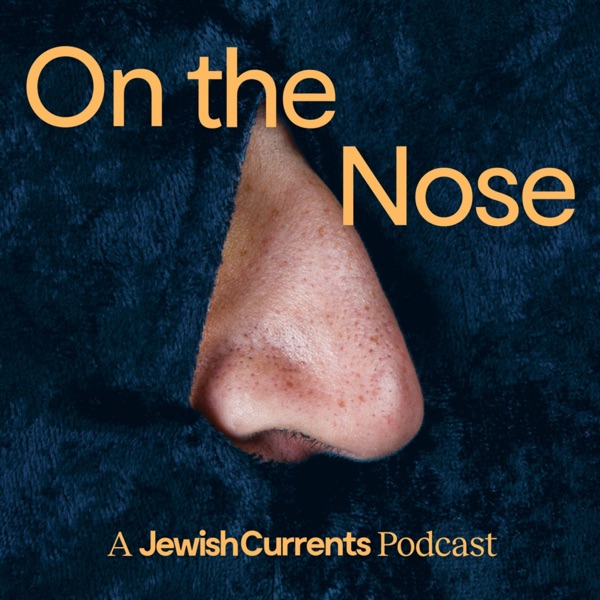
On the Nose
On the Nose is a biweekly podcast by Jewish Currents, a magazine of the Jewish left founded in 1946. The editorial staff discusses the politics, culture, and questions that animate today’s Jewish left.
- Episodes
- 164
- Releases
- Weekly
- Typical length
- 51 min
- On air since
- 2021
- Latest episode
- 5 days ago
Episodes
164 episodes, newest first
-
51 min
The Inheritance of Defeat
Episode 162
Show notes
From the Shoah to McCarthyism to the failures of the New Left, it has been a long 20th century for radical Jews. Each new iteration of the Jewish left finds itself building on a legacy that has been largely buried, learning from a history of defeat at the hands of much more powerful forces. Given those losses, what do we inherit from both our movement ancestors and our actual kin? How does their example shape the way we organize in the present? Are there models from which we might learn? Or must we create something new for every new moment? On this episode of On the Nose, recorded live from a panel at Jewish Currents Live on October 11th, Arielle Angel tackles these questions with artist and writer Molly Crabapple, author Harriet Clark, and poet and activist Irena Klepfisz.
Thanks to Jesse Brenneman for editing and to Nathan Salsburg for the use of his song “VIII (All That Were Calculated Have Passed).”
Links and Further Reading
“The Hill,” On the Nose, Jewish Currents
“Here Where We Live Is Our Country,” On the Nose, Jewish Currents
“For Eli Jacobson” by Kenneth Rexroth
“Beyond Grievance,” Arielle Angel, Jewish Currents
“The Work of Love in Recollecting One Who is Dead,” Sören Kierkegaard, Works of Love
-
56 min
The Impact of American Zionism on American Islamophobia
Episode 161
Show notes
Seasons of Fury, a new book by the journalist Rozina Ali, tells a sweeping history of American Islamophobia through narrative reporting on four American Muslim families with varied backgrounds. The book reveals that American Zionism is integral to the story of anti-Muslim bias in the US. The legal structures for surveilling and criminalizing Muslims originated in US officials’ preoccupation with Palestinian militants in the 20th century, and Zionist organizations have been key participants in a broad civil society ecosystem pushing Islamophobia in the American mainstream. In this episode of On the Nose, senior politics editor Mari Cohen guest hosts to interview Ali about the book and her findings. They discuss how the targeting of Arab activists morphed into anti-Muslim sentiment; how the definition of terrorism changed in the 20th century and came to be associated with Islam; how the Anti-Defamation League has abetted Islamophobia; and how antisemitism and Islamophobia are pitted against each other in American politics.
Thanks to Jesse Brenneman for editing and to Nathan Salsburg for the use of his song “VIII (All That Were Calculated Have Passed).”
Links and Further Reading
Seasons of Fury: Four Families and the Rise of Islamophobia in America by Rozina Ali
Disciplining Terror by Lisa Stampnitzky
“Painful memory for Muslims: Outrage over a proposed Islamic center in Manhattan,” Anne Barnard, New York Times
The Feeling of Being Watched by Assia Boundaoui
“How the ADL’s Anti-Palestinian Advocacy Helped Shape U.S. Terror Laws,” Darryl Li, The Intercept
ADL amicus brief in Humanitarian Law Project vs. Holder
“Jewish Communities Must Root Out Islamophobia,” Donna Nevel, Jewish Currents
“When ‘Jewish Security’ Meets Muslim Surveillance,” Asad Dandia, Jewish Currents
ADL changes its tune on mosques, Justin Elliott, Salon
The Anti-Defamation League and the Racial State by Emmaia Gelman
-
1 hr 8 min
Fact Versus Fiction in Claims About Antisemitism in Publishing
Episode 160
Show notes
On July 9th, PEN America published an article called “A Silent Moratorium,” which asserts that Jewish and Israeli writers face “blatant hostility, discrimination, and hate” and attempts to chart the “impact on their freedom of expression.” The PEN article affirms a narrative advanced across Jewish media and mainstream press alike that—as the headline of a piece by James Kirchick in The New York Times put it—“a chill has fallen over Jews in publishing” amid the war on Gaza. The article has since been joined by other attempts to quantify the damage to Jewish letters: An article by the writer Meg Keene attempted to provide data to support the claim of a precipitous dropoff in Jewish books since 2023. The ADL recently added another report to the pile.
Last week, we published a report written by Josh Lambert, director of Jewish studies at Wellesley College, and Dan Sinykin, director of graduate studies at Emory University—both researchers of publishing history, with expertise between them in contemporary Jewish literature and quantitative literary studies. The piece took on the claims of the PEN America article, about which they wrote, “Digging into its anecdotal reports of abandonment by agents and missing book deals, online harassment and review-bombing, we found that many of the claims were too vague to qualify as evidence, and that many accounts . . . turn out to be imprecise at best and entirely false at worst.” They also examined Keene’s data and ran some of their own; it turns out the picture of the number of Jewish titles being published looks very different with a more solid methodology.
On this episode of On the Nose, Arielle Angel speaks with Lambert and Sinykin about what these accounts of anti-Jewish sentiment in publishing got wrong, and what it means about the current market for both Zionist and anti-Zionist books.
Thanks to Jesse Brenneman for editing and to Nathan Salsburg for the use of his song “VIII (All That Were Calculated Have Passed).”
Links and Further Reading
“What PEN America Got Wrong About Antisemitism in Publishing,” Josh Lambert and Dan Sinykin, Jewish Currents
“A Silent Moratorium,” PEN America
“I gathered the data on Jewish fiction publishing. The trends are alarming.,” Meg Keene, JTA
ADL report on antisemitism in publishing
Josh Lambert’s Jewish book column, “State of the Genre”
Hunting in America by Tehila Hakimi
“I'm not happy about it, but I wrote about PEN.,” Josh Lambert’s Substack
“A Bookshop Cancels an Event Over a Rabbi’s Zionism, Prompting Outrage,” Ginia Bellafante, The New York Times
“Examining the ADL’s Antisemitism Audit,” Shane Burley and Naomi Bennet, Jewish Currents
The Rehearsal, Nathan Fielder
Erasure by Percival Everett
“Repetition and Solipsism in the ‘Israel Debate’ Play,” On the Nose, Jewish Currents
“An Open Letter to the Jewish Book Council From a Concerned Group of Jewish Writers,” Literary Hub
Register for the New Jewish Institutions Skill-building Boot Camp!
Transcript forthcoming.
-
59 min
Naza and the Function of Perpetrator Cinema
Episode 159
Show notes
Naza, a film by Israeli filmmakers Yuval Abraham and Rachel Szor, features interviews with 24 members of elite intelligence units in the Israeli military describing the mechanics of carrying out remote, indiscriminate mass killing in Gaza. Since news spread of a 25-minute standing ovation for the film at the Venice Film Festival, it has provoked intense debate, with some Palestinians expressing criticism of the way that Israelis’ confessions have made the genocide more “real” in the West than Palestinians’ own testimony. Meanwhile, in Israel, the film has elicited disturbing incitement against the filmmakers (who currently remain abroad), and Prime Minister Benjamin Netanyahu has threatened to revoke the filmmakers’ citizenship.
What is the unique function of cinema focused on the perpetrators of genocide? How do we understand the concept of “evil” in listening to the voices of the murderers? And can these testimonies provoke a reckoning within global Jewry? To discuss these questions, Arielle Angel speaks with two filmmakers: Rami Younis, Palestinian journalist and co-director of the film Lyd, about the city in historic Palestine, now in the south of Israel; and Joshua Oppenheimer, director of the Oscar-nominated films The Act of Killing and The Look of Silence, about the Indonesian genocide.
Thanks to Jesse Brenneman for editing and to Nathan Salsburg for the use of his song “VIII (All That Were Calculated Have Passed).”
Links and Further Reading
Naza, directed by Yuval Abraham and Rachel Szor
The Act of Killing and The Look of Silence, directed by Joshua Oppenheimer and Anonymous
Lyd, directed by Rami Younis and Sarah Ema Friedland
“Gaza before and after: New Google Maps imagery shows destruction of the Strip,” José A. Álvarez and Anna Navarro, El País
“‘NAZA’ is forcing Israelis to reflect. But we Palestinians are not your mirror,” Ayat Abou Shmeiss, +972 Magazine
“The moment a human life becomes ‘collateral damage,’” Mahmoud Mushtaha, +972 Magazine
“Palestinian Suffering Must Pass Through an Israeli Voice to Be Heard,” Hanin Majadli, Haaretz
Rami Younis’s interview with Hany Abu Assad at Palestine Cinema
“Watching 'NAZA' Shocked Me. So Did What Its Creators Left Out,” Raviv Drucker, Haaretz
Raviv Drucker interviewing Yuval Abraham
“'It hurts me' - Guardiola vows to speak up on conflicts,” Shamoon Hafez, BBC
“‘Violent and baseless raid’: Human rights group demands probe of police over Umm el-Fahm wedding,” Yoav Etiel, The Jerusalem Post
Register for the New Jewish Institutions Skill-building Boot Camp!
Transcript forthcoming.
-
52 min
Slam Frank's Hall of Mirrors
Episode 158
Show notes
Slam Frank—the satirical play about a Latina “Anita Franco” stuck in the attic with a colorblind cast (à la Hamilton) of daft identitarians—reopened last week Off-Broadway at the Orpheum Theatre in Manhattan. While some audience members have reportedly been shocked by its irreverent take on a child hero of the Holocaust, some viewers on both the left and the right are convinced that the play reflects their sensibilities and political leanings. The play’s author, Andrew Fox, has declined to say anything about his personal politics, but touchstone books of Jewish reactionary grievance like David Baddiel’s Jews Don’t Count and Dara Horn’s People Love Dead Jews are part of the show’s dramaturgy.
On this episode of On the Nose, Arielle Angel talks to theater critic Alisa Solomon and New York Times columnist M. Gessen about their differing interpretations of the play. The three argue about what the play actually intends to say about the contemporary left, whether the playwright’s own political leanings matter to the read of the play itself, and whether the proliferation of interpretations is a feat or a liability.
Thanks to Jesse Brenneman for editing and to Nathan Salsburg for the use of his song “VIII (All That Were Calculated Have Passed).”
Links and Further Reading
“‘Slam Frank,’ a Daring Satire, and ‘Crooked Cross’ Demand Our Attention,” Laura Collins-Hughes, The New York Times
“The Composer Making a Hip-Hop Musical About Anne Frank,” Kelefa Sanneh, The New Yorker
Information on Gazi Kodzo, the author of the original “Anne Frank/white privilege” tweet
Jews Don’t Count by David Baddiel, People Love Dead Jews by Dara Horn, and a Jewish Currentsreview of both books by Linda Kinstler
“Actress Dasha Nekrasova Fired By Gersh, Dropped From Movie Amid Backlash Over Podcast Interview With Far-Right Political Commentator Nick Fuentes,” Matt Grobar, Deadline
Slam Frank reviews in the Times of Israel and the Jewish Journal
“Springtime for Hitler,” The Producers
Slam Frank’s Bondi post and Andrew Fox’s apology
“Campus Politics Takes the Stage in ‘The Ally,’” On the Nose, Jewish Currents
“Anne Frank, the Exhibition” at the Center for Jewish History
“Nosegate,” On the Nose, Jewish Currents
Register for the New Jewish Institutions Skill-building Boot Camp!
-
48 min
Kol Nidre's Sacred Border Crossings
Episode 157
Show notes
As we make our way through the Days of Awe, On the Nose is turning over our feed to an episode of Ways of Awe, an exploration of the high holiday liturgy written by artist and educator Maia Brown and writer and organizer Shelby Handler, and based on translations originally shared with the Kadima Reconstructionist Community in Seattle, WA. This episode explores the “Kol Nidre” prayer recited on Erev Yom Kippur, in which all vows from the year before are nullified. In this episode, the hosts spoke with Rabbi Jessica Rosenberg and Rabbi Xava De Cordova.
This episode was edited by Maia Brown, with audio engineering by Daniel Guenther. Thank you to Ross Kirshenbaum of Levoneh for composing our show music and to Peter Lippman and Jimmy Austin for playing on the track, and to Jenny Asarnow for their field recordings. Thank you to the Jack Straw Cultural Center Artist Support Program, the Seattle Office of Arts & Culture Smart Ventures Program, and Signal Fire Coop. Thank you to Hannah Epstein for design.
Thank you to all those who lent their prayer-voices to the Kol Nidre episode including: Noraa Kaplan, Sharone Sayegh, Moyshe Oysher. Thank you to Jeannie Wells-Yablonsky from the Seattle Symphony for her rendition of Kol Nidre. An excerpt from “Kol Nidre,” performed by Sharone Sayegh in the Iraqi Sephardic tradition, was produced by Reboot in partnership with Hillel International for Higher Holidays 2020 and is reproduced here with permission.
Links and Further Reading
“Jewish Emptiness: Kavannot for Kol Nidrei,” Rabbi Xava De Cordova, RitualWell
“The Case Against Kol Nidre,” Adam Soclof, JTA
“Kol Nidre: Past, Present, and Future,” Richard-Steiner, Jewish Studies, an Internet Journal
Kol Nidre entry in the 1906 Jewish Encyclopedia
“A Brief History of the Kol Nidrei Prayer,” Cantor Deborrah Cannizzaro
“Exploring Kol Nidre,” David Schwartz, Sefaria
“The Geonim,” Eli Barnavi, My Jewish Learning
This Is Real and You Are Completely Unprepared by Rabbi Alan Lew
Register for the New Jewish Institutions Skill-building Boot Camp!
Transcript can be found here.
-
53 min
UK Sanctions Settlements
Episode 156
Show notes
On September 8th, the UK announced sanctions against Israeli settlements in the West Bank, including an import trade ban, sanctions on companies and individuals, bans on advertising the sale of stolen land, and restrictions on arms export licensing. They were joined in the adoption of these policies by France and Canada, and nine other European countries released a statement announcing intentions to support the effort. This unprecedented raft of policies was largely framed as an attempt to salvage the two-state solution and to counter planned settlement expansion into the E-1 Corridor, which would split the West Bank in two.
On this episode of On the Nose, Arielle Angel speaks with Ryvka Barnard, deputy director of the UK-based Palestine Solidarity Campaign; Emily Hilton, international policy director at Diaspora Alliance; and Maya Rosen, associate editor of Jewish Currents, about these latest developments. They discuss the issues with limiting sanctions to the settlements in one-state reality, potential loopholes in implementation, and the reactions from the UK Jewish establishment and the Israeli settlement movement.
Thanks to Jesse Brenneman for editing and to Nathan Salsburg for the use of his song “VIII (All That Were Calculated Have Passed).”
Media Mentioned and Further Reading
Joint Foreign Ministers’ Statement on the Two-State Solution
“UK, France among 12 states backing sanctions on illegal Israeli settlements,” Al Jazeera
“Trump didn't oppose UK sanctions on Israeli settlements,” Barak Ravid, Axios
“The Wrong Way to Fight Antisemitism in Britain,” On the Nose, Jewish Currents
“Polling reveals Palestine a major factor in progressive voters ditching Labour,” Palestine Solidarity Campaign
“The Making of a Coal Boycott,” Andreas Malm and Maxy Guedes, Jewish Currents
“Burnham confirms top level government meeting to bolster security for Jewish community over High Holy Days,” Lee Harpin, Jewish News
“America Should Follow UK and Sanction West Bank Settlements,” New Jewish Narrative statement
“J Street Welcomes UK, France and Canada’s Decision to Ban Imports From West Bank Settlements,” J Street statement
“What is the Police and Crime Bill and how will it change protests?,” BBC
“The Settler Community Responds to UK Sanctions,” C14
Register for the New Jewish Institutions Skill-building Boot Camp!
Transcript forthcoming.
-
1 hr 3 min
Fighting the Politics of Powerlessness
Episode 155
Show notes
Organizing is hard, not just for the ways we are knocked down by our opponents, but also for the ways we often turn on our comrades in anger and despair. In the recently published book For Louder Days, Yotam Marom—a veteran of Occupy Wall Street, co-founder of IfNotNow, and movement facilitator who has worked with Sunrise, Dream Defenders, Uncommitted, and more—diagnoses how the left’s ambivalence about power leads to a number of bad habits. We tear down our leaders or pretend there are no leaders at all; we avoid conflict and hard choices, which leads to bad strategy; we draw the boundaries of belonging too narrowly. On this episode of On the Nose, Marom talks to Arielle Angel about all the ways we turn on each other instead of playing to win—and how we might shift our orientation away from the “politics of powerlessness.”
Thanks to Jesse Brenneman for editing and to Nathan Salsburg for the use of his song “VIII (All That Were Calculated Have Passed).”
Media Mentioned and Further Reading
For Louder Days by Yotam Marom
Jewish Diaspora Movement Skill-Building Boot Camp Registration
“Who Speaks for Black Voters?,” On the Nose, Jewish Currents
Hate by Seyda Kurt
“Why Israelis are leaving in record numbers,” Hila Amit, +972 Magazine
Transcript forthcoming.
-
4 min
TEASER: The Myth of the “Good Guy at the Checkpoint” Trailer
Episode 155
Show notes
This episode of On the Nose is for subscribers and members only. Subscribe for $4/month here. If you’re already a subscriber, check your email for instructions on accessing this episode.
A recent article in Haaretz announced that a left-wing youth group called Hamahanot Haolim, part of the socialist Zionist movement, is planning a kibbutz-style settlement in the Jordan Valley, in the occupied West Bank. According to the article, organization director Ilan Gazit said that “he is aware of the damage West Bank settlements do to Palestinian rights, but argued that since new settlements will be built in the Jordan Valley in any case, it’s preferable to have as many of them as possible populated by leftists.” Gazit elaborated: “We aren’t ashamed of this and we aren’t hiding it. This is in line with our worldview: A strong security border is needed in the east that will be defensible and create a necessary condition for peace. We are leftists who believe in equality between people and are guided by a humanistic, socialist, democratic worldview.”
On this premium episode of On the Nose, Israeli American social worker and co-founder of the Unsettled podcast Asaf Calderon talks to Arielle Angel about the fallacy of the “good guy at the checkpoint,” and what this announcement says about the shifting relationship between Israel’s so-called left and the settlement enterprise.
Thanks to Jesse Brenneman for editing and to Nathan Salsburg for the use of his song “VIII (All That Were Calculated Have Passed).”
Media Mentioned and Further Reading
“Israeli Left-wing Youth Group Plans Kibbutz-style Settlement in West Bank,” Yair Foldes, Haaretz
“What the Soldiers Did in Gaza,” On the Nose, Jewish Currents
“The Anti-Politics of Disengagement,” Elisheva Goldberg, Jewish Currents
“Revising the Dream,” Mari Cohen, Jewish Currents
Transcript forthcoming.
-
56 min
Repetition and Solipsism in the “Israel Debate” Play
Episode 154
Show notes
After a few years of seeing Jewish plays “debating” Israel/Palestine, Jewish Currents editor-at-large Arielle Angel and theater critic Alisa Solomon explored the phenomenon through an exchange of letters, which were published this week. On this episode of On the Nose, they discuss the plays that fall into this category: most recently, the critically acclaimed Birthright by Jonathan Spector, but also including The Zionists by S. Asher Gelman, Giant by Mark Rosenblatt, The Ally by Itamar Moses, and Prayer for the French Republic by Joshua Harmon. They detail the compulsive repetition of these plays and they explore why Jewish hand-wringing is being consistently elevated during a moment of genocide, and why it appears so popular with critics and liberal audiences alike.
Thanks to Jules Natt for editing and to Nathan Salsburg for the use of his song “VIII (All That Were Calculated Have Passed).”
Media Mentioned and Further Reading
“BirthrightStages a Tired Debate,” Arielle Angel and Alisa Solomon, Jewish Currents
Birthright by Jonathan Spector
Giant by Mark Rosenblatt
The Zionists by S. Asher Gelman
The Ally by Itamar Moses
Prayer for the French Republic by Joshua Harmon
“Campus Politics Takes the Stage inThe Ally,” On the Nose, Jewish Currents
“Who Is Tom Stoppard’s ‘Jewish Play’ For?” On the Nose, Jewish Currents
“GiantGave the People What They Want,” Jessica Goldschmidt, Jewish Currents
“‘Birthright’ and ‘Giant’ Tackle Jewish Identity,” Emily Nussbaum, The New Yorker
“‘Birthright’ Stages a Thrillingly Complex Conversation on Conversation Itself,” Helen Shaw, The New York Times
“Taking the Long View, Brilliantly:BirthrightandCamping,” Sarah Holdren, Vulture
“Most US kids of intermarriage raised Jewish; parents want institutions to notice,” Ben Sales, The Times of Israel
“Shari Redstone’s Next Act: Mogul Named Chair of ‘We Will Dance Again’ and ‘Bad Boy’ Studio Sipur,” Alex Weprin, The Hollywood Reporter
Miami New Drama’s announcement of the Y6K Project
“‘A Silent Moratorium,’” Lisa Tolin, Geraldine Baum, Malka Margolies, PEN America
“Feeling excluded in the literary world, Jews are launching their own publishing houses,” Philissa Cramer, JTA
“Birthright Israel and #MeToo,” Sarah M. Seltzer, Jewish Currents
“Michael Steinhardt, a Leader in Jewish Philanthropy, Is Accused of a Pattern of Sexual Harassment,” Sharon Otterman and Hannah Dreyfus, The New York Times
“Nadav Lapid Faces ‘No,’” On the Nose, Jewish Currents
“Kaddish for an Unborn Avant-Garde” by Maia Ipp
Sarah Hurwitz on how phones are making it hard to speak to Jewish young people about Gaza
“Van Jones and the moral vacancy of American commentary on Gaza,” Ziyad Motala, Al Jazeera
Theater Workers for a CeasefireBirthrightBoycott
Transcript forthcoming.
-
56 min
Who Speaks for Black Voters?
Episode 153
Show notes
Progressive outsider candidate Abdul El-Sayed narrowly prevailed over establishment pick Haley Stevens to win the Democratic nomination for Michigan’s open Senate seat, though AIPAC spent tens of millions of dollars to defeat him. The narrative that has emerged before and after the primary is one that stresses El-Sayed’s weakness with Black and Jewish voters.
As Jewish Currents senior reporter Alex Kane wrote earlier this month, Black and Jewish centrists are teaming up in key races to defeat progressive candidates, whom they portray as fixated on Palestine at the expense of their Black constituents. As Darius Jones—senior adviser to a Black centrist group called the National Black Empowerment Action Fund and longtime AIPAC operative—told Jewish Currents, “Focusing on a “foreign conflict” won’t “lower health care or housing costs for a Black senior in Detroit, or ensure that a path to home ownership easier for a Black constituent in St Louis or Ferguson.” These Black politicos have endeavored to link moderate Democratic policies and Black interests; reflecting on El-Sayed’s attacks on the Democratic establishment, for example, party strategist Jamal Simmons told The Hill that such “attacks on the Democratic establishment in places like Detroit are attacks on Black leaders.” Meanwhile, moderates and conservatives across the country appear intent on pushing the narrative that democratic socialism is the province of privileged white people, pointing to the demographics of the group’s membership and the class backgrounds of Mayor Zohran Mamdani’s staffers and advisers.
To discuss the ways that the figure of the “Black voter” is being used in the fight over the direction of the Democratic Party, host Arielle Angel and Alex Kane welcome Keeanga-Yamahtta Taylor—professor of African American studies at Princeton University, author of From #BlackLivesMatter to Black Liberation, and a co-founder of the digital magazine Hammer & Hope—to On the Nose. They discuss the role of Israel/Palestine in Black politics, the fallacy that Black voters are more moderate on the issues, and what to do with DSA’s demographic problem.
Thanks to Jules Natt for editing and to Nathan Salsburg for the use of his song “VIII (All That Were Calculated Have Passed).”
Media Mentioned and Further Reading
“The End of Black Politics,” Keeanga-Yamahtta Taylor, The New York Times
“Donald Trump’s Victory, the Elitism of Democrats, and the Need to Build a Hospitable Left,” Keeanga-Yamahtta Taylor and Daniel Denvir, Hammer & Hope
“With Jewish Establishment’s Help, a Black Political Group Battles the Left,” Alex Kane, Jewish Currents
“An Anti-AIPAC Insurgent Tests Her Message in a Working-Class Stronghold,” Alex Kane, Jewish Currents
“The Congressional Black Caucus’s Silent Partnership With AIPAC,” Anthony Conwright, The Nation
“Can Abdul El-Sayed unite Dems? He has work to do with Black, Jewish voters,” Simon D. Schuster, Bridge Michigan
“Who Is Abdul El-Sayed? His Harsh Trump Takedown Is a Clue,” Daily Blast with Greg Sargent, The New Republic
“El-Sayed faces ‘risky bet’ with Michigan’s Black voters,” Amie Parnes and Caroline Vakil, The Hill
“NYC-DSA is 60% white, internal survey says,” Peter Sterne, City & State
“How ‘Pro-Israel’ Orthodoxy Keeps US Foreign Policymaking White,” Peter Beinart, Jewish Currents
“Valerie Foushee ‘Will Not Accept’ AIPAC Money in 2026 Election,” Chase Pelligrini de Paur, Indy
“The Revolutionary Imperative,” Neil Smith, Antipode
Siena University poll of DSA favorability
“Most Americans Say Policing Needs 'Major Changes,’” Steve Crabtree, Gallup
“AOC and Mamdani wanted to defund the police. Their backtracking puts organizers at risk,” Derecka Purnell, The Guardian
“Movement for Black Lives opposes George Floyd Justice in Policing Act,” AP
“Eliot Engel, Jamaal Bowman, and the CBC,” Alexander Sammon, The American Prospect
Communists in Harlem During the Depression by Marc Naison
The New Jim Crow by Michelle Alexander
Transcript forthcoming.
-
46 min
Genocide Studies Departments Still Can’t Name Genocide in Gaza
Episode 152
Show notes
In early June 2024, the Holocaust historian Raz Segal was offered a job directing the Center for Holocaust and Genocide Studies at the University of Minnesota after roundly impressing an academic search committee. But as soon as the offer was extended, donors, politicians, and Jewish advocacy groups mobilized against his hire due to his public advocacy against Israel’s genocide in Gaza, which included his Jewish Currents article “A Textbook Case of Genocide” from October 13th, 2023. Within a week, the university’s interim president intervened to rescind Segal’s offer. Now, two years later, Segal, an associate professor of Holocaust and genocide studies and the endowed professor in the study of modern genocide at Stockton University, has reached a $250,000 settlement with the University of Minnesota.
On this episode of On the Nose, senior editor Mari Cohen guest hosts to interview Segal about the lessons from his struggle at Minnesota and recent developments in the field of genocide studies, which Cohen reported on extensively in a 2024 Jewish Currents feature. In their conversation, Segal traces the history of genocide studies and the political contexts that have made it difficult for scholars in the field to adequately address Israeli violence, and reflects on “A Textbook Case of Genocide” nearly three years after its publication. Is genocide studies finally evolving to meet the moment? And what should we make of the fact that many liberal commentators are only now willing to accept the argument Segal made six days after October 7th?
Thanks to Jesse Brennemen for editing and to Nathan Salsburg for the use of his song “VIII (All That Were Calculated Have Passed).”
Media Mentioned and Further Reading
“A Textbook Case of Genocide,” Raz Segal, Jewish Currents
“Can Genocide Studies Survive a Genocide in Gaza?,” Mari Cohen, Jewish Currents
“An Israeli professor lost a prestigious US job offer after speaking out on Gaza. Now the university is paying him $250,000,” Alice Speri, The Guardian
“A Holocaust Scholar Called Israel’s Actions in Gaza ‘Genocide.’ It Cost Him a Job Offer,” Maggie Hicks, Chronicle of Higher Education
“Many American Jews sharply critical of Israel on Gaza, Post poll finds,” The Washington Post
“Bad Memory,” Jewish Currents
“Israel Must Stop Weaponizing the Holocaust,” Raz Segal, The Guardian
“Tenured California Professor Fired Over Gaza Protest Wins Job Back,” Alice Speri, The Guardian
The Problems of Genocide by Dirk Moses
IAGS Resolution on the Situation in Gaza
Convention on the Prevention and Punishment of the Crime of Genocide
“Museum Statement on the Attack on Israel,” US Holocaust Memorial Museum
“No, Israel is Not Committing Genocide in Gaza,” Bret Stephens, The New York Times
“US Universities Are Seeing an Influx of ‘Antisemitism Centers.’ Some Jewish Scholars Are Worried,” Alice Speri, The Guardian
“Disputed Gaza Language No Longer on Stockton Holocaust Studies Page,” Buzz Keough, The Press of Atlantic City
Transcript forthcoming.
-
52 min
Here Where We Live Is Our Country
Episode 151
Show notes
The resounding success of Here Where We Live Is Our Country, Molly Crabapple’s vividly told and extensively researched history of the Jewish Labor Bund—a socialist group founded at the end of the 19th century on principles of internationalist solidarity, doikayt (or hereness), and Jewish national-cultural autonomy—has improbably brought the Bund, decimated in the Holocaust, into the 21st century. In this interview, Arielle Angel speaks with Crabapple about what it means to see the Bund from this vantage, from the other side of a century where Jews have gone from victims of genocide to genocidaires. What can we learn about purity politics and principled refusal, about solidarity and its failures?
Thanks to Julia Natt for editing and to Nathan Salsburg for the use of his song “VIII (All That Were Calculated Have Passed).”
Media Mentioned and Further Reading
Here Where We Live Is Our Country by Molly Crabapple
“Back to the Bund,” Samuel Hayim Brody, Jewish Currents (forthcoming in the Fall issue)
Transcript forthcoming.
-
1 hr 17 min
The Event
Episode 150
Show notes
A strange fire has consumed the land between the river and the sea.
Fiction by Henry Bean from our Fall 2025 issue.
"The Event" was written by Henry Bean and edited for the page by Arielle Angel and Nathan Goldman. It was narrated by the author, with sound design and music by Amber Devereux at Tin Can Audio
"The Event" was recorded in New York City by Will Coley, with additional recording by Annie Bennett. It was produced and directed by Ella Watts and Arielle Angel, with Executive Production by Arielle Angel.
Special thanks to Leora Barish, Max Bean, Andy Bienan, Dana El Kurd, Matthew Francis, Jessica Marglin, David Myers, Hussein Omar, Josephine Riesman, Adam Liam Rose, Jonathan Shamir, and Elisheva Urbas.
-
4 min
TEASER: The Hazing of Scott Wiener Trailer
Episode 150
Show notes
This episode of On the Nose is for subscribers and members only. Subscribe for $4/month here. If you're already a subscriber, check your email for instructions on accessing this episode.
Last week, two videos of constituents aggressively confronting California State Senator Scott Wiener on his stance on Israel/Palestine went viral—one from a World Cup watch party and one from a trans march during Pride. Wiener, the likely replacement in the House for the retiring Nancy Pelosi, has joined commentators in labeling the incidents as antisemitic harassment. But pro-Palestine constituents have some basis for being wary of Wiener: In January, Wiener awkwardly—perhaps opportunisitically—reversed his position on applying the word “genocide” to the devastation in Gaza after declining to use the term on the debate stage.
In this premium episode of On the Nose, Arielle Angel talks with Jewish Currents senior politics editor Mari Cohen parse the two videos, and discuss how the left should relate to even the most opportunistic reversals on Palestine in the Democratic Party.
Thanks to Jesse Brenneman for editing and to Nathan Salsburg for the use of his song “VIII (All That Were Calculated Have Passed).”
Media Mentioned and Further Reading
Letter to the editor on the imperative to welcome Scott Wiener
“S.F. Trans March organizers defend protesters who drove out Scott Wiener,” Lucy Hodgman, San Francisco Chronicle
“Democratic Presidential Contenders Are Turning on Israel. Will They Convince Progressives?,” Alex Kane, Jewish Currents
“Facing backlash after accusing Israel of genocide, Scott Wiener steps down as Calif. Jewish Caucus co-chair,” Philissa Cramer, JTA
“Harris reaches out to Mamdani, pro-Palestinian activists in run-up to 2028,” Holly Otterbein, Alex Thompson, Axios
“Justice Department opens civil rights probe after NYC coffee shop bans congressman over Israel support,” Katherine Tangalakis-Lippert, Business Insider
“In California, Jewish Groups’ Win Is Students’ Loss,” Gabi Kirk, Jewish Currents
Zohran Mamdani being confronted on Palestine
Transcript forthcoming.
-
41 min
“Democracy and Asylum Rise and Fall Together”
Episode 149
Show notes
Last week, the Supreme Court ruled on several issues related to immigration policy. While the court narrowly preserved birthright citizenship, it issued other rulings that will put an untold number of people in danger. One ruling, Mullin v Al Otro Lado, upheld the federal government’s policy of turning back asylum seekers before they can reach the US-Mexico border—a policy also known as “metering”—hollowing out the right to asylum enshrined in both domestic and international law. In her dissent, Justice Sonia Sotomayor referenced the St. Louis, the ship of Jewish refugees from Nazi Germany turned away from the US, whose passengers were mostly killed in the Holocaust: “Congress passed the Refugee Act in 1980 because it did not want this country to repeat the mistakes of its past. Yet if the refugees on the M. S. St. Louis were to walk up to a port of entry on our southern border today, the majority’s interpretation would allow immigration officers to refuse even to consider their asylum applications by physically blocking them from stepping foot onto US soil,” she said.
In another ruling, Mullin v Doe, the Supreme Court granted the president the power to end the Temporary Protected Status program, or TPS, which has allowed vetted and eligible immigrants to live and work legally in the US if they cannot return safely to their countries. Justice Samuel Alito, in his majority opinion, said courts do not have a say in what the president and the Department of Homeland Security decide; the president can end TPS for Haitians and Syrians without judicial review. He also rejected a separate claim brought by Haitians that the move to deport them was based in racial prejudice. TPS has been in effect since 1990. There are 350,000 Haitians who have been in the US legally under TPS, and whose lives have now been thrown into chaos.
In our spring issue, we published a prescient piece by immigration reporter Tanvi Misra about the death of asylum, and the ways that its decline is a dire portent for democracy itself. Asylum, Misra reminds us, is a “place-based right” designed to prioritize human life over national borders: As soon as an endangered person steps foot onto a country’s soil, they “are entitled to that body’s protection,” regardless of whether they crossed with permission. This is exactly the principle that has been undermined with this recent ruling, which prevents people from arriving and making an application. As this ruling suggests, for as long as asylum has existed in the US, so have efforts to weaken it. It has been issued selectively and on racial grounds—much more easily been granted to German-speaking Protestants than to Jews escaping the Holocaust; readily offered to Cubans fleeing Castro but not to Haitians fleeing the US-supported Duvalier dictatorship.
Misra’s essay tells us that this tactic of denying landfall to migrants as a way of denying them asylum has gone into overdrive in the past decades as border agents try to intercept asylum seekers earlier and earlier in their journeys. In the process, the US border has, Misra says, “not just hardened, but expanded”—into Mexico, Guatemala, Panama, and beyond. Under Trump 2.0, the border has also spilled inward, into LA, Chicago, Minneapolis, and all the other places where border agents are chasing down asylum seekers and, increasingly, all migrants.
In this episode of On the Nose, recorded in mid-June before the Supreme Court rulings, Misra speaks about these grievous attacks on asylum with John Washington, a staff reporter at Lookout and the author of the forthcoming book,https://www.haymarketbooks.org/books/2880-how-to-close-a-campHow to Close a Camp: Dispatches from the Fight Against Immigrant Detention, as well as The Case for Open Borders and The Dispossessed: A Story of Asylum at the US-Mexico Border.
This conversation was originally a live membership event. Become a member so you don’t miss the next one!
Thanks to Jesse Brenneman for editing and to Nathan Salsburg for the use of his song “VIII (All That Were Calculated Have Passed).”
Media Mentioned and Further Reading
“The Death of Asylum,” Tanvi Misra, Jewish Currents
How to Close a Camp: Dispatches from the Fight Against Immigrant Detention by John Washington
The Case for Open Borders by John Washington
The Dispossessed: A Story of Asylum at the US-Mexico Border by John Washington
The Suppliants by Aeschylus
Oedipus at Colonus by Sophocles
“The principle of non-refoulement,” European Union Agency for Asylum
1951 UN Refugee Convention and its 1967 Protocol
“A History of Haitian Discrimination by United States Immigration Policy,” US Committee for Refugees and Immigrants
“‘Metering’ of Asylum Seekers Is Bad Policy, Bad Law, and Bad for the Border,” Aaron Reichlin-Melnick, American Immigration Council
“US flight carrying deported migrants lands in Central African Republic,” France24
“What Are Third-Country Removals? Understanding Their Use In U.S. Immigration Policy,” American Immigration Council
“Broader Crises,” Tanvi Misra, The Baffler
“The Unraveling of Afghan Asylum,” Tanvi Misra, New York Review of Books
Transcript forthcoming.
-
39 min
Nadav Lapid Faces “No”
Episode 148
Show notes
Over the last couple weeks, there has been an enormous amount written—from The New York Times to Le Monde to Haaretz, among other places—about a controversy centered on Nadav Lapid, an Israeli filmmaker living in France. Lapid has made several critically acclaimed films, including Synonyms, Ahed’s Knee, and, most recently, Yes, and his work has taken home jury prizes at the Berlinale and Cannes.
The recent controversy was focused on the FIDMarseille international film festival. There was a planned retrospective of Palestinian films at the festival this year. Meanwhile, Lapid was invited to head the jury. It was also decided that there would be an event honoring him, and that he would teach a master class. When a dozen filmmakers threatened to pull their films from the festival, Lapid withdrew as head of the jury. When that did not quell the protests, he decided to cancel the event and the master class, as well.
The response from many in the film world has largely been to rally around Lapid, with two letters published in Le Monde, one of them garnering over 350 signatures of high-profile figures in the industry. The letters allege that Lapid is being boycotted solely because of his identity. One of them declares, “Nothing justifies the silencing of an artist . . . the cultural boycott is an intellectual dead end that we must collectively overcome.”
Meanwhile, Film Workers for Palestine, allied with PACBI, which coordinates the academic and cultural boycott of Israel, published a translation of a statement by Palestine Will Save Cinema, pointing to the fact that Nadav Lapid’s latest film, Yes, received support from the Israeli Film Fund, was presented at the 2025 Cannes Film Festival as an Israeli co‑production, and competed for the Ophir Awards (akin to Israel’s Academy Awards). “States have always invested in cinema, literature, the arts, and festivals as instruments of influence and legitimacy. Cultural production does not circulate in a political vacuum. It contributes to the representation of nations, the construction of their international image, and the dissemination of their narratives,” they wrote. “This is precisely why cultural boycott exists. Not because artists are responsible for the crimes committed by their governments, nor because certain works should be prohibited, but because cultural institutions, funding systems, and distribution policies play a concrete role in states’ strategies of legitimation.” There can be no mistaking the content of Yes, which seeks to depict the depravity of Israeli society during the genocide. But it does open with the icon of Israel’s Ministry of Culture, due to the support it took from the Israeli Film Fund, which accounted for 13% of the film’s funding.
On this episode of On the Nose, Arielle Angel talks to Nadav Lapid about the recent controversy, and the two hash out some of their disagreements about cultural boycott.
Thanks to Jesse Brenneman for editing and to Nathan Salsburg for the use of his song “VIII (All That Were Calculated Have Passed).”
Media Mentioned and Further Reading
“‘Guilty by Virtue of My Identity,’” Nirit Anderman, Haaretz
Two letters in support of Nadav Lapid, published in Le Monde
Film Workers for Palestine translation of Palestine Will Save Cinema statement on FID Marseillle
Film Workers for Palestine Pledge to End Complicity
“What the NY Knicks Mania Reveals About Israelis and Collective Blame for Gaza,” Libby Lenkinski, Haaretz
“Thank You for Boycotting Me: As an Israeli Filmmaker, Here’s Why Global Pressure Amid Gaza Matters,” Avigail Sperber, Haaretz
“Paul Simon’s Graceland: the acclaim and the outrage,” Robin Denselow, The Guardian
“Non,” Catherine Haas, lundimatin
“Is the cultural boycott of Israel an effective political tool for the Palestinian cause?” on Radio France
“Israeli Grotesque,” Mitchell Abidor, Jewish Currents
Transcript forthcoming.
-
53 min
Politics and the Jewish Body
Episode 147
Show notes
In the latest issue of Jewish Currents, we published a piece called “Does the Jewish Body Keep the Score?” by Jon Danforth-Appell, which looks at three recent left-wing books about the relationship between Jewish trauma and Zionism, and challenges the view that Zionism in Jewish communities constitutes a trauma response that will need to be healed in order to be fought. On this episode of On the Nose, Arielle Angel speaks with the author of one of those books, Wendy Elisheva Somerson, known as Wes, a somatic healer who helped found the Seattle chapter of Jewish Voice for Peace and published An Anti-Zionist Path to Embodied Jewish Healing last year. Angel and Somerson discuss the risk of essentializing about “Jewish bodies,” whether implanted or prosthetic trauma still needs to be “healed,” and what it means to claim Jewish ritual as somatic practice.
Thanks to Jesse Brenneman for editing and to Nathan Salsburg for the use of his song “VIII (All That Were Calculated Have Passed).”
Media Mentioned and Further Reading
An Anti-Zionist Path to Embodied Jewish Healing by Wendy Elisheva Somerson
“Western Philosophy as White Supremacism,” Crispin Sartwell, The Philosophical Salon
Power-Under: Trauma and Nonviolent Social Change by Steven Wineman
“Prosthetic Trauma at the Nova Exhibition: Holocaust Memory, Reenactment, and the Affective Reproduction of Genocidal Nightmares,” Ben Ratskoff, Journal of Genocide Research
“Picturing Power,” Arielle Angel, Jewish Currents
Wounds Into Wisdom: Healing Intergenerational Jewish Trauma by Tirzah Firestone
Taking the State Out of the Body: A Guide to Embodied Resistance to Zionism by Eliana Rubin
Transcript forthcoming.
-
43 min
The Israel Day Parade Debacle
Episode 146
Show notes
Last Sunday, New York City officials took part in the annual Israel Day Parade on Fifth Avenue. Mayor Zohran Mamdani was notably absent, insisting that this was not a “Jewish pride parade,” as it is often styled, but a celebration of a country committing genocide, and saying he did not need to be present to “ensure the safety” of the parade. His resolve proved prudent, as New York officials found themselves scrambling to distance themselves from the far-right Israeli Finance Minister Bezalel Smotrich, who is responsible for the creeping annexation and violent ethnic cleansing of the West Bank, and who took part in the march along with a rogues gallery of openly genocidal Israeli government officials.
On this episode of On the Nose, host Arielle Angel, senior reporter Alex Kane, and news director Josh Nathan-Kazis discuss the history and makeup of the Israel Day Parade, parse the responses from New York officials facing criticism for marching with extremists, and debate the feasibility of an actual “Jewish pride parade” in New York City.
Thanks to Jesse Brenneman for editing and to Nathan Salsburg for the use of his song “VIII (All That Were Calculated Have Passed).”
Media Mentioned and Further Reading
“A Litmus Test Backfires,” Josh Nathan-Kazis, Jewish Currents
“NYC Mayor Zohran Mamdani missed the Israel Day Parade. Many who went didn’t miss him.” Grace Gilson, The Forward
“Progressive Zionists Choose a Side,” Mari Cohen, Jewish Currents
Documentation of abuses in Hebron on B’Tselem
“Meet the U.S. Nonprofit That Funds the Israeli Guards Who Terrorize Palestinians,” Alex Kane, In These Times
“Universal Jurisdiction in Action: Peru Investigates Israeli Soldier for Genocide and War Crimes after HRF Complaint,” The Hind Rajab Foundation
Nerdeen Kiswani tweet about protesting the Israel Day Parade
“Bitter Rift Over Israel Hits LGBTQ Jews Hard After Controversial Protest At Celebrate Israel Parade,” Ari Feldman, The Forward
“Jewish New York deserves a parade as diverse as its communities,” Jill Jacobs, JTA
Transcript forthcoming.
-
46 min
Sally Rooney in Hebrew
Episode 145
Show notes
In 2021, famed Irish author Sally Rooney declined to publish her book in Israel because there was no BDS-compliant publisher. At the time, she said she would be “pleased and proud” to have her books translated into Hebrew, as long as it was done in a way that respected the principles of the boycott. Last week, Rooney announced that she was publishing a Hebrew translation of her latest book, Intermezzo, with November Books and +972 Magazine. The publishers had been vetted by PACBI, the Palestinian Campaign for the Academic and Cultural Boycott of Israel, and deemed BDS compliant. This means November Books does not operate in Israeli settlements, receives no state funding, and explicitly recognizes the Palestinian right of return. In The Guardian, Rooney said she “kept in touch with PACBI along the way to try to ensure that I was upholding both the letter and the spirit of the institutional boycott.”
Immediately, there was backlash. Some Palestinian writers, including Mohammed El Kurd and Susan Abulhawa, questioned the decision to use this “loophole” in BDS guidelines to bring the book to Israeli audiences. Why now? And why this? Even if it adheres to the letter of the boycott, does it capture the spirit, as Rooney says? On this episode of On the Nose, Arielle Angel speaks with Ahmed Moor, a writer and fellow at the Foundation for Middle East Peace; Maya Rosen, assistant editor at Jewish Currents; and Muhammad Shehada, a writer from Gaza and a visiting fellow at the European Council on Foreign Relations, about this tempest in a teapot surrounding the Hebrew translation of Intermezzo. They discuss whether this action hit its strategic marks, and what the response says about the Palestine movement’s relationship to both the Israeli left and the prospect of changing Israeli society.
Thanks to Jesse Brenneman for editing and to Nathan Salsburg for the use of his song “VIII (All That Were Calculated Have Passed).”
Media Mentioned and Further Reading
“On +972 Magazine, Sally Rooney, and the centering of Israelis in an anti-colonial movement,” Susan Abulhawa, Mondoweiss
The Ethnic Cleansing of Palestine by Ilan Pappé
“Yuval Noah Harari on Donald Trump’s Core Delusion,” The Ezra Klein Show
Perfect Victims by Mohammed El Kurd
“We’re publishing Sally Rooney in Hebrew, in line with BDS. Here’s how and why,” Haggai Matar, +972 Magazine
Salma Shawa discussing Hebrew on Instagram
“In the Middle of Our Palestinian Neighborhood, My Daughter Started Yelling in Hebrew,” Sari Bashi, Haaretz
PACBI’s Position onNo Other Land
“Did Zionism Go Wrong or Was It Always Wrong?,” Peter Beinart with Omer Bartov and Gideon Levy on the Beinart Notebook on Substack
Transcript forthcoming.
Judaism lists
More Judaism shows picked out from the charts






More in Judaism
Placed highest on Apple Podcasts' Judaism chart right now