Podcast
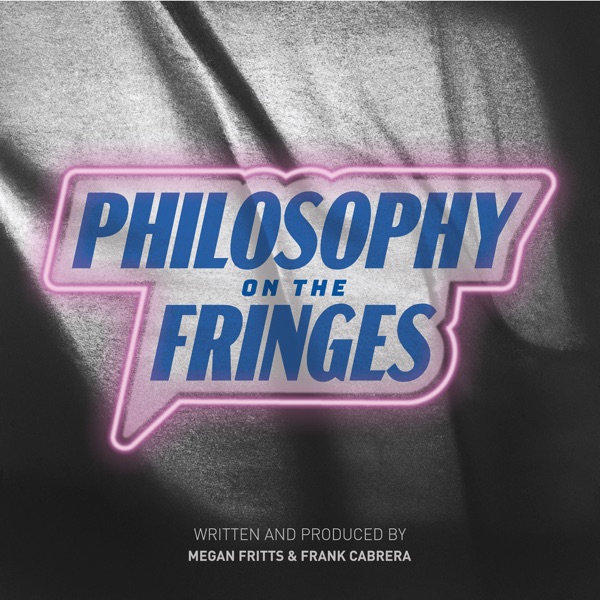
Philosophy on the Fringes
A couple of philosophy professors, Megan Fritts and Frank Cabrera, try to prove that you can do philosophy about almost anything. Join them as they explore the philosophical dimensions of topics on the outskirts of the academy. From Bigfoot to birthday parties, they take a Socratic approach to phenomena strange and mundane, asking listeners the question: What if we did philosophy on the fringes?
- Episodes
- 34
- Releases
- Monthly
- Typical length
- 1 hr
- On air since
- 2023
- Latest episode
- 1 month ago
Episodes
34 episodes, newest first
-
1 hr 3 min
Esotericism
Episode 34
Show notes
In this episode, Megan and Frank discuss esotericism, as both a type of, and approach to, knowledge. Are there hidden messages in the classic texts? Can some truths only be approached indirectly?
Special guest: Earl Fontanellle of The Secret History of Western Esotericism Podcast (SHWEP)
-----------------------
Hosts' Websites:
Email: philosophyonthefringes@gmail.com
-----------------------
Bibliography:
Strauss, L. - PERSECUTION AND THE ART OF WRITING | JSTOR
Melzer, A. - Philosophy Between the Lines: The Lost History of Esoteric Writing
The Esoteric Plato – The Secret History of Western Esotericism Podcast (SHWEP)
-----------------------
Cover Artwork by Logan Fritts
-------------------------
Music from #Uppbeat (free for Creators!):
https://uppbeat.io/t/simon-folwar/neon-signs
License code: 0RHIQO3EGPUDF8Z9
-
1 hr 8 min
MKUltra
Episode 33
Show notes
In this episode, Megan and Frank discuss the secret CIA mind control program known as MKUltra. Is mind control really possible? What ethical norms should govern human subjects research? And should those rules be flexible in the face of an existential threat?
To investigate some of these questions, this episode contains a guest interview with Dr. Justin Bernstein (University of Virginia). Dr. Bernstein joins the podcast to discuss questions relating to research ethics, the relationship between politics and morality, and trust in public health institutions.
Hosts' Websites:
Email: philosophyonthefringes@gmail.com
-----------------------
Bibliography:
Interim Framework for COVID-19 Vaccine Allocation and Distribution in the United States
Building trust while influencing online COVID-19 content in the social media world - PMC
Political Realism | Internet Encyclopedia of Philosophy
We Built Reality - Hardcover - Jason Blakely - Oxford University Press
Machiavelli - The Prince | Project Gutenberg
Rawls - A Theory of Justice: Revised Edition
-----------------------
Cover Artwork by Logan Fritts
-------------------------
Music from #Uppbeat (free for Creators!):
https://uppbeat.io/t/simon-folwar/neon-signs
License code: 0RHIQO3EGPUDF8Z9
-
59 min
Why We Should (Not?) Think About Weird Things
Episode 32
Show notes
In this episode, Megan and Frank reflect on the mission of Philosophy on the Fringes. Why think about "fringe" topics, such as near-death experiences, aliens, and past life memories? Are these topics any weirder than what passes for respectable in mainstream academic philosophy? And most important, does taking fringe topics seriously make one a crank?
To investigate some of these questions, this episode contains a guest interview with Dr. Joshua Blanchard (Oakland University). Dr. Blanchard joins the podcast to discuss the "problem of unwelcome epistemic company", the problem of finding yourself in agreement with some morally or intellectually suspect sources.
Hosts' Websites:
Email: philosophyonthefringes@gmail.com
-----------------------
Bibliography:
Joshua Blanchard, The Problem of Unwelcome Epistemic Company
Neil Levy, When Is Company Unwelcome?
Adam Piovarchy, How I Learned to Stop Worrying and Ignore Unwelcome Epistemic Company
-----------------------
Cover Artwork by Logan Fritts
-------------------------
Music from #Uppbeat (free for Creators!):
https://uppbeat.io/t/simon-folwar/neon-signs
License code: JY4SF4CQFTHS951X
-
1 hr
Dreams
Episode 31
Show notes
In this episode, Megan and Frank investigate dreams and dream interpretation. Are dreams random hallucinations? Hidden desires? Messages from the gods? What, if anything, can dreams tell us about ourselves, and how might media shape our dreaming experiences? Thinkers discussed include: Plato, Aristotle, Cicero, Artemidorus of Daldianus, Rene Descartes, Sigmund Freud, Carl Jung, Norman Malcom, Eric Schwitzgebel, and David Lynch.
Hosts' Websites:
Email: philosophyonthefringes@gmail.com
-----------------------
Bibliography:
Genesis 41 ESV - Joseph Interprets Pharaoh's Dreams - Bible Gateway
Daniel 2 NIV - Nebuchadnezzar’s Dream - In the - Bible Gateway
Sirach 34 GNT - Dreams Mean Nothing - Foolish people - Bible Gateway
Artemidorus' Oneirocritica - Daniel E. Harris-McCoy - Oxford University Press
Peter Thonemann - An Ancient Dream Manual: Artemidorus' The Interpretation of Dreams
The Internet Classics Archive | On Dreams by Aristotle
The Internet Classics Archive | On Prophesying by Dreams by Aristotle
LacusCurtius • Cicero — De Divinatione: Book I
Plato's Republic Book 9 [Allan Bloom's translation]
Sigmund Freud: The Interpretation of Dreams
Dreaming | Norman Malcolm | Taylor & Francis eBooks
Scientists entered people’s dreams and got them ‘talking’ | Science | AAAS
Human Behavior and Psychology | The Great Courses(Episode 14)
Eric Schwitzgebel - Why did we think we dreamed in black and white?
Dreaming, Philosophy of | Internet Encyclopedia of Philosophy
Descartes - Meditations on First Philosophy
-----------------------
Cover Artwork by Logan Fritts
-------------------------
Music from #Uppbeat (free for Creators!):
https://uppbeat.io/t/simon-folwar/neon-signs
License code: C2OWCCQD2KK3ERKO
-
1 hr
Aphantasia
Episode 30
Show notes
In this episode, Megan and Frank investigate aphantasia, the inability to generate mental imagery. What can aphantasia tell us about the nature of the mind, in particular, "the hard problem" of consciousness? Should aphantasia be considered a disorder, or merely another variation in human experience? And is it possible to meaningfully talk about our inner experiences, or would that necessarily constitute a kind of private language? Thinkers discussed include: Adam Zeman, Merlin Monzel, Elizabeth Barnes, Ludwig Wittgenstein, and Soren Kierkegaard.
Hosts' Websites:
Email: philosophyonthefringes@gmail.com
-----------------------
Bibliography:
Some People Can’t See Mental Images. The Consequences Are Profound | The New Yorker
Zeman et al. 2015 - Lives without imagery - Congenital aphantasia - PubMed
Krempel & Monzel 2024 - Aphantasia and involuntary imagery
Monzel et al. 2023 -Aphantasia within the framework of neurodivergence
The Private Language Argument | Issue 58 | Philosophy Now
Disability: Definitions and Models (Stanford Encyclopedia of Philosophy)
The Minority Body: A Theory of Disability | Oxford Academic
-----------------------
Cover Artwork by Logan Fritts
-------------------------
Music from #Uppbeat (free for Creators!):
https://uppbeat.io/t/simon-folwar/neon-signs
License code: QHFDPNIRFW3UXOH3
-
1 hr 6 min
The Prophecies of Nostradamus
Episode 29
Show notes
In this episode, Megan and Frank explore the prophecies of Nostradamus. Nostradamus was a prophet--but what is a prophet? What should we make of his seemingly accurate predictions of major world events? Do prophetic powers imply that the future is determined? Or are we simply bound to an immovable fate? And what, if anything, does Nostradamus have to tell us about our futures? Thinkers discussed include: Socrates, Plato, Aristotle, Friedrich Nietzsche, Brian Leiter, and David Foster Wallace.
Hosts' Websites:
Email: philosophyonthefringes@gmail.com
-----------------------
Bibliography:
Nostradamus : how an obscure Renaissance astrologer became the modern prophet of doom : Gerson, Stéphane (source for biographical details, anxiety vs. fear, and WWII propaganda)
The prophecies : a dual-language edition with parallel text : Nostradamus, 1503-1566
Nostradamus' grim predictions for 2026 revealed
David Foster Wallace and the Challenge of Fatalism | Blog of the APA
Future Contingents | Internet Encyclopedia of Philosophyhttps://www.gutenberg.org/files/51356/51356-h/51356-h.htm
The Birth of Tragedy, or Hellenism and Pessimism, by Friedrich Nietzsche.
The Twilight of the Idols, by Friedrich Nietzsche.
Brian Leiter- Moral Psychology with Nietzsche
Moral Psychology with Nietzsche | Reviews | Notre Dame Philosophical Reviews
Nietzsche’s Moral and Political Philosophy (Stanford Encyclopedia of Philosophy)
Intersubjective Accountability: Politics and Philosophy in the Left Vienna Circle
-----------------------
Cover Artwork by Logan Fritts
-------------------------
Music from #Uppbeat (free for Creators!):
https://uppbeat.io/t/simon-folwar/neon-signs
License code: AJWTULC6PYYNJ7BJ
-
1 hr 12 min
The Mandela Effect
Episode 28
Show notes
In this episode, Megan and Frank investigate the Mandela Effect. Why do so many people "remember" Nelson Mandela dying in prison in the 1980s, or the Fruit of the Loom logo as containing a cornucopia, or the existence of a movie starring Sinbad as a genie? What explains these collective mis-rememberings: parallel dimensions, a government cover-up, a glitch in the matrix? Or should we just conclude that human memory is inherently unreliable? How do false memories arise, and how can we distinguish the real from the imagined? Despite our cultural obsession with preserving every memory, could there be some value in forgetting the past? Thinkers discussed include Augustine of Hippo, Friedrich Nietzsche, Edmund Husserl, and Elizabeth Loftus.
Hosts' Websites:
Email: philosophyonthefringes@gmail.com
-----------------------
Bibliography:
The Visual Mandela Effect as Evidence for Shared and Specific False Memories Across People
The Deese-Roediger-McDermott (DRM) Task: A Simple Cognitive Paradigm to Investigate False Memories
Understanding Memory and the Human Lifespan | Plus
Loftus & Pickrell 1995 - The formation of false memories.
Chloe Wall - Knowing (from) me, knowing (from) you: Essays on memory and testimony
Total recall: the people who never forget | Memory | The Guardian
Nietzsche: 'On the Genealogy of Morality' and Other Writings
-----------------------
Cover Artwork by Logan Fritts
-------------------------
Music from #Uppbeat (free for Creators!):
https://uppbeat.io/t/simon-folwar/neon-signs
License code: OEYM6IYHOOWN8GSB
-
1 hr 7 min
Reiki & Alternative Medicine
Episode 27
Show notes
In this episode, Megan and Frank discuss the alternative medicine practice known as "Reiki," a kind of touch energy healing. What is Reiki, and how is it supposed to work? Is there scientific evidence of Reiki's effectiveness, or is it all just a placebo? And if so, would that really be a problem?
Hosts' Websites:
Email: philosophyonthefringes@gmail.com
-----------------------
Bibliography:
Frontiers | Does Reiki Benefit Mental Health Symptoms Above Placebo?
What is Reiki? Energy Healing and Chakra Work — Lisa Kern
Does Reiki Work? - The Atlantic
Evidence and explanation in Cicero's On Divination
Tylenol Is Popular and Safe, Yet Nobody Knows How It Works | Scientific American
Siegel - Predictive Analytics, Revised and Updated
The Phantom Pattern Problem - Gary Smith; Jay Cordes - Oxford University Press
A radical new hypothesis in medicine: give patients drugs they know don’t work | Vox
The weird power of the placebo effect, explained | Vox
The Power of Mind over Body | Plus
Placebos Work—Even Without Deception | Harvard Medical School
Hume, David: Causation | Internet Encyclopedia of Philosophy
Researchers are still working to prove that antidepressants are more effective than placebo
Medical Nihilism - Jacob Stegenga - Oxford University Press
-----------------------
Cover Artwork by Logan Fritts
-------------------------
Music from #Uppbeat (free for Creators!):
https://uppbeat.io/t/simon-folwar/neon-signs
License code: GAXUNUBZXURBJU22
-
1 hr
The Apocalypse
Episode 26
Show notes
In this episode, Megan and Frank examine the Apocalypse. How should we define "the apocalypse"? How does religious apocalyptic thought apply in a secular context? What are the dangers of apocalyptic thinking? And why do we always seem to be in the end times? This episode pays special attention to the book Apocalypse Without God: Apocalyptic Thought, Ideal Politics, and the Limits of Utopian Hope by Ben Jones. Other thinkers discussed include: Machiavelli, Hobbes, Engels, and Rawls.
Hosts' Websites:
Email: philosophyonthefringes@gmail.com
-----------------------
Bibliography:
Ben Jones - Apocalypse without God
Revelation 1 NIV - Prologue - The revelation from Jesus - Bible Gateway
The Rapture Was Predicted to Happen Today. TikTok Has Some Advice. - The New York Times
Opinion | An Interview With the Herald of the Apocalypse - The New York Times
Lectures on the History of Moral Philosophy — Harvard University Press
Roland Boer - Revelation and Revolution: Friedrich Engels and the Apocalypse
-----------------------
Cover Artwork by Logan Fritts
-------------------------
Music from #Uppbeat (free for Creators!):
https://uppbeat.io/t/simon-folwar/neon-signs
License code: ZFG8LUQL3TOVMSUP
-
1 hr 1 min
The Illuminati: Conspiracy Theories
Episode 25
Show notes
In this episode, Megan and Frank continue their discussion of the Illuminati. Here, the focus is on the afterlife of the Bavarian Order. How did conspiracy theories involving the Illuminati arise? Why is so much pop culture full of Illuminati imagery? And are there any good reasons to believe in such conspiracy theories? Thinkers discussed include: Dostoyevsky, Kierkegaard, and Maarten Boudry.
-----------------------
Hosts' Websites:
Email: philosophyonthefringes@gmail.com
-----------------------
Bibliography:
Michael Taylor- Illuminati in the US - American History Hit | Acast
The Secret School of Wisdom: The Authentic Rituals and Doctrines of the Illuminati (Primary source documents)
CATHOLIC ENCYCLOPEDIA: Illuminati
Kierkegaard - The Crowd is Untruth
The Grand Inquisitor, by Feodor Dostoevsky
Barruel - Memoirs Illustrating The History Of Jacobinism
From Thomas Jefferson to Bishop James Madison, 31 January 1800
Did an Illuminati Conspiracy Theory Help Elect Thomas Jefferson? - POLITICO
Nesta Webster - World revolution; the plot against civilization
Zionism versus Bolshevism - Churchill
Boudry, Maarten - Why We Should Be Suspicious of Conspiracy Theories. A Novel Demarcation Problem
[Reddit] why do the large shadow organizations leave clues that could lead to their downfall?
Megan Fritts & Frank Cabrera, Fake News and Epistemic Vice: Combating a Uniquely Noxious Market
Are Republicans and Conservatives More Likely to Believe Conspiracy Theories? - PMC
The psychological and political correlates of conspiracy theory beliefs
Is Conspiracy Theorising Irrational? - Neil Levy
Predictors of belief in conspiracy theory
Conspiracy theory and cognitive style: a worldview
-----------------------
Cover Artwork by Logan Fritts
-------------------------
Music from #Uppbeat (free for Creators!):
https://uppbeat.io/t/simon-folwar/neon-signs
License code: ZILRIT8XNZAA6LYZ
-
1 hr 4 min
The Illuminati: Bavarian Order
Episode 24
Show notes
In this episode, Megan and Frank investigate the Bavarian Order of the Illuminati, a secret society founded in 1776 by the Enlightenment philosopher Adam Weishaupt. This conversation covers who the Illuminati were, what they believed, and how they attempted to bring about a "new world order." Thinkers discussed include: Adam Weishaupt, Rousseau, Kant, Hegel, Marx, Mencius, and Alasdair MacIntyre.
-----------------------
Hosts' Websites:
Email: philosophyonthefringes@gmail.com
-----------------------
Bibliography:
The Secret School of Wisdom: The Authentic Rituals and Doctrines of the Illuminati (Primary source documents)
CATHOLIC ENCYCLOPEDIA: Illuminati
Illuminaten - Dictionary of Gnosis & Western Esotericism
Perfectibilists | Independent Publishers Group
After Virtue - A Study in Moral Theory - Alasdair MacIntyre
How Mengzi came up with something better than the Golden Rule | Aeon Ideas
-----------------------
Cover Artwork by Logan Fritts
-------------------------
Music from #Uppbeat (free for Creators!):
https://uppbeat.io/t/simon-folwar/neon-signs
License code: CUCILUBPXFZKKTOP
-
1 hr
The Enneagram
Episode 23
Show notes
In this episode, Megan and Frank investigate the Enneagram. Is the Enneagram a legitimate science of personality? What even is personality? And how much of our lives does personality determine? Join them as they examine the classic book, "Discovering Your Personality Type: The Essential Introduction to the Enneagram" by Don Richard Riso & Russ Hudson. Other thinkers discussed include: Aristotle, Friedrich Nietzsche, Karl Popper, Thomas Kuhn, and John Doris.
-----------------------
Hosts' Websites:
Email: philosophyonthefringes@gmail.com
-----------------------
Bibliography:
Don Richard Riso & Russ Hudson - Discovering Your Personality Type
Empirical Approaches to Moral Character (Stanford Encyclopedia of Philosophy)
Pseudoscience and the Demarcation Problem | Internet Encyclopedia of Philosophy
Beyond Good and Evil by Friedrich Nietzsche
Situationism, Moral Improvement, and Moral Responsibility | The Oxford Handbook of Moral Psychology
Virtue Ethics | Internet Encyclopedia of Philosophy
-----------------------
Cover Artwork by Logan Fritts
-------------------------
Music from #Uppbeat (free for Creators!):
https://uppbeat.io/t/simon-folwar/neon-signs
License code: O6ZNDALO7DL2LNHE
-
1 hr 8 min
Past Life Memories
Episode 22
Show notes
In this episode, Megan and Frank investigate the strange phenomenon of past life memories. Are past life memories evidence for reincarnation? Is what we remember a good guide to who we are? And how might a single identity span different lifetimes? Thinkers discussed in this episode include Plato, Pythagoras, Thomas Reid, J.M.E. McTaggart, and Michael Sudduth.
-----------------------
Hosts' Websites:
Email: philosophyonthefringes@gmail.com
-----------------------
Bibliography:
The Next Dalai Lama: Preparing for Reincarnation and Why It Matters to India
Claire White, Robert M. Kelly & Shaun Nichols, Remembering Past Lives
Thomas Reid, Essays on the Intellectual Powers of Man
Children Who Report Memories of Past Lives - Division of Perceptual Studies
The Case of James Leininger_ An American Case of the Reincarnation Type
Jim Tucker - Response to Sudduth’s “James Leininger Case Re-Examined”
The Science of Reincarnation—VIRGINIA Magazine
The Philosophy of Dr. McTaggart.
S2, Episode 6: The Self and Survival (Mar. 27th, 2018) – Hi-Phi Nation
New evidence shows false memories can be created | UW News
-----------------------
Cover Artwork by Logan Fritts
-------------------------
Music from #Uppbeat (free for Creators!):
https://uppbeat.io/t/simon-folwar/neon-signs
License code: ZMHYPZTDWFJ3QXU2
-
59 min
Prehistory
Episode 21
Show notes
In this episode, Megan and Frank discuss the philosophical dimensions of prehistory. What and when is the “prehistoric”? How was prehistory "discovered", and what explains our fascination with it? Is ancient archeology safe from our biases? And how did archaic man’s meaning-making differ from our own? Thinkers discussed include: Colin Renfrew, Hegel, Charles Taylor, Mircea Eliade, and Wittgenstein.
-----------------------
Hosts' Websites:
Email: philosophyonthefringes@gmail.com
-----------------------
Bibliography:
Prehistory: The Making of the Human Mind - Colin Renfrew
Hegel's Lectures on the Philosophy of History
Cave of Forgotten Dreams - Official Trailer | HD | IFC Films
Bewitched by an Elf Dart: Fairy Archaeology, Folk Magic and Traditional Medicine in Ireland - Dowd
A Secular Age — Harvard University Press
Theory and Observation in Science (Stanford Encyclopedia of Philosophy)
From things to thinking: Cognitive archaeology - Currie & Killin
Cognitive Archaeology and the Minimum Necessary Competence Problem - Killin & Pain
An Ape's View of the Oldowan - Wynn & McGrew
Neuroscience, evolution and the sapient paradox - Colin Renfrew
Sapient paradox: Why humans got stuck in prehistory -Gossip Trap- Big Think
The Myth of the Eternal Return | Princeton University Press
Eliade_Mircea_The_Sacred_and_The_profane_1963
Wittgenstein - Notebooks, 1914 - 1916, 2nd Edition | Wiley
-----------------------
Cover Artwork by Logan Fritts
-------------------------
Music from #Uppbeat (free for Creators!):
https://uppbeat.io/t/simon-folwar/neon-signs
License code: AAO0Q7IZMGVTLFJH
-
56 min
Astrology
Episode 20
Show notes
In this episode, Megan and Frank examine astrology. What is astrology, and why do people practice it? What are the strongest objections to astrology? Should astrology count as a science? If not, why not? What can the case of astrology teach us about the role of science in a democratic society? And why does the ancient practice of reading the stars prompt us to ponder the deepest aspects of human experience? Thinkers discussed include: Aristotle, Cicero, Ptolemy, Karl Popper, Thomas Kuhn, Imre Lakatos, Paul Feyerabend, Carl Sagan, Ian James Kidd, and Massimo Pigliucci.
-----------------------
Hosts' Websites:
Email: philosophyonthefringes@gmail.com
-----------------------
Bibliography:
Philosophy of Science and the Occult | State University of New York Press (first section is an invaluable resource, containing the 1975 manifesto, Feyerabend's critique, and articles summarizing statistical studies disconfirming astrology)
Cabrera - Evidence and explanation in Cicero's On Divination
LacusCurtius • Ptolemy — Tetrabiblos
LacusCurtius • Cicero — De Divinatione: Book I
A double-blind test of astrology | Nature
Readings in the Philosophy of Science: From Positivism to Postmodernism (See for short selections from Popper, Kuhn, and Lakatos)
Ian James Kidd - Why did Feyerabend Defend Astrology? Integrity, Virtue, and the Authority of Science (An excellent paper that very much informed our discussion of the science & society question)
M. Pigliucci - Was Feyerabend Right in Defending Astrology? A Commentary on Kidd
-----------------------
Cover Artwork by Logan Fritts
-------------------------
Music from #Uppbeat (free for Creators!):
https://uppbeat.io/t/simon-folwar/neon-signs
License code: YYRPW29K1IDMU76F
-
54 min
Ghosts and Hauntings
Episode 19
Show notes
In this episode, Megan and Frank investigate ghosts and hauntings. Are ghosts some kind of spirit, physical beings, or something in between? Is there a natural explanation for ghostly encounters? And what can ghosts teach us about the depths of human experience? Thinkers discussed include: Descartes, Philip Goff, and Beverley Clack.
-----------------------
Hosts' Websites:
Email: philosophyonthefringes@gmail.com
-----------------------
Bibliography:
Ghosts of Philosophy LaBossiere | A Philosopher's Blog
Victorian ectoplasm-producing mediums: freaks or fakes? | Children's books | The Guardian
Philip Goff, Ghosts and Sparse Properties
The wisdom of ghosts - Clack | Religious Studies | Cambridge Core
Braude, Immortal Remains: The Evidence for Life After Death
Podemore, et al. - Phantasms of the Living
The Best Ghost Story - by Alexander J. Zawacki
LEGION OF THE DAMNED - ghostwalkbrighton.co.uk
Time | Internet Encyclopedia of Philosophy
Megan Fritts, Arresting Time's Arrow: Death, Loss, and the Preservation of Real Union
-----------------------
Cover Artwork by Logan Fritts
-------------------------
Music from #Uppbeat (free for Creators!):
https://uppbeat.io/t/simon-folwar/neon-signs
License code: KKPO6KMRESVX1ZQD
-
55 min
Hypnosis
Episode 18
Show notes
In this episode, Megan and Frank examine hypnosis. What evidence is there that hypnosis is a real phenomenon, and why does hypnosis have a dubious reputation? Does hypnosis alleviate pain, or just mask it? What is the nature of hypnotic consciousness? And does hypnosis prove there’s no true self? Thinkers discussed include: William James, Ernest and Josephine Hilgard, Derek Parfit, Sigmund Freud, and Tim Bayne.
-----------------------
Hosts' Websites:
Email: philosophyonthefringes@gmail.com
-----------------------
Bibliography:
Uncovering the new science of clinical hypnosis
The Morpheus Clinic for Hypnosis
Hypnosis and Conscious States: The Cognitive Neuroscience Perspective
Hypnosis to quit smoking: What to know
Neural functional correlates of hypnosis and hypnoanalgesia: Role of the cingulate cortex
Hypnotic Suggestion and the Modulation of Stroop Interference
Hypnosis in the Relief of Pain
Mary Haight, Hypnosis and the Philosophy of Mind
Hypnosis in History - American Hypnosis Association
Hidden observer - Oxford Reference
Hidden Observer APA Dictionary
The split brain: A tale of two halves | Nature
Derek Parfit. Here's why he mattered. | Vox
Tim Bayne, Hypnosis and the unity of consciousness
Tim Bayne - The Unity of Consciousness | Oxford Academic (oup.com)
Bilingual “I Hear a Pickle/ Oigo Un Pepinello” (kidizen.com)
-----------------------
Cover Artwork by Logan Fritts
-------------------------
Music from #Uppbeat (free for Creators!):
https://uppbeat.io/t/simon-folwar/neon-signs
License code: DC5U47IEPMLOLTFG
-
49 min
Biohacking
Episode 17
Show notes
In this episode, Megan and Frank tackle the growing trend of "hacking" one's biology to increase longevity and possibly attain immortality. Are biohackers right to fear death, though? Would immortality be desirable? And is the human condition worth preserving? Thinkers discussed include: Epicurus, Bernard Williams, Schopenhauer, John Martin Fischer, Martha Nussbaum, and J.R.R. Tolkien.
-----------------------
Hosts' Websites:
Email: philosophyonthefringes@gmail.com
-----------------------
Bibliography:
What Is Biohacking And How Does It Work? – Forbes Health
Challenging Bryan Johnson On His “Never Die” Biohacking Protocol (youtube.com)
Letter to Menoeceus by Epicurus (mit.edu)
Is Death Bad for You? by Shelley Kagan (chronicle.com)
Williams on Immortality.pdf (nd.edu)
John Martin Fischer Response to Williams
Gift of Ilúvatar | The One Wiki to Rule Them All | Fandom
Schopenhauer - The vanity of existence
Brooke Alan Trisel, Human extinction and the value of our efforts
Being and Becoming in Modern Physics (Stanford Encyclopedia of Philosophy)
Megan Fritts, Arresting Time's Arrow: Death, Loss, and the Preservation of Real Union
-----------------------
Cover Artwork by Logan Fritts
-------------------------
Music from #Uppbeat (free for Creators!):
https://uppbeat.io/t/simon-folwar/neon-signs
License code: DEKZTEGOGV2Q0TH7
-
1 hr 23 min
Myths, Pt. 2
Episode 16
Show notes
In this episode, Megan and Frank continue their discussion of myths and mythology. Join them as they further explore different approaches to interpreting and understanding myth. How have creation myths differed across cultures? Should myth be regarded as an allegory? Is the point of myth to justify society’s norms? Is myth a tool for exploring the subconscious aspects of our minds? And do we have any use for myth in the modern world? Thinkers discussed include Joseph Cambell, Carl Jung, Karl Popper, and Mary Midgley.
-----------------------
Hosts' Websites:
Email: philosophyonthefringes@gmail.com
-----------------------
Bibliography:
Powell - A Short Introduction to Classical Myth (earlhaig.ca) (Chs. 2-3 for an excellent overview of theories of myth)
Classical Mythology - Prof. Vandiver (A great lecture series we learned a lot from)
Myth in Human History - Grant Voth (Another great lecture series we drew from)
Myth and Knowing: An Introduction to World Mythology (quoted a few times in the episode)
Teaching Jung - Kelly Bulkeley; Clodagh Weldon (Ch. 5 by Robert Segal was very helpful!)
Campbell's "Other" Monomyth - The Hero's Journey: Life's Great Adventure
A Secular Age — Charles Tayllor
Conjectures & Refutations - Karl Popper
The Myths We Live By - Mary Midgley
-----------------------
Cover Artwork by Logan Fritts
-------------------------
Music from #Uppbeat (free for Creators!):
https://uppbeat.io/t/simon-folwar/neon-signs
License code: LRDE4XFUJKAMEDIZ
-
51 min
Myths, Pt. 1
Episode 15
Show notes
In this episode, Frank and Megan discuss myths and mythology. What role has myth played in philosophy? What's the relationship between myths, history, and truth? And did the ancients really believe their myths? Join us as we engage with thinkers such as Thales of Miletus, Plato, Aristotle, Herodotus, Augustine, Paul Veyne, and R.G. Collingwood. This is the first part of a two-part episode.
-----------------------
Hosts' Websites:
Email: philosophyonthefringes@gmail.com
-----------------------
Bibliography:
Powell - A Short Introduction to Classical Myth (earlhaig.ca) (Main source for claims about history of word "mythos" and its use in Plato/Herodotus/Aristotle. Highly recommended!)
Lehoux - All things are full of gods": naturalism in the classical world
R. G. Collingwood - The Idea of History
The Herodotus - The Histories (See also BBC "In Our Time" podcast episode on Herodotus)
Thucydides - The History of the Peloponnesian War (See also BBC "In Our Time" podcast episode on Thucydides)
Plato’s Myths - (Stanford Encyclopedia of Philosophy)
Julia Annas - Plato's Myths of Judgement(Discusses Aristotle critique of Plato's geography in the myth in the Phaedo)
Paul Veyne - Did the Greeks Believe in Their Myths?
Dana L. Burgess - Review of Veyne's "Did the Greeks Beleive in Their Myths?"
Augustine - Two Books on Genesis
-----------------------
Cover Artwork by Logan Fritts
-------------------------
Music from #Uppbeat (free for Creators!):
https://uppbeat.io/t/simon-folwar/neon-signs
License code: VYYZJBODHJSDWNZP
Philosophy lists
More Philosophy shows picked out from the charts







More in Philosophy
Placed highest on Apple Podcasts' Philosophy chart right now