Podcast
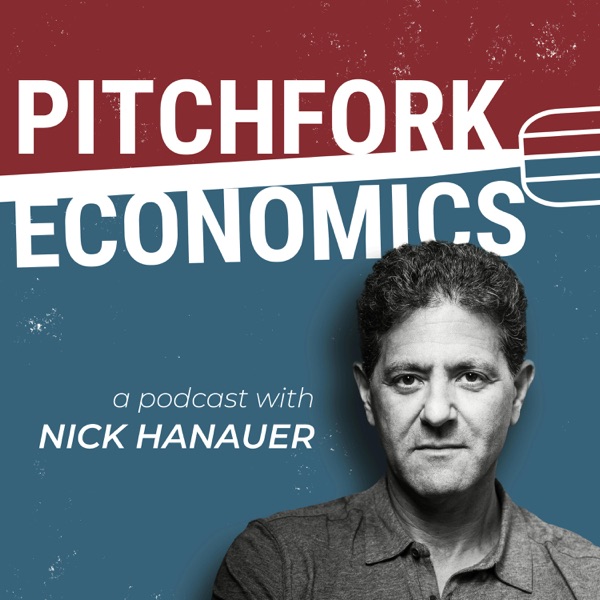
Pitchfork Economics with Nick Hanauer
We are living through a paradigm shift from trickle-down neoliberalism to middle-out economics — a new understanding of who gets what and why. Join zillionaire class-traitor Nick Hanauer and some of the world’s leading economic and political thinkers as they explore the latest thinking on how the economy actually works.
- News Commentary chart
- #65
- Episodes
- 460
- Releases
- Weekly
- Typical length
- 41 min
- On air since
- 2018
- Latest episode
- 17 hours ago
Episodes
460 episodes, newest first
-
37 min
Why Bosses Get Away With Stealing Your Wages (with Terri Gerstein)
Show notes
If you steal from your employer, you could end up in jail. But what happens when your employer steals from you?
Every year, employers steal billions of dollars from American workers through unpaid wages, overtime violations, and other illegal practices. Yet the consequences for employers are often little more than the cost of doing business.
On Election Day, we're revisiting our 2024 conversation with labor law enforcement expert Terri Gerstein about one of the most widespread and overlooked crimes in the American economy. Why is wage theft so common? Why are employers so rarely held criminally accountable? And what would it take to change that?
Because building an economy that works for working people isn't just about passing better laws. It's about having a government willing to enforce them.
This episode originally aired April 9, 2024
Terri Gerstein is the director of the NYU Wagner Labor Initiative and a leading expert on wage theft and workers’ rights enforcement. She previously served as Labor Bureau Chief in the New York Attorney General’s Office and Deputy Commissioner of the New York State Department of Labor.
Social Media:
Further reading:
The Regulatory Review - A Resilient Web of State and Local Enforcers
More than $1.5 billion in stolen wages recovered for workers between 2021 and 2023
How district attorneys and state attorneys general are fighting workplace abuses
Website: http://pitchforkeconomics.com/
Facebook: Pitchfork Economics Podcast
Bluesky: @pitchforkeconomics.bsky.social
Instagram: @pitchforkeconomics
Threads: pitchforkeconomics
TikTok: @pitchfork_econ
YouTube: @pitchforkeconomics
LinkedIn: Pitchfork Economics
Twitter: @PitchforkEcon, @NickHanauer
Substack: The Pitch
Nick’s Substack: http://nickhanauer.substack.com
-
40 min
Bonus Episode: Introducing Pitchfork Politics — Who Are the New Swing Voters? Bonus
Show notes
We're bringing you something new from the Pitchfork universe!
Today, we're sharing the debut episode of Pitchfork Politics, a new podcast hosted by Civic Ventures President Zach Silk and Middle Out Center Executive Director Richard Trent, exploring how to run and win on the economy.
In this first episode, Zach and Richard ask a question that could reshape how we think about American elections: Who are the new swing voters?
Today's most politically volatile voters are increasingly working-class Americans who want to know whether their paychecks can keep up with the cost of living.
From Alaska and Texas to Kansas and Maine, Zach and Richard explore what decades of political realignment can tell us about the coming election, why economic dissatisfaction keeps reshaping the electorate, and what it takes to turn electoral victories into lasting political power.
Enjoy this special preview, and be sure to follow Pitchfork Politics wherever you get your podcasts for more conversations about the economic ideas, messages, and campaigns shaping American politics.
-
47 min
Why Your Raise Doesn’t Feel Like a Raise (with Angela Hanks)
Show notes
You got a raise. So why does it feel like you’re still struggling?
New research finds that rising debt payments have swallowed more than half of real income gains for a typical one-earner household since late 2022. Angela Hanks of The Century Foundation joins Goldy and Paul to explain how debt is deepening America's affordability crisis, trapping workers in bad jobs, and weakening their bargaining power. And why fixing the problem requires more than just getting people out of debt.
Angela Hanks is Chief of Policy Programs at The Century Foundation and a coauthor of the report: Half of Every Dollar: How Household Debt Eats Into Workers’ Income Gains.
Social Media:
Further reading:
Half of Every Dollar: How Household Debt Eats Into Workers’ Income Gains
Men at Arms by Terry Pratchett
Sam Vimes ‘Boots’ Theory of Socio-Economic Unfairness
Website: http://pitchforkeconomics.com/
Facebook: Pitchfork Economics Podcast
Bluesky: @pitchforkeconomics.bsky.social
Instagram: @pitchforkeconomics
Threads: pitchforkeconomics
TikTok: @pitchfork_econ
YouTube: @pitchforkeconomics
LinkedIn: Pitchfork Economics
Twitter: @PitchforkEcon, @NickHanauer
Substack: The Pitch
Nick’s Substack: http://nickhanauer.substack.com
-
51 min
Anti-Fascist Economics (with Isabella Weber)
Show notes
What happens to democracy when people can no longer afford the basics of everyday life?
Economist Isabella Weber argues that the affordability crisis isn't just an economic problem—it's a threat to democracy itself. Drawing on her new book, Anti-Fascist Economics, she joins Nick and Goldy to explore how inflation, austerity, and corporate profiteering fuel the rise of the far right, and why protecting democracy requires more than defending its institutions. From housing and groceries to energy and healthcare, Weber makes the case for an economy that puts people's livelihoods, dignity, and democratic power ahead of corporate profits.
Isabella Weber is an associate professor of economics at the University of Massachusetts Amherst and founding director of Essential Economics. Her research focuses on inflation, corporate pricing power, and economic policy. She is the author of Anti-Fascist Economics: In Defense of Affordability, Dignity, and Democracy and How China Escaped Shock Therapy.
Social Media:
Further reading:
Anti-Fascist Economics: In Defense of Affordability, Dignity, and Democracy
Best of Times, Worst of Times: Record Fossil-Fuel Profits, Inflation and Inequality
How China Escaped Shock Therapy
The Wall Street Journal - America Made Me Very Rich. There's a Pro-Market Way to Give Back.
Website: http://pitchforkeconomics.com/
Facebook: Pitchfork Economics Podcast
Bluesky: @pitchforkeconomics.bsky.social
Instagram: @pitchforkeconomics
Threads: pitchforkeconomics
TikTok: @pitchfork_econ
YouTube: @pitchforkeconomics
LinkedIn: Pitchfork Economics
Twitter: @PitchforkEcon, @NickHanauer
Substack: The Pitch
Nick’s Substack: http://nickhanauer.substack.com
-
42 min
Housing Is a Market Power Problem (with Sandeep Vaheesan & Brian Callaci)
Show notes
Housing is still ridiculously expensive, and building more housing is absolutely part of the solution. But supply alone won’t fix a system where landlords have the power to jack up rents with the assistance of algorithms, and developers make more money building for the wealthiest in the market, rather than building homes a typical family can afford.
In this 2024 conversation, Brian Callaci and Sandeep Vaheesan join Nick and Goldy to explain why America’s housing crisis is about more than a shortage of homes. They dig into landlord power, RealPage and algorithmic rent-setting, tenant protections, rent stabilization, and why relying on private developers alone won’t produce enough housing that working- and middle-class families can actually afford.
They also make the case for a bigger public role in housing—including social housing and other public options that can create affordable homes without requiring every project to maximize private returns.
This episode originally aired December 10, 2024.
Brian Callaci is the Campaigns Director at the Strategic Organizing Center and the former chief economist at the Open Markets Institute. He is also the author of Chains of Command: The Rise and Cruel Reign of the Franchise Economy.
Sandeep Vaheesan is Legal Director at the Open Markets Institute, where he leads the organization’s legal advocacy and research, including its amicus program. His work focuses on antitrust, monopoly power, labor markets, and fair competition.
Further reading:
“The Market Alone Can’t Fix the U.S. Housing Crisis”
“Supply and the Housing Crisis: A Debate”
Social Media:
Website: http://pitchforkeconomics.com/
Facebook: Pitchfork Economics Podcast
Bluesky: @pitchforkeconomics.bsky.social
Instagram: @pitchforkeconomics
Threads: pitchforkeconomics
TikTok: @pitchfork_econ
YouTube: @pitchforkeconomics
LinkedIn: Pitchfork Economics
Twitter: @PitchforkEcon, @NickHanauer
Substack: The Pitch
Nick’s Substack: http://nickhanauer.substack.com
-
35 min
Who Is Industrial Policy Really For? (with Isabel Estevez)
Show notes
Industrial policy is back at the center of the economic debate. But tariffs, factories, and reshoring are only part of the story. In this 2023 conversation, development economist Isabel Estevez joins Nick and Goldy to argue that industrial policy is ultimately about choices: what we produce, how we produce it, and who benefits. She explains why a smart industrial strategy has to look beyond manufacturing output to workers, communities, climate, public investment, and the broader public good.
Because the real debate isn’t whether the government shapes markets. It already does. The question is what—and who—we’re shaping them for.
This episode originally aired August 1, 2023.
Isabel Estevez is an institutional and development economist and Co-Executive Director of i3T—Industry, Infrastructures and Innovation for Strategic Transformation. She previously served as Deputy Director of Industrial Policy and Trade at the Roosevelt Institute and as a Senior Policy Advisor at the Sierra Club.
Further reading:
How Can (Green) Industrial Policy Serve Human and Natural Flourishing?
The New Economics of Industrial Policy
Social Media:
Website: http://pitchforkeconomics.com/
Facebook: Pitchfork Economics Podcast
Bluesky: @pitchforkeconomics.bsky.social
Instagram: @pitchforkeconomics
Threads: pitchforkeconomics
TikTok: @pitchfork_econ
YouTube: @pitchforkeconomics
LinkedIn: Pitchfork Economics
Twitter: @PitchforkEcon, @NickHanauer
Substack: The Pitch
Nick’s Substack: http://nickhanauer.substack.com
-
31 min
When Companies Run the Courts: How Corporate Power Becomes Legal Power (with Brendan Ballou)
Show notes
We like to think that if a company cheats us, steals our wages, or breaks the law, we can take them to court. Unfortunately, there’s a good chance you’ve already signed that right away.
This week, Brendan Ballou returns to the podcast to explain how forced arbitration created what he calls America’s secret justice system—and why this is as much an economic story as a legal one. He joins Paul and Goldy to unpack how corporations use economic power to weaken workers’ and consumers’ legal power, why the myth of the “voluntary contract” falls apart when every option comes with the same fine print, and how making corporate misconduct harder to challenge changes the incentives that shape the entire market.
Brendan Ballou is the founder of the Public Integrity Project, a nonprofit anti-corruption law firm, and the author of When Companies Run the Courts: How Forced Arbitration Became America’s Secret Justice System.
Further reading:
When Companies Run the Courts: How Forced Arbitration Became America’s Secret Justice System
Plunder: Private Equity’s Plan to Pillage America
Social Media:
Instagram: @brendanballou
Substack: @brendanballou
Ask Pitchfork: Have a question for Nick, Goldy, or the show? Leave it in the comments on YouTube or Spotify with #askpitchfork.
Website: http://pitchforkeconomics.com/
Facebook: Pitchfork Economics Podcast
Bluesky: @pitchforkeconomics.bsky.social
Instagram: @pitchforkeconomics
Threads: pitchforkeconomics
TikTok: @pitchfork_econ
YouTube: @pitchforkeconomics
LinkedIn: Pitchfork Economics
Twitter: @PitchforkEcon, @NickHanauer
Substack: The Pitch
Nick’s Substack: http://nickhanauer.substack.com
-
46 min
Gouged: How Big Tech Reinvented the Rip-Off (with Lindsay Owens)
Show notes
For 150 years, the price tag made a simple and universal promise: the price you saw was the price everyone saw. Now, that promise is disappearing. This week, Lindsay Owens, President and CEO of the Groundwork Collaborative returns to discuss her new book, Gouged: The End of a Fair Price — And What That Means for Your Wallet. She explains how corporations are using algorithms, personal data, and AI to figure out not what something costs, but how much you personally are willing to pay. From Instacart’s grocery experiments to the coming world of AI shopping agents, the conversation asks a basic question: If nobody knows what the real price is, can markets actually work the way we’re told they do?
Lindsay Owens, PhD, is the President and CEO of Groundwork Collaborative, an economic policy think tank focused on corporate power, prices, and an economy that works for workers and families. She is also the author of Gouged: The End of a Fair Price — And What That Means for Your Wallet.
Social Media:
Further reading:
Gouged: The End of a Fair Price—and What That Means for Your Wallet
“Same Cart, Different Price: Instacart’s Price Experiments Cost Families at Checkout”
When the Invisible Hand Becomes An Algorithm with Lindsay Owens
How Outsized Corporate Profits Raised Prices with Lindsay Owens
Website: http://pitchforkeconomics.com/
Facebook: Pitchfork Economics Podcast
Bluesky: @pitchforkeconomics.bsky.social
Instagram: @pitchforkeconomics
Threads: pitchforkeconomics
TikTok: @pitchfork_econ
YouTube: @pitchforkeconomics
LinkedIn: Pitchfork Economics
Twitter: @PitchforkEcon, @NickHanauer
Substack: The Pitch
Nick’s Substack: http://nickhanauer.substack.com/
-
43 min
Can We Build a Common Good Economy? (with Mariana Mazzucato)
Show notes
Economics teaches us to think of markets as natural forces, and government as something that should only intervene when they fail. In her new book, The Common Good Economy: How to Make Capitalism Work for Us All, economist Mariana Mazzucato argues that story is backward. She joins Nick and Goldy to ask what changes when we recognize that markets are choices — shaped by rules, institutions, public investment, and power — and what that means for the kind of economy we could build instead.
If we designed this system, can we redesign it?
Mariana Mazzucato is a Professor in the Economics of Innovation and Public Value at University College London (UCL) and founding director of the UCL Institute for Innovation and Public Purpose. She is the author of several acclaimed books, including The Entrepreneurial State, The Value of Everything, Mission Economy, The Big Con, and most recently, The Common Good Economy: How to Make Capitalism Work for Us All.
Social Media:
Further reading:
The Common Good Economy: How to Make Capitalism Work for Us All
UCL Institute for Innovation and Public Purpose
Mission Economy: A Moonshot Guide to Changing Capitalism
The Great Transformation by Karl Polanyi
A Mission-Oriented Approach to School Meals
Mission-Oriented Public-Private Partnerships: Lessons from the Oxford–AstraZeneca COVID-19 Vaccine
Website: http://pitchforkeconomics.com/
Facebook: Pitchfork Economics Podcast
Bluesky: @pitchforkeconomics.bsky.social
Instagram: @pitchforkeconomics
Threads: pitchforkeconomics
TikTok: @pitchfork_econ
YouTube: @pitchforkeconomics
LinkedIn: Pitchfork Economics
Twitter: @PitchforkEcon, @NickHanauer
Substack: The Pitch
Nick’s Substack: http://nickhanauer.substack.com
-
34 min
The $29 Trillion Social Security Crisis We Already Know How to Fix ( with Rey Fuentes)
Show notes
Americans are told Social Security is in trouble because there are more retirees and fewer workers to support them. But that story leaves out a major part of the problem: how much income now sits outside the system that funds Social Security.
Roosevelt Institute’s Rey Fuentes joins Nick and Goldy to explain how rising inequality, stagnant wages, and an outdated payroll-tax structure helped create Social Security’s looming shortfall — and why benefit cuts are far from inevitable. Plus, Nick puts forward a different way to think about fixing the system — one that starts with a basic question: why should some kinds of income count toward Social Security while others don’t?
Rey Fuentes is Director of Strategic Initiatives at the Roosevelt Institute.
The $29 trillion figure in this episode’s title refers to Social Security’s projected 75-year unfunded obligation. According to the 2026 Social Security Trustees Report, the combined retirement, survivor, and disability programs are projected to have a $29.3 trillion financing shortfall, measured in present-value dollars, between 2026 and 2100. That is not $29 trillion that comes due when the retirement trust fund is projected to deplete its reserves in 2032.
Read the 2026 Social Security Trustees Report Summary
Social Media:
Further reading:
Social Security Doesn’t Need Cuts. The Fiscal Panic Is Missing Where the Money Is
1983 v. 2032: The Economics of the Last and Next Social Security Reform
What’s Actually Behind Social Security’s Trust Fund Shortfall
Website: http://pitchforkeconomics.com/
Facebook: Pitchfork Economics Podcast
Bluesky: @pitchforkeconomics.bsky.social
Instagram: @pitchforkeconomics
Threads: pitchforkeconomics
TikTok: @pitchfork_econ
YouTube: @pitchforkeconomics
LinkedIn: Pitchfork Economics
Twitter: @PitchforkEcon, @NickHanauer
Substack: The Pitch
Nick’s Substack: http://nickhanauer.substack.com
-
40 min
Profit, Power, and the Crisis of the Common Good (with Sen. Chris Murphy)
Show notes
Why do so many Americans feel powerless, lonely, and disconnected — and what does that have to do with our economy?
Senator Chris Murphy joins Nick and Goldy to discuss his new book, Crisis of the Common Good, which makes the case that America’s political crisis is inseparable from a deeper collapse of power, connection, and shared purpose.
They dig into the “cult of profit,” Market Humanism, AI, scarcity, corruption, and the limits of an economy organized around efficiency and extraction. It’s a conversation about what happens when profit becomes the highest measure of success, and what it would mean to build an economy rooted in dignity, connection, and the common good.
Senator Chris Murphy is the junior United States Senator for Connecticut
Social Media:
Further reading:
Crisis of the Common Good: The Fight for Meaning and Connection in a Broken America
Watch Nick Debate Obama Admin Economist Jason Furman: http://nickhanauer.substack.com
Website: http://pitchforkeconomics.com/
Facebook: Pitchfork Economics Podcast
Bluesky: @pitchforkeconomics.bsky.social
Instagram: @pitchforkeconomics
Threads: pitchforkeconomics
YouTube: @pitchforkeconomics
LinkedIn: Pitchfork Economics
Twitter: @PitchforkEcon, @NickHanauer
Substack: The Pitch
Nick’s Substack: http://nickhanauer.substack.com
-
43 min
Chains of Command: How Franchising Turned Control Without Responsibility Into a Business Model (with Brian Callaci)
Show notes
When you walk into a McDonald’s, it looks like one company. But legally, the person making your fries probably doesn’t work for McDonald’s at all. Brian Callaci, Chief Economist at the Open Markets Institute and author of Chains of Command, joins Nick and Goldy to explain how franchising became a blueprint for corporate control without responsibility — shifting risk, liability, and labor costs onto franchisees and workers while profits flow upward.
Brian Callaci is the chief economist at the Open Markets Institute and author of Chains of Command: The Rise and Cruel Reign of the Franchise Economy.
Social Media:
Further reading:
Chains of Command: The Rise and Cruel Reign of the Franchise Economy
Franchise: The Golden Arches in Black America by Marcia Chatelain
Sectoral bargaining FAQ: Collective bargaining, sectoral wage and standards boards, and worker power
Continental T.V., Inc. v. GTE Sylvania, Inc., 433 U.S. 36 (1977)
Website: http://pitchforkeconomics.com/
Facebook: Pitchfork Economics Podcast
Bluesky: @pitchforkeconomics.bsky.social
Instagram: @pitchforkeconomics
Threads: pitchforkeconomics
TikTok: @pitchfork_econ
YouTube: @pitchforkeconomics
LinkedIn: Pitchfork Economics
Twitter: @PitchforkEcon, @NickHanauer
Substack: The Pitch
-
41 min
The Joy of Money (with Carrie Joy Grimes)
Show notes
Most personal finance advice starts with the same basic premise: you’re doing money wrong. But Carrie Joy Grimes, founder of WorkMoney and author of The Joy of Money, says that misses half the story.
Yes, people need real tools to budget, save, pay down debt, and plan for the future. But no amount of discipline can fix an economy where wages are too low, costs are too high, and working people have lost power over the rules that shape their lives. This week, Nick and Goldy talk with Grimes about why money is “math and feelings,” how shame keeps people stuck, why so much financial advice is written for people who already have money, and why the best thing we can do is not teach people to be better at being poor — but build an economy where fewer people are poor in the first place.
Carrie Joy Grimes is the founder and CEO of WorkMoney and author of The Joy of Money. Before founding WorkMoney, she spent two decades as a union organizer fighting for higher wages, better benefits, and stronger worker power.
Social Media:
Carrie Joy Grimes
Work Money
Further reading:
The Joy of Money: How to Do More With and Feel Better About Your Money—No Matter How Much You Have
WorkMoney - Provides free tools, tips, and resources to help people lower their living costs, find financial assistance, and increase their overall income.
MoneyFinder - A bill-negotiation service launched by WorkMoney.
Website: http://pitchforkeconomics.com/
Facebook: Pitchfork Economics Podcast
Bluesky: @pitchforkeconomics.bsky.social
Instagram: @pitchforkeconomics
Threads: pitchforkeconomics
TikTok: @pitchfork_econ
YouTube: @pitchforkeconomics
LinkedIn: Pitchfork Economics
Twitter: @PitchforkEcon, @NickHanauer
Substack: The Pitch
-
45 min
What Happened to Liberal Democracy (with Nobel Prize-winning economist Daron Acemoglu)
Show notes
Nobel Prize-winning MIT economist Daron Acemoglu joins Nick and Goldy to discuss his new book, What Happened to Liberal Democracy? Remaking a Politics of Shared Prosperity. They explore why so many people have lost faith in democracy, how inequality and weakened worker power have reshaped politics, and why democracy has to deliver in people’s daily lives. They also dig into AI, automation, and whether new technology will concentrate even more wealth and power — or help build a more prosperous, democratic future.
Daron Acemoglu is a Nobel Prize-winning economist and Institute Professor at MIT. He is one of the world’s leading thinkers on political economy, institutions, inequality, technology, and the relationship between democracy and shared prosperity. His books include Why Nations Fail, The Narrow Corridor, and Power and Progress. His new book is What Happened to Liberal Democracy? Remaking a Politics of Shared Prosperity.
Social Media:
Further reading:
What Happened to Liberal Democracy? Remaking a Politics of Shared Prosperity
New York Times - Nearly 200 Economists and Tech Leaders Warn of A.I. Threats
NBER - Automation and Repression
Check out THE BILLIONAIRE AGE on IDEAS
Website: http://pitchforkeconomics.com/
Facebook: Pitchfork Economics Podcast
Bluesky: @pitchforkeconomics.bsky.social
Instagram: @pitchforkeconomics
Threads: pitchforkeconomics
TikTok: @pitchfork_econ
YouTube: @pitchforkeconomics
LinkedIn: Pitchfork Economics
Twitter: @PitchforkEcon, @NickHanauer
Substack: The Pitch
-
40 min
What Happens When the Other Washington Stops Enforcing Antitrust? (with WA State Attorney General Nick Brown)
Show notes
Paramount Skydance wants to merge with Warner Bros. Discovery in a $111 billion deal that would put even more of Hollywood—and two major newsrooms—under one corporate roof.
Washington State Attorney General Nick Brown joins Nick and Goldy to explain why a coalition of states is suing to stop it, how they forced Paramount to pause the merger, and why state attorneys general are increasingly stepping in as the federal government retreats from antitrust enforcement. They also discuss the successful fights against Live Nation–Ticketmaster and Kroger–Albertsons—and what happens when corporations become powerful enough to escape competition.
Nick Brown is the Attorney General of Washington State
Social Media:
Further reading:
Washington Post - Washington state is suing Paramount. Here’s why.
Washington State Office of the Attorney General
Check out THE BILLIONAIRE AGE on IDEAS
Website: http://pitchforkeconomics.com/
Facebook: Pitchfork Economics Podcast
Bluesky: @pitchforkeconomics.bsky.social
Instagram: @pitchforkeconomics
Threads: pitchforkeconomics
TikTok: @pitchfork_econ
YouTube: @pitchforkeconomics
LinkedIn: Pitchfork Economics
Twitter: @PitchforkEcon, @NickHanauer
Substack: The Pitch
-
42 min
The Good Life Economy (with Elizabeth Wilkins)
Show notes
What is the economy for — GDP, corporate profits, or people?
This week, Nick and Goldy talk with Elizabeth Wilkins, President and CEO of the Roosevelt Institute, about Roosevelt’s new Good Life Agenda and why so many old assumptions about markets, government, and growth are suddenly up for grabs. It’s a conversation about human flourishing, public power, and what democracy has to deliver if people are going to believe in it again.
Elizabeth Wilkins is the President and CEO of the Roosevelt Institute.She previously served as Chief of Staff to the Chair and Director of the Office of Policy Planning at the Federal Trade Commission. She has also held senior roles in the White House and the Office of the Attorney General for the District of Columbia, clerked for Justice Elena Kagan and then-Judge Merrick Garland. She began her career as a labor organizer with SEIU 32BJ. She is one of the authors of Roosevelt’s new report, The Good Life: An Agenda for Fuller Lives, a Stronger Economy, and Renewed Trust.
Social Media:
@elizabethwwilkins.bsky.social
Further reading:
The Good Life: An Agenda for Fuller Lives, a Stronger Economy, and Renewed Trust.
Website: http://pitchforkeconomics.com/
Facebook: Pitchfork Economics Podcast
Bluesky: @pitchforkeconomics.bsky.social
Instagram: @pitchforkeconomics
Threads: pitchforkeconomics
TikTok: @pitchfork_econ
YouTube: @pitchforkeconomics
LinkedIn: Pitchfork Economics
Twitter: @PitchforkEcon, @NickHanauer
Substack: The Pitch
-
37 min
Myths That Built Trickle-Down Economics: Productivity Doesn’t Trickle Down (with Preston Mui)
Show notes
Some of the world’s richest executives are selling AI as the engine of a yet-to-be realized “historic” productivity boom — while warning that it will also eliminate millions of jobs. But if workers absorb the disruption while the gains flow upward, that isn’t shared prosperity. It’s trickle-down economics with better software.
In the final installment of Myths That Built Trickle-Down Economics archive miniseries, we’re returning to Nick and Goldy’s conversation with economist Preston Mui about why productivity is a policy choice. Mui explains how full employment, sustained public investment, resilient supply chains, and affordable essentials create the conditions for workers and businesses to produce more value.
Technology may help us build a more productive economy. Policy will determine who benefits from it.
This episode originally aired April 2, 2024.
Preston Mui is a senior economist at Employ America specializing in macroeconomics, labor economics, productivity, and Federal Reserve policy.
Social Media:
Further reading:
Post-ECI note: The Supply-side May Spoil Warsh's Productivity Story
The Dream of the 90s is Slipping Away in 2025
Early Estimates of the Impact of AI
Within BEA’s Industry Economic Accounts
Our Mission In An Age Of Turbulence: Creating A New Economic Policy Toolkit
Website: http://pitchforkeconomics.com/
Facebook: Pitchfork Economics Podcast
Bluesky: @pitchforkeconomics.bsky.social
Instagram: @pitchforkeconomics
Threads: pitchforkeconomics
TikTok: @pitchfork_econ
YouTube: @pitchforkeconomics
LinkedIn: Pitchfork Economics
Twitter: @PitchforkEcon, @NickHanauer
Substack: The Pitch
-
49 min
Myths That Built Trickle-Down Economics: Austerity Politics (with Clara Mattei)
Show notes
This week, we’re continuing our archive miniseries, Myths That Built Trickle-Down Economics, with the myth that austerity is responsible economic policy.
We’re revisiting this conversation now because the austerity playbook is still very much alive. The Trump administration and DOGE have cut federal agencies, pushed out public servants, and treated public infrastructure like waste — even though those are the systems we need most during a crisis. And if the economy turns downward, politicians will almost certainly reach for the same old answer: slash public support, make working people pay the price, and call it responsibility.
Nick and Goldy talk with professor and political economist Clara Mattei, author of The Capital Order: How Economists Invented Austerity and Paved the Way to Fascism, about how austerity became one of the most powerful myths of modern capitalism, how economists helped sell it as common sense, and why it has always been about more than budgets.
Clara Mattei is a professor of economics at the University of Tulsa, Founding President of FREE: Forum for Real Economic Emancipation, and author of The Capital Order: How Economists Invented Austerity and Paved the Way to Fascism and Escape from Capitalism: An Intervention.
This episode originally aired on December 12, 2023.
Social Media:
Further reading:
The Capital Order: How Economists Invented Austerity and Paved the Way to Fascism
U.S. Treasury: The U.S. Economic Recovery in International Context
CBPP: Robust COVID Relief Bolstered Economy and Reduced Hardship for Millions
GAO: Federal Agency Workforce Changes
Website: http://pitchforkeconomics.com/
Facebook: Pitchfork Economics Podcast
Bluesky: @pitchforkeconomics.bsky.social
Instagram: @pitchforkeconomics
Threads: pitchforkeconomics
TikTok: @pitchfork_econ
YouTube: @pitchforkeconomics
LinkedIn: Pitchfork Economics
Twitter: @PitchforkEcon, @NickHanauer
Substack: The Pitch
-
45 min
Myths That Built Trickle-Down Economics: Zombie Economics (with Paul Krugman)
Show notes
This week, we’re continuing our archive miniseries, Myths That Built Trickle-Down Economics, with the myth that bad economic ideas die once the evidence proves them wrong.
They don’t. They come back as zombie ideas: tax cuts for the rich sold as growth policy, safety-net cuts sold as responsibility, and market fundamentalism sold as common sense. These ideas have failed again and again, but they keep returning because they still serve the people and institutions with the most power.
In this episode, Nobel Prize-winning economist Paul Krugman joins Nick and Goldy to explain why zombie economics refuses to die, how bad assumptions infected mainstream economic thinking, and why defeating trickle-down economics requires more than better evidence — it requires naming the myths that keep shaping our politics.
This episode originally aired on March 31, 2020.
Paul Krugman is a Nobel Prize-winning economist, professor, author, and former New York Times columnist. His book Arguing with Zombies: Economics, Politics, and the Fight for a Better Future examines the failed economic ideas that continue to dominate American policy debates.
Social Media:
Further reading:
Arguing with Zombies: Economics, Politics, and the Fight for a Better Future
CBO: Estimated Distributional Effects of the One Big Beautiful Bill Act
KFF: Tracking Implementation of the 2025 Reconciliation Law: Medicaid Work Requirements
CBPP: The 2017 Trump Tax Law Was Skewed to the Rich, Expensive, and Failed to Deliver
EPI: Setting High Standards for a Federal Minimum Wage
Tax Foundation: Who Pays Tariffs? Americans Will Bear the Costs of Tariffs
Website: http://pitchforkeconomics.com/
Facebook: Pitchfork Economics Podcast
Bluesky: @pitchforkeconomics.bsky.social
Instagram: @pitchforkeconomics
Threads: pitchforkeconomics
TikTok: @pitchfork_econ
YouTube: @pitchforkeconomics
LinkedIn: Pitchfork Economics
Twitter: @PitchforkEcon, @NickHanauer
Substack: The Pitch
-
48 min
Myths That Built Trickle-Down Economics: Shareholder Value (with William Lazonick and Lenore Palladino)
Show notes
This week, we’re continuing our archive miniseries, Myths That Built Trickle-Down Economics, with the myth that corporations exist to maximize shareholder value.
For decades, Americans were sold the idea that if corporations focused on boosting stock prices and rewarding shareholders, prosperity would trickle down to workers, consumers, and communities. Instead, shareholder primacy helped justify stock buybacks, wage suppression, layoffs, and underinvestment — extracting wealth from the real economy and funneling it upward.
In this episode, Nick and Goldy talk with William Lazonick and Lenore Palladino about how shareholder value became one of the core myths of trickle-down economics, why it has caused so much damage, and what it would mean to build corporations around workers, consumers, communities, and long-term prosperity instead.
This episode originally aired on February 19, 2019.
Lenore Palladino is associate professor of economics and public policy at the University of Massachusetts Amherst, a senior fellow at the Roosevelt Institute, and author of Good Company: Economic Policy After Shareholder Primacy.
William Lazonick is professor emeritus of economics at the University of Massachusetts Lowell and co-founder and president of the Academic-Industry Research Network.
Social Media:
Further reading:
Good Company: Economic Policy After Shareholder Primacy
Washington Center for Equitable Growth - To restore democracy, end shareholder primacy at U.S. corporations and on Wall Street
Roosevelt Institute - Regulating Stock Buybacks: The $6.3 Trillion Question
Roosevelt Institute - Ending Shareholder Primacy in Corporate Governance
Website: http://pitchforkeconomics.com/
Facebook: Pitchfork Economics Podcast
Bluesky: @pitchforkeconomics.bsky.social
Instagram: @pitchforkeconomics
Threads: pitchforkeconomics
TikTok: @pitchfork_econ
YouTube: @pitchforkeconomics
LinkedIn: Pitchfork Economics
Twitter: @PitchforkEcon, @NickHanauer
Substack: The Pitch
News Commentary lists
More News Commentary shows picked out from the charts






More in News Commentary
Placed highest on Apple Podcasts' News Commentary chart right now