Podcast
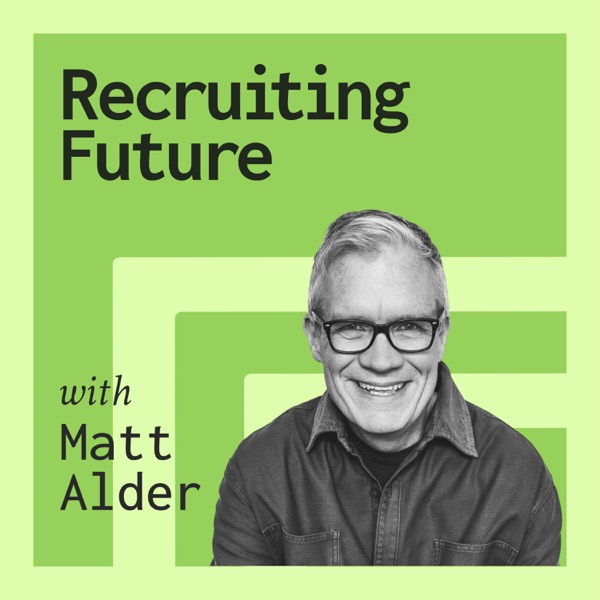
Recruiting Future with Matt Alder - What's Next For Talent Acquisition, HR & Hiring?
Talent acquisition is undergoing unprecedented disruption as AI, economic uncertainty, and the ever-shortening lifespan of skills radically reshape recruiting. On Recruiting Future, Matt Alder explores this evolving landscape, using insightful interviews with transformational TA practitioners and forward-thinking experts to spark your imagination and provide the insights you need to shape the future of talent acquisition in your organization.
Each episode explores topics such as AI, recruiting automation, recruitment marketing, employer branding, skills-based hiring, assessment, candidate experience, DEI, internal mobility, and the transformation of TA teams. Recruiting Future is an essential resource for everyone involved in hiring.
Matt Alder is a globally respected talent acquisition futurist, author, and speaker with over 25 years of experience exploring what’s next in recruiting. Renowned for his expertise in strategic foresight and technology trends, Matt provides a unique perspective that empowers leaders to navigate disruption. His deep industry knowledge and ability to spark meaningful conversations make Recruiting Future a must-listen for talent acquisition and HR professionals everywhere.
- Careers chart
- #128
- Episodes
- 916
- Releases
- Twice a week
- Typical length
- 25 min
- On air since
- 2015
- Latest episode
- 5 days ago
Episodes
916 episodes, newest first
-
32 min
Six Predictions For AI In HR
Episode 834
Show notes
There is no shortage of predictions about AI in HR and hiring at the moment. Most of them come from analysts, vendors and commentators looking in from the outside. Far more useful, and much harder to come by, is the perspective of someone actually doing the work, running the transformation and making these changes inside their own organization. That is exactly why I wanted to talk to this week's guest.
My guest is Vic Akosile, Head of AI Transformation and People Strategy at Cloudflare, where he also serves as Chief of Staff to the Chief People Officer. He sent me a set of predictions for AI in HR in 2027, and they make a great framework for understanding what is really changing and what it means for the people doing this work. In our conversation, Vic talks me through those predictions and what each one looks like in practice.
In the interview, we discuss Vic's predictions, including:
• More HR teams will build and maintain their own AI agents and applications
• HR functions will appoint internal AI product leaders
• Businesses will judge AI on much more than time saved or cost avoided
• Employees who get faster with AI will hide that they are using it
• Work design will come before headcount planning
• Recruiters will use live exercises and work samples to assess judgment
• What the longer-term future holds beyond 2027
-
27 min
Deciding What Not To Automate In Hiring
Episode 833
Show notes
AI can automate a large and growing share of the recruiting process, and within a few years it may be capable of handling almost all of it.
For employers, the question is what AI should be doing in hiring, not simply what it could, and that means deciding where people still need to be involved.
Human in the loop is the standard response, but it can amount to little more than a person reviewing and approving what the AI recommends. A recruiter in that position becomes a validator rather than a decision maker, and a process built that way can feel just as impersonal as one with no human in it at all.
Human in the loop is not the same as human agency, where recruiters apply their own judgment, context, and knowledge of the business to the decision.
So how should employers decide not just where people belong in the process, but what they are there to do?
My guest this week is Rob Devlin, founder of Devlin Talent.. In our conversation, Rob explains why the problem has to come before the technology, what human agency looks like in practice, what recruiters should do with the time AI gives back, and how choosing which parts of hiring to keep human can become a competitive advantage.
In the interview, we discuss:
• Starting with the problem, not the product
• What should AI be doing, rather than what could it do?
• Why AI won't fix a broken process
• Using AI to improve the intake meeting
• Human in the loop versus human agency
• What to deliberately choose not to automate
• Six lenses for looking at any AI decision
• Where human conversations create competitive advantage
• What TA leaders can build themselves before buying new technology
• Why the AI decisions being made today are designing the future of work
-
38 min
Round Up September 2026
Show notes
If you've not listened to Round Up before, it's a short review of the episodes that I've published in the last month to make sure you don't miss out on the valuable insights that my guests are sharing.
This month Round Up returns to its live format, and this is a recording of my live conversation with Jim Miller VP of People & Talent at Ashby about four of the episodes published in September 2026
Episodes featured in this Round Up:
Ep 823: How AI Is Disrupting Entry Level Jobs
Ep 824: Is AI Creating Talent Debt?
-
25 min
The Human Side Of AI Readiness
Episode 832
Show notes
AI is moving from a specialist technology to something employees in large parts of the organization are increasingly expected to be using. Skills, mindsets, and long-established habits are much harder to change than software, which is why meeting that expectation is proving difficult. If the challenge is mainly a human one, AI readiness is as much a matter for HR and talent leaders as for technology teams. So what does it take to get a workforce ready for AI, and what opportunity does that create for talent leaders?
My guest this week is Dr. Michael Housman, Co-Founder and CEO of AI Performance Lab. Michael has spent 17 years building AI and machine learning platforms, and now helps leadership teams around the world adopt AI. In our conversation, he explains what the human aspect of AI readiness means in practice, why execution matters more than strategy, and why HR and talent leaders are well-placed to lead the change.
In the interview, we discuss:
• What has changed since AI went mainstream, and what hasn't
• Why AI readiness is a question of mindset, culture, and skills
• Treating AI as a digital colleague rather than a tool
• Exponential innovation, flat adoption, and an hour a day of AI playtime
• The companies leading on AI are growing headcount, not cutting it
• Why a strategy deck is not the same as execution
• Deciding where humans stay in the loop, and the risk of skills atrophy
• Why this is a unique moment for HR and talent leaders
• Why experience and AI skills together are such a powerful combination
• What does the future look like when adoption can't keep pace with innovation?
-
19 min
The Talent Employers Are Throwing Away
Episode 831
Show notes
Redundancies have become a constant feature of the talent market. AI is taking a lot of the blame, but the drivers behind this are much broader. Jobs and skills are changing faster than most organizations can keep track of and the conventional response is to restructure the workforce and then hire in the new skills that are needed. That approach relies on a ready supply of perfectly qualified candidates, and in a fast-moving skills market those candidates are increasingly hard to find. It also assumes that employers already have a clear view of the skills and potential within their existing workforce, which is rarely the case.
So what does a smarter approach to restructuring look like?
My guest this week is JC Townend, President of The Adecco Groupfor the UK and Ireland and CEO of LHH, the Adecco Group business that supports individuals through redundancy. In the UK alone, LHH works with more than 20,000 people a year who have been made redundant, which gives JC a rare view of both the decisions employers are making and where the people affected end up next. In our conversation, she explains what is really driving the current wave of restructuring, why the financial case for replacing people rather than redeploying them has changed, and how the best employers are rethinking workforce planning.
In the interview, we discuss:
• How the pattern of restructuring has changed over the last eight years
• What is really driving the current wave of redundancies
• AI, automation and the skills mismatch that goes well beyond them
• Why companies understand skills within teams but not across them
• The employers letting people go and then rehiring for similar skills
• Why the perfectly qualified external candidate is getting harder to find
• Changing how internal moves are perceived and helping people sell their transferable skills
• Agile workforce planning and a matrix of opportunities rather than a single career ladder
• Five careers in a lifetime, all at the same company, and what the future looks like
Connect with JC on LinkedIn:
https://www.linkedin.com/in/jeannetownend/
Read the 2026 LHH Career Redeployment and Outplacement Trends Report:
https://www.lhh.com/en-gb/insights/the-mobility-breakdown
-
26 min
Is AI Anxiety Holding TA Teams Back?
Episode 830
Show notes
There is a lot of pressure on talent acquisition to adopt AI, and the discussion about how to do it tends to focus on tools and skills. With layoffs attributed to AI in the headlines, the people in TA teams have good reason to feel anxious about the technology they are being asked to use. That anxiety makes people less willing to experiment, and addressing it has less to do with the technology than with how leaders handle uncertainty.
So what does it take to move a recruiting team from anxiety about AI to confidence in using it?
My guest this week is Jennifer Rozon, Division President of McLean & Company, a global HR research and advisory firm whose recent research looks at leadership and AI transformation.
In our conversation, Jennifer explains what is driving AI anxiety, how leaders can give their teams the confidence to experiment, and the risks of relying too heavily on AI and cutting entry-level roles.
In the interview, we discuss:
• What is driving AI anxiety in the workforce?
• Why AI anxiety should not be mistaken for resistance to technology
• Leading through uncertainty when you don't have all the answers
• How leaders can give their teams the confidence to experiment
• How structures, incentives and culture can work against leaders
• What is cognitive debt and why does it matter?
• What happens to future leadership pipelines when entry-level roles disappear?
• Redesigning entry-level roles around the work AI creates
• Why current experience is becoming a less reliable basis for hiring and succession
• What does the future look like?
-
23 min
What TA Leaders Are Talking About Now
Episode 829
Show notes
TA leaders have to keep delivering for the business while they use AI to transform how hiring works. At RecFest USA in Nashville, AI was the main topic of conversation, although the people I spoke to talked about much more than the technology. So where should TA leaders be focusing their attention?
I recorded seven short interviews at the event, and they fall into three themes. Those themes are the value that talent acquisition brings to the business, the risks that employers now have to manage, and what comes next for hiring.
My guests are Jamie Leonard, Founder of RecFest; Stef Nikitas, Director of Talent Acquisition at Ace Hardware; Julia Levy, a former Fortune 500 talent acquisition executive; Jim Stroud, Head of Market Strategy and Industry Engagement at ProvenBase; Lorna Erickson, Co-Founder of Expert Interviewers; Mark Chaffey, Co-Founder and CEO of hackajob, the company behind Archer; and Ben Russell, Co-Founder and CCO of SonicJobs. In our conversations, they discuss who should own quality of hire, how employers are responding to legal risk and candidate fraud, and how AI is changing the way candidates and employers find each other.
In the interview, we discuss:
• The growing conversation about how TA aligns with business goals
• Who should own quality of hire and how should it be measured?
• The compliance and legal pitfalls around AI and pay transparency
• How to check for candidate fraud without making the process harder for real candidates
• The lack of trust between candidates and recruiters
• How job seekers are using large language models to look for work
• What generative engine optimization means for employers
• Is agent-to-agent hiring the future of talent acquisition?
-
25 min
Managing Career Transitions
Episode 828
Show notes
The world of work is changing quickly, and the way people move between roles is changing with it. Hiring for senior positions looks very different from the way it did even five years ago, while many people still approach their own careers with instincts shaped by a market that no longer exists.
What does it mean to manage a career well in this environment, and how do the people who navigate transitions successfully approach them differently?
My guest this week isKelly O. Kay, Global Managing Partner of the Enterprise Software and AI Practice at Heidrick & Struggles. Kelly has spent more than twenty years in executive search, and together with his longtime colleague Jeff Sanders he has just published Show Up to Win, a Harvard Business Review Press book on how leaders should manage their careers and navigate transitions.
In our conversation, he explains how hiring at the top has changed, why career management needs to be a continuous and strategic activity, where AI does and doesn't fit into the process, and what people misunderstand about the way search firms work.
In the interview, we discuss:
• How hiring at the most senior level has changed
• What the best leaders do to get the best roles
• Career management as a continuous process, not a response to wanting to move
• Quality of company, quality of role, quality of offer
• Showing them how you think via executive dialogue rather than question and answer
• What people misunderstand about how search firms work
• Using AI as an interview coach
• What does the future of leadership careers look like?
-
34 min
Ep 827: Agent To Agent Recruiting
Episode 827
Show notes
Recruiting is generating more activity than ever and less connection. Candidates are using AI to produce polished applications at scale, employers are using AI to screen and reach out at scale, and the result is a level of noise that is eroding trust on both sides. More automation applied to the same processes will only make this worse. Solving it means rethinking how matching works, with depth of understanding on both sides and transparency and fairness designed in from the start. So what does that look like in practice?
My guest this week is Matt Wilson, Co-founder and CEO of Jack and Jill, whose AI agents work on both sides of the hiring market. In our conversation, Matt shares why supercharging existing processes deepens the noise problem, how transparency and independent auditing build trust in AI matching, and where human judgment remains essential.
In the interview, we discuss:
• Why job hunting is still an inefficient, luck-based process
• How AI is supercharging broken processes and creating noise on both sides of hiring
• Building trust in agentic driven processes
• Bias, fairness, and transparency
• Challenging deep-seated beliefs about how recruiting gets done
• Where human judgment remains essential in the hiring process
• How Jack and Jill manage their own hiring process
• What does agent-to-agent recruiting mean for the future of hiring?
-
25 min
Do AI Interviews Work?
Episode 826
Show notes
AI is becoming more embedded across recruiting tools, but there is a meaningful difference between AI that automates workflows behind the scenes and AI that talks directly to candidates. When AI conducts the conversation, the stakes are higher; the first interaction shapes how candidates perceive the employer and the role. That is why many talent acquisition teams remain cautious about AI interviews, even as they adopt AI everywhere else. A growing number of enterprises are now running AI interviews at scale in high-volume hiring, and the data coming back on candidate experience and quality of hire improvements is difficult to ignore.
So what does that evidence show, and what should it mean for how the industry thinks about AI in hiring?
My guest this week is Dave Vu, Co-Founder and COO of Ribbon, who spent 15 years in talent and people leadership before co-founding the AI interview platform. In our conversation, Dave shares what enterprises are reporting from deploying AI interviews across thousands of candidates, how those candidates are responding, and what this could mean for the future of hiring.
In the interview, we discuss:
• The shift from AI experimentation to enterprise deployment
• The difference between back-office AI and candidate-facing AI
• Moving from chatbots to natural conversations
• The impact on the candidate experience
• Building candidate trust and AI interviewing
• Improving speed, efficiency and quality of hire
• Detecting cheating and protecting interview integrity
• How will AI interviewing evolve over the next few years
-
27 min
The Real Risks Of Candidate Fraud
Episode 825
Show notes
Remote hiring, freely available deepfake tools and harvested identities have created an opportunity that organized criminals are now taking seriously. State-backed operations are training workers to apply for remote roles using stolen credentials and proxy interviewers. The aim is the salary and access to source code, customer data and intellectual property once they are inside. Recruiters are the ones meeting these people first, and in most organizations they are assessing them with a background check and their own judgment while IT, InfoSec and legal are rarely involved. So how seriously should employers be treating this, and what does a credible response look like?
My guest this week is Lauren Furey, Principal Product Manager at Proof, where she leads product work on candidate fraud and identity verification. In our conversation, Lauren explains how these attacks work, where hiring processes are most exposed, and what TA teams can do about it.
In the interview, we discuss:
• Bots, deepfakes, identity harvesting and proxy interviewers
• The criminal motivations behind state-backed infiltration
• Why the background check is no longer enough on its own
• How much recruiters overestimate their ability to spot a fake
• Why remote hiring created the gaps bad actors exploit
• Building identity continuity through the hiring process
• Making fraud prevention a shared responsibility with IT and InfoSec
• The candidate experience trade-off and where to place verification
• Verifiable credentials and protecting candidates' own identities
• Practical first steps and what does the future look like?
https://www.linkedin.com/in/laurennfurey/
-
31 min
Round Up August 2026
Show notes
If you've not listened to Round Up before, it's a short review of the episodes that I've published in the last month to make sure you don't miss out on the valuable insights that my guests are sharing.
This month Round Up returns to its live format, and this is a recording of my live conversation with my guest co-host Rhona Pierce from Workfluencer Media, about six of the episodes published during July and August 2026
Episodes featured in this Round Up:
Ep 807: Trust, Transparency And The AI Interview
Ep 809: The Data Foundation For AI In Hiring
Ep 812: Who Trains The Human In The Loop?
https://recruitingfuture.com/2026/07/ep-812-who-trains-the-human-in-the-loop/
Ep 816: Hiring For Judgment In The AI Era
https://recruitingfuture.com/2026/08/ep-816-hiring-for-judgment-in-the-ai-era/
Ep 821: Why Every Employer Brand Sounds The Same
https://recruitingfuture.com/2026/08/ep-821-why-every-employer-brand-sounds-the-same/
-
27 min
Is AI Creating Talent Debt?
Episode 824
Show notes
Inside most organizations, the pressure has shifted from proving that AI works to showing what it is worth in cost, productivity and headcount. Some workforce plans are now being decided on that basis before anyone has looked closely at how the work is done. The organizations getting the most from AI are treating it as a question of work design rather than technology.
So what does designing work around AI involve, and what does it cost the organizations that skip that step?
My guest this week is Matt Campbell, Managing Director at Alvarez & Marsal, where he leads the Talent, Organization & People practice and advises organizations on workforce strategy and organization design. In our conversation, he explains why most AI pilots produce an inconclusive result, a five-stage model of AI's impact on work, the ways organizations misread their own people, and why cutting too far, too fast creates a talent debt.
In the interview, we discuss:
- Why most AI pilots are designed to prove the wrong thing
- Who owns AI?
- Why big tech's approach to AI and headcount is the wrong template for everyone else
- The difference between a job and a role
- The five A's: avoid, assist, augment, automate and autonomous
- How to put numbers against cost, productivity and capacity
- The four things organizations most often get wrong
- Why unauthorized AI use gives employees the benefit and the organization the risk
- Talent debt and the cost of cutting too far, too fast
- Are you designing work around AI, and what does the future look like?
-
24 min
How AI Is Disrupting Entry Level Jobs
Episode 823
Show notes
In software development, AI tools now write much of the code, and at a growing number of organizations junior developers are no longer doing that work themselves. Tech is where the impact on a first job is clearest, and likely a preview of what other industries will see next. When the tools handle the technical work, what is left requires judgment, collaboration and communication, capabilities that take much longer to develop. That changes how people are prepared for work and what employers should be hiring for. What should the pathway into a tech career look like now? My guest this week is Reuben Ogbonna, Co-Founder and Executive Director of The Marcy Lab School, a one-year alternative to college in Brooklyn that prepares young adults for careers in tech. In our conversation, he explains why the traditional college model is falling behind, what people are still needed for when AI writes the code, and how employers should rethink entry-level hiring.
In the interview, we discuss:
• The impact AI is having on first jobs
• The rising bar of expectations for early careers
• What skills should students now be learning
• Why developing judgment matters and why it is difficult to teach
• The difference between tasks and jobs
• How do educators keep up with changing needs?
• Learning that has to mimic the real workplace
• How should employers redesign entry-level hiring?
• What does the future look like, and how might AI drive job creation?
-
21 min
How To Win Investment For Employer Branding
Episode 822
Show notes
Hi there, welcome to episode 822 of Recruiting Future with me, Matt Alder.
Employer branding teams are still under sustained pressure. Budgets have shrunk and headcount has been reduced across many organizations, even when the hiring the business needs has become more specific and more critical. Despite all of the cuts, some employer brand leaders are still winning investment and influence.
What sets them apart is how closely their work connects to what the business is trying to achieve and how effectively they communicate its impact.
So what does it take to make employer branding matter to the business?
My guest this week is Stephen Quinn, CEO of Atomic, an insight-led agency working with employer brand leaders at some of the world's largest organizations. In our conversation, Stephen shares what the most effective employer brand leaders do differently, which metrics carry weight with the business, and how to plan employer branding for the long term.
In the interview, we discuss:
• Trends and challenges in Employer Branding
• What separates the most successful employer brand leaders
• Attaching Employer Branding to the critical needs of the employer
• Where should employer branding sit in the organization?
• Building relationships across the business
• Measuring and reporting on impact and ROI via the right metrics
• Long-term strategy thinking rather than short-term campaign thinking
• What does the future of Employer Branding look like
-
37 min
Why Every Employer Brand Sounds The Same
Episode 821
Show notes
Employer messaging has a sameness problem. Candidates researching potential employers find the same values, the same mission statements, and the same well-meaning phrases wherever they look, which makes choosing between companies harder than it should be. The upside is a genuine opportunity. Standing out is no longer about outspending the competition; it comes from understanding what your organization offers that others don't, and the work of finding and proving that difference is now within reach of employers of any size. So how do you uncover what genuinely makes you different?
My guest this week is James Ellis, founder of Employer Brand Labs and author of several books on employer branding. James has spent his career arguing that every company, whatever its size, can compete for talent by leaning into what makes it different. In our conversation, he shares why difference matters more than ever, why real proof beats nice-sounding claims, and where employers should start.
In the interview, we discuss:
• Why so many employers sound identical
• What scraping every Fortune 500 career site reveals
• Why playing it safe has become the riskiest strategy
• The opportunity for employers outside the Fortune 500
• The chicken soup story and the power of proof
• How AI changes the economics of employer brand work
• Finding evidence in the material you already have
• Why differentiation takes courage as well as insight
• What does the future look like?
-
19 min
What Strategic HR Really Means
Episode 820
Show notes
The gap between claiming to be strategic and actually operating strategically has real consequences, and nowhere are they clearer than at the top of HR. CHRO turnover is unusually high at the moment, and it also spikes sharply in the first year under a new CEO. A change at the top usually brings a new thesis about what the business needs, and what the CEO needs from HR shifts with it. Many CHROs find themselves running a system built for the previous mandate, and by the time the gap becomes visible, trust has already eroded. The problem is structural rather than personal, which means it can be fixed.
So what separates the HR leaders who thrive in the role from those who don't?
My guest this week is Jackson O. Lynch, founder of Talent Sherpa and a former CHRO who works with CEOs, CHROs, and boards on connecting talent systems to business strategy. In our conversation, Jackson shares why mandate misalignment drives so much churn at the top of HR, what operating at the top level means in practice, and why AI is making the redesign of work urgent.
In the interview, we discuss:
• Why is CHRO turnover so high?
• Mandate misalignment and the conversation that rarely happens
• What does strategic HR look like in practice?
• Systems for transformation versus systems for stability
• Looking at business strategy through the talent lens
• Business logic versus compliance logic in the C-suite
• The trust issue
• Why AI is forcing a rethink of how work is designed
• Can HR take this opportunity for reinvention, and what does the future look like?
-
27 min
Who Gets The Biggest Job In HR?
Episode 819
Show notes
The job of Chief People Officer has never been more demanding, and the way organizations decide who gets it is changing fast. Appointment volumes have fallen sharply, boards are rethinking what they value in an HR leader, and the profile of the people winning the top seats looks different from even two years ago. Experience of having done the job before is no longer the deciding factor it once was, which changes the calculation for everyone with ambitions on the role. So what are boards really looking for when they appoint a Chief People Officer?
My guest this week is Olivia Sharp, a Partner at executive search firm Eton Bridge Partners, where she leads searches for Chief People Officers and board-level appointments and heads the firm's research into CPO hiring globally. In our conversation, she shares what the data reveals about experience versus potential, the skills that now define the role, and how TA leaders can position themselves for the top job.
In the interview, we discuss:
• The fundamental shifts in what organizations value when hiring Chief People Officers
• Why boards are taking calculated risks on potential rather than buying proven experience
• What the appointment data means for first-time CPO candidates
• The leadership qualities that now matter more than HR expertise
• Where the traditional HR career path falls short
• The commercial capability gap in HR development
• How TA leaders can position themselves for the top job
• The swing back to external hiring and why new doesn't mean radical
• What will the Chief People Officer role look like in the future?
-
32 min
The New Hiring Decision
Episode 818
Show notes
Skills have been on the HR agenda for decades, but they rarely became the basis for real decisions; frameworks took so long to build that the business had moved on before they were finished. What's different now is that AI agents are starting to handle work that used to require a person, and that changes the question employers need to ask. It's no longer just about who to hire; it's about whether the work needs a human at all. When you can map work to the skills it requires, you have a basis for deciding what stays with people and what moves to an agent. Making that shift isn't straightforward, though; it raises questions about what HR itself needs to look like and what capabilities the function needs to develop. So what does it take to make skills the basis for deciding how work gets done?
My guest this week is Ciara Harrington, Chief People Officer at Skillsoft. In our conversation, Ciara shares how Skillsoft is rethinking which work needs a person, why HR has to become more technical to lead that conversation, and what happens when you add "bot" to your talent strategy.
In the interview, we discuss:
• How is AI changing the way we think about skills?
• Build, buy, borrow, bot
• Helping leaders understand what work could be done differently
• Tasks, skills, jobs, and units of work
• How understanding skills underpins this transformation
• AI can be more expensive than humans
• Building an effective governance model
• Hiring technical skills into HR and connecting the data
• Critical human skills and why they need to be developed faster
• What does the future look like?
-
27 min
Decoding the C-Suite: Part 5 The Market
Show notes
This is the final episode of Decoding the C-Suite, a five part miniseries from Recruiting Future about how leadership really thinks about AI, recorded with the leadership team at SmartRecruiters seven months into their acquisition by SAP.
Three years into the AI boom, the marketing noise has never been louder. Everything is AI-powered and every vendor makes the same claims. In the final episode, Steve Hardy, who leads marketing at SmartRecruiters, is unusually candid about all of it: why he tells his own sales team to stop demoing, what he calls AI washing, why buyers should start with business priorities rather than features, and what actually builds trust with buyers and candidates alike. The series closes with the question that ran through every conversation: what does good leadership look like in an AI-driven world?
Careers lists
More Careers shows picked out from the charts









More from Evergreen Podcasts
All Evergreen Podcasts podcasts


More in Careers
Placed highest on Apple Podcasts' Careers chart right now