Podcast
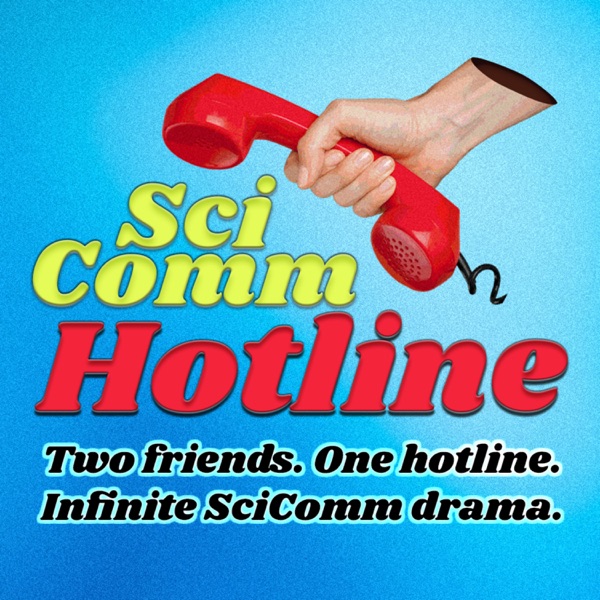
SciComm Hotline
Best friends and SciComm researchers, Reyhaneh Maktoufi and Stephanie Castillo, gossip about all the cringeworthy and exciting ways science is communicated in real life.
- On air since
- 2025
- Episodes
- 23
- Releases · typical length
- Every two weeks · 52 min
- Latest episode
- 3 days ago
Chart history since Oct 26
| Now | Chart | Peak | Since Oct 26 |
|---|---|---|---|
| 127 New | Social Sciences Arrived Nov 20 | #127 |
Episodes
23 episodes, newest first
-
47 min
Context, ethics, and the unreliable narrator | You Can See Everything
Season 1, Episode 22
Show notes
We jumped on to the cultural bandwagon to discuss “You Can See Everything.” We chat about Nathan Fielder’s work and the Theranos backstory changes how viewers interpret the documentary. Debate whether the film is primarily about Elizabeth Holmes or about Fielder, and consider how his on-camera presence makes him an unreliable narrator. And explore whether documentary subjects, experts, vulnerable participants, and affected families should be compensated, and the risks of defining who qualifies.
Share your hot takes or ask for advice: drama@scicommhotline.com or visit http://scicommhotline.com
-
53 min
AI Communication Pitfalls (and How it Mirrors Climate Change Communication)
Season 1, Episode 21
Show notes
After spending too much time doomscrolling, Rey and Steph started to notice a similar pattern between climate change and AI communication. From the doom and gloom narratives to shaming, there are lots of unhelpful tactics being used that might backfire in the process of making AI more safe and ethical.
References:
“Yale Climate Opinion Map” https://climatecommunication.yale.edu/visualizations-data/ycom-us/
“Emotion and the Psychological Distance of Climate Change” https://journals.sagepub.com/doi/10.1177/1075547019889637
“Hopium or empowering hope? A meta-analysis of hope and climate engagement” https://www.frontiersin.org/journals/psychology/articles/10.3389/fpsyg.2023.1139427/full
“Hopeless Average 10-year-old” https://www.instagram.com/p/DdVSpKziWDH/
“Please Protect Your Hope” https://www.instagram.com/p/DdHf2nxHTw-/
-
36 min
When Academics Disagree on Persuasion & SciComm Goals
Show notes
Rey and Steph are reviewing the Journal of Science Communication commentary "Does science communication have its goals wrong? From persuading science skeptics to promoting scientific empowerment" from Anne Toomey and Kevin Elliott, PLUS John Besley and Sara Yeo's response to that commentary.
We talk about how each paper defines persuasion, what we liked about each author's claims, and who do we side with? Also, why do we always reference pandemic communication in every freaking episode????
Special thanks to the Civic Science Media Lab for supporting our work in gossiping about all things scicomm. https://civicsciencemedia.org/
References:
“Does science communication have its goals wrong? From persuading science skeptics to promoting scientific empowerment” https://jcom.sissa.it/article/pubid/JCOM_2501_2026_C07/
“A response to: “Does science communication have its goals wrong? From persuading science skeptics to promoting scientific empowerment” — A defense of certain types of persuasion” https://jcom.sissa.it/article/pubid/JCOM_2504_2026_L01/
-
1 hr 1 min
AI Shaming, Hank Green’s LLM Debacle & the Ethics of it All
Season 1, Episode 19
Show notes
You might have heard of Hank Green’s AI use and its aftermath in the science and SciComm community. You might have also gotten a bit worried about being the target of the next shaming campaign OR that AI users are not being shamed ENOUGH. In this episode, Steph and Rey discuss their thoughts on the whole drama and try to figure out their own boundaries, roles in keeping the community safe for experimentation, yet accountable.
Share your hot takes or ask for advice: drama@scicommhotline.com or visit http://scicommhotline.com
References:
• The AI penalty and disclosure paradox: Trust, authenticity and knowledge uptake in AI-mediated communication: https://www.sciencedirect.com/science/article/pii/S2949882126000551
• Hank’s comment about his AI use. Posted here as its own thing to find easily.https://www.reddit.com/r/nerdfighters/comments/1vc37aw/hanks_comment_about_his_ai_use_posted_here_as_its/?share_id=AIVpWkwkHYrBNO67kyPkU
• Colin and Samir video on Hank Green situation: https://youtu.be/cVT7MbRBiLY?si=ea4HPR2u9FCU3V01
• NYT Opinion, “If You’re Over 40, You’re Ready to Use AI”: https://www.nytimes.com/2026/07/27/opinion/teaching-kabbalah-ai.html
• AI, Craftsmanship, and Scaling Up https://www.instagram.com/p/Db09LxaSD6b/
• Do people prefer AI-generated stories? https://www.instagram.com/p/DbozJESP2Jh/ -
1 hr 4 min
What Makes a Great Science Host? (in our opinion)
Season 1, Episode 18
Show notes
Who is your favorite host? What do you like about them? What makes a good host? It’s not just the person but a whole team and environment that can have an effect. Listen to Rey and Steph fangirl about their favorites and get into the nitty gritty of hosting.
Share your hot takes or ask for advice: drama@scicommhotline.com
or visit http://scicommhotline.com
On these lists
SciComm Hotline is one of the shows picked out on this list