Podcast
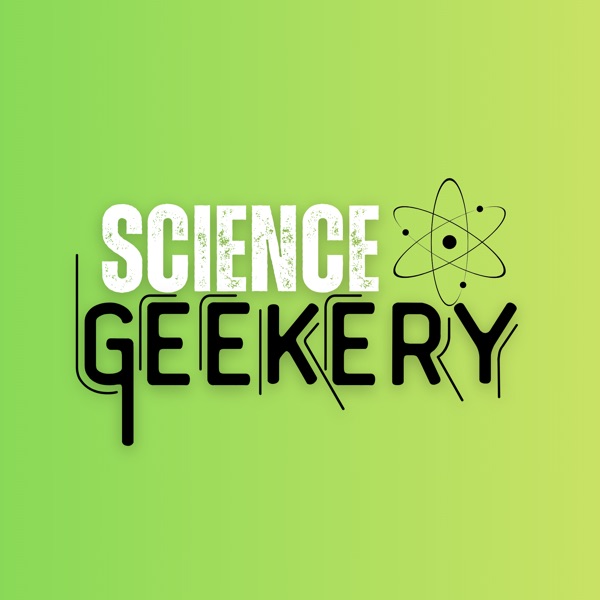
Science Geekery
Science Geekery is a place to geek out about all kinds of science, from paleontology to astronomy to chemistry. It's also a place to celebrate human scientific endeavors. I'll tell you not just what we know, but how brilliant experiments show us what we know.
- Natural Sciences chart
- #197
- Episodes
- 2
- Releases
- Every two weeks
- Typical length
- 36 min
- On air since
- 2026
- Latest episode
- 2 weeks ago
Episodes
2 episodes, newest first
-
32 min
Episode 2: How to Turn Lead into Gold
Episode 2
Show notes
For millennia, alchemists sought to turn lead into gold. They thought it could be done by mixing the "elements" (fire, water, earth, and air) or the "primes" (sulfur, mercury, and salt) in different ratios. Today we know that this will not work, and instead, nuclear physics is needed. Using particle accelerators, scientists have turned mercury, bismuth, and lead into gold. Find out how on this episode, and learn why we don't do it more often.
Here's a link to the episode blog post
If you'd like to support the show, please check out the Patreon,
follow on Facebook, or
join the Discord serverIf you have ideas for future episode topics, submit them here
Intro/Outro/Interlude music:
"Neon Laser Horizon" Kevin MacLeod (incompetech.com)
Licensed under Creative Commons: By Attribution 4.0 License
http://creativecommons.org/licenses/by/4.0/Sources:
("Transmutation of Mercury by Fast Neutrons." Physical Review, 60(7), 473–479. DOI: 10.1103/PhysRev.60.473)Morrissey, D. J., Lee, D., Bredel, K. J., Crowley, B. J., Loveland, W., & Seaborg, G. T. (1980). "Target residue mass distributions from the reaction of 8.0-GeV 20Ne with 209Bi." Physical Review C, 21(5), 1783–1798.
ALICE Collaboration. (2025). "Electromagnetic dissociation of relativistic lead ions producing gold isotopes in ultra-peripheral collisions at the LHC." Physics Letters B
Inghram, M. G., Hess, D. C., & Hayden, R. J. (1947). "Neutron Cross Sections for Mercury Isotopes." Physical Review, 71(8), 561.
Wiens, J. H. (1946). "The Production of 198Hg by Neutron Bombardment of Gold." Physical Review, 70(11-12), 910. (Followed by Meggers, Wiens, & Alvarez, 1948, "The Isotope 198Hg as a Primary Standard of Wave Length", Journal of Research of the National Bureau of Standards).
-
40 min
Episode 1: Cracking the Genetic Code
Episode 1
Show notes
DNA stores all the information needed to build an organism. Specifically, it stores the information needed to make proteins, which are the work-horses of life. But how does DNA store that information, and how do we know about it? In this episode of Science Geekery, I discuss what the genetic code is, and the scientists and experiments that cracked the genetic code. Because of their efforts, today we have many powerful tools that aid in biology research and improve human health.
Here's a link to the episode blog post
If you'd like to support the show, please check out the Patreon,
follow on Facebook, or
join the Discord serverIf you have ideas for future episode topics, submit them here
Intro/Outro/Interlude music:
"Neon Laser Horizon" Kevin MacLeod (incompetech.com)
Licensed under Creative Commons: By Attribution 4.0 License
http://creativecommons.org/licenses/by/4.0/
Natural Sciences lists
More Natural Sciences shows picked out from the charts








More in Natural Sciences
Placed highest on Apple Podcasts' Natural Sciences chart right now