Podcast
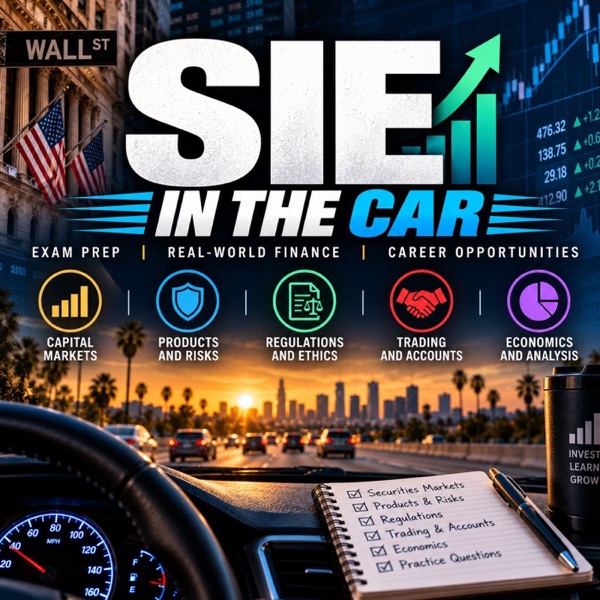
SIE in the Car
Learn the language of the securities industry while you’re on the road. SIE in the Car breaks down capital markets, investment products, risks, trading, customer accounts, regulations, prohibited practices, and other Securities Industry Essentials concepts into approachable audio lessons. Build your financial vocabulary, understand the reasoning behind the rules, and turn otherwise unused commuting time into SIE preparation.
- Episodes
- 7
- Releases
- Weekly
- Typical length
- 3 min
- On air since
- 2026
- Latest episode
- 2 days ago
Episodes
7 episodes, newest first
-
3 min
Stop Orders vs. Stop-Limit Orders: Understanding Price Triggers and Execution Risks
Show notes
Stop orders and stop-limit orders are frequently tested on the Securities Industry Essentials (SIE) exam because they require investors to understand the difference between triggering an order and guaranteeing an execution price. Although both orders activate when a security reaches a specified price, they behave differently once triggered. In this episode, we examine buy stops, sell stops, stop-limit orders, and the risks associated with rapidly changing markets. We also explore common exam scenarios designed to test your understanding of price protection, execution certainty, and order placement.
-
4 min
Market Orders vs. Limit Orders — How Investors Accidentally Get Unexpected Prices
Show notes
You see a stock trading at $50, place an order to buy it, and discover that you paid $53. How did that happen? Understanding market orders, limit orders, stop orders, and execution prices is essential for the Securities Industry Essentials (SIE) examination and everyday investing. In this episode, we explain how different order types work, why liquidity and volatility matter, and how emotional decision-making can lead investors to make costly execution mistakes.
-
3 min
The Sunk Cost Fallacy: Why Investors Hold Losing Stocks
Show notes
Investors sometimes hold declining securities because they cannot accept realizing a loss. Learn how sunk costs, loss aversion, and anchoring influence investment behavior, and connect these concepts to risk, diversification, and rational portfolio decisions.
-
3 min
Bond Prices and Interest Rates: Why They Move in Opposite Directions
Show notes
Why do bond prices fall when interest rates rise? This inverse relationship is one of the most important concepts tested on the Securities Industry Essentials (SIE) exam. In this episode, we explain how changing interest rates affect bond prices, yields, and investor decisions. Through simple examples, you'll learn how to recognize interest rate risk, understand bond premiums and discounts, and answer common SIE exam questions with confidence.
-
4 min
Bond Basics: Par Value, Coupon Rates, Maturity, and Yield
Show notes
Bonds can seem complicated because several numbers describe the same investment, but the SIE exam becomes much easier once you understand what each number actually means. In this episode of SIE in the Car, we break down par value, coupon rates, maturity dates, and yield using straightforward examples. By the end, you’ll understand the basic language of bonds and be prepared for more advanced questions involving bond prices and interest rates.
-
3 min
Common vs. Preferred Stock: Know the Difference for the SIE
Show notes
Owning stock can mean different things depending on the type of equity security involved. Common and preferred shareholders differ in voting rights, dividend characteristics, liquidation priority, and investment objectives. This episode gives you a straightforward framework for separating the two on the SIE exam.
-
3 min
Stocks vs. Bonds: The Difference You Need to Know for the SIE
Show notes
Stocks and bonds are foundational to understanding the securities industry, but the distinction goes deeper than “stocks are ownership and bonds are debt.” This episode explains what investors actually receive, how companies use each form of financing, and why their risks differ. Master this distinction and many later SIE concepts become easier.
Natural Sciences lists
More Natural Sciences shows picked out from the charts












More in Natural Sciences
Placed highest on Apple Podcasts' Natural Sciences chart right now