Podcast
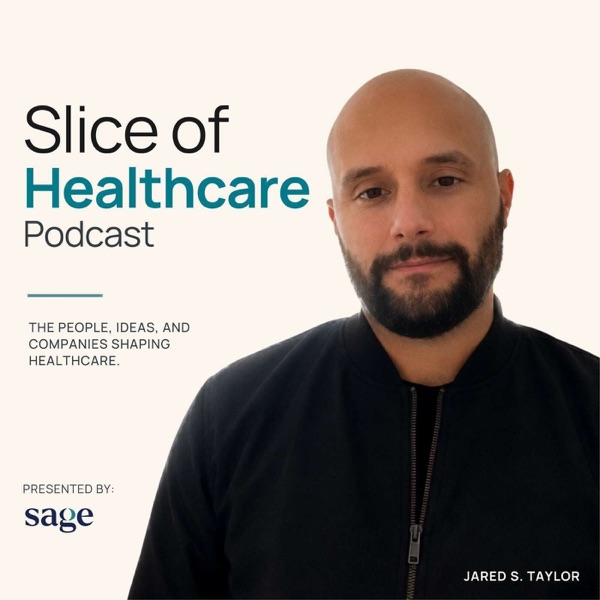
Slice of Healthcare
The people, ideas, and companies shaping healthcare. The best podcast for healthcare executives and investors. Presented by Sage Growth Partners.
- Episodes
- 545
- Releases
- Every two weeks
- Typical length
- 20 min
- On air since
- 2018
- Latest episode
- 1 week ago
Episodes
545 episodes, newest first
-
20 min
#544 - Not a doc in a box | Jeff Adams (Chief Technology Information Officer, Eagle Telemedicine)
Episode 544
Show notes
Jeff Adams (Chief Technology Information Officer, Eagle Telemedicine) joins Jared S. Taylor to walk through what happens at 2 a.m. when a patient comes into a small-town ER and there's no neurologist in the building. Jeff has spent close to 30 years in IT, almost all of it in healthcare, and the work got personal early, when family members went through medical errors that better-connected systems might have caught. He still thinks about his grandmother in that bed when he designs anything, down to a microphone on a six-foot extension so a frail patient and a remote doctor can actually hear each other.
Eagle is a physician-led virtual specialty care partner for hospitals and health systems. Its doctors log straight into each hospital's own EMR and tools, so a new program doesn't sit in the IT backlog. Jeff, who chairs Eagle's AI governance committee, also explains what ambient documentation does for "pajama time," how a new tool earns a yes, why a small pod of doctors beats a round robin, and the one thing he'd change about how security works inside hospital IT.
We discuss:
1. The family experience that turned a career in IT into a mission
2. 2 a.m. in a small-town ER with no neurologist, and how a specialist gets on screen in seconds
3. Why the doctor should look life-size, and designing the setup around a frail patient
4. Staying out of the hospital's IT backlog by working inside its existing EMR and workflows
5. Professional services, not software, and why change management matters as much as cost
6. Pajama time, and what ambient documentation changes for physicians
7. How an AI tool gets a yes: intake, trust centers, risk scoring, and a committee vote
8. Clinical AI, physician oversight, and keeping a human in the loop
9. What a hospital CEO should ask virtual care companies, and why pods beat a round robin
Guest: Jeff Adams, Chief Technology Information Officer, Eagle Telemedicine
Host: Jared S. Taylor
Brought to you by: Sage Growth Partners. Value-focused strategy and marketing for growth-driven healthcare organizations.
-
20 min
#543 - Why the exam room tells you what claims data can't | Dr. Liz Kwo (CEO, Vanna Health)
Episode 543
Show notes
Dr. Liz Kwo (CEO, Vanna Health) joins Jared S. Taylor to talk about the stuff that walks through the door and never shows up in claims: eviction notices, food running out, a missed refill, a family member who didn't know what to watch for. Dr. Kwo runs Vanna and still sees patients at Cambridge Health Alliance, so she lives on both sides of it. As she puts it, the exam room tells you why in real time. The data tells you what happened last quarter.
Vanna works with Medicaid and now commercial members living with serious mental illness, closing the gap between mental, behavioral, and physical health without cutting people off from their community doctors. The company is named after co-founder Giovanni Colella's mother, who cared for his father through serious mental illness. Tom Insel, former director of the National Institute of Mental Health, is also a co-founder, and his idea that people need a place, people, and a purpose shapes Vanna's "clubhouse light" model. Dr. Kwo also gets into her own stillbirth and depression, what she brought over from Amwell, and the two outcomes she wishes payers would pay for.
We discuss:
•
What Vanna sees in real time that payers only see a quarter later in claims
•
People, place, and purpose, and how coaches actually put "purpose" into practice
•
Missed check-ins, med adherence, and kitchen-table conversations instead of a stale office
•
Closing the mental, behavioral, and physical health gap without disintermediating community doctors
•
How her stillbirth and depression shaped the way she leads: servant leader, but accountable
•
Doing the right clinical thing even when it doesn't make short-term business sense, and tying it to shared savings
•
Building a community coach workforce after Amwell, and why the 80/20 problem breaks scale
•
The outcomes nobody pays for today: housing stabilization and the Sunday text
•
Getting up to speed fast: AI, skill stacking, and her book Clinician to Executive
•
The proof point she wants in 12 months: a model that scales, coaches who grow, and members who graduate
—
Brought to you by: Sage Growth Partners — Value-focused strategy and marketing for growth-driven healthcare organizations.
-
36 min
#542 - Why 41% of moms feel less than confident bringing baby home | Dr. Tom Lundquist, Susan Rawlings-Molina & Dan D'Orazio
Episode 542
Show notes
Watch on YouTube: https://youtu.be/myoYIumoY4w
Dr. Tom Lundquist (Chief Medical Officer, ProgenyHealth), Susan Rawlings-Molina (CEO, https://GroundGame.Health), and Dan D'Orazio (CEO, Sage Growth Partners) join Jared Taylor to unpack Sage Growth Partners' 2026 series The State of Maternal & NICU Care — and what coverage cliffs, communication gaps, and social drivers of health actually look like for mothers and babies on the ground.
The panel lands on a few hard numbers from the research and the clinic: 41% of mothers felt less than confident taking their child home; health plans rate community support as effective 46% of the time while moms say 9%; and only 7% of plans feel very effective at acting on SDoH data even though most feel "somewhat" confident collecting it. Half of NICU admissions, Dr. Lundquist notes, come from pregnancies that were never labeled high-risk.
We discuss:
1. What Sage's three-part maternal & NICU research series found when health plans and moms were asked the same questions
2. Why cost and coverage confusion often rank above finding a physician for new mothers
3. The postpartum and NICU discharge confidence gap (37% vs 29% "excellent")
4. What coverage, communication, and SDoH gaps feel like clinically for a mother and baby
5. Why specialized wraparound partners matter when plans manage hundreds of thousands of lives
6. Getting upstream: identifying pregnancy in the first trimester — not at the delivery claim
7. Anxiety, behavioral health screening, and why trust takes more than one call
8. How community-based organizations and physician billing for social identification change the pathway
9. Closing the loop: screening is not care — intervention and follow-through are
10. What's next for ProgenyHealth, Sage Growth Partners, and https://GroundGame.Health
—
Brought to you by: Sage Growth Partners — Value-focused strategy and marketing for growth-driven healthcare organizations.
-
36 min
#541 - Why better AI can make healthcare trust worse | Susan Rawlings Molina (Co-Founder & CEO, GroundGame Health)
Episode 541
Show notes
Susan Rawlings Molina is the co-founder and CEO of https://GroundGame.Health, the company working with health plans, providers, employers, and community organizations to close the gap between identifying what a person needs and actually getting that need met. She was last on the show solo roughly three years ago, when much of the conversation centered on technology. This time, she makes a more complicated argument: healthcare technology is extraordinarily capable, but for the people driving some of the hardest costs in the system, technology eventually hits a ceiling.
Two things in this episode surprised us. The first is what https://GroundGame.Health found while testing AI agents. The problem was not that the AI was bad. It was almost the opposite. If an agent becomes good enough that an overwhelmed member believes they are talking to a human, Susan thinks you risk undermining the trust the entire intervention depends on. The second is the story of a commercially insured father in Southern California working two jobs while managing HIV and raising two young daughters. What looked in the data like medication noncompliance was actually a chain reaction involving a medication bill of roughly $4,000 to $5,000 a month, fear of losing his housing, and not being able to put fresh food on the table. A handful of interventions ultimately improved his financial situation by roughly $3,000 a month.
We discuss:
•
Why Susan believes technology has a ceiling in healthcare, and why the hardest-to-reach people are often not technologically limited, but emotionally overwhelmed
•
The commercially insured father with HIV whose apparent medication problem was actually tied to housing, food, utilities, two jobs, and two young daughters
•
Why a risk score is not an outcome and a referral sent is not a need met, and what actually breaks down after a referral enters the system
•
https://GroundGame.Health’s “teeter-totter” between health plans and community organizations, and why someone has to bridge the gap between the two
•
Why health plans have historically invested heavily in screening and referral technology while underinvesting in the human navigation layer
•
The ROI evidence changing that conversation, including roughly five-to-one returns and a reported 27% reduction in inpatient admissions
•
What GroundGame learned testing AI agents, including the unexpected risk that an agent can become so convincing it actually undermines trust
•
Susan’s rule for where healthcare goes next: use AI and technology wherever you can, and deploy the more expensive human intervention where you have to
—
Brought to you by: Sage Growth Partners — Value-focused strategy and marketing for growth-driven healthcare organizations.
-
20 min
#540 - Why does a rural health plan need millions of claims? | Logan Trautwein (BCBS of Wyoming)
Episode 540
Show notes
Subscribe: Spotify | Apple Podcasts | YouTube
See below for timestamps, transcript, episode links and more.
*This episode is audio only
—
Logan Trautwein is the Director of Provider Affairs and Payment Integrity at Blue Cross Blue Shield of Wyoming, where he sits at the intersection of the providers delivering care and the claims that ultimately pay for it. Wyoming makes both sides unusually complicated. The state is highly rural, some counties have no local access to important specialties, and maternity care can mean crossing mountain passes or driving 180 miles to reach a facility capable of delivering a baby.
This conversation is largely about what happens when a regional health plan faces the same payment integrity problems as the country's largest payers without having the same volume of claims to learn from. Logan's answer is that scale matters even when the plan itself is small: a partner that sees millions of claims can identify billing patterns, coding issues, fraud, waste and abuse that may appear only a handful of times in Wyoming. That makes outside data and expertise part of the infrastructure, not just an outsourced service.
Two things in this episode stood out to us. The first is Logan's definition of payment integrity. He does not describe it as clawing back money or finding reasons not to pay providers. The goal is much simpler: get the claim paid accurately and appropriately as close to the first time as possible. The second is his build-versus-buy line. BCBS Wyoming could theoretically hire specialists and build capabilities like DRG review internally. The problem is that doing so does not necessarily make sense when a national partner already has the clinical expertise, claims volume and infrastructure to do it better.
We discuss:
Why rural healthcare changes the job of a health plan, from provider shortages to maternity deserts where members may need to travel 180 miles for care
How Logan defines payment integrity and why accurate coding affects more than reimbursement — it helps determine how a member is understood and supported throughout the system
Why a smaller regional plan still needs access to millions of claims, and how national data can reveal patterns that would be nearly invisible inside Wyoming alone
The build-versus-buy decision at BCBS Wyoming, including why DRG claims review and secondary claims editing landed firmly on the "do not build this ourselves" side
How Cotiviti has surfaced edits, trends and real savings that BCBS Wyoming either would not have identified internally or may not have found until a retrospective review one or two years later
Why catching an issue on the front end matters for providers too, and how immediate claim-edit feedback creates a better experience than discovering a problem months after payment
What turns a vendor into a trusted partner, and why Logan pays attention to whether a company is willing to accept "no" even when selling another service could make it more money
Why clinical expertise becomes another scale problem for regional health plans, and the value of having access to physicians and specialists who can help shape payment policies
What Logan would tell a payment integrity leader building a program from zero: break the problem into pieces, resist trying to do everything at once and do not assume it all needs to be built internally
Why an impact estimate that looks too good to be true probably is, and what health plans should look for when evaluating potential payment integrity partners
How introducing too many edits at once can create a shock to the provider community, and why communication and lead time matter as much as the technology itself
The bigger goal behind payment integrity: reducing administrative waste while making sure providers are reimbursed correctly and members can get the care they need
—
Brought to you by:
Sage Growth Partners — Value-focused strategy and marketing for growth-driven healthcare organizations.
-
38 min
#539 - Why she said no to GLP-1 money | Michelle Davey (Co-Founder & CEO, Wheel)
Episode 539
Show notes
Subscribe: Spotify | Apple Podcasts | YouTube
See below for timestamps, transcript, episode links and more.
—
Michelle Davey is the co-founder and CEO of Wheel, the virtual care infrastructure company powering enterprise telehealth programs at scale. She was last on this show in 2020, when the job was explaining what telemedicine even was. Nine years into building Wheel, the conversation is different. It is about what it costs to hold a line while the market pays everyone else for crossing it, and about rebuilding a live business into an AI native one without breaking the part that touches patients.
Two things in this episode surprised us. The first is that the information asymmetry in a telehealth visit has flipped. Patients now arrive with wearable data, biomarker panels, and a sixteen page health record they have already run through an LLM, and the clinician on the other side of the screen cannot see any of it. Wheel built an entire layer to fix that and did almost no marketing about it, because the testing and governance work stayed internal. The second is her answer to how she actually survived watching competitors print money on compounded GLP-1s. There is no framework. She turned off LinkedIn and Twitter for three months.
We discuss:
•
Why she framed the moment as a structural problem rather than a bad actor problem, and why she would rather teach than point fingers
•
The MEDVi week, the two very different reactions inside healthcare, and what it means for infrastructure companies to self-regulate with a lowercase r
•
Why telehealth as a standalone business unit is hard for most enterprise customers, and what changes when it attaches to a pharmacy or another owned asset
•
The three reasons Wheel did not build a compounded GLP-1 business: they were not good at it, branded medications were the better mass-scale clinical fit, and short-term revenue bumps do not survive the next fundraise
•
What holding that line actually looked like day to day, including three months off LinkedIn and Twitter
•
The 2021 decision to walk away from SMB digital health revenue and move up to enterprise, made before that cliff arrived
•
Being measured on headcount from 2020 to 2022, the layoffs that followed, and what it feels like on the other side: under 100 full-time people running more than 100 care programs and over three million visits a year
•
Agentifying 70% of Wheel's operations by year end, from capacity modeling and forecasting to matching the right clinician to the right patient, with inference running three months forward on CDC, customer, and seasonality data
•
The flipped information asymmetry, and how Wheel structures wearable, lab, and record data against clinical guidelines so the clinician walks in knowing what is actually relevant
•
Why "clinician in the loop" is the wrong framing, and what leading with the clinician means when AI can be confidently wrong
•
How you win over a clinician who does not want AI: citations, studies, and guidelines exposed inside the tooling, because doctors were never an adoption problem, they were a trust problem
•
Why abundance is the real story, using radiology as the case in point, and why the supply and demand imbalance gets worse rather than better
•
What "AI native" actually means when hiring an executive: tool fluency, measurable ROI and KPIs, and building teams of humans running agents against an outcome instead of stacking headcount to ratios
•
The founder material she rarely talks about publicly: two co-founders exited, the isolation that follows, why space matters more than closure, and the people who show up when you call
—
Brought to you by: Sage Growth Partners — Value-focused strategy and marketing for growth-driven healthcare organizations.
-
35 min
#538 - Why did two clinical AI founders bet on the paperwork instead? | Shaju Puthussery (CEO, LightSpun) & Deepak Ramaswamy (CTO)
Show notes
Subscribe: Spotify | Apple Podcasts | YouTube
See below for timestamps, transcript, episode links and more.
TRANSCRIPT:
https://www.sliceofhealthcare.com/p/538-lightspun-shaju-puthussery-deepak-ramaswamy-transcript—
EPISODE LINKS:
•
LightSpun: https://www.lightspun.com/
•
LightSpun team page: https://www.lightspun.com/about
•
Shaju's LinkedIn: https://www.linkedin.com/in/shajuputhussery/
•
Deepak's LinkedIn: https://www.linkedin.com/in/deepak-ramaswamy-0124032/
•
ADA collaboration announcement: https://www.ada.org/about/press-releases/ada-collaboration-with-lightspun
•
LightSpun on the ADA Delegated Credentialing Service: https://www.lightspun.com/blog/ada-lightspun
•
LightSpun's $13M Series A: https://www.lightspun.com/blog/seriesa-fundraise
•
Overjet: https://www.overjet.com/
•
NationsBenefits dental: https://nationsbenefits.com/nationsdental
•
Hugging Face: https://huggingface.co/
•
NCQA credentialing accreditation: https://www.ncqa.org/
•
NPDB: https://www.npdb.hrsa.gov/
—
Shaju Puthussery and Deepak Ramaswamy are the CEO and CTO of LightSpun, which is rebuilding the back-end engine of insurance processing as agentic AI infrastructure, starting in dental and moving into vision and ancillary benefits. Both came from Overjet, where Deepak was a co-founder and Shaju the first employee, and this conversation is largely about why they walked away from that thesis. Reading X-rays was the visible AI problem. Underneath it was a plumbing problem: claims that never reach clinical review because the documents were wrong, the provider record did not match, or the file never loaded cleanly.
Two things in this episode surprised us. The first is that their most valuable asset was an accident. Shaju assumed credentialing was table stakes until a payer CEO told him it was blocking dentist onboarding, and one weekend later Deepak had an approach. That became the rail for roughly 87% of practicing dentists in the US and the provider data spine that feeds adjudication. The second is Shaju's answer to whether anyone profits from claim friction, which is not the cynical answer most people give.
We discuss:
•
Why Deepak argues the AI question is not either-or, and why world-class clinical review is worthless if the claim cannot get to it
•
The moment their business model was confidently wrong: they built for benefits configuration, customers came back asking about credentialing, duplicate records, and file loads, and a startup that planned to do one thing had to bet on ten
•
Why credentialing was never a Trojan horse for the provider data layer, how the same 200,000-dentist dataset gets monetized twice, and what obligation comes with being the thing the system quietly depends on
•
The honest ceiling on model performance: 85 to 90% out of the box, and why the climb to 98 or 99% production-ready is where the humans actually live
•
The exact decision they will not automate, with the line drawn between deterministic denials (two cleanings a year, a $2,000 annual max) and anything touching a clinical outcome
•
Why regulation, not technology, sets the pace, and how they take a faster primary source verification method to their internal NCQA leader with screenshots, timestamps, and source authenticity to prove it still holds up
•
Shaju's contrarian read on the $17 to $21 billion admin waste question: no one is winning from the friction, both sides are automating, and the real goal is shifting dollars from admin to care
•
Bringing fintech into adjudication with a benefits flex card that carries a Visa or Mastercard rail, blocks non-covered procedures at the chair, and opened doors to a vendor network of roughly 150 health plans
•
The discipline of not chasing every model release, what Hugging Face taught them early about picking bets, and why the architecture is built to swap foundation models out entirely
•
Deepak's pushback on the beachhead narrative: dental is several years behind medical, which means the solutions may not transfer cleanly, and they designed for vision and ancillary from day one rather than treating dental as a waypoint
•
Why compliance came before the AI story, with SOC 2 Type 2, HITRUST, and NCQA in place first so they could get in the room with large payers at all
•
The legacy Deepak actually wants: recognized as the company that automated the boring and the safe, and left the critical decisions with people
—
Brought to you by: Sage Growth Partners — Value-focused strategy and marketing for growth-driven healthcare organizations.
—
Where to find Jared:• X: https://x.com/jaredstaylor• LinkedIn: https://www.linkedin.com/in/jaredstaylor/
-
20 min
#537 - Is the smart home finally becoming healthcare infrastructure? | Mike McSherry (CEO, Xealth)
Show notes
Mike McSherry is the CEO of Xealth, the digital health orchestration company now operating inside Samsung Electronics. Xealth gives clinicians a way to prescribe and recommend far more than medication—including digital health apps, connected devices, remote-monitoring programs, transportation, meal delivery, and other services that increasingly shape a patient’s care journey.
The Samsung acquisition puts Xealth inside a company with a healthcare footprint far larger than most Americans realize. Samsung operates major hospitals, manufactures biologic medicines and medical equipment, develops healthcare robotics, and already has televisions, appliances, phones, watches, and other connected devices inside millions of American homes. Mike’s bet is that this existing footprint can become the infrastructure for aging in place, chronic-care management, fall detection, medication support, and earlier intervention—without making patients feel constantly watched or turning the home into a hospital.
That opportunity is becoming more immediate through the CMS ACCESS Model, a ten-year effort to bring technology-enabled, outcomes-based care to Medicare patients with chronic conditions. The model could allow companies offering services such as weight management, diabetes support, mental healthcare, wearable monitoring, and AI coaching to participate more directly in Medicare care delivery. Xealth can serve as the connective layer between health systems, clinicians, patients, and these new programs, while Samsung’s devices and consumer reach could support both monitoring and distribution.
Mike’s larger argument is that healthcare is approaching a data reset. Consumer technology companies and AI platforms are beginning to combine medical records, laboratory results, wearable signals, and patient-reported information into a more complete picture than many hospitals currently possess. Health systems and EHR companies that cannot absorb wearable data may lose relevance—but simply dumping more information on clinicians will make the problem worse. The real breakthrough will come from AI systems that filter continuous data, identify what actually matters, and surface only the moments that require human attention.
We discuss:
•
Why Samsung may have a better chance in home-based healthcare than Amazon, Walmart, Best Buy, and other major companies that struggled to turn consumer reach into sustained healthcare adoption
•
How Samsung’s hospitals, medical equipment, biologics manufacturing, robotics, wearables, smartphones, televisions, and connected appliances could become infrastructure for aging in place and chronic-care management
•
Why big technology companies repeatedly bounce off healthcare—and why the industry rewards trust, patience, integration, and long-term investment rather than quick wins and software-like margins
•
What the ten-year CMS ACCESS Model could change for Medicare patients with chronic conditions—and why companies such as Noom, WHOOP, Headspace, Lark, and Welldoc could begin operating more like technology-enabled care providers
•
How Xealth could connect clinicians and health systems with covered digital-health programs, while Samsung’s devices and consumer reach support patient monitoring, engagement, and distribution
•
Why EHRs that cannot absorb wearable data risk falling behind AI platforms and consumer-health companies that already combine medical records, laboratory results, and continuous biometric information
•
How AI could prevent physicians from drowning in streams of heart rate, temperature, oxygen, sleep, stress, and activity data by identifying the signals that actually require human intervention
•
Where wearables and connected care go next—from patches, earbuds, glasses, and implantables to household devices and robots that help patients remain independent without making their homes feel like hospitals
—
Brought to you by: Sage Growth Partners — Value-focused strategy and marketing for growth-driven healthcare organizations.
—
Where to find Jared: • X: https://x.com/jaredstaylor• LinkedIn: https://www.linkedin.com/in/jaredstaylor/
-
19 min
#536 - Is 340B really going away — or finally becoming infrastructure? | Kim Tzoumakas (CEO, VytlOne)
Show notes
Kim Tzoumakas is the CEO of VytlOne, the nation's only independent, fully integrated total pharmacy solutions partner — the century-old company formerly known as Maxor, which she rebranded and merged with ProxsysRx in a fast-moving transformation after taking the helm in January 2025. VytlOne partners with mission-driven hospitals and health systems, combining pharmacy operations, 340B management, specialty pharmacy, pharmacy benefit management, and patient affordability solutions to help nonprofit providers unlock revenue and reinvest in their communities — work that generated $1.4 billion for its pharmacy partners in a single year. Its newest bet is VytlAIQ, an end-to-end intelligence platform built ground-up (not grafted onto a legacy system) that connects clinical, pharmacy, payer, and financial data into one real-time platform, surfacing next-best actions and checking every 340B claim for eligibility and documentation so problems get caught before they cost providers money. Kim came to pharmacy the long way around — two decades as a healthcare attorney embedded in hospitals and health systems, then CEO of RAYUS Radiology and 21st Century Oncology. Her core conviction is that 340B isn't a loophole to be abused or a relic on its way out; it's critical infrastructure that lets nonprofit health systems reinvest in patient care, and the real failure is that the tools serving it stayed reactive, fragmented, and manual. VytlOne's bet is that AI belongs in pharmacy not to replace clinical judgment or wipe out teams, but as an intelligent partner that tears down the administrative barriers — prior auth, denied claims, missing documentation — standing between a patient and their medication. The test of success: a patient who simply feels their care move faster and never once thinks about the software behind it.
We discuss:
•
Why the first thing Kim checks in any business isn't the P&L — it's the boards, the ownership model, and financial stability that determine whether a CEO can actually win — and what twenty years as a healthcare attorney inside hospitals taught her to see
•
The real story on 340B: why the "it's going away" prediction has been wrong for thirty years, why the program is now evolving faster and getting more complex, and the one scenario where hospitals genuinely are in the wrong — double-dipping on rebates
•
How you build a product when the rules might change next quarter — launching VytlAIQ right as the courts threw out the 340B rebate model, and why VytlOne built it from the ground up with pharmacists at the table instead of stitching together what already existed
•
Why most health-system dashboards get built and then ignored — and what makes a platform a pharmacist and a CFO will actually act on: one centralized, real-time source feeding the EHR that tracks every claim all the way through to payment received
•
What you can't afford to break when you rebrand and merge a hundred-year-old company fast — protecting the culture and the people who gave decades to the organization while still turning the corner
•
The uncomfortable truth for a CFO who's been burned by vendors — why pharmacy teams reflexively say "we already do that," where the skepticism about third parties really comes from, and how to turn a ten-million-dollar opportunity into a win-win instead of a threat
•
Where the line sits between what AI should decide versus only suggest in pharmacy — why it should never make a clinical or licensed decision — and the legal risks Kim sees as tech players rush into healthcare without understanding the guardrails, patient risks, or regulatory history
•
What Kim learned mentoring veterans through the Pat Tillman Foundation about fear of failure and hard choices — and the five-years-out test for VytlAIQ: a patient in specialty or chronic care who simply feels faster access to their medication and never connects it back to the software
—
Brought to you by: Sage Growth Partners — Value-focused strategy and marketing for growth-driven healthcare organizations.
—
Where to find Jared: • X: https://x.com/jaredstaylor • LinkedIn: https://www.linkedin.com/in/jaredstaylor/
-
31 min
#535 - Why is chronic disease still winning? | Mark Clermont (CEO, Cecelia Health) & Wendi Mader (CCO)
Show notes
Mark Clermont is the CEO of Cecelia Health, and Wendi Mader is the company's Chief Commercial Officer. Cecelia is a virtual multi-specialty medical practice, licensed in all 50 states, that helps employers, payers, health systems, and life sciences companies manage chronic and cardiometabolic disease and bring down the cost of care. It's not a point solution. It's a medical practice that prescribes and manages medication (including GLP-1s, from prescribing through titration and side-effect management), runs intensive nutrition therapy, and handles behavior and lifestyle care, all through a team of RNs, RDs, certified diabetes educators, and physicians. The model is built to extend primary care, not replace it, and to coordinate across specialists instead of adding one more disconnected program.
Mark and Wendi's argument is simple: chronic disease isn't winning because we lack apps or tools. It's winning because care is fragmented and nobody's tying it together. GLP-1s are making that worse before they make it better. They're the first drug class with indications spanning diabetes, obesity, sleep apnea, fatty liver, and soon addiction, which means a single patient can suddenly need four specialists who don't talk to each other. Cecelia's bet is that a multi-specialty practice can be the layer that connects all of it.
We get into:
•
Why chronic disease keeps winning even though there are more apps, tools, and wellness programs than ever, and what point solutions got wrong
•
What actually happens to a patient with diabetes and high blood pressure inside Cecelia's model versus the system today
•
Why GLP-1s are the first drug class to cross medical specialties, and why that's making fragmentation worse right now
•
The patient on a high-dose GLP-1 and an SSRI who almost ended up in the ER, and what the direct-to-consumer prescriber missed
•
How the US can rank dead last among developed nations and still be the system Mark wouldn't trade for anywhere else
•
Where the industry is over-indexing on AI in chronic care, and where Wendi thinks tech actually belongs
•
The specialty shortage, healthcare deserts, and rural-health funding, and how virtual coordinated care reaches patients brick-and-mortar can't
•
What's different for patients five years from now if Cecelia gets this right
—
Brought to you by: Sage Growth Partners — Value-focused strategy and marketing for growth-driven healthcare organizations.
—
Where to find Jared: • X: https://x.com/jaredstaylor • LinkedIn: https://www.linkedin.com/in/jaredstaylor/
-
19 min
#534 - Can Cotiviti build the infrastructure layer healthcare's never had? | Ric Sinclair (CEO, Cotiviti)
Show notes
Ric Sinclair is the CEO of Cotiviti, an enterprise healthcare software and data company that serves hundreds of health plans — including the top 25 in the country — across payment integrity, interoperability, risk adjustment, value-based care, and member engagement, touching coverage for over 300 million patients and members. Cotiviti pairs algorithms and AI with thousands of clinical nurses, MDs, and content experts in a human-in-the-loop model, working across the full administrative ecosystem that moves between payers, providers, patients, and pharma. Ric's core conviction is that healthcare's central problem isn't a data problem or a technology problem — it's a coordination problem, and what the system has never had is a true infrastructure layer to tie it together. Cotiviti isn't trying to pick a side between payers and providers; the bet is that a neutral party sitting in the middle can drive fair, transparent outcomes and pull down the trillion-plus dollars of administrative waste in U.S. healthcare.
We discuss:
•
Why healthcare's core problem isn't a data problem or a technology problem — it's a coordination problem, and what it actually takes to build the first infrastructure layer the system has ever had
•
The real difference between owning a decade of data assets (and the Edifecs integration) and becoming the infrastructure the industry runs on — and where Cotiviti is in that build today
•
How "human in the loop" works at scale — pairing AI with thousands of nurses, MDs, and content experts so every claim is reviewed fairly and problems get predicted before they happen
•
Why Ric's answer to AI isn't "cut the 10-person team to 2" — it's "take all 10 and do what 50 could," and what that augment-don't-replace math means for client ROI
•
How you build trust and accountability into an AI workflow rather than bolting it on — and who's accountable when models start shaping decisions about claims and care
•
How to sit in the neutral middle between payers and providers who don't trust each other — and what it takes to build something both sides actually believe is fair
•
What Ric learned as a working drummer in Nashville before healthcare found him — leading without the spotlight, making others better, and why simplicity is a discipline that transfers straight into business
•
What a truly differentiated healthcare platform looks like five years out — and the test Ric uses for what "winning" means: a family of five at the dinner table who never have to think about the administrative machinery behind their care
—
Brought to you by: Sage Growth Partners — Value-focused strategy and marketing for growth-driven healthcare organizations.
—
Where to find Jared: • X: https://x.com/jaredstaylor • LinkedIn: https://www.linkedin.com/in/jaredstaylor/
-
16 min
#533 - Why technology alone can't fix value-based care | Tim Elliott (CEO, Navvis)
Show notes
Tim Elliott is the CEO of Navvis, a value-based enablement company that works with health systems, health plans, physician groups, and employers to drive performance under value-based agreements. Navvis takes a cross-continuum view of care — supporting patients before, during, and after the physician visit — and operates across the full spectrum of payment models, from full-risk MA and MSSP ACOs to bundled payments, TEAMS, and CJR. Tim's core conviction is that physicians are the linchpin of any sustainable change in value-based care, and that the "last mile" of transformation is change management — not technology. Navvis doesn't show up with a blank piece of paper or a mandatory platform; they bring a point of view on what world-class looks like and engage physicians in the refinement and rollout.
We discuss:
•
What AI consistently misses in value-based care — and why "human in the loop" needs to be on steroids in healthcare, not just a check on the model
•
How to recognize when a health system is rolling tools out faster than clinicians can absorb them — and why bottom-up physician demand is reshaping the AI rollout playbook
•
The real difference between a care model physicians co-designed and one that was handed to them — and how Navvis approaches refinement vs. a blank-paper exercise
•
What surprises health systems most when they move into real downside risk for the first time — the misalignment between contract incentives and operational behavior
•
Why "two standards of care" is the wrong frame for value-based vs. fee-for-service patients — and what the EMR needs to recognize at the point of encounter
•
The alignment problem at the executive and physician level that quietly kills downside-risk contracts before the year is out
•
The lesson Tim hopes the industry finally learns 20 years from now — why the 3-5% of patients driving 60-80% of cost are the unfinished work of this era
•
Who Navvis is built for, and why their model is to optimize existing technology rather than force a 12-to-18-month rip-and-replace
—
Brought to you by: Sage Growth Partners — Value-focused strategy and marketing for growth-driven healthcare organizations.
—
Where to find Jared: • X: https://x.com/jaredstaylor • LinkedIn: https://www.linkedin.com/in/jaredstaylor/
-
22 min
#532 - Why you can't hire your way out of healthcare's workforce crisis | Navin Gupta (CEO, Viventium) + Adam Lewis (Founder, Apploi)
Show notes
Navin Gupta is the CEO of Viventium, a verticalized HCM platform purpose-built for the post-acute care market — serving home health, skilled nursing, and hospice providers. He's spent over a decade at the intersection of senior care and technology, with deep experience across EHR, revenue cycle management, and engagement platforms for senior living. Adam Lewis is the founder of Apploi and now GM of Talent and Workforce Management at Viventium following the February acquisition. He's been building HR tech since 2007 and grew Apploi into a leading recruiting, credentialing, onboarding, and scheduling platform for healthcare. Together, the combined company now serves 13,000+ provider organizations and is on a mission to fix workforce instability in the most demographically urgent corner of healthcare.
We discuss:
•
Why post-acute care is the most mission-critical — and most underserved — tech opportunity in healthcare
•
The four-part workforce crisis every operator is fighting: supply, utilization, retention, and compliance
•
What the Apploi + Viventium acquisition unlocks that a five-year partnership couldn't
•
Why hiring friction is a direct hit to revenue — and why staffing now sits with CEOs and COOs, not just HR
•
The case for purpose-built vertical platforms over retrofitted horizontal HCM
•
The Perks4Care acquisition, and why you cannot hire your way out of a retention problem
•
Where AI creates real leverage in caregiver hiring — and how to deploy it without losing the human touch
•
Three audit questions every post-acute provider should ask their current vendor today
—
Brought to you by:Sage Growth Partners — Value-focused strategy and marketing for growth-driven healthcare organizations.
—
Where to find Jared:
• X: https://x.com/jaredstaylor
• LinkedIn: https://www.linkedin.com/in/jaredstaylor/
-
22 min
#531 - Carrie Hodge, Co-Founder and CEO at Dimer Health
Show notes
Join us on the latest episode, hosted by Jared S. Taylor!
Our Guest: Carrie Hodge, Co-Founder and CEO at Dimer Health.
What you’ll get out of this episode:
•
Carrie Hodge’s experience as both clinician and cancer patient exposed critical gaps in post-discharge care.
•
Dimer Health validated its model through real patient care before scaling technology.
•
The company is introducing a new care model centered on “transitionists” to support recovery at home.
•
AI and clinicians work together to provide continuous, responsive patient support.
•
A $13.5M raise reflects strong product-market fit, patient outcomes, and growing demand.
To learn more about:Website https://www.dimerhealth.com/ Linkedin https://www.linkedin.com/company/dimer-health/
Our sponsors for this episode are:Sage Growth Partners https://www.sage-growth.com/Quantum Health https://www.quantum-health.com/
Show and Host's Socials:Slice of HealthcareLinkedIn: https://www.linkedin.com/company/sliceofhealthcare/
Jared S TaylorLinkedIn: https://www.linkedin.com/in/jaredstaylor/
WHAT IS SLICE OF HEALTHCARE?The go-to site for digital health executive/provider interviews, technology updates, and industry news. Listed to in 65+ countries.
-
43 min
#530 - Matt Seefeld, Chief Executive Officer at MedEvolve
Show notes
Join us on the latest episode, hosted by Jared S. Taylor!
Our Guest: Matt Seefeld, Chief Executive Officer at MedEvolve.
What you’ll get out of this episode:
•
Matt Seefeld argues that healthcare’s biggest revenue cycle problem is not just strategy, but the lack of visibility into human touches and workflow breakdowns.
•
He says the industry is relying on outdated lagging metrics instead of leading indicators that show where margin is leaking in real time.
•
Seefeld challenges the promise of AI in healthcare, saying automation without financial outcome tracking is incomplete.
•
He identifies wasted touches, front-end errors, and overstaffing as major sources of preventable revenue loss.
•
He believes better revenue cycle performance ultimately improves the patient experience by reducing billing confusion and friction.
To learn more about:Website https://medevolve.com/ Linkedin https://www.linkedin.com/company/medevolve/
Our sponsors for this episode are:Sage Growth Partners https://www.sage-growth.com/Quantum Health https://www.quantum-health.com/
Show and Host's Socials:Slice of HealthcareLinkedIn: https://www.linkedin.com/company/sliceofhealthcare/
Jared S TaylorLinkedIn: https://www.linkedin.com/in/jaredstaylor/
WHAT IS SLICE OF HEALTHCARE?The go-to site for digital health executive/provider interviews, technology updates, and industry news. Listed to in 65+ countries.
-
23 min
#529 - Karthik Ganesh, Chief Executive Officer at OnMed
Show notes
Join us on the latest episode, hosted by Jared S. Taylor!
Our Guest: Karthik Ganesh, Chief Executive Officer at OnMed.
What you’ll get out of this episode:
•
Karthik Ganesh describes healthcare as both his profession and his vehicle for making the world better.
•
His 26-year career spans health plans, PBMs, value-based care, consulting, and tech-enabled care delivery.
•
At OnMed, he focused on amplifying product strengths while neutralizing blind spots rather than reinventing what already worked.
•
He believes AI should empower clinicians and improve workflows, while the human element remains the last mile in care.
•
OnMed’s work in underserved communities is showing strong adoption, with many patients identifying the care station as their medical home.
To learn more about:Website https://www.onmed.com/ Linkedin https://www.linkedin.com/company/onmedcarestation/
Our sponsors for this episode are:Sage Growth Partners https://www.sage-growth.com/Quantum Health https://www.quantum-health.com/
Show and Host's Socials:Slice of HealthcareLinkedIn: https://www.linkedin.com/company/sliceofhealthcare/
Jared S TaylorLinkedIn: https://www.linkedin.com/in/jaredstaylor/
WHAT IS SLICE OF HEALTHCARE?The go-to site for digital health executive/provider interviews, technology updates, and industry news. Listed to in 65+ countries.
-
30 min
#528 - Aaron Sheedy, COO at Xealth
Show notes
Join us on the latest episode, hosted by Jared S. Taylor!
Our Guest: Aaron Sheedy, COO at Xealth.
What you’ll get out of this episode:
•
Building Xealth with health system partners: Early validation from Providence and other major systems helped shape a scalable integration platform for digital health tools.
•
Improving patient readiness through digital engagement: Sending timely pre- and post-visit information dramatically improves patient preparation, including a 42% increase in MRI appointment readiness.
•
Reducing friction in patient communication: Portal-adjacent access allows patients to view care instructions without logging into traditional patient portals, driving significantly higher engagement.
•
Samsung’s healthcare vision: With devices already in millions of homes, Samsung aims to use wearable data and home technology to connect patients to the right care at the right time.
•
Digital health strategy beyond the EHR: Health systems relying solely on their EHR for digital health risk lacking a true digital strategy and differentiation.
To learn more about:Website https://www.xealth.com/Linkedin https://www.linkedin.com/company/xealth/
Our sponsors for this episode are:Sage Growth Partners https://www.sage-growth.com/Quantum Health https://www.quantum-health.com/
Show and Host's Socials:Slice of HealthcareLinkedIn: https://www.linkedin.com/company/sliceofhealthcare/
Jared S TaylorLinkedIn: https://www.linkedin.com/in/jaredstaylor/
WHAT IS SLICE OF HEALTHCARE?The go-to site for digital health executive/provider interviews, technology updates, and industry news. Listed to in 65+ countries.
-
15 min
#527 - Dan D’Orazio, CEO at Sage Growth Partners, ViVE 2026
Show notes
Join us on the latest episode, hosted by Jared S. Taylor!
Our Guest: Dan D’Orazio, CEO at Sage Growth Partners.
What you’ll get out of this episode:
•
Access Program & Fee-for-Service Disruption: New regulatory and payment guidance signals a major shift away from fee-for-service toward market-driven healthcare reform.
•
PBM Reform & Transparency: Accelerating policy changes aim to increase transparency and reshape pharmacy benefit management.
•
AI: From Hype to Practicality: The industry is moving from AI excitement to enterprise-level use cases in clinical, revenue cycle, and administrative workflows.
•
Interoperability & Data Liquidity: Data liquidity remains a central priority, with interoperability still an unresolved industry-wide challenge.
•
The Fax Paradox: Despite AI momentum, fax remains deeply embedded in healthcare workflows—now increasingly moving to the cloud.
To learn more about:Website http://www.sage-growth.com/Linkedin https://www.linkedin.com/company/sage-growth-partners/
Our sponsors for this episode are:Sage Growth Partners https://www.sage-growth.com/Quantum Health https://www.quantum-health.com/
Show and Host's Socials:Slice of HealthcareLinkedIn: https://www.linkedin.com/company/sliceofhealthcare/
Jared S TaylorLinkedIn: https://www.linkedin.com/in/jaredstaylor/
WHAT IS SLICE OF HEALTHCARE?The go-to site for digital health executive/provider interviews, technology updates, and industry news. Listed to in 65+ countries.
-
23 min
#526 - Dan D’Orazio, CEO, Sage Growth Partners, and Christina Speck, Chief Solutions & AI Officer, Sage Growth Partners
Show notes
Join us on the latest episode, hosted by Jared S. Taylor!
Our Guests: Dan D’Orazio, CEO, Sage Growth Partners, and Christina Speck, Chief Solutions & AI Officer, Sage Growth Partners.
What you’ll get out of this episode:
•
Strategic AI Adoption: Leaders must align AI tools with real business problems, not just adopt technology for its own sake.
•
Enterprise Change Management: Success hinges more on people and process readiness than on the AI technology itself.
•
Human + AI Synergy: The rise of “HI + AI” and “HSI” (Humanist Super Intelligence) models puts empathy at the center of AI innovation.
•
Clinical & Administrative Focus: Real AI excitement lies in automating repetitive administrative tasks, with clinical applications gaining cautious momentum.
•
Sage’s Growth-Centric AI Model: From readiness to impact, Sage Growth Partners tailors AI strategies to support each client’s growth journey.
To learn more about:Website http://www.sage-growth.comLinkedin https://www.linkedin.com/company/sage-growth-partners/
Our sponsors for this episode are:Sage Growth Partners https://www.sage-growth.com/Quantum Health https://www.quantum-health.com/
Show and Host's Socials:Slice of HealthcareLinkedIn: https://www.linkedin.com/company/sliceofhealthcare/
Jared S TaylorLinkedIn: https://www.linkedin.com/in/jaredstaylor/
WHAT IS SLICE OF HEALTHCARE?The go-to site for digital health executive/provider interviews, technology updates, and industry news. Listed to in 65+ countries.
-
5 min
Inside the ‘Big Unlock’: How UpToDate Is Reinventing Clinical Decisions
Show notes
Join us on the latest episode, hosted by Jared S. Taylor!
Our Guest: Yaw Fellin, Senior Vice President and GM, UpToDate Clinical Decision Support and Provider Solutions at Wolters Kluwer Health.
What you’ll get out of this episode:
•
How UpToDate is making clinical decision support conversational
•
Why validation, quality, and expert oversight are essential in AI tools
•
The growing impact of workflow integration and ambient technologies
•
Key takeaways from HLTH 2025, including partnerships and customer momentum
•
The shift from AI hype to real-world clinical impact
To learn more about :Website https://www.wolterskluwer.com/en/health Linkedin https://www.linkedin.com/company/wolters-kluwer-health/
Guest Linkedin https://www.linkedin.com/in/yaw-fellin-470a5621/
Our sponsors for this episode are:Sage Growth Partners https://www.sage-growth.com/Quantum Health https://www.quantum-health.com/
Show and Host's Socials:Slice of HealthcareLinkedIn: https://www.linkedin.com/company/sliceofhealthcare/
Jared S TaylorLinkedIn: https://www.linkedin.com/in/jaredstaylor/
WHAT IS SLICE OF HEALTHCARE?The go-to site for digital health executive/provider interviews, technology updates, and industry news. Listed to in 65+ countries.
On these lists
Slice of Healthcare is one of the shows picked out on this list

More in Business News
Placed highest on Apple Podcasts' Business News chart right now