Podcast
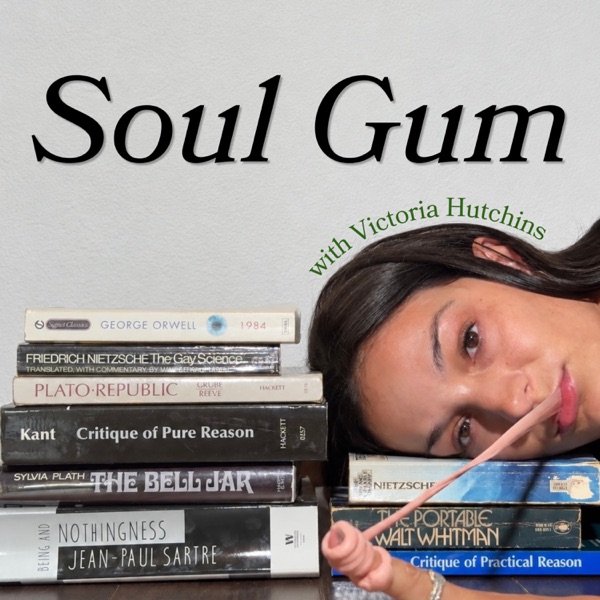
Soul Gum
A self-development podcast with philosophical, psychological and literary flair hosted by Victoria Hutchins, the creator of @thedailyvictorian and nationally bestselling author of MAKE BELIEVE. Episodes every other Sunday.
- Philosophy chart
- #20
- Episodes
- 44
- Releases
- Weekly
- Typical length
- 38 min
- On air since
- 2022
- Latest episode
- 1 week ago
Episodes
44 episodes, newest first
-
35 min
How to Prepare for the Best Year of Your Life
Season 3, Episode 8
Show notes
The best year of your life doesn't start on January 1. It starts with what you do before the year begins. Today, I come to you with three things you can do right now to prepare for 2027 to be the best year of your life.
I know it’s still October, but every year we lose our collective minds from November until January. And soon it will be New Year’s Eve and we’ll be trying to make our vision boards without having given any thought to the actual vision. SO: we’re getting a head start on preparing for 2027 before the holiday chaos hits with 3 audits that will help you get clear on what you want, what's holding you back, and how you actually want to live.
Along the way, we're talking about why we're so bad at estimating how much we can get done in a day, why being harder on yourself might actually be holding you back, what the Stoics (the original chads) can teach us about new year’s resolutions, and how to chase your biggest dreams without wishing away the life you're living.
PS: I made you a free worksheet to walk you through all three audits! It's got all the questions we talk about in this episode and space to work through them yourself. Find it here!!
EPISODE OUTLINE
00:00 Intro + why we’re starting before January 1
06:40 Audit #1: the levels of energy audit
07:36 How to make an energy ledger
10:02 The energetic evolution of choices
12:32 Epictetus on how to handle temptation
14:02 Reflection questions to audit your energy
14:44 Audit #2: the promise audit
16:26 Why shaming yourself doesn’t work
18:01 The planning fallacy
20:25 How to actually plan your day accurately
21:57 Intentions are not plans
23:08 Procrastination as a coping method
24:54 Audit #3: the perfect day audit
26:17 How to design your perfect mundane day
27:08 My perfect day
29:12 Comparing your ideal day to reality
29:57 Loving your current self while working to meet your next self
30:46 lightning round recap + worksheet!
33:48 The Orange by Wendy Cope
EPISODE LINKS
GET THE FOLLOW-ALONG WORKSHEET HERE
My debut poetry collection MAKE BELIEVE is out everywhere now
Subscribe to Soul Gum’s new instagram :-)
Follow me on Instagram and TikTok
-
40 min
How to Become Unbotherable
Season 3, Episode 7
Show notes
We all have that one person who can ruin our day in less than 30 seconds. Why is it so hard to stay in our values around certain people? And how do we stop giving them so much power? In this episode, we're turning to the 19th-century philosopher Friedrich Nietzsche for five lessons on dealing with difficult people, navigating conflict, and becoming unbotherable. If you've ever let a five-minute interaction ruin your entire week, this episode is for you.
EPISODE OUTLINE - NIETZSCHEAN PRINCIPLES FOR BECOMING UNBOTHERED
00:00 Intro
9:13 1. Navigating other people’s opinions of you
14:50 2. Let them misunderstand
21:01 3. “They muddy the water to make it seem deep”
24:30 4. Are you actually keeping the peace?
31:10 5. Knowing when to walk away
35:40 Lightning round recap
38:08 Help keep Soul Gum ad free
39:05 To Take Back a Life by Kate Baer
EPISODE LINKS
My debut poetry collection MAKE BELIEVE is out everywhere now
Subscribe to Soul Gum’s new instagram :-)
Follow me on Instagram and TikTok
-
34 min
The 6 Levels of Living a Meaningful Life
Season 3, Episode 6
Show notes
According to the existentialists, the core problem of being human is this: we are meaning-seeking creatures in a universe that is silent on meaning. But somehow, we're supposed to figure out what to major in, who to marry, and what to do with the approximately 30,000 days we get to be alive.
In this episode, we walk through six levels of living a meaningful life as described by Simone de Beauvoir in her 1947 work The Ethics of Ambiguity, moving from brainrotten aimlesness to a life driven by purpose. If you want to live a life that feels meaningful but have no idea what you’re supposed to be doing with it, this episode is for you.
EPISODE OUTLINE: THE 6 LEVELS OF LIVING A MEANINGFUL LIFE (according to 20th century existentialist philosopher Simone de Beauvoir)
00:00 Intro
04:57 1. The sub-man
10:13 2. The serious man
14:17 3. The nihilist
16:43 4. The adventurer
22:06 5. The passionate man
24:10 6. The compassionate person
26:27 but btw life isn’t a ladder
27:51 Reflection questions
30:20 Lightning round recap
32:07 When Death Comes by Mary Oliver
MY LINKS
My debut poetry collection MAKE BELIEVE is out everywhere now
Follow Soul Gum’s new instagram :-)
Follow me on Instagram and TikTok
-
42 min
Habits of Highly Charismatic People
Season 3, Episode 5
Show notes
The manosphere wants you to think charisma is all about dominance and control. But what if it’s actually about deep presence and social courage?
I don’t want to be like the guy who uses scarce communication to hide his lack of depth and fear of commitment. I want to be like the people who make you feel cool just by talking to them, while radiating charisma themselves.
If you’ve ever wondered why some people can have fun talking to literally anyone, struggled to know what to say when someone asks you a question, or wished you were more comfortable saying what you actually think, this episode is for you.
In today’s episode, we unpack 5 habits of highly charismatic people, from what they say when they’re getting to know someone to how they navigate disagreements. Along the way, we’ll talk about what we can learn from Socrates about swag, dive into the science of answering any question well, and use Byung-Chul Han’s concept of “the smooth” to investigate how we can stay raw and real in a world that tries to sand our edges.
EPISODE OUTLINE: HABITS OF HIGHLY CHARISMATIC PEOPLE
00:00 Intro
07:14 1. How to ask better questions
08:18 The science of how asking questions makes people like you
10:18 The power of follow-up questions
13:41 2. How to answer any question without freezing
14:37 The scary thing no one tells you about writing a book
17:11 Why your mind goes blank when someone asks you a question
18:03 The secret to answering questions with ease
20:21 The link between storytelling and charisma
22:40 3. Stop performing agreement in conversations
23:18 What is backchanneling?
23:59 Upspeak, confidence, gender, and the way we talk
26:05 Should we actually backchannel less?
28:58 4. How charismatic people handle disagreement
30:27 What Socrates can teach us about intellectual humility
32:14 5. Stop treating human connection like a formula
33:36 Byung-Chul Han and “the smooth”
36:13 Btw you’re not a chad for wanting to be loved
39:04 Lightning round recap
40:44 Poem: Small Kindnesses by Danusha Laméris
MY LINKS
My debut poetry collection MAKE BELIEVE is out everywhere now
Subscribe to Soul Gum’s new instagram :-)
Follow me on Instagram and TikTok
-
41 min
How to Plan Your Fall to Change Your Life
Season 3, Episode 4
Show notes
Pumpkin spice apologists wya? It’s the great lock in Charlie Brown!!!!! In this episode, I’m walking you through the exact five-step seasonal planning system that dramatically changed my life a few years back. Along the way, we’ll dive into the philosophy and psychology behind why it works. We’ll talk through Nietzsche’s philosophy on habits, Simone de Beauvoir’s ideas on how to reconcile your past and future selves, the planning fallacy, and more. Whether you want to change the trajectory of your life this fall or just set up some systems to make life a little less chaotic, this episode is for you.
EPISODE OUTLINE: HOW TO PLAN YOUR FALL TO CHANGE YOUR LIFE
00:00 Intro
06:21 I made you a worksheet ◡̈
09:30 STEP 1: THE AUDIT
10:36 Facticity vs. transcendence (de Beauvoir)
11:11 The importance of considering both your past and your potential
12:55 Using self-distancing to self-reflect more effectively
13:31 How to audit your goals
14:56 How to audit your execution
18:24 STEP 2: THE PURGE
19:07 The paradox of choice
Cleaning out digital and physical worlds
22:15 Choice architecture
25:15 STEP 3: THE CHOICE
25:55 The planning fallacy
27:54 Optimism bias & why overplanning feels good
29:00 STEP 4. THE TRADE OFF
31:25 Nietzsche’s on the power of “brief habits”
33:10 STEP 5. THE TIME
34:33 Temporal landmarks and why they make you more likely to achieve goals
35:44 the fresh start effect
36:05 Kairos: the opportune moment
37:28 Leaving room for life inside our lives
38:13 Lightning round recap
EPISODE LINKS
Get instant access to the fall planning worksheet HERE. NOTE: If you can't find it in your email, search "YOUR FALL PLANNING WORKSHEET" in your email inbox! It is likely hiding in the Social or Promotions tab.
My debut poetry collection MAKE BELIEVE is out everywhere now
-
28 min
The Possibility Crisis of Your Late 20s
Season 3, Episode 3
Show notes
If your early twenties are for your Sylvia Plath fig tree allegory crisis, then your late twenties are for your Joan Didion Goodbye to All That crisis. In her famous 1967 essay, Didion writes, “That was the year, my twenty-eighth, when I was discovering that not all of the promises would be kept, that some things are in fact irrevocable and that it had counted after all, every evasion and every procrastination, every mistake, every word, all of it.”
This episode explores a strain of existential dread that often shows up in your late twenties: the possibility crisis. Sometimes it hits you after capital-S Something happens. A bad break up, a wounding professional failure, or a friendship ending that felt like betrayal. Other times, there is no one defining moment or incident. You just realize one day that you are no longer as bright eyed, bushy tailed, or hopeful as you used to be, and can’t put your finger on why.
Using Didion’s Goodbye to All That as our guide, we break down three key signs you might be experiencing a possibility crisis and what it might be trying to teach you. Along the way, we talk about how to cope with the realization that certain doors really do close, what to do when new people stop feeling full of promise, and how to let go of the fantasy that someday you’ll magically know what you’re doing. Consider this episode a field guide on the strange grief of growing up.
EPISODE OUTLINE
00:00 Intro
04:23 What made Joan Didion great?
05:13 Signs of a Goodbye to All That crisis
05:46 1. You realize future you is just you
07:41 Weird girl money
08:22 The 90s’ overly adult depiction of your 30s
10:41 2. You stop believing in new faces
11:32 Hope springs eternal on Love Island
12:09 Give me back my girlhood, it was mine first
12:58 POV you’re 28 & have met every person alive
13:55 3. Some doors are actually closing
14:52 The first time I felt a door close
16:14 When the doors start slamming left & right
17:03 It’s easy to see beginnings and harder to see ends
18:54 Perspective shifts that got me out of this crisis
19:29 1. Idk what I’m doing but neither does anyone else
20:59 2. Trust means more when it’s a choice not an instinct
21:45 3. On “it’s never too late”
22:27 Possibility must be unactualized to exist
23:10 The U-shaped happiness curve
23:55 Has the internet made the possibility crisis start earlier?
24:28 Socioemotional selectivity theory
25:25 The happy ending Joan Didion doesn’t tell you
EPISODE LINKS
My debut poetry collection MAKE BELIEVE is out everywhere now
Follow Soul Gum’s new instagram :-)
Follow me on Instagram and TikTok
-
31 min
Rituals for De-Internalizing the Male Gaze
Season 3, Episode 2
Show notes
Be honest: do you ever perform for no one? Do you spectate your own life instead of living it? Have you ever caught yourself changing pieces of you, from your clothes to your voice to your hobbies, in order to impress someone you don’t even like?
This episode is for you if you’ve ever sucked in your stomach in a completely empty room. Or scrolled through your own social media posts, imagining someone else looking at them. It’s for you if you've ever looked at yourself through someone else's eyes for so long that you've forgotten what you look like through your own.
In it, we’ll unpack how we get trapped under the male gaze through the work of Jean-Paul Sartre, Simone de Beauvoir, Susan Sontag, Margaret Atwood, Ada Limón, and more. Then, I'll walk you through 7 rituals that have actually helped me climb out from under it.
This is not an episode about giving up on love. It is a field guide on how to stop twisting yourself into inauthentic shapes to earn validation to fill the void of love. If you want to become the subject of your own life again, I think you'll like this one.
RITUALS FOR DE-INTERNALIZING THE MALE GAZE: EPISODE OUTLINE
00:00 Intro
07:28 1. The gaze audit (Sartre)
08:40 Subject self versus object self
10:01 Foucault’s panopticon & self-surveillence
10:54 How to do a gaze audit
14:11 2. Photo and mirror detox (Sontag)
15:42 3. Interrogate “I do it for myself” (de Beauvoir)
16:50 de Beauvoir v. Sartre: existence precedes essence?
17:21 Do we have to stop shaving to be good feminists?
18:14 How to trace the origins of your grooming habits
18:47 The marketing origins of shaving
20:02 5. Bechdel mode
21:35 The importance of non-man focused conversation
22:25 6. Pleasure inventory (Mary Oliver)
22:56 The antidote to self-surveillance according to psychology
23:45 How to take a pleasure inventory
24:49 7. Pre-situationship prep
26:44 Love poem with apologies for my appearance (Ada Limon
27:51 The surprising unobjectifying power of being really loved and really seen
28:48 Lightning round recap
EPISODE LINKS
My debut poetry collection MAKE BELIEVE is out everywhere now
-
36 min
Secret Portals to Your Next Self
Season 3, Episode 1
Show notes
In stories, the narrator tells you which ordinary things are portals to magic and adventure. In real life, you have to find them yourself.
This episode reveals 5 secret portals to the next version of yourself: seemingly ordinary choices, traits, and habits that are thresholds to the future version of you who lives with more courage, clarity, and freedom. It’s for you if an old version of you has died but the new one hasn’t been born yet. You might have recently experienced a big life change: a move, or a relationship ending, or a career change. Or maybe you know one is coming. It’s for you if you have an unshakeable feeling that there is a more alive version of you out there, if only you could figure out how to get to them.
We’ll examine the work of philosophy’s greatest minds, like Nietzsche, Kant, Kafka, and the Ancient Greeks, to uncover the hidden thresholds between who you are and who you're becoming, and point out clues for how to spot them when they appear in your own life.
EPISODE OUTLINE
00:00 Intro
04:54 I missed you
06:05 Help me keep Soul Gum ad-free
07:35 Talk to me!!!
08:18 1. Intuition is a portal
08:49 Nietzsche’s beef with Socrates
10:44 The neuroscience of intuition (Gary Klein)
12:31 I exist because of a woman’s intuition
13:03 The tension between ambition & intuition
14:13 Mary Oliver on reacquianting with your intuition
15:05 Small ways to reconnect with your intuition
15:42 2. Solitude is a portal (Pascal)
16:39 The fear of being alone with your thoughts
17:33 2014 study on the discomfort of being un-stimulated
18:05 Solitude as a tool in my creative process
18:58 Brain drain study: it is that d**n phone
19:30 Going phone n*k*d
20:12 3. Aligned friendship is a portal
21:36 Nietzsche: Friends should be your “best enemies”
23:06 Friendship as a mirror
23:40 The research of social contagion
24:18 Look for friends that show you what’s possible
24:52 4. Nature is a portal
25:40 Our increasingly sanitized relationship with nature
26:15 Kant, the sublime, and the gorpcore of it all
28:41 The ego-interrupting power of awe
29:45 5. Action is a portal (Kafka’s Before the Law)
31:29 Mary Oliver on the most regretful people
32:00 You deserve to know what’s on the other side of fear
32:33 Leap by Joy Sullivan
33:34 For the Ones Who Left by Me (Victoria Hutchins)
34:29 Lightning round recap
35:40 Subscribe, rate, share, talk to me!!!
LINKS
My debut poetry collection MAKE BELIEVE is out everywhere now
-
7 min
Season 3 Coming Soon Bonus
Season 2
Show notes
See you soon - I'll miss you! Make sure you're subscribed so you know when Soul Gum is back.
WHERE TO FIND ME:
• MAKE BELIEVE is out everywhere now
• Get a signed copy of MAKE BELIEVE from Blue Willow Bookshop (write “REQUEST FOR SIGNED COPY” in the order notes!)
• Join the waitlist for future retreats!
• Practice yoga with me at Shanti Yoga Houston on the last Sunday of every month!
• Find me @thedailyvictorian on Instagram
• Find me @thedailyvictorian on TikTok -
47 min
The Philosophy of Love
Season 2, Episode 31
Show notes
Everyone wants love, but no one can tell you exactly what love is. In this episode, we deep dive into seven philosophical perspectives on love, ranging from the Ancient Greeks to the existentialists. If you’re curious whether Plato thought soulmates were real or Kierkegaard would tell you to text your ex, this episode is for you.
EPISODE OUTLINE
00:00 Intro (the philosophy of love)
03:19 What even is love? (hypotheticals on love)
07:07 Ancient Greek philosophy on love
07:35 Origins of the concept of soulmates (Plato’s The Symposium)
09:03 Socrates’ ladder of love
13:03 Enlightenment thinkers on love
13:15 Love as social performance (Rousseau)
13:58 Rousseau’s two types of self love
15:22 How self love affects how you love others
17:31 The humanity formula (Kant)
19:49 Practical vs. passionate love (Kant)
22:07 Love as a trick (Schopenhauer)
24:04 Why do opposites attract? (Schopenhauer)
24:28 Is love just biological encouragement to reproduce? (Schopenhauer)
26:06 Existentialists on love
26:14 The tension between love and freedom of choice (Sartre)
27:50 Love as an objectifying force (Sartre)
30:32 Jean Paul Sartre and Simone de Beauvoir’s non-monogamous love story
31:40 The relationship between love and possession (de Beauvoir)
33:06 How your fear of being seen impacts your ability to give and receive love (Sartre, Doestoevsky, de Beauvoir)
36:54 Kierkegaard’s Works of Love
37:22 Unreasonable standards in love (Kierkegaard)
42:24 Lightning round recap
MENTIONED IN THIS EPISODE
• Plato, The Symposium (c. 385–370 BCE)
• Jean-Jacques Rousseau, The Social Contract (1762)
• Immanuel Kant, Groundwork of the Metaphysics of Morals (1785)
• Immanuel Kant, The Metaphysics of Morals (1797)
• Arthur Schopenhauer, The World as Will and Representation (1818)
• Søren Kierkegaard, Works of Love (1847)
• Fyodor Dostoevsky, Notes from Underground (1864)
• Jean-Paul Sartre, Being and Nothingness (1943)
• Jean-Paul Sartre, No Exit (1944)
• Simone de Beauvoir, The Second Sex (1949)
• Gordon Marino, The Existentialist’s Survival Guide (2018)MY LINKS
• MAKE BELIEVE is out everywhere now
• Get a signed copy of MAKE BELIEVE from Blue Willow Bookshop (write “REQUEST FOR SIGNED COPY” in the order notes!)
• Join the waitlist for future retreats!
• Practice yoga with me at Shanti Yoga Houston on the last Sunday of every month!
• Find me @thedailyvictorian on Instagram
• Find me @thedailyvictorian on TikTok -
43 min
7 Secrets of Creative Geniuses
Show notes
Ever wonder why some people seem to have endless creativity while you’re stuck with half-baked ideas that never make it out of your Notes app? In this episode, we explore the habits, tips and artistic processes of creative geniuses ranging from Plato and Picasso to Mary Oliver and Rick Rubin. I reveal the 7 secrets of creative geniuses that helped me stop chasing perfection, relight my creative spark, and actually enjoy the process of making art. If you’re ready to stop gatekeeping your own creativity, this one’s for you.
EPISODE OUTLINE
00:00 Intro: Why creativity matters for everyone (not just artists)
03:58 1. Great creatives don’t let perfection be the enemy of creation (Plato’s Republic, perfection vs. forms, Ira Glass on “the gap”)
11:28 2. They separate creation, refinement, and critique (Rick Rubin, The Creative Act)
14:41 3. They focus on next possibilities, not ultimate goals (Stuart Kauffman’s adjacent possible, evolutionary biology, Bhagavad Gita, Rick Rubin on artistry vs. craftsmanship)
20:56 4. They embrace flow and anti-flow (Mihaly Csikszentmihalyi on flow state; Mary Oliver’s editing process; Stanley Kubrick’s many takes)
25:52 5. They thrive under constraints (Barry Schwartz’s paradox of choice; Mary Oliver writing Wild Geese as a constraint exercise; Parkinson’s Law)
30:35 6. They know that if they don’t create it, someone else will (Rick Rubin on how ideas move, Elizabeth Gilbert’s hand-off story with Ann Patchett)
34:01 7. They know that no one really knows (Socrates on knowing nothing, imposter feelings, why your contributions matter)
37:57 Lightning round recap
MENTIONED IN THIS EPISODE
• Plato, The Republic
• Studies on the impact of perfectionism on performance and creativity (2022 and 2025)
• Rick Rubin, The Creative Act: A Way of Being
• Stuart Kauffman, At Home in the Universe
• Mihaly Csikszentmihalyi, Flow: The Psychology of Optimal Experience
• Mary Oliver, A Poetry Handbook; “Wild Geese”; On Being interview with Krista Tippett
• Barry Schwartz, The Paradox of Choice
• Elizabeth Gilbert, Big Magic: Creative Living Beyond Fear
MY LINKS
• MAKE BELIEVE is out everywhere now
• Get a signed copy of MAKE BELIEVE from Blue Willow Bookshop (write “REQUEST FOR SIGNED COPY” in the order notes!)
• Join the waitlist for future retreats!
• Practice yoga with me at Shanti Yoga Houston on the last Sunday of every month!
• Find me @thedailyvictorian on Instagram
-
44 min
How I Got My Spirituality Back
Season 2, Episode 30
Show notes
What happens when your faith collapses? In this episode, I share my story of spiritual deconstruction and how I learned to believe again—sort of. This isn’t a “how to get your faith back” story. It’s the story of tearing my faith down to the studs, sifting through the rubble, and deciding what was worth keeping. We’ll talk god shaped holes, Kierkegaard, Camus, Pascal’s wager, and the surprising peace of not needing all the answers. This episode if for anyone who is currently filling their god-shaped hole with TikTok marathons, self-help books and spiral-inducing questions. If you started at church camp and have landed in full-blown nihilism, press play.
EPISODE OUTLINE
00:00 Intro: the story of how I lost my faith and got it back (sort of)
08:01 1. Why spiritual crises often happen at the worst possible time
10:35 How my own spiritual crisis began
18:07 Kierkegaard on despair and the self
19:47 2. Why spiritual health gets worse before it gets better
26:19 The delight of spiritual curiosity
27:43 3. Choosing how to fill the God shaped hole
29:42 Absurdism and optimistic nihilism (Camus)
30:57 Pascal’s Wager explained and what it gets wrong
32:51 Approaching belief pragmatically (belief as a choice)
33:53 What “god” means to me now
35:33 Can you make yourself believe? Should you?
36:16 On stepping in the same river twice (Heraclitus)
36:49 Five reflection questions (Rainn Wilson)
38:14 Lightning round recap
MENTIONED IN THIS EPISODE
Søren Kierkegaard, The Sickness Unto Death (1849)
Rhett McLaughlin’s Spiritual Deconstruction Story
Blaise Pascal, Pensées (1670)
St. Augustine, Confessions (c. 400 CE)
Albert Camus, The Myth of Sisyphus (1942)
Heraclitus, Fragment 49a (c. 500 BCE)
Rainn Wilson, Soul Boom (2023)
Mary Oliver, Upstream: Selected Essays (2016)
MY LINKS
• Listen to my episode of Soul Boom with Rainn Wilson on Spotify
• Watch my episode of Soul Boom with Rainn Wilson on Youtube
• MAKE BELIEVE is out everywhere now
• Get a signed copy of MAKE BELIEVE from Blue Willow Bookshop (write “REQUEST FOR SIGNED COPY” in the order notes!)
• Join the waitlist for future retreats!
• Find me @thedailyvictorian on Instagram
• Find me @thedailyvictorian on TikTok
RESOURCES
-
36 min
How to Get Better at Confrontation
Show notes
Confrontation is hard. But avoiding it is harder—on your peace, your relationships, and your self-respect. In this episode, explore how to get better at having tough conversations. We’ll look to Aristotle, Joan Didion, and the Gottman institute’s world-renowned research on conflict to create a roadmap for navigating confrontation without abandoning yourself or bulldozing anyone else. If you spiral after hitting send, avoid awkward conversations for weeks while playing out fake arguments in the shower, or disassociate every time someone says “we need to talk,” this one's for you.
EPISODE OUTLINE
00:00 Intro
05:19 1. The correlation between confrontation and respect
06:27 Joan Didion On Self Respect
08:47 The trolley problem (Foote)
14:33 2. Approaching confrontation practically
16:33 Phronesis (Aristotle)
18:35 Kant’s categorical imperative
20:50 Thich Nhat Hanh’s three gates
23:27 3. Confrontation dos and don’ts
23:49 the Gottman institute
24:44 Confrontation don’ts
26:14 Confrontation dos
26:17 The magic ratio for healthy relationships
26:53 Bids for attention
27:59 Soft startups
29:08 Repair attempts
32:09 Lightning round recap
MENTIONED IN THIS EPISODE
• Joan Didion, On Self Respect (Vogue, 1961)
• Aristotle, Nichomachean Ethics (c. 350 BCE)
• Immanuel Kant, Groundwork for the Metaphysics of Morals (1785)
• Thích Nhất Hạnh, The Art of Communicating (2013)
• Drs. John & Julie Gottman, The Seven Principles for Making Marriage Work (1999)MY LINKS
• MAKE BELIEVE is out everywhere now
• Get a signed copy of MAKE BELIEVE from Blue Willow Bookshop
• Join the waitlist for future retreats!
• Find me @thedailyvictorian on Instagram
• Find me @thedailyvictorian on TikTok -
38 min
5 Habits of Great Conversationalists
Season 2, Episode 27
Show notes
Want to become a better conversationalist? You should! Good conversations can open doors, build friendships, and even change your life. But in an age of goldfish attention spans, hot takes, and chronic fear of being seen, real connection is harder than ever. The good news? Conversation is an art, but it’s also a science. In this episode, we walk through 5 things great conversationalists do differently, according to philosophy and psychology. If you want to feel less robotic on dates, network without cringing, vibe better with your friends, or just not panic when someone says “tell me about yourself,” this one’s for you.
EPISODE OUTLINE:
00:00 Intro
04:07 1. Seeing conversation as a skill
11:03 2. Starting lots of conversations
18:30 3. Asking more questions
25:06 4. Leaving room for the unexpected
29:08 5. Expecting reality, not hyperreality
33:27 Lightning round recap
36:19 Challenge
MENTIONED IN THIS EPISODE:
Simulacra and Simulation, Jean Baudrillard (1981)
TALK: The Science of Conversation and The Art of Being Ourselves, Alison Wood Brooks (2025)
-
45 min
How to Get Unstuck Post-Crash Out
Season 2, Episode 26
Show notes
Feeling stuck, numb, or overwhelmed? Crashing out for the third time this week? Good news! Philosophy, the sad girl discipline of academia, has lots of advice for you. This episode breaks down 5 reasons why we get stuck according to philosophical greats like Franz Kafka, Soren Kierkegaard, Jean Paul Sartre, Albert Camus and more. We’ll talk about practical strategies to climb out of your spiral and start feeling like yourself again. If your search history includes ‘why am I like this’ and ‘how to feel okay again,’ press play.
EPISODE OUTLINE
00:00 Intro
04:53 You’re stuck because…
05:00 1. You’re free
05:18 The dizziness of freedom (Kierkegaard)
06:04 We’re condemned to be free (Sartre)
07:13 The fig tree allegory (Sylvia Plath)
13:21 2. You’re choosing information over experience
13:35 Mary’s Room hypothetical (Jackson)
22:49 3. You’ve outgrown a version of yourself
23:02 The Metamorphosis (Kafka)
26:54 4. You’re expecting sense in senseless places
27:04 The Trial (Kafka)
35:14 5. You think nothing matters
35:24 Mechanical life (Camus)
36:34 The moment of the absurd (Camus)
37:13 The myth of Sisyphus (Camus)
40:08 Lightning round recap
MENTIONED IN THIS EPISODE:
On Anxiety, Soren Kierkegaard (1844)
Being and Nothingness, Jean Paul Sartre (1943)
The Bell Jar, Sylvia Plath (1963)
The Big Secret, Deepak Chopra (2008)
Epiphenomenal Qualia, Frank Jackson (1982)
The Metamorphosis, Franz Kafka (1915)
The Trial, Franz Kafka (1925)
The Myth of Sisyphus, Albert Camus (1942)
-
31 min
Nietzsche’s 3 Steps to Soul-Deep Transformation
Season 2, Episode 25
Show notes
19th century German philosopher Friedrich Nietzsche believed every transformation followed a sacred three-step pattern. In this episode, we walk through the three metamorphoses of the soul from Nietzsche’s 1883 work Thus Spoke Zarathustra. We’ll talk about why a chapter of chaos might be necessary to become your fullest, truest self, and how Nietzsche’s stages apply to modern life. This episode is for you if you're experiencing or anticipating a big shift, no matter whether it relates to your career, relationships, creativity, spirituality, identity, or everything at once. If you’re feeling lost, restless, or ready for reinvention, this one’s for you.
EPISODE OUTLINE
00:00 Intro
06:34 The camel spirit
11:32 The lion spirit
17:25 The child spirit
25:40 Lightning round recap
26:43 Challenge
MY LINKS
• MAKE BELIEVE is out everywhere now
• Get a signed copy of MAKE BELIEVE from Blue Willow Bookshop
• Join the waitlist for future retreats!
• Find me @thedailyvictorian on Instagram
-
33 min
Smart Girl Summer Toolkit
Season 2, Episode 24
Show notes
Thought daughters, this one’s for you. This episode is your guide to keeping your mind fed all summer long. In it, I share the note-taking system that’s changing my life, a 10 minute morning routine that primes your brain for creative work, recs for intellectually stimulating podcasts, books, and newsletters, and more.
EPISODE OUTLINE
00:00 Intro
02:14 1. Take notes
06:57 2. Write by hand
08:42 3. Get out of your echo chamber
11:01 4. Remember the Zeigarnik effect
14:54 5. Change your conversation norms
18:08 6. Practice hard attention
21:11 7. 10 minute morning rule
22:33 8. Chew your brain food
23:54 9. Show what you don’t know
26:20 Newsletter recs
27:41 Philosophy podcast recs
28:08 Poetry recs
29:40 Lightning round recap
-
37 min
8 Hard Truths for Seasons of Change
Season 2, Episode 23
Show notes
So your life just changed. Maybe you moved, your relationship ended, or you quit a job. You've found yourself in new territory without your usual routines, roles, or scripts. You're Googling “who even am I?” every night.
Just because it’s hard doesn’t mean it’s wrong. In this episode, I’m sharing 8 things I wish I knew during past seasons of change in my life. The in-between is uncomfortable, but it's also full of possibility. If you’re in a messy middle right now, this one’s for you.
EPISODE OUTLINE
03:35 How to follow your intuition
06:38 How to know the right choice
10:50 The effect of your ego
14:10 The impact of who you keep close
19:27 The importance of confrontation
23:21 The impact of tiny choices
26:40 How to shift into the next chapter
28:59 Hard versus wrong
SOURCES
Audre Lorde essay: The Transformation of Silence into Language and Action
Churning of the ocean story from the Mahabharata
-
52 min
How to Plan Your Week to Change Your Life
Season 2, Episode 22
Show notes
How you spend your weeks is how you spend your life. In this episode, I walk through five powerful philosophical, psychological and spiritual concepts—including Nietzsche’s eternal return, Aristotle’s golden mean, the planning fallacy, and Parkinson’s Law—that will help you create a weekly routine you love. I also let you in on my own weekly routine, including a Sunday night ritual to rewire your brain and my top tips for planning weeks that change your life.
EPISODE OUTLINE
04:21 Nietzsche’s eternal return
12:27 Aristotle’s golden mean
19:04 The jar principle & Parkinson’s law
23:16 “I don’t have time” vs. “it’s not a priority”
25:28 The planning fallacy (Kahneman)
31:59 Dharma
37:22 My weekly routine
MY LINKS
• MAKE BELIEVE is out everywhere now
• Get a signed copy of MAKE BELIEVE from Blue Willow Bookshop
• Join the waitlist for future retreats!
• Find me @thedailyvictorian on Instagram
-
45 min
How to Care Less What People Think
Season 2, Episode 21
Show notes
The bad news is you’re always going to care what people think. The good news is it doesn’t have to control your life. In this episode, I walk through 9 ways to rethink your relationship with external validation. If you want to be done letting other people’s opinions steer your every move, this one’s for you.
EPISODE OUTLINE
00:00 Intro
05:28 1. Caring what people think is natural
07:14 2. You can’t control how you feel, but you can control what you do
16:07 3. You should care what some people think
18:16 4. Not caring what people think ≠ not caring about people
19:45 5. Chasing approval always backfires eventually
26:21 6. You don’t know what people think
30:29 7. Other people are not thinking about you as much as it feels like they are
35:32 8. You care more about other people’s opinions when you don’t have your own
37:28 9. It’s okay to want to be with people who make you feel good
39:27 Lightning round recap
42:29 Challenge
EPISODE LINKS
• The Four Agreements by Don Miguel Ruiz
• Man’s Search for Meaning by Viktor Frankl
• The Courage to Be Disliked by Ichiro Kishimi and Fumitake Koga
• The Second Sex by Simone de Beauvoir
• The Art of Living by Epictetus
• Social Rejection Triggers Physical Pain Brain Centers
• Surgeon General's Report on the Health Impact of Loneliness
MY LINKS
• MAKE BELIEVE is out everywhere now
• Get a signed copy of MAKE BELIEVE from Blue Willow Bookshop
• Join the waitlist for future retreats!
• Find me @thedailyvictorian on Instagram
Philosophy lists
More Philosophy shows picked out from the charts









More in Philosophy
Placed highest on Apple Podcasts' Philosophy chart right now