Podcast
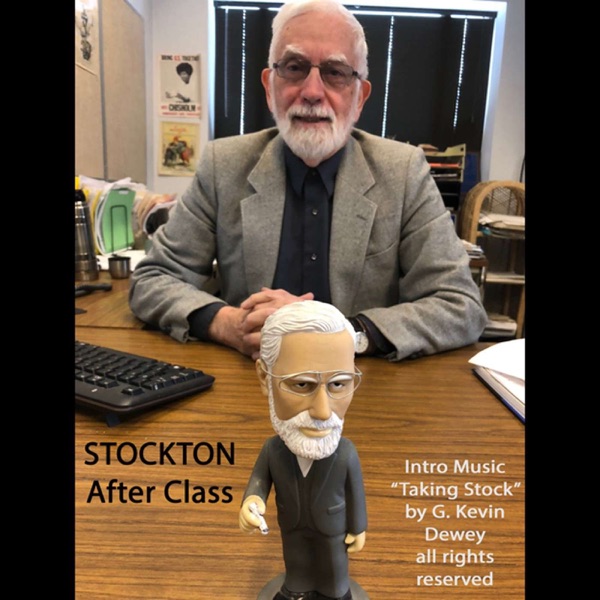
StocktonAfterClass
Ron Stockton was a professor of political science at the University of Michigan-Dearborn for 48 years. His specialty was non-western politics and political change. He taught classes on the Israeli-Palestinian Conflict, Religion and Politics, the Politics of Revolution, Non-Western politics, and American politics. He also taught in the Honors Program, focusing upon foundational readings from the 18th and 19th centuries. He has an interest in religion and politics and in the role of religio-ethnic groups in the political system. The listener can anticipate talks on Arab-Americans, Jews, African-Americans, the Scots-Irish, and Evangelicals. He has lectured and written on American politics, public opinion, and voting behavior and on the role of religious organizations and ideologies in the political system. There will be occasional discussions of books and films that address serious issues. And he has lectured and published and even taught a class on gravestones, especially those of different ethnic and religious groups such as Muslims, African-Americans, Jews, and Native Americans. The goal of the podcast series is to provide analysis and commentary by a political scientist to explain and make accessible political, historical, and cultural developments in the United States and around the world, and to give the listener analytical tools to understand those developments. It is also to entertain the listener.
- Social Sciences chart
- #153
- Episodes
- 237
- Releases
- Every two weeks
- Typical length
- 29 min
- On air since
- 2021
- Latest episode
- 1 week ago
Episodes
237 episodes, newest first
-
48 min
A Week Before The Election (2026)
Show notes
Usually I have a text for a podcast. This time I just talked from some notes. I hope this works for you.
I did once say that Abdul ran for mayor when I meant governor.
And if you want to listen to my podcast on the South African genocide charge against Israel I think it is called "Israel in the Dock"
Also, I forgot to mention an important point. The policies of the "progressives" do not appear radical to the people who support them. When mamdani says he is going to provide nursery school starting at age 2, the moms sending their kids do not consider those politicies particularly radical or even "progressive." That is just providing their kids with education. And when he says he will cut the cost of public transportation, the people who ride the busses are very happy.
AND everyone out there has a friend or relative who lacks health coverage so calling for Medicare for All sounds very logical.
-
9 min
Ron's Talk on September 11
Show notes
The chancellor wanted to have a commemoration event on September 13, two days after Septembeer 11. He invited me to speak.
As I look back on my comments 25 years later, I am pleased at how I detected the dangers inherent in the political system. But I also realize how much I under estimated what was to come. We had a Republican president who went to the national mosque and declared Islam to be a religion of peace. He made it clear to his cabinet that there would be no retaliation against Muslims. How could we even imagine the regime to come, whose supporters openly call for the expulsion of all Muslims from the country?
But we do what we can in the moment presented to us. I look back on this talk with some satisfaction.
-
11 min
Abdul El Sayed Discusses Israel. And a Jewish response
Show notes
This is from an article on The Forward, a Jewish newspaper. It draws from an interview that Abdul El sayed gave with the New Yorker a day before the primary election.
A Jewish journalist thought it deserved discussion so he provided key excerpts along with his comments.
If you are a supporter of Abdul, or his critic, you will find this of interest.
Sorry I posted this without music.
-
3 min
Bad Hair Day. Two Tens and a Five, please. A True Story, Just for Fun
Show notes
This is a true story of a young woman cashier who was having a VERY bad day.
I really didn't mean to add to her problems, but stuff happens.
-
8 min
A Salvtion Army Graveyard and a Historic Poem by Vachel Lindsey.
Show notes
I once visited a Salvation Army graveyard section. It was a very interesting experience.
-
4 min
Crazy Lady On The Phone: A True Story
Show notes
This is one of those episodes in life that descend upon you like a mosquitoe that just keeps buzzing around. You can either let it ruin your night's sleep or you can view it as an opportunity. I chose to turn it into an anecdote.
By the way, there was a time, not long ago, when there were people called "operators." They were very helpful and were always available to help find a number or to reach a person. In time, the phone companies decided they could be replaced by on-line information. Then they started charging for on-line information. That is why some of you who are younger may be slightly confused by the "operator" aspect of this story.
-
32 min
Question Israel at Your Own Risk. The University of Michigan Graduation Speech, 2026
Show notes
Derek Peterson, Chair of the UM Faculty Senate, was asked to deliver remarks to the 2026 graduating class. He focused upon the tradition of protest on campus, going back to the period after the Civil War. Everything was ducky until he got to protests against the Gaza War.
Well, you can listen to what happened after that.
My approach was to read the statements of the various parties to this dispute, and to same my own thoughs until the end.
Update: In the end, I decided to read the full (rather long) statement by the 1100 faculty and staff rather than excerpts. My wife thought that any attempt to edit it down would change it in some way, and detract from its purpose. I agreed.
-
17 min
Last Will and Testament, 1717 style
Show notes
Being my family historian, I bump into strange documents from time to time. A couple of years ago, I saw a will from 1717 that I thought might belong to an ancestor. It turned out that it did not, but the will was so fascinating that I wanted to discuss it with you. The logic and style are very different from what we know as a will today (although the goal is the same -- to allocate resources according to the wishes of the deceased, without tension).
Three small points
First, in a mistake, I once said an ell was 14 inches. In fact it is 45 inches.
Second, I suspect you know the term anno domini, which we commonly call A. D.
Third, a "share" of tobacco had different meanings. In some cases it was a negotiated amount, for example with a shareholder. The most common meaning was a full "hogshead" barrel, which was typically 1,000 pounds. It sounds as if that might be what was meant in this document.
This is a relatively short podcast so it will not cost a significant portion of your life to listen. And you might find it interesting.
-
36 min
At War With Iran! Everything You Wanted to Know but Were Afraid to Ask
Show notes
This is a discussion of the historic context of this war, plus some thoughts on the strategic issues involved.
Note: At one point I referred to the end of the Gulf War when I meant to say the end of World War II.
Note: At this point (March 17) opposition to the war is about 53-41. Republicans are very supportive, Democrats opposed. The general pattern in public opinion, is that whenever your country goes to war, you support it, but then support falls off very quickly within a month or so. By 51-29 Americans think the war has made us less safe.
-
26 min
Stop Blaming God. When Bad Things Happen to Good People by Rabbi Kushner. The Story of Job, and the Lessons We Can Learn From It.
Show notes
In 1981 Rabbi Harold Kushner wrote a book on suffering. He decided to write this when he learned that his beloved son Aaron had a terrible disease that would turn him into an old man even as a child. Aaron died at eight. Kushner reflected upon why an innocent child should suffer so much. Could God have prevented this? Kushner turned to the story of Job to try to understand.
If you like this podcast, I hope you will read the book.
And another book, Man's Search for Meaning by Viktor Frankel. I also have a podcast on that book.
-
24 min
Venezuela And The Trump Empire.
Show notes
On January 3 American forces went into Caracas and captured Venezuelan President Maduro. He was taken to the United States to stand trial. Is this a one-off adventure because of a corrupt leader, or does it suggest a broader set of actions of which this is just the first of many?
-
5 min
No Room in the Inn. An Alternative Nativity Story. (Probably more accurate than the one you learned as a kid).
Show notes
When I was in Turkey I visited a caravan serai. It was a place where a caravan would stop along the way. (And where travelers could find a place to spend the night). When we read that there was "no room in the inn" and Mary had to deliver in the stable, what does that mean? I suspect it was not nearly as harsh as I learned when I was a kid.
Two updates might be helpful
First, scholars have not found evidence of a caravan serai in Bethlehem.
Second, scholars believe that many stories in the Bible are metaphors, not facts. Some scholars believe that Jesus was not born in Bethlehem. That is more like one of the parables of Jesus, which everyone recognizes is a story designed to make a point
-
29 min
Trump in Decline. An Explanation
Show notes
I am very cautious about predictions. All the pundits are doing those, plus most of them seem to be chasing headines.
I have made an exception in this case, because I think Trump has peaked and is on his decline.
Am I just doing what others are doing and over-reading headlines? Maybe. But I think I see something worth noting.
You are welcome to spend 29 minutes see if you agree.
Feedback welcome. Rstock@Umich.edu
-
33 min
The Georgia Vote Stealing Case. Dismissed today November 26, 2025. What Were the Charges?
Show notes
Biden carried Georgia by just under 12,000 votes. They had a Republican governor and Republican Secreatary of State. Trump called them and asked them to "find" those votes. I just need one more than Biden got to carry the state. Trump threatened the Secretary of State with prosecution if he did not "find" the votes.
The county prosecutor Fannie Wills charged the president with corruption. Trump fought furiously. In time, Wills was removed for conflict of interest. (She was boinking one of her associates). The person who replaced her was a well respected prosecutor. Today he dismissed the case. Why?
1. The case should never have been in a county court. It should have been in a federal court. Allowing every county prosecutor to bring criminal charges against a president would produce chaos.
2. The critical sentence from Trump about "find the votes" could have been interpreted as having criminal intent OR just urging the local official to do his job. The law specifies that if reasonable people could interpret a statement in two ways, the prosecutor is obligated to grant the accused the benefit of the doubt.
3. The case was very complex with many individuals named. It would have involved multiple trials.
4. Trump is now in office. It could not go to trial until he was out of office. That would be very difficult.
What I do not yet understand is what happens to all of the peripheral individuals who already pleaded guilty to being a part of a conspiracy and have been sentenced. Wills used the RICO law to suggest that there were a host of people involved in this effort. This podcast will explain the original indictment document, including the logic of the RICO charge.
This is not long and is very informative.
-
20 min
Turning Point in the Revolution: King's Mountain.
Show notes
After the catastrophic defeat at Charleston, the Patriot forces were on the ropes. General Clinton, commander of the British army, was so confident of the outcome, that he left his deputy, General Cornwallis, in charge and headed north.
Cornwallis planned to link up with Tory militias from North and South Carolina, to crush resistance, and to remove two more stars from the flag. (The British already controlled Georgia, at least they thought they did).
The Tory militias, backed up by some regulars, had gathered at King's Mountain right on the border between North and South Carolina. They were in a formidable position, holding the high ground. The plan was to link up with Cornwallis, finish off the rebellion, and go home as heroes. What could go wrong?
But four battles (Musgrave Mill, Cowpens, King's Mountain, and Guilford Courthouse) changed the tragectory of the war.
We have been watching the Ken Burns masterpiece on The American Revolution. This story is told in the last episode.
-
1 hr 17 min
An American in Palestine: A Love Story. Memoir and Insights from Christa Bruhn
Show notes
Christa Bruhn was my student back in the 1980s. I remember very well the first time I met her. She told me she had lived for a semester in Gaza. I have been to Gaza twice and did not consider it a place for a young American woman to be spending a semester. But Christa was never able to get Palestine out of her soul.
This is her own story of her life-long engagement with a land and a people whose survival is not guaranteed. In time she fell in love with a Palestinian student she met in the US. She moved with him to Jenin where she became fully integrated into her new Palestinian family.
Christa shares amazing insights from her years in that land. I found it easy and very rewarding to interview her about her life and her book.
This interview is over an hour long but you will be glad you listened.
-
30 min
To Deport or Not to Deport. Stories From an Expert Witness (me)
Show notes
I have been an expert witness in four deportation hearings. The job of an expert witness is to given the judge reasons to permit the individual to remain in the U. S.
The cases were people from Lebanon, Syria, Iraq, and Palestine. The Palestinian case was the most interesting because it dealt with a stateless person.
I also want to share with you a conversation I had with an Immigration judge.
Immigration Attorney Shahad Atiya commented on this podcast:
• "Asylum law requires people to contort their fears into categories that sometimes make no sense to the expert observer. For those reasons, for the chemist, it was better for him to be able to select a category to be discriminated against such as religion, rather than fit himself into the catch all category (membership in a particular social group, that being chemists). That category kills many cases. Religion is black and white. What is membership in a particular social group anyway? We litigate this every day.
• "Although you mention these cases may be in the public record, they may be because of media attention or other ways they were discovered. Generally, asylum records and asylum cases are not discoverable and cannot be FOIA’d. You kept them anonymous though anyway.
• "Many of the timelines you mentioned for these cases put them under the Obama presidency. This shows that asylum law and its harsh realities know no party lines.
• "There is a level of privilege from the clients that you were an expert witness for having entered the U.S. legally and then applied after overstaying a visa. However, the privilege quickly fails when credibility is at the center of their case. Their credibility of their claims on the fact that they presented themselves at a port of entry, they held themselves out to be tourists or students or temporary workers or visitors. They told officers they intended to leave the U.S. but all along they had the intent to file for asylum because their claims naturally rest on things they experienced prior to their entry. Had their fear started while they were here, the case would be completely different. They would have a valid fear in the opinion of an officer and thereby now AFTER experiencing such events did their intentions change from nonimmigrant to immigrant. Islam and especially Shias put a lot of emphasis on the intentions you make prior to an act. I joke about how immigration law can be so Shia." -
29 min
No Heresy Trial (Yet). Four Entertaining Stories About Religion.
Show notes
This is a bit different from my typical podcast. This is four stories inspired by religion.
The story of Rachel and Rebecca, and the mandrake. (You have never read this story so you know nothing about the mandrake (or even what it is).
The Story of my close brush with the Rapture. (I will admit. I brought it on myself).
The story of the first (?) female pope. So you have never heard of Pope Joan. Well, you will now learn about her.
And the time I threw my hat into the ring when the papacy became vacant. (I know. It sounds like a bizarre scheme but the Church was in big trouble and i did not feel that I could just stand on the sidelines and watch it disintegrate).
Then, just for the sake of those not yet offended, I threw in a few atheist jokes.
Enjoy!
-
46 min
Marx and the Jews. Not What You Expect. The 1844 Manuscripts.
Show notes
Bruno Bauer, an intellectual colleague of Marx, wrote two essays to which Marx reacted strongly. The first was called “The Jewish Question” (Die Judenfrage), the second “On The Capacity of Present-Day Jews and Christians to Become Free.” Marx wrote two essays responding to Bauer’s work, using the same titles. The group of intellectuals of which Marx and Bauer were a part were debating how to achieve freedom (emancipation). Bauer saw Jews in terms of the Jewish religion. While Christians had just to seek freedom, Jews had to go through two steps to achieve freedom, theological and political (universal). They had to abandon the Torah, and their focus upon themselves, and then join Christians to become politically free. Bauer thought Jewish political behavior could be completely understood in terms of their ancient teachings.
Marx objected strongly, insisting that the religious issues were superficial and that Bauer had misunderstood the nature of conflict and freedom. These two essays were published in limited circulation and fell from public view when the 1848 uprising failed to achieve democracy and Marx fled into exile. They were only republished (along with several others) after World War II and are commonly called The 1844 Manuscripts or The Economic and Philosophical Manuscripts. These few manuscripts show a very different Marx from the Cold War image. He was someone interested in religion and human development. (Note: The first American publication used the title “A World Without Jews,” a term Marx never used, and which sounded very ominous in the aftermath of the Jewish holocaust.
I did this as a class lecture in my Religion and Politics class. It was a valuable lecture because not a single student had ever heard of these essays. I hesitated to turn the lecture into a podcast but once I had a text of the lecture, I saw that it had potential and decided to adapt it to podcast format.
I frequently asked students to write a two-page reaction paper (not graded) about how they thought about the lecture. Almost universally, they liked this lecture because it taught them some things they did not know. One of my students, a couple of decades ago, offered a unique perspective. He was a trained Islamic scholar. He said he had been trained in Koranic studies. He knew the Koran and the Hadith (opinions and stories from the life and example of Mohammed). to him those things were very important. But he now understood that Muslims were also a community of people who lived in the real world. Much of their behavior could be understood by thinking in that context.
His was a reaction that many students had.
Glitch: Around nine minutes in I accidentally hit the keyboard. This required some editing. If you notice a jump around that point, this is why.
-
22 min
The Gaza Genocide. A Public Talk
Show notes
This is a public talk I delivered on the concept of genocide and the arguments presented in the South African genocide charge against Israel in late 2023. Several people who wanted to attend but could not asked if it could be recorded. We tried, but somehow that did not work out.
To the extent possible I tried to be scholarly and analytical in this talk. But how can we be scholarly and detached and analytical when we see Miss Rachel singing "hop little bunny" as a three-year-old Palestinian child dances gleefully around on her new artificial legs? And the evening news (if you watch a good source) is beyond distressing. There are times when I think of that line from Joseph Conrad's Heart of Darkness: "The horror! The horror!
I have delivered this talk three times, once at a university, once at a church, and once at a retirement community. In all three cases, the audience was open and responsive, and the post-talk discussion was serious and engaging.
I hope you find this talk helpful. Also, I delivered a full hour-long podcast discussion of that South African document soon after it was filed with the High Court of Justice in the Hague.
On these lists
StocktonAfterClass is one of the shows picked out on this list


More in Social Sciences
Placed highest on Apple Podcasts' Social Sciences chart right now