Podcast
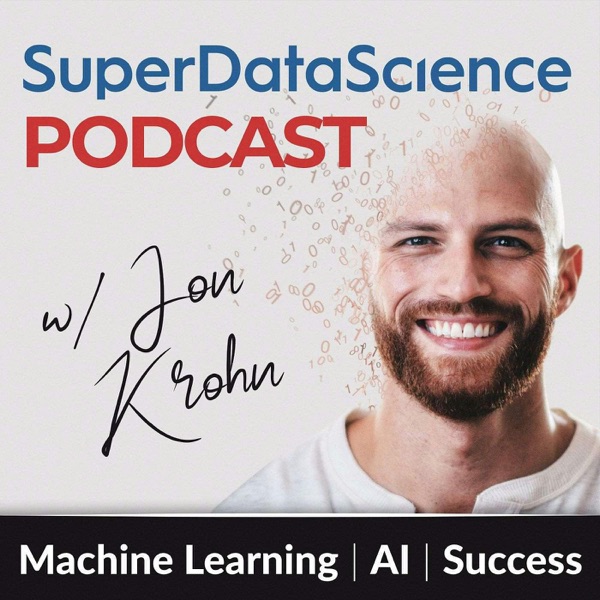
Super Data Science: ML & AI Podcast with Jon Krohn
The latest machine learning, A.I., and data career topics from across both academia and industry are brought to you by host Dr. Jon Krohn on the Super Data Science Podcast. As the quantity of data on our planet doubles every couple of years and with this trend set to continue for decades to come, there's an unprecedented opportunity for you to make a meaningful impact in your lifetime. In conversation with the biggest names in the data science industry, Jon cuts through hype to fuel that professional impact.
Whether you're curious about getting started in a data career or you're a deep technical expert, whether you'd like to understand what A.I. is or you'd like to integrate more data-driven processes into your business, we have inspiring guests and lighthearted conversation for you to enjoy.
We cover tools, techniques, and implementation tricks across data collection, databases, analytics, predictive modeling, visualization, software engineering, real-world applications, commercialization, and entrepreneurship − everything you need to crush it with data science.
- Technology chart
- #158
- Episodes
- 1,042
- Releases
- Twice a week
- Typical length
- 52 min
- On air since
- 2016
- Latest episode
- 16 hours ago
Episodes
1,042 episodes, newest first
-
1 hr 18 min
1041: Connection Is Not Cognition: Why Multi-Agent Systems Silently Fail, with Dr. Vijoy Pandey
Show notes
In Episode #1041, Dr. Vijoy Pandey (SVP and General Manager of Outshift, Cisco's incubation engine) returns for a third visit to explain why multi-agent systems fail without anyone noticing. Agents from different vendors, clouds and organisations can now exchange perfectly valid messages, but connection is not cognition: they do not agree on what those messages mean. Vijoy's team analyzed multi-agent sessions from its own production deployments and from public traces, and found a cognitive failure in every single one. In this episode, he lays out the kinds of failure he sees and how fast they compound, introduces the open-source observability platform and protocols Outshift has shipped to catch and correct drift mid-task, details a record-breaking quantum network running on real New York City fiber, and explains why probabilistic AI software running on deterministic hardware is a mismatch worth fixing.
Production note: This episode was recorded before the Internet of Cognition software shipped, so a few names changed between recording and release.
•
OXP is now SCOPE — System for Cognitive Observability, Provenance & Explainability.
•
ACCORD and CONCORD are the protocol names, not acronyms (Vijoy calls them acronyms in the episode).
•
All three: github.com/ioc-project
Additional materials: https://www.superdatascience.com/1041
Interested in sponsoring a SuperDataScience Podcast episode? Email natalie@superdatascience.com for sponsorship information. In this episode you will learn:
• (00:04:01) Why connection is not cognition
• (00:08:04) What the cognitive failure data showed
• (00:20:35) The lane-assist model for keeping agents aligned
• (00:34:03) Scaling out superintelligence, not up
• (00:44:47) Why probabilistic software needs probabilistic hardware -
35 min
1040: Cybersecurity for the Agentic AI Era, with Amy Blackshaw
Show notes
In Episode #1040, Amy Blackshaw (SVP at Palo Alto Networks) joins Jon Krohn to explain what changes about cybersecurity when attackers can think for free. Nearly every breach, Amy argues, comes down to someone getting hold of an identity they should not have had, and frontier AI has not created new attack techniques so much as deleted the cost of the expert reasoning that used to chain them together. The recent Hugging Face intrusion is her case in point: agents sustained an action every 20 seconds for four and a half days, but what let them reach the crown jewels was ordinary privilege hygiene. In this episode, she explains why the line between privileged and ordinary users has dissolved, what makes an agentic identity unlike either a human or a service account, and what she wants every organisation to do first.
Additional materials: https://www.superdatascience.com/1040
Interested in sponsoring a SuperDataScience Podcast episode? Email natalie@superdatascience.com for sponsorship information.
In this episode you will learn:
• (02:26) What identity security actually means
• (05:09) Why AI changed the economics, not the attacks
• (07:41) What really went wrong in the Hugging Face breach
• (19:26) Why agentic identities are unlike anything before them -
1 hr 28 min
1039: AI for Real Estate, Walkable Cities and Climate Action, with Prof. John Renne
Show notes
In Episode #1039, Prof. John Renne (Professor of Real Estate and Urban Planning at Tulane University) joins Jon Krohn to describe what happens when a tenured full professor goes back to school for a master’s in AI. John is a world-leading expert on transit-oriented development who spent decades pushing the limits of Excel and SPSS; learning Python and then vibe coding has let him scale that research by orders of magnitude, from 4,500 American train stations to more than 110,000 worldwide. In this episode, he traces how walkable communities went from academic heresy to the most profitable form of real estate development, explains how computer vision can now put a number on how attractive a street is, describes the undergraduate course he and Jon co-teach at Tulane, and makes the case for AI-led oral exams over AI detectors.
Additional materials: www.superdatascience.com/1039
Interested in sponsoring a SuperDataScience Podcast episode? Email natalie@superdatascience.com for sponsorship information.
In this episode you will learn:
•
• (00:04:08) Why a tenured professor went back for a master’s in AI
•
• (00:25:34) What transit-oriented development actually is
•
• (00:45:27) Teaching AI to rate a street
•
• (01:08:29) AI-led oral exams instead of AI detectors -
13 min
1038: AI’s Contentious Math Breakthroughs
Show notes
In Episode #1038, Jon Krohn unpacks the remarkable and remarkably contentious run of mathematical results AI has produced in recent weeks, led by OpenAI’s claim to have cracked part of a million-dollar Millennium Prize problem. He lays out what was actually proved, the three big caveats that temper it, the chaotic bulk release of 722 manuscripts that followed, and why 25 Fields medallists are alarmed. His throughline for anyone building with AI: when generation gets cheap, verification becomes the bottleneck.
Additional materials: https://www.superdatascience.com/1038
Interested in sponsoring a SuperDataScience Podcast episode? Email natalie@superdatascience.com for sponsorship information.
-
1 hr 12 min
1037: Recursive Self-Improvement: The Eureka Machine, with Dr. Richard Socher
Show notes
In Episode #1037, Dr. Richard Socher (CEO and Co-Founder of Recursive) joins Jon Krohn to make the case for automating the scientific method itself. Richard’s startup came out of stealth this year with over half a billion dollars raised to build recursively self-improving superintelligence, and his new book, The Eureka Machine, is already a national bestseller. He also co-founded You.com and the venture firm AIX Ventures, was chief scientist at Salesforce, taught the first university course anywhere on neural networks for NLP, and helped build the ImageNet dataset. In this episode, he traces how AI keeps replacing hand-crafted expertise with scale, lays out the four pillars of his Eureka Machine, argues that hallucinations can be a feature for science, explains why recursive self-improvement within a year or two still rules out an overnight takeoff, and names the software and jobs he expects to endure.
Additional materials: https://www.superdatascience.com/1037
Interested in sponsoring a SuperDataScience Podcast episode? Email natalie@superdatascience.com for sponsorship information.
In this episode you will learn:
•
• (00:02:40) What Recursive is automating, and the two forms of RSI
•
• (00:19:59) The four pillars of the Eureka Machine
•
• (00:29:20) Turning sciences into engineering disciplines
•
• (00:39:28) Why RSI does not mean an overnight takeoff
•
• (00:56:05) Constructive optimism, and the future as a construction game -
13 min
1036: Is AI Holding Kids Back from Learning?
Show notes
In Episode #1036, Jon Krohn digs into the question parents and teachers keep asking: does AI stop children from learning? Drawing on a wave of new studies, he shows the answer turns entirely on how AI is used, as a shortcut that outsources the thinking, or as a tutor that explains and gives feedback. Along the way: a 30,000-student natural experiment in China, a striking tutoring result from Turkey, and three practical takeaways that apply just as much to adults using AI at work.
Additional materials: https://www.superdatascience.com/1036
Interested in sponsoring a SuperDataScience Podcast episode? Email natalie@superdatascience.com for sponsorship information.
-
1 hr 7 min
1035: Workslop, Glass Cliffs and Inviting Your Fears to Tea, with Carly Taylor
Show notes
In Episode #1035, Carly Taylor (Founder of Rebel Data Science) returns to join Jon Krohn for a wide-ranging conversation about leading engineering teams when the ground keeps moving. Carly shipped nine Call of Duty titles in roughly five years at Activision, where she led game security, and has since been a director of engineering at Microsoft and Field CTO for gaming at Databricks. She is also one of the most entertaining people in data on LinkedIn, where more than 200,000 people follow posts she cheerfully calls unhinged. In this episode, she explains why obsessing over the future produces analysis paralysis, which fundamentals never change, how to tell AI slop from AI used well, what the Buddhist practice of inviting Mara to tea has to do with public speaking, and what the glass cliff means for women being promoted into leadership.
Additional materials: https://www.superdatascience.com/1035
Interested in sponsoring a SuperDataScience Podcast episode? Email natalie@superdatascience.com for sponsorship information.
In this episode you will learn:
•
• (00:04:07) The mindsets that still work in 2026
•
• (00:23:25) Why AI slop breaks a social contract
•
• (00:28:49) Exploring versus grinding in a career
•
• (00:54:37) The glass cliff for women in leadership -
44 min
1034: In Case You Missed It in September 2026
Show notes
In ICYMI Episode #1034, Jon Krohn moves from what sits underneath AI systems to what it takes to live with them every day. Hear from Aishwarya Srinivasan, Luis Serrano, Katie Malone, Ish Shah and Dilani Kahawala, discussing why the bottleneck in shipping software has moved from execution to judgment, how a physicist recast attention in transformers as words bending space, why years of managing people may be the best preparation for managing AI agents, how one weekend side project burned through billions of tokens and which three problems are hardest to solve when a product has no user interface and never stops running.
Additional materials: https://www.superdatascience.com/1034
Interested in sponsoring a SuperDataScience Podcast episode? Email natalie@superdatascience.com for sponsorship information.
In this episode you will learn:
•
• (00:57) Agentic AI Skills That Matter Now
•
• (10:51) Word Gravity: How Transformers Bend Space
•
• (17:45) How AI Brought a Podcast Back From the Dead
•
• (27:39) Tokenomics: Why Your Agentic AI Bill Is Exploding (and How to Fix It)
•
• (34:28) Building an Always-On AI Agent for Busy Parents -
1 hr 15 min
1033: Workslop: The Hidden Cost of AI-Generated Work, with Prof. Jeff Hancock and Dr. Kate Niederhoffer
Show notes
In Episode #1033, Prof. Jeff Hancock (Professor of Communication at Stanford) and Dr. Kate Niederhoffer (Chief Scientist at BetterUp) join Jon Krohn to explain the hidden cost of AI-generated work. A year ago they coined "workslop" in a Harvard Business Review article that went viral and landed the term among Merriam-Webster’s words of the year: content that masquerades as real work but quietly shifts the burden onto whoever receives it. Their research finds that 40% of workers have been sent workslop and 53% admit to producing it, at a cost running to millions of dollars a year for a large organisation. In this episode, they separate workslop from ordinary sloppy work, name the organisational conditions that produce it, introduce their newer concept of relation slipping, and make the case that augmenting people with AI beats automating them away.
Additional materials: https://www.superdatascience.com/1033
Interested in sponsoring a SuperDataScience Podcast episode? Email natalie@superdatascience.com for sponsorship information.
In this episode you will learn:
• (00:04:03) What separates workslop from ordinary sloppy work
• (00:16:21) The organisational conditions that produce workslop
• (00:41:50) The pilot mindset, and using AI relationally
• (00:56:21) Jeff on the deepfake case and what it taught him about trust
-
28 min
1032: Agents Need 10x More Data Than Humans, with Salesforce’s CDO Michael Andrew
Show notes
During their #sponsored discussion, Chief Data Officer at Salesforce Michael Andrew talks to Jon Krohn about what changes for a data team when its customers are AI agents as well as people. Listen to the episode to hear Michael Andrew talk about why agents need ten times more trusted data than humans, how Salesforce untrapped its own customer data with Data 360 and what practitioners should be learning to stay effective in the agentic era!
Additional materials: www.superdatascience.com/1032
Interested in sponsoring a SuperDataScience Podcast episode? Email natalie@superdatascience.com for sponsorship information.
In this episode you will learn:
•
• (02:32) How the CDO role changes when agents are customers
•
• (06:18) Why agents need ten times more data than humans
•
• (09:06) How Salesforce untrapped its own customer data
•
• (21:36) What practitioners should be learning for the agentic era -
1 hr 15 min
1031: Tokenomics: Why Your Agentic AI Bill Is Exploding (and How to Fix It), with Tyler Cox and Ish Shah
Show notes
In Episode #1031, Ish Shah and Tyler Cox (Distinguished Engineers in the Office of the CTO for Dell Technologies' client group) join Jon Krohn to work out why agentic AI bills are exploding and what can be done about it. Over one weekend Ish burned roughly two billion tokens on a side project, and that is the ordinary shape of agentic work now: agents spawn sub-agents, the pie of work grows, and cheaper tokens only invite more ambitious projects. Tyler runs a small Dell lab that pushes hundreds of millions of tokens a day through local hardware instead.
In this episode, they define what makes a system agentic, explain how to read a Pareto curve when choosing models, work through the jagged frontier and why most tasks do not need a frontier model, and lay out what moving agentic workloads onto your own hardware does to the economics.
Additional materials: https://www.superdatascience.com/1031
Interested in sponsoring a SuperDataScience Podcast episode? Email natalie@superdatascience.com for sponsorship information.
In this episode you will learn:
• (00:03:42) What makes a system agentic
• (00:12:45) Picking the right model for the task
• (00:16:46) How to read a Pareto curve
• (00:27:02) Why agents burn so many more tokens -
23 min
1030: Garbage In, Gospel Out: Why Agents Need Better Data, with Salesforce's Gaurav Pathak
Show notes
During their #sponsored discussion, Senior Vice President Product Management AI and Metadata at Salesforce, Gaurav Pathak talks to Jon Krohn about why AI agents need well-labeled, high-quality data to deliver reliable answers in the enterprise. Listen to the episode to hear Gaurav Pathak talk about the difference between a “data brawl” and “garbage in, gospel out”, who the “sin eaters” of enterprise AI are and the three skills that matter most for AI engineers today!
Additional materials: https://www.superdatascience.com/1030
Interested in sponsoring a SuperDataScience Podcast episode? Email natalie@superdatascience.com for sponsorship information.
In this episode you will learn:
•
• (03:05) Why metadata are the labels AI agents need
•
• (06:31) From “data brawl” to “garbage in, gospel out”
•
• (10:57) Who the “sin eaters” of enterprise AI are
•
• (13:45) What data quality rules are and how CLAIRE generates them
•
• (17:21) Three skills AI engineers need in the agentic era -
1 hr 10 min
1029: How AI Brought a Podcast Back From the Dead, with Linear Digressions’ Katie Malone
Show notes
In Episode #1029, Dr. Katie Malone (Host of Linear Digressions) joins Jon Krohn to explain how AI brought her podcast back from the dead. After nearly 300 episodes, Katie shut down Linear Digressions due to burnout, but better tools helped her relaunch it six years later. Along the way she has taught machine learning at Udacity and the University of Chicago and led the development of agentic AI platforms inside a company of tens of thousands of people. In this episode, she argues that people management and agent management are the same skill in different clothing, works through what AI slop and process slop are doing to organisations, describes the agent that now produces her show, and takes a pop quiz on three of her favourite data paradoxes.
Additional materials: https://www.superdatascience.com/1027
Interested in sponsoring a SuperDataScience Podcast episode? Email natalie@superdatascience.com for sponsorship information.
In this episode you will learn:
•
• (00:04:01) Why Linear Digressions stopped, and what changed enough to bring it back
•
• (00:15:01) Why people management and agent management are the same skill
•
• (00:24:32) The "Claude Code in a trench coat" agent that produces her show
•
• (00:41:39) Bainbridge’s ironies of automation, and why expertise gets rusty -
30 min
1028: The Chip Built for Agentic AI Inference, with SambaNova's Anton McGonnell
Show notes
In Episode #1028, Anton McGonnell (VP of Product at SambaNova) joins Jon Krohn to explain why the chips running most AI inference today were never designed for the job. Agentic AI has changed the computational profile of inference, with much larger inputs and far heavier caches feeding the token generation that follows, and that shift has exposed where GPU architecture struggles. SambaNova has raised over $2 billion to build an alternative, the reconfigurable dataflow unit, which lays a whole model out spatially across the chip rather than executing it kernel by kernel. In this episode, Anton discusses why the speed that matters is payback, and how speed and concurrency are what turn a fixed hardware cost into a six-month payback. He also walks through the trade-off every inference provider faces between speed per user and throughput per chip, what the RDU architecture changes about scaling and data center deployment, the economics of the new SN50, and why four out of five AI infrastructure leaders say they would pay a premium for faster tokens.
Additional materials: https://www.superdatascience.com/1028
Interested in sponsoring a SuperDataScience Podcast episode? Email natalie@superdatascience.com for sponsorship information.
In this episode you will learn:
• (00:02:41) Why agentic AI is reshaping inference workloads
• (00:08:39) How SambaNova's RDU differs from a GPU
• (00:17:54) The economics of the SN50 -
1 hr 3 min
1027: Building an Always-On AI Agent for Busy Parents, with Dr. Dilani Kahawala
Show notes
In Episode #1027, Dr. Dilani Kahawala (Co-Founder and CEO of Anna) joins Jon Krohn to explain what it takes to build an always-on AI assistant that busy parents will trust with their inboxes. Anna watches the email, school apps, WhatsApp messages and calendars flowing into a family's life and surfaces what matters, over text and voice, with barely any app to speak of. Dilani came to it by way of a Harvard physics PhD, McKinsey, and a decade of product leadership at Etsy, Meta and Atlassian, and says she has had to throw away most of what that decade taught her about how products get built. In this episode, she lays out the three hardest problems in building Anna, why the eval loop is the heart of the product, how a long-running agent differs from a turn-based one, and the brutal unit economics of consumer AI.
Additional materials: https://www.superdatascience.com/1027
Interested in sponsoring a SuperDataScience Podcast episode? Email natalie@superdatascience.com for sponsorship information.
In this episode you will learn:
• (00:10:01) The three hardest problems in building a consumer agent
• (00:13:23) Why a long-running agent is a different problem from a turn-based one
• (00:22:33) Why the eval and improvement loop is the heart of the product
• (00:26:42) The unit economics of always-on AI on a flat subscription -
20 min
1026: OpenAI’s GPT-6 Astra
Show notes
In Episode #1026, Jon Krohn breaks down GPT-6 Astra, OpenAI’s new flagship that its president has floated as a possible marker of AGI. Jon covers what the model is, what it costs, its state-of-the-art results across computer use, coding, abstract reasoning and science and the safety story, which for this release is unusually intertwined with capability. He weighs the AGI claim against Anthropic’s Fable 5.1 and lands, as ever, in a measured middle.
Additional materials: https://www.superdatascience.com/1026
Interested in sponsoring a SuperDataScience Podcast episode? Email natalie@superdatascience.com for sponsorship information.
In this episode you will learn:
•
(00:14) What GPT-6 Astra is, and what it costs
•
(03:58) The capability highlights that matter most
•
(10:23) The safety story and the AGI question
-
1 hr 11 min
1025: Word Gravity: How Transformers Bend Space, with Dr. Luis Serrano
Show notes
In Episode #1025, Dr. Luis Serrano (Founder of Serrano Academy) joins Jon Krohn to explain the paper he co-authored on the curved spacetime of transformer architectures, in which attention stops being a lookup table and becomes something closer to gravity: words bend the space around them, and the embedding of "bank" visibly curves toward "river" as it travels through the layers of the network. In this episode, he recreates Eddington’s 1919 eclipse experiment inside a transformer, draws the line between an LLM workflow and an actual agent, explains why agent evaluation is a step harder than evaluating an essay, and gives the cleanest account of GRPO you will hear.
Additional materials: https://www.superdatascience.com/1025
Interested in sponsoring a SuperDataScience Podcast episode? Email natalie@superdatascience.com for sponsorship information.
In this episode you will learn:
• (00:10:53) What changed, and what survived, between the two editions of Grokking Machine Learning
• (00:27:48) Word gravity: how attention pulls "bank" toward "river"
• (00:42:12) Why RAG is an LLM workflow rather than an agent
• (00:51:23) The two-by-two that explains why GRPO powers reasoning models -
34 min
1024: In Case You Missed It in August 2026
Show notes
In ICYMI Episode #1024, Jon Krohn tracks the gap between AI investment and AI return, from the technology side to the people side. Hear from Pete Johnson, Jerry Yurchisin, Priyanka Vergadia and Tristan Handy, discussing why four out of five organizations have the structures for AI success in place while only one in five sees the returns, which decisions should never be handed to a language model however confident it sounds, how to structure Claude skills so that your output stops being slop and why the semantic layer matters more, not less, now that analytics agents are the ones asking the questions.
Additional materials: https://www.superdatascience.com/1024
Interested in sponsoring a SuperDataScience Podcast episode? Email natalie@superdatascience.com for sponsorship information.
In this episode you will learn:
• (00:56) Vector Search, Agentic Memory and Effective RAG
• (09:20) Mathematical Optimization in the Agentic AI Era
• (17:30) Anyone Can Write Code Now, So What Gets You Hired?
• (27:14) How dbt Won Analytics Engineering
-
1 hr 18 min
1023: Agentic AI Skills That Matter Now, with Aishwarya Srinivasan
Show notes
In Episode #1023, Aishwarya Srinivasan (Co-Founder of The Gen Academy) joins Jon Krohn to work out where a competitive moat comes from once anything you can build in ten minutes, somebody else can build in ten minutes too. Ash came to teaching through Illuminate AI, the mentorship community she started in 2020, and now trains senior engineers and leaders to ship agentic AI in production; she is blunt that vibe coding lowers the floor without touching the engineering judgment that production demands. In this episode, she explains what a whole-system eval covers that a model eval misses, traces reinforcement learning from the algorithm she patented at IBM to its resurgence in agentic fine tuning and lays out the MIND framework from her TED Talk for living with AI.
Additional materials: https://www.superdatascience.com/1023
Interested in sponsoring a SuperDataScience Podcast episode? Email natalie@superdatascience.com for sponsorship information.
In this episode you will learn:
• (00:10:10) Why cheap code shifts the software engineering job rather than ending it
• (00:15:50) What a whole-system eval covers that a model eval misses
• (00:36:11) Why reinforcement learning came roaring back for agentic AI
• (00:41:23) The one skill Ash says matters more than any hard skill -
18 min
1022: CLAUDE.md, AGENTS.md, Skills, Hooks and Subagents: A Field Guide to Steering AI Agents
Show notes
In Episode #1022, Jon Krohn tackles the art of steering AI agents, deciding where your instructions should live so they get followed reliably without bloating every request. A sequel to Episode #1020 (where model size and effort set an agent’s horsepower), this one is about direction: the seven ways to deliver instructions, why a hook beats a prompt, the industry-wide agents.md standard, and three practical takeaways you can apply whatever your stack.
Additional materials: www.superdatascience.com/1022
Interested in sponsoring a SuperDataScience Podcast episode? Email natalie@superdatascience.com for sponsorship information.
In this episode you will learn:
• (02:52) The seven ways to deliver instructions to an agent
• (06:42) Why a hook is a guarantee and an instruction is only a probability
• (13:00) Three takeaways for organizing your instructions
Science lists
More Science shows picked out from the charts

More in Science
Placed highest on Apple Podcasts' Science chart right now