Podcast
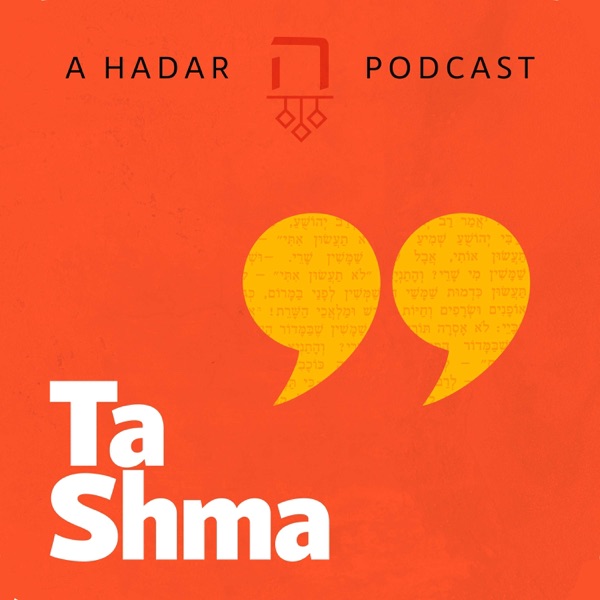
Ta Shma
Bringing you recent lectures, classes, and programs from the Hadar Institute, Ta Shma is where you get to listen in on the beit midrash. Come and listen on the go, at home, or wherever you are. Hosted by Rabbi Avi Killip of the Hadar Institute.
- Judaism chart
- #90
- Episodes
- 803
- Releases
- Twice a week
- Typical length
- 13 min
- On air since
- 2017
- Latest episode
- 1 day ago
Episodes
803 episodes, newest first
-
44 min
R. Ayal Robkin: Beyond the Reed Sea: Defining a New Redemption
Show notes
What does it mean to be free? Is freedom simply the ability to do what we want, or is there something deeper at stake? The Maharal of Prague offers a profound understanding of slavery and redemption that challenges our assumptions and invites us to consider some essential questions: What defines us? What holds us back? And what does it mean to live freely? Through his teachings, we’ll explore what freedom might mean thousands of years after God took the Israelites out of Egypt. Recorded at Hadar's July Learning Seminar 2026.
Source sheet: https://mechonhadar.s3.us-east-1.amazonaws.com/mh_torah_source_sheets/JLS2026RobkinBeyondRedSea.pdf
-
9 min
R. Avi Strausberg on Parashat Vayera: A Place Without Words
Show notes
Prayer in Jewish tradition is most commonly expressed in spoken words. But in Parashat VaYera, Avraham, Hagar, and Yishmael each have a moment of being heard and seen in the presence of the Divine in which their thoughts are unspoken—but which our tradition understands as an archetype of prayer.
-
1 hr
R. Aviva Richman and R. Ethan Tucker: The Akeidah on Trial: Did Abraham Pass the Ultimate Test?
Show notes
Join Hadar's rashei yeshiva, R. Aviva Richman and R. Ethan Tucker, for a unique debate as they spar with the text — and with one another. Was the binding of Isaac the peak moment of Abraham's faith journey — or did he fail his calling in the most spectacular way possible? Is the akeidah a model for what faith demands of us, or a nightmare we're meant to learn from? This memorial Rabbi Jonathan D. Levine keynote was given in September 2026.
Source sheet: https://mechonhadar.s3.us-east-1.amazonaws.com/mh_torah_source_sheets/HHDLecture2026RichmanTuckerAkeidahOnTrial.pdf
-
9 min
R. Avi Strausberg on Parashat Lekh Lekha: On That Day: When the Present and Future Become One
Show notes
A core thread running through Jewish tradition is a continuous yearning toward a promised future. In our holy texts, the Prophets preach to a people in exile of a day in which they will be gathered together again in their land with God. In our davening, we pray for the future rebuilding of Jerusalem and the Holy Temple. Each week when we observe Shabbat, we imagine it as a taste of the more perfect world-to-come. We live in the reality of now—and we are always waiting and striving for a promised future.
-
27 min
R. Avi Killip on Shofar, So Good! Podcast: For Heaven's Sake
Show notes
In this episode of the Shofar, So Good! podcast, host Kate Mishkin delves into havruta learning, the Jewish tradition of studying Torah in pairs. The goal of this paired endeavor: arguing "for the sake of heaven." Kate speaks with Hadar's Rabbi Avi Killip as well as Pedagogy of Partnership's Dr. Orit Kent to explore what exactly that means, teaches us about Jewish history's most famous study partners, and learns how AI is changing havruta learning. Then, Kate and her dad become havrutas.
You can check out the Shofar, So Good! podcast here: https://podcasts.apple.com/us/podcast/shofar-so-good/id1773839577
-
7 min
R. Avi Strausberg on Parashat Noah: After the Worst Happens
Show notes
Where there is order, there is the potential for disorder. Where forces are held back, there is the potential for them to break free.
Last week, in Parashat Bereishit, God ordered the world, separating light from darkness, the upper waters from the lower waters, dry land from water, and the powerful tehom, the watery depths at the foundation of God’s world, was held at bay. A fragile kind of existence was created which allowed for the creation of life in these new conditions. But in Parashat Noah, we see what happens when the tehom breaks free. The question our parashah poses is: what happens next?
-
51 min
R. Jason Rogoff: Cooperation and Competition: Israel and Babylonia as Centers of Torah
Show notes
This class explores the competing claims to religious authority in the Talmudic era between the Land of Israel and Babylonia. Through close reading of selected stories and debates in the Talmud, one can trace a broader struggle over where Torah resides and who has the authority to shape it. These texts help consider how categories and tensions continue to inform contemporary conversations about the relationship between Israel and the Diaspora.
Source sheet: https://mechonhadar.s3.us-east-1.amazonaws.com/mh_torah_source_sheets/JLS2026RogoffCooperationCompetition.pdf
-
8 min
R. Avi Strausberg on Parashat Bereishit: A Song of Rising Up
Show notes
In the beginning, God lifted the world out of chaos.
The Torah paints a dramatic scene. A wasteland. A darkness covering the surface of the tehom, the great depths. God sweeping over the face of the water. Out of this expanse of nothingness, God creates something. God creates order.
-
38 min
R. Avi Killip: The Long and Winding Road to Redemption
Show notes
We long for a better world. Judaism teaches us to yearn and pray and work to bring the messiah, reach redemption, and earn our place in the world to come. But what does that mean? What are these different conceptions of redeemer and redemption, and what does each require of us? This class explores these terms and the tremendous, exhilarating, terrifying potential each holds. Recorded at Hadar's July Learning Seminar, 2026.
Source sheet: https://mechonhadar.s3.us-east-1.amazonaws.com/mh_torah_source_sheets/JLS2026KillipLongRoadGeulah.pdf
-
8 min
A Festival About Nothing: Dr. Tsivia Frank Wygoda on Shemini Atzeret-Simhat Torah
Show notes
In Israel, Shemini Atzeret-Simhat Torah feels like the busiest day of the year. So many prayers; so many different atmospheres. Year after year, juggling back and forth from the joy of celebrating the completion of the annual Torah cycle with singing, dancing, and endless Torah readings, to the more somber parts of the holiday—Yizkor; the prayer for rain—leaves me exhausted and a little dizzy, almost wishing for the peace and quiet of “aharei ha-hagim - after the holidays.”
-
8 min
R. Avital Hochstein on VeZot HaBerakhah: Journey Summary
Show notes
R. Simlai taught: Torah—its beginning is kindness and its end is kindness.
Its beginning is kindness—as it is written, “God made leather garments for Adam and his wife and dressed them” (Genesis 3:21) And its end is kindness—as it is written, “[God] buried [Moshe] in the valley” (Deuteronomy 34:6), (from Tractate Sotah 14a).
Dear Friends, with the end of the year, we also complete another cycle of reading through the Five Books of the Torah. This offers a pause to look back on the philosophical, moral, and human journey we walked together.
-
37 min
R. Dena Weiss: Language As a Lens: Silence (Part 5)
Show notes
Explore the role that language plays in our personal, religious, and spiritual lives, by challenging assumptions about core areas of speech like prayer (is it supposed to be effective?) gossip (is it really bad?), and telling the truth (is it necessary?). Recorded in Summer 2026.
Source sheet: https://mechonhadar.s3.us-east-1.amazonaws.com/mh_torah_source_sheets/WeissLanguageLensPart52026.pdf
-
7 min
R. Avital Hochstein on Parashat Ha'azinu: A Topography of Distance
Show notes
“I will hide My face from them” (Deuteronomy 32:20)—so declares the Holy Blessed One in Parashat Ha’azinu. This is one of the most painful and jarring statements in the Bible. It describes a deep rift in the relationship between God and Israel: a dynamic of hiding, withdrawal, and a sealed face. This is called in Jewish theology and tradition hester panim, the hiding of God’s face.
-
43 min
R. Dena Weiss: Language As a Lens: Prayer (Part 4)
Show notes
Explore the role that language plays in our personal, religious, and spiritual lives, by challenging assumptions about core areas of speech like prayer (is it supposed to be effective?) gossip (is it really bad?), and telling the truth (is it necessary?). Recorded in Summer 2026.
Source sheet: https://mechonhadar.s3.us-east-1.amazonaws.com/mh_torah_source_sheets/WeissLanguageLensPart42026.pdf
-
11 min
R. Avital Hochstein on Parashat Nitzavim-VaYeilekh: On Mutual Responsibility
Show notes
At this time of year, as the High Holidays approach, we are used to thinking about our own personal responsibility. In the Yom Kippur Vidui, we worry not only about our sins that we are aware of, but even those that “are not revealed to us,” rather known to God alone. But the verse that introduces the concept of revealed or hidden sins is about not personal, but national responsibility. Since the evil of others can be even more hidden to us than our own, this introduces difficult questions. What is our responsibility for the other members of our society? And what are the limits of this responsibility?
-
44 min
R. Dena Weiss: Language As a Lens: When Is It OK to Lie? (Part 3)
Show notes
Explore the role that language plays in our personal, religious, and spiritual lives, by challenging assumptions about core areas of speech like prayer (is it supposed to be effective?) gossip (is it really bad?), and telling the truth (is it necessary?). Recorded in Summer 2026.
Source sheet: https://mechonhadar.s3.us-east-1.amazonaws.com/mh_torah_source_sheets/WeissLanguageLensPart32026.pdf
-
13 min
R. Avital Hochstein on Parashat Ki Tavo: Clearing the Holy from the Home
Show notes
Our parashah describes a ceremony known as vidui ma’aser. The word vidui here from the root י.ד.ה. probably means something like “declaration of thanks” (like the prayer Modim), but can be also literally translated as “confession,” like the vidui familiar to us from our High Holiday liturgy. What at first seems like an idyllic description of a perfect covenant in our land turns, through a reading of a Medieval commentator, into a pathway to move forward after sin and covenantal rupture.
-
44 min
R. Dena Weiss: Language As a Lens Part 2
Show notes
Explore the role that language plays in our personal, religious, and spiritual lives, by challenging assumptions about core areas of speech like prayer (is it supposed to be effective?) gossip (is it really bad?), and telling the truth (is it necessary?). Recorded in Summer 2026.
Source sheet: https://mechonhadar.s3.us-east-1.amazonaws.com/mh_torah_source_sheets/WeissLanguageLensPart22026.pdf
-
13 min
R. Avital Hochstein on Parashat Ki Teitzei: Three Contemporary Readings of the Rebellious Son
Show notes
One of the most emotionally charged and provocative legal passages is found in our parashah: the case of the rebellious son.
-
41 min
R. Dena Weiss: Language As a Lens Part 1
Show notes
Explore the role that language plays in our personal, religious, and spiritual lives, by challenging assumptions about core areas of speech like prayer (is it supposed to be effective?) gossip (is it really bad?), and telling the truth (is it necessary?). Recorded in Summer 2026.
Source sheet: https://mechonhadar.s3.us-east-1.amazonaws.com/mh_torah_source_sheets/WeissLanguageLensPart12026.pdf
Judaism lists
More Judaism shows picked out from the charts


More in Judaism
Placed highest on Apple Podcasts' Judaism chart right now