Podcast
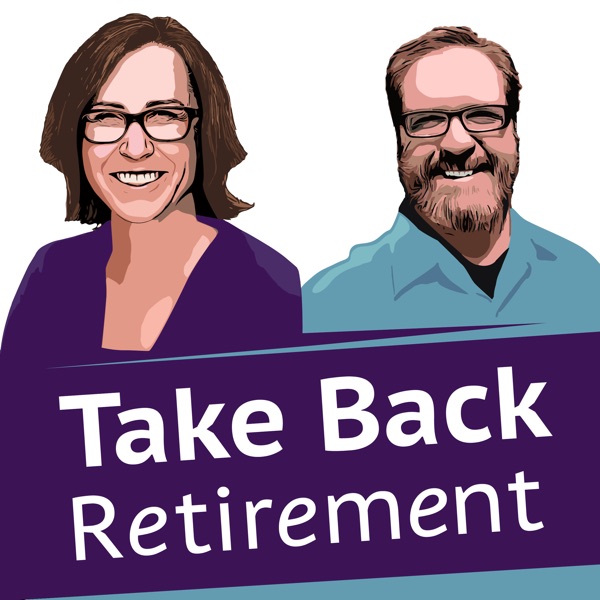
Take Back Retirement
You're a woman on the cusp of "retirement" naturally feeling some anxiety. We are two financial planners who take this subject seriously (but ourselves less so). We will help you feel more confident about your choices by cutting through the myths and mysteries. Through conversations and interviews with both subject-experts and women who have gone through what you are approaching, you will have the correct information and motivation to be in control of your future.
- Episodes
- 147
- Releases
- Every two weeks
- Typical length
- 41 min
- On air since
- 2020
- Latest episode
- 5 days ago
Episodes
147 episodes, newest first
-
41 min
146: Financial Therapy: The Intersection of Money and Emotions with Wendy Wright (rerun)
Episode 146
Show notes
"There is not good or bad with money"
Our hosts, Stephanie McCullough and Kevin Gaines, sit down with financial therapist Wendy Wright to unpack the emotional complexities that often underlie our financial behaviors. Wendy believes that money issues aren't just math problems—they're emotional ones too!
Rather than focusing on dollars and cents alone, Wendy helps her clients understand why they avoid budgeting, overspend in emotional moments, or feel incapable of managing money.
Her mantra? "Abundant, compassionate curiosity and zero judgment."
Wendy discusses common patterns like the belief of being "bad with money," the influence of childhood messages, and the emotional burden of debt. She advocates for intentionality, self-awareness, and sustainability over perfection, as well as financial journaling and identifying emotional triggers to help people rewrite their "money stories" and build healthier, more resilient habits.
"Nothing's going to work for you if it's not sustainable."
Healing your relationship with money begins with something as small as a $10 weekly savings goal. It's totally unhelpful to label yourself as "good" or "bad" with money. Personal finance is a deeply personal journey that benefits from reflection, not just spreadsheets.
Whether you're confronting debt, struggling with avoidance, or simply seeking a more peaceful relationship with money, give yourself permission to start exactly where you are—with grace.
Key Topics & Timestamps:
• Wendy's Financial Therapy Framework (03:20)
• Avoidance and Emotional Burdens (08:39)
• The "Bad with Money" Myth (10:45)
• Algorithmic Influences on Money Shame (13:22)
• Debt, Shame, and Sustainability (15:10)
• Money as a Tool, Not a Goal (31:28)
• Where to Begin: Curiosity, Not Judgment (34:14) Resources:
• https://wendywrightfinancialtherapy.com/
• Wendy on LinkedIn: https://www.linkedin.com/in/wendy-wright-lmft-financial-therapist-money-coach-70943723/
• Wendy on Instagram: https://www.instagram.com/wendywrightfinancialtherapy/
• Wendy on Facebook: https://www.facebook.com/financialtherapysolutionsIf you like what you've been hearing, we invite you to subscribe on your favorite platform and leave us a review. Tell us what you love about this episode! Or better yet, tell us what you want to hear more of in the future. stephanie@sofiafinancial.com
You can find the transcript and more information about this episode at https://www.takebackretirement.com/.
Follow Stephanie of Sofia Financial on Twitter, Facebook, YouTube and LinkedIn.
Follow Kevin of American Financial Management Group on Twitter, Facebook, YouTube and LinkedIn.
-
50 min
Your Year-End Financial Checklist: 10 Things to Review Before December
Episode 145
Show notes
"December is probably too late to scramble around and logistically get stuff done."
Our host Stephanie McCullough counts just nine work weeks left in the year, so she and co-host Kevin Gaines walk through a ten-item year-end checklist. Needless to say, these are best tackled months in advance rather than during the December scramble!
They cover the year-end deadlines. Contributions to 401(k)s must land by December 31, even though IRA contributions can wait until April 15, and a bonus paid in January counts toward next year.
For 2026, the limit is $24,500, with an $8,000 catch-up from age 50 and a larger $11,250 "super catch-up" for ages 60 through 63. Required minimum distributions can't slide past year-end either. A missed one carries a 25% penalty on the shortfall, which is especially painful on inherited Roth IRAs.
Gifts up to $19,000 per person avoid gift-tax filing, and charitable giving now carries a half-percent-of-income floor for itemizers. Donor-advised funds and qualified charitable distributions help with giving, too.
Next, review your tax picture. A low-income year may open the door to Roth conversions, while capital gains and other surprises can trigger higher Medicare IRMAA surcharges two years later.
Stephanie and Kevin also talk about precautionary measures, what they appropriately call your "smoke detector batteries": check your cash cushion, beneficiary forms, powers of attorney, and scam defenses, then start casual conversations with family about money.
Kevin adds a surprise eleventh item for anyone planning a net unrealized appreciation move on company stock: empty the 401(k) by December 31, or the tax bill balloons.
Key Topics:
• 401(k) Deadlines vs. the IRA Grace Period (02:55)
• RMDs and the Inherited IRA Roth Trap (09:35)
• Gifting: The $19,000 Rule (16:05)
• Review Your Taxes: Roth Conversions and Aunt IRMAA (19:16)
• Charitable Giving Gets a Floor (27:43)
• Donor-Advised Funds and QCDs (31:46)
• Tax-Loss Harvesting: Making Losers Useful (36:57)
• Smoke Detector Batteries: How Much Cash Do You Have? (40:32)
• Beneficiary Forms and Estate Documents (42:17)
• Scams, Passwords, and Cyber Safety (43:56)
• Talking to Your People About Money (about 45:50)
• Surprise #11: The NUA Deadline (47:46)Resources:
• Take Back Retirement Episode 33: What Women Need to Know about the Estate and Gift Tax System: https://takebackretirement.com/podcasts/what-women-need-to-know-about-the-estate-and-gift-tax-system/
• Take Back Retirement Episode 142: Don't Wait Until 65: Medicare Planning For Gen X And Beyond with Danielle Kunkle Roberts: https://takebackretirement.com/podcasts/dont-wait-until-65-medicare-planning-for-gen-x-and-beyond/
• Take Back Retirement Episode 78: The Essential Rules to Know When You Inherit an IRA: https://takebackretirement.com/podcasts/the-essential-rules-to-know-when-you-inherit-an-ira/
• Take Back Retirement Episode 83: Combating Fraud and Protecting Your Financial Future with AARP's Kathy Stokes: https://takebackretirement.com/podcasts/combatting-fraud-and-protecting-your-financial-future-with-aarps-kathy-stokes/
• Take Back Retirement Episode 112: Navigating Family Wealth Transfers: Emotional Intelligence and Effective Communication with Jill and Sean Maher: https://takebackretirement.com/podcasts/navigating-family-wealth-transfers-emotional-intelligence-and-effective-communication-with-jill-and-sean-maher/
• American Financial Management Group Newsletter: https://afmgplanning.kit.com/profileIf you like what you've been hearing, we invite you to subscribe on your favorite platform and leave us a review. Tell us what you love about this episode! Or better yet, tell us what you want to hear more of in the future. stephanie@sofiafinancial.com
You can find the transcript and more information about this episode at https://www.takebackretirement.com/.
Follow Stephanie on Twitter, Facebook, YouTube and LinkedIn.
-
30 min
144: We Need to Talk About Inheritance!
Episode 144
Show notes
"The biggest mistake parents can make is passing down money without communicating the family values that drive your thinking."
Our hosts, Stephanie McCullough and Kevin Gaines, dig into Kiplinger's October cover story on "the great wealth transfer," the slow handoff of an estimated $124 trillion from Baby Boomers to their children and grandchildren.
That number is a bit misleading considering more than half of that wealth sits with the richest 2% of households, and a quarter of parents expect to leave less than $100,000.
Citing the magazine's survey, roughly two in five families have never discussed how the older generation plans to pass down assets, and more parents claim to have had "the talk" than their kids remember hearing it.
This unwillingness to talk it out goes both ways. Parents worry that talking could breed entitlement. Adult children, meanwhile, sometimes make major life decisions (having kids, choosing careers, buying homes) without knowing whether money is coming, only to be upended when it does.
Their fix, echoing financial psychologist Brad Klontz, is to skip the one big, dreaded conversation in favor of many small ones, paired with practical basics like where documents live. They also make the case for gifting during your lifetime rather than only at death. After all, inheritances typically land when recipients are already in their 60s, which is well past when the money would have mattered most.
Underneath the tax talk and gifting strategy sits something more personal: as one advisor quoted in the piece puts it, the number attached to a life of saving is really the story of that life, and sharing it is what brings families closer.
Key Topics:
• One Big Talk vs. Many Little Conversations (05:49)
• Build the Plan, Then Adapt as Life Unfolds (06:42)
• IRAs, Roths, and the Ten-Year Clock (16:33)
• Gifting Now vs. Waiting Until You're Gone (17:57)
• Guardrails for Giving While You're Alive (20:44)
• Money Lessons That Stick: Envelopes and Gas Pumps (22:43)
• Sharing Knowledge and Family History (26:58)Resources:
• Diane Harris Kiplinger Article: Why So Many Families Are Unprepared for the Great Wealth Transfer — and What You Can Do About it https://www.kiplinger.com/retirement/inheritance/why-so-many-families-are-unprepared-for-the-great-wealth-transfer-and-what-you-can-do-about-it
• Take Back Retirement Episode 33: What Women Need to Know about the Estate and Gift Tax System https://takebackretirement.com/podcasts/what-women-need-to-know-about-the-estate-and-gift-tax-system/
• Take Back Retirement Episode 114: Child-free Estate Planning: Picking the Right People for Key Roles – and What to do if You are Picked! with Patricia De Fonte https://takebackretirement.com/podcasts/child-free-estate-planning-picking-the-right-people-for-key-roles-and-what-to-do-if-you-are-picked-with-patricia-de-fonte/
• Take Back Retirement Episode 78: The Essential Rules to Know When You Inherit an IRA https://takebackretirement.com/podcasts/the-essential-rules-to-know-when-you-inherit-an-ira/If you like what you've been hearing, we invite you to subscribe on your favorite platform and leave us a review. Tell us what you love about this episode! Or better yet, tell us what you want to hear more of in the future. stephanie@sofiafinancial.com
You can find the transcript and more information about this episode at https://www.takebackretirement.com/.
Follow Stephanie on Twitter, Facebook, YouTube and LinkedIn.
-
49 min
143: Am I Allowed? The Permission Paradox, with Dan Haylett
Episode 143
Show notes
"The one thing you're guaranteed to run out of is time."
Our hosts, Stephanie McCullough and Kevin Gaines, welcome back financial planner Dan Haylett, founder of Humans vs. Retirement and author of The Retirement You Didn't See Coming, to unpack his viral essay "The Permission Paradox."
Digging through his own client conversations for patterns, Dan found the two words that came up most were "permission" and "allowed." The people who have saved diligently for decades are often the ones least able to enjoy it, because permission was always external. For them, a paycheck justified spending, and a job title justified rest.
Retirement erases that scaffolding overnight, and now they find themselves with a little voice in their head always asking, "Am I allowed?"
Dan reckons that this is a case of ancient wiring. We evolved to store the grain rather than eat it. We have what he calls a "sensible person's trap," where decades of diligent saving become a habit too strong to break.
The real risk, he argues, isn't running out of money; it's dying with too much of it, having never spent down the roughly twelve good years of health and energy retirement actually grants.
His antidote is five permissions you need to give yourself: to enjoy what you've built, to rest without producing, to spend on experiences before you can't, to give "with a warm heart, not a cold hand," and to become someone new.
Retirement finally hands people money, time, and freedom together, but only permission unlocks any of it!
Key Topics:
• Permission Used to Be External (06:18)
• The Real Risk: Dying With Too Much, Not Running Out (10:02)
• Wired to Save: The Ancient Roots of "Survive First, Thrive Second" (12:45)
• The Sensible Person's Trap (20:19)
• From a Savings Habit to a Spending Mindset (23:41)
• The "12 Good Years" Window (25:00)
• Permission One: Starting With Enjoying What You've Built (27:10)
• Permission Two: Rest Without Producing (28:29)
• Permission Three: Spend on Experiences Before You Can't (30:40)
• Permission Four: Give With a Warm Heart, Not a Cold Hand (33:51)
• Permission Five: Become Someone New (38:36)
• Key Takeaways (43:25)Resources:
• Dan on Substack: https://danhaylett.substack.com/
• The Humans vs Retirement Podcast: https://www.humansvsretirement.com/
• Dan on YouTube: https://www.youtube.com/@DanHaylett
• Dan on LinkedIn: https://www.linkedin.com/in/dan-haylett-retirement-coach/Dan Haylett, and TFP Financial are not affiliated with or endorsed by Private Advisor Group, American Financial Management Group, or Sofia Financial.
If you like what you've been hearing, we invite you to subscribe on your favorite platform and leave us a review. Tell us what you love about this episode! Or better yet, tell us what you want to hear more of in the future. stephanie@sofiafinancial.com
You can find the transcript and more information about this episode at https://www.takebackretirement.com/.
Follow Stephanie on Twitter, Facebook, YouTube and LinkedIn.
-
51 min
142: Don't Wait Until 65: Medicare Planning For Gen X And Beyond with Danielle Kunkle Roberts
Episode 142
Show notes
"Everything government touches is complicated." - Danielle Kunkle Roberts
Our hosts, Stephanie McCullough and Kevin Gaines, bring on Danielle Kunkle Roberts of Boomer Benefits, and author of 10 Costly Medicare Mistakes You Can't Afford to Make.
As the title of her book suggests, Medicare isn't free. Believing otherwise is mistake number one! Premiums, deductibles, and coverage gaps are real costs that blindside retirees, especially anyone who leaves the workforce before 65 and needs an ACA bridge plan to survive the gap.
The trickiest wrinkle is the size-of-employer rule. If you work for a company with 20-plus employees past 65, your group plan stays primary while Medicare waits in the wings. Work for a smaller one, and Medicare becomes primary whether you enrolled or not, leaving a surprise medical bill for anyone who assumed their coverage worked the way a friend's did.
Never assume your neighbor's, cousin's, or friend's Medicare situation applies to yours, because age, employer size, and state all rewrite the rules.
Danielle also talks about "Ugly IRMAA". As the income-based surcharge calculated off your tax return from two years back, the Medicare IRMAA can ambush anyone who thought retirement meant no more "earnings." Then there's the annual Advantage plan and Part D notices of change, proof that even after enrollment, nothing about Medicare is truly "set it and forget it."
Danielle's fix isn't memorizing every rule, but finding a broker paid by commission rather than out-of-pocket, who revisits your plan every single year.
Key Topics:
• Medicare Isn't Free: Premiums and Coverage Gaps (05:30)
• Late Enrollment Penalties That Last Forever (11:39)
• Meet "Ugly IRMAA": Income-Based Premium Surcharges (18:31)
• Keep Your Creditable Coverage Paperwork (25:26)
• Medigap vs. Advantage: The One-Way Door (31:28)
• How Brokers Actually Get Paid (33:11)
• Why Advantage and Part D Are Never "Set It and Forget It" (40:34)
• Key Takeaways (45:38)Resources:
• Boomer Benefits: https://boomerbenefits.com
• Medicare Q&A with Boomer Benefits Free FB Group: https://www.facebook.com/groups/BoomerBenefits/
• 10 Costly Medicare Mistakes You Can't Afford to Make (book): https://a.co/d/09YBATz5"Danielle Kunkle Roberts, and Boomer Benefits are not affiliated with or endorsed by Private Advisor Group, American Financial Management Group, or Sofia Financial."
This episode or article may contain affiliate links.
If you like what you've been hearing, we invite you to subscribe on your favorite platform and leave us a review. Tell us what you love about this episode! Or better yet, tell us what you want to hear more of in the future. stephanie@sofiafinancial.com
You can find the transcript and more information about this episode at https://www.takebackretirement.com/.
Follow Stephanie on Twitter, Facebook, YouTube and LinkedIn.
-
30 min
141: Estimating Spending in Retirement Calculations: Front-end the Fun!
Episode 141
Show notes
"Spreadsheets are great at math; they suck at flexibility."
Our hosts, Stephanie McCullough and Kevin Gaines, take aim at the assumption that every retiree spends the same inflation-adjusted dollar amount, every year, until death. It's the number your 401(k) statement spits out, the number the 4% rule promises, and it's wrong in two directions at once!
First, it ignores life's lumpiness such as the new roof, the wedding, the pandemic-delayed trip to Greece. These are one-off costs that planners can average into projections but never quite eliminate.
Second, and more provocatively, it ignores the "retirement smile". That's spending that's higher in the active go-go years, dips in the slow-go years, then ticks back up in the no-go years as long-term care costs bite.
Their fix isn't a better formula but the intentionality to separate true essentials (food, shelter, utilities) from discretionary spending (travel, hobbies), because only the latter can flex when markets fall or inflation bites.
Front-load the trips and experiences you're physically able to enjoy now. Retirees should borrow from "future spending" you were always going to do eventually anyway. Take it from Stephanie, who encourages us to "plan that trip, people!"
Key Topics:
• The Straight-Line Spending Myth (03:16)
• One-Off Expenses and Life's Lumpiness (05:33)
• The Retirement Smile: Go-Go, Slow-Go, No-Go (06:45)
• What the 4% Rule Actually Promises (10:10)
• Front-Loading the Fun Stuff (13:45)
• Essentials vs. Discretionary: Building In Flexibility (16:20)
• Savings Reframed as "Future Spending" (19:31)
• Long-Term Care and the No-Go Years (22:35)Resources:
• Take Back Retirement Episode 130: Planning to Age Well: Life Care, Long-term Care, and Advocacy with Laura Lynn Morrissey: https://takebackretirement.com/podcasts/planning-to-age-well-life-care-long-term-care-and-advocacy-with-laura-lynn-morrissey/
• Take Back Retirement Episode 110: Navigating the Complexities of Aging: Proactive Planning for Seniors and Families with Jill and Steve Marshall: https://takebackretirement.com/podcasts/navigating-the-complexities-of-aging-proactive-planning-for-seniors-and-families-with-jill-and-steve-marshall/If you like what you've been hearing, we invite you to subscribe on your favorite platform and leave us a review. Tell us what you love about this episode! Or better yet, tell us what you want to hear more of in the future. stephanie@sofiafinancial.com
You can find the transcript and more information about this episode at https://www.takebackretirement.com/.
Follow Stephanie on Twitter, Facebook, YouTube and LinkedIn.
-
37 min
140: Don't You Dare Call Me Retired: Amy Bernstein on Creativity, Doubt, and Uncoupling Your Worth From Your Paycheck
Episode 140
Show notes
"You need to uncouple your self-worth from your income."
Amy Bernstein does not like the word "retired". Our hosts, Stephanie McCullough and Kevin Gaines, aren't too fond of the word either.
A former journalist and federal government communications veteran, she didn't quit anything cold. She shortened her commute first, then went part-time, then, when the pandemic made her last part-time job untenable, took the final step.
What followed was less a plan than experiments guided by whatever sparked joy. These "experiments" included playwriting classes, a first novel written on the train, and a book-coach certification that flipped a switch.
Six novels and a nonfiction guide for doubting creatives later, Amy has built a life that pays in confidence and craft more than dollars, and insists that trade is no downgrade. She believes that culture rewards money, title, and productivity so completely that anything creative reads as indulgence, something to feel guilty about squeezing in around "real" obligations.
Reading a book, listening to music, mastering a soufflé. These are creative acts whether or not monetized, and treating unmonetized creativity as worthless has it backwards. Her book, Wrangling the Doubt Monster, does not promise to cure self-doubt; it normalizes it, insisting doubt can ride along without driving the car.
Stephanie and Kevin are all about the idea that retirement rarely trips people up financially. It is the identity vacuum of "who am I once the job title disappears" that catches people off guard, and creativity is where many will find their answer!
Key Topics:
• From "Have To" to "Want To": Redefining Retirement (04:28)
• Overcoming the Guilt of Taking Time for Yourself (10:08)
• Normalizing Creative Self-Doubt (12:42)
• Permission to Experiment (and Fail) Without a Master Plan (22:02)
• Creativity as Therapy (28:38)
• Stephanie and Kevin's Wrap Up (31:28)Resources:
• https://amywrites.live/
• Take Back Retirement Episode 87: Cultivating Creative Connections for Lifelong Wellness with Claire Waite BrownIf you like what you've been hearing, we invite you to subscribe on your favorite platform and leave us a review. Tell us what you love about this episode! Or better yet, tell us what you want to hear more of in the future. stephanie@sofiafinancial.com
You can find the transcript and more information about this episode at https://www.takebackretirement.com/.
Follow Stephanie on Twitter, Facebook, YouTube and LinkedIn.
-
40 min
139: What Women Need to Know about Moving Investment Accounts
Episode 139
Show notes
"As with all things with the IRS, document, document, document."
Our hosts, Stephanie McCullough and Kevin Gaines, explain what actually happens when you move an investment or retirement account from one custodian to another.
The mechanics may seem as simple as filling out a form and waiting a few days. But Kevin walks through the fine print that trips up even seasoned advisors. Taxable accounts can usually move without triggering a sale, so cost basis and unrealized gains transfer intact.
Retirement accounts are where the real danger lives.
There are two ways to move retirement money: a trustee-to-trustee transfer, where the funds never touch your hands, and a 60-day rollover, where they briefly become yours.
The second path can be a minefield because, if you miss the 60-day window by even a day, the money is reclassified as a taxable distribution. The only way back is IRS self-certification for a handful of approved hardships, or a costly private letter ruling. And if you mix up traditional and Roth buckets during a move, you risk an illegal conversion or double taxation.
Beyond the rollover clock, Kevin brings up the mandatory 20% withholding on 401(k) distributions, and after-tax "basis" dollars that shouldn't be taxed twice. Then there's Form 5498, an easily discarded document that turns out to be essential for tracking IRA contributions and conversions for years to come.
Needless to say, all of this can be overwhelming. That's why it's so important to ask questions, document everything, and use direct transfers whenever possible.
Key Topics:
• Taxable Accounts and Custodians, Defined (04:38)
• The Myth That You Have to Sell Everything to Move (06:26)
• Transfer vs. Rollover: The Critical Difference (13:37)
• Inside the 60-Day Rollover Danger Zone (17:39)
• RMDs, Penalties, and the First-Dollar Rule (21:31)
• After-Tax Basis: Money You've Already Paid Tax On (26:51)
• The Mandatory 20% Withholding Trap on 401(k) Rollovers (31:50)
• Annuities and Surrender Periods (35:21)If you like what you've been hearing, we invite you to subscribe on your favorite platform and leave us a review. Tell us what you love about this episode! Or better yet, tell us what you want to hear more of in the future. stephanie@sofiafinancial.com
You can find the transcript and more information about this episode at https://www.takebackretirement.com/.
Follow Stephanie on Twitter, Facebook, YouTube and LinkedIn.
-
27 min
138: What Women Need to Know about the Estate and Gift Tax System (Rerun)
Episode 138
Show notes
Today, Stephanie and Kevin cover a topic that can often get confusing for many people: the estate and gift tax system. This is different from the income tax system, and both are federal tax systems that everyone needs to be aware of when planning for retirement.
At the end of the day, the IRS is getting paid. The only two questions, then, are: Who pays? and When? Our hosts tackle these questions and more.
While today's discussion is a big picture overview of the estate and gift tax system, it will give you a general grasp of the concepts and vocabulary that will make your next meeting with your accountant or estate planning attorney a more insightful and productive one.
Key Topics:
• "At the end of the day, the IRS is getting paid." (2:28)
• Defining estate taxes. (3:00)
• What are "exclusion amounts?" (5:58)
• Defining gift taxes. (8:00)
• Maximizing how much your beneficiaries inherit. (11:37)
• "My parents can only give me $16,000 a year…" Why this isn't true. (17:14)
• "I want to avoid probate, because if I can do that, then I'm not going to pay estate tax…" Why this isn't true. (21:55)Resources Mentioned:
• Take Back Retirement Episode 31: What the Heck is a Trust, and Why Might I Need One?
• Take Back Retirement Episode 32: True Confessions of Two Financial Planners.If you like what you've been hearing, we invite you to subscribe on your favorite platform and leave us a review. Tell us what you love about this episode! Or better yet, tell us what you want to hear more of in the future. stephanie@sofiafinancial.com
You can find the transcript and more information about this episode at https://www.takebackretirement.com/.
Follow Stephanie on Twitter, Facebook, YouTube and LinkedIn.
-
49 min
137: Rethink Retirement: Taking Charge of Your Next Chapter with Andi Simon
Episode 137
Show notes
"Take charge. Your retirement is your time."
Our hosts, Stephanie McCullough and Kevin Gaines, sit down with Dr. Andi Simon, corporate anthropologist and author of Rethink Retirement, whose research offers a bracing corrective to how most people think about life after work.
Andi spent years embedding herself in senior living communities on the west coast, interviewing residents who had done everything "right" financially and still found themselves empty, bored, and stripped of identity.
Through it all, she's concluded that retiring from something is not the same as retiring to something.
The central tension Andi identifies is one of agency. Retirement is a transition most people face without any rehearsal. Unlike a career, which assigns identity, purpose, and daily rhythm almost automatically, retirement demands that individuals build those things from scratch. Most people don't realize this until the calendar is suddenly, completely clear.
Her research also surfaces a loneliness epidemic quietly accelerating among retirees. Work colleagues disappear, and friendships built around shared roles don't transfer easily. Also, relationships don't deepen automatically just because time is now available. Instead, they must be deliberately cultivated.
Andi suggests trying new activities, building community intentionally, and recognizing which old roles to carry forward and which to release.
Above all, she invites near-retirees to take charge, not just of their portfolio, but of the life waiting on the other side!
Key Topics:
• What is a Corporate Anthropologist? (02:31)
• Research in Senior Living (05:57)
• Identity Loss When Work Ends (07:49)
• Retirement Myths Held by the Youth (11:02)
• Talking with Your Adult Children About What Matters to You (19:54)
• "How Do I Have Purpose, Agency, and Meaning in This New Chapter?" (21:09)
• The Loneliness Epidemic in Retirement (24:00)
• Building New Community From Scratch (25:29)
• When Retirement Is Forced Upon You (36:09)
• Overcoming Retirement Misconceptions and Finding Your Unique Path (39:14)
• Stephanie and Kevin's Takeaways (42:28)Resources:
• https://www.andisimon.com/
• Andrea Simon on LinkedIn
• Andi Simon on SubstackIf you like what you've been hearing, we invite you to subscribe on your favorite platform and leave us a review. Tell us what you love about this episode! Or better yet, tell us what you want to hear more of in the future. stephanie@sofiafinancial.com
You can find the transcript and more information about this episode at https://www.takebackretirement.com/.
Follow Stephanie on Twitter, Facebook, YouTube and LinkedIn.
-
36 min
136: 10 Things To Do When You're 10 Years Out From Retirement
Episode 136
Show notes
"Don't sit around waiting to feel motivated. You take some little actions, and that often gives you the motivation and the momentum to move forward."
Our hosts, Stephanie McCullough and Kevin Gaines, sit down to work through a HerMoney.com list of ten things to do when retirement is a decade away. The meta-lesson turns out to be bigger than any single item on it!
The list, from Jean Chatzky's financial information service for women, gives them a useful scaffold, but what they keep returning to is the paralysis that keeps so many people from starting at all. Planning for retirement can feel like pushing a stone uphill; getting moving makes it roll the other way.
The list items themselves span the practical and the personal. Test-drive potential retirement destinations before committing. Tackle home repairs now, while you still have a paycheck. Start volunteering, not just to give back but to road-test how you'll spend your time when work no longer fills it.
On the financial side: understand what Medicare actually covers (spoiler: not dental, vision, or long-term care). Build your HSA if you're eligible. Track down old 401(k)s and check the beneficiaries on every account. Create your Social Security account online and verify your earnings record for errors. And on claiming age, Kevin pushes back on the blanket advice to "always wait" because Social Security strategy depends on how it fits the rest of your specific plan.
The bonus tip says it all: say it out loud. Telling people you're planning to retire creates accountability. It makes the stone easier to push!
Key Topics:
• Trying Out Retirement Destinations (04:32)
• Home Repairs, Renovations, and Aging in Place (07:25)
• Volunteering: A Test Drive for Your Time (12:11)
• Reclaiming Your Calendar… and Your Identity (13:34)
• Healthcare Costs, Medicare Myths, and HSAs (16:56)
• Building a Social Network Outside the Office (21:11)
• Checking In on Pensions and Old 401(k)s (25:23)
• Why the 10-Year Mark Is the Right Time to Find a Financial Planner (27:32)
• Social Security: "Wait" Is Not a One-Size-Fits-All Answer (29:54)
• Creating Your Social Security Account (and Checking Your Earnings Record) (30:47)
• Say It Out Loud (32:10)Resources:
• Retirement Readiness Quiz: https://www.aarp.org/money/retirement/readiness-quiz/
• The 5 Years Before You Retire and other books by Emily Guy Birken: https://www.emilyguybirken.com/books
• HerMoney.com Article Discussed in this Episode: https://hermoney.com/invest/10-things-you-should-do-when-retirement-is-10-years-away/Take Back Retirement Episodes Referenced:
• Making Your Own Story: Finding Meaning After 50 with Diane Gansauer
• Redefining Retirement: Finding Your Creative Voice Through Comedy with Lynn Harris
• The Challenges and Opportunities of Defining Your Identity in Retirement with Elizabeth Parsons
• Practicing for Retirement: Balancing Creative Pursuits and Financial Planning with Mary Jo Hoffman
• Simplifying Medicare: What's Important For You To Know with Susan Sloan
• Cultivating Creative Connections for Lifelong Wellness with Claire Waite Brown
• Getting the Most from Social Security: Smart Strategies for Women with Heather Schreiber
• Smarter Social Security: Getting What's Yours Without PanickingIf you like what you've been hearing, we invite you to subscribe on your favorite platform and leave us a review. Tell us what you love about this episode! Or better yet, tell us what you want to hear more of in the future. stephanie@sofiafinancial.com
You can find the transcript and more information about this episode at https://www.takebackretirement.com/.
Follow Stephanie on Twitter, Facebook, YouTube and LinkedIn.
-
34 min
135: Smarter Social Security: Getting What's Yours Without Panicking
Episode 135
Show notes
"It's all about these different pieces and how they can fit together. And it's not just how they fit together in good ways, but also how they fit together in bad ways."
Our hosts, Stephanie McCullough and Kevin Gaines, sit down to unpack a letter from a reader of The Retirement Strategy Report who signed off as "Get What's Mine Before It's Gone", ready to claim at 62 just to lock in something before the trust fund runs dry.
That reader is right to be anxious. The Social Security OASI Trust Fund is now projected to deplete by 2033, at which point ongoing tax revenues would cover only about 77% of promised retirement benefits. That's an automatic across-the-board cut of roughly 23%!
Add frozen income thresholds from 1983 (with an 85% taxation tier added in 1993) that quietly pull more retirees into taxation every year, plus Medicare's IRMAA surcharges that jump off income cliffs, and you've got a retirement income picture that's genuinely complex.
But claiming early doesn't solve any of it. A 23% cut hits whether your monthly benefit is $1,400 or $2,200. The math still favors patience, as 77% of a larger number is always better than 77% of a smaller one.
What does help is projecting your taxable income now and managing it deliberately.
Kevin's core suggestion is to avoid leaving all your money in traditional, pre-tax retirement accounts and wait for RMDs to force a reckoning. Use lower-income years (early retirement, career transitions, entrepreneurship) to draw down those accounts at the 12% bracket instead of the 22% or 24% you might face later. Convert some to Roth. Build out taxable investment accounts alongside tax-deferred and tax-free buckets, so you have flexibility every year.
The goal isn't to predict what Congress will do. It's to build a retirement with enough moving parts that whatever happens, you have room to adjust.
Key Topics:
• How Social Security Fits Into Our Retirement (02:15)
• Should You Claim Early to "Get Yours"? (06:30)
• How Social Security Benefits Get Taxed (10:22)
• IRMAA and Medicare: The Hidden Hit on Your Net Check (17:19)
• Roth Conversions and the Case for Acting in Low-Income Years (19:39)
• Tax Diversification: Balancing Your Buckets (29:02)Resources:
• Take Back Retirement Episode 82: Getting the Most from Social Security: Smart Strategies for Women with Heather Schreiber: https://takebackretirement.com/podcasts/getting-the-most-from-social-security-smart-strategies-for-women-with-heather-schreiber/
If you like what you've been hearing, we invite you to subscribe on your favorite platform and leave us a review. Tell us what you love about this episode! Or better yet, tell us what you want to hear more of in the future. stephanie@sofiafinancial.com
You can find the transcript and more information about this episode at https://www.takebackretirement.com/.
Follow Stephanie on Twitter, Facebook, YouTube and LinkedIn.
-
43 min
134: Impact Investing for the Rest of Us: Making a Difference Without Millions with Missy Sue Mastel
Episode 134
Show notes
"If you are feeling that you are not powerful, you are wrong. You are very powerful just in and of yourself. And in community, it's just multiplied." - Missy Sue Mastel
Most people think impact investing is only for the ultra-wealthy. Missy Sue Mastel, a financial strategist with three decades in nonprofit capacity building, disagrees.
Our hosts, Stephanie McCullough and Kevin Gaines, welcome Missy to explore how everyday investors and retirees can drive meaningful change without writing a massive check. The conversation centers on what Missy calls "hypergrowth capitalism": a system so focused on Q3-over-Q2 returns that no one stops to ask how much is enough, or what the money is actually for.
Her alternative framework begins with better questions. Missy cites the popular claim that women speak roughly 21,000 words a day compared to men's 7,000 (a figure worth noting has been disputed by research). The point is that the conversations we choose to have carry real power, and directing some of them toward nonprofits, fund managers, and community organizations can matter more than most people realize.
The bridge she's building is what she calls Sustain Exchange: connecting corporations that need sustainability credibility with nonprofits that need operational capacity and funding.
Retirees are a key piece of that puzzle. A retired doctor advising an under-resourced community health clinic, a former CFO helping a local nonprofit understand its balance sheet. That's capacity building money alone can't buy!
Even for those not ready to volunteer, choosing mutual funds aligned with your values amplifies the advocacy those funds carry into shareholder meetings. Your few thousand dollars may not move a corporation alone, but it adds weight to the voice of a fund that will.
As the saying goes, never doubt that a small group of thoughtful, committed people can change the world. (Margaret Mead)
Key Topics:
● What Is "Hypergrowth Capitalism" and Why It Falls Short (04:17)
● Asking Better Questions Instead of Waiting for More Wealth (08:08)
● How Corporations and Nonprofits Can Partner for Sustainability (12:42)
● Progress vs. Replacement: Where AI and Capitalism Miss the Point (22:00)
● Retirees as Nonprofit Capacity Builders (29:29)
● Putting it All into Action (33:22)
● Stephanie and Kevin's Wrap Up (36:55)
Resources:
• https://impactnonprofits.co/: https://impactnonprofits.co/
• Missy Sue Mastel on LinkedIn: https://linkedin.com/in/missy-s-mastel-596751If you like what you've been hearing, we invite you to subscribe on your favorite platform and leave us a review. Tell us what you love about this episode! Or better yet, tell us what you want to hear more of in the future. stephanie@sofiafinancial.com
You can find the transcript and more information about this episode at https://www.takebackretirement.com/.
Follow Stephanie on Twitter, Facebook, YouTube and LinkedIn.
-
33 min
133: Don't Panic, Pause: Simple Steps to Avoid Being Scammed
Episode 133
Show notes
"Scammers rely on emotion. If they can catch you in that half second of panic, then they might be able to get you to do something."
41% of American adults have lost money to scams. And that's only those who reported it.
Our hosts, Stephanie McCullough and Kevin Gaines, are back to talk all about money scams because the problem keeps growing, and because the scammers, as Kevin puts it, keep learning.
The core mechanism hasn't changed either. Scams are all about manufactured panic. Whether it's a Social Security alert, a fake IRS demand, or a "computer security team" that called out of nowhere to say you've been hacked, the goal is to knock your skepticism offline before it fires. According to behavioral science, acute panic literally impairs the higher-order reasoning you'd need to catch the trick.
The antidote is AARP's three-step model: pause, reflect, protect. The research behind it illustrates that awareness of a specific scam makes you 80% less likely to fall for it. Their free Fraud Watch Network sends alerts several times a month, and Stephanie suggests that even skimming the subject lines is protective.
As Kevin likes to say, "Always independently verify."
If someone sends you a phone number to call, that number is already suspect. The best long-term defense isn't paranoia but connection. That means staying in regular contact with people who aren't in panic mode when you are.
Key Topics:
• AARP Fraud Watch Network and the 80% Awareness Effect (04:29)
• Why Smart People Still Get Caught (06:08)
• The IT Support Scam (13:05)
• IRS Impersonation and the Tax Season Warning (19:00)
• "Pause, Reflect, Protect" in Practice: Charity Call Story (21:48)
• Romance Scams, Friendship Scams, and the Loneliness Factor (24:53)
• Final Tip: Make More Friends, Call Your Mother (28:51)Resources:
• Take Back Retirement Ep 74: https://takebackretirement.com/podcasts/taking-charge-carol-maraks-strategy-for-solo-aging-and-retirement-planning/
• Take Back Retirement Ep 83: https://takebackretirement.com/podcasts/combatting-fraud-and-protecting-your-financial-future-with-aarps-kathy-stokes/
• AARP Link: https://www.aarp.org/money/scams-fraud/
• "Pause, Reflect, Protect" Article: https://www.axios.com/local/des-moines/sponsored/train-your-brain-to-spot-scams-before-they-strikeIf you like what you've been hearing, we invite you to subscribe on your favorite platform and leave us a review. Tell us what you love about this episode! Or better yet, tell us what you want to hear more of in the future. stephanie@sofiafinancial.com
You can find the transcript and more information about this episode at https://www.takebackretirement.com/.
Follow Stephanie on Twitter, Facebook, YouTube and LinkedIn.
-
26 min
132: What's Your Number? (rerun)
Show notes
"You need to come up with your own number, not using someone else's, because your situation is going to be different from someone else... and it's going to change over time, and that's still okay."
A lot of folks believe that there is a magic number that they need to work towards in order to be able to retire.
There is a myth out there that there is some perfect number of dollars you need to accumulate so that you can retire. That it's really all just one mathematical equation with one distinct, perfect answer.
…Except this belief is completely, utterly unfounded.
Listen in as Stephanie and Kevin dismantle the notion that hitting your "magic number" is the key to your retirement success.
They explain why coming up with a specific dollar amount for that next chapter in your life may not be as simple as you think, the psychological dangers of focusing solely on such a number, and how to really diversify your assets to maximize your freedom in your retirement years.
Key Topics:
• Is there really such a thing as a "magic number" to retirement? (01:46)
• Do you really know what the next chapter of your life is going to look like? (06:01)
• We're guessing, and that's OK! (08:07)
• Not all dollars are created equal. (09:03)
• Keys to diversification. (12:23)
• Why the notion of a "magic number" is psychologically dangerous. (13:23)
• "You don't have to have all those dollars in your hand on day one of your retirement." (14:57)
• Why hitting a "magic number" doesn't guarantee smooth sailing in retirement. (17:45)
• "Your money is here for a reason. Don't lose sight of the reason." (18:26)
• Stephanie and Kevin's Wrap-Up (21:01)Resources Mentioned:
•
"Doom, Despair and Agony on Me"
•
Take Back Retirement Episode 7: Here's a Secret: We're Guessing, and That's OK
If you like what you've been hearing, we invite you to subscribe on your favorite platform and leave us a review. Tell us what you love about this episode! Or better yet, tell us what you want to hear more of in the future. stephanie@sofiafinancial.com
You can find the transcript and more information about this episode at https://www.takebackretirement.com/.
Follow Stephanie on Twitter, Facebook, YouTube and LinkedIn.
-
30 min
131: Back to Basics: Essential First Steps to Taking Control of Your Finances (rerun)
Episode 131
Show notes
"It's not about deprivation. It's about balance. It's about taking care of your today self and your future self."
Join our hosts, Stephanie McCullough of Sofia Financial and Kevin Gaines of American Financial Management Group, as they simplify the world of financial planning, starting with understanding cash flow. They tackle how to monitor the inflow and outflow of your money, without yet worrying about its source or where it's going. Learn the importance of observing more than one month of data, as things can fluctuate from month to month.
Stephanie and Kevin further explore the significance of setting up an emergency fund and how much cash you should ideally have available. Listen as they explain why it's essential to have a cash cushion to cover unexpected expenses. They provide insights on how to calculate the amount you should have in your emergency fund and why it may need to be increased if your future seems uncertain. Also, discover the differences between cash and investments, and why cash is best for emergencies.
They discuss the different retirement savings and investing options available, such as 401(k)s, IRAs, and target date funds. Gain knowledge on the benefits of each, from lower costs to matching options and pre-tax savings. They also touch on setting up a regular investment account with no limits or restrictions. Their ultimate aim is to emphasize the importance of establishing an investment plan that suits you and doesn't cause unnecessary stress. This episode is your guide to making informed and confident decisions about your financial future.
Key Topics:
• Cash and Cash Flow (05:15)
• Looking at the Trends (08:13)
• How Much Cash Should I Have and Where to Put It? (10:58)
• How to Invest More Money (20:24)
• Don't Get Intimidated by the 1099 Form (24:15)
• Savings vs. Investment (25:51)
• Wrap-Up (28:23)
Resources:
• Take Back Retirement Episode 29: How Much Cash Should I Have and Where Should I Be Putting It?
• Take Back Retirement Episode 12: What Women Need to Know About IRA's, with Sarah Brenner
• Take Back Retirement Episode 45: What Women Need to Know about Target Date Funds
• Put One Foot in Front of the Other - Santa Clause is Coming to Town (skit)
• HEE HAW Gloom Despair And Agony On Me | Classic Her Haw TV (skit)
If you like what you've been hearing, we invite you to subscribe on your favorite platform and leave us a review. Tell us what you love about this episode! Or better yet, tell us what you want to hear more of in the future. stephanie@sofiafinancial.com
You can find the transcript and more information about this episode at https://www.takebackretirement.com/.
Follow Stephanie on Twitter, Facebook, YouTube and LinkedIn.
-
56 min
130: Planning to Age Well: Life Care, Long-term Care, and Advocacy with Laura Lynn Morrissey
Episode 130
Show notes
"A lot of women feel as though this is 'my role, this is my job, and if I have to ask for help, there's something wrong with me.' It doesn't mean failure. It just means that you're taking care of yourself as well as your loved ones." - Laura Lynn Morrissey
Our hosts, Stephanie McCullough and Kevin Gaines, sit down with Laura Lynn Morrissey, founder of Silver Savvy. She brings a unique perspective, combining two decades at Fidelity Investments with hands-on experience building and selling home care companies in Boston!
Laura Lynn's journey into senior care began while simultaneously climbing the corporate ladder and serving as a caregiver for her mother since age seven. Through both experiences, she learned the magic of putting clients first and treating aging individuals with dignity.
She discovered that many professionals would direct conversations to family members while ignoring the person actually receiving care. That's a dynamic she intentionally reversed in her own practice.
The centerpiece of her work is life care planning, a comprehensive approach treating the aging process as thoughtfully as planning a wedding or college education. This framework examines seven key areas: purposeful living, lifelong learning, social connections, healthcare planning, financial confidence, exercise routines, and home safety.
Most homes aren't built for aging, and simple issues like losing ankle mobility can cascade into dangerous falls.
She also talks long-term care insurance, revealing surprising complexities most policyholders don't understand. The elimination period (essentially a deductible) requires paying out-of-pocket for 30-120 days before benefits begin. It's a shock to many families expecting immediate coverage.
Laura Lynn stresses the importance of honest assessments, noting that proud individuals often minimize their limitations during evaluations, potentially jeopardizing their claims.
With physician shortages looming and assisted living facilities facing two-to-three-year waitlists, Laura Lynn advocates for proactive planning before emergencies strike. Her advocacy services include filing claims, coordinating with doctors, preparing clients for assessments, and writing follow-up letters clarifying what proud individuals might downplay during evaluations.
Key Topics:
● Lessons from Caregiving and Home Care Business (03:25)
● What is Life Care Planning? (11:26)
● Aging in Place: Exercise and Home Safety (16:01)
● Assisted Living Realities and Wait Lists (18:21)
● Long-Term Care Insurance Misconceptions (25:51)
● Understanding the Elimination Period (29:08)
● Benefit Triggers and Activities of Daily Living (38:45)
● The Assessment Process and Advocacy Role (40:38)
● Appealing Denied Claims (46:31)
● Stephanie and Kevin's Wrap-Up (49:18)
Resources:
• Laura Lynn Morrissey in LinkedIn
• SilverSavvy WebsiteIf you like what you've been hearing, we invite you to subscribe on your favorite platform and leave us a review. Tell us what you love about this episode! Or better yet, tell us what you want to hear more of in the future. stephanie@sofiafinancial.com
You can find the transcript and more information about this episode at https://www.takebackretirement.com/.
Follow Stephanie on Twitter, Facebook, YouTube and LinkedIn.
-
37 min
129: What Women Need to Know About Charitable Giving and Retirement
Episode 129
Show notes
"There are ways to get some more net dollars to the charity, having a smaller financial impact on your own situation. It just takes a little bit of looking at [your financial situation]."
Our hosts Stephanie McCullough of Sofia Financial and Kevin Gaines of American Financial Management Group tackle the ins-and-outs of charitable giving, and reveal how strategic planning can maximize impact while preserving your financial security. While charities treat all dollars equally (they pay zero taxes), how you give dramatically affects your bottom line!
First up, they cover critical 2026 tax changes, including a new above-the-line deduction ($1,000 single, $2,000 married) and an unfortunate 0.5% AGI floor for itemizers.
Donating appreciated assets (stocks or mutual funds held over a year) beats cash donations, because you avoid capital gains taxes while deducting the full current value, not just what you paid.
Donor-advised funds emerge as timing powerhouses, letting you bunch donations in high-income years while distributing to charities over time.
For those 70½ and older, Qualified Charitable Distributions (QCDs) from IRAs offer tax-efficient giving that doesn't count as income. That's crucial for avoiding Medicare IRMAA surcharges and Social Security taxation pitfalls. The 2026 QCD limit is $111,000 per person.
Estate planning gets attention, too. Naming charities as IRA beneficiaries saves heirs from devastating tax bills on inherited retirement accounts. Stephanie and Kevin also offer creative strategies involving life insurance policies and charitable trusts.
The key takeaway is the importance of consulting professionals early in the year. Tax laws change constantly, and thoughtful planning transforms charitable impulses into maximum impact without jeopardizing your retirement security.
Key Topics:
• New 2026 Tax Rules for Cash Donations (5:44)
• Donating Appreciated Assets and Capital Gains (08:08)
• Donor-Advised Funds: Timing and Flexibility (14:09)
• Qualified Charitable Distributions (QCDs) from IRAs (18:41)
• Estate Planning: Beneficiary Designations for Charities (26:05)
• Creative Strategies: Life Insurance and Charitable Trusts (30:22)Resources:
• Women + Roth IRA's – What Should You Be Aware Of? (episode)
If you like what you've been hearing, we invite you to subscribe on your favorite platform and leave us a review. Tell us what you love about this episode! Or better yet, tell us what you want to hear more of in the future. stephanie@sofiafinancial.com
You can find the transcript and more information about this episode at https://www.takebackretirement.com/.
Follow Stephanie on Twitter, Facebook, YouTube and LinkedIn.
-
44 min
128: Scripts, Frameworks, and Real Talk: Mastering Money Conversations with Erika Wasserman
Episode 128
Show notes
"My goal in life, my purpose in life, is to spark conversations. And in 2026, my goal is to spark 10,000 financial conversations." -Erika Wasserman
Our hosts, Stephanie McCullough and Kevin Gaines, welcome back financial therapist Erika Wasserman to discuss her groundbreaking new book Conversations with Your Financial Therapist.
Invited by Wiley Publishing to write about the emotional side of money, Erika created a practical guide wrapped in storytelling, featuring seven composite characters navigating real financial conversations throughout their lives.
The heart of the book is the Money Mindset Method. It's a five-step framework using the word MONEY itself: Make the conversation comfortable (setting matters!), One question at a time (resist throwing in the kitchen sink), Nurture shared goals (understanding the "why" behind decisions), Evaluate practical solutions (brainstorm separately, then share), and Yes to compassion (for yourself and others).
This repeatable approach gives people tools to practice at home once they've built the confidence.
Erika emphasizes that talking about money is a skill most of us never learned. With 81% of people taught not to discuss finances (without even knowing why), we're left without the vocabulary or framework for these crucial conversations.
Our money mindsets come from our backgrounds, religion, culture, and personal experiences, yet we merge finances with partners who have completely different histories without ever discussing them.
The book includes incredibly practical nuggets such as actual conversation scripts for specific scenarios, visual diagrams showing different ways couples can structure their finances, and the wisdom that what works at 23 won't necessarily work at 40.
When we normalize talking about money, we create ripple effects, modeling healthier relationships with finances for the next generation watching us!
Key Topics
• The Money Mindset Method Framework (07:33)
• Make the Conversation Comfortable (13:34)
• Using "Passwords" to Take Breaks During Hard Talks (21:36)
• Practical Scripts for Real Conversations (24:43)
• Visual Diagrams: Different Ways to Merge Money (27:35)
• Where Money Mindsets Come From (30:34)
• Kevin's and Stephanie's Wrap Up (38:49)Resources:
• https://yourfinancialtherapist.com/
If you like what you've been hearing, we invite you to subscribe on your favorite platform and leave us a review. Tell us what you love about this episode! Or better yet, tell us what you want to hear more of in the future. stephanie@sofiafinancial.com
You can find the transcript and more information about this episode at https://www.takebackretirement.com/.
Follow Stephanie on Twitter, Facebook, YouTube and LinkedIn.
-
36 min
127: Conversations That Count: Money, Values, and Clarity with Carl Richards
Episode 127
Show notes
"In a life well lived, there's always going to be more things you may want to do than you can do with time, energy, money, and attention." -Carl Richards
Stephanie and Kevin welcome Carl Richards, creator of the iconic "Sketch Guy" column in The New York Times, for an inspiring conversation about his latest book, "Your Money: Reimagining Wealth in 101 Simple Sketches." Over 17 years in the making, this collection distills complex financial concepts into simple drawings designed to spark the conversations that truly matter!
Each sketch focuses on a single idea, creating entry points for conversations that words alone can't generate. You won't get all the answers, but that's okay! The true goal is to help people start talking about money in meaningful ways.
Stephanie and Kevin explore several of their favorite sketches, beginning with "The Getting Ahead Trap": a bar graph showing that money needed to "get ahead" has no top, while money needed for "having enough" is surprisingly small.
Makes sense. After all, step zero of financial planning is understanding what's most important to you. Without that clarity, discussions about dollars and vehicles are pointless.
Carl emphasizes that "your values are not at war, they're in conversation". That's probably his favorite line in the entire book!
"None of us were really taught how to talk about money," Carl reflects, especially the deep conversations about worries and values rather than just CNBC-style market talk.
The book gives us permission to be imperfect. Financial planning is educated guessing, goals are guesses, and things change. Not only is that okay, but it's reality.
Carl encourages "deep hugs and big spreadsheets" when clients need certainty, while gently helping them understand that precision isn't always possible or necessary.
Most importantly, money isn't just math. Algorithms can't feel anxiety about major decisions or pride in achieving goals. Human guidance remains essential, even as technology advances.
Key Topics
· Creating Conversation Starters, Not Answers (03:35)
· The Getting Ahead Trap vs. Having Enough (05:03)
· Real Financial Planning: Money Meets Life (07:27)
· Values in Conversation, Not at War (09:29)
· The Price of Silence About Money (12:29)
· Money Isn't Just Math (15:35)
· Goals Are Guesses (and That's Okay!) (21:30)
· Standing Between Clients and Big Mistakes (27:24)
· Stephanie and Kevin's Wrap-Up (30:32)
Resources:
· Carl's Weekly Newsletter, Book, and other Resources
If you like what you've been hearing, we invite you to subscribe on your favorite platform and leave us a review. Tell us what you love about this episode! Or better yet, tell us what you want to hear more of in the future. stephanie@sofiafinancial.com
You can find the transcript and more information about this episode at https://www.takebackretirement.com/.
Follow Stephanie on Twitter, Facebook, YouTube and LinkedIn.
How To lists
More How To shows picked out from the charts











More in How To
Placed highest on Apple Podcasts' How To chart right now