Podcast
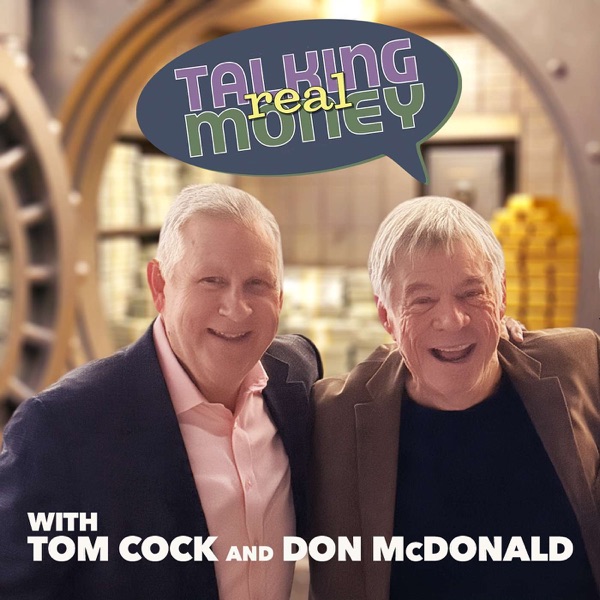
Talking Real Money - Investing Talk
Financial talk radio veteran, Don McDonald and former host of Serious Money on PBS, Tom Cock, join forces to talk about real money issues. In each episode, they solve real money problems, dole out real investing (not speculating) advice, and really explain the financial issues that effect all of us. Plus, it's actually fun! Talking Real Money is a podcast designed to provide the real help we all need to enjoy a really great future. Call in with your questions anytime at 855-935-TALK (8255).
- Investing chart
- #65
- Episodes
- 2,013
- Releases
- Daily
- Typical length
- 33 min
- On air since
- 2018
- Latest episode
- 16 hours ago
Episodes
2,013 episodes, newest first
-
36 min
Ep. 2013: Betting Against Your Future
Show notes
A $50 sports bet can cost more than the money you lose today. Don and Tom explore why treating gambling as an investment can put decades of potential growth at risk—and why patient, low-cost, diversified investing offers a very different proposition. They discuss the pull of betting apps, the power of compounding, and the habits that make saving automatic.
Listener questions bring the conversation back to flexibility: How firmly should a retiree follow an investment policy statement during a market downturn? And can a family ease up on Roth contributions to buy a bigger home without derailing retirement? Plus, the hosts have a little fun with a supposedly groundbreaking retirement-withdrawal announcement.
01:19 The Financial Fysicist and 50 for 50 at 5
01:57 When sports betting becomes an investment strategy
06:30 The future cost of a $50 bet
09:32 Fees, automatic saving, and diversification
13:58 Retirement guardrails and market downturns
17:50 A bigger home versus Roth contributions
23:08 A familiar retirement-withdrawal breakthrough
26:35 Your questions and a portfolio review
29:28 Important disclosures -
34 min
Ep. 2012: The Price of Free
Episode 2012
Show notes
Financial products rarely come with a zero price tag—even when the salesperson insists that “the company pays.” Don and Tom unpack Rule 16 of Financial Physics, expose the hidden commissions and ongoing expenses behind that pitch, and compare a costly Nationwide target-date fund with a far cheaper Vanguard alternative. The real question is not whether you pay, but whether you know how much—and what service you receive in return.
Then a burned-out 53-year-old nurse asks whether a $1.4 million net worth is enough to leave full-time work. Don and Tom discuss the spending gap, Social Security, early access through substantially equal periodic payments, and why a personalized retirement plan matters. They also explain how BND can show a healthy SEC yield while its share price falls, and whether a small bond allocation belongs inside a Roth account.
00:45 Financial Physics and podcast fame
03:42 The big lie about investment fees
07:53 Comparing target-date fund costs
13:49 A foldable iPhone detour
18:14 Can Arlene retire early?
24:24 Understanding bond-fund yields
28:30 Returns, Roth accounts, and asset location -
20 min
Ep. 2011: Four Questions Before Halloween
Episode 2011
Show notes
On Halloween Eve, Don takes four listener questions about starting young, retiring early, managing risk, and making the most of Social Security. The costumes may be spooky, but the answers are practical.
First, he weighs whether an 18-year-old without earned income should keep an Acorns account or move to a taxable brokerage account. Then he explains why someone retiring before 59½ may still benefit from pre-tax workplace contributions, with Rule 72(t) and Roth basis providing potential bridges.
Don also looks at how much investment risk makes sense when pensions and Social Security already cover most spending, and why delaying Social Security can be more valuable than reaching for income from a 10-year Treasury—especially for the surviving spouse.
01:00 Halloween Eve and today’s questions
03:58 Investing accounts for young adults
06:24 Taxable brokerage versus tax-deferred savings
09:05 Portfolio risk and when to claim Social Security
13:29 Treasuries versus delaying Social Security -
35 min
Ep. 2010: The Market Timing Mirage
Episode 2010
Show notes
Market timing always looks easy in hindsight: just miss the 30 worst days. The catch is that the market’s best and worst days cluster together, so getting out means risking the rebound. Don and Tom unpack the seductive math, the impossible two-part prediction, and why diversified buy-and-hold investing remains the boring answer that actually works.
A 73-year-old widow asks what to do after an insurance agent who sold her two EquiTrust annuities calls with another idea. Don and Tom question whether the proposed withdrawals could lead to another commission-paying sale, and examine the conflicts behind the recommendation. They explain why her pension, Social Security, and Vanguard portfolio already cover her needs—and why ending the relationship may be the cleanest move.
They also tackle traditional versus Roth contributions in a municipal 457 plan, including the Roth catch-up rule for higher earners, then examine America’s latest passive-income obsession: laundromats. The conclusion is simple—whether it’s real estate, washing machines, or markets, there is no wealth without work or risk.
01:15 AI jingle and prog-rock memories
03:10 The fantasy of missing the market’s worst days
11:23 Famous market timers and bad forecasts
16:31 Listener questions
17:03 The annuity agent calls again
24:11 Traditional versus Roth 457 contributions
28:34 The laundromat passive-income boom -
37 min
Ep. 2009: Finding Your Fiduciary
Episode 2009
Show notes
Finding an advisor means looking beyond the word “fiduciary.” Don and Tom explore what it takes to find someone who puts your interests first all the time, why experience and a team matter, and what an ongoing fee should buy beyond portfolio management. They also discuss the challenge of handing over the financial reins—and making sure your spouse has someone to call.
Listener questions tackle adding bonds before a career change, the tax tradeoffs of bonds in a brokerage account, why retirement accounts are not an emergency fund, and how to evaluate Roth conversions when spouses have different retirement timelines.
01:04 Finding a fiduciary who always puts you first
02:08 Why a do-it-yourself investor hired an advisor
05:03 Minimums, experience, and a backup team
07:47 Financial planning beyond the portfolio
09:14 What advisory fees should buy
14:12 Letting go of the financial reins
17:10 Keeping personal biases out of investment decisions
19:44 Adding bonds before a career change
22:47 Bond interest and taxable accounts
26:13 Emergency savings belong outside retirement accounts
29:31 Roth conversions and two retirement timelines
35:17 Disclosures -
36 min
Ep. 2008: The Bond Tango
Episode 2008
Show notes
Rising interest rates can make bond prices fall—and still be good news for savers. Don and Tom explain the bond-price mechanics, why higher yields matter, and why bonds belong in a portfolio for stability rather than excitement.
They compare BND, money markets, and bond ladders, then explain how rebalancing and holding high-quality bonds to maturity can quiet the noise. Listener questions cover why money markets alone aren't enough and a blunt review of the costly, illiquid Ares Core Infrastructure Fund pitched to an 85-year-old investor.
Plus, Talking Real Money celebrates crossing 2,000 episodes and asks listeners to follow and rate the show.
01:05 The Bond Tango: rates and bond prices
08:50 Why bonds stabilize a portfolio
16:35 BND vs. money markets and bond ladders
19:23 An unsuitable private infrastructure pitch
27:02 Celebrating 2,000 episodes
31:57 Supporting TRM and Don's story podcasts -
37 min
Ep. 2007: Follow the Money
Episode 2007
Show notes
Financial Physics Rule 15 says to follow the money. Don and Tom explain why an advisor's compensation still matters, how commissions and fee-based arrangements can muddy the picture, and why transparent fee-only advice and peer-reviewed evidence remain the better starting points.
Listener questions cover choosing broad, low-cost bond ETFs without panicking over tiny short-term moves, a correction to the S&P 500's streak of double-digit gains, and why Roth conversions should be evaluated year by year instead of treated as automatic.
Plus, Don detours into The Economist's look at Celebration, Florida—and discovers that Halloween trick-or-treating is really just another return-on-investment calculation.
01:00 Financial Physics Rule 15: Follow the Money
06:47 Fee-only vs. fee-based advice
16:34 Choosing bond ETFs amid rate fears
20:10 Correcting the S&P 500 streak
23:43 Roth conversions are not automatic
28:08 The town Disney built and Halloween ROI -
24 min
Ep. 2006: Five Questions, No Magic Answers
Episode 2006
Show notes
Don takes five listener questions with no magic tricks required: how simple a young investor’s Roth IRA can be, whether socialist economies have stock markets, and what rising U.S. debt really means for Treasury investors and the dollar.
He explains why a globally diversified fund can do most of the heavy lifting, why modern economies are hybrids rather than neat ideological labels, and how stocks, TIPS, and global diversification can help with inflation risk—without pretending there is a perfect hedge against a true dollar collapse.
Then Don tackles the hard math of creating retirement income for a recently widowed friend, including survivor benefits, immediate annuities, and a reverse mortgage, before closing with how target-maturity corporate bond ETFs can form a rolling ladder.
00:00 Friday Q&A and a Frightly October
02:46 A simple Roth IRA portfolio
04:44 Do socialist economies have stock markets?
07:43 Treasury debt, inflation, and dollar risk
13:28 Retirement income after losing a spouse
17:39 Rolling a target-maturity bond ladder
19:49 The Financial Fysicist and listener questions
22:01 Disclosures -
30 min
Ep. 2005: The Habanero Portfolio
Episode 2005
Show notes
0:43 Don and Tom turn up the heat on factor investing: why small, value, and profitable companies have historically earned higher returns, why tracking error can be brutal, and why a modest tilt may be easier to live with than a portfolio built entirely around factors.
12:20 A listener’s 457(b) includes a non-U.S. value fund holding roughly 45% cash. The hosts explain why that unusually high cash position, active management, and higher expenses make the simpler international index option more appealing.
17:47 Should a bond mutual fund inside an IRA be converted to its new ETF version? Then at 20:49, they weigh Schwab’s stock-lending program, including income potential, collateral, taxes, and the small but real tail risk when markets seize up.
-
33 min
Ep. 2004: The Annuity Rules Keep Changing
Episode 2004
Show notes
Indexed annuities promise market-like gains without market losses—but Don and Tom explain how commissions, surrender charges, spreads, participation rates, and even changing contract terms can leave investors with disappointing returns and very little transparency.
They also discuss how much cash belongs in a retirement “reservoir,” why falling bond prices do not make high-quality bonds riskier than stocks, and how MYGA tax deferral works through a 1035 exchange.
01:31 Musical royalties and an annuity joke
02:26 Why indexed-annuity sales keep soaring
05:52 When the insurer changes the rules
11:32 Investments Don would avoid
14:41 Designing a retirement cash reservoir
22:05 Why bond-fund prices have fallen
26:22 Extending MYGA tax deferral
29:34 Free portfolio analysis
31:51 Disclosures -
33 min
Ep. 2003: Seven Styles, One Portfolio
Episode 2003
Show notes
Don and Tom dismantle the idea that investors need to choose one narrow “style.” Growth, value, small companies, momentum, and passive investing are ingredients—not competing identities—and the sensible answer is a globally diversified, low-cost portfolio built to work together.
They also answer questions about arranging stocks and bonds across a Roth and rollover IRA, helping a late-starting saver use a 403(b) and Roth IRA, and whether a 30-year Treasury yielding more than 5% is really a safe long-term retirement plan.
00:00 Sauce, songs, and financial simplicity
02:11 Seven supposed investing styles
07:45 Why diversification is the real strategy
11:53 Investor behavior and smarter portfolios
13:36 Building a 50/50 retirement allocation
15:52 Starting retirement savings at 46
20:37 The appeal—and danger—of a 30-year Treasury
25:07 Nashville, time warps, and episode-number confusion
31:54 Disclosures -
30 min
Ep. 2002: The Buggy Whip Theory
Episode 2002
Show notes
The “Buggy Whip Theory” is a reminder that even when investors correctly see the future coming, they rarely know which company—or which part of a new industry—will actually win. Don and Tom trace the lesson from ice delivery and buggy whips to streaming, airlines, and artificial intelligence.
They also explain why rebalancing is portfolio maintenance rather than market timing, what falling municipal-bond prices really mean, and how to calculate international exposure as a percentage of the stock portion of a portfolio.
00:58 The Monday financial-physics edition
02:28 The Buggy Whip Theory
06:22 Ice companies, refrigerators, and 7-Eleven
07:21 Seeing the future still doesn’t identify the winner
09:42 Artificial intelligence and the Nvidia surprise
11:11 Diversification beats prediction and FOMO
14:34 Rebalancing versus market timing
16:26 Evaluating Vanguard’s municipal-bond ETF
21:24 How much international stock exposure?
23:36 Podcast diversification and the follow button
27:57 Disclosures -
29 min
Ep. 2001: A New Millennium of Money Questions
Episode 2001
Show notes
Episode 2001 begins a new millennium of money questions—with Don sorting out the numbering before tackling inherited IRAs, CD ladders, Roth conversions, workplace retirement plans, Warren Buffett’s famously simple portfolio advice, and capital-gains harvesting for children.
The common thread is simplicity with enough diversification and tax planning to avoid expensive surprises.
01:07 Welcome to Episode 2001
04:27 Simplifying inherited IRAs
09:13 Building an automatic CD ladder
11:46 Roth conversions, legacy, and charity
16:07 Reviewing a LifePath 2045 portfolio
18:18 Is Buffett’s 90/10 portfolio too simple?
23:14 Capital-gains harvesting for children
26:40 Wrap-up
27:55 Disclosures -
34 min
Ep. 2000: Bonds Are Doing Their Job
Episode 2000
Show notes
Bond prices are falling as yields rise—and that does not mean diversification has failed. Don and Tom explain why high-quality bonds can decline when stocks and the economy are strong, why that behavior is normal, and why chasing high-yield or “alternative” bond funds can quietly turn the conservative side of a portfolio into more stock-market risk.
They also answer questions about Roth conversions after required minimum distributions have begun, whether conversion taxes should ever come from retirement assets, and whether buying an annuity for a child makes sense compared with a Roth IRA or 529 plan.
00:00 Nashville-style intro
02:16 Why bond prices are falling
04:02 Comparing BND, municipal, Treasury, and high-yield funds
05:40 What a balanced portfolio is supposed to do
07:17 The hidden risk in “better-performing” bond funds
11:47 Stocks for growth, bonds for cushion
14:19 Roth conversions after RMDs begin
22:28 Listener questions
24:16 Paying Roth-conversion taxes
26:46 An annuity for a child?
31:46 Wrap-up
32:37 DisclosuresQuestions? Comments? Click the microphone at TalkingRealMoney.com.
-
30 min
Ep. 1999: IRA Mistakes You Can’t Undo
Episode 1999
Show notes
Some IRA mistakes cannot simply be reversed. Don and Tom explain the traps around non-spouse beneficiary transfers, the one-rollover-per-year rule, 72(t) plans, the same-property rollover rule, outdated beneficiaries, qualified charitable distributions, missed RMDs, and portfolio drift.
Then Mike from Salt Lake City asks how aggressively he should convert a traditional IRA to Roth before Social Security and future inherited assets change the tax picture. Don and Tom discuss bracket management, paying conversion taxes from taxable savings, QCDs, inherited pretax accounts, and rerunning the plan every year.
They also answer whether costs matter in 529 and UTMA accounts and review a globally diversified retirement portfolio approaching withdrawals.
00:00 Dixieland intro
01:28 IRA mistakes you can’t undo
03:00 Non-spouse beneficiary transfers
04:50 The one-rollover-per-year rule
05:45 Altering a 72(t) plan
07:43 The same-property rollover rule
10:56 Beneficiaries, QCDs, RMDs, and portfolio drift
16:20 Roth-conversion strategy
22:42 Listener questions
23:44 529 and UTMA expenses
24:40 Reviewing a retirement portfolio
27:43 Wrap-up
28:47 DisclosuresQuestions? Comments? Click the microphone at TalkingRealMoney.com.
-
34 min
Ep. 1998: The S&P 500 or the Whole World?
Episode 1998
Show notes
Don and Tom compare the S&P 500 with total-market and globally diversified investing, explain the danger of home bias, and show why owning more of the world can reduce concentration risk. Then they answer questions about Roth conversions, bond-fund losses, CD ladders, and matching a risk score to a stock-bond allocation.
00:00 Oktoberfest musical intro
01:23 S&P 500 versus the whole market
04:18 Why global diversification matters
09:07 Home bias around the world
13:11 A lost decade for the S&P 500
15:46 Three questions about diversification
16:59 Roth-conversion strategy
23:31 Bond funds versus individual bonds
27:37 CD ladders and reinvestment risk
29:55 Risk scores and stock-bond allocation
32:53 Wrap-up and disclosuresQuestions? Comments? Click the microphone at TalkingRealMoney.com.
-
29 min
Ep. 1997: The Lemmings Didn’t Jump
Episode 1997
Show notes
Don and Tom use Disney’s infamous lemming myth to explain investor herd behavior, recency bias, and the danger of chasing whatever has recently been hot. Then they answer questions about simplifying a diversified portfolio, evaluating a long-held annuity, and why “Bank on Yourself” whole-life strategies create more problems than they solve.
00:00 The lemming film clip
00:56 The lemmings didn’t jump
02:21 The lemming corollary
04:38 Herd behavior in tech, crypto, and markets
07:58 When the crowd is wise—and when it isn’t
12:48 Listener questions begin
13:16 Simplifying a diversified portfolio
16:32 Should she keep the annuity?
20:40 The problems with “Bank on Yourself”
25:58 Wrap-up
27:11 DisclosuresQuestions? Comments? Click the microphone at TalkingRealMoney.com.
-
29 min
Ep. 1996: Growth, Value, and When to Retire
Episode 1996
Show notes
Don tackles listener questions about growth versus value stocks, choosing the right time to retire, Medicaid and estate-planning concerns, the problems with infinite-banking whole-life policies, when annuities may make sense, and how mutual-fund distributions affect share prices.
00:00 Zeuhll musical intro
01:08 Friday Q&A begins
03:51 Growth stocks versus value stocks
07:43 Choosing the right month to retire
11:29 A parent’s home, Medicaid, and estate planning
14:52 Infinite banking and whole-life insurance
17:59 When annuities may make sense
22:56 Mutual-fund capital-gains distributions
26:34 Wrap-upQuestions? Comments? Click the microphone at TalkingRealMoney.com.
-
34 min
Ep. 1995: The Homeownership Trade-Off
Episode 1995
Show notes
Is a home always a great investment? Don and Tom compare buying with renting, explain why leverage can make home returns look better than they are, and lay out when owning makes sense. Then they answer listener questions about one-fund versus multi-fund portfolios, disciplined rebalancing, and whether delaying Social Security still pays when a spouse is waiting for a benefit increase.
0:34 The American dream of homeownership
3:42 Home returns versus stocks
8:01 When buying beats renting
11:35 Buying and selling in a high-rate market
15:06 Listener questions
16:19 One global fund or several ETFs?
23:32 Building and rebalancing a multi-fund portfolio
26:42 Social Security timing for couples -
38 min
Ep. 1994: The $31,000 Advice Bill
Episode 1994
Show notes
Don and Tom unpack what financial advice should cost after a retired couple discovers they’re paying $31,000 a year. They compare fee-only, fee-based, and commission models, explain how hidden fund expenses compound the damage, and show why every advisor should disclose the full all-in cost.
Listener questions cover the Avantis balanced fund, building retirement income from a total-return portfolio, and where bonds belong across taxable and retirement accounts.
They also compare qualified charitable distributions, donor-advised funds, and charitable gift annuities—and explain why complexity and guarantees can hide expensive tradeoffs.
0:41 Cajun opening
2:50 What financial advice should cost
8:03 Do you actually need an advisor?
11:11 Hidden fund fees and commissions
16:31 Listener questions
18:04 The Avantis balanced-fund correction
19:30 Building retirement income
22:23 QCDs, donor-advised funds, and charitable gift annuities
29:17 A musical warning about bad advice
On these lists
Talking Real Money - Investing Talk is one of the shows picked out on this list


More in How To
Placed highest on Apple Podcasts' How To chart right now